
A complete issue · 16 pages · 1887
Judge — August 27, 1887
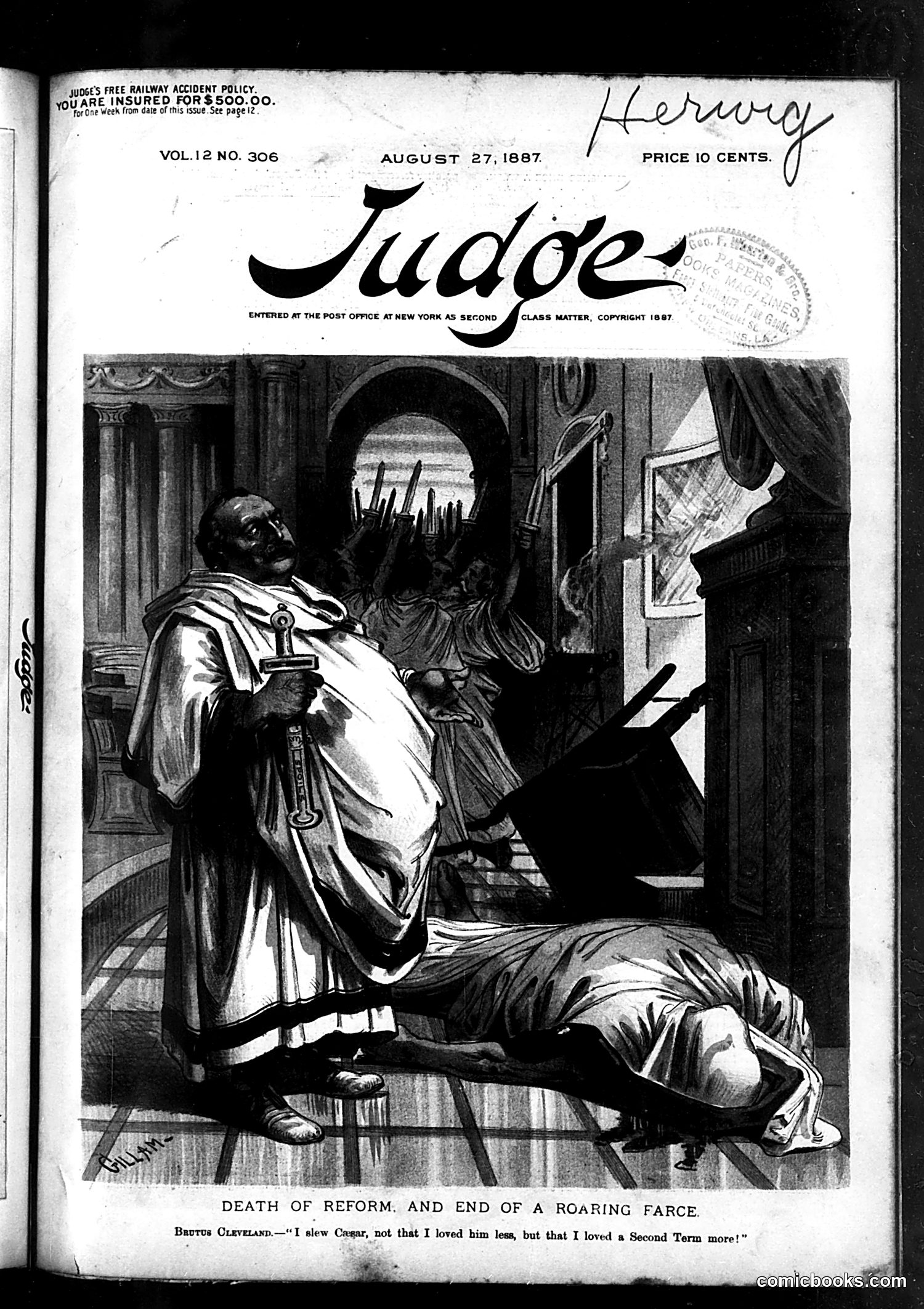
This August 27, 1887 *Judge* cartoon satirizes the failure of reform efforts, likely during the Cleveland administration (referenced in the caption quote about "Second Term"). The central figure appears to be a clergy member or reform advocate in white robes, standing over a prone body—representing reform itself "dead." The architectural setting suggests an official building, possibly a courthouse or government chamber. The cartoon's message: reform movements that initially seemed vigorous have collapsed into futility. The "roaring farce" likely refers to political theater surrounding reform promises that proved hollow in practice. Without more specific historical context about 1887 reform debates, the exact target remains unclear, though the image powerfully depicts disillusionment with reform's effectiveness.
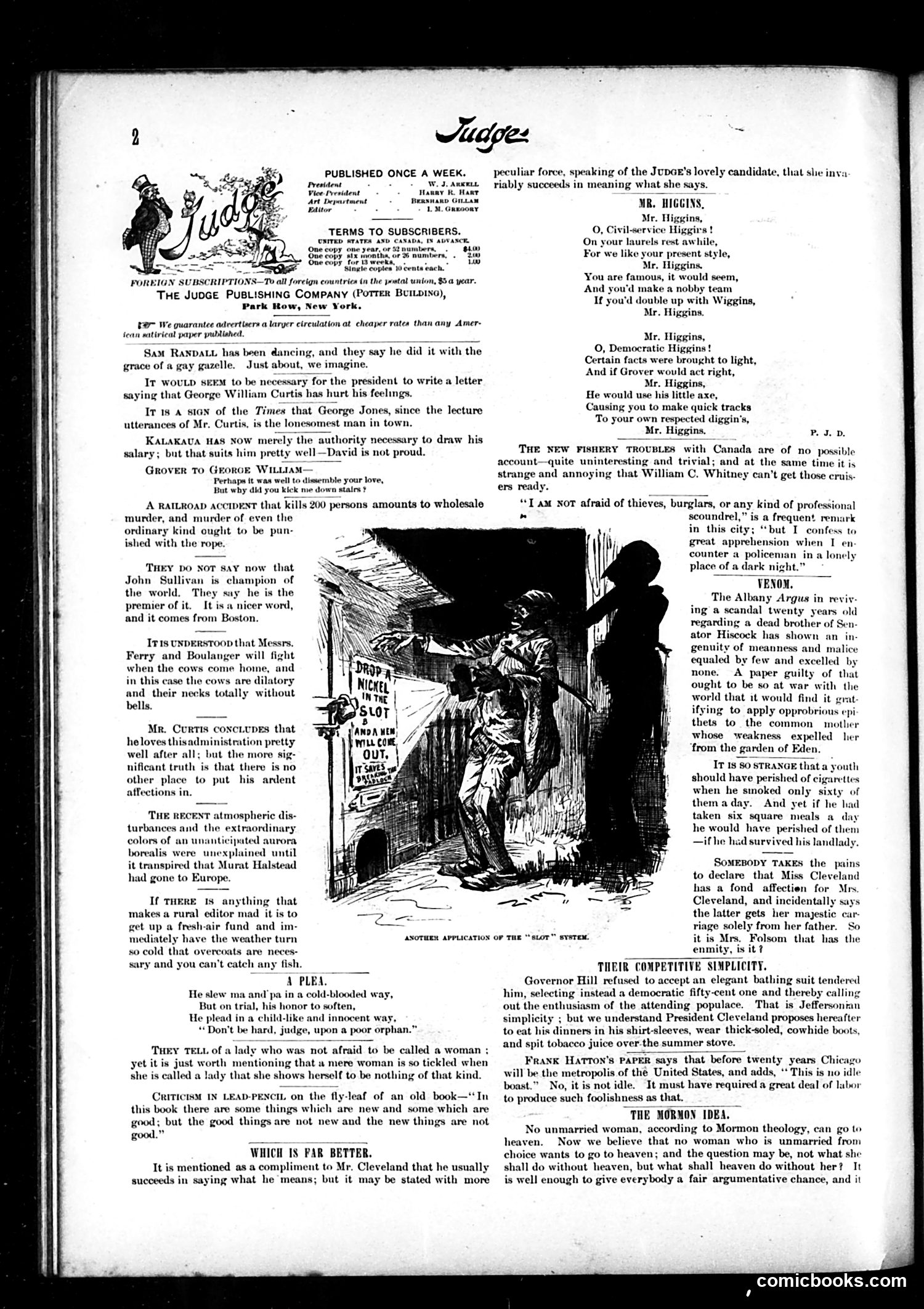
The central cartoon, titled "Another Application of the 'Mott' System," depicts a figure at a door labeled with what appears to be tenement housing signage. The satire targets housing conditions and likely references a contemporary urban housing reform debate or specific "Mott" system being discussed. The page contains numerous brief satirical commentary pieces criticizing various figures: George William Curtis (apparently hurt feelings), John L. Sullivan (boxing champion), and references to administrative or political figures. One piece mocks George Jones of the Times newspaper. The overall tone targets late 19th-century political and social figures through short, sharp witticisms typical of Judge's satirical style. Without clearer identification of specific dates and figures, the precise political context remains partially unclear, though the magazine clearly engaged contemporary governance and urban social issues.
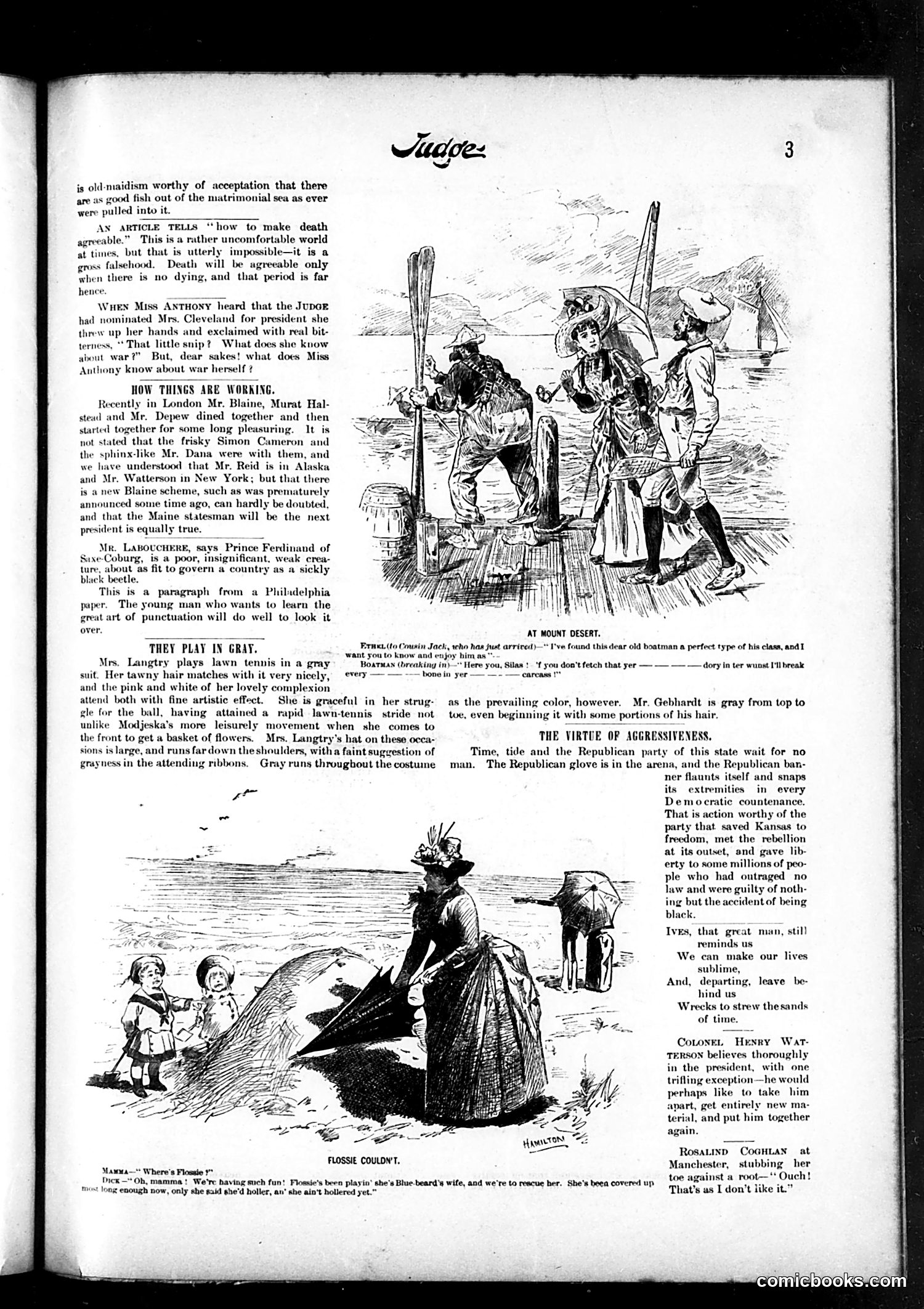
This page contains political commentary and social satire typical of late-19th-century American journalism. **Political Content:** The "How Things Are Working" section discusses James G. Blaine (Maine politician) allegedly planning another presidential bid through secret London meetings with associates. The satire mocks what the writer sees as inevitable Republican maneuvering. **Social Commentary:** The "Virtue of Aggressiveness" section praises Republican Party activism, specifically crediting Republicans with ending slavery and preserving the Union—standard GOP rhetoric of the era. **Celebrity/Entertainment:** "They Play in Gray" satirizes actress Lillie Langtry's lawn tennis fashion choices, noting how her gray outfit coordinates aesthetically with her appearance. **Cartoons:** Two illustrated scenes show everyday moments: one depicting people at Mount Desert (likely a vacation destination), another showing children playing a rescue game based on the Bluebeard fairy tale. The page reflects Judge's mix of partisan politics, high-society gossip, and genteel humor.
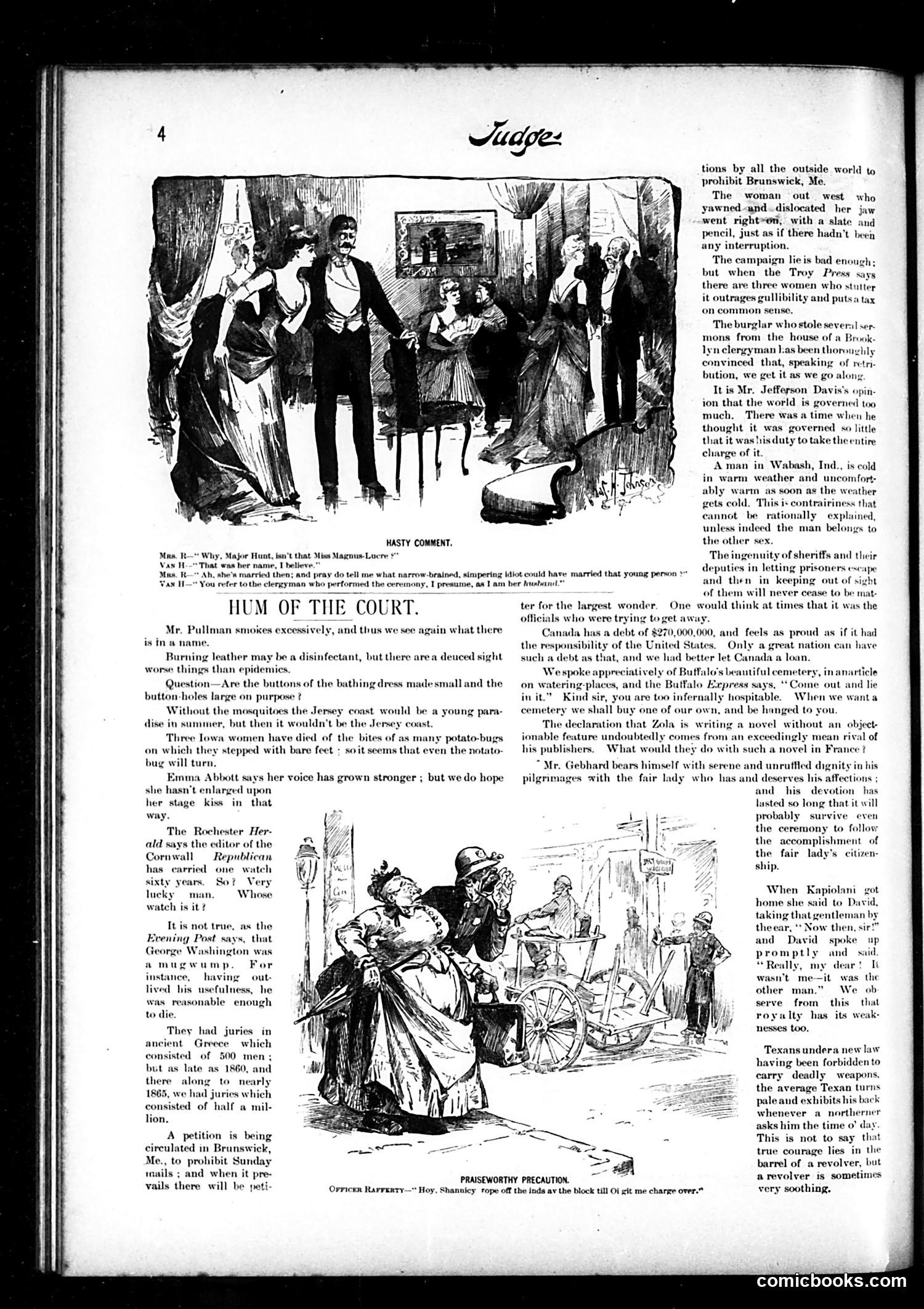
This page contains multiple brief satirical items typical of Judge magazine's format. The main cartoons and commentary mock various subjects: **"Hasty Comment"** appears to satirize a woman's marriage to a clergyman, with the joke hinging on calling him an "idiot" for marrying her. **"Hum of the Court"** section collects short satirical quips about contemporary issues: Mr. Pullman's excessive smoking, bathing dress design, mosquitoes on the Jersey coast, and Emma Abbott's theatrical kissing. **"Praiseworthy Precaution"** (bottom cartoon) depicts an officer preparing to execute someone, with the caption joking about proper procedure—likely satirizing bureaucratic red tape or Irish-American stereotypes common in period Judge illustrations. The scattered items reflect Judge's style: quick jabs at celebrities, public figures, social absurdities, and contemporary events. Without clearer context on specific names and dates visible in the degraded OCR, precise historical references are difficult to identify with certainty.
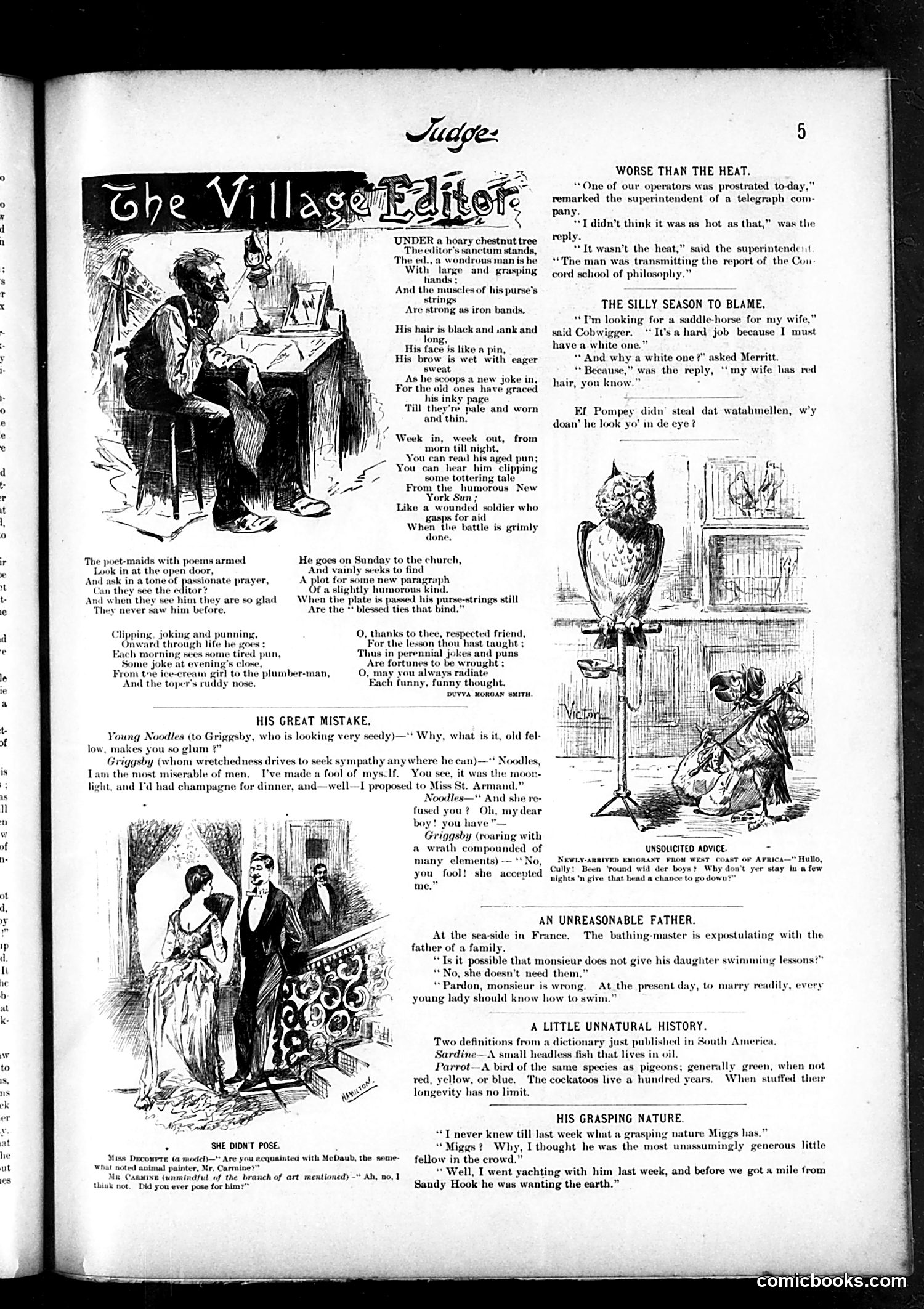
This page contains several unrelated humorous sketches typical of *Judge* magazine's format. **"The Village Editor"** (main cartoon): Depicts an editor as an exhausted, perpetually working figure who mines old jokes and material from other papers (particularly the New York Sun) to fill his publication. The satire mocks both the editor's relentless labor and the recycled, worn-out nature of his humor—jokes described as "pale and worn and thin." It's also a gentle jab at his stinginess (tight purse-strings at church). **"His Great Mistake"**: A young man named Noodles comforts Griggsby, assuming rejection caused his misery. The twist: Griggsby is devastated because his proposal *was accepted*—the satire being that marriage is worse than rejection. **Remaining items**: Brief joke sketches on mundane topics (telegraph operators, horse shopping, emigrant advice, swimming lessons, dictionary definitions), representing the typical "filler" humor of the period—none referencing specific political events or figures.
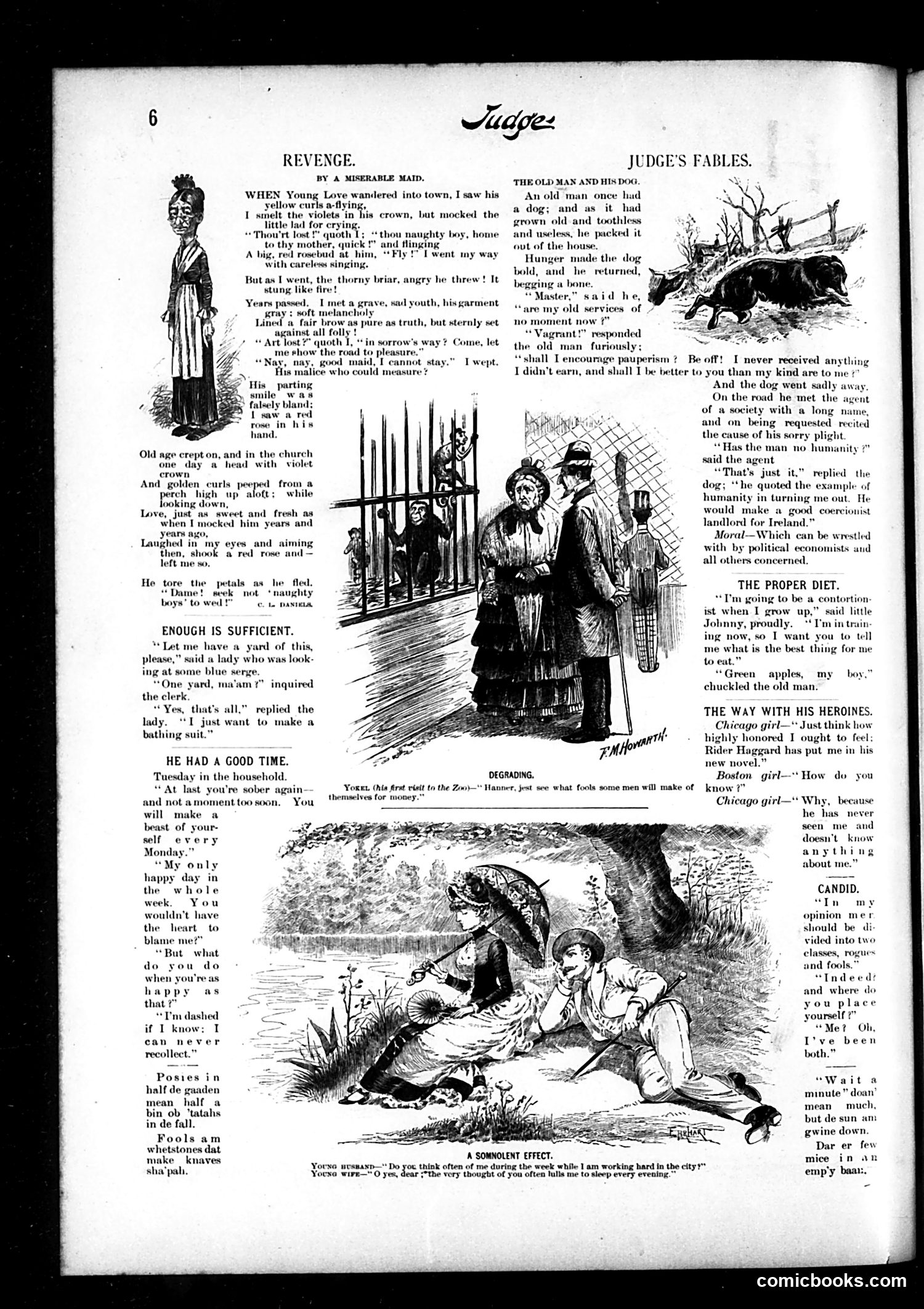
This page contains multiple short humor pieces typical of 1880s-90s Judge magazine: **"Revenge by a Miserable Maid"** — A narrative poem about a woman who mocked Cupid as a child; years later, an aged but still-beautiful Cupid returns to mock her in turn, plucking rose petals as he departs. The satire targets romantic sentimentality and the cyclical nature of love's cruelties. **"The Old Man and His Dog"** — Satirizes Social Darwinist arguments: an old man discards his useless dog, then uses "humanity" and "political economy" to justify the cruelty. The moral mocks callous Victorian economic philosophy applied to the poor. **"A Somnolent Effect"** — A joke about a bored wife whose husband's absence puts her to sleep—gentle domestic satire on loveless marriage. Other brief pieces mock romantic pretension, Irish landlord practices, and class pretension (Rider Haggard's heroines, Boston vs. Chicago attitudes). The illustrations are woodcuts typical of the period's satirical press.
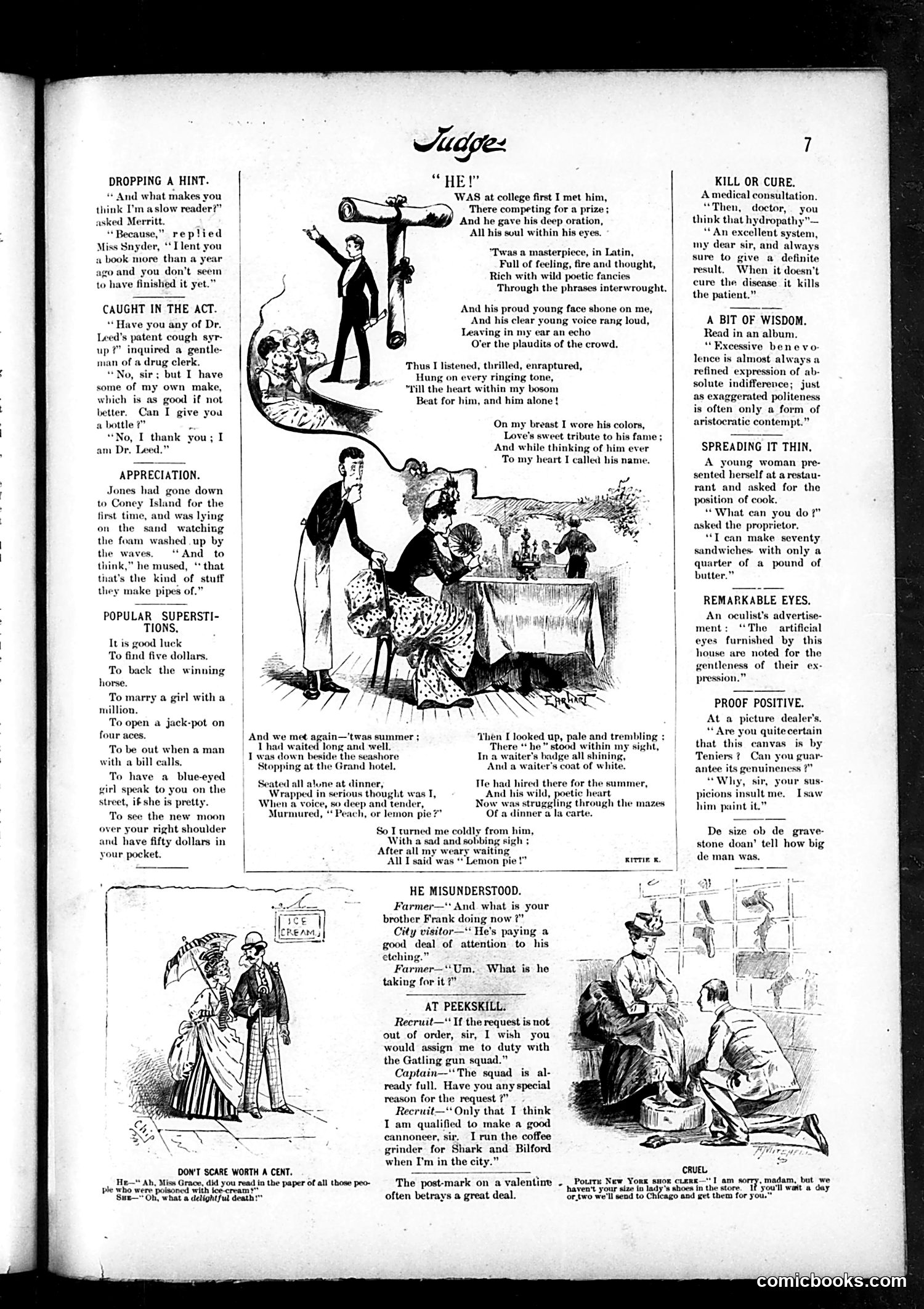
This page from Judge contains several short humorous items typical of late 19th-century American satire: **The main narrative poem "HE!"** recounts a woman's romantic disappointment: she fell in love with a brilliant, passionate college orator, only to later encounter him as a waiter at a seaside hotel—now reduced to reciting dinner options ("lemon pie"). The satire mocks the gap between youthful idealism and adult mundane reality, and perhaps critiques how economic circumstances could diminish formerly promising individuals. **Short jokes and quips** scattered throughout include wordplay about drug clerks, superstitions, and misunderstandings (a farmer confuses "etching" the art form with something profitable). **The illustrations** show Victorian-era scenes: social encounters, a military recruit, and domestic situations—all rendered in pen-and-ink style typical of the period. The overall tone reflects Judge's characteristic blend of gentle mockery of social pretension, romantic disillusionment, and everyday absurdities of Gilded Age America. No specific political figures or events are referenced on this page.
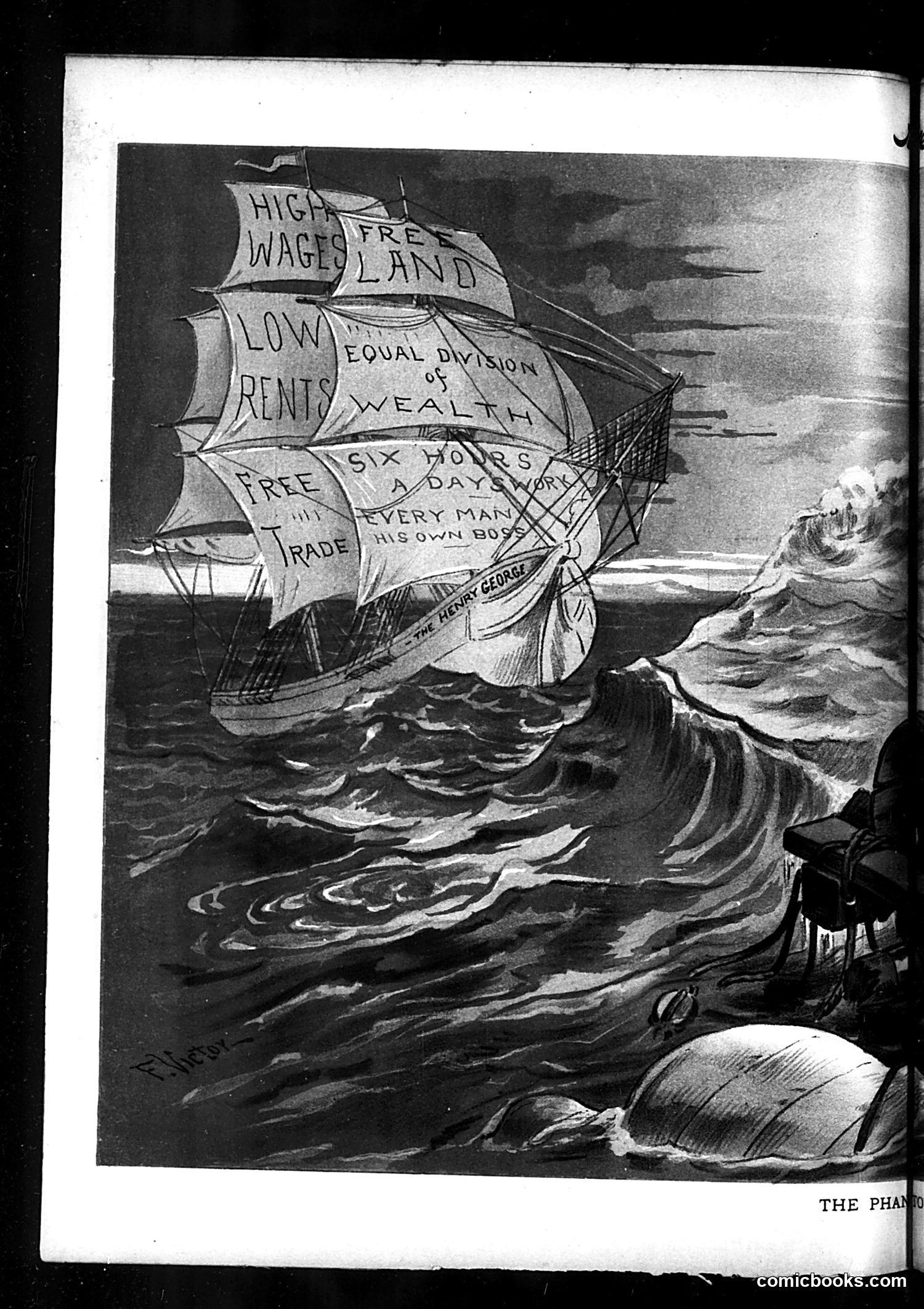
This is a satirical ship-of-state allegory from *Judge* magazine. The vessel's sails display reform demands of the era: "High Wages," "Free Land," "Low Rents," "Equal Division of Wealth," "Free Trade," "Six Hours a Day Work," and "Every Man His Own Boss." The ship navigates turbulent waters toward rocky shores, suggesting these populist and labor reform proposals—likely from the 1880s-1890s progressive movement—represent dangerous, unrealistic political courses that will wreck the nation's economy. The cartoon satirizes reformers' idealistic demands as naive fantasies that contradict practical economic reality. The rough seas and treacherous rocks symbolize the actual consequences the cartoonist predicts from implementing such radical changes. The artist's signature appears present but is difficult to read clearly.
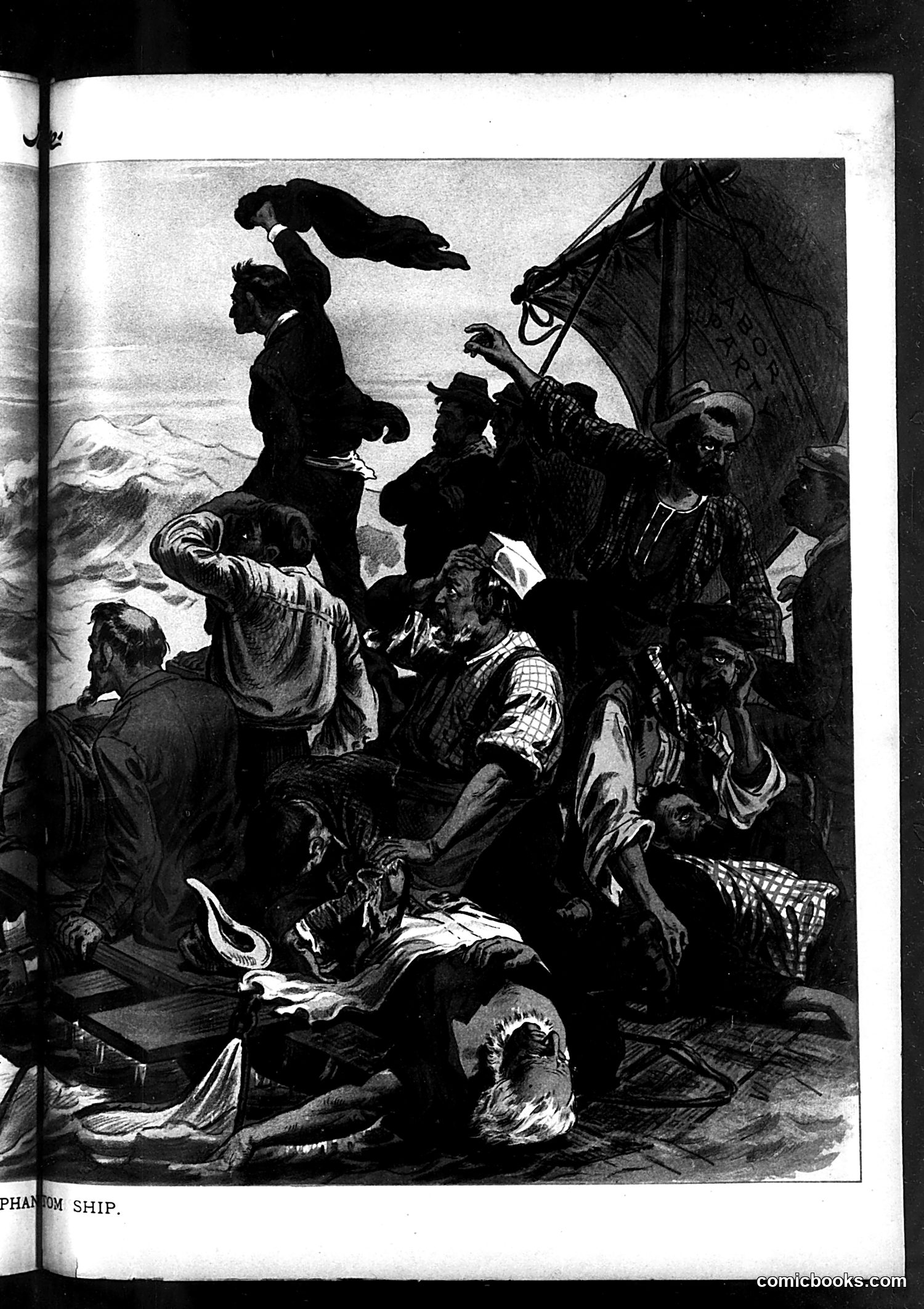
This dramatic engraving depicts a chaotic maritime scene labeled "Phantom Ship." The illustration shows sailors in distress aboard a vessel during rough seas, with figures gesturing dramatically and what appears to be a sail or supernatural element in the background. Without clearer OCR text or additional context, the specific satirical reference is unclear. However, "phantom ship" imagery was used in 19th-century satire to represent elusive or illusory political concepts—perhaps an administration's failed promises, a doomed venture, or impending disaster. The turbulent composition and desperate crew suggest commentary on political chaos or a ship of state in danger. Judge magazine typically employed such maritime metaphors for political critique, though the exact target remains ambiguous from this image alone.
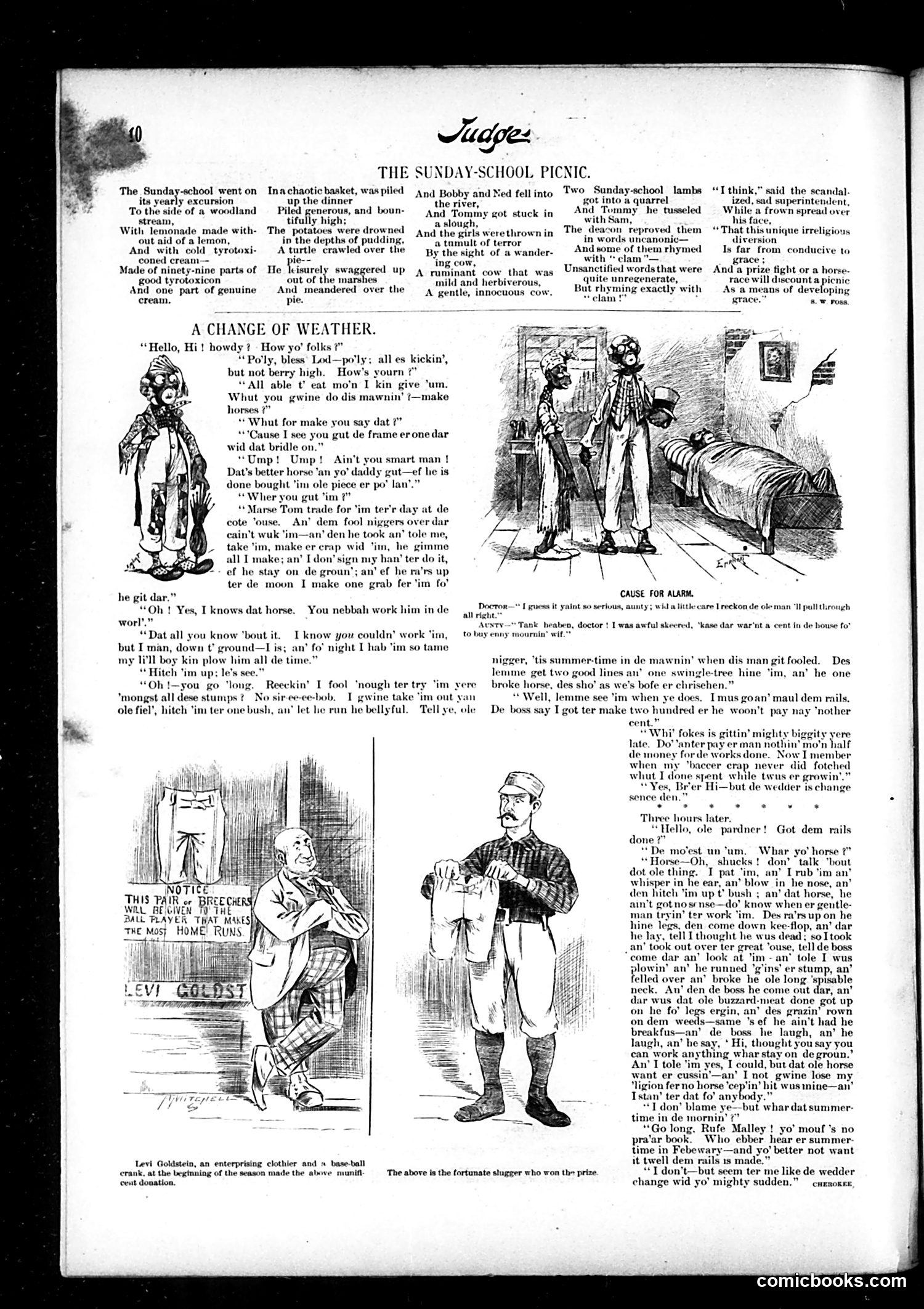
This page contains two distinct satirical pieces from Judge, likely late 19th century, both mocking American social pretensions: **"The Sunday-School Picnic"** ridicules the chaos of religious institutions' public outings, where children misbehave (fighting, quarreling, using profanity) despite supposed moral instruction. The deacon's disapproval highlights the gap between Sunday-school piety and actual behavior. **"A Change of Weather"** is a dialect-heavy dialogue between two Black men discussing a horse trade. It satirizes both rural poverty (one man has no money) and the stereotyping common in period humor—using exaggerated dialect and depicting African Americans as simple or foolish. The punchline involves the supposedly-broken horse miraculously surviving injury, mocking the men's poor judgment. Both pieces target hypocrisy: religious institutions failing morally, and rural/poor people's incompetence. The humor relies on period stereotypes and class-based mockery that modern readers would recognize as condescending.
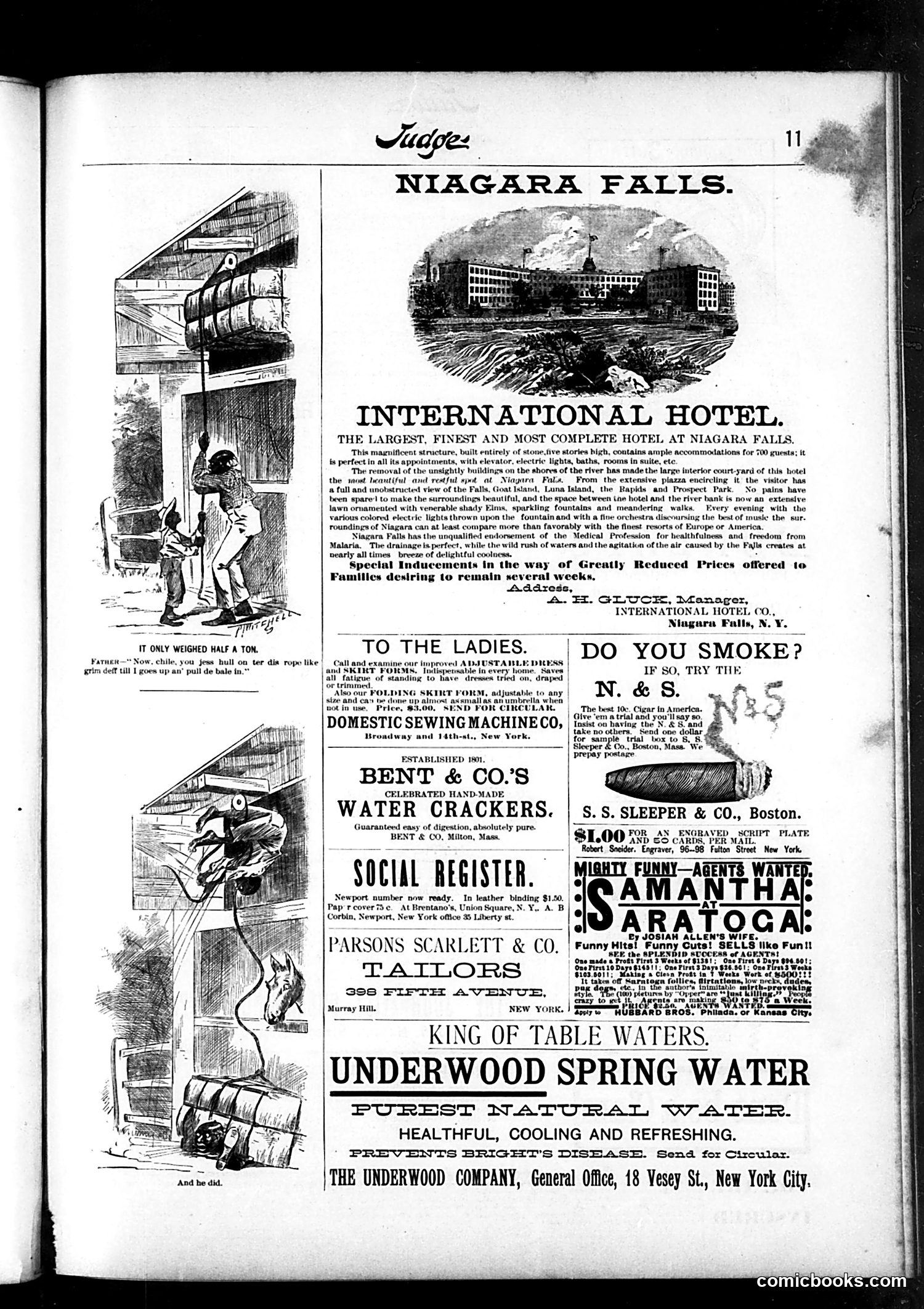
This page is primarily **advertising**, not political cartoon content. The only cartoon element appears in the left margin—a humorous sketch labeled "It Only Weighed Half a Ton" showing a farmer instructing someone to pull a rope, illustrating a dialectal joke about Southern rural life (the farmer's dialect suggests this era's comic stereotyping). The bulk of the page consists of advertisements for the International Hotel at Niagara Falls, plus promotions for various products: sewing machines, dress forms, cigars, water crackers, a "Social Register" directory, tailors, and mineral water. The "Samantha at Saratoga" ad (bottom right) references what appears to be a popular humorous book or play, likely aimed at middle-class readers. For modern readers, this mainly illustrates what *Judge* magazine actually was: a vehicle for advertisements targeting wealthy, urban American consumers, with lightweight humor mixed in.
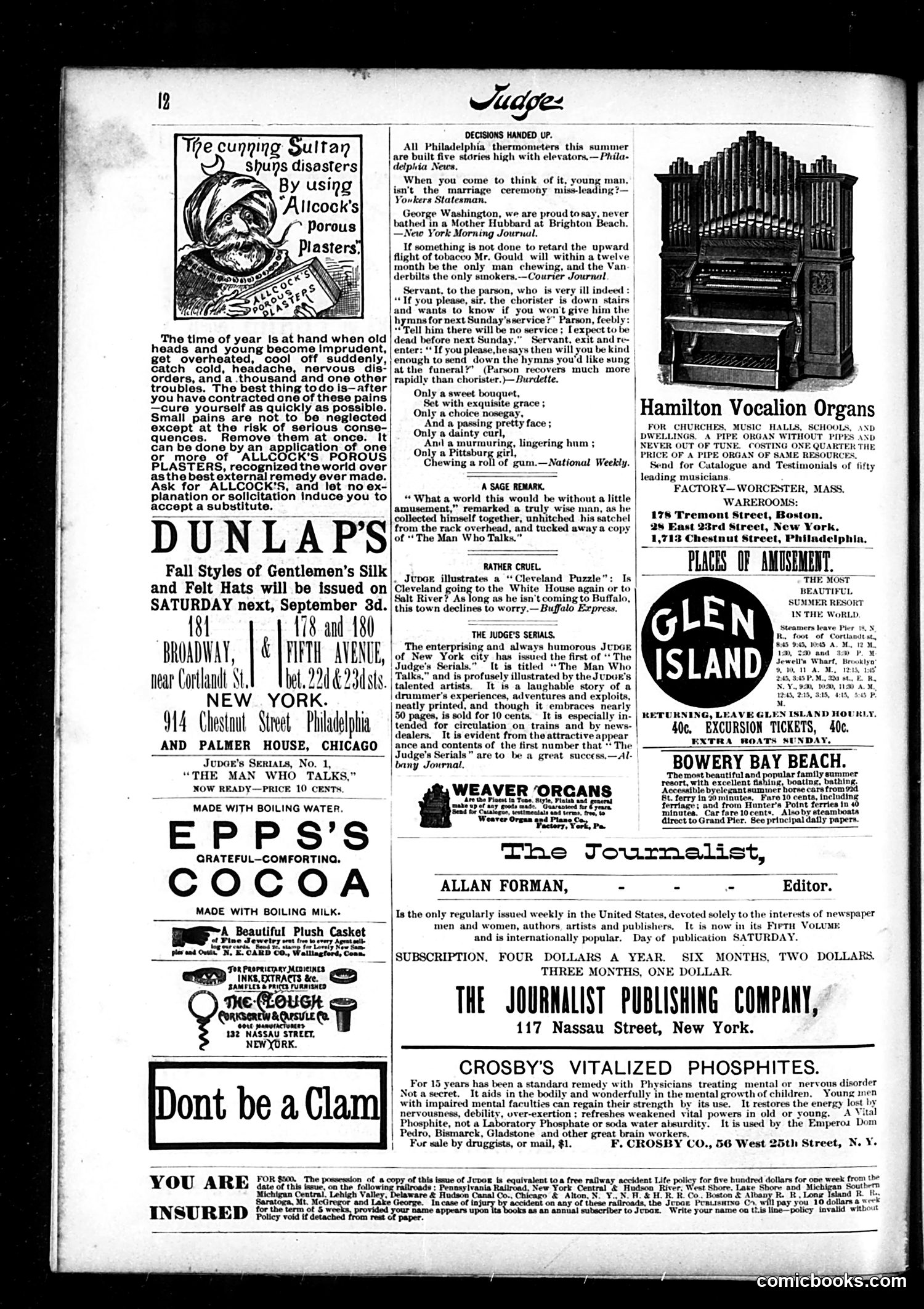
This page is primarily **advertising and editorial content** from Judge magazine, with minimal political satire. The main illustrated item is a small advertisement for **Allcock's Porous Plasters** (medicinal heat patches), featuring a caricatured face and promotional text about treating seasonal ailments. The bulk of the page contains: - **"Decisions Handed Up"**: Brief humorous observations attributed to various cities' newspapers, poking gentle fun at contemporary topics (Philadelphia's heat, marriage ceremonies, tobacco prices, clergy). These are mild social humor rather than sharp political satire. - Advertisements for **Dunlap's hats**, **Epps's cocoa**, Judge's serial publication "The Man Who Talks," and various other commercial products. - A brief notice promoting Judge magazine itself as devoted to newspaper industry interests. Rather than political cartooning, this appears to be a **typical late-19th-century magazine page** mixing light comedic observations with commercial advertisements—the standard format for such publications.
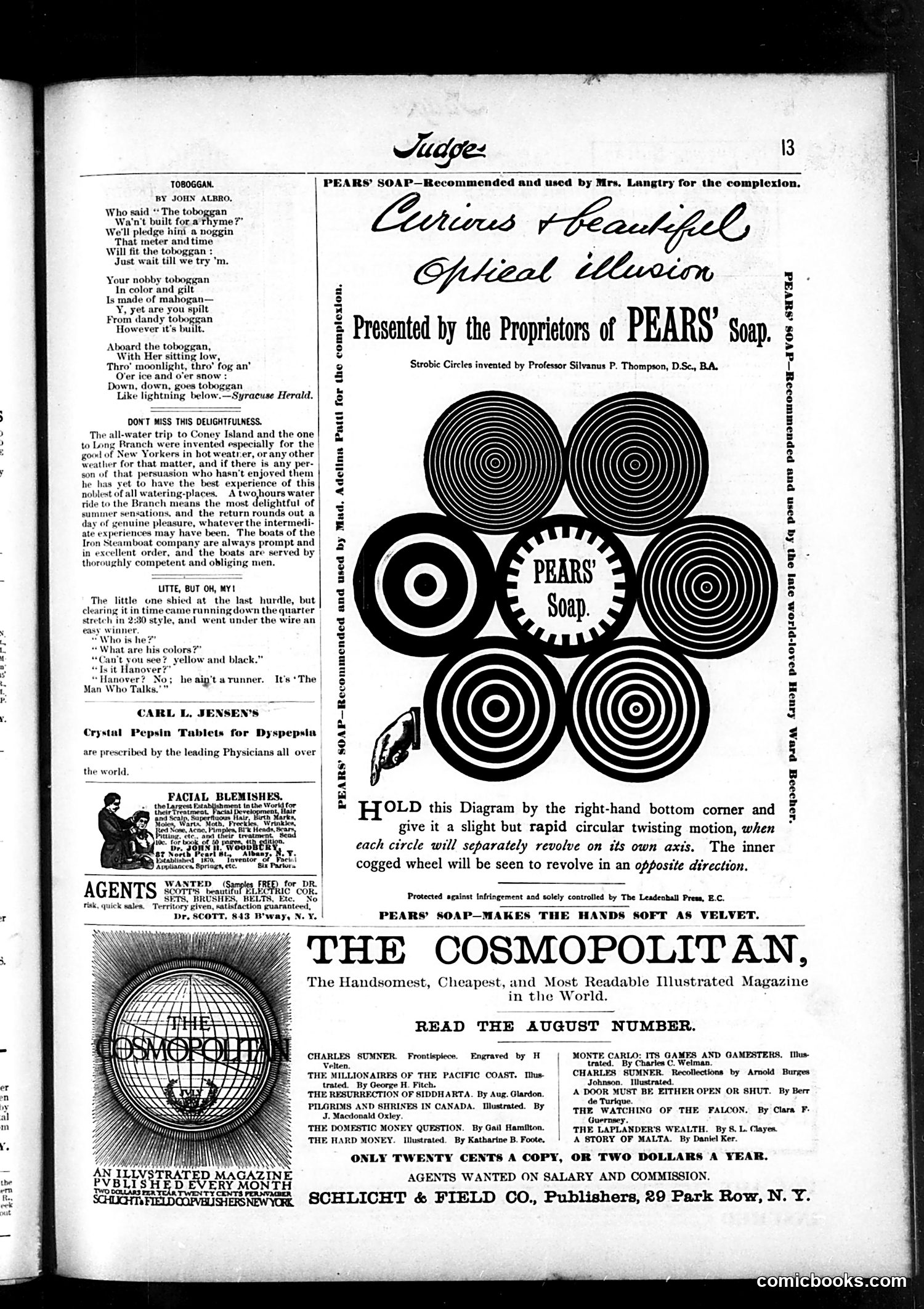
This page is primarily **advertising and promotional content**, not political satire. The main featured item is a **Pears' Soap advertisement** showcasing an optical illusion (strobic circles) designed by Professor Silvanus P. Thompson. The ad claims the soap was "recommended and used by Mrs. Langtry" (a famous actress of the era) for complexion improvement. The circular diagram with concentric rings was meant to create a motion effect when rotated—a common Victorian optical novelty. The page also includes a poem about tobogganing by John Albro, advertisements for Crystal Pepsin Tablets and other patent medicines, and promotions for *The Cosmopolitan* magazine and various agents/products. There is **no discernible political cartoon or satire** on this page. It represents typical late-19th-century magazine content: poetry, patent medicine ads, and beauty product endorsements leveraging celebrity names—standard advertising strategy of the period.
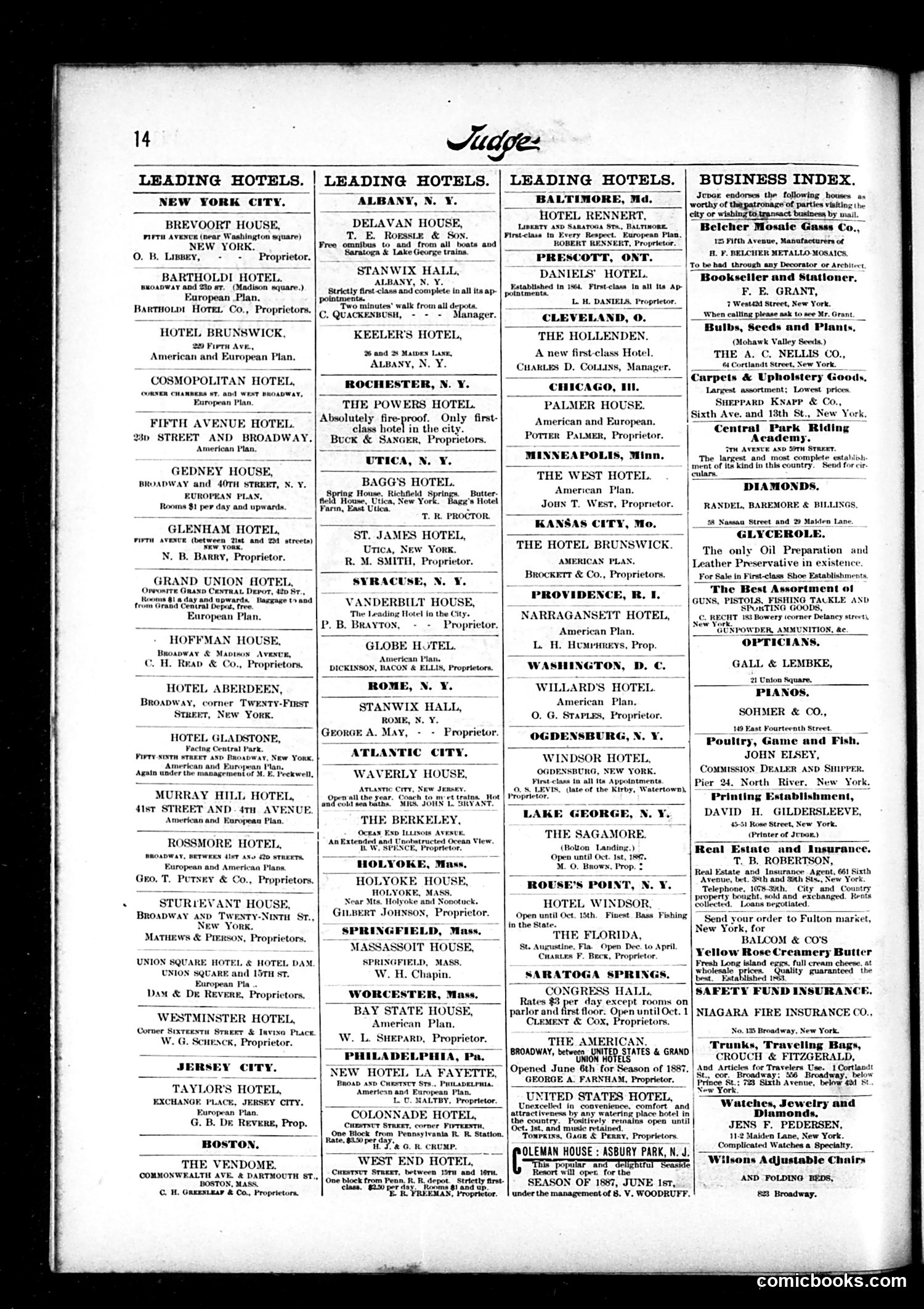
This page is primarily a **business directory** of leading hotels across major American cities (New York, Albany, Baltimore, Chicago, etc.) from the 1880s. There are no political cartoons or satirical illustrations visible. The page functions as advertising space, listing dozens of hotels with their proprietors, locations, and amenities. This was typical for Judge magazine—it subsidized editorial content through paid directory advertisements. **What's notable historically**: The emphasis on "American and European Plan" (room rates with or without meals) and amenities like fire-proofing reflects late-19th-century hotel standards. References to train depots and lake resorts show how transportation infrastructure shaped tourism. This is essentially a classified ads page, not satirical content. Judge contained both humor and practical business directories to fund its publication.
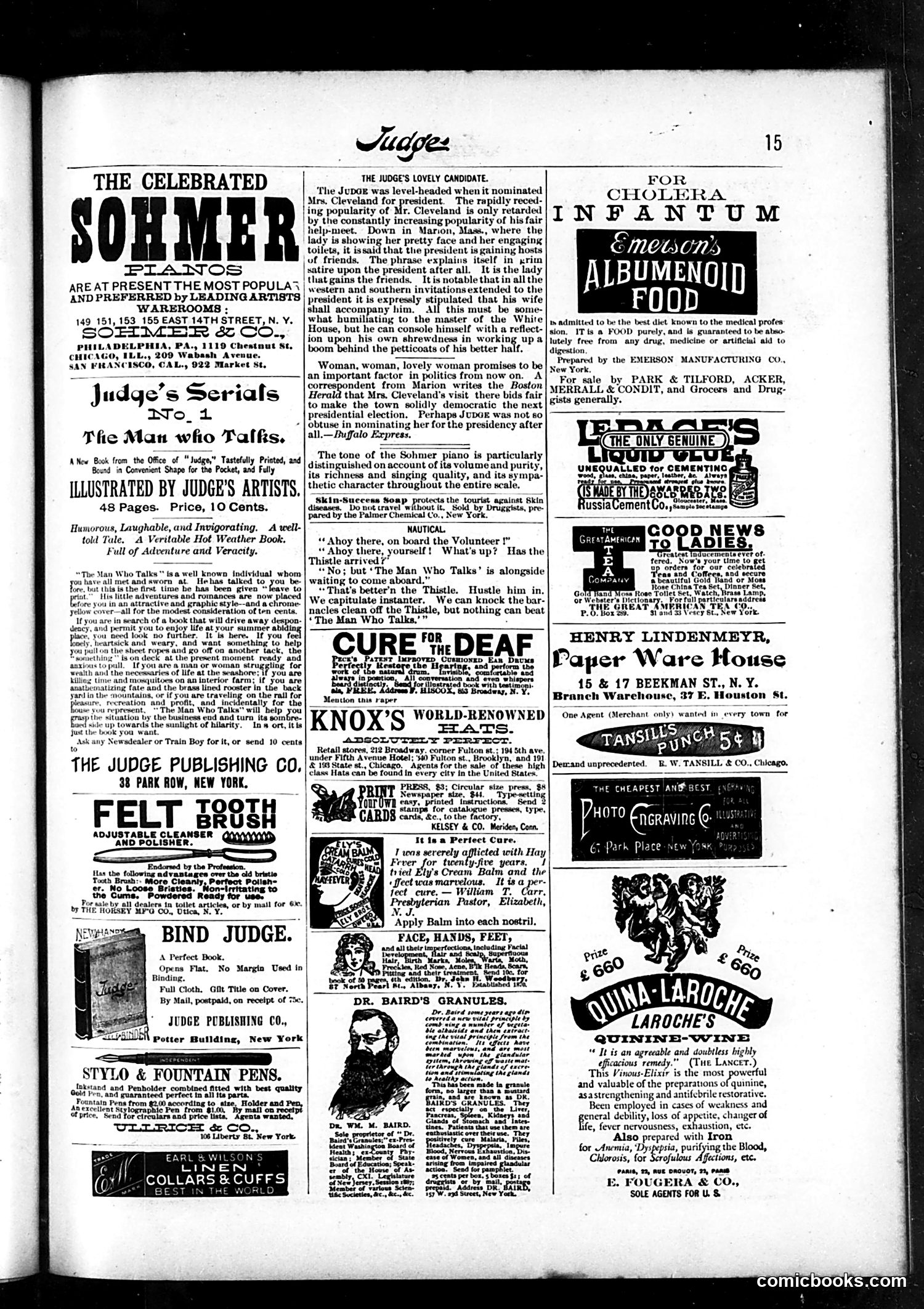
This page is primarily **advertising**, with one significant satirical article. The main political content is "The Judge's Lovely Candidate," which mocks President Grover Cleveland by suggesting his wife Frances should be nominated for president instead of him. The satire's point: Cleveland's popularity is declining while his wife's is rising. Wherever she appears (the article cites Marion, Massachusetts), people flock to see her, and political delegations specifically request her attendance alongside the president. The piece sarcastically suggests that *she*, not Cleveland, is winning supporters and could be the better candidate. The humor targets Cleveland's diminished political standing circa this period (likely 1880s) and plays on the notion that a woman—unusual for the era—might actually outshine a sitting president in public appeal. It's gendered satire that, while mocking Cleveland, also reflects contemporary attitudes about women's limited political roles. The rest of the page consists of advertisements for pianos, books, dental products, and other goods typical of the era.
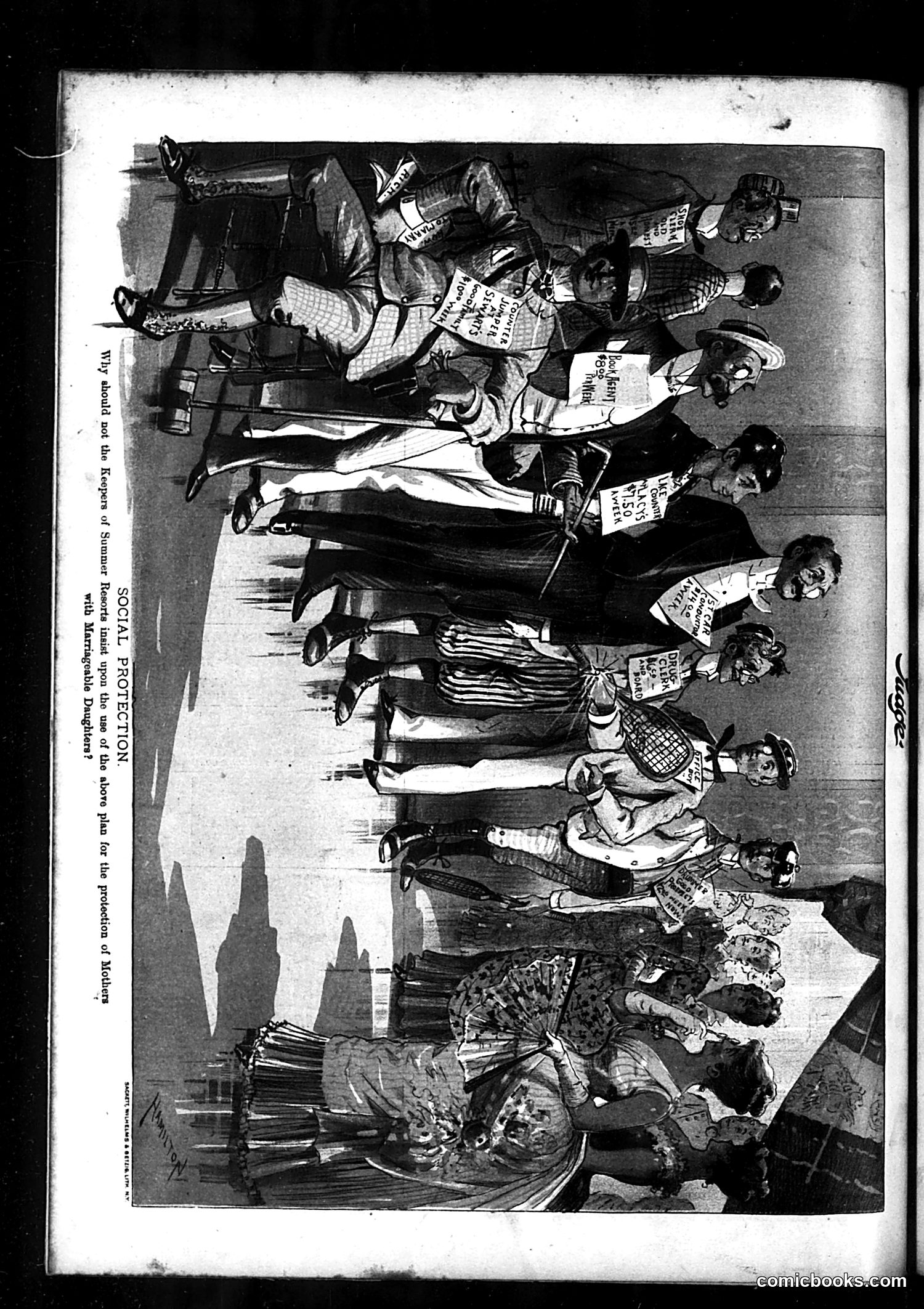
This satirical cartoon mocks Victorian-era anxieties about protecting young unmarried women at summer resorts. The image shows mothers with marriageable daughters literally enclosed in protective cages or barriers—a visual exaggeration of the era's strict chaperonage customs. The joke targets the excessive vigilance resort proprietors and parents employed to prevent unsuitable romantic encounters. By depicting the daughters as trapped in physical enclosures (rather than merely social restrictions), the cartoon ridicules how absurdly controlling these "protective" measures had become. The satire suggests that if resorts truly wanted to protect young women's marriageability and reputation, they'd need literal imprisonment—highlighting the inherent absurdity of attempting to control courtship through isolation rather than through actual social standards or education.