
A complete issue · 16 pages · 1887
Judge — July 30, 1887
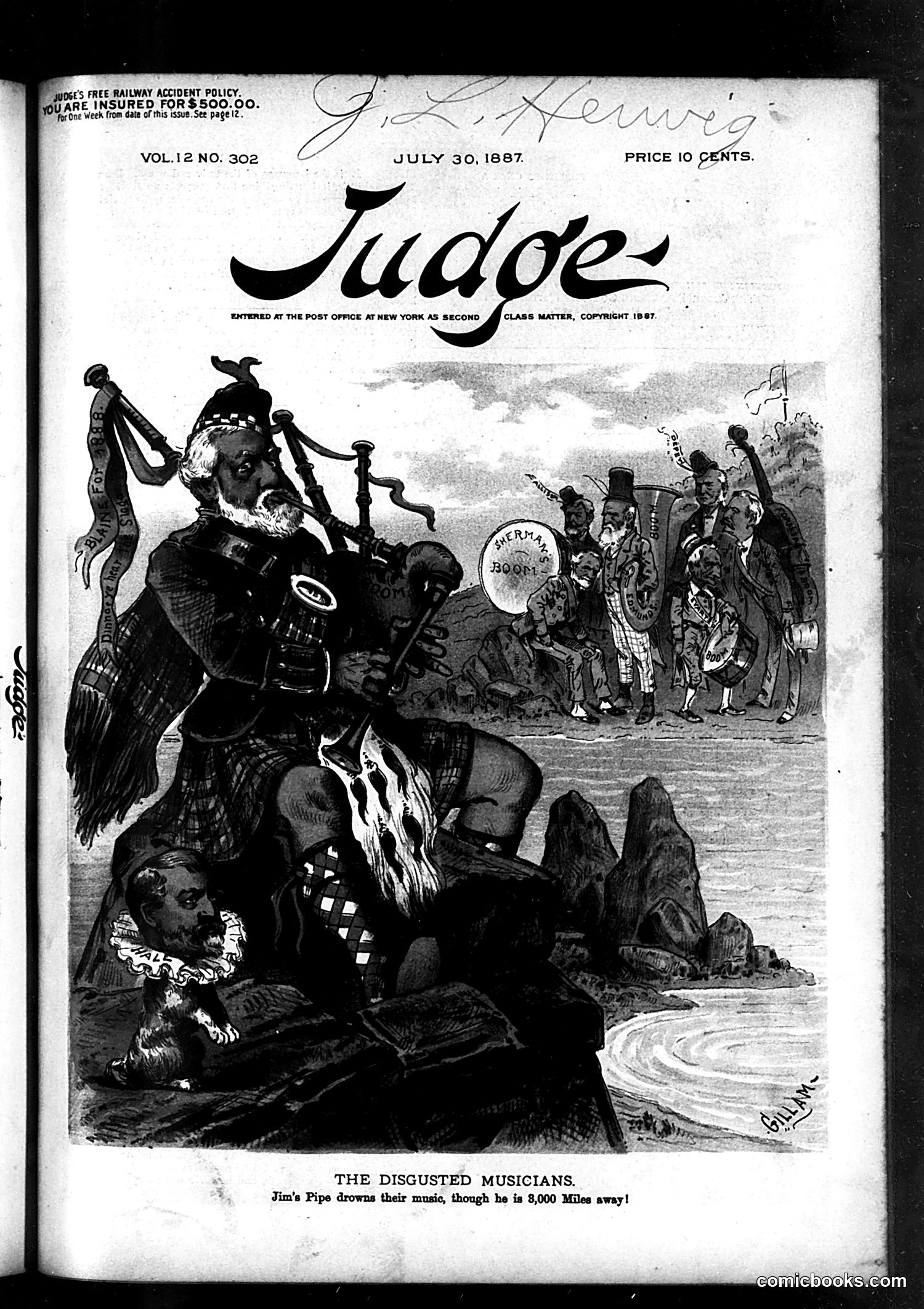
This Judge magazine cover from July 30, 1887, depicts a Scottish bagpiper (identifiable by kilt and pipes) sitting disconsolately by the shore, drowning his musical instrument in the water. The caption reads: "Jim's Pipe drowns their music, though he is 3,000 Miles away!" The cartoon satirizes someone named "Jim" whose bagpipe playing is so notoriously bad that even his absence—he's 3,000 miles away—cannot stop the suffering of other musicians. The joke plays on the piercing, grating quality bagpipes are stereotypically known for in Anglo-American humor. The "disgusted musicians" visible in the background appear to represent the broader musical community relieved to be rid of such terrible playing.
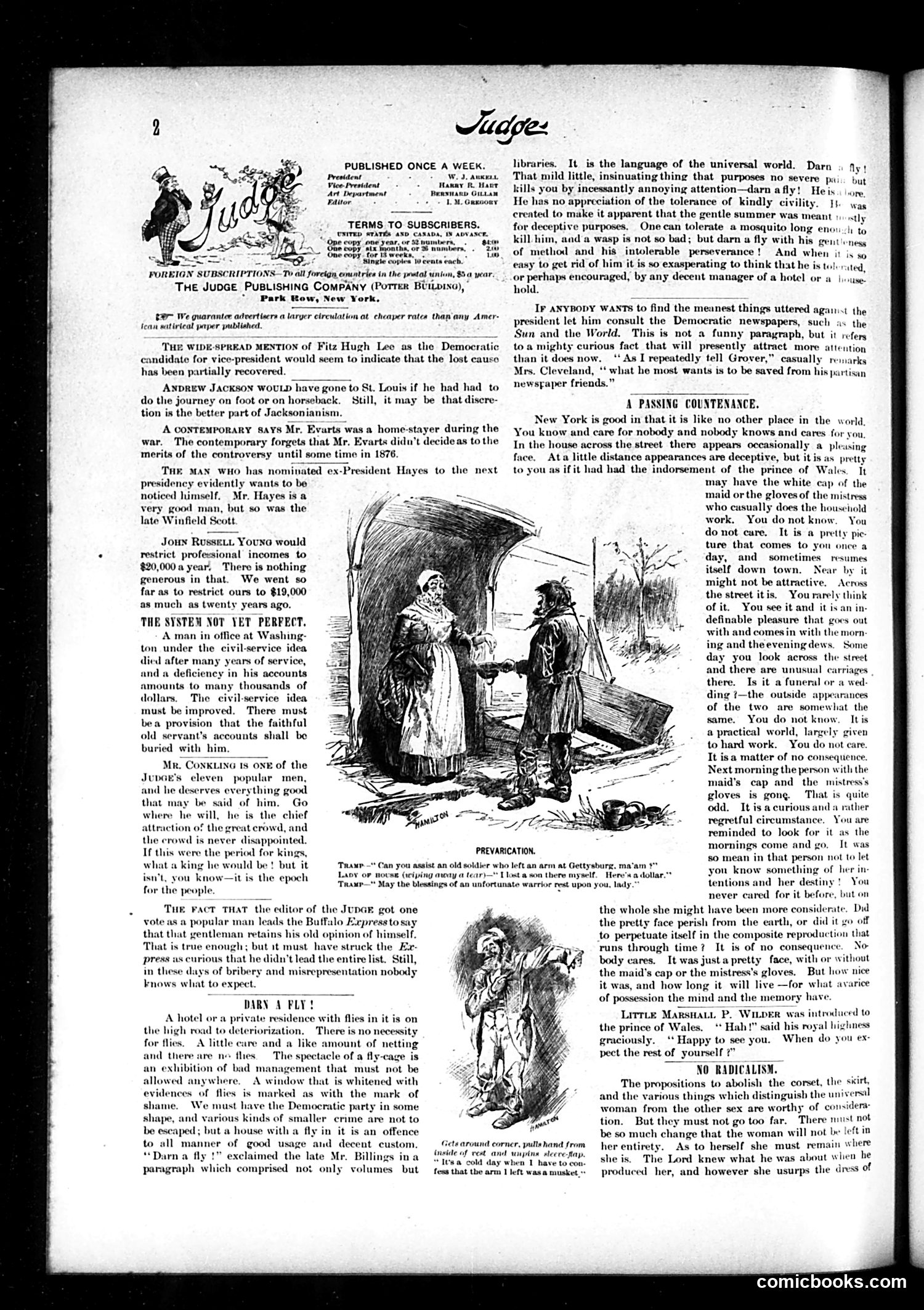
This page contains two satirical cartoon sketches with accompanying editorial commentary. The left illustration, titled "Prevarication," depicts two figures in winter clothing engaged in dialogue, apparently illustrating dishonesty or evasion of truth. The right illustration shows another figure, though its specific subject is unclear from the visible text. The editorial sections discuss various political and social matters of the era, including commentary on Democratic newspapers, civil service reform, and gender-related social customs. One notable section titled "A Passing Countenance" satirizes casual encounters on New York streets and social indifference. Without clearer identification of the specific figures or dated context, the precise political targets remain uncertain, though the overall tone is characteristic of Judge's late-19th-century satirical approach to contemporary politics and social behavior.
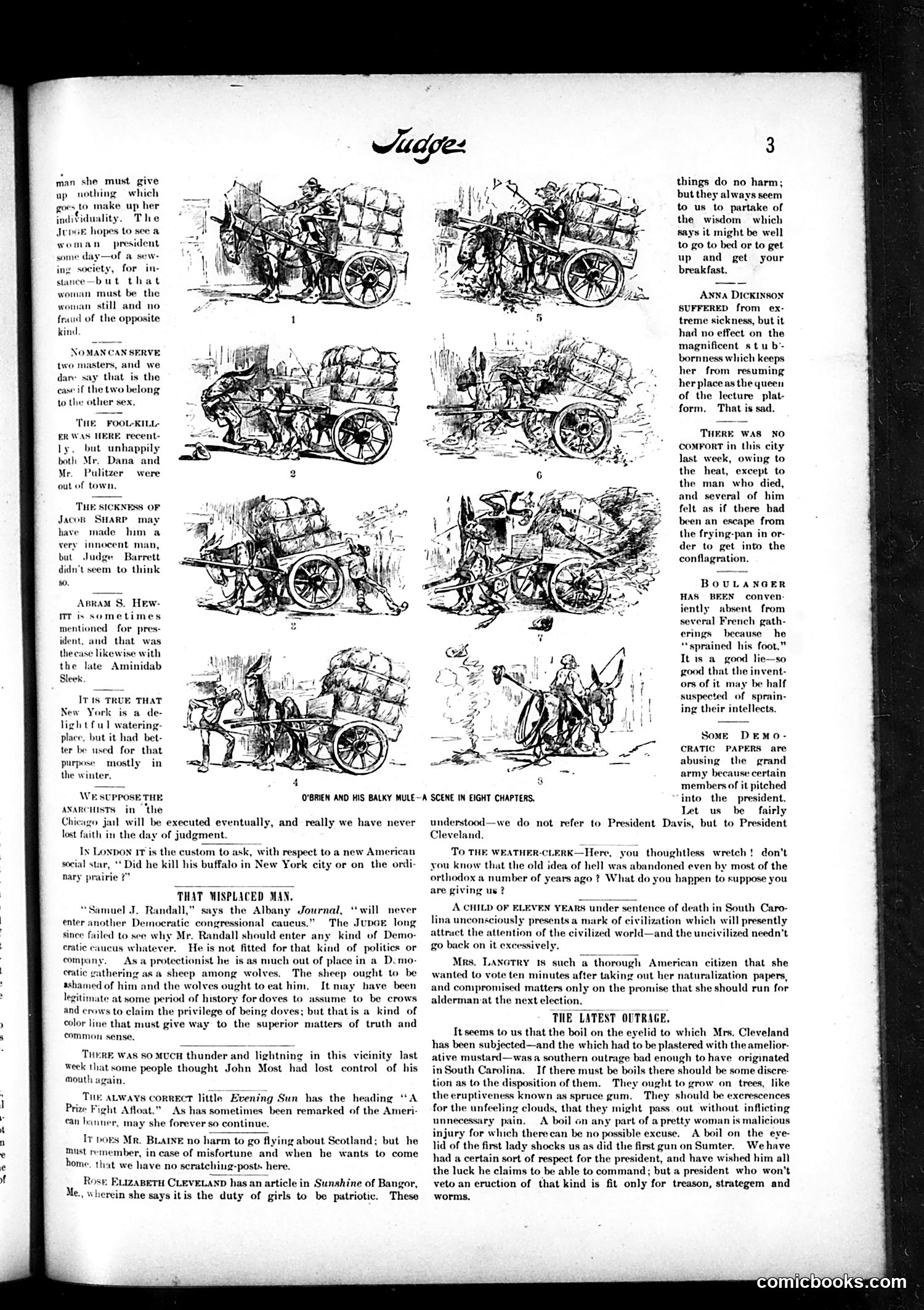
This page from *Judge* magazine contains brief satirical commentaries on contemporary American politics and society, alongside a multi-panel cartoon titled "O'Brien and His Balky Mule." The text attacks **Samuel J. Randall**, a Democratic politician criticized for being a protectionist (supporting tariffs)—ideologically misaligned with his party. The satire compares him to "a sheep among wolves," suggesting he doesn't belong in Democratic circles. Other targets include: the **Chicago anarchists** (likely referencing the Haymarket affair perpetrators awaiting execution); **John Most** (a German-American anarchist agitator); and **General Boulanger** (a French political figure accused of avoiding public appearances by claiming injury). The commentary also critiques **President Cleveland**, **Anna Dickinson** (a female lecturer), and excessive summer heat. The repeated "O'Brien and His Balky Mule" cartoon appears to be ongoing serial humor, likely Irish-American themed based on the name. Overall, this reflects *Judge's* role as a Republican, anti-anarchist, pro-business publication using humor to mock Democratic politicians and social agitators.
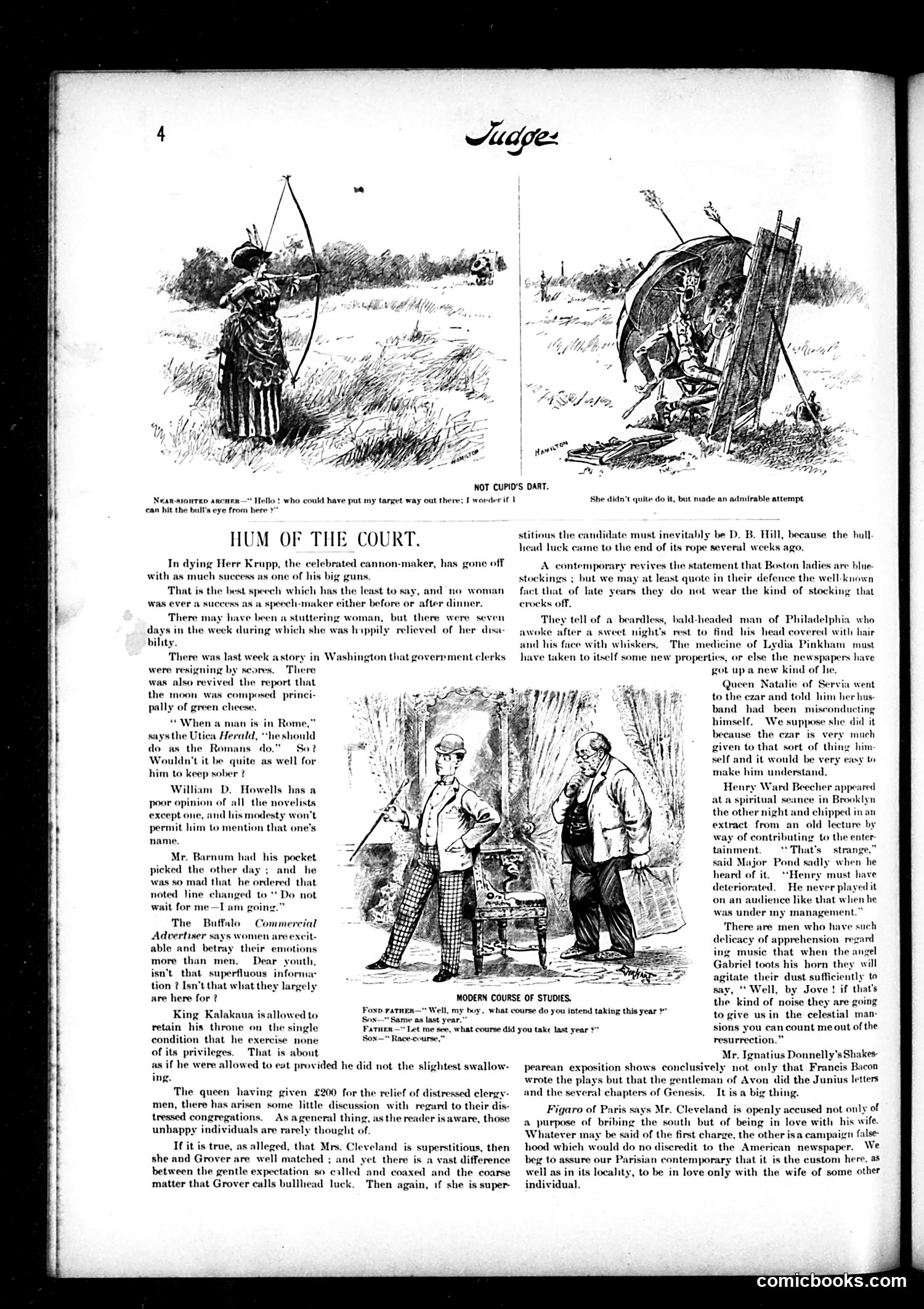
This satirical page from Judge magazine contains multiple short humor pieces mocking contemporary figures and social issues: **Top cartoons**: "Not Cupid's Dart" shows a woman archer missing her target, likely satirizing women's incompetence or romantic failures—a common Judge trope. **"Hum of the Court"** section includes jabs at: - **Herr Krupp** (German cannon manufacturer, recently deceased) - **William D. Howells** (novelist, mocked for false modesty) - **P.T. Barnum** (circus showman, referenced dismissively) - **King Kalakaua** (Hawaiian monarch, criticized for powerlessness) - **Mrs. Cleveland** (wife of President Grover Cleveland, mocked for superstition) **"Modern Course of Studies"** cartoon shows a student choosing the "race-course"—a pun on academic programs, implying frivolous education. The humor targets celebrities, politicians, and social pretensions typical of 1890s American satire. The magazine assumes readers recognize these public figures and finds amusement in their perceived flaws or recent scandals.
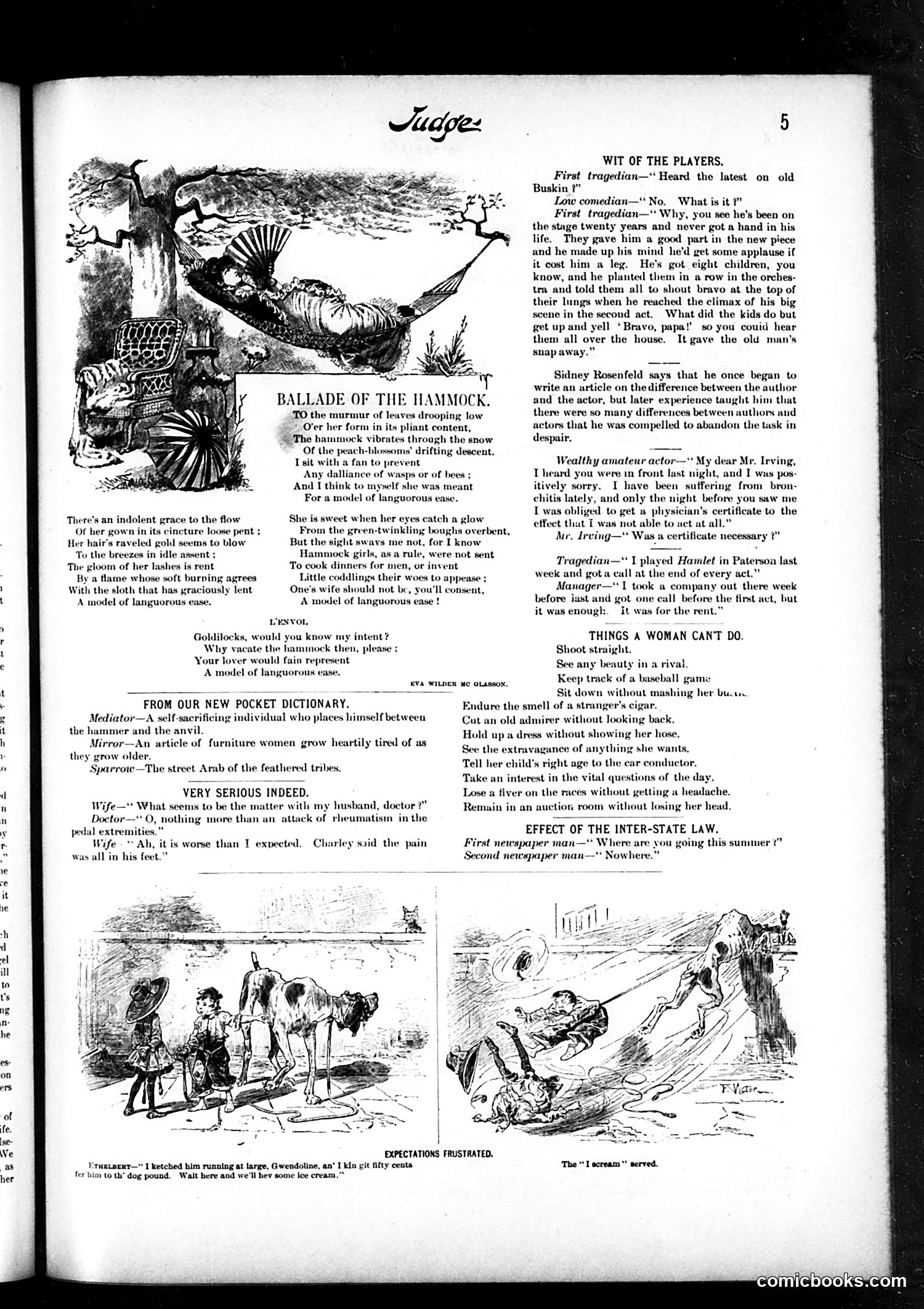
This page contains satirical humor typical of late-19th-century American magazines. The main content includes: **"Ballade of the Hammock"**: A poem romanticizing women lounging in hammocks, by Eva Wilder McGlasson. The satire targets idle leisure-class women who are decorative but impractical—"hammock girls...were not sent / To cook dinners for men." **"Wit of the Players"**: Theater anecdotes mocking actors' vanity and desperation. One story describes an unsuccessful actor planting his eight children in the orchestra to applaud him; another involves an amateur actor's transparent excuses for poor performance. **"Things a Woman Can't Do"**: A list of stereotypical female incompetencies (poor aim, jealousy of rivals, inability to sit without showing stockings), reflecting contemporary sexist attitudes presented as humor. The cartoons below illustrate related domestic/social comedy scenarios. Overall, the page reflects Judge's formula: genteel satire targeting both theatrical pretension and women's social limitations, presented as entertainment for educated readers.
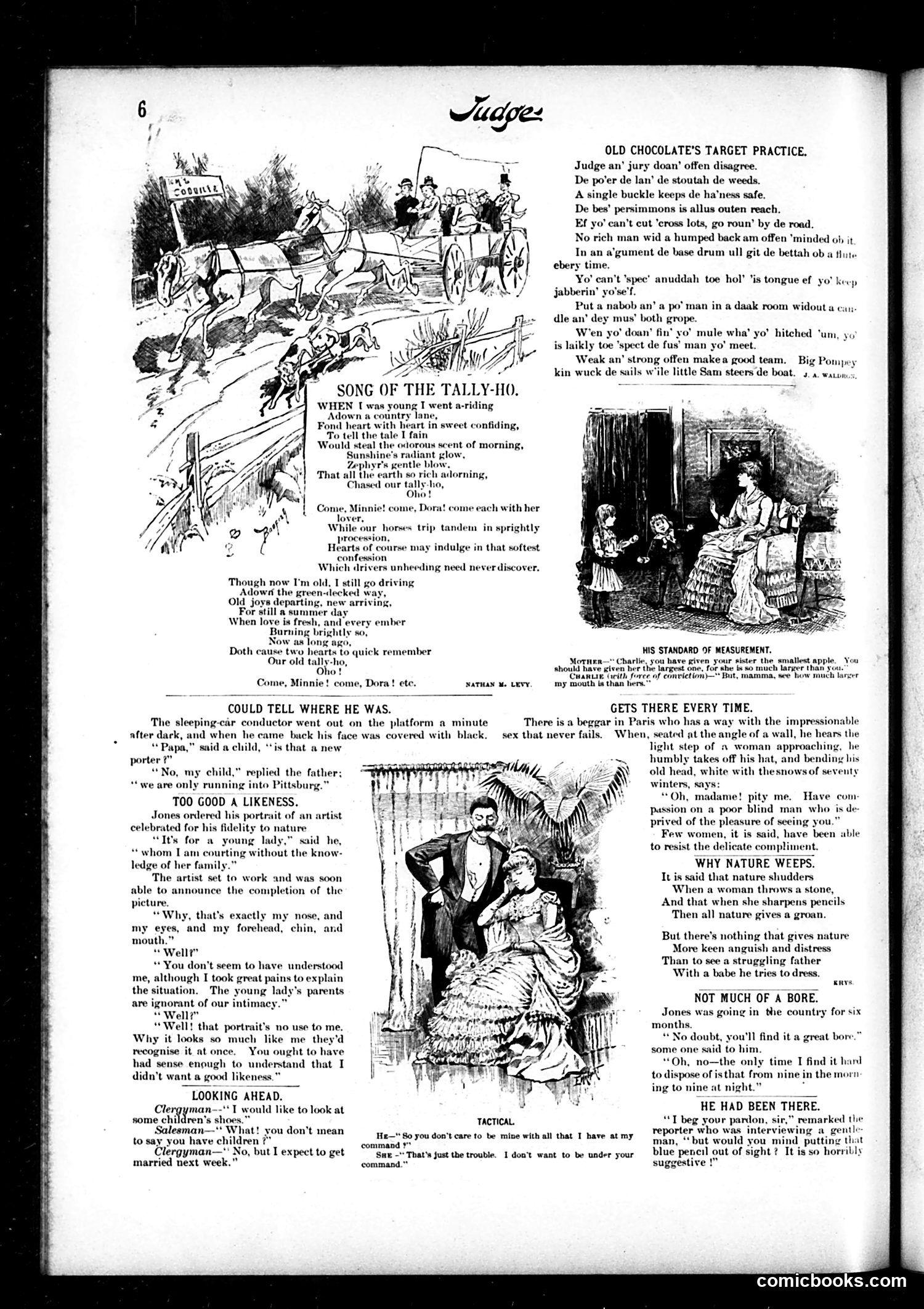
This **Judge** magazine page (likely late 19th century) contains several unrelated humorous items: **"Song of the Tally-Ho"** is nostalgic verse about courtship rides in horse-drawn carriages—standard romantic sentiment of the era. **"Could Tell Where He Was"** jokes that a conductor's blackened face upon arriving in Pittsburgh implies the city's industrial pollution (Pittsburgh was famous for steel mills and smog). **"Too Good a Likeness"** satirizes a man courting a woman secretly—he wants a flattering portrait to show her family, not an accurate one. The irony: accuracy defeats his deceptive purpose. **"Old Chocolate's Target Practice"** presents racist dialect humor attributed to a Black character offering folksy aphorisms. This reflects the period's prevalent minstrelsy stereotypes. **Minor items** include jokes about clergy expectations and a beggar's flattery toward women. The page reflects Judge's mix of gentle satire, romantic nostalgia, and period-typical racial stereotyping.
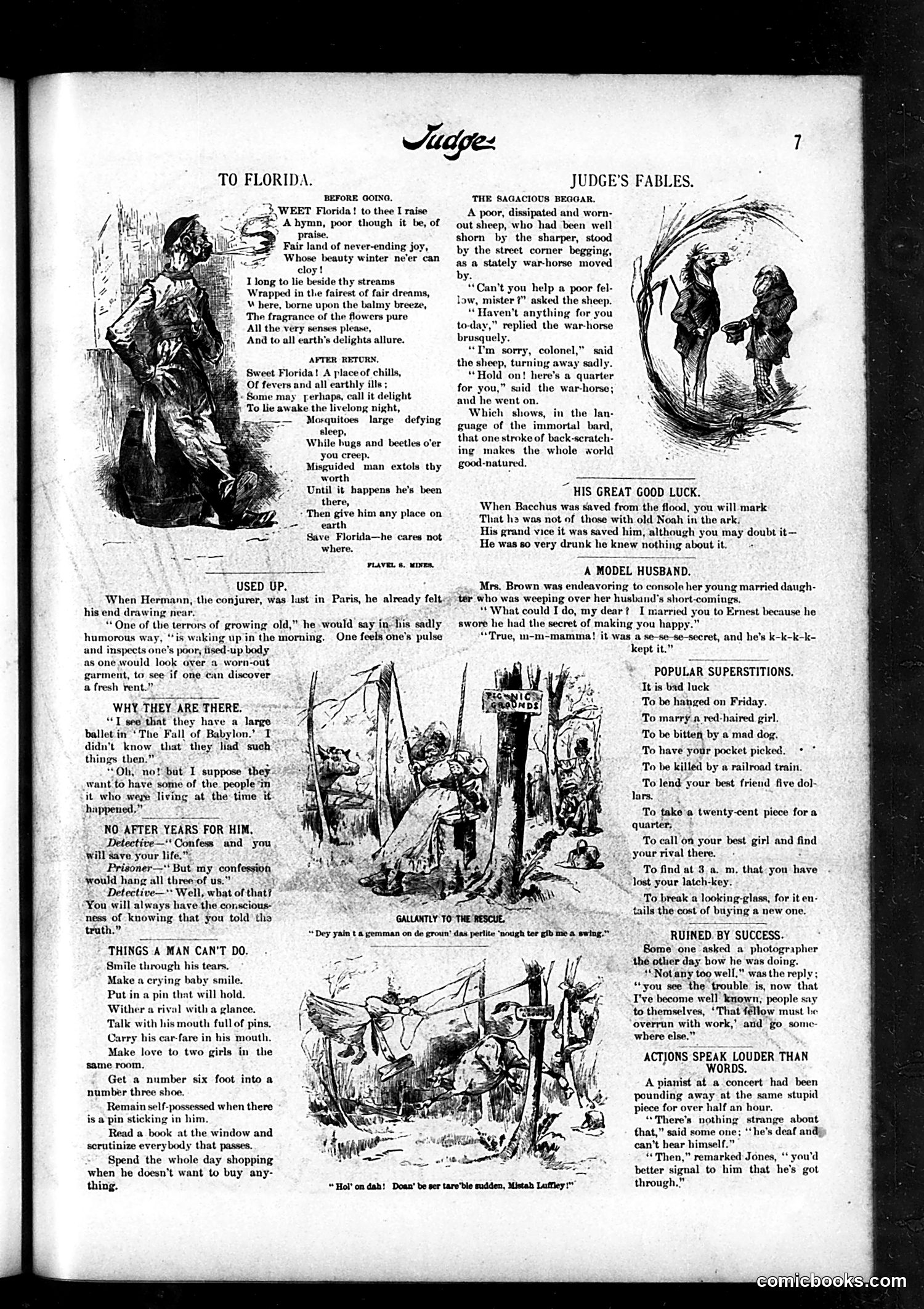
This page from Judge magazine contains several satirical pieces mocking 19th-century life and conventions: **"To Florida"** contrasts romantic expectations with reality—the poem celebrates Florida's beauty before visiting, then bitterly complains about mosquitoes, bugs, and fevers upon return. It satirizes the gap between travel fantasies and disappointing experience. **"The Sagacious Beggar"** fable depicts a worn-out sheep asking a war-horse for charity. When refused, the horse reconsiders and gives a quarter, prompting the moral that "back-scratching makes the world good-natured"—cynically suggesting self-interest drives charity. **"A Model Husband"** jokes about a husband who promised to make his bride happy but kept the method secret—implying he failed entirely. The page also includes various humorous lists ("Things a Man Can't Do") and satirical observations about superstitions and human behavior. The accompanying illustrations show period characters in exaggerated situations, typical of Judge's satirical style. The overall tone mocks social pretension, false promises, and human contradiction.
This political cartoon depicts a figure on the right (appearing to be a caricatured politician or public official) being struck by lightning emanating from the left side, where an American flag is visible against stormy clouds. The lightning bolt carries what appears to be text or messaging, suggesting a "strike" of public opinion or consequence. The figure on the right wears formal attire and appears distressed or reactive to this strike. The cartoon's setup suggests commentary on political accountability or public backlash against a particular figure or policy. However, without a visible date or caption clearly identifying the specific political figure or historical event referenced, I cannot definitively specify which politician, scandal, or controversy this satirizes. The general theme appears to be American political consequences or reckoning.
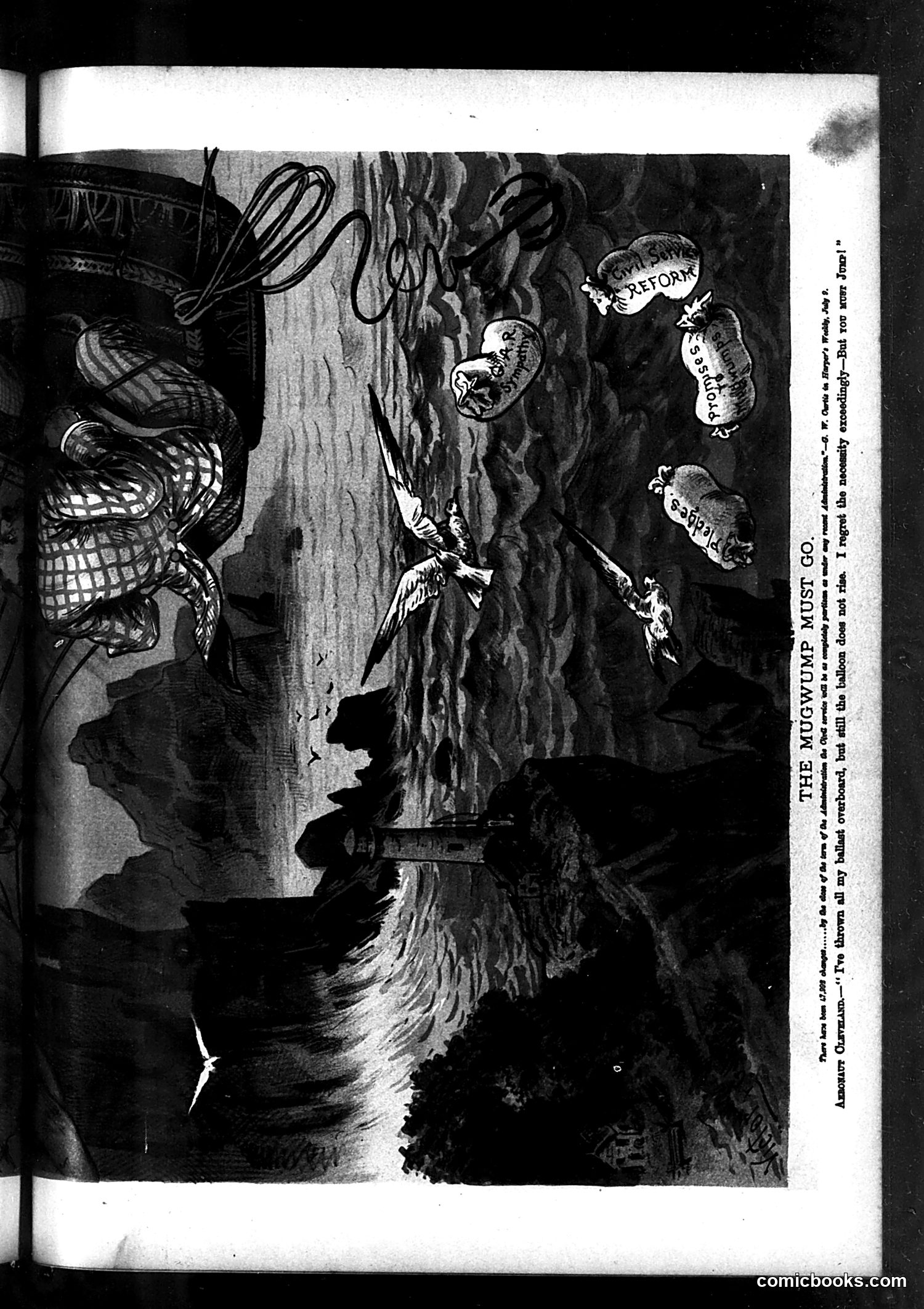
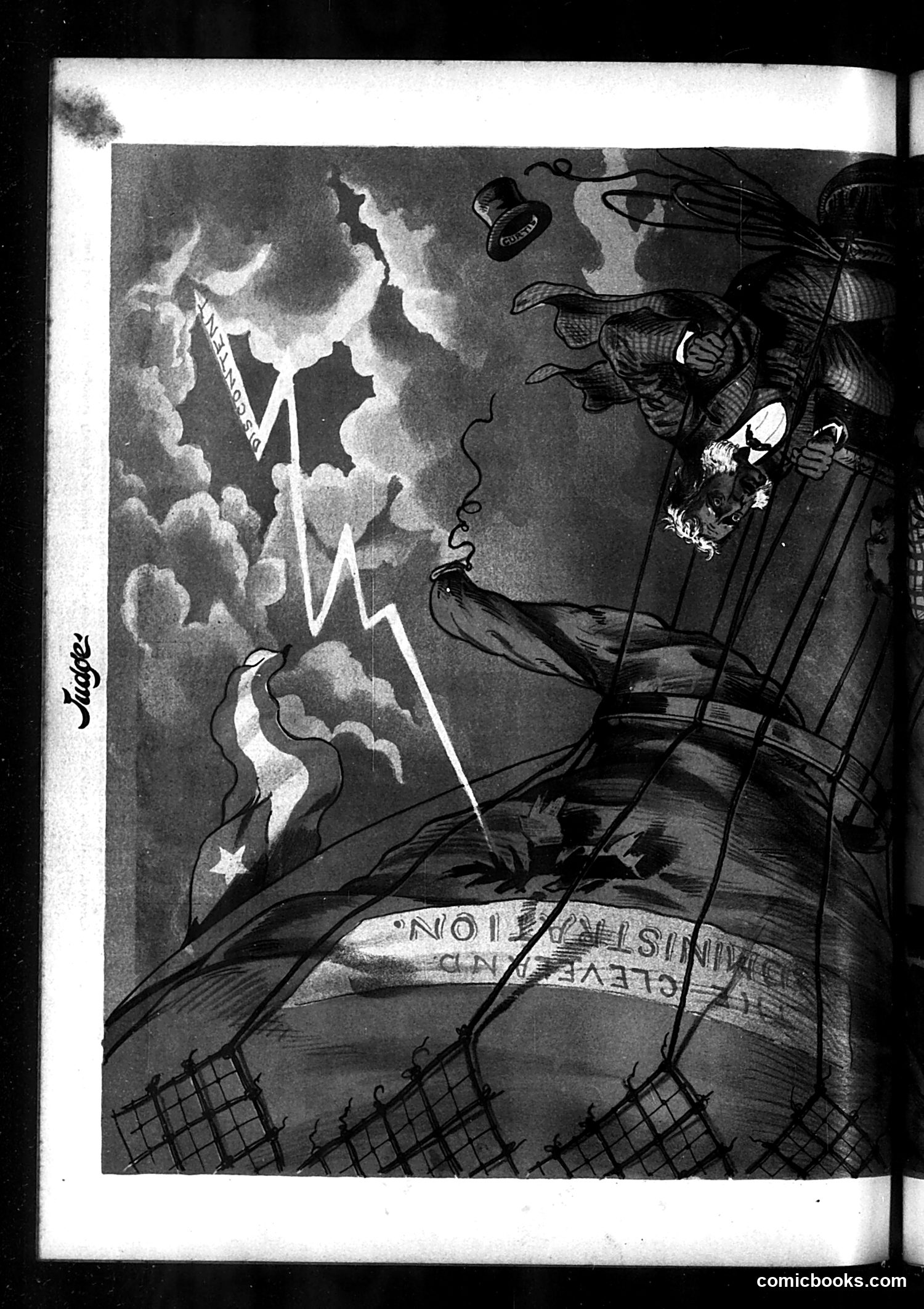
This cartoon satirizes the Cleveland Administration's alleged partisanship despite reform promises. The OCR'd quote attributes to G.W. Curtis (Harper's Weekly) the observation that the administration became as partisan as predecessors. The image depicts a figure (likely President Cleveland) in a hot air balloon labeled "THE MIDNIGHT MIST GO" (unclear exact meaning), desperately throwing ballast overboard—represented as small figures with labels suggesting dismissed officials or broken promises. The balloon fails to rise despite these jettisoned items. **The satire:** Cleveland campaigned as a reformer who would eliminate political patronage, but his administration allegedly removed Republicans and replaced them with Democrats just as readily. The cartoon mocks this hypocrisy—he's discarding principles and people to appear elevated, yet his reform balloon won't "rise" (succeed). The "ballast" thrown overboard represents the casualties of his partisan actions, contradicting his stated anti-corruption platform.
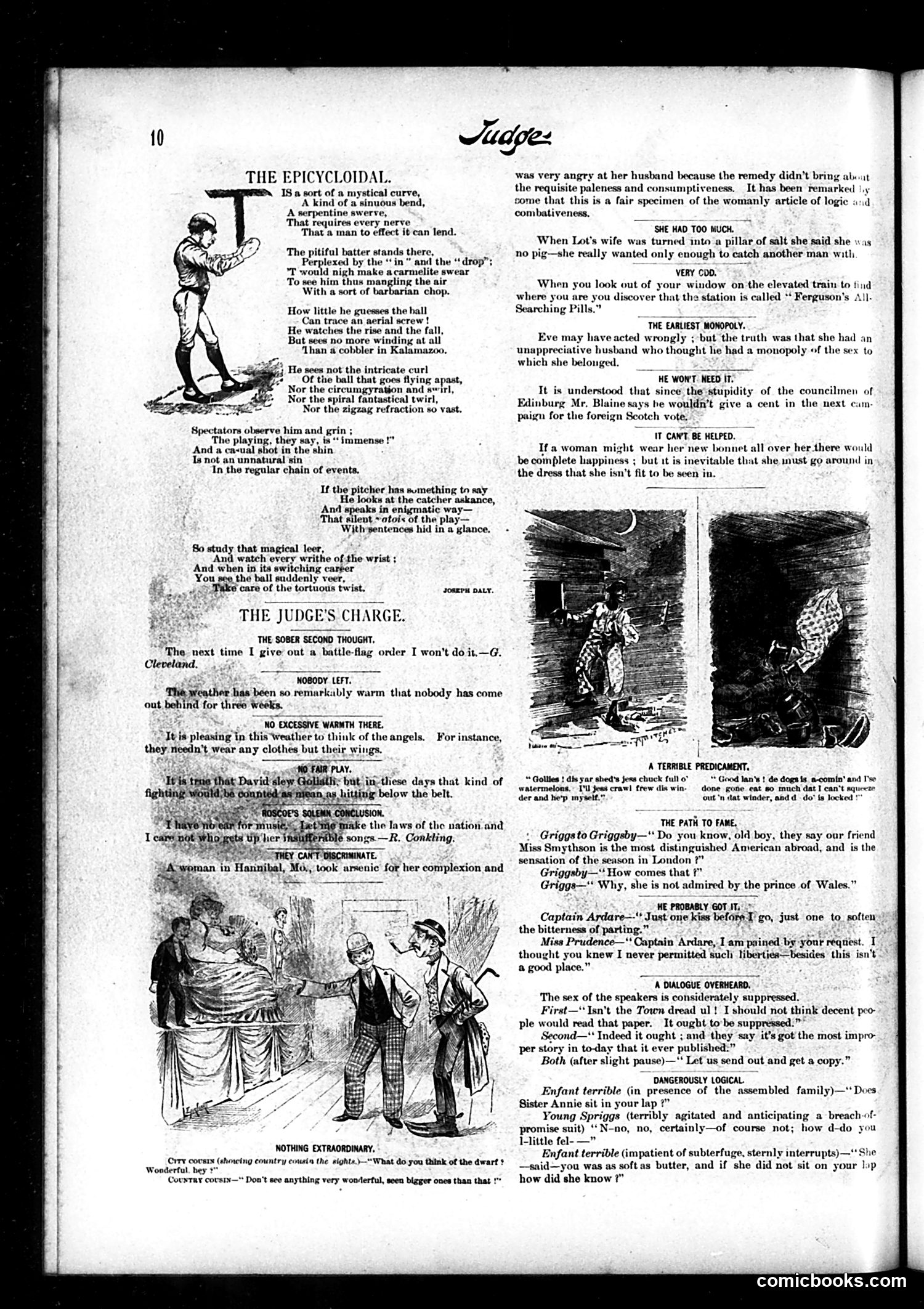
This page contains miscellaneous satirical pieces typical of Judge magazine's format. The main content includes: **"The Epicycloidal"** — A poem mocking baseball batters who fail to understand the complex physics of a curveball, comparing their ignorance to "a cobbler in Kalamazoo." The accompanying illustration shows a confused batter. **"The Judge's Charge"** — Brief satirical notes on contemporary issues, including a reference to Cleveland's military policy and jokes about warm weather and dating customs. **Various short quips** satirizing: - Women's illogical reasoning (a wife's complaint about medicine) - Advertising ubiquity (even train stations named after pills) - Female fashion vanity - Blaine's political prospects regarding Scottish voters - Social pretension (a woman gaining fame by *not* being admired by royalty) The tone throughout is lighthearted social commentary typical of 1880s-90s American humor magazines, targeting gender relations, politics, and urban life without serious political intent.
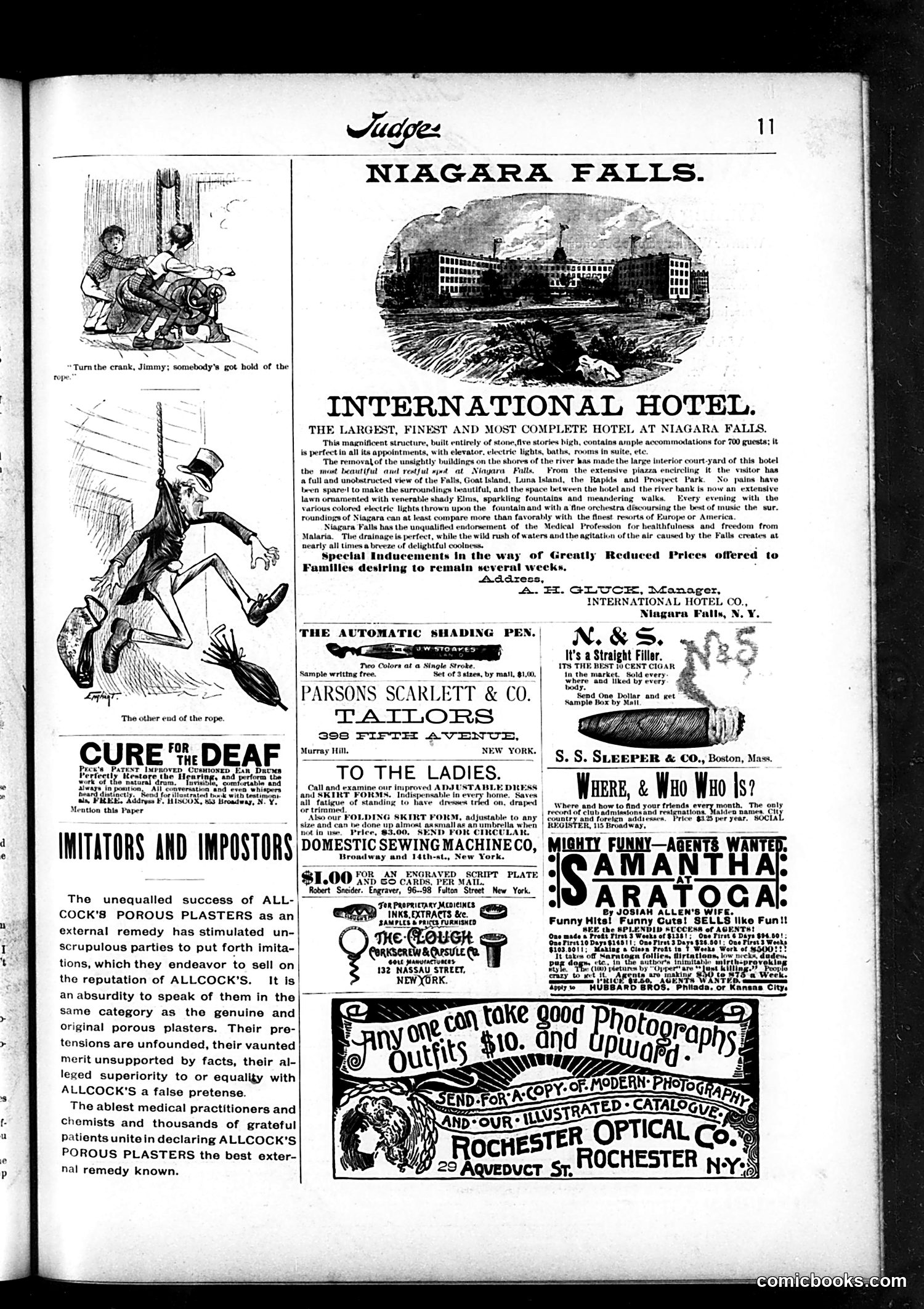
This page is primarily **advertising**, with two editorial cartoons on the left side. ## The Cartoons: The two sketches show a figure in a tug-of-war scenario labeled "Turn the crank, Jimmy; somebody's got hold of the rope" and "The other end of the rope." The cartoons appear to satirize **mechanical futility or wasted effort**—someone cranking a device while an unseen force on the other end resists, suggesting the joke is on the operator who thinks they're in control. The style and figures are unclear regarding specific political targets. ## The Advertisements: The bulk of the page features period advertisements: Niagara Falls' International Hotel, Allcock's Porous Plasters (attacking counterfeit competitors), Parsons Scarlett tailors, a sewing machine company, an automatic pen, and various patent medicines. The Allcock's ad explicitly warns against "imitators and impostors," defending their brand's superiority—common in an era before modern consumer protection laws. The page reflects late-19th-century American commerce and consumer concerns about product authenticity and patent medicines.
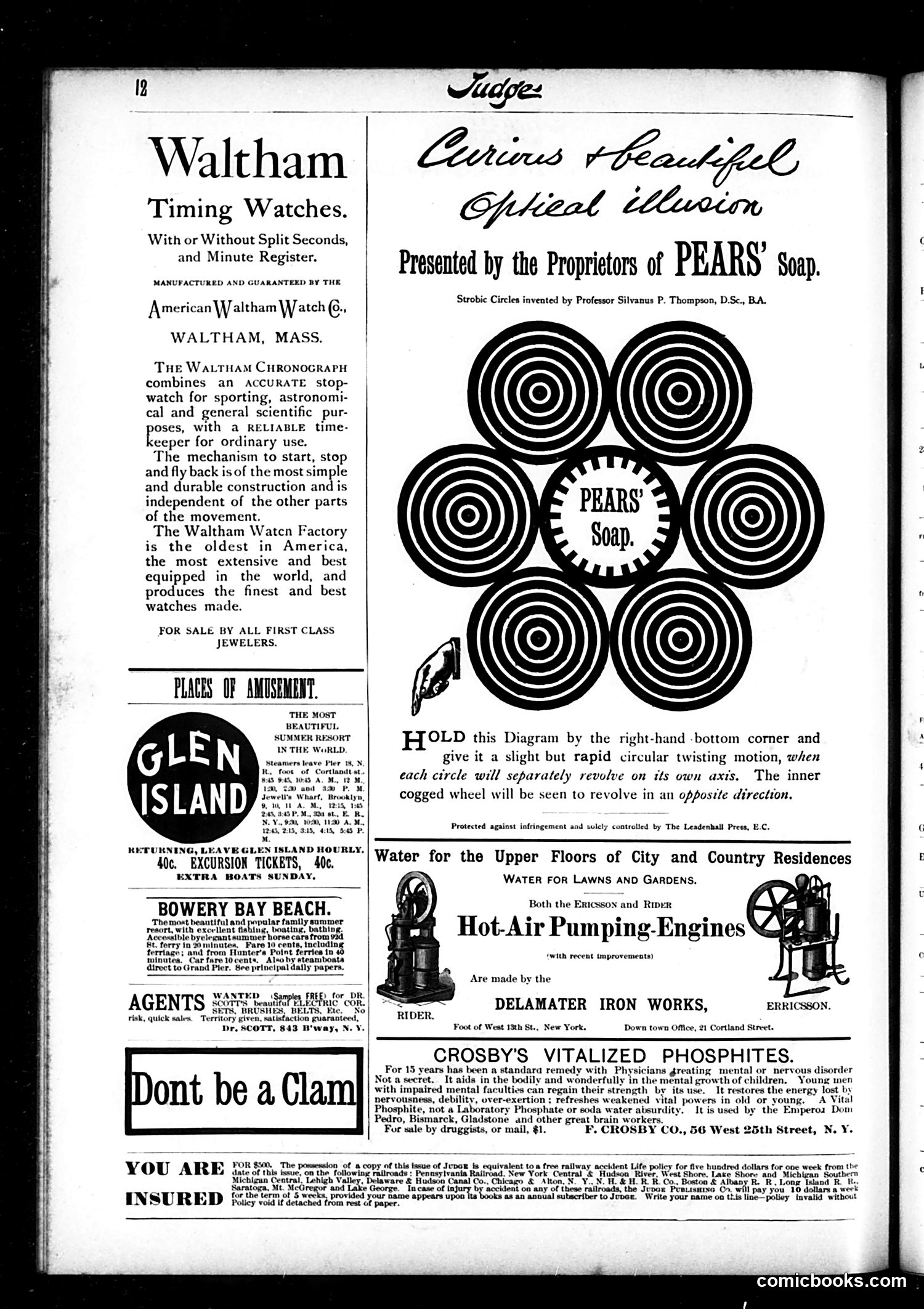
This is primarily an **advertising page** with no political cartoons or satirical content requiring historical context. The page features commercial advertisements from the late 1800s/early 1900s: Waltham watches, Glen Island resort excursions, and Bowery Bay Beach. Most notably, **Pears' Soap presents an optical illusion** — concentric circles that appear to rotate when the page is twisted, invented by Professor Silvanus P. Thompson. This was a popular scientific novelty used for advertising. There's also a small ad reading "Don't be a Clam," using common slang (calling someone a "clam" meant they were uncommunicative or stingy). The bottom contains fine print about **accident insurance** — Judge offered readers free railway accident coverage as a subscription benefit, listing major railroads like the Pennsylvania Railroad and New York Central. No political satire or caricatures appear on this page.
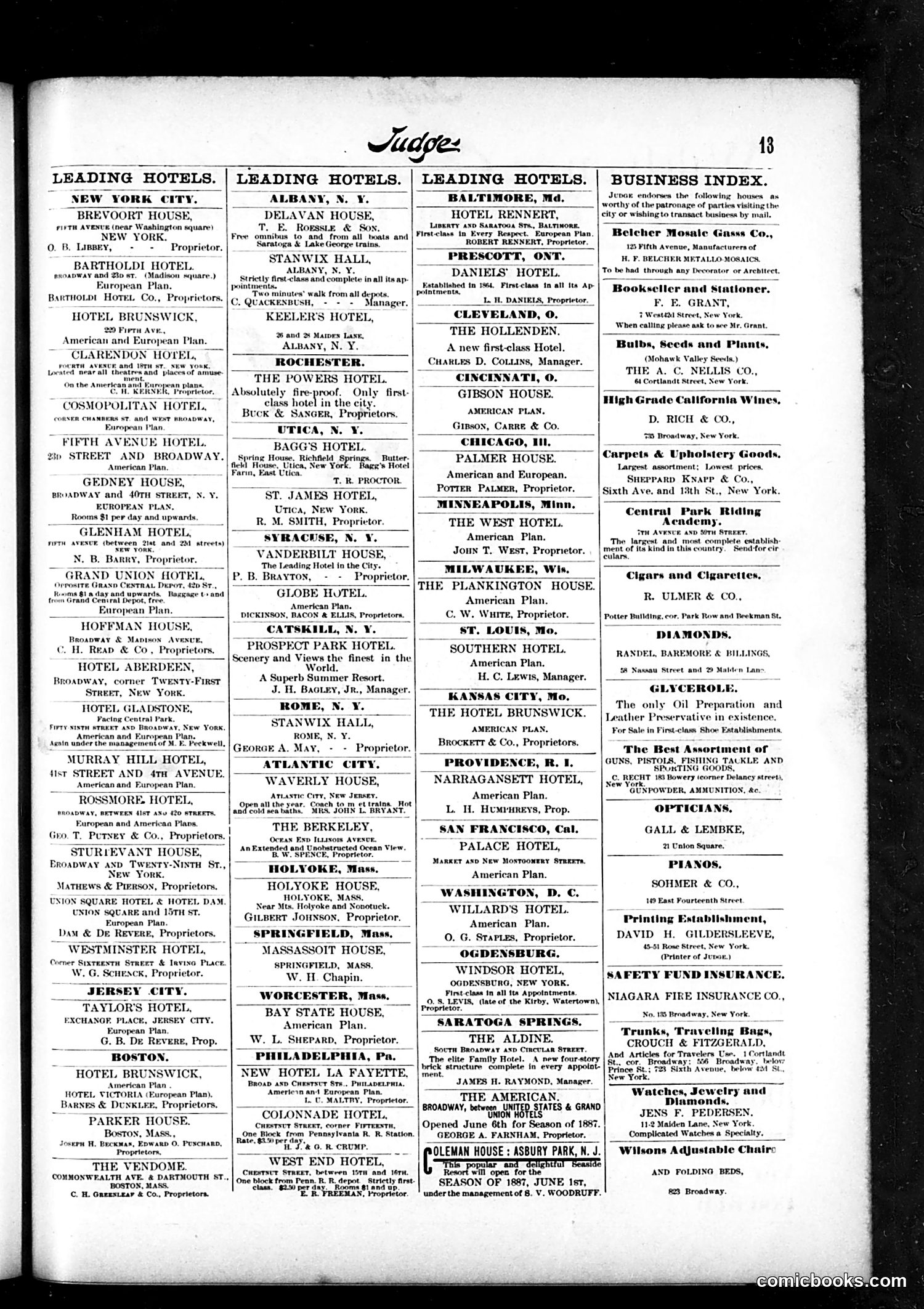
This page from *Judge* magazine (page 18) contains **no visible cartoons or satirical content**. It is dominated by hotel advertisements organized by city: New York, Albany, Boston, Philadelphia, Baltimore, and various other American destinations. The listings are straightforward business directory entries naming hotel proprietors, locations, and amenities (European Plan, American Plan, fireproof construction, etc.). The only non-advertising text visible is the header "BUSINESS INDEX" at top right, suggesting this is the magazine's commercial directory section. **No political figures, caricatures, or satirical commentary appear on this page.** While *Judge* was known for political cartoons and social satire, this particular page served a purely commercial function—connecting wealthy travelers (the magazine's target audience) with upscale lodging options across America.
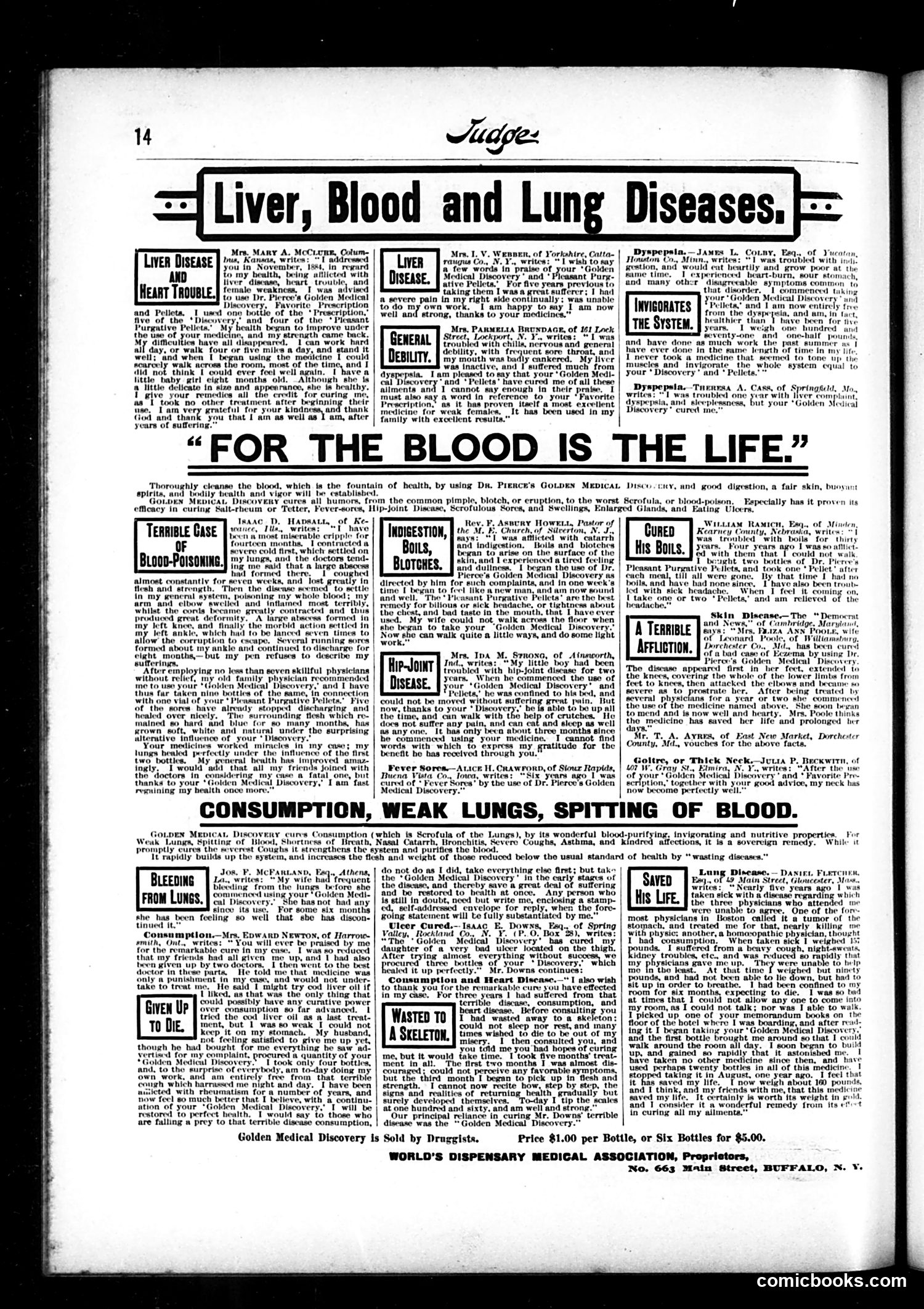
This page is primarily a **patent medicine advertisement** for Dr. Pierce's Golden Medical Discovery, not a political cartoon. It occupies most of page 14 of Judge magazine. The advertisement features: - **Testimonial letters** from ostensible patients (Mrs. McClune, Mrs. Wennen, Mrs. Broadhae, etc.) claiming cures for various ailments: liver disease, heart trouble, dyspepsia, weak lungs, blood poisoning, and consumption. - **Large banner headline**: "FOR THE BLOOD IS THE LIFE"—a biblical reference implying the medicine purifies the body's essential substance. - **Boxed case studies** with dramatic titles like "Terrible Case of Blood-Poisoning" and "Wasted to a Skeleton," using sensationalized language typical of late-19th-century patent medicine marketing. The satire Judge likely intends is implicit: the magazine publishes these extravagant health claims alongside its satirical content, possibly mocking both the dubious medical claims and readers' gullibility. No identifiable political figures or events are referenced.
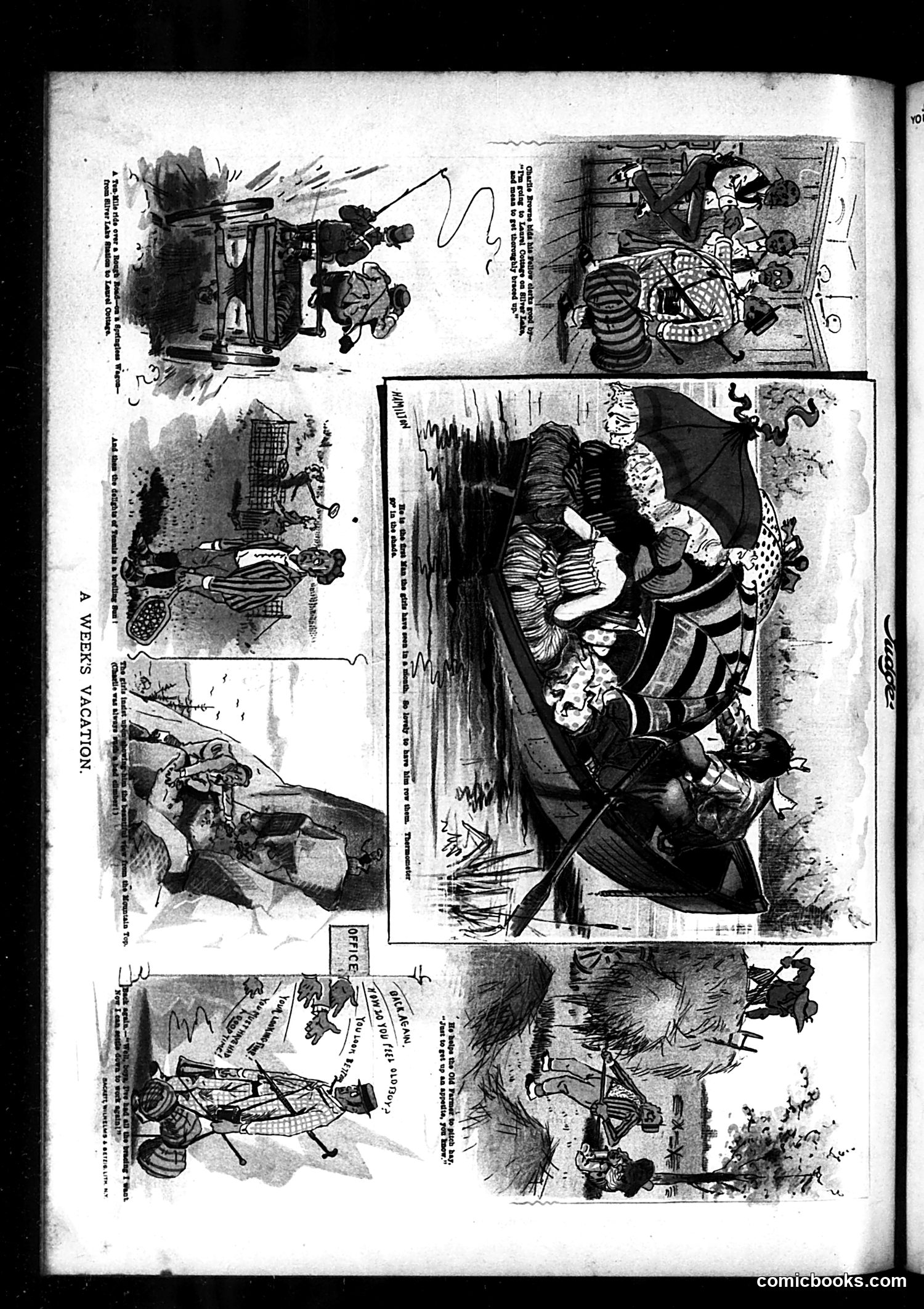
This page satirizes the contradictions of leisured vacation activities, particularly among wealthy Americans. The title "A Week's Vacation" frames several vignettes showing supposedly relaxing pursuits that are actually exhausting or uncomfortable. The central joke appears to be ironic: activities marketed as leisure—hay-pitching "to get up an appetite," rowing in heat, and playing tennis "in a broiling Sun"—are physically demanding and unpleasant. The satire targets the affectation of wealthy vacationers who perform manual labor or strenuous sports as fashionable entertainment, treating genuine work as recreational activity. References to thermometers and complaints about heat underscore the discomfort these "relaxations" actually involve. The cartoon mocks the pretense that such activities constitute enjoyable vacation time, particularly for the idle rich seeking authentic experiences or health benefits while avoiding actual labor.