
A complete issue · 16 pages · 1887
Judge — July 16, 1887
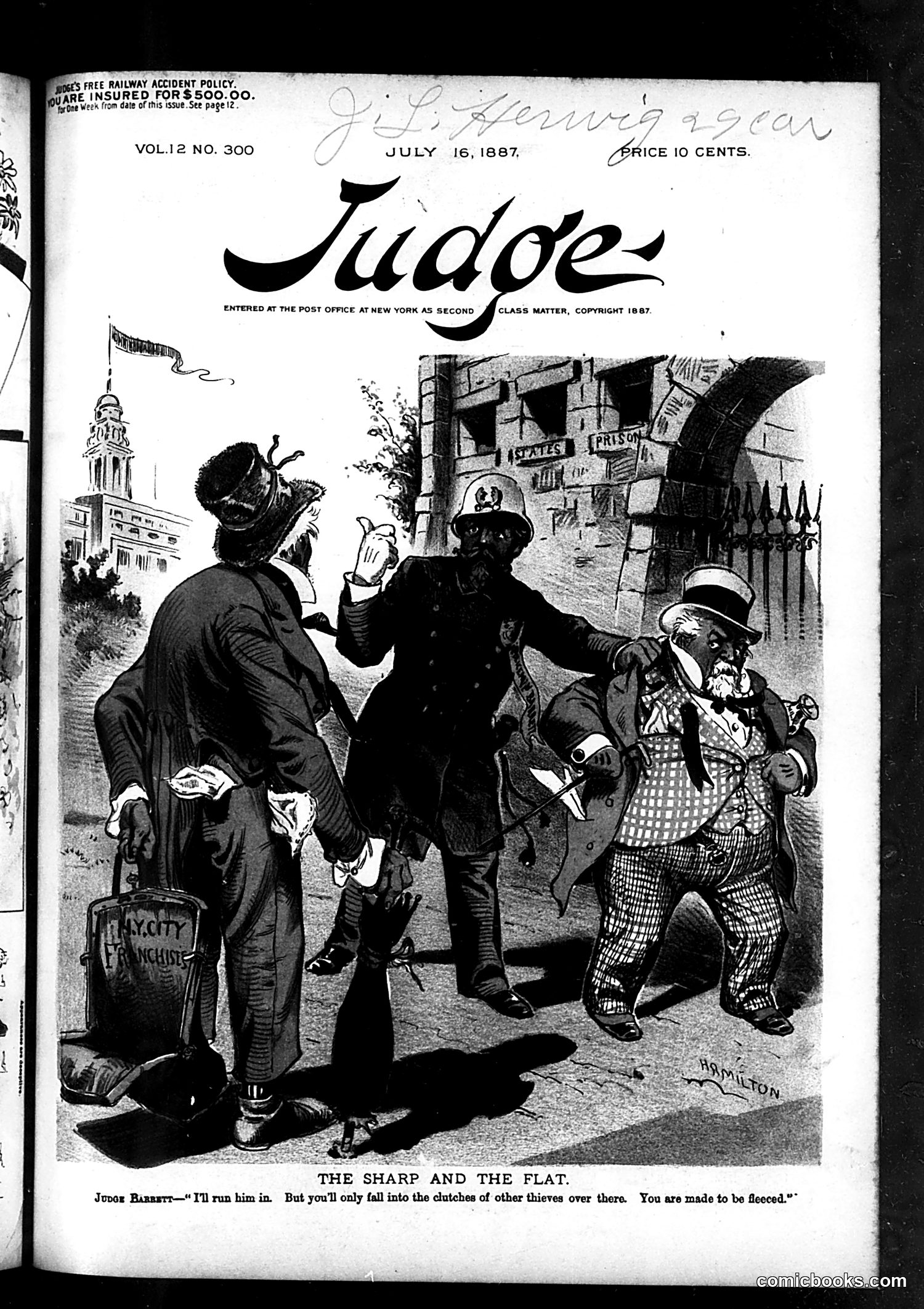
This cartoon from *Judge* (July 16, 1887) satirizes urban crime and criminal networks. The caption quotes "Judge Barrett" warning that running a con artist will only lead to falling "into the clutches of other thieves over there"—suggesting criminals inevitably betray each other. The scene depicts what appears to be a street encounter involving a well-dressed man (possibly a con man or swindler, marked "SHARP"), police or authority figures, and a ragged character on the right. The prison building visible in the background reinforces the crime theme. The "sharp and flat" title likely plays on musical terminology to contrast cunning criminals ("sharp") with their victims or fellow criminals ("flat"—meaning dull or foolish). It's social commentary on 1880s urban vice and the interconnected underworld.
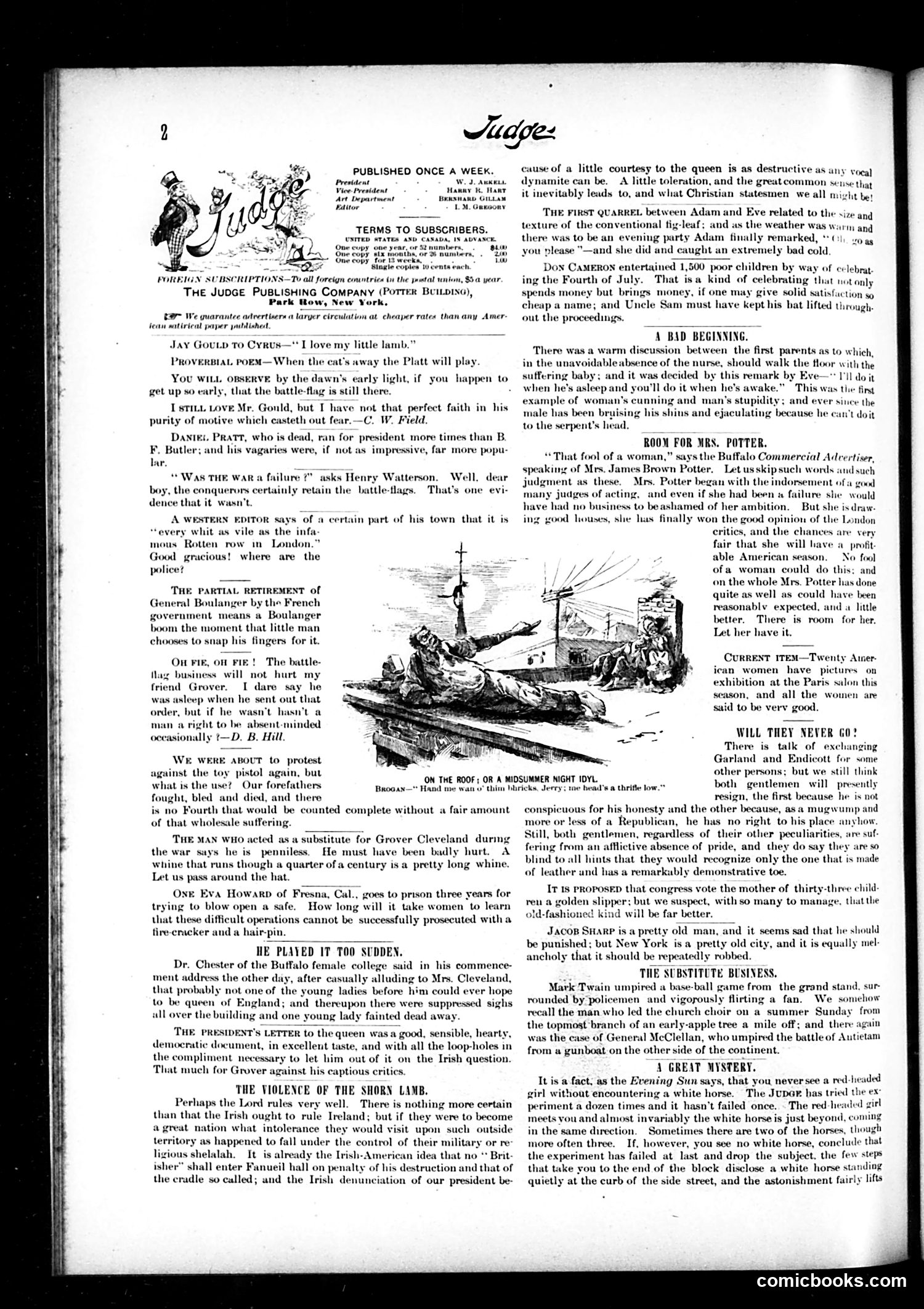
This page contains several brief satirical commentary pieces rather than a single cartoon. The visible illustration shows a figure on a roof during what appears to be a nighttime scene—likely illustrating one of the accompanying anecdotes. The text pieces mock contemporary political and social figures, including references to "Jay Gould" (the wealthy industrialist) and "Grover Cleveland" (the U.S. President). There are jabs at politicians' hypocrisy, wealthy businessmen's ethics, and social pretensions. One section critiques military/government incompetence during what appears to be discussion of the Cleveland administration's policies. Another mocks women in theater and society. The overall tone is typical Judge magazine satire: irreverent commentary on current events, politicians, and social figures through brief humorous anecdotes and observations rather than large-scale political cartoons.
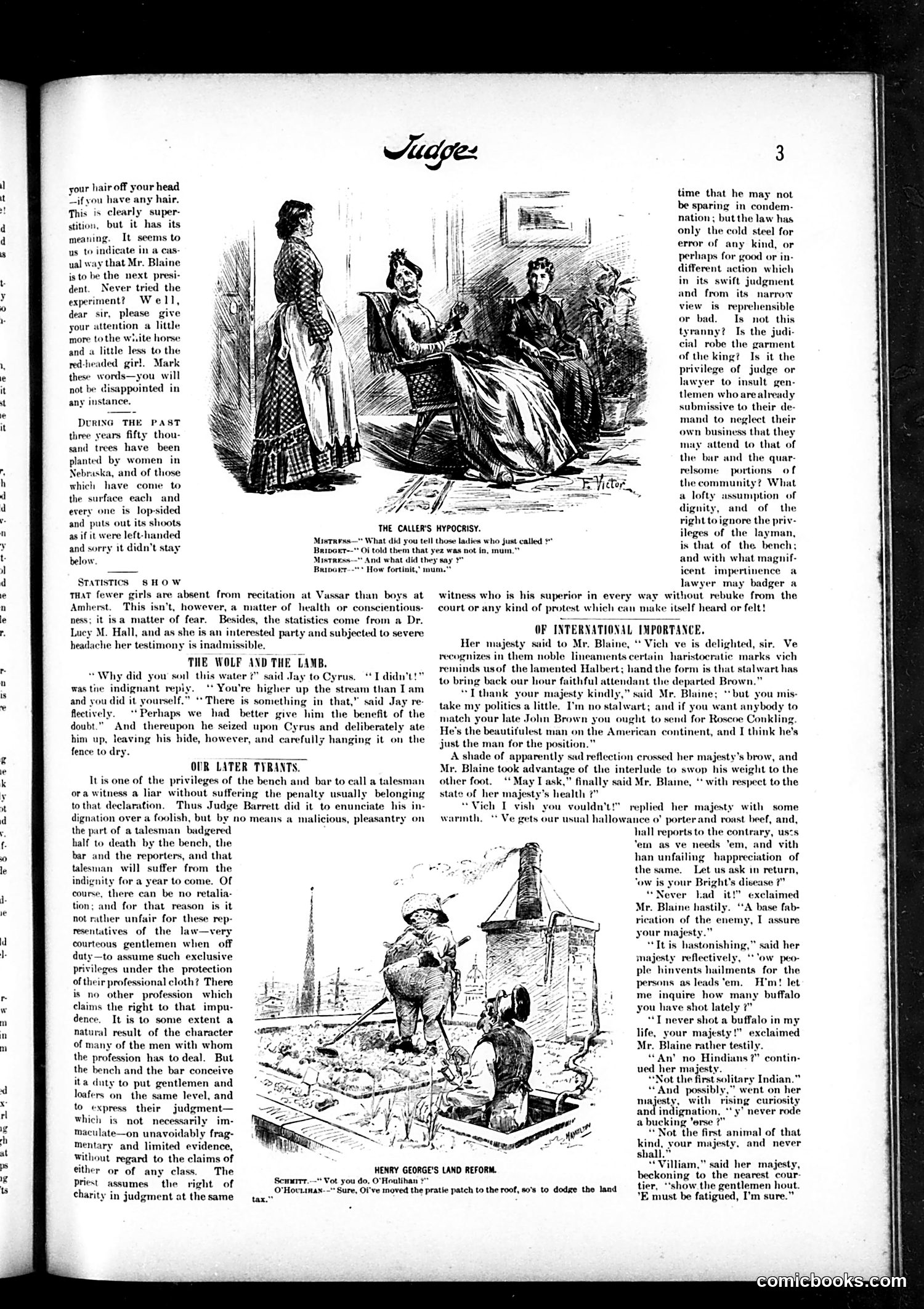
This page contains several satirical pieces critiquing American institutions and figures circa the 1880s: **"The Wolf and the Lamb"** appears to reference the Jay Gould–Cyrus Field railroad dispute, using Aesop's fable to satirize how the powerful exploit procedural advantages to crush rivals regardless of actual guilt. **"Our Later Tyrants"** attacks judicial arrogance—specifically judges' and lawyers' privilege to call witnesses "liars" without legal consequence, while ordinary citizens face penalties for identical behavior. The satire argues this legal immunity reflects unfair class privilege. **"The Caller's Hypocrisy"** is a brief joke about a servant falsely claiming callers weren't home, then admitting the lie—mocking social pretense. **"Henry George's Land Reform"** satirizes the Single Tax movement by showing an Irishman moving his potato patch to his roof to avoid land taxes—absurdist commentary on the impracticality of George's proposals. The page also includes casual observations on superstition regarding James G. Blaine's presidential prospects and women planting trees in Nebraska, establishing Judge's tone of irreverent social commentary.
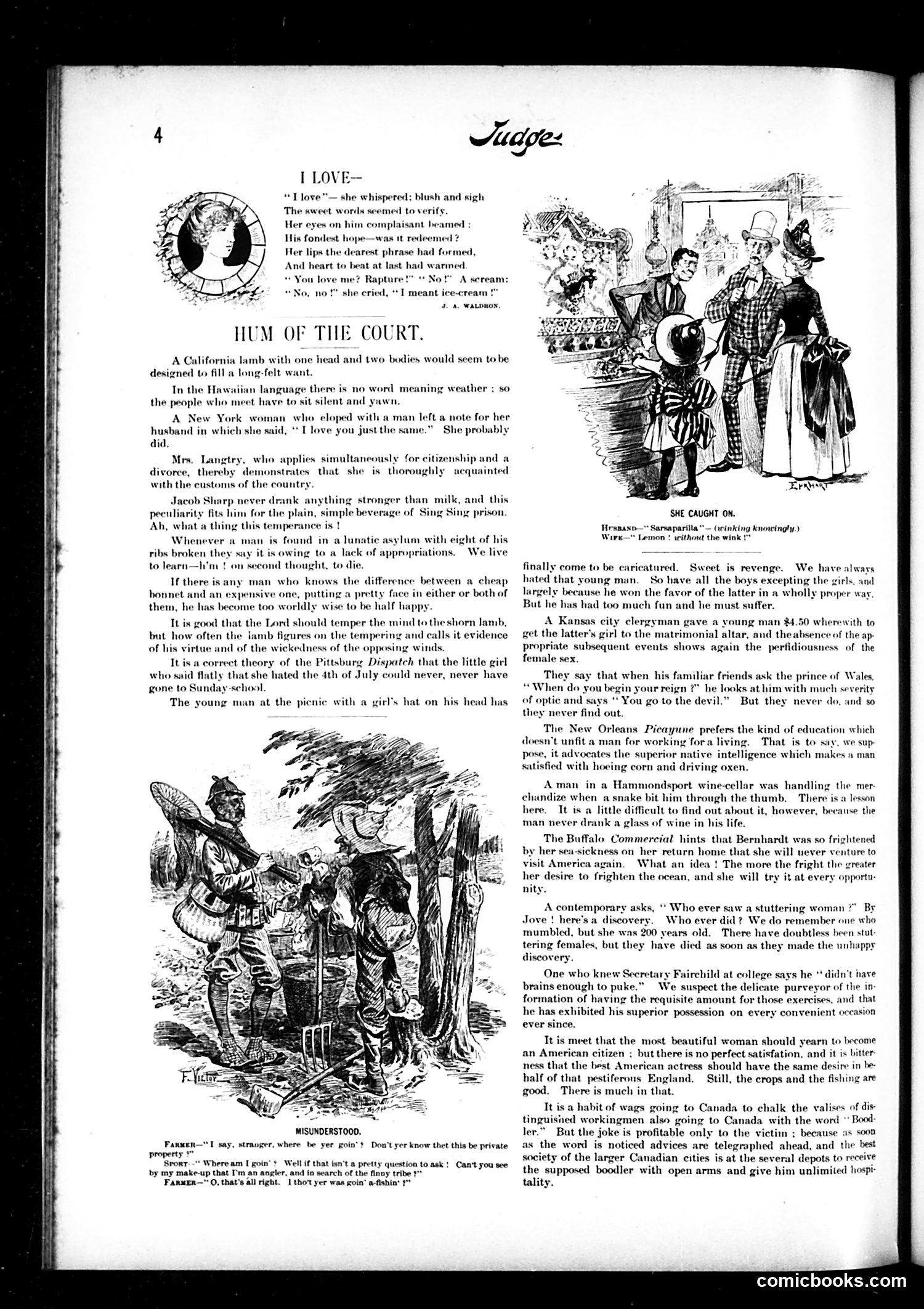
This page contains several satirical pieces typical of late-19th-century American humor: **"I Love"** (top left): A romantic verse where a woman whispers "I love you"—but clarifies she meant *ice cream*, not the man. The joke mocks sentimental romance and female fickleness. **"Hum of the Court"** (main text): A collection of brief satirical observations about contemporary society, including jabs at: - Hawaiian language limitations - Mrs. Langtry (actress Lillie Langtry, seeking simultaneous citizenship and divorce) - Sing Sing prison conditions - Lunatic asylums and political corruption - Various social absurdities **"Misunderstood"** and **"She Caught On"** (bottom cartoons): Short comedic sketches about miscommunication—a farmer mistaking a fisherman for a trespasser, and a wife catching her husband's euphemistic wink about "sarsaparilla" (likely coded language). The page exemplifies *Judge*'s format: mixing verse, commentary on current events/celebrities, and comic vignettes to satirize American society, pretension, and gender relations.
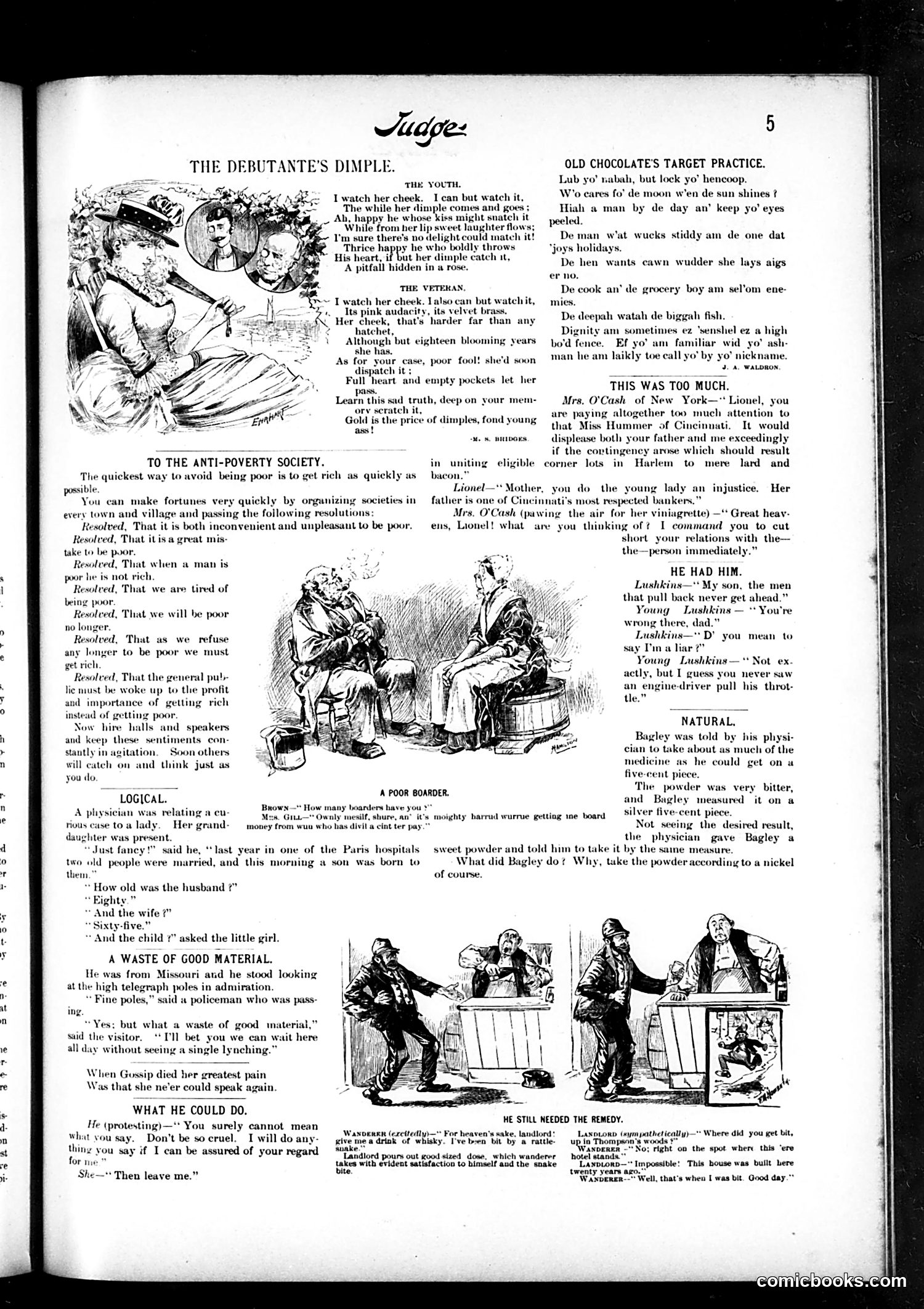
This page from *Judge* contains several satirical pieces mocking American social pretensions and human folly: **"The Debutante's Dimple"** ridicules young men infatuated with wealthy debutantes, warning that their romantic pursuits of rich girls will leave them financially ruined ("Full heart and empty pockets"). **"To the Anti-Poverty Society"** sarcastically critiques poverty-relief organizations by suggesting their solution—passing resolutions stating "we will be poor no longer"—is absurdly simplistic, implying such groups accomplish nothing. **"Logical"** presents a crude joke about an elderly couple having a child, playing on the medical impossibility. **"A Poor Boarder"** depicts landlord-tenant conflict, with a landlord complaining about collecting rent from destitute boarders. **"A Waste of Good Material"** mocks Southern racism, with a Missouri man disappointed that a lynching didn't occur. The remaining pieces—"Natural," "He Had Him," and "It Still Needed the Remedy"—contain dialogue jokes about medical treatments and domestic disputes. The dialect pieces employ period-typical stereotypical speech patterns reflecting class and regional attitudes.
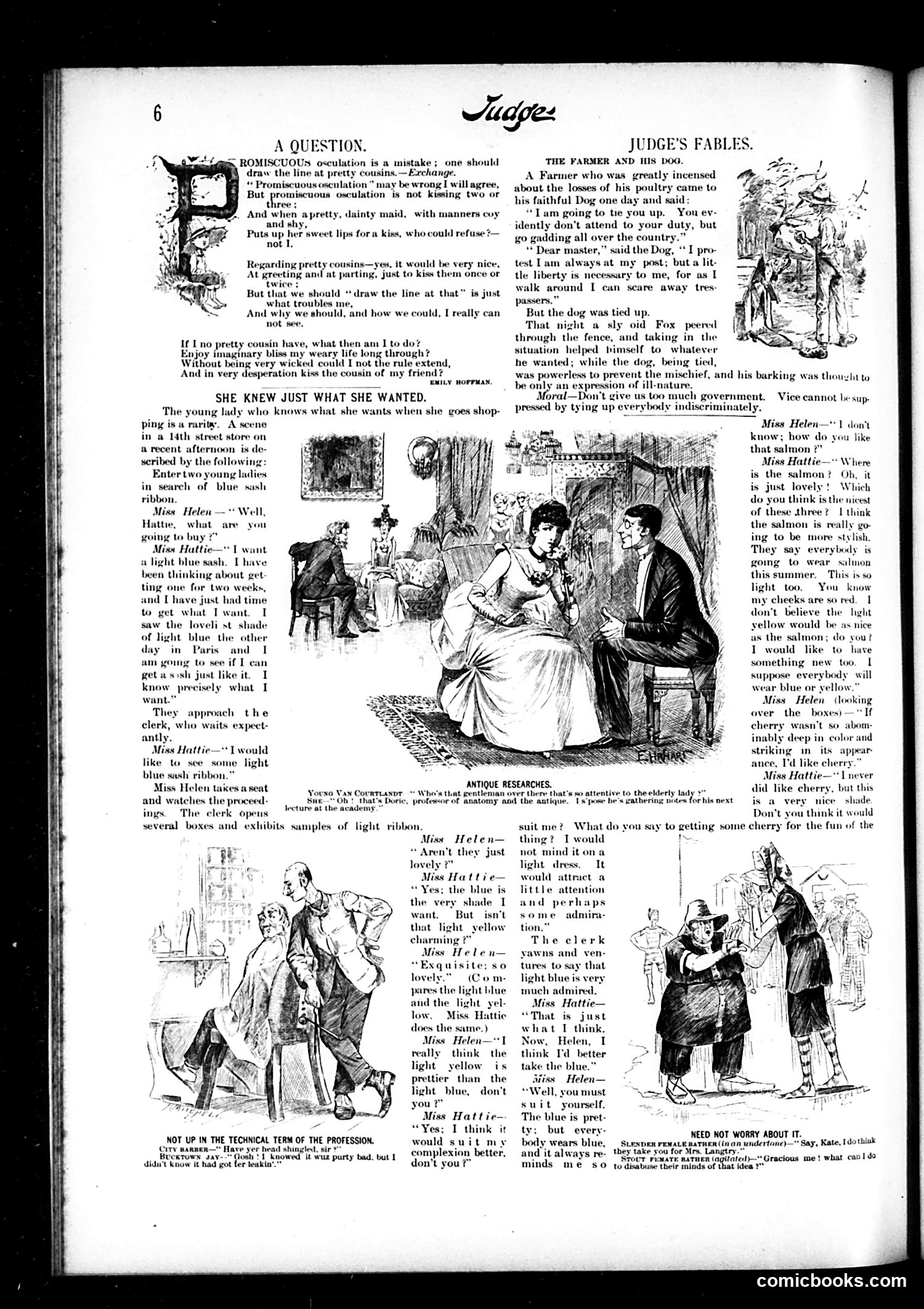
This page contains three distinct satirical pieces: **"A Question"** debates the etiquette of kissing relatives—specifically whether "promiscuous osculation" (indiscriminate kissing) with cousins is proper. The satire mocks social anxiety over courtship rules and physical affection norms of the era. **"The Farmer and His Dog"** is a fable criticizing government overreach. A farmer punishes his loyal dog by tying it up, supposedly for neglecting duty. The dog protests he needs freedom to work effectively; restrained, he cannot prevent a fox from raiding the farm. The moral attacks excessive restrictions on liberty, suggesting "Vice cannot be supposed by tying up everybody indiscriminately"—likely commentary on Gilded Age regulatory debates. **"She Knew Just What She Wanted"** satirizes women's indecisiveness about fashion. Two young ladies shop for ribbon; one decisively wants light blue (from Paris), while the other endlessly deliberates between salmon, light yellow, and blue. The clerk's yawns underscore female shopping paralysis as comedic fodder. All three pieces rely on period-specific social anxieties: propriety, liberty, and gender expectations.
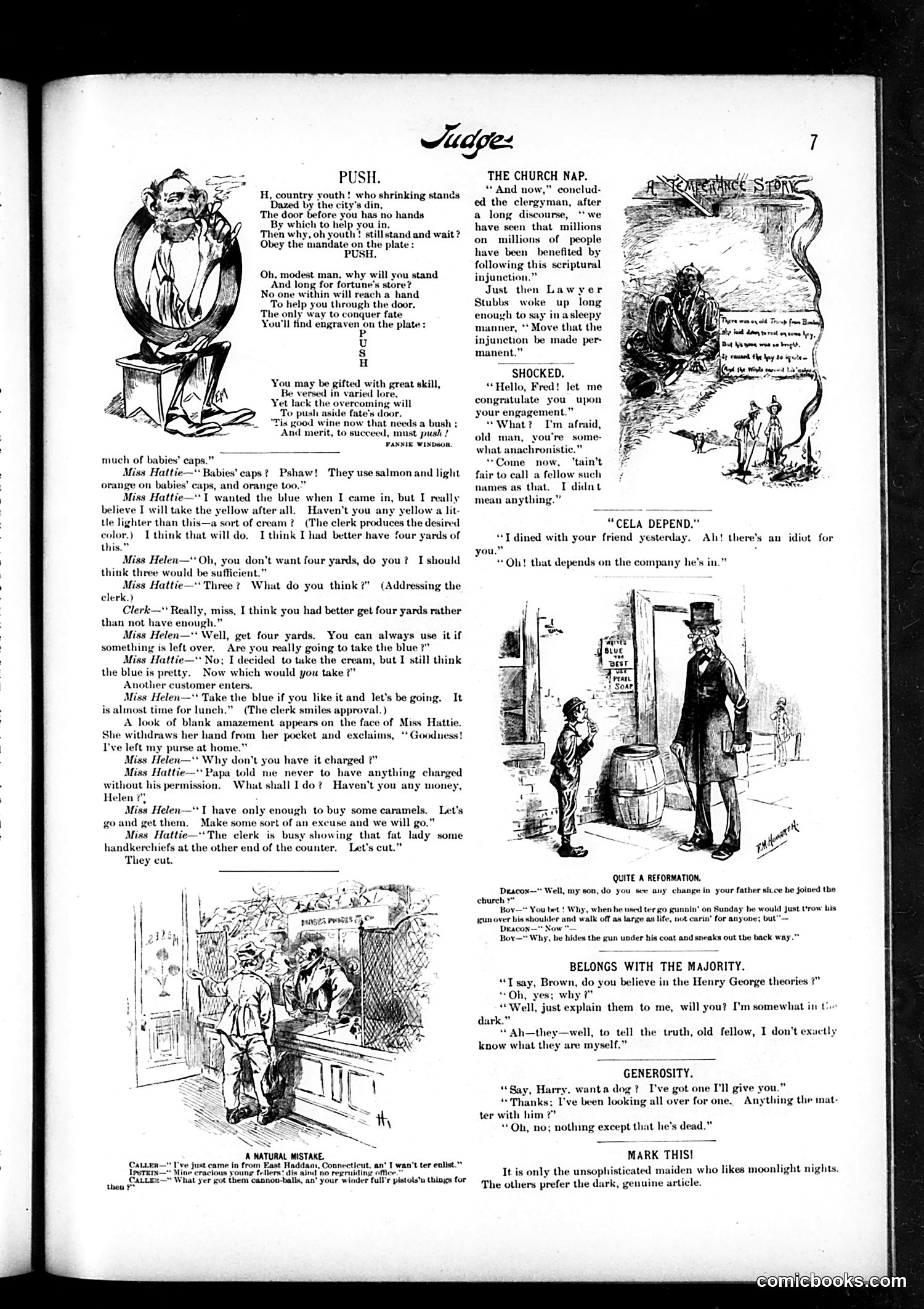
This page collects brief humorous sketches satirizing American social conventions and hypocrisy. **"Push"** (top): A moralizing poem about self-reliance—encouraging young men to take initiative rather than wait passively for fortune. Typical Victorian advice literature. **"The Church Nap"**: Lawyer Stubbs sleeps through a sermon, then groggily moves to make the clergyman's "injunction" permanent—confusing legal and religious language for comedic effect. **"Cela Depend"**: Social satire on inconsistent judgment—a man's character depends entirely on "company," suggesting shallow, unprincipled society. **"Quite a Reformation"**: A father's conversion to church attendance changes his Sunday behavior from openly carrying guns to hiding them "under his coat"—he's reformed appearance, not conduct. **"Belongs with the Majority"**: Mocks intellectual pretense. When asked about Henry George's economic theories, a man admits he doesn't understand them but believes in them anyway—satirizing blind conformity. The sketches ridicule Victorian hypocrisy, shallow faith, and unthinking adherence to popular opinion.
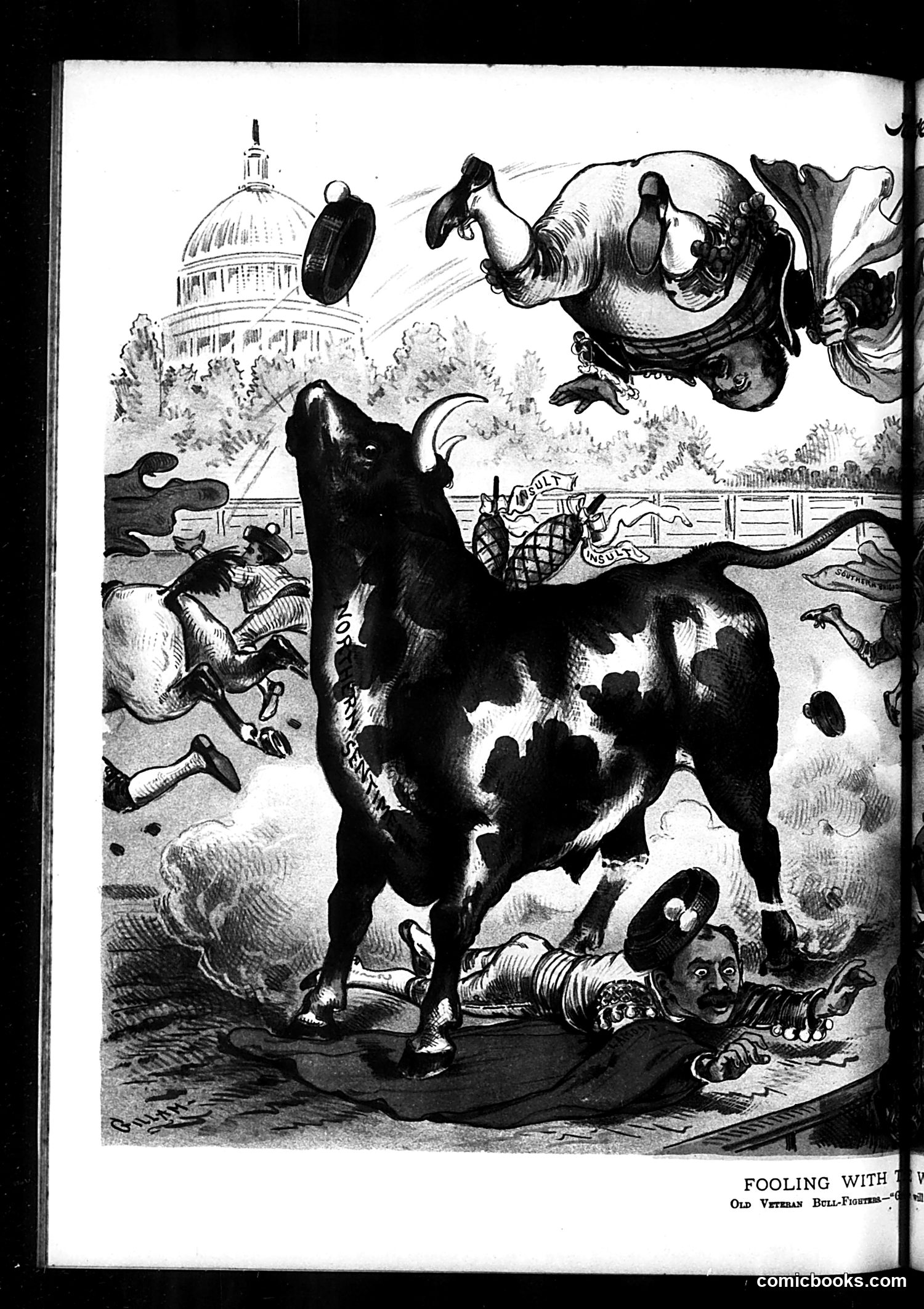
This political cartoon depicts a large cow being provoked by multiple figures in a chaotic scene. The Capitol building is visible in the background, suggesting this is commentary on Washington politics. The cow appears to represent an established political institution or veteran politician (the "Old Veteran" referenced in the title). Various figures—some appearing to be politicians or agitators—are taunting and attacking the cow, which responds with characteristic bovine aggression, kicking figures into the air. The satire criticizes people who deliberately provoke established political powers, suggesting such provocation is foolish and dangerous. The phrase "bell-fighters" likely refers to those who ring bells to agitate bulls in combat, making this a metaphor for political rabble-rousers stirring up trouble with entrenched power.
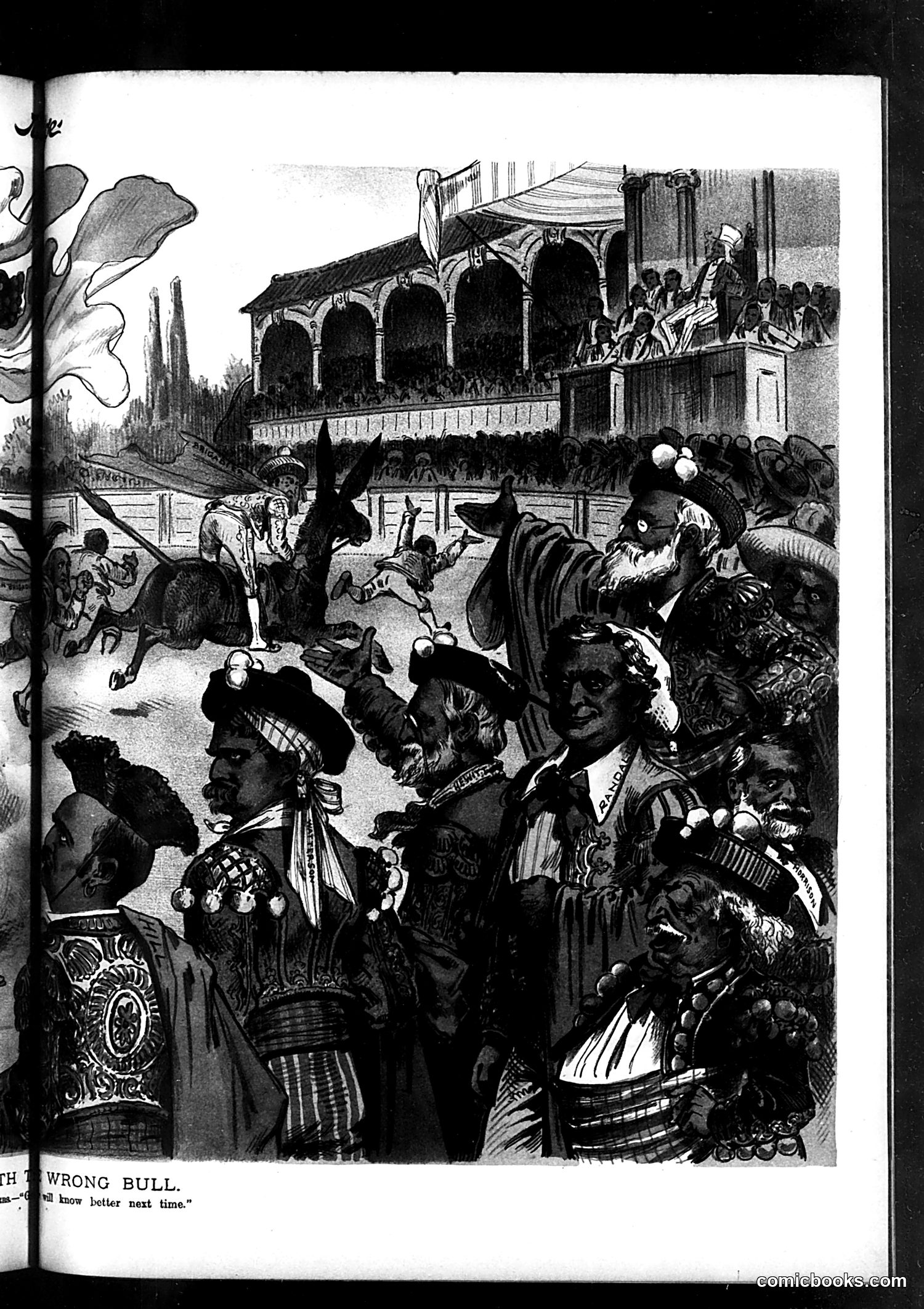
This cartoon depicts a bullfighting scene with spectators in period dress watching from stands. The caption "He'll know better next time" suggests a satirical comment on a failed or mistaken action with consequences. The figures in the foreground wear elaborate military uniforms and decorative regalia, indicating they are likely political or military leaders. The bullfighting setting appears metaphorical—possibly commenting on diplomatic or political conflict being handled poorly or recklessly. Without knowing the specific publication date, the exact identities remain unclear, but the satire seems to mock those in power for their missteps, implying they faced predictable consequences for choosing the "wrong" approach, much like a matador might face a bull unprepared.
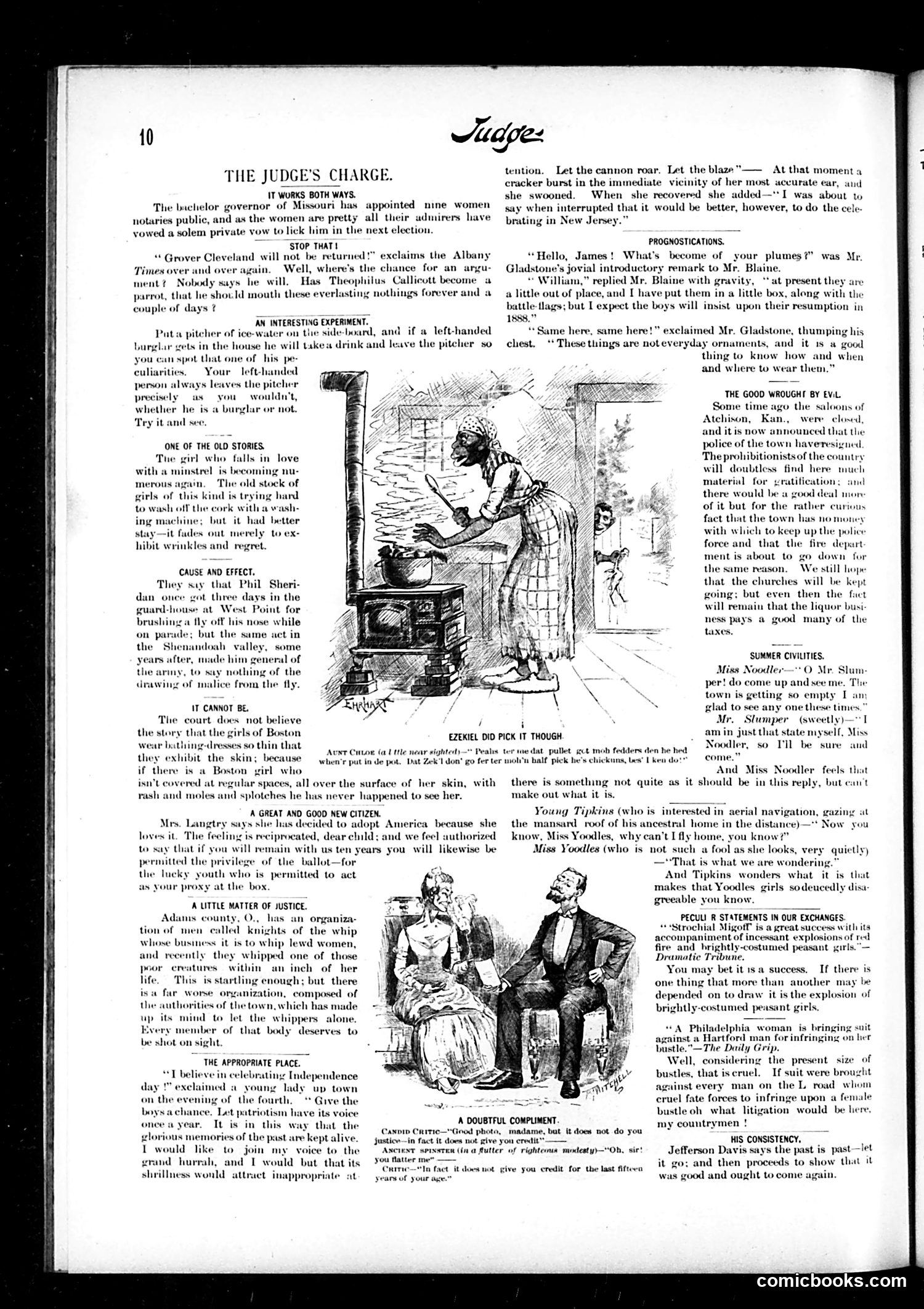
This page contains multiple brief satirical items typical of Judge's format: **"It Works Both Ways"**: Mocks Missouri's bachelor governor for appointing female notaries public. The joke: his political admirers (wanting to court the women) now threaten to vote against him—the appointments backfired. **"One of the Old Stories"**: Satirizes the cliché of girls falling for minstrel performers, suggesting the romantic appeal fades when reality (washing off makeup) reveals skin imperfections. **"A Great and Good New Citizen"**: References actress Lillie Langtry's adoption of American citizenship. The satirical "compliment" suggests she'll need to wait ten years before gaining voting rights—mocking both her and restrictive women's suffrage. **"A Little Matter of Justice"**: Condemns vigilante "knights of the whip" (appearing to reference actual organizations) who whipped women while local authorities ignored them—exposing hypocrisy and lawlessness. The cartoons illustrate these brief commentary pieces with period-appropriate sketches of the scenarios described.
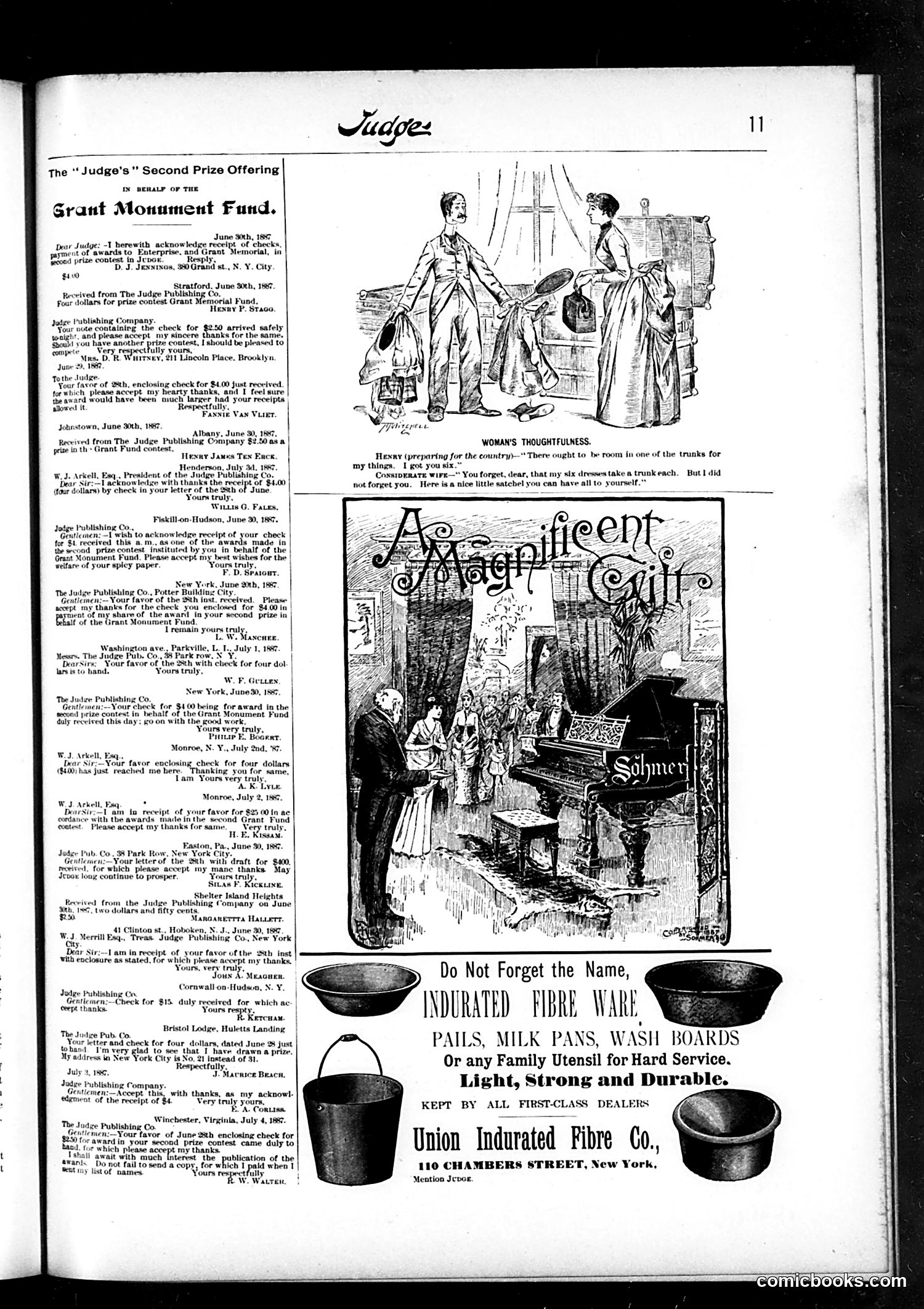
This page documents **The Judge Publishing Company's second prize-drawing contest benefiting the Grant Monument Fund** (a memorial to President Ulysses S. Grant, who died in 1885). The page consists almost entirely of **acknowledgment letters from contest winners** who received monetary awards—typically $2-$4 each—between June and July 1887. These are genuine thank-you notes from across America (Brooklyn, Monroe, Johnstown, etc.), published to demonstrate the contest's legitimacy and encourage future participation. The two illustrations are unrelated **advertisements**: "A Negligent Earth" (promoting Sohmer pianos) and "Indurated Fibre Ware" (hawking durable household kitchenware). **Context for modern readers**: This reflects late-19th-century fundraising practices where magazines held contests to raise money for public monuments while simultaneously building circulation and goodwill. The published letters served as both proof of legitimacy and marketing material.
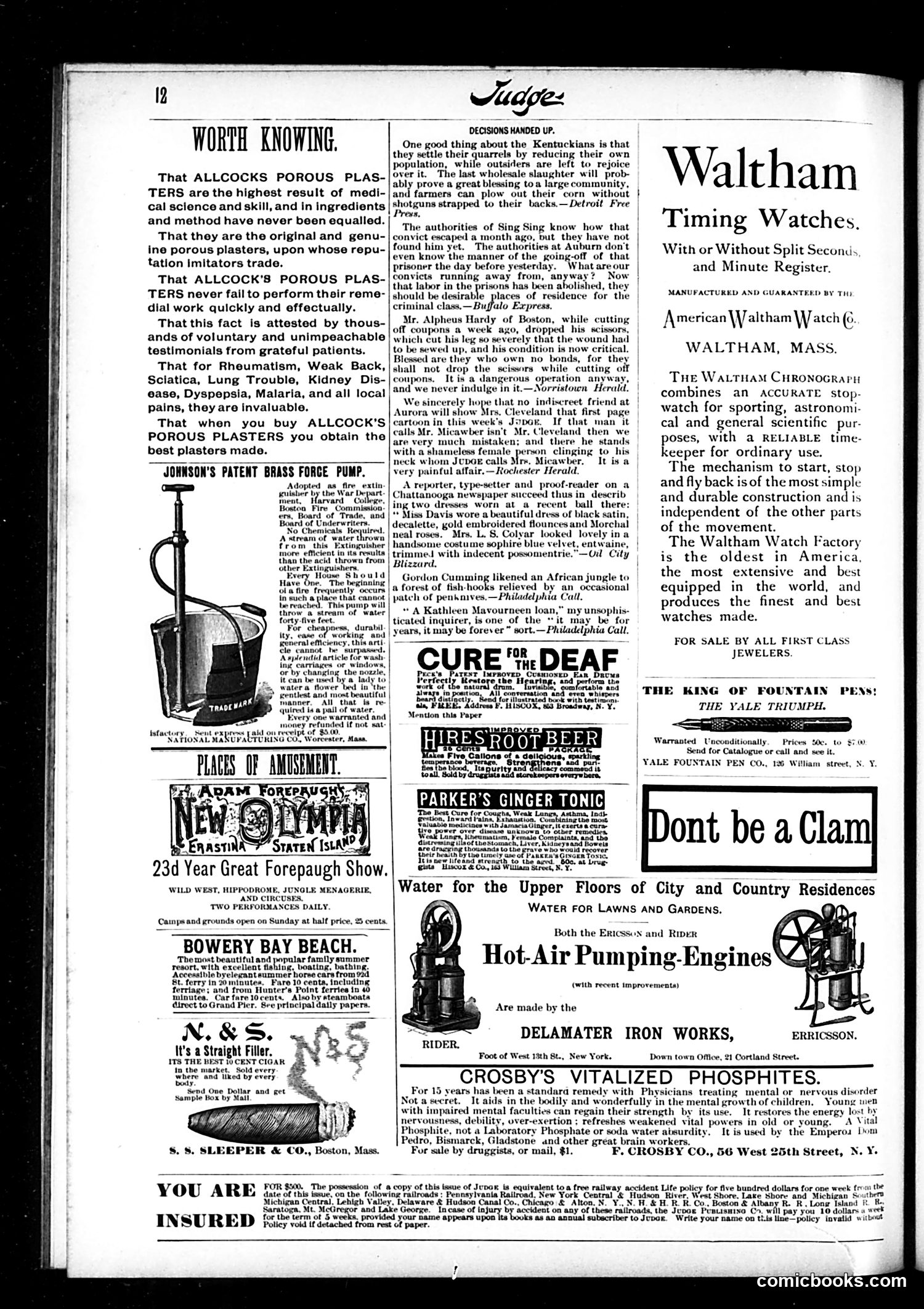
This page is primarily **advertising**, not political satire. The dominant content consists of product advertisements for patent medicines and devices (Allcock's Porous Plasters, Johnson's Brass Force Pump, Hires Root Beer, etc.) and entertainment venues, typical of *Judge* magazine's revenue model. The small "DECISIONS HANDED UP" section appears to be brief satirical commentary on regional news—Kentucky violence, escaped convicts, and various local incidents—presented as mock "judicial decisions." One item makes light of wealthy Bostonians accidentally injuring themselves with scissors while cutting bond coupons, mocking the idle rich. Another jibes at the Cleveland presidency regarding unnamed scandals. The satire is **gentle social commentary** rather than sharp political critique, reflecting *Judge's* focus on domestic scandal and regional foibles rather than national politics on this particular page.
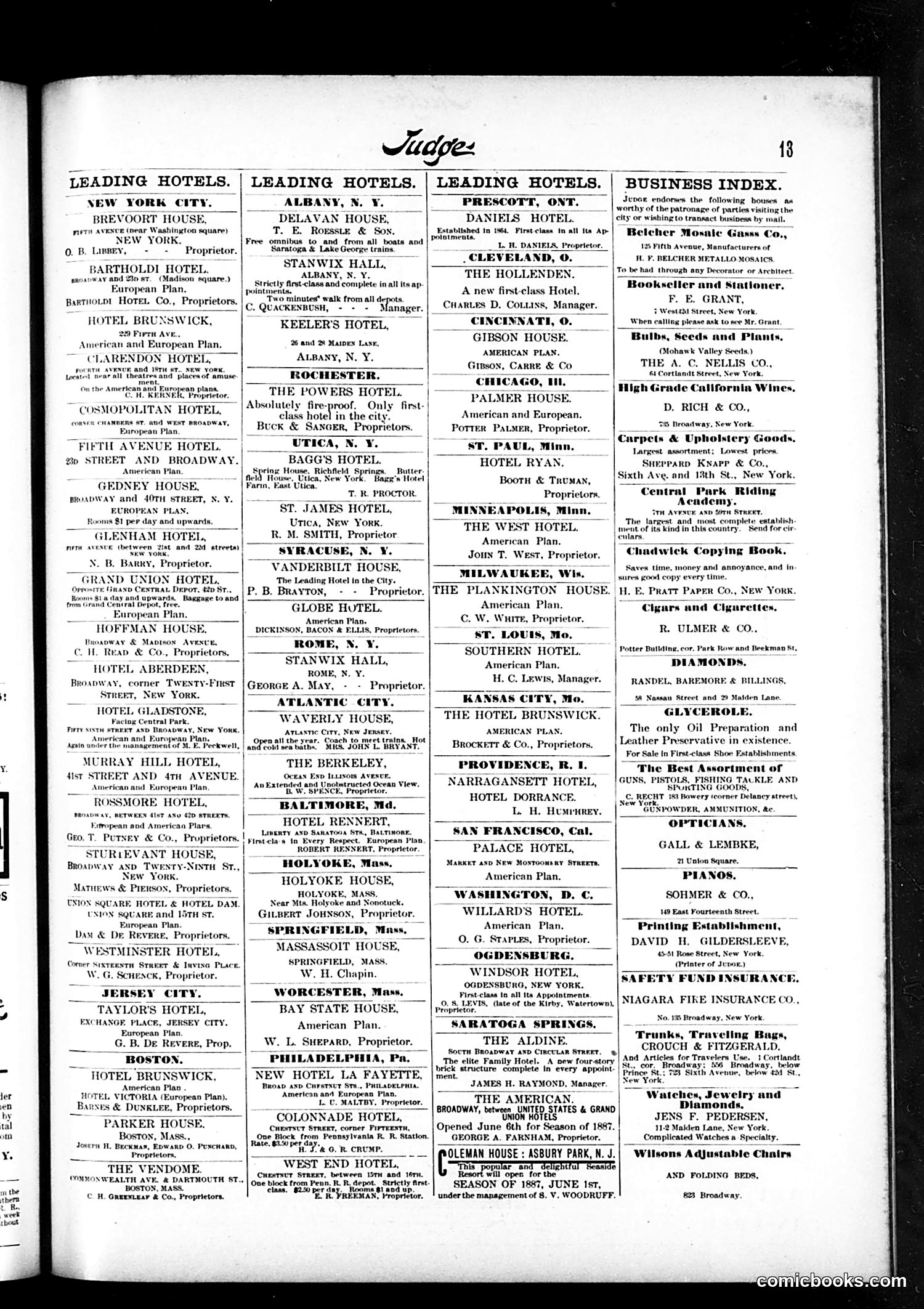
This page is primarily a **business directory of leading hotels**, not a satirical cartoon page. It lists American hotels by city (New York, Albany, Boston, Philadelphia, Chicago, San Francisco, Washington D.C., etc.) with proprietor names and brief descriptions of amenities. The right column contains a "Business Index" advertising various goods and services—metalwork, bookbinding, carpets, cigars, pianos, insurance, and watches. **There is no identifiable cartoon or satirical content** on this page. Judge magazine typically featured political satire and humor, but this particular page functions as advertising and commercial directory material—likely filler content between editorial pages. It represents the magazine's commercial revenue model, where ads subsidized publication costs.
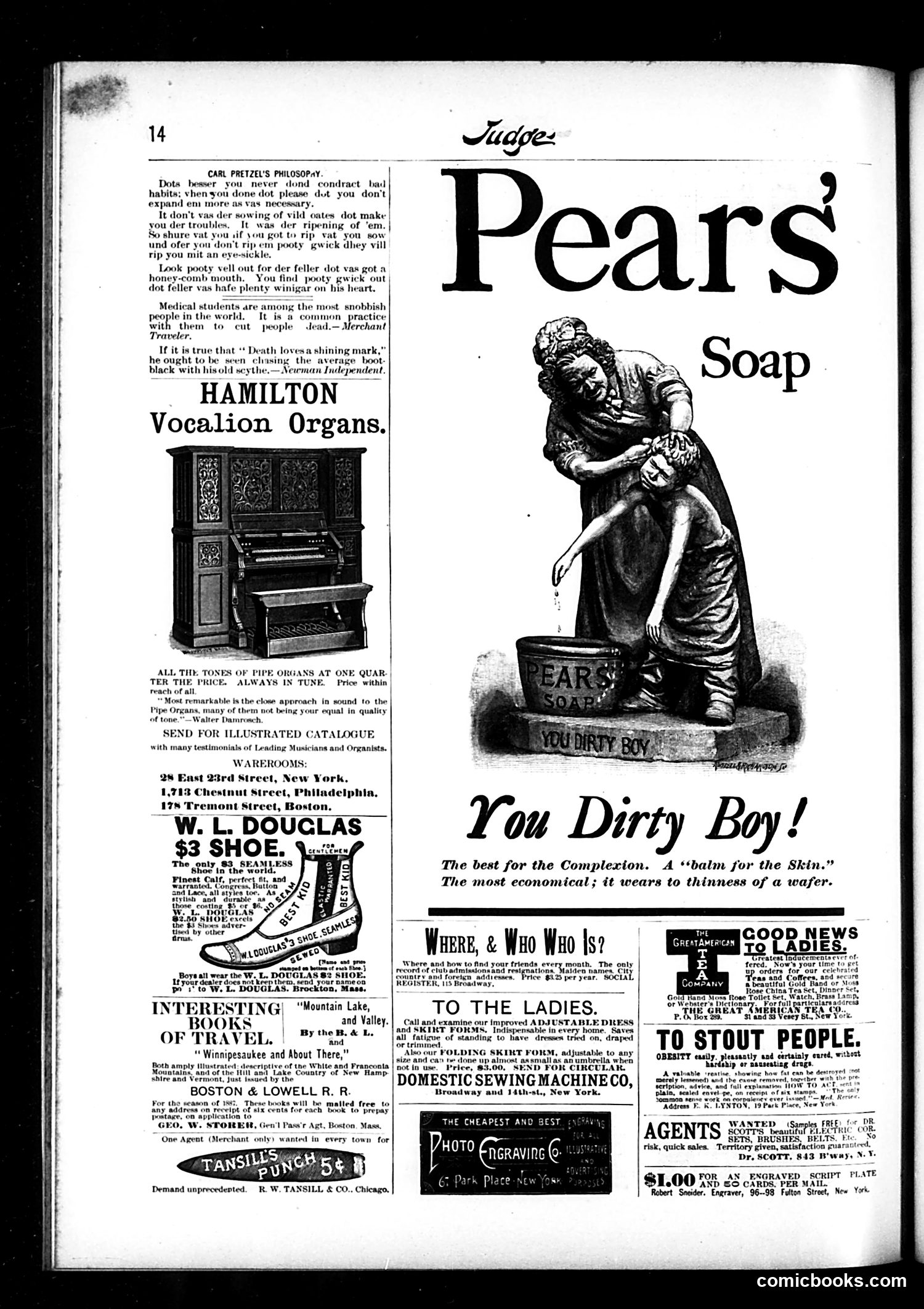
This page is primarily **advertising content**, not political satire. The dominant feature is a large advertisement for **Pears' Soap** showing a caricatured figure (appears to be a working-class or lower-class person) scrubbing a child clean, with the tagline "You Dirty Boy!" **The satire/humor**: The ad plays on Victorian-era class anxiety and cleanliness obsession. The exaggerated caricature and condescending tone suggest soap as a tool for "civilizing" the working classes—a common advertising trope of the era. The dramatic before/after implication mocked by the phrase satirizes how middle-class products were marketed as moral/social necessities rather than mere hygiene items. **Context for modern readers**: Late 19th-century advertising often used class-based humor and relied on viewers finding working-class stereotypes amusing. The ad's messaging reflects genuine period attitudes that cleanliness signified respectability and social status. The rest of the page contains various other period advertisements (organs, shoes, sewing machines), with one brief philosophical quote attributed to "Carl Pretzel"—likely a humorous ethnic character name common to Judge magazine's content.
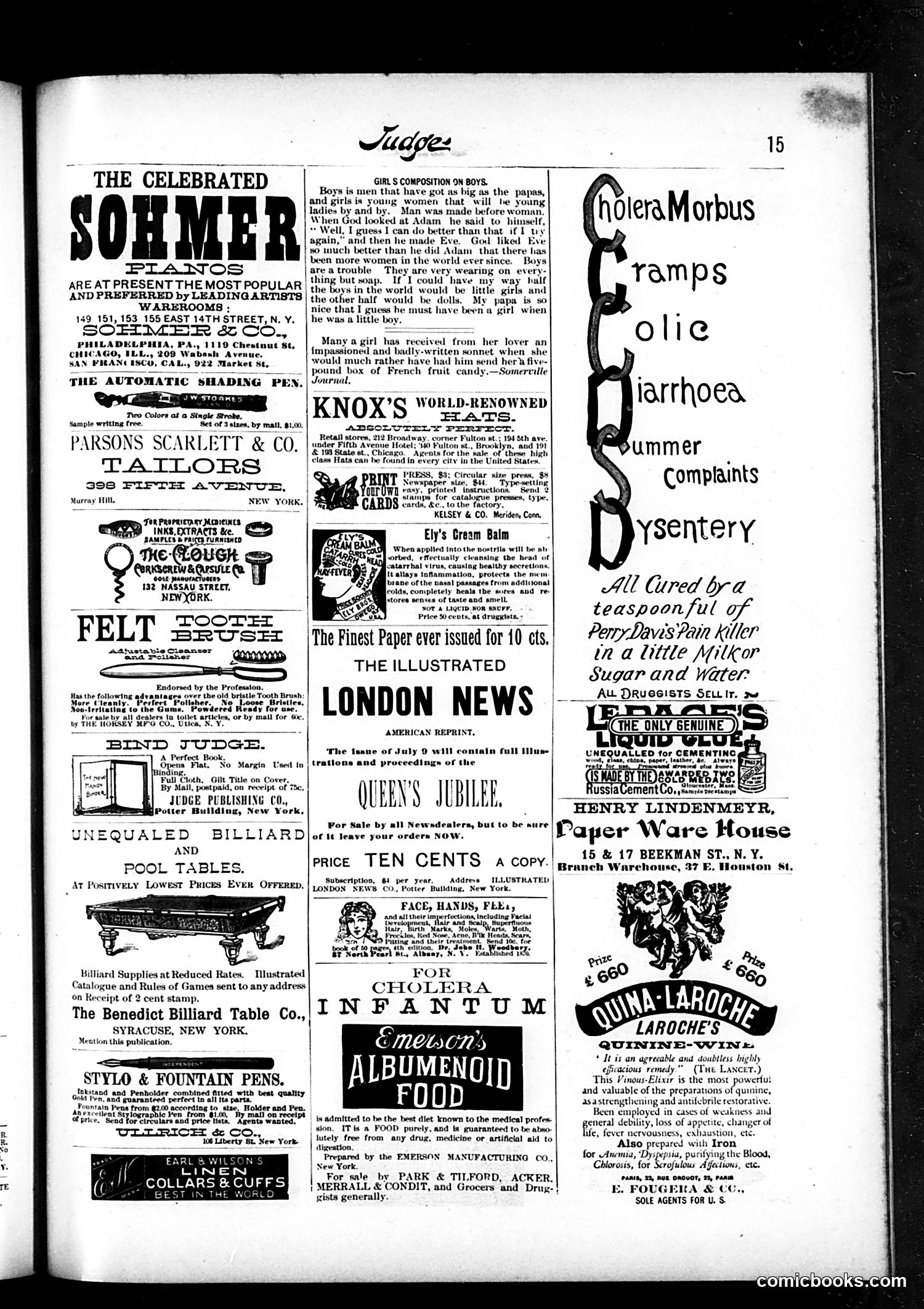
This page is primarily **advertising** rather than political satire or editorial cartooning. It contains: **Merchandise advertisements** for: - Sohmer pianos - Billiard tables - Fountain pens - Printing presses - Various patent medicines (Ely's Cream Balm for catarrh, Emerson's Albumenoid Food) - Hat manufacturers - Newspaper subscriptions **One genuine content piece**: A humorous **"Girl's Composition on Boys"** — a satirical short essay apparently written by a young girl offering naive observations about the sexes. It employs gentle period humor contrasting male and female behavior (boys are "troublesome," girls prefer candy to love sonnets, etc.). The page also advertises the **Illustrated London News** covering the **Queen's Jubilee** (likely Victoria's, though the specific year isn't visible here). This is a typical late-19th-century magazine page mixing editorial content with classified and display advertising—the primary revenue source for publications of that era.
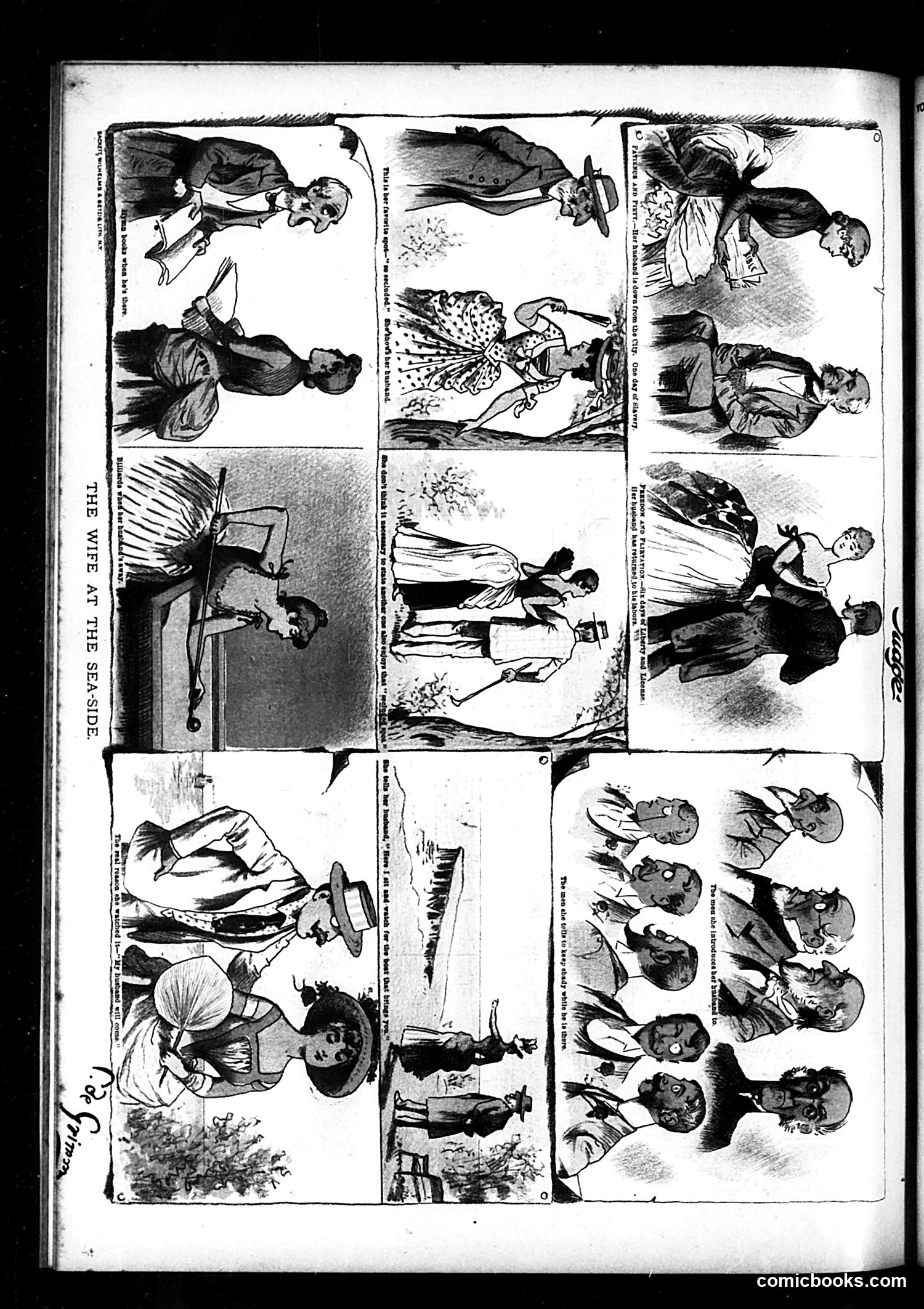
This page appears to be a humorous comic strip about a wife waiting at the seaside. The caption suggests irony: while the wife claims to watch for a boat bringing her husband, the OCR'd text hints at an unstated "real reason" she watches—implying she has ulterior motives beyond greeting him. The multiple panels likely show various seaside scenes and characters, though specific identities are unclear in this reproduction. The satire appears to target marriage dynamics and female behavior, playing on period assumptions about wives' motivations and fidelity. The joke structure—setup versus revealed "real reason"—was typical of Judge magazine's comedic style, which frequently used domestic situations for social commentary and humor, often with somewhat cynical takes on relationships.