
Judge, 1887-07-16 · page 3 of 16
Judge — July 16, 1887 — page 3: what you’re looking at
What you’re looking at
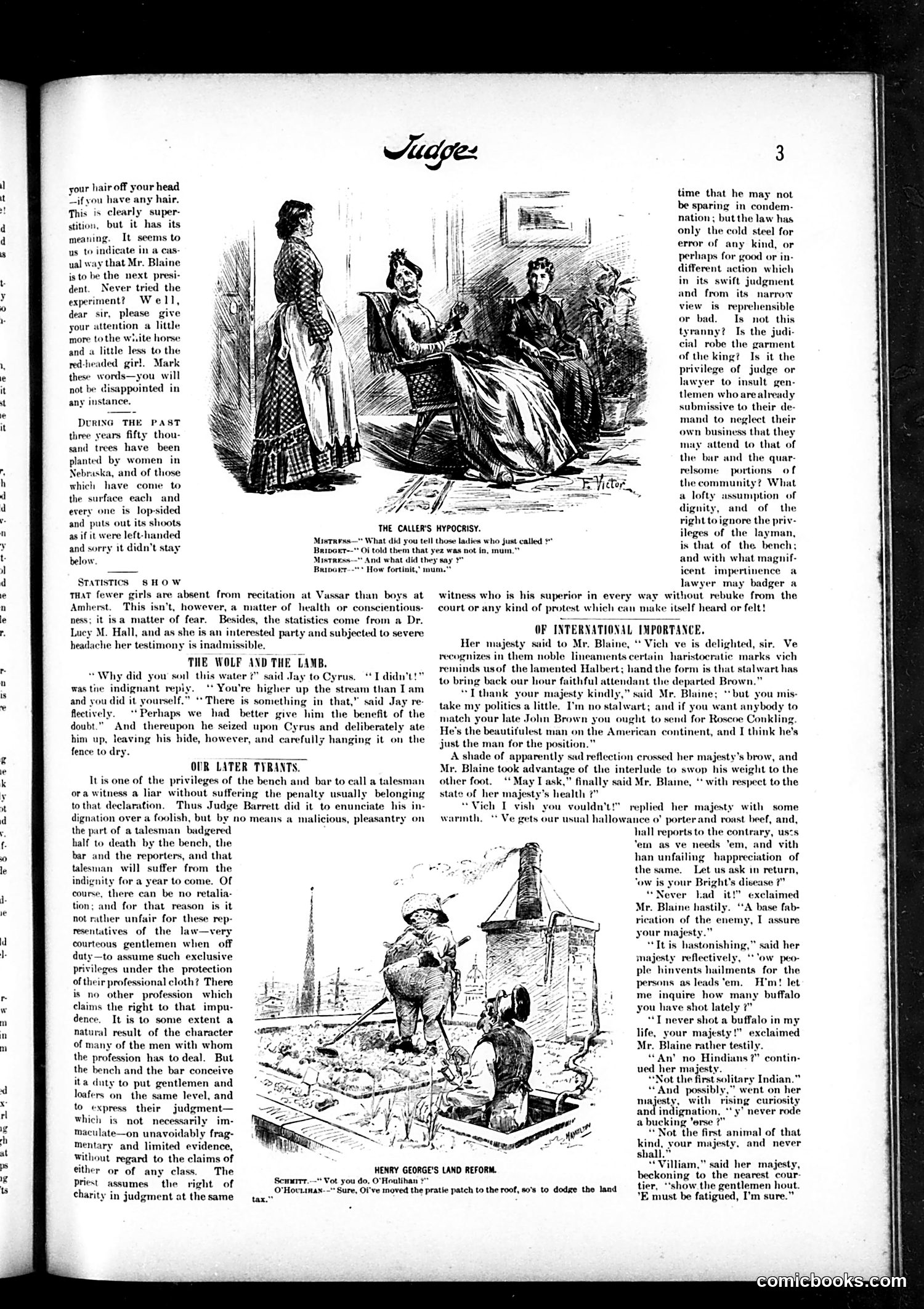
This page contains several satirical pieces critiquing American institutions and figures circa the 1880s: **"The Wolf and the Lamb"** appears to reference the Jay Gould–Cyrus Field railroad dispute, using Aesop's fable to satirize how the powerful exploit procedural advantages to crush rivals regardless of actual guilt. **"Our Later Tyrants"** attacks judicial arrogance—specifically judges' and lawyers' privilege to call witnesses "liars" without legal consequence, while ordinary citizens face penalties for identical behavior. The satire argues this legal immunity reflects unfair class privilege. **"The Caller's Hypocrisy"** is a brief joke about a servant falsely claiming callers weren't home, then admitting the lie—mocking social pretense. **"Henry George's Land Reform"** satirizes the Single Tax movement by showing an Irishman moving his potato patch to his roof to avoid land taxes—absurdist commentary on the impracticality of George's proposals. The page also includes casual observations on superstition regarding James G. Blaine's presidential prospects and women planting trees in Nebraska, establishing Judge's tone of irreverent social commentary.
📄 Transcribed text from this page (OCR, searchable)
Machine-transcribed from the original scan — historical spelling and the odd misread are preserved.
your hair off your head Lifyou have any hair. This is clearly super- stition, but it has its meaning. It seems to us to indicate in a cas- ual way that Mr. Blaine is to be the next presi- dent. Never tried the experiment?’ Well, dear sir, please give your attention a litle more tothe wihite horse and a little less to the red-headed girl, Mark ppointed in any instance. DvrING THE PAST three years fifty thou- sand trees have been planted by women in Nebras! id of those which have come to the surface each and every one is lop-sided and puts out its shoots as if it were left-handed and sorry it didn’t stay below Misrreas STATISTICS SHOW Tat fewer girls are absent from recitation at Vassar than boys at Amhi This isn't, however, a matter of health or conscientious: ness; it isa matter of fear. Besides, the stati come from a Dr. Lucy M. Hall, and as she is an interested party and subjected to severe headache her testimony is inadmissible. THE WOLF AND THE LAMB. “Why did you’ soil this water ¢” said Jay to Cyrus. ‘I didn't!” was tne indignant repiy. You’ re higher up the stream than Lam and you did it yourself, something in that,” said Jay re- flecti “Perhaps we had better give him the benefit of the doubt.” And thereupon he seized upon Cyrus and deliberately ate him up, leaving his hide, however, and carefully hanging it on the fence to dry OUR LATER TYRA. It is one of the privileges of the bench and bar to calla sman ora witness a liar without suffering the penalty usually belonging to that declaration. Thus Judge Barrett did it to enunciate his in- dignation over a foolish, but by no means a malicious, peasantry on the part of a talesman badgered half to death by the bench, the bar and the reporters, and that n will suffer from the gnity fora to come. Of course, there can be no ret: tion; and for that reason not rather unfair for these rey resentatives of the law—very courteous gentlemen when off duty—to assume such exclusive privileges under the protection of their professional cloth? There is no other profession which claims the right to that impu- dence. It is to some extent a natural result of the character of many of the men with whom the profession has to deal. But the bench and the bar conceive ita duty to put gentlemen and loafers on the same level, and to express their judgment— which is not necessarily im- maculate—on unavoidably frag- mentary and limited evidence, Without regard to the claims of either or of any class. The Priest. assumes the right of charity in judgment at thesame tax." § “ Vot you do, O’Houlihan + O'Hovtinas. THE CALLER'S HYPOCRISY. * What dk! you tell those ladies who just called #* told them that yez was not i, mum." And what did they say 2 jow fortinit,’ mum. HENRY GEORGE'S LAND REFORM. Sure, Oi've moved the pratie patch to the roof, so's to dodge the land tier, 3 time that he may not be sparing in condem- nation ; but the law has only the cold steel for error of any kind, or perhaps for good or in- different action which in its swift judgment nd from its narrow view is. reprehensible or bad. Is not this tyranny? Is the judi- cial robe the garment of the king? Is it the privilege of judge or lawyer to insult gen: tlemen who areal submissive to their di mand to neglect their own business that they may attend to that of the bar and the quar- relsome portions of the community? What a lofty assumption of dignity, and of the right to ignore the priv- ileges of the layman, is that of the bench and with what magnif- icent impertinence a ger a from the id Mr. Blaine: Se but 3 you mis- ; and if you want anybody to ‘your late Jolin: Brown you ouight to send for Roscoe Conkling the beautifulest man on the American continent, and I think he’s just the man for the posi A shade of apparently sad reflection crossed her majesty’s brow, and Mr. Blaine took advantage of the interlude to swop his weight to the other foot. ‘* May I ask,” finally said Mr. Blaine, ‘* with respect to the state of her majesty’s health ?” “Vich TL vish you vouldn't! replied her majesty with some warmth, ** Ve gets our usual hallot ce 0” porter and roast beef, and, hall reports to the contrary, u: ‘em as ve needs ‘em, han unfailing happre the same. Let us ask in return, ‘ow is your Bright's disease ?” by 7 !” exclaimed Mr. Blaine h: “A base fab- rication of the enemy, I assure your majesty.” “It is hastonishing,” said her majesty reflectively, ‘ ‘ow peo- ple hinvents hailments for the persons as leads ‘em. H'm! let me inquire how many buffalo you have shot lately 7” “T never shot a buffalo in my life, your majesty!” Mr. Blaine rather testi “An’ no_ Hindians ?” contin: And possibly mani ty, with and indignation, ng 'erse 2” Not the first animal of that y, and never went on her ng curiosity said her majesty, beckoning to the nearest cour: how the gentlemen hout. ‘E must be fatigued, I'm sure.”