
A complete issue · 20 pages · 1887
Judge — June 25, 1887
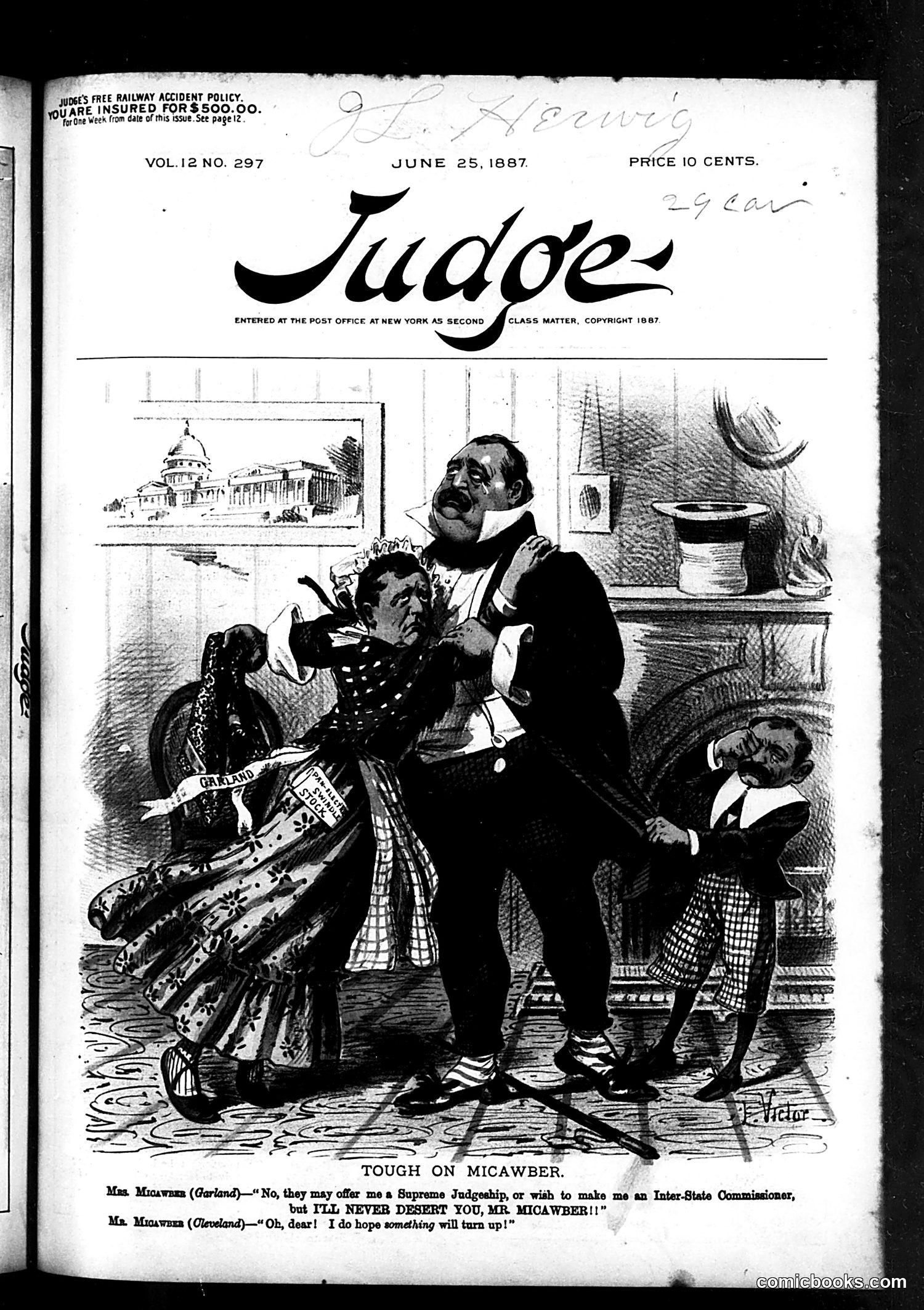
This cartoon satirizes two political figures both nicknamed "Micawber" (referencing Dickens's eternally optimistic character). The central figure holds a distressed child while addressing someone off-panel. The dialogue contrasts two "Mrs. Micawbers"—one from Garland (likely James A. Garland, possibly related to President Garland) and one from Cleveland (likely President Grover Cleveland). The Garland figure refuses positions like Supreme Judge or Inter-State Commissioner, insisting "I'll NEVER DESERT YOU, MR. MICAWBER!" The Cleveland figure responds with worry about the consequences. The cartoon appears to mock political patronage disputes and broken promises of political loyalty during the Cleveland administration, using Dickens's character type to critique politicians' self-serving optimism and unreliability.
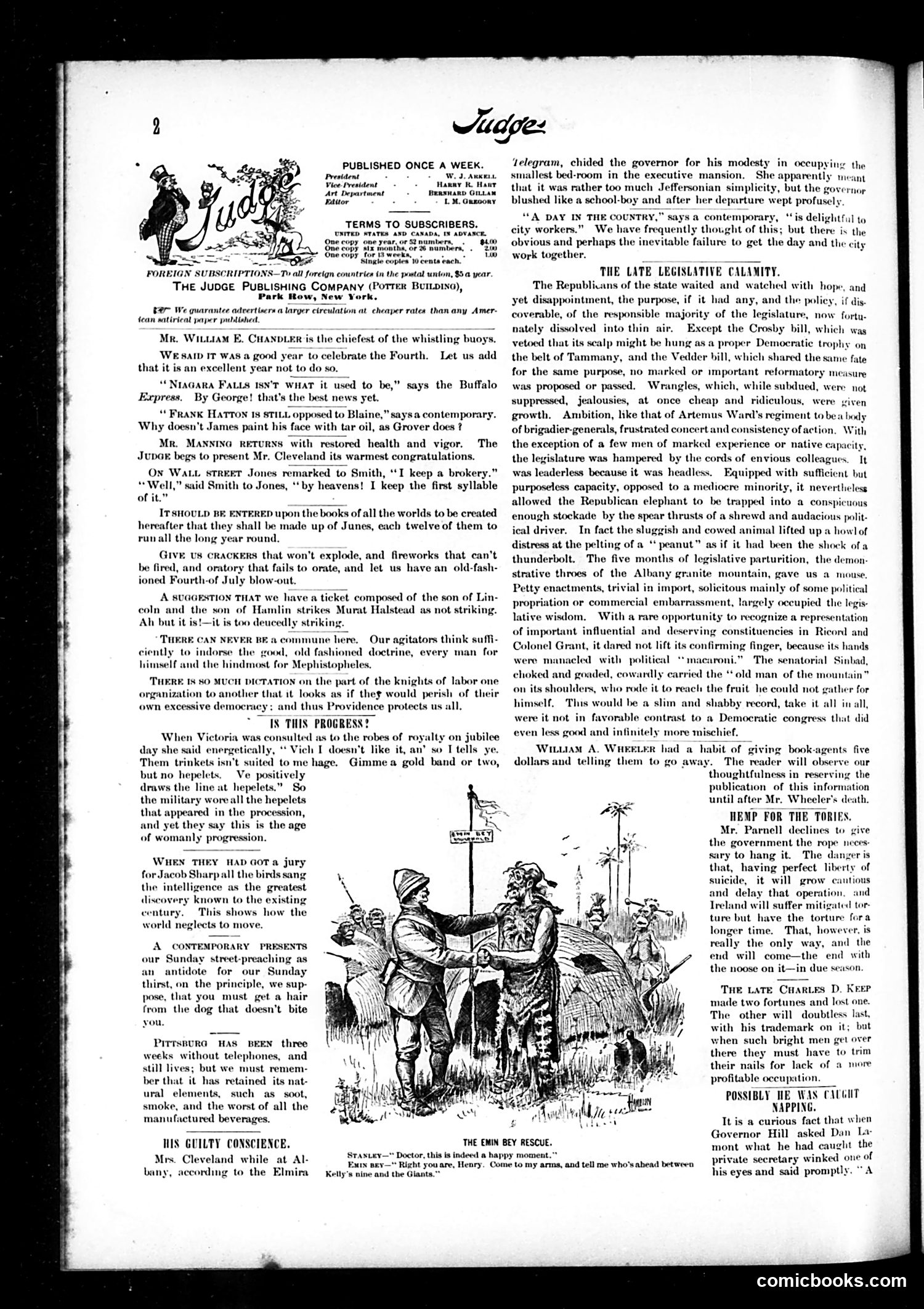
This cartoon satirizes a contemporary political or social situation involving the rescue of a boy named Erin. The dialogue—"Doctor, this is indeed a happy moment" / "Right you are, Henry. Come to my arms, and tell me who's ahead between Kelly's mule and the clams"—suggests a comedic non-sequitur where urgent concern for the rescued child is immediately displaced by trivial concerns (a mule race and seafood). The satire likely mocks political or public figures (possibly including someone named Kelly) who exploit dramatic news events for personal gain or attention while remaining indifferent to genuine welfare concerns. The juxtaposition of rescue with absurd priorities reflects Judge magazine's typical critique of public hypocrisy and misplaced priorities among the era's political class.
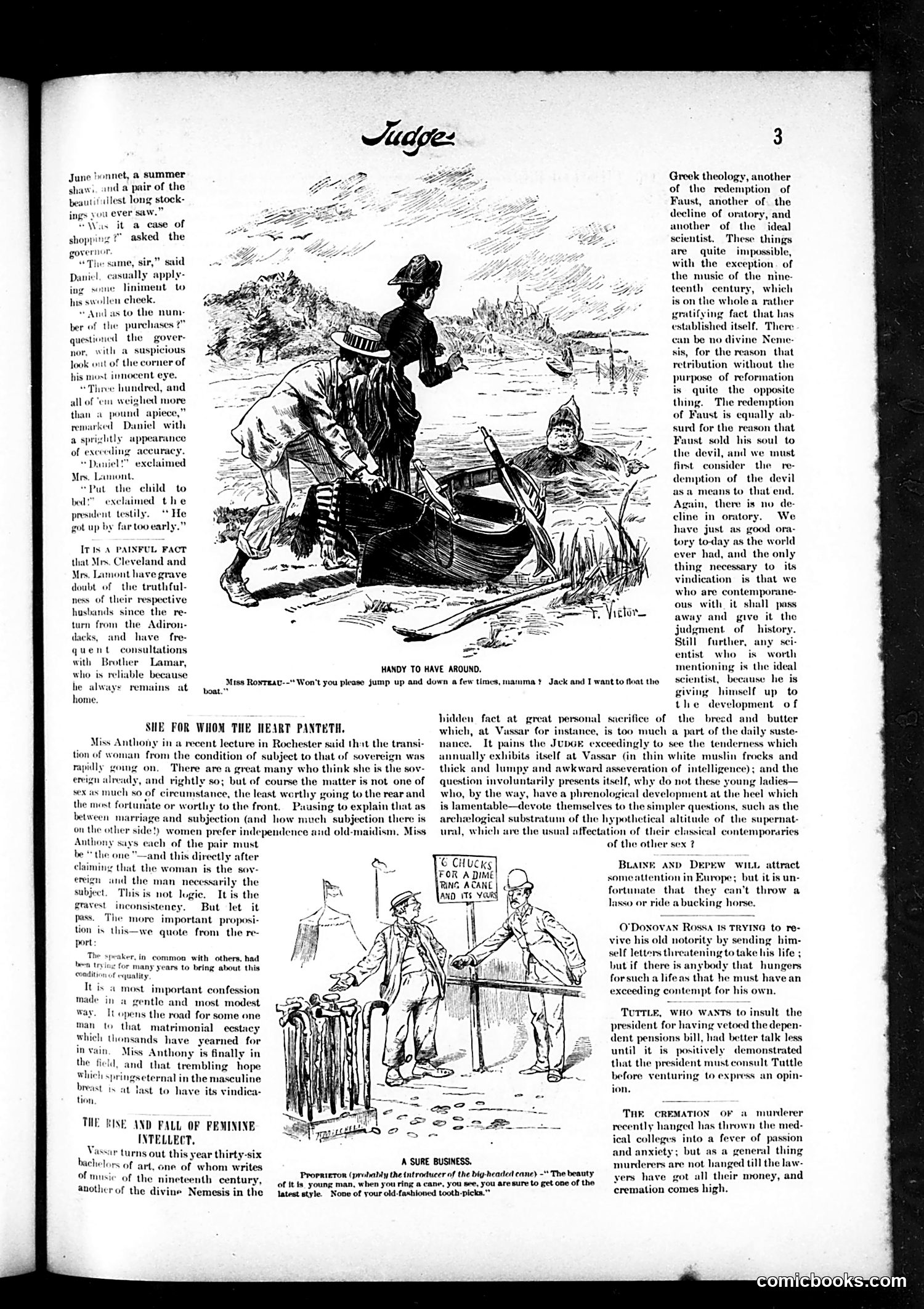
This page contains multiple satirical pieces typical of Judge's social commentary: **"Handy to Have Around"** (top cartoon): Depicts a woman asking her mother to jump repeatedly so children can float a boat—absurd domestic logic satirizing women's impracticality or the era's stereotypes about female reasoning. **"She for Whom the Heart Panteth"**: Critiques Susan B. Anthony's recent Rochester lecture on women's suffrage and independence. The satire mocks Anthony's apparent contradiction: she champions women's independence from marriage while simultaneously suggesting women should be "the subject" in relationships. The piece argues her logic is inconsistent—if women are sovereign, they can't also be subjects. **"The Rise and Fall of Feminine Intellect"**: Reports that Vassar produced thirty-six male graduates with impressive scholarly achievements (medieval music, Greek theology, etc.), then sardonically argues these accomplishments are logically impossible or absurd—attacking both women's education and abstract scholarship simultaneously. **"A Sure Business"** (bottom): A vendor promoting a cane-ringing device that supposedly guarantees fashionable results, satirizing consumer gullibility and dubious commercial schemes.
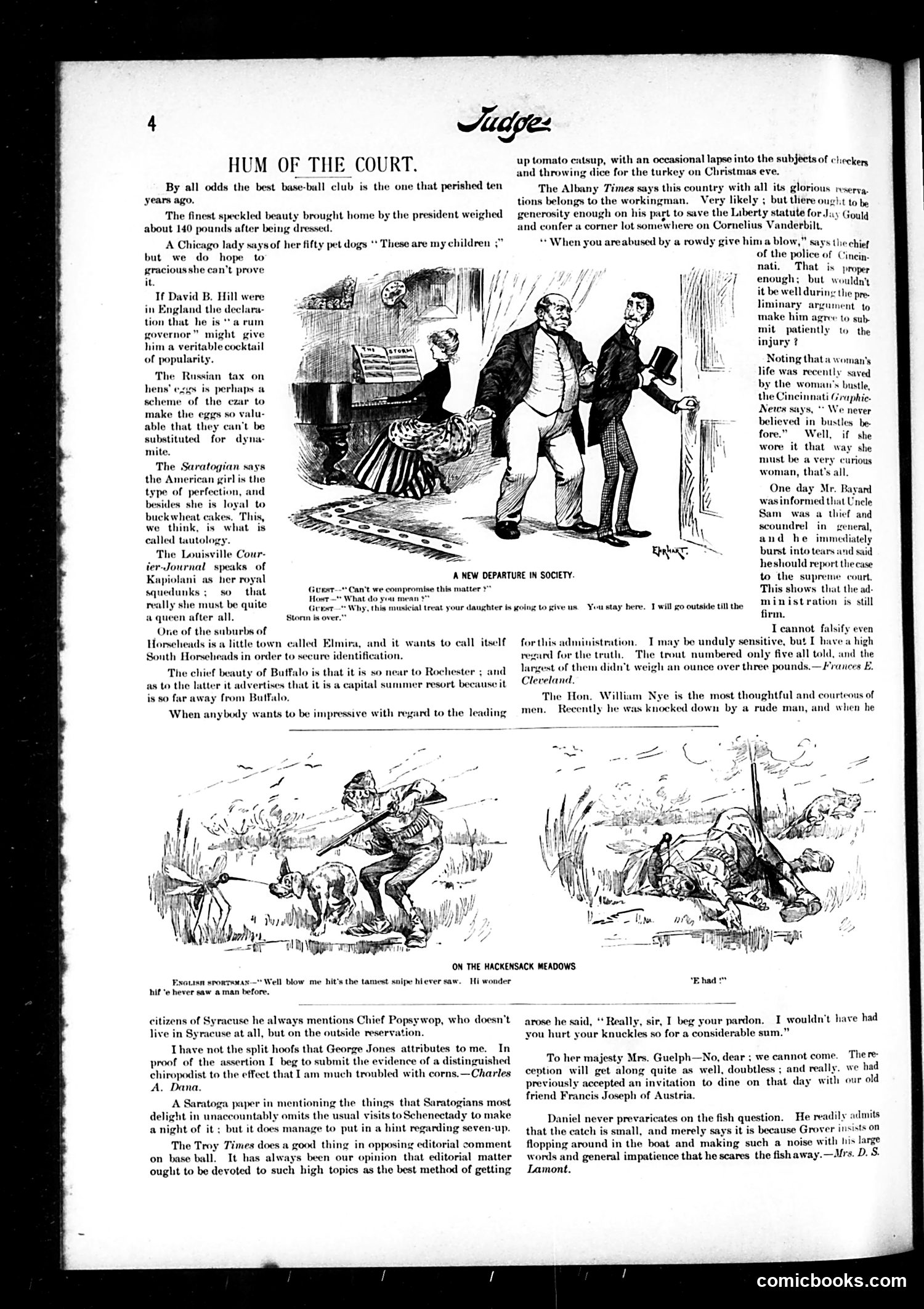
This page from *Judge* magazine contains several short satirical items and two cartoons mocking late-19th-century American society and politics. **"A New Departure in Society"** (top cartoon) depicts a social dinner where a guest asks what will be served. The host replies they'll serve "up tomato catsup, with an occasional lapse into the subjects of checkers and throwing dice for the turkey on Christmas eve"—satirizing how working-class entertainments were infiltrating upper-class social gatherings, apparently shocking to the magazine's audience. **"On the Hackensack Meadows"** (bottom cartoons) shows hunting or fishing scenes with captions mocking sportsmen's exaggerated tales. One hunter says he's never seen such a "tame snipe"; another's companion doubts he's "ever saw a man before." The text snippets mock various contemporary figures and absurdities: David B. Hill (a New York politician), Buffalo's proximity to Rochester, women's fashion (bustles), and Secretary of State Bayard's earnestness about legality—all typical *Judge* targets of elite hypocrisy and pretension.
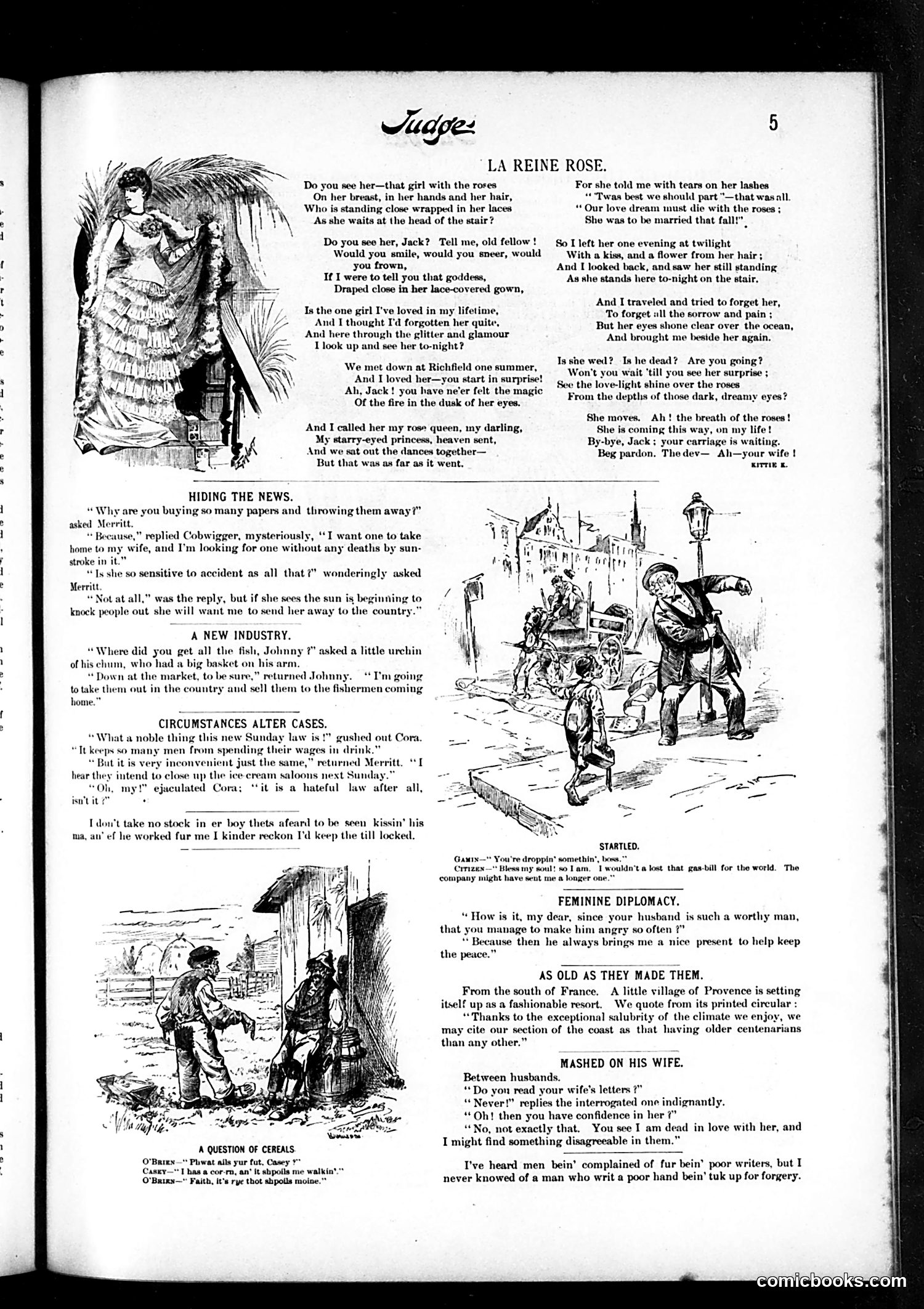
This page from *Judge* contains several short satirical pieces targeting common social situations of the era: **"La Reine Rose"** is a sentimental poem about a man encountering an old flame at a social gathering—she's now married, and his wife arrives at the awkward moment. The satire mocks romantic nostalgia and domestic awkwardness. **"Hiding the News"** jokes about a man buying newspapers to hide from his wife news of a fatal heatstroke, fearing she'll demand to leave the city. **"A New Industry"** depicts a boy selling fish to fishermen—absurdist humor about circular commerce. **"Circumstances Alter Cases"** contrasts noble ideals (Sunday closing laws preventing drinking) with selfish reality (it's inconvenient). **"Startled"** is a brief comic exchange about dropping a gas bill. **"Feminine Diplomacy"** satirizes a wife who deliberately angers her husband to extract gifts and appease him afterward. **"As Old as They Made Them"** mocks a French resort's dubious claim about longevity in its region. **"Mashed on His Wife"** presents domestic trust paradoxes—the husband doesn't read letters yet lacks confidence. The cartoons illustrate these pieces with period-appropriate line drawings.
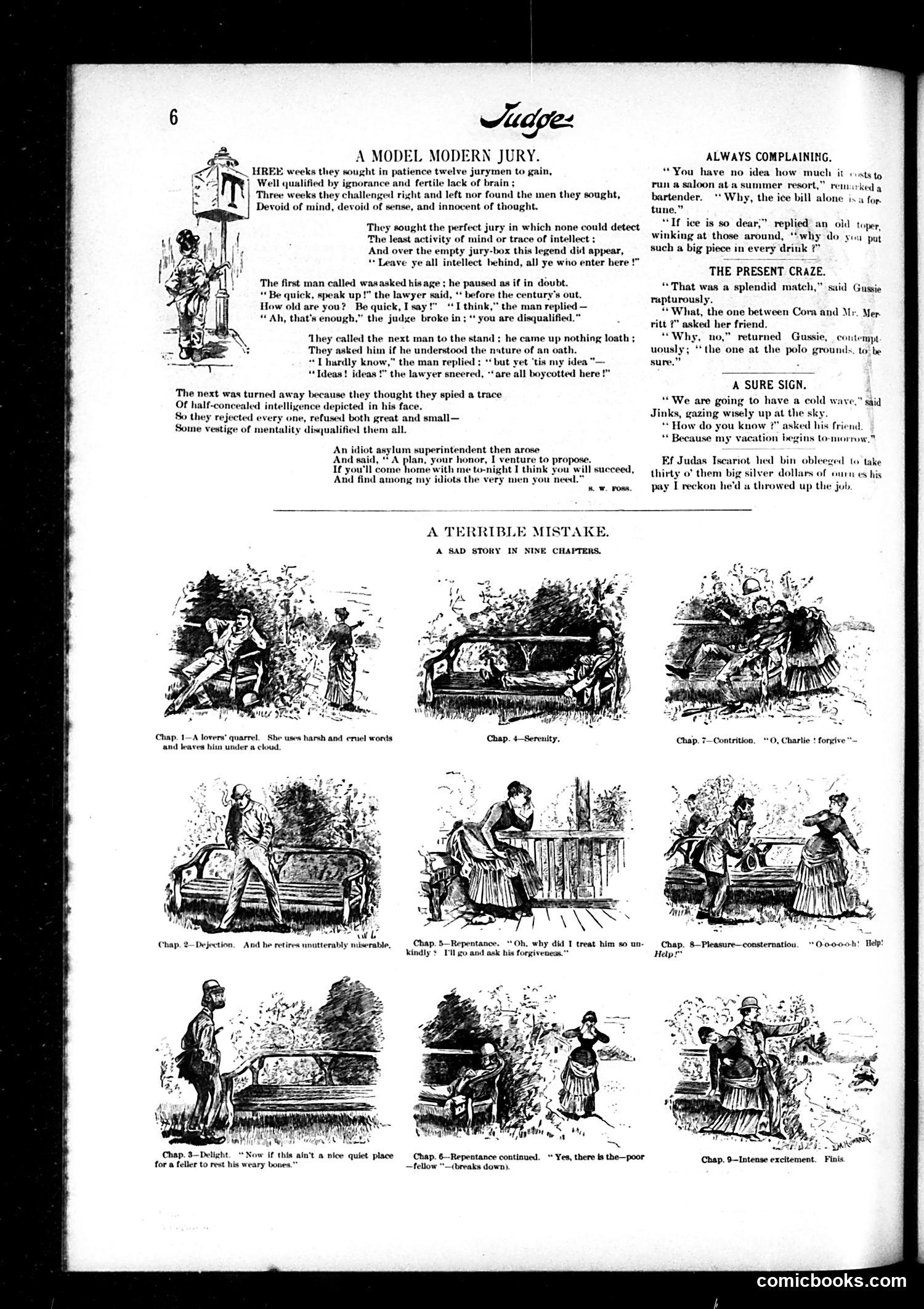
**"A Model Modern Jury"** satirizes the jury selection process by depicting lawyers and judges actively rejecting any juror showing intelligence or independent thought. The satire suggests the legal system prefers jurors who are ignorant and easily manipulated. When one potential juror pauses to think before answering, he's immediately disqualified. The final panel hints that they'll recruit from an "idiot asylum," making explicit the cartoon's claim that the system deliberately seeks mental incapacity. This reflects late 19th/early 20th-century skepticism about democratic institutions and suggests legal proceedings favor predetermined outcomes over genuine deliberation. **"A Terrible Mistake"** is a sequential nine-panel melodrama showing a lovers' quarrel escalating into tragedy—she leaves him angry, he despairs, then seeks reconciliation, but presumably the ending is tragic. It's likely a sentimental moral tale about hasty words and regret, popular in Judge's humor content. The page also contains brief humorous commentary pieces on topics like summer resort costs and polo-playing romance.
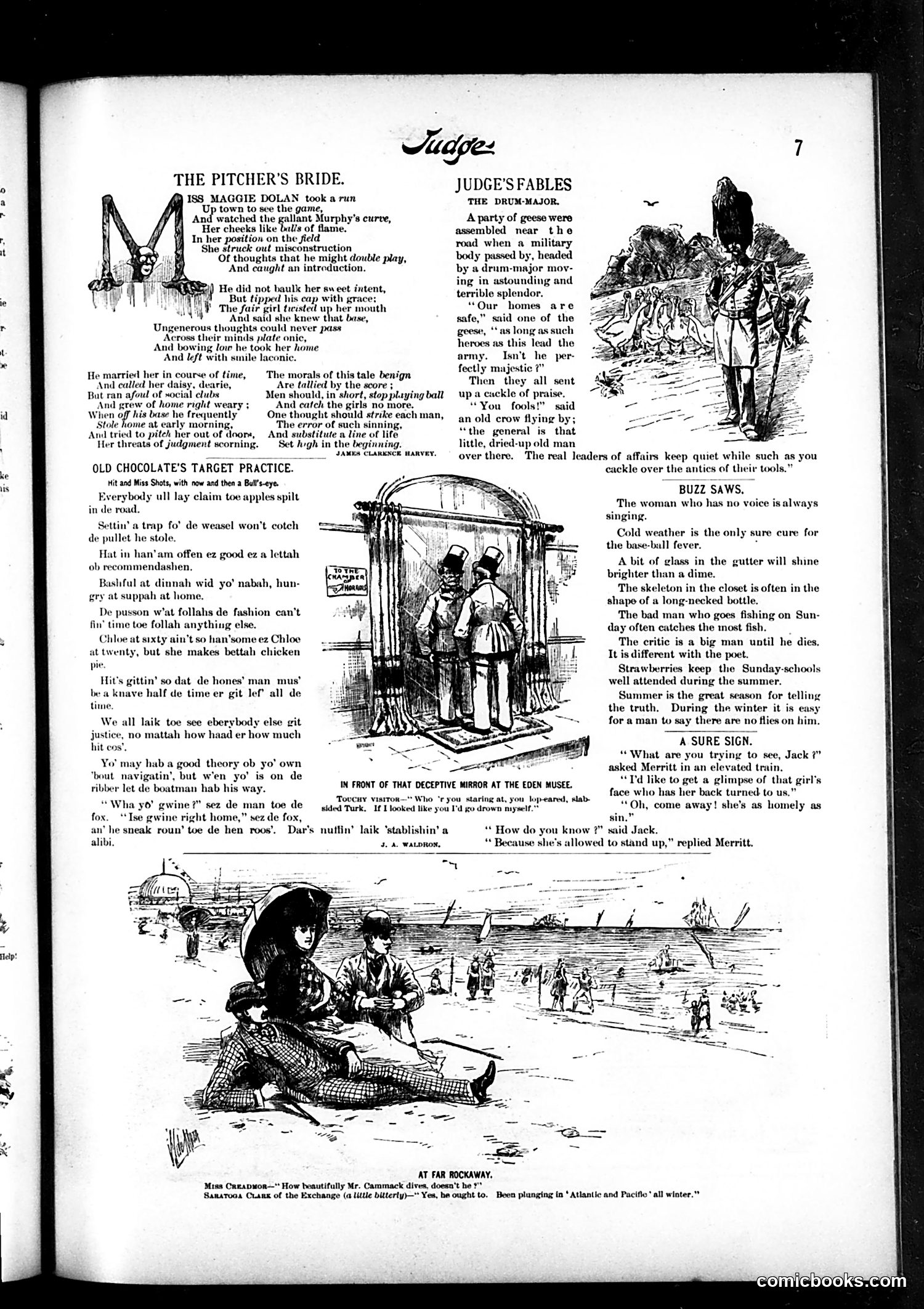
This page contains several satirical pieces typical of Judge's humor: **"The Pitcher's Bride"** (top left) is a baseball-themed romantic comedy poem mocking hasty marriages. A woman becomes infatuated with pitcher Murphy at a game, they marry quickly, but the relationship sours when he treats her poorly at home—a critique of impulsive romance and domestic discord. **"Judge's Fables: The Drum-Major"** presents a moral fable where vain geese are impressed by a military drum-major's pageantry, until a wise crow reveals the real military leaders remain quiet while subordinates "cackle over the antics of their tools"—satire on blind obedience to pomposity and appearance over substance. **"Old Chocolate's Target Practice"** collects dialect-heavy aphorisms in African American vernacular, offering homespun wisdom about human nature. **"Buzz Saws"** provides witty one-liners on contemporary life and human behavior. The page concludes with humorous vignettes about vanity and romantic disappointment, typical of Judge's focus on social observation and the foibles of everyday life.
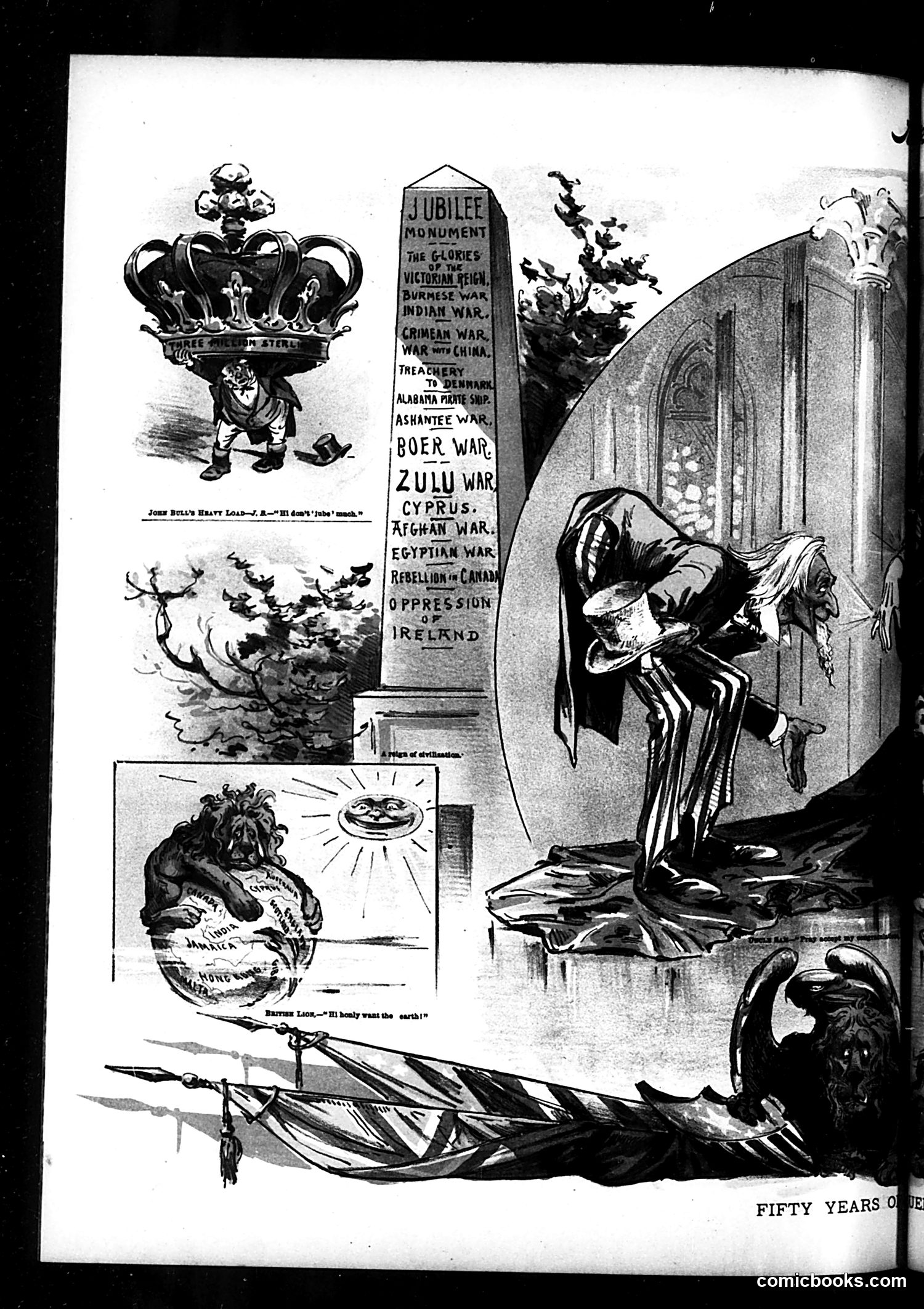
This page satirizes Britain's imperial overextension during Queen Victoria's reign. The central "Jubilee Monument" lists the British Empire's military conflicts: Boer War, Zulu War, Egyptian War, Afghan War, Ashantee War, Opium Wars in China, and "Oppression in Ireland." On the left, John Bull (personifying Britain) strains under an enormous crown, suggesting the weight of empire. The bottom panel shows a figure labeled "British Lion" saying "I't hardly want the earth!"—ironic commentary on Britain's endless territorial ambitions. The right panel depicts a weary figure entering what appears to be a church or monument, likely representing the consequences of these conflicts: death, suffering, and moral exhaustion. The overall message critiques British imperialism as unsustainable and morally corrosive, using the Jubilee (Victoria's celebration) as occasion for this pointed social criticism.
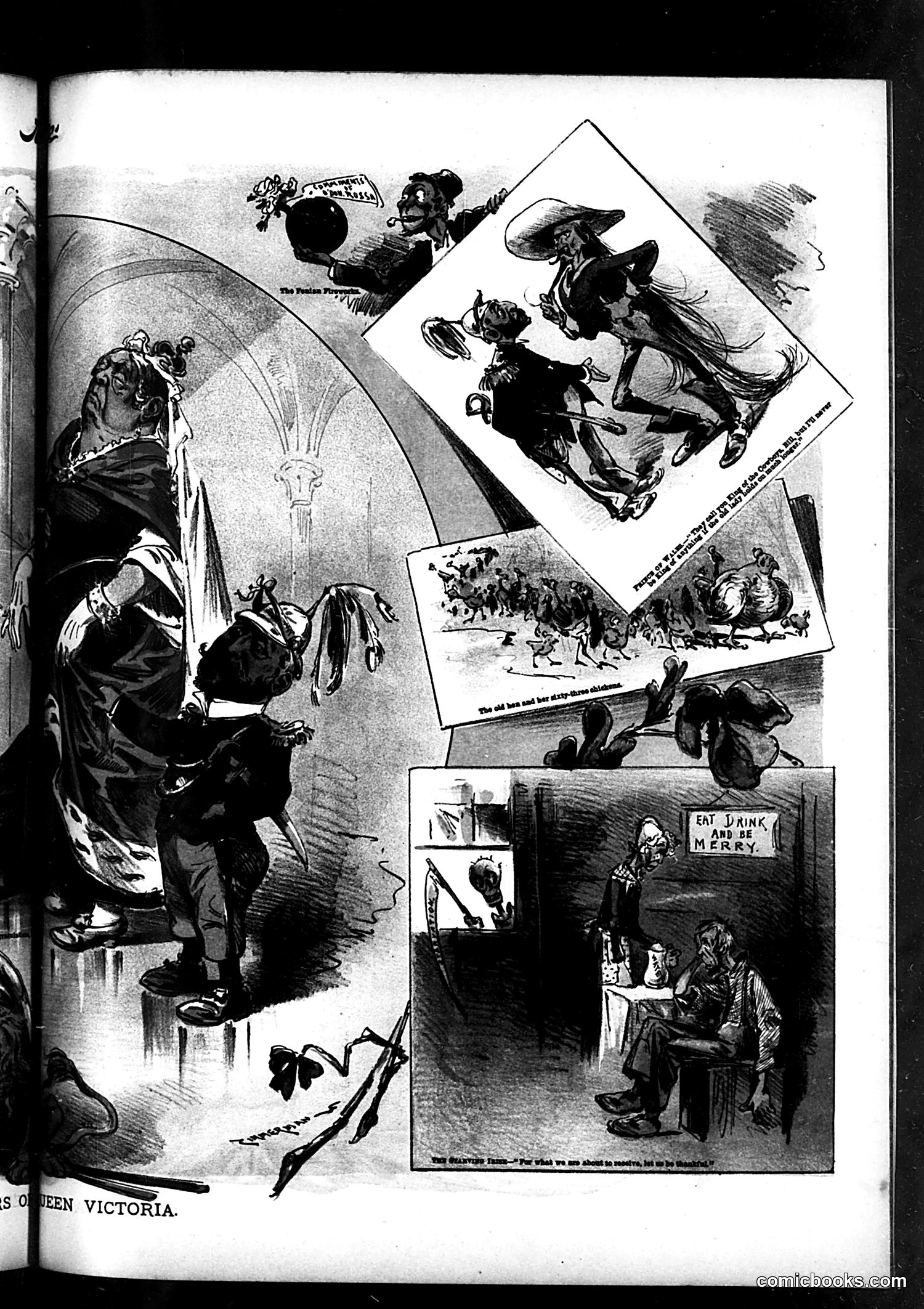
This page appears to be a dream or fantasy sequence, likely depicting political/social satire. On the left, a sleeping figure (possibly a politician or public figure) dreams the visions shown on the right—floating illustrated panels showing various scenes of chaos, revelry, and misadventure. The visible text "EAT DRINK AND BE MERRY" suggests themes of excess or indulgence. The dream-visions include figures in various states of disarray, with what appear to be caricatured characters engaged in undignified behavior. The page heading partially reads "...OF QUEEN VICTORIA," indicating this likely satirizes British politics or society during Victoria's reign. Without clearer OCR text or visible captions, the specific political targets remain uncertain, but the overall structure mocks someone's fantasy of chaos or impropriety.
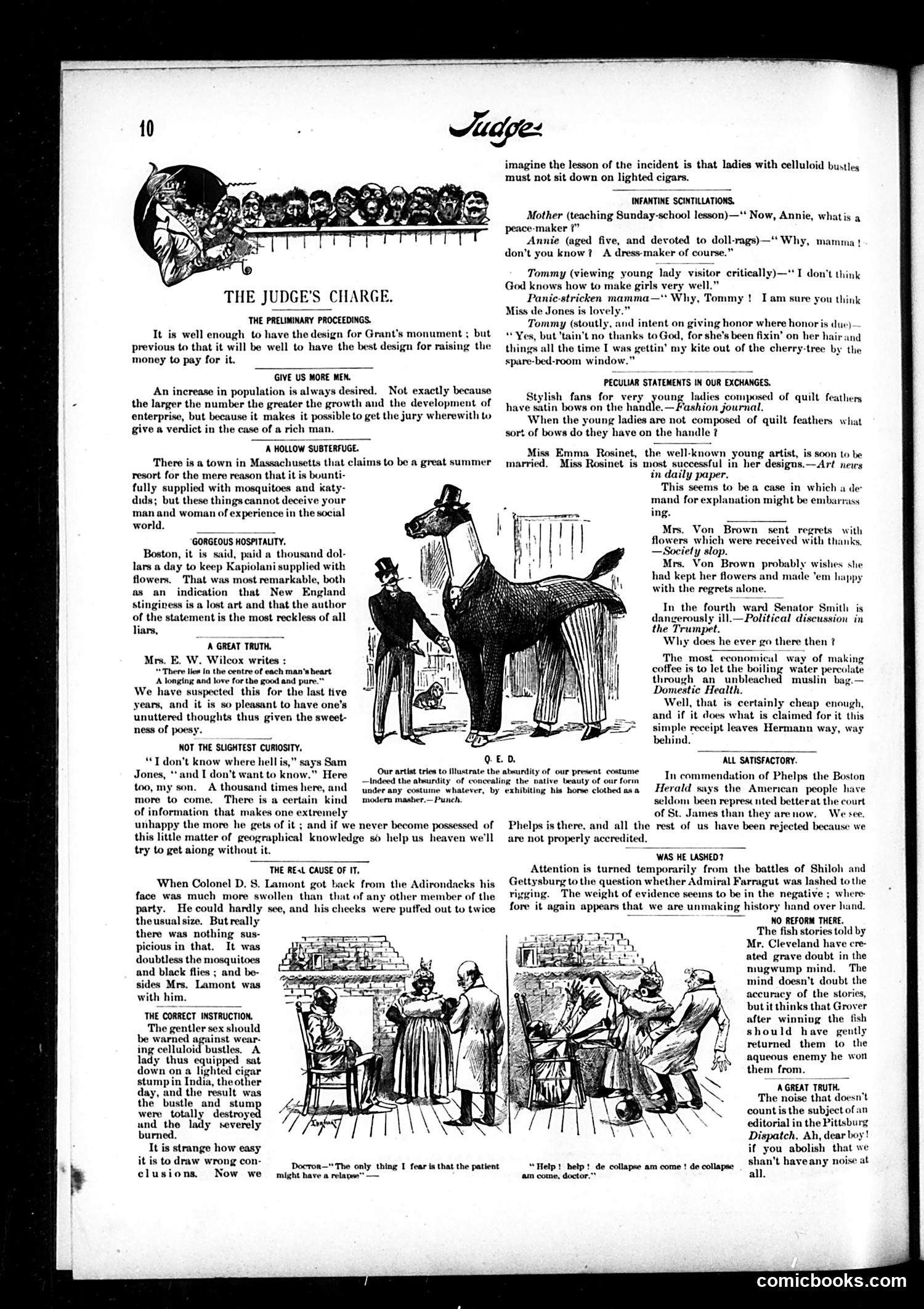
This page from *Judge* contains multiple brief satirical commentaries typical of the publication's format: **"The Judge's Charge"** mocks the absurdity of planning a monument to General Grant while lacking funds to build it—questioning priorities. **"Give Us More Men"** cynically suggests population growth matters mainly for jury selection in wealthy defendants' trials, satirizing how the wealthy manipulate the justice system. **"Celluloid Bustles"** ridicules both Victorian fashion (women wearing rigid celluloid undergarments) and poor reasoning: a woman's bustle caught fire near a cigar, so the satirist absurdly concludes women shouldn't sit on lit cigars—rather than questioning why they wear flammable clothing. **"The Real Cause"** uses Colonel Lamont's swollen face from mosquito bites to joke about marital discretion, suggesting his wife's presence prevented embarrassing questions. The children's quotes mock youthful innocence saying socially awkward truths, while various short items target contemporary issues: Boston's expensive hospitality toward visiting royalty, Massachusetts resort towns' exaggerated claims, and Mrs. Wilcox's sentimental poetry. Overall: genteel social satire targeting fashion, wealth, vanity, and Victorian hypocrisy.
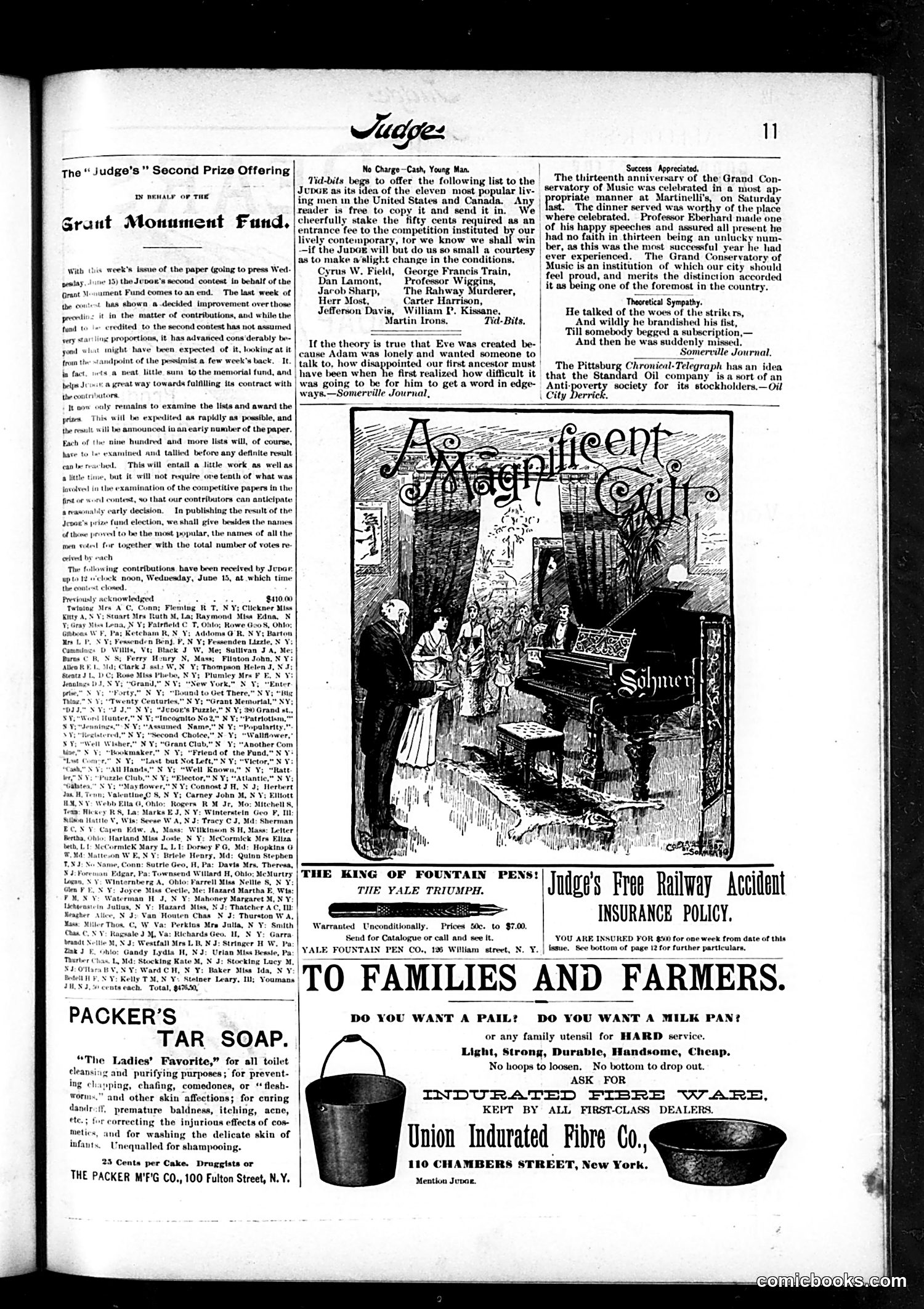
This page primarily contains **advertisements and announcements** rather than satirical cartoons. The main illustrated item is "A Magnificent Sojourn"—an ornate engraving depicting what appears to be wealthy figures in an elegant interior, likely advertising travel, luxury goods, or entertainment. The substantive content includes: 1. **Grant Monument Fund announcement**: Judge magazine's second fundraising contest for Ulysses S. Grant's monument, listing contributors and their donations. 2. **"Success Appreciated"**: A brief notice celebrating the Grand Conservatory of Music's thirteenth anniversary dinner, noting that Professor Eberhard dismissed superstitions about the number thirteen. 3. **Commercial advertisements**: Packer's Tar Soap, "King of Fountain Pens," Judge's Free Railway Accident Insurance Policy (satirical), and Union Indurated Fibre Co.'s household goods. The "Free Railway Accident Insurance" is the only clearly satirical element—offering humorous mock-insurance to families and farmers. The page functions primarily as a fundraising vehicle and advertising platform rather than political satire.
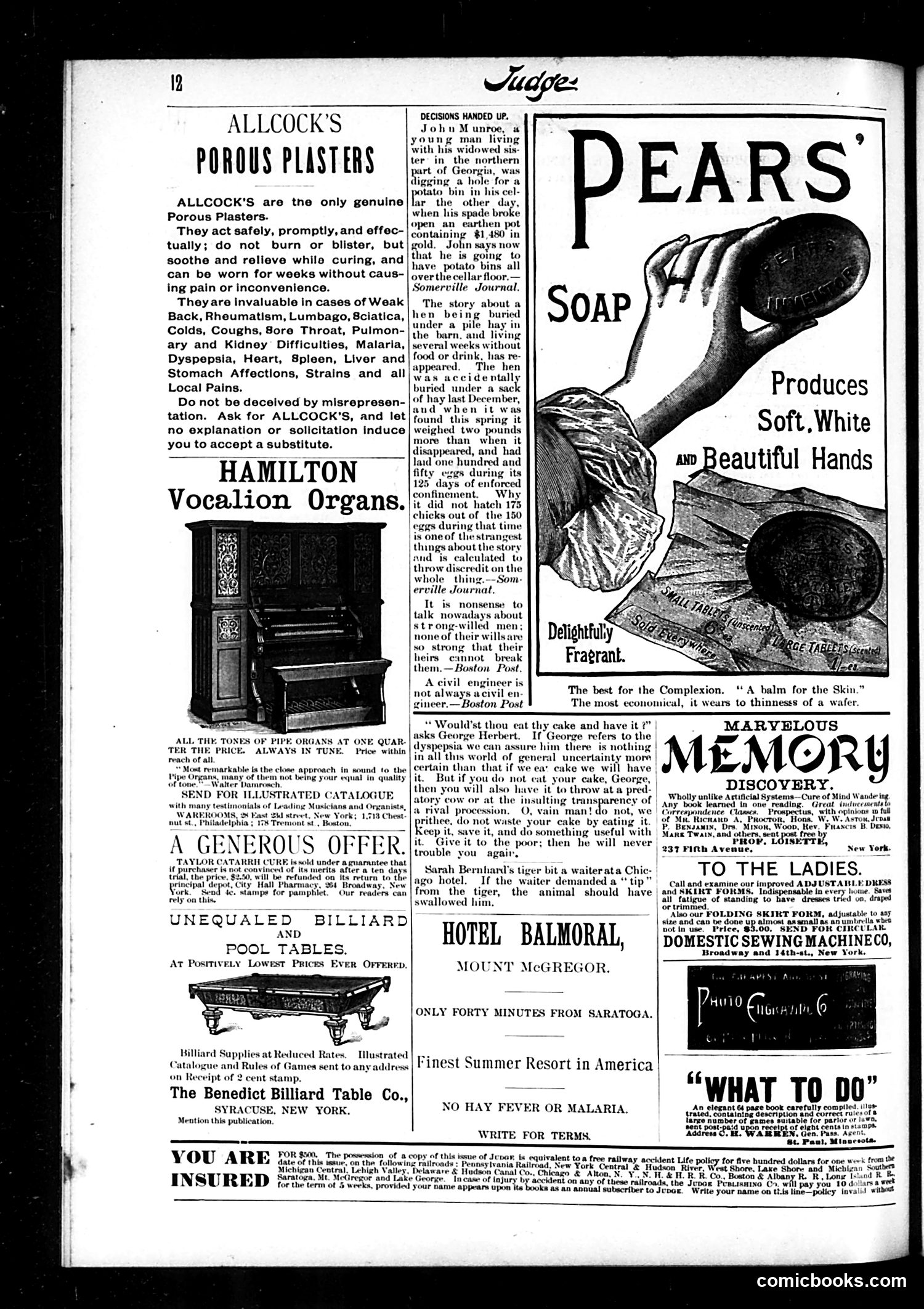
This page is primarily **advertisements with minimal editorial content**. The few short humor pieces present follow Judge's typical format: **The Humor Items:** - Brief, anecdotal jokes about rural life (potato bins, a hen buried in hay for months, Sarah Bernhardt's tiger biting a waiter) - Light philosophical quips about eating cake and charity - These appear to mock small-town gossip and exaggerate impossible stories for comedic effect **The Advertisements:** The page is dominated by patent medicines and consumer goods typical of the era (Allcock's Porous Plasters, Hamilton organs, billiard tables, Pears' Soap, memory improvement courses). These ads reflect late 19th/early 20th-century consumer culture and often made dubious health claims. **Notable Detail:** The bottom contains an insurance offer—Judge's circulation apparently qualified as accident insurance on certain railroads, a promotional gimmick. The page lacks significant political satire or identifiable caricatures. It's a standard commercial publication mixing light humor with extensive advertising.
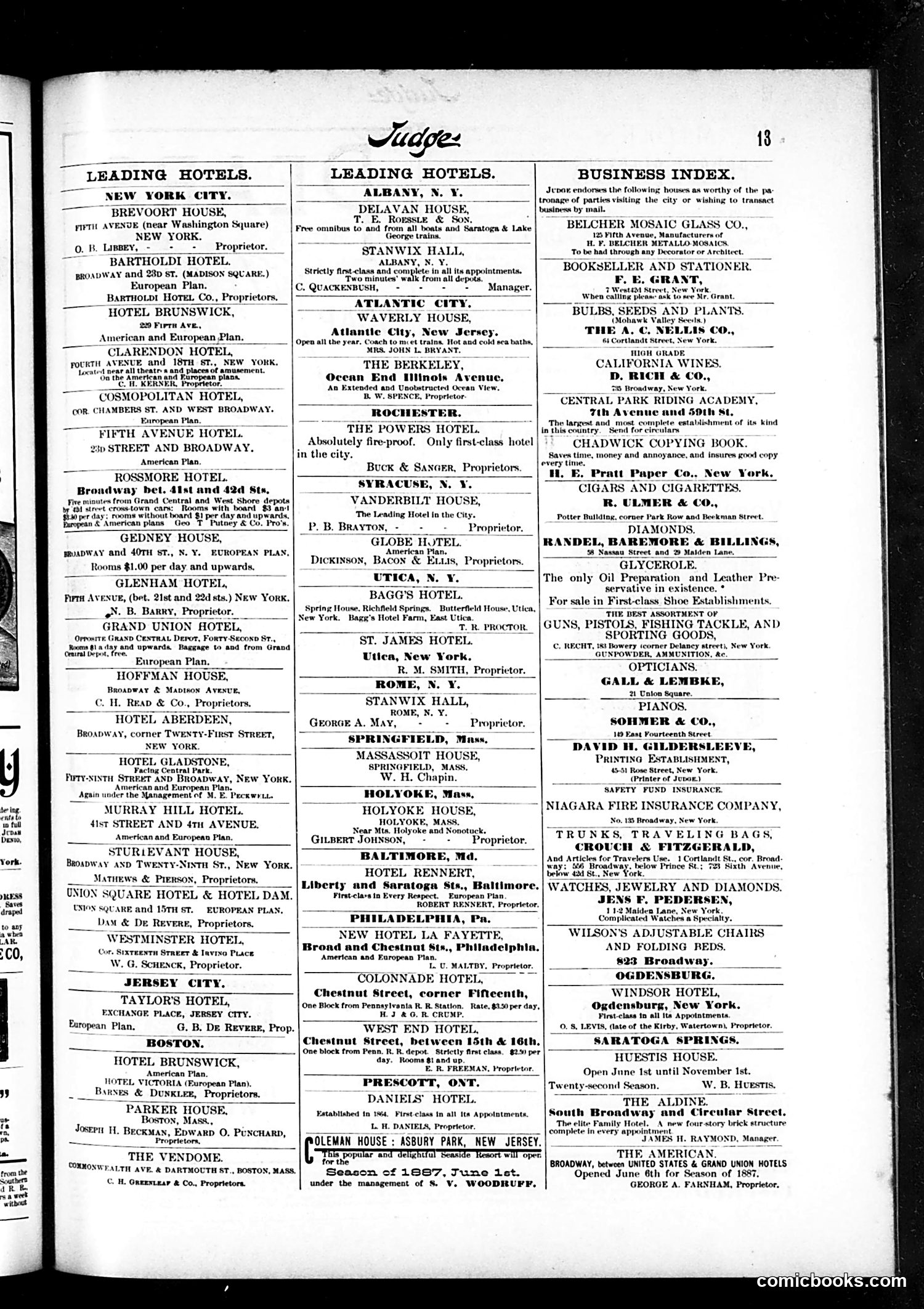
This page is **primarily a business directory**, not a satirical cartoon page. It consists almost entirely of hotel advertisements organized by city (New York, Albany, Atlantic City, Syracuse, Baltimore, Philadelphia, Boston, etc.). The right column contains a "Business Index" listing various commercial establishments—glass companies, stationers, seed suppliers, riding academies, paper companies, insurance firms, and other businesses. **There is no visible cartoon or satirical content** on this page. This appears to be a standard advertising/directory section from *Judge* magazine, demonstrating how late-19th-century publications supplemented editorial content with extensive paid advertising. The hotels listed range from modest establishments ($1/day) to first-class properties, reflecting the economic diversity of the era's travel industry.
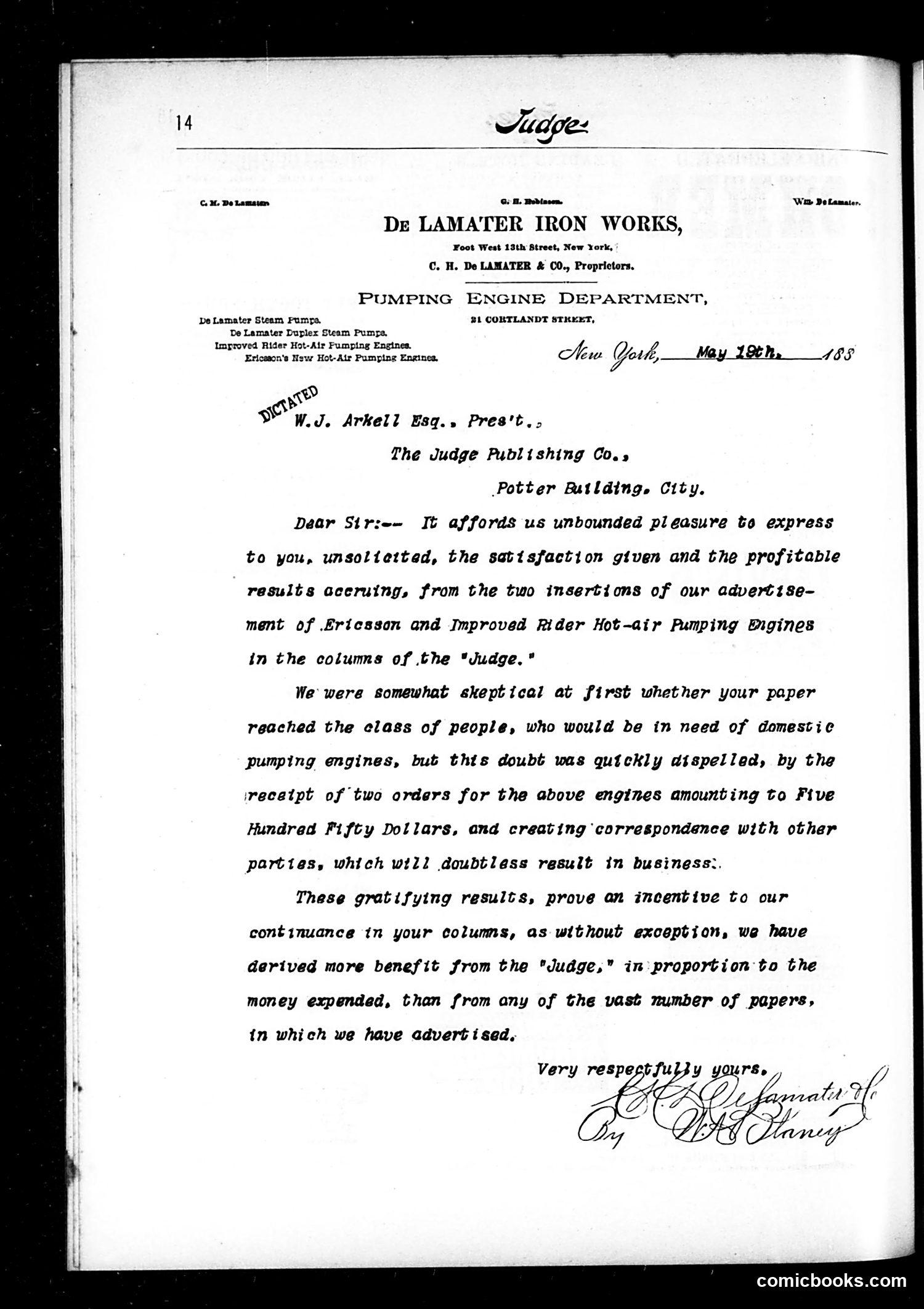
This page is **not a cartoon or satirical content**—it's a testimonial advertisement. The De Lamater Iron Works, a New York pump manufacturer, wrote to Judge magazine's publisher (W.J. Arkell) praising the publication's advertising effectiveness. **The key point:** De Lamater initially doubted whether Judge's readers—presumably educated, satirical-magazine subscribers—would need industrial pumping engines. They were pleasantly surprised: two advertisements generated $550 in orders and promising business leads. **The implicit satire** (if any) lies in the irony that a *humor and satire magazine* proved more valuable for B2B industrial advertising than other publications. This appears to be Judge's own marketing tool, demonstrating the magazine's reach across professional/business audiences, not just readers seeking comedy. This is essentially a paid testimonial showcasing Judge's advertising ROI to potential clients.
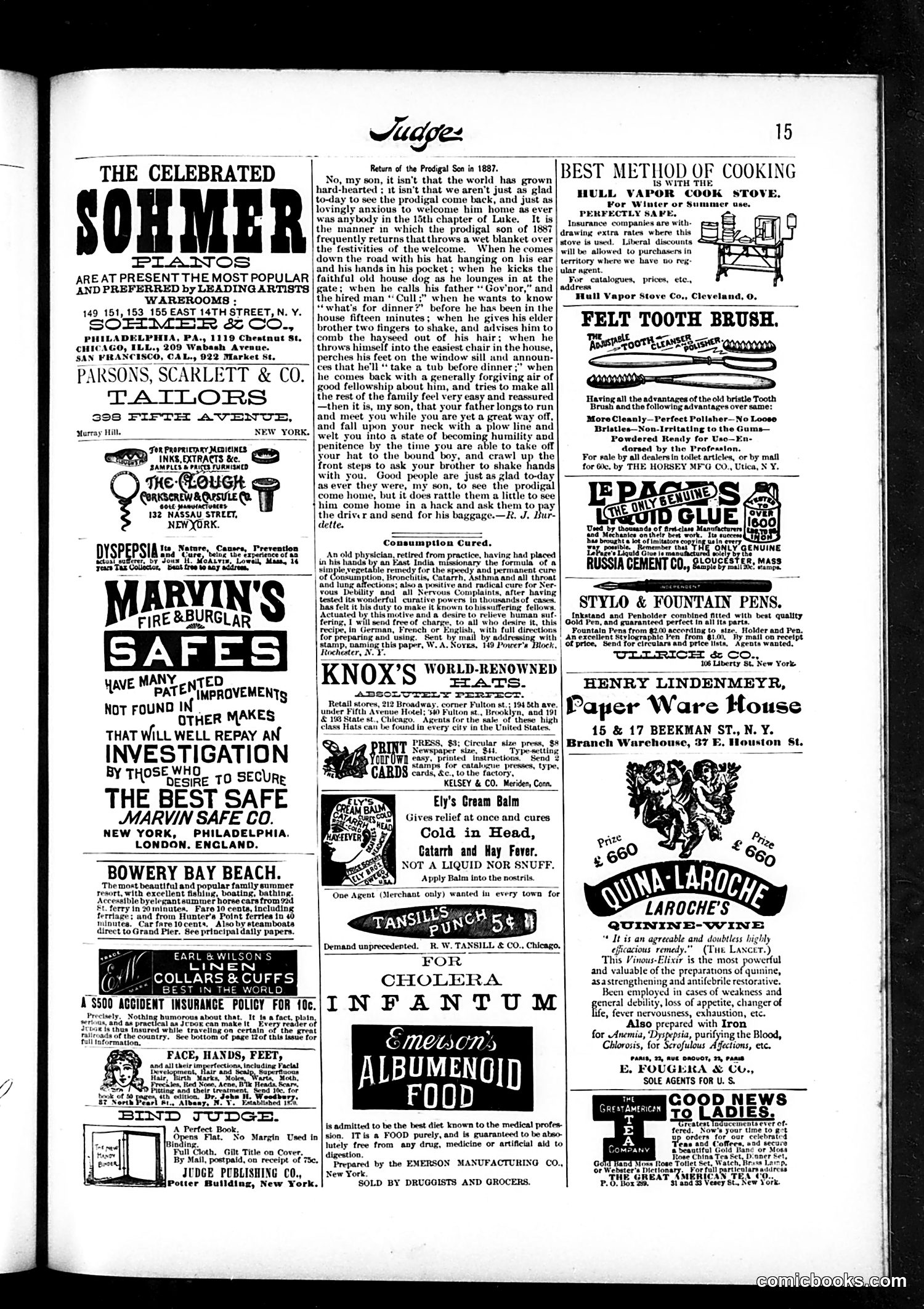
This page is primarily **advertisements and commercial content**, not political satire. The dominant feature is a lengthy prose piece titled "Return of the Prodigal Son in 1887" — a humorous social commentary (attributed to R. J. Burdette) about how 19th-century wealthy young men who return home after time away behave disrespectfully: lounging with hats askew, calling their father "Gov'nor," putting feet on furniture, and generally acting entitled and ungracious. The joke contrasts the Biblical parable of the forgiving father with modern reality: parents today are just as loving, but exhausted by their sons' arrogance and assumption of privilege. The satire mocks upper-class masculine entitlement and poor manners among the newly wealthy. The remainder of the page consists of period advertisements for pianos, tailors, safes, and patent medicines—typical Judge magazine filler content.
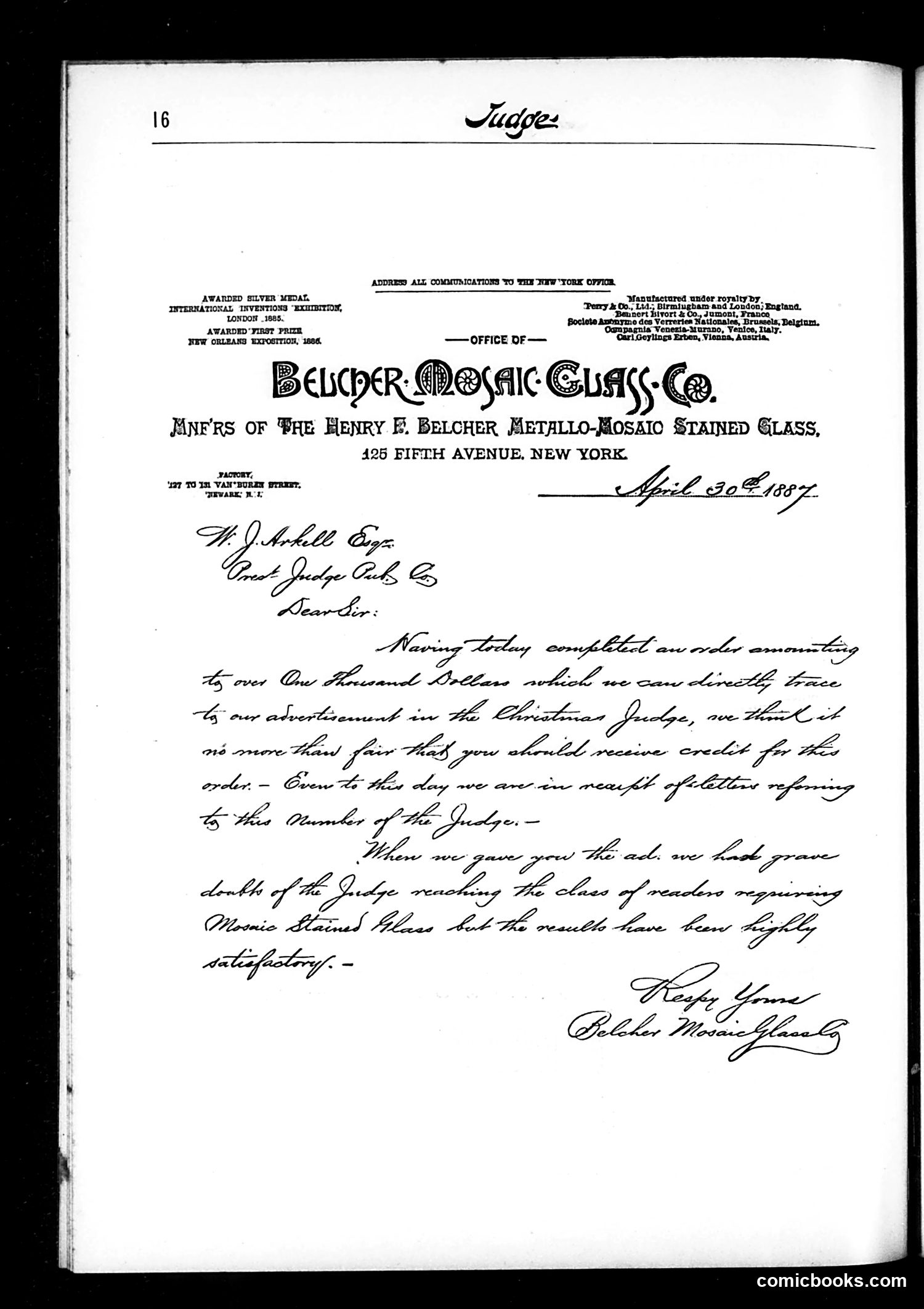
This is primarily a **business letterhead and correspondence**, not a cartoon or satirical content page. The document is a letter from **Belcher Mosaic Glass Co.**, manufacturers of Henry F. Belcher Metallo-Mosaic Stained Glass located at 425 Fifth Avenue, New York, dated April 30, 1887. The letter is addressed to H. Dalzell, Esq. of West Judge Cable Co. in Dundee, and discusses completing an order worth over one thousand dollars. The writer thanks the recipient for advertising in *The Christmas Judge* and mentions receiving credit for the order. The header notes *Judge* magazine's awards and distribution information for its New York office. **This page contains no political satire or cartoon content**—it is essentially an advertisement/business communication. Modern readers would recognize it as corporate correspondence from the Gilded Age, demonstrating how 19th-century magazines supported operations through paid advertising and business partnerships.
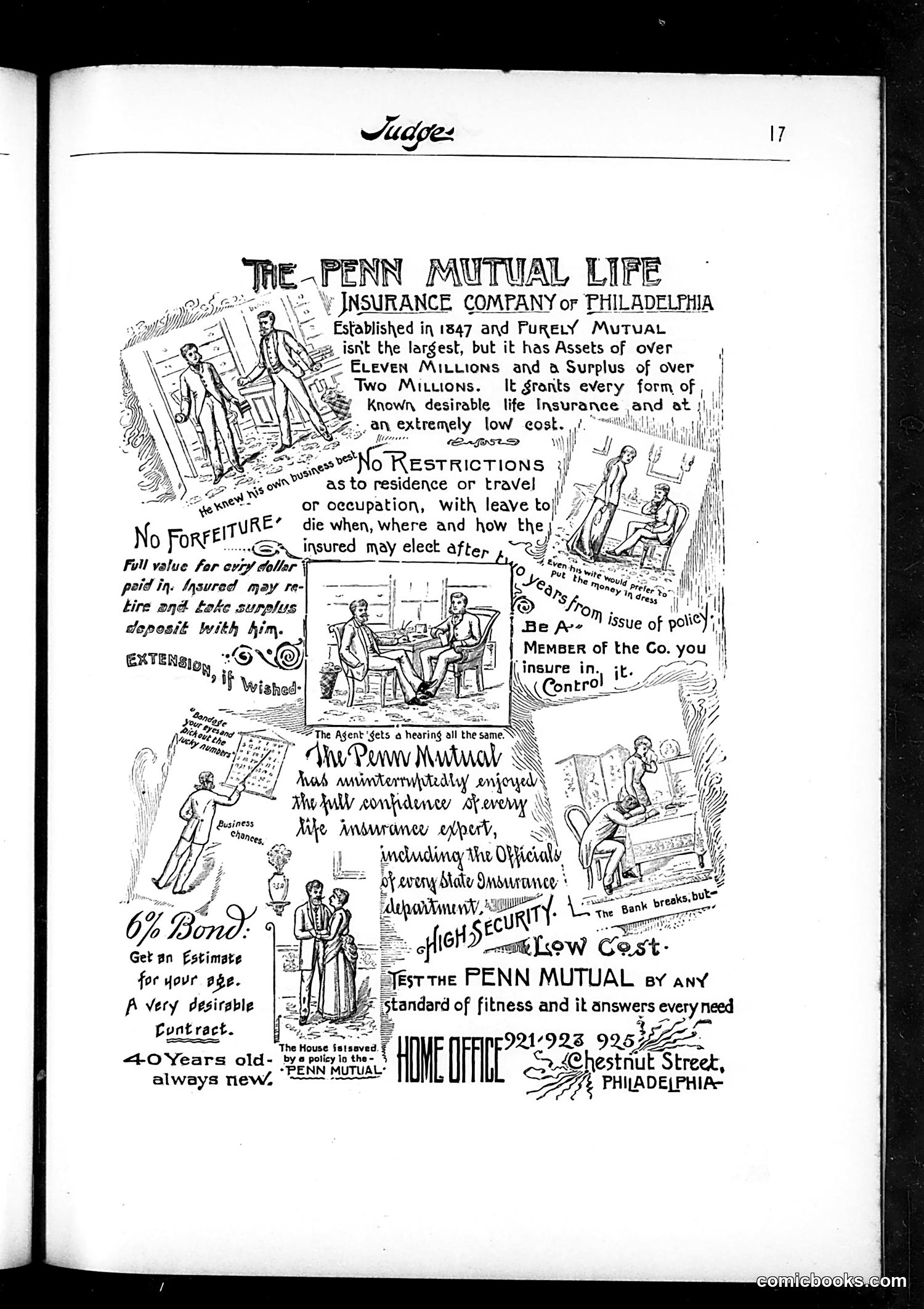
This page is primarily a **life insurance advertisement**, not political satire. It promotes the Penn Mutual Life Insurance Company of Philadelphia, established in 1847. The illustrations depict ordinary people in domestic and business scenes—families, businessmen, and individuals reviewing documents—to convey reliability and accessibility. The visual style uses period-appropriate sketches to humanize the insurance product. **Key selling points advertised:** - Assets of over $11 million with $2 million surplus - No restrictions on residence, travel, or occupation - Low cost with high security - Flexible withdrawal options ("6% Bond") - A "40 Years old—always new" company (paradoxically claiming both established longevity and modern vitality) The home office address is given as 921-923-925 Chestnut Street, Philadelphia. This appears to be a straightforward commercial advertisement rather than satirical commentary, though it uses Judge magazine's illustrated style to reach readers.
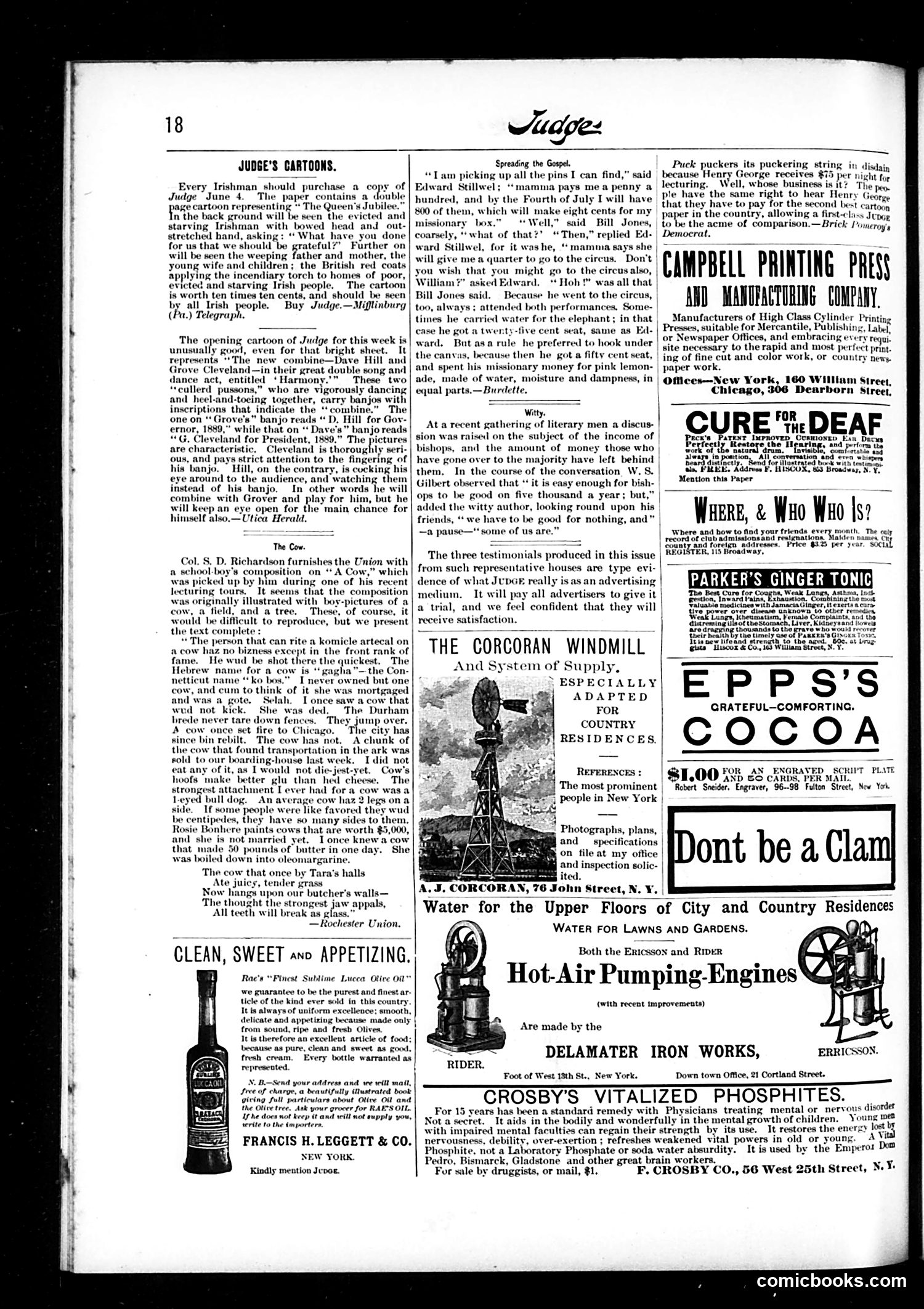
This page from Judge contains **primarily advertisements and editorial commentary** rather than a major political cartoon. The notable content includes: **"Judge's Cartoons" section:** References to upcoming Judge cartoons, including one depicting Queen Victoria's Jubilee with starving, evicted Irish people asking what Britain has done for them—reflecting 1880s tensions over Irish Home Rule and British land policy. Another cartoon depicts Cleveland and Dave Hill (likely Governor David B. Hill of New York) as a "double song and dance act," suggesting their political partnership was performative and self-serving—Hill keeping "an eye open for the main chance for himself." **The bulk of the page** consists of advertisements for olive oil, cocoa, printing services, ginger tonic, and water pumping systems—typical of Judge's revenue model. **"The Cow" piece** is humorous doggerel about cattle, not political satire. The page reflects Judge's dual nature: a satirical publication about American politics and society, supplemented heavily by advertising to sustain publication.
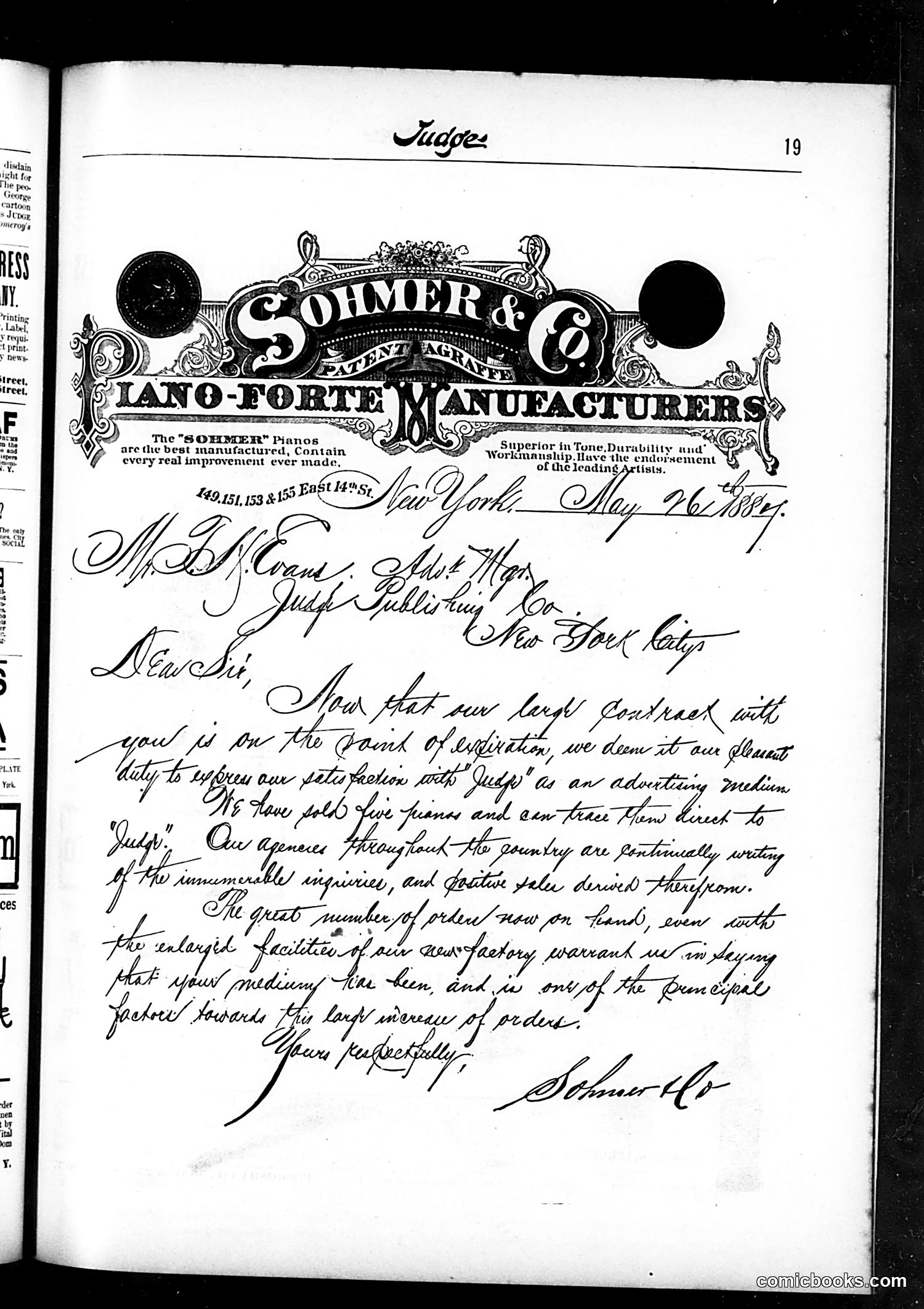
This page is **not a cartoon or satirical content**—it's a **business letter** from Sohmer & Co., piano manufacturers in New York, dated May 26, 1887. The ornate letterhead features the company's logo and advertising claims that "SOHMER" pianos "are the best manufactured" with superior workmanship. The handwritten letter discusses a business arrangement involving "Judge" as an advertising medium, mentioning orders and factory capacity. This appears to be a **paid advertisement or testimonial letter** that Judge published, not satirical commentary. It reflects 19th-century magazine business practices where companies purchased space and contributed endorsement letters. The page number "19" and "Judge" header indicate this ran in the magazine, likely as sponsored content rather than editorial satire.
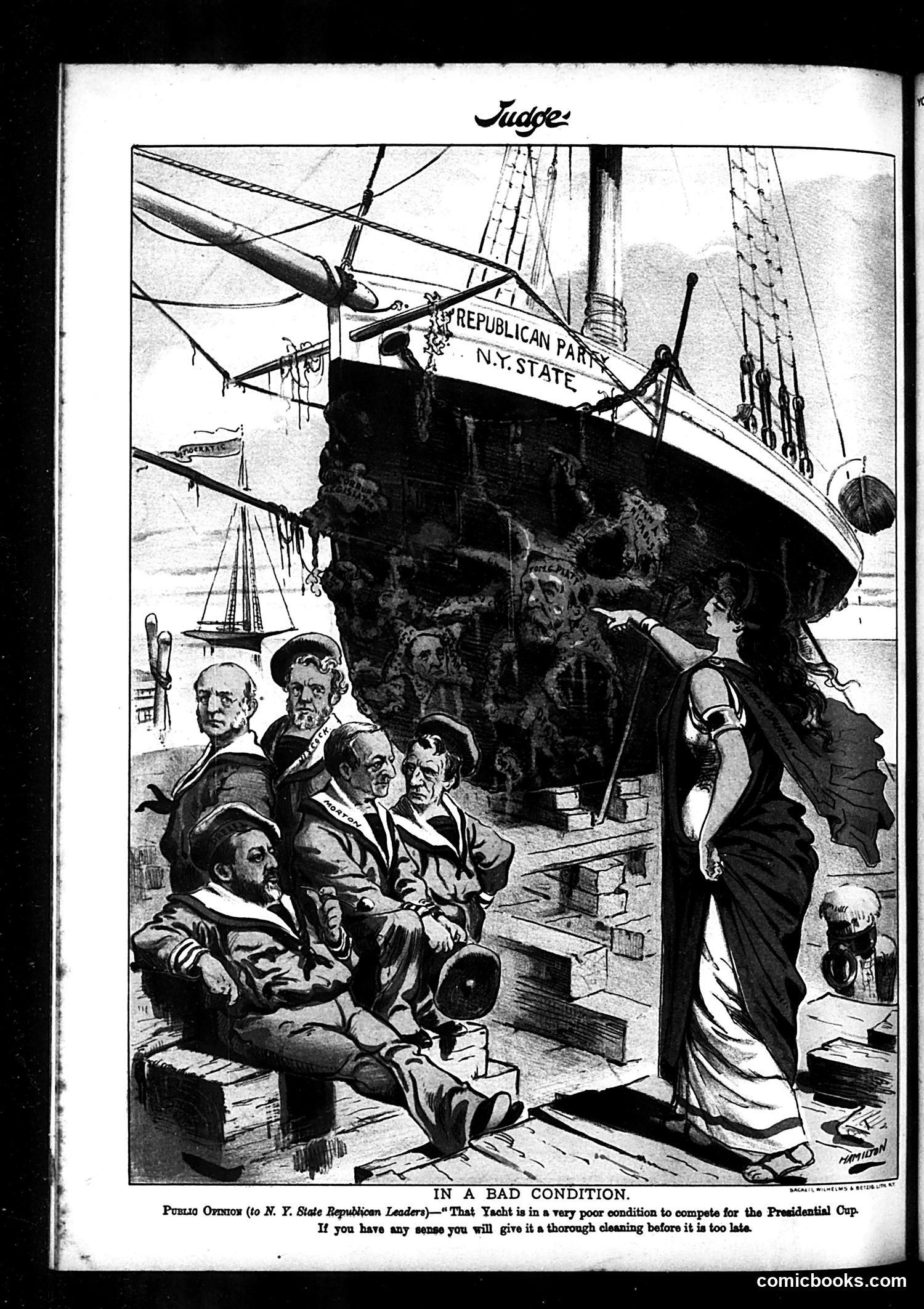
This Judge magazine cartoon satirizes the condition of the Republican Party's 1912 presidential campaign. The "yacht" labeled "Republican Party, N.Y. State" represents the party itself, depicted as a dilapidated, barnacle-encrusted vessel. The public speaker addresses New York State Republican leaders, warning them the party is in such poor shape it cannot compete in the upcoming presidential election without major internal reform and "cleaning." The cartoon reflects the Republican Party's crisis period following Theodore Roosevelt's 1912 split from the GOP, which fractured the party into Progressive ("Bull Moose") and regular Republican factions. The satire mocks party leadership's inability to present a unified, competitive front, suggesting their organization is crumbling and requires urgent remedial action.