
A complete issue · 16 pages · 1887
Judge — May 14, 1887
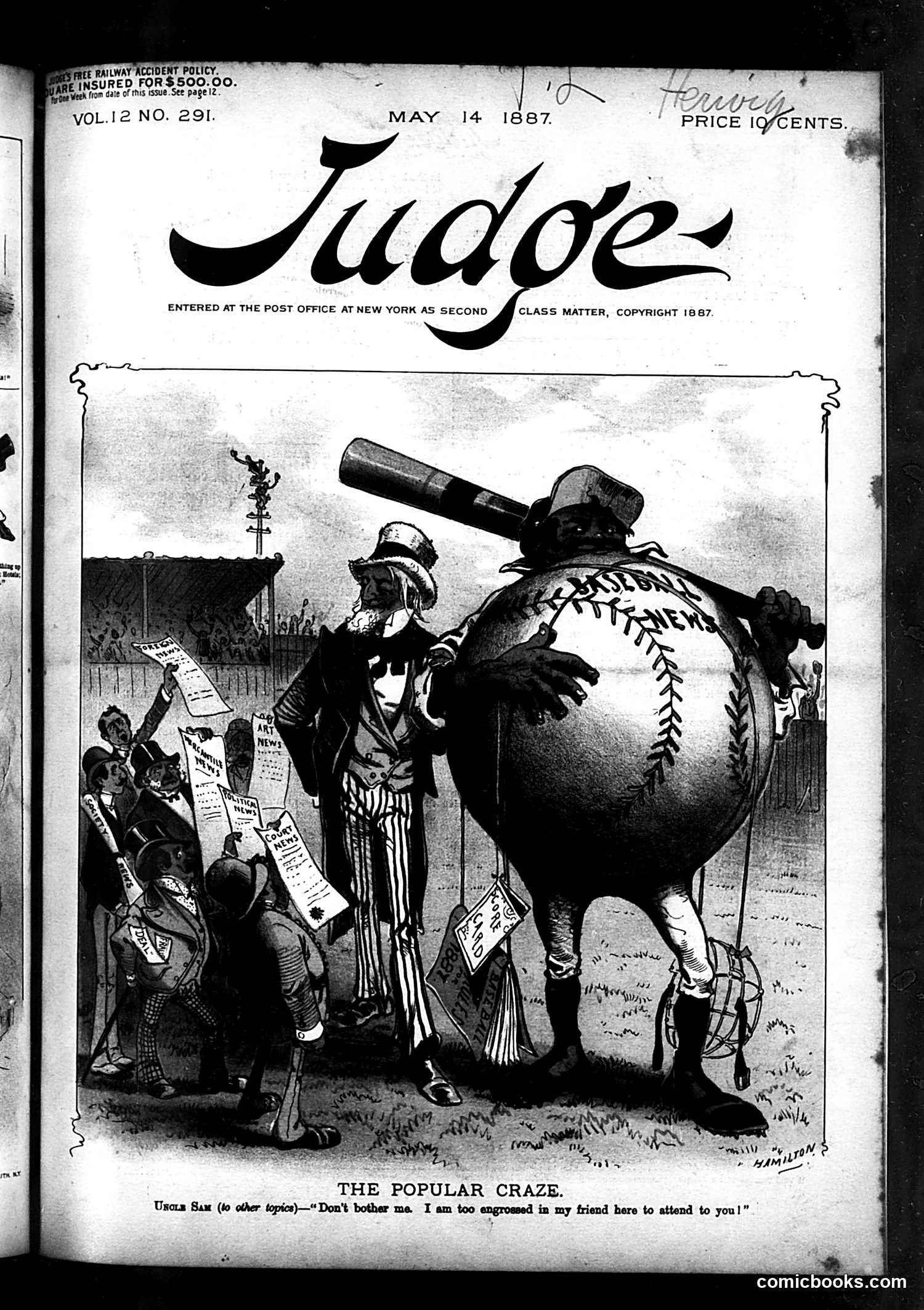
This cartoon satirizes the baseball craze sweeping America in the 1880s. Uncle Sam (identifiable by his starred hat and striped pants) operates a massive telescope aimed at an enormous baseball. A crowd of small figures surrounds him, holding newspapers with headlines about baseball, appearing absorbed in the spectacle. The satire criticizes Americans' obsessive focus on baseball at the expense of other concerns—Uncle Sam's dialogue suggests he's too engrossed in his "friend" (baseball) to attend to other pressing matters. The exaggerated scale of the baseball and telescope emphasize how disproportionately the sport dominates public attention and media coverage. This reflects late-19th-century anxieties about baseball's growing cultural dominance in American life.
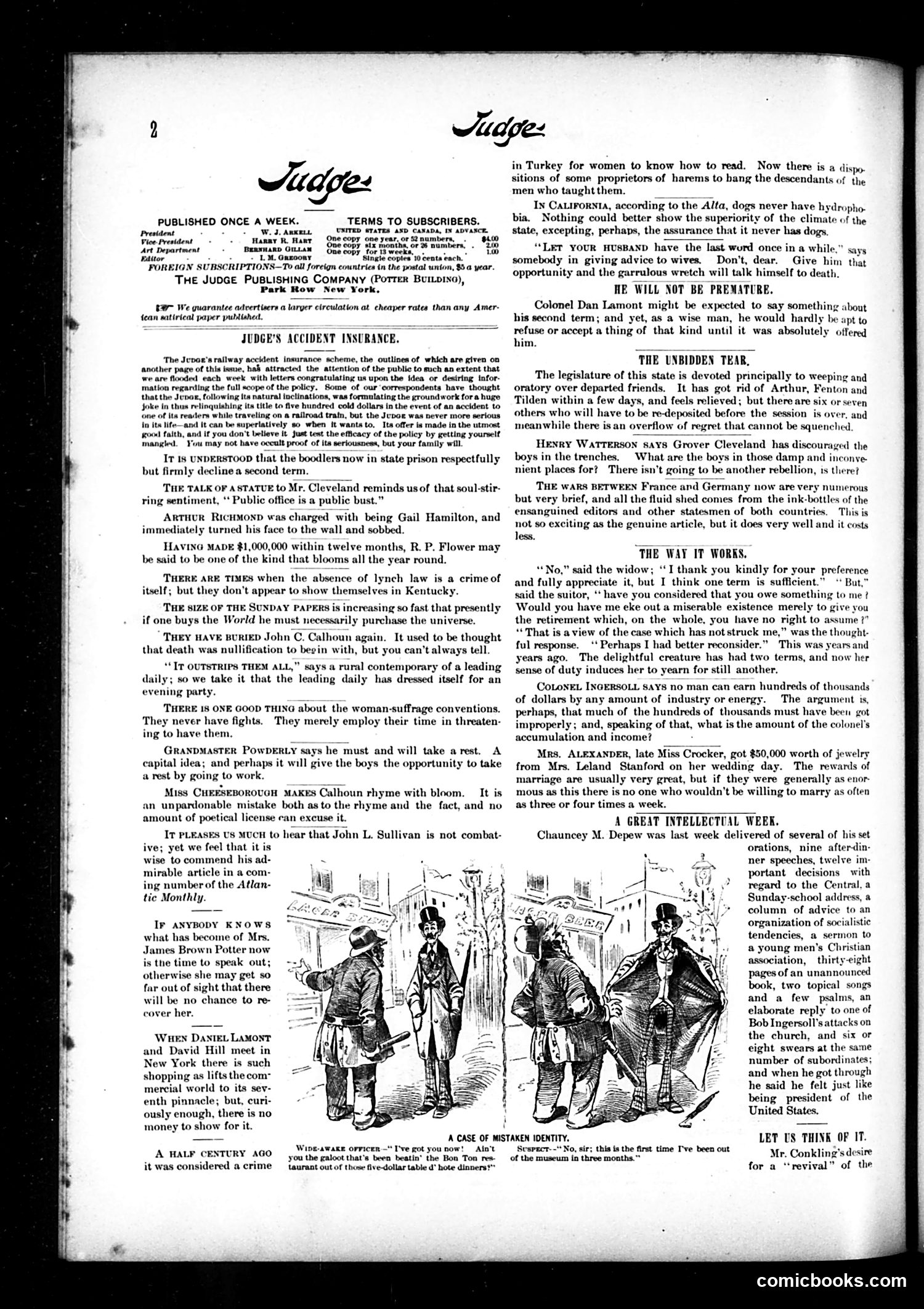
This page contains multiple satirical articles and one cartoon titled "A Case of Mistaken Identity," depicting three men in military uniforms having a conversation. The cartoon's caption reads: "...You bet! this is the first time I've been out of the museum in three months." The joke appears to reference someone or something that belongs in a museum—suggesting obsolescence or irrelevance. Without clearer identification of the specific figures or the historical moment this was published, the exact target of satire is unclear. The surrounding text addresses various contemporary issues including women's suffrage, marriage, and military matters. The page reflects Judge magazine's typical approach: combining biting political and social commentary with illustrated humor aimed at educated readers.
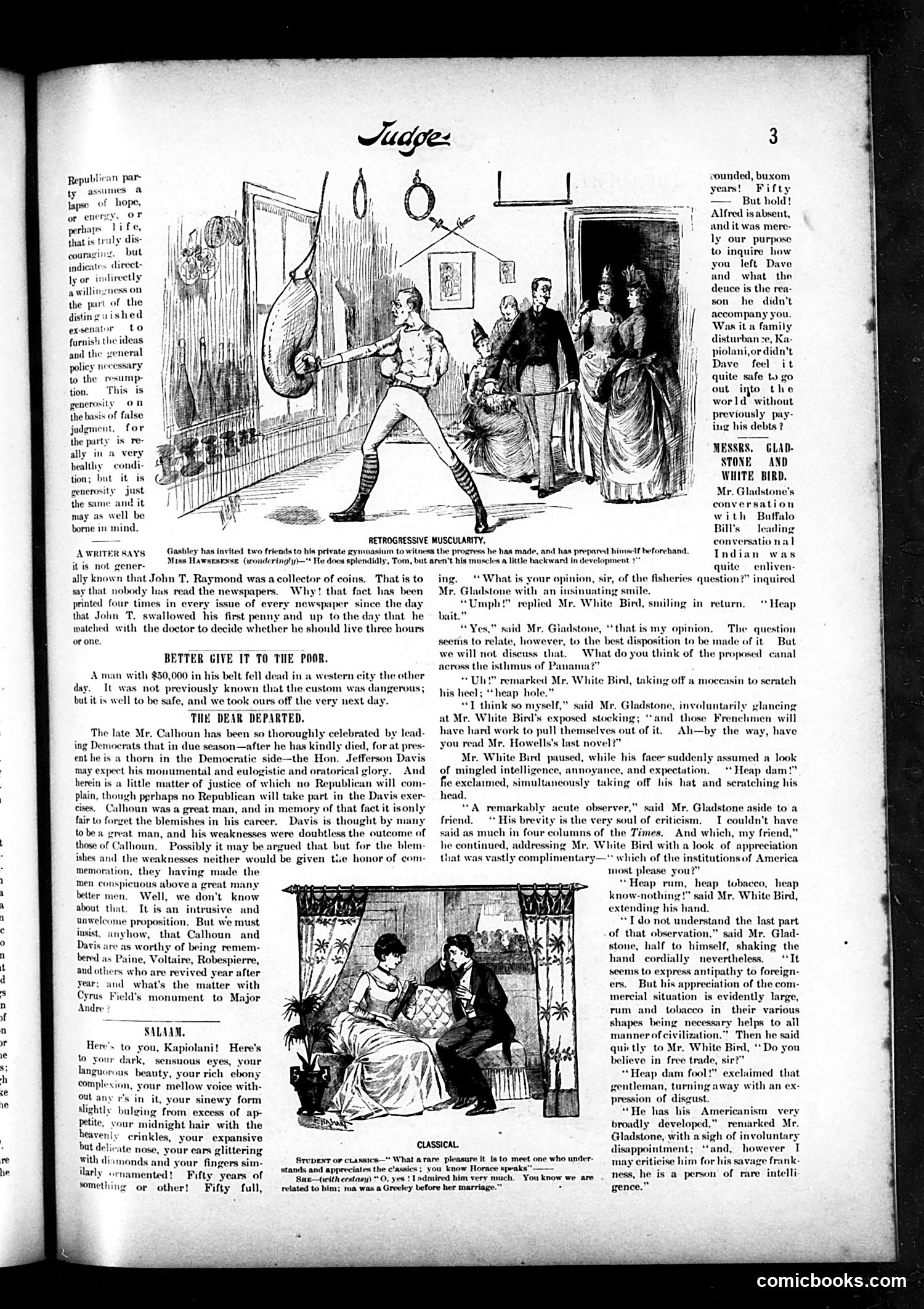
This page contains multiple satirical pieces typical of Judge magazine's political and social commentary. **"Retrogresssive Muscularity"** (top cartoon): Shows a muscular man fencing while well-dressed visitors watch. The caption references Garfield's gymnasium activities, satirizing how newspapers obsessively covered trivial details about public figures like John T. Raymond's coin collection. **"The Dear Departed"**: Criticizes the Democratic Party's timing in celebrating recently-deceased John C. Calhoun, a pre-Civil War Southern senator. The piece argues Republicans should also memorialize figures like Thomas Paine and Voltaire, questioning why Confederate figures receive such honor while American patriots are neglected. **"Salaam"** (bottom section): Mocks overly romanticized descriptions of Hawaiian princess Kapiolani, using exaggerated, patronizing language about her appearance—reflecting period attitudes toward indigenous peoples and colonial attitudes toward Hawaii. The page reflects 1880s concerns: media sensationalism, sectional divisions over Civil War memory, and orientalist stereotyping of non-Western figures.
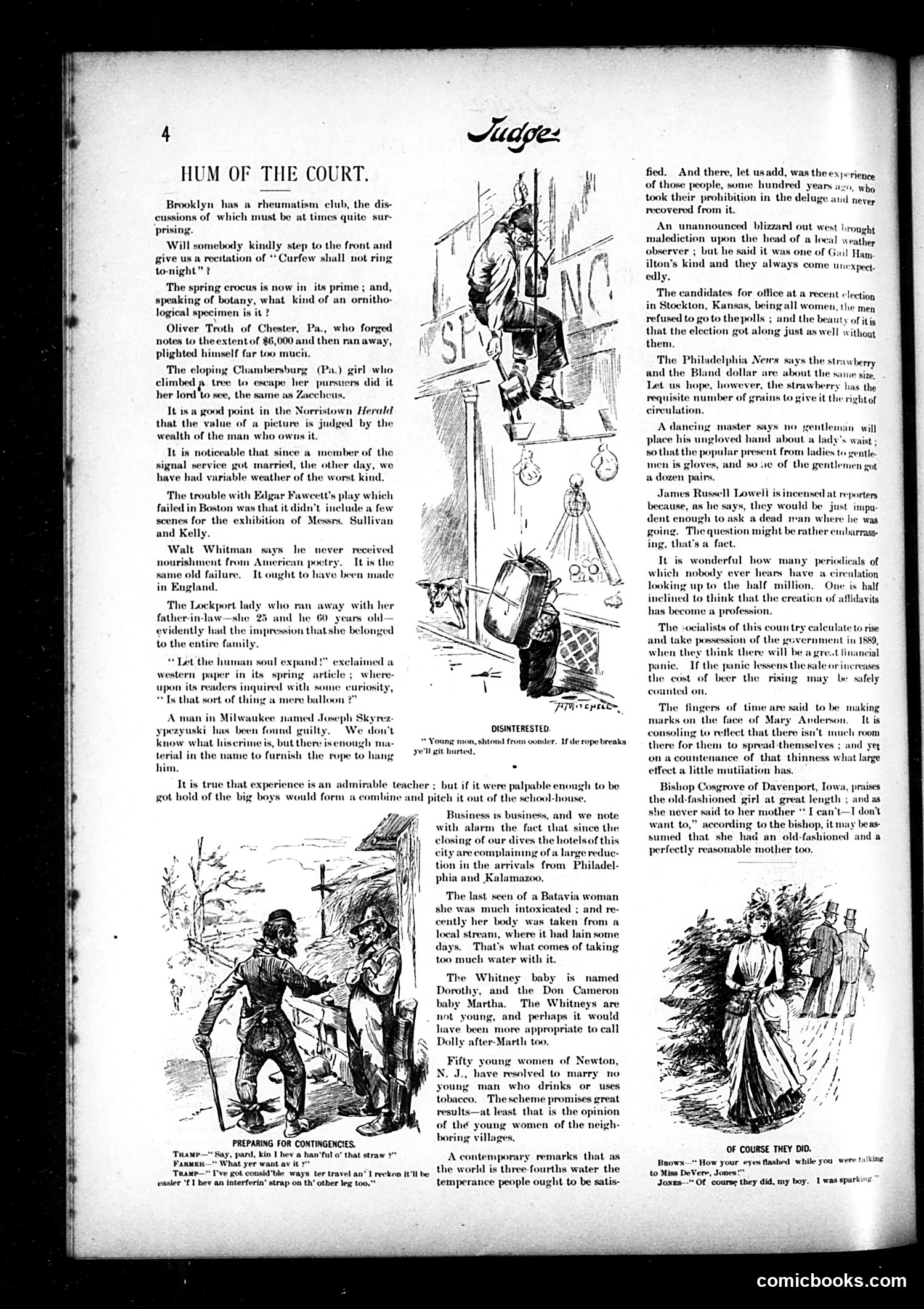
This page from **Judge** (a 19th-century American satirical weekly) contains brief social commentary and jokes rather than single large political cartoons. The illustrations mock contemporary absurdities: one shows a man dangling from a gallows with the caption "Disinterested," satirizing executions; another depicts people in various comic predicaments. The text's "Hum of the Court" column ridicules minor news items and social trends: a woman who eloped by climbing a tree; a Milwaukee man with an unpronounceable name convicted of crime; the closing of "dives" (bars) causing hotel complaints; women in Kansas refusing to marry tobacco users. A recurring theme is **Prohibition and temperance reform**—mocking the anti-alcohol movement by noting that temperance advocates shouldn't complain about water when it once flooded the earth (the Flood reference), and that strawberries aren't as reliably "grain-sized" as currency. The humor is lightweight, targeting local news oddities, human foibles, and reform movements Judge considered ridiculous—typical of Victorian-era satirical magazine humor.
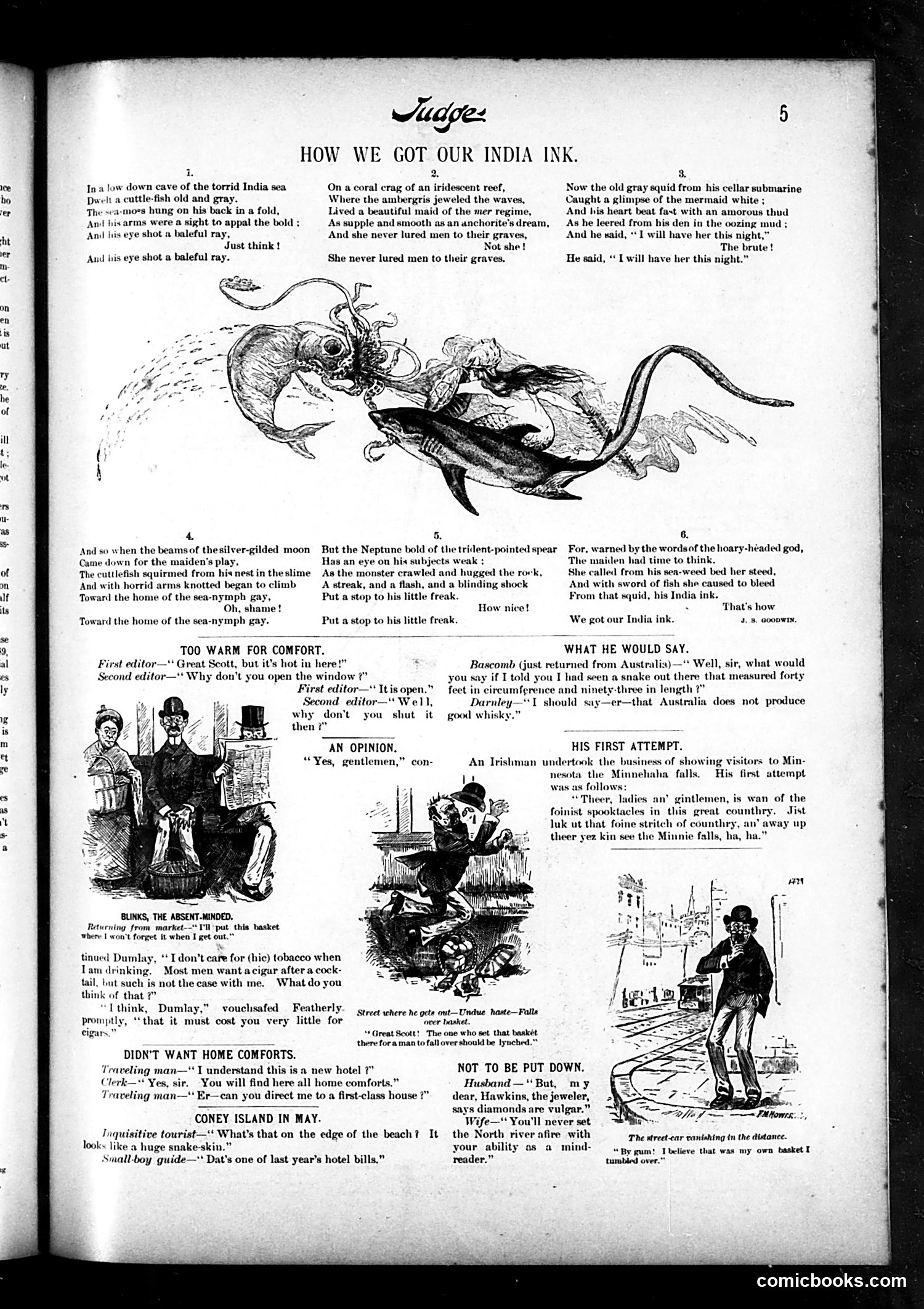
This page's centerpiece is a whimsical poem-and-illustration explaining the origin of India ink through an absurd sea tale. A lecherous old cuttlefish pursues a virtuous mermaid toward her home. Neptune, the sea god, intervenes—striking the squid and causing it to release its ink as a weapon or defense mechanism, which humorously "explains" how humans obtained India ink. The satire targets Victorian sentimentality and pseudo-scientific "just-so" storytelling popular in children's literature. The joke mocks elaborate mythological explanations for everyday objects. The page also contains miscellaneous comic vignettes about absent-minded characters, traveling men, hotel discomforts, and exaggerated tall tales—typical Judge magazine filler humor. These satirize American types: forgetful businessmen, traveling salesmen, henpecked husbands, and boastful travelers. The comedy relies on wordplay, irony, and gentle social mockery rather than political content.
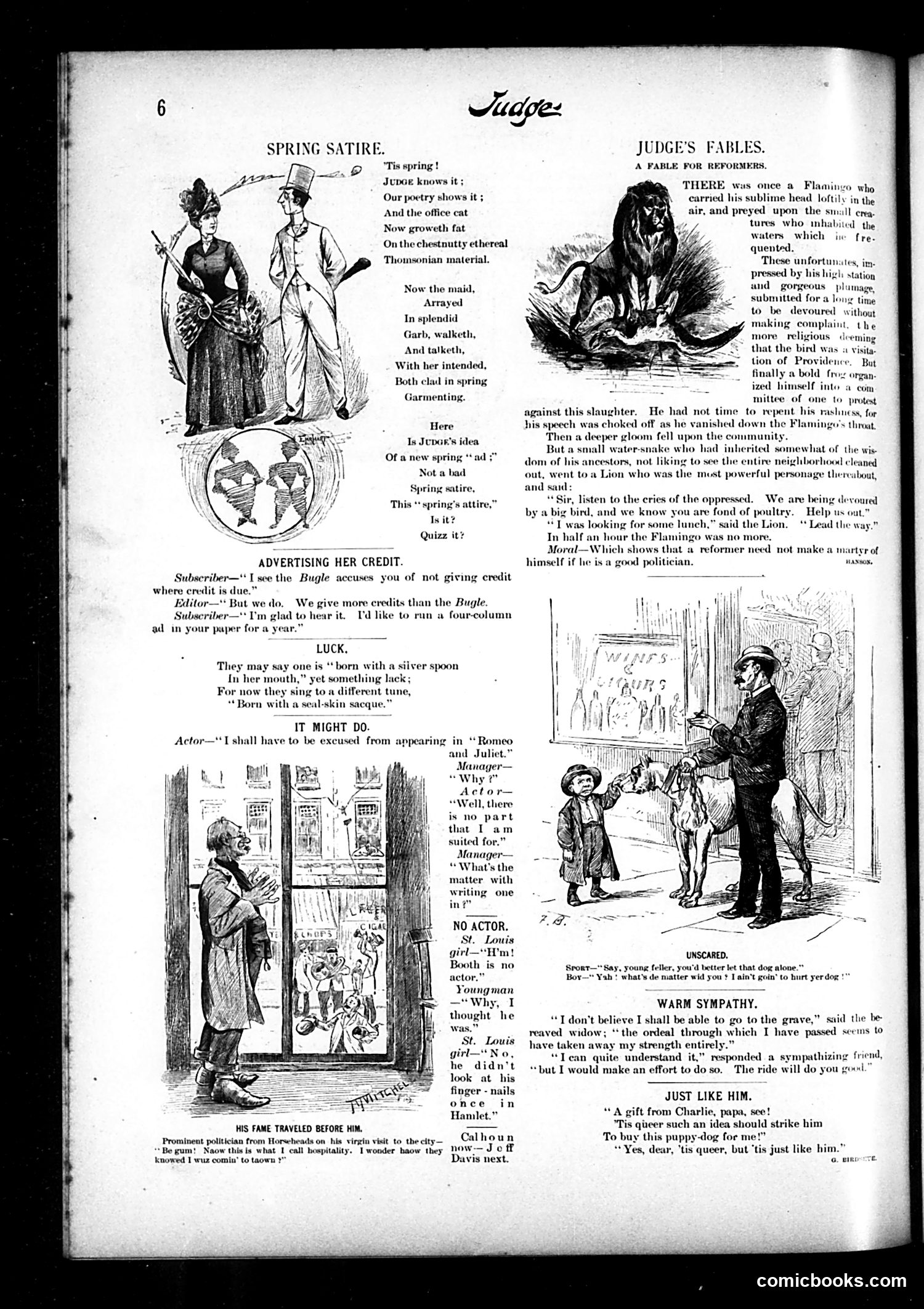
This page from Judge (a 19th-century American satirical weekly) contains multiple brief satirical pieces: **"Spring Satire"** mocks the predictable, overwrought poetry and fashion clichés that emerge each spring—maids in new garments, romantic walks, etc. **"Advertising Her Credit"** jokes about a newspaper's credibility, with a subscriber sarcastically praising the editor for giving "more credits than the Bugle" (a rival publication). **"It Might Do"** contains an actor's excuse for avoiding a role—claiming he's suited for no part, prompting the manager's suggestion that he could play Hamlet, implying the actor is incompetent. **"His Fame Traveled Before Him"** satirizes a provincial politician visiting the city, naively assuming the welcoming reception was due to his reputation, when it's clearly coincidental. **"Judge's Fables"** offers a morality tale: a Flamingo devours small creatures until reformers complain; a Lion kills the Flamingo for lunch. The moral: reformers needn't martyr themselves if they're pragmatic politicians. The remaining items are brief humorous snippets about sympathy, puppies, and dogs.
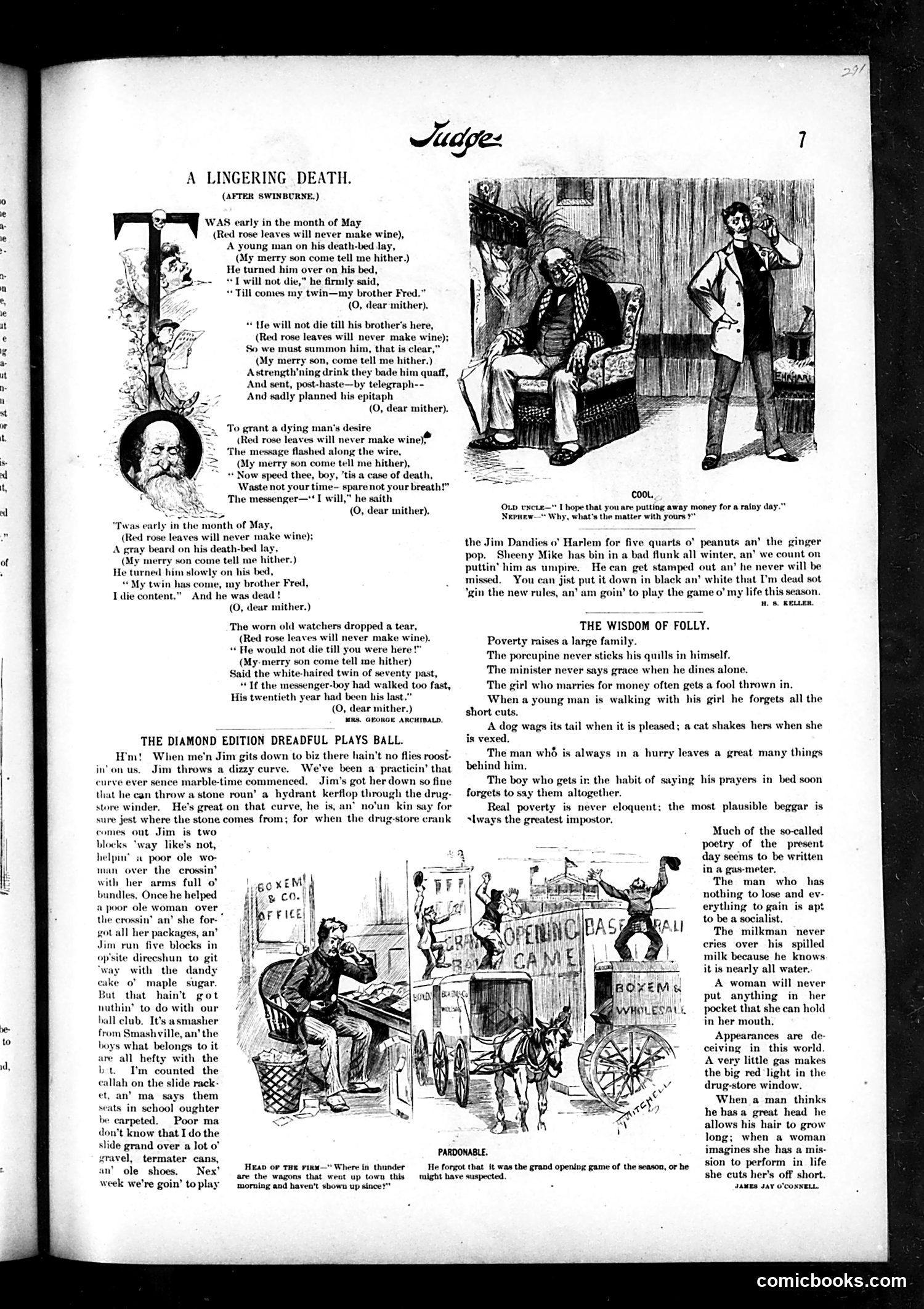
This page contains a literary parody mocking the ornate, repetitive style of Victorian poet Algernon Charles Swinburne. "A Lingering Death" mimics Swinburne's characteristic use of archaic language, repeated refrains ("Red rose leaves will never make wine"), and melancholic tone—but applies it absurdly to a mundane scenario: a dying man waiting for his twin brother Fred before he'll pass away. The joke is the contrast between Swinburne's overwrought aesthetic and the trivial subject matter. By the poem's end, both twins are dead—the elderly one finally content to die once his brother arrives. The accompanying illustrations and other sketches (baseball humor, sentimental aphorisms) represent typical *Judge* fare: satirizing contemporary culture through humor and caricature. This page exemplifies how 1880s-90s American satirical magazines entertained educated readers with literary mockery and social commentary.
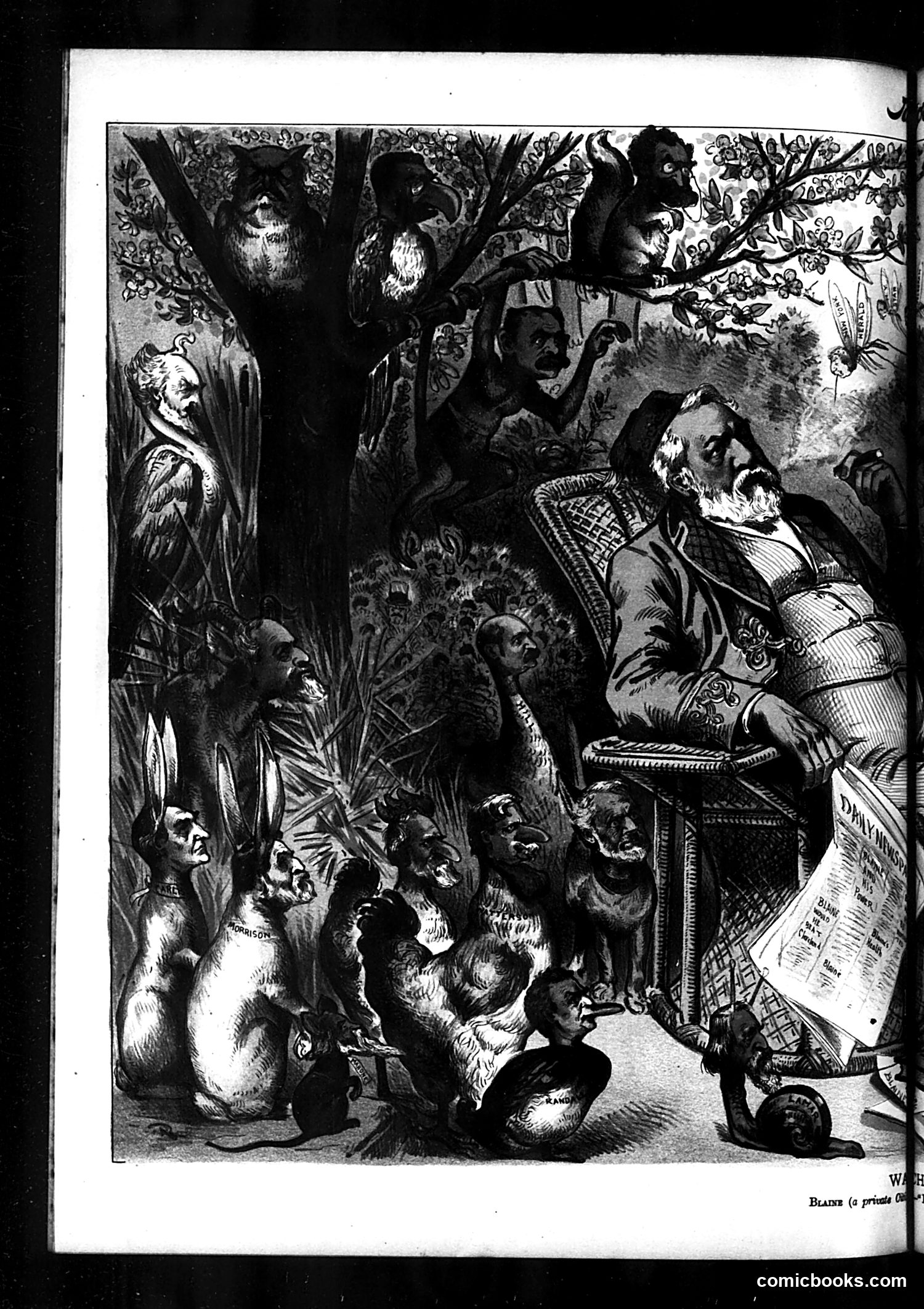
The OCR text is too degraded to read clearly. However, the image shows a satirical engraving depicting what appears to be a **European nobleman or aristocrat** (right side, elaborately dressed) surrounded by **monkeys and apes** in a natural setting with trees and foliage. This is likely **19th-century political satire** mocking a specific public figure by depicting them alongside primates—a common racist and dehumanizing trope used in period comics to ridicule opponents or foreign leaders. Without legible text identifying the specific figure or date, I cannot determine which politician or incident this targets. The style suggests mid-to-late 1800s *Judge* magazine content, but the exact subject remains **unclear from this image alone**.
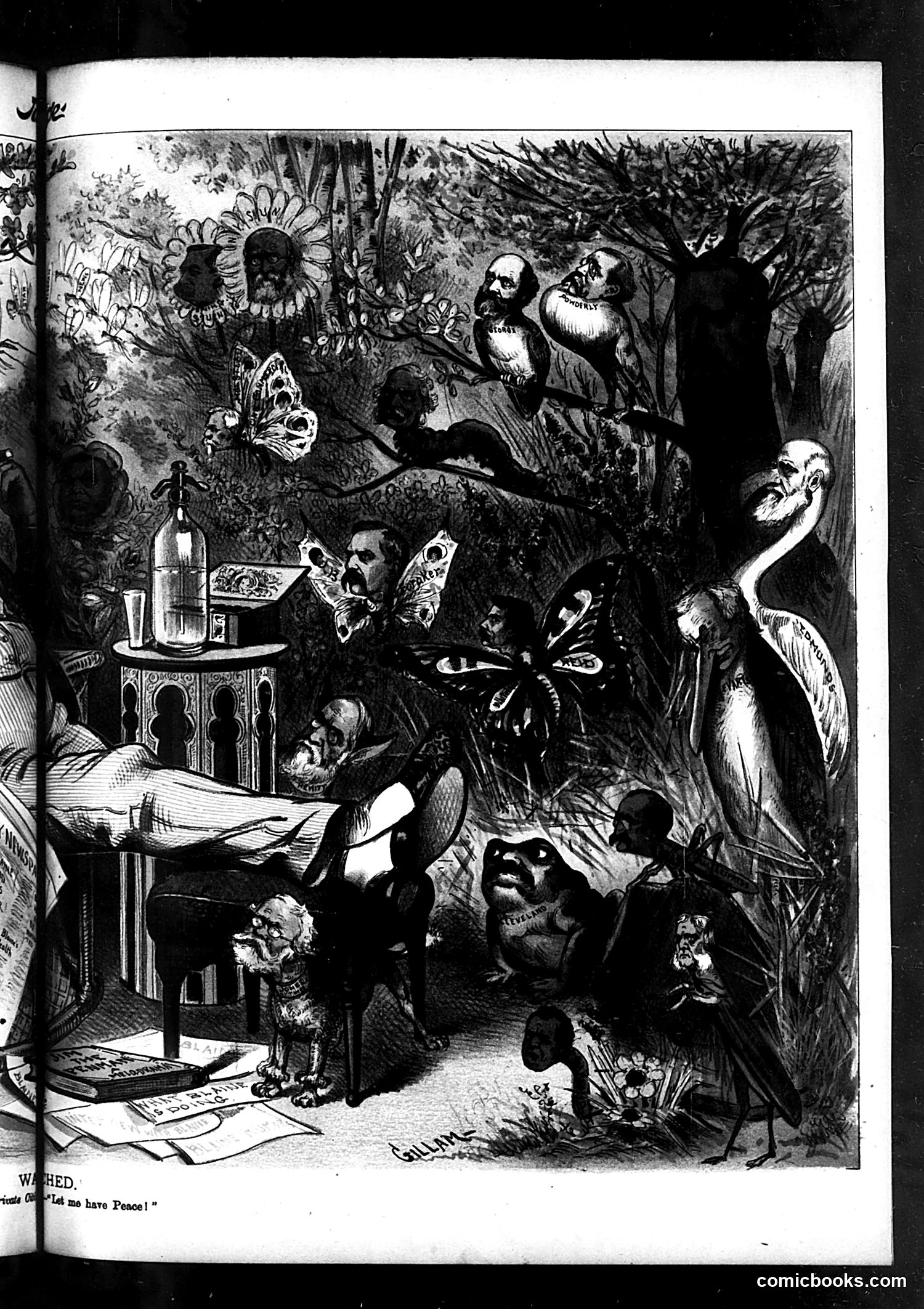
This engraving depicts a nightmarish woodland gathering of grotesque, demonic figures—likely representing political opponents or corrupt politicians of the Gilded Age. The scene shows: **Key Elements:** - A formal gathering in a forest setting with twisted trees - Exaggerated, monstrous caricatures of human figures - A table with a bottle (possibly wine or spirits), suggesting debauchery - Owls and other nocturnal creatures observing the scene - The partial text "Let me have Peace!" visible at bottom **The Satire:** The cartoon appears to mock political figures as literal demons or devils conducting secret, immoral dealings under cover of darkness. The "peace" plea suggests hypocrisy—these corrupt actors claim to seek peace while engaging in nefarious activities. The woodland setting reinforces themes of hidden corruption and unnatural proceedings, typical of Judge magazine's satirical attacks on political establishments. Without a visible date or publication context, the specific figures remain unclear.
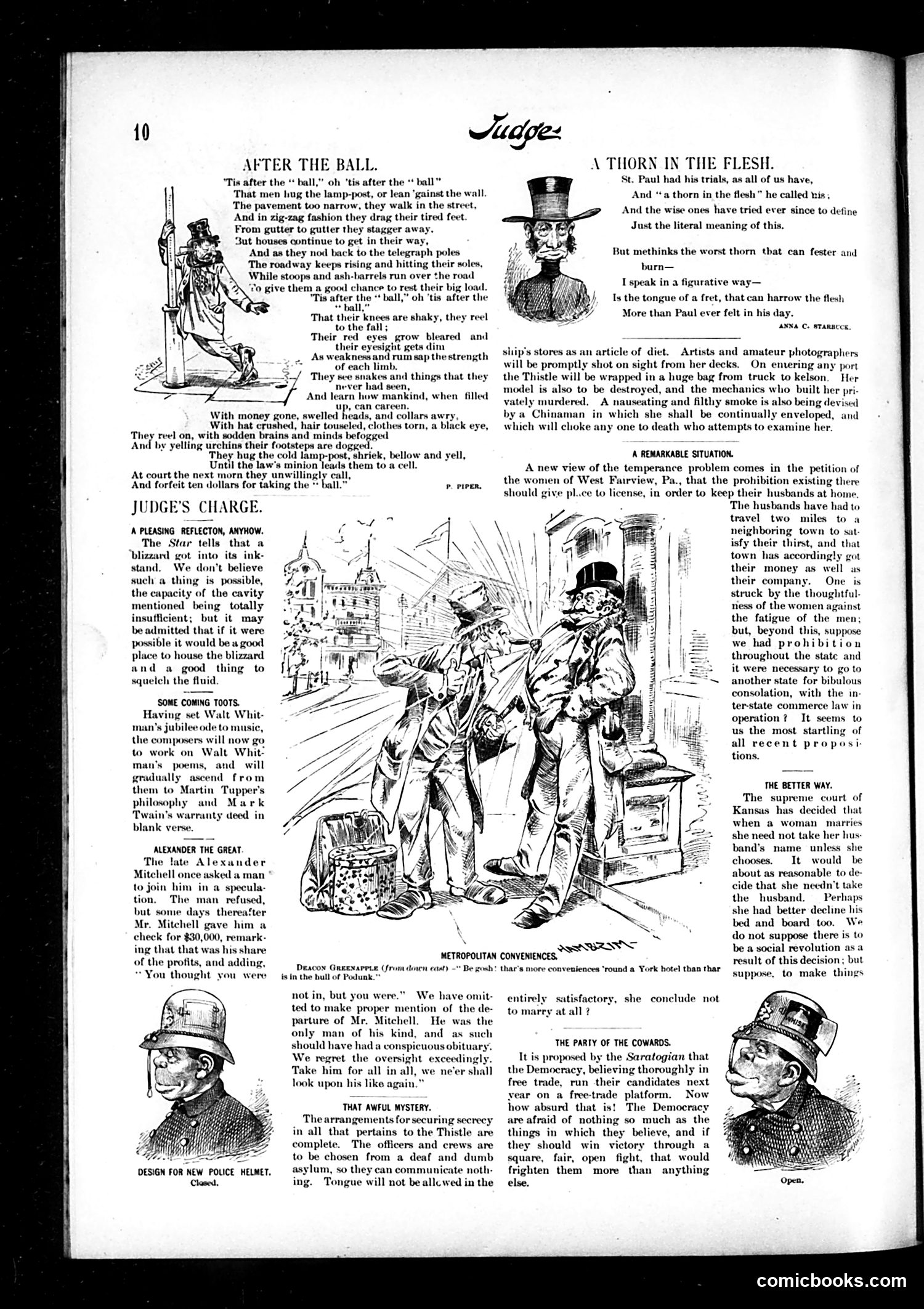
This page from Judge magazine contains several satirical pieces mocking social behavior and contemporary issues: **"After the Ball"** depicts drunk men stumbling home after evening festivities—a common sight lampooning excessive alcohol consumption and the moral degradation it causes. The exaggerated descriptions of their disheveled state and disorientation serve as social commentary on drinking culture. **"A Thorn in the Flesh"** references St. Paul's biblical ailment while equating a nagging wife's tongue to worse suffering than Paul's literal affliction—typical period misogyny disguised as clever wordplay. **"Judges' Charge"** contains brief satirical notes, including absurdist humor about a blizzard in an inkstand and commentary on composers adapting Walt Whitman's work. **"Metropolitan Conveniences"** satirizes rural husbands traveling miles to drink illegally, with women petitioning to legalize alcohol locally—ironically to keep husbands home. The cartoon illustrates the unintended consequences of prohibition. The illustrations use caricature and exaggeration typical of Victorian-era satirical journalism, targeting working-class behavior and contemporary debates over temperance and women's domestic authority.
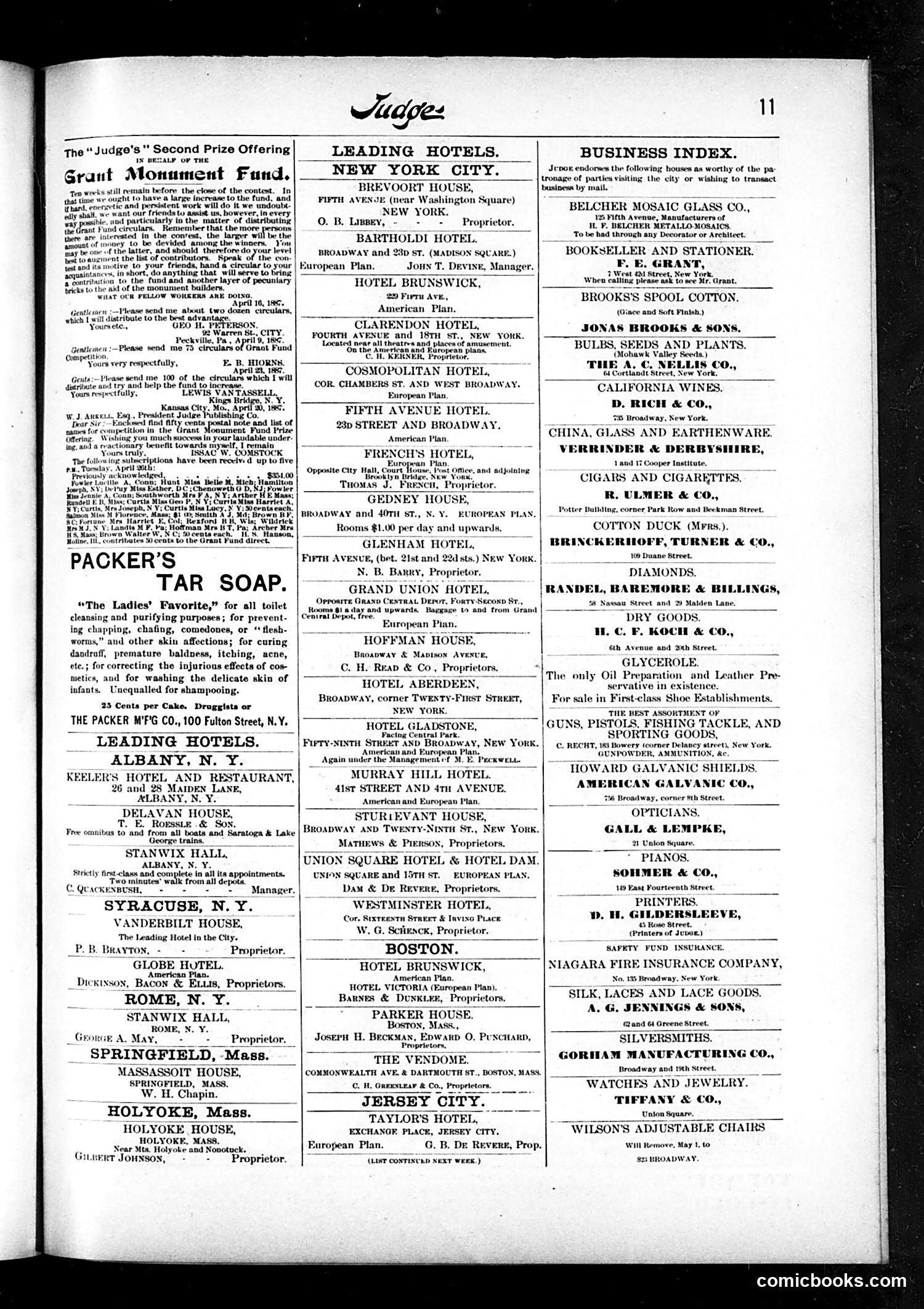
This page is primarily a business directory and advertising layout, not a political cartoon. It contains: **Main content:** A contest announcement for Judge's "Second Prize Offering" to support the Grant Monument Fund (a fundraising effort for a Civil War general's memorial). The page includes letters from contributors pledging to distribute promotional circulars. **Advertising:** The bulk of the page features paid advertisements for hotels across northeastern cities (New York, Boston, Albany, Syracuse) and consumer products like Packer's Tar Soap and various services (glassware, cigars, insurance, jewelry). **Political/social context:** The Grant Monument Fund references represent post-Civil War memorialization efforts that were culturally significant in the 1880s-90s. This wasn't satire—it was Judge magazine leveraging its readership for civic fundraising while generating advertising revenue. The page demonstrates how 19th-century magazines mixed editorial content with commercial interests.
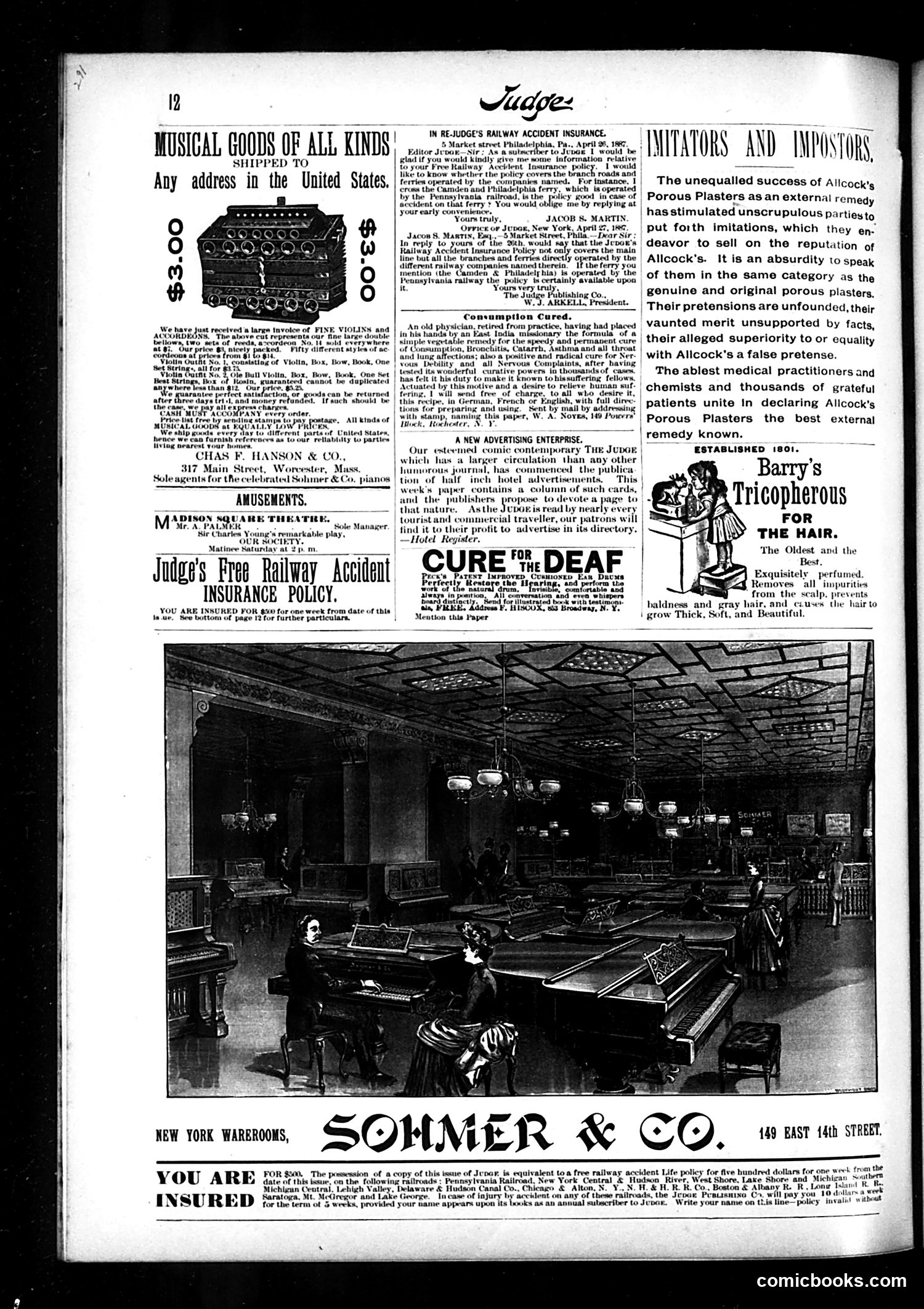
This page is primarily **advertising and announcements** rather than political satire. The content includes: **Main Features:** - Musical instrument vendors (Hanson & Co., Sohmer & Co. pianos) - Judge's "Free Railway Accident Insurance Policy" — a humorous promotional gimmick offering readers $500 coverage for railway accidents - Advertisements for medical products (consumption cure, deafness cure, Allcock's Porous Plasters) - A reader's inquiry about insurance policy coverage **The Satire:** The railway accident insurance is the page's primary joke. Judge presented this as genuine coverage, playing on readers' awareness that railway accidents were common and often fatal in the 1880s-90s. The absurdity lies in the magazine offering "free" insurance — clearly promotional rather than legitimate. **Historical Context:** This reflects the era's dangerous railway travel, widespread patent medicine advertising, and magazines using humor to attract subscribers through promotional schemes rather than serious journalism. The page demonstrates how 19th-century satirical magazines monetized through advertisements while maintaining their comedic brand.
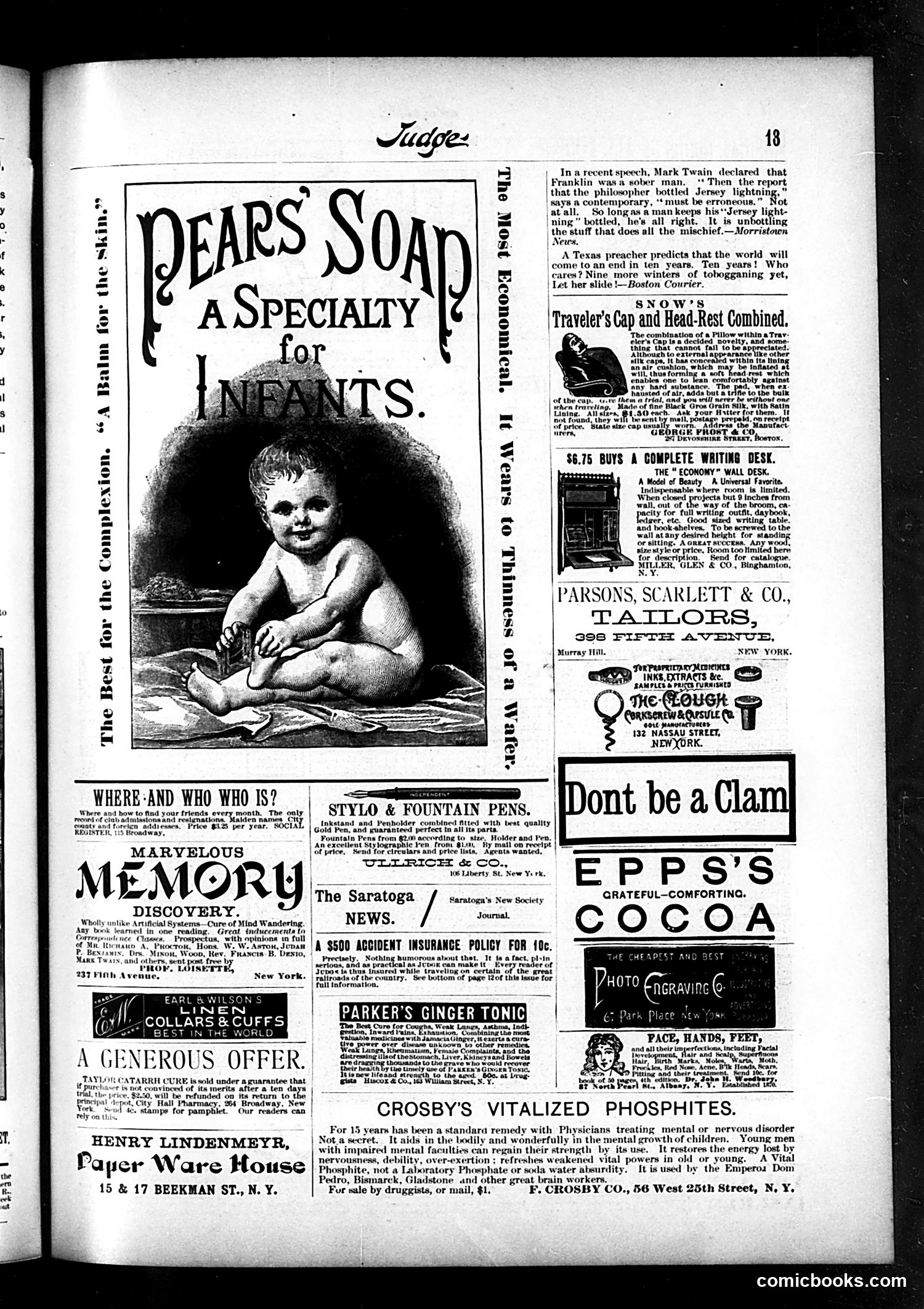
This page is primarily **advertisements** with brief humorous snippets interspersed. The main satirical content consists of short joke-like passages: **The Mark Twain reference** mocks a report that Benjamin Franklin drank heavily, suggesting the real problem isn't bottling liquor but *unbottling* it—a play on the idea that trouble comes from consumption, not storage. **The Texas preacher prediction** jokes about an end-times prophecy claiming the world will end in ten years. The humor lies in the casual response: readers only care about nine more winters of tobogganing before doomsday. The rest is advertising: Pears' Soap for infants, fountain pens, insurance policies, medicines (Parker's Ginger Tonic, Crosby's Vitalized Phosphites), writing desks, and tailoring services—typical late 19th-century print ads making dubious health and product claims. The page reflects Judge's mixed model of satire paired with revenue-generating advertisements.
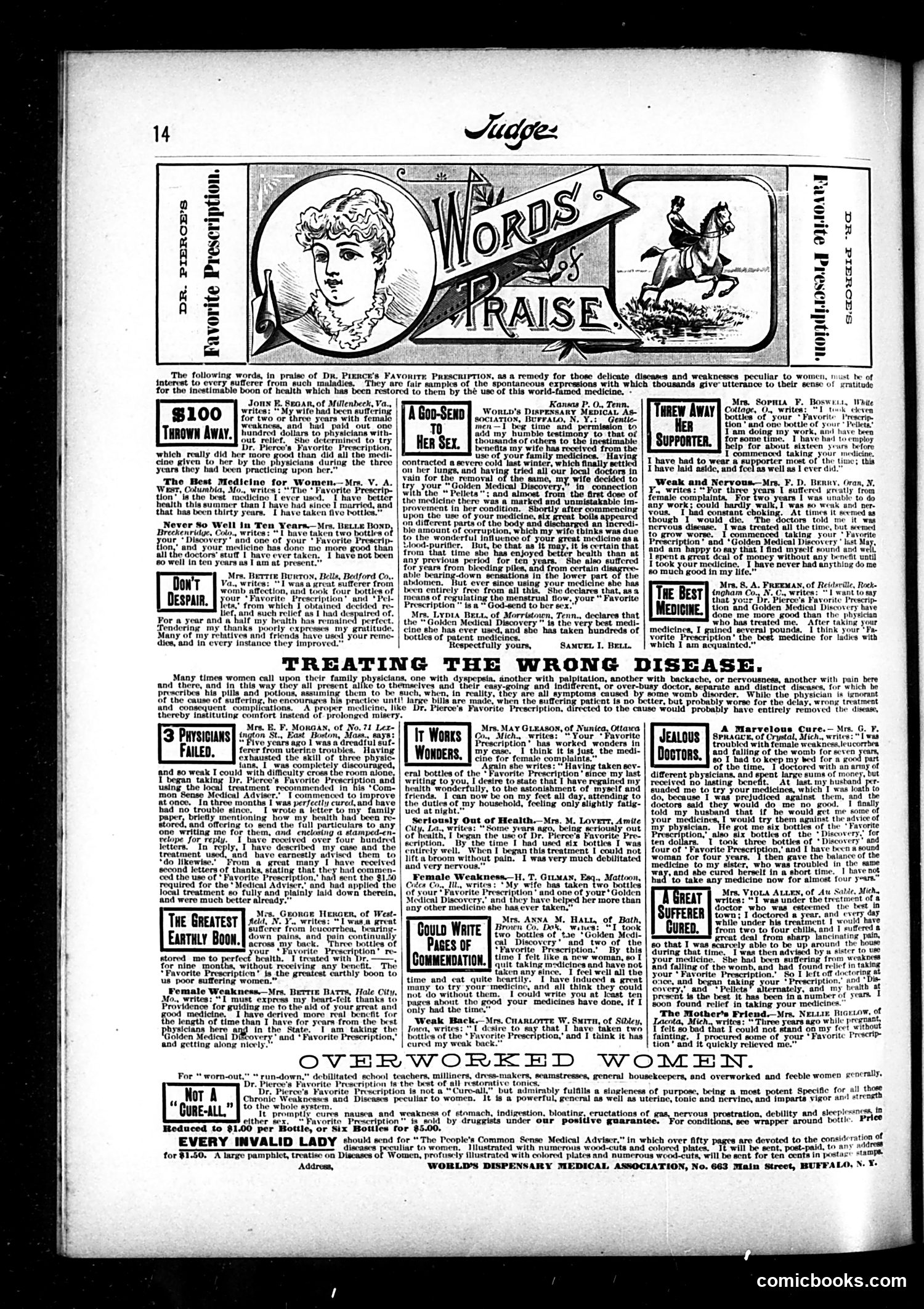
This page is primarily **advertising, not political satire**. It features testimonial advertisements for Dr. Pierce's medical products, specifically his "Favorite Prescription" and "Golden Medical Discovery"—patent medicines marketed to women for "female weakness" and related ailments. The content reflects late 19th/early 20th-century medical marketing practices. Multiple letters from women testify to the medicines' effectiveness for conditions like menstrual problems, "womb affection," and general debility. The ads promise cures where conventional physicians supposedly failed. The decorative header "Words of Praise" with a woman's portrait is typical period advertising design. While the page appears in a satirical magazine, this section functions as commercial content rather than satire—exploiting contemporary anxieties about women's health and the era's widespread reliance on unregulated patent medicines. These products were often ineffective or harmful, representing a medical landscape Judge might normally mock, though this page appears to be paid advertising space.
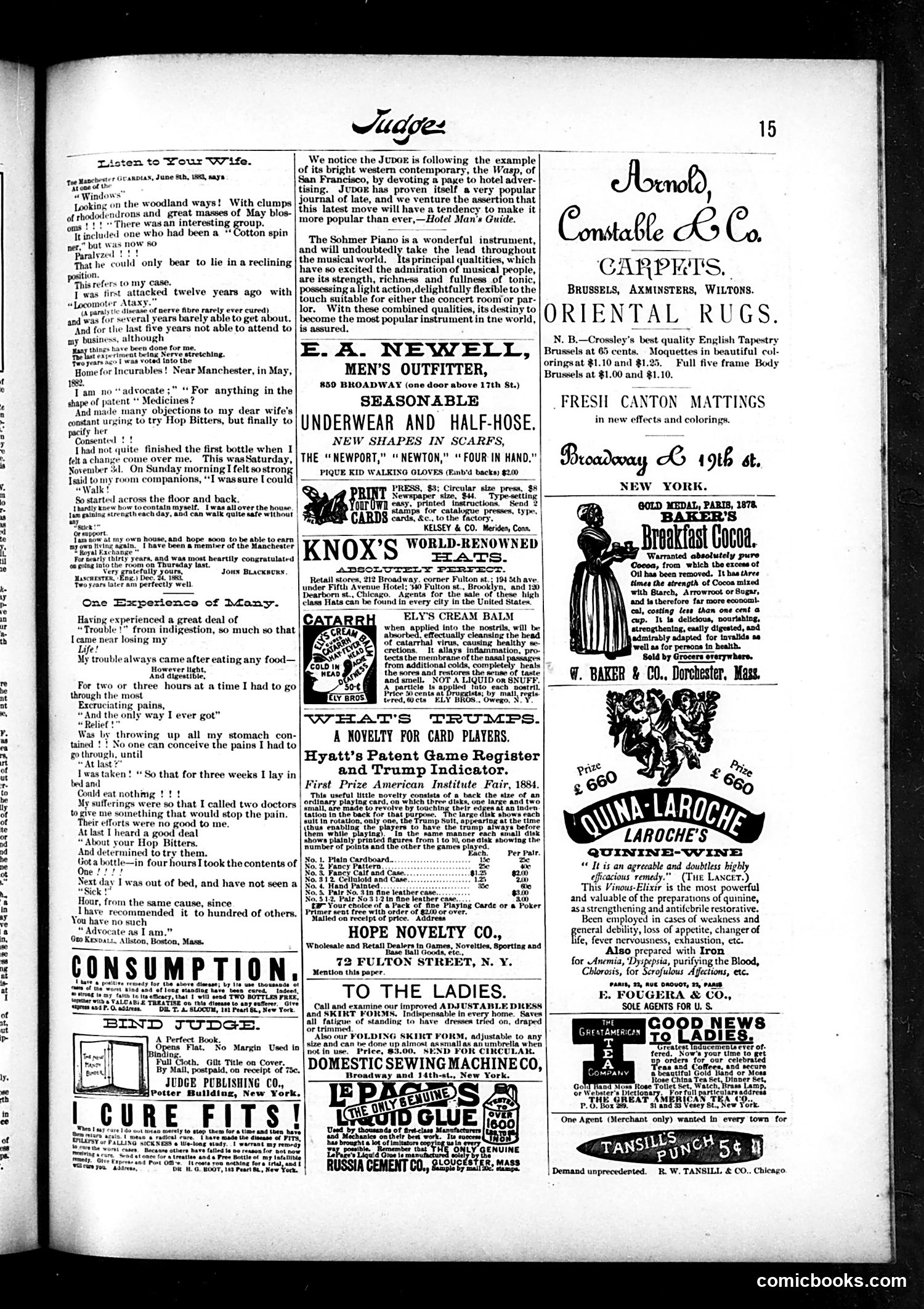
This page is primarily **advertising**, not editorial content or political cartoons. It's page 15 of Judge magazine from approximately 1884. The dominant content consists of commercial advertisements for consumer products: Sohmer pianos, E.A. Newell men's clothing, Knox hats, Ely's Cream Balm, and various patent medicines (Hop Bitters for indigestion and nerve conditions, Russia Cement). The upper portion includes testimonial letters praising Hop Bitters' medicinal efficacy—typical 19th-century advertising strategy using purported patient accounts. There's also a brief editorial note crediting Judge for following the San Francisco *Wasp* magazine's practice of dedicating pages to hotel advertising. The page reflects the era's commercial practices: unregulated health claims, patent medicines with dubious ingredients, and testimonial-based marketing. No political satire or social commentary is evident here—this is purely a revenue-generating advertising section of the magazine.
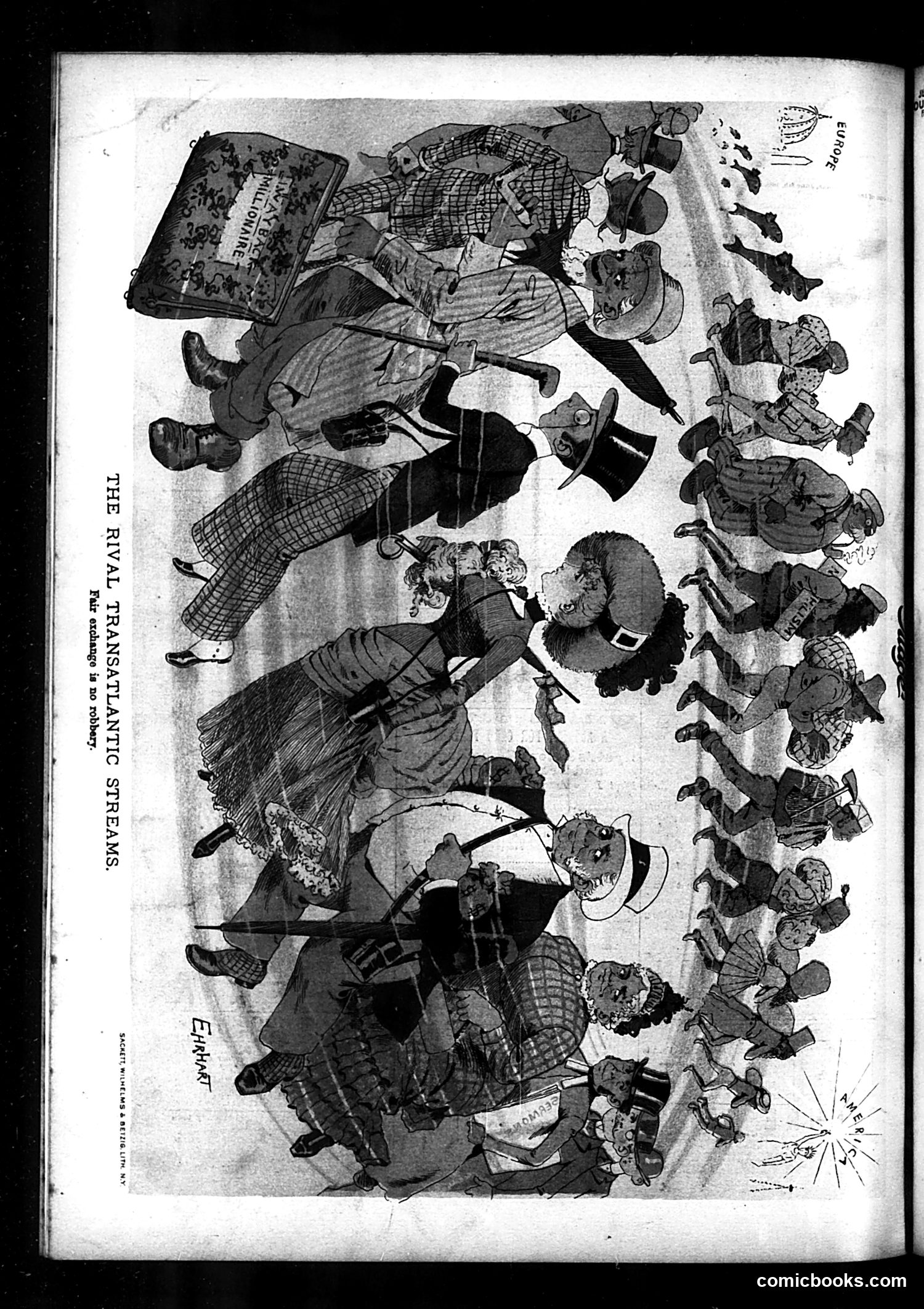
This satirical cartoon depicts competition between transatlantic passenger steamship lines. The central figure appears to be a gentleman being pulled in opposite directions by two rival ship captains or company representatives—one labeled with what seems to be a European line, the other American. The humor plays on "fair exchange is no robbery," suggesting each steamship company was aggressively competing for wealthy passengers' business by offering superior accommodations and service. The gentleman's distressed posture indicates how travelers were caught between competing offers. This likely references the intense rivalry between major transatlantic shipping companies in the late 19th/early 20th century, when crossing the Atlantic was a prestigious and profitable business for shipping lines competing for affluent clientele.