
Judge, 1887-05-14 · page 7 of 16
Judge — May 14, 1887 — page 7: what you’re looking at
What you’re looking at
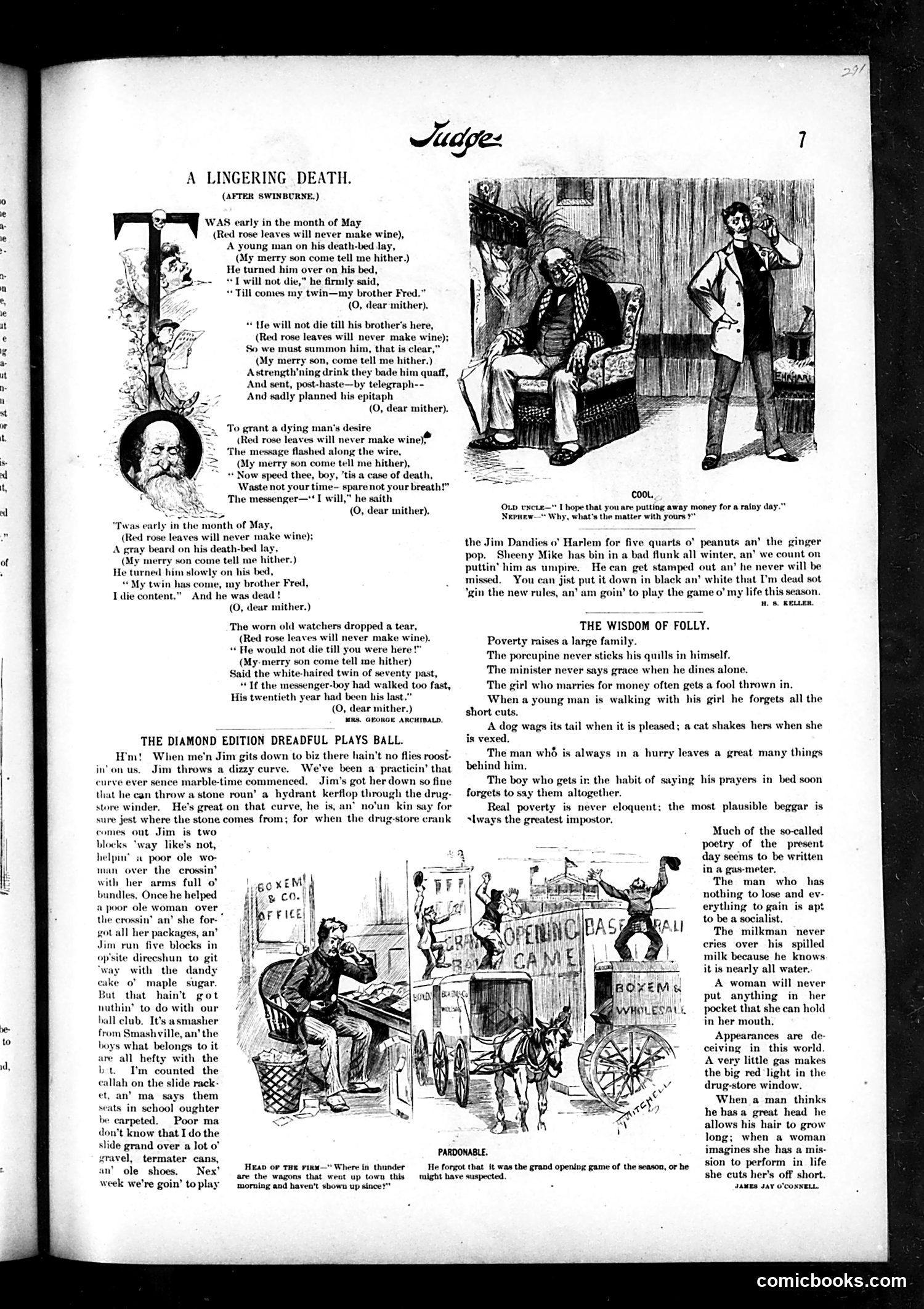
This page contains a literary parody mocking the ornate, repetitive style of Victorian poet Algernon Charles Swinburne. "A Lingering Death" mimics Swinburne's characteristic use of archaic language, repeated refrains ("Red rose leaves will never make wine"), and melancholic tone—but applies it absurdly to a mundane scenario: a dying man waiting for his twin brother Fred before he'll pass away. The joke is the contrast between Swinburne's overwrought aesthetic and the trivial subject matter. By the poem's end, both twins are dead—the elderly one finally content to die once his brother arrives. The accompanying illustrations and other sketches (baseball humor, sentimental aphorisms) represent typical *Judge* fare: satirizing contemporary culture through humor and caricature. This page exemplifies how 1880s-90s American satirical magazines entertained educated readers with literary mockery and social commentary.
📄 Transcribed text from this page (OCR, searchable)
Machine-transcribed from the original scan — historical spelling and the odd misread are preserved.
A LINGERING DEATH. (AFTER SWINBURNE.) WAS early in the month of May (Red rose leaves will never make wine), A young man on his death-bed lay, (My merry son come tell me hither.) He turned him over on his bed, “Twill not he firmly said, + Till comes my twin—my brother Fred.” (O, dear mither), “ Ue will not die till his brother's here, (Red rose leaves will never make wine); So we must summon hi (My merry son, come tell me hither.) Astrength’ning drink they bade him quaff, And sent, post-haste—by telegrap And sadly planned his epitaph (O, dear mither). ‘To grant a dying man’s desire (Red rose leaves will never make winey® ‘The message flashed along the wire, (ly merry son come tell me hither), “ Now speed thee, boy, ‘tis a case of death, Waste not you: ne- spare not your breath!” The messenger—'*I will,” he saith por, Fare (O, dear mither). “Twas early in the month of May, (Red rose leaves will never make wine); A gray beard on his death-bed (My merry son come tell me hither.) He turned him slow ‘on his bed, “ My twin has come, my brother Fred, Ldie content.” And he was dead ! (O, dear mither.) The worn old watchers dropped a tear, (Red rose leaves will never make ¥ “ He would not die till you were hers (My: merry son come tell me hither) Said the white-haired twin of seventy past, “If the messenger-boy had walked too fast, His twentieth year had been his last.” (O, dear mither.) uns. OPoRGE ANCHIBALD, THE DIAMOND EDITION DREADFUL PLAYS BALL. Hm! When me'n Jim gits down to biz there hain’t no flies roost- in’ onus. Jim throws a dizzy curve. We've been a practicin’ that curve ever sence marble-time commenced. Jim’s got her down so fine n throw a stone roun’ a hydrant kerflop through the drug- He's great on that curve, he an’ no‘un kin say for sure jest where the stone comes from; for when the drug-store crank comes out Jim is two blocks ‘way like’s not, helpin’ a poor ole wo- man over the crossin’ with her arms full o° bundles. Once he helped a poor ole woman over the crossin’ an’ she for-* got all her packages, an’ Jim run five blocks in pp'site direeshun to git with the dandy cake 0’ maple sugar. But that hain't got nuthin’ to do with our hall club, It's asmasher from Smashville, an’ the boys what belongs to it are all hefty with the bt. I'm counted the callah on the slide rack- ct, an’ ma says them seats in school oughter be carpeted. Poor ma don’t know that I do the slide grand over a lot o° gravel, termater cans, an’ ole shoes. Nex’ week we're goin’ to play Heap ov THe vinw—" Where in thunder are the wagons that went up town this morning and haven't shown up since!" PARDONABLE. He forgot that it was the grand opening game of the season, or he might have suspected, hope that you are putting away money for a rainy day.” Why, what's the matter with yours the Jim Dandies 0’ Harlem for five quarts 0’ peanuts an’ the ginger pop. Sheeny Mike has bin in a bad flunk all winter, an’ we count on puttin’ him as umpire. He can get stamped out an’ he never will be missed. You can jist put it down in black an’ white that I'm dead sot ‘gin the new rules, an’ am goin’ to play the game o' my life this season. WS. KELLER. THE WISDOM OF FOLLY. Poverty raises a large family. The porcupine never sticks his quills in himself. The minister never says grace when he dines alone. The girl who marries for money often gets a fool thrown in. When a young man is walking with his girl he forgets all the short cuts. A dog wags its tail when it is pleased; a cat shakes hers when she is vexed. The man whé is always in a hurry leaves a great many things behind hin The boy who gets ir: the habit of saying his prayers in bed soon forgets to say them altogether. Real poverty is never eloquent; the most plausible beggar is sIways the greatest impostor, Much of the so-called poetry of the present day seems to be written in a gas-meter, The man who has nothing to lose and ev- erything to gain is apt to be a socialist. The milkman never cries over his spilled milk because he knows. it is nearly all water. A woman will never put anything in her pocket that she can hold in her mouth, Appearances are de i g in this world. little gas makes the big red light in the drug-store window. When a man thinks he has a great head he allows his hair to grow long; when a woman imagines she has a mis- sion to perform in life she cuts her’s off short. JAMES JAY O'CONNELL. comicbooks.com