
A complete issue · 16 pages · 1887
Judge — March 5, 1887
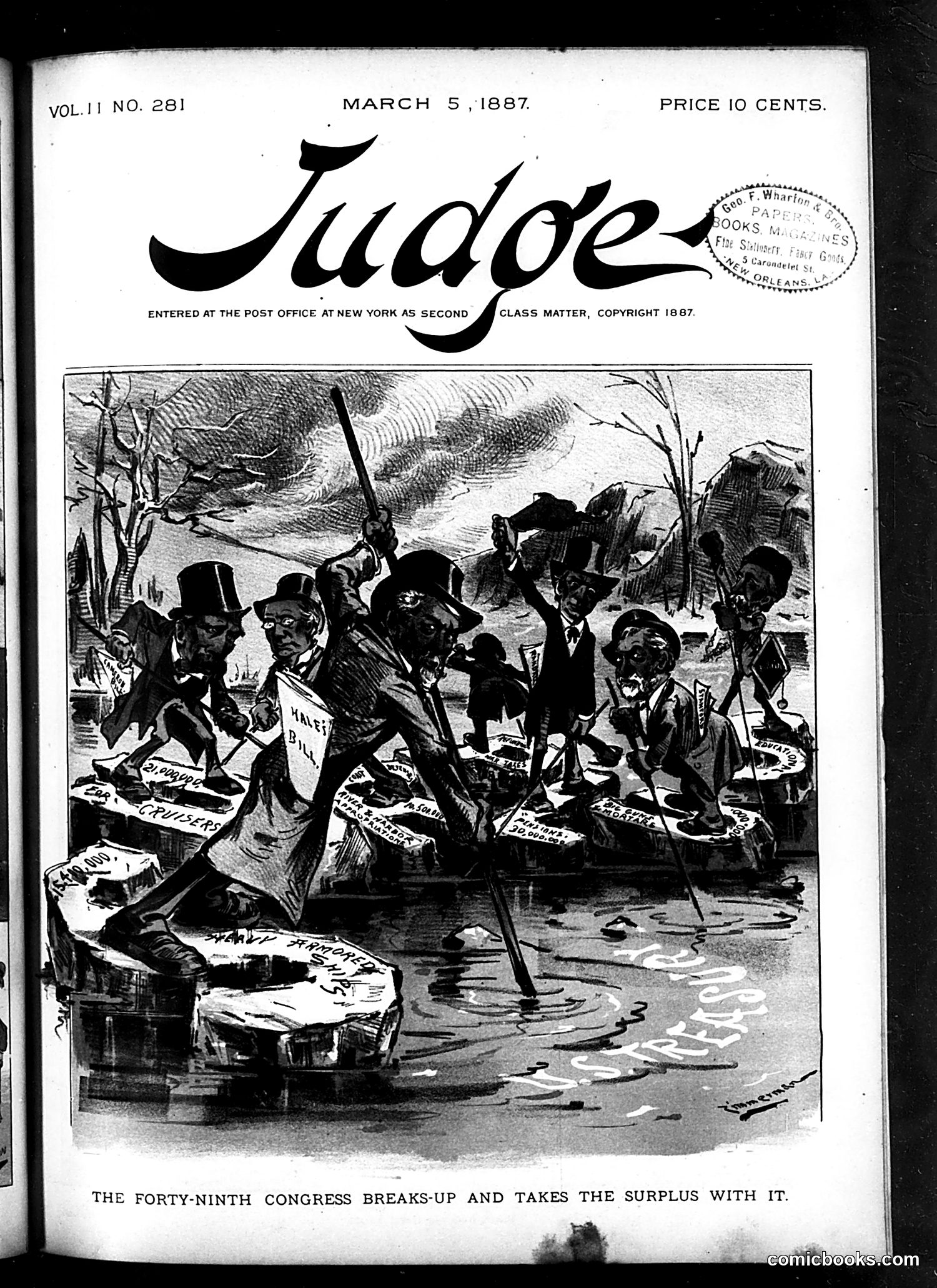
This cartoon satirizes the 49th Congress breaking up after its session ended. The image shows caricatured politicians depicted as figures in a boat on water, seemingly taking the "surplus" (government budget surplus) with them as they depart. The cartoon criticizes Congress members for allegedly benefiting personally from public funds rather than using the surplus for the nation's benefit. The exaggerated, grotesque caricatures and the water setting suggest the politicians are abandoning ship or fleeing with ill-gotten gains. The specific identities of individual figures are unclear from the image alone, but the satire targets the broader practice of political corruption and misappropriation of federal resources during the Gilded Age—a period notorious for such congressional abuses.
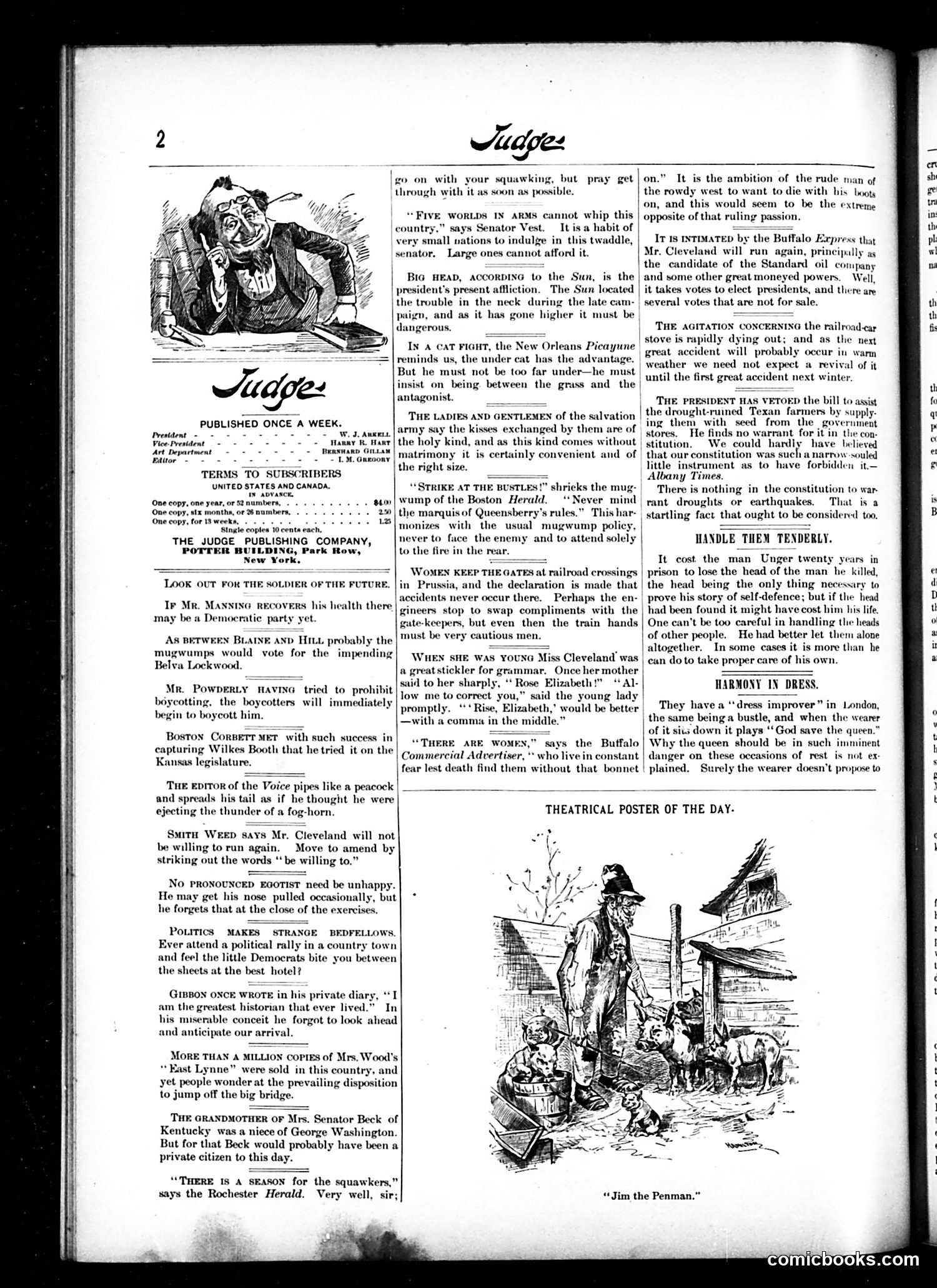
The main cartoon depicts a disheveled political figure labeled "JUDGES" - likely a caricature of a judge or political opponent of the magazine's editorial position. The exaggerated, grotesque facial features and ungainly posture are typical of Judge's satirical attack style. The surrounding text criticizes various political figures and policies: Senator Vest's military spending views, Cleveland's potential re-election, railroad regulations, and women's roles. One item mocks the Buffalo "Commercial Advertiser" for claims about women's fearlessness. The "Theatrical Poster of the Day" shows "Jim the Penman" - appearing to reference a contemporary play or story about crime/deception. Without publication date context, the specific political targets remain unclear, though the anti-establishment tone and focus on Cleveland suggests 1880s-1890s Republican-leaning satire.
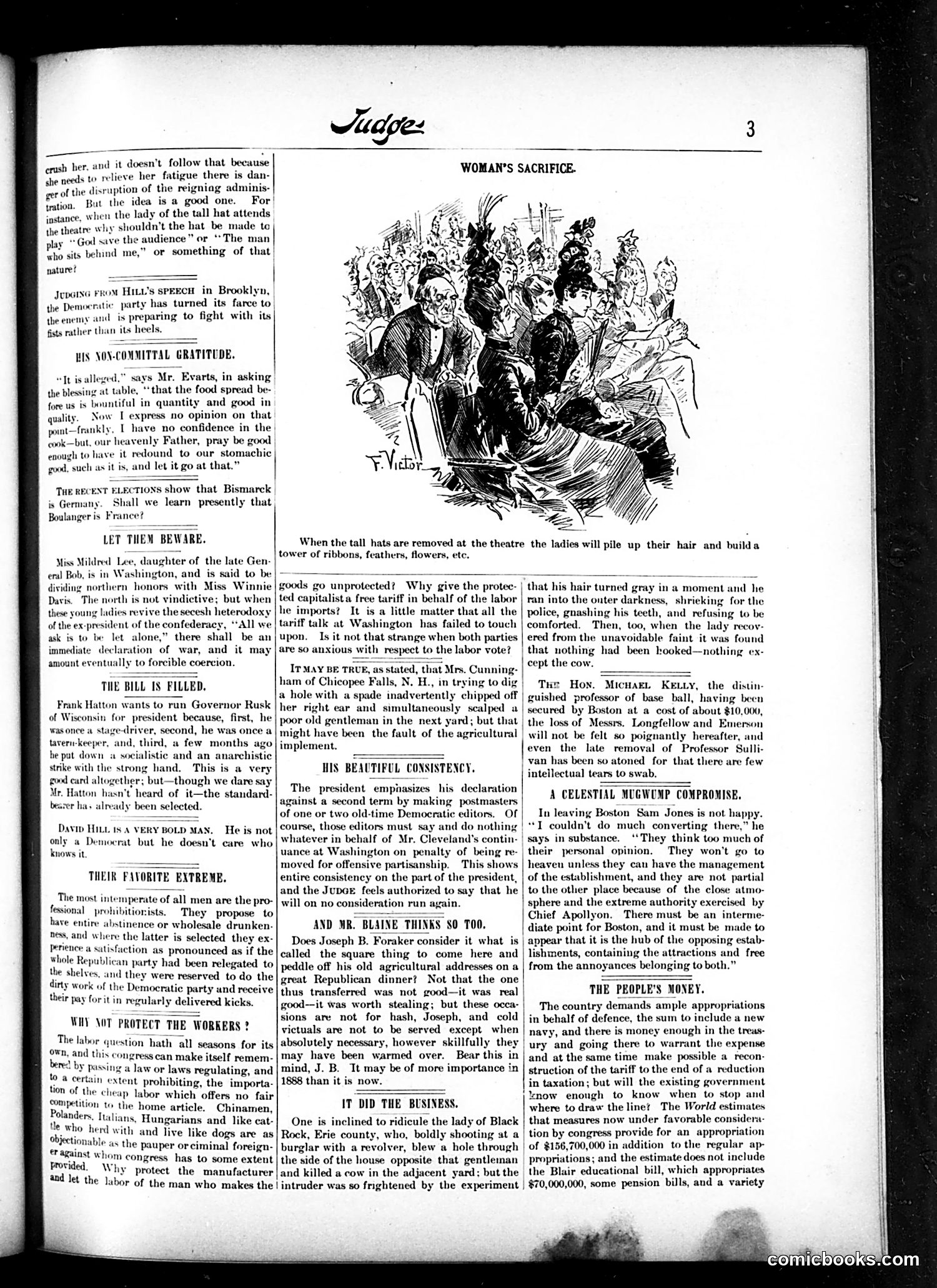
This page contains several brief political satires typical of 1880s American humor: **"Woman's Sacrifice"** (cartoon): Mocks women's elaborate hairstyles at theaters by depicting a towering construction of hair, ribbons, and feathers. The satire criticizes women's fashion vanity and the obstruction tall hats and hairstyles caused for theater audiences. **Political commentary** includes jabs at: - Democratic leadership (Hill, Evarts) for inconsistency and weak positions - Republican presidential prospects (Hatton promoting Governor Rusk) - Labor protection debates in Congress—the magazine criticizes Republicans for protecting manufacturers with tariffs while ignoring workers' interests regarding cheap immigrant labor **"Let Them Beware"** mocks Northern sensitivity about Southern nostalgia, referencing General Robert E. Lee's daughter Winnie Davis reviving Confederate rhetoric. The page reflects Gilded Age concerns: labor competition, tariff politics, women's fashion excess, and lingering post-Civil War sectional tensions. The humor assumes readers understood contemporary political figures and economic debates.
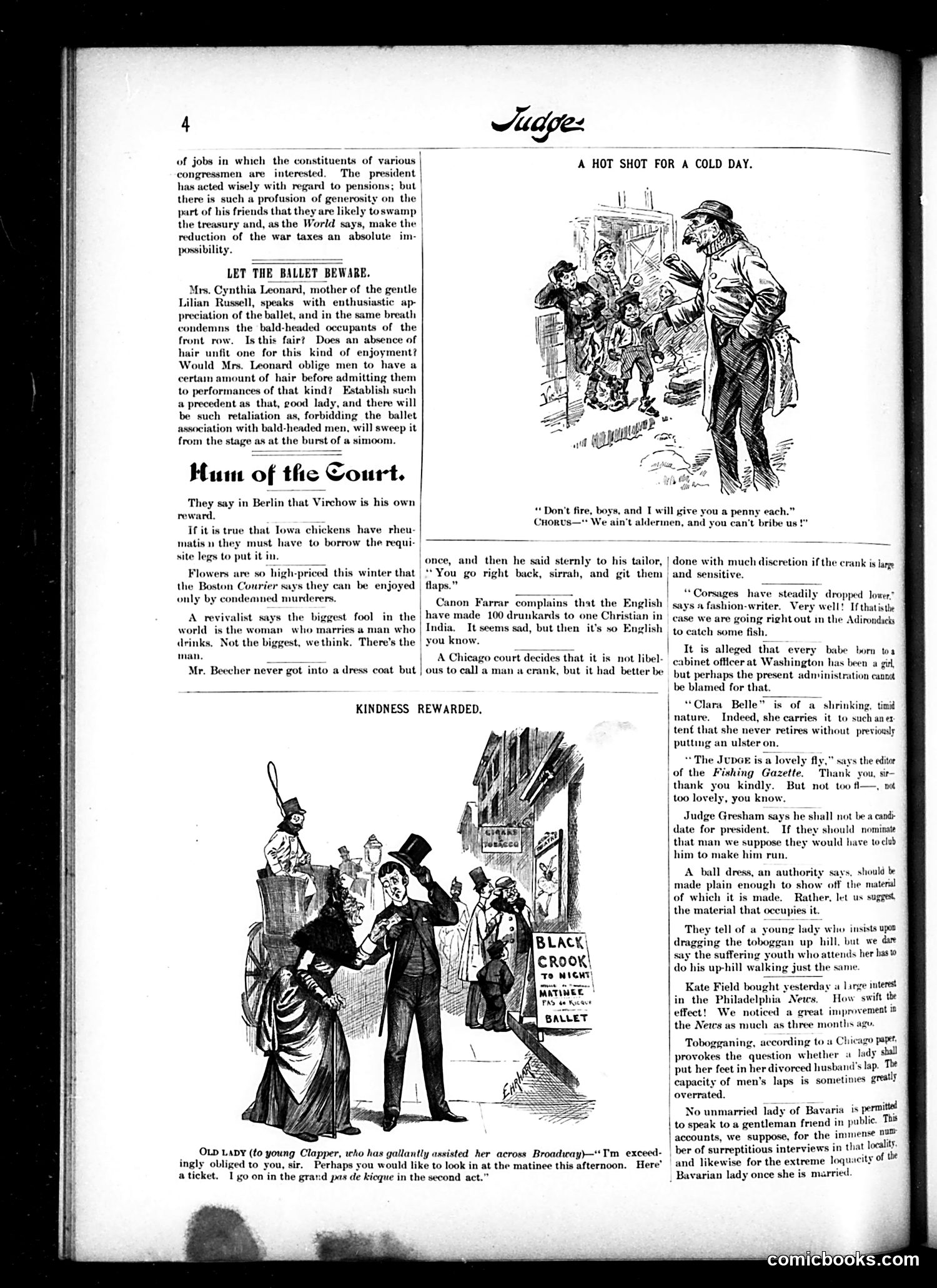
This page from *Judge* (an American satirical weekly) combines social commentary with humor typical of the late 19th century. **Main Cartoons:** 1. **"A Hot Shot for a Cold Day"**: Shows a street vendor offering poor children hot drinks for pennies, with the caption about not bribing them like "aldermen." This satirizes urban poverty and political corruption. 2. **"Kindness Rewarded"**: Depicts an elderly woman offering a young man a theater ticket after he helps her cross Broadway. The man is thrilled—the satire suggests that small acts of kindness are so rare they're shocking. **Column Content:** The page includes brief satirical "items" mocking contemporary figures and issues: Mrs. Cynthia Leonard's complaints about bald men at ballet performances, clerical figures like Henry Ward Beecher and Canon Farrar, fashion trends, and political figures like Judge Gresham. The humor relies on absurdist exaggeration and wordplay rather than specific events. The overall tone is light social satire targeting manners, fashion, morality, and public figures.
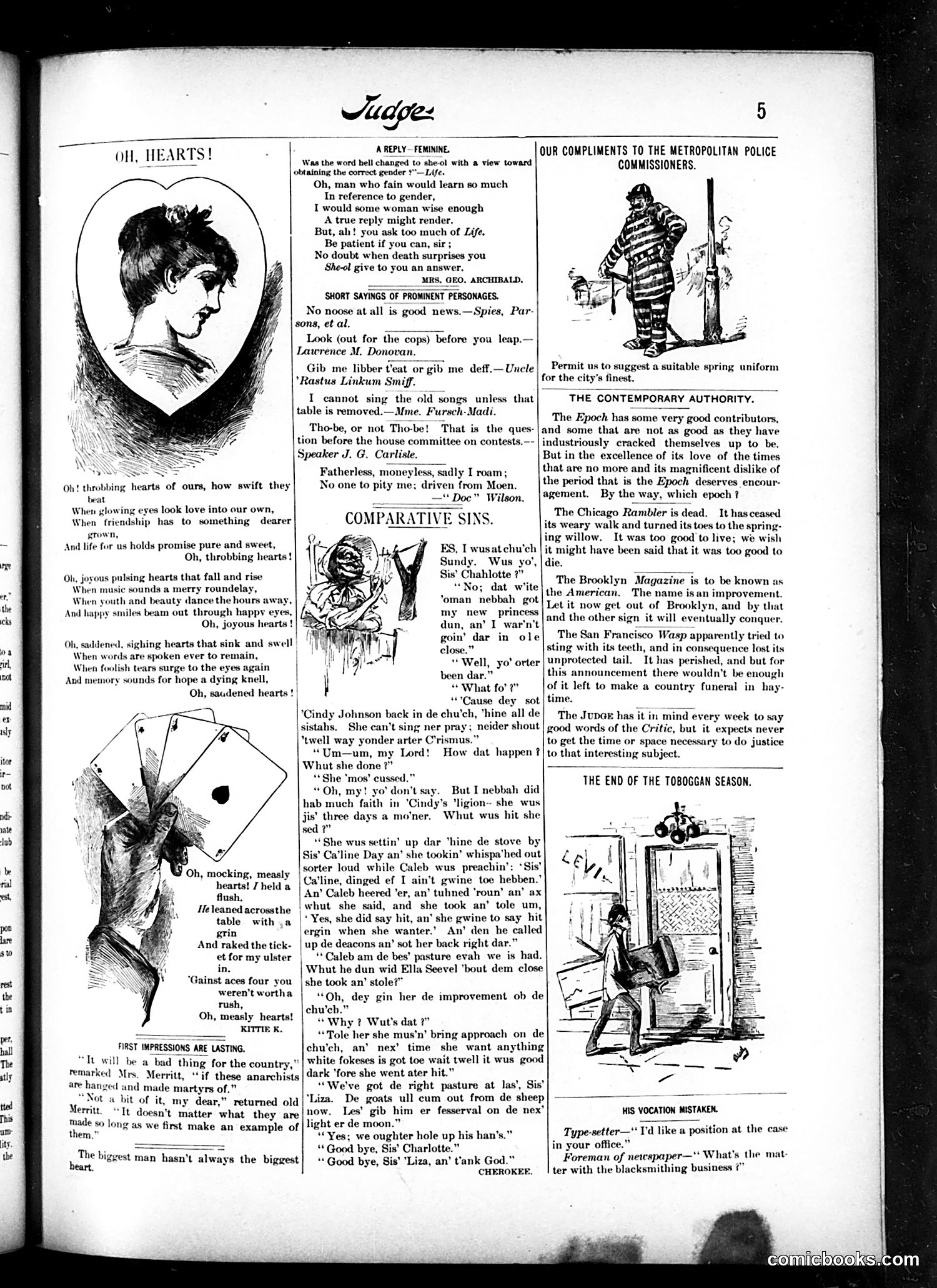
This page from *Judge* magazine contains several satirical pieces mocking contemporary issues and publications circa the 1880s-90s. **Top Right**: "Our Compliments to the Metropolitan Police Commissioners" shows a caricatured police officer, likely critiquing New York City police uniforms or leadership. **Left Side**: "Oh, Hearts!" is sentimental poetry mocking overly romantic verse popular at the time. **Center**: "Comparative Sins" uses dialect humor (reflecting period racism) depicting African American characters discussing church attendance—a common comedic trope of the era, though offensive by modern standards. **Right Column**: Brief satirical reviews of contemporary magazines (*The Chicago Rambler*, *Brooklyn Magazine*, *San Francisco Wasp*, *The Critic*, *The Epoch*), mocking their quality, closure, or pretensions. **Bottom Right**: "His Vocation Mistaken" presents a brief joke about job dissatisfaction. The page exemplifies *Judge*'s satirical approach: targeting media competitors, social pretension, and using ethnic stereotypes considered "humorous" in its era.
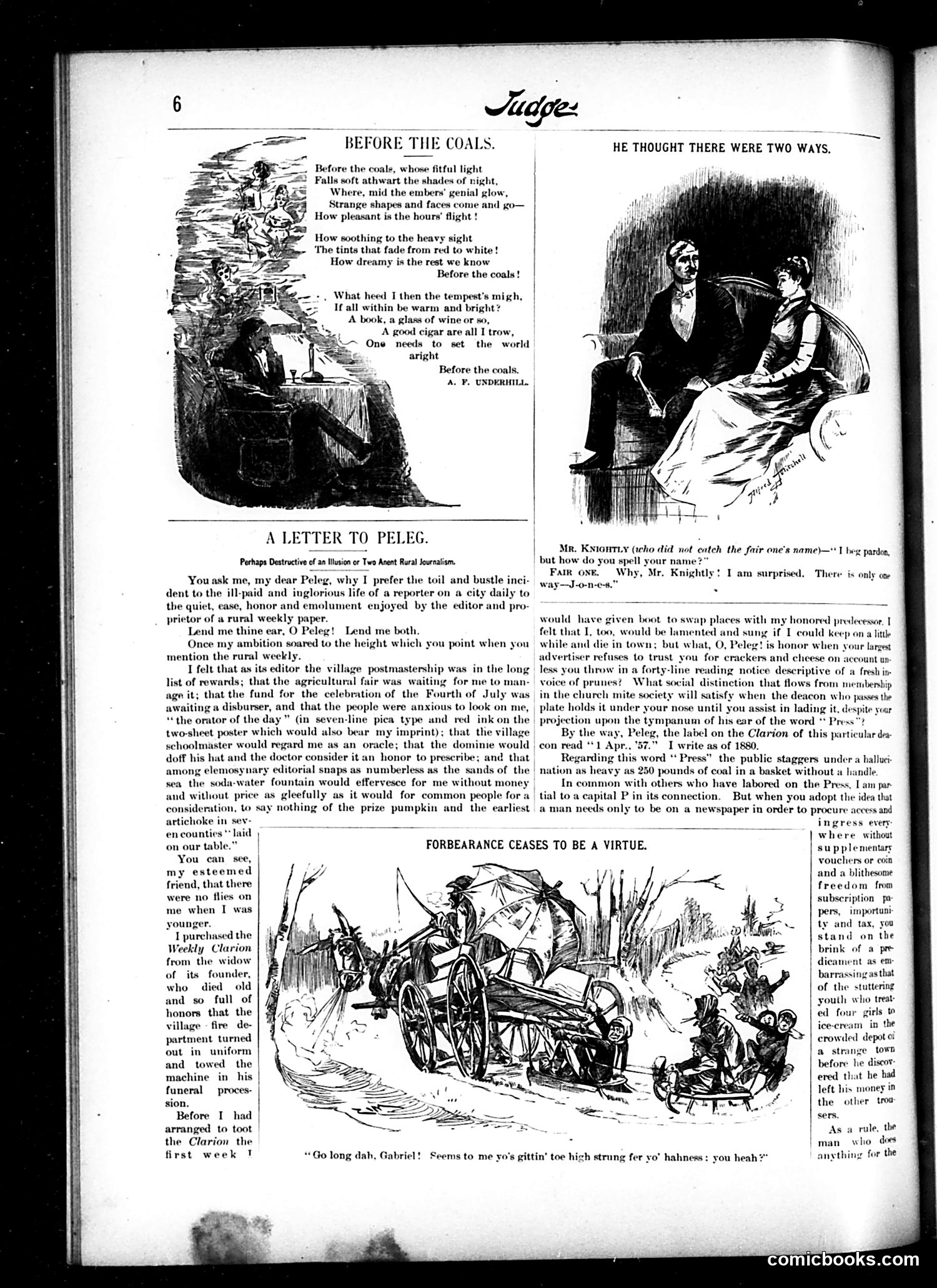
This page contains three satirical pieces mocking rural American life and journalism circa 1880. **"Before the Coals"** is a nostalgic poem by A.P. Underhill romanticizing domestic comfort—sitting by a fireplace with wine and cigars—as superior to worldly ambitions. **"A Letter to Peleg"** is the main satire, describing a city reporter's disillusionment after purchasing a rural weekly newspaper. The writer exposes the harsh realities: rural editors face constant pressure to provide free services (managing community funds, writing free advertisements disguised as "reading notices"), unpaid subscriptions, and social obligations to local clergy and officials. The satire targets rural journalism's pretensions and the impossible financial position of small-town editors. **"Forbearance Ceases to Be a Virtue"** depicts a humorous romantic misunderstanding where a suitor misspells his love interest's name—a gentle joke about courtship miscommunication. The cartoons illustrate these themes with sketches showing domestic scenes and rural life, reinforcing Judge's satirical critique of rural American society's economic pressures and social hierarchies.
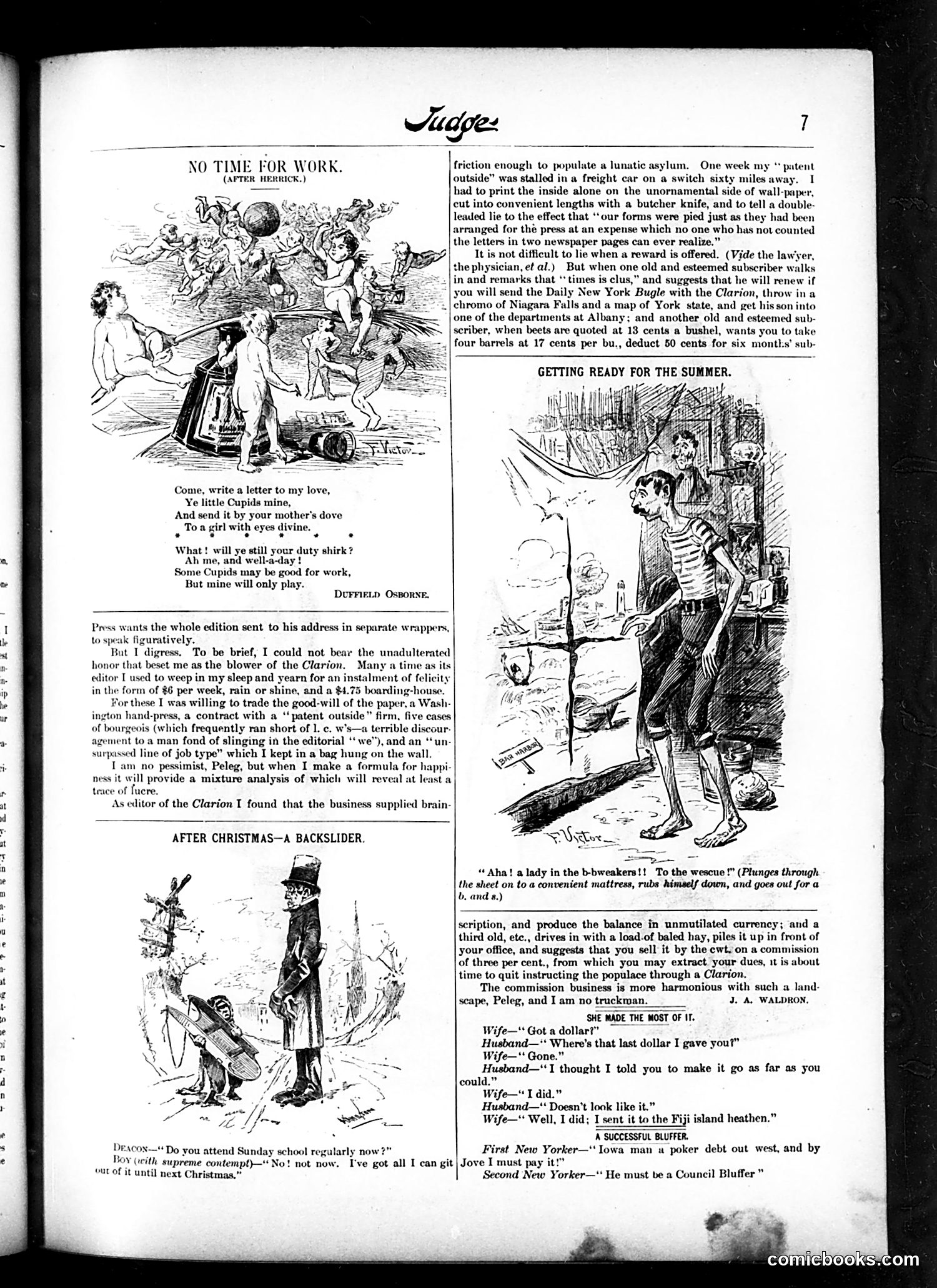
This page from *Judge* contains humorous editorial content satirizing various American social issues of the era (likely 1880s-90s). **"No Time for Work"** presents a poetic complaint about irresponsible behavior—cupids (representing romantic impulses) refusing productive labor for play, a metaphor for idle leisure-class attitudes. **The main editor's essay** satirizes the difficulties of running a newspaper (*Clarion*). It mocks readers making impossible demands: one wants the paper bundled with unrelated publications and patronage; another tries paying subscription with discounted beets; a third proposes the editor become a hay broker. The satire targets both unreasonable subscribers and the editor's desperation—willingness to lie and abandon journalistic integrity for meager wages. **"After Christmas—A Backslider"** jokes about a boy attending Sunday school only for Christmas gifts, revealing shallow religious motivation. **"She Made the Most of It"** satirizes wives' charitable impulses over household budgeting—the wife sends money to foreign missions despite household need. **"A Successful Bluffer"** suggests an Iowa man's credibility derives from western reputation management rather than actual wealth. The overall tone criticizes both consumer unreasonableness and moral/financial hypocrisy.
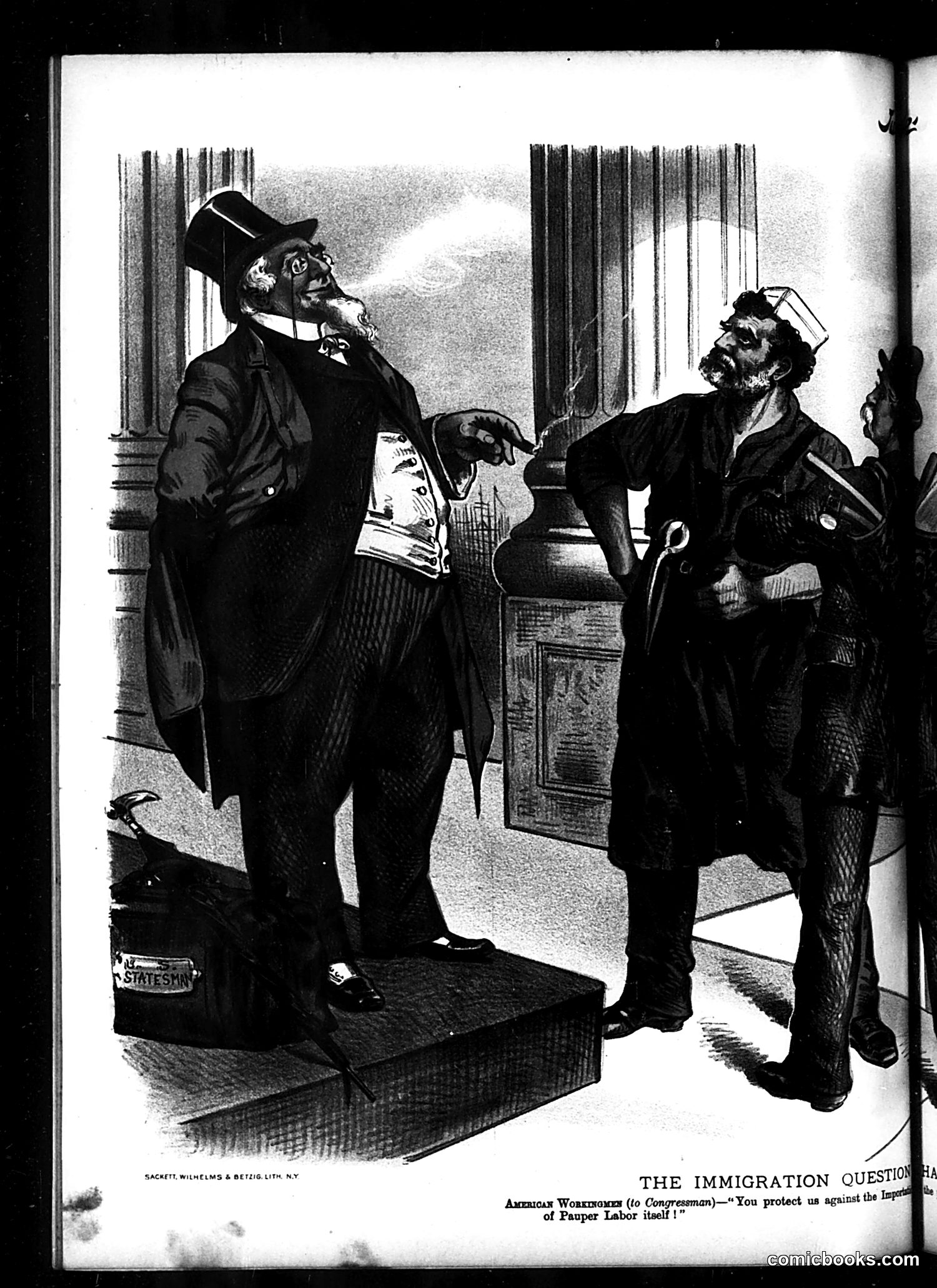
This political cartoon satirizes American workers' concerns about immigration during the late 19th or early 20th century. An American workman (left, caricatured with exaggerated features) appeals to a Congressman, demanding protection "against the [influx] of Pauper Labor itself." The satire appears to mock the hypocrisy of American laborers: they demand government protection from cheap immigrant labor while themselves appearing to be desperate, working-class figures. The cartoon likely critiques protectionist labor arguments as self-serving—suggesting that American workers fear economic competition from immigrants willing to work for lower wages, yet frame this as a moral or national defense issue rather than economic self-interest. The context reflects heated debates over immigration and labor standards in industrial America.
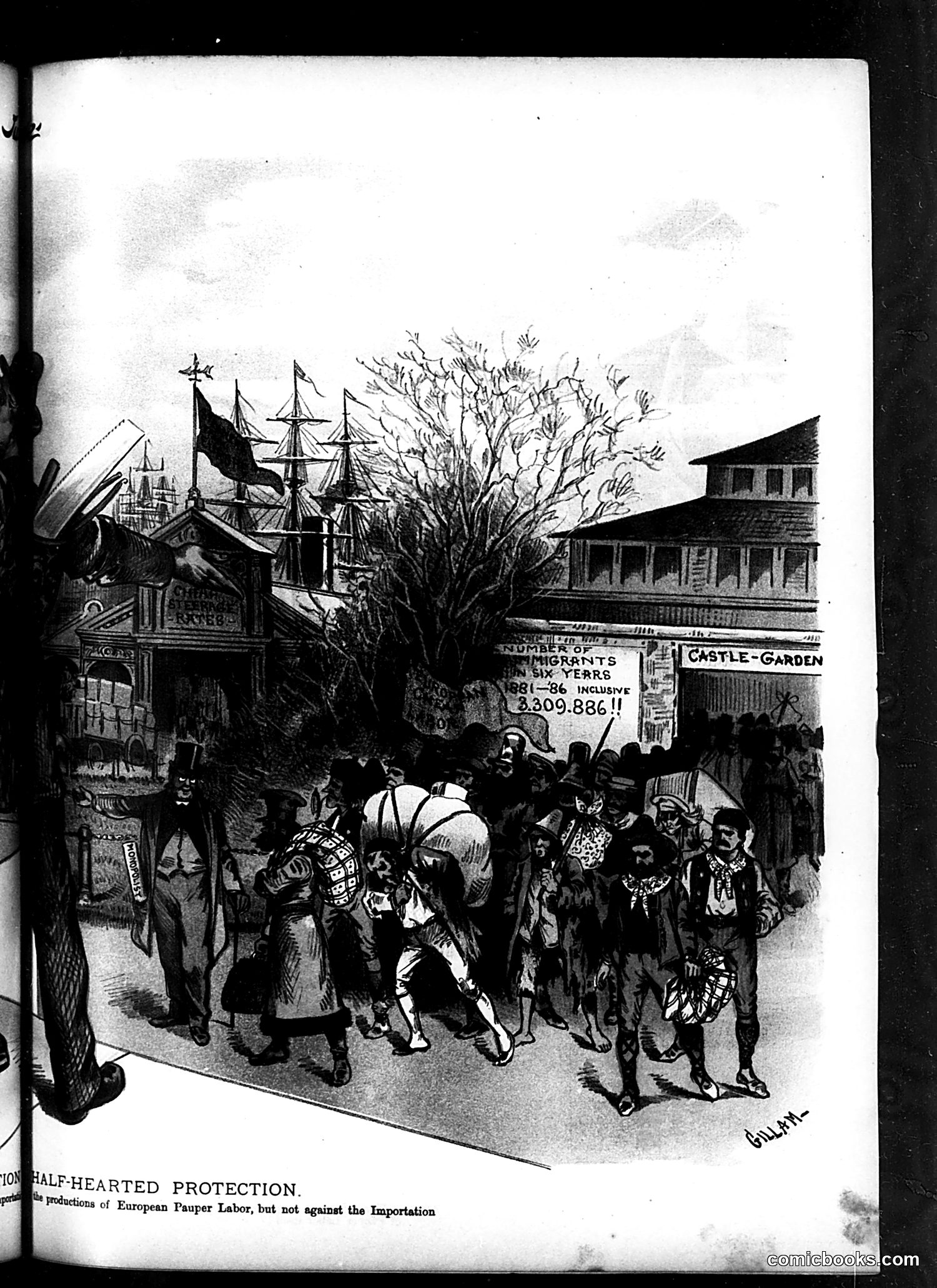
This cartoon satirizes American immigration policy, specifically criticizing inconsistent protectionism. The sign visible in the image reads "NUMBER OF MIGRANTS IN 56 YEARS 1831-86 INCLUSIVE: 5,309,886!!" The cartoon depicts European immigrants arriving at what appears to be a port or entry point, with period buildings and a sailing ship visible. The caption's text suggests the U.S. claimed to protect American workers against "European Pauper Labor" through trade restrictions, yet simultaneously allowed massive immigration of poor European workers to enter the country. The satire points out this contradiction: protective tariffs meant to shield American workers rang hollow when the country simultaneously accepted hundreds of thousands of impoverished foreign laborers willing to work for lower wages. The policy was therefore "half-hearted"—inconsistent and ineffective at its stated goal.
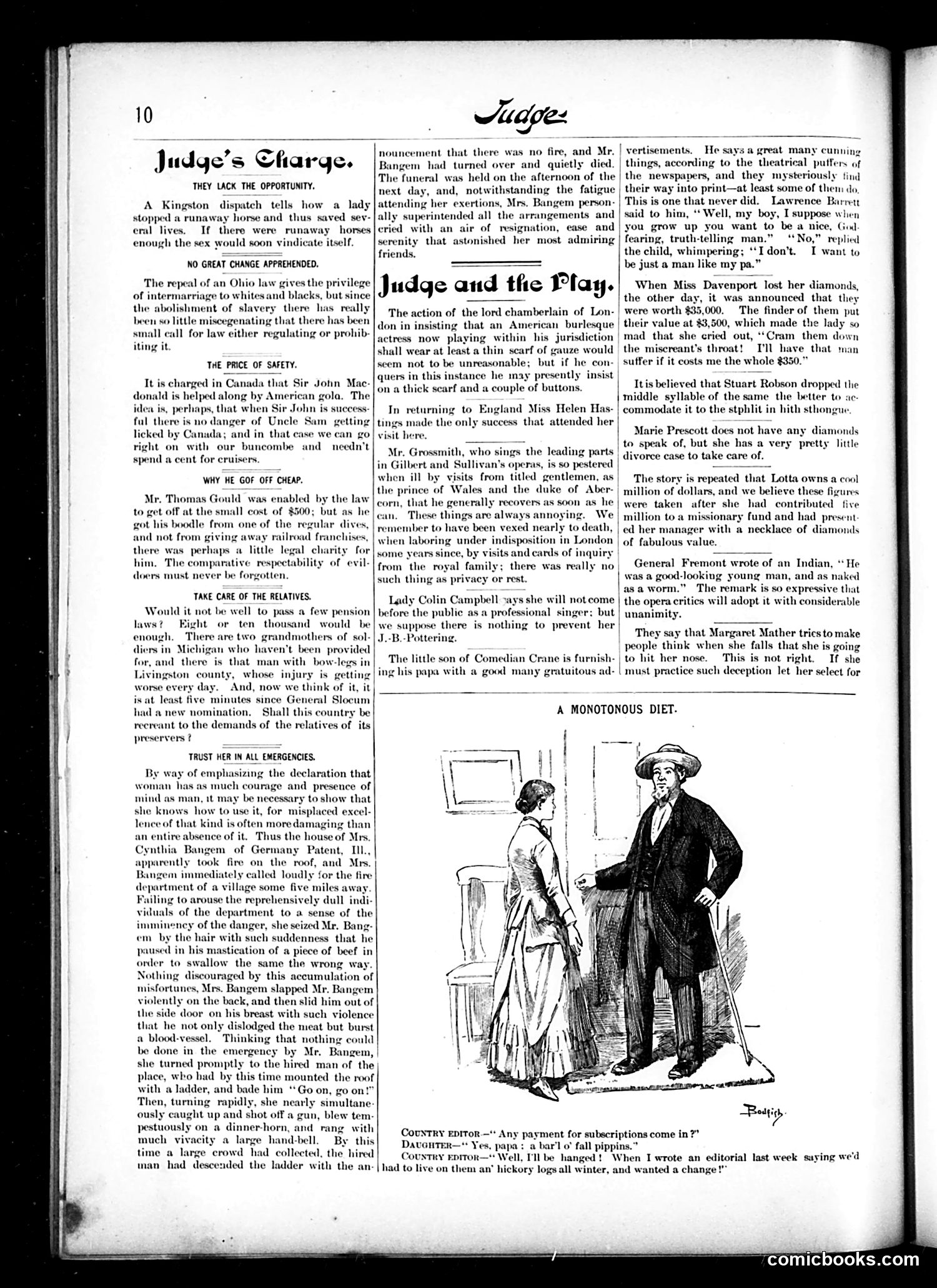
This page contains several satirical commentary pieces typical of Judge's editorial voice, plus one cartoon. **The Main Cartoon** ("A Monotonous Diet") depicts a domestic scene where a woman stands while a man sits. The caption suggests tedious married life—likely about the repetitive, unstimulating nature of domestic routine or marriage itself. **The Editorial Pieces** include: - Mockery of Canadian Prime Minister Sir John A. Macdonald, suggesting he's funded by American gold - A jab at lenient sentencing (Thomas Gould getting off cheaply) - Satire on pension-seeking relatives of soldiers, implying opportunistic exploitation - A lengthy anecdote about "Mrs. Bangem," satirizing women's supposed "courage"—she panics during a house fire, accidentally kills her husband through misguided intervention, yet maintains composure at his funeral. The satire mocks the contemporary declaration that women possess equal courage to men, suggesting their judgment may be dangerously poor. **The Cartoon at bottom** shows a country editor being pressured by his daughter about subscription payments and editorial decisions—light domestic humor about newspaper operations. The page reflects late-19th-century attitudes toward gender roles and colonial/American politics.
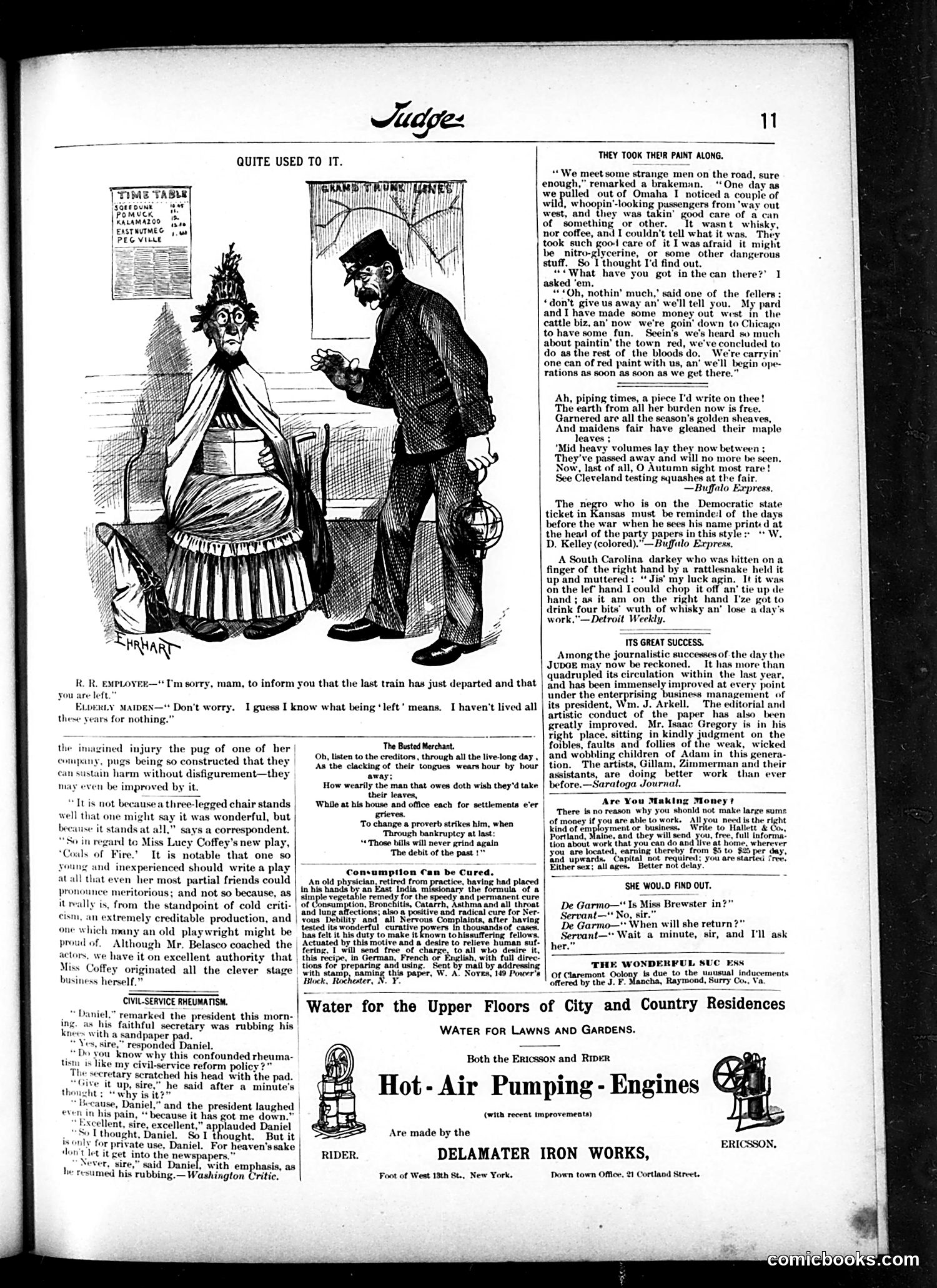
This page contains two main satirical cartoons: **"Quite Used to It"** depicts an elderly unmarried woman at a train station being informed the last train has departed. Her response—that she's experienced being "left" (abandoned romantically) her whole life—is the joke: she's so accustomed to rejection that missing a train is unremarkable compared to her romantic disappointments. **"Civil-Service Rheumatism"** shows a president (likely referencing late 19th-century U.S. politics) joking with his secretary Daniel about his rheumatism resembling his civil-service reform policy because "it has got me down." This satirizes the president's failure to implement promised civil-service reforms—a recurring issue of the Gilded Age. The page also includes verses ("The Busted Merchant," "They Took Their Paint Along") mocking financial ruin and traveling con artists, typical of Judge's social commentary. The remaining content is period advertising.
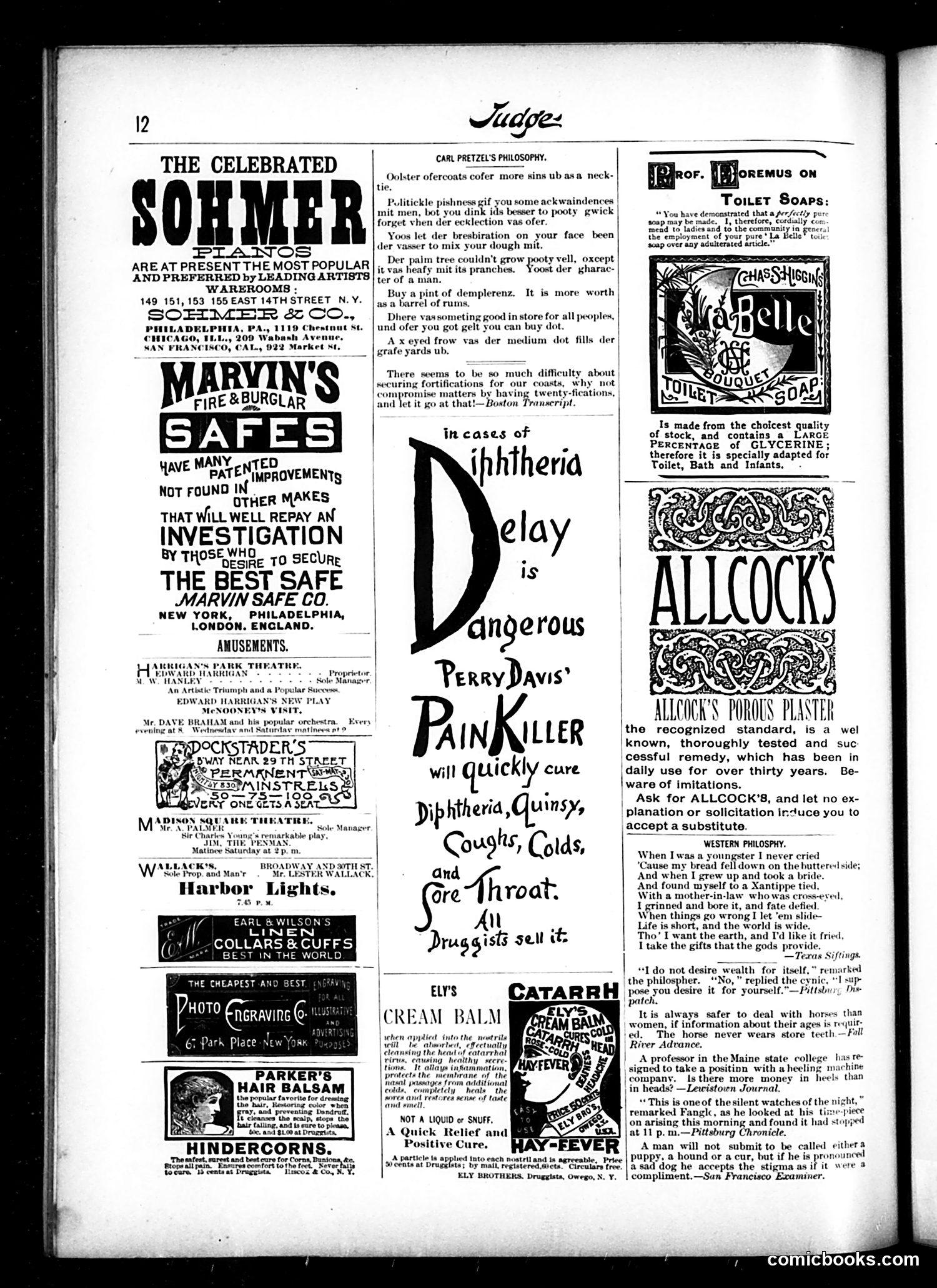
This is primarily an **advertising page** from Judge magazine, not a political cartoon. The page consists almost entirely of commercial advertisements for products like Sohmer pianos, Marvin safes, Perry Davis' Pain Killer, Allcock's porous plasters, and various other 19th-century remedies and goods. The only satirical content is **"Carl Pretzel's Philosophy"**—a recurring humor column featuring broken-English aphorisms from a German-American character. These short, folksy observations mock pretentious self-help wisdom (e.g., "buying a pint of common sense is worth more than a barrel of rum"). The page also includes brief, generic jokes at the bottom about philosophy and horse-trading that reflect period attitudes but carry no specific political meaning. **Context for modern readers**: This reflects how Judge financed itself—satirical content subsidized by advertisements. The ethnic dialect humor in "Carl Pretzel" was typical period comedy, though offensive by today's standards.
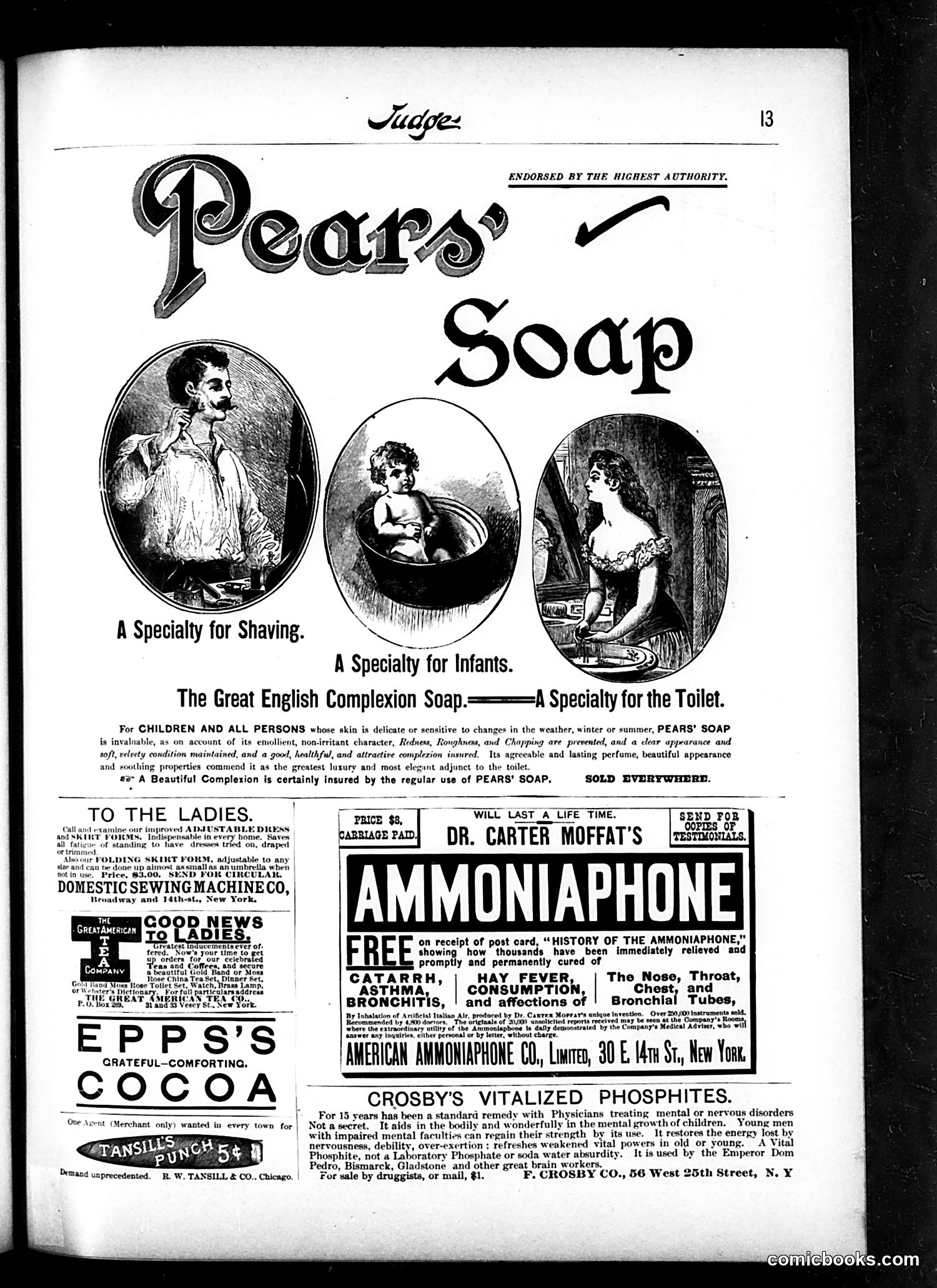
This page is primarily **advertising**, not satirical content. It showcases period patent medicines and consumer products typical of late 19th-century American magazines. **Key advertisements:** - **Pears' Soap**: A British luxury soap marketed for facial complexion, claiming to prevent redness and roughness—reflecting Victorian beauty standards emphasizing pale, smooth skin. - **Dr. Carter Moffat's Ammoniaphone**: A quack medical device claiming to cure asthma, bronchitis, hay fever, and consumption (tuberculosis) through "artificial Italian air" inhalation. The endorsement by European leaders (Pedro, Bismarck, Gladstone) is typical snake-oil marketing. - **Crosby's Vitalized Phosphites**: A nutritional supplement allegedly restoring mental vigor and energy, marketed toward young men with "impaired mental faculties." These ads reflect period anxieties about health, appearance, and vigor while promoting dubious or ineffective remedies. The "highest authority" endorsement claim appears ironic to modern readers but was serious marketing then.
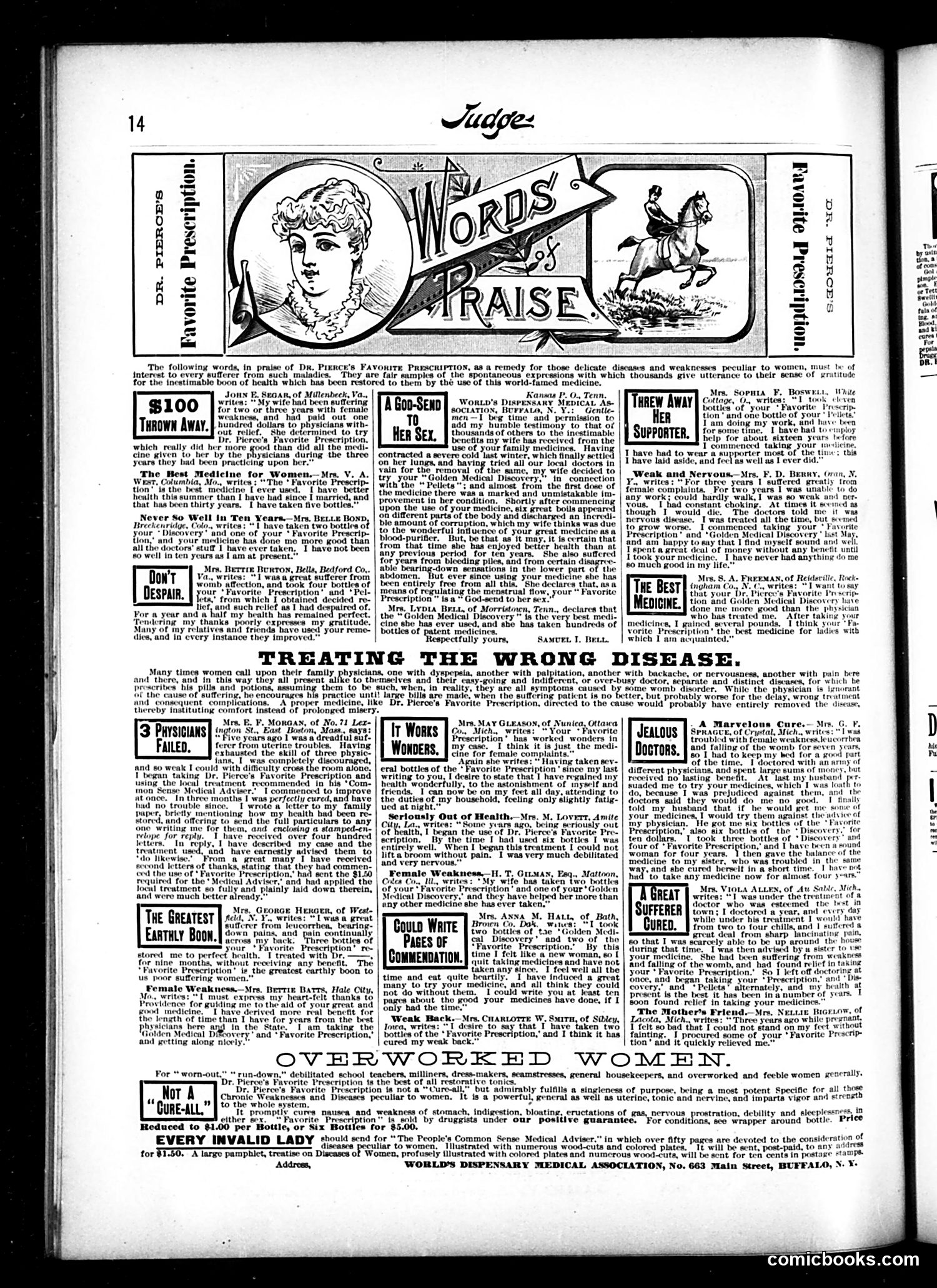
This page is a vintage advertisement for Dr. Pierce's Favorite Prescription, a patent medicine marketed for women's ailments, packaged as a satirical magazine feature. The decorative header includes a fashionable woman's profile and decorative imagery, framing testimonial letters from women claiming the medicine cured "female weakness," menstrual irregularities, and various gynecological conditions. The accompanying text presents these as genuine endorsements from satisfied customers across America. The satire lies in Judge magazine publishing this alongside fake testimonials alongside ads labeled "Don't Despair" and "Not a Quack-call"—mock reassurances designed to parody patent medicine marketing conventions of the era. These medicines were typically ineffective or contained harmful substances, yet were heavily advertised using emotional testimonials and medical jargon. By presenting this material, Judge critiques both the fraudulent patent medicine industry and the manufacturers' cynical exploitation of women's health concerns and limited access to legitimate medical care.
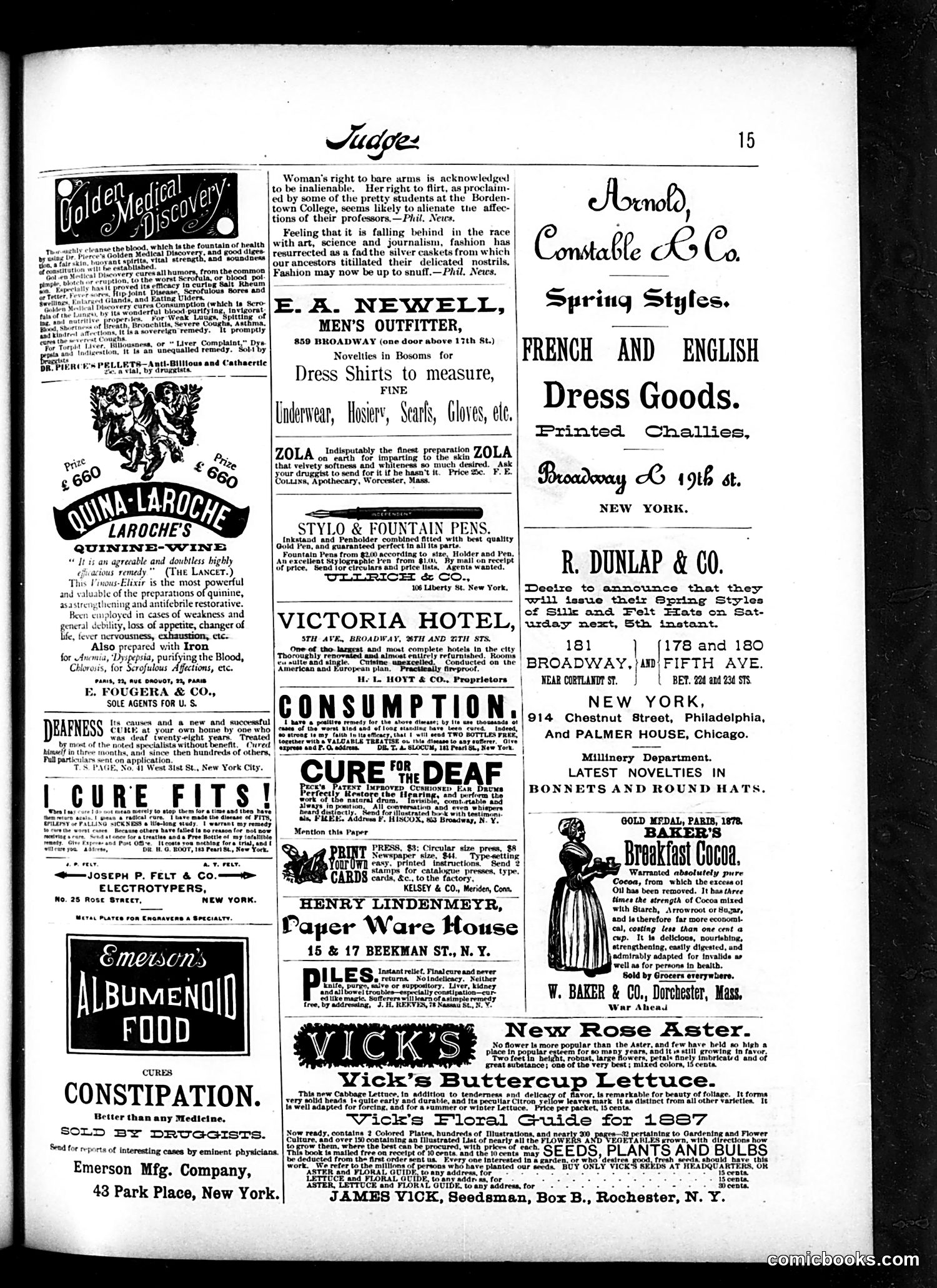
This is primarily an **advertising page** with minimal editorial content. The few satirical items present are brief social commentary pieces rather than illustrated cartoons: **The Social Satire Notes:** Two short quips address contemporary gender and fashion issues: 1. **"Women's right to bare arms"** — A joke about women's fashion (sleeveless dresses) being socially acceptable, while their "right to flirt" at Bordentown College allegedly threatens professors' relationships. 2. **"Fashion and snuff boxes"** — A pun suggesting fashion has revived the decorative snuff boxes (for inhaling powdered tobacco) that aristocrats once used, with the closing joke "Fashion may now be up to snuff." **The Advertisements:** The remainder of the page showcases period products: patent medicines (quinine wine, remedies for deafness and consumption), clothing retailers (E.A. Newell menswear, Dunlap hats, Constable dress goods), hotels, and novelty items. These reflect typical 1880s-90s consumer goods and business practices. **Historical Context:** The ads reveal common medical practices of the era—unregulated patent medicines were standard advertising. The social commentary reflects Victorian-era anxieties about women's changing roles and fashion independence.
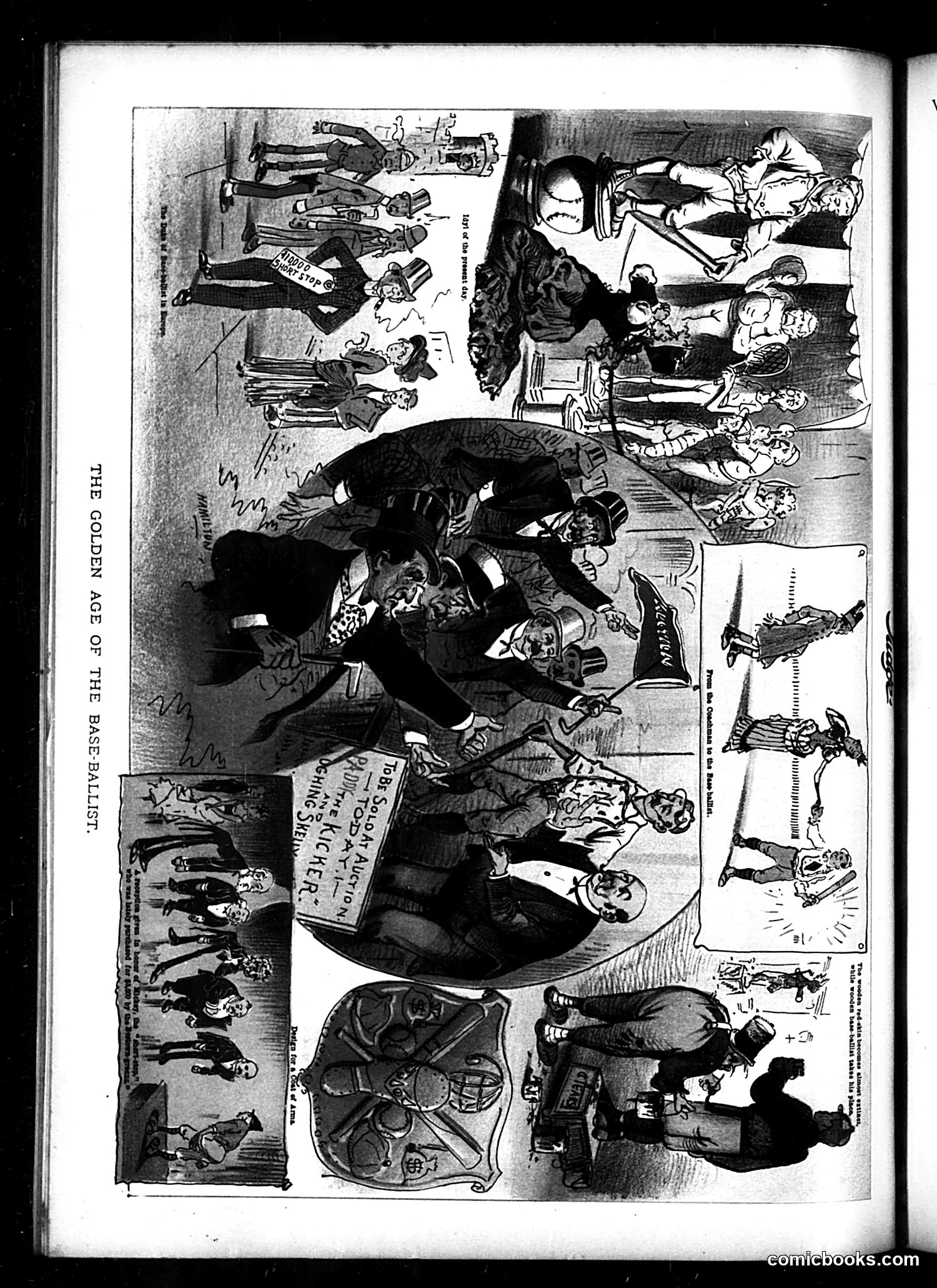
I can see this is a page from *Judge* magazine titled "The Golden Age of the Basebatlist" (or similar), but the image quality and orientation make it difficult to read the specific text clearly or identify particular figures with certainty. The page appears to contain multiple cartoon panels related to baseball, given the title reference. There are what seem to be caricatured figures in period clothing, and various scene compositions typical of satirical magazine layouts from the early 20th century. However, without being able to read the OCR text reliably or identify specific individuals in the illustrations with confidence, I cannot accurately explain the political or social satire intended. I would be guessing at identifications and meanings rather than stating what the image and text actually support. A clearer reproduction would be needed for accurate analysis.