
Judge, 1887-03-05 · page 7 of 16
Judge — March 5, 1887 — page 7: what you’re looking at
What you’re looking at
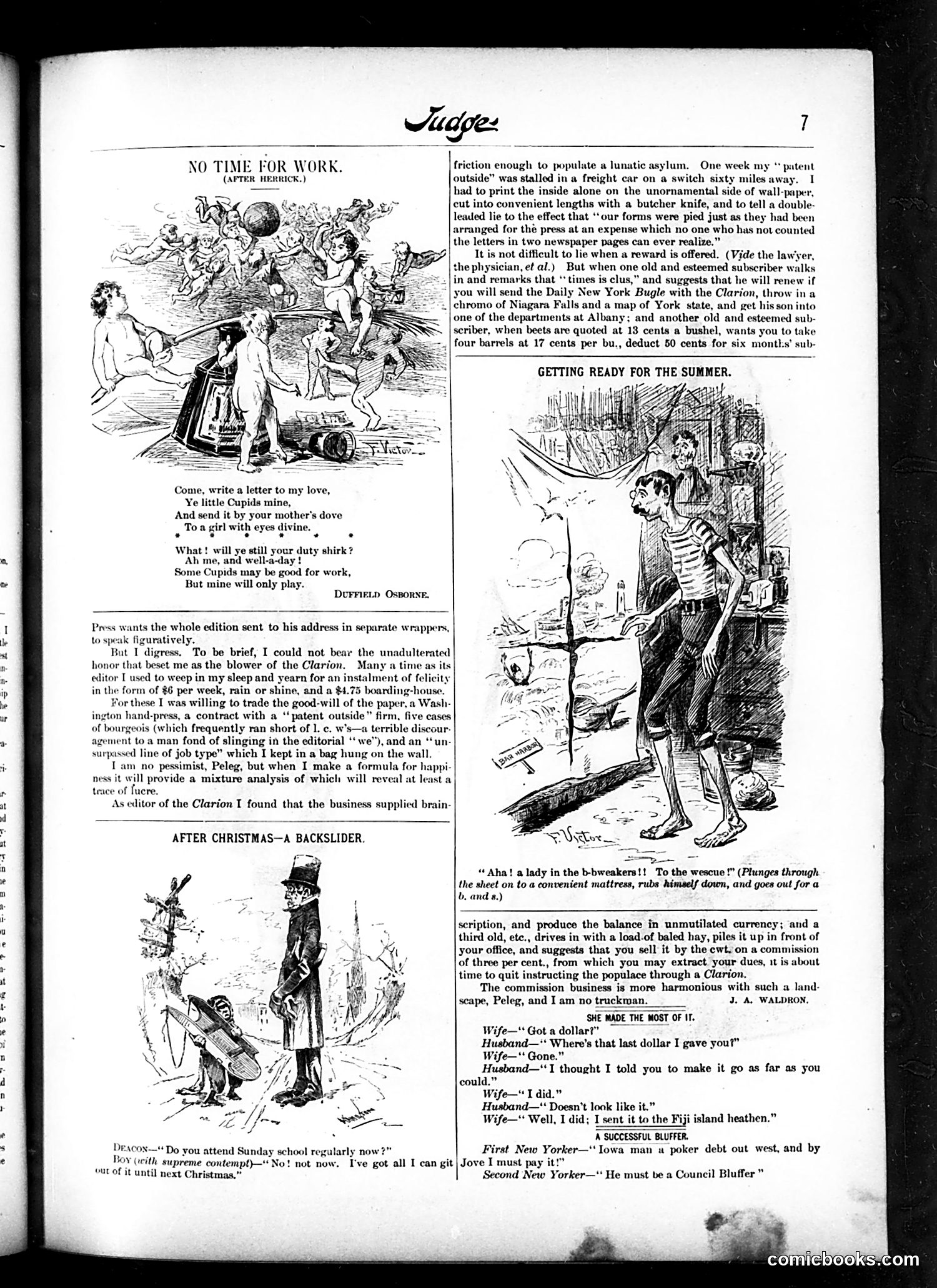
This page from *Judge* contains humorous editorial content satirizing various American social issues of the era (likely 1880s-90s). **"No Time for Work"** presents a poetic complaint about irresponsible behavior—cupids (representing romantic impulses) refusing productive labor for play, a metaphor for idle leisure-class attitudes. **The main editor's essay** satirizes the difficulties of running a newspaper (*Clarion*). It mocks readers making impossible demands: one wants the paper bundled with unrelated publications and patronage; another tries paying subscription with discounted beets; a third proposes the editor become a hay broker. The satire targets both unreasonable subscribers and the editor's desperation—willingness to lie and abandon journalistic integrity for meager wages. **"After Christmas—A Backslider"** jokes about a boy attending Sunday school only for Christmas gifts, revealing shallow religious motivation. **"She Made the Most of It"** satirizes wives' charitable impulses over household budgeting—the wife sends money to foreign missions despite household need. **"A Successful Bluffer"** suggests an Iowa man's credibility derives from western reputation management rather than actual wealth. The overall tone criticizes both consumer unreasonableness and moral/financial hypocrisy.
📄 Transcribed text from this page (OCR, searchable)
Machine-transcribed from the original scan — historical spelling and the odd misread are preserved.
NO TIME FOR WORK. (AFTER HERRICK.) Come, write a letter to my love, Ye little Cupids mine, And send it by your mother's dove To a girl with eyes divine. ang ee gn s . What ! will ye still your duty shirk? Ah me, and well-a-day ! Some Cupids may be good for work, But mine will only play. DUFFIELD OSBORNE. Press wants the whole edition sent to his address in separate wrappers, to speak figuratively. But I digress. To be brief, I could not bear the unadulterated honor that beset me as the blower of the Clarion. Many a time as its editor I used to weep in my sleep and yearn for an instalment of felicity in the form of $6 per week, rain or shine, and a $4.75 boarding-house. For these I was willing to trade the good-will of the paper, a Wash- ington hand-p a contract with a ‘patent outside” firm, five cases of bourgeois (which frequently ran short of 1. c. w’s—a terrible discour- agement to a man fond of slinging in the editorial ‘‘ we"), and an “un- surpassed line of job type” which I kept in a bag hung on the wall. Iam no pessimist, Peleg, but when I make a formula for happi ness it will provide a mixture analysis of which will reveal at trace of fucre. As editor of the Clarion I found that the business supplied brain- AFTER CHRISTMAS—A BACKSLIDER. Descox— Do you attend Sunday school regularly now?” Boy (with supreme contempt}—“"No! not now. I've got all I can git out of it until next Christmas,” friction enough to populate a lunatic asylum. One week my “ patent outside” was stalled in a freight car on a switch sixty miles aw. I had to print the inside alone on the unornamental side of wall-paper, cut into convenient lengths with a butcher knife, and to tell a double- leaded lie to the effect that ‘‘our forms were pied just as they had been arranged for thé press at an expense which no one who has not counted the letters in two newspaper pages can ever realize.” It is not difficult to lie when a reward is offered. (Vide the lawyer, the physician, ef al.) But when one old and esteemed subscriber y in and remarks that ‘* times is clus,” and suggests that he will renew if you will send the Daily New York Bugle with the Clarion, throw in a chromo of Niagara Falls and a map of York state, and get his son into one of the departments at Albany; and another old and esteemed sub- scriber, when beets are quoted at 13 cents a bushel, wants you to take four barrels at 17 cents per bu., deduct 50 cents for six months’ sub- GETTING READY FOR THE SUMMER. — s “ Aha! a lady in the b-bweakers!! To the wescue !” (Plunges through the sheet on to a convenient mattress, rubs himself down, and goes out for a bands.) scription, and produce the balance in unmutilated currency; and a third old, ete., drives in with a load-of baled hay, piles it up in front of your office, and suggests that you sell it by the cwt. on a commission of three per cent., from which you may extract your dues, 1 is about time to quit instructing the populace through a Clarion. The commission business is more harmonious with such a land- scape, Peleg, and I am no truckman. J. A. WALDRON, SHE MADE THE MOST OF IT. Wife—‘ Got a dollar?” Husband—** Where's that last dollar I gave yout” Wife—‘ Gone.” Husband—‘‘I thought I told you to make it go as far as you could.” Wife—“ I did.” Husband—“ Doesn't look like it.” Wife—* Well, I did; I sent it to the Fiji island heathen.” A SUCCESSFUL BLUFFER. First New Ye r— Iowa man u poker debt out west, and by Jove I must pay Second New Yorker—‘' He must be a Council Bluffer ”