
A complete issue · 16 pages · 1887
Judge — January 22, 1887
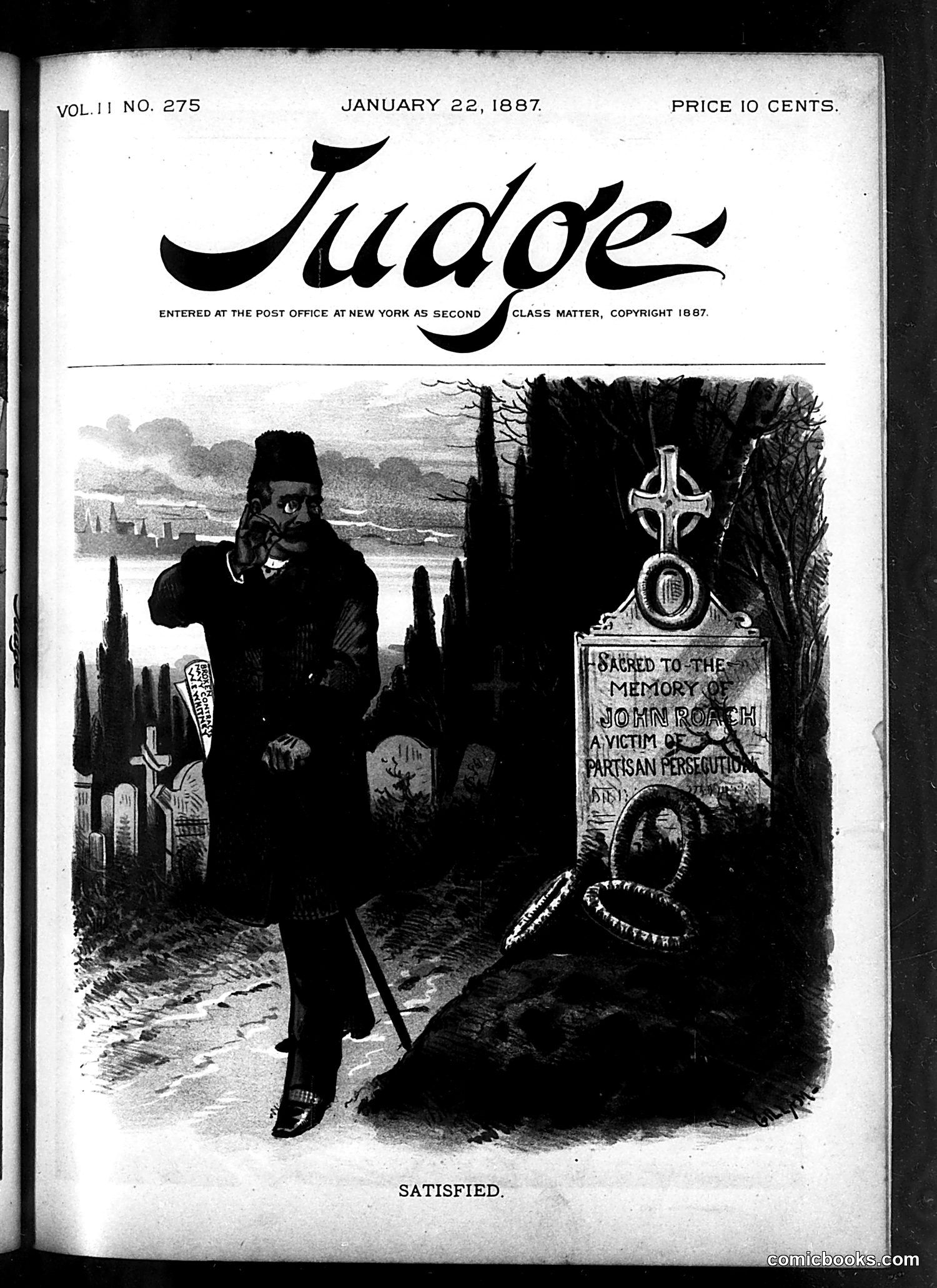
This political cartoon depicts a man in military uniform standing satisfied beside a grave monument. The inscription reads: "SACRED TO THE MEMORY OF JOHN ROACH / A VICTIM OF PARTISAN PERSECUTION." The cartoon appears to reference John Roach, a prominent 19th-century American shipbuilder who faced financial difficulties and legal troubles. The satire suggests that someone—likely a political opponent or the current administration—took satisfaction from Roach's misfortune, which the cartoonist characterizes as persecution rather than legitimate justice. The title "Satisfied" implies bitter irony: the figure is pleased by another's downfall. This reflects Judge magazine's typical partisan critique of political enemies and their vindictive tactics during the contentious post-Reconstruction era.
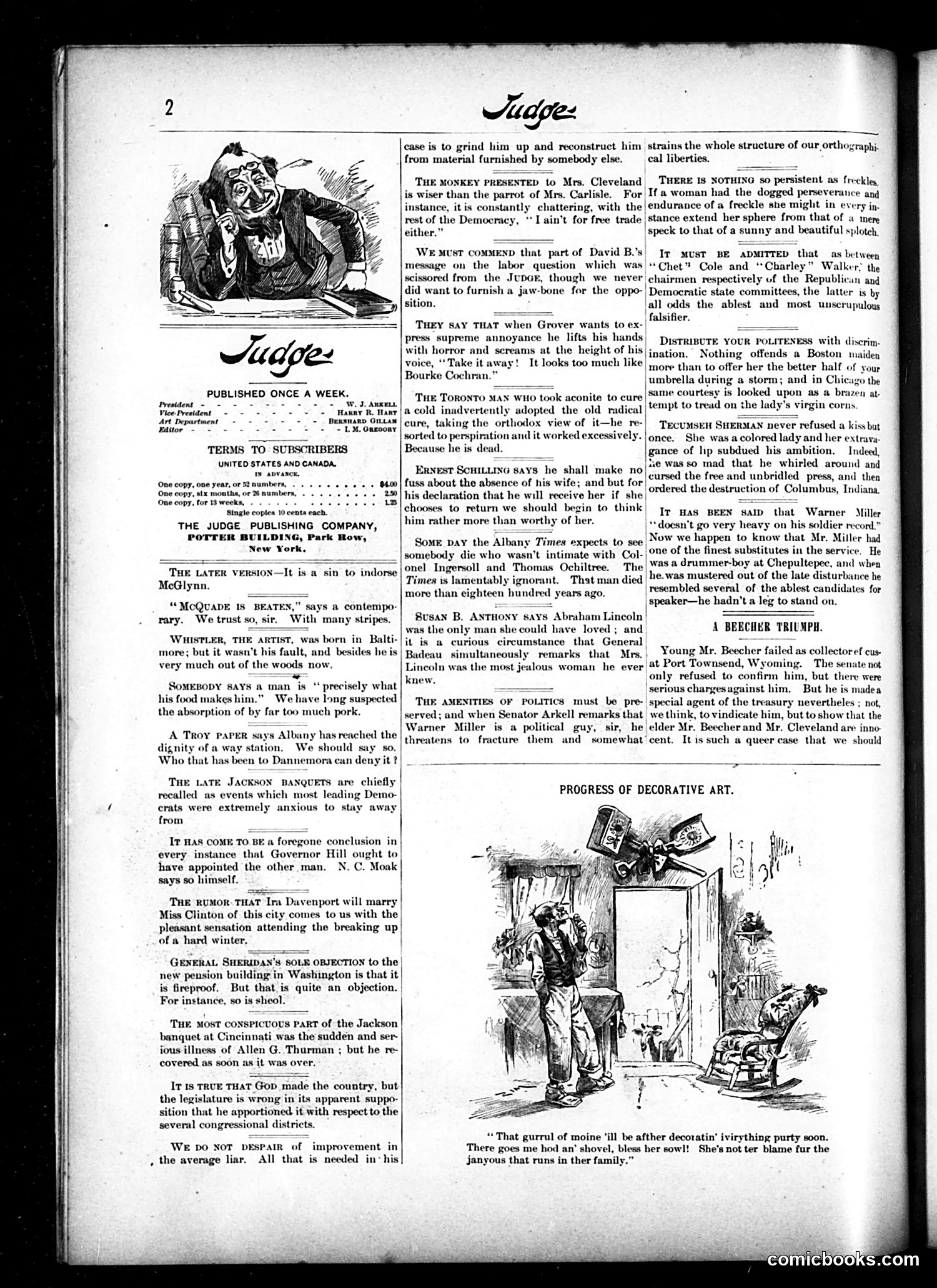
This page contains political commentary and social satire typical of Judge magazine. The main cartoon, "Progress of Decorative Art," depicts a man entering a room where decorative items are falling or in disarray, with a woman sitting amid the chaos. The caption suggests marital discord over domestic decoration—a common satirical subject mocking both bourgeois materialism and gender relations. The text includes various brief political jabs: criticism of David B's labor commentary, mockery of Grover Cleveland's temperament, commentary on Republican/Democratic leadership (Cole and Walker), and jibes at Warner Miller and other political figures. References to Abraham Lincoln and Susan B. Anthony appear in historical context. The satire targets political hypocrisy, marital tensions, and domestic pretension—typical Judge content mixing partisan politics with social observation.
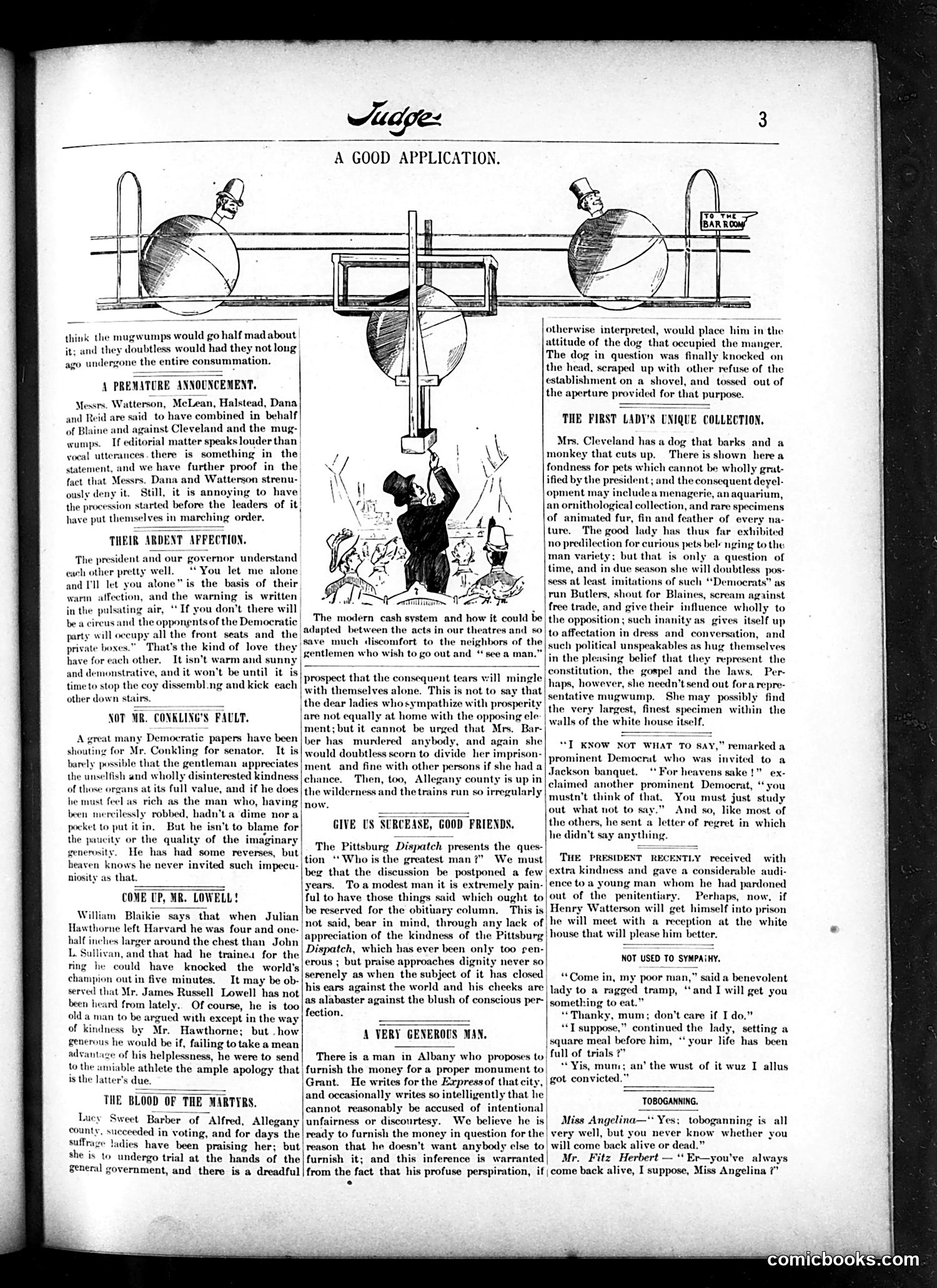
The main cartoon depicts a **cash system apparatus** (resembling industrial machinery with spheres and mechanisms) being applied to theater operations. The satire addresses a practical social annoyance: wealthy patrons who interrupt performances by arriving late or leaving early to socialize. The joke proposes an automated "cash system" between acts to facilitate patron exits/entries without disturbing other theatergoers—a sarcastic solution to the problem of wealthy, self-important individuals disrupting performances for others' enjoyment. The surrounding editorial content criticizes Democratic political figures (Cleveland, "mugwumps," and various newspaper editors like Dana and Watterson) for their supposed hypocrisy and self-interest. It also includes commentary on women's suffrage, mocking Lucy Sweet Barber's attempt to vote, and satirizing various public figures' pretensions. The page reflects late 19th-century American political divisions and class anxieties typical of Judge's satirical focus.
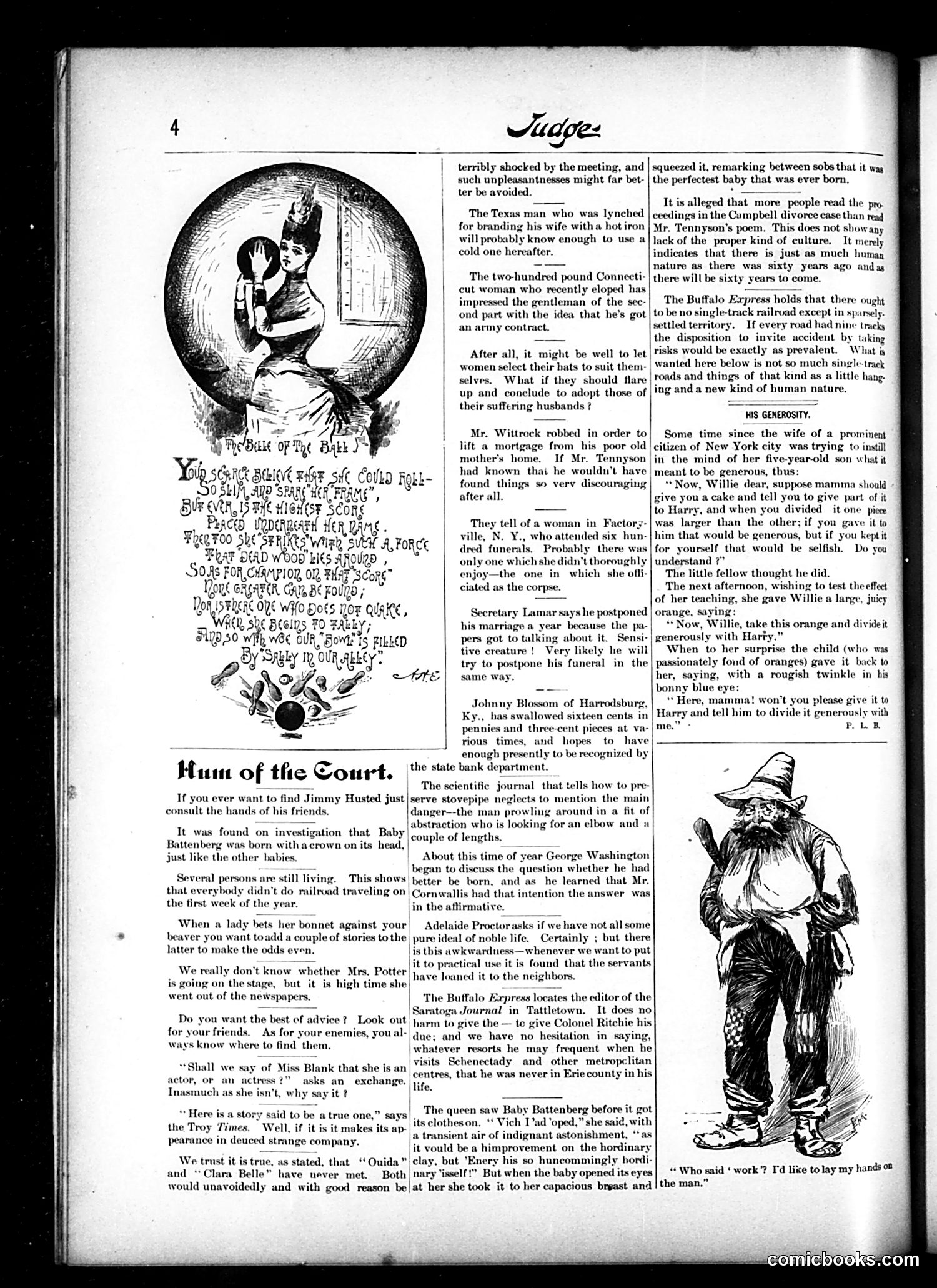
This page contains brief satirical commentary on contemporary scandals and absurdities, typical of Judge's format. Key items: **"Hum of the Court"** collects quips mocking actual incidents: a Texas man lynched for branding his wife (darkly joking he'll use "cold" iron next); a Connecticut woman's elopement; a woman attending 600 funerals including her own; Johnny Blossom swallowing coins. **The cartoons** (top and right margin) appear to illustrate domestic themes—a woman in domestic distress, and a wizard-like figure—supporting the magazine's commentary on marriage, gender relations, and social behavior. **The tone** is consistently cynical, mocking human folly, marital discord, newspaper sensationalism, and social pretense. References to George Washington and contemporary figures suggest 19th-century publication. The satire works through exaggeration and dark humor about real crimes and scandals, reflecting Judge's role as social/political commentary on Gilded Age America.
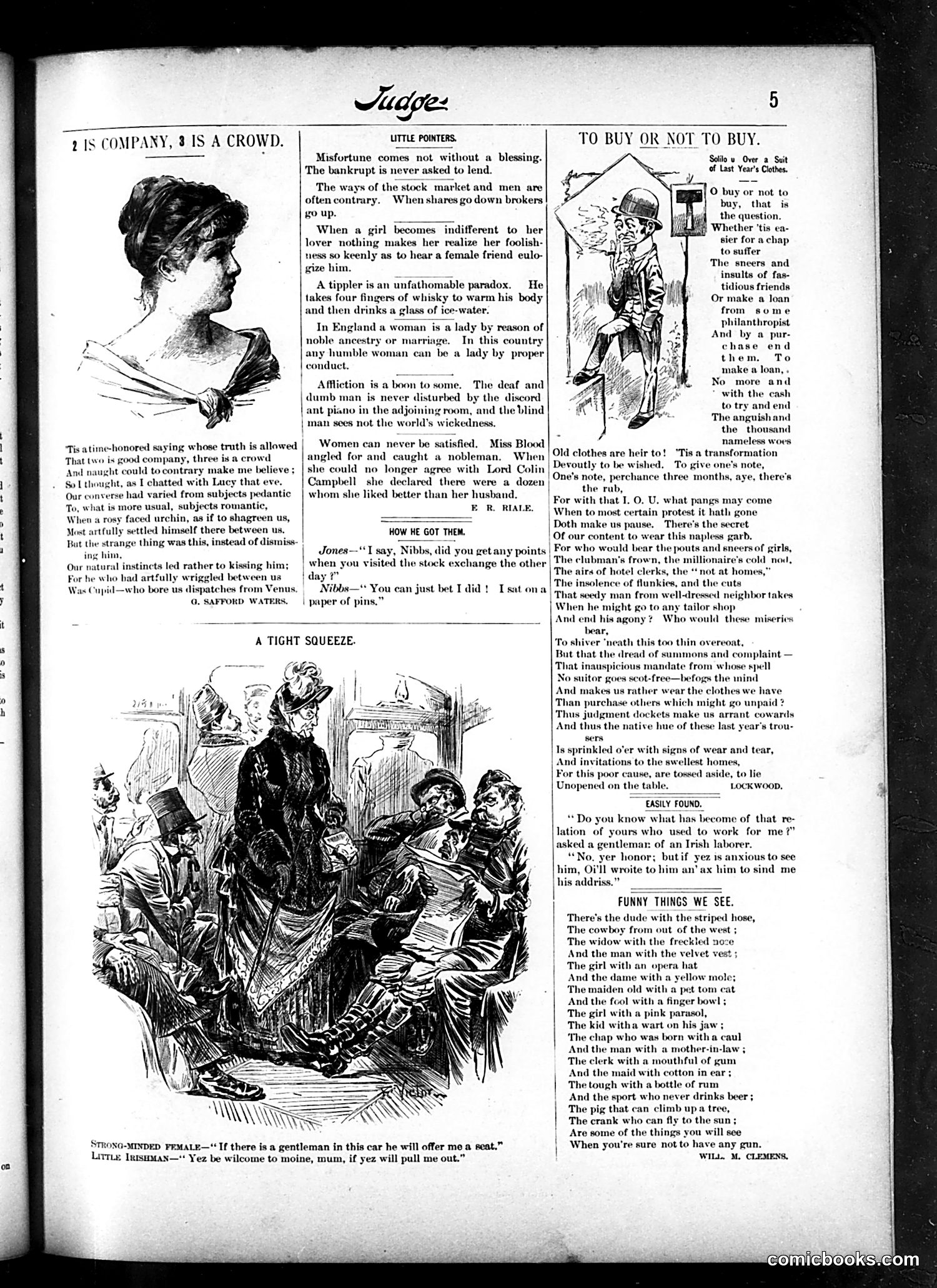
This page contains three main satirical pieces: **"A Tight Squeeze"** (illustrated cartoon): Mocks a "strong-minded female" (a reference to women's rights advocates of the era) demanding a gentleman offer her a seat on a crowded streetcar. An Irish laborer offers his seat with the condition she pull him out first—satirizing both feminist demands and Irish stereotypes. **"To Buy or Not to Buy"** (right column): A Shakespearean parody about a poor man deciding whether to purchase new clothes or wear shabby ones. The satire targets class anxiety: he fears the "sneers" of wealthy friends and hotel staff, the "dread of summons" (debt collection), and social humiliation—capturing Gilded Age anxieties about appearance and economic status. **Various short items** mock contemporary behaviors: stock market trickery, indifferent lovers, tippling contradictions, and English class pretensions versus American meritocracy. The page reflects late 19th-century concerns: feminism, class mobility, financial speculation, and social climbing—all treated with satirical mockery.
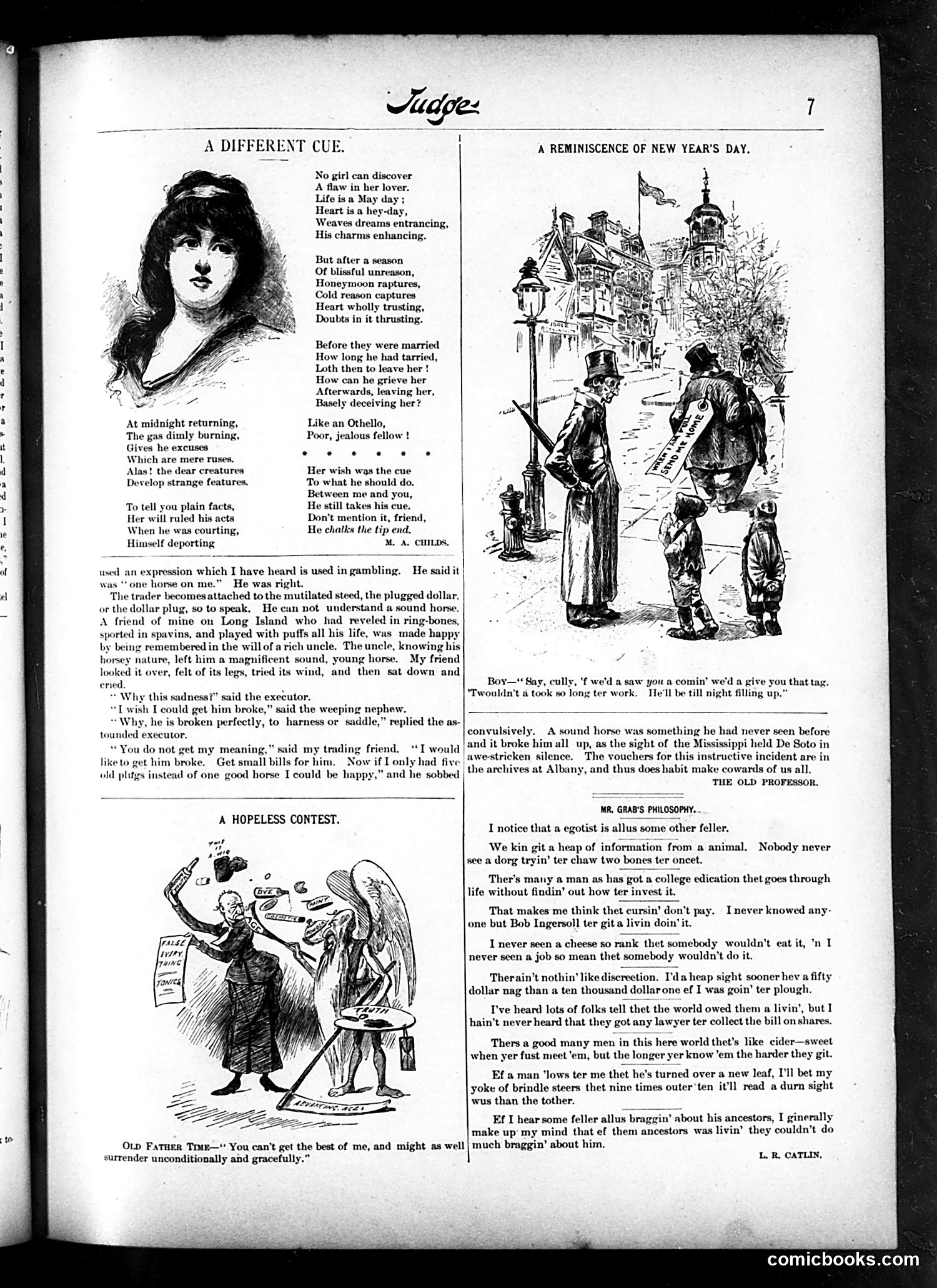
This page from *Judge* satirizes marriage and domestic life through multiple pieces: **"A Different Cue"** (poem by M.A. Childs) mocks the trajectory of romance. During courtship, a man eagerly obeys his beloved's wishes ("Her will ruled his acts"). Post-marriage, he becomes like Othello—jealous and unfaithful—taking his "cue" elsewhere, suggesting infidelity. The satire targets male hypocrisy: men present themselves as devoted suitors but become unreliable husbands. **"A Hopeless Contest"** (cartoon) depicts Old Father Time struggling against Death (or a skeletal figure), symbolizing humanity's futile battle against mortality—a common 19th-century memento mori theme. **"Mr. Grab's Philosophy"** (rural aphorisms) offers folk wisdom through a rural character. Notable: a jab at Robert Ingersoll, the famous atheist lecturer, suggesting his irreligious lectures are his only livelihood—contemporary Protestant criticism of agnosticism. The overall page reflects Victorian anxieties about marriage, morality, and the tension between romantic ideals and actual behavior.
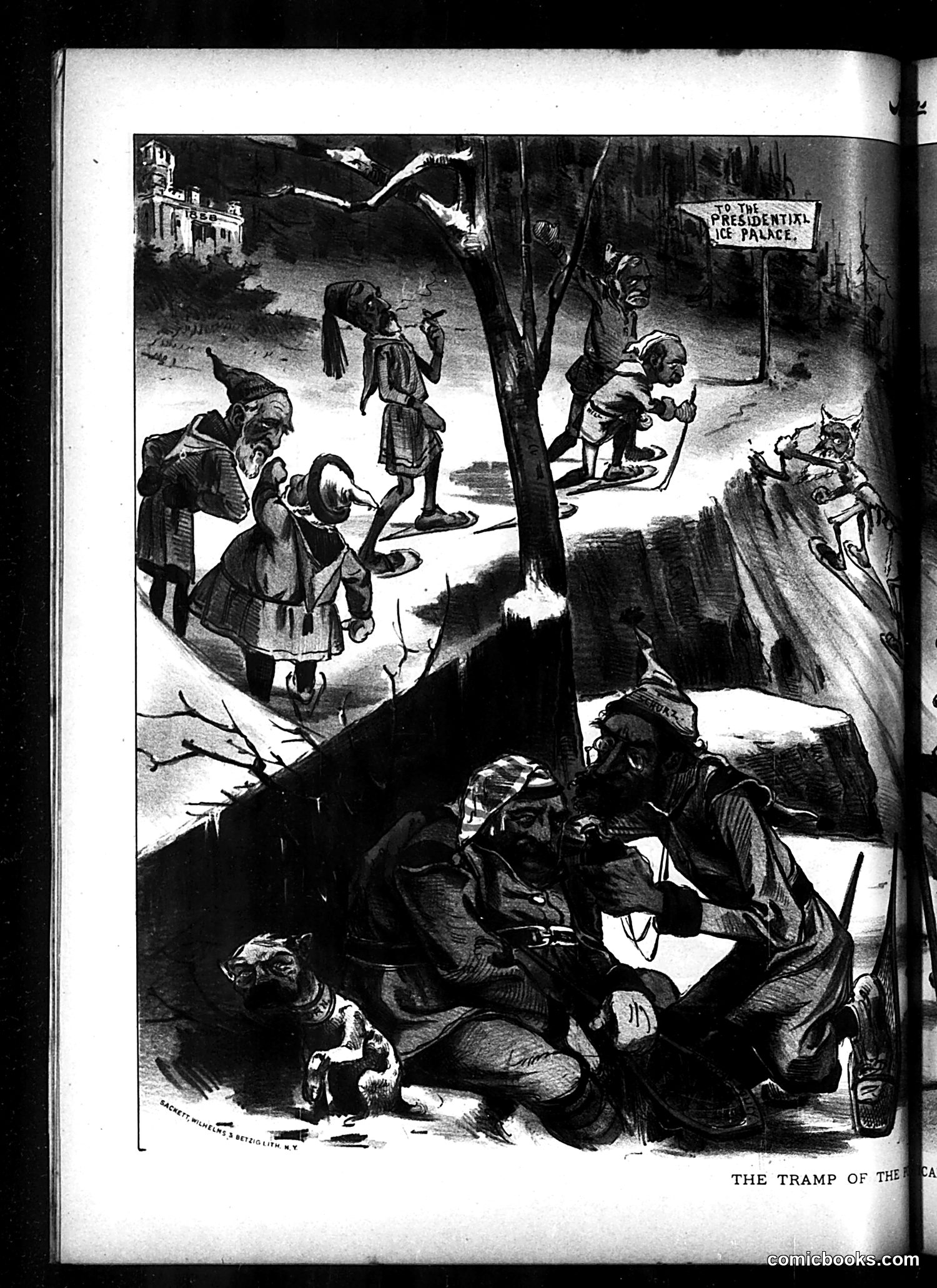
This appears to be a satirical illustration from *Judge* magazine depicting a homeless vagrant or "tramp" in a snowy, winter setting. The figure in the foreground (lower left) is huddled in tattered clothing, while upper figures appear to be well-dressed citizens or authority figures, one holding a sign pointing toward "THE PRESIDENTIAL ICE PALACE." The cartoon likely satirizes class inequality and indifference to poverty during winter hardship. The contrast between the freezing vagrant below and the apparently prosperous figures above—seemingly directing the poor away from luxury establishments—suggests critique of Gilded Age wealth disparity and governmental neglect of the homeless. The exact political moment remains unclear without the full title or date visible.
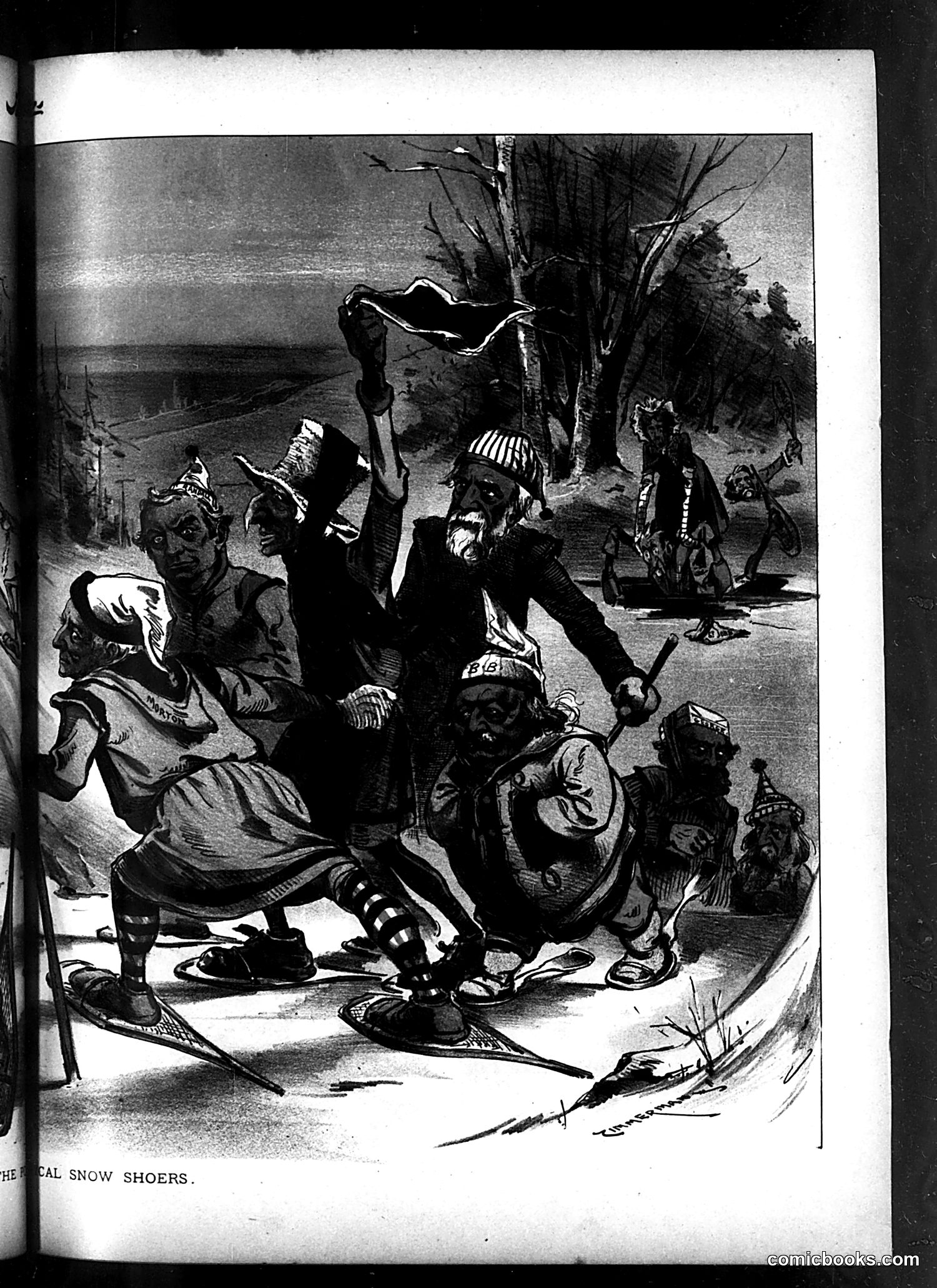
This appears to be a satirical illustration from *Judge* magazine depicting what looks like magical or fantastical characters in winter clothing. The OCR text is largely corrupted, making the specific political reference unclear. However, the image shows elaborately dressed figures—including someone in a tall hat and formal coat, and various characters wearing winter gear and distinctive headwear—gathered in a snowy landscape with dead trees. The style suggests this is likely late 19th or early 20th-century political satire, possibly mocking political figures or foreign dignitaries. The "magical snow shoes" referenced in the partial caption suggests the cartoon comments on some impractical or absurd scheme or policy. Without clearer text or visual context identifying the specific figures, the precise satirical target remains unclear.
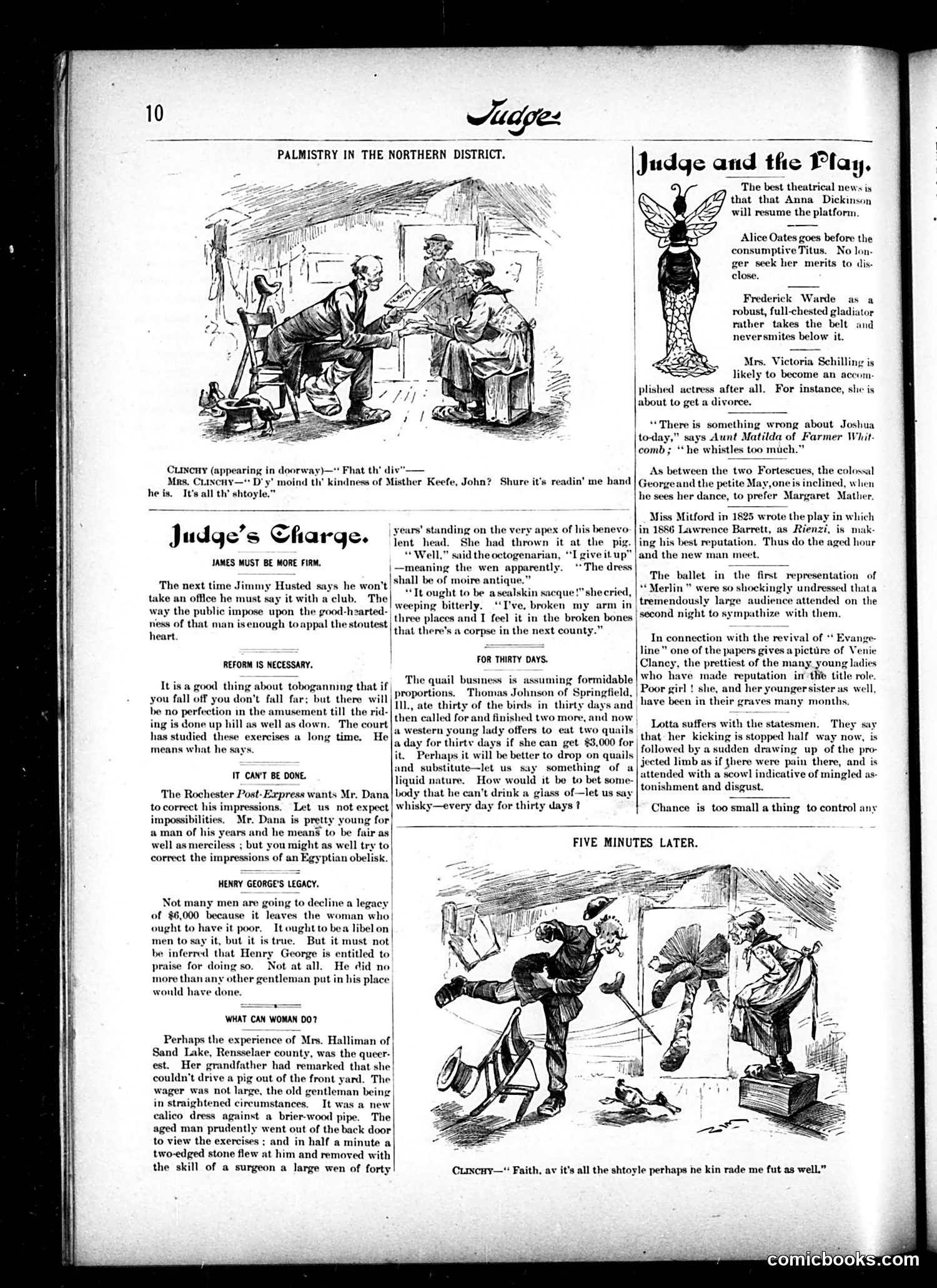
This page from Judge magazine (circa 1880s) contains several satirical pieces and cartoons typical of the era: **"Palmistry in the Northern District"** shows a working-class Irish character (indicated by dialect) having his palm read—likely satirizing both fortune-telling fads and Irish immigrant stereotypes popular in contemporary humor. **"Judge's Charge"** is a humor column with short satirical takes on contemporary figures and events. References include Jimmy Husted (unclear without more context), Henry George's legacy (the famous social reformer), and various theatrical personalities like Anna Dickinson and actress Alice Oates. **"Five Minutes Later"** depicts slapstick comedy of someone falling or being struck—common visual humor of the period. The theatrical section discusses stage performers and productions, indicating Judge covered popular entertainment extensively. The overall tone is irreverent toward public figures while employing stereotypes (Irish dialect, class-based humor) typical of 1880s American satire.
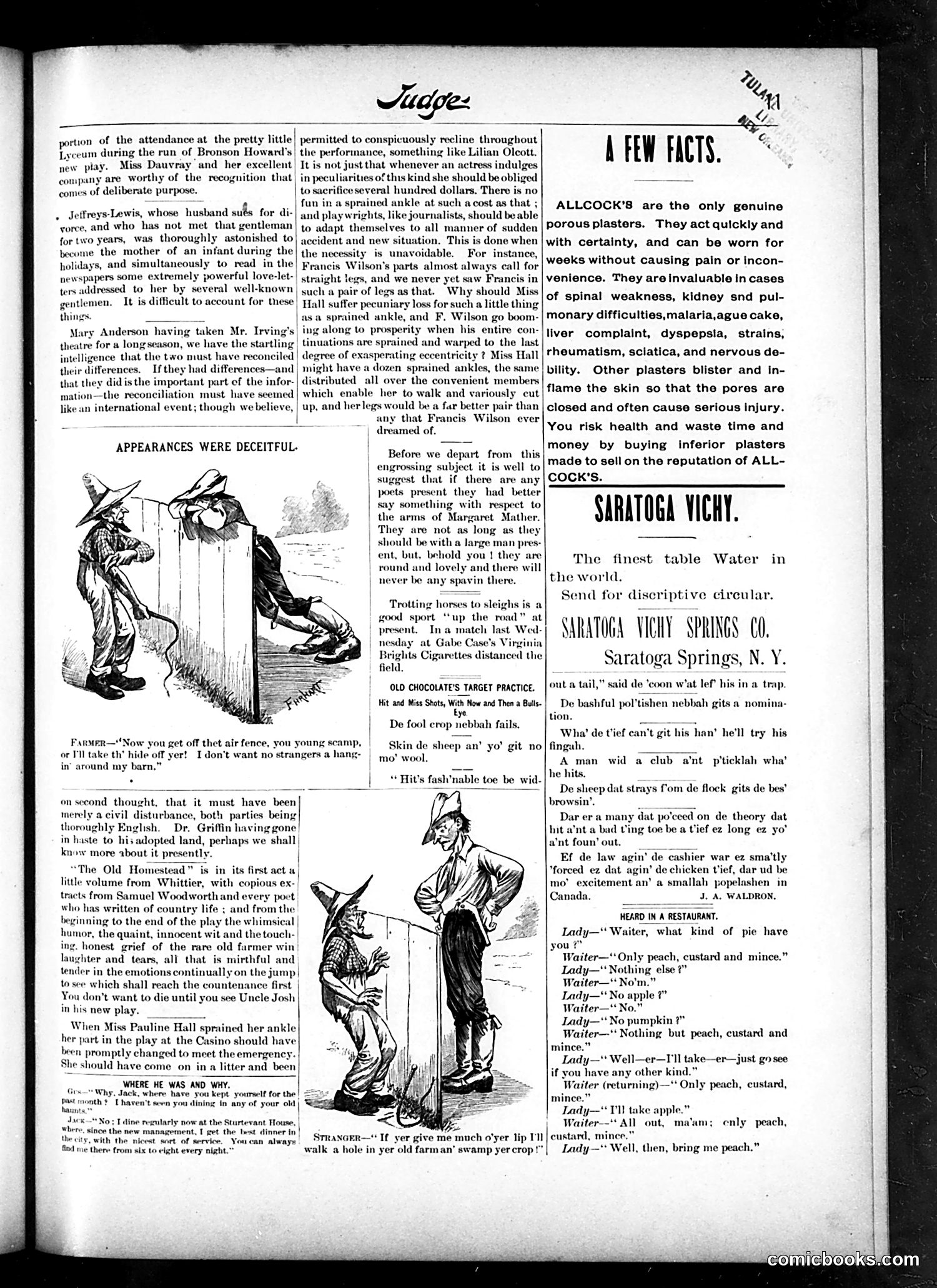
This page contains **theater criticism and satirical commentary** on 1880s-90s theatrical figures and productions. The key content: **Theater References:** - Discusses Bronson Howard's new play and actress Miss Dauvray - Comments on Mary Anderson and Henry Irving's theater company - Reviews "The Old Homestead" (a rural comedy) and actress Pauline Hall's sprained ankle **The Satire:** The main joke critiques **theatrical double standards**. When actress Pauline Hall sprains her ankle, she must forfeit her salary—but when male actor Francis Wilson's legs are awkwardly positioned or his physical comedy is exaggerated, he profits from it. The author sarcastically notes Wilson should have "sprained" everything if it made him money, while women suffer financial loss for genuine injuries. **The Cartoons:** Illustrations show rural comedic scenes—a farmer confronting a trespasser, a farmhand exchange—supporting commentary on "The Old Homestead's" authentic country humor. The page critiques **gender inequity in theater economics** while reviewing contemporary Broadway productions.
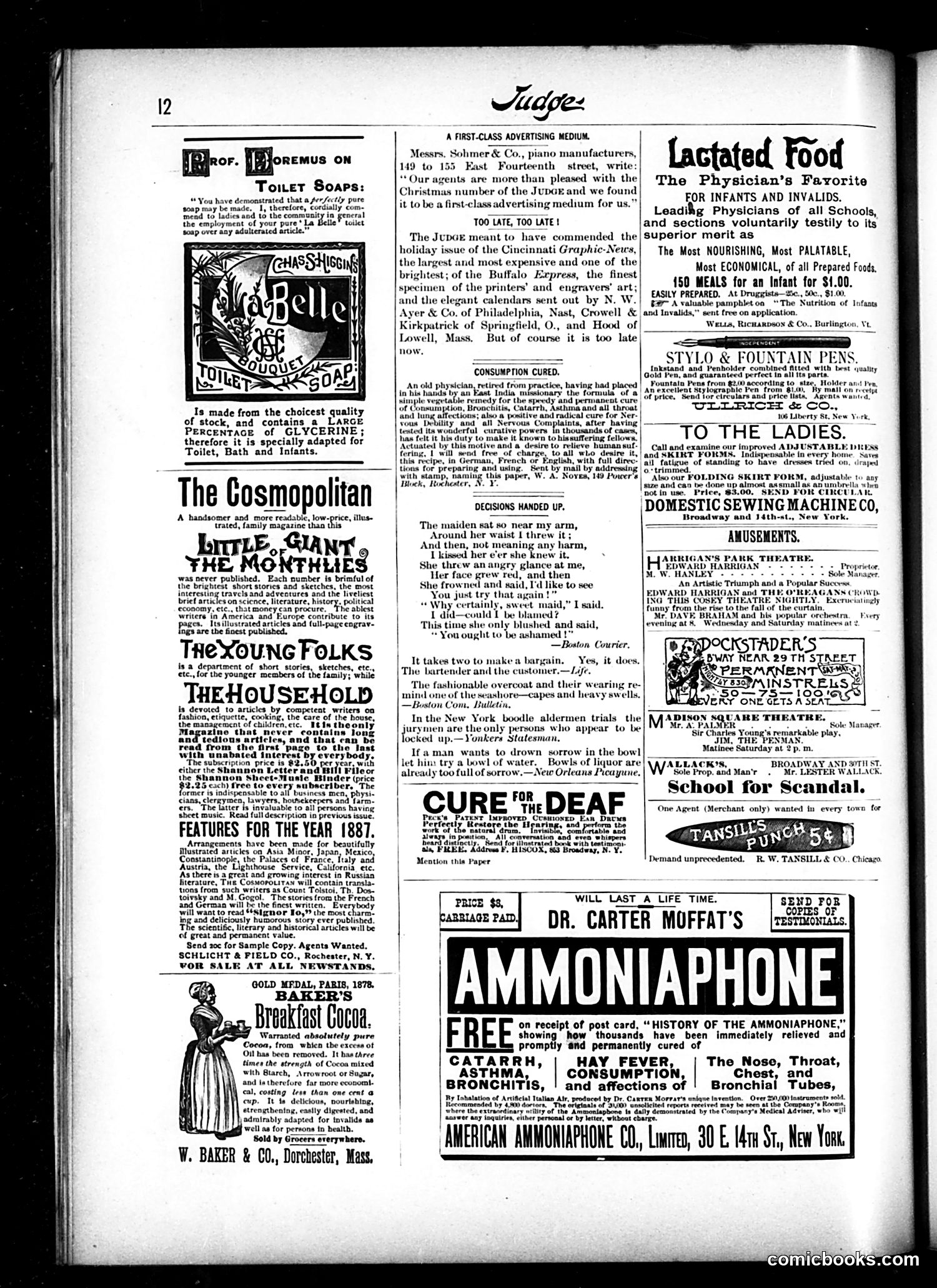
This page is primarily **advertising**, not editorial content. The visible text includes testimonials and advertisements for commercial products: toilet soaps, magazines, cocoa, and patent medicines. The only identifiable satirical element is a brief poem titled **"Digssons Handed Up"** and references to "**The Young Folks**" and "**The Household**" sections—standard magazine departments rather than political cartoons. The bulk of the page features **ads for Sohmer pianos, The Cosmopolitan magazine, Baker's Breakfast Cocoa, and Dr. Carter Moffat's Ammoniophone** (a dubious patent cure for deafness and respiratory ailments). The latter represents the period's prevalent medical quackery. No clear political satire or commentary is visible. This appears to be a typical late-19th-century magazine page mixing editorial content with revenue-generating advertising—itself a historical artifact of periodical economics of that era.
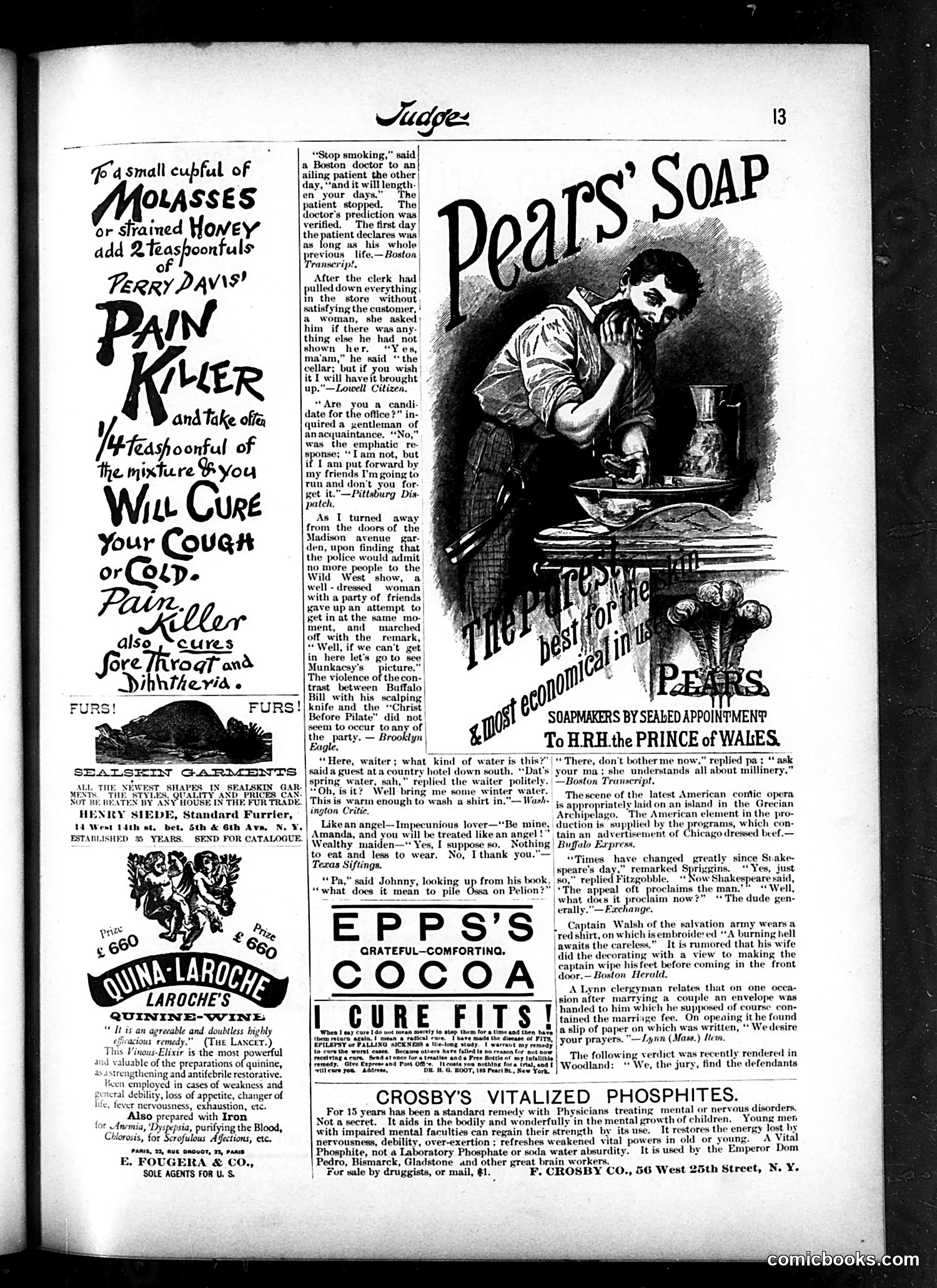
This page is primarily **advertising**, featuring patent medicines and consumer products typical of late 19th-century American magazines. The satirical content is minimal. The small text snippets scattered between ads are brief humorous anecdotes rather than political cartoons: - A Boston doctor's patient stops smoking; the patient claims each day now feels as long as his entire previous life (absurdist humor) - A store clerk offers to retrieve items he hasn't shown a demanding customer - A man claims he's not a political candidate but will run if nominated (gentle political commentary on ambition) - A woman leaves a Wild West show, suggesting instead to see Munkacsy's "Christ Before Pilate"—contrasting Buffalo Bill's violence with religious art (social observation on taste) The dominant content comprises advertisements for **Pear's Soap**, **Epps's Cocoa**, **Crosby's Vitalized Phosphites**, and various patent medicines (quinine wine, pain killers), reflecting Judge's era when such ads subsidized satirical publications. There are no identifiable political figures or caricatures on this particular page.
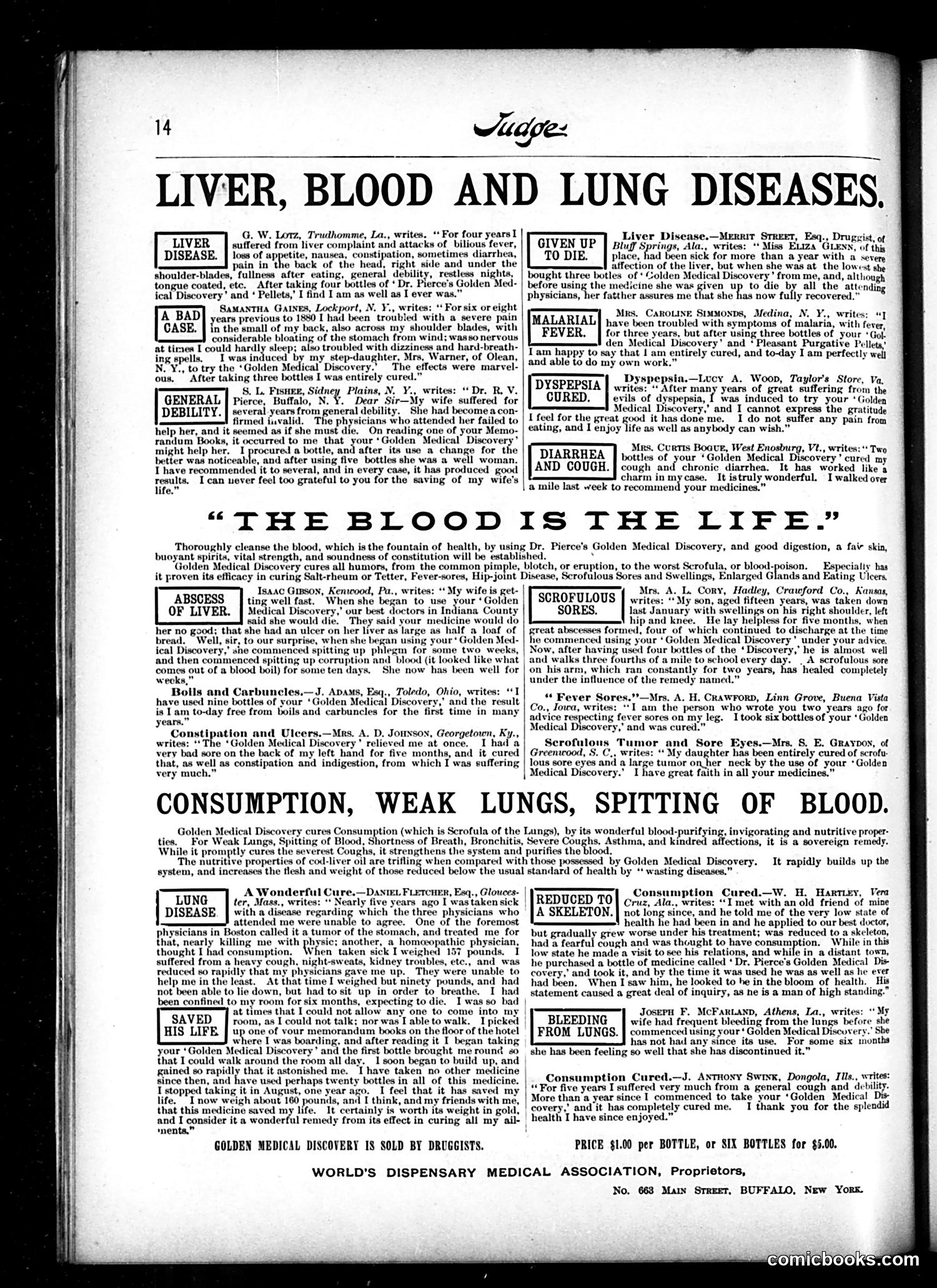
This is **not a political cartoon or satire**—it's a full-page advertisement for "Dr. Pierce's Golden Medical Discovery," a patent medicine. The page uses testimonial letters from purported customers claiming the product cured liver disease, dyspepsia, malarial fever, consumption, lung disease, diarrhea, and other ailments. Names and locations are provided to suggest legitimacy. **The satire comes from Judge magazine itself**: by printing this ad alongside its satirical content, Judge was likely mocking the era's ubiquitous patent medicine industry—quack remedies with vague ingredients and miraculous cure-all claims marketed through emotional testimonials. For modern readers: this represents the unregulated medical marketplace of the 19th century, where magazines profited from advertising products making impossible health claims. The "Golden Medical Discovery" almost certainly contained worthless or harmful ingredients. Judge's audience would recognize this as characteristic fraudulent medicine of their time.
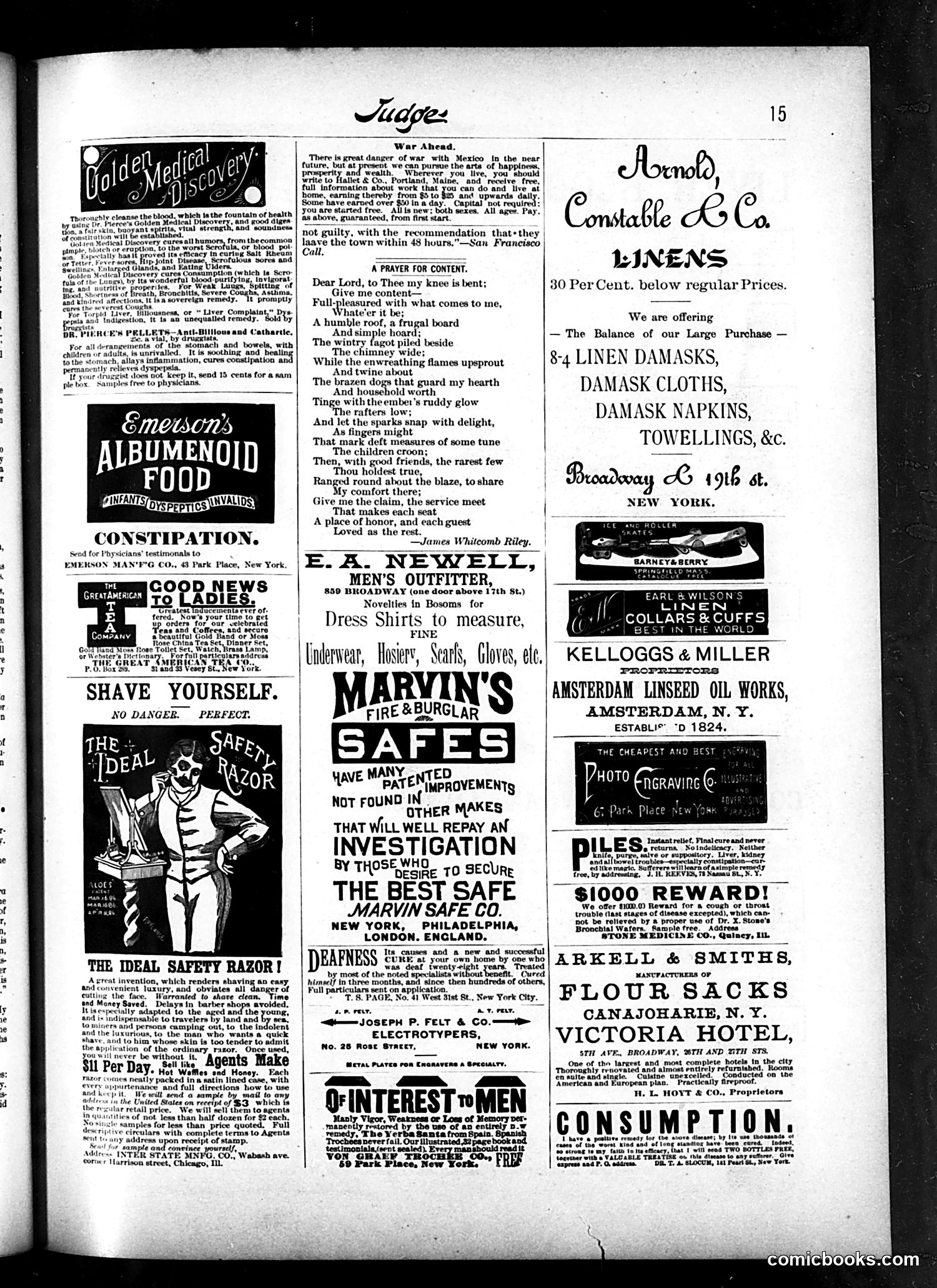
This is primarily an **advertising page**, not a satirical cartoon page. Judge magazine (founded 1881) mixed humor with commercial ads to fund publication. The page features patent medicine ads typical of the era—"Golden Medical Discovery" claims to cure consumption, scrofula, and various ailments; "Albumenoid Food" promises to cure constipation. These reflect the **pre-FDA era** when such products made unregulated health claims. Other notable ads include safety razors ("The Ideal Safety Razor"), safes, linens, and business services. The only editorial content is a poem by James Whitcomb Riley titled "A Prayer for Content"—a sentimental verse about humble contentment. The brief "War Ahead" snippet references potential conflict with Mexico and advertises work-from-home opportunities, common promotional copy of the period. **Bottom line**: This page reveals what Judge's readers encountered—commercial messaging mixed with light editorial content, reflecting late 19th-century publishing economics and the prevalence of dubious patent medicine marketing.
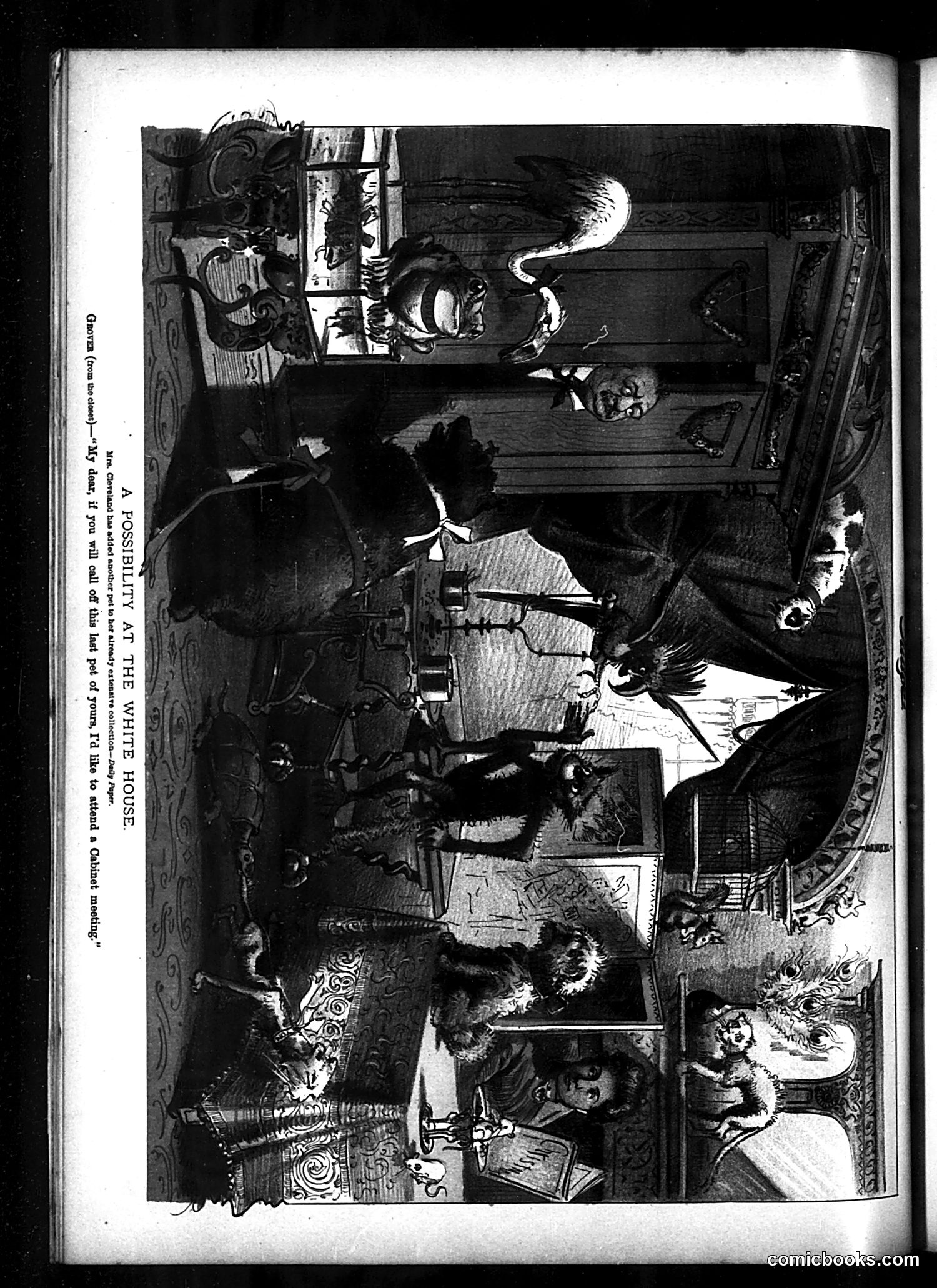
This cartoon satirizes President Grover Cleveland's wife, Mrs. Cleveland, who apparently kept numerous pets. The joke depicts Cleveland being driven from his own Cabinet meeting by his wife's latest pet addition—a dog labeled "Daily Paper" (likely a pun on newspaper reading or daily habits). The humor lies in the domestic reversal: instead of the president controlling his household, his wife's pet collection has grown so extensive that it interferes with government business. Cleveland appears subordinate, forced to ask permission to attend official duties. The cartoon mocks both Mrs. Cleveland's pet-collecting hobby and, by extension, suggests the president lacks authority even in his own home—a common satirical trope about powerful men being henpecked by their wives.