
A complete issue · 16 pages · 1887
Judge — January 1, 1887
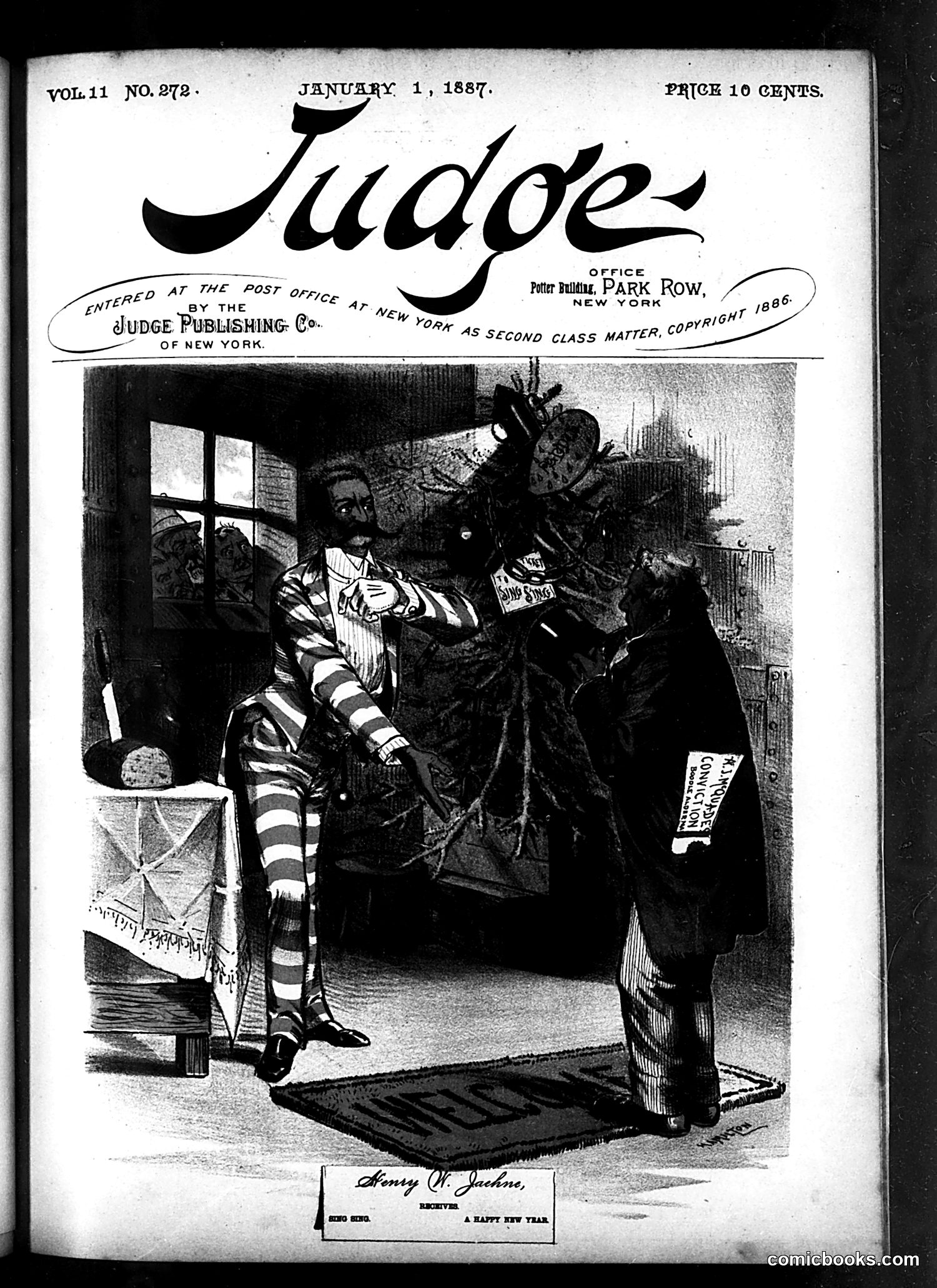
**Title:** "Army of Jackies" / "A Happy New Year" **The Satire:** This appears to be New Year's Day commentary on military or police uniforms. A bearded man in striped prison or military garb is surrounded by figures in dark clothing, one holding what appears to be a sign or placard. The striped costume suggests either a convict or soldier. **Likely Meaning:** Without clearer context or visible text on the signs, the exact target is uncertain. However, the crowded, chaotic scene and "Army" reference suggest satire about either military expansion, prison conditions, or possibly police/enforcement proliferation in American life circa 1887. **What's Unclear:** The specific identity of "Jackies" and whether this references a particular political figure, military leader, or social movement of that era.
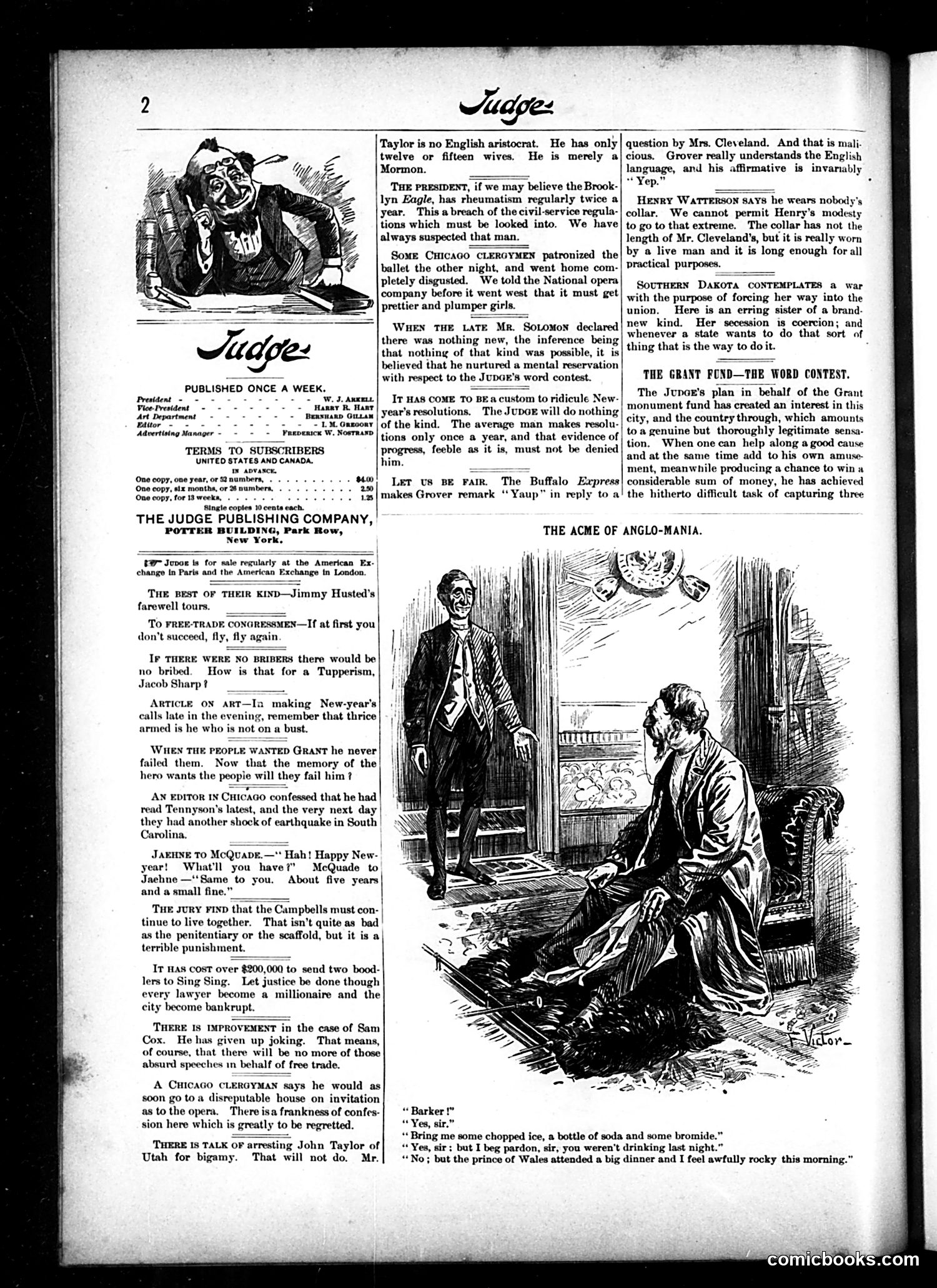
This cartoon satirizes British affectation among wealthy Americans. A standing figure in formal British dress confronts a seated man, demanding "chopped ice, a bottle of soda and some bromide" — supposedly what the seated man needs after attending a dinner where "the prince of Wales" was present. The satire targets American snobbism: the standing figure's exaggerated British mannerisms and formal dress mock those Americans who adopt British customs and speech to appear sophisticated. The joke is that despite this pretentious imitation of British style, the seated character still feels "awfully rocky" (hungover/unwell) — suggesting that affected Anglophilia cannot actually confer genuine refinement or superiority. The title "Acme of Anglo-Mania" directly identifies the target: excessive American admiration for British culture.
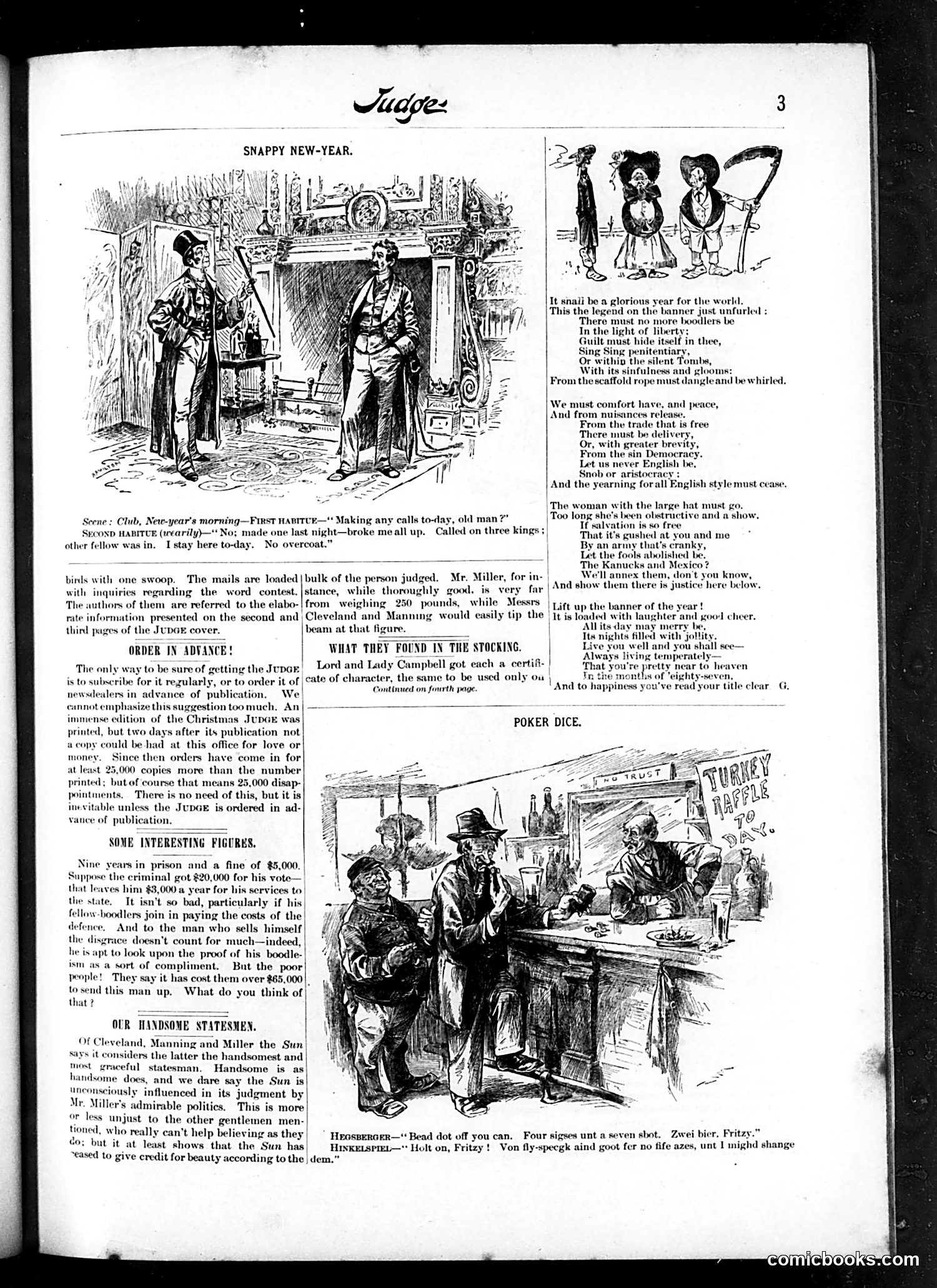
This page from Judge (likely early 1880s) contains New Year's political satire. The main cartoon shows two club members on New Year's morning—one asking if the other made any calls, the other grumbling he visited "three kings" last night and broke himself up financially. The accompanying poem mocks Democratic corruption and reform promises, referencing specific figures: Cleveland, Manning, and Miller—likely Grover Cleveland (president) and his associates. The satire targets "boodlers" (corrupt politicians receiving bribes) and promises of reform that Judge finds hypocritical. A secondary section praises these three men as "handsome statesmen," sarcastically crediting the Sun newspaper for judging Miller handsome due to his politics rather than actual appearance. The "Poker Dice" cartoon depicts German immigrants gambling, using heavy dialect humor typical of era stereotyping. The overall message: Judge is cynical about Democratic anti-corruption rhetoric, viewing it as empty posturing.
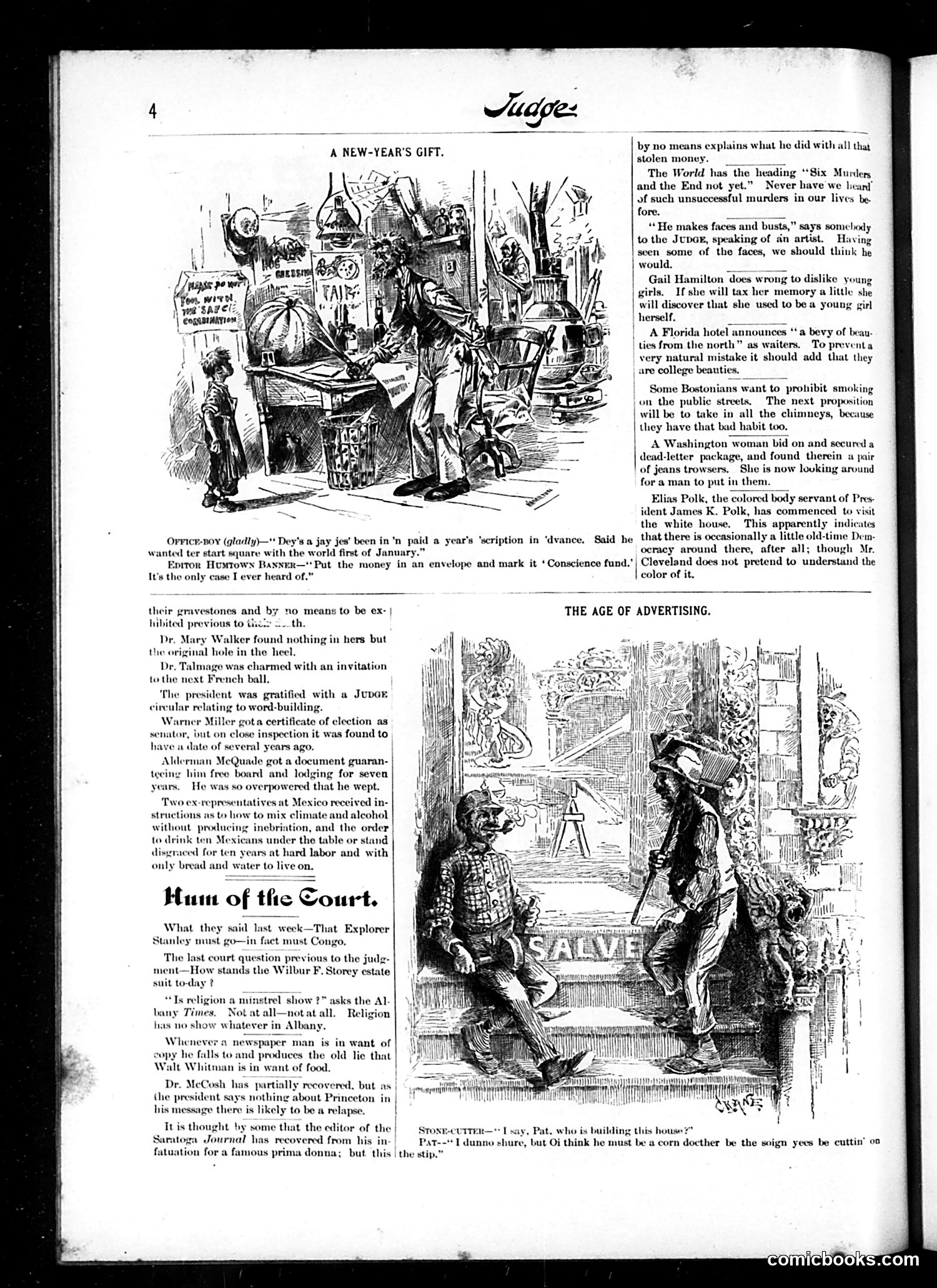
This page contains several short satirical items typical of 1880s Judge magazine humor: **"A New-Year's Gift"** (top cartoon): An office boy receives advance payment for a year's subscription. Editor Houghton Bixbee instructs him to mark it a "Conscience fund"—satirizing how publications solicited advance payments while pretending moral righteousness. **"Hints of the Court"** section mocks contemporary figures and events: - Explorer Stanley (likely Henry Morton Stanley) and the Congo - The Wilbur F. Storey newspaper estate dispute - Various politicians and public figures receiving minor ridicule **"The Age of Advertising"** (right cartoon): Two figures discuss construction, with a pun on "corn doctor" cutting on "the sip"—likely mocking inflated advertising claims and pseudoscientific practitioners common in the era. The page emphasizes Judge's formula: short quips about current events, politicians, and social trends, mixed with visual satire. Most references assume reader familiarity with contemporary scandals and personalities now largely forgotten.
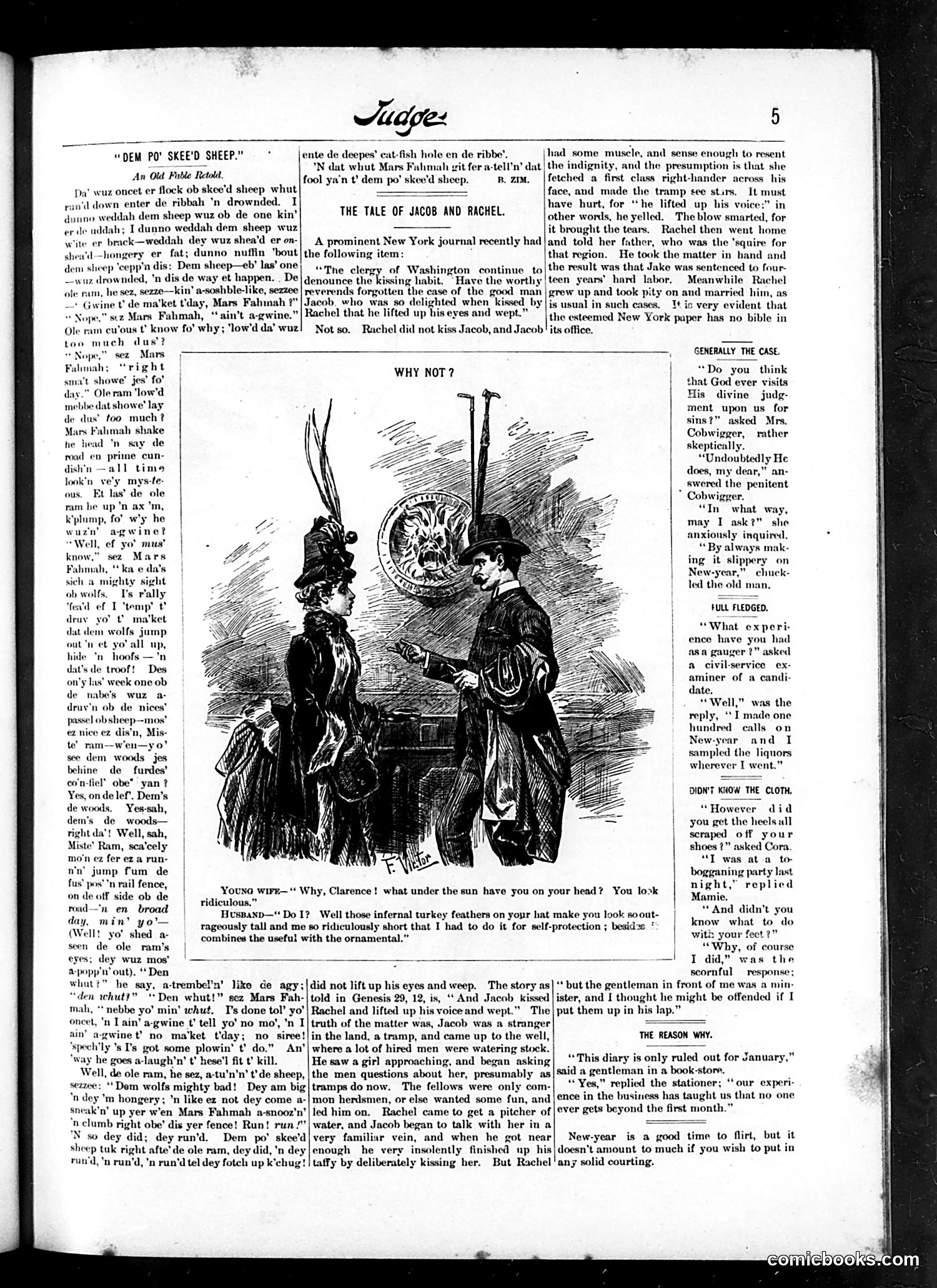
This page contains multiple satirical pieces typical of Judge magazine's humor: **"Dem Po' Skee'd Sheep"** (top left): A dialect-heavy fable mocking rural superstition. A farmer's warning about market prices causes his sheep to panic and drown—the satire targets how fearful masses blindly follow leaders' dire predictions without understanding them. **"The Tale of Jacob and Rachel"** (center): Judge ridicules clergy moralizing about kissing by contrasting a biblical tale with modern consequences. The satire suggests the clergy misread scripture—Rachel would actually punch Jacob, get arrested, serve fourteen years, then marry him anyway. The joke exposes the absurdity of using selective biblical examples for modern moral instruction. **Minor comic vignettes** (right side): Brief jokes about New Year's resolutions, gauging liquor, and winter activities—standard magazine filler humor. The cartoons employ period-typical dialect humor and mock pretentious moralizing from religious authorities.
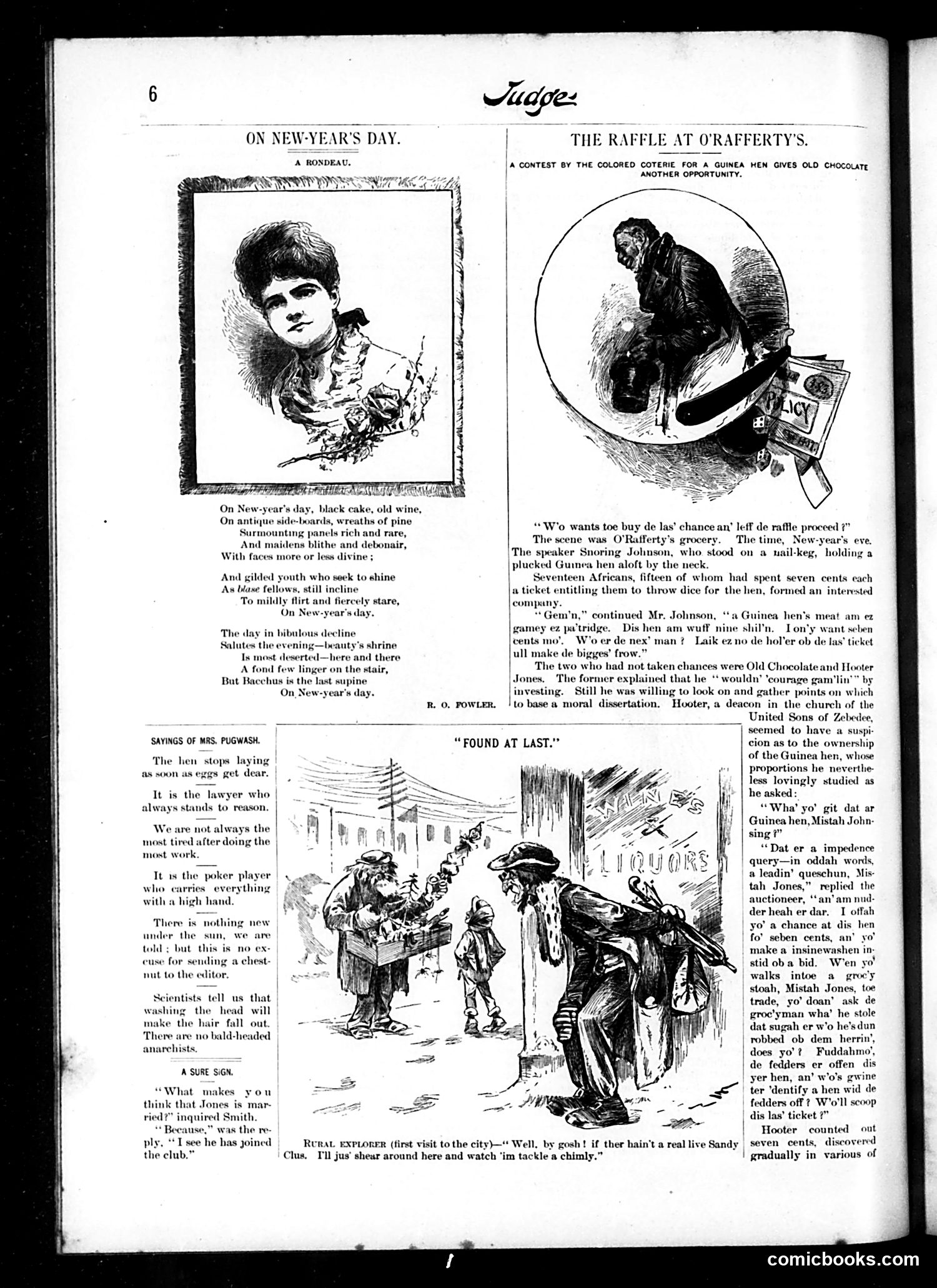
This cartoon satirizes a raffle conducted by African American men at a grocery store on New Year's Eve. The auctioneer "Snoring Johnson" hawks a guinea hen to the participants, using exaggerated dialect and high-pressure sales tactics. The satire targets both the participants and the broader culture: the working-class Black men gambling on trivial stakes, the moral hypocrisy of "Old Chocolate" and "Hooter Jones" (a church deacon) who decline to gamble while eagerly observing, and the slick auctioneer's rhetorical tricks to pressure holdouts into buying tickets. The heavy use of minstrel-show dialect and the depiction of petty gambling reflects period racial stereotypes common in Judge magazine. The "moral dissertation" reference to Hooter suggests satirical commentary on religious pretense masking vice. The cartoon reinforces era-specific prejudices while ostensibly mocking lower-class behavior across racial lines.
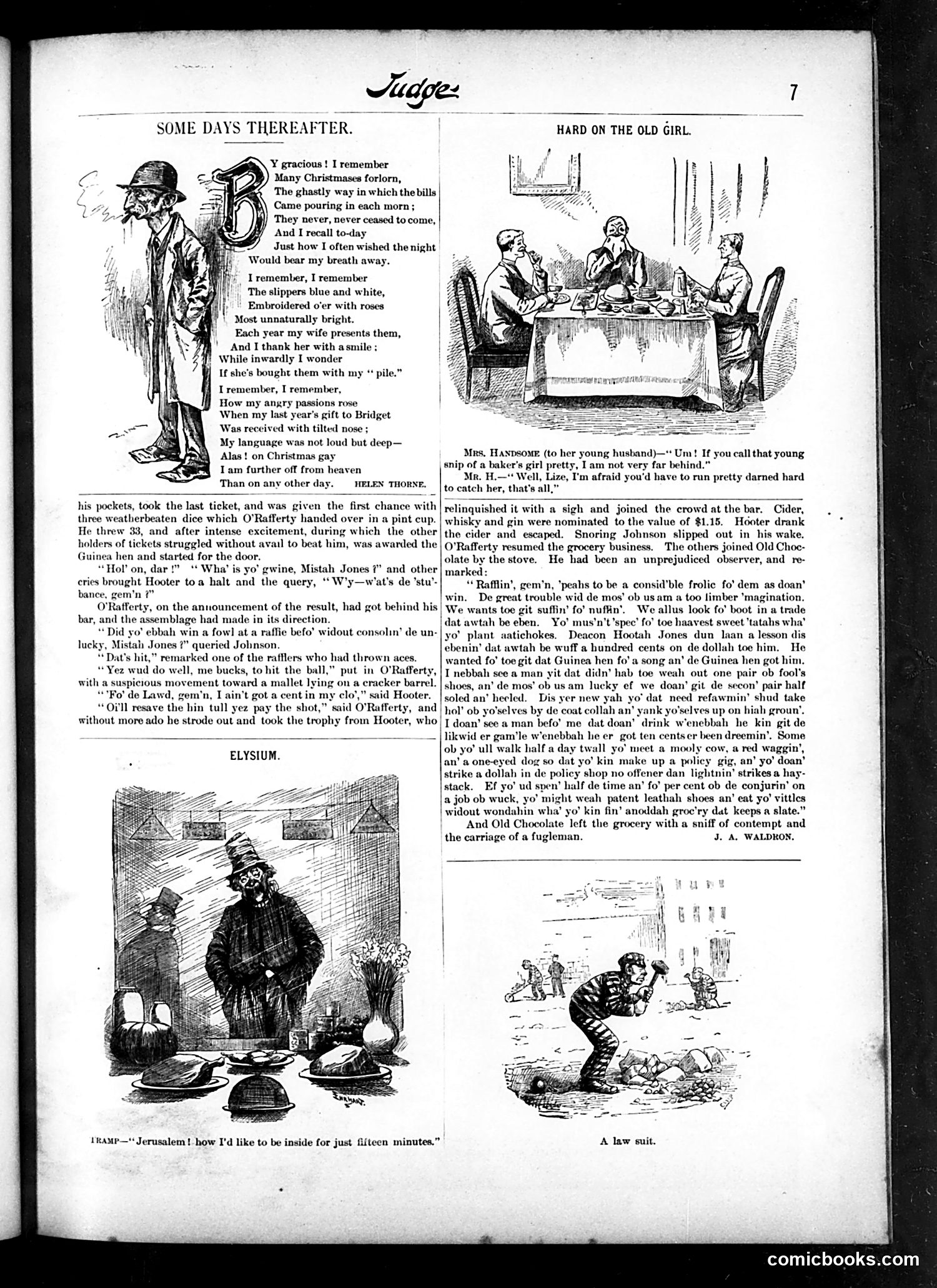
This page contains three distinct satirical pieces mocking domestic life and working-class leisure: **"Hard on the Old Girl"** (top right): A husband compliments a baker's girl's appearance to his wife, who bristles at the comparison. He responds she'd "have to run pretty darned hard to catch her"—a cutting joke about his wife's aging or declining attractiveness, typical of period humor degrading women. **"Some Days Thereafter"** (left): A melancholic poem about Christmas—bills, unwanted gifts (ugly slippers), servants' ingratitude, and marital disappointment. It satirizes sentimental nostalgia by revealing Christmas as financially burdensome and emotionally hollow. **"Elysium"** (bottom left): Depicts an Irish immigrant tavern scene where poor Black patrons participate in a raffle. The heavily dialectized text mocks their speech while showing themes of gambling, poverty, and the perpetual cycle of working-class futility—they chase easy money but always lose. The page reflects period prejudices through caricature and exaggerated dialect while satirizing marital discord and working-class desperation.
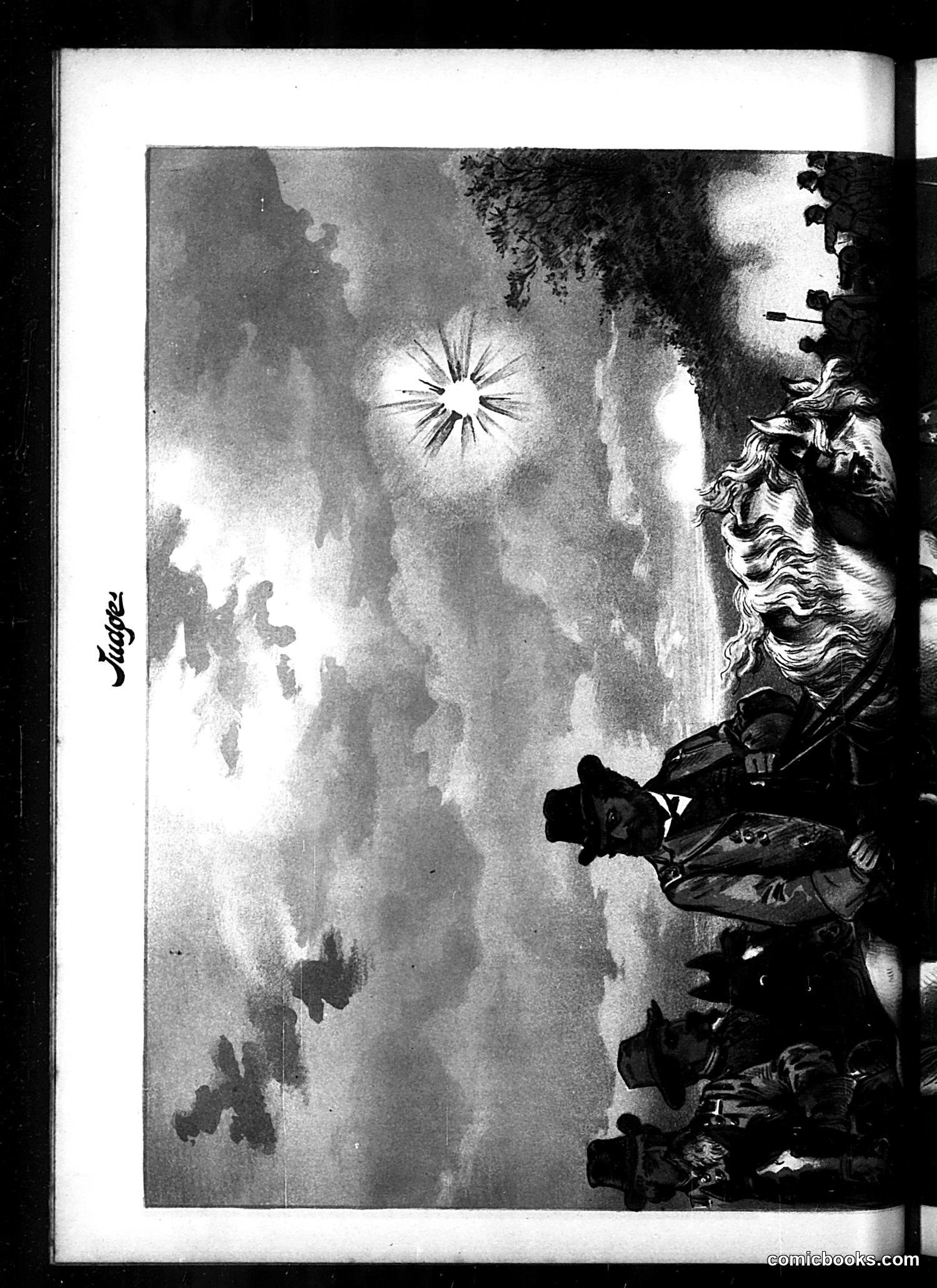
The image appears to show a satirical illustration, but the OCR text provided is blank or unreadable, making it impossible to identify the specific political figures, historical events, or satirical commentary being depicted. What's visible: The illustration shows figures in military uniforms on the right side, observing what appears to be an explosion or bright light in a cloudy sky on the left. The style and composition suggest military or political satire typical of *Judge* magazine. **To accurately explain this cartoon, I would need:** - Legible OCR text from the page - The publication date - Any visible captions or titles Without these details, identifying the specific historical references, figures, or satirical intent would require speculation rather than evidence-based analysis.
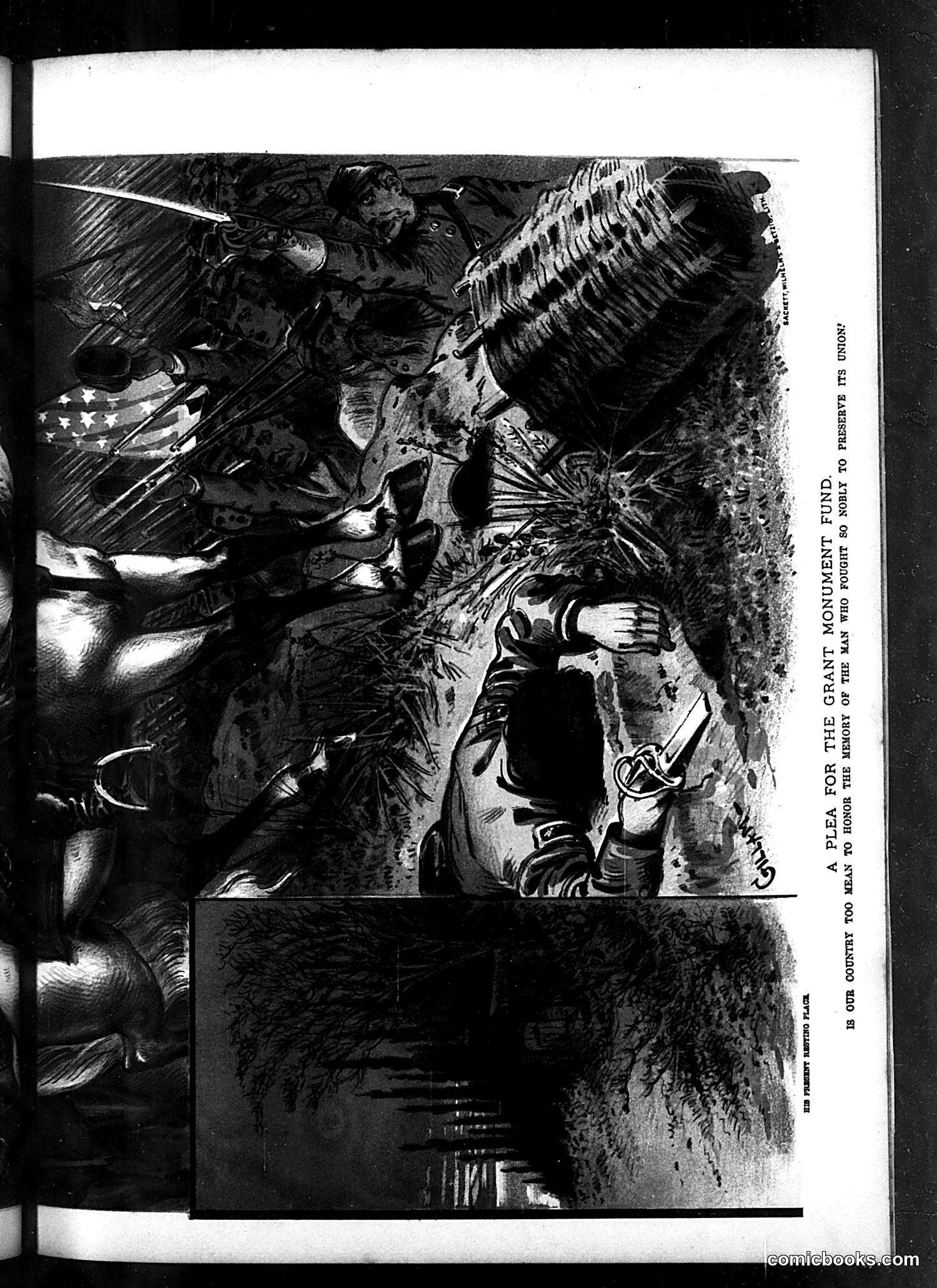
I cannot reliably interpret this page. The OCR text is severely corrupted and unreadable—it appears reversed or scrambled rather than providing meaningful content. While the image shows what appears to be a satirical illustration in black and white with multiple figures in dramatic poses, I cannot confidently identify the specific political figures, historical event, or satirical point being made without legible text. To properly analyze this Judge magazine cartoon, I would need either a clearer image or accurate transcription of the caption and any accompanying text. Without these, asserting specific identifications would violate the accuracy-first principle you've requested.
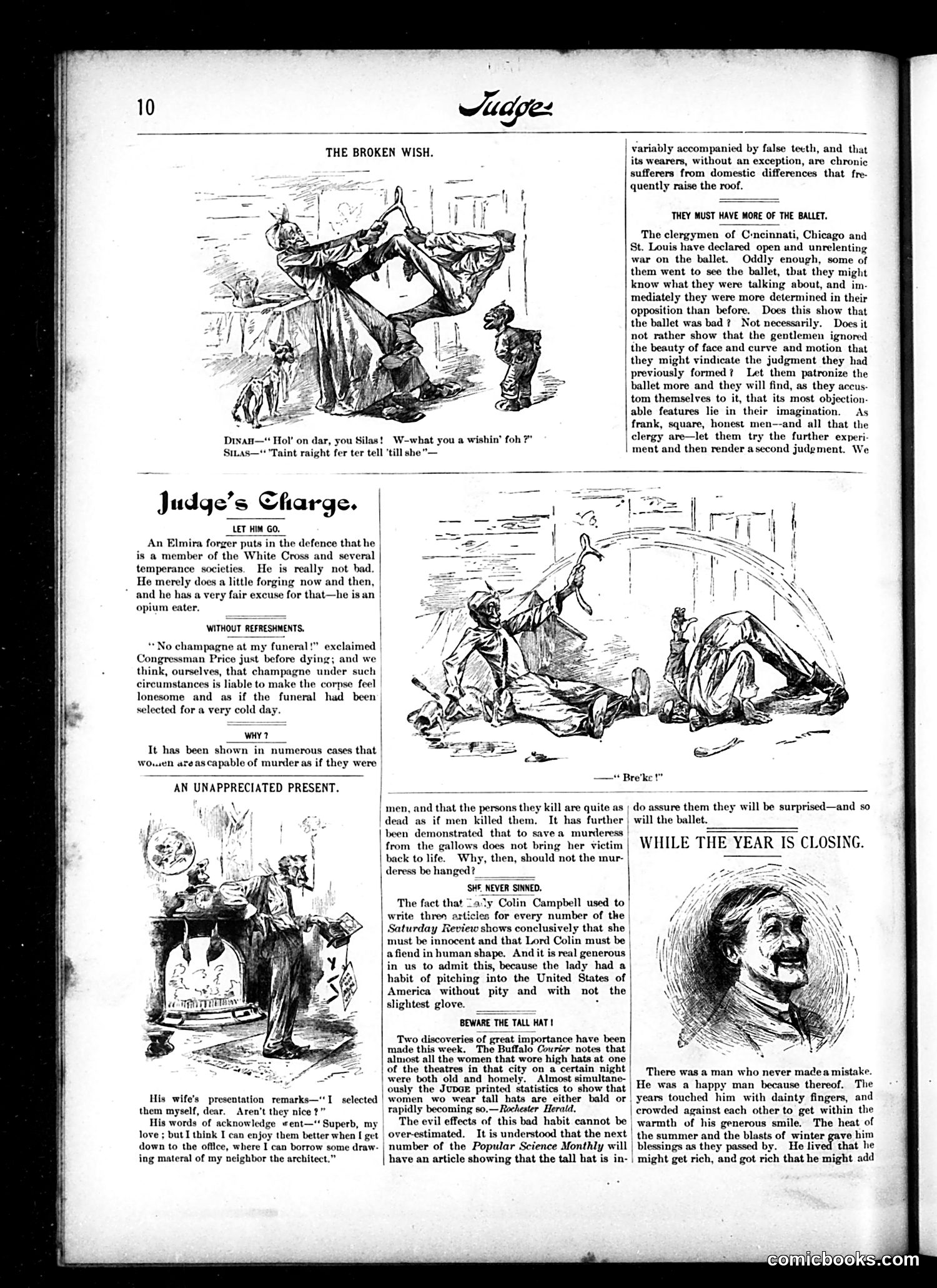
This page from *Judge* magazine contains several short satirical pieces targeting social hypocrisy and legal absurdities of the era. **"The Broken Wish"** (top cartoon): A dialectal joke featuring two African American figures, using period stereotypes common to 19th-century humor. **"Judge's Charge"** section includes: - **"Let Him Go"**: Satirizes lenient courts excusing crimes (forgery, opium addiction) based on temperance society membership - **"Without Refreshments"**: Mocks a congressman's deathbed request against champagne at his funeral - **"An Unappreciated Present"**: Humorously depicts a husband ungrateful for his wife's gift, planning to return it for office supplies **"They Must Have More of the Ballet"**: Defends ballet against clergy opposition, sarcastically suggesting clergymen attend more performances to overcome their imagined objections rather than genuine moral concerns. **"Beware the Tall Hat"**: Reports that tall hats worn by women correlate with unattractiveness or baldness—mocking both the women and the dubious "statistics" proving it. The overall tone criticizes selective morality, legal leniency, and sanctimonious judgment.
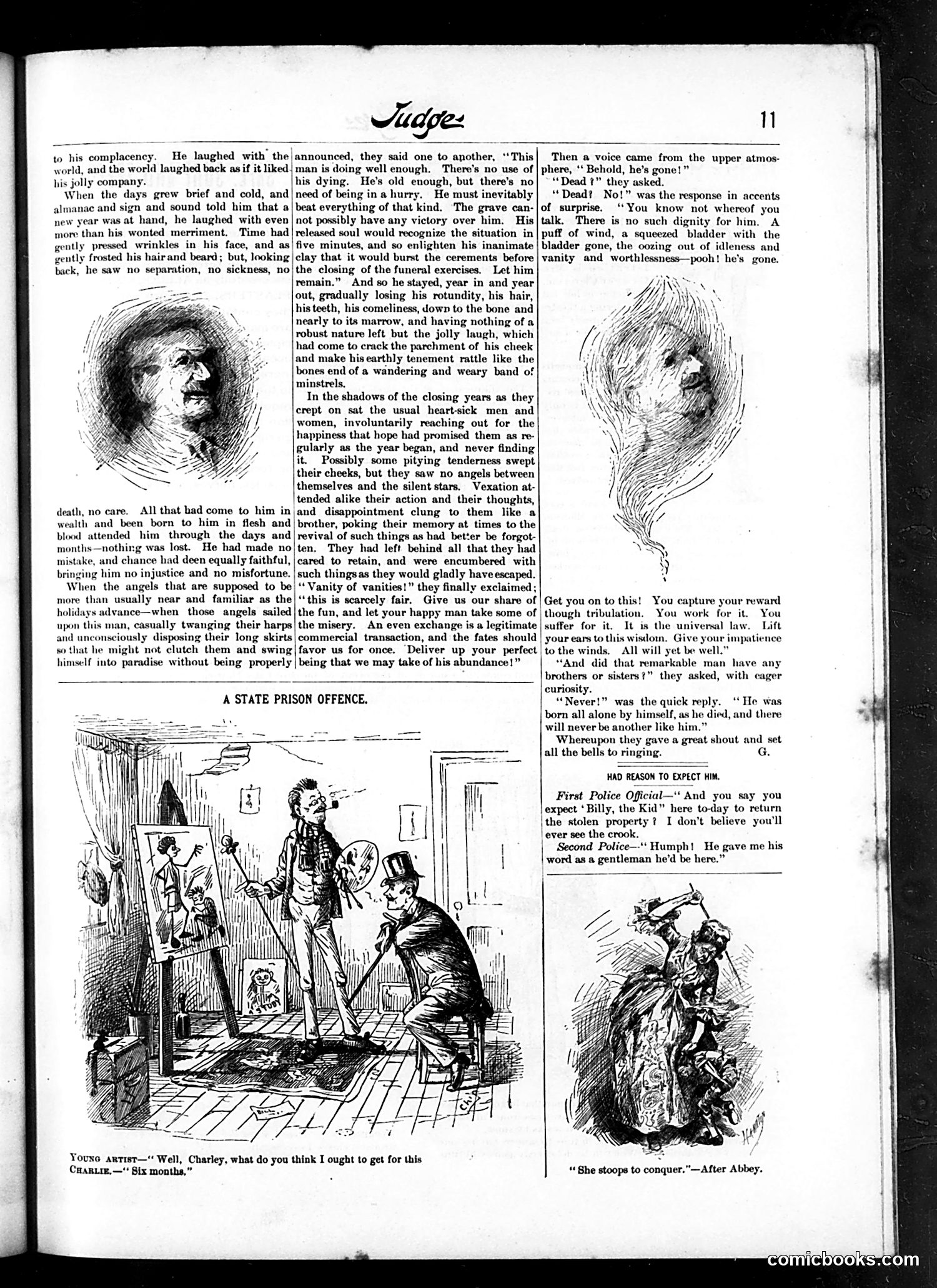
This page presents a philosophical allegory about a perpetually cheerful man who ages without bitterness, contrasted with the complaints of suffering onlookers. **The Main Text:** Describes an aging man who maintains his jovial nature despite time's ravages—wrinkles, lost teeth, diminished vitality. He laughs at life's indignities without self-pity, finding no separation from his earlier self. Around him, however, bitter souls who've suffered complain to fate, demanding "an even exchange"—they want his happiness transferred to themselves while he shares their misery. They're refused. **The Cartoons:** "A State Prison Offence" (lower left) appears unrelated—a prison scene. "She stoops to conquer" (right) references Oliver Goldsmith's 1773 play, depicting a woman conquering through humility or cunning. **The Satire's Point:** Judge critiques those who resent others' happiness and demand cosmic fairness. The perpetually cheerful man succeeds not through privilege but attitude; the bitter fail through their own resentment. This reflects late-19th-century American ideology emphasizing individual character over circumstance.
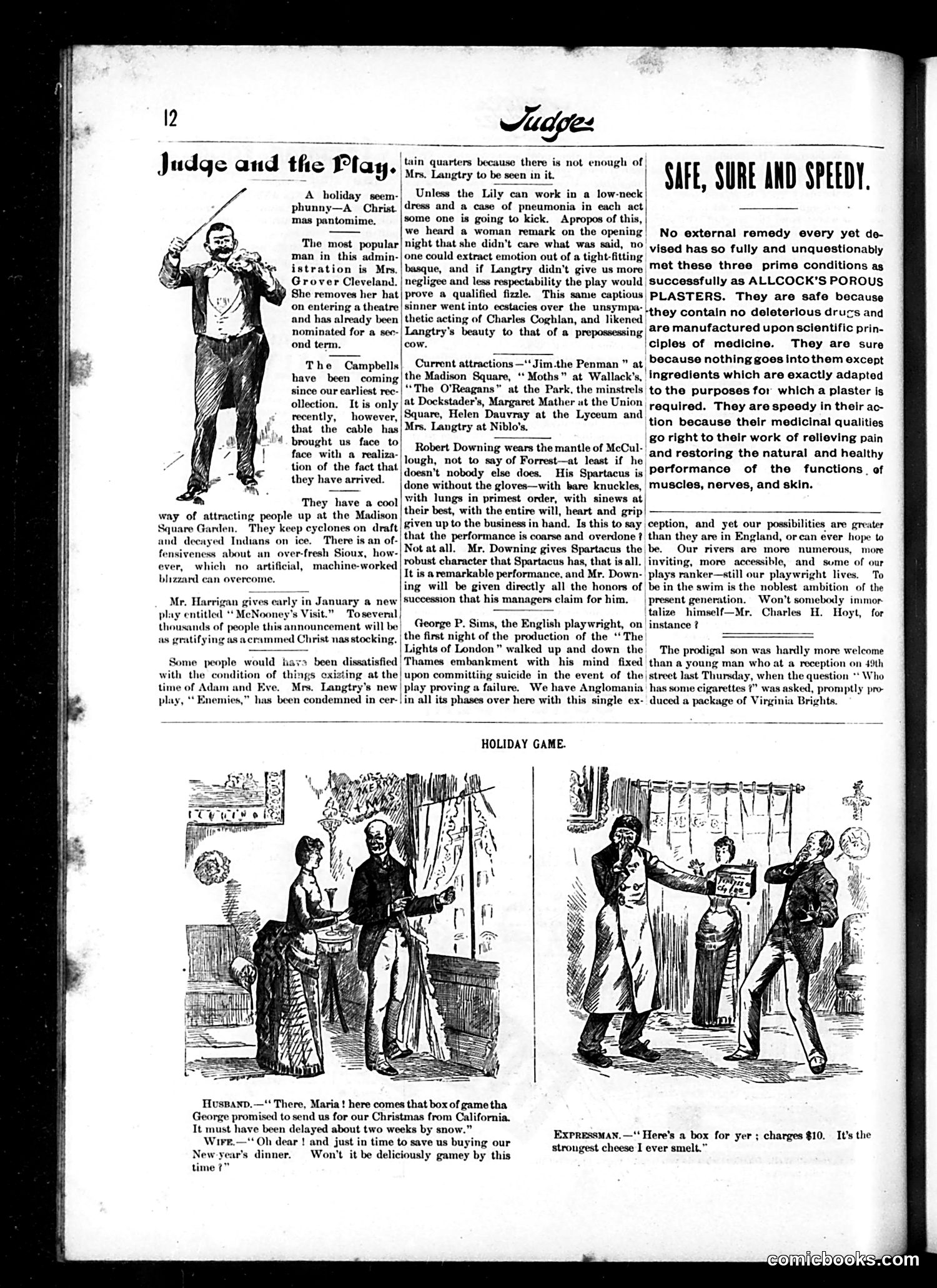
This page satirizes New York theater and its personalities circa the 1880s. The main article, "Judge and the Play," critiques contemporary theatrical productions and performers with sharp wit. Key targets include: - **Mrs. Grover Cleveland**: Praised ironically as "the most popular man in this administration" for removing her hat in theaters—a dig at President Cleveland's wife's social prominence. - **Lillie Langtry** ("The Lily"): Mocked for her limited stage presence and for appearing in a "tight-fitting basque" rather than the negligee audiences wanted; criticized as having beauty "of a prepossessing cow." - **Robert Downing**: Praised genuinely for his passionate performance as Spartacus, performing without gloves to show raw physical commitment. The "Holiday Game" cartoons below show a domestic scene of relatives receiving a malodorous cheese shipment—gentle family humor about Christmas gift-giving expectations versus disappointing reality. The overall tone reflects Judge's characteristic theatrical criticism blended with social commentary on celebrity and fashion.
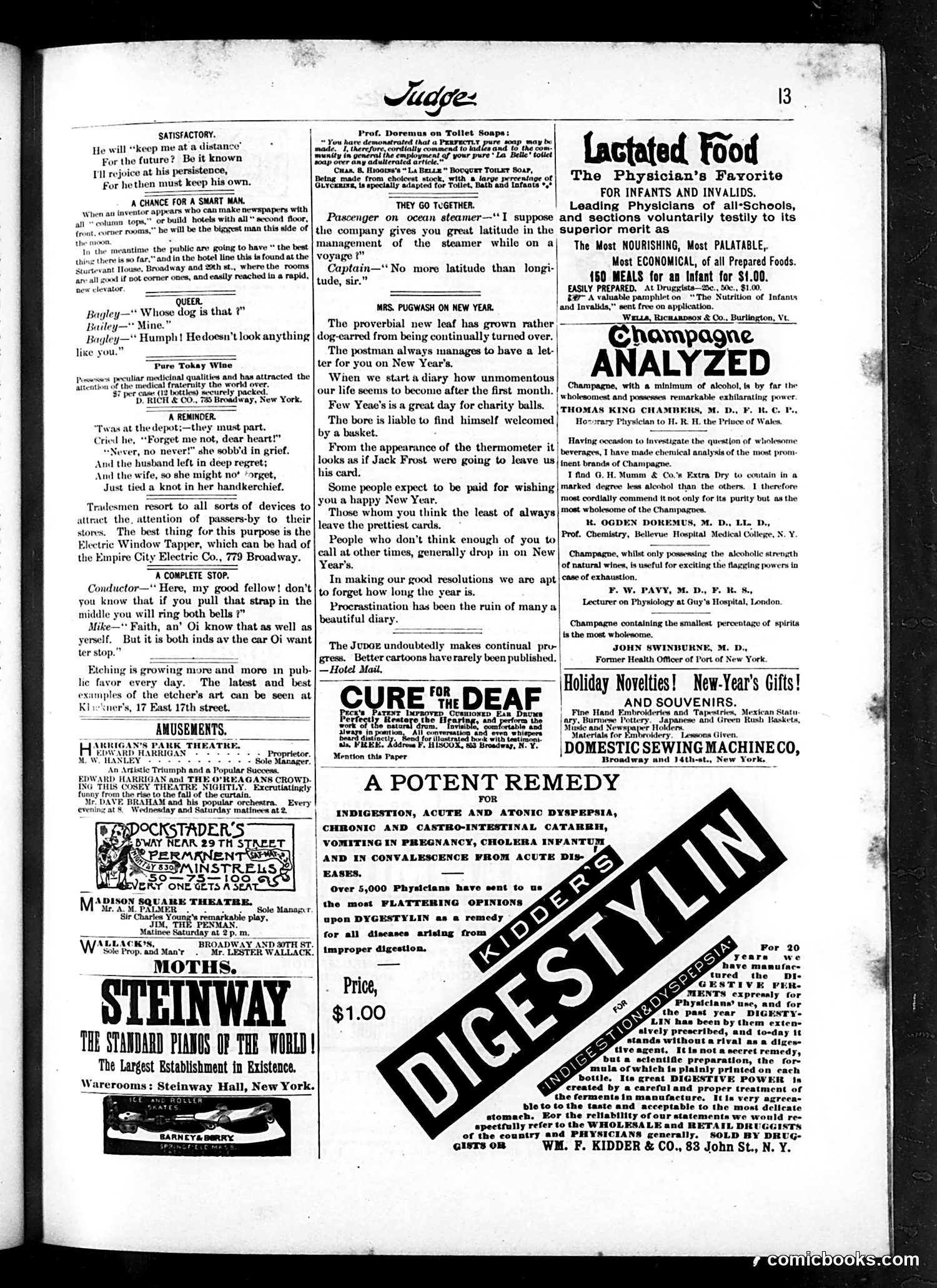
This page is primarily **advertising with light humor pieces**, typical of Judge magazine's format. The political/social content is minimal. The main satirical pieces are brief jokes: - **"A Chance for a Smart Man"** mocks impractical newspaper/hotel design innovations while promoting the Steuart House hotel. - **"They Go Together"** is a simple pun about a ship captain using "latitude" and "longitude" interchangeably—wordplay with no deeper meaning. - **"Mrs. Pugwash on New Year"** gently satirizes the human tendency to make and break New Year's resolutions, and the predictability of holiday traditions (charity balls, thermometer watching). The bulk of the page consists of **product advertisements** for Lactated Food (infant formula), Champagne, Kidder's Dysentery remedy, and pianos—reflecting late-19th century consumer culture. These ads appeal to physicians and wealthy readers, positioning products as scientifically endorsed and socially respectable. There are no identifiable political figures or significant satirical targets visible here.
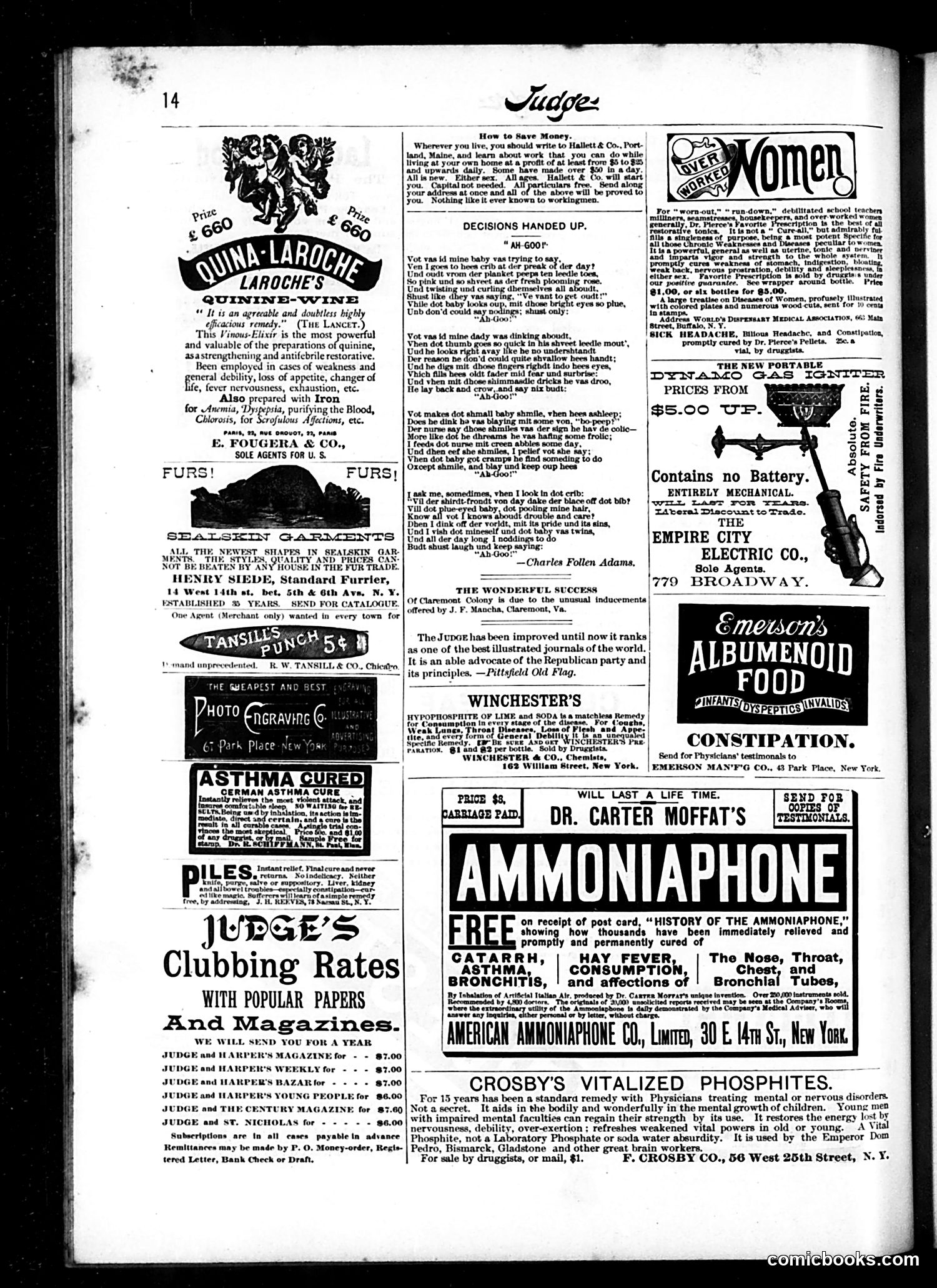
This page is primarily **advertising**, typical of late 19th/early 20th-century magazines. However, one notable satirical content appears: a dialect poem by **Charles Follen Adams** titled "Decisions Handed Up." The poem uses heavy **German-immigrant dialect** ("dot," "vhen," "aboudl") to humorously describe a father's reasoning about his baby's behavior—the child pulling at a bib, poking eyes, and crying. The "decisions" are the father's comical explanations for why babies do these things. This reflects period humor that relied on ethnic caricature and dialect comedy, common in Judge. The bulk of the page comprises patent medicine advertisements (Quinine-Laroche, Winchester's remedies, Dr. Carter Moffat's Ammoniaphone) and various commercial offers—typical of how magazines subsidized themselves. These ads, promising cures for ailments from asthma to constipation, reveal the era's unregulated medical marketplace before modern FDA standards.
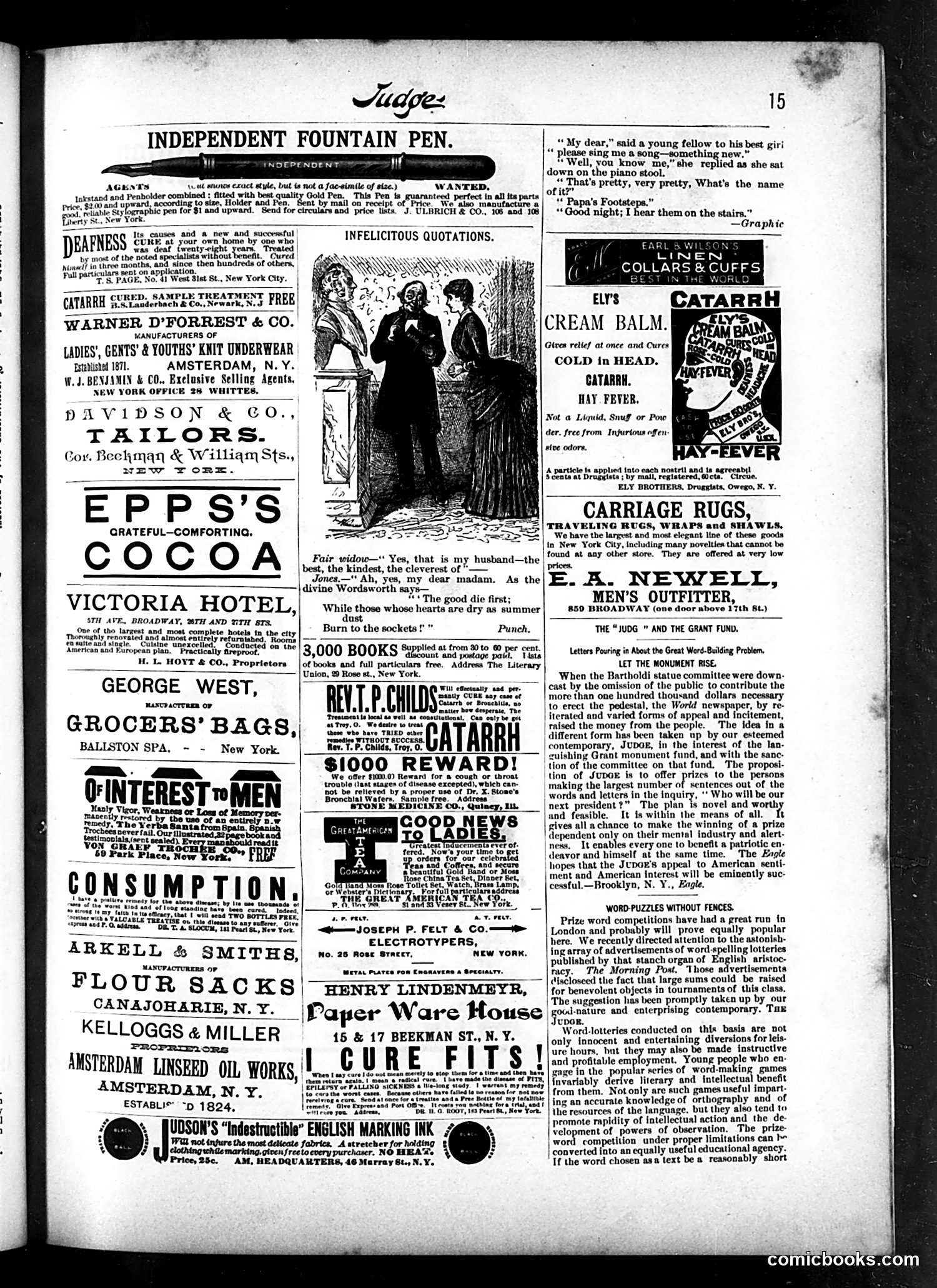
This page is primarily **advertising** with one small satirical cartoon titled "Infelicitous Quotations." The cartoon depicts a young man at a piano with a woman, who has just sung "Papa's Footsteps." He compliments her singing as "very pretty" and asks the song's name. She responds it's "Papa's Footsteps," and he replies, "Good night; I hear them on the stairs." **The joke**: The woman has apparently misquoted or misapplied a literary reference. The cartoon satirizes people who use famous quotations incorrectly or inappropriately—in this case, mixing sentimental song titles with misplaced literary allusions. The humor targets social pretension and the misuse of classical references among the educated classes. The rest of the page contains period advertisements for fountain pens, hotels, medicinal products (catarrh cream, marking ink), clothing, and furniture—typical of Judge's revenue model. One notable ad promotes a "$1000 Reward" for cough remedies, reflecting common 19th-century patent medicine marketing.
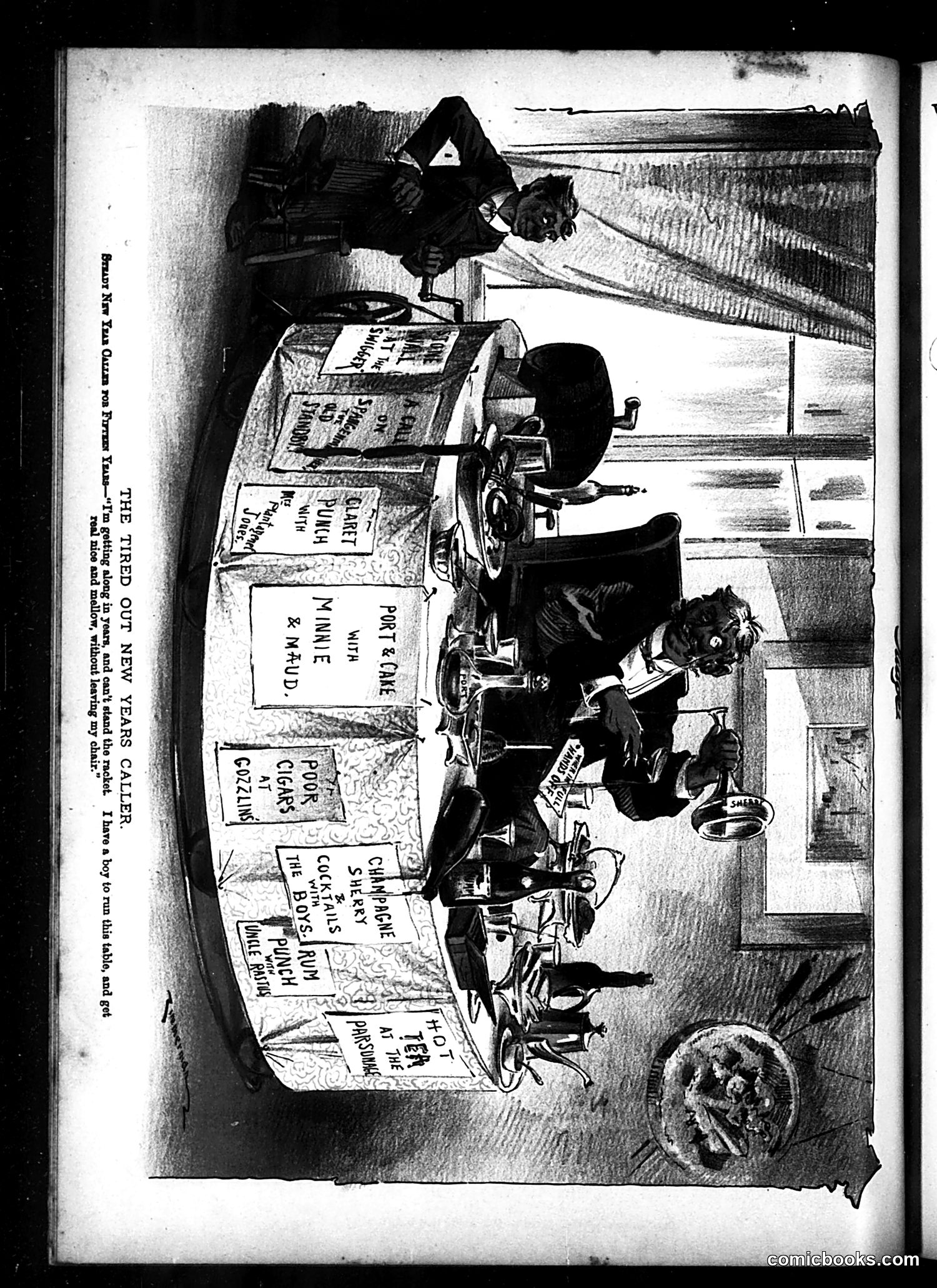
This Judge magazine cartoon satirizes the exhausting social custom of making New Year's Day calls—a formal tradition where people visited numerous households to pay respects. The image shows a weary, elderly gentleman who has devised a lazy solution: instead of trudging door-to-door, he's installed a rotating carousel or table of cigars labeled with different names/addresses (visible on the boxes). He sits stationary while a young boy operates the mechanism, theoretically allowing him to "call on" multiple people without leaving his chair. The satire mocks both the tiresome convention itself and the gentleman's absurd attempt to shortcut it through mechanical means. The caption emphasizes his age and exhaustion with the "racket" of maintaining social obligations. It's a commentary on outdated social rituals and human laziness dressed up as innovation.