
Judge, 1887-01-01 · page 10 of 16
Judge — January 1, 1887 — page 10: what you’re looking at
What you’re looking at
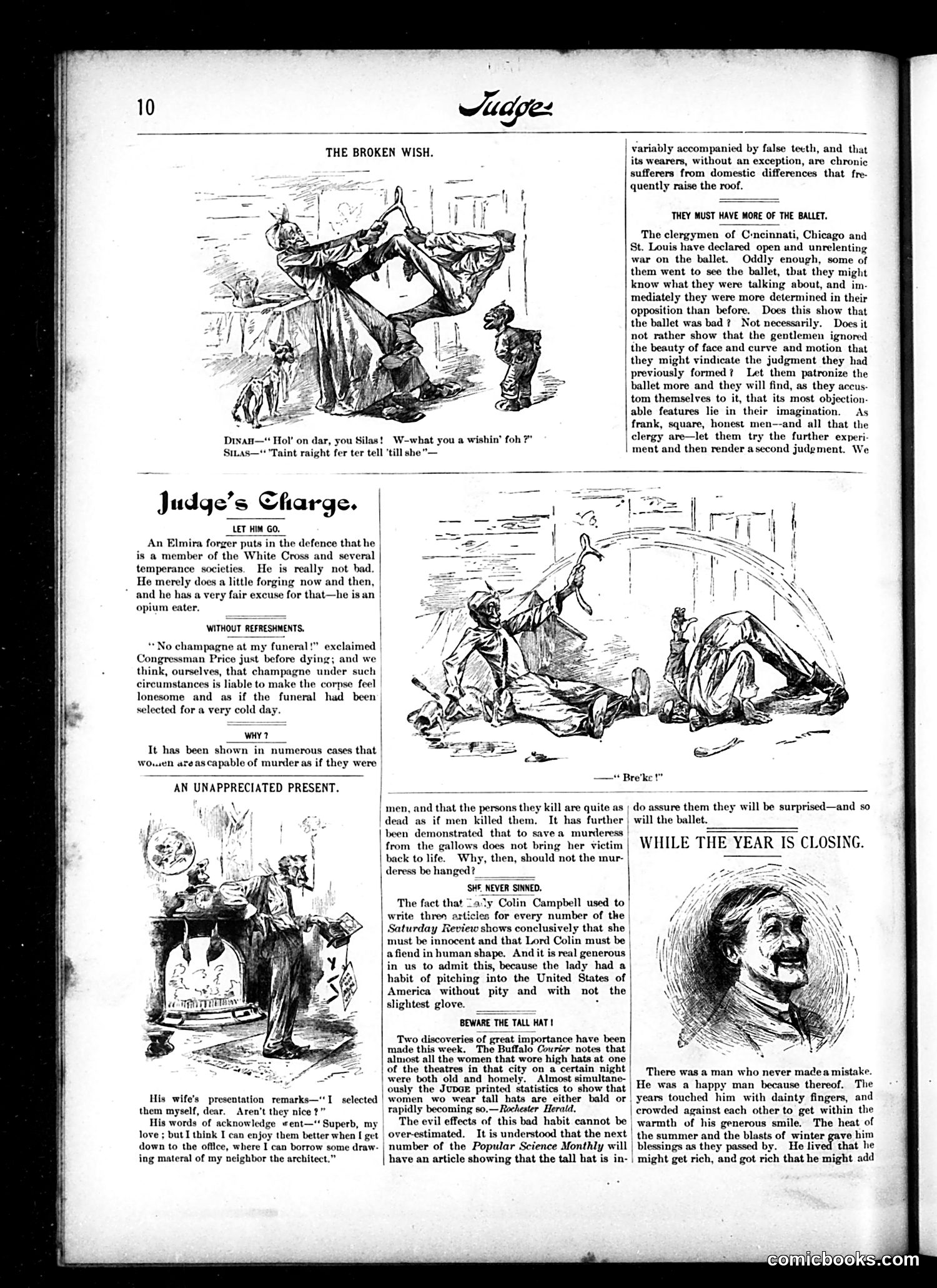
This page from *Judge* magazine contains several short satirical pieces targeting social hypocrisy and legal absurdities of the era. **"The Broken Wish"** (top cartoon): A dialectal joke featuring two African American figures, using period stereotypes common to 19th-century humor. **"Judge's Charge"** section includes: - **"Let Him Go"**: Satirizes lenient courts excusing crimes (forgery, opium addiction) based on temperance society membership - **"Without Refreshments"**: Mocks a congressman's deathbed request against champagne at his funeral - **"An Unappreciated Present"**: Humorously depicts a husband ungrateful for his wife's gift, planning to return it for office supplies **"They Must Have More of the Ballet"**: Defends ballet against clergy opposition, sarcastically suggesting clergymen attend more performances to overcome their imagined objections rather than genuine moral concerns. **"Beware the Tall Hat"**: Reports that tall hats worn by women correlate with unattractiveness or baldness—mocking both the women and the dubious "statistics" proving it. The overall tone criticizes selective morality, legal leniency, and sanctimonious judgment.
📄 Transcribed text from this page (OCR, searchable)
Machine-transcribed from the original scan — historical spelling and the odd misread are preserved.
Dtxan—* Hol’ on dar, you Silas! W-what you a wishin’ foh ?" Sitas—“* ‘Taint raight fer ter tell 'till she"— bd Judge’s Charge. LET HIM GO. An Elmira forger puts in the defence that he is a member of the White Cross and several temperance societies, He is really not bad. He merely does a little forging now and then, * and he has a very fair excuse for that—he is an | opium eater. WITHOUT REFRESHMENTS, ‘No champagne at my funeral!” exclaimed Congressman Price just before dying; and we think, ourselves, that champagne under such circumstances is liable to make the corpse feel lonesome and as if the funeral had been selected for a very cold day. | wiy? It has been shown in numerous cases that Wouwen azeascapable of murder as if they were AN UNAPPRECIATED PRESENT. His wife's presentation remarks—‘'I selected | them myself, dear. Aren't they nice ? His words of acknowledge went—“ Superb, my love ; but I think I can enjoy them better when I get down to the office, where I can borrow some draw- ing materal of my neighbor the architect.” | variably accompanied by false teeth, and that its wearers, without an exception, are chronic sufferers from domestic differences that fre- quently raise the roof. THEY MUST HAVE MORE OF THE BALLET. The clergymen of C-ncinnati, Chicago and St. Louis have declared open und unrelenting war on the ballet. Oddly enough, some of them went to see the ballet, that they might know what they were talking about, and im- mediately they were more determined in their opposition than before. Does this show that the ballet was bad? Not necessarily. Does it not rather show that the gentlemen ignored the beauty of face and curve and motion that they might vindicate the judgment they had previously formed? Let them patronize the ballet more and they will find, as they accus- tom themselves to it, that its most objection- able features lie in their imagination. As frank, square, honest men--and all that the clergy are—let them try the further experi- | ment and then render asecond judgment. We —“ Bre'ke !” men, and that the persons they kill are quite as | do assure them they will be surprised—and so dead as if men killed them, It has further | will the ballet. been demonstrated that to save a munderess _ Mae from the gallows does not bring her victim | WHILE THE YEAR IS CLOSING. back to life. Why, then, should not the mur- =u le deress be hanged? SHE, NEVER SINNED. The fact that Lacy Colin Campbell used to | write thren articles for every number of the Saturday Review shows conclusively that she must be innocent and that Lord Colin must be afiend in human shape. And it is real generous | in us to admit this, because the lady had a habit of pitching into the United States of | America without pity and with not the| slightest glove. y BEWARE THE TALL HAT! Two discoveries of great importance have been made this week. The Buffalo Courier notes that almost all the women that wore high hats at one of the theatres in that city on a certain night were both old and homely. Almost simultane- ously the Jupag printed statistics to show that y 1 u women wo wear tall hats are either bald or | years touched him with dainty fingers, and rapidly becoming s0.— Rochester Herald. | crowded against each other to get within the The evil effects of this bad habit cannot be | warmth of his generous smile. The heat of overestimated. It is understood that the next | the summer and the blasts of winter gave him number of the Popular Science Monthly will | blessings as they passed by. He lived that he have an article showing that the tall hat is in- | might get rich, and got rich that he might add There was a man who never madea mistake. He was a happy man because thereof. The