
A complete issue · 16 pages · 1886
Judge — November 27, 1886
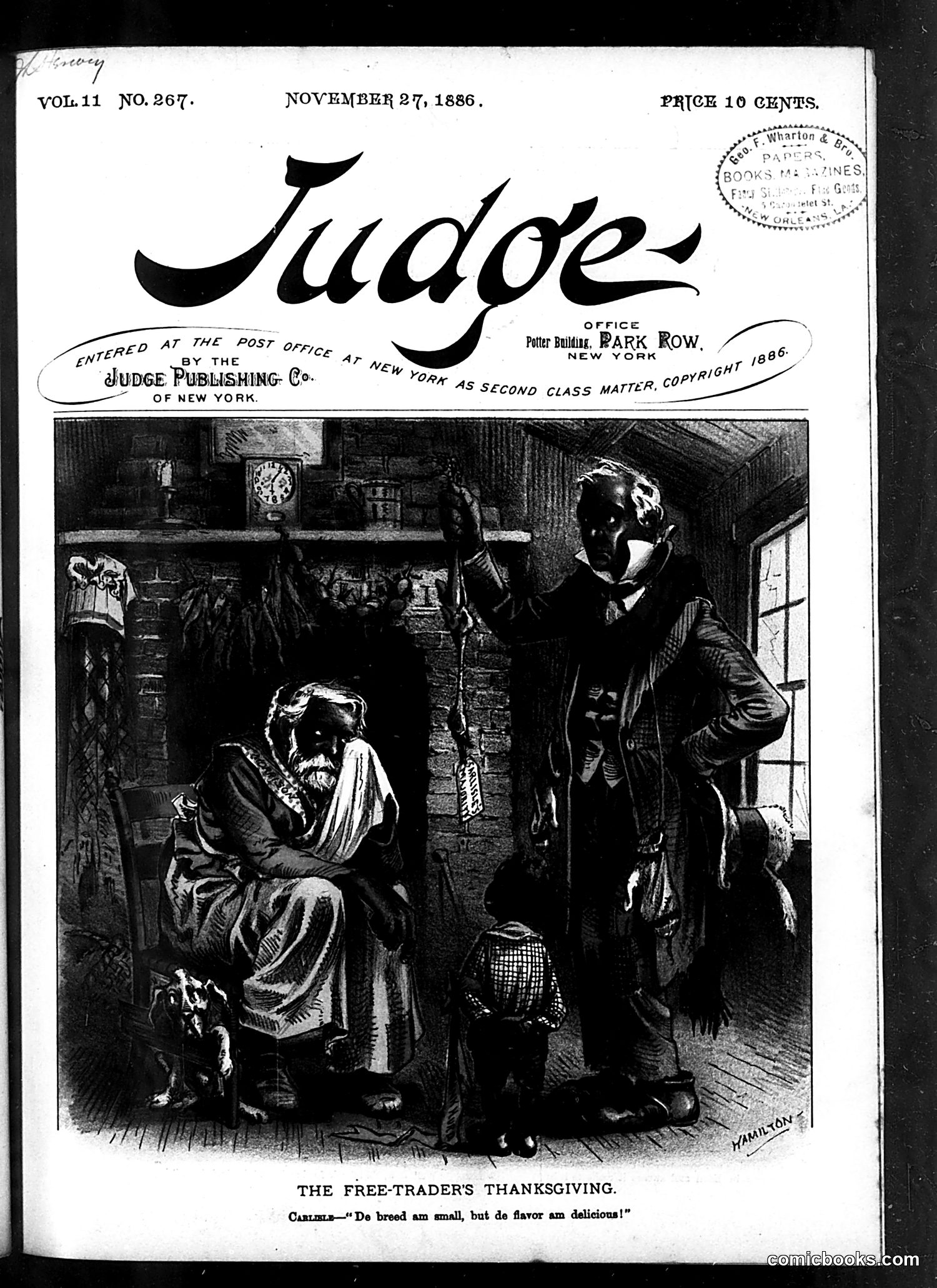
This political cartoon satirizes free-trade advocates during a period of intense tariff debate in America. The caption quotes Carlyle: "Do breed an small, but be flavor am delicious!" The image depicts what appears to be a poor, elderly person (representing a free-trader or their policy's victim) sitting meagerly while well-dressed figures stand nearby—likely protectionists or those benefiting from tariffs. The skeletal poverty contrasted with the visitors' comfort suggests the cartoon's argument: that free-trade policies result in hardship for ordinary citizens, while others prosper. This reflects the 1880s Republican protectionist stance against Democratic free-trade proposals. The "Thanksgiving" is ironic—depicting deprivation rather than abundance.
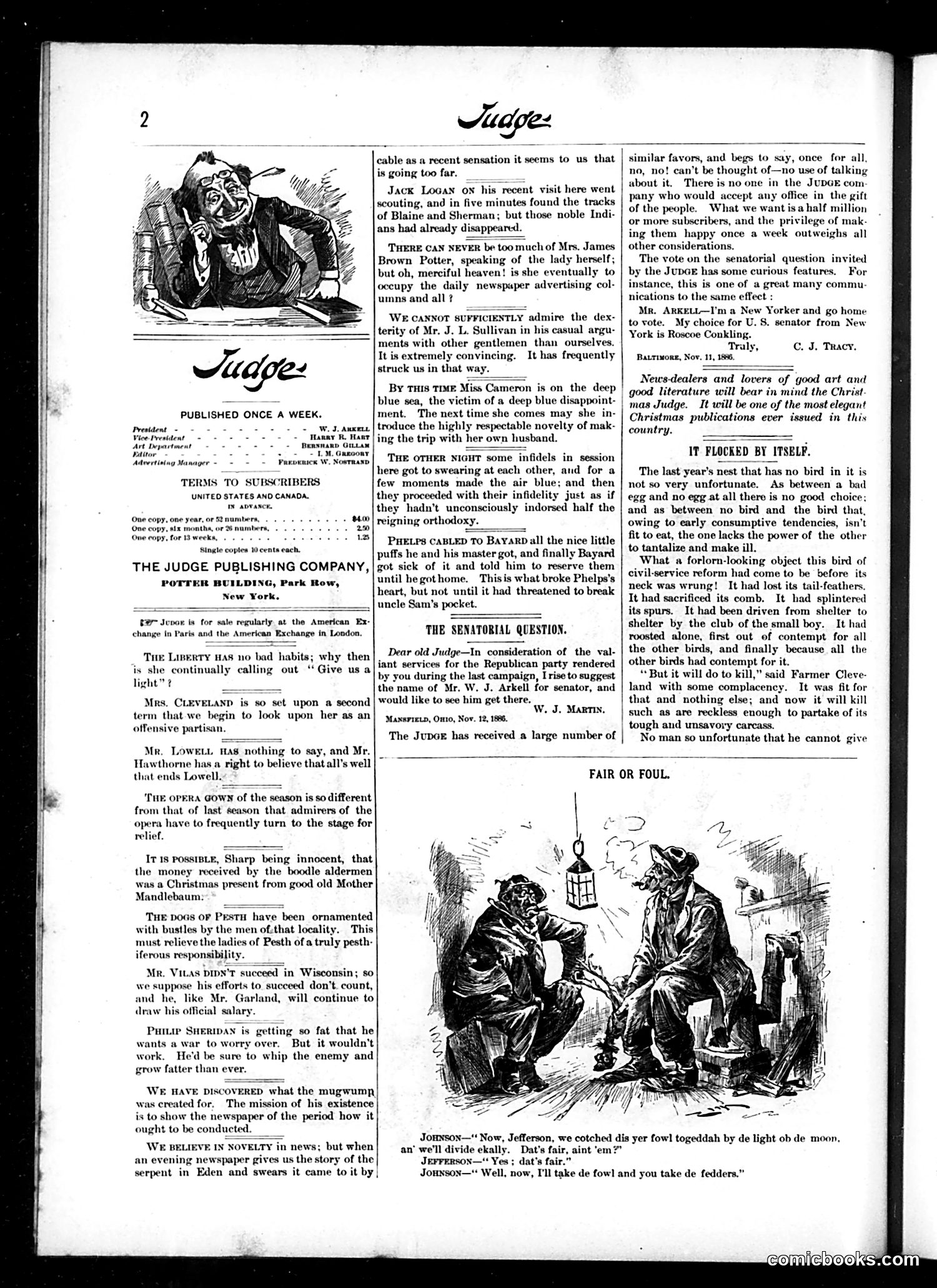
This page contains editorial commentary and two distinct cartoons. The top illustration depicts a caricatured figure (unclear who), while the bottom cartoon titled "FAIR OR FOUL?" shows two men negotiating over a bird, with dialogue about dividing a "yer fowl" fairly—an apparent pun suggesting a dispute settled by splitting assets. The text discusses contemporary political matters: Senator Arkell's candidacy, questions about Miss Cameron and her husband, and Cleveland's potential second term bid. There are also lighter social critiques about opera and various public figures. The cartoons use anthropomorphized animals and exaggerated caricatures typical of 1880s-90s satirical journalism. Without clearer identification of the figures or specific dates provided, the precise political targets remain uncertain, though the content reflects late 19th-century American political and social debate.
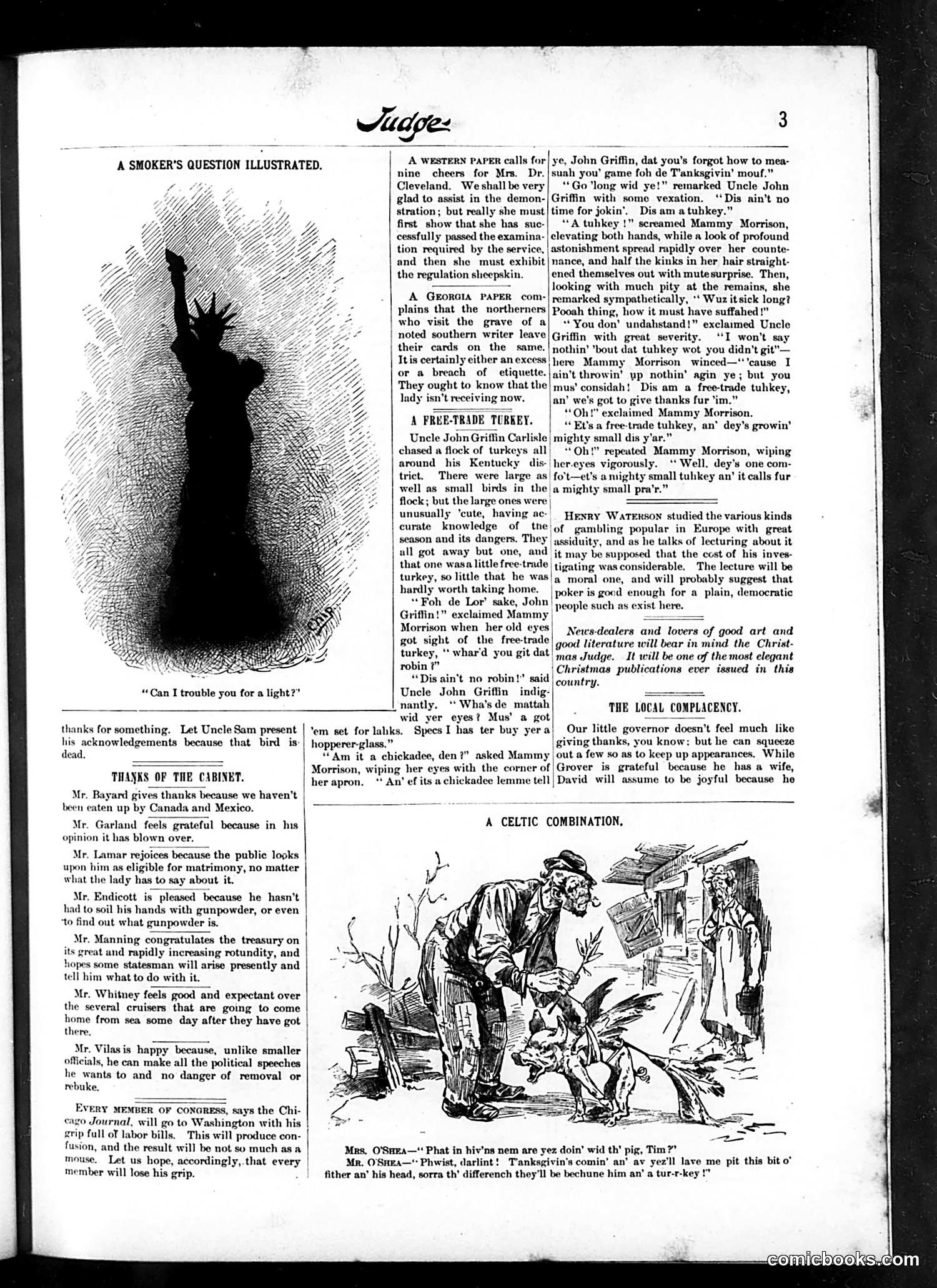
**"A Smoker's Question Illustrated"** (top left): A simple visual gag—a man asks another for a light, shown in silhouette. The humor plays on the ambiguous phrasing. **"A Free-Trade Turkey"** (center-right): This satirizes the political debate over tariffs and free trade. Uncle John Griffin (referencing politician John Griffin Carlisle, a free-trade Democrat) owns a turkey so scrawny it's practically worthless—a metaphor for how free-trade policies allegedly harm American producers. The dialogue between Griffin and Mammy Morrison uses period-typical dialect humor to mock the absurdity: a turkey so diminished by free trade that it barely warrants thanksgiving. **"Thanks of the Cabinet"** (left): Brief satirical jabs at President Cleveland's cabinet members, mocking their competence and priorities—Bayard for avoiding war, Garland for his opinions, etc. Standard political mockery of the administration's performance. The page reflects 1880s-90s concerns about tariff policy, with free trade portrayed as economically damaging to American interests.
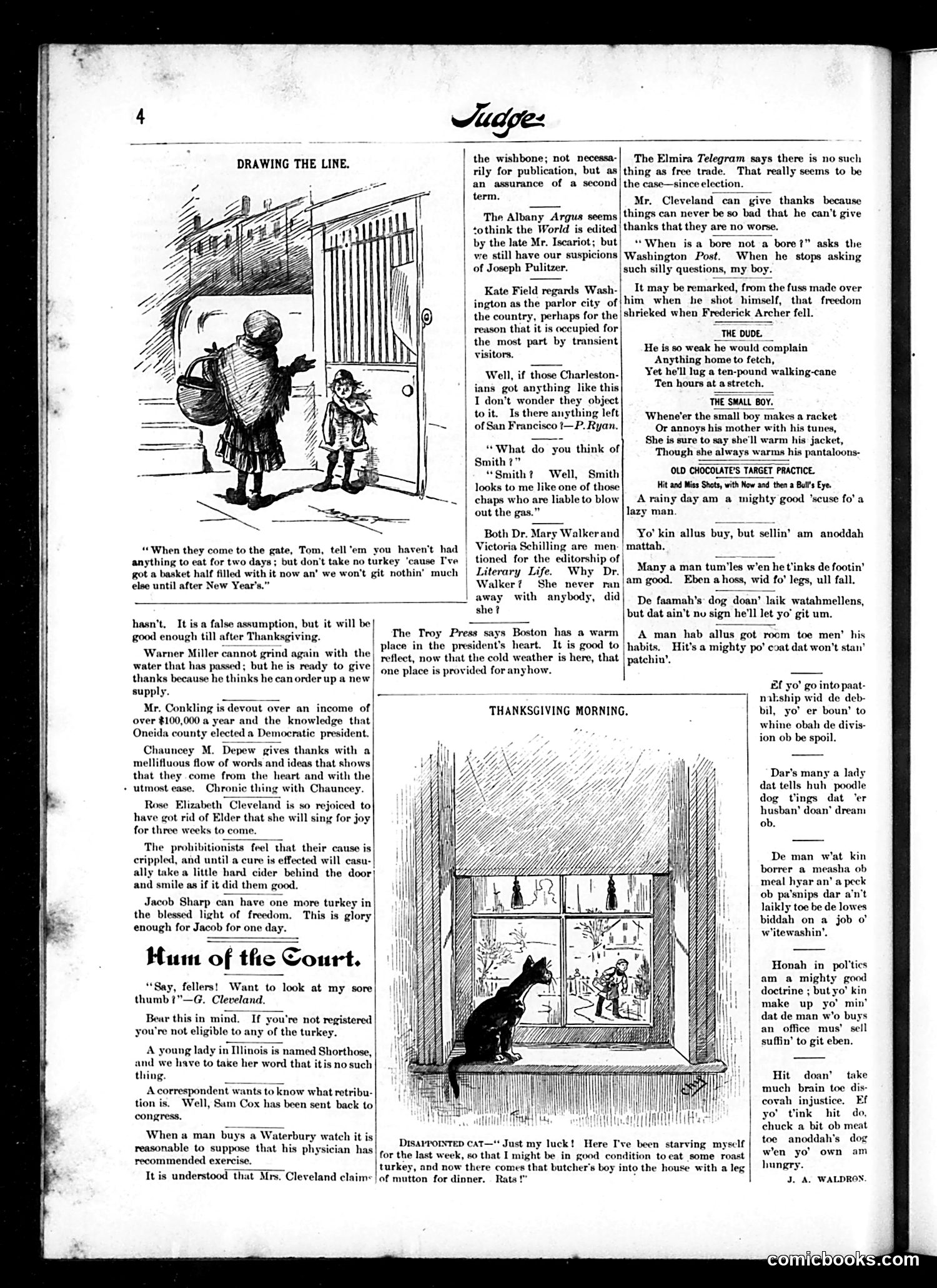
This page from Judge (a satirical weekly) contains multiple brief political jabs and social commentary typical of the publication's format, rather than single large cartoons. **Key targets:** - **Joseph Pulitzer** (Albany Argus reference): Mocked for allegedly dishonest journalism - **Warner Miller and Roscoe Conkling**: New York Republican politicians criticized for hypocrisy - **Chauncey Depew**: Ridiculed for insincere, flowery speeches - **Rose Elizabeth Cleveland**: President Cleveland's sister, mocked for celebrating the departure of "Elder" (unclear reference) - **Prohibitionists**: Satirized as hypocrites drinking cider secretly - **Jacob Sharp**: A scandal-tainted figure given ironic "thanks" - **Grover Cleveland**: Multiple jokes about his weakness and indecision The cartoons ("Drawing the Line" and "Thanksgiving Morning") use domestic scenes to mock political figures. The content reflects 1880s Democratic/Republican partisan feuding and personal scandals now largely forgotten.
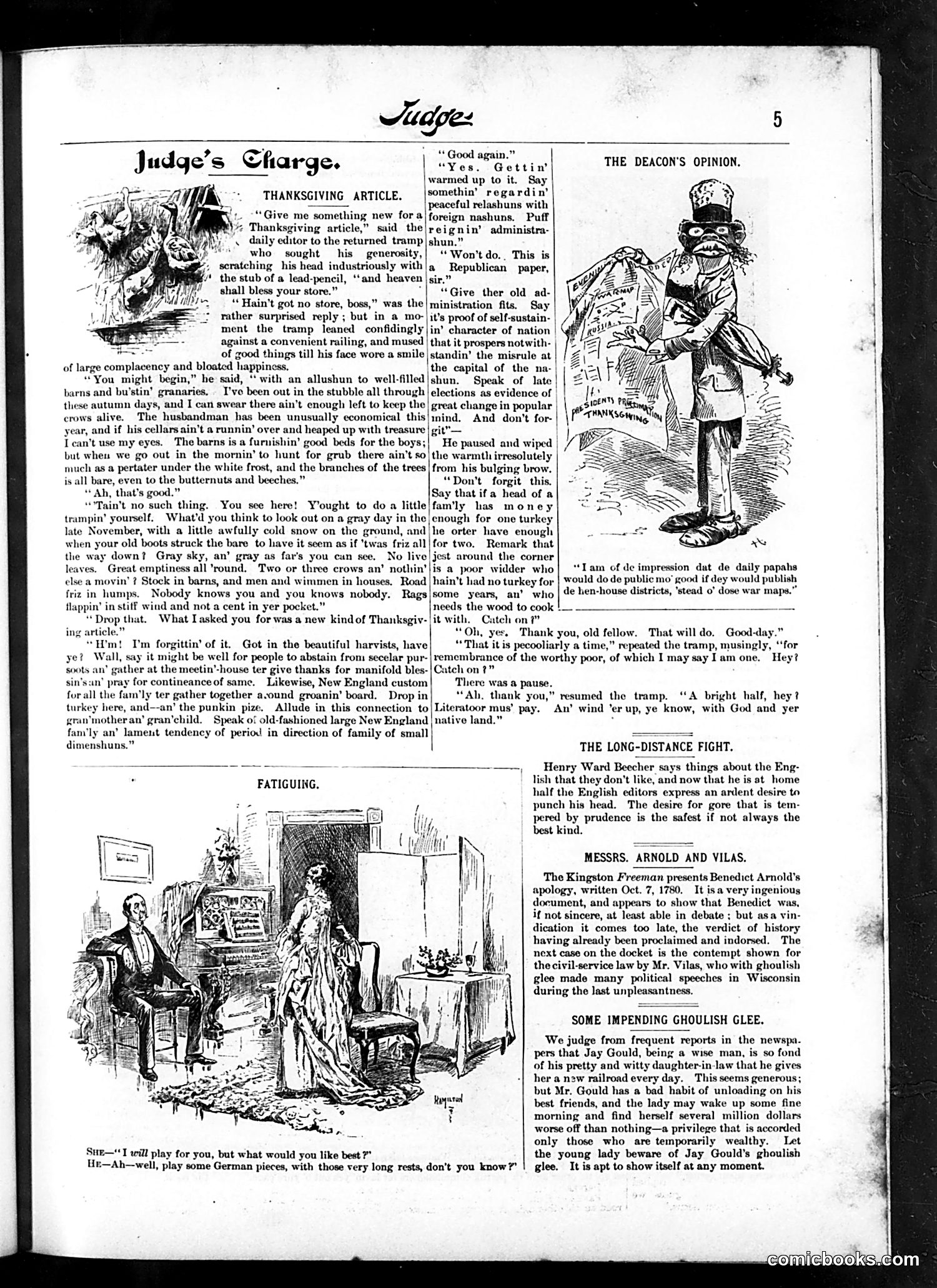
This page satirizes Thanksgiving journalism and hypocrisy. The main cartoon shows an editor commissioning a Thanksgiving article from a tramp. The tramp cynically subverts the holiday's traditional sentiments—rather than celebrating abundance, he describes autumn poverty: frozen ground, empty fields, and starving crows. He then mock-suggests the editor include platitudes about gratitude, family gatherings, and charitable giving to the poor, while the editor keeps rejecting suggestions that criticize the Republican administration. The satire's point: *Judge* mocks how newspapers publish hollow Thanksgiving pieties while ignoring actual poverty and hardship. The tramp's sardonic voice exposes the gap between Thanksgiving's stated values (helping the needy) and reality. The final exchange—where the tramp notes he himself is poor—drives home the irony: editorial sentimentality about charity rings false when real suffering surrounds readers. The secondary cartoon, "Fatiguing," shows a musician requesting "long rests," a simple visual pun on musical exhaustion.
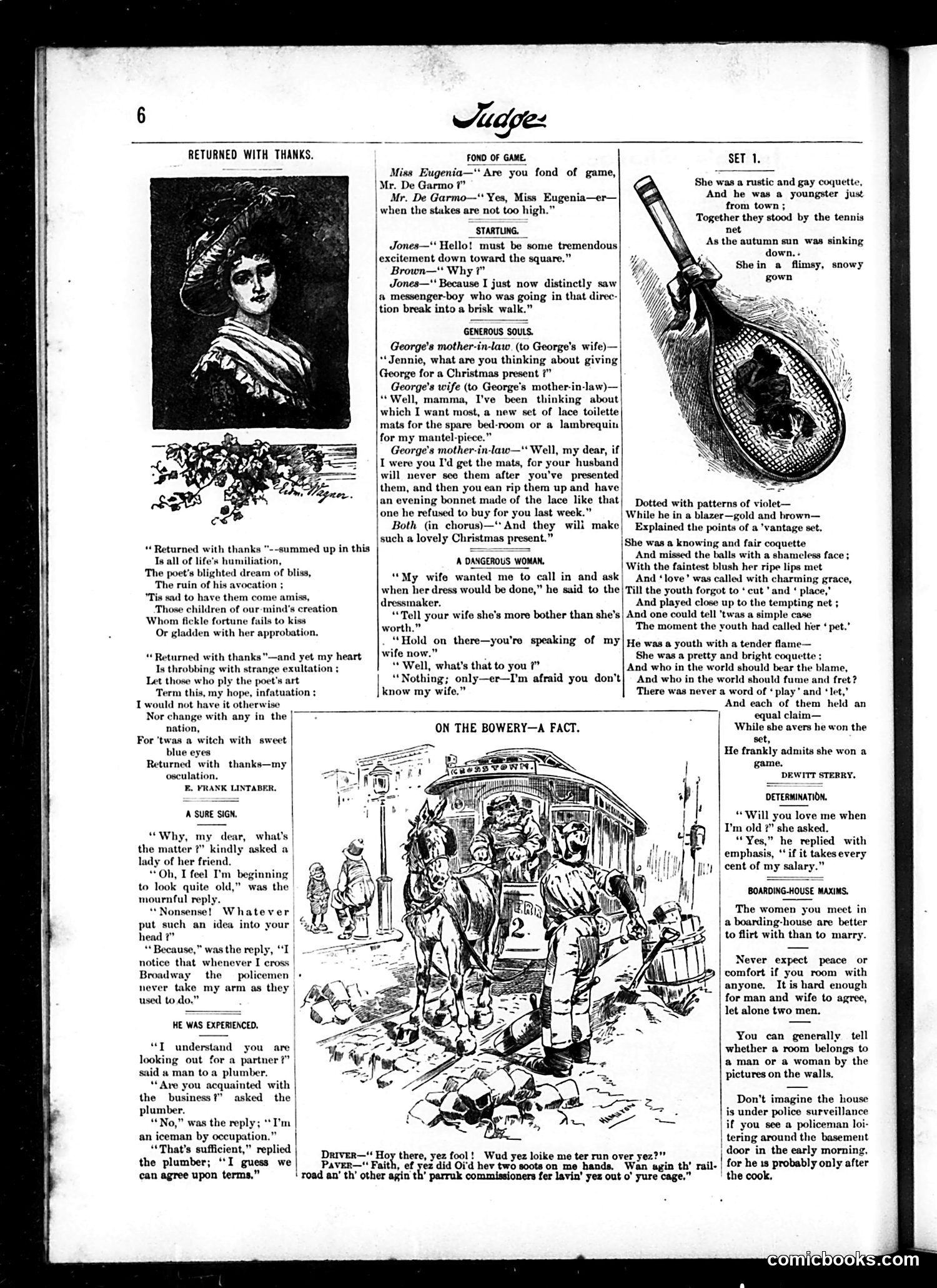
This page contains several brief humorous sketches typical of *Judge*'s satirical style: **"Fond of Game"** jokes about a suitor's reluctance when "stakes are not too high"—a double meaning playing on courtship versus gambling. **"Startling"** satirizes urban indifference: a messenger boy breaking into a brisk walk is treated as major news, mocking how little actually excites city dwellers. **"Generous Souls"** mocks domestic gift-giving: George's wife and mother-in-law discuss Christmas presents for George while planning to repurpose them ("rip them up"), suggesting women's self-interest disguised as generosity. **"A Sure Sign"** jokes about aging: a woman assumes she's old because policemen no longer offer her their arm—implying this was once a common courtesy for women crossing streets. The lengthy poem "Set 1" romanticizes a flirtation between a country girl and city youth at tennis. **"On the Bowery"** depicts working-class Irish dialect humor involving a careless street worker and impatient driver—typical period ethnic comedy. The illustrations support these lighthearted domestic and social observations rather than political commentary.
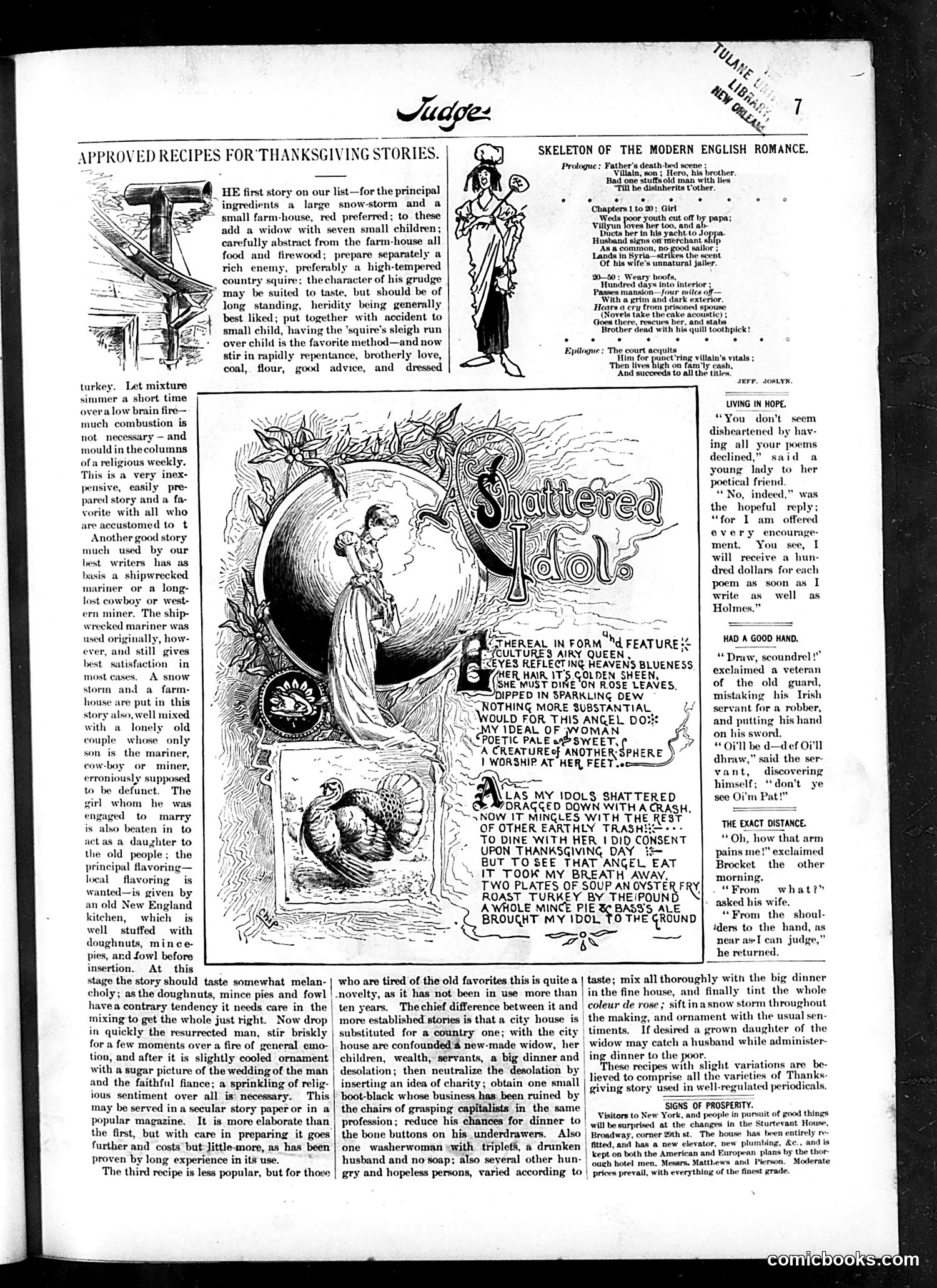
This page satirizes **formulaic Thanksgiving fiction** published in American magazines and newspapers of the era. The "Approved Recipes" mock the predictable, mass-produced sentimental stories editors demanded for holiday issues. Judge identifies three recipe-style templates: 1. **The Snow-Storm Farm Story**: Poor widow, seven children, squire's sleigh accident, miraculous redemption—all seasoned with "repentance, brotherly love, coal, flour, good advice." 2. **The Shipwrecked Lover**: Long-lost sailor/cowboy, elderly couple, faithful fiancée, New England kitchen stuffed with traditional food, resurrection, and wedding finale. 3. **The English Romance skeleton** (right column): A predictable melodrama formula involving inheritance fraud, villainy, abduction, and courtroom vindication. The satire's point: publishers churned out identical, formulaic stories annually, substituting familiar ingredients (snowstorms, reunions, moral lessons) rather than genuine creativity. Judge mocks both the lazy writers and editors' reliance on these tired templates to satisfy sentimental reader tastes during holidays.
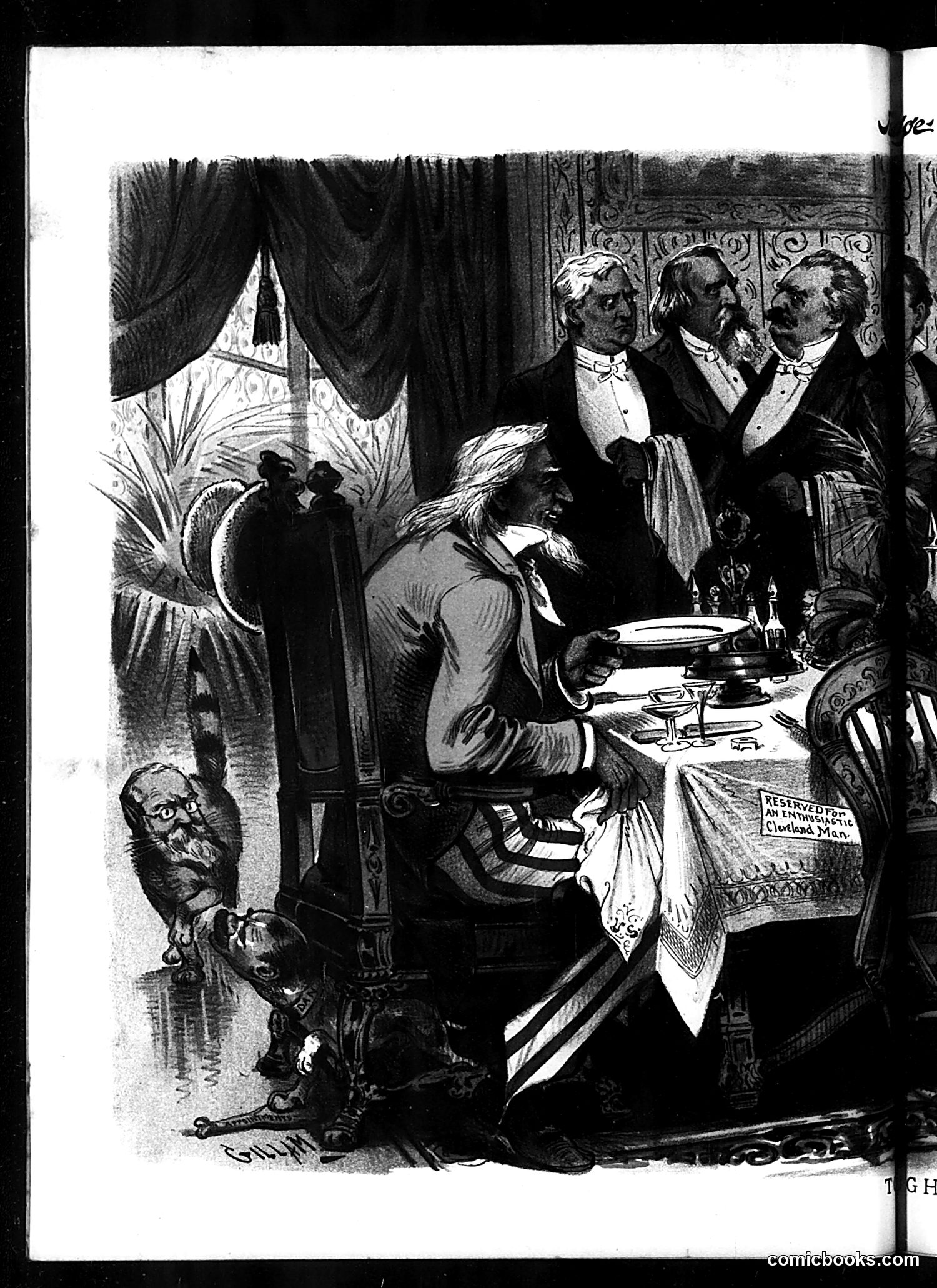
This appears to be a satirical scene from *Judge* magazine depicting a formal dinner or diplomatic reception. The central figure—a man in formal attire seated at a table—appears to be a person of importance or authority being entertained or negotiated with by well-dressed gentlemen standing behind him. The cartoon likely satirizes high-society political maneuvering or diplomatic dealings, common themes in *Judge*'s satirical coverage. Without clearer identification of the specific figures or visible caption text beyond the partial OCR, I cannot definitively state which political figures or events are being lampooned. The ornate interior, formal dress, and deliberate staging suggest commentary on elite political culture, but the precise historical reference remains unclear from this image alone.
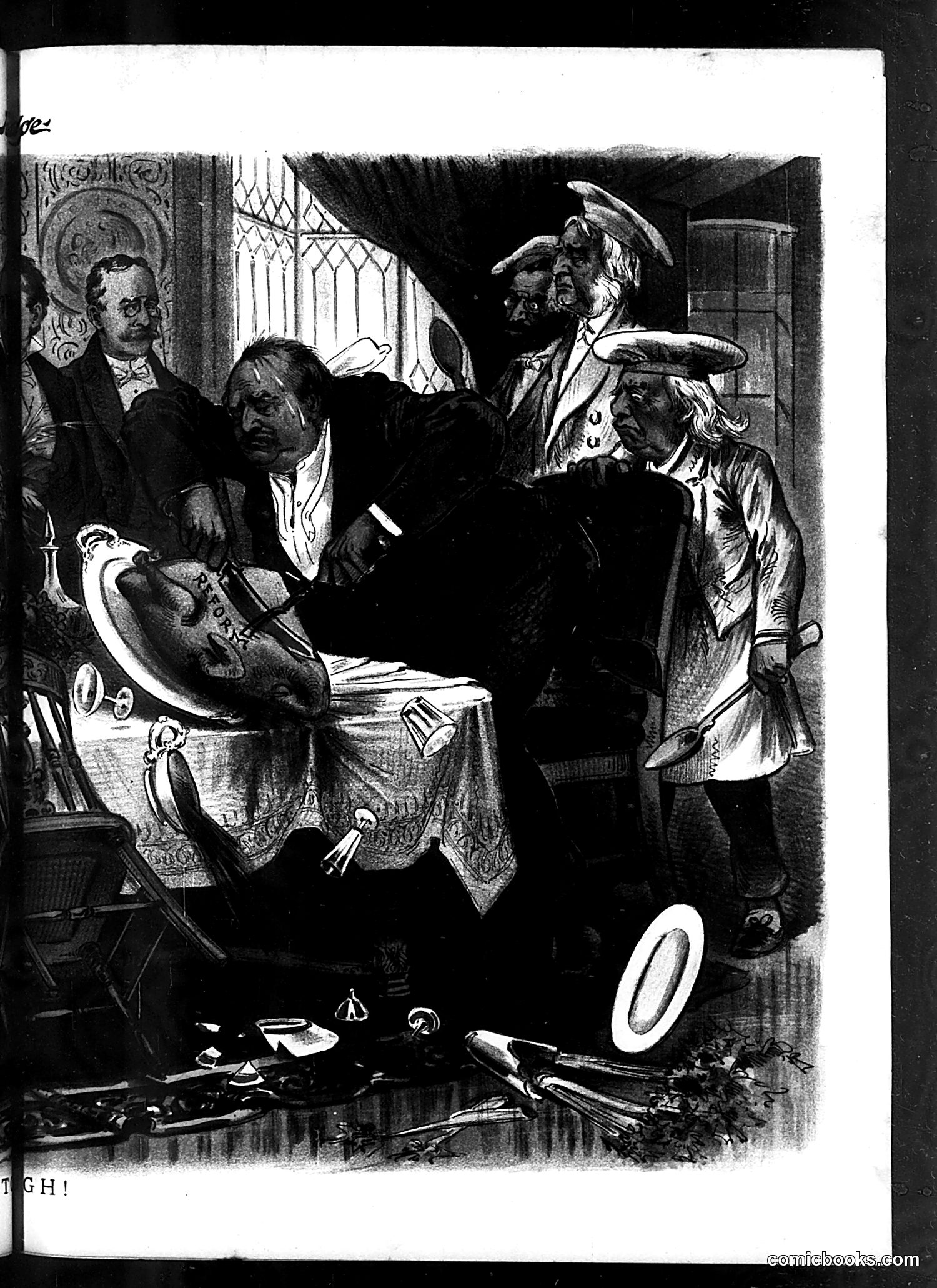
This appears to be a satirical Judge magazine cartoon depicting a scene of political or diplomatic negotiation, likely from the late 19th or early 20th century based on the artistic style and clothing. The central figure seated at a table appears to be a prominent politician or dignitary, surrounded by what seem to be military officers or government officials with exaggerated facial features typical of period caricature. The scattered objects on the floor—including what appears to be military equipment—suggest either a conflict resolution scene or political compromise being negotiated. Without clearer identifying text or visible dates, I cannot definitively name the specific figures or pinpoint the exact historical event referenced. The composition suggests commentary on power dynamics or diplomatic dealings, but the specific political context remains unclear from the image alone.
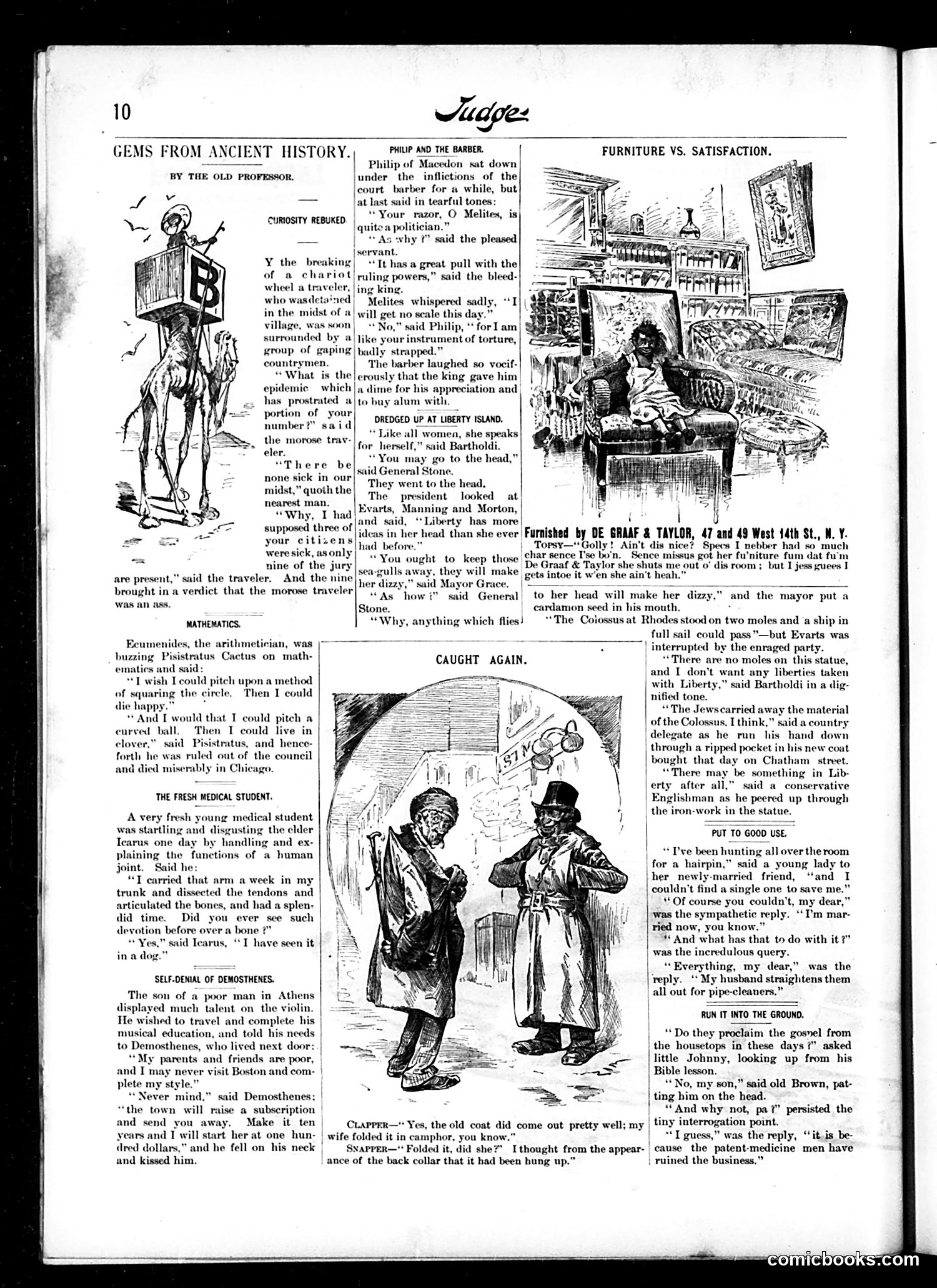
This page from *Judge* contains several satirical anecdotes and advertisements: **"Curiosity Rebuked"** mocks a traveler who insults a village by assuming citizens are sick, only to be judged "an ass" by locals—satire on rural pride and urban condescension. **"Mathematics"** jokes about a scholar obsessed with "squaring the circle" (an impossible geometric problem), suggesting impractical intellectual pursuits. **"The Fresh Medical Student"** ridicules a young doctor's excessive pride in cadaver dissection, with a seasoned physician comparing his devotion to that of a dog—mocking pretentious professionalism. **"Philip and the Barber"** depicts a king complaining his barber's razor is a "politician" with "pull"—likely satirizing political favoritism or corrupt officials. **"Furniture vs. Satisfaction"** is an advertisement featuring dialect humor typical of the era, depicting an African American man pleased with furniture from De Graaf & Taylor. The page demonstrates *Judge*'s mix of intellectual satire and period-typical ethnic humor common to 1880s American magazines.
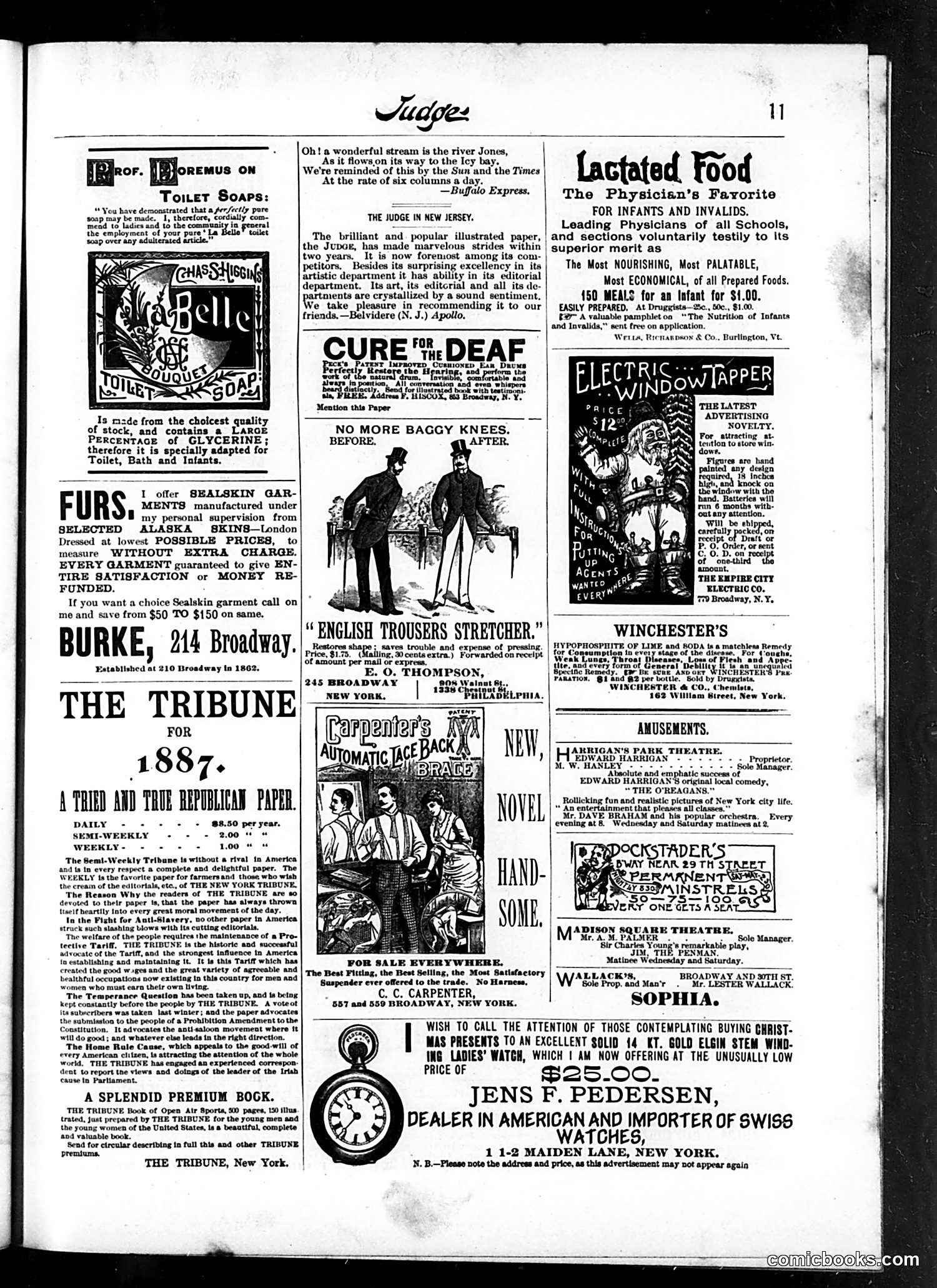
This page is primarily **advertising**, with one small satirical poem at the top. The poem mocks excessive newspaper coverage of the Jones River by the "Sun and Times" papers, which devote six columns daily to what appears to be a minor local waterway—satirizing sensationalist journalism and over-reporting. The page contains dozens of period advertisements: soap, furs, watches, medical devices (including a "Cure for Deaf"), and theatrical notices. One notable ad features the "English Trousers Stretcher," claiming to eliminate "baggy knees"—a humorous product typical of 1880s dubious remedies. The prominent **Tribune newspaper advertisement** occupies substantial space, promoting its Republican politics, support for protective tariffs, temperance advocacy, and Irish Home Rule coverage—positioning it as America's moral authority on major issues. Most content serves commercial purposes rather than satire. The page reflects Judge's dual identity: satirical magazine and advertising vehicle for 1880s consumer goods and services.
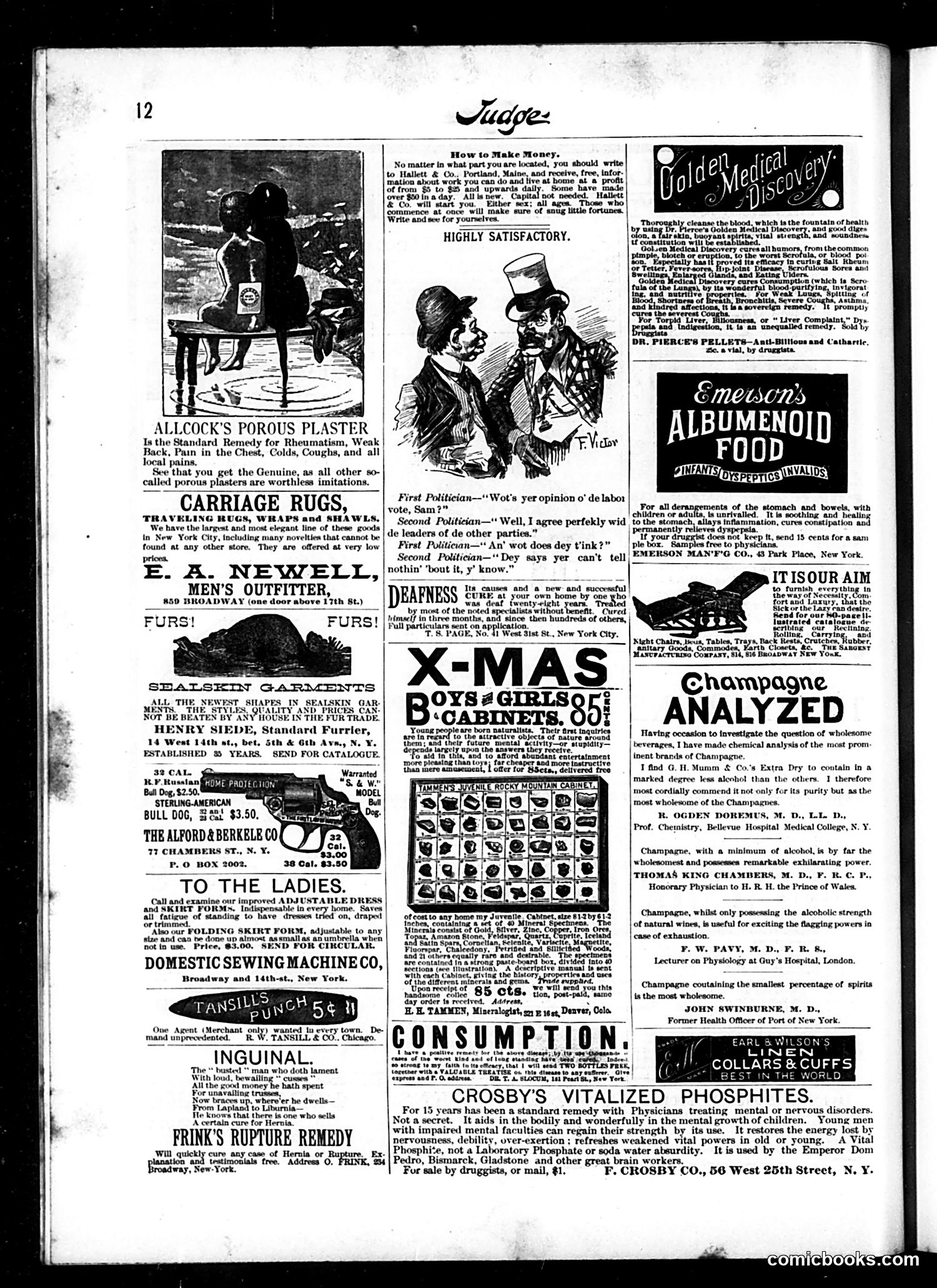
This page contains a **political satire cartoon** featuring two politicians in conversation about labor votes. The dialogue mocks political evasiveness: **First Politician** asks the second for his opinion on the labor vote. **Second Politician** responds that he agrees with other party leaders—who say "you can't tell" what laborers think. The joke satirizes **hollow political rhetoric and circular reasoning**: the politician claims agreement while admitting nobody actually knows the laborers' position. This reflects late 19th-century American political culture where labor movements were growing but politicians often spoke vaguely about working-class concerns without substantive commitment. The crude dialect and caricatured features suggest working-class or immigrant politicians, typical of *Judge* magazine's satirical approach to urban politics. The cartoon critiques the gap between political posturing and genuine understanding of labor interests during an era of significant labor unrest and organizing.
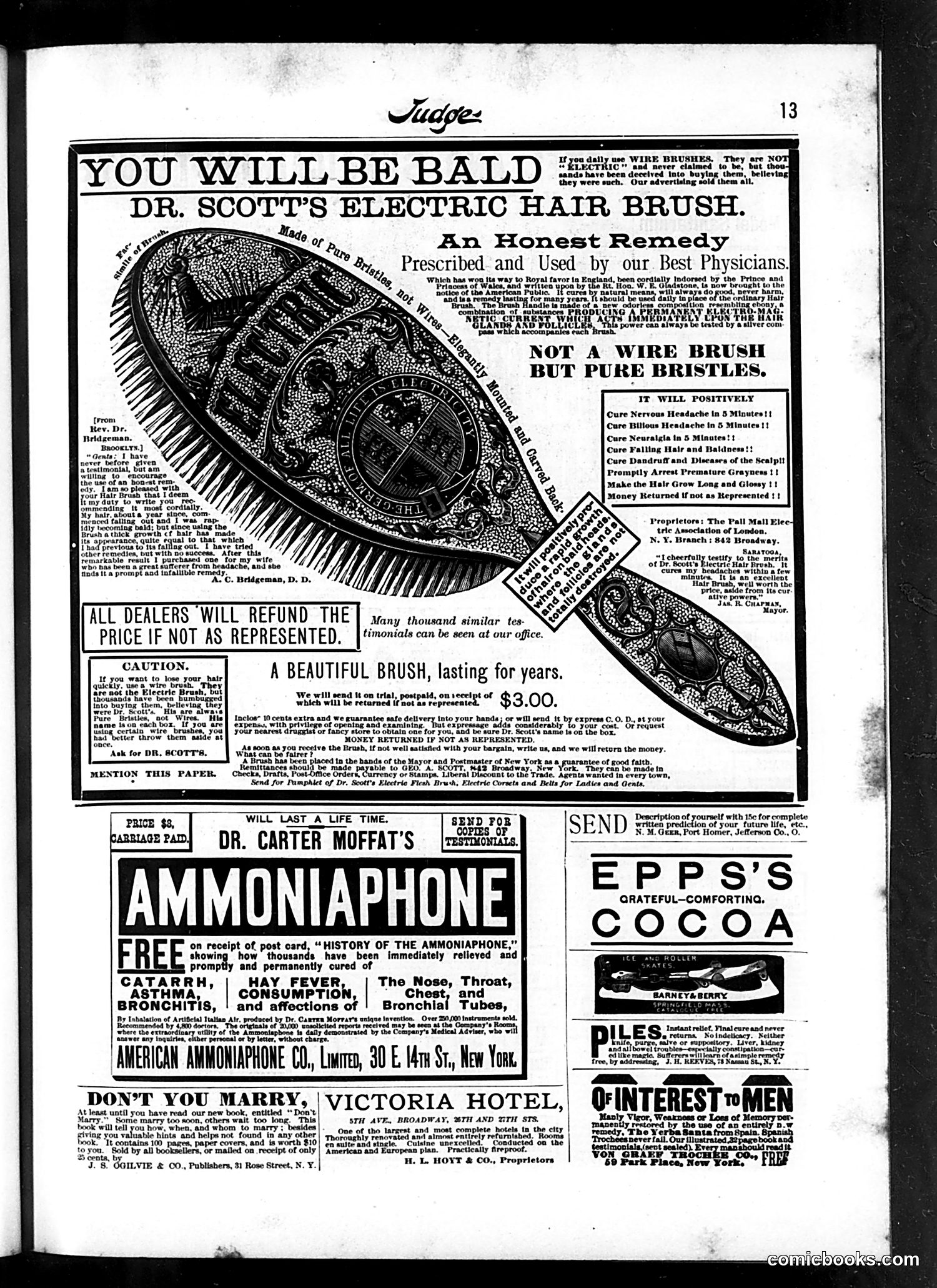
This page is primarily **advertising**, not political satire. It contains several late-19th-century patent medicine and product advertisements typical of the era. The dominant ad promotes **Dr. Scott's Electric Hair Brush**, claiming it cures baldness, headaches, and various scalp conditions through "electricity." The brush features testimonials from physicians and endorsements (appears to reference the Prince of Wales). This reflects the period's widespread pseudoscientific use of "electricity" as a cure-all, exploiting public fascination with new technology. Other ads include Dr. Carter Moffat's "Ammoniophone" for hay fever and asthma, Epps's Cocoa, and a book titled "Don't You Marry" offering dating advice. These represent classic **snake oil marketing**—exaggerated health claims, fake testimonials, and appeals to authority—that modern readers recognize as fraudulent. Judge likely ran these ads for revenue while occasionally mocking such products in actual satirical content elsewhere in the magazine. The page demonstrates how patent medicine scams saturated late-Victorian publications.
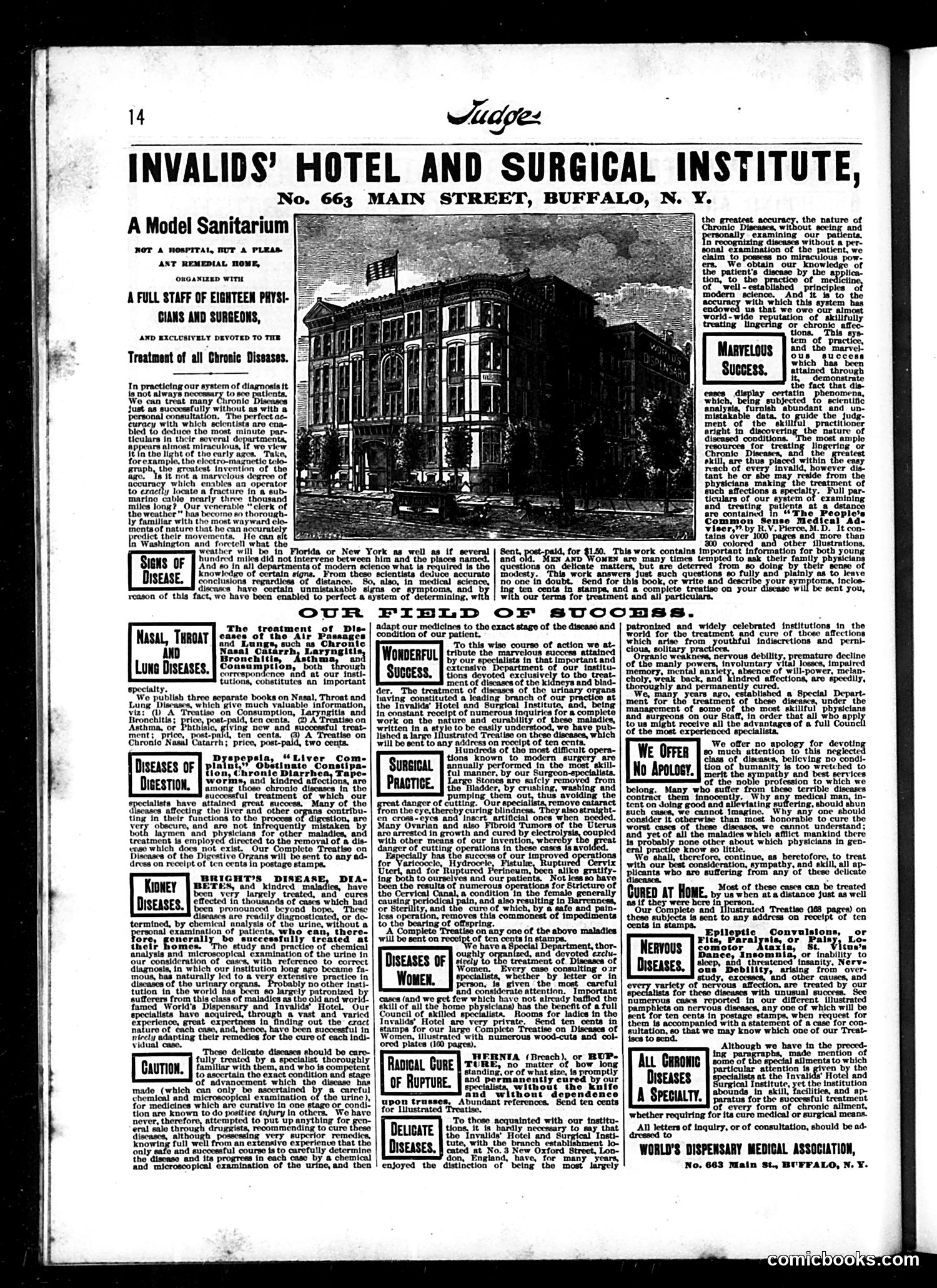
This page is primarily an **advertisement**, not a cartoon with political satire. It promotes the "Invalids' Hotel and Surgical Institute" in Buffalo, New York—a medical facility claiming to specialize in treating chronic diseases. ## Key Claims Made: The institute advertises: - Eighteen physicians and surgeons on staff - A diagnostic system claiming to identify diseases from distant descriptions (comparing themselves to telegraph operators and weather forecasters) - Treatment for chronic conditions: nasal/throat/lung diseases, kidney ailments, digestive problems, women's diseases, and nervous afflictions - Mail-order medical consultation services ## Historical Context: This reflects **late 19th-century medical advertising**—an era of unregulated medical claims. The institute's assertions about diagnosing patients without personal examination seem dubious by modern standards. The grandiose comparisons to technological marvels (telegraphs, weather prediction) exemplify how medical practitioners exploited scientific prestige to market questionable treatments during this period. The page has no satirical cartoons mocking the institute; *Judge* magazine itself was simply publishing paid advertising.
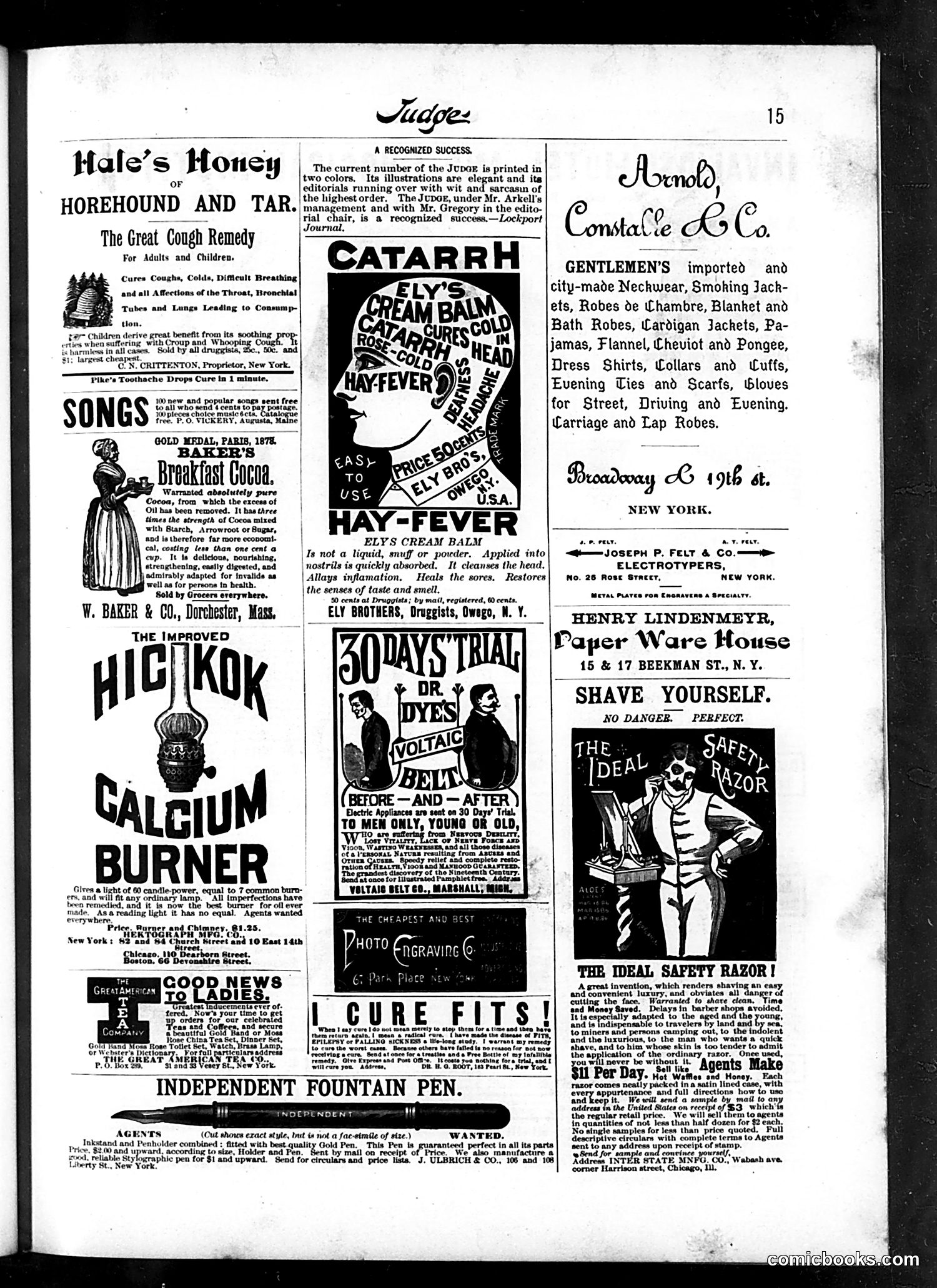
This page is predominantly **advertising**, not editorial content or political cartoons. It showcases late 19th-century patent medicines and commercial goods typical of Judge magazine's revenue model. **Notable advertisements include:** - **Hale's Honey** (cough remedy) and **Baker's Cocoa** — standard patent medicine and food ads - **Ely's Cream Balm** — a catarrh treatment with pseudo-medical claims - **"Dr. Dyes' Voltaic Belt"** — a quack electrical device marketed "to men only, young or old," promising to cure nervousness and debility (a common scam of the era) - **The Ideal Safety Razor** — an actual innovation being marketed - **Independent Fountain Pen** — office supplies The **Dr. Dyes advertisement** is the most historically notable: it exploits anxieties about male vitality using pseudoscientific "electrical" language, a common patent medicine con of this period that modern readers would recognize as fraudulent. Arnold Constable and other clothing merchants provide the remaining space.
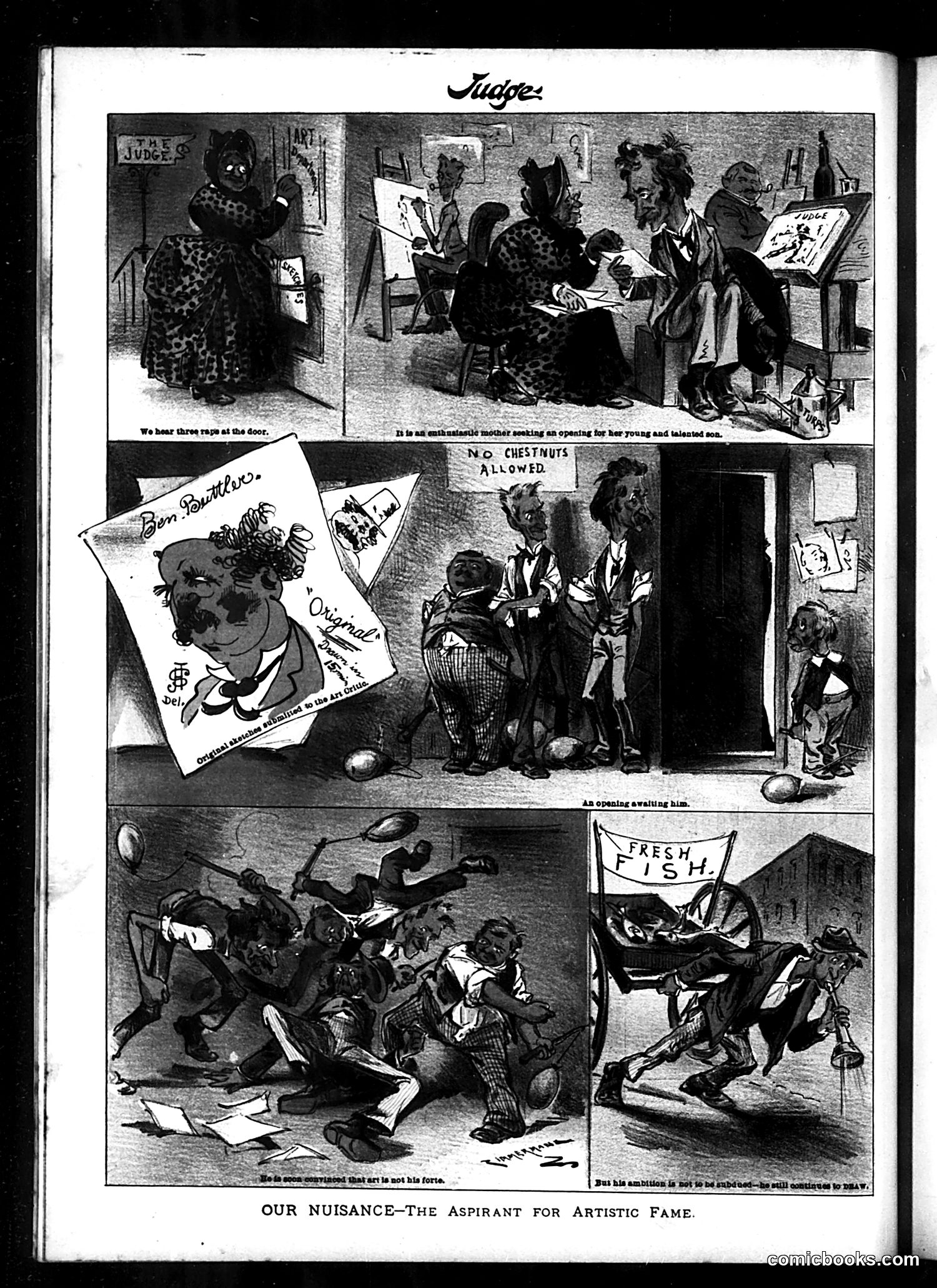
This satirical cartoon mocks struggling young artists seeking recognition. The sequence shows an aspiring artist repeatedly pestering established judges and art patrons with portfolios ("Born Penniless," "Original"). The narrative progresses through rejection: judges dismiss the work at their door; a mother advocates for her "young and talented son"; the artist receives a polite refusal ("No Chestnuts Allowed"); eventually descending into desperation—literally fighting over "Fresh Fish" and other street goods, suggesting he's been reduced to common labor. The satire targets both the delusional persistence of untalented aspirants and perhaps the gatekeeping indifference of the art establishment. The title characterizes such ambitious but unsuccessful artists as a public "nuisance"—suggesting widespread frustration with persistent artistic hopefuls in urban society.