
Judge, 1886-11-27 · page 5 of 16
Judge — November 27, 1886 — page 5: what you’re looking at
What you’re looking at
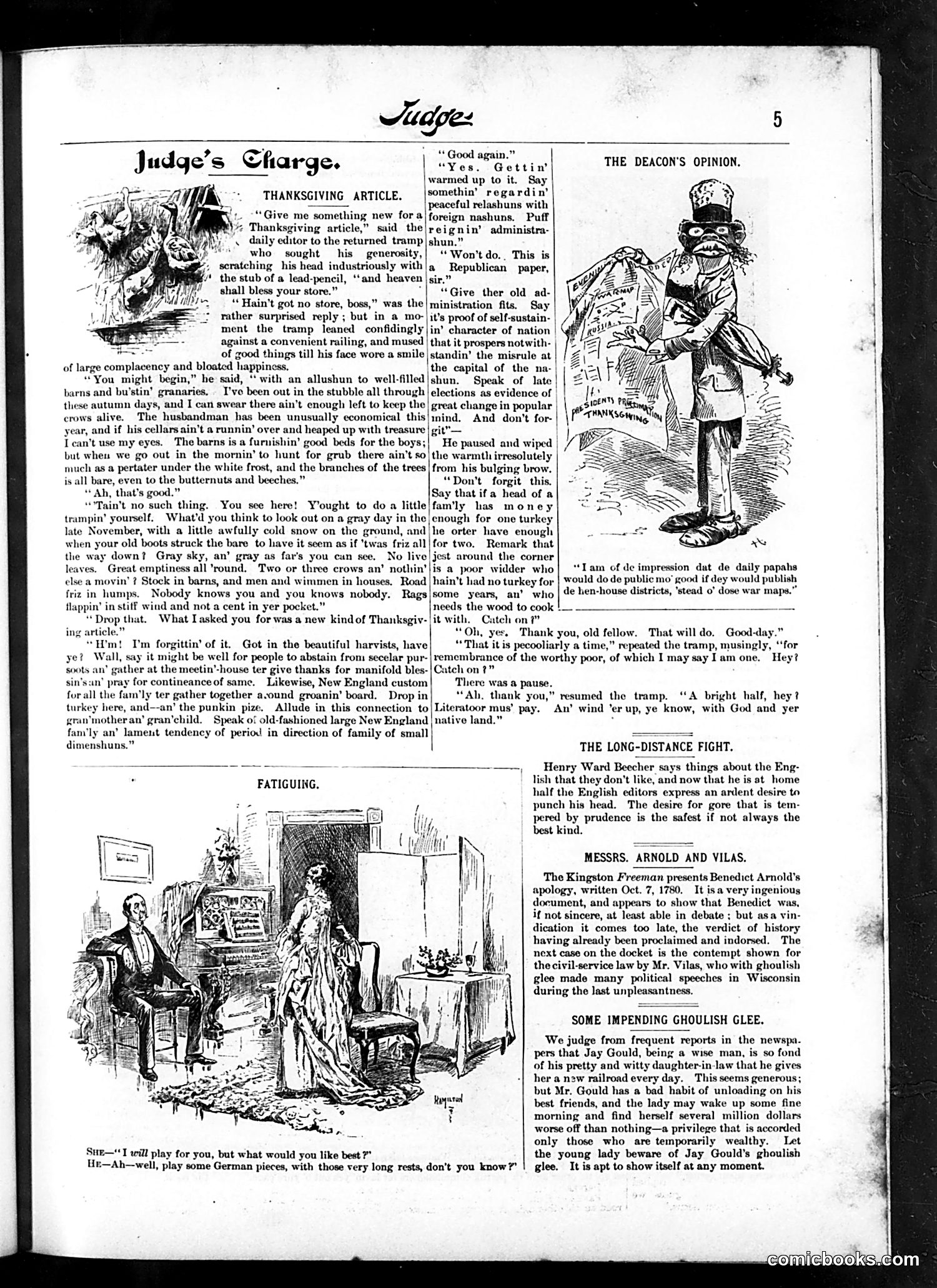
This page satirizes Thanksgiving journalism and hypocrisy. The main cartoon shows an editor commissioning a Thanksgiving article from a tramp. The tramp cynically subverts the holiday's traditional sentiments—rather than celebrating abundance, he describes autumn poverty: frozen ground, empty fields, and starving crows. He then mock-suggests the editor include platitudes about gratitude, family gatherings, and charitable giving to the poor, while the editor keeps rejecting suggestions that criticize the Republican administration. The satire's point: *Judge* mocks how newspapers publish hollow Thanksgiving pieties while ignoring actual poverty and hardship. The tramp's sardonic voice exposes the gap between Thanksgiving's stated values (helping the needy) and reality. The final exchange—where the tramp notes he himself is poor—drives home the irony: editorial sentimentality about charity rings false when real suffering surrounds readers. The secondary cartoon, "Fatiguing," shows a musician requesting "long rests," a simple visual pun on musical exhaustion.
📄 Transcribed text from this page (OCR, searchable)
Machine-transcribed from the original scan — historical spelling and the odd misread are preserved.
THANKSGIVING ARTICLE. “Give me something new fora yz Thanksgiving article,” said the , daily editor to the returned tramp who sought his generosity, scratching his head industriously with the stub of a lead-pencil, ‘‘and heaven | shall bless your store.” . “ Hain't got no store, boss,” was the rather surprised reply; but in a mo- ment the tramp leaned confidingly against a convenient railing, and mused | ; of good things till his face wore a smile| of large complacency and bloated happiness. “You might begin,” he said, ‘with an allushun to well-filled barns and bu’stin’ granaries. _ I've been out in the stubble all through these autumn days, and I can swear there ain’t enough left to keep the crows alive. The husbandman has been unusually economical this year, and if his cellars ain't a runnin’ over and heaped up with treasure I can’t use my eyes. The barns is a furnishin’ good beds for the boys; but when we go out in the mornin’ to hunt for grub there ain't so much as a pertater under the white frost, and the branches of the trees is all bare, even to the butternuts and beeches.” “Ah, that’s good.” “ain't no such thing. You sce here! Y’ought to do a little trampin’ yourself, What'd you think to look out on a gray day in the, late November, with a little awfully cold snow on the ground, and when your old boots struck the bare to have it seem as if ‘twas friz all the way down? Gray sky, an’ gray as far’s you can see. No live leaves. Great emptiness all ‘round. Two or three crows an’ nothin’ | else a movin’ ? Stock in barns, and men and wimmen in houses, Road friz in humps. Nobody knows you and you knows nobody. Rags flappin’ in stiff wind and not a cent in yer pocket.” “Drop that. What Iasked you for was a new kind of Thanksgiv-| ing article.” “H'm! I’m forgittin’ of it. Got in the beautiful harvists, have ye? Wall, say it might be well for people to abstain from secelar pur- soots an’ gather at the meetin’-house ter give thanks for manifold bles- sin’sun’ pray for contineanceof same. Likewise, New England custom for all the fam'ly ter gather together acound groanin’ board. Drop in turkey here, and--an’ the punkin pi: Allude in this connection to gran’motheran’ gran’child. Speak of old-fashioned large New England | fam'ly an’ lament tendency of period in direction of family of small dimenshuns.” FATIGUING, Str—I will play for you, but what would you like best ?” Hr—Ah—well, play some German pieces, with those very long rests, do jini “Good again.” “Yes. Gettin’ warmed up to it. Say somethin’ regardin’ peaceful relashuns with foreign nashuns. Puff reignin’ administra- shun.” “Won't do.. This is a Republican paper, sir.” “Give ther old ad- ministration fits. Say it’s proof of self-sustain- | in’ character of nation | that it prospers notwith- standin’ the misrule at the capital of the na- shun. Speak of late elections as evidence of great change in popular id. And don’t for- THE DEACON’S OPINION. git’ He paused and wiped the warmth irresolutely from his bulging brow. “Don't forgit this. Say that if a head of a fam'ly has money enough for one turkey he orter have enough for two. Remark that jest around the corner is a poor widder who hain’t had no turkey for some years, an’ who needs the wood to cook it wil fe om Thank you, old fellow. That will do, Good-day.” “That it is pecooliarly a time,” repeated the tramp, musingly, ‘for remembrance of the worthy poor, of which I may say I am one. Hey? Catch on?” There was a pause. “Ah. thank you,” Literatoor mus’ pay. native land.” “Tam of de impression dat de daily papahs would do de public mo’ good if dey would publish de hen-house districts, ‘stead o' dose war maps.” resumed the tramp. “A bright half, hey? An’ wind ‘er up, ye know, with God and yer THE LONG-DISTANCE FIGHT. Henry Ward Beecher says things about the Eng- lish that they don't like, and now that he is at home half the English editors express an ardent desire to punch his head. The desire for gore that is tem- pered by prudence is the safest if not always the best kind. MESSRS. ARNOLD AND VILAS. ‘The Kingston Freeman presents Benedict Arnold’s apology, written Oct. 7, 1780. It isa very ingenious document, and appears to show that Benedict was, if not sincere, at least able in debate ; but asa vin- dication it comes too late, the verdict of history having already been proclaimed and indorsed. The next case on the docket is the contempt shown for the civil-service law by Mr. Vilas, who with ghoulish glee made many political speeches in Wisconsin during the last unpleasantness. SOME IMPENDING GHOULISH GLEE. ‘We judge from frequent reports in the newspa. pers that Jay Gould, being a wise man, is so fond of his pretty and witty daughter-in-law that he gives her a new railroad every day. This seems generous; but Mr. Gould has a bad habit of unloading on his best friends, and the lady may wake up some fine morning and find herself several million dollars worse off than nothing—a privilege that is accorded only those who are temporarily wealthy. Let the young lady beware of Jay Gould’s ghoulish glee. It is apt to show itself at any moment. n't you know?”