
Judge, 1886-11-27 · page 6 of 16
Judge — November 27, 1886 — page 6: what you’re looking at
What you’re looking at
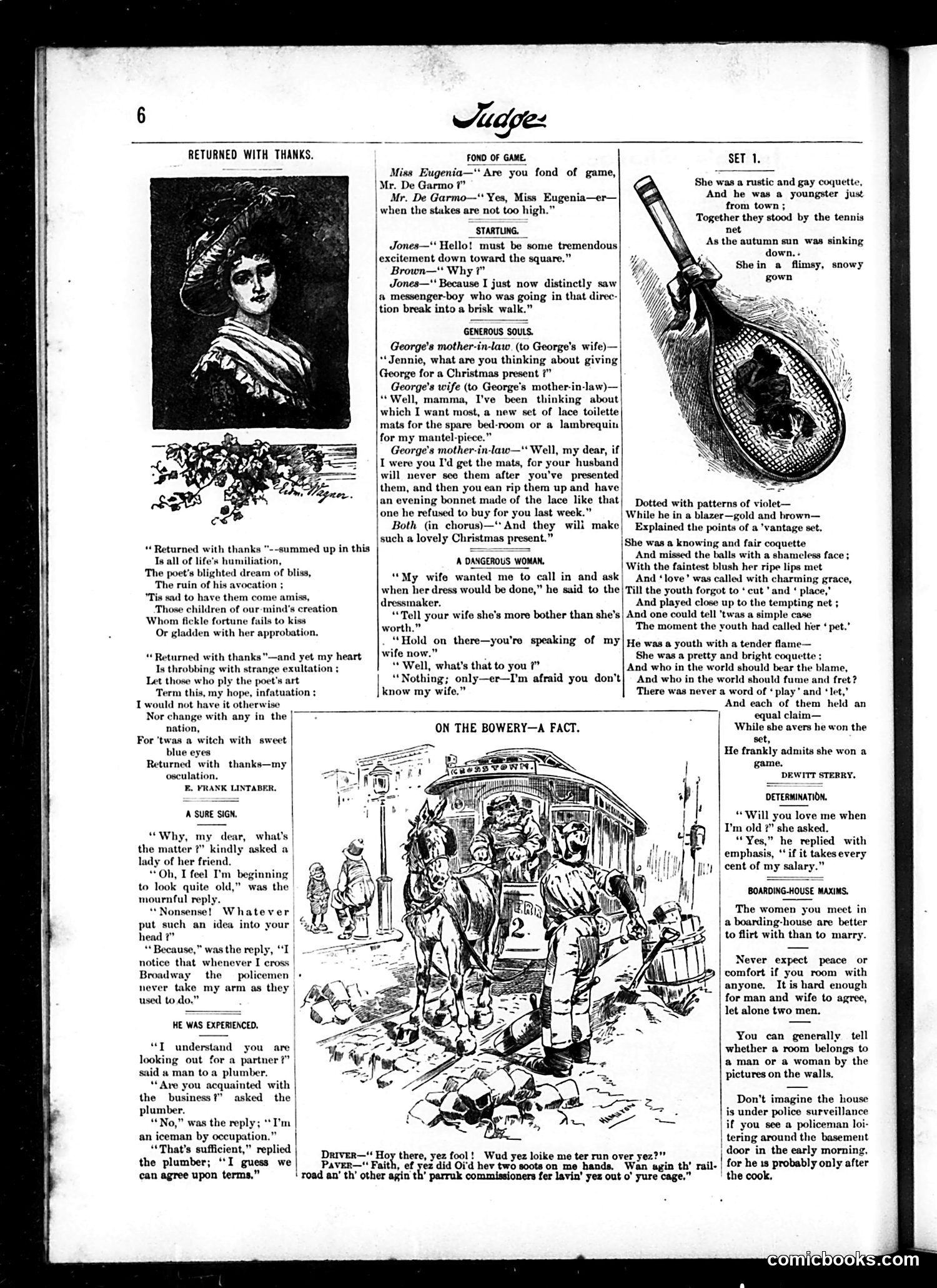
This page contains several brief humorous sketches typical of *Judge*'s satirical style: **"Fond of Game"** jokes about a suitor's reluctance when "stakes are not too high"—a double meaning playing on courtship versus gambling. **"Startling"** satirizes urban indifference: a messenger boy breaking into a brisk walk is treated as major news, mocking how little actually excites city dwellers. **"Generous Souls"** mocks domestic gift-giving: George's wife and mother-in-law discuss Christmas presents for George while planning to repurpose them ("rip them up"), suggesting women's self-interest disguised as generosity. **"A Sure Sign"** jokes about aging: a woman assumes she's old because policemen no longer offer her their arm—implying this was once a common courtesy for women crossing streets. The lengthy poem "Set 1" romanticizes a flirtation between a country girl and city youth at tennis. **"On the Bowery"** depicts working-class Irish dialect humor involving a careless street worker and impatient driver—typical period ethnic comedy. The illustrations support these lighthearted domestic and social observations rather than political commentary.
📄 Transcribed text from this page (OCR, searchable)
Machine-transcribed from the original scan — historical spelling and the odd misread are preserved.
RETURNED WITH THANKS. FOND OF GAME, | Miss Eugenia— Are you fond of game, \Mr. De Garmo 1” Mr. De Garmo—‘ Yes, Miss Eugenia—er— when the stakes are not too high.” _STARTUNG. Jones—‘‘ Hello! must be some tremendous excitement down toward the square.” Brown—" Why ?” Jones—'' Because I just now distinctly saw messenger-boy who was going in that direc- tion break into a brisk walk.” GENEROUS SOULS. George's mother-in-law. (to George's wife)— ‘Jennie, what are you thinking about giving George for a Christmas present ?” George's wife (to George's mother-in-law)— “Well, mamma, I've been thinking about which I want most, a new set of lace toilette mats for the spare bed-room or a lambrequin for my mantel-piece.” George's mother-in-law—" Well, my dear, if I were you I'd get the mats, for your husband SET 1. She was a rustic and gay coquette, And he was a youngster just from town ; Together they stood by the tennis net As the autumn sun was sinking down. Shein a flimsy, snowy | will never see them after you've presented | them, and then you ean rip them up and have} an evening bonnet made of the lace like that} Dotted with patterns of violet— “ Returned Is all of life's hun The poet’s blighted dream of bliss, The ruin of his avocation ; "Tis sad to have them come amiss, Those children of our-mind’s creation Whom fickle fortune fails to kiss Or gladden with her approbation. “ Returned with thanks"—and yet my heart Is throbbing with strange exultation ; Let those who ply the poet's art Term this, my hope, infatuation : I would not have it otherwise one he refused to buy for you last week.” Both (in chorus)—" And they will make| such a lovely Christm me to call in and ask/ when her dress would be done,” he said to the dressmaker. “Tell your wife she’s more bother than she's worth.” “Hold on there—you're speaking of my wife now.” “Well, what's that to you ?” “Nothing; only—er—I'm afraid you don't know my wife.” | While he in a blazer—gold and brown— | Explained the points of a vantage set. |She was a knowing and fair coquette | And missed the balls with a shameless face ; | With the faintest blush her ripe lips met And ‘love’ was called with charming grace, Till the youth forgot to ‘ cut ’ and * place,’ And played close up to the tempting net ; And one could tell ‘twas a simple case The moment the youth had called her ‘ pet.’ He was a youth with a tender flame— She was a pretty and bright coquette ; And who in the world should bear the blame, And who in the world should fume and fret? There was never a word of ‘play’ and ‘let,’ And each of them held an Nor change with any in the | nation, For ‘twas a witch with sweet blue eyes Returned with thanks—my osculation, F, PRANK LINTABER. ‘A SURE SIGN, “Why, my dear, what's | the matter ?” kindly asked a lady of her friend. “Oh, [feel I'm beginning | to look quite old,” was the mournful reply. “Nonsense! Whateve put such an idea into your | head ¢” * Because,” was the reply, Da = notice that whenever I cross | Broadway the — policemen never take my arm as they used to do.” ‘ a. HE WAS EXPERIENCED. “IT understand you are looking out for a partner ?” said a man toa plumber. “Arve you acquainted with | the business?” asked the plumber. “*No,” was the reply; I'm an iceman by occupation.” “That's sufficient,” replied the plumber; “I guess we | can agree upon terms.” | ON THE BOWERY—A FACT. Driver—‘* For | there, yez fool! Wud yez loike me ter run over yez?"” Paver—“ Fait! ‘road an’ th’ other agin tl ef yez did Oi'd hev two soots on me hands. Wan agin th’ rail-| ’ parruk commissioners fer lavin’ yez out o' yure cage.” | equal clai While she avers he won the set, He frankly admits she won a game. DEWITT STERRY, DETERMINATION. “Will you love me when I'm old ?” she asked. “Yes,” he replied with emphasis, ‘‘ if it takesevery cent of my salary. ad BOARDING-HOUSE MAXIMS. The women you meet in a boarding-house are better to flirt with than to marry. Never expect peace or comfort if you room with anyone. It is hard enough for man and wife to agree, let alone two men. You can generally tell whether a room belongs to @ man or a woman by the pictures on the walls. Don't imagine the house is under police surveillance |if you see a policeman loi- | tering around the basement door in the early morning, for he 1s probably only after the cook,