
A complete issue · 16 pages · 1886
Judge — November 6, 1886
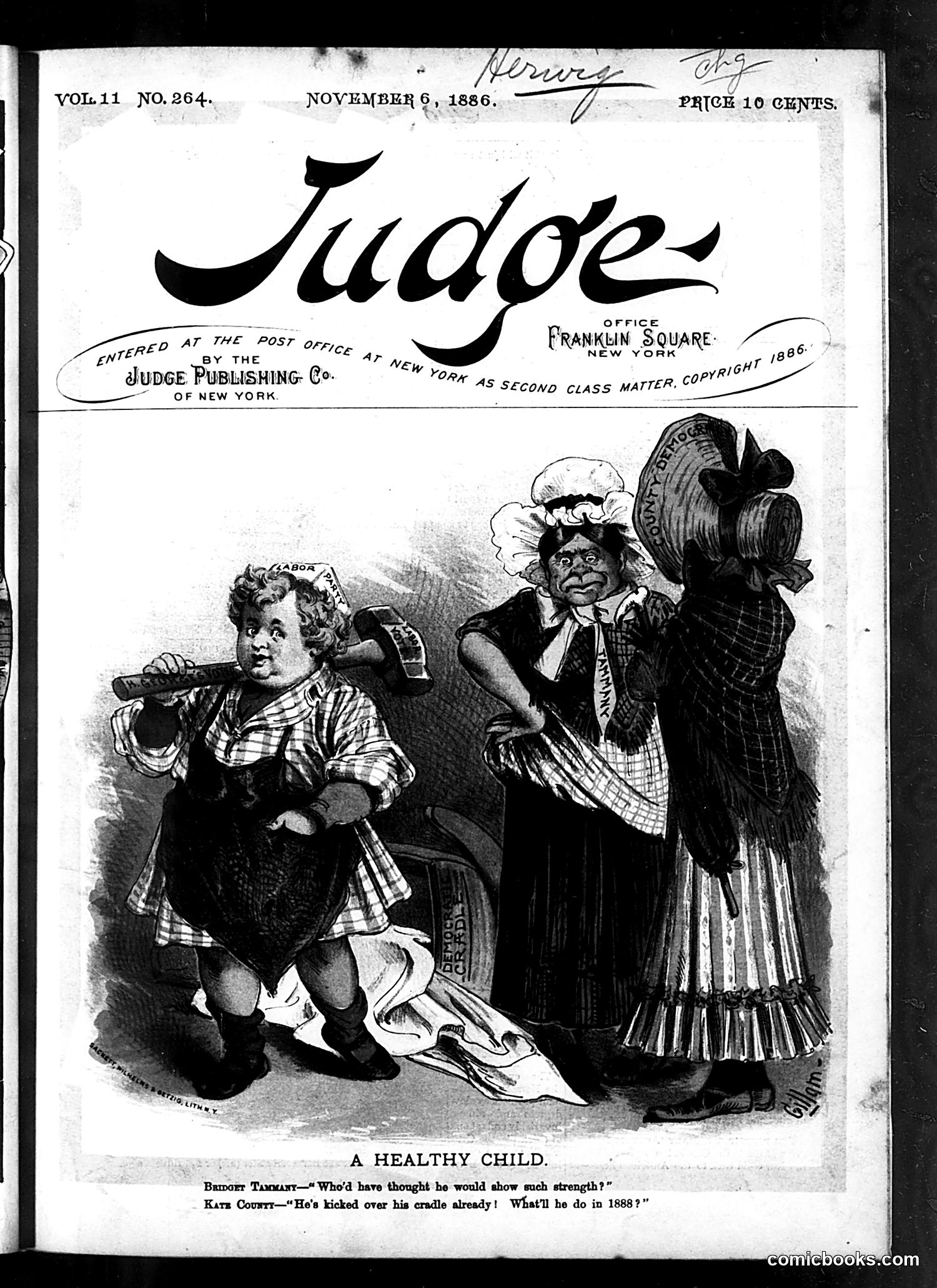
This cartoon satirizes the political strength of a child figure, likely representing Ireland or an Irish-American constituency. The caption quotes two women—Bridget Tammany and Kate County—marveling at the child's physical vigor despite mistreatment. The figures appear to reference Tammany Hall (New York's powerful Democratic political machine) and Irish-American political interests. The satire suggests that despite being "kicked over his cradle already," this political constituency remains robust and powerful—a commentary on Irish-American political influence in New York City during the Gilded Age. The exaggerated caricatural style and ethnic stereotyping were typical of 1880s American satirical illustration, reflecting period attitudes and visual conventions.
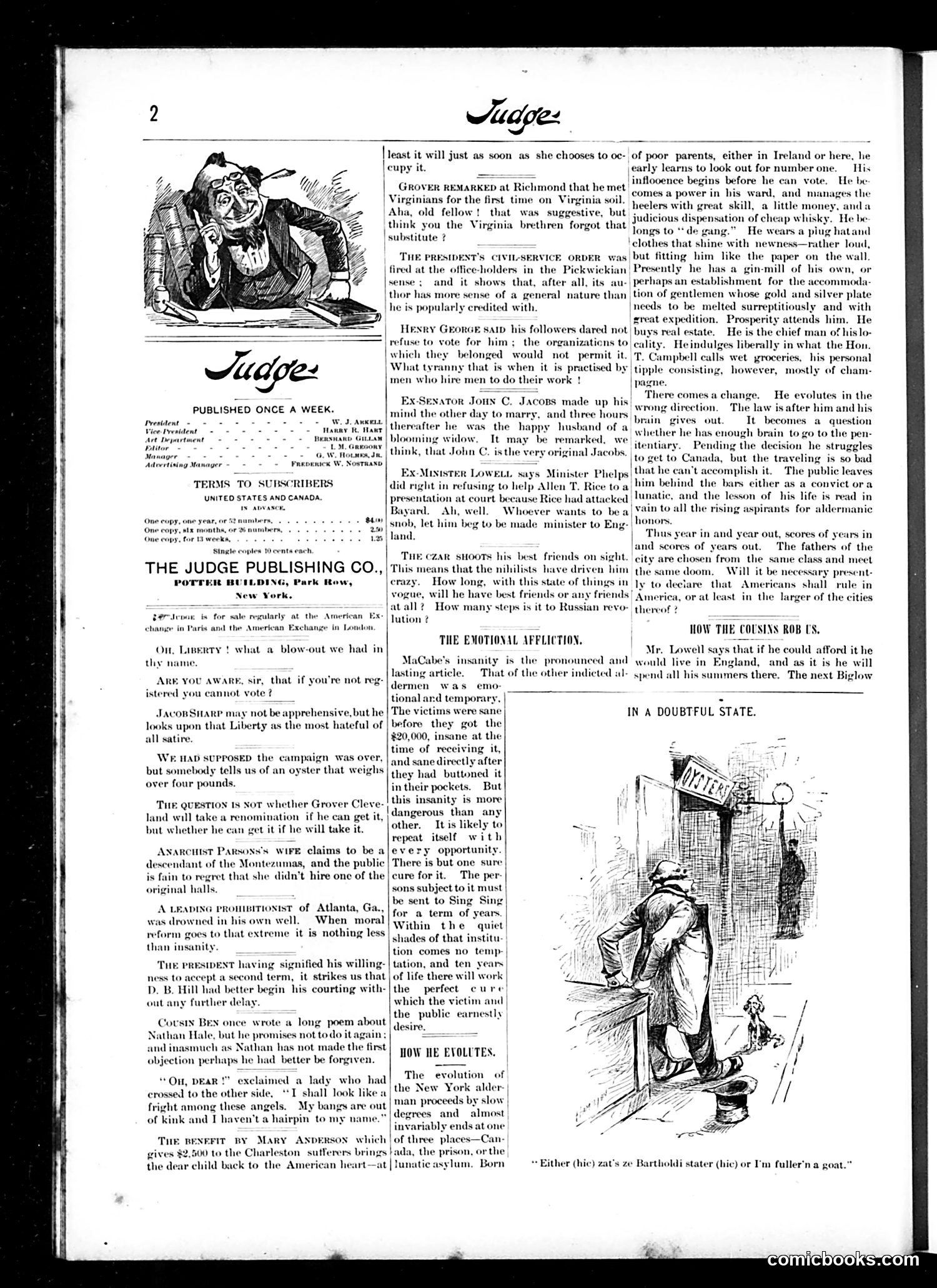
This page contains editorial commentary and two illustrations typical of Judge's satirical format. The left cartoon depicts a disheveled figure, likely representing a vagrant or laborer, though the specific target isn't entirely clear from the image alone. The right illustration, captioned "IN A DOUBTFUL STATE," shows a poorly dressed man confronting what appears to be a well-dressed figure near a building. The caption reads: "Either (he) zat's ze Barthodi stater (die) or I'm foller'n a goat," suggesting satire about the Statue of Liberty or immigration-related social confusion. The page's text discusses various political matters including civil service, electoral organization, and social conditions, characteristic of Judge's reformist commentary on Gilded Age American society. The specific historical references require additional context to fully interpret.
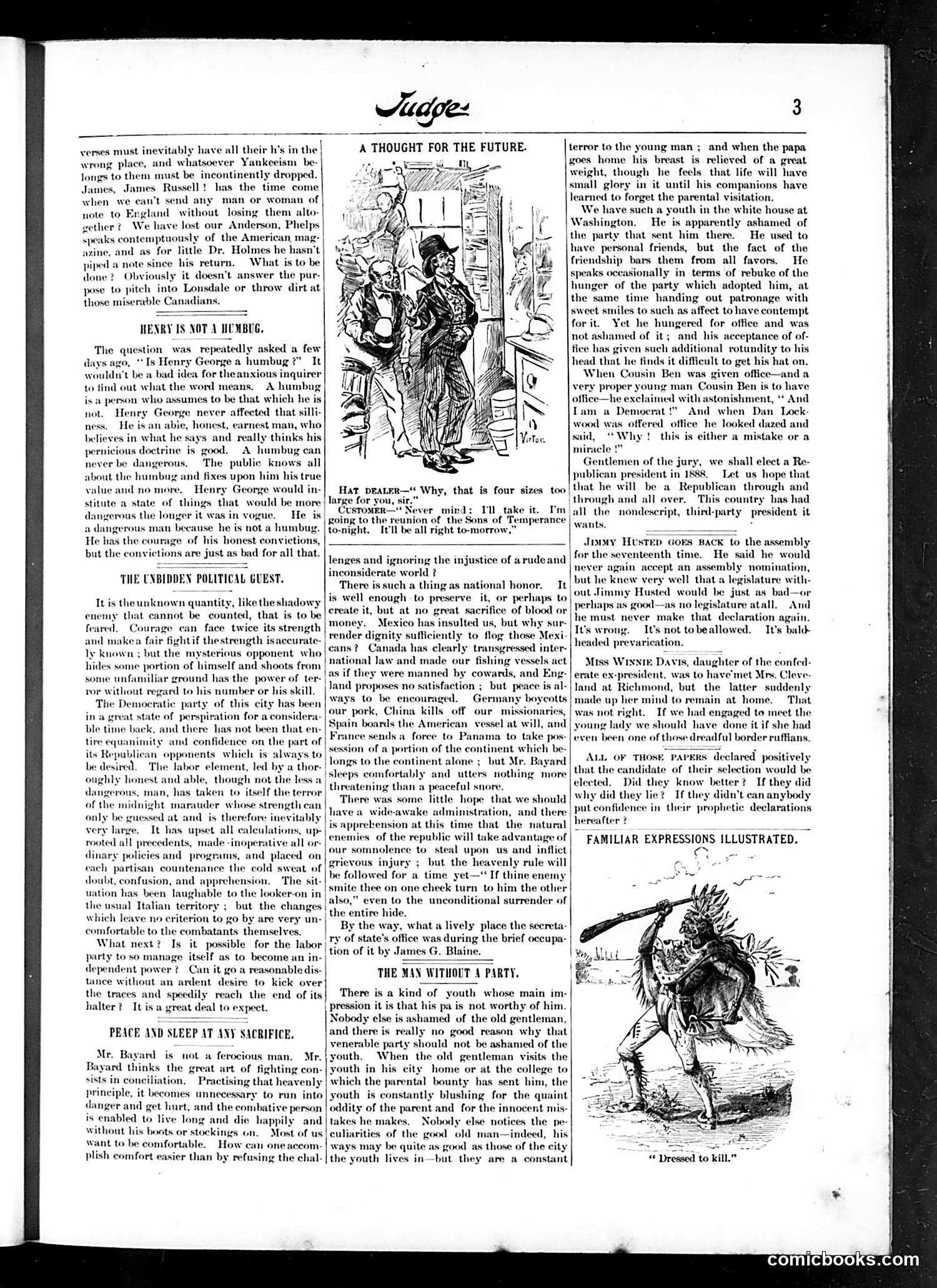
This page contains several distinct satirical pieces critiquing American politics and society circa the 1880s-90s. **"A Thought for the Future"** (top cartoon): Depicts a hat dealer and customer in dialogue about attending a "Sons of Temperance" meeting tonight, implying he'll get drunk anyway tomorrow. This satirizes the hypocrisy of temperance advocates who don't actually abstain. **"Henry is Not a Humbug"**: Defends Henry George (the single-tax reformer) against accusations of being a charlatan, arguing he's sincere if dangerously wrong in his economic theories. **"The Unbidden Political Guest"**: Criticizes the unpredictable, disruptive nature of third-party political movements (likely populist or labor parties) that upset established Democratic-Republican politics through unexpected tactics and platforms. **"Peace and Sleep at Any Sacrifice"**: Mocks pacifist politicians willing to avoid conflict with Mexico and Canada over national honor issues, suggesting cowardly appeasement. The commentary reflects late-19th-century anxieties about radical reform movements, political instability, and America's international standing.
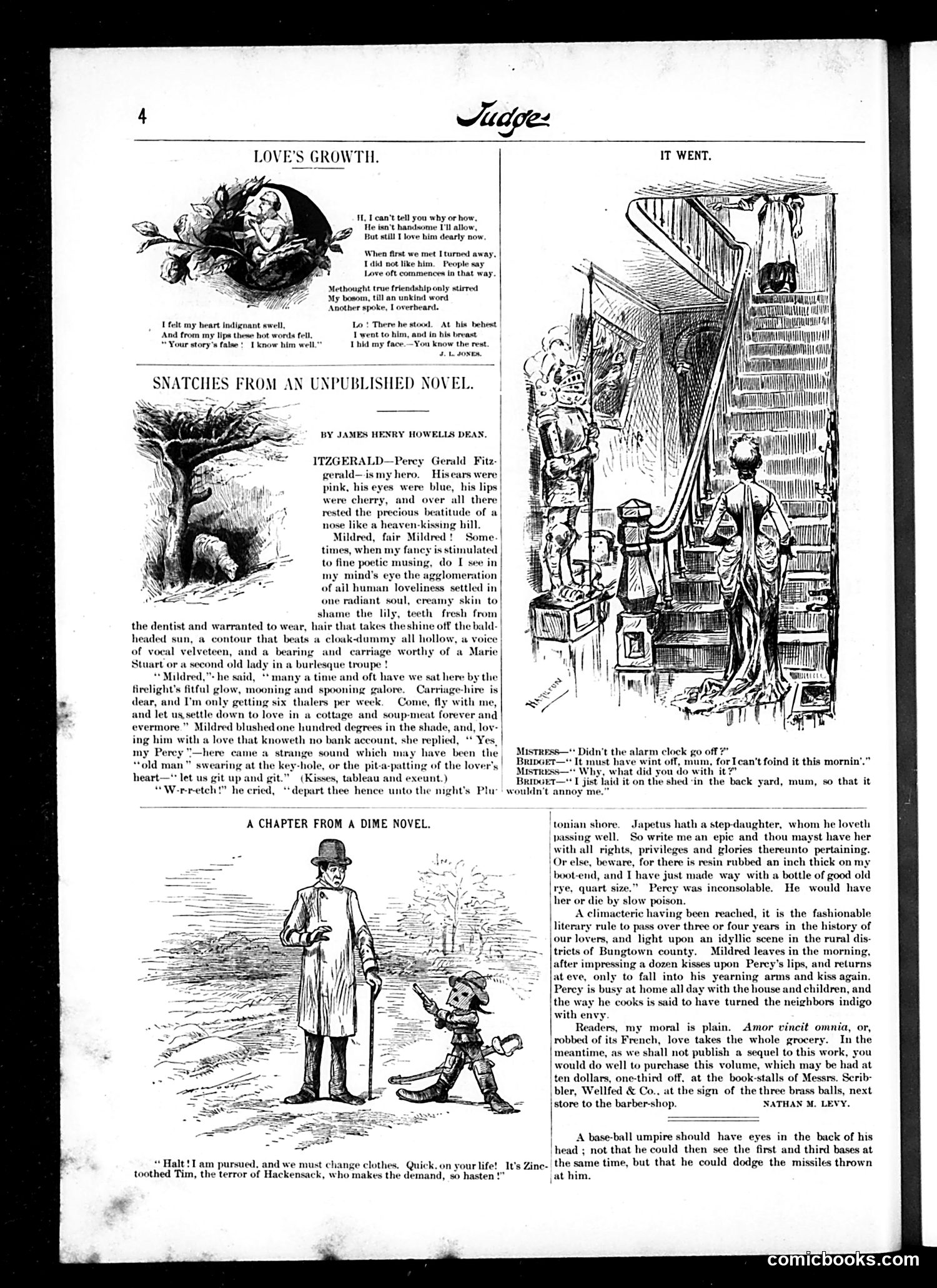
This page satirizes popular literary genres of the era through parody. "Love's Growth" mocks sentimental Victorian poetry about romance blooming unexpectedly. "Snatches from an Unpublished Novel" by James Henry Howells Dean parodies overwrought dime novels—melodramatic serialized fiction consumed by working-class readers. The excerpt features absurdly florid language ("cherry" lips, "precious beatitude of a nose"), clichéd plot devices (lovers eloping despite poverty), and overwrought dialogue ("Amor vincit omnia"). The bottom cartoon and text mock pulp fiction conventions further, while the sidebar joke about a baseball umpire provides comic relief. Judge targeted educated, middle-class readers who considered such popular literature gauche. The satire mocks both the purple prose of cheap novels and their working-class audience's supposed gullibility. The illustrations exaggerate character types—the swooning heroine, the devoted lover—reinforcing the mockery of genre conventions readers would instantly recognize.
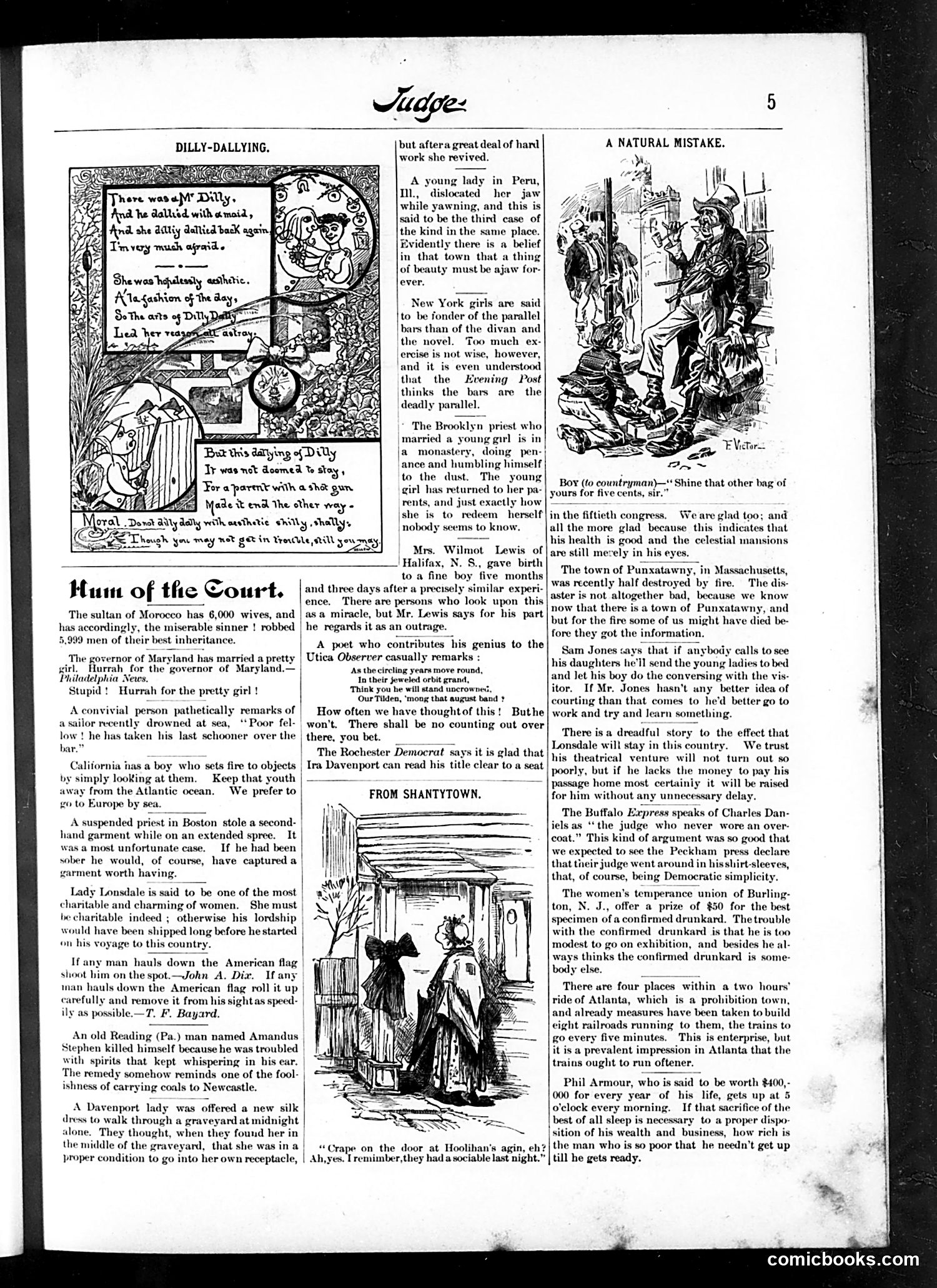
This page contains several brief satirical items typical of Judge's style—short commentaries on contemporary social absurdities. **"Dilly-Dallying"** (left): A illustrated poem mocking an "aesthete" woman obsessed with beauty and affectation, likely referencing the 1870s Aesthetic Movement. The humor targets her pretentious obsession with being "jawlessly aesthetic." **Main items ridicule:** - A Peru, Illinois woman who dislocated her jaw yawning (three cases reported there) - A Brooklyn priest confined to monastery penance after marrying a young girl - The Moroccan sultan's 6,000 wives as moral outrage - Various minor social follies (a Boston priest stealing while drunk; a California boy who allegedly sets fires by looking) **"Mum of the Court"**: Brief quips about Morocco's sultan, Maryland's governor marrying a pretty girl, and political figures like Tilden and Bayard. **"From Shantytown"**: A sketch depicting working-class Irish life, with a woman at a door and casual reference to "Hoolihan's" social gathering. The page satirizes social pretension, clerical hypocrisy, and highlights curiosities from period newspapers—typical Judge content mixing class commentary with absurdist humor.
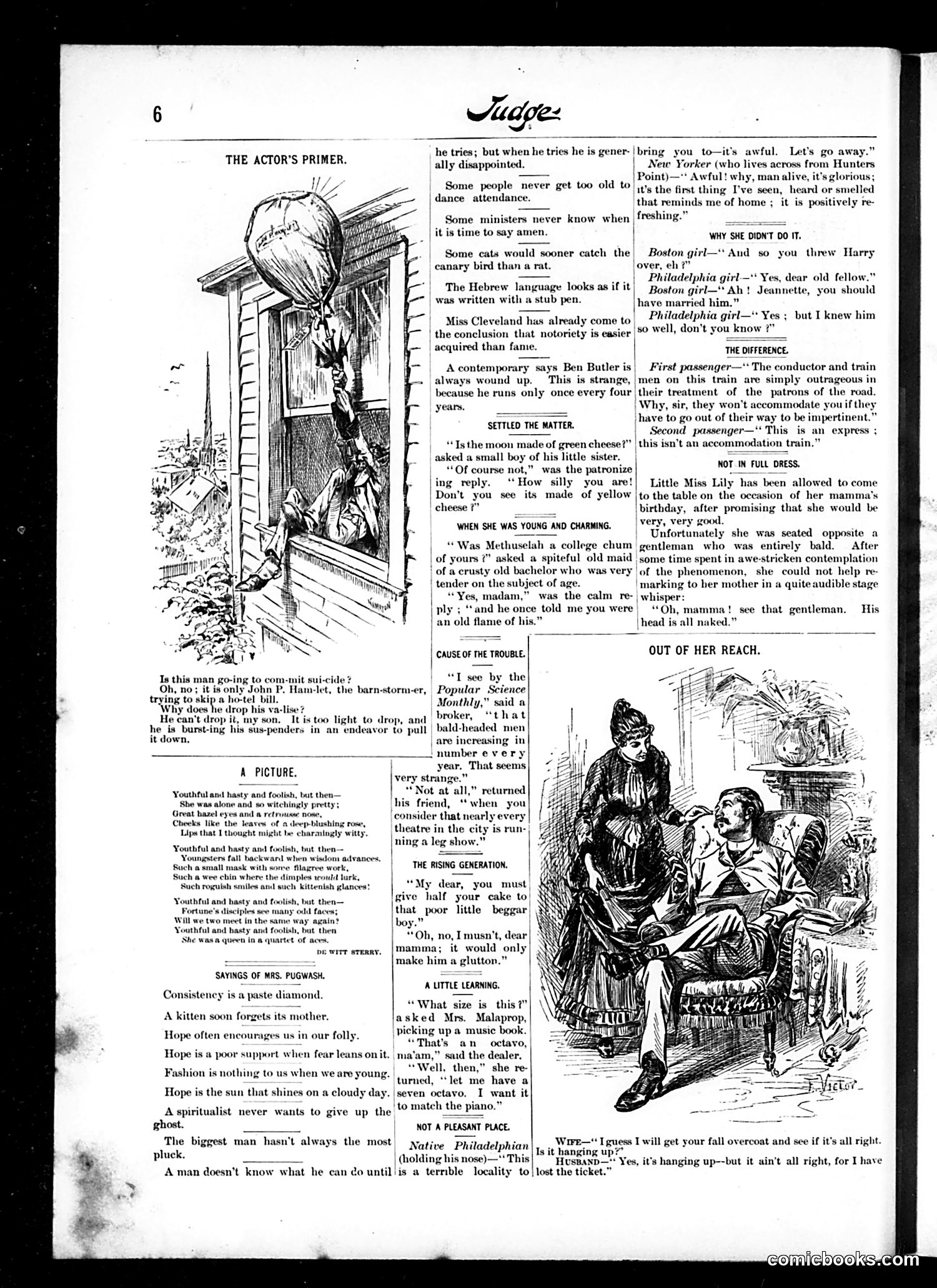
This page from Judge contains several satirical short pieces lampooning American social types and contemporary figures: **"THE ACTOR'S PRIMER"** offers witty observations about human behavior—some people never knowing when to stop, ministers' awkward silences, cats' priorities. **"MISS CLEVELAND"** references Frances Cleveland (wife of President Grover Cleveland), joking that she's achieved notoriety more easily than fame. **"BEN BUTLER"** is General Benjamin Butler, a controversial political figure, mocked as "always wound up" yet running for office infrequently. Several pieces satirize regional American girls' social behaviors and romantic choices—Boston versus Philadelphia girls, for instance. **"POPULAR SCIENCE MONTHLY"** contains a typical Victorian-era joke about baldness increasing because leg shows in theaters are distracting men. The illustrated panels show domestic scenes with period humor: a child's innocent remark about a bald man's head, marital quarrels over overcoats. The page represents Judge's formula: political jabs at recognizable figures mixed with genteel observational humor about courtship, marriage, and social pretension.
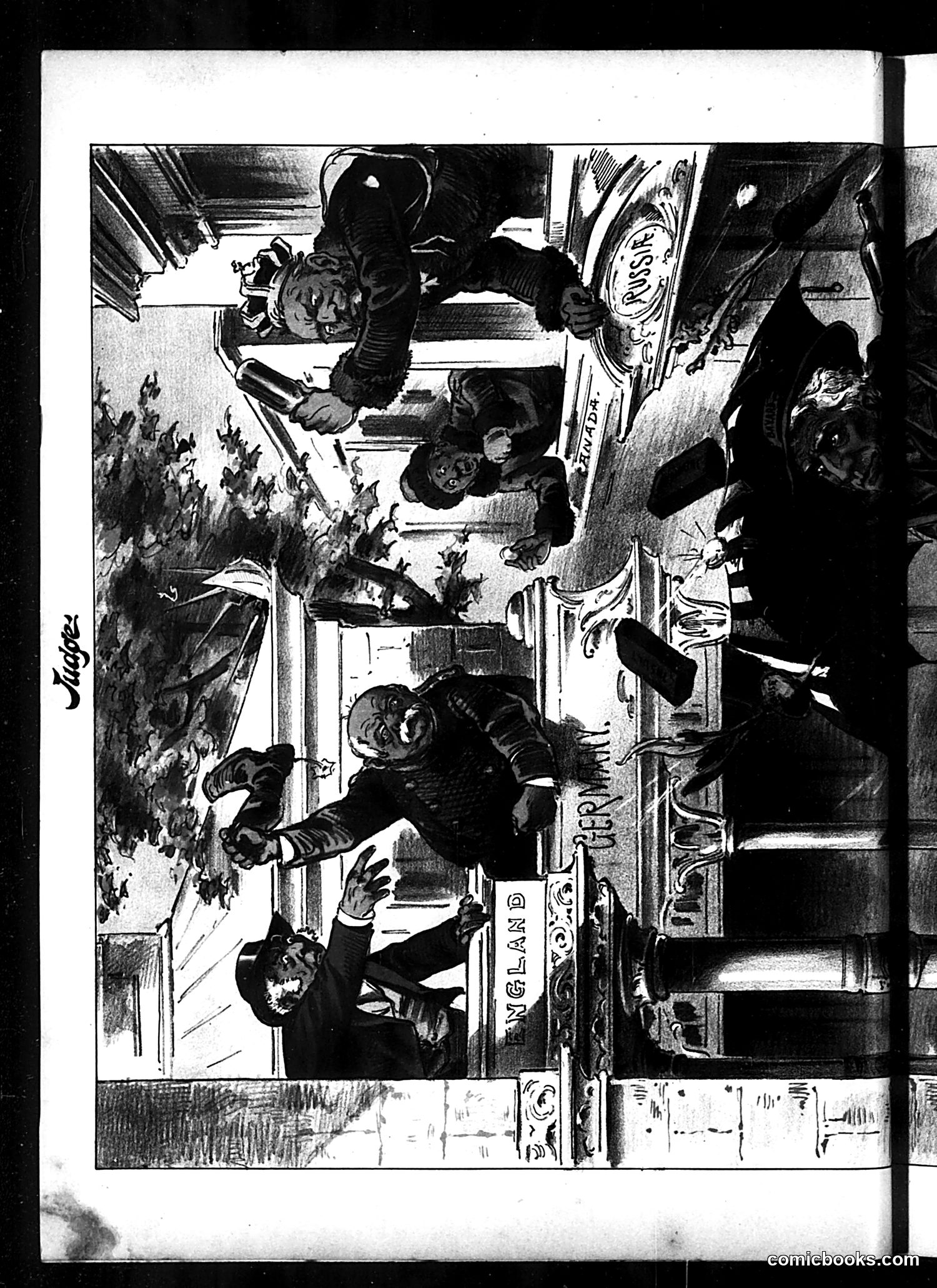
This page appears to be rotated 90 degrees, making it difficult to read completely. The visible OCR text includes "ENGLAND" and what may be publication/attribution information, but the OCR is too fragmented for confident interpretation. The black-and-white cartoon depicts multiple figures in what appears to be an interior domestic scene. The drawing style and clothing suggest late 19th or early 20th-century origin. However, without legible text labels or captions, I cannot definitively identify the specific figures, the political/social situation being satirized, or the intended meaning of the cartoon for Judge's contemporary readership. The image quality and rotation prevent accurate analysis. A clearer, properly-oriented version would be needed for reliable historical interpretation.
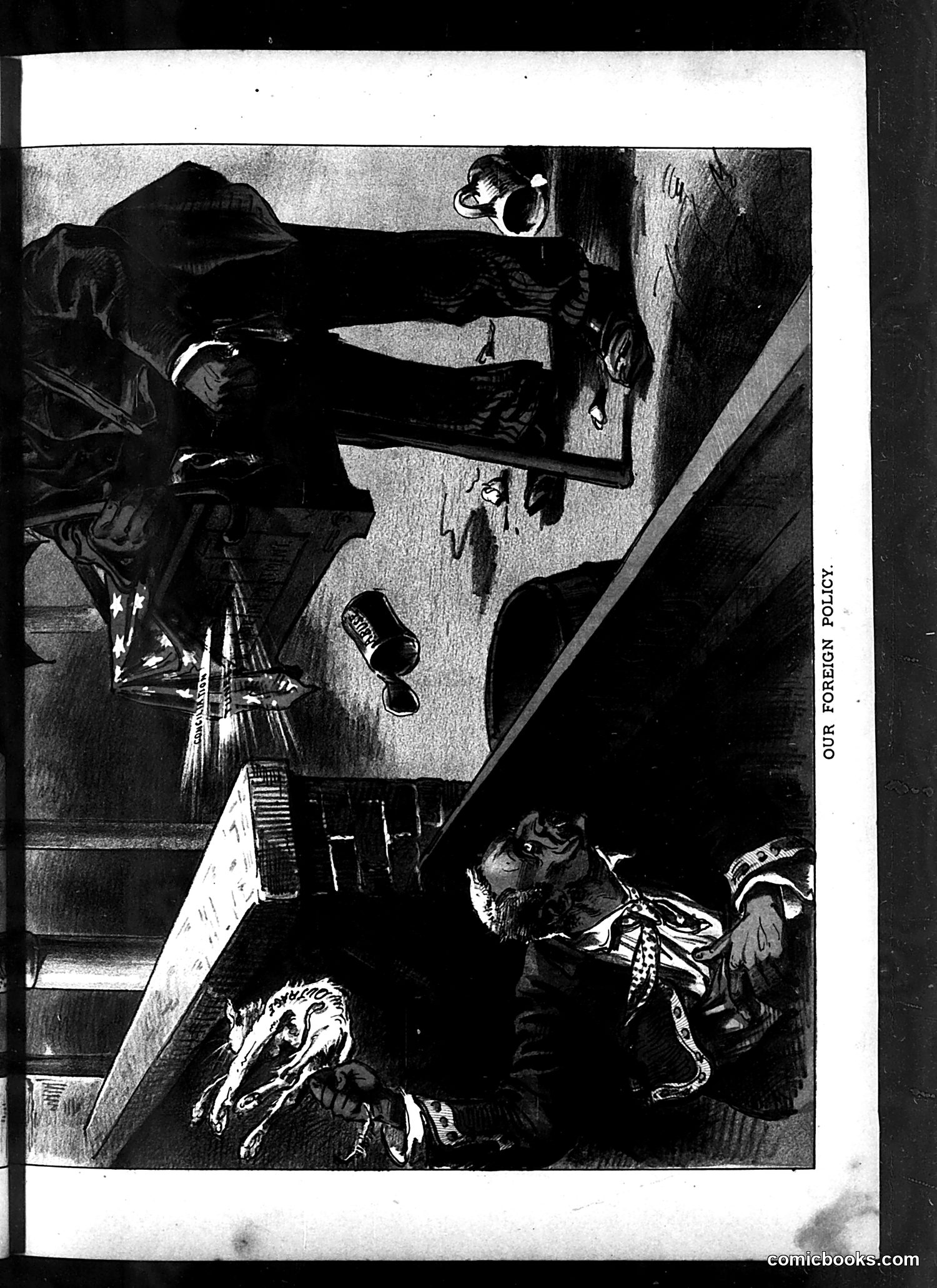
The OCR text is essentially unreadable—just scattered letters and symbols that don't form coherent words. Regarding the **image itself**: This is a black and white illustration showing what appears to be a scene with multiple figures, including someone in formal dress (possibly a police officer or authority figure based on the uniform), and what looks like a dog. The composition and style are consistent with Judge magazine's satirical approach, but **without legible text or a clear caption, I cannot definitively identify the specific political figures being caricatured, the historical event being referenced, or the satirical point being made**. The page header reads "OUR FOREIGN POLICY," suggesting this commentary relates to American international relations, but the specific critique remains unclear from the image alone.
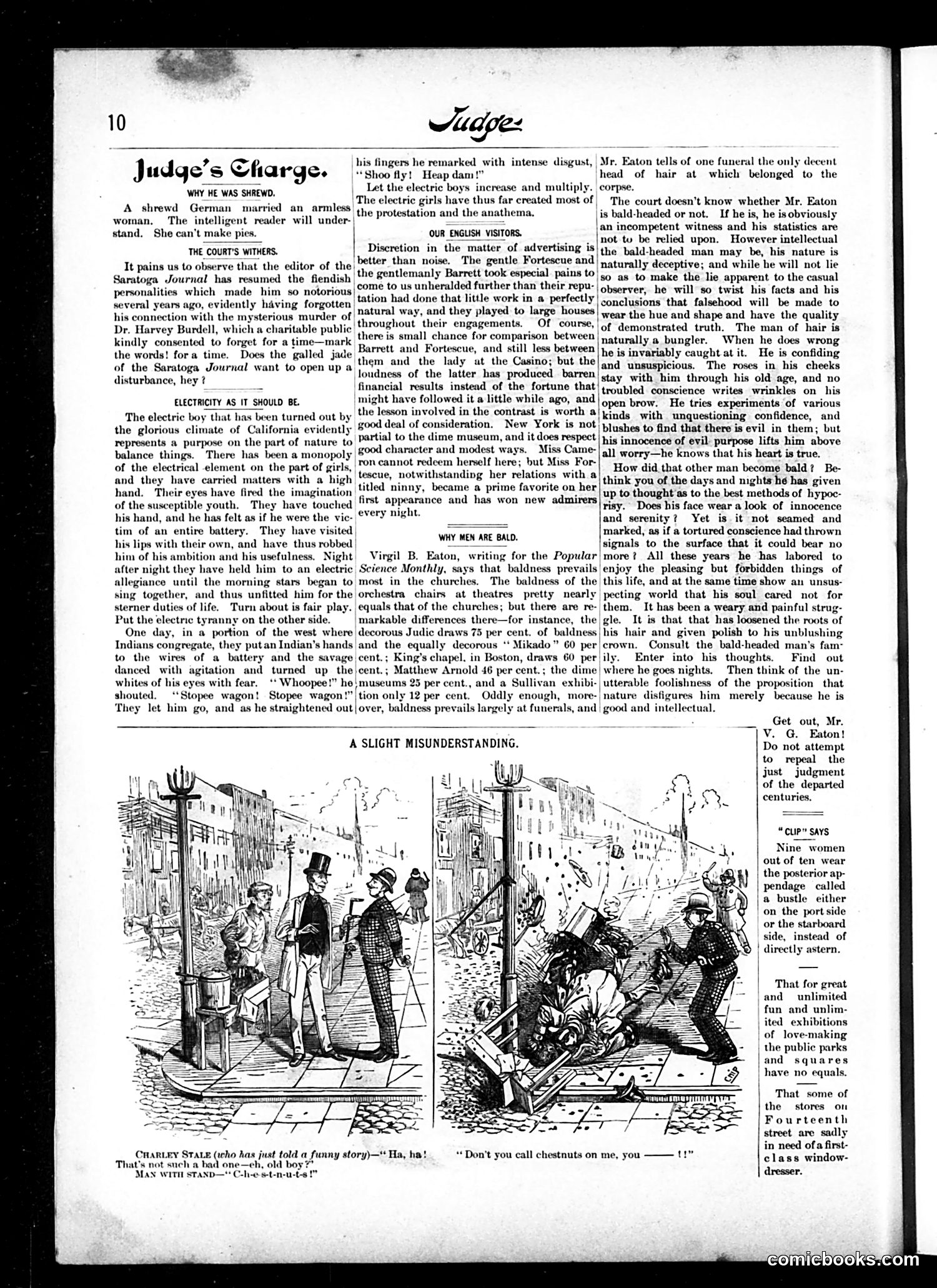
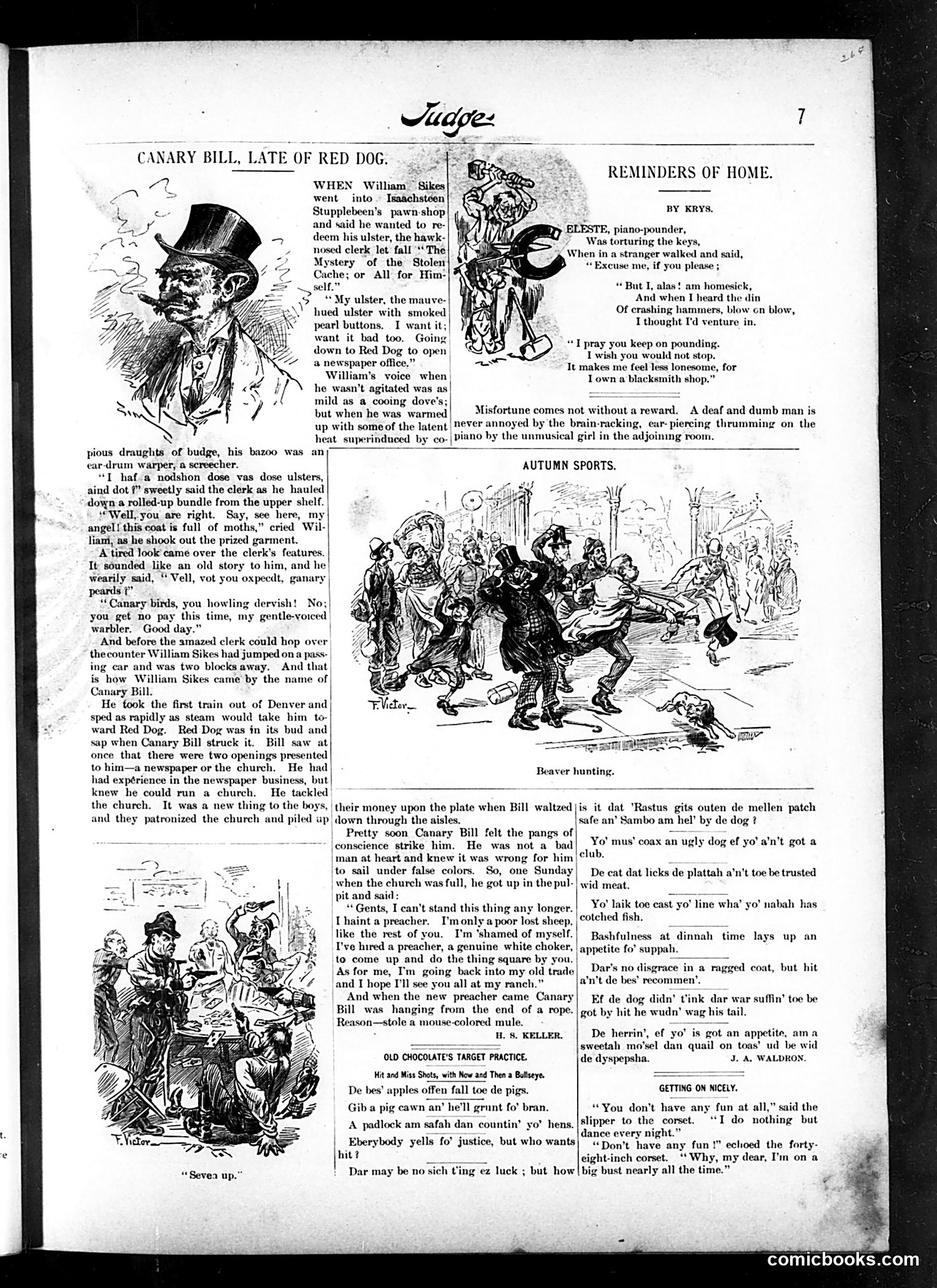
This page contains several distinct satirical pieces typical of Judge magazine's social commentary: **"A Shrewd German"**: A crude ethnic joke about a German marrying an armless woman—the "joke" being she cannot bake pies. This reflects period anti-German stereotyping. **"The Court's Withers"**: A lengthy editorial attack on the Saratoga Journal editor, accusing him of reviving personal attacks and referencing a mysterious murder (Dr. Harvey Burdell case) to suggest the editor's untrustworthiness. **"Electricity as It Should Be"**: Satirizes the contemporary "electric girl" trope—young women whose vitality supposedly mesmerizes men. The piece mocks this by imagining an "electric boy" from California, and humorously describes a Native American's shocked reaction to electricity, using offensive dialect humor typical of the era. **"A Slight Misunderstanding"**: Two cartoon panels showing a street altercation, with figures arguing about "chestnuts" (old jokes). The overall tone is irreverent social satire mixed with ethnic stereotyping common to 19th-century American humor.
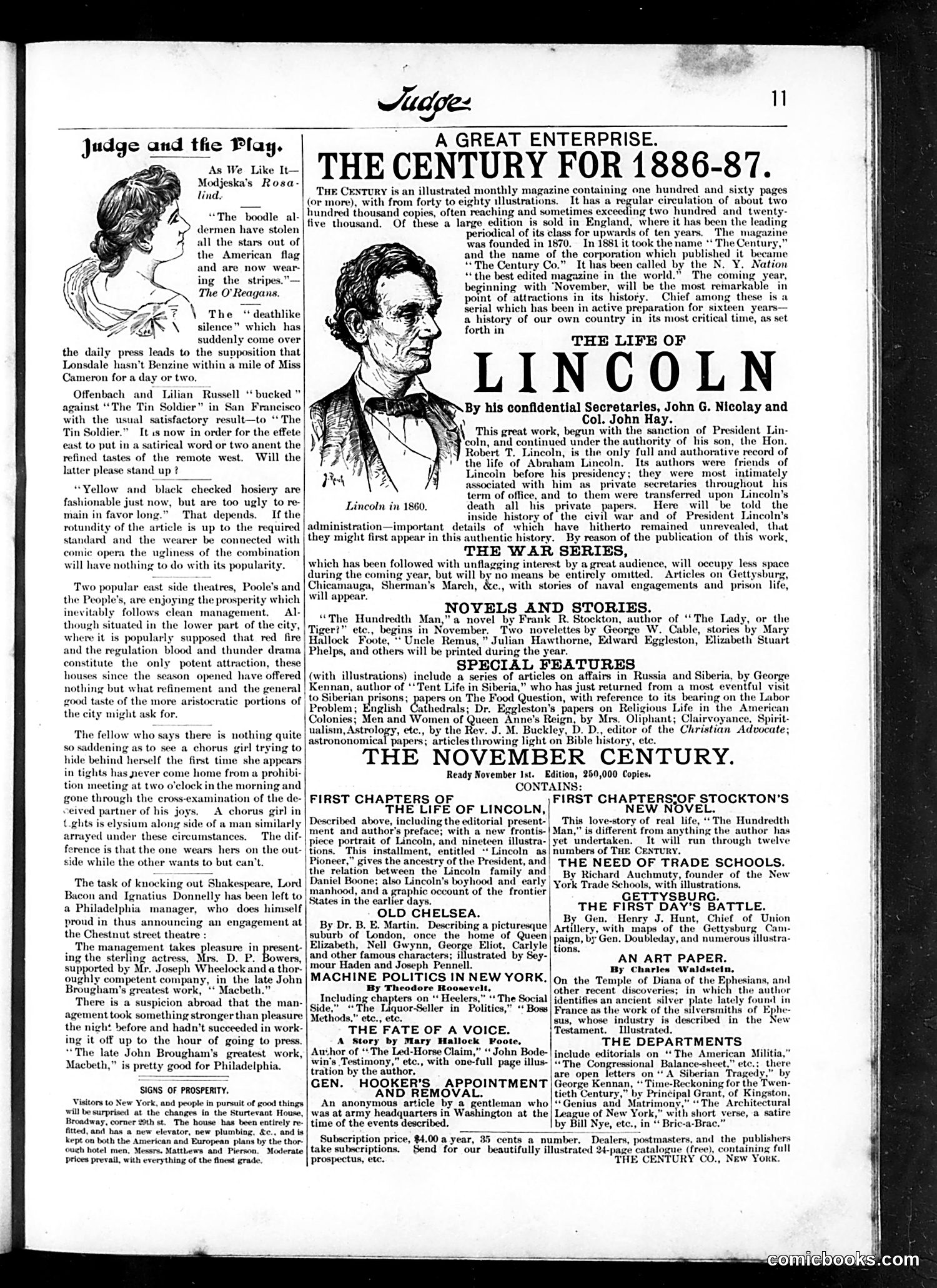
This page primarily contains theatrical criticism and entertainment gossip rather than political cartoons. The main cartoon visible shows a profile sketch labeled "Lincoln in 1860," accompanying an advertisement for *The Century* magazine's serialized biography *The Life of Lincoln*, written by his former secretaries John G. Nicolay and Robert T. Lincoln. The theatrical section mocks Philadelphia theater management for absurdly crediting John Brougham's *Macbeth* as "the late John Brougham's greatest work"—when *Macbeth* is Shakespeare's play. The humor suggests the manager was intoxicated when making this announcement. Other brief critiques discuss popular actresses like Modjeska and Lilian Russell. The "boodle aldermen" reference in the opening alludes to corrupt city officials who supposedly steal public resources—a common theme in *Judge's* satirical coverage of urban politics and municipal corruption during this era.
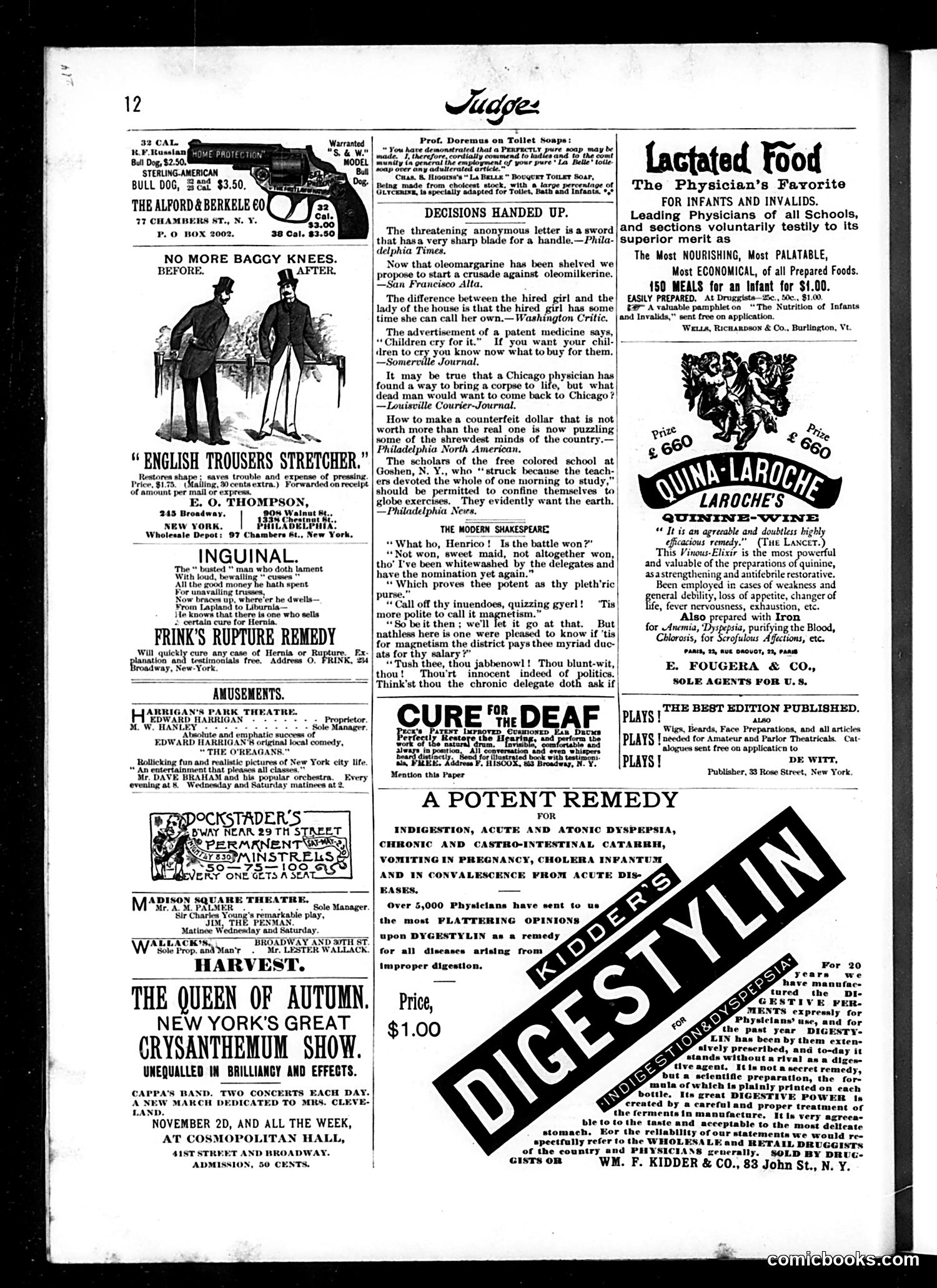
This page is primarily **advertisements and filler content** rather than editorial satire. The main cartoon, "NO MORE BAGGY KNEES" (top left), shows a before-and-after comparison of men's trousers, advertising a "stretcher" device to eliminate knee bagging—a common clothing problem of the era. The center section contains brief, disconnected witticisms labeled "DECISIONS HANDED UP," satirizing various contemporary annoyances: anonymous threatening letters, oleomargarine debates, hired girls' autonomy, patent medicine advertising ("Children cry for it"), and Chicago's reputation. The page is dominated by **patent medicine advertisements** (Lactated Food, Quina-Laroche's wine-elixir, digestive remedies), reflecting Judge's reliance on dubious pharmaceutical marketing—standard for 1880s-90s publications. The theatrical advertisements below suggest this is from a November issue. The overall content reflects late-Victorian American life: class anxieties, medical quackery, and urban social commentary, but without sustained satirical focus.
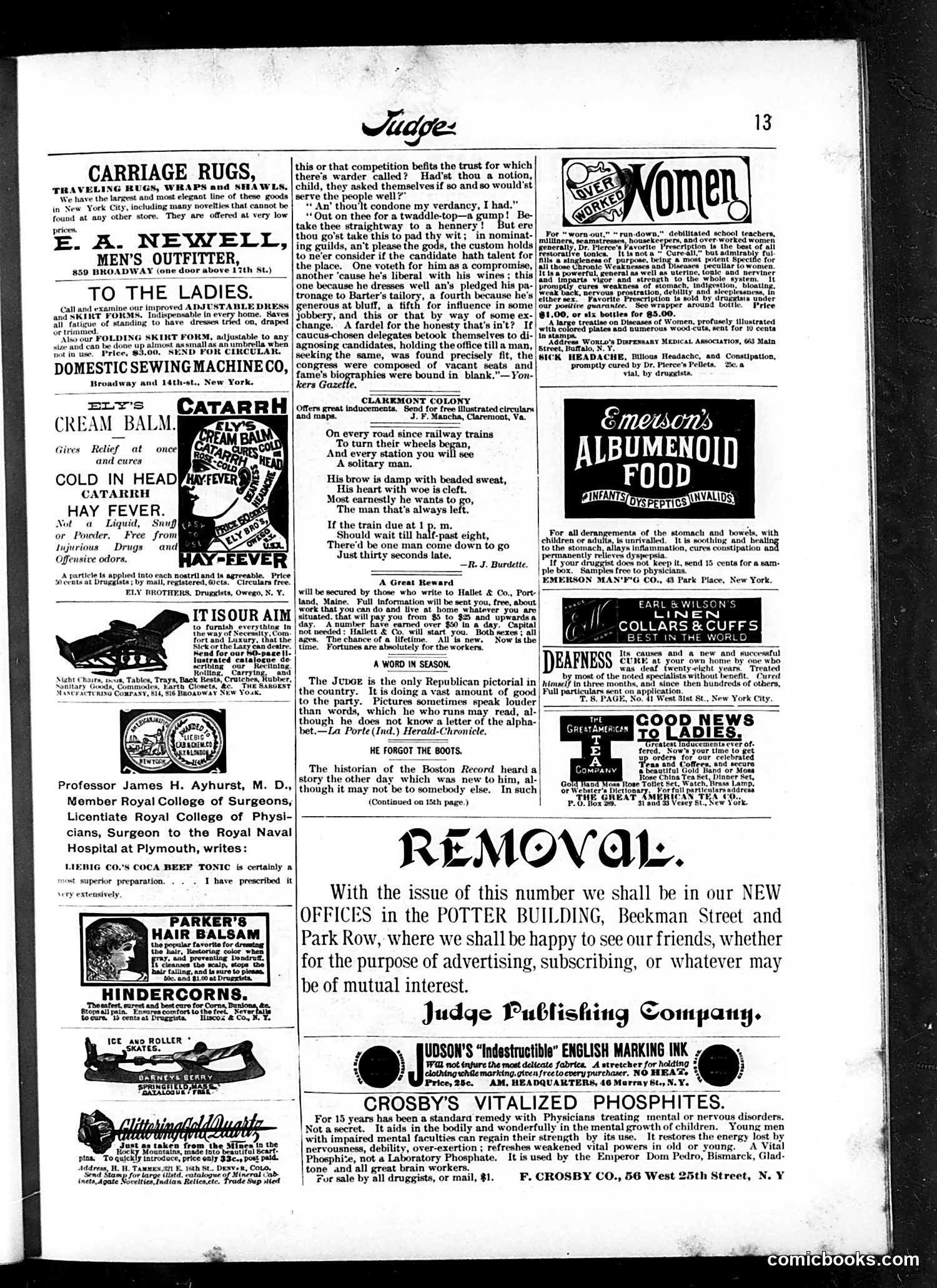
This page is primarily **advertising**, not political satire. Judge magazine here functions as a vehicle for commercial products rather than social commentary. The notable literary content is a **dialog about political patronage** (top left), where a speaker lectures that elected officials are chosen based on personal favors, wealth, tailoring endorsements, and backroom deals—not merit or fitness for office. This reflects Gilded Age cynicism about corrupt nomination processes and caucus systems. A poem titled "The Man That's Always Left" describes someone perpetually missing trains, a mundane humor piece. The remainder consists entirely of **period advertisements**: sewing machines, hair products, medical tonics, carriage rugs, and remedies for corns and headaches. A notice announces the magazine's office relocation to the Potter Building. No identifiable political figures or specific events are caricatured on this particular page—it represents Judge functioning as a general-interest publication with satirical articles alongside commercial content.
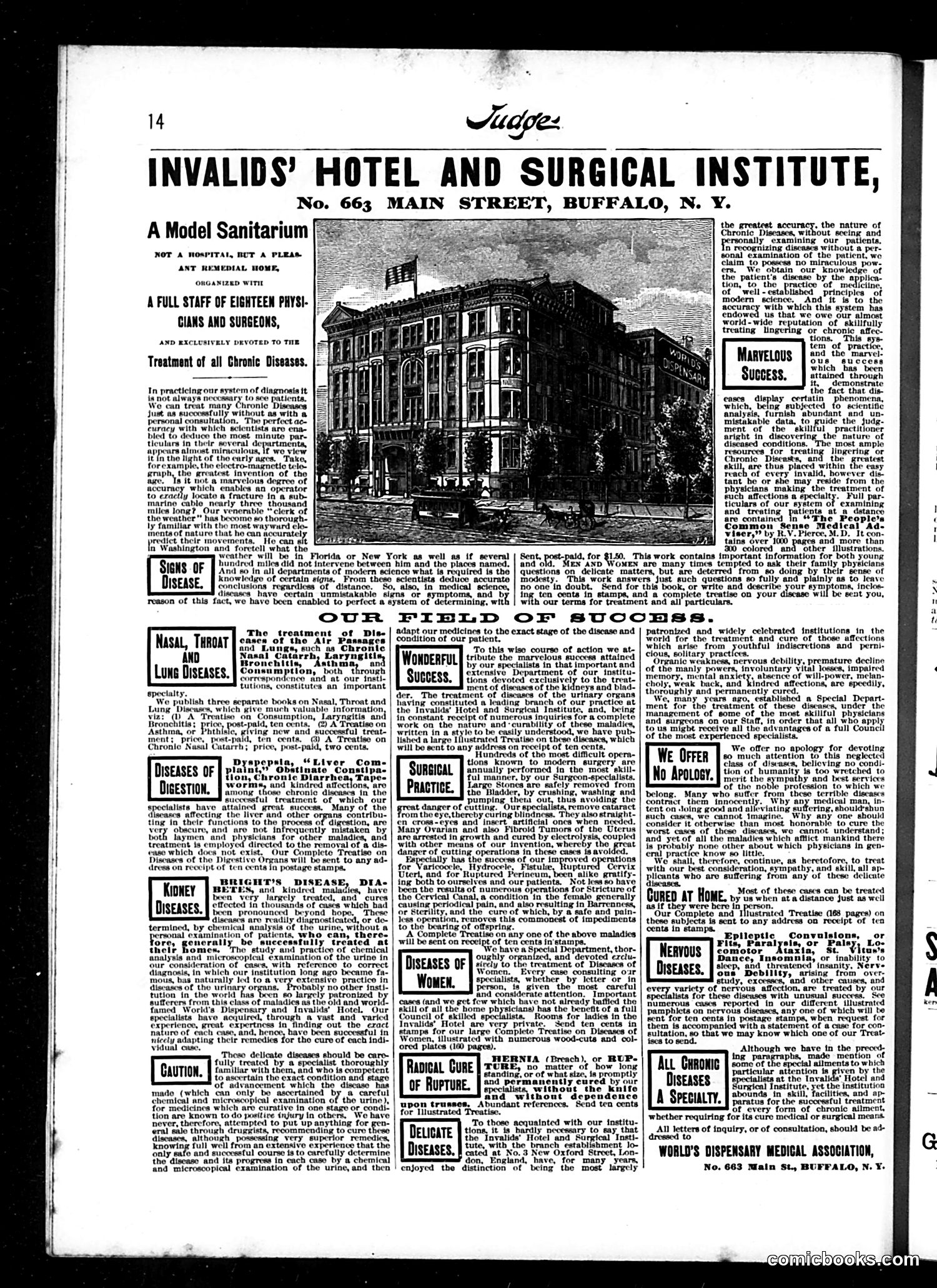
This page is primarily **medical advertising**, not political satire or cartooning. It's an advertisement for the "Invalids' Hotel and Surgical Institute" in Buffalo, New York—a private medical facility claiming to treat chronic diseases. The building photograph shows a substantial multi-story structure. The ad emphasizes that doctors can diagnose patients remotely "without seeing" them, comparing this to telegraph technology and weather prediction—dubious claims that would be considered fraudulent today. The marketing uses pseudo-scientific language ("electro-magnetic telegraph," "Modern science") to legitimize treatments for conditions like consumption (tuberculosis), asthma, digestive disorders, and women's diseases. The repeated phrase "Marvelous Success" appears designed to convince desperate chronically ill patients. **Context**: This reflects the Gilded Age medical marketplace, when unregulated private institutes made exaggerated therapeutic claims. This predates modern FDA oversight and medical licensing standards.
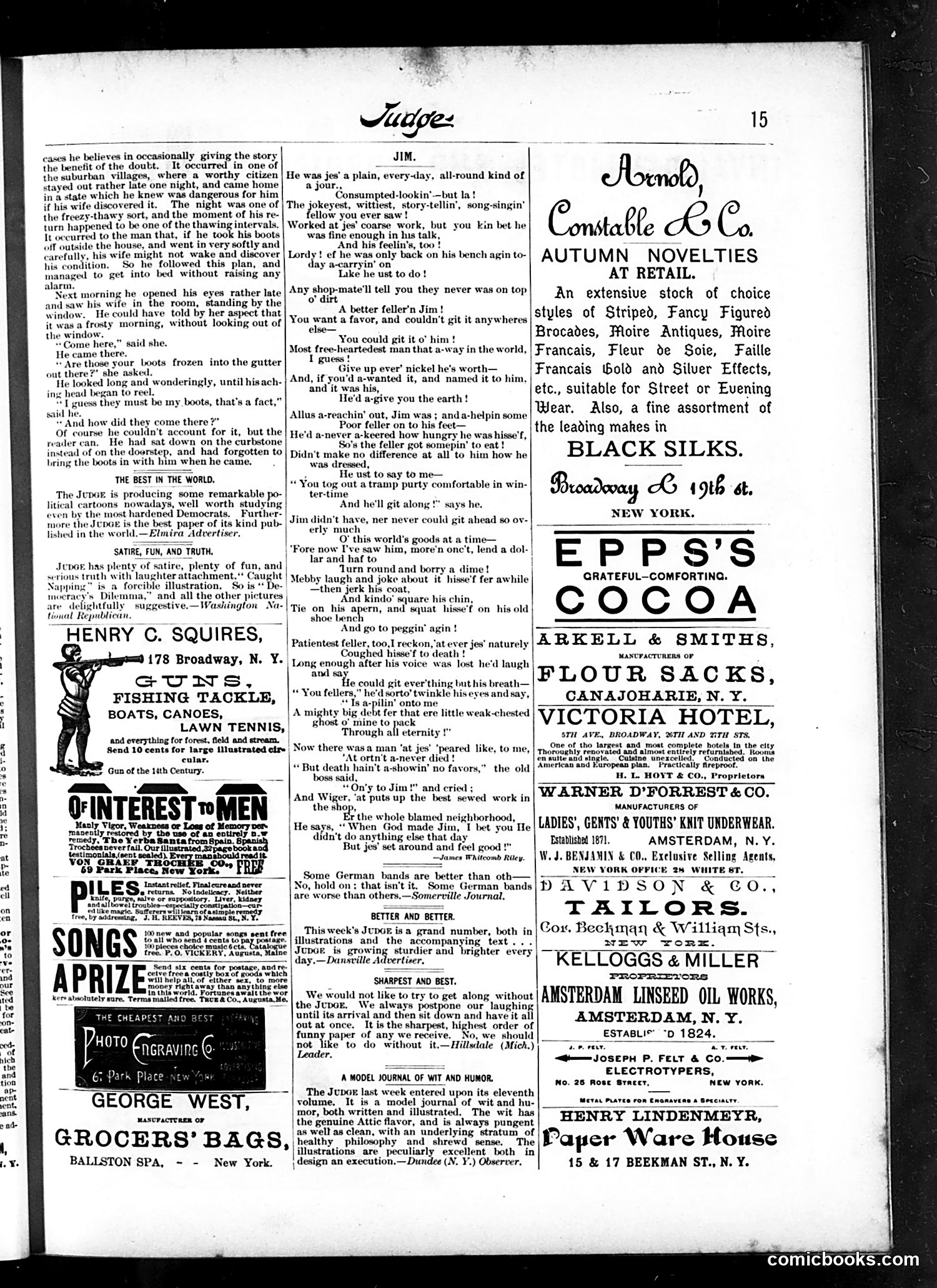
This page is primarily **advertisements and filler content**, not political cartoons. The main narrative text is a sentimental short story titled "JIM" about a working-class man—described as plain-looking but generous-hearted, witty, and selfless. The story, written in dialect, celebrates Jim's character: he shares his meager earnings, helps others without complaint, and never worries about his own appearance or hardship. The piece reads as **nostalgic working-class tribute**, possibly commemorative or elegiac in tone (the past tense and reflective voice suggest Jim may be deceased or departed). The rest of the page consists of period advertisements for various commercial products and services (cocoa, silk goods, flour, hotel accommodations, etc.) typical of Judge's revenue model. There is **no visible political cartoon or satire** on this particular page—it appears to be a regular editorial/advertising issue rather than one focused on topical commentary.
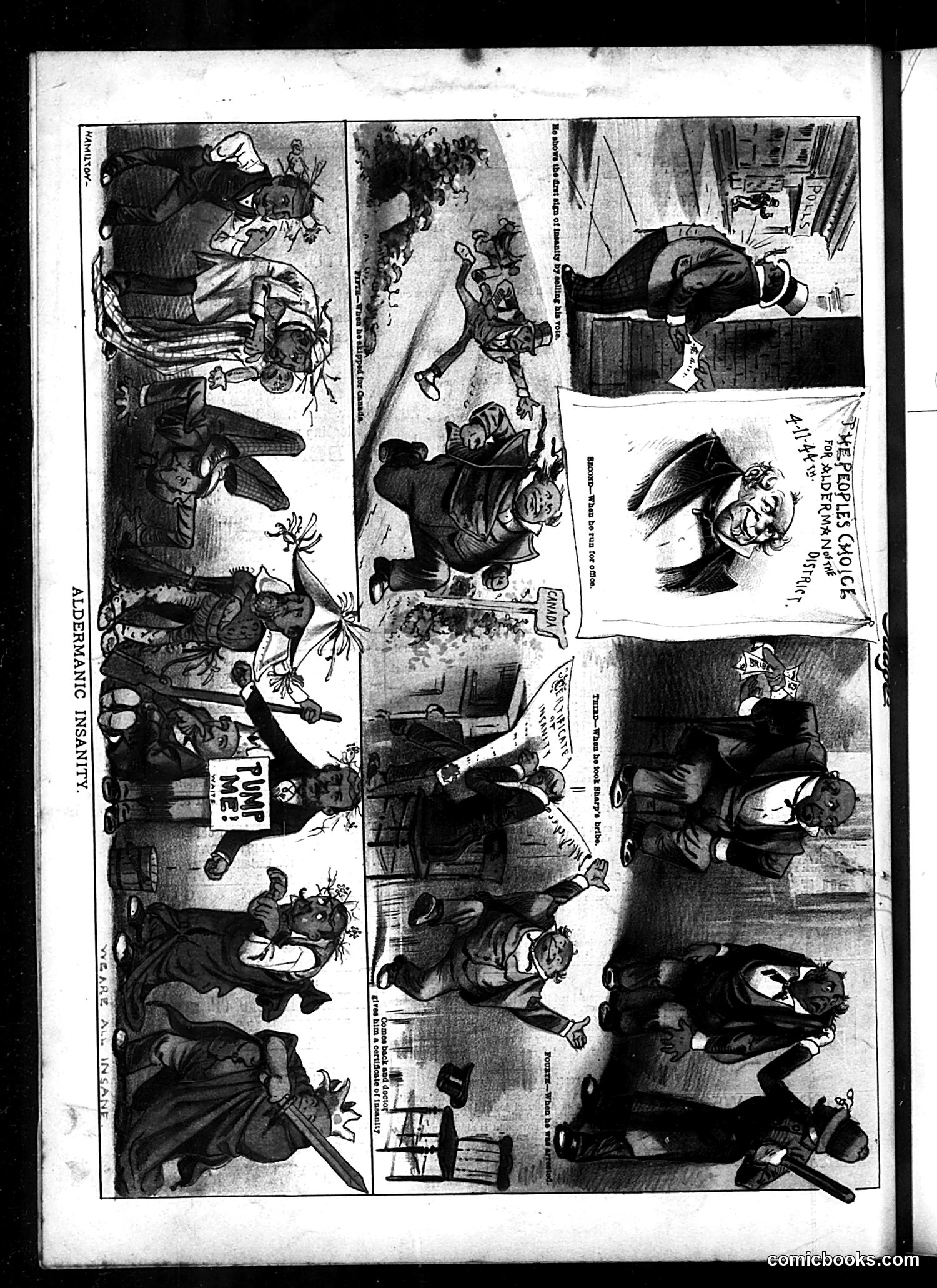
This is a satirical cartoon mocking candidates for alderman (city council members) in what appears to be a Canadian election. The title "The People's Choice for Alderman" is ironic—the figures depicted are clearly meant to represent unsuitable or absurd candidates. The cartoon criticizes municipal politics by portraying aldermanic candidates as various types of lunatics or fools. The caricatures suggest that local politics attracts incompetent, deranged, or morally questionable individuals seeking office. The repeated refrain about "the people's choice" emphasizes the satirist's frustration with democratic voters who support such unfit candidates. "Aldermanic Insanity" suggests the broader message: that municipal government attracts—or that voters foolishly elect—the mentally unfit or corrupt.