
A complete issue · 16 pages · 1886
Judge — September 25, 1886
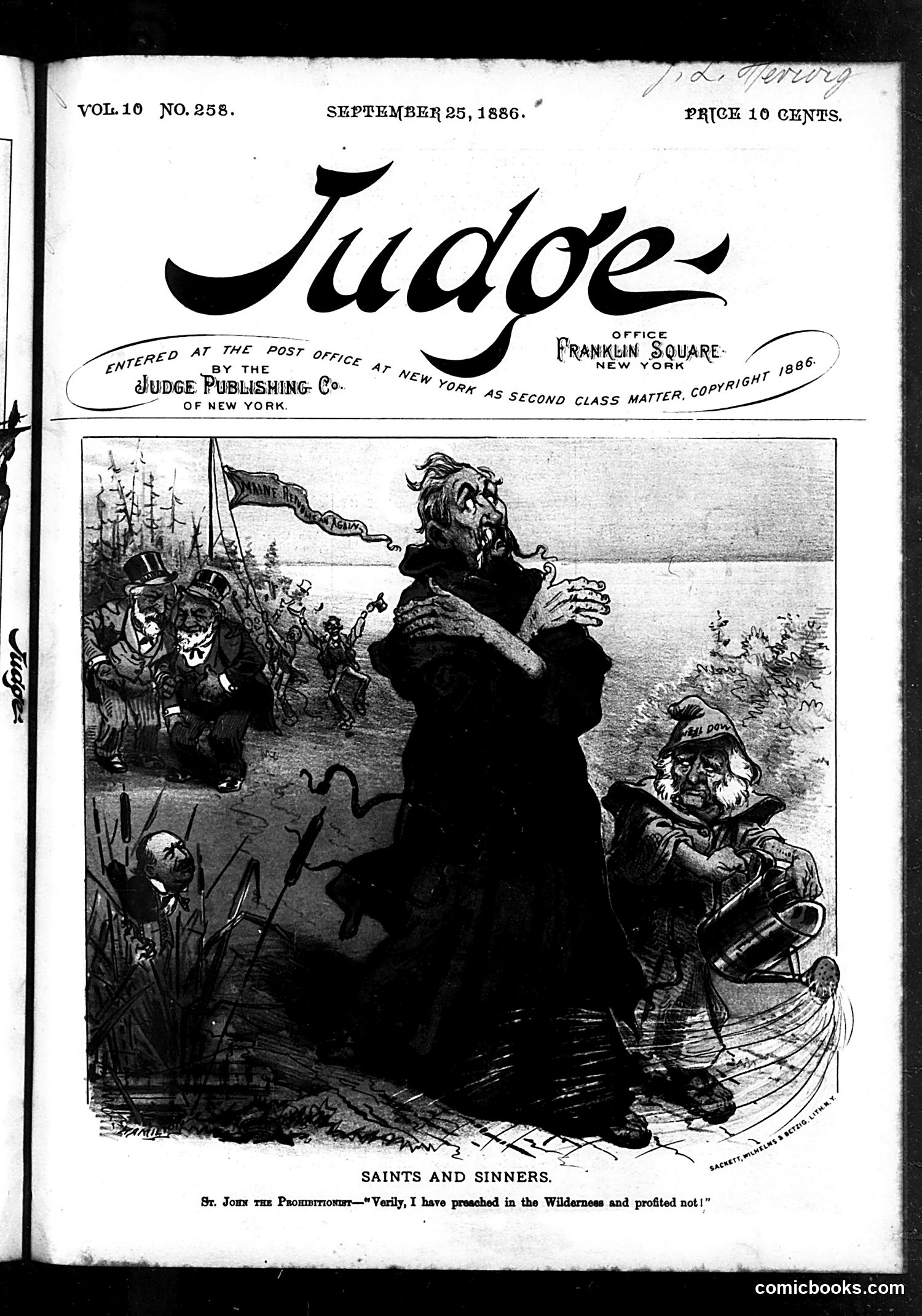
This political cartoon critiques **St. John the Prohibitionist**, depicting him as a hypocritical religious figure. The caption quotes him claiming "Verily, I have preached in the Wilderness and profited not!" The central robed figure appears to represent a temperance advocate or prohibitionist preacher. He's surrounded by smaller figures—likely representing "sinners" or the public he's trying to convert—who seem unimpressed or dismissive of his moral crusade. The satire mocks the ineffectiveness of prohibition advocates in 1886, suggesting their wilderness preaching gains no converts. The "Saints and Sinners" title emphasizes the contrast between the self-righteous prohibitionists and ordinary people who reject their message. This reflects ongoing 19th-century debate over alcohol regulation.
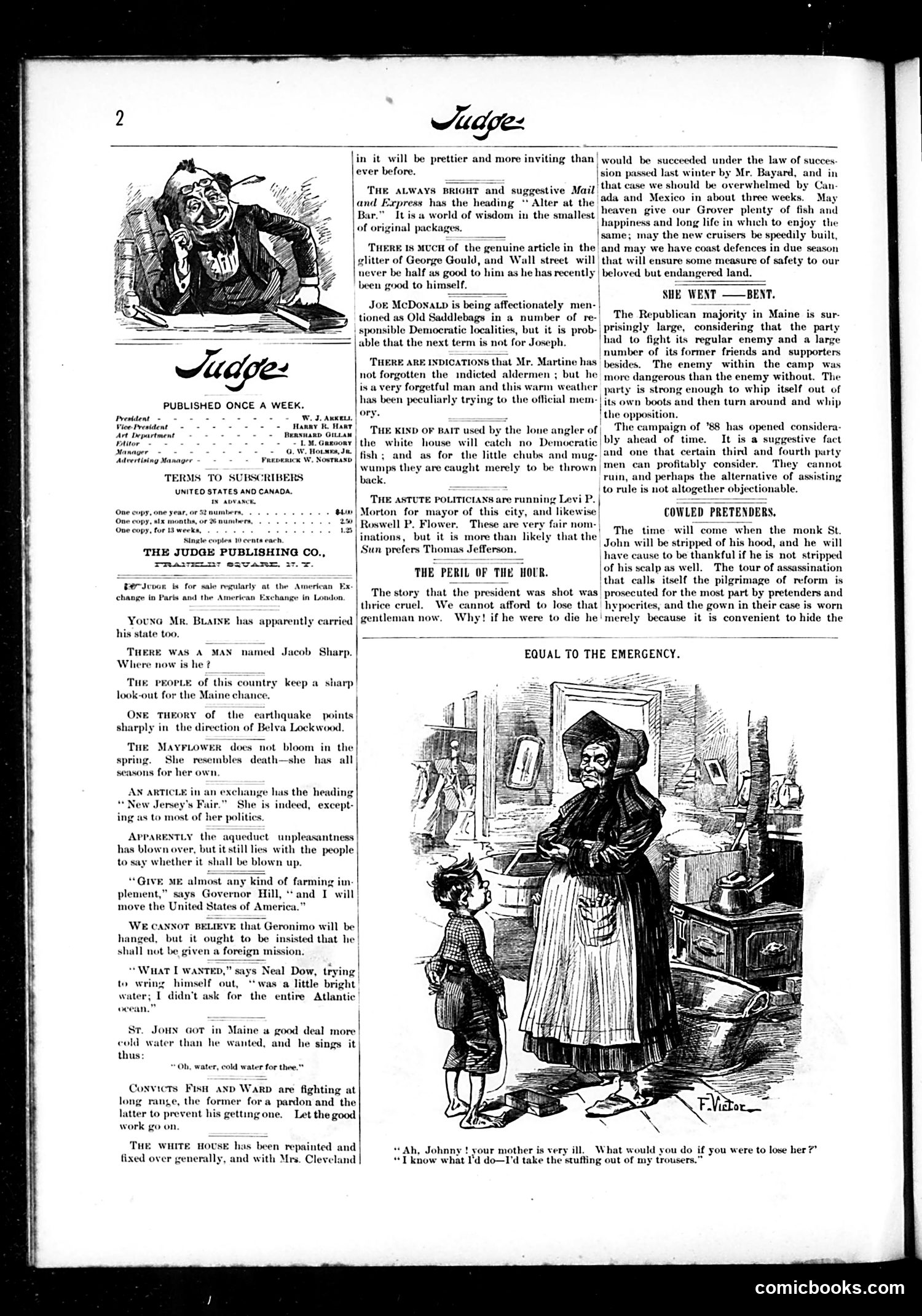
This page contains satirical political commentary and editorial cartoons typical of Judge magazine's format. The main cartoon titled "Equal to the Emergency" depicts a poor woman and child in what appears to be a tenement, with the woman asking what she'd do if she lost her mother—suggesting she'd take "the stuffing out of my trousers." This satirizes poverty and desperation during an economic crisis. The editorial section references contemporary political figures including Joseph McDonald and mentions debates about Democratic politics and presidential succession. References to Maine politics and the "campaign of '88" suggest this dates to the 1880s. The overall tone mocks political pretensions while highlighting working-class suffering, typical of Judge's satirical approach to Gilded Age politics and social conditions.
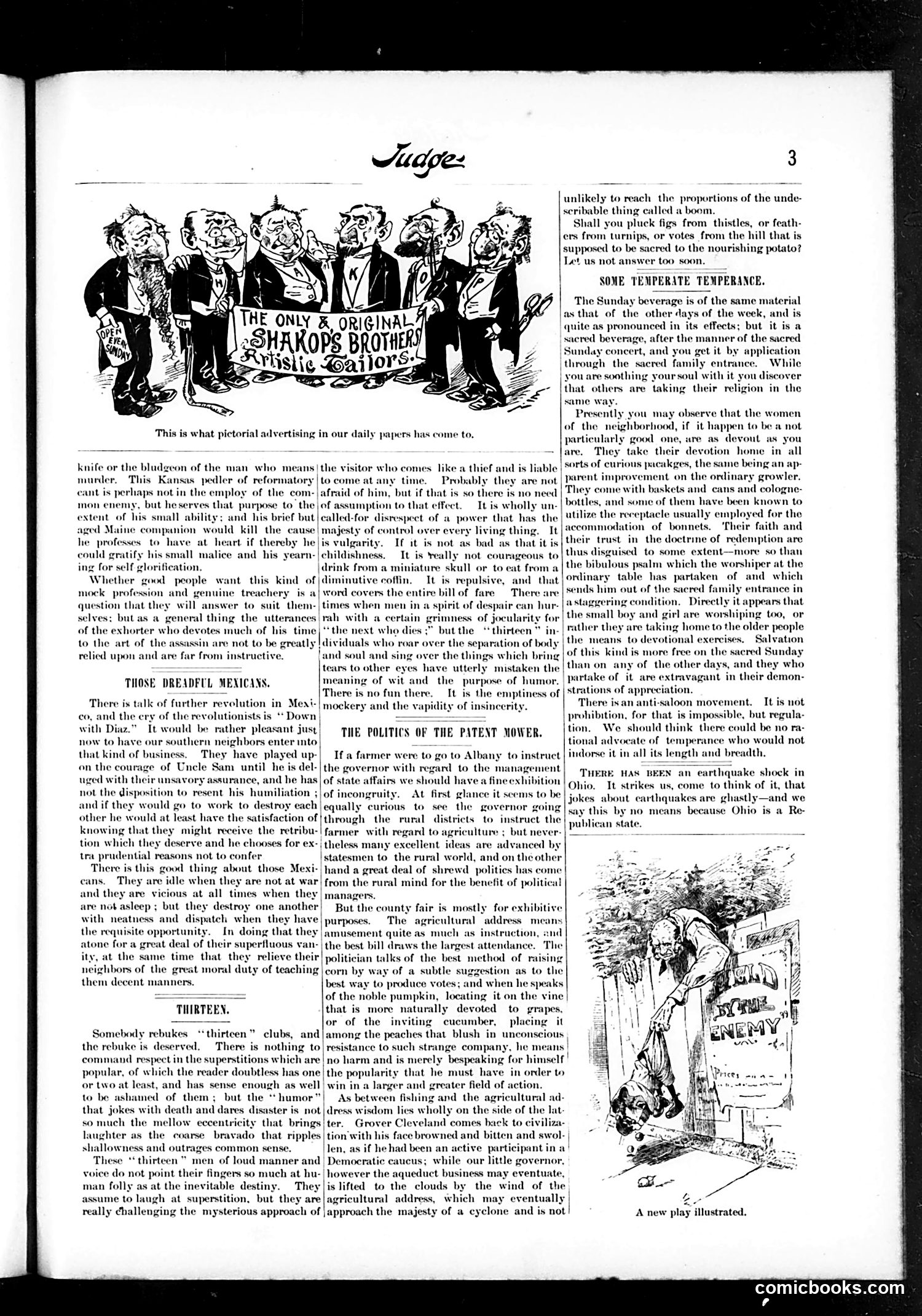
This page contains three separate satirical pieces: **"Shakops Brothers" Cartoon**: The illustrated advertisement mocking fraudulent patent medicine or confidence schemes—typical Judge fodder attacking commercial deception and consumer gullibility. **"Those Dreadful Mexicans"**: A commentary on Mexican political instability and U.S.-Mexico relations. Judge sarcastically welcomes potential Mexican revolution as entertainment, viewing Mexicans as chronically idle or violent, while suggesting Americans shouldn't intervene. This reflects period American attitudes of smug superiority toward Latin American neighbors. **"Thirteen" and "Some Temperate Temperance"**: Social commentary on superstition (mocking "13" clubs) and hypocrisy around Sunday drinking laws. The piece criticizes those using religious pretense to circumvent temperance restrictions—wealthy people obtaining alcohol through "sacred family entrances" while working-class women smuggle drinks in cologne bottles and bonnets. The overall thrust attacks humbug, moral inconsistency, and social fakery across class lines.
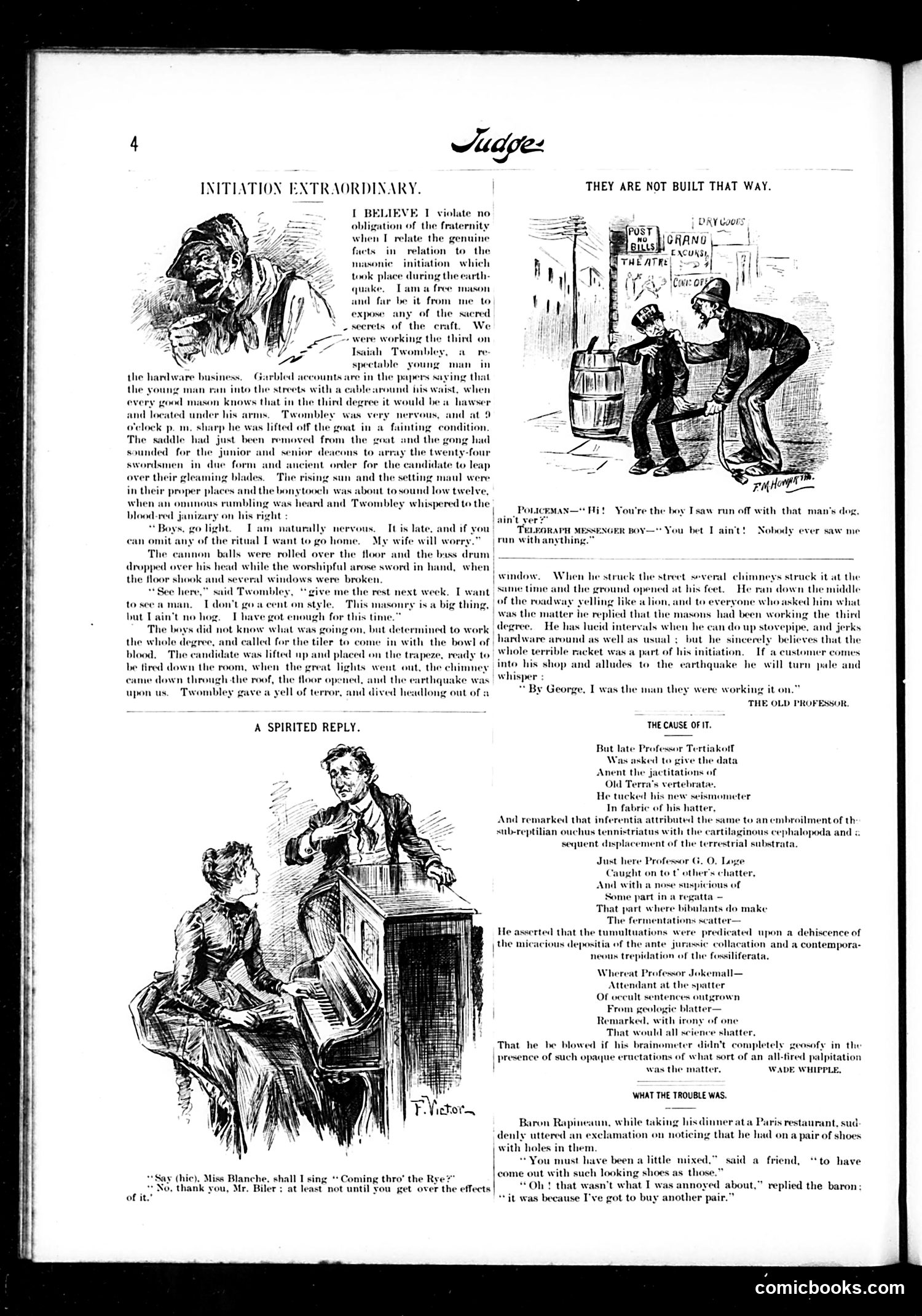
This page contains three satirical pieces typical of Judge's humor: **"Initiation Extraordinary"** (top left): A mason describes a chaotic fraternal initiation where candidate Twombley nearly dies during an elaborate ritual involving cannons, swords, and symbolism. When an actual earthquake strikes, Twombley escapes through the roof thinking it's part of the hazing—satirizing the absurdity and danger of secret fraternal initiation ceremonies. **"They Are Not Built That Way"** (top right): A street urchin claims he didn't run off with a man's dog, while a messenger boy confirms no one could outrun with a dog—a simple joke about a dog's loyalty or the boy's incredulity. **"A Spirited Reply"** (bottom): Two academics argue using deliberately obfuscated scientific jargon about causes of earthquakes, mocking pretentious intellectuals who hide ignorance behind incomprehensible terminology. **"What the Trouble Was"** (bottom right): A baron dining in Paris is annoyed about worn shoes—not because they're embarrassing, but because he must buy another pair, satirizing wealthy aristocratic priorities.
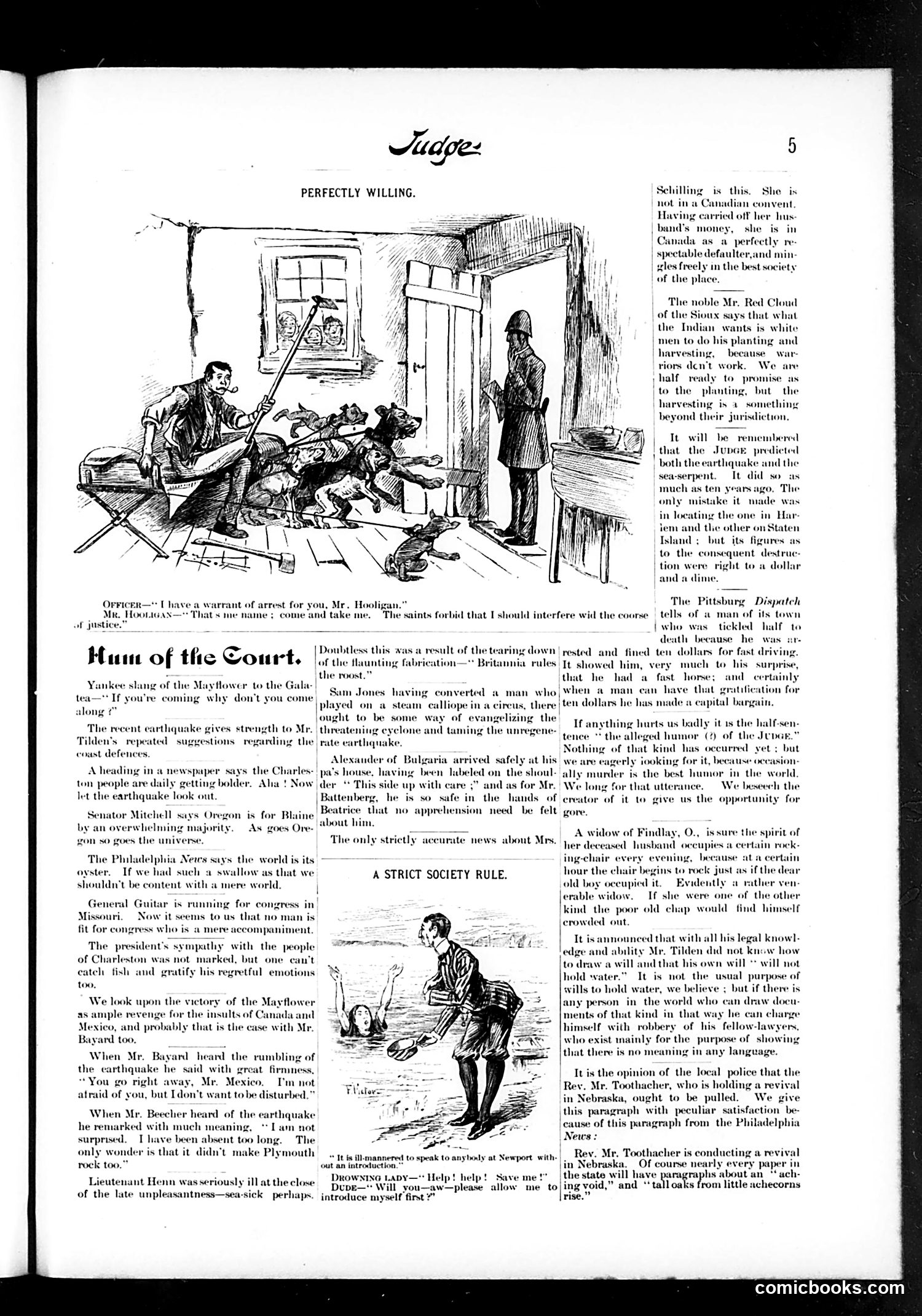
This page contains several brief satirical items rather than a single cartoon: **"Perfectly Willing"** depicts a police officer arresting an Irish immigrant (indicated by the name "Hooligan"), illustrating anti-Irish stereotypes common in late 19th-century America. **"Hum of the Court"** collects political jokes mocking contemporary figures: President Tilden's earthquake predictions, General Garfield's congressional qualifications, and Henry Ward Beecher's (a famous minister) absence from Plymouth Rock. **"A Strict Society Rule"** shows a gentleman at Newport (the elite resort) awkwardly introducing himself without proper introduction—satirizing rigid upper-class social protocols. The content reflects Judge's focus on domestic politics, social pretension, ethnic stereotypes, and religious figures. Most references are now obscure without historical context, though the satire of class rigidity and political incompetence remains recognizable.
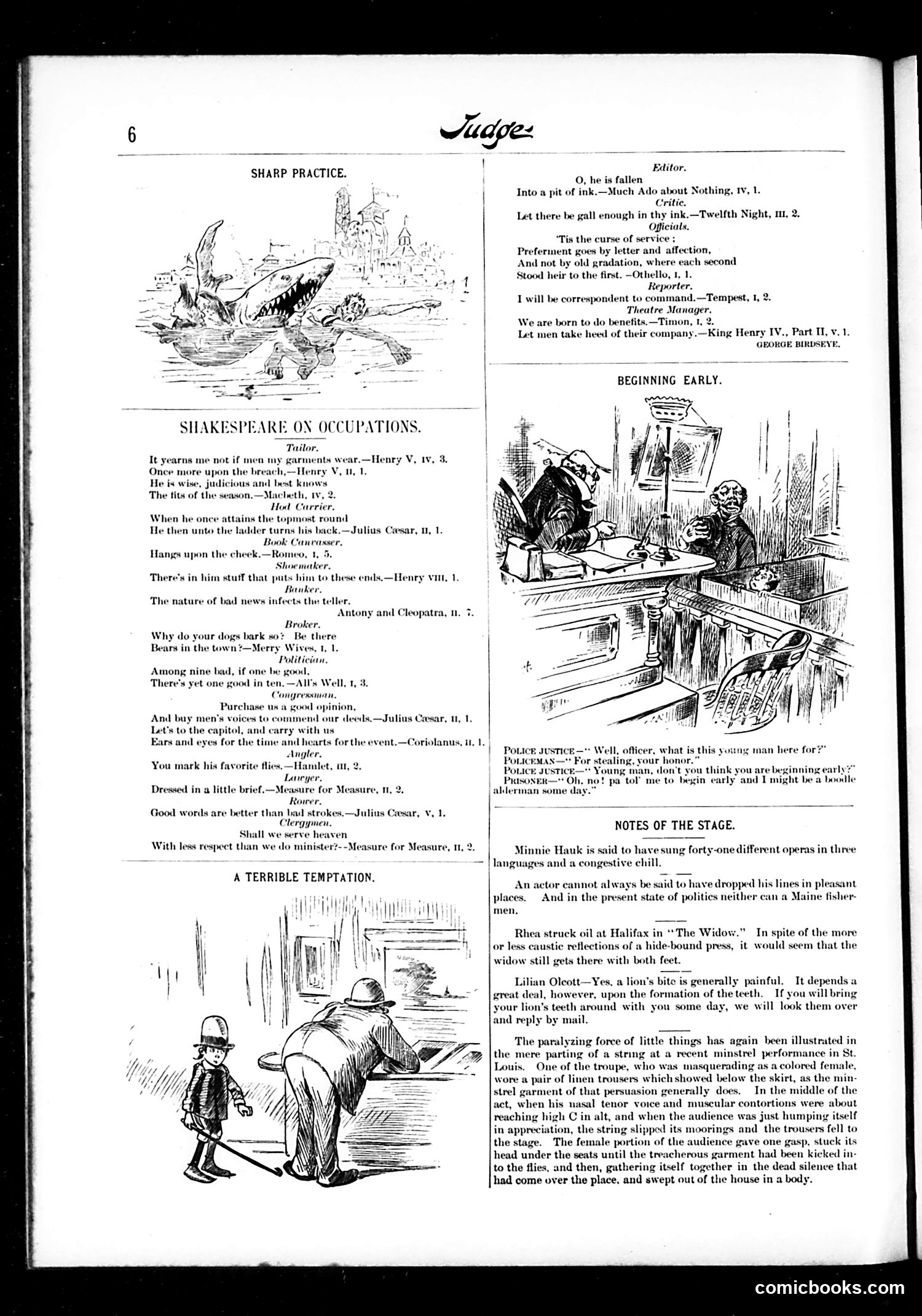
This page from *Judge* combines literary humor with social commentary. The main feature, "Shakespeare on Occupations," pairs Shakespeare quotations with various professions—tailors, bankers, politicians, congressmen, lawyers—using the Bard's words to satirize each group's character flaws or motivations. A congressman, for instance, is matched with a quote about buying men's votes, suggesting corruption in American politics. The cartoons "Sharp Practice" and "A Terrible Temptation" depict predatory or unethical behavior in unnamed professions, typical of Gilded Age satirical commentary on business and professional misconduct. "Beginning Early" jokes about a child's ambition to become an alderman—poking fun at municipal politics and suggesting even children recognize corruption's path to power. The "Notes of the Stage" section offers theatrical gossip and absurdist anecdotes, characteristic of *Judge's* light entertainment mixed with sharper social critique.
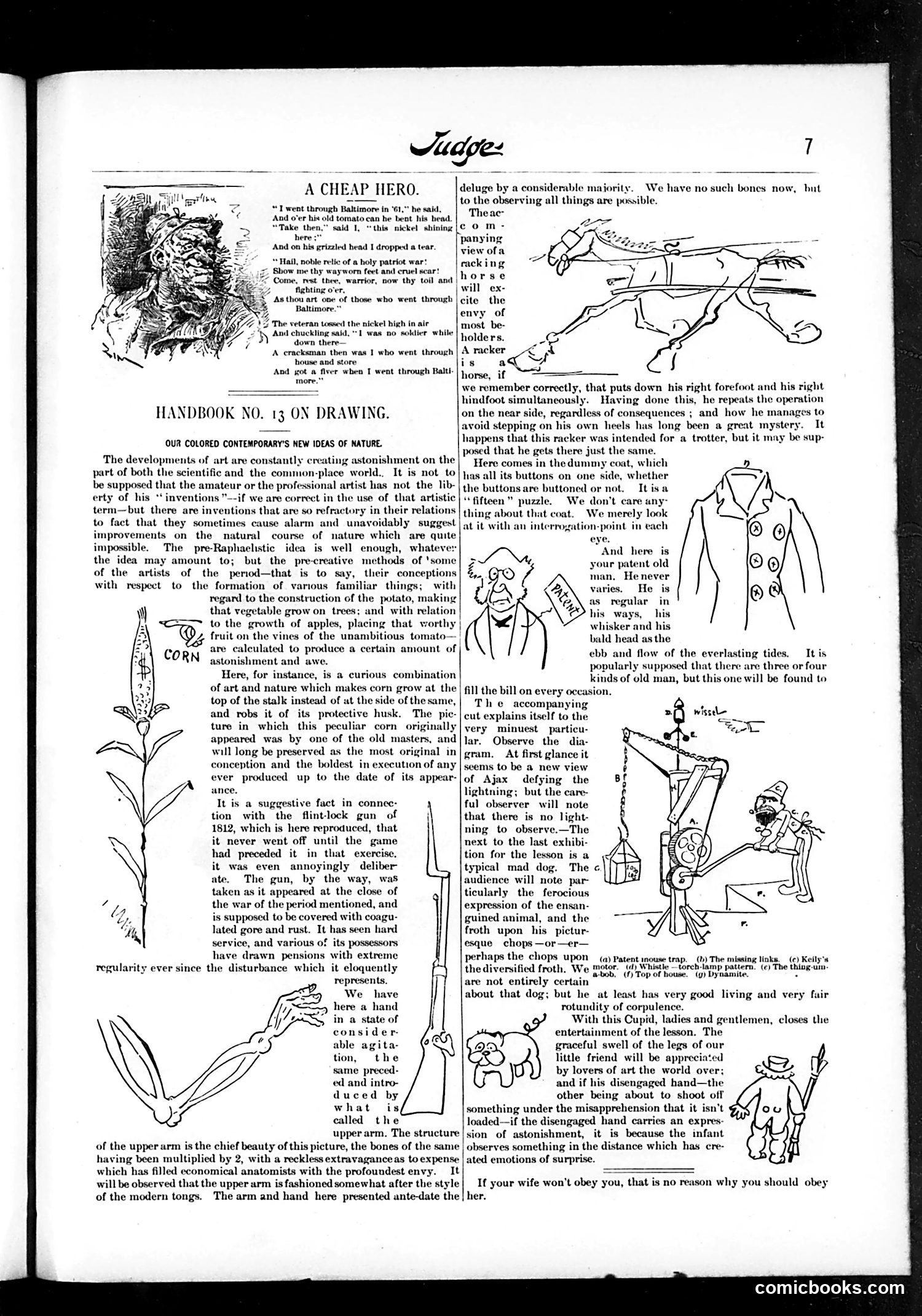
This poem mocks the exploitation of Civil War veteran status. A man claims to have fought in Baltimore during the 1861 conflict, earning sympathy and a nickel from the narrator. The twist: he admits he was actually a "cracksman" (burglar) who robbed houses and stores during that period—the "fiver" (five dollars) he got came from theft, not combat. The satire targets both the fabrication of military credentials and the public's gullible sentimentality toward supposed war heroes. By the Gilded Age when *Judge* published this, pension fraud and false veteran claims were widespread problems, making the "cheap hero" a recognizable social nuisance. The second section on drawing humorously critiques anatomically impossible or absurd artistic representations—exaggerated anatomy, misplaced corn growth, and incorrectly-constructed horses—likely referencing contemporary art movements or amateur pretensions that *Judge* found ridiculous.
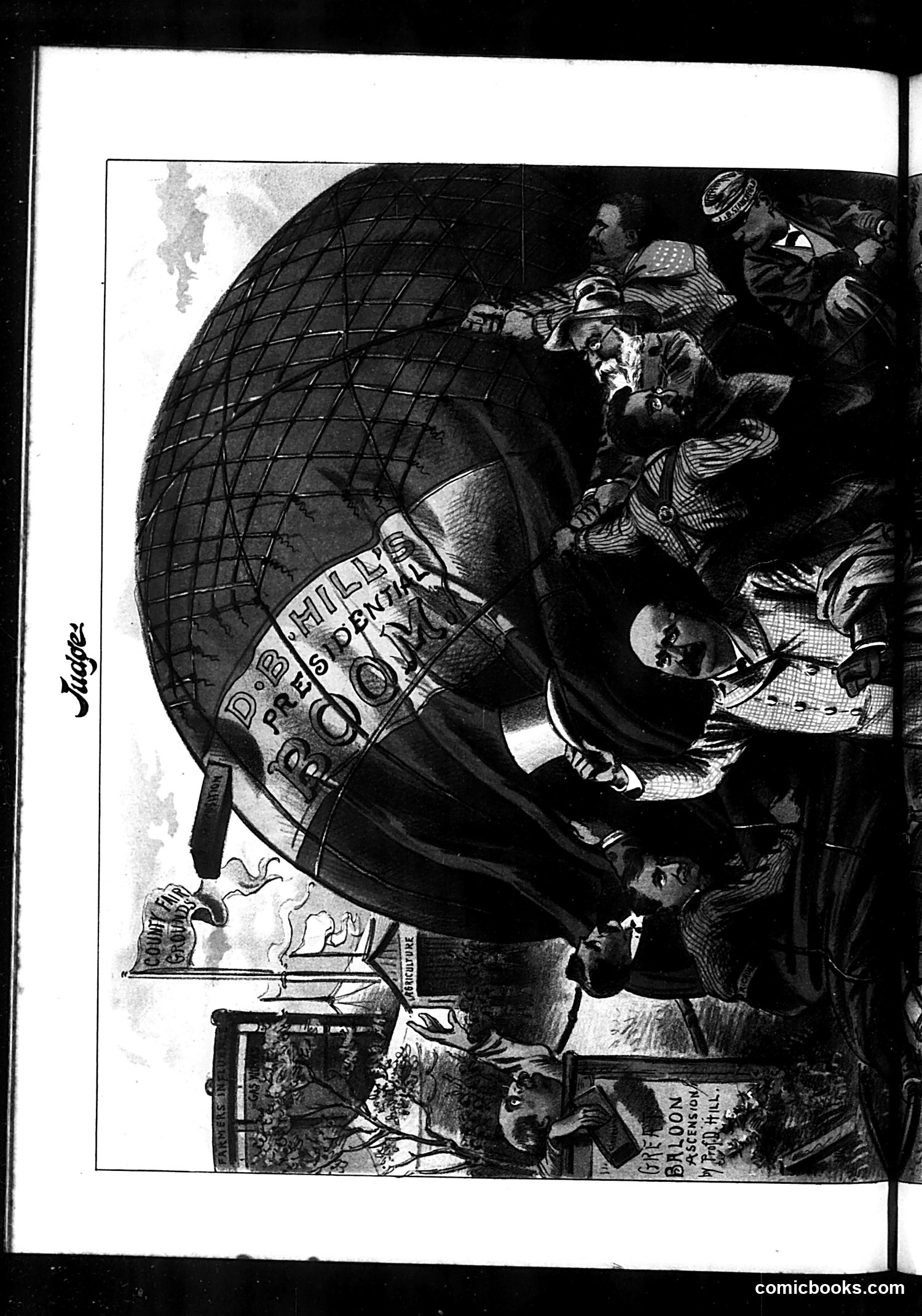
I can see this is a political cartoon from Judge magazine, rotated 90 degrees. The image shows a large globe/world being examined or worked on by multiple figures in period dress and hats. There appears to be text on the globe reading "DULL PROSPERITY" (or similar), and additional text that's partially visible at the base. However, the image quality, rotation, and OCR limitations make it difficult for me to confidently identify the specific figures, the exact date of publication, or the precise political event being satirized. To provide accurate historical context rather than speculation, I'd need a clearer, properly-oriented image or additional publication information from Judge magazine's archives.
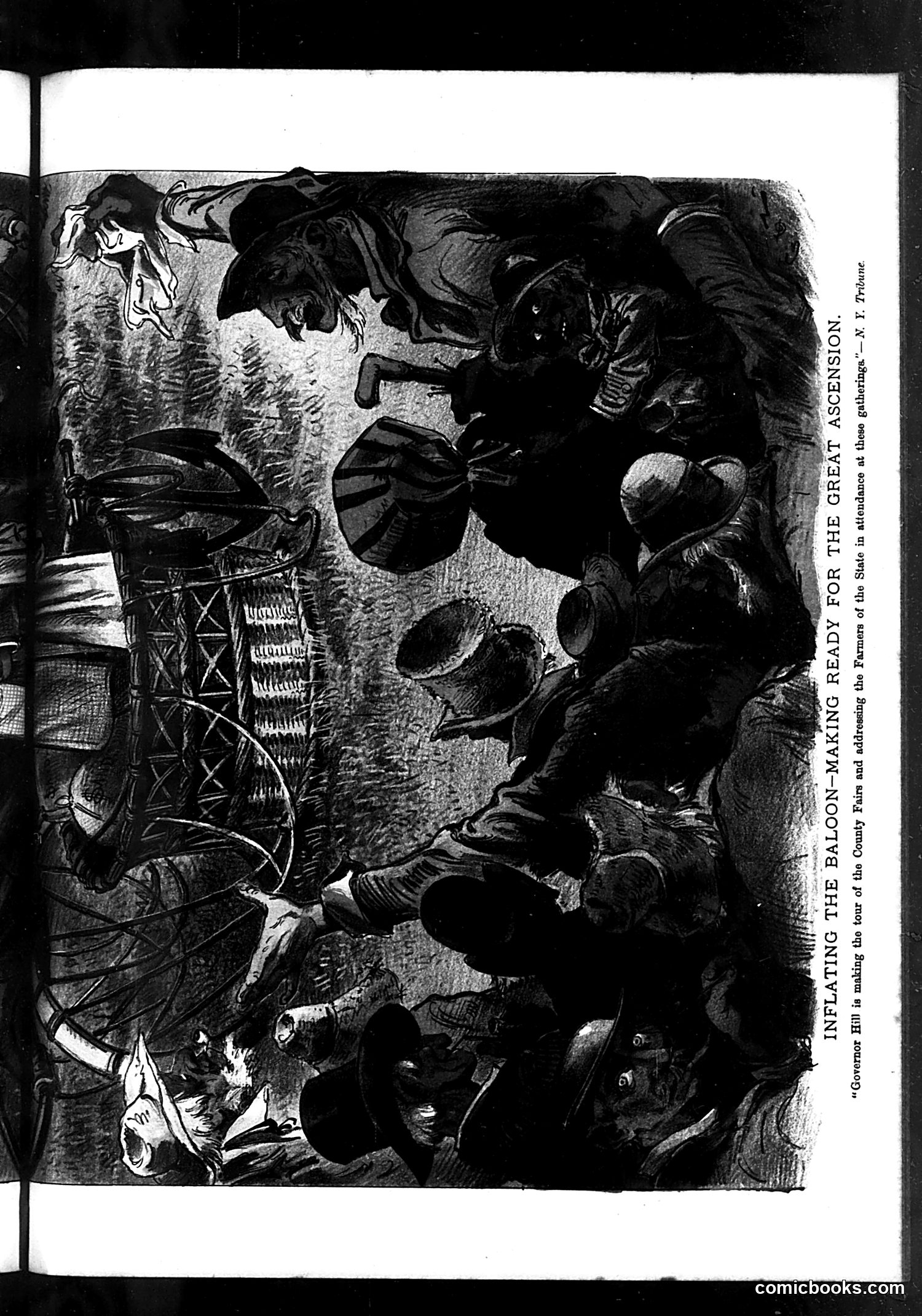
This political cartoon satirizes electoral corruption, likely from the Gilded Age or Progressive Era. The OCR text is heavily corrupted, but the title refers to "inflating the ballot box" — a metaphor for fraudulent vote-counting or ballot stuffing. The image shows figures (likely politicians or party operatives) working with what appears to be large ballot boxes or voting equipment, depicted in exaggerated, grotesque style typical of Judge magazine's satirical approach. The "ascension" reference suggests climbing to power through dishonest means. The satire targets the widespread electoral fraud common in American politics during this period — a major reform issue. The cartoon's grotesque rendering emphasizes the moral corruption underlying such practices, mocking those who would manipulate democracy through inflated vote counts rather than legitimate electoral processes.
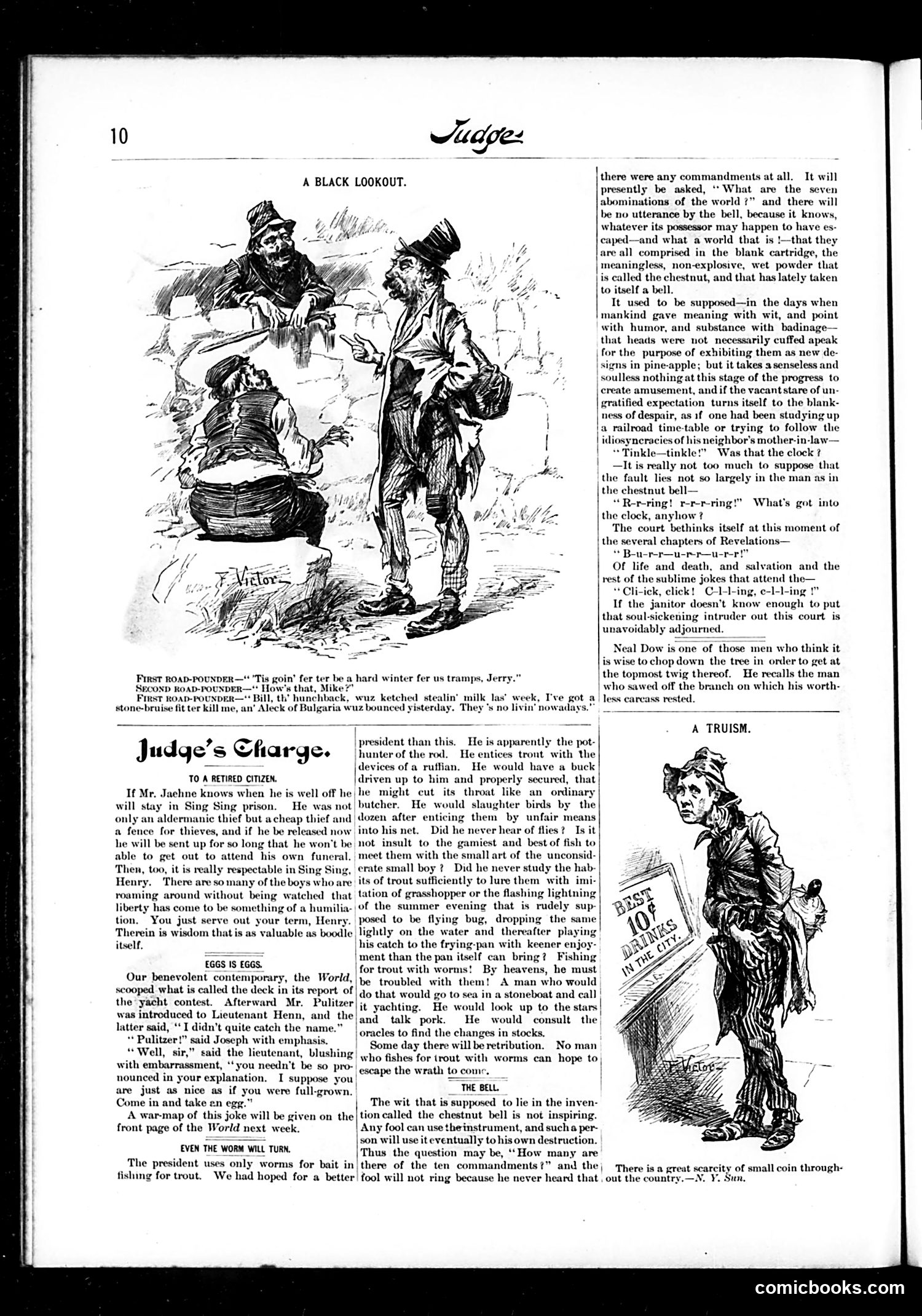
This page from Judge magazine (date unclear from image) contains three satirical pieces: **"A Black Lookout"**: The cartoon depicts tramps discussing hardship. The humor relies on colloquial speech and the tramps' resigned acceptance of misery, typical of late 19th-century social humor. **"Judge's Charge to a Retired Citizen"**: Sarcastically advises alderman Jaehne to remain imprisoned in Sing Sing rather than be released, mocking both prison corruption and political graft. The joke: prison is "respectable" because so many politicians are there. **"A Truism"**: Mocks a wealthy sportsman (likely President Theodore Roosevelt, suggested by context about hunting/fishing practices) for unsporting behavior—using worms instead of flies, driving deer to be shot, using bird-luring devices. Judge attacks his pretense to gentlemanly sportmanship while engaging in crude, working-class hunting methods. These pieces exemplify Judge's critique of political corruption, hypocrisy among the wealthy, and social pretension in the Progressive Era.
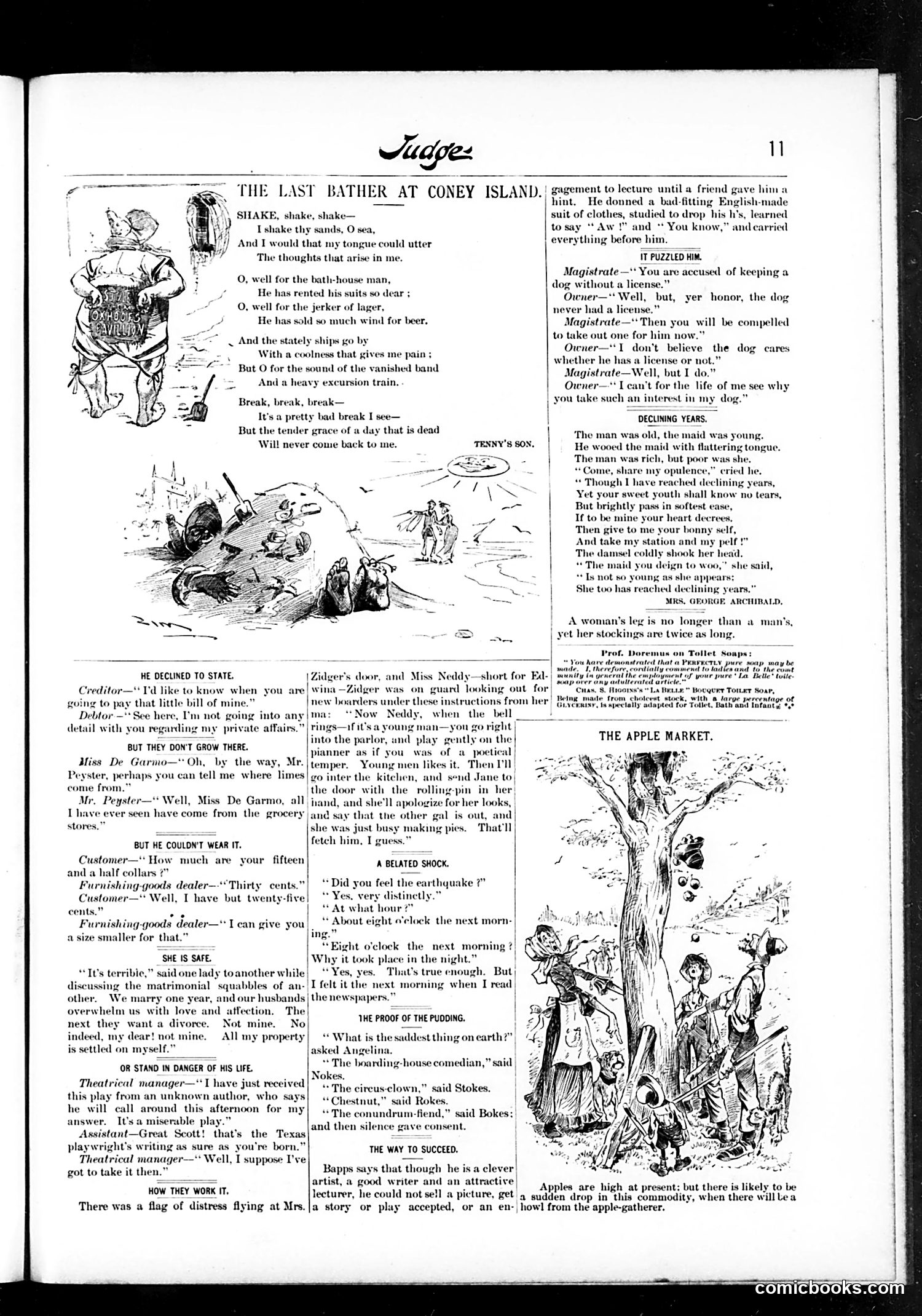
This page contains multiple satirical pieces typical of Judge's late-19th-century humor: **"The Last Bather at Coney Island"** parodies Tennyson's "Break, Break, Break," applying melancholic Victorian poetry to a mundane beach scene—mocking both literary pretension and the commercialization of Coney Island (bathhouse rentals, beer sales). **The dog-license dialogue** satirizes bureaucratic absurdity: a magistrate insists a dog needs licensing for the dog's own sake, despite the owner's logical objection that the dog "cares" nothing for such formalities. **"Declining Years"** mimics sentimental Victorian courtship poetry, where an older wealthy man proposes to a young woman; she rejects him, implying age affects women's desirability identically to men's. **The remaining sketches**—about lime sources, collar sizes, and earthquake reporting—are brief comic dialogues exploiting misunderstandings or absurd logic common to period humor. The overall tone targets Victorian sentimentality, bureaucratic pomposity, class pretension, and the gap between literary/social conventions and common sense.
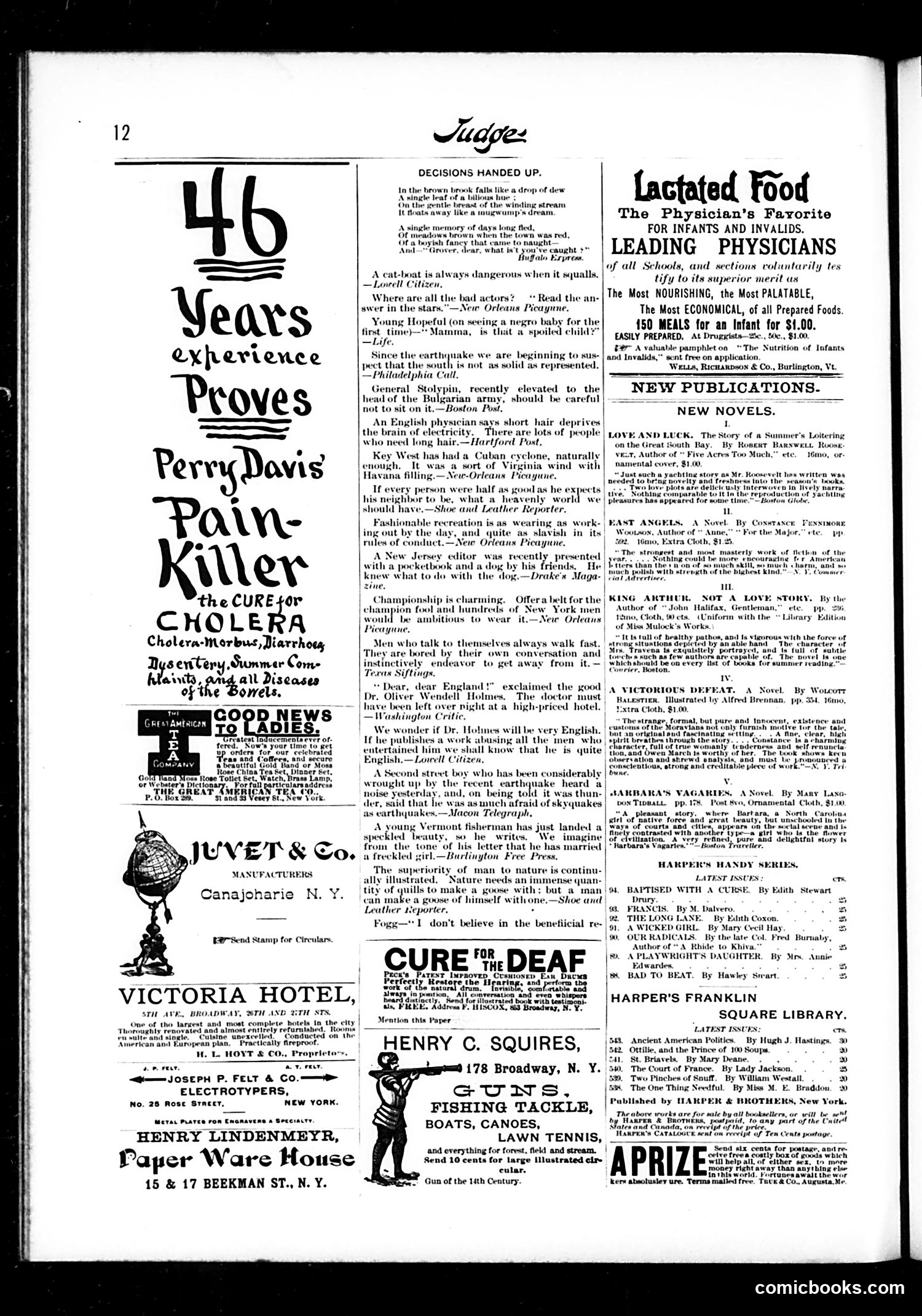
This page is primarily **advertising and literary notices**, not political satire. The left side features Victorian-era product ads (Perry Davis Pain-Killer for cholera, hotels, manufacturing services). The center column, titled "DECISIONS HANDED UP," contains **brief humorous observations and witticisms**—short jokes on contemporary life. These include remarks about Bulgarian military leadership, fashion trends, English physicians, and newspaper editors. The humor is gentle social commentary rather than pointed political satire: a New Jersey editor receives a dog he doesn't know what to do with; a man mistakes thunder for earthquakes; a fisherman's letter reveals he married "a freckled girl." The right side lists **new book publications** from Harper & Franklin Square Library, including novels and works on history and politics. There is **no identifiable political cartoon** on this page. The content reflects typical Judge magazine material: light social humor, advertising, and literary notices for educated, upper-class readers of the late 19th/early 20th century.
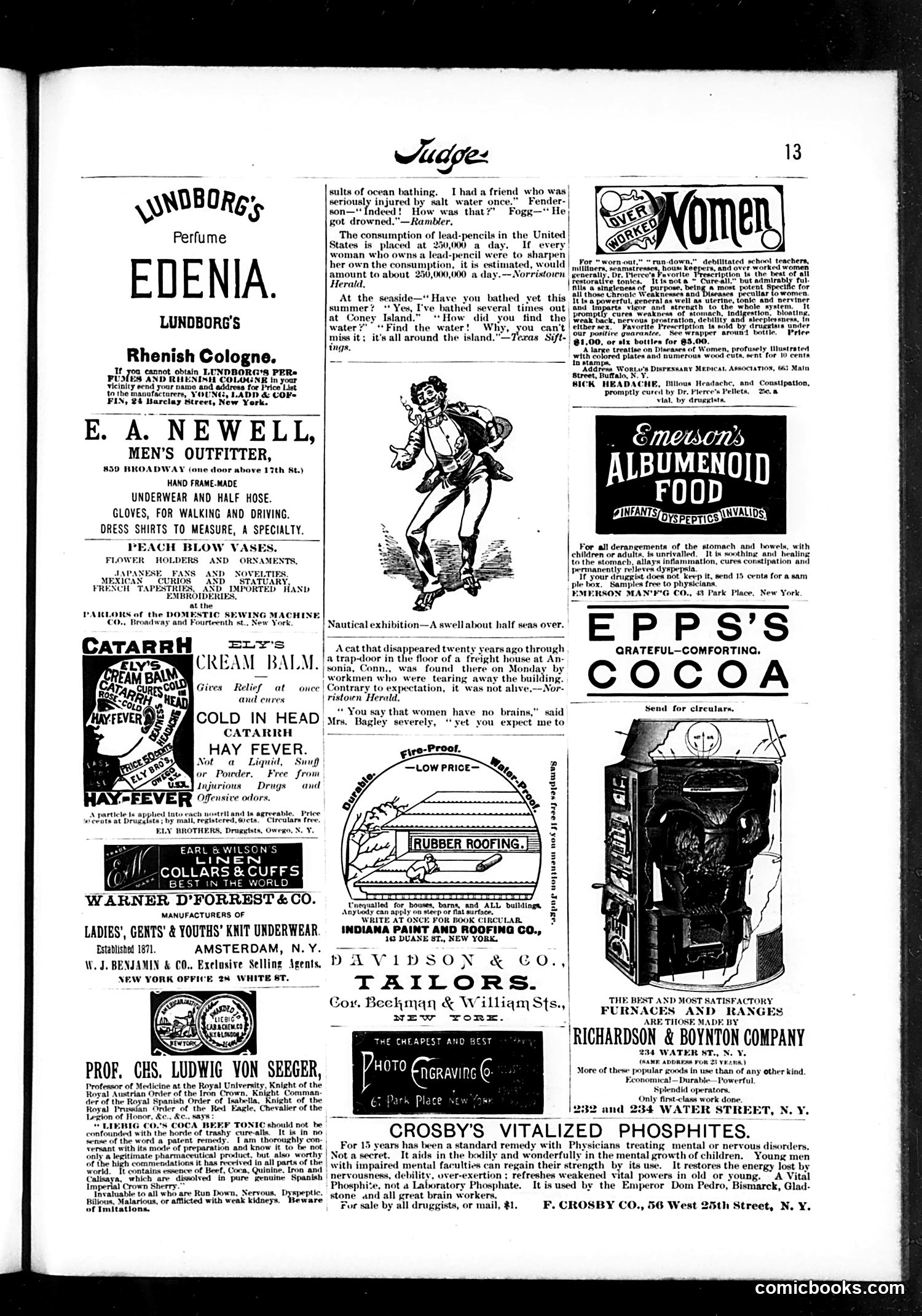
This is primarily an **advertising page** from Judge magazine, with minimal editorial content. The few jokes present are brief and generic: - A crude pun about a man nearly drowning while ocean bathing - A quip about women's hat-pinning difficulties and island geography - A woman sarcastically responds to a man claiming women lack brains The cartoons are small filler illustrations accompanying product advertisements for perfumes, colognes, patent medicines, clothing, and housewares—typical of late 19th-century magazine layout. The single notable visual element is a sketch of a somewhat disheveled man labeled "Nautical exhibition—A swell about half seas over" (a period phrase meaning drunk), but this is minor. Rather than satire, this page reflects Judge's primary revenue model: selling advertising space to patent medicine companies, clothing manufacturers, and dubious health tonics. The magazine's satirical content appears elsewhere; this spread demonstrates how such publications monetized their circulation.
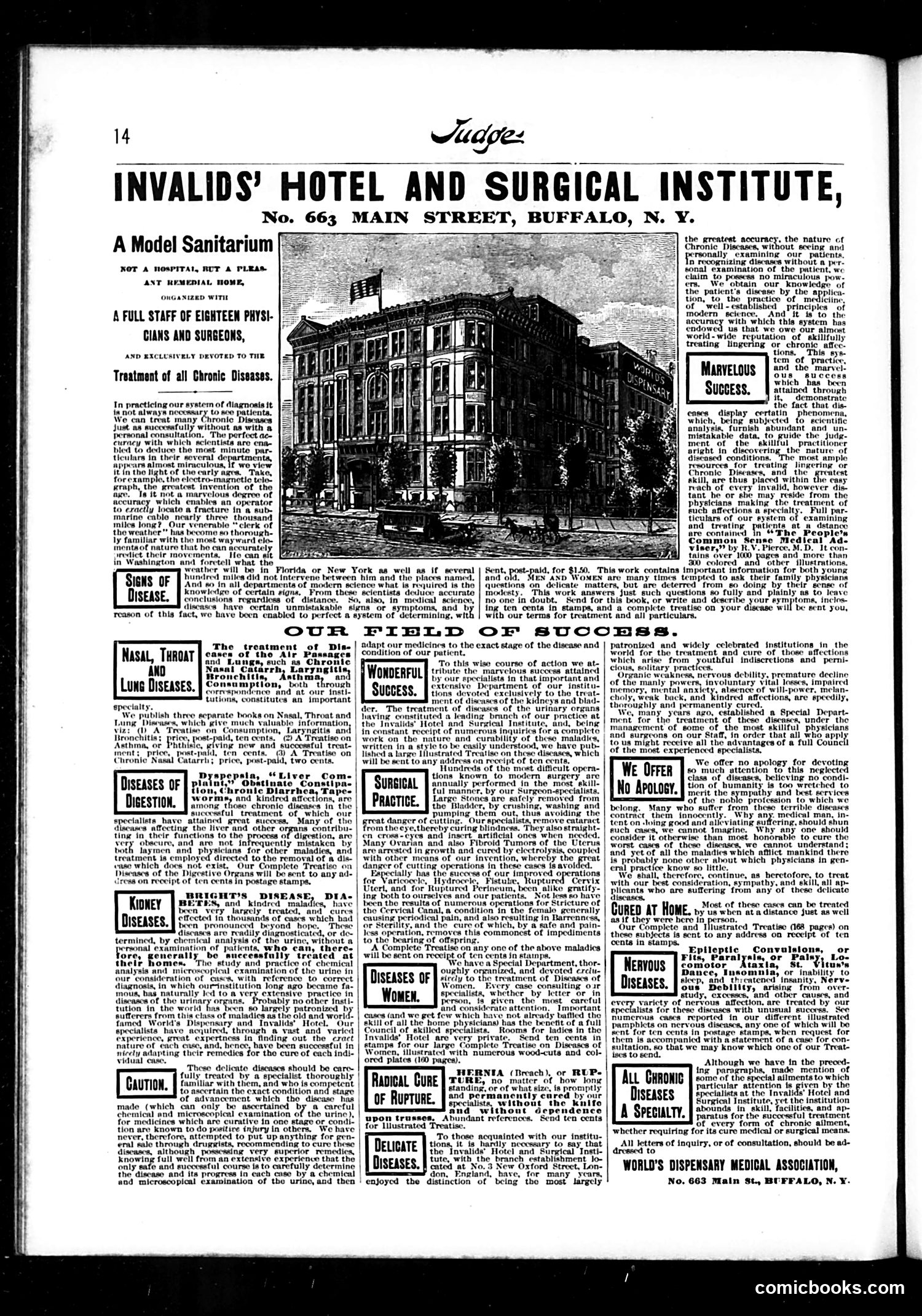
This page is primarily a **medical advertisement**, not a cartoon. It promotes a Buffalo, New York sanitarium claiming to treat chronic diseases through remote diagnosis—physicians allegedly could determine illness "without seeing and personally examining" patients by analyzing symptoms alone. The ad employs pseudo-scientific rhetoric, comparing medical diagnosis to telegraph technology and weather prediction to legitimize treating patients by mail. It advertises an 1000+ page medical guide by R.V. Pierce, M.D., marketed as answering "delicate matters" patients wouldn't ask their own doctors. **For modern readers**: This represents 19th-century **medical quackery**—distance diagnosis was medically baseless. The appeal to emerging technologies (telegraphy, meteorology) as analogies for medical capability would have seemed cutting-edge then but is transparently fraudulent now. The promise of discreet advice on sexual/reproductive health exploited contemporary embarrassment.
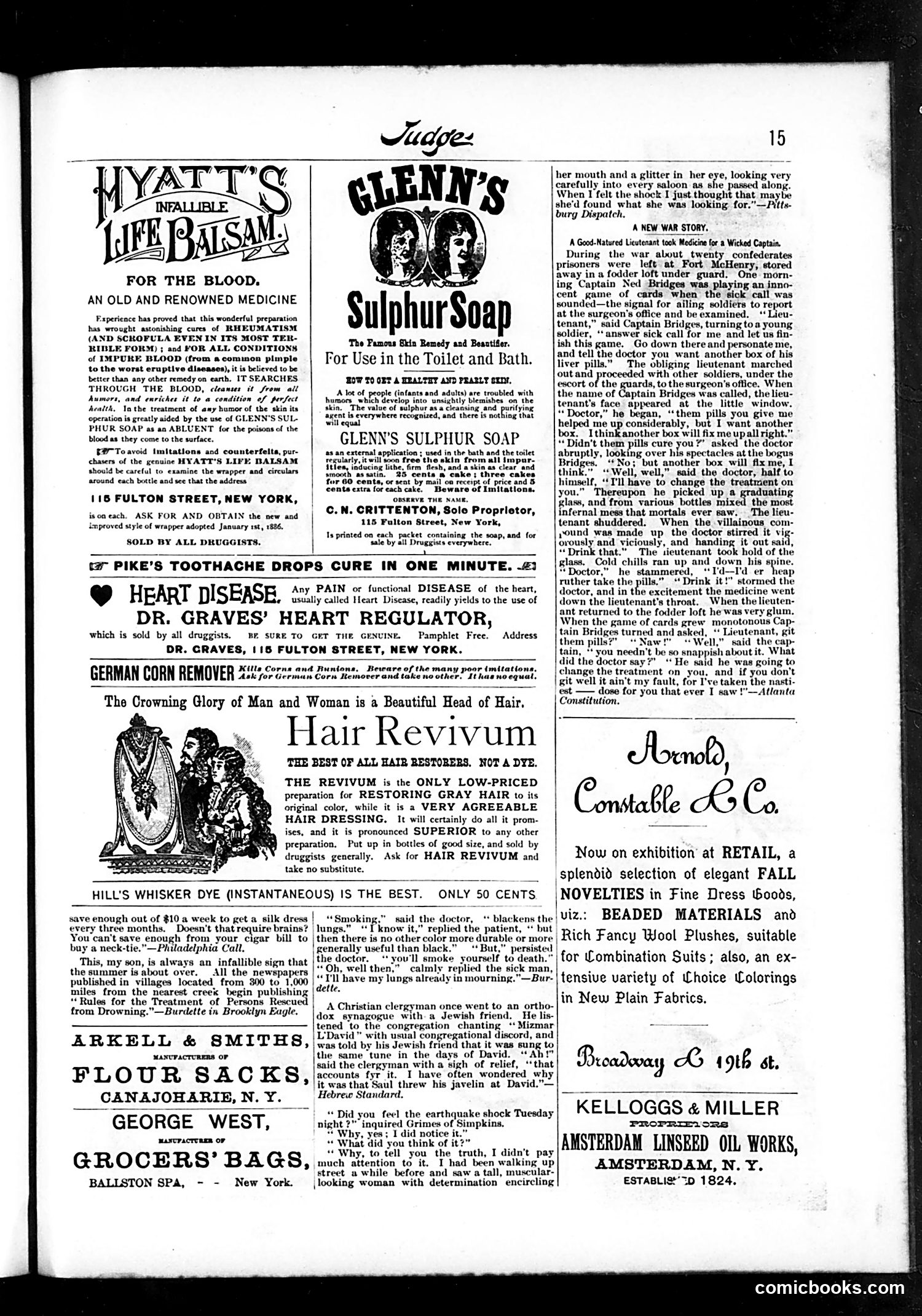
This page is primarily **advertisements and a humorous war anecdote**, not political satire. **The Main Story:** "A Good-Natured Lieutenant took Medicine for a Wicked Captain" depicts a Civil War incident at Fort McHenry. A captain named Ned Bridges evades sick call by ordering a young lieutenant to impersonate him to the surgeon. The lieutenant reports the captain's ailments; the doctor, suspicious something's amiss, concocts a deliberately foul-tasting medicine as punishment. The joke targets military shirking and the doctor's clever retribution. **Historical Context:** This appears from a Civil War-era Judge magazine, so the anecdote likely reflects contemporary attitudes toward officer misconduct and the lower ranks' resourcefulness in navigating military hierarchy. **Advertisements:** The page is dominated by patent medicine ads (Hyatt's Life Balsam, Glenn's Sulphur Soap, Dr. Graves' Heart Regulator)—typical for this era's journalism. The content reflects 19th-century American humor: poking fun at authority figures, military life, and featuring folk remedies as comedic elements.
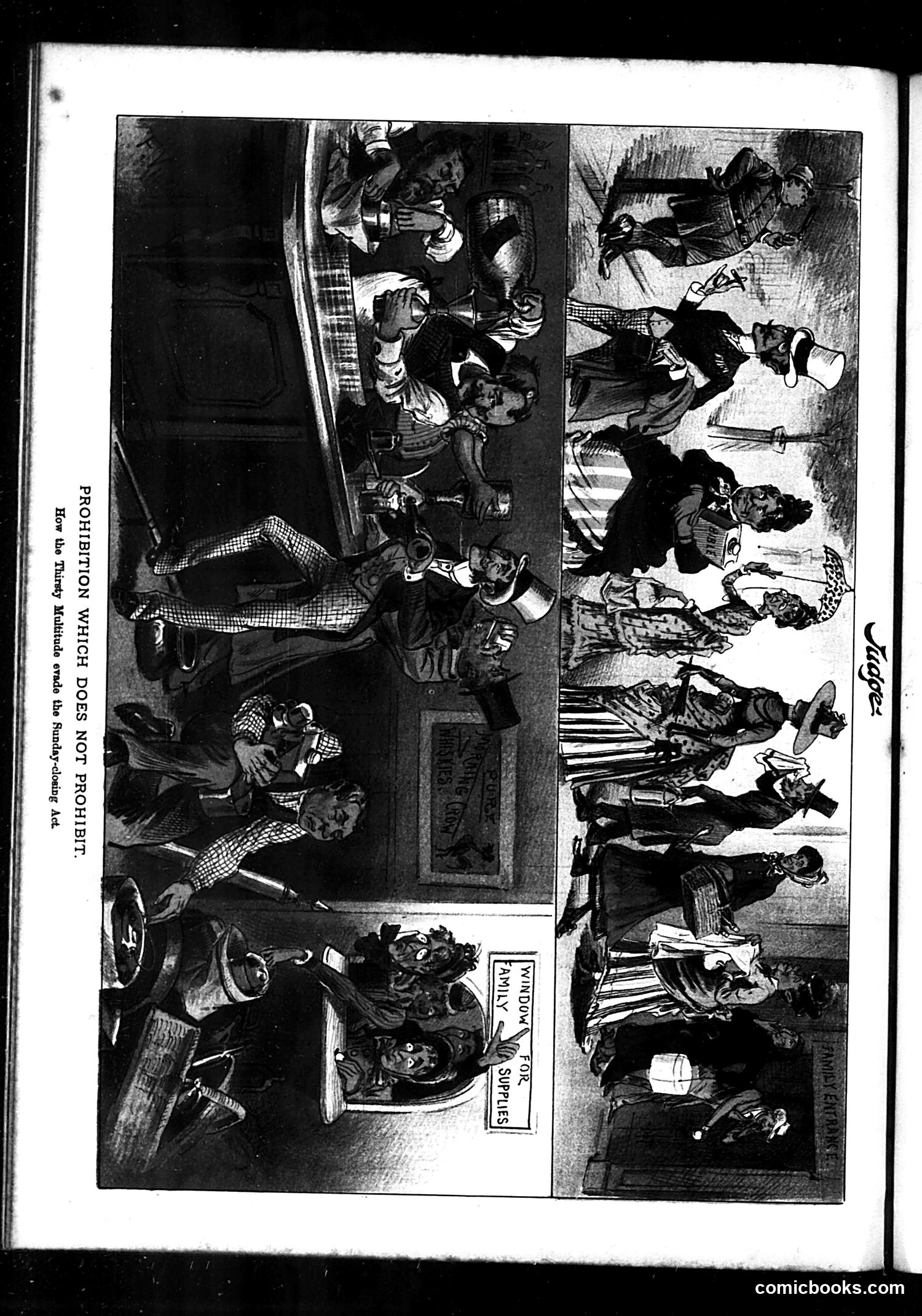
This Judge cartoon satirizes the ineffectiveness of Sunday-closing laws intended to restrict alcohol sales. The two panels show working-class patrons finding loopholes: the left panel depicts people entering what appears to be a back entrance or side door, while the right shows them gathered inside drinking establishments despite legal restrictions. The caption's ironic title suggests that prohibition laws fail in practice—the "thirsty multitude" easily circumvent regulations meant to limit alcohol access on Sundays. This reflects real tensions of the era when various temperance measures attempted (often unsuccessfully) to control drinking through legal means. The cartoon mocks both the laws' futility and the working-class determination to enjoy alcohol regardless of restrictions, capturing a common frustration with unenforceable or easily-evaded legislation.