
Judge, 1886-09-25 · page 7 of 16
Judge — September 25, 1886 — page 7: what you’re looking at
What you’re looking at
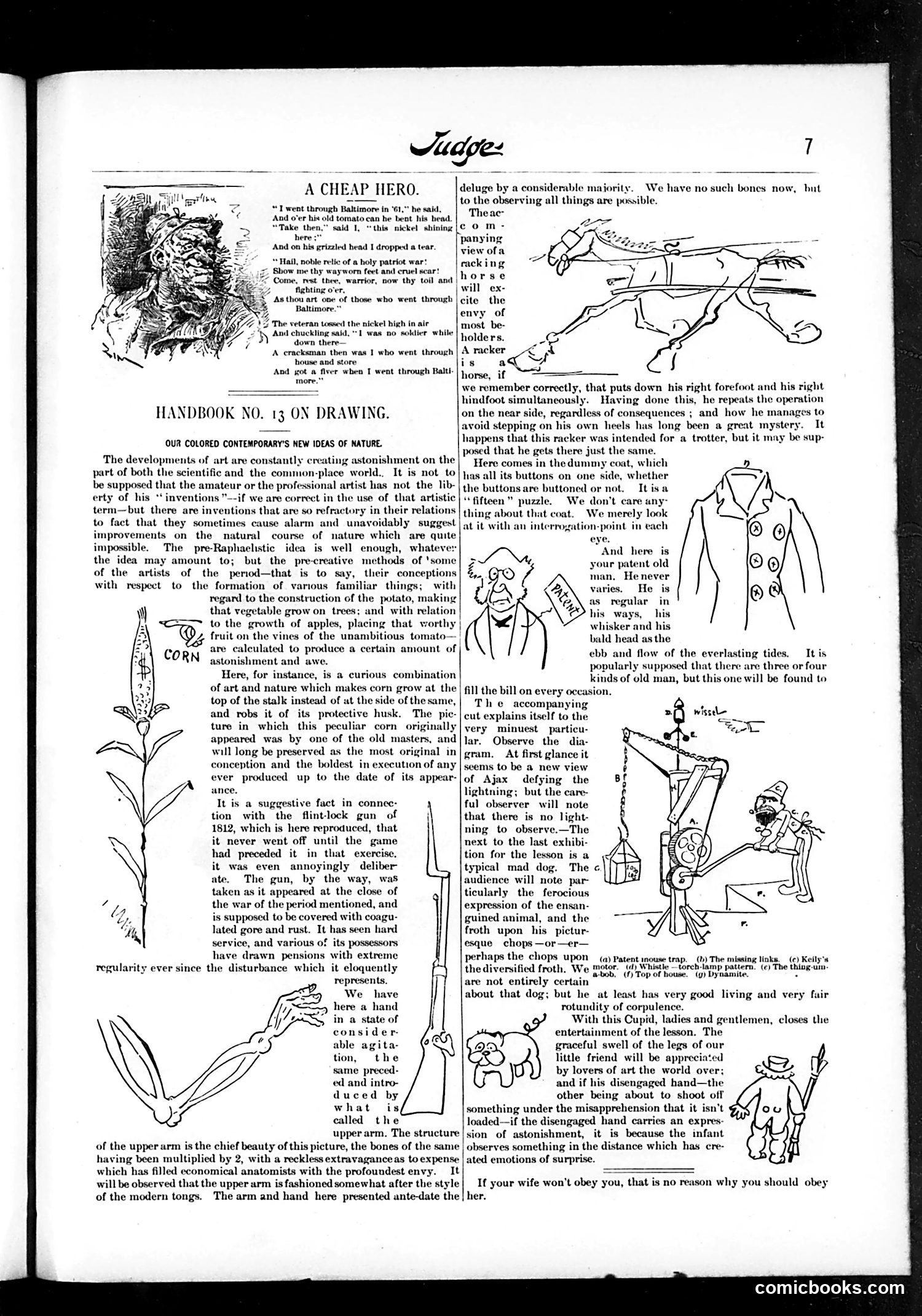
This poem mocks the exploitation of Civil War veteran status. A man claims to have fought in Baltimore during the 1861 conflict, earning sympathy and a nickel from the narrator. The twist: he admits he was actually a "cracksman" (burglar) who robbed houses and stores during that period—the "fiver" (five dollars) he got came from theft, not combat. The satire targets both the fabrication of military credentials and the public's gullible sentimentality toward supposed war heroes. By the Gilded Age when *Judge* published this, pension fraud and false veteran claims were widespread problems, making the "cheap hero" a recognizable social nuisance. The second section on drawing humorously critiques anatomically impossible or absurd artistic representations—exaggerated anatomy, misplaced corn growth, and incorrectly-constructed horses—likely referencing contemporary art movements or amateur pretensions that *Judge* found ridiculous.
📄 Transcribed text from this page (OCR, searchable)
Machine-transcribed from the original scan — historical spelling and the odd misread are preserved.
ape: 7 A CHEAP HERO. “I went through Baltimore in ‘61,” he said, And o'er his old tomato can he bent his head. “Take then,” said I, “this nickel shining here : And on his grizzled head I dropped a tear. “Hail, noble relic of a holy patriot war! Show me thy wayworn feet and cruel scar! Come, rest thee, warrior, now thy toil and Z fighting o'er, As thou art one of those who went through Baltimore.” ‘The veteran tossed the nickel high in air 7D) Anil chuckling sald, “1 was no soldier while down there— A cracksman then was I who went through house and store And got a fiver when I went through Balti HANDBOOK NO. 13 ON DRAWING. OUR COLORED CONTEMPORARY’S NEW IDEAS OF NATURE. The developments of art are constantly creating astonishment on the part of both the scientific and the common-place world., It is not to be supposed that the amateur or the professional artist has not the lib- erty of his ‘inventions "--if we are correct in the use of that artistic term—but there are inventions that are so refractory in their relations to fact that they sometimes cause alarm and unavoidably suggest improvements on the natural course of nature which are quite impossible. The pre-Raphaelistic idea is well enough, whatev the idea may amount to; but the pre-creative methods of 'some of the artists of the period—that is to say, their conceptions with respect to the formation of various familiar things; with regard to the construction of the potato, making that vegetable grow on trees; and with relation to the growth of apples, placing that worthy | fruit on the vines of the unambitious tomato— culated to produce a certain amount of astonishment and awe. Here, for instance, is a curious combination of art and nature which makes corn grow at the | top of the stalk instead of at the side of the same, and robs it of its protective husk. The pic- ture in which this peculiar corn originally appeared was by one of the old masters, and will long be preserved as the most original in conception and the boldest in execution of any ever produced up to the date of its appear- ance. It is a suggestive fact in connec: tion with the flint-lock gun of 1812, which is here reproduced, that it never went off until the game had preceded it in that exercise, it was even annoyingly deliber- ate, The gun, by the way, was taken as it appeared at the close of the war of the period mentioned, and is supposed to be covered with coagu- lated gore and rust. It has seen hard service, and various of its possessors have drawn pensions with extreme regularity ever since the disturbance which it eloquently represents. We 1 here a hand in a state of consider able agita- tion, the same preced- ed and intro- duced by what is called the upper arm. The structure of the upper arm is the chief beauty of this picture, the bones of the same having been multiplied by 2, with a reckless extravaganceas to expense which has filled economical anatomists with the profoundest envy. It will be observed that the upper arm is fashioned somewhat after the style of the modern tongs. The arm and hand here presented ante-date the deluge by a considerable majority. We have no such bones now, but to the observing all things are possible. Theac- com- panying view ofa racking horse | will ex- jcite the envy of most be- holders. is Aracker ‘7 is ag horse, if ——- we remember correctly, that puts down his right forefoot and his right hindfoot simultaneously. Having done this, he repeats the operation on the near side, regardless of consequences ; and how he manages to avoid stepping on his own heels has long been a great mystery. It happens that this racker was intended for a trotter, but it may be sup- posed that he gets there just the same. Here comes in thedummy coat, which has all its buttons on one side, whether —) the buttons are buttoned or not. It is a “fifteen” puzzle. We don't care any- M ee thing about that coat. We merely look — \ at it with an interrogation-point in each ore ® 6 And here is your patent old (9) (0) 4 man, He never ies, He is A) & cA 6 as regular in his ways, his whisker and his bald head as the ebb and flow of the everlasting tides. It is popularly supposed that there are three or four nds of old man, but this one will be found to fill the bill on every occasion. The accompanying cut explains itself to the very minuest particu lar. Observe the gram. At first glance it seems to be a new view of Ajax defying the lightning; but the care- ful observer will note that there is no light ning to observe.—The next to the last exhibi- tion for the lesson is a typical mad dog. The audience will note par- ticularly the ferocious expression of the ensan- guined animal, and the froth upon his pictur- esque chops —or—er— perhaps the chops upon (a) Patent inouse trap. (b) The missing links, (¢) Kelly are not entirely certai about that dog; but he at least has very good living and very fair rotundity of corpulence. With this Cupid, ladies and gentlemen, closes the entertainment of the lesson. The graceful swell of the legs of our little friend will be appreciated by lovers of art the world over; and if his disengaged hand—the other being about to shoot off something under the misapprehension that it isn’t loaded—if the disengaged hand carries an expres- sion of astonishment, it is because the infant observes something in the distance which has cre- ated emotions of surprise. If your wife won't obey you, that is no reason why you should obey her. comicbooks.com