
Judge, 1886-09-25 · page 6 of 16
Judge — September 25, 1886 — page 6: what you’re looking at
What you’re looking at
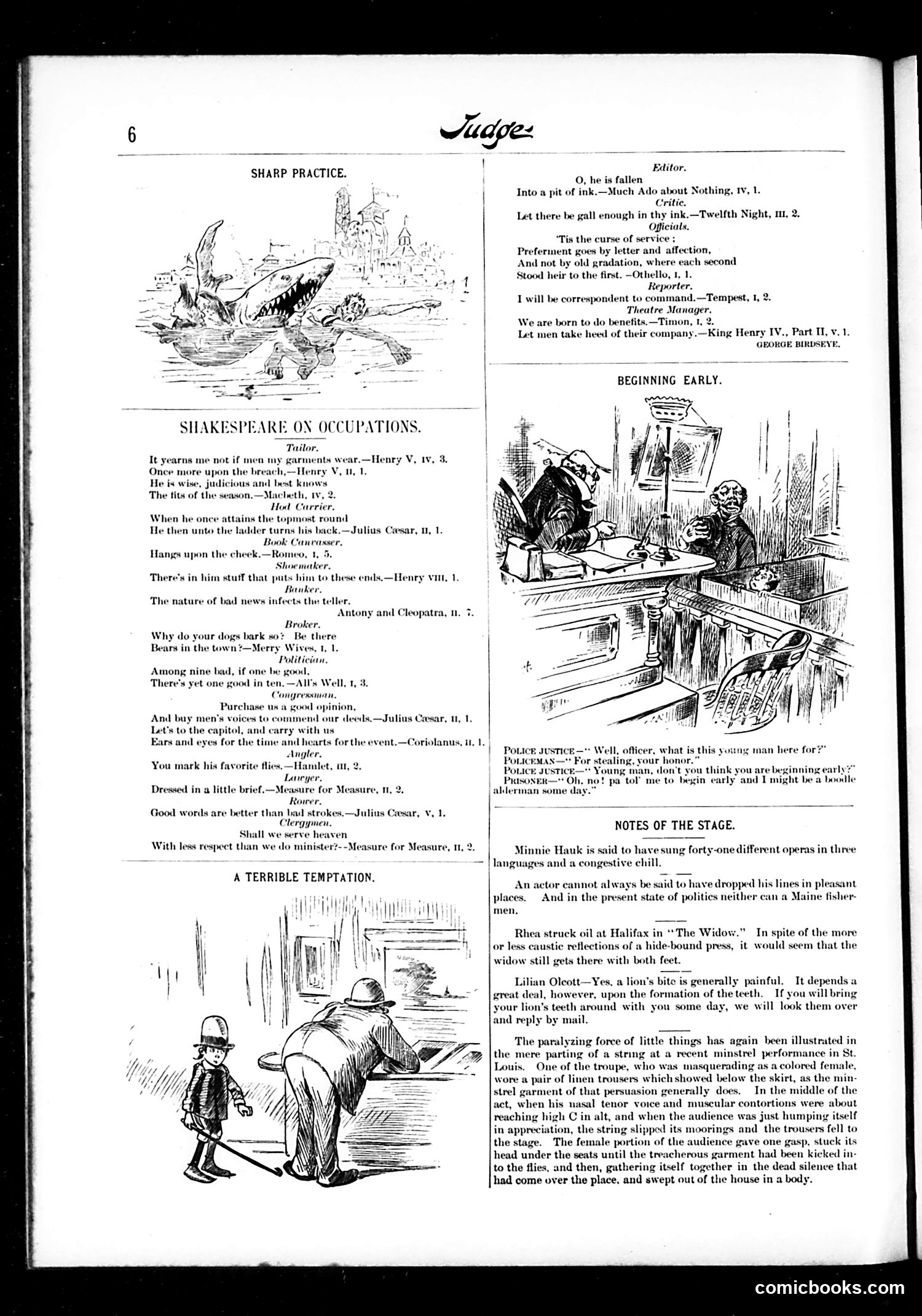
This page from *Judge* combines literary humor with social commentary. The main feature, "Shakespeare on Occupations," pairs Shakespeare quotations with various professions—tailors, bankers, politicians, congressmen, lawyers—using the Bard's words to satirize each group's character flaws or motivations. A congressman, for instance, is matched with a quote about buying men's votes, suggesting corruption in American politics. The cartoons "Sharp Practice" and "A Terrible Temptation" depict predatory or unethical behavior in unnamed professions, typical of Gilded Age satirical commentary on business and professional misconduct. "Beginning Early" jokes about a child's ambition to become an alderman—poking fun at municipal politics and suggesting even children recognize corruption's path to power. The "Notes of the Stage" section offers theatrical gossip and absurdist anecdotes, characteristic of *Judge's* light entertainment mixed with sharper social critique.
📄 Transcribed text from this page (OCR, searchable)
Machine-transcribed from the original scan — historical spelling and the odd misread are preserved.
SHAKESPEARE ON OCCUPATIO} Tailor. It yearns me not if men my garments nthe bi vus and best knows The tits of the season.—Macheth, 1 Hod Carrier. When he once attains the topmost round He then unto the ladder turns his back.—Julius Cesar, 11, 1 Book Canvasse Hangs upon the cheek,—Romeo, 1, Shoemaker, There's in him stuff that puts him to these ends—Henry vit, 1. Banker. The nature of bad news infects the teller. Antony and Cleopatra, 1. 7 Broker. Why do your dogs bark so? Be there Bears in the town ?—Merry Wives, 1, 1. Politician, Among nine bad, if one be good, There's yet one good in ten. —All's Well, 1, ngresxnian, Purchase us a good opinion, And buy men’s voices to commend our deeds, —Julius Cresar, 1, 1. Let's to the capite arry with us Ears and eyes for the time and hearts forthe event.—Coriolanus, Angler. You mark his favorite flies. Hamlet, ttt, 2. Laucyer. Dressed in a little brief, —Measure for Measure, 11, 2. Rower. Good words are better than bad strokes.—Julius Cesar, ¥, 1. Clergymen. Shall we serve heaven With less respect than we do minister?--Measure for Measure, 11, 2. A TERRIBLE TEMPTATION. Editor. O, he is fallen Into a pit of ink.—Much Ado about Nothing, Iv, 1. Critic. Let there be gall enough in thy ink,—Twelfth Night, 11, 2. Oficiats. f service ; er and affection, And not by old gradation, where each second ‘Stood heir to the first. -Othello, 1, 1. Reporter. I will be correspondent to command.—Tempest, 1, 2. Theatre Manager. We are born to do benefits.—Timon, 1, 2. Let men take heed of their company.—King Henry IV. BEGINNING EARLY. ou are beginning *Oh, no! pa tol’ me to begin early’ and T might be alderman some day NOTES OF THE STAGE. Minnie Hauk is said to have sung forty-one different operas in three Hanguages and a congestive chill. An actor cannot always be said to have dropped his lines in pleasant places. And in the present state of politics neither can a Maine fisher- men, Rhea struck oil at Halifax in “The Widow.” In spite of the more or less caustic reflections of a hide-bound press, it would seem that the widow still gets there with both feet. n Olcott—Yes, a lion’s bite is generally painful, It depends a great deal, however, upon the formation of the teeth. Ifyou will bring your lion’s teeth around with you some day, we will look them over and reply by mail. The paralyzing force of little things has again been illustrated in the mere parting of a string at a recent minstrel performance in & Louis. One of the troupe, who masquerading as a colored fe wore a pair of linen trousers which showed below the skirt, as the min- strel garment of that pe ion generally does. In the middle act, when his nasal tenor voice and muscular contortions were reaching high C in alt, and when the audience was just humping itself in appreciation, the string slipped its moorings and the trousers fell to the stage. The female portion of the audience gave one gasp, stuck its head under the seats until the treacherous garment had been kicked in- to the flies, and then, gathering itself together in the dead silence that had come over the place, and swept out of the house in a body. comicbooks.com