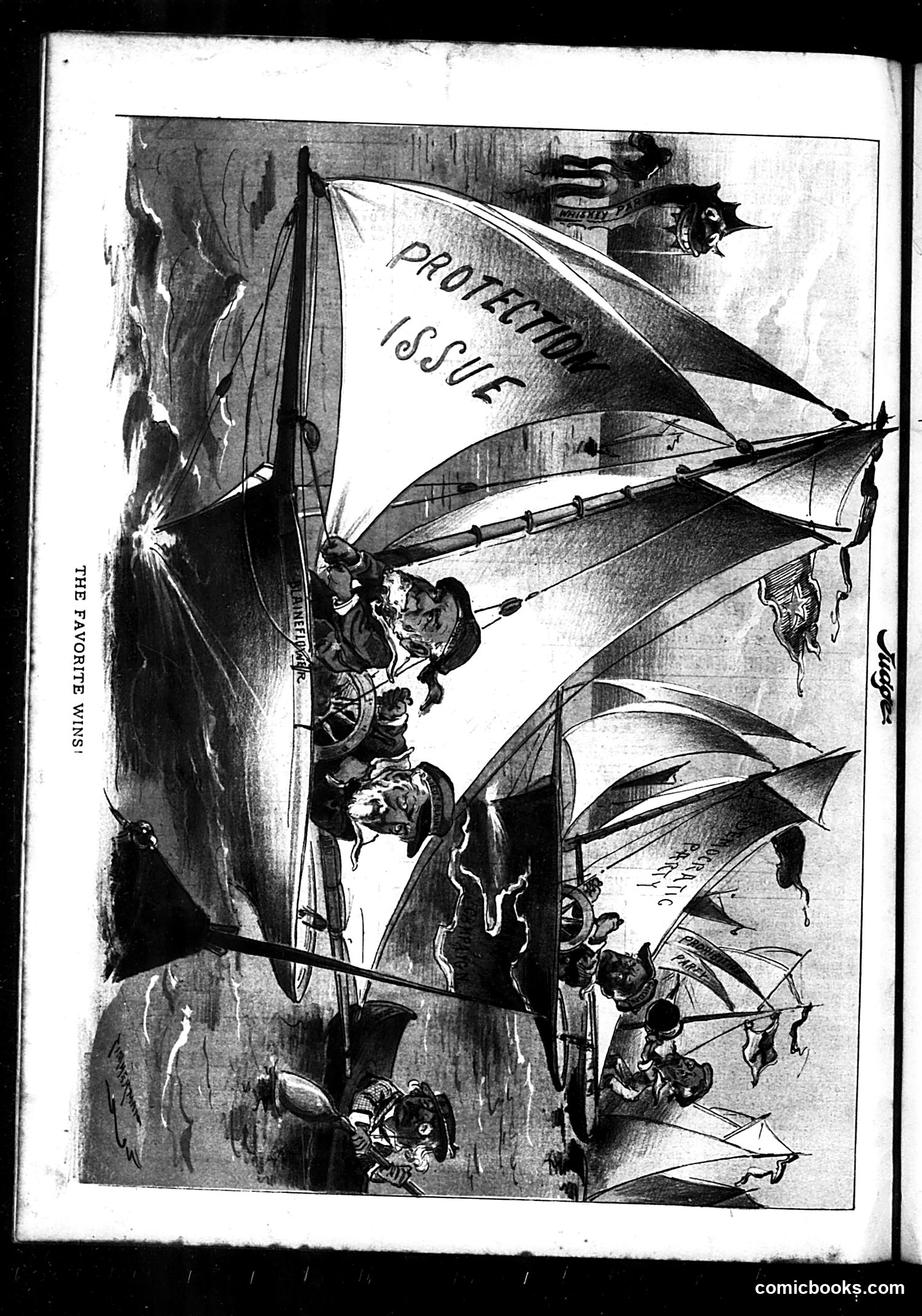
A complete issue · 16 pages · 1886
Judge — September 18, 1886
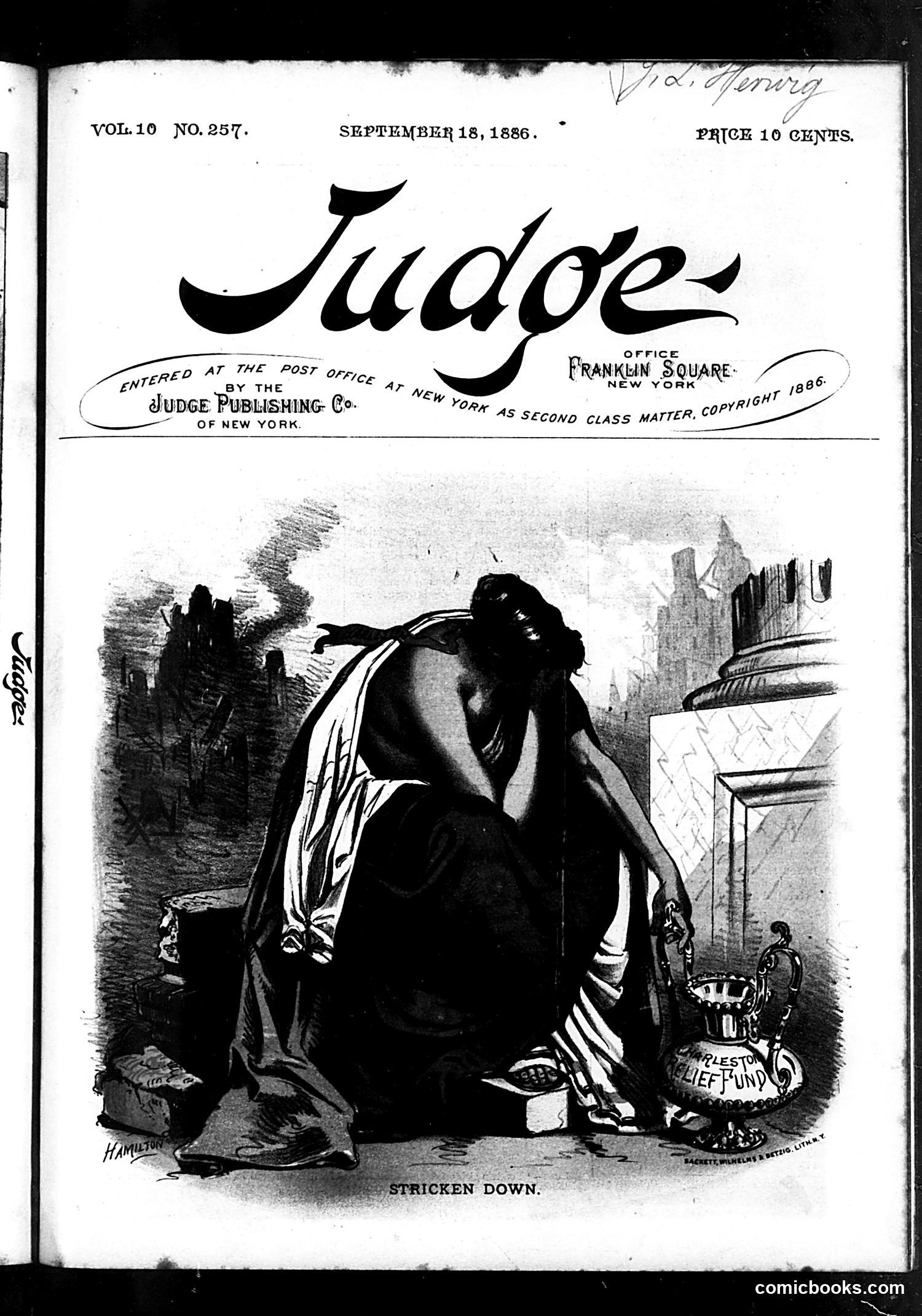
This political cartoon depicts a woman in classical allegorical style (likely representing Justice or Labor) collapsed or "stricken down." She's surrounded by symbols of poverty and hardship—a relief fund container is visible at bottom right. The image appears to reference labor unrest or economic distress from 1886, a year marked by significant labor strikes and the Haymarket affair in Chicago. The collapse of the female figure suggests the defeat or wounding of a social cause—possibly workers' rights or fair labor practices. The classical drapery and pose elevate the subject to serious political commentary rather than mere reporting. Without additional text explaining which specific event this satirizes, the exact target remains unclear, though the timing suggests contemporary labor conflicts.
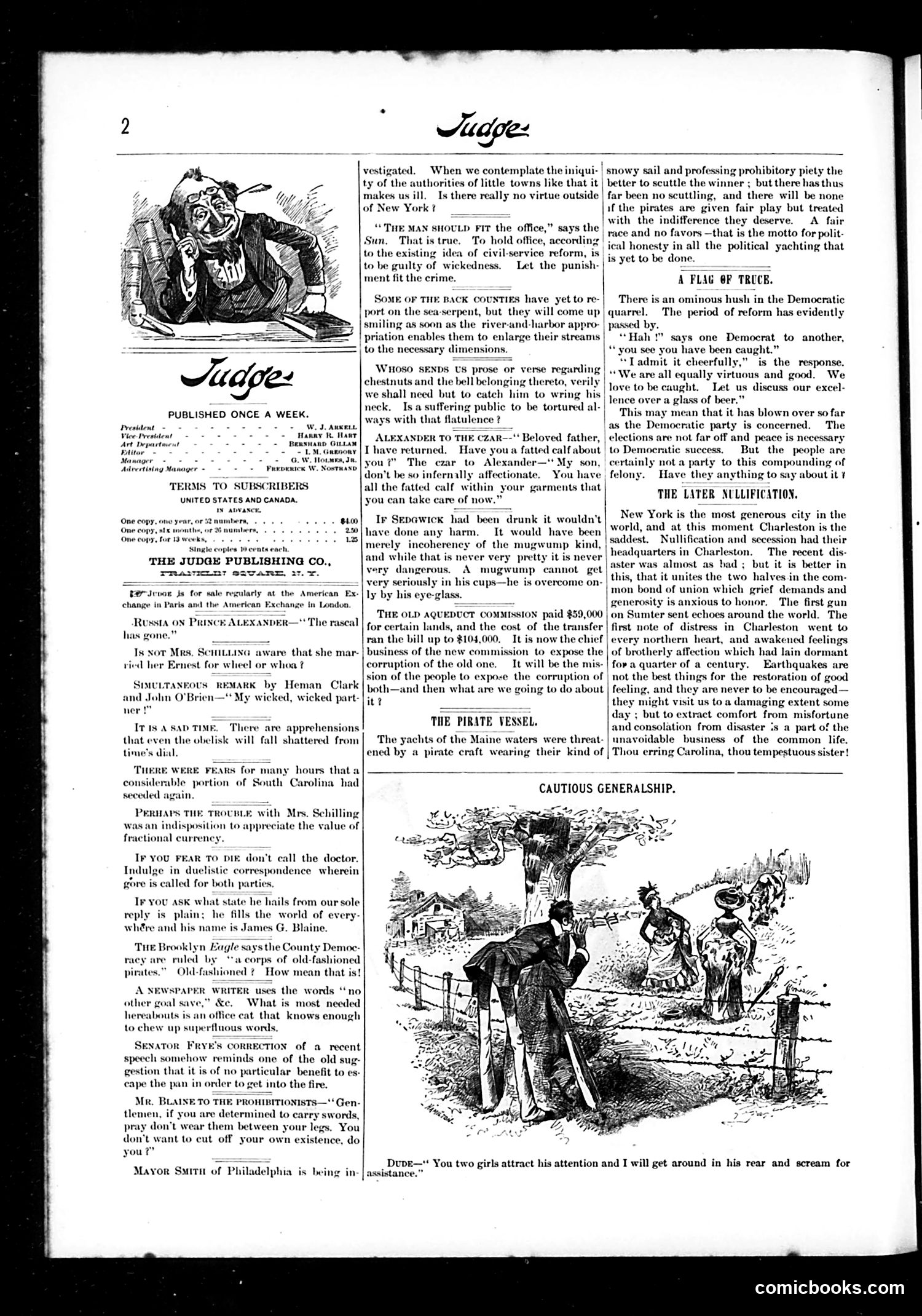
This page contains several political commentary pieces rather than a single unified cartoon. The main illustrated cartoon, titled "Cautious Generalship," depicts a military officer on horseback being warned by a woman that "two girls attract his attention" and she'll "get around in his rear and scream for assistance." The text sections mock various political figures and issues of the era, including criticism of Democratic Party hypocrisy during reform periods, commentary on South Carolina political corruption, and jibes at specific politicians like Mayor Smith of Philadelphia and Senator Frye. The satire targets political dishonesty, fractional party disputes, and incompetent leadership. Without clearer context on specific dates or figures referenced, precise identification of all targets remains uncertain, though the overall thrust critiques contemporary American political corruption and inconsistency.
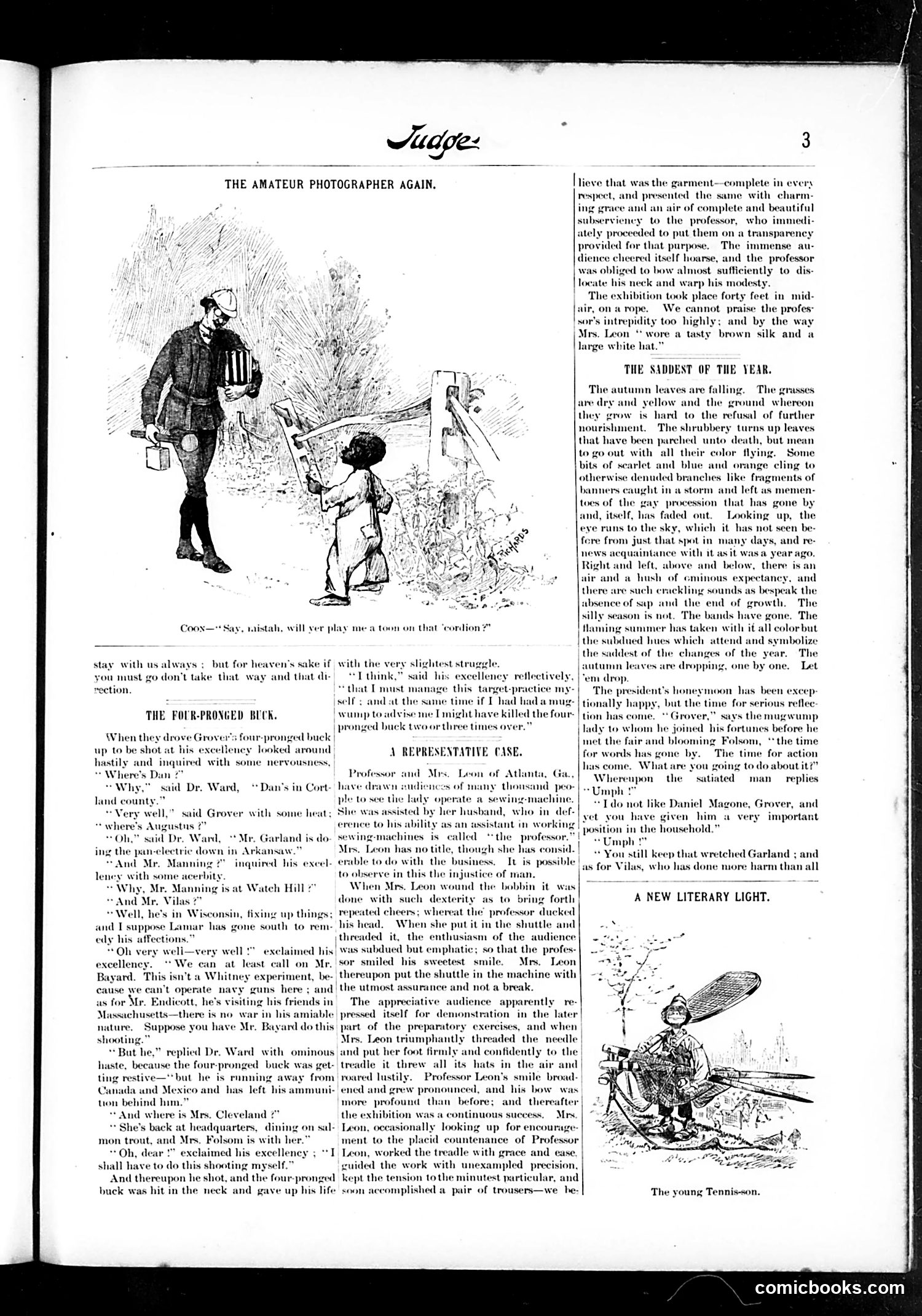
This page from *Judge* satirizes President Grover Cleveland's administration through two main pieces: **"The Four-Pronged Buck"** mocks Cleveland's cabinet by depicting him trying to shoot a deer while his key advisors are absent: Dan (unclear who), Augustus Garland (Attorney General), Manning (likely Secretary of Treasury), and others scattered across the country. The joke relies on depicting the President as incompetent without his team—he must "do this shooting myself." **"A Representative Case"** ridicules gender dynamics of the era through Mrs. Leon (wife of a Georgia professor) skillfully operating a sewing machine at a public demonstration. While she performs the work with excellence, her husband receives the applause and accolades, and she defers to him subserviently. The piece satirizes how women's labor and competence were systematically credited to men. Both pieces use humor to critique contemporary politics and social conventions, typical of *Judge's* satirical approach during the Gilded Age.
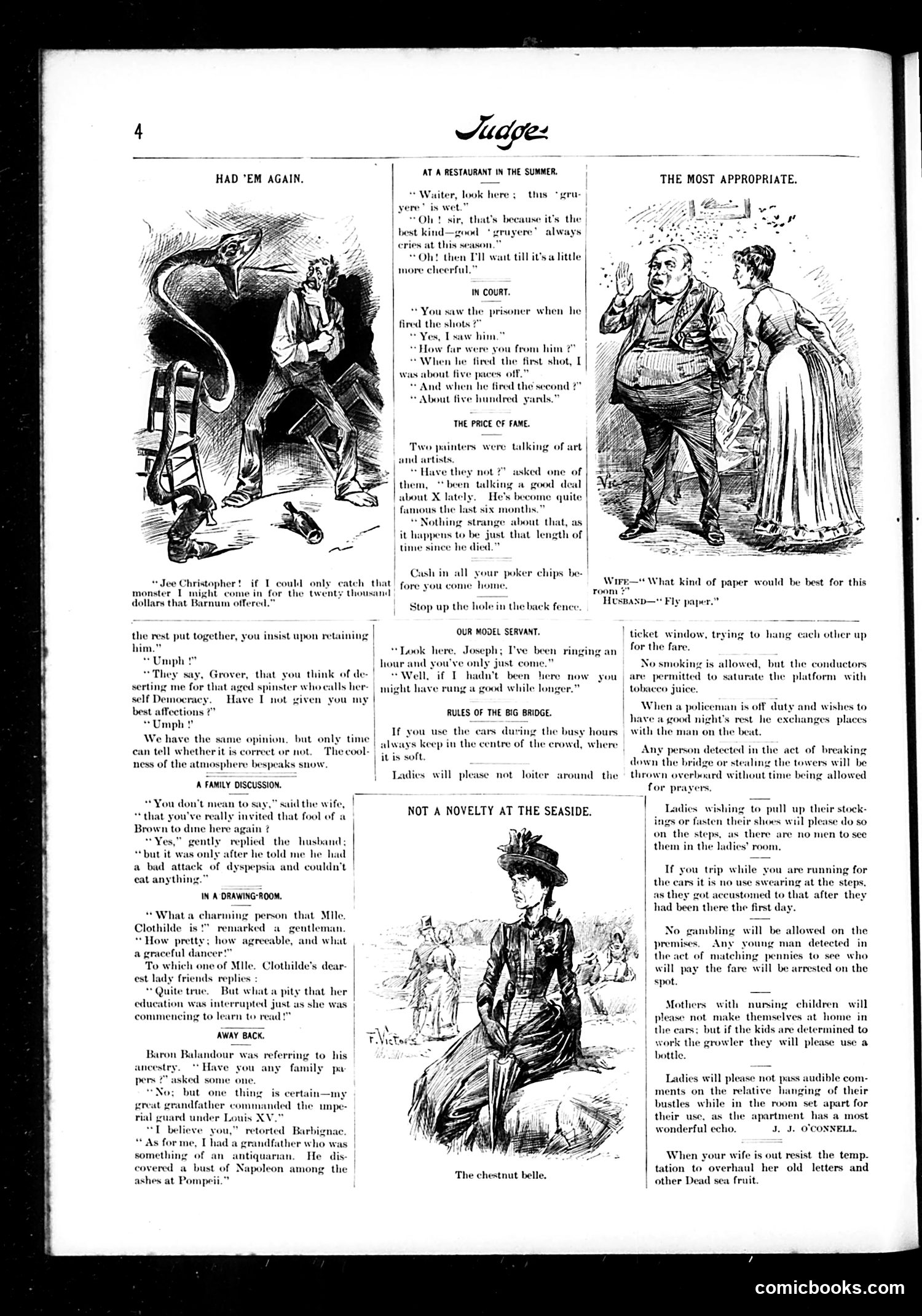
This page from **Judge** (a prominent American satirical weekly, likely from the 1880s-1890s) contains multiple unrelated humor pieces and illustrations typical of the magazine's format. The cartoons mock contemporary social behavior and etiquette: - **"Had 'Em Again"**: A snake trainer displaying his serpent, likely satirizing circus attractions or exotic animal shows popular at the time. - **"Not a Novelty at the Seaside"**: A fashionable woman at the beach, poking fun at seaside tourism culture and vacationing habits. - **"The Chestnut Belle"**: References a woman known for repeating the same tired stories (a "chestnut" being old, worn-out material). The text sections include absurdist dialogue jokes about waiters, court testimony, servants, and social conventions—typical Judge humor that ridiculed class pretension, domestic life, and urban customs. The "Rules of the Big Bridge" section appears to be humorous mock regulations about public behavior. Overall, this represents **genteel Victorian-era satire** targeting middle and upper-class social foibles and entertainment culture.
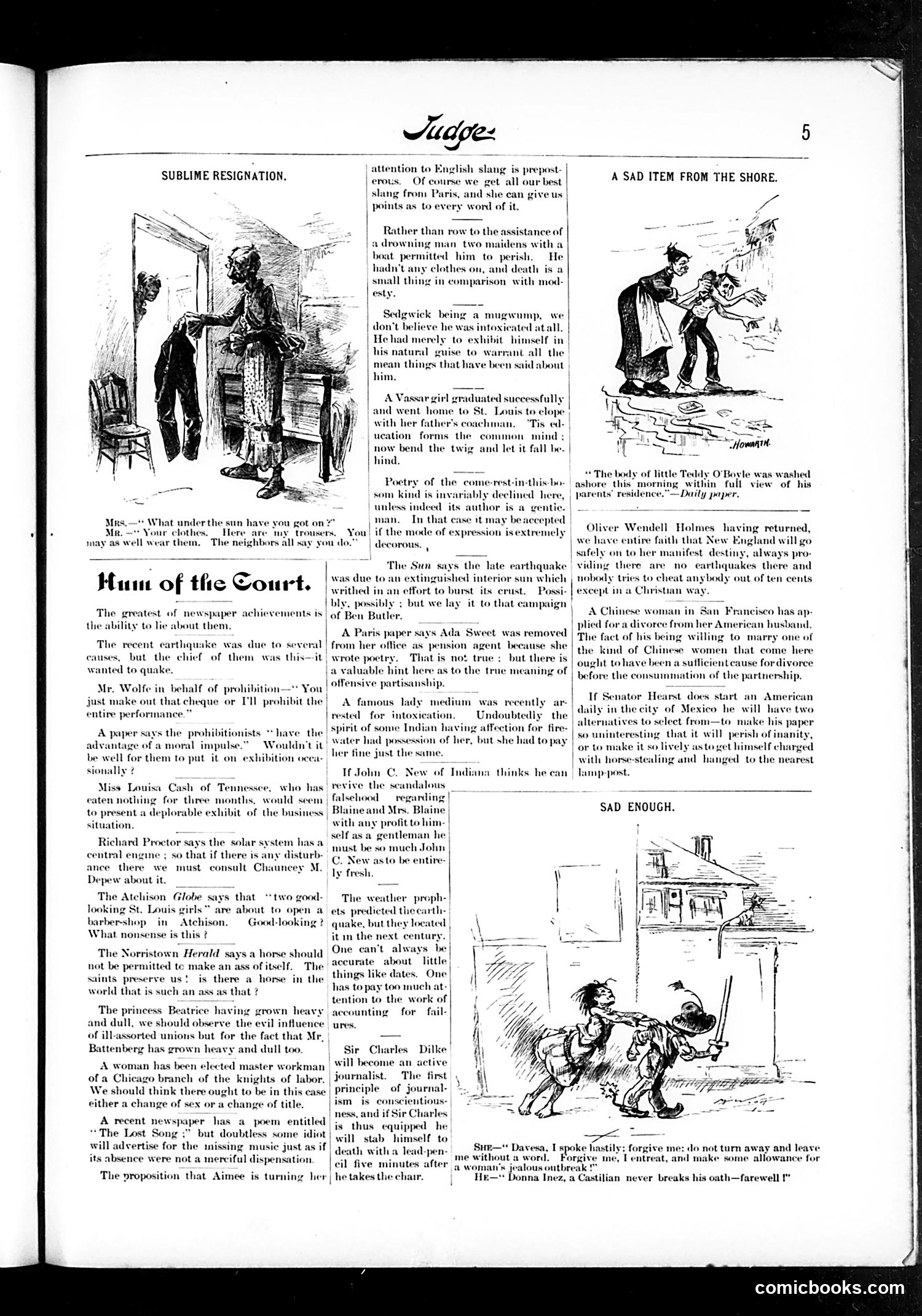
This page contains satirical commentary on contemporary issues circa the 1880s-90s. Key items include: **"Sublime Resignation"**: A sketch mocking newspaper dishonesty—the joke being that papers lie routinely about their achievements. **"Harm of the Court"**: Various brief satirical jabs at contemporary figures and events. References include the recent earthquake (likely the 1886 Charleston earthquake), Chauncey Depew (a railroad executive/politician), and political figures like Sedgwick (a "mugwump"—an independent Republican). The humor targets prohibition advocates, the poor economy (Miss Cash's starvation), and women entering male-dominated professions. **"A Sad Item from the Shore"**: A sketch illustrating a tragic news story: two young women allowed a drowning man to perish rather than risk impropriety by helping him directly—satirizing the era's rigid social propriety prioritizing modesty over human life. The page exemplifies *Judge*'s style: punching up at politicians, corporate figures, and social pretensions while mocking contemporary absurdities through brief, acerbic quips and illustrations.
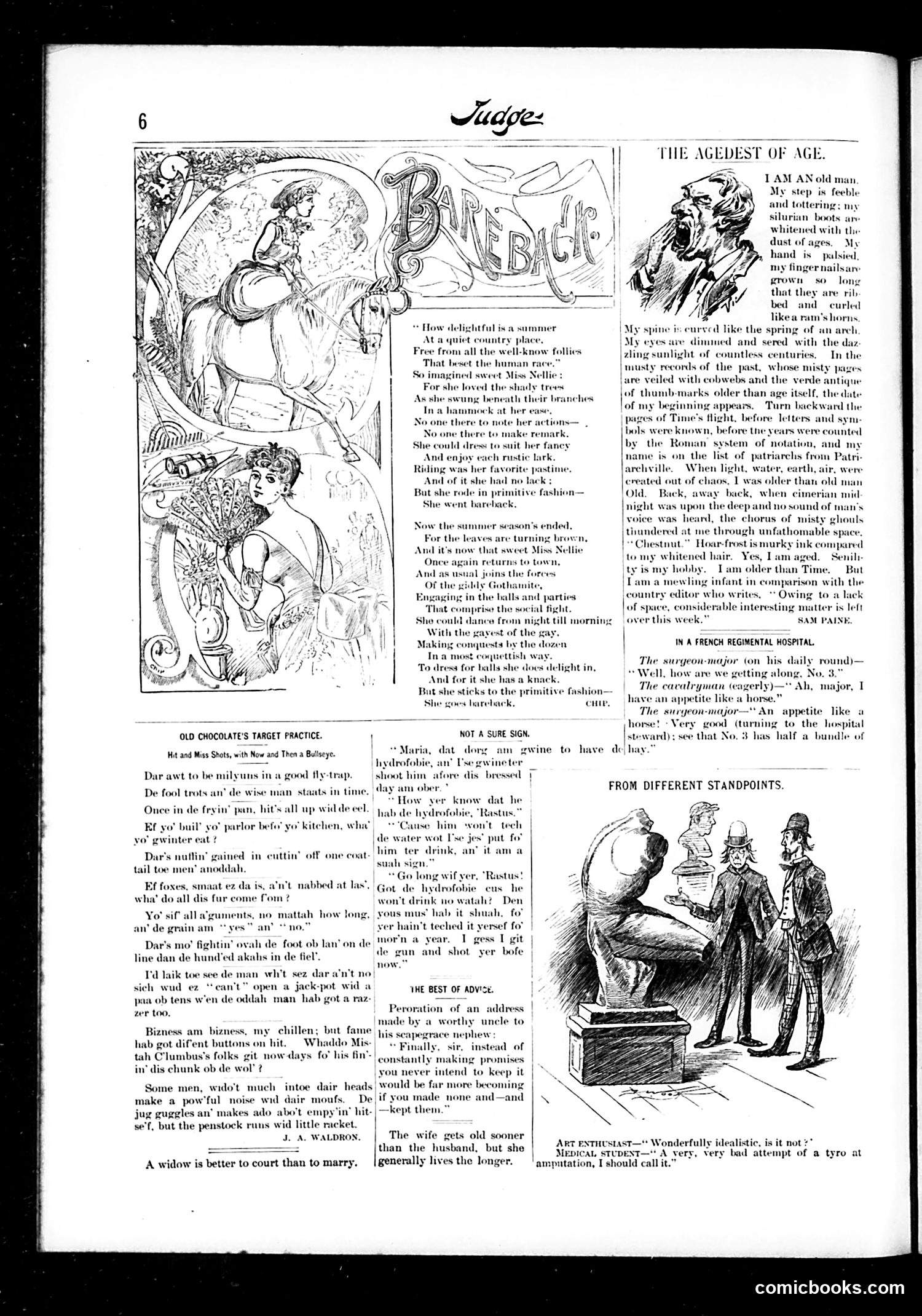
This page contains multiple satirical pieces typical of late 19th/early 20th-century Judge magazine: **"The Agedest of Age"** (right): A humorous monologue by an impossibly ancient man claiming to be older than Time itself, complaining about his decrepitude. The joke satirizes both elderly vanity and editorial complaints about space constraints—the old man sarcastically notes he's "a mere infant in comparison with the country editor who writes, 'Owing to lack of space, considerable interesting matter is left over this week.'" **"Old Chocolate's Target Practice"** (lower left): Dialect humor featuring an African American character discussing practical wisdom in vernacular speech—common in Judge's often-offensive ethnic comedy of the era. **Other snippets**: Brief jokes about French military hospitals, addresses, and romantic advice occupy remaining space. The page is primarily entertainment/humor rather than political commentary, reflecting Judge's mix of social satire, ethnic stereotypes, and everyday absurdist comedy typical of American humor magazines from this period.
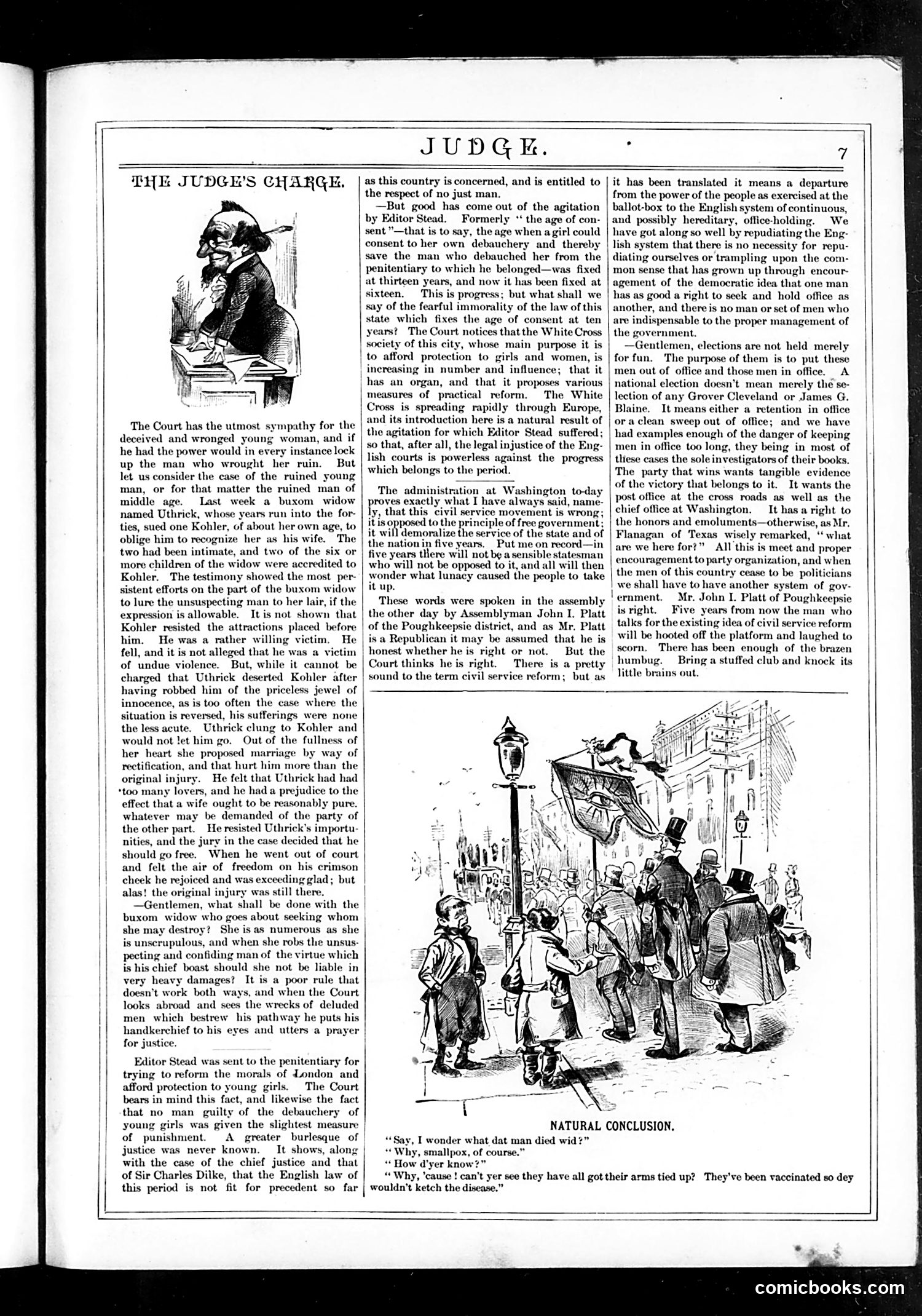
This page presents a mock judicial lecture addressing a real legal case: a widow named Uthrick sued a man named Kohler for breach of promise/recognition of illegitimate children. The judge's "charge" sarcastically argues that men deserve equal legal protection from seduction. The satire critiques the double standard in legal consequences: while Editor W.T. Stead faced imprisonment for exposing child exploitation, actual seducers faced no punishment. The judge notes England recently raised the age of consent from thirteen to sixteen—yet absurdly, some U.S. states fixed it at merely ten years. The cartoon (lower illustration) depicts street life, possibly illustrating the social disorder the editorial warns against. The satire ultimately mocks both naive male victimhood claims and the legal system's hypocrisy: punishing moral reformers while protecting actual exploiters. The "Natural Conclusion" joke at bottom suggests vaccinated children can't "ketch the disease"—likely referencing both literal vaccination and metaphorical moral "infection."
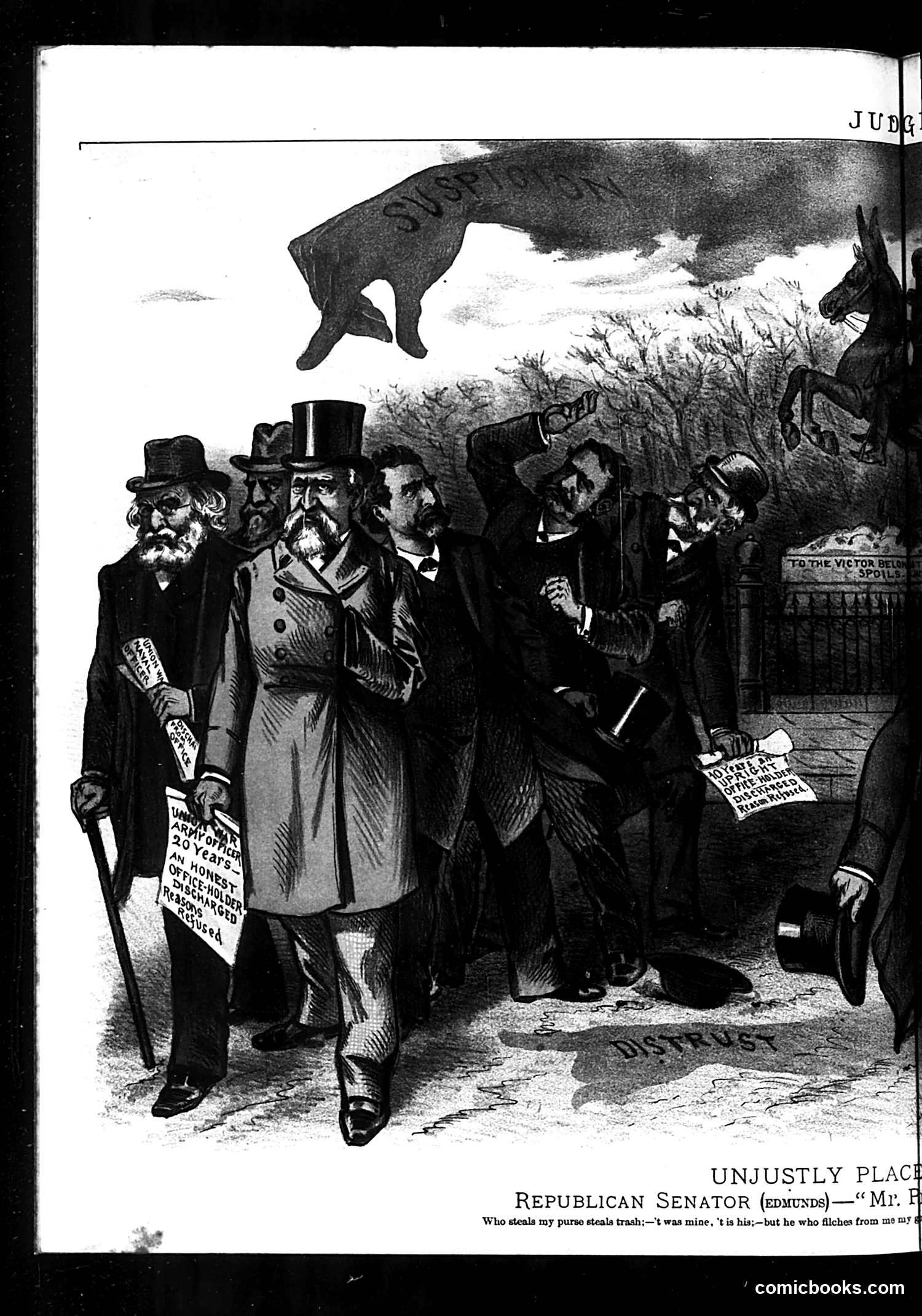
This Judge magazine cartoon satirizes a Republican Senator (identified as Edmunds in the OCR text) who appears to be caught in a compromising situation. The figure is surrounded by what appear to be political opponents or critics, with documents visible suggesting financial or ethical impropriety. The Shakespeare quotation (from *Othello*) about stealing a purse versus one's reputation suggests the cartoon's central critique: the Senator is accused of damaging his own integrity or reputation through questionable conduct—a moral theft worse than monetary theft. The wild donkey flying overhead likely represents political chaos or disorder resulting from the scandal. The cartoon appears to attack Republican leadership hypocrisy or corruption, using classical literary reference to emphasize the gravity of the offense. Without the publication date visible, the specific incident remains unclear.
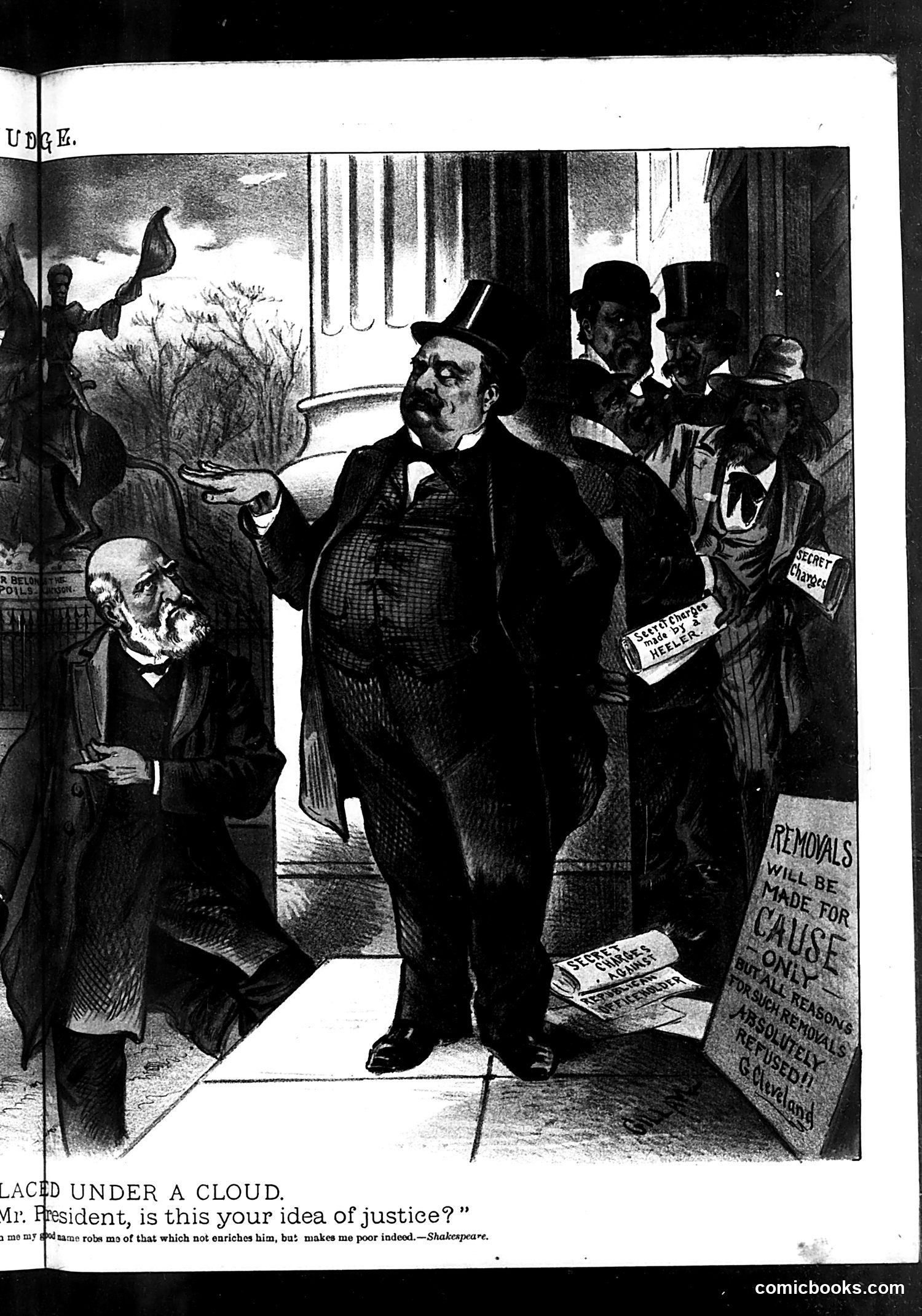
This cartoon satirizes a U.S. President's handling of justice and removals from office. The central figure—a rotund man in formal dress—is surrounded by officials and men wearing badges labeled "SECRET SERVICE" and other administrative roles. Papers visible reference "REMOVALS" and note "WILL BE MADE FOR CAUSE ONLY"—suggesting controversial dismissals or patronage decisions. The title "LACED UNDER A CLOUD" and the accusing question "Mr. President, is this your idea of justice?" critique what appears to be arbitrary or politically-motivated removals from government positions. The Shakespeare quote reinforces the moral accusation—that these actions impoverish (harm) those removed without benefiting the President. Without the publication date visible, the specific President and removals referenced remain unclear, though this reflects common 19th-century critiques of executive patronage abuse.
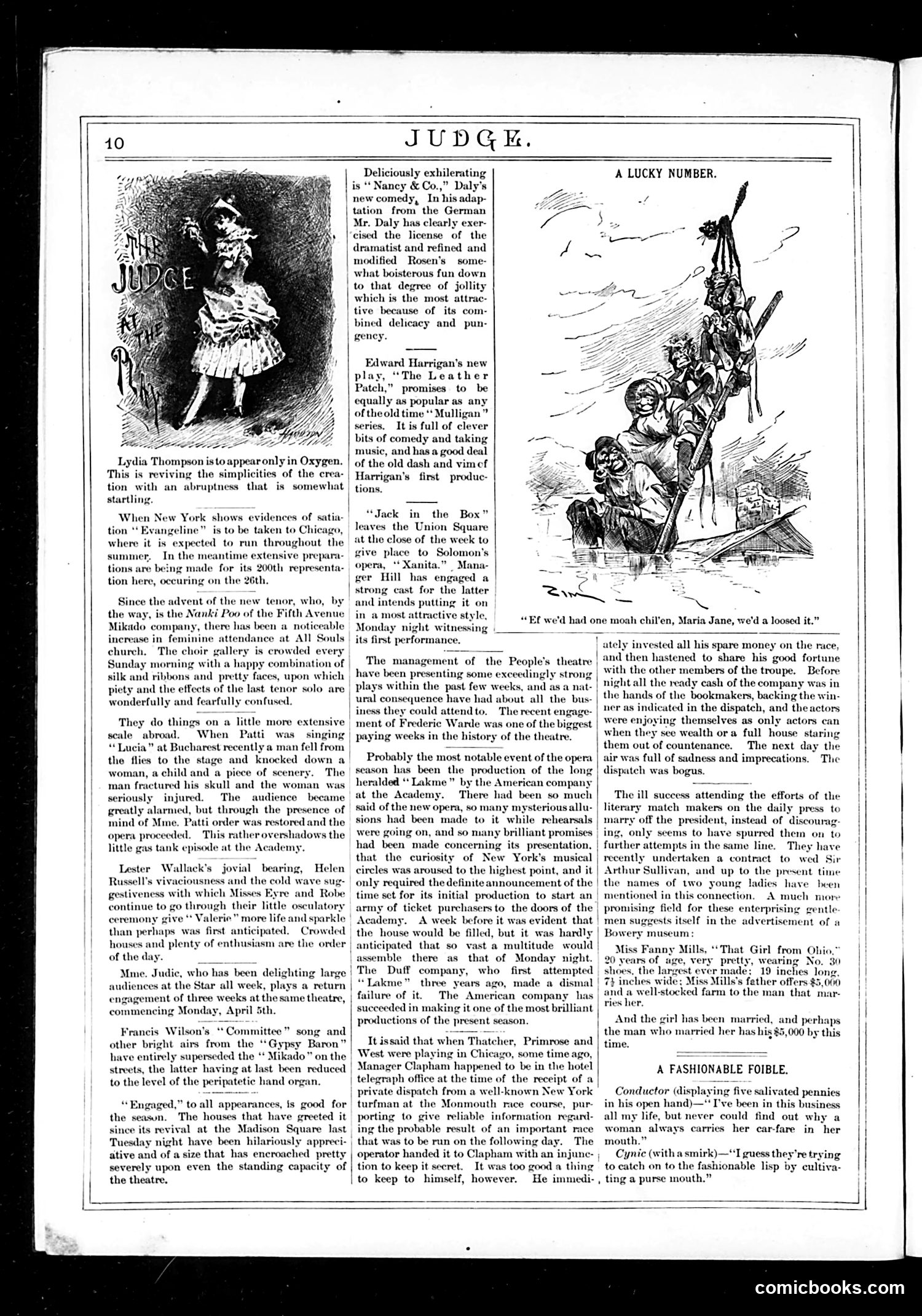
This page reviews New York theatrical productions from the 1880s-90s. The main illustrated cartoon (upper right, titled "A Lucky Number") depicts what appears to be a lottery or gambling scene with figures near a pole or post in winter conditions—likely satirizing the popular obsession with lottery schemes or gambling. The text discusses contemporary theater productions including operatic works like "Lakme" and "Nanki Poo," comedies by Edward Harrigan and Daly, and performances by actors like Francis Wilson. References to "The Mikado" suggest the Gilbert & Sullivan opera's popularity on American streets and stages. The satire focuses on theater-goers' behavior—particularly the "feminine attendance" spike at churches featuring attractive tenors, and general urban fascination with theatrical productions as both entertainment and social display. The overall tone mocks New York's theater scene as simultaneously frivolous and culturally aspirational.
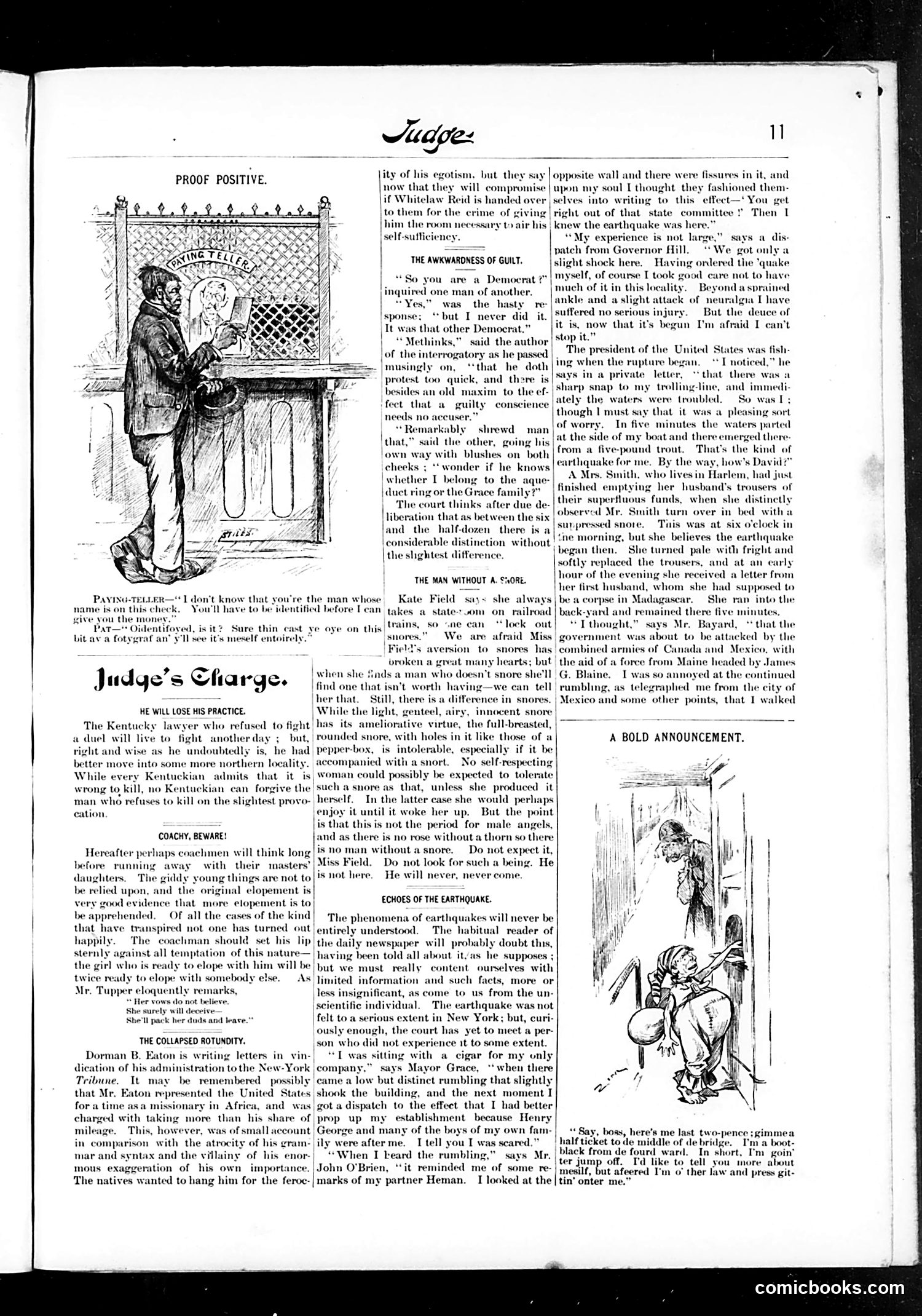
This page contains several satirical pieces typical of late 19th-century American humor: **"Proof Positive"** (top): A cartoon showing what appears to be an Irish immigrant ("meself entoire") being questioned about identity. The satire likely mocks ethnic stereotypes and the immigrant experience. **"Judge's Charge"**: Commentary on Kentucky dueling culture, sarcastically praising a man who refused a duel while acknowledging Kentucky's violent honor culture won't forgive him. **"The Man Without a Shore"**: Kate Field's satirical observations about men who snore, using snoring as metaphor for male imperfection. The humor is domestic and gender-focused. **"Echoes of the Earthquake"**: A brief piece about public misunderstanding of earthquake phenomena, likely referencing a recent seismic event, mocking how newspapers oversimplify scientific events. **"The Collapsed Rotundity"**: References Dorman B. Eaton's administrative record, appearing to critique his character and writing style. The page exemplifies Judge's approach: political/social satire mixed with humor about contemporary issues and personalities, using caricature and wordplay.
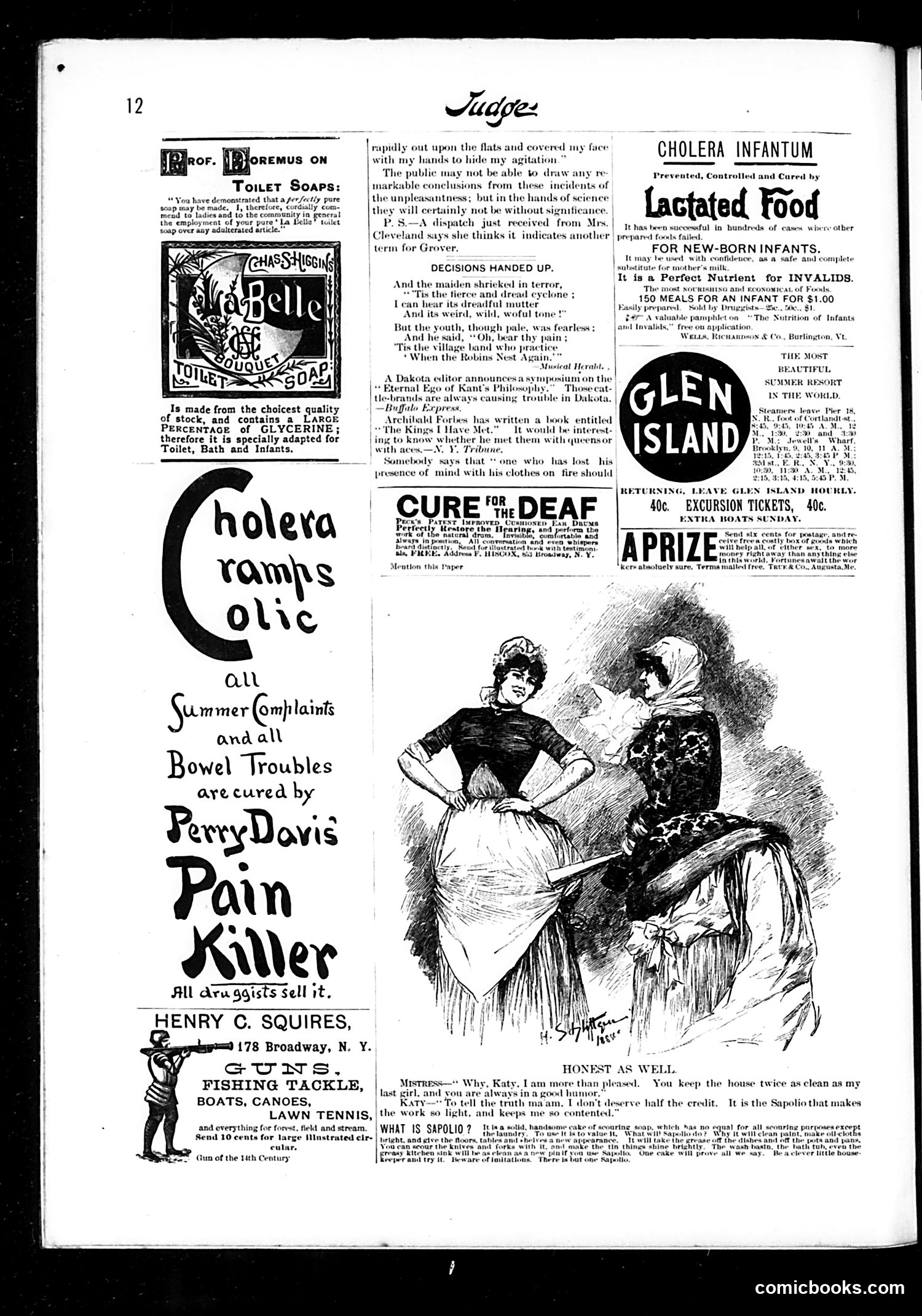
This page is primarily **advertising**, typical of late-19th-century magazines. The ads promote patent medicines and household products common to the era. The main satirical content appears in the small section titled "DECISIONS HANDED UP," which references **Mrs. Cleveland** (wife of President Grover Cleveland) and jokes that recent unpleasant incidents suggest "another term for Grover"—political humor about Cleveland's presidency. The cartoon labeled "HONEST AS WELL" depicts a **mistress and maid** discussing housekeeping. The humor hinges on the servant's claim that Sapolio soap (advertised below) deserves credit for cleanliness, not her own labor—a gentle satire on consumer advertising's exaggerated claims about product efficacy. The remaining content consists of period advertisements: soap, patent pain medicine (Perry Davis), guns/sporting goods, baby food, and Sapolio cleaning soap. These ads reflect contemporary attitudes toward unregulated medical claims and product endorsements that would seem dubious to modern readers.
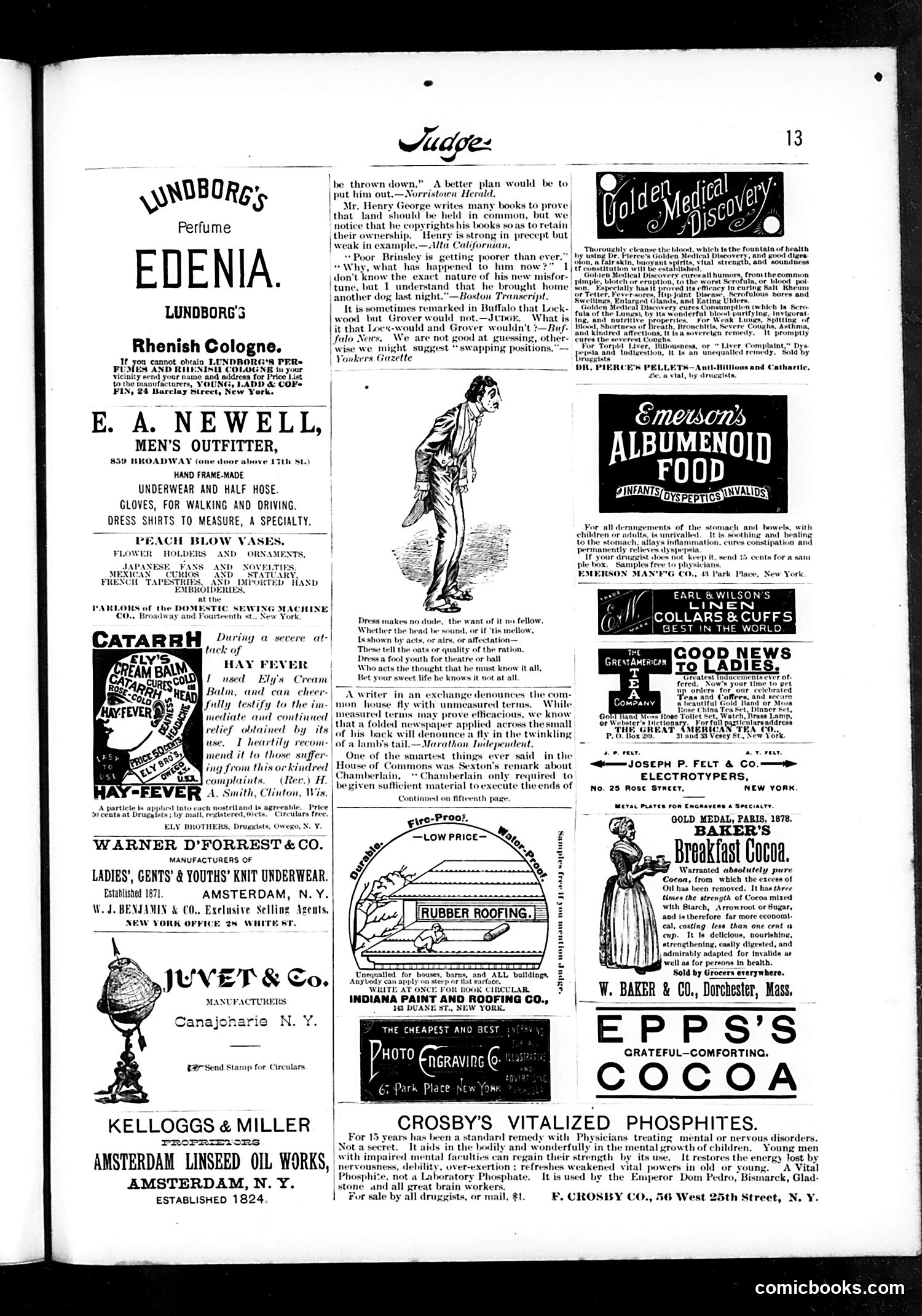
This page is primarily **advertisements** with minimal editorial content. The main illustrated cartoon (center-left) shows a poorly dressed man in a stooped posture, captioned with commentary about how "dress makes no dud[e]" — suggesting that appearance alone doesn't determine character or quality. The text discusses common social observations: a writer denounces house flies using "unmeasured terms," and there's a reference to a witty remark by Sexton in the House of Commons about Chamberlain requiring "sufficient material to execute the ends of" (text cuts off). Most notably, there's satirical commentary about **Henry George**, the economist and single-tax advocate, who wrote books arguing land should be held in common — yet copyrighted his own books to retain ownership. This hypocrisy is the joke: George preaches communal property while practicing private ownership. The page is otherwise dominated by period product advertisements (cocoa, cologne, roofing, electrotyping services), typical of Judge's revenue model. No major political figures or events are the focus.
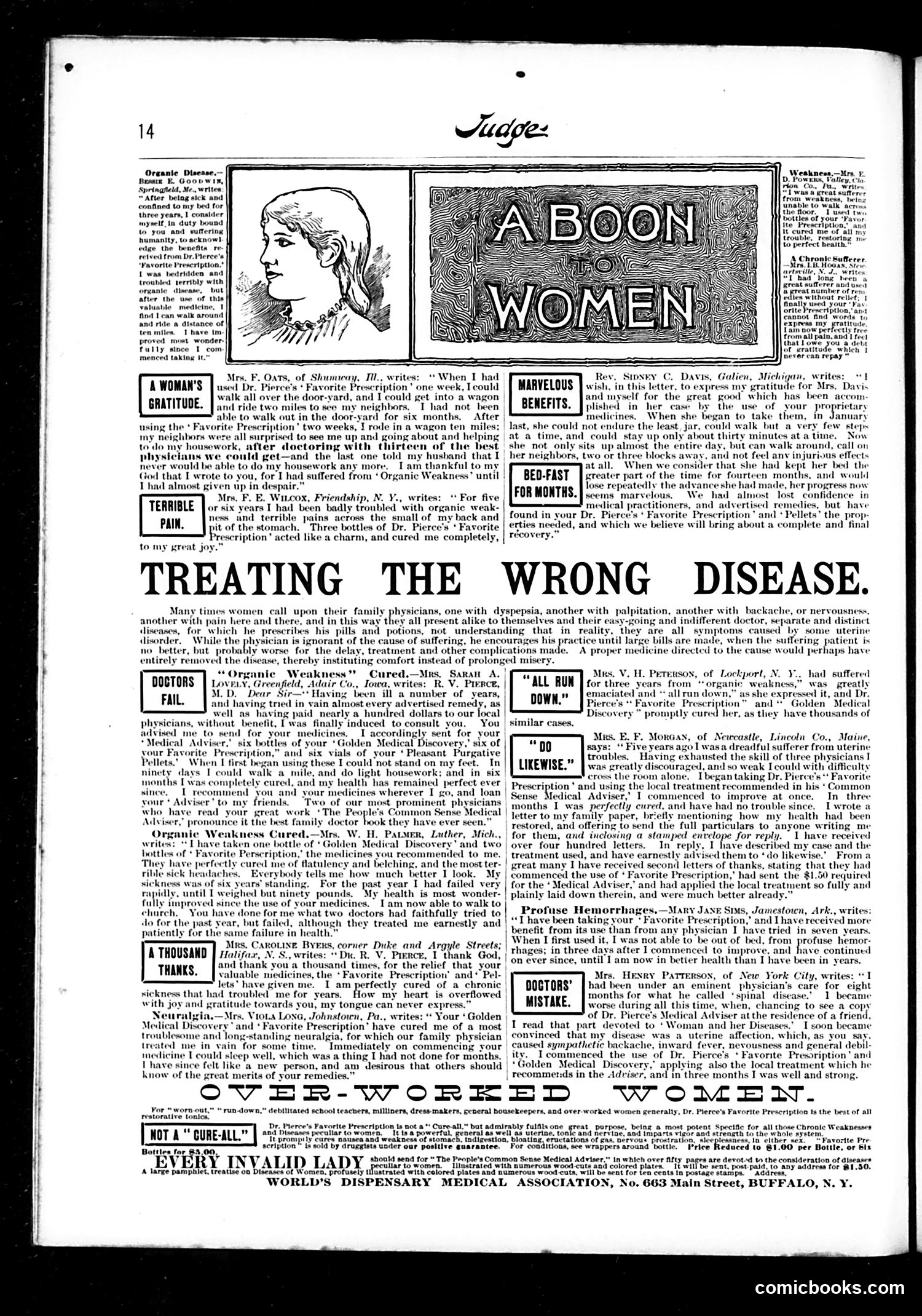
This is a **patent medicine advertisement**, not a political cartoon. Judge magazine (a satirical publication) runs these lucrative ads throughout its pages. The page features testimonial letters from women claiming Dr. Pierce's "Favorite Prescription" cured various ailments—backaches, weakness, inability to walk. The bold claim: physicians are treating the wrong disease. They diagnose dyspepsia or nervousness when the real cause is "organic weakness" (uterine disorder). This reflects late 19th/early 20th-century medical pseudoscience. The ad preys on women's limited access to legitimate healthcare and doctors' actual ignorance about gynecological conditions. The "satire" (if any) is Judge's standard practice of printing these dubious ads alongside journalistic content—ironic, since Judge itself profit from snake oil while mocking other frauds. **Modern context**: This exemplifies how women's complaints were dismissed, patronized, and exploited by commercial medicine before the FDA regulated pharmaceuticals.
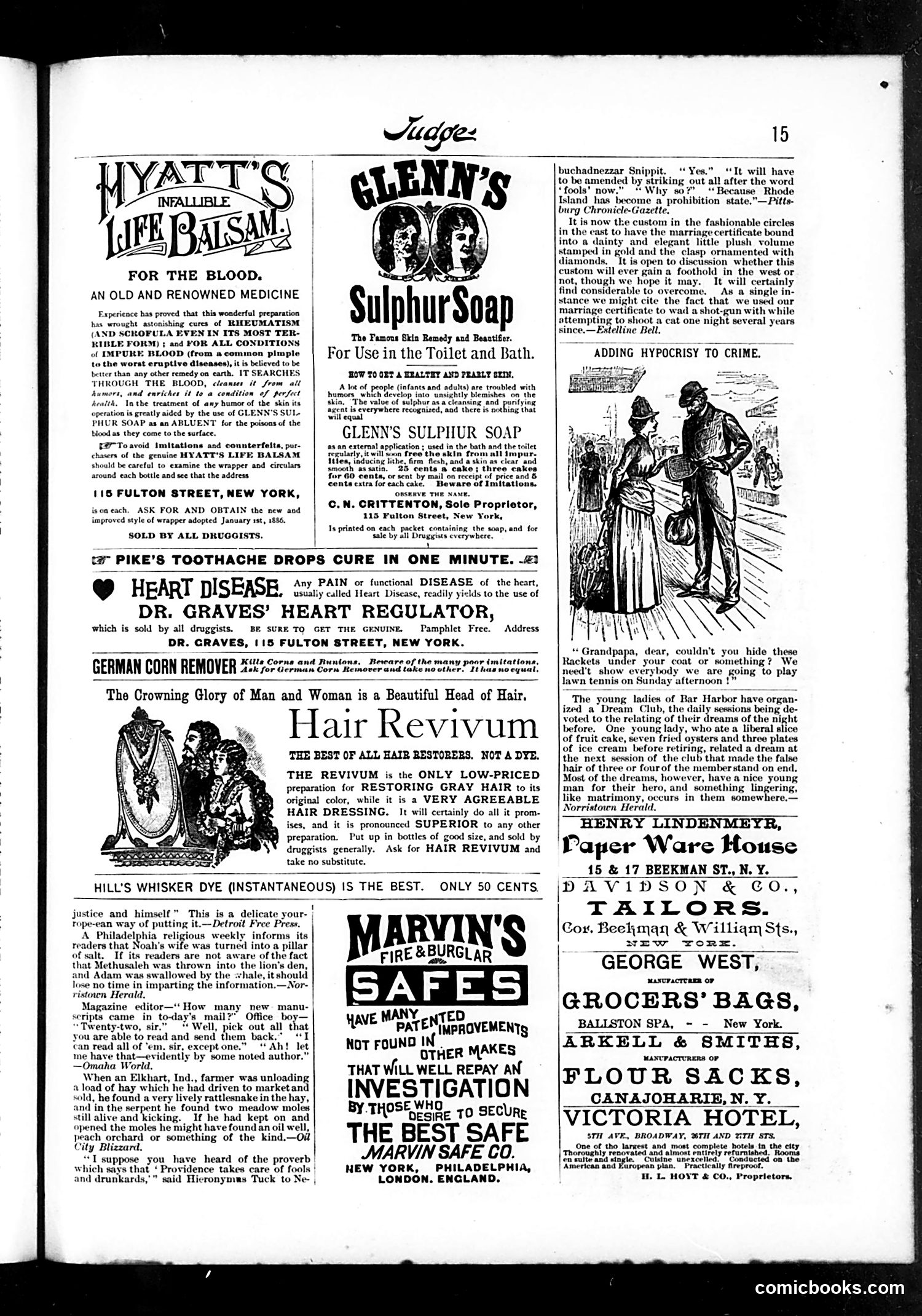
This Judge magazine page (circa 1886) is primarily **advertising**, featuring patent medicines and commercial products typical of the era. However, it contains one political cartoon titled "ADDING HYPOCRISY TO CRIME." The cartoon depicts a well-dressed couple hiding tennis rackets under a coat, explaining they don't want to show them publicly because they're going to play lawn tennis on Sunday afternoon. The satire targets **Sunday blue laws**—legal prohibitions against recreational activities on the Sabbath that were common in America. The joke is that wealthy, fashionable people hypocritically violate these laws while pretending to uphold strict religious observance. The cartoon critiques the gap between public morality and private behavior among the elite, with the added irony that Rhode Island (mentioned in another brief text on the page) had recently become a prohibition state, suggesting selective enforcement of moral laws.