
Judge, 1886-09-18 · page 7 of 16
Judge — September 18, 1886 — page 7: what you’re looking at
What you’re looking at
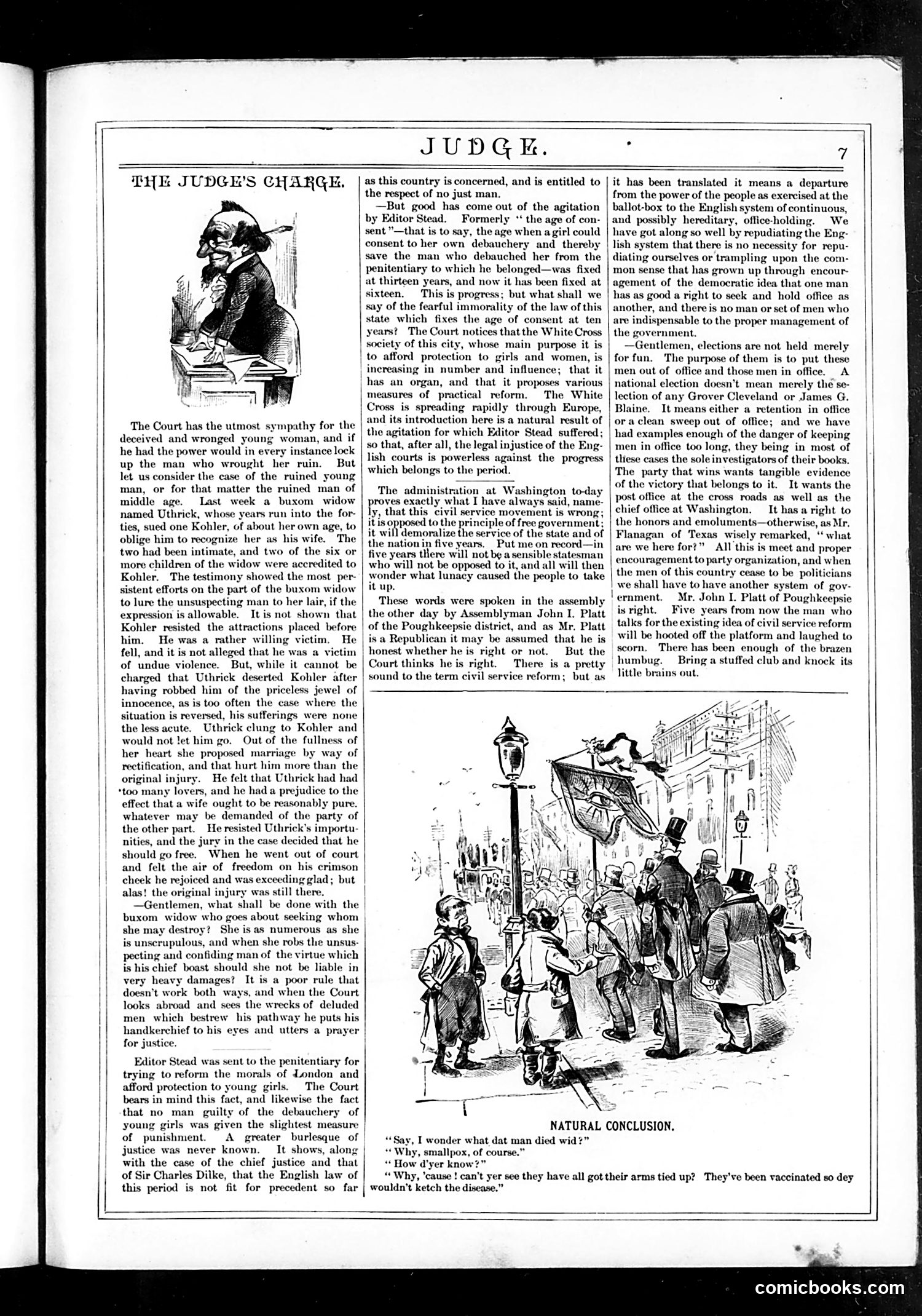
This page presents a mock judicial lecture addressing a real legal case: a widow named Uthrick sued a man named Kohler for breach of promise/recognition of illegitimate children. The judge's "charge" sarcastically argues that men deserve equal legal protection from seduction. The satire critiques the double standard in legal consequences: while Editor W.T. Stead faced imprisonment for exposing child exploitation, actual seducers faced no punishment. The judge notes England recently raised the age of consent from thirteen to sixteen—yet absurdly, some U.S. states fixed it at merely ten years. The cartoon (lower illustration) depicts street life, possibly illustrating the social disorder the editorial warns against. The satire ultimately mocks both naive male victimhood claims and the legal system's hypocrisy: punishing moral reformers while protecting actual exploiters. The "Natural Conclusion" joke at bottom suggests vaccinated children can't "ketch the disease"—likely referencing both literal vaccination and metaphorical moral "infection."
📄 Transcribed text from this page (OCR, searchable)
Machine-transcribed from the original scan — historical spelling and the odd misread are preserved.
JUDGE. THE JUDGE'S CHARGE. The Court has the utmost sympathy for the deceived and wronged young woman, and if he had the power would in every i up the man who wrought her r let us consider the case of the ruined young man, or for that matter the ruined man of middle age. Last week a buxom widow named Uthrick, whose years run into the for- ties, sued one Kohler, of about her own age, to oblige him to recognize her as his wife. The two had been intimate, and two of the six or | more children of the widow were accredited to Kohler. The testimony showed the most per- sistent efforts on the part of the buxom widow to lure the unsuspecting man to her lair, if the expression is allowable. It is not shown that Kohler resisted the attractions placed before He was a rather willing victim. He fell, and it is not alleged that he was a victim of undue violence. But, while it cannot be charged that Uthrick deserted Kohler after having robbed him of the priceless jewel of innocence, as is too often the case where the situation is reversed, his sufferings were none the less acute. Uthrick clung to Kohler and would not let him go. Out of the fullness of her heart she proposed marriage by way of rectification, and that hurt him more than the iginal injur; He felt that Uthrick had had *too many lover effect that a wife ought to be reasonably pure. whatever may be demanded of the party of the other part. He resisted Uthrick’s importu- nities, and the jury in the case decided that he should go free. When he went out of court and felt the air of freedom on his crimson cheek he rejoiced alas! the original injury was still there. —Gentlemen, what shall be done with the buxom widow who goes about seeking whom she may destroy? She is as numerous as she is unscrupulous, and when she robs the unsu: pecting and confiding man of the virtue whicl is his chief boast should she not be liable in very heavy damages? It is a poor rule that doesn’t work both ways, and when the Court looks abroad and sees the wrecks of deluded men which bestrew his pathway he puts his handkerchief to his eyes and utters a prayer | for justice. Editor Stead was sent to the penitentiary for trying to reform the morals of London’ and afford protection to young girls. The Court bears in mind this fact, and likewise the fact that no man guilty of the debauchery of young girls was given the slightest measure of punishment. A greater burlesque of justice was never known. It shows, along with the case of the chief justice of Sir Charles Dilke, that the English law of this period is not fit for precedent so far | honest whether nd he had a prejudice to the | nd was exceeding glad; but | as this country is concerned, and is entitled to the respect of no just man. —But good has come out of the agitation by Editor Stead. Formerly “‘ the age of con- sent "—that is to say, the age when agirl could consent to her own debauchery and thereby save the man who debauched her from the penitentiary to which he belonged—was fixed at thirteen years, and now it has been fixed at sixteen. This is progress; but what shall we say of the fearful immorality of the law of th state which fixes the age of consent at ten years? The Court notices that the White Cross society of this city, whose main purpose it is | to afford protection to girls nd women, is increasing in number and influence; that it has an organ, and that it proposes various | measures of practical reform. The White Cross is spreading rapidly through Europe, and its introduction here is a natural result of the agitation for which Editor Stead suffered; so that, after all, the legal injustice of the Eng- lish courts is powerless against the progress which belongs to the period. The administration at Washington to-day pore exactly what I have alw y, that this ci nent is wrong; if spposed to the principle of free government; it will demoralize the service of the state and of the nation in five on record—in five years there ible statesman who will not be opposed to it, and all will then wonder what lunacy caused the people to take it up. These words were spoken in the assembly Put | the other day by Assemblyman John I, Platt of the Poughkeepsie district, and as Mr, Platt is a Republican it may be assumed that he is is right or not. But the Court thinks he is right. There is a pretty sound to the term civil service reform; but as it has been translated it means a departure from the power of the people as exercised at the ballot-box to the English system of continuous, office-holding. We have got along so well by repudiating the Eng- lish system that there is no necessity for repu- diating ourselves or trampling upon the com- mon sense that has grown up through encour- agement of the democratic idea that one man | has as good a right to seek and hold office as nother, and there is no man or set of men who are indispensable to the proper management of the government. —Gentlemen, elections are not held merely for fun. The purpose of them is to put these men out of office and those men in office. A national election doesn't mean merely thé se- lection of any Grover Cleveland or James G. Blaine. It means either a retention in office oraclean sweep out of office; and we have had examples enough of the danger of keeping men in office too long, they being in most of these cases the sole investigators of their books. The party that wins wants tangible evidence of the victory that belongs to it. It wants the post office at the cross roads as well as the chief office at Washington. It has a right to the honors and emoluments—otherwise, as Mr. Flanagan of Texas wisely remarked, “what are we here for?” All 'this is meet and proper | encouragement to party organization, and when the men of this country cease to be polit 8 we shall have to have another system of gov- ment. Mr. John I. Platt of Poughkeepsie ght. ears from now the man who talks for the existing idea of civil service reform will be hooted off the platform and laughed to scorn, There has been enough of the brazen humbug. — Bring a stuffed club and knock its little brains out. NATURAL CONCLUSION. “Say, I wonder what dat man died wid?” “ Why, smallpox, of course.” “ How d'yer know?” “ Why, ‘cause ! can't yer see they have all got their arms tied up? They've been vaccinated so dey wouldn't ketch the disease.” comicbooks.com