
A complete issue · 16 pages · 1886
Judge — September 4, 1886
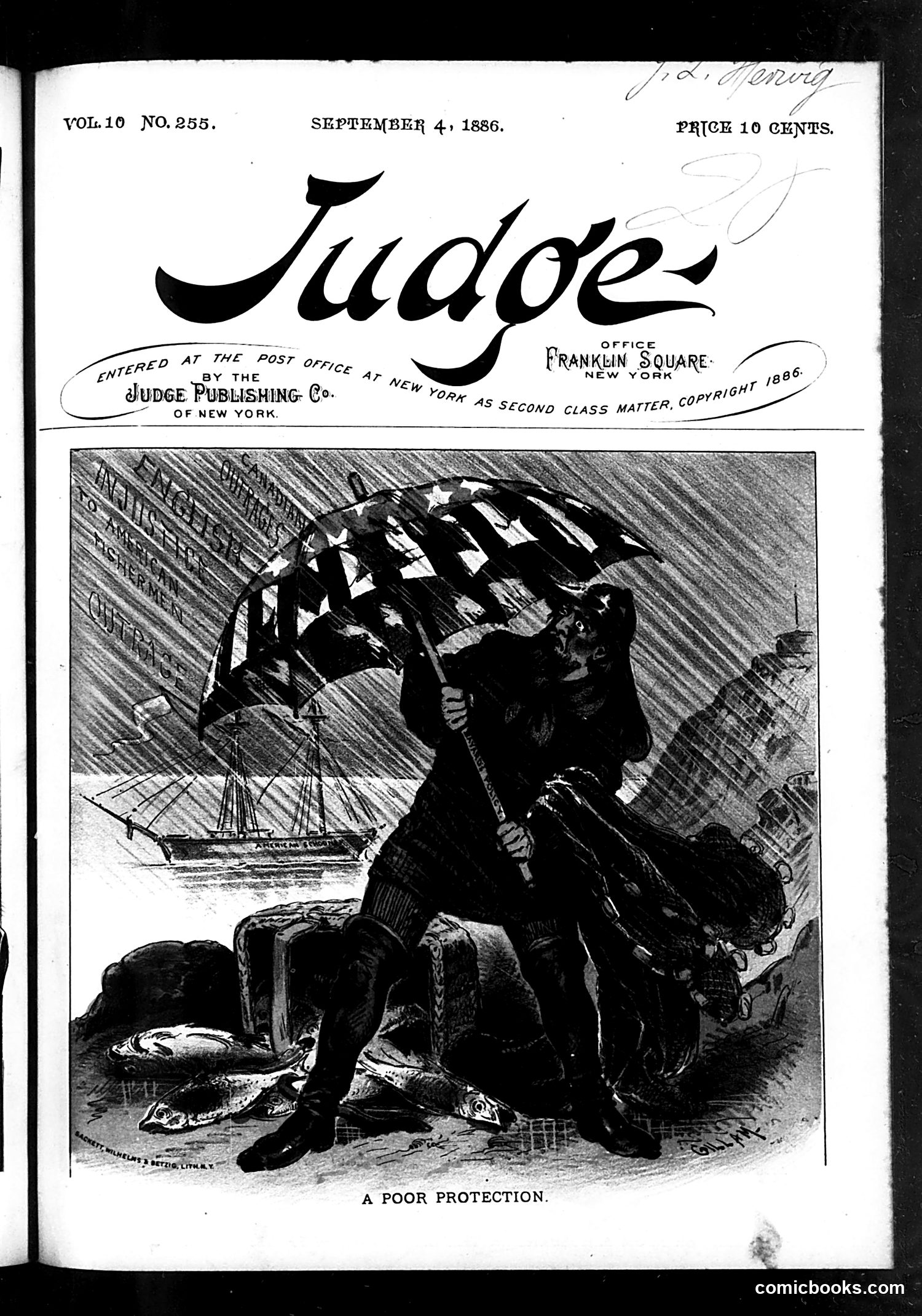
This political cartoon satirizes inadequate maritime safety measures. A figure sits huddled beneath a makeshift umbrella while a sailing ship burns in the background, suggesting useless protection against maritime disasters. The caption "A Poor Protection" indicates the umbrella represents some policy or regulation the artist views as insufficiently safeguarding sailors or passengers from shipping dangers. The 1880s saw growing concerns about maritime safety following several major shipwrecks and industrial accidents. The contrast between the fragile umbrella and the catastrophic fire emphasizes the cartoon's criticism—whatever protective measures exist (likely new maritime regulations or safety standards) are mockingly portrayed as laughably inadequate for genuine protection against the serious hazards of sea travel.
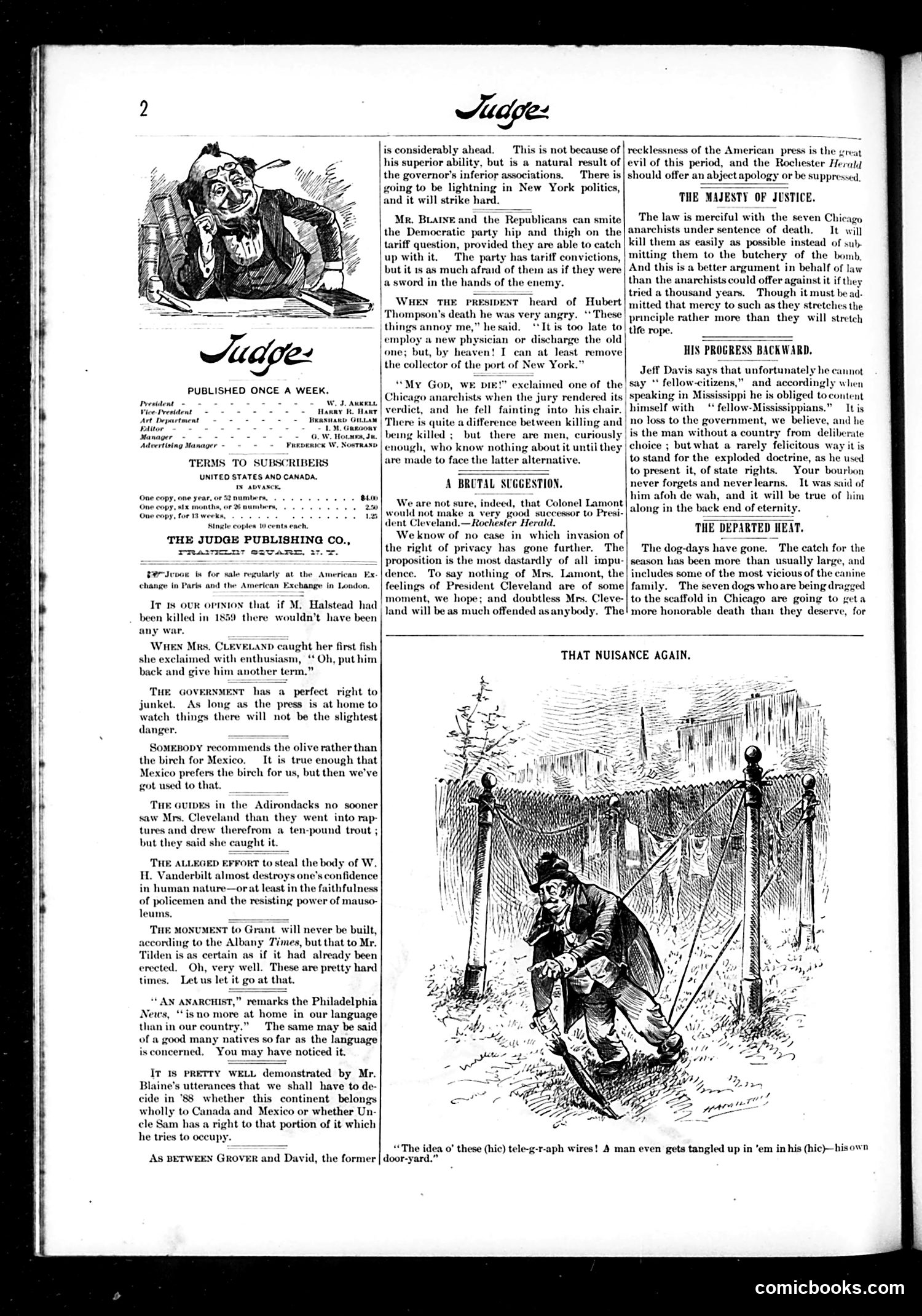
This page contains political commentary and satirical articles rather than comics. The main cartoon "That Nuisance Again" depicts a man struggling with telegraph wires—a visual metaphor for the frustration caused by overhead telegraph lines in cities, a genuine public nuisance of the era. The text discusses Chicago anarchists sentenced to death, Mrs. Cleveland catching fish, and Mrs. Vanderbilt's confidence in law enforcement. References to "An Anarchist" remark and debates about invasion of privacy suggest this addresses late 19th-century anxieties about anarchism and government power. The articles criticize judges, discuss Mrs. Lamont's treatment, and debate proper punishment methods—reflecting contemporary political divisions over law and justice.
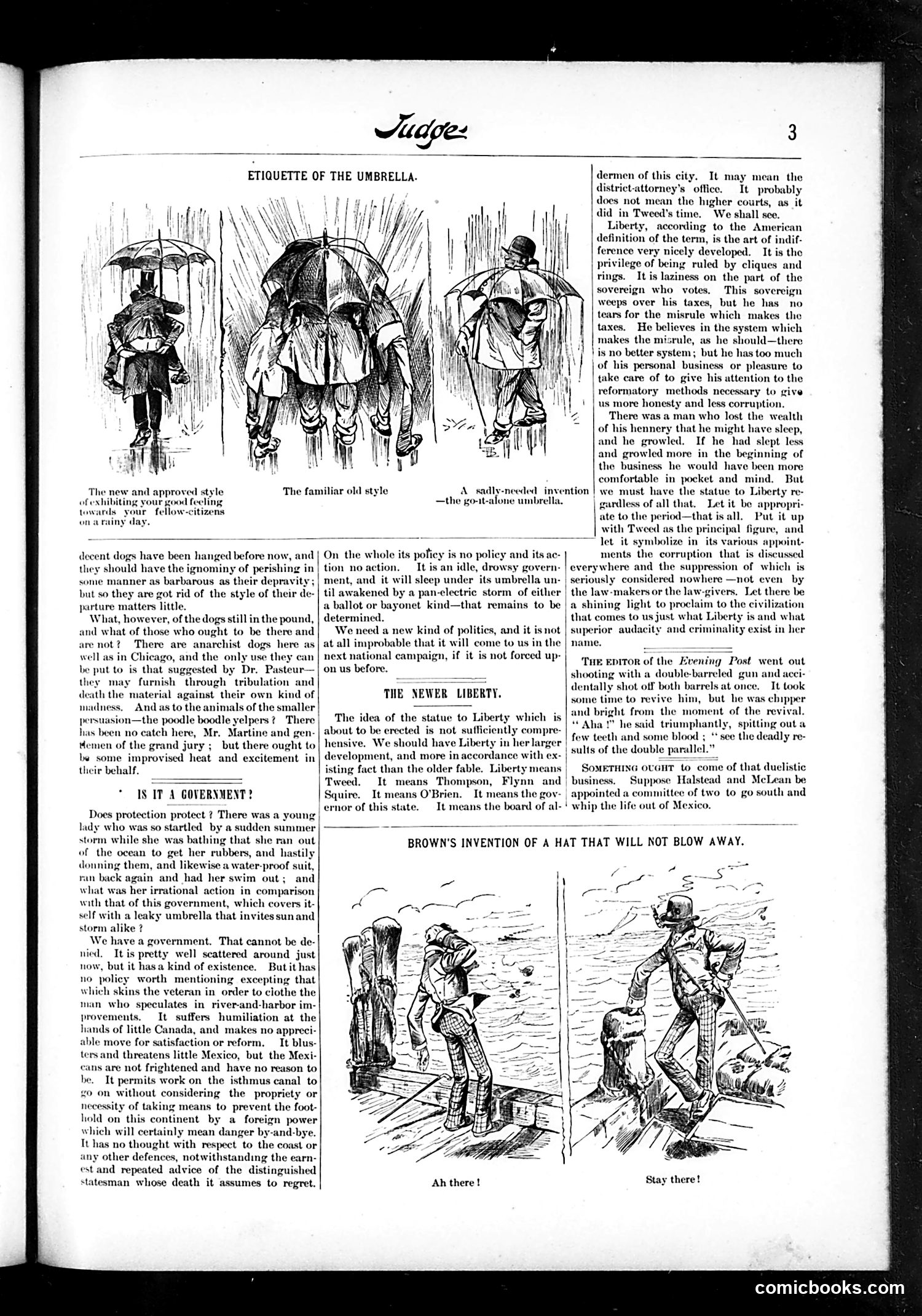
This page satirizes American government incompetence and corruption circa the 1880s-90s. **"IS IT A GOVERNMENT?"** attacks the U.S. government as ineffectual—using an absurd image of a woman wearing a raincoat into the ocean to mock the government's contradictory policies. The author criticizes its failure to protect veterans while favoring river-and-harbor speculators, its weakness against Canada and Mexico, and its inaction on canal security and coastal defense. **"THE NEWER LIBERTY"** mocks the Statue of Liberty concept, sarcastically redefining "Liberty" as corrupt city politics—naming apparent local Democratic politicians (Tweed, Thompson, Flynn, O'Brien) associated with machine politics and graft. It equates liberty with the people's apathy: they complain about taxes but tolerate the corruption causing them. **The umbrella cartoons** illustrate changing fashions ("etiquette of the umbrella"). **"Brown's Invention"** (bottom) appears to show a humorous contraption designed to keep hats from blowing away. The page overall expresses cynical disgust with urban political corruption and governmental paralysis.
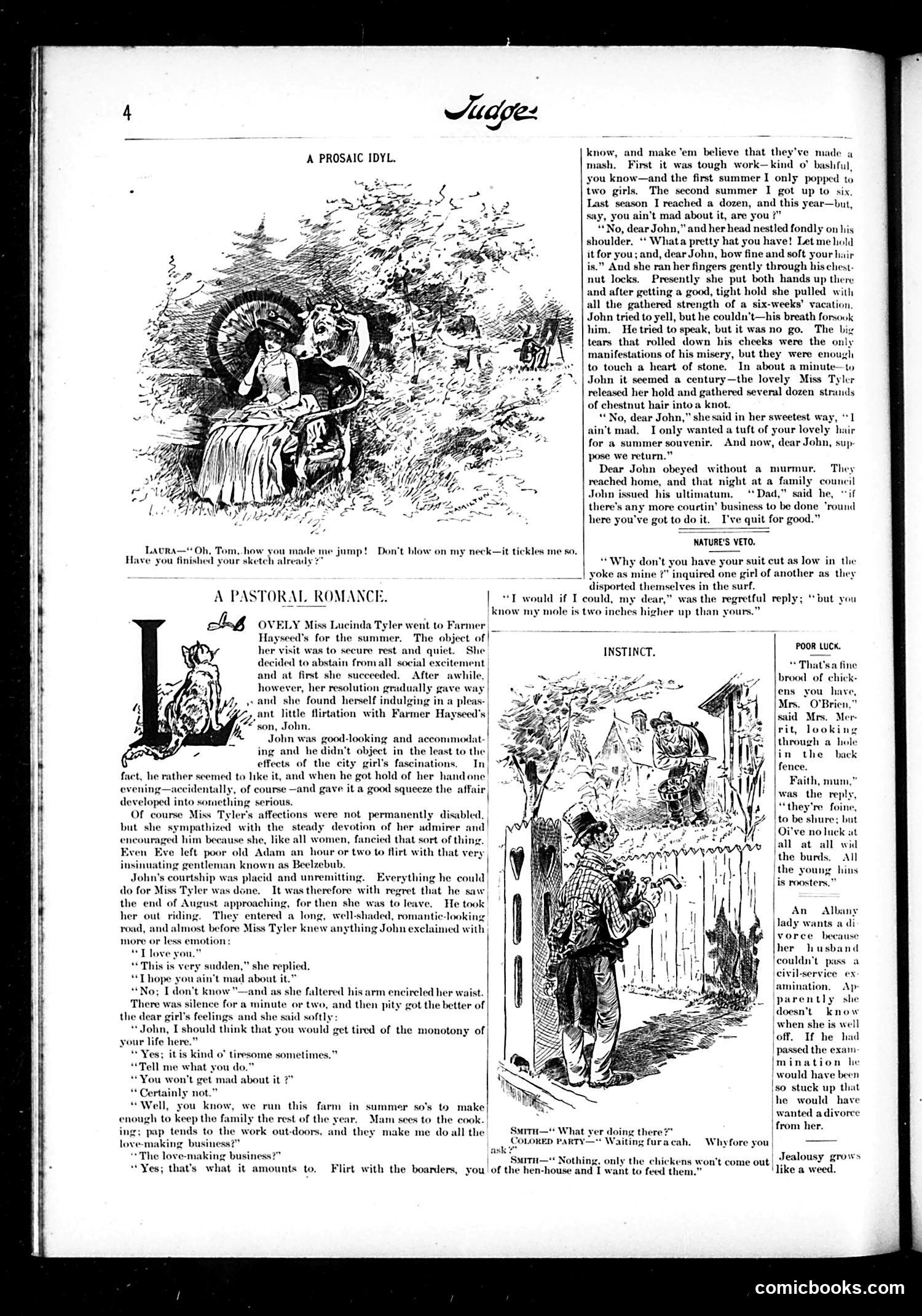
This page contains three humorous stories satirizing courtship and romance customs of the era: **"A Pastoral Romance"** depicts a city girl (Miss Lucinda Tyler) flirting with a farmer's son (John) during a summer visit. The joke: after encouraging his romantic advances all season, she brutally yanks out a tuft of his hair as a "souvenir," causing him to swear off courting entirely. The satire targets both the manipulative coquetry of city women and the naive gullibility of rural men. **"A Prosaic Idyl"** (top) shows similar themes—a couple's courtship ending in physical violence when romance proves monotonous. **"Nature's Veto"** and **"Instinct"** are brief, lighter quips about physical appearance and animal behavior constraining human desires. The broader satire mocks the artificiality of Victorian courtship rituals and suggests that genuine emotion—or simple practicality—ultimately defeats romantic pretense. The rural setting contrasts innocent country life against manipulative urban sophistication.
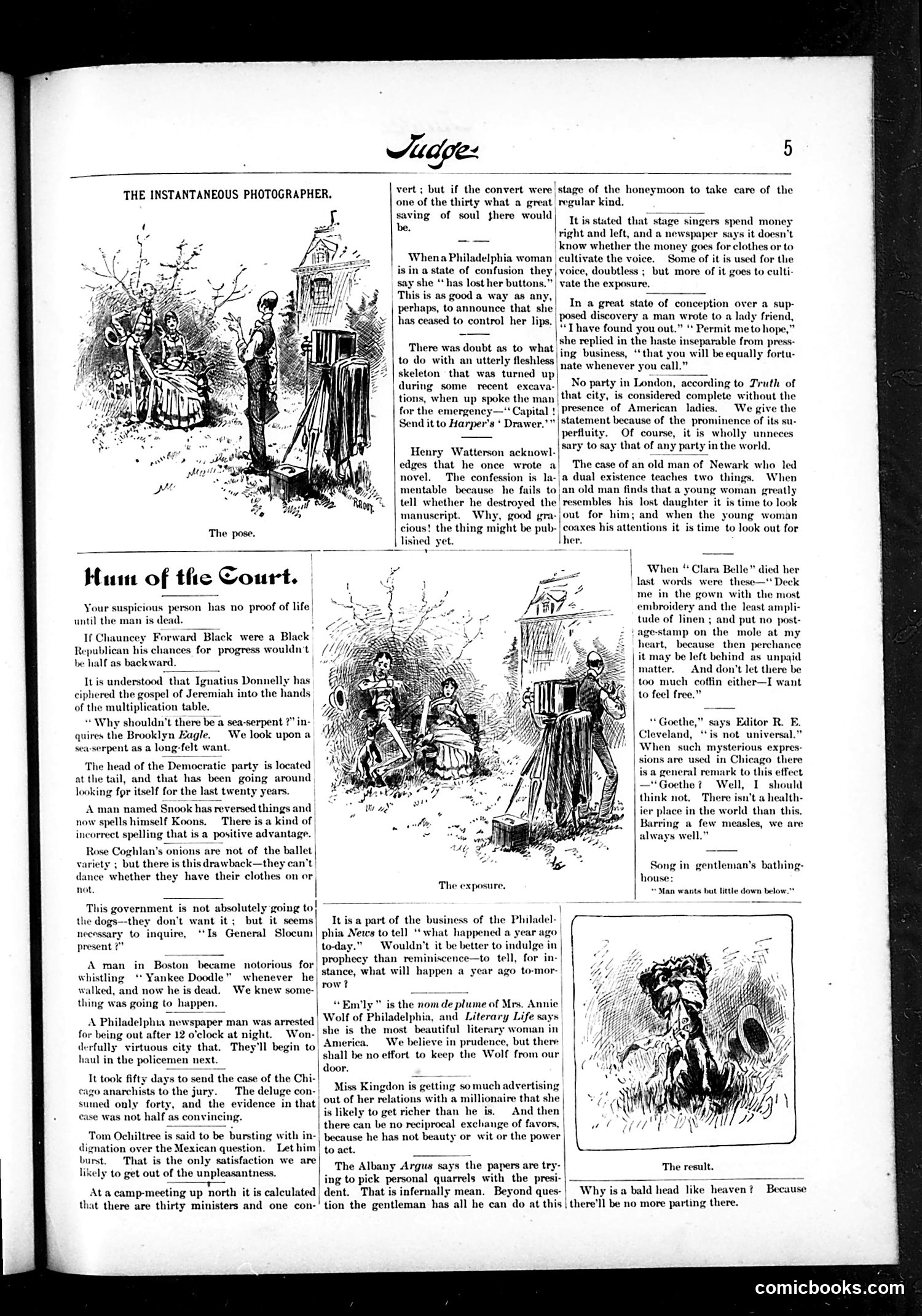
This page contains multiple brief satirical items typical of Judge's style. Key targets include: **"The Instantaneous Photographer"** mocks stage singers' spending habits, suggesting money ostensibly for voice training actually funds "exposure" (publicity). **"Hum of the Court"** consists of quick political jabs: Chauncey Forward Black's name is the joke itself; Henry Watterson's admission of writing a novel becomes absurd because he never revealed whether he destroyed the manuscript; Ignatius Donnelly is ridiculed for allegedly "ciphering the gospel" into multiplication tables—likely mocking his pseudohistorical theories. The cartoons titled "The pose," "The exposure," and "The result" appear to illustrate domestic/social situations, though their specific references are unclear without additional context. Overall, the page demonstrates Judge's approach: punchy wordplay, personality-based humor targeting public figures, and social commentary on contemporary American life and pretensions.
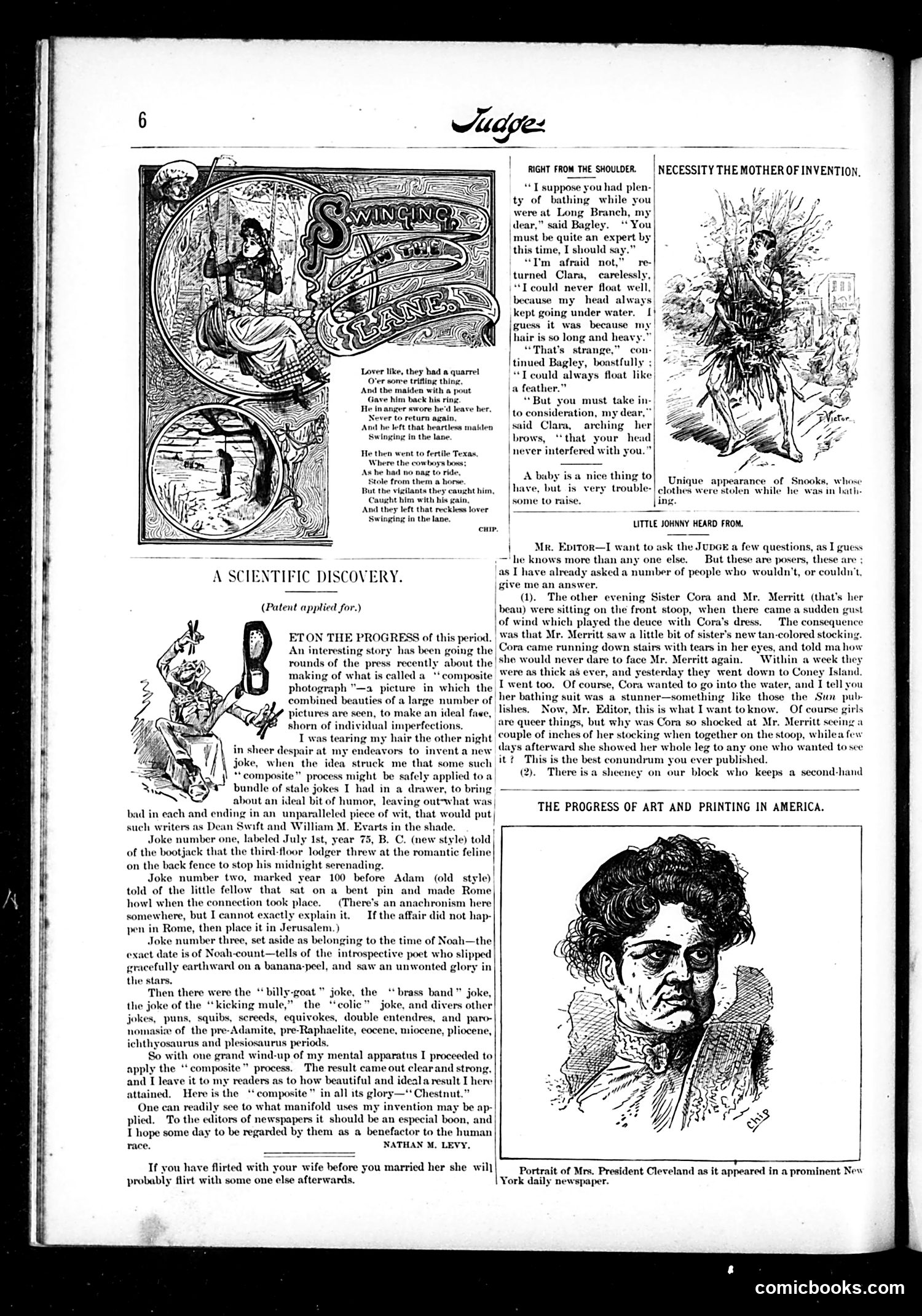
This page contains primarily **satirical commentary and humor pieces** rather than political cartoons. The main content, "A Scientific Discovery" by Nathan M. Levy, satirizes the Victorian obsession with "composite photography"—a pseudo-scientific trend where multiple photographs were combined to create idealized images. Levy humorously proposes applying this technique to old jokes, treating stale humor as if it could be "perfected" through combination. The joke operates on multiple levels: mocking both the composite photography craze and the desperate recycling of worn-out comedic material. The side sections include brief satirical quips about relationships and parenting, typical of Judge's format. One notable exchange between "Bagley" and "Clara" uses a woman's long hair as a punchline about swimming inability—humor dependent on period gender stereotypes. The portrait of "Mrs. President Cleveland" references a contemporary political figure, though the specific context is unclear from this page alone. Overall, this reflects Judge's focus on social satire rather than hard political commentary.
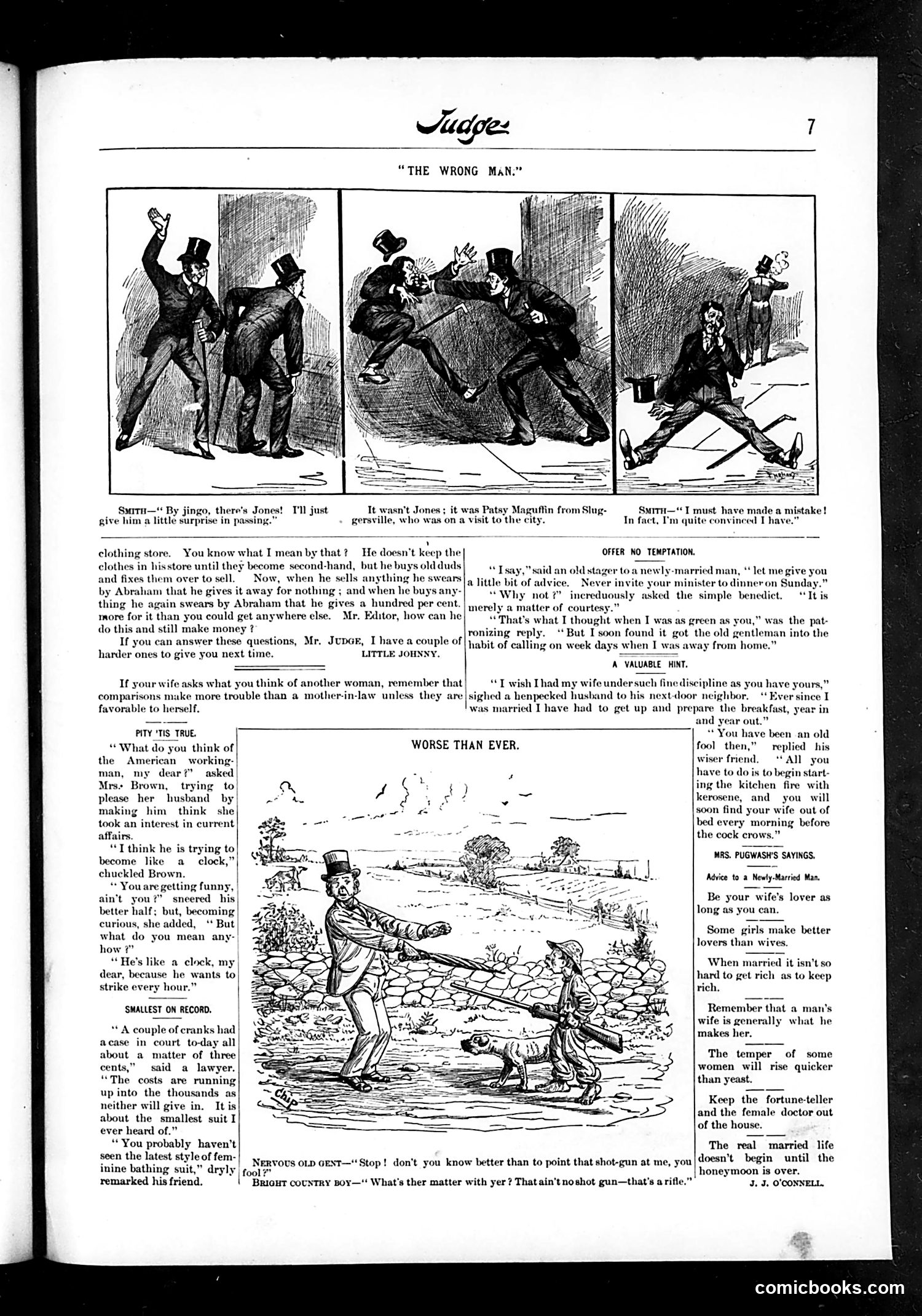
This Judge magazine page contains multiple short satirical pieces mocking American social conventions, particularly marriage and gender relations. **"The Wrong Man" comic strip** (top) depicts a man mistaking a visitor for someone else—a simple case-of-mistaken-identity gag typical of period humor. **The remaining satirical pieces** target marital dynamics: a husband comparing workers to clocks that "want to strike every hour" (commentary on labor unrest/demands for shorter workdays); advice warning against inviting ministers to Sunday dinners (implying infidelity concerns); a henpecked husband forced to prepare breakfast; and "Mrs. Pugwash's Sayings"—cynical aphorisms about marriage being disappointing after the honeymoon. **The rural shooting scene** shows a country boy pointing a rifle at an old gentleman, creating humor from the distinction between urban sophistication and rural ignorance. The overall tone reflects turn-of-the-century anxieties about marriage as obligatory drudgery, labor activism, and rural/urban cultural differences.
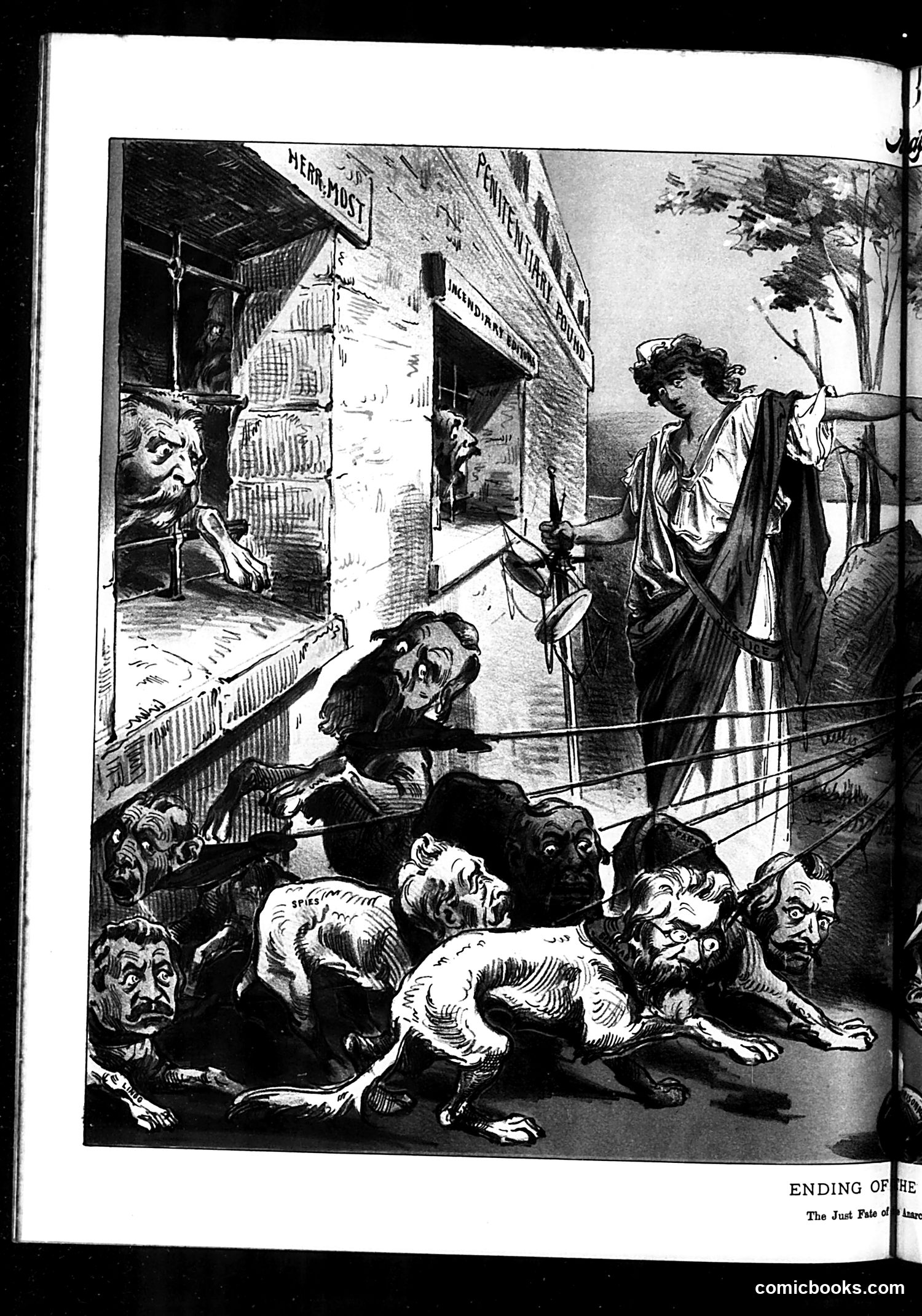
This appears to be a satirical illustration from *Judge* magazine showing a street scene outside what looks like a tavern or establishment (signage visible reading "HERMOST" and "PRIVATE"). The cartoon depicts a well-dressed woman wielding a whip or rod against a pack of dogs and what appear to be caricatured men in the street. The style suggests this is likely commentary on temperance or prohibition-era social reform—with the woman representing a reform activist or moral crusader using force against those she views as moral threats or "dogs" (a dehumanizing metaphor common in period satire). The incomplete OCR text ("ENDING OF HE...") and cropped caption make the specific target unclear, but the overall image satirizes the aggressive enforcement methods of social reformers of the era.
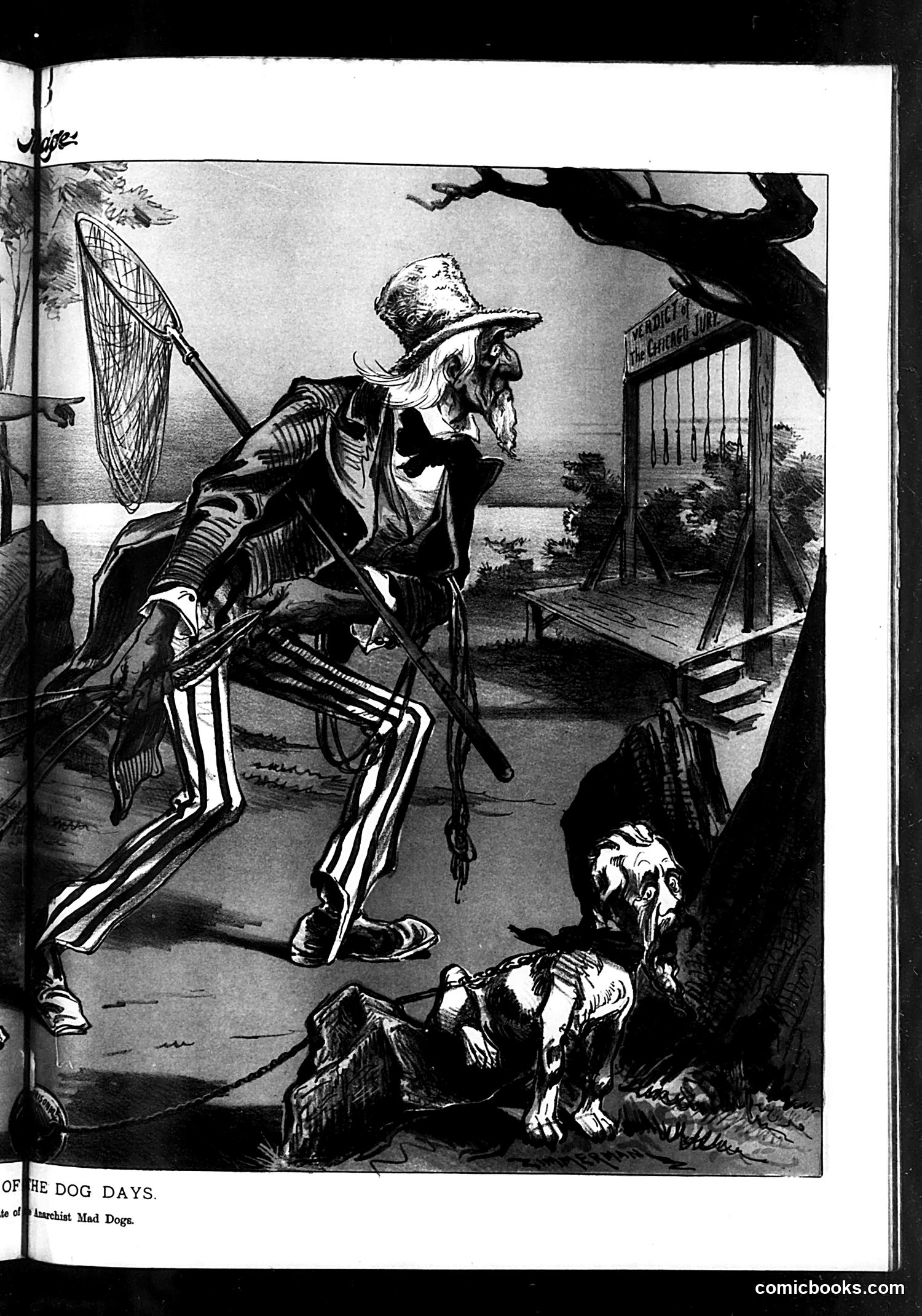
This political cartoon depicts an elderly man with a distinctive long beard, wearing a hat and patriotic striped pants, wielding a butterfly net while confronting a dog. The caption references "Anarchist Mad Dogs," suggesting this is Cold War-era satire about anarchist threats. The bearded figure likely represents Uncle Sam or an American authority figure attempting to "catch" or eliminate perceived anarchist dangers, symbolized as a "mad dog." The butterfly net suggests a somewhat absurd or inadequate response to the threat. A gate structure in the background appears to reference containment or border control. The "Dog Days" reference (visible in the page title) is a pun—simultaneously referring to the hot summer period and the literal dogs depicted, while commenting on dangerous political elements during an era of anarchist concern in America.
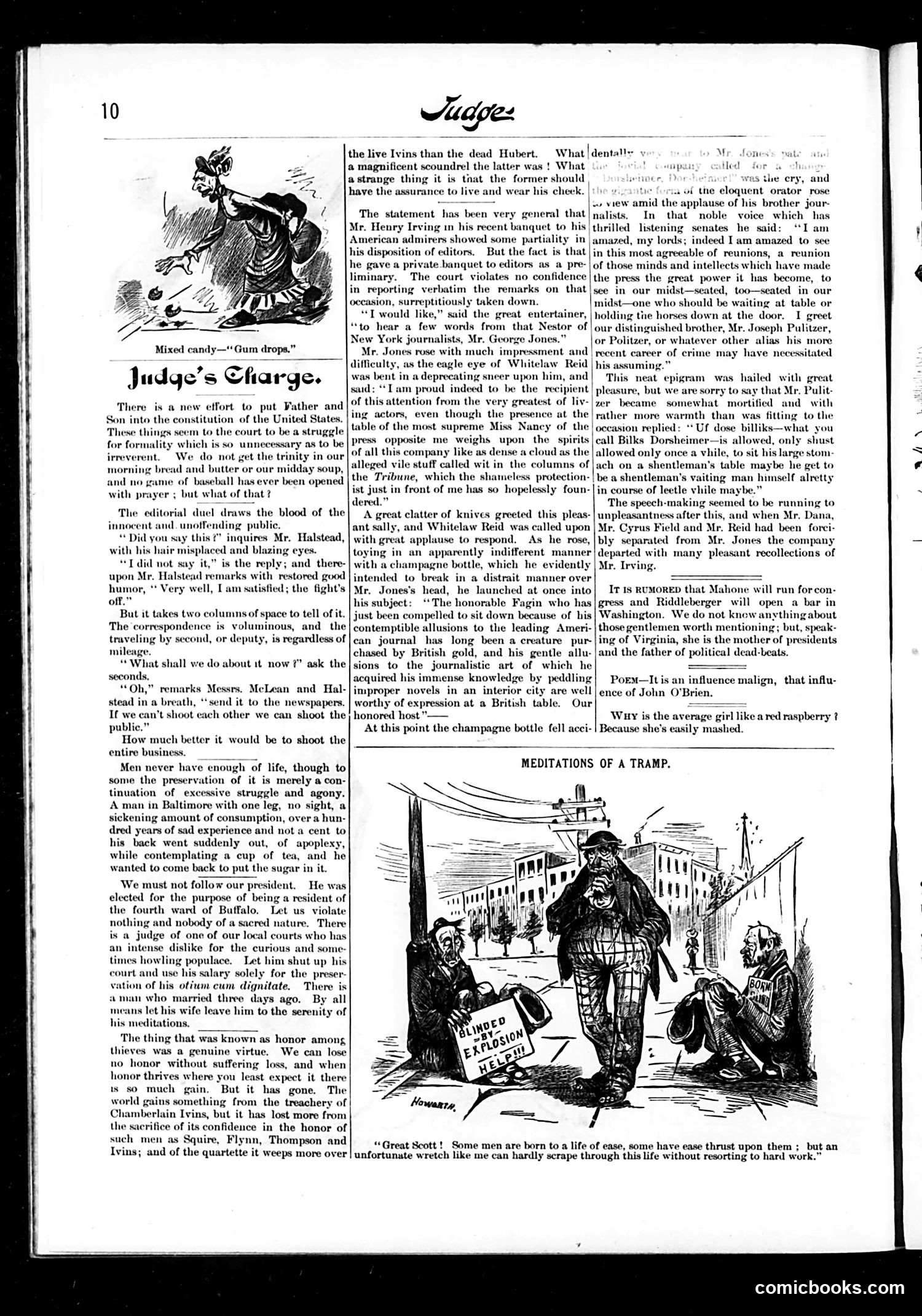
This page satirizes the recent banquet Henry Irving (the famous English actor) threw for American newspaper editors in New York. The editorial discusses how the editors engaged in petty feuds over the event's coverage—specifically mentioning George Jones and editor Whitelaw Reid, who apparently squabbled publicly about Irving's remarks and treatment of the press. The main cartoon "Mixed Candy—Gum Drops" (top left) depicts the absurdity of these editorial disputes, using the "gum drops" metaphor to suggest the editors are quarreling over trivial matters. The larger "Meditations of a Tramp" cartoon below shows a homeless man contemplating urban life, contrasting sharply with the self-important editorial quarrels described above. The overall point: Judge ridicules journalists for their vanity and pointless feuding, suggesting they prioritize personal dignity and public disputes over substantive issues, while ordinary people face real hardship.
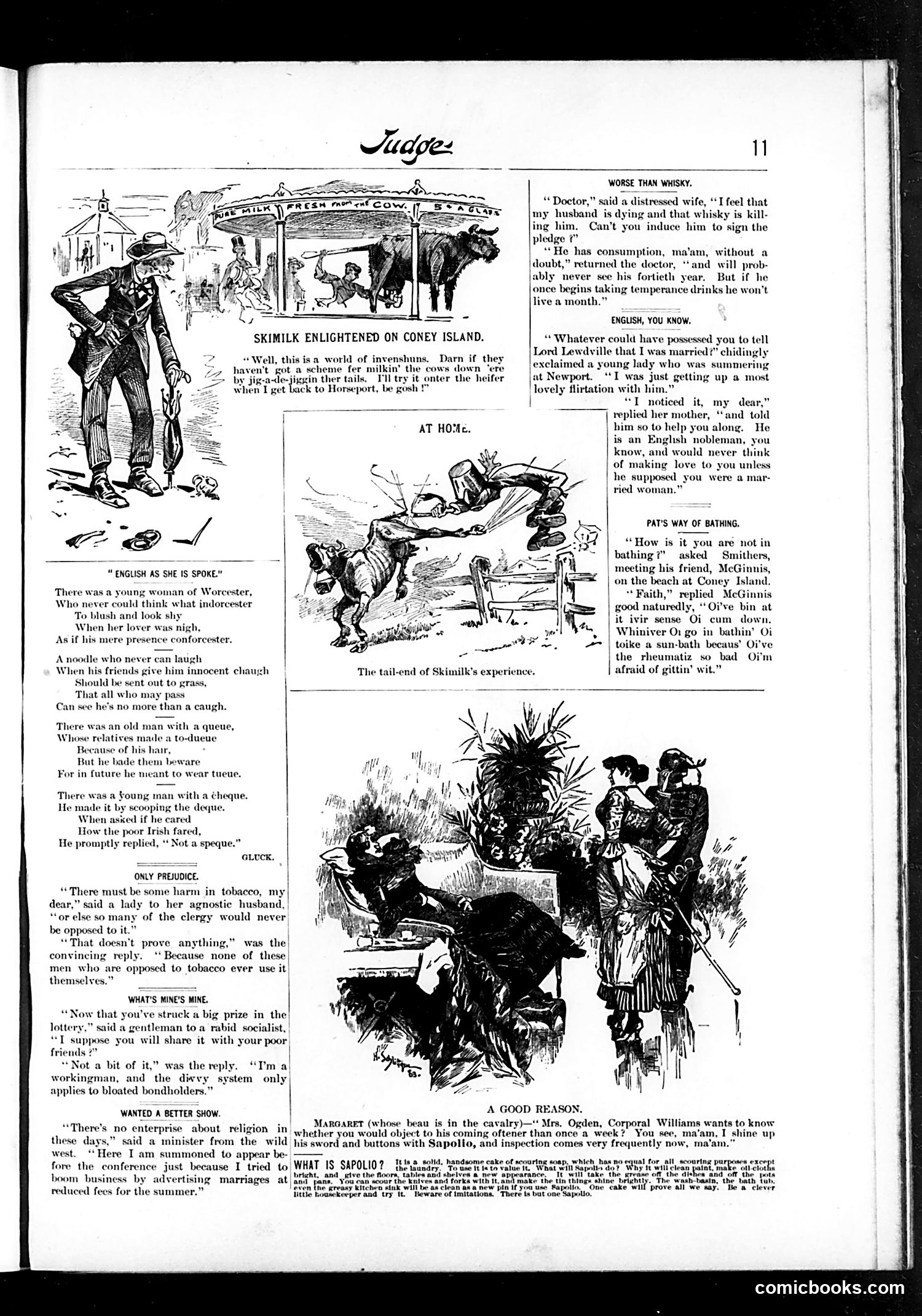
This page contains multiple brief satirical pieces typical of late 19th-century American humor: **"English as She Is Spoke"** mocks malapropisms and linguistic errors through nonsense poetry about a Worcester woman, a man who can't laugh, and others—satirizing poor English or affected speech patterns. **Social/Moral Satire** includes: - "Worse Than Whisky": A doctor tells a dying consumptive husband that temperance drinks are worse for him than whisky—absurdist humor attacking temperance movements - "Only Prejudice": A clergyman's hypocrisy about tobacco—clergy oppose it while using it themselves - "What's Mine's Mine": A workingman refuses to share lottery winnings with the poor, mocking class divisions - "Wanted a Better Show": A minister admits advertising cut-rate marriages to boost church business **Ethnic/Class Humor** includes "Pat's Way of Bathing," featuring an Irishman (McGinnis) in stereotyped dialect avoiding water due to rheumatism—typical period ethnic caricature. The page ends with a **Sapolio soap advertisement**, indicating how commercial advertising integrated into satirical publications. Overall, the content reflects Gilded Age social criticism mixed with period-typical prejudices.
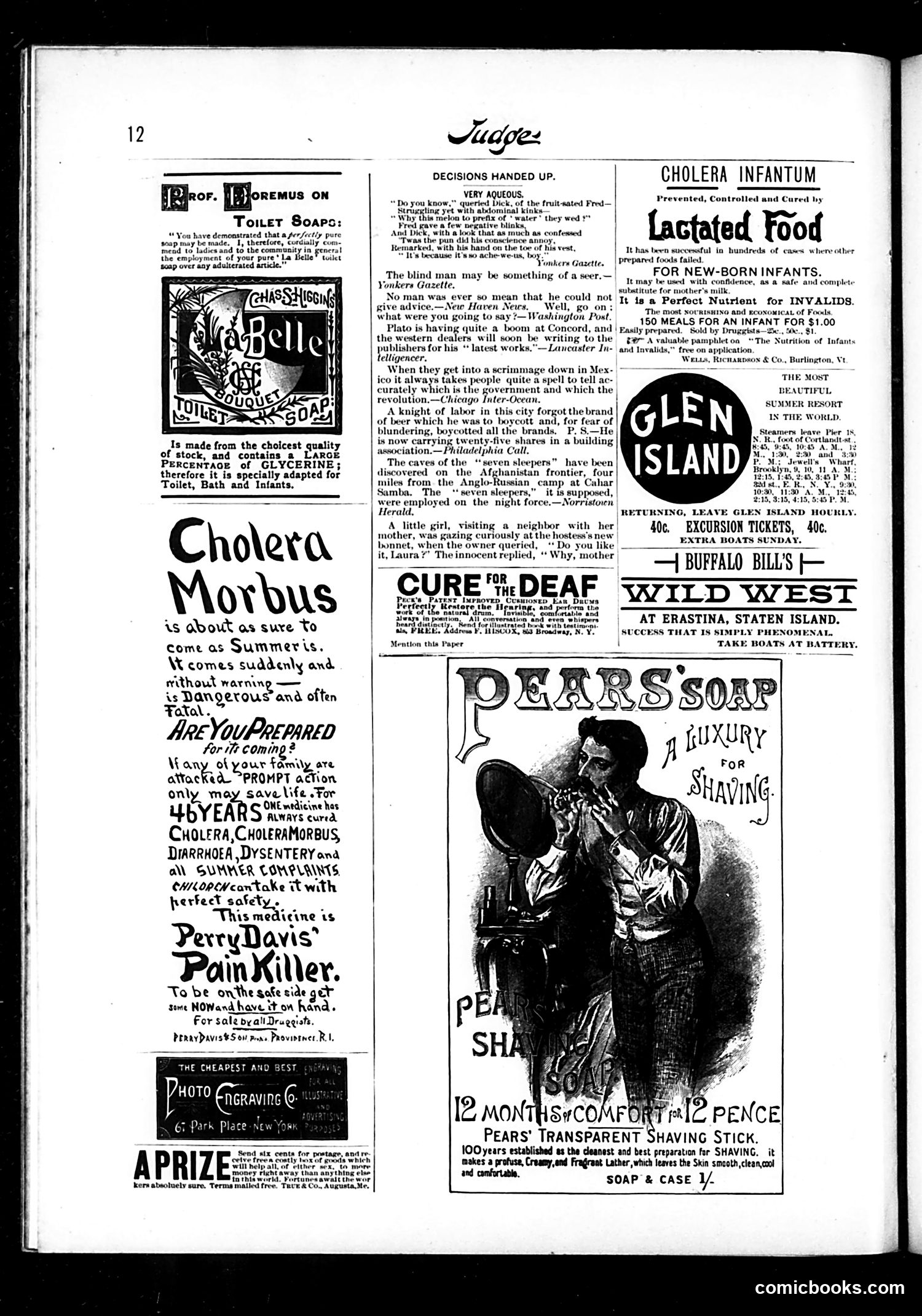
This page is primarily **advertising**, typical of late 19th-century magazines. The notable content includes: **Main Advertisements:** - **La Belle Toilet Soap** — endorsed with a (likely fabricated) testimonial claiming it's "perfectly pure" - **Perry Davis' Pain Killer** — marketed as a cure-all for cholera, dysentery, and summer complaints - **Lactated Food** — infant formula claiming to prevent cholera infantum - **Pears' Soap** — shaving product - **Glen Island** — summer resort advertisement - **Buffalo Bill's Wild West** — theatrical show at Staten Island **Satirical Content:** The small section "Decisions Handed Up" contains brief witticisms about contemporary life—jokes about fruit-eating, blind men, philosophers, labor boycotts, and curious children. These appear to mock everyday absurdities and social pretensions. **Historical Context:** The heavy promotion of patent medicines and dubious health claims reflects the unregulated pharmaceutical era. Cholera and infant mortality were genuine public health fears, making such advertisements exploitative by modern standards.
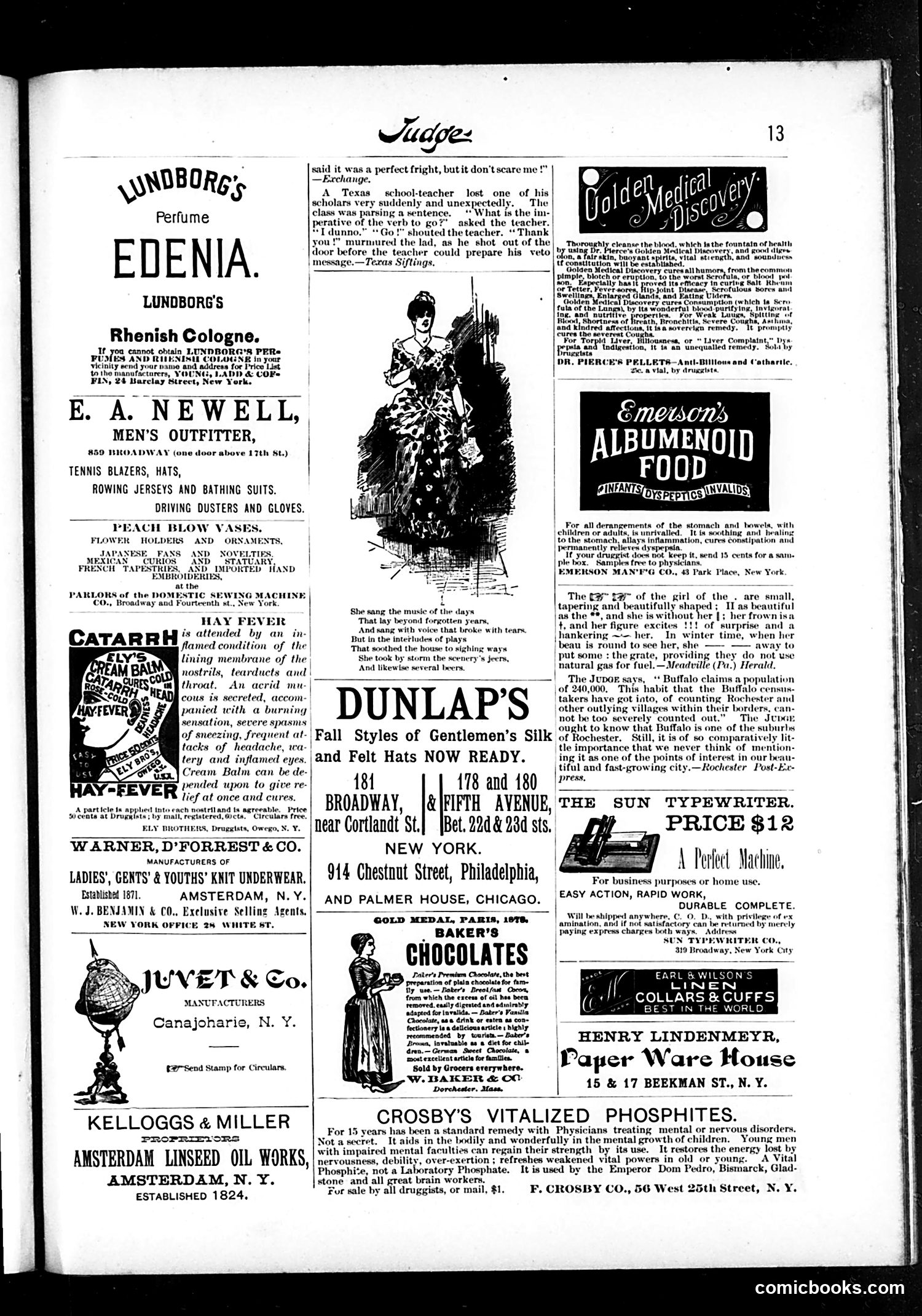
This page is primarily **advertising**, not political satire. It contains commercial notices for late-19th-century products: perfumes (Lundborg's), men's clothing (E.A. Newell, Dunlap's hats), medicines (Ely's Cream Balm for hay fever, Crosby's Vitalized Phosphites), chocolates (Baker's), and various patent remedies. The only editorial content visible is small **humorous filler pieces** between ads—brief jokes about schoolteachers and a girl's beauty routine. These are lighthearted, non-political anecdotes typical of humor magazines of the period. There are **no identified political cartoons, caricatures, or satirical commentary** on this particular page. It represents the revenue-generating advertisement section that filled Judge magazine's pages alongside its satirical editorial content.
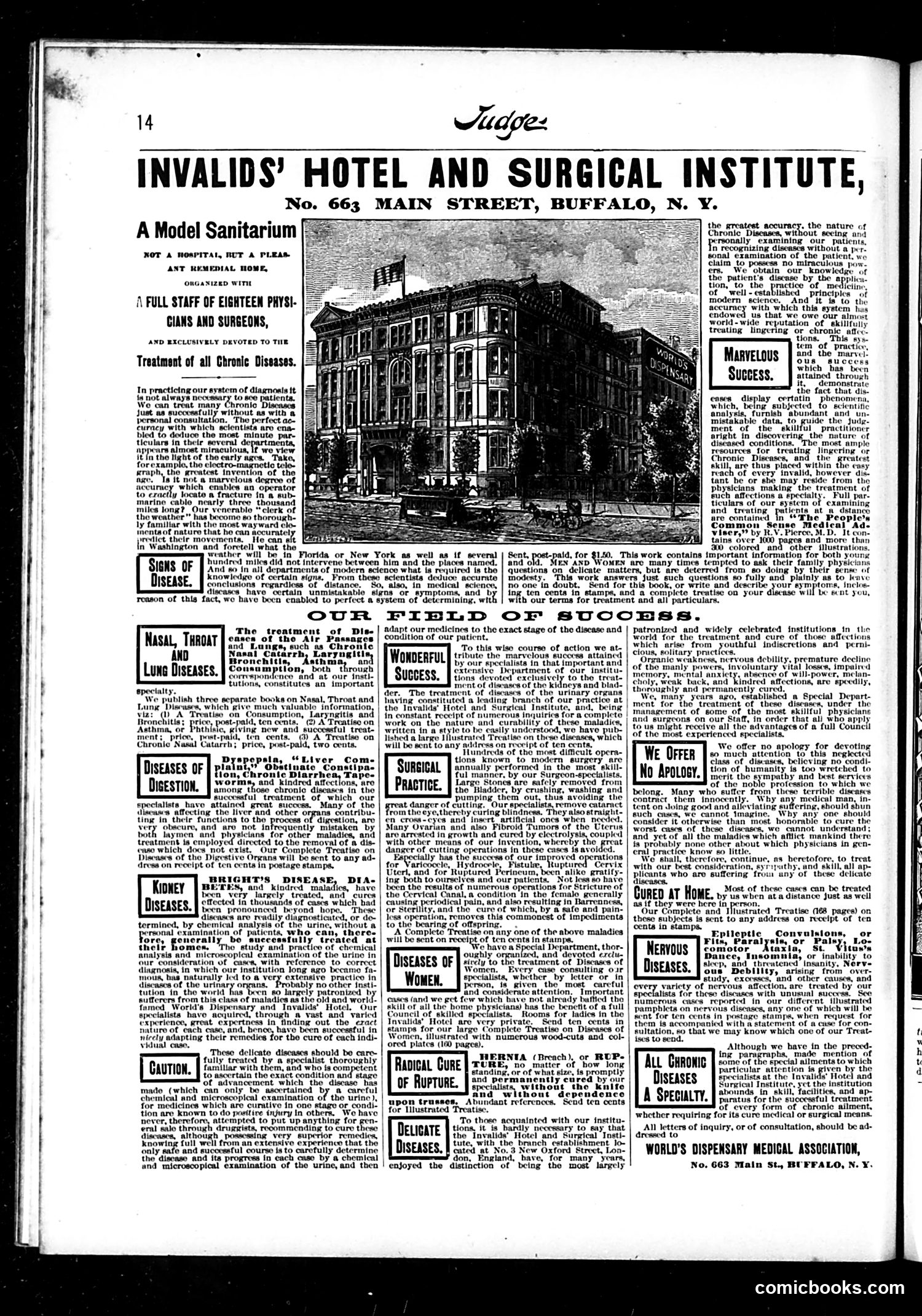
This is primarily a **medical advertisement**, not political satire. The Invalids' Hotel and Surgical Institute in Buffalo promoted itself as a specialized treatment center for chronic diseases, claiming expertise in diagnosing patients remotely through careful analysis of symptoms. The page's rhetoric—comparing medical diagnosis to telegraph operators locating breaks in underwater cables or weather forecasters predicting distant conditions—reflects **late-19th-century confidence in scientific expertise**. The facility offered consultations by mail and promised treatment "at a distance," selling a mail-order medical service. The surrounding smaller advertisements address typical chronic ailments (nasal/throat diseases, digestion, kidney disease, women's conditions) common to the era. The language emphasizes scientific rigor and "marvelous success," though such institutions were often of questionable medical value. This represents the patent medicine and mail-order medical consultation industry that proliferated before modern medical licensing and FDA regulations.
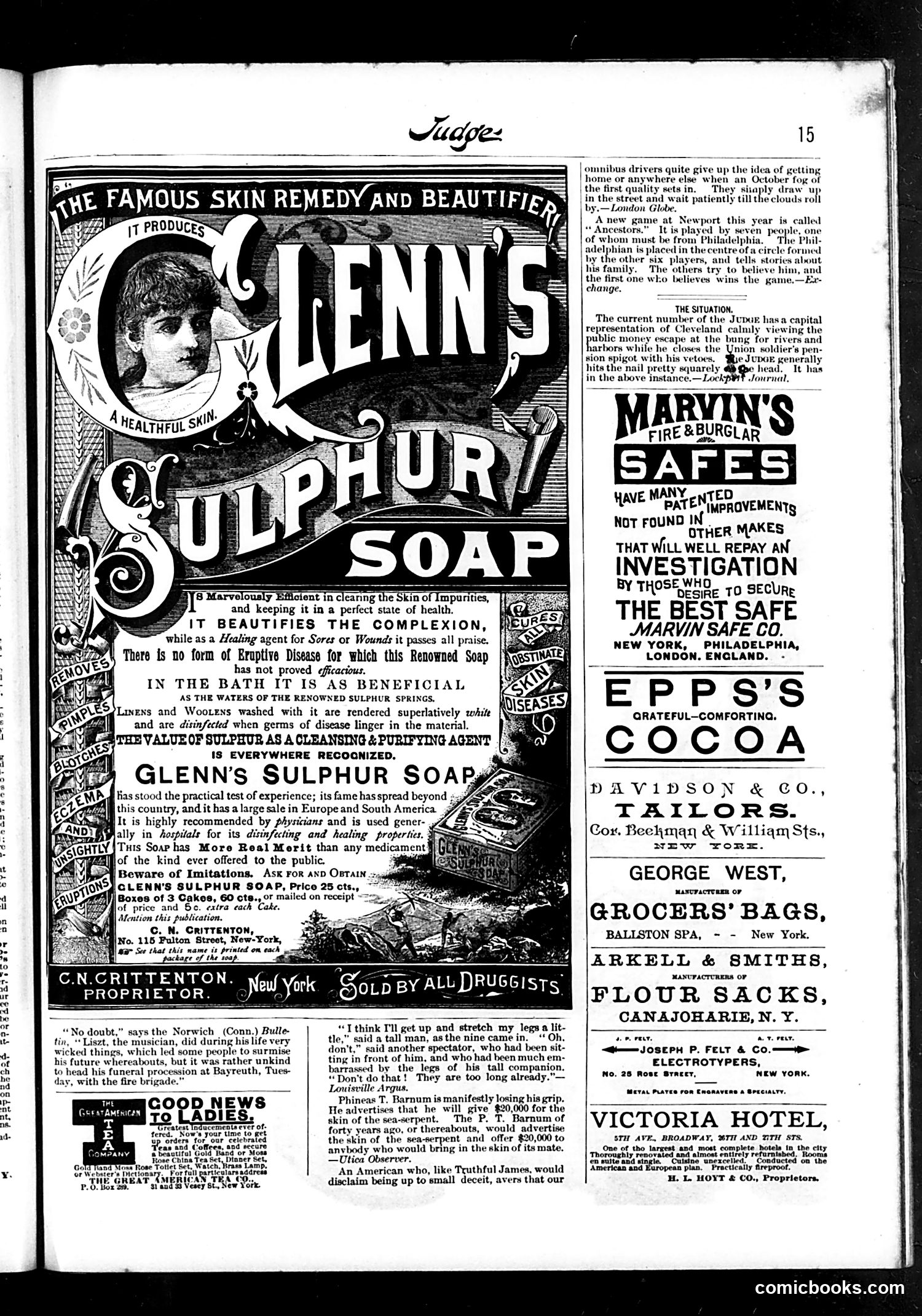
This page is primarily **advertisements with minor comic content**. The dominant feature is a large advertisement for Glenn's Sulphur Soap, a Victorian-era skin remedy claiming to treat various diseases and beautify complexions. **Comic Elements:** The short jokes at the bottom include one about **Liszt the musician**, sarcastically noting he had such a "wicked" reputation that it was cruel to have the fire brigade (implying they'd be needed in hell) lead his funeral procession. Another joke mocks **P.T. Barnum's declining showmanship**: where the younger Barnum once would offer $20,000 for a sea serpent's skin *and secretly offer $20,000 more for a matching mate* (a con artist's trick), he now simply offers money without the duplicitous scheme—suggesting he's lost his cunning. **Historical Context:** The page reflects late-19th-century America's fascination with patent medicines and skepticism about once-legendary figures. The humor depends on readers knowing Barnum and Liszt as famous names whose character flaws were public knowledge.
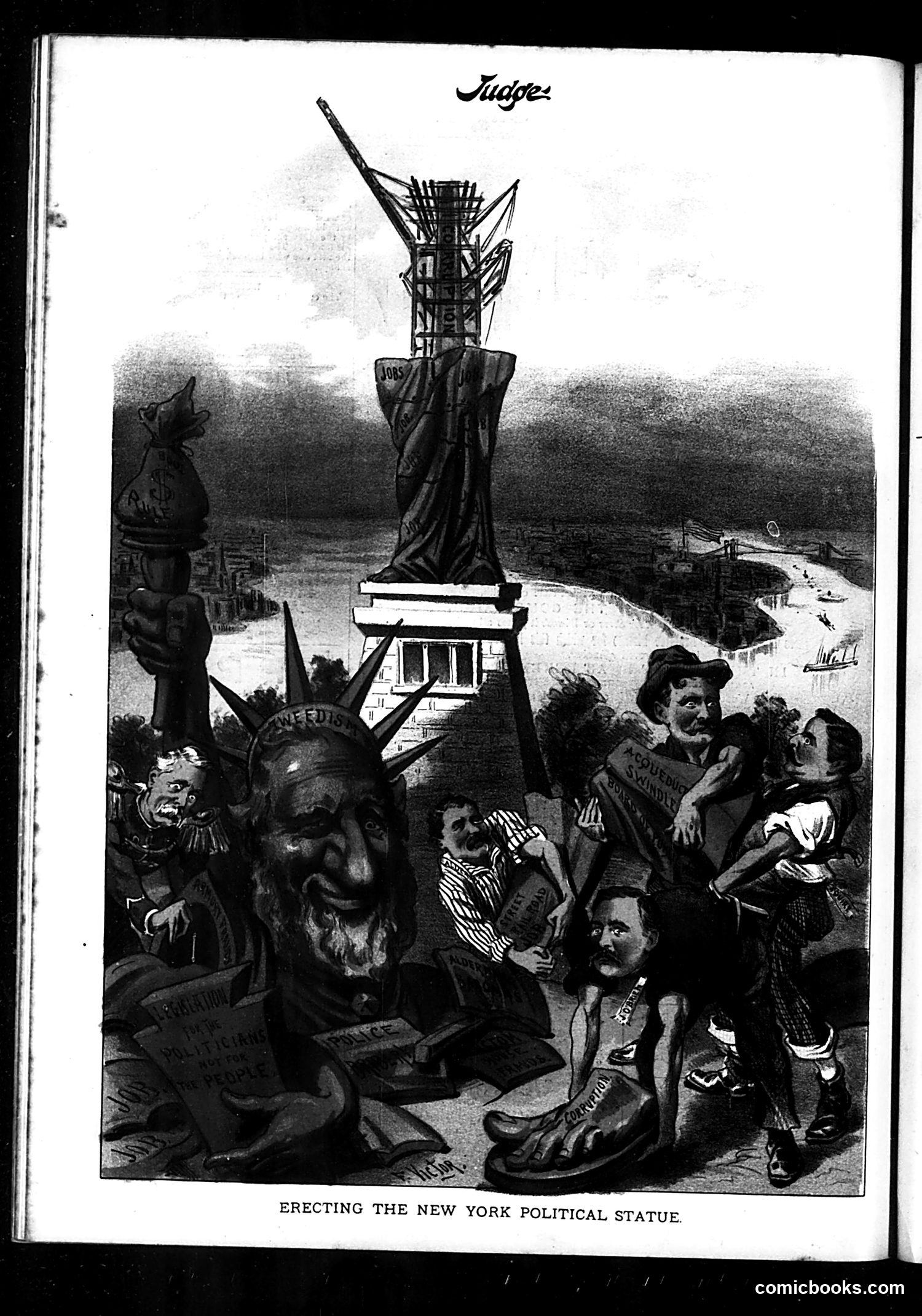
This satirical cartoon depicts the construction of a monument to New York politics, with the central structure resembling the Statue of Liberty but inverted or corrupted. The base is surrounded by caricatured figures—appearing to include politicians and various stereotyped characters—engaged in what seems to be corrupt or underhanded activity. The satire appears to critique New York's political establishment, suggesting that the city's political system is built upon a foundation of corruption, manipulation, and dubious dealings rather than noble ideals. By parodying Lady Liberty, the cartoon implies that authentic democratic principles have been replaced by something grotesque and compromised. The numerous figures at the base suggest collusion among multiple political players and interests.