
A complete issue · 16 pages · 1886
Judge — August 7, 1886
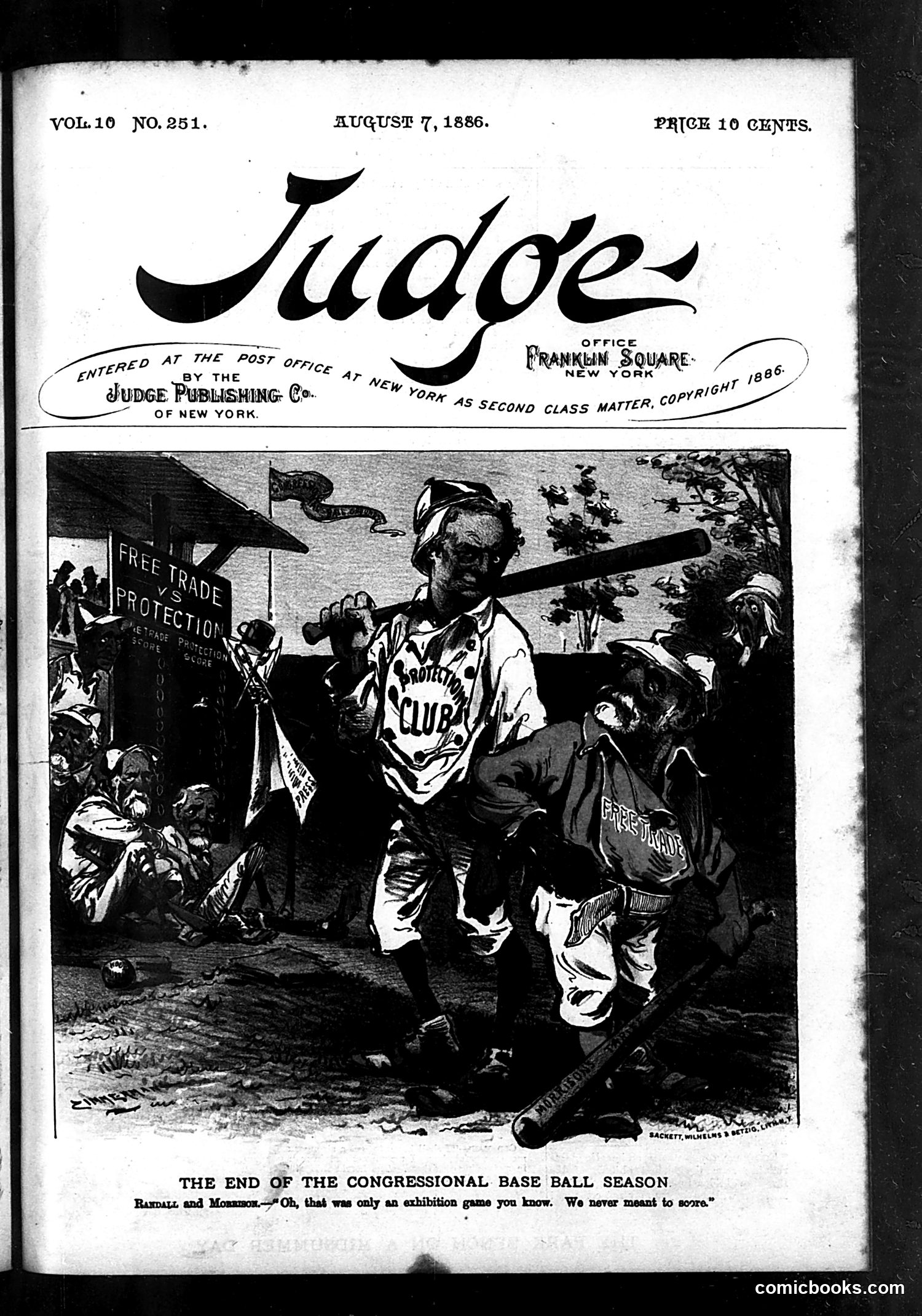
This cartoon satirizes the end of the Congressional baseball season. The title "THE END OF THE CONGRESSIONAL BASE BALL SEASON" indicates Congress members played baseball as recreation. The image shows a large figure (likely representing Congress or a specific congressman) wearing a "Protection Club" uniform, wielding a baseball bat like a weapon or club. He appears aggressive or exhausted. A smaller figure labeled "BARGAINER" cowers nearby, with "Free Trade Protection" signage visible. The accompanying quote—"Or, that was only an exhibition game you know. We never meant to score"—suggests Congress's baseball games were merely performative displays with no real competitive intent or results. The satire likely mocks Congressional inaction or empty political posturing regarding tariff and trade policy, using the baseball metaphor to criticize their ineffectiveness.
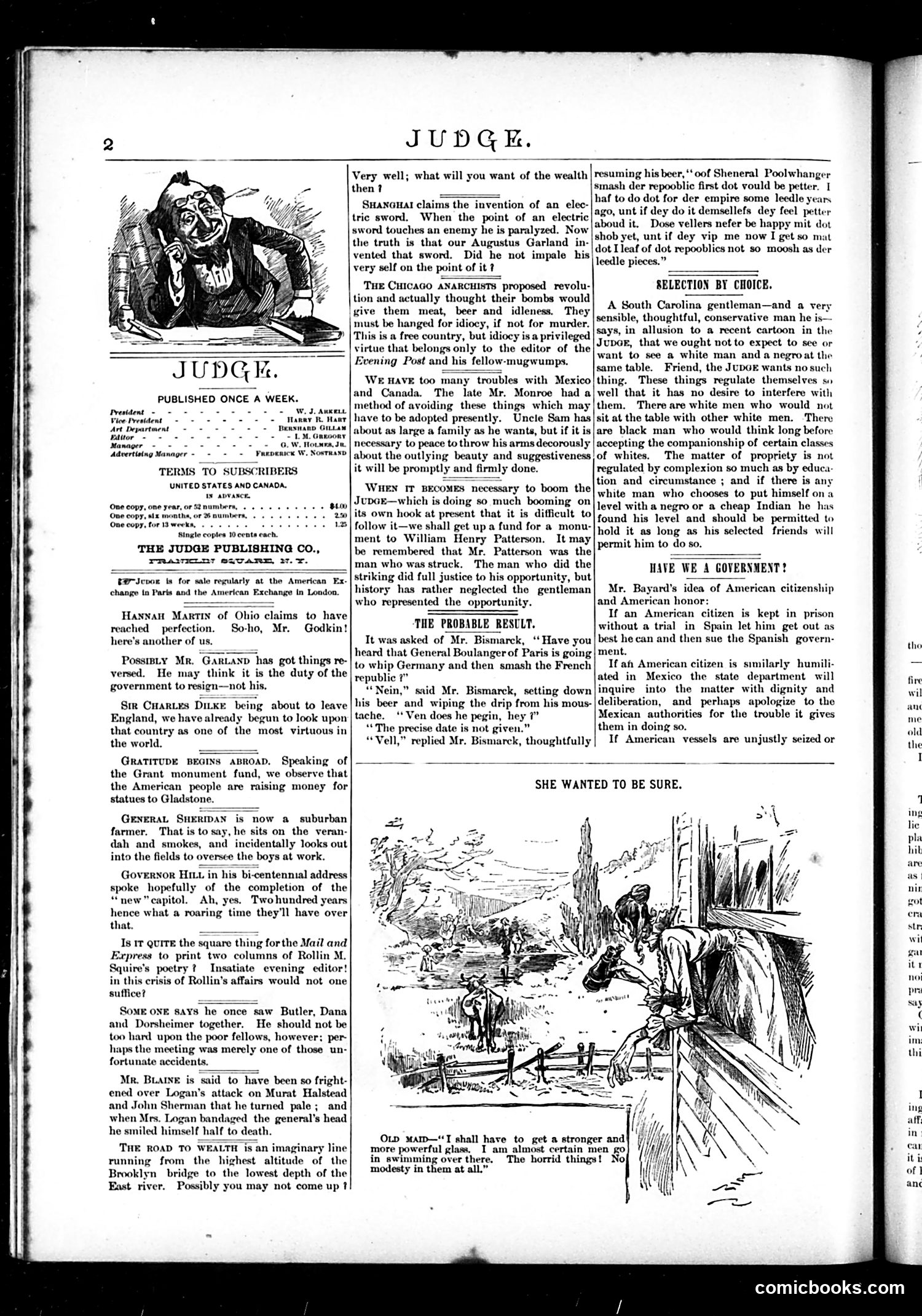
This page contains editorial commentary and satirical items rather than a single cartoon. The main cartoon titled "SHE WANTED TO BE SURE" depicts an old woman speaking to a man, with her dialogue: "I shall have to get a stronger and more powerful dose. I am almost certain men go when looking out there. The horrid thing! Do modesty in all of us." The surrounding text includes brief satirical items mocking various figures and issues, including references to General Sheridan, Sir Charles Dilke, and commentary on American citizenship and Mexican relations. The specific political contexts are unclear without additional historical documentation, but the page exemplifies Judge's typical format of mixing short satirical commentary pieces with illustrations targeting contemporary politicians and social issues of the era.
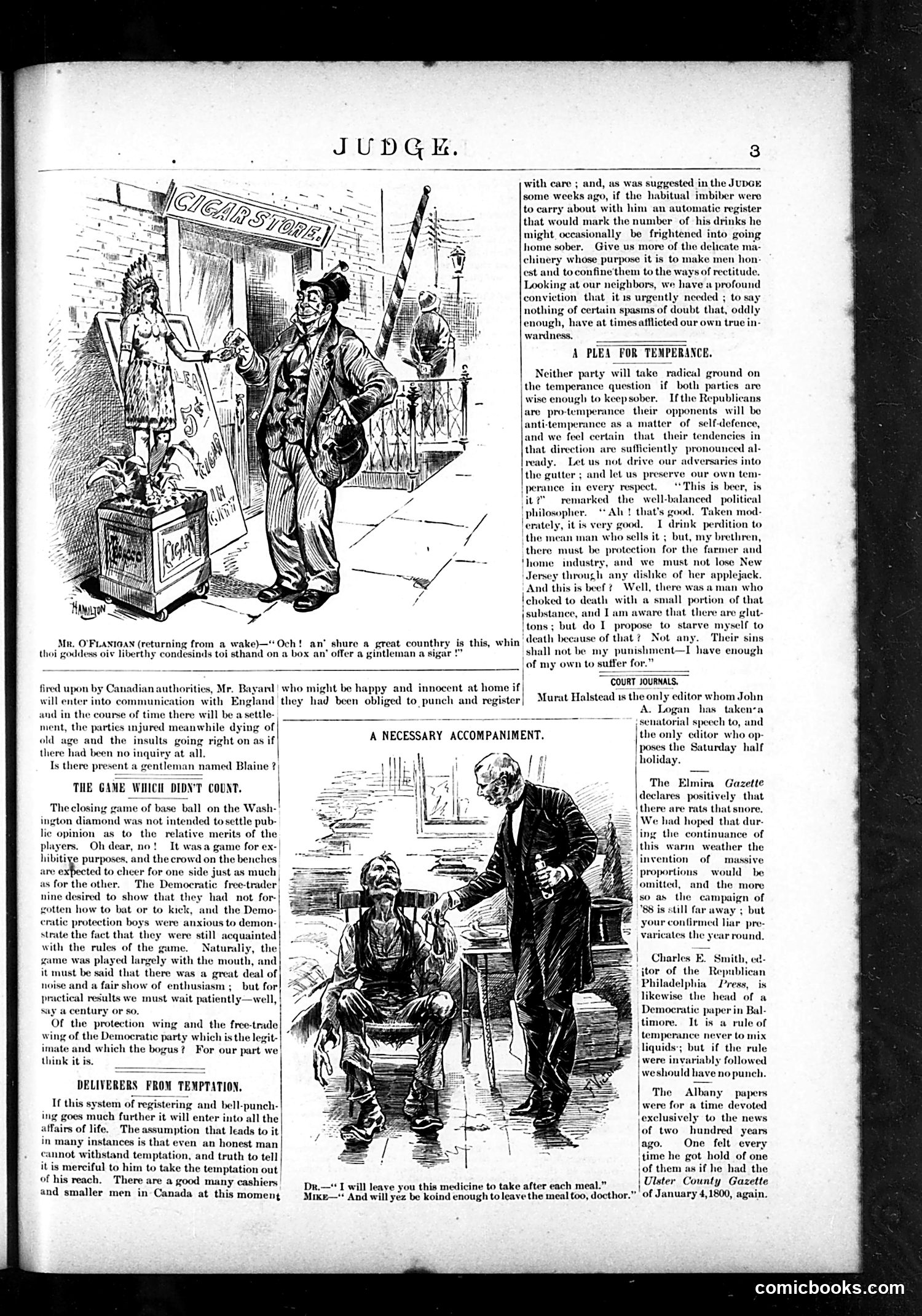
This page contains three political cartoons and commentary from Judge, a late-19th-century American satirical magazine. **Top cartoon**: Mr. O'Flanagan (Irish stereotype, indicated by dialect) returns from a wake and observes Lady Liberty offering cigars. The joke satirizes American patriotism and Irish-American immigrants—suggesting absurdity in expecting the "Goddess of Liberty" to interact with ordinary citizens. **Middle section titled "A Plea for Temperance"**: Political commentary arguing both Republican and Democratic parties avoid taking strong stances on alcohol regulation out of partisan self-interest. The satirist advocates moderation without criminalizing drinking. **Lower cartoon "A Necessary Accompaniment"**: Depicts a doctor prescribing an automatic drink-counter device to an intoxicated patient—satirizing the notion that mechanical gadgets can cure alcoholism through shame or fear. The page reflects late-1800s American debates over temperance, immigration, and partisan politics while mocking both excessive drinking and overly-simplistic "technological" solutions to social problems.
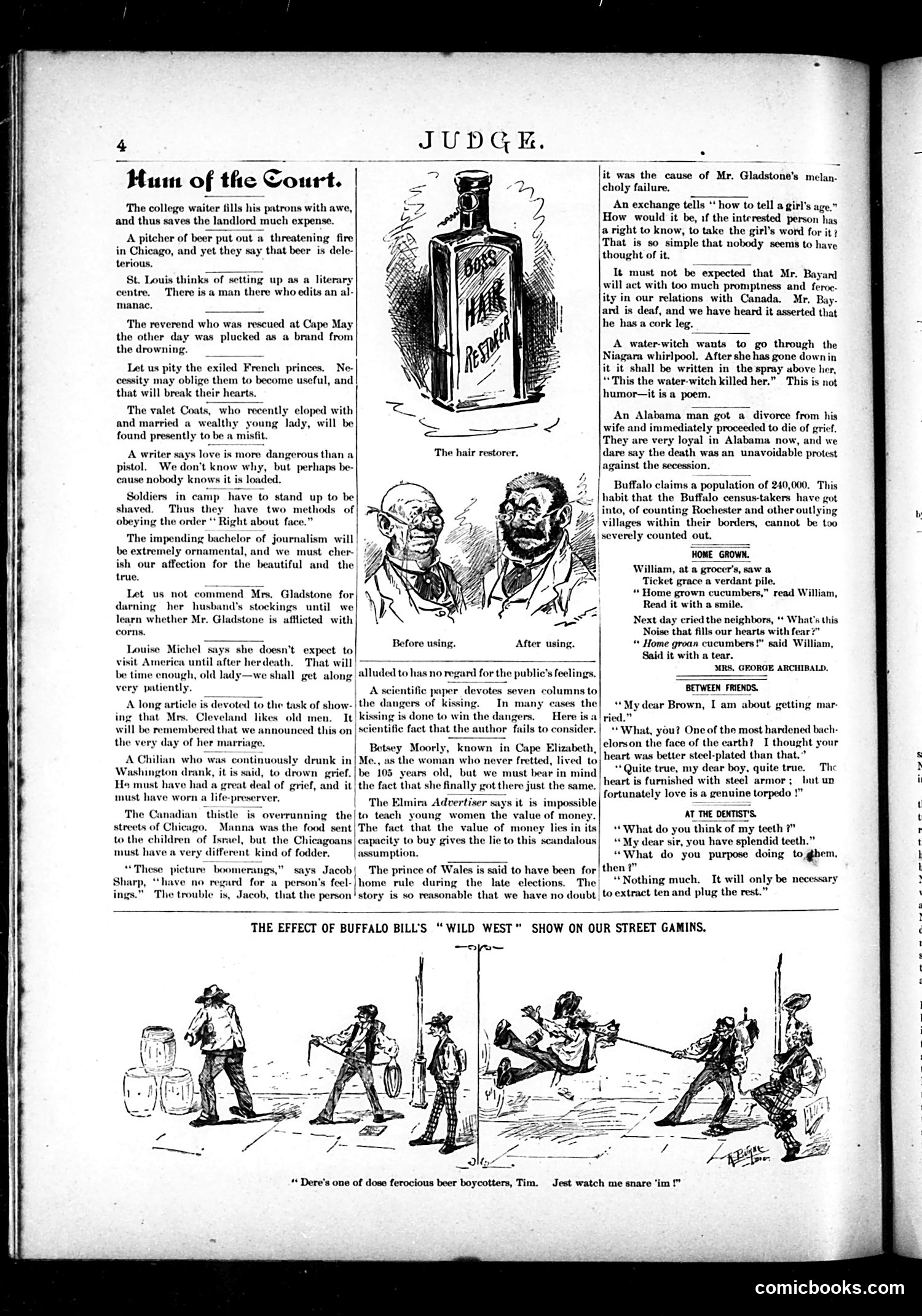
This page from *Judge* magazine contains short satirical commentary pieces ("Ham of the Court") typical of 1880s American humor. The jokes target contemporary figures and social absurdities: **Key References:** - **Mrs. Gladstone/Mr. Gladstone**: The British Prime Minister and his wife—a jab suggesting her darning efforts are undermined by his physical ailments - **Louise Michel**: French Commune radical; the joke implies Americans won't miss her until she's dead - **Jacob Sharp**: Likely a controversial figure of the era, criticized for lacking regard for public feelings - **The Prince of Wales and Home Rule**: Reference to Irish political debates of the period **The "Hair Restorer" Advertisement Cartoon**: Shows a product's before/after, mocking patent medicines' dubious claims. **Bottom Cartoon**: Street urchins imitating Buffalo Bill's Wild West show—commentary on how popular entertainment influences urban youth behavior. Overall, this reflects *Judge*'s mission: witty, often cutting social and political commentary mixed with ads, targeting educated readers aware of contemporary public figures and debates.
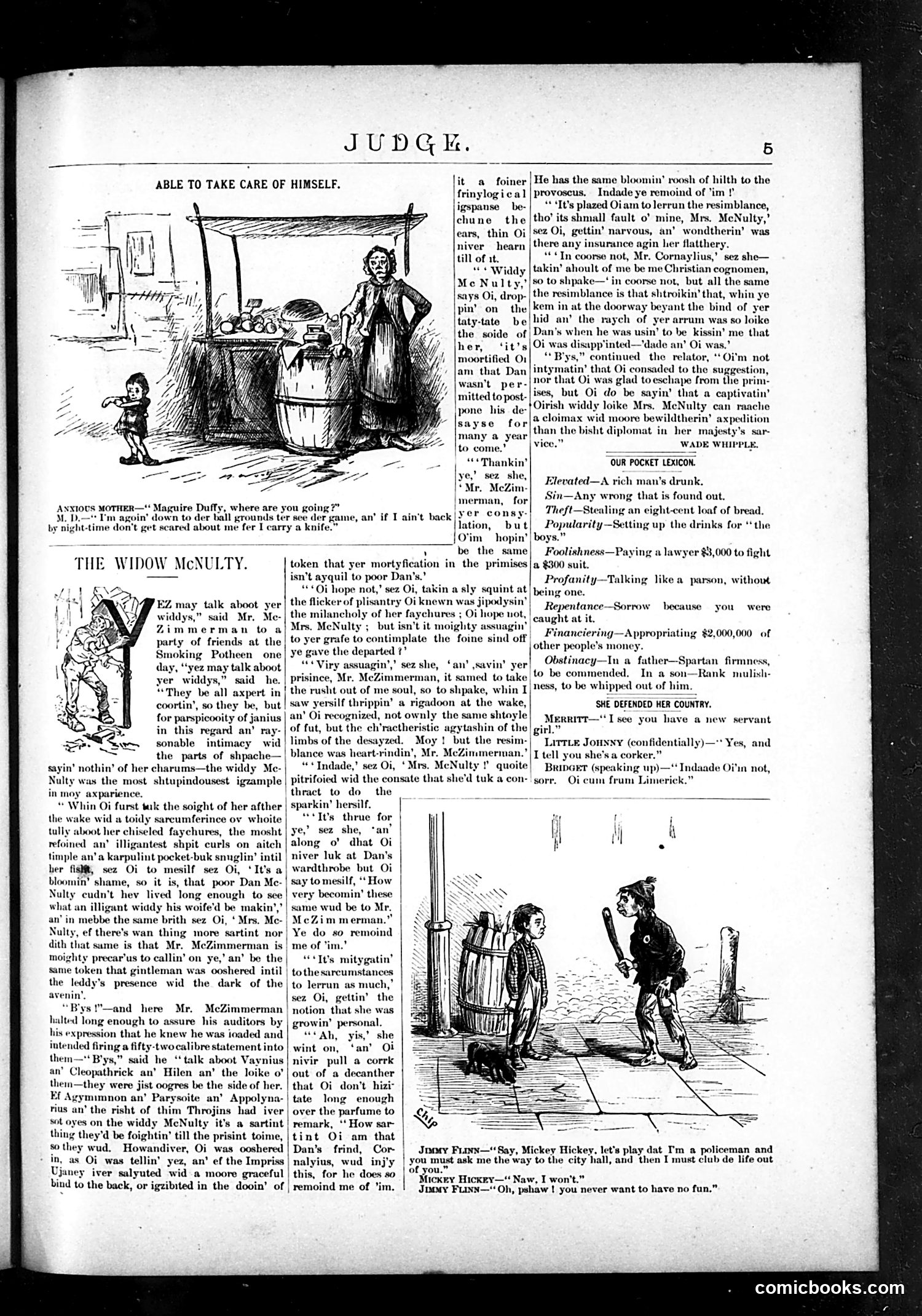
This page contains two Irish-dialect stories satirizing Irish-American life and courtship customs, likely from the late 19th century. **"Able to Take Care of Himself"** (top): A brief scene of an Irish working-class man assuring his friend he needs no protection going to a baseball game, despite carrying a knife—satirizing the stereotype of Irish-Americans as rough, violence-prone laborers. **"The Widow McNulty"** (main story): Mr. McZimmerman recounts courting the widow McNulty, praising her intelligence, eloquence, and charm while comparing her to historical/mythological figures (Venus, Cleopatra, Helen of Troy). The joke culminates when she mistakes him for her deceased husband Dan—she was so attracted to his resemblance to Dan that she "disapp'inted" when realizing he wasn't her late husband. **The satire**: Heavy Irish-dialect humor (typical of Judge), poking fun at Irish-American speech patterns, courtship rituals, and the widow's apparent mercenary interest in a man resembling her wealthier deceased husband rather than McZimmerman himself. The bottom illustration shows two children playing policeman, continuing the working-class Irish theme.
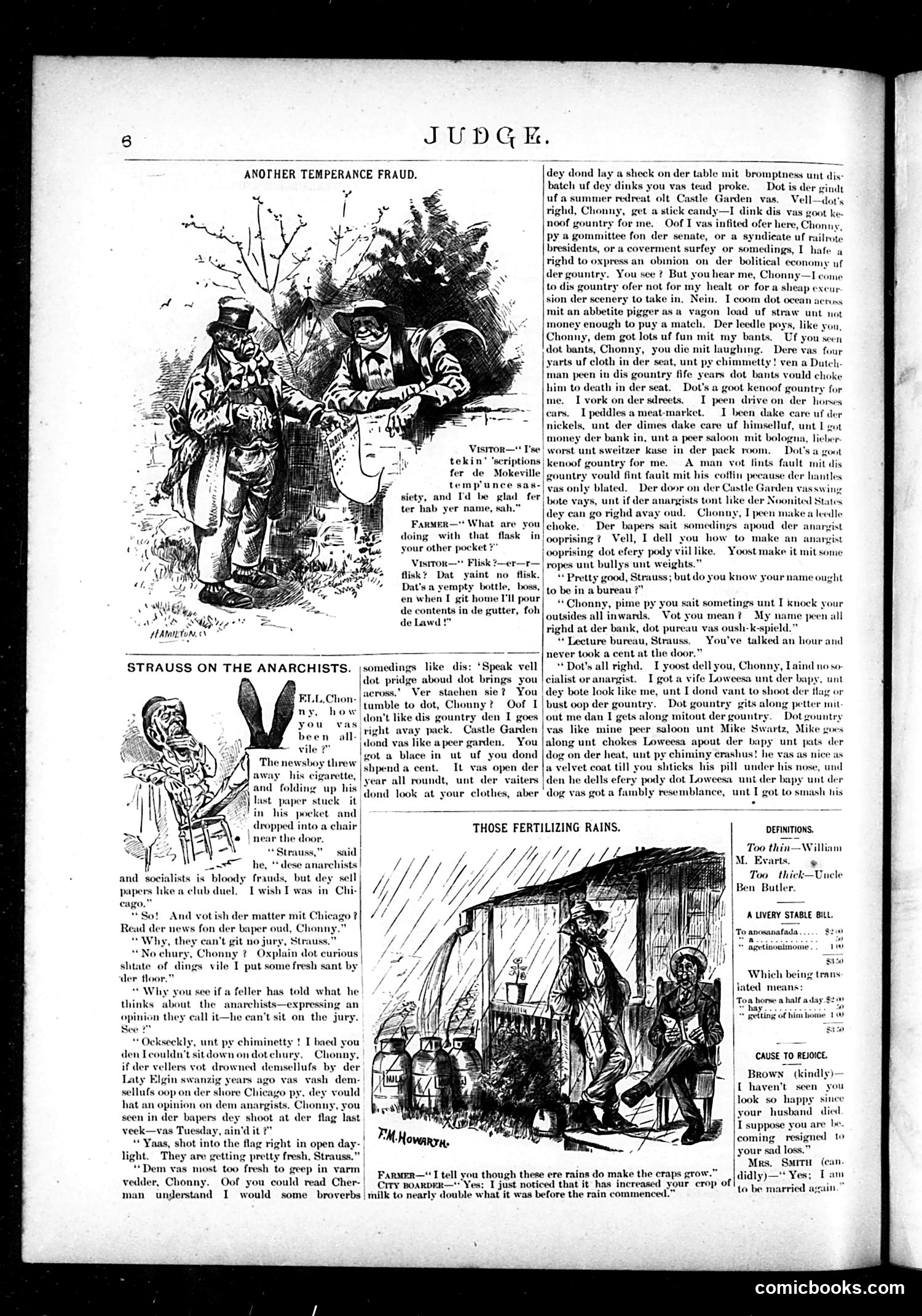
## "Another Temperance Fraud" The top cartoon depicts a dialogue between a temperance society representative and "Strauss," a German immigrant character (indicated by the thick dialect). The satire targets **temperance movement hypocrisy**: while lecturing working-class immigrants about alcohol abstinence, the movement's wealthy backers ignore poverty and exploitation. Strauss ironically notes that after five years of hard labor—working streets, driving horses, selling meat—he's earned barely enough to survive, yet reformers criticize him for seeking comfort in drink rather than addressing his economic condition. The joke exposes how temperance crusades blame the poor's moral failings while ignoring systemic injustice. The "Strauss on the Anarchists" section continues this character's critique, with Strauss defending working-class solidarity and dismissing both anarchists and wealthy do-gooders equally. ## Bottom Section "Those Fertilizing Rains" appears to be a brief illustration joke about agricultural rainfall, while the right side contains definitions and advertisements typical of the magazine's miscellaneous content—not political satire. **Context**: Late 19th-century Judge frequently mocked reform movements as sanctimonious and disconnected from workers' actual needs.
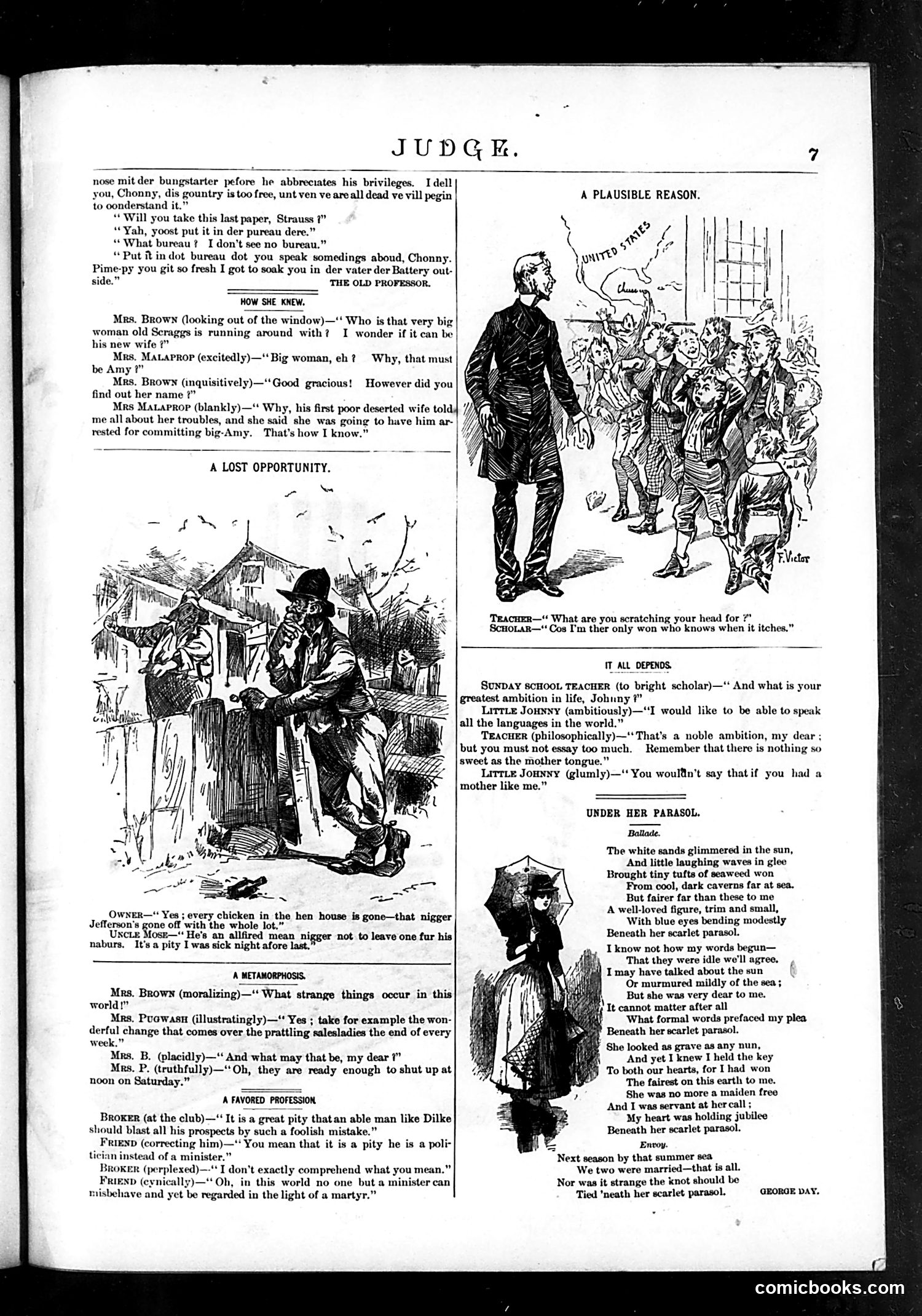
This page contains multiple satirical sketches and a romantic poem typical of 1880s-90s humor magazines. **"The Old Professor"** mocks German immigrants through dialect humor, depicting an elderly man criticizing American freedom while mangling English ("bungstarter," "abbreciates"). The satire targets both immigrant speech patterns and their perceived ingratitude. **"How She Knew"** plays on Mrs. Malaprop's character (a stock figure who misuses words)—she mishears "Amy" (a woman's name) as "big-Amy" (a crime), creating confusion about an affair. **"A Lost Opportunity"** uses racist dialogue between a white owner and "Uncle Mose" about stolen chickens, reflecting the deeply offensive racial stereotypes common in period humor. **Other sketches** satirize workplace behavior (salesgirls), professional hypocrisy (ministers misbehaving with impunity), and childhood candor. **"Under Her Parasol"** is sentimental romantic verse, contrasting sharply with the crude humor surrounding it—typical of Judge's mixed content appealing to diverse readers.
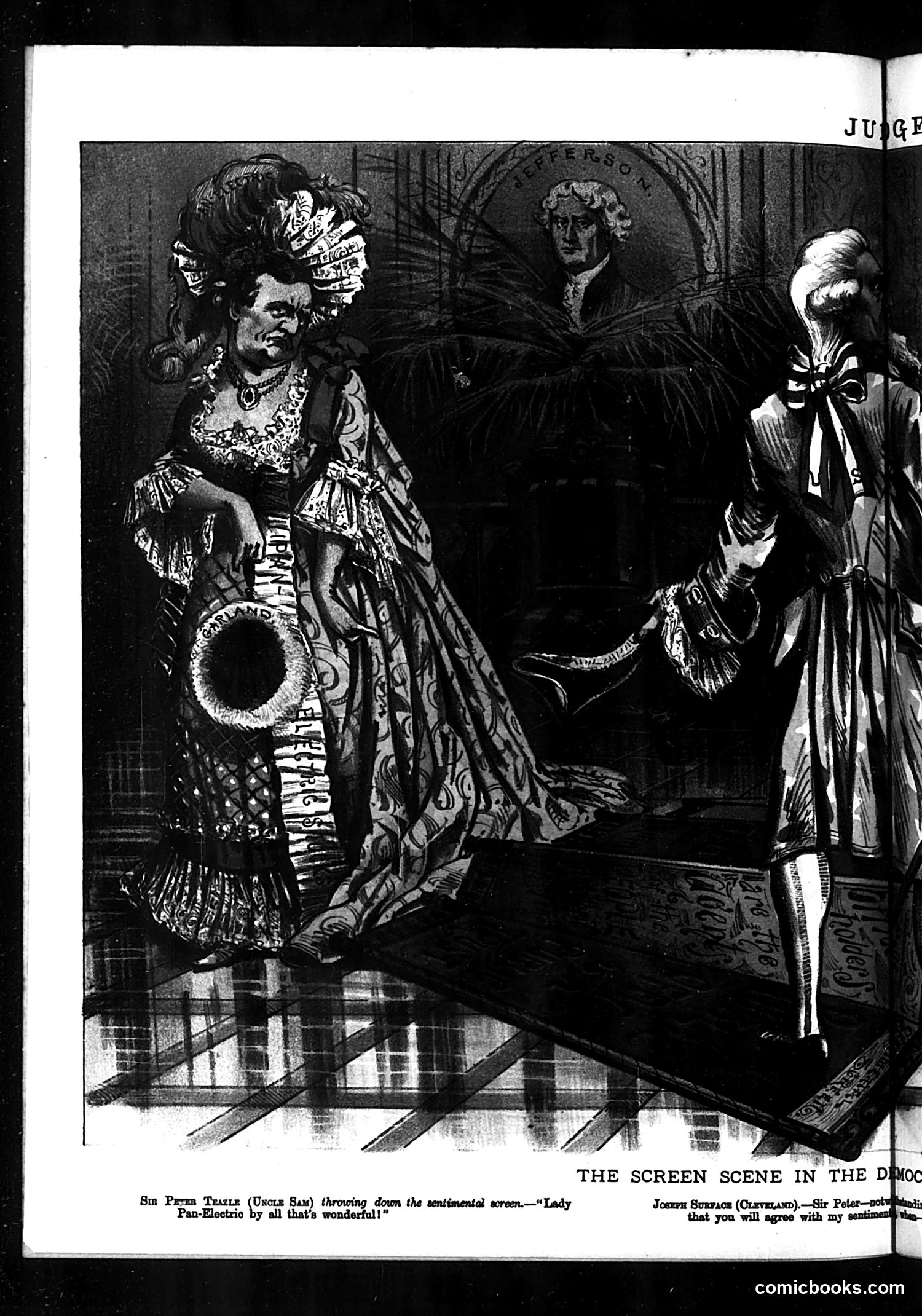
This appears to be a scene from a theatrical production, likely a film or stage play. The caption references "Sir Percy Tesziz" throwing down a "sentimental screen" and mentions "Lady Pan-Electric." The image shows two elaborately costumed figures in what appears to be a period interior setting, with a portrait visible in the background. The ornate clothing and theatrical staging suggest this is satirizing either a melodramatic period piece or a contemporary film production. The text "Pan-Electric by all that's wonderful!" suggests satire of early cinema technology or production methods. However, without clearer identification of the specific production being mocked or the historical context of this Judge magazine issue, I cannot confidently explain the precise satirical point intended for contemporary readers.
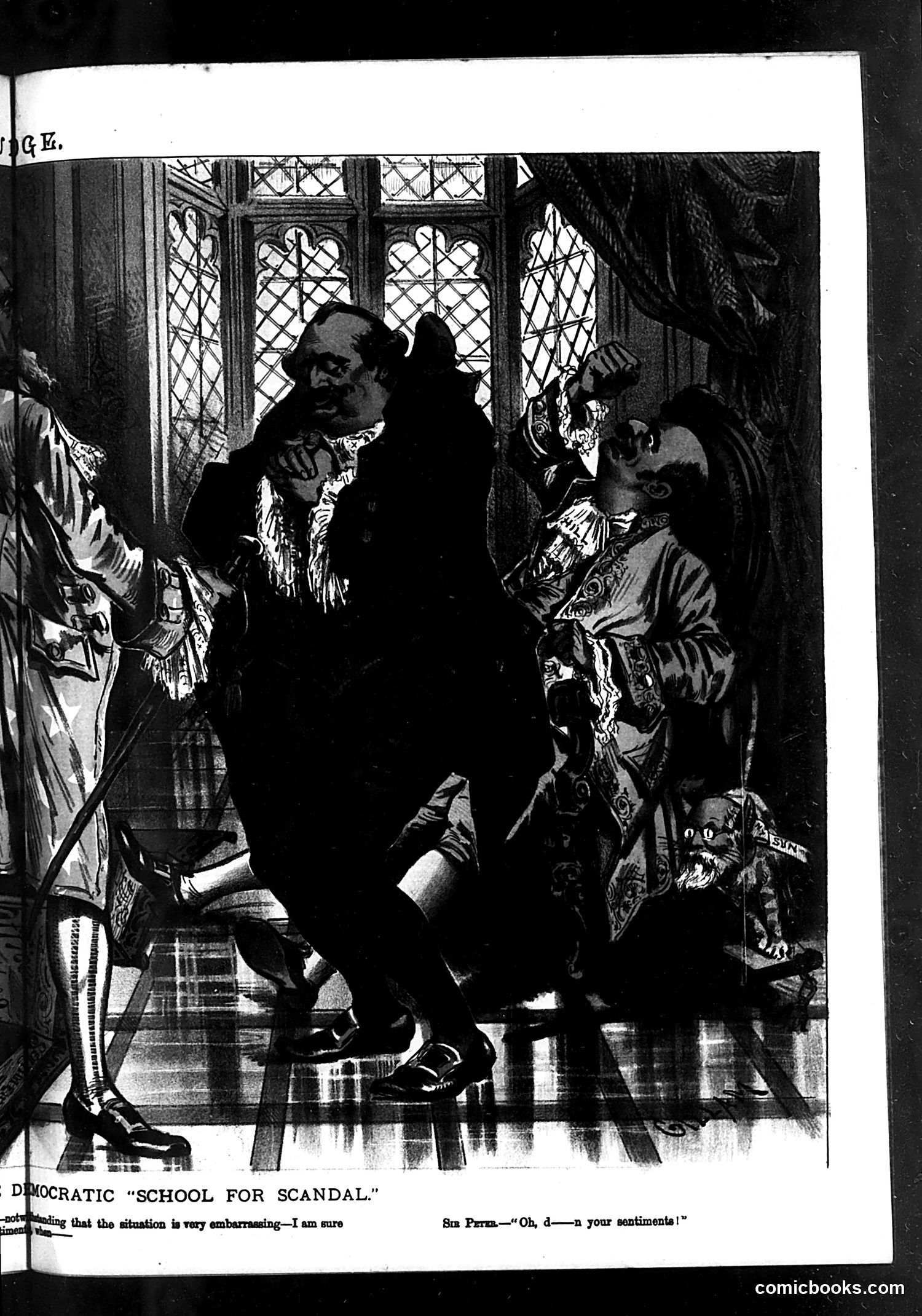
This political cartoon satirizes the Democratic Party as a corrupt institution. The scene depicts what appears to be party leadership instructing younger members in improper conduct—a "school" teaching scandal rather than ethics. The title references Sheridan's play "The School for Scandal," implying Democrats are systematically training members in dishonest practices. The ornate interior suggests a formal, institutional setting where this corruption is normalized and passed down. The dialogue—"Oh, d—n your sentiments!"—shows contempt for moral objections, suggesting Democratic leadership dismisses ethical concerns. Without a visible date, the specific scandal referenced remains unclear, but the cartoon attacks Democratic Party integrity and suggests institutional corruption at multiple levels.
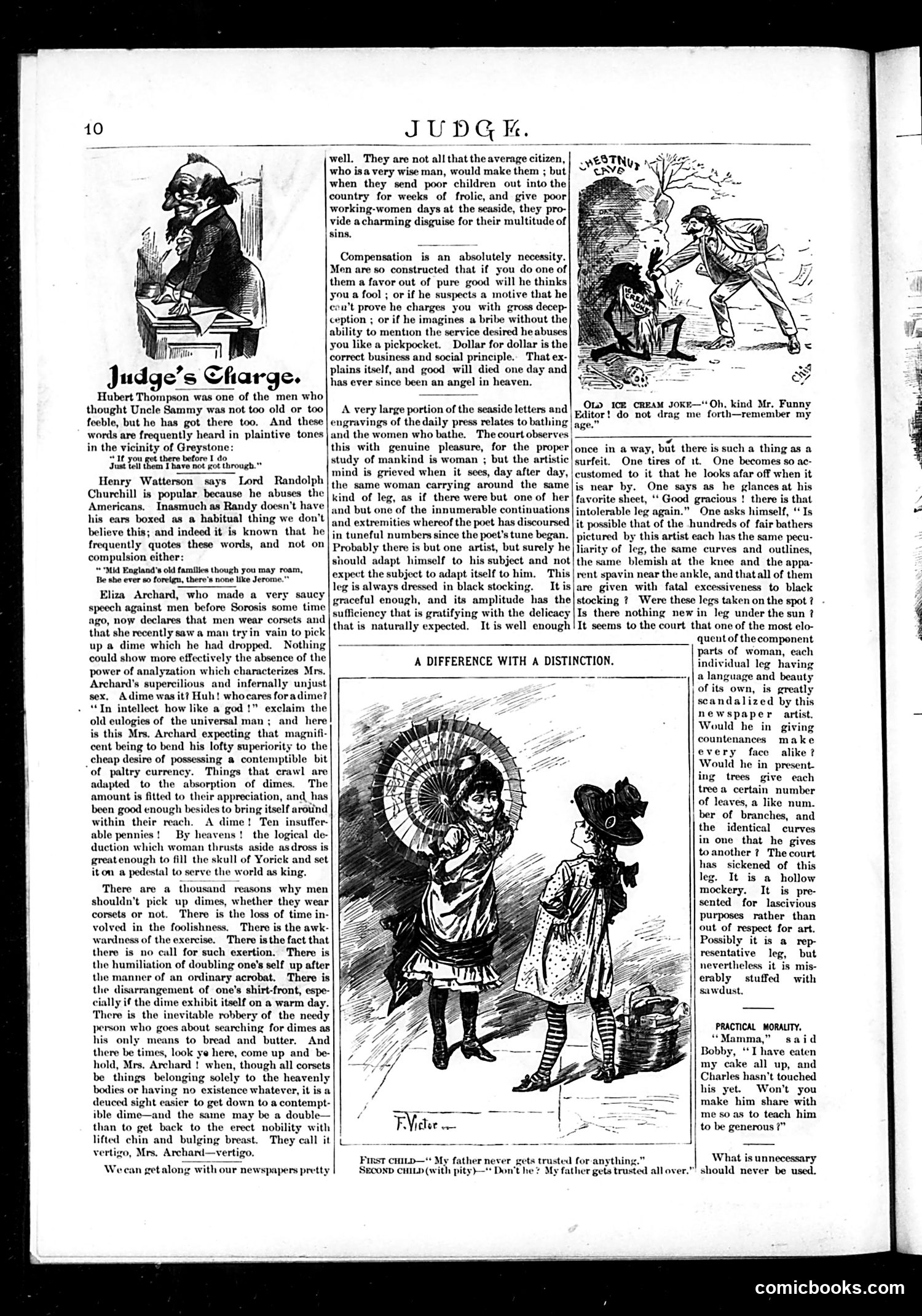
This page from the satirical magazine **Judge** contains several commentary pieces satirizing contemporary social attitudes, particularly regarding gender relations and class dynamics. **Main Cartoons/Content:** 1. **"Judge's Charge"** (left): Critiques Eliza Archard, a women's rights advocate who recently gave a speech against men at Sorosis (a women's club). The piece mocks her claim that men wear corsets and her complaint about a man struggling to pick up a dropped dime. The satire argues such trivial concerns reveal women's supposed lack of analytical power—the author sarcastically insists that dignified men shouldn't debase themselves retrieving mere pennies. 2. **"A Difference with a Distinction"** (center): An illustration showing a woman with an umbrella in wind, accompanying text about newspaper "seaside letters" and artistic representation of nature. 3. **"Practical Morality"** (right): A brief anecdote about teaching generosity to children. **Context:** The satire reflects late-19th-century male backlash against emerging feminism and women's public advocacy for equality.
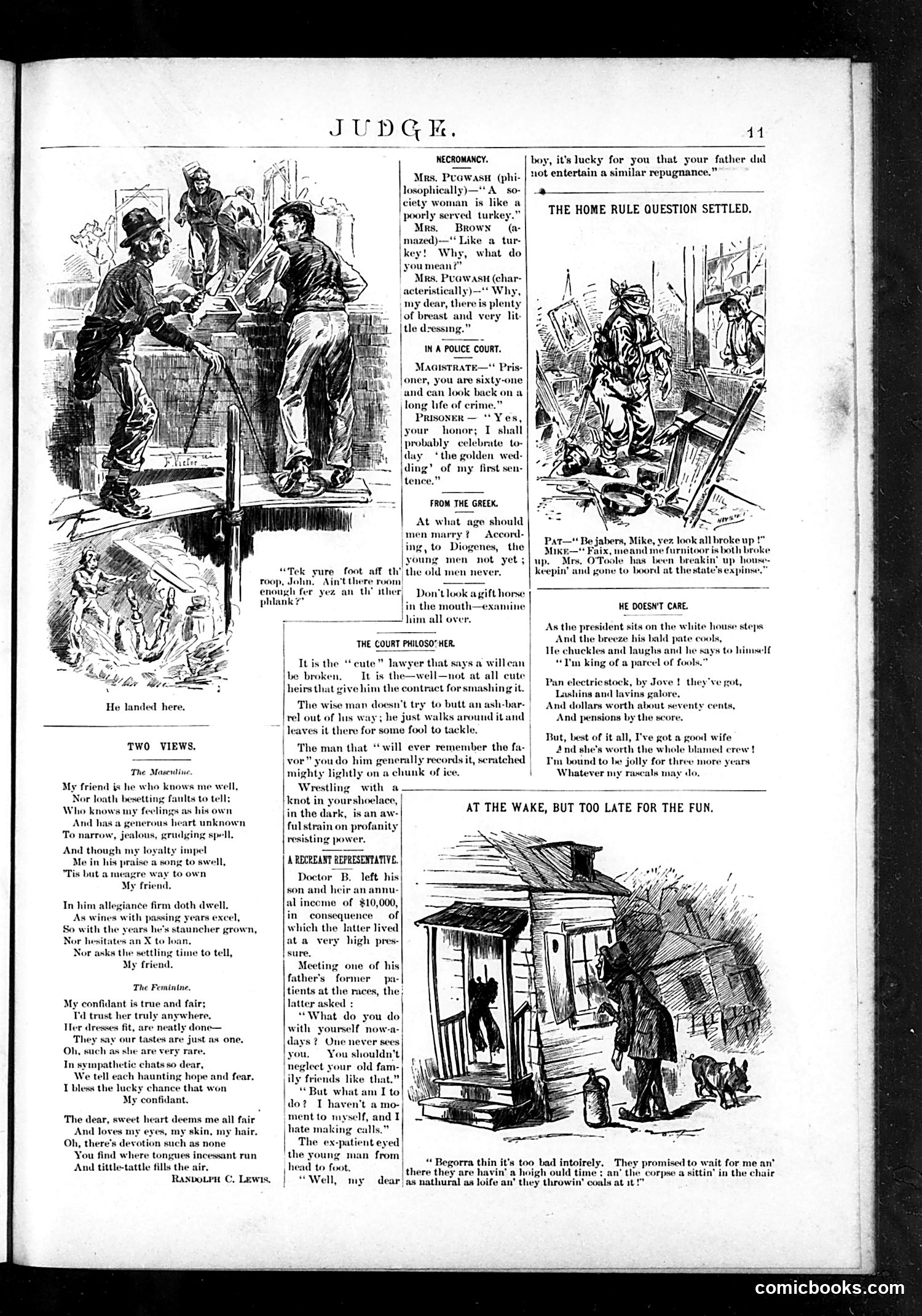
This page contains multiple satirical pieces typical of the magazine's style: **"Two Views"** compares male and female perspectives on friendship/romance through poetry, with gentle mockery of both genders' sentimentality. **"Necromancy"** jokes about society women, comparing one unfavorably to "a poorly served turkey" — a commentary on superficial high society. **"In a Police Court"** features wordplay where a 61-year-old criminal celebrates his "golden wedding" (50th anniversary) of crime — satirizing recidivism. **"The Home Rule Question Settled"** depicts Irish-immigrant characters (dialect suggests working-class immigrants) deciding to solve their domestic disputes by having one move out — a jab at Irish domestic life and "home rule" political debates. **"He Doesn't Care"** critiques a presidential administration (unclear which era) as corrupt, with stock manipulation and falsified pensions, yet the president remains smug. **"At the Wake"** shows an Irish funeral scene with crude humor about the deceased's corpse. These pieces reflect Judge's satirical targets: high society hypocrisy, political corruption, immigrant stereotypes, and criminal justice absurdities.
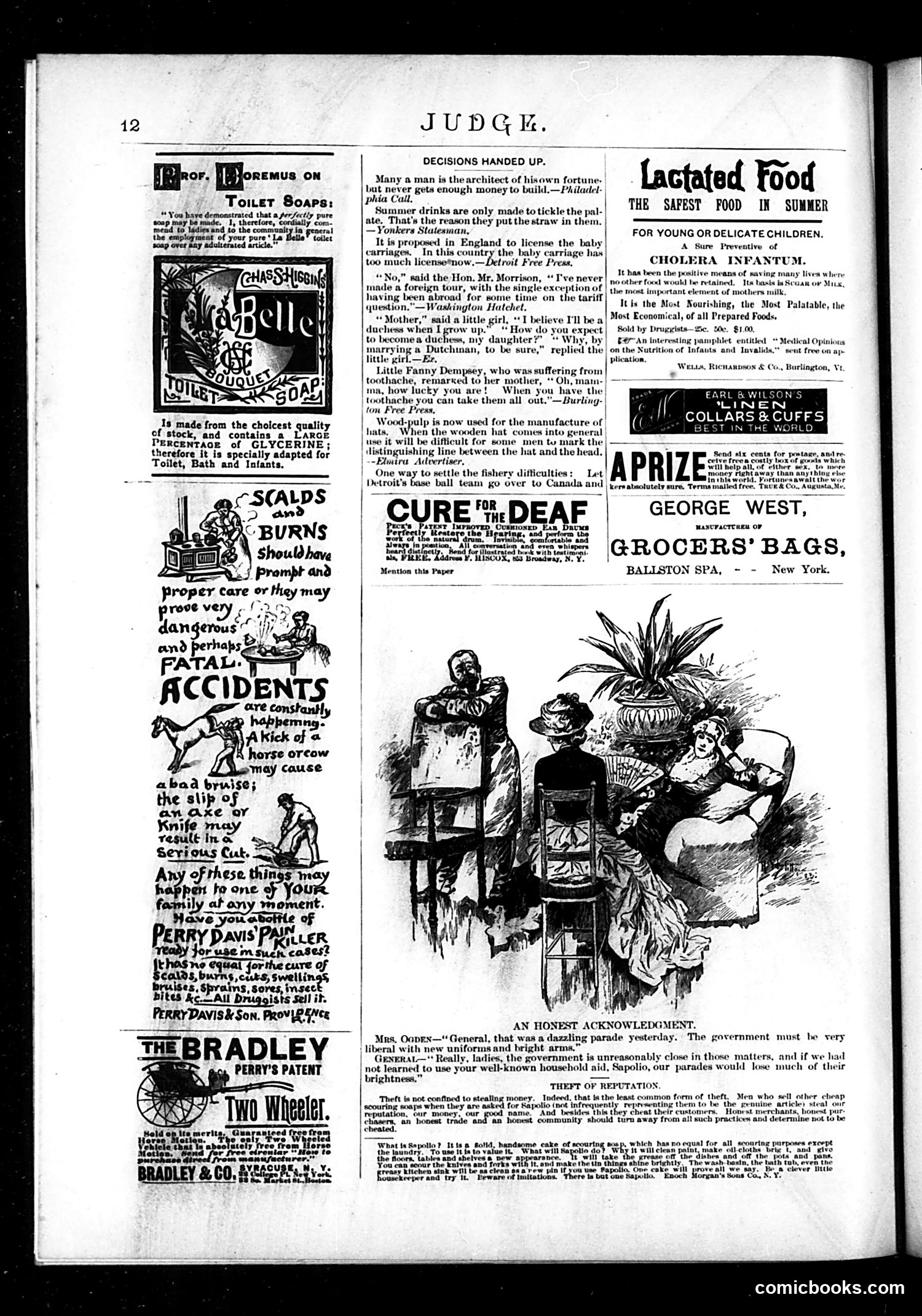
This page is primarily **advertisements and satirical quips** rather than a political cartoon. The main content consists of: 1. **"Decisions Handed Up"** — a humor column of short, cynical observations about American life (baby carriages having "too much license," proposals to license English baby carriages, tariffs, marriage jokes). These mock legal pronouncements reflect Judge's satirical style. 2. **"An Honest Acknowledgment"** — a dialogue where a General credits Sapolio household cleaner for making military parades look impressive. This is satirical: the government is "unreasonably close" with funding, but Sapolio compensates. 3. **"Theft of Reputation"** — Sapolio's advertisement warns against counterfeiters selling cheap soaps as the genuine product, stealing their reputation and customers' money. The page heavily features **patent medicines and household products** (Lactated Food, Perry Davis Painkiller, The Bradley Two-Wheeler, Sapolio soap). The satirical content critiques contemporary American society through brief, punchy jokes typical of Judge's format.
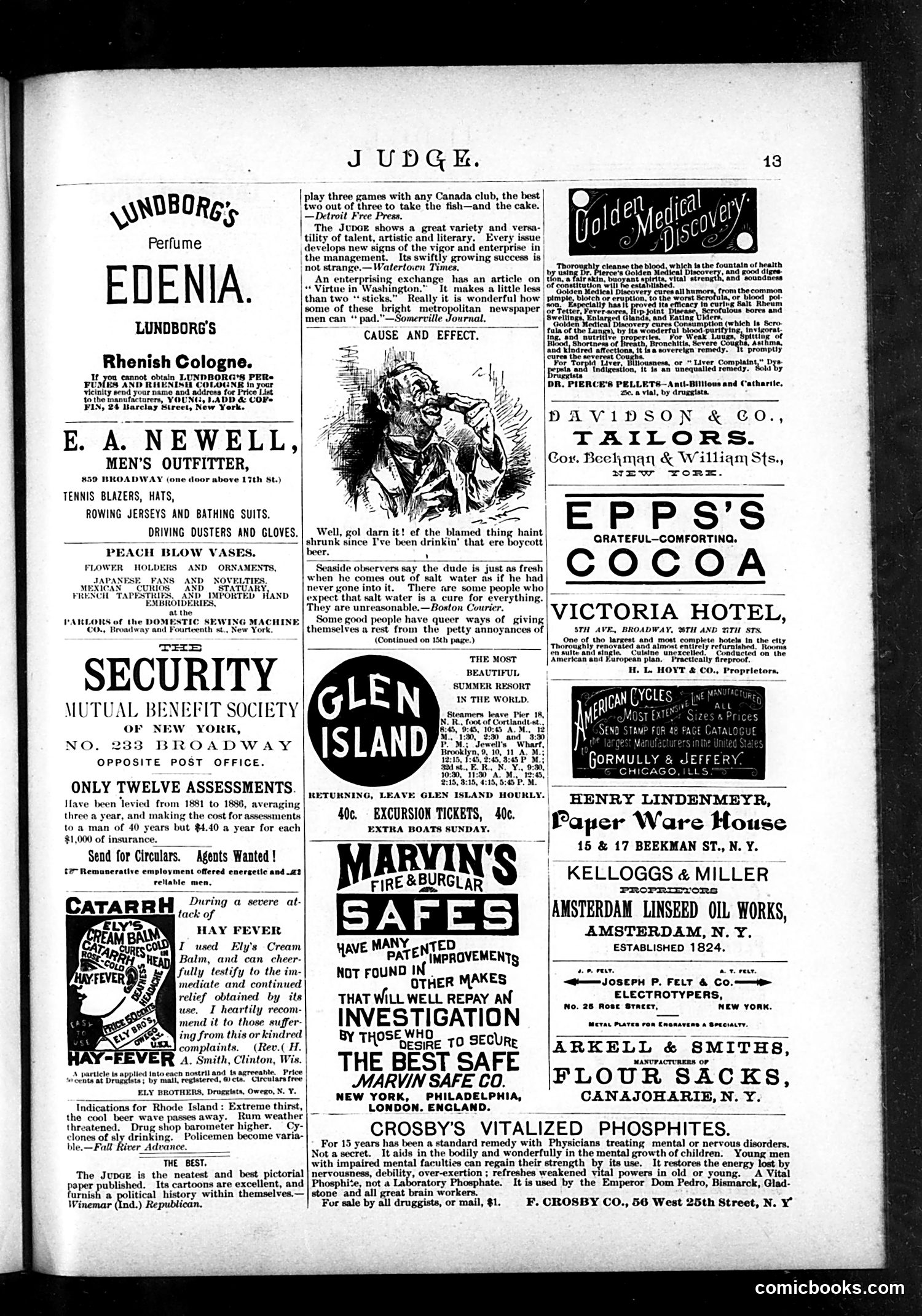
This page is primarily **advertising** with minimal editorial cartoon content. The single cartoon titled "CAUSE AND EFFECT" depicts a rural man complaining that beer from a boycott has made him sick—a satirical jab at the temperance/prohibition movement. The joke relies on anti-boycott sentiment: the man blames the boycotted beer itself rather than acknowledging the boycott's intent. The page's other content is purely commercial: perfumes, cologne, men's clothing, medical remedies (hay fever balm, phosphite tonics), safes, and a summer resort. Brief editorial notes at top praise *Judge* magazine's quality and offer commentary on Rhode Island politics and Washington virtue—typical 1880s small-town newspaper observations. **Modern context needed:** This reflects the era's active temperance debates and commercial advertising's growing dominance in illustrated magazines.
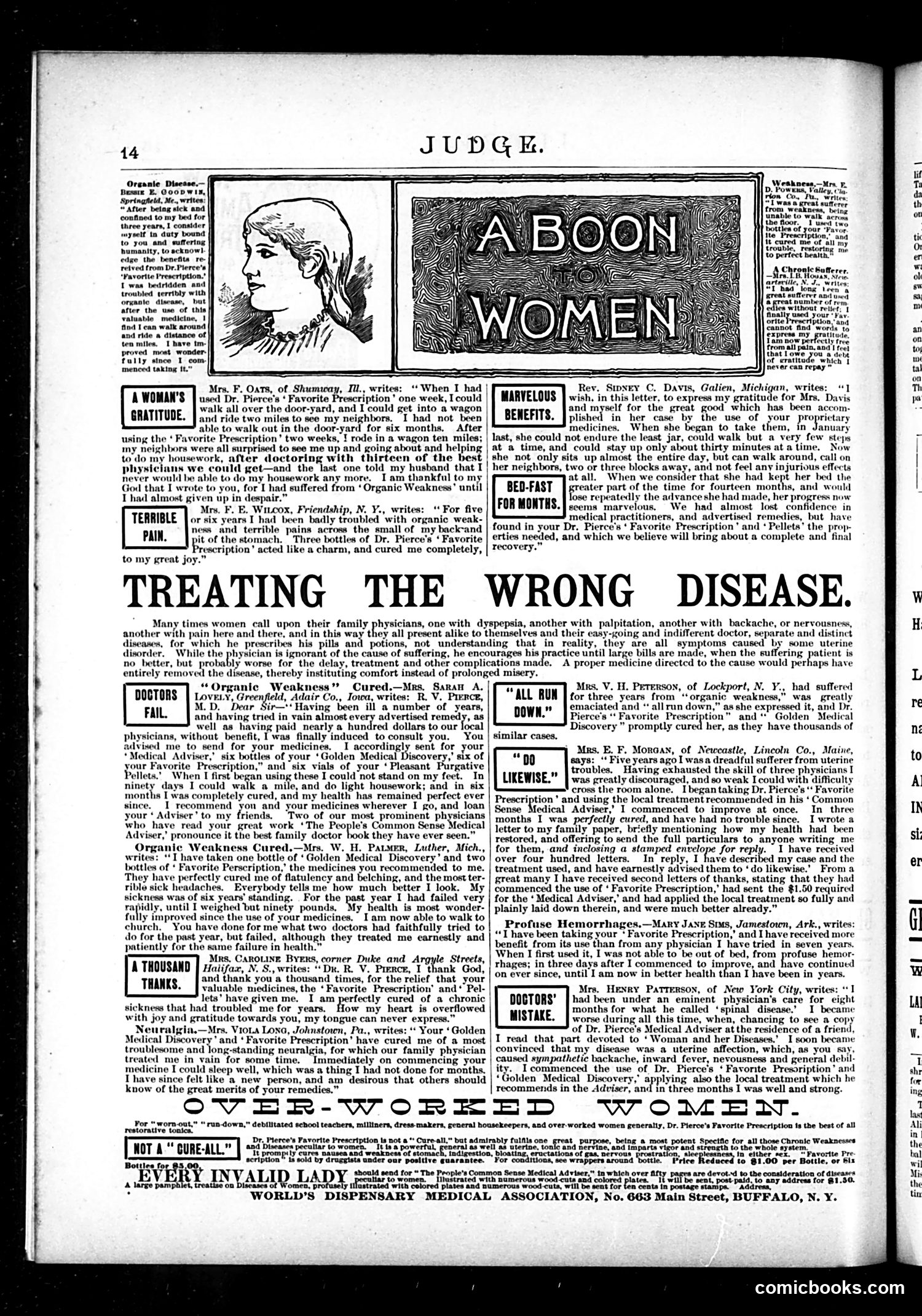
This page from *Judge* magazine (page 14) is primarily an advertisement for Dr. Pierce's "Favorite Prescription," a patent medicine marketed to women. Interspersed with testimonial letters from supposed patients, the text critiques misdiagnosis—specifically, physicians treating women's vague complaints (backache, nervousness, palpitations) as separate ailments rather than recognizing an underlying "organic disease" or "uterine trouble." The satire's target is unclear from this excerpt, but the underlying argument is that incompetent male doctors misdiagnose female patients, wasting time and money—whereas Dr. Pierce's proprietary remedy, when correctly applied, achieves miraculous cures. The centered section "TREATING THE WRONG DISEASE" frames the pitch: male physicians are inadequate; Dr. Pierce's patent medicine is the solution. This represents typical 19th-century patent-medicine marketing exploiting medical anxiety and gender frustration.
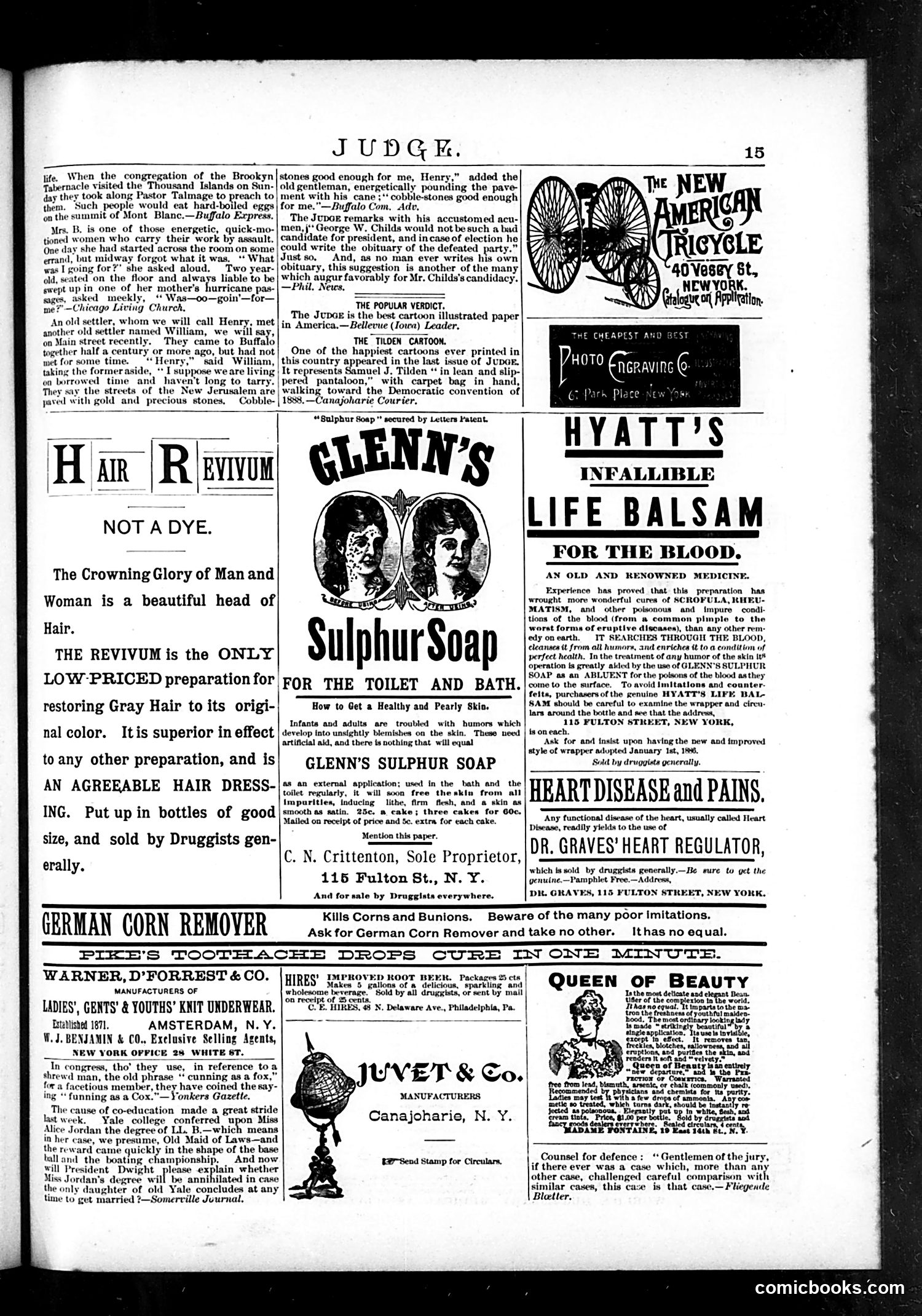
This page is primarily **advertisements and brief humor columns** rather than political cartoons. The notable content includes: **The Tilden Reference**: A brief mention notes that Judge recently printed a cartoon depicting **Samuel J. Tilden** (former Democratic presidential candidate) in "lean and slippered pantaloon" with a carpet bag, walking toward the 1888 Democratic convention. This appears to mock Tilden as a tired, outdated political figure from the past—suggesting he should retire rather than involve himself in current politics. **The Childs Comment**: A quip about George W. Childs as a presidential candidate, joking that he'd be good because "as no man ever writes his own obituary," his election would mean the defeated party wouldn't have to write theirs either—dark humor about electoral defeat. **Otherwise**: The page is dominated by period patent medicine ads (hair restorer, corn remover, toothache drops, blood balsam) and various product advertisements typical of 1880s magazines. Several brief humorous anecdotes appear in columns but contain no significant political content.
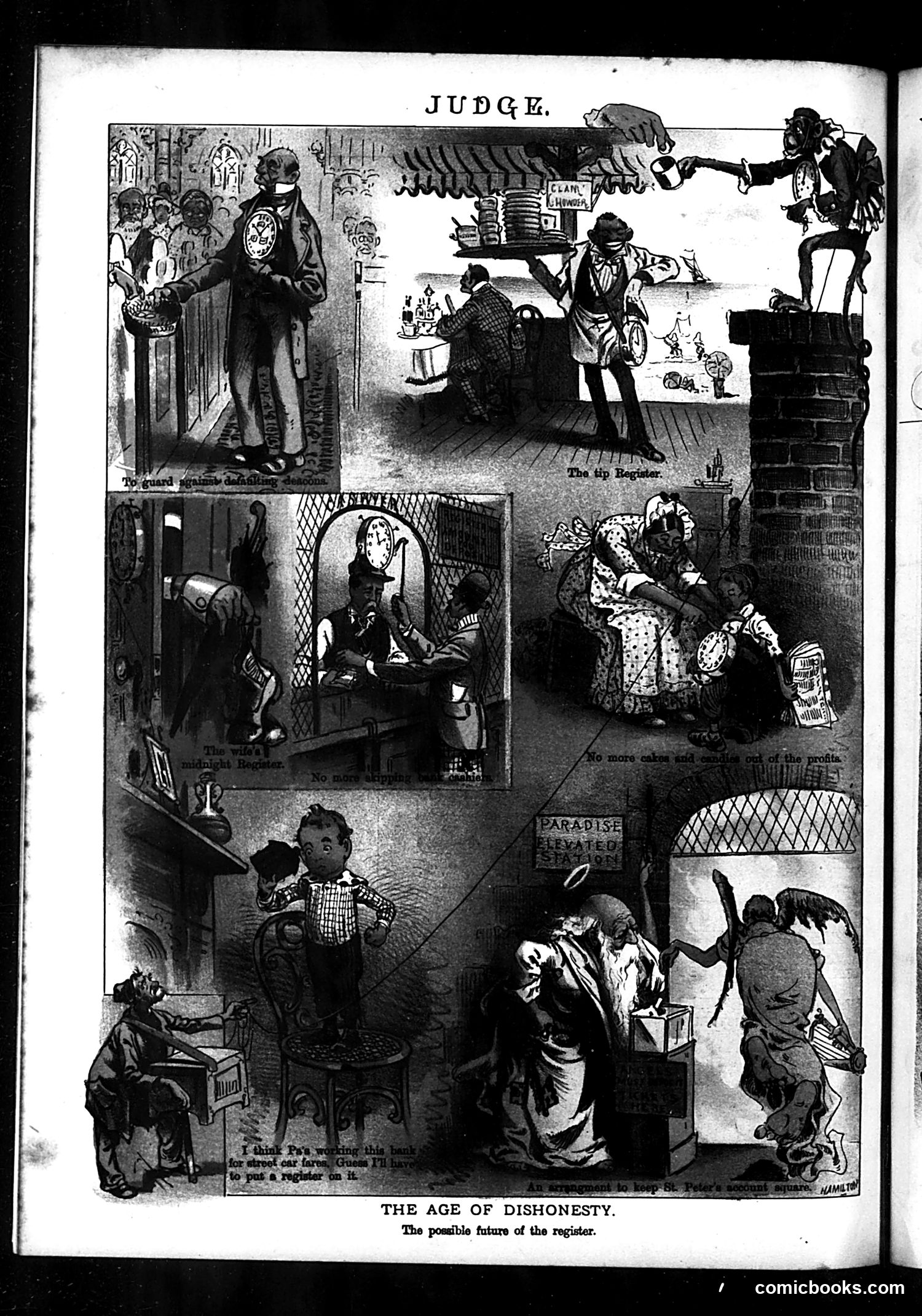
This Judge cartoon warns about corruption in commercial registers/cash registers. The multi-panel narrative depicts various schemes: dishonest shopkeepers manipulating registers, bribing officials, concealing fraudulent transactions, and exploiting customers and children. The satirical point appears to be that without proper regulation or oversight, store owners will systematically cheat the public through rigged registers and corrupt dealings. The title's ironic reference to "the possible future" suggests this dishonesty is already endemic or becoming so. The cartoon reflects Progressive-era concerns about consumer fraud and business ethics. It critiques both merchant dishonesty and the apparent ease with which such schemes operate unchecked, implying systemic corruption in retail commerce and potentially regulatory failure.