
A complete issue · 16 pages · 1886
Judge — May 22, 1886
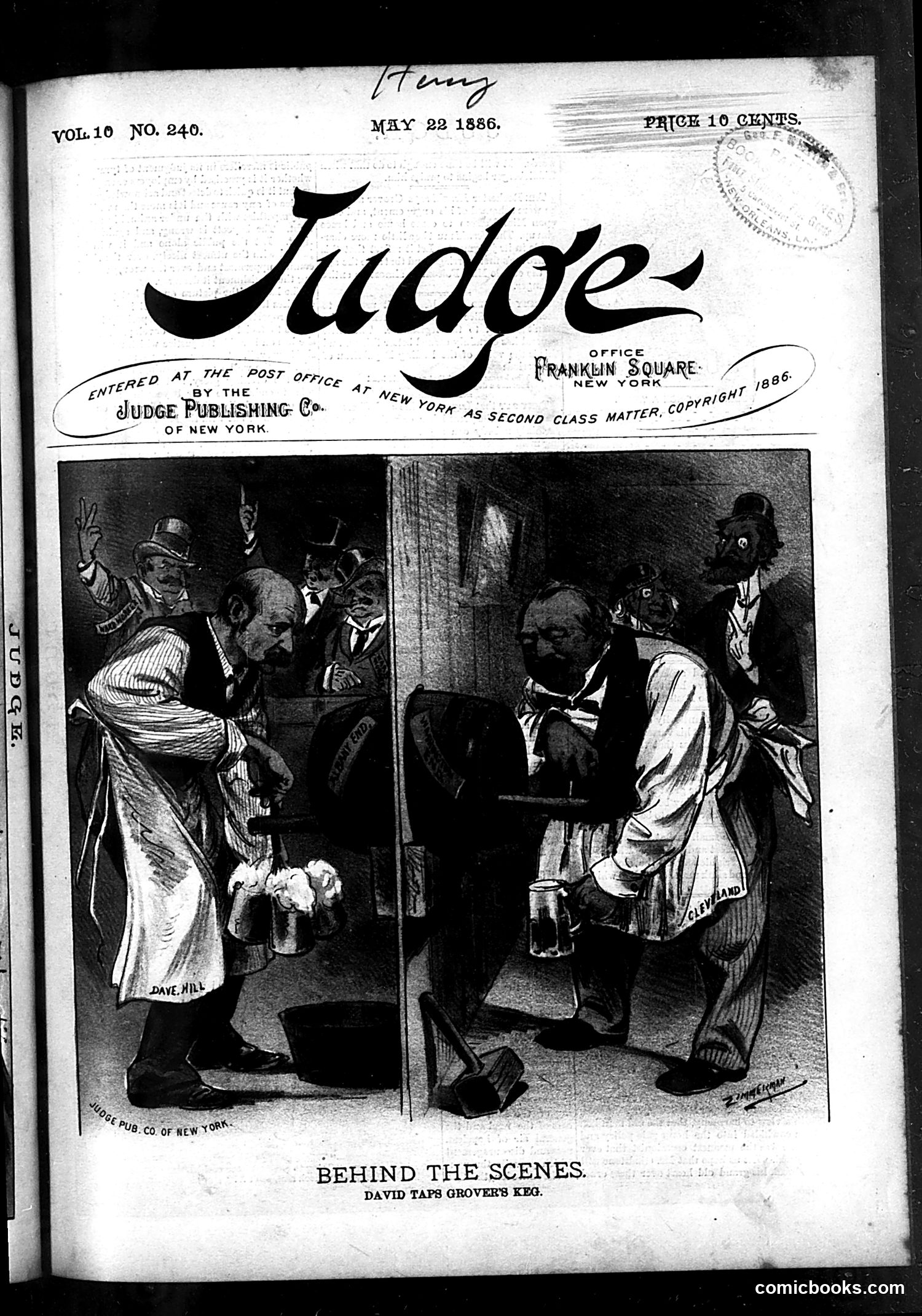
This page features a two-panel cartoon titled "Behind the Scenes: David Taps Grover's Ego" by Dave Hill and Cleveland (artist signatures visible). The cartoon appears to satirize **President Grover Cleveland**, using the biblical David-and-Goliath metaphor. The left panel shows a small figure (David) confronting a large man in formal dress (representing Cleveland/Goliath). The right panel depicts the aftermath, with the smaller figure having apparently "tapped" or struck the larger one. The satire likely mocks Cleveland's ego or a recent political controversy. The "behind the scenes" framing suggests the cartoon reveals hidden political machinations. The biblical reference implies David's underdog victory, suggesting critics believed someone small or unlikely could challenge the President's authority or pride. Specific contemporary events referenced remain unclear without additional historical context.
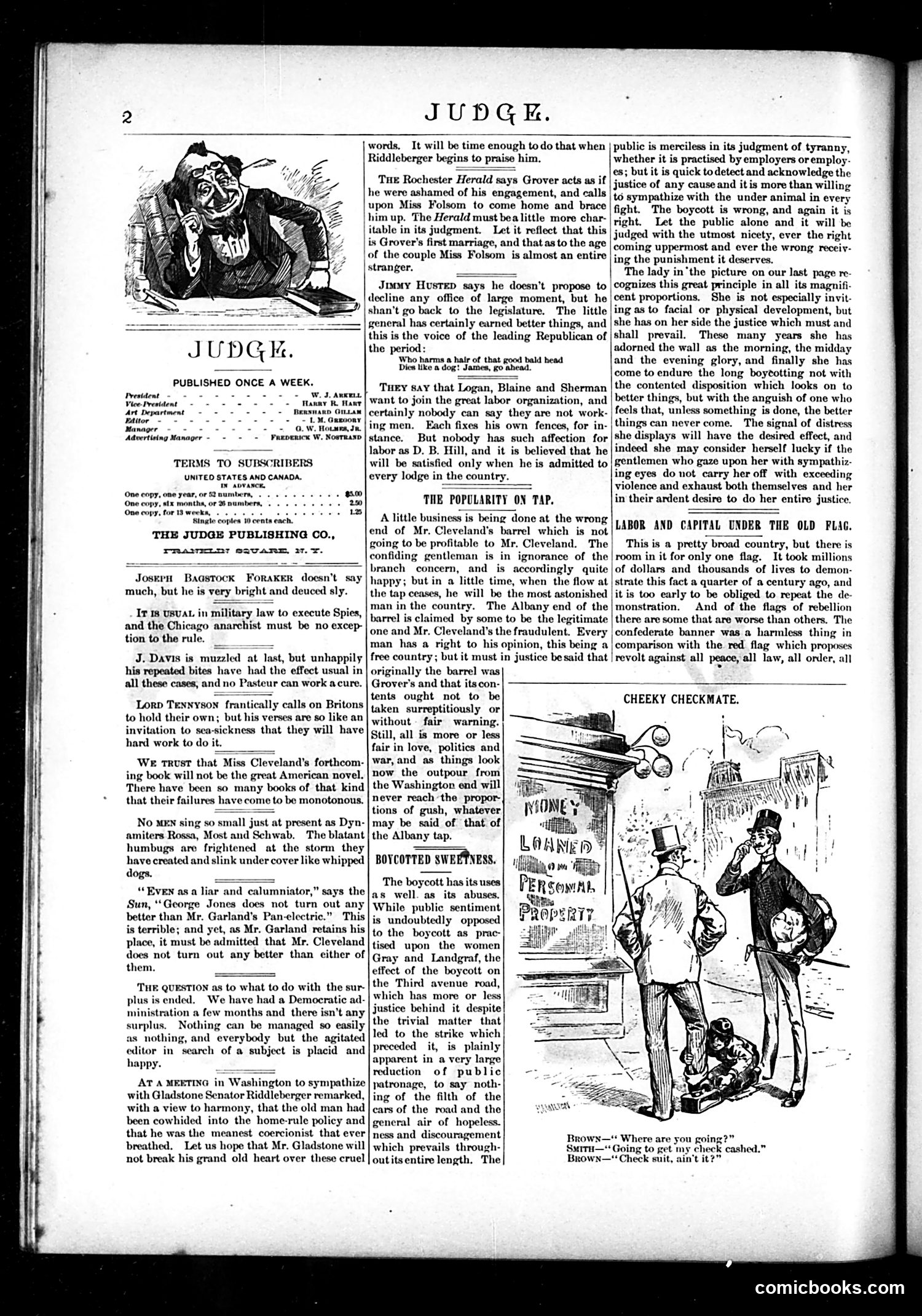
This cartoon satirizes labor boycotts and their social consequences during the Gilded Age. The illustration shows well-dressed figures confronting strikers/boycotters blocking access to property or businesses (labeled "Home," "Land," "Personal Property"). The accompanying text references the "boycott" as a tool used by labor organizers, particularly mentioning figures like Logan, Blaine, and Sherman joining labor organizations. The cartoon mocks the boycott's effectiveness and unintended consequences—notably that it harms ordinary people and public order while targeting capital. The "checkmate" framing suggests the boycott is portrayed as both a clever tactical move and a dangerous overreach that threatens civil society, property rights, and social stability. The satire critiques labor activism as destabilizing, reflecting Judge magazine's generally conservative, pro-business editorial stance.
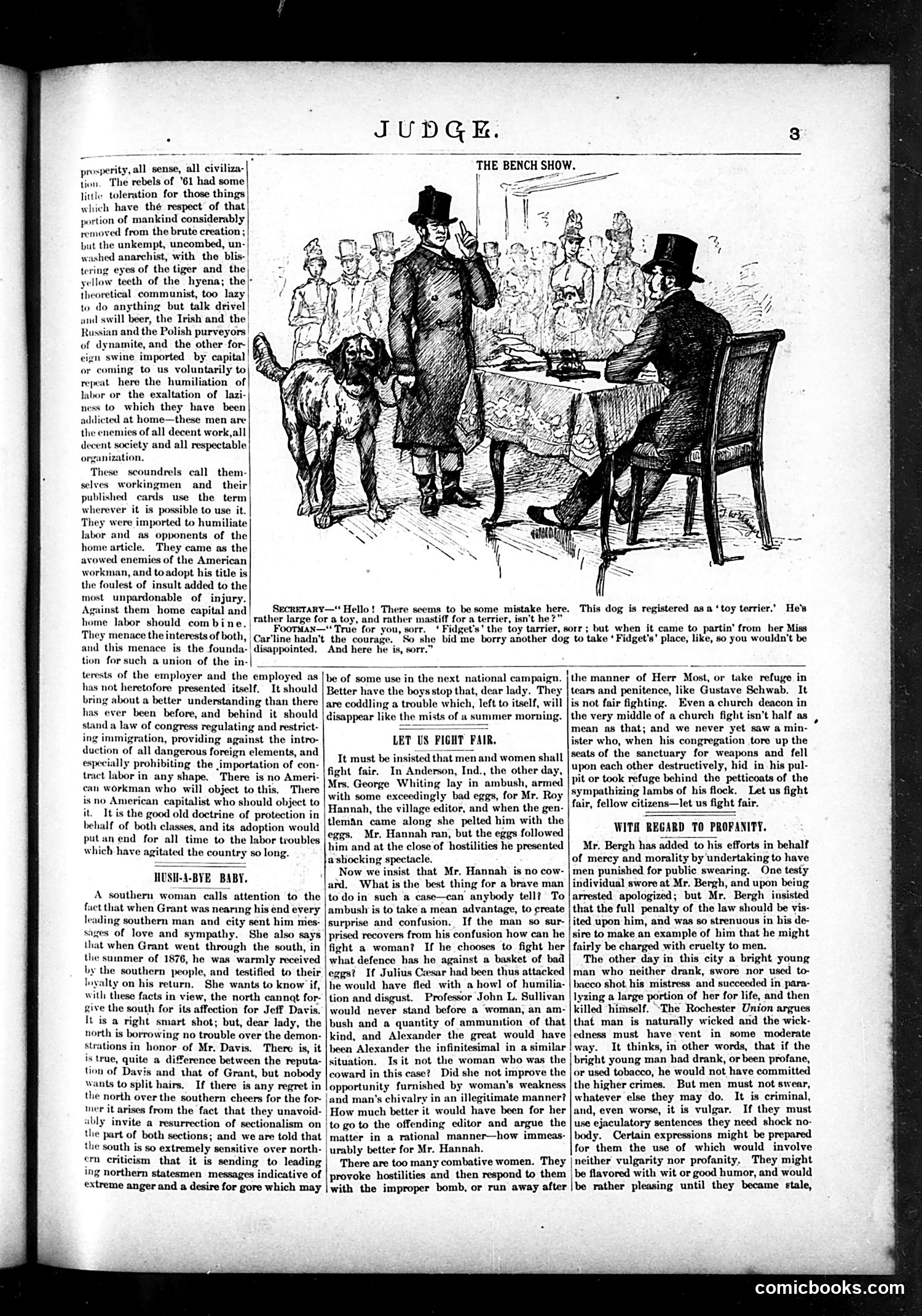
This satirical cartoon depicts a dog show mishap. A secretary discovers that a dog registered as a "toy terrier" is actually far too large for that classification. The Irish handler (depicted with period stereotypes) explains that the dog belongs to "Miss Car'line," who couldn't bear to part with her actual toy terrier "Fidget," so she substituted this larger dog instead—hoping the switch wouldn't be noticed at the show. The humor relies on the absurdity of the deception and the handler's resigned acceptance of the situation. The cartoon satirizes both the pretentiousness of dog shows and the gullibility of their judges. The surrounding text discusses labor disputes and immigration—unrelated to this cartoon—suggesting this was a miscellaneous collection page typical of Judge magazine's format.
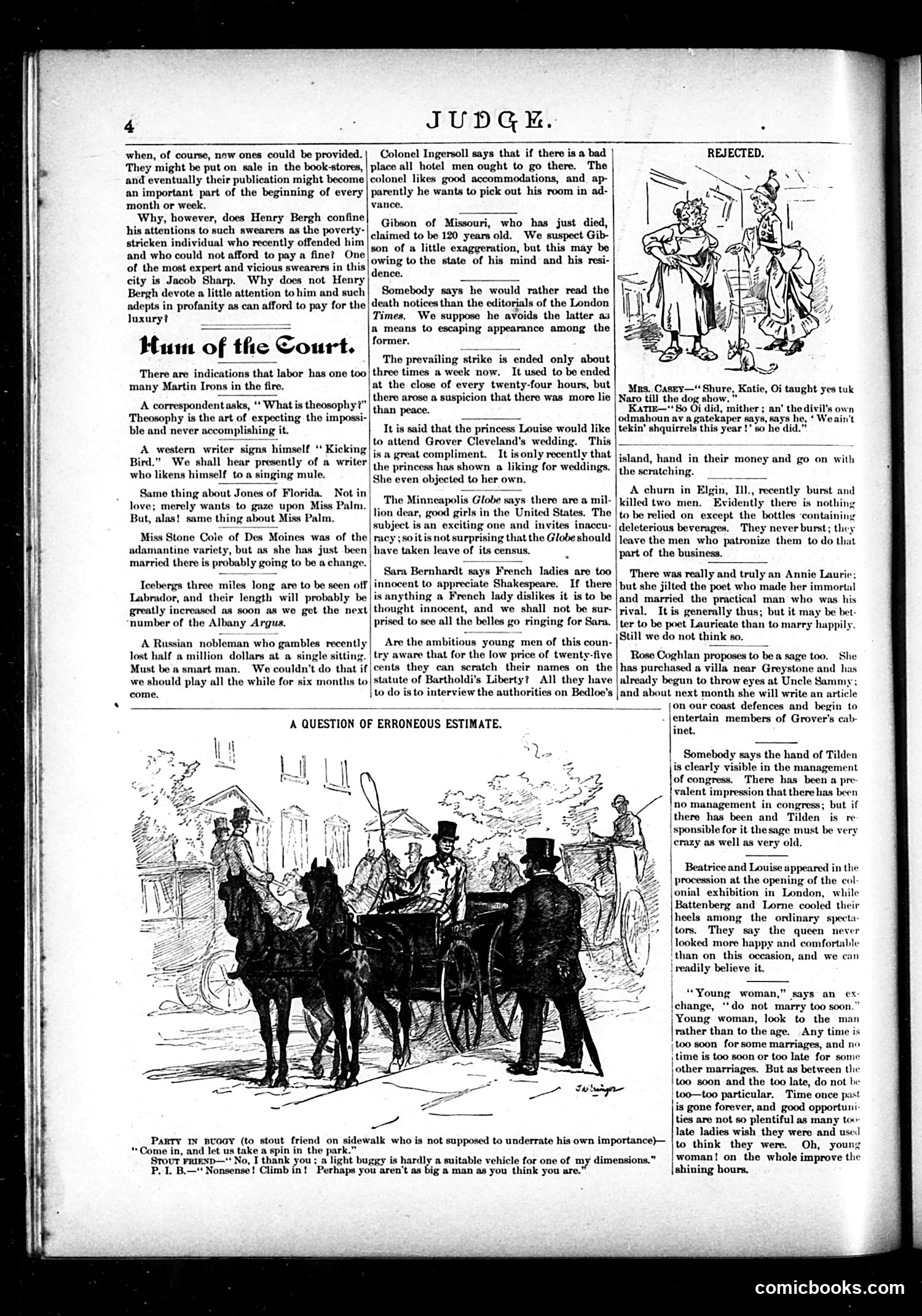
This page from Judge contains social commentary and light satire typical of late 19th-century humor: **Main Cartoon ("A Question of Erroneous Estimate")**: Shows well-dressed men in a carriage, illustrating a joke about a stout man asking to join friends for a buggy ride. The humor relies on physical comedy—the carriage is too small for someone of his size. **Textual Satire Targets**: - **Henry Bergh** (animal welfare advocate): Mocked for selectively targeting poor swearers while ignoring wealthy ones like Jacob Sharp - **Princess Louise**: Joked about her reluctance to attend weddings despite attending Grover Cleveland's - **Labor strikes**: References "Martin Irons" (unclear reference) and mentions strikes ending/resuming frequently - **Sara Bernhardt**: Satirizes French actresses as hypocritically claiming innocence while being sophisticated The page blends society gossip, political figures, and absurdist humor typical of Judge's satirical approach to contemporary American life and personalities.
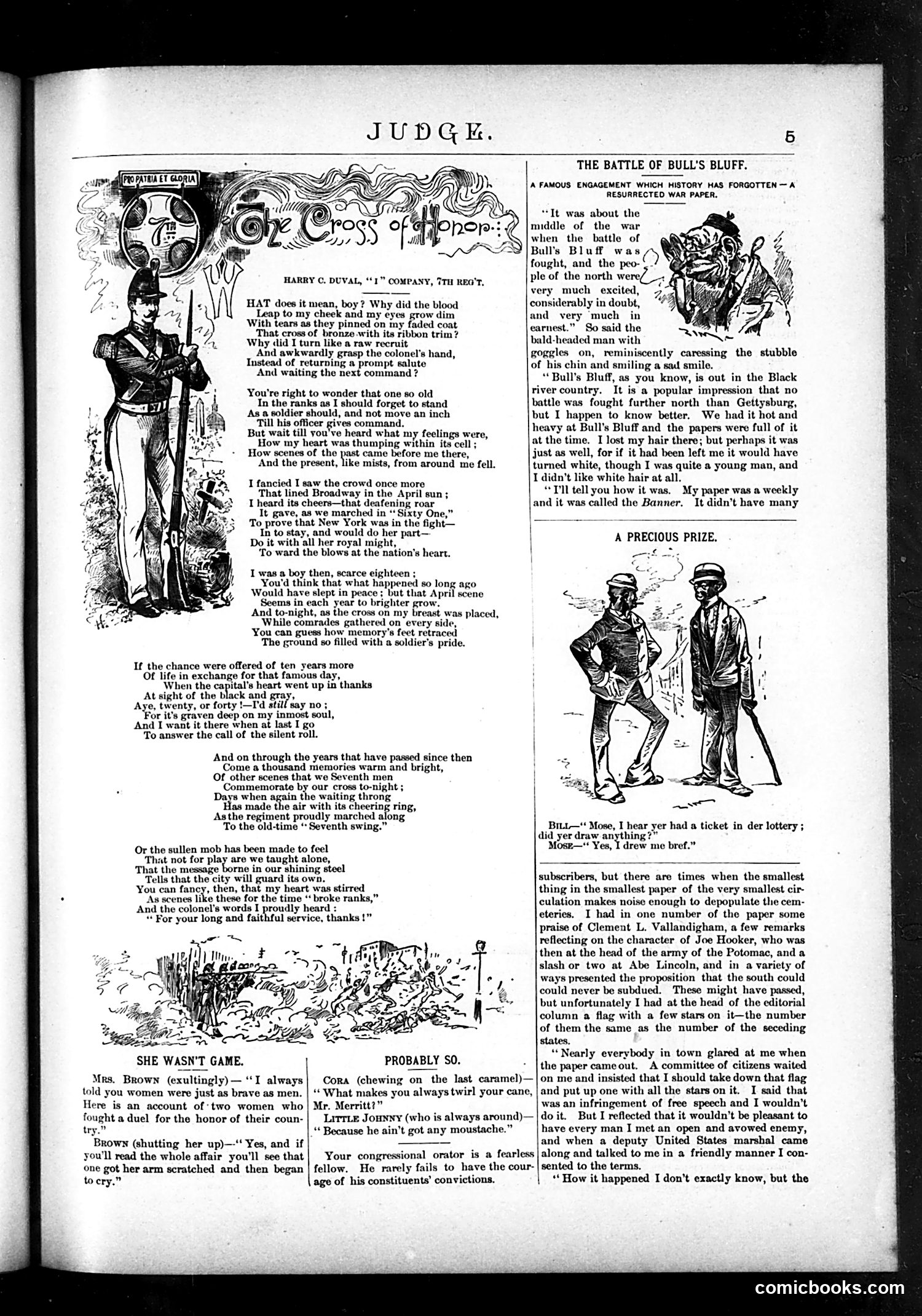
This page contains Civil War reminiscence mixed with light social humor. **Main Content**: "The Battle of Bull's Bluff" features a veteran soldier receiving a military decoration, triggering memories of the Civil War (specifically the 1861 Battle of Bull's Bluff in Virginia). The verse describes an elderly soldier emotionally recalling his youth marching with New York's Seventh Regiment in 1861, when crowds cheered them as they departed to defend the nation. The soldier reflects that he wouldn't trade those patriotic memories for additional years of life. **Historical Context**: Bull's Bluff was an actual 1861 Union defeat. The story uses this battle as a vehicle for nostalgic patriotism and veteran reverence—themes popular in Judge during the post-Civil War period. **Humor Section**: Brief comic vignettes mock women's suffrage ("women brave as men") and social pretension (a man twirling a cane to compensate for lacking a mustache). The overall tone balances sentimental militarism with gentle domestic satire typical of 1880s-90s American magazines.
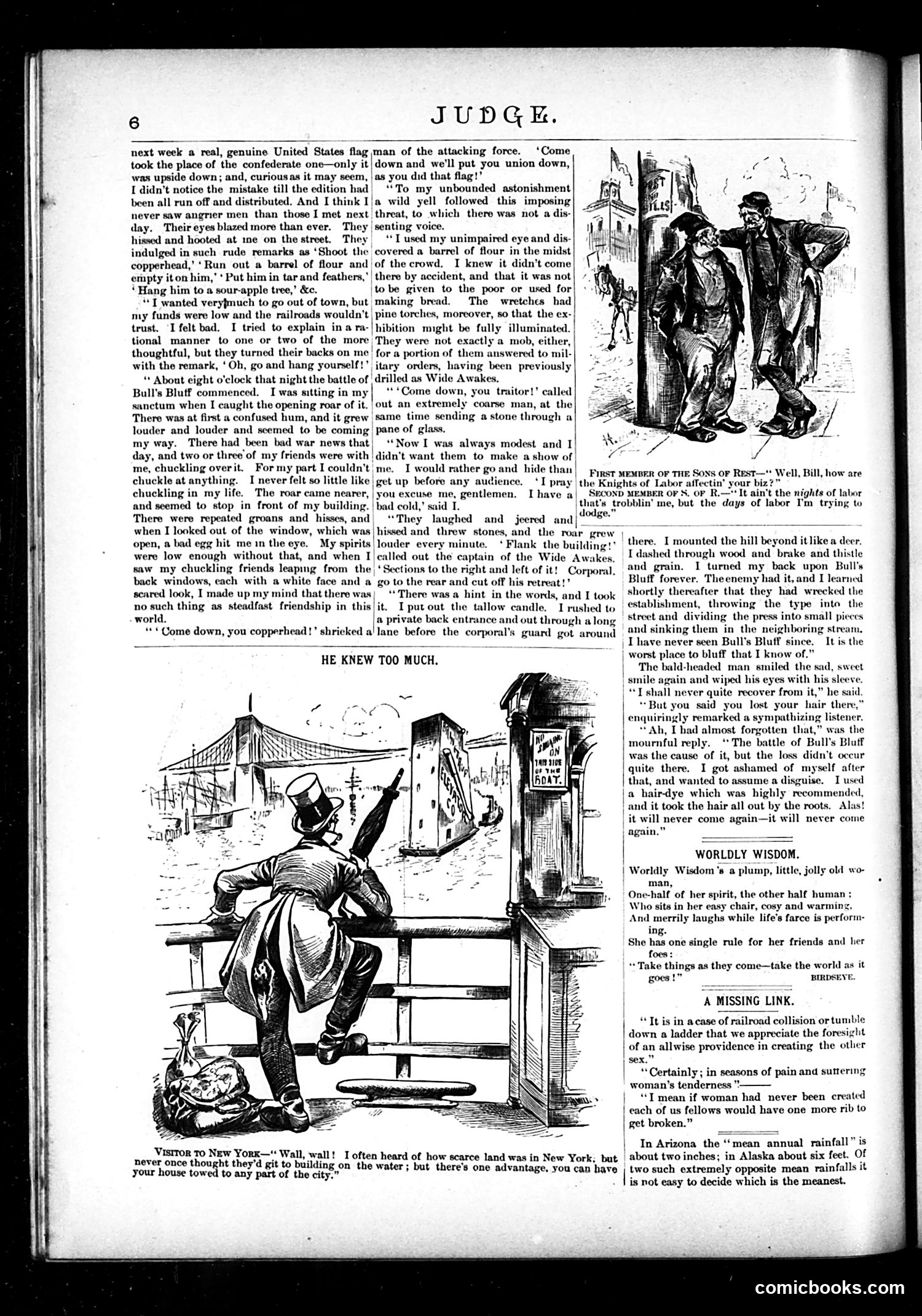
This page contains Civil War-era satirical content mocking Northern opposition to the war. The main narrative describes an editor who accidentally printed an upside-down American flag, infuriating local residents. When Confederate forces attack (likely referencing the First Battle of Bull Run, 1861), an angry mob—organized as "Wide Awakes" (a Republican militia group)—surrounds his building, forcing him to flee. The satire targets "Copperheads" (Northern Democrats opposing the war) by depicting anti-war sentiment as cowardly and treasonous. The mob's military organization suggests popular support for Union causes. The lower cartoon, titled "He Knew Too Much," appears to show someone fleeing—reinforcing the theme of Northern disloyalty facing consequences. The page also includes lighter pieces like "Worldly Wisdom" offering domestic advice, typical of Judge's mixed content format.
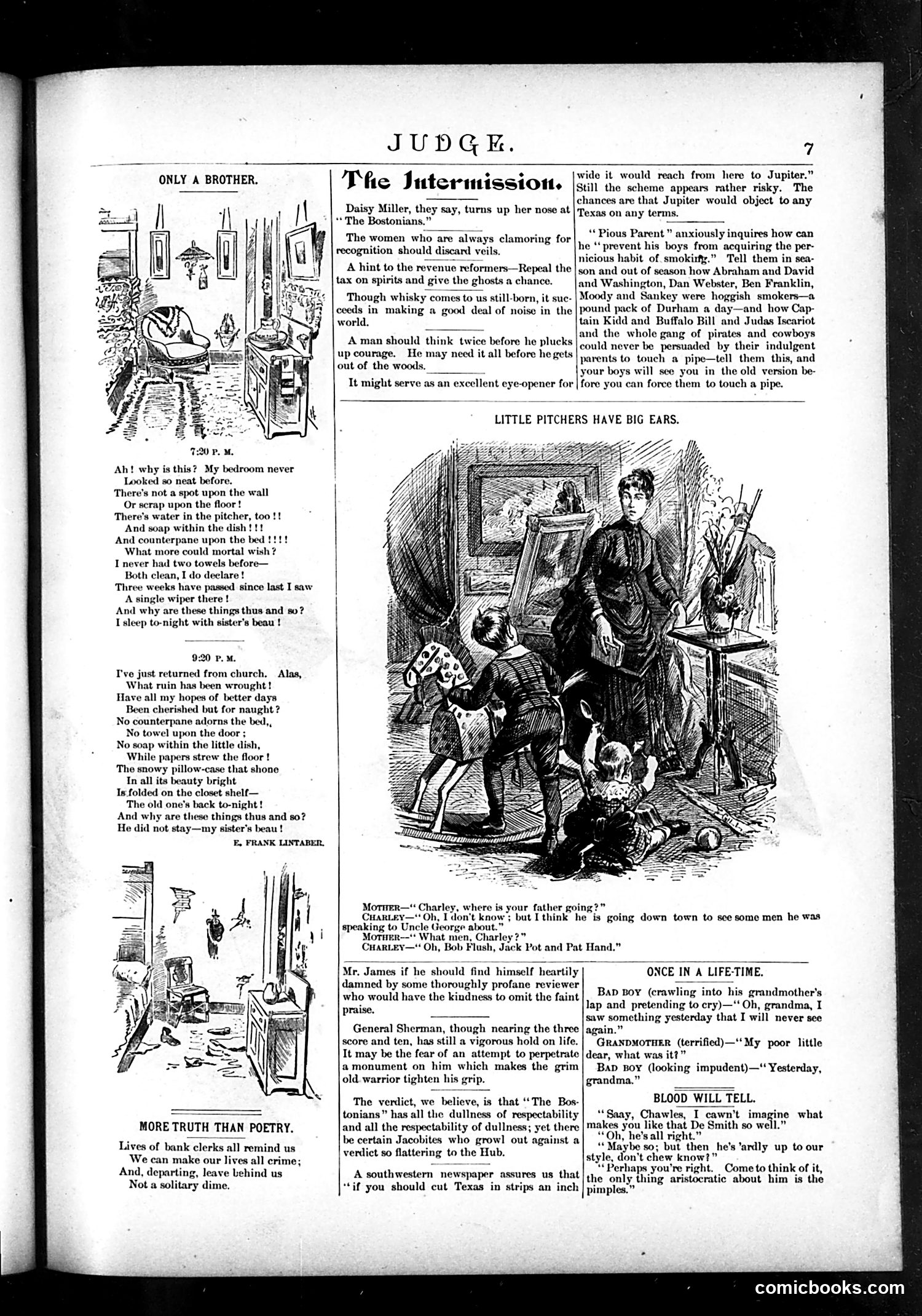
**"Only a Brother"** is a humorous poem about domestic tidiness. When the narrator's sister's boyfriend stays over, the bedroom becomes spotlessly clean (towels appear, soap materializes, counterpanes are arranged). Once he leaves, everything reverts to slovenly chaos. The joke satirizes how families present false facades for guests—particularly suitors—while maintaining actual disorder in private. The accompanying sketches show the contrasting states. **"The Intermission"** is a collection of brief satirical quips mocking contemporary figures and social issues. References include Daisy Miller (Henry James's novel character), discussions of women's veils, tax reform, General Sherman, and "The Bostonians" (James's novel, criticized as dull yet respectable). One item jokes about a Texan newspaper's boast that Texas strips could reach Jupiter. **"Little Pitchers Have Big Ears"** and **"Blood Will Tell"** are short humorous anecdotes showing children's innocent (or impudent) misunderstandings and their inherited traits—typical Judge humor about domestic life and child behavior.
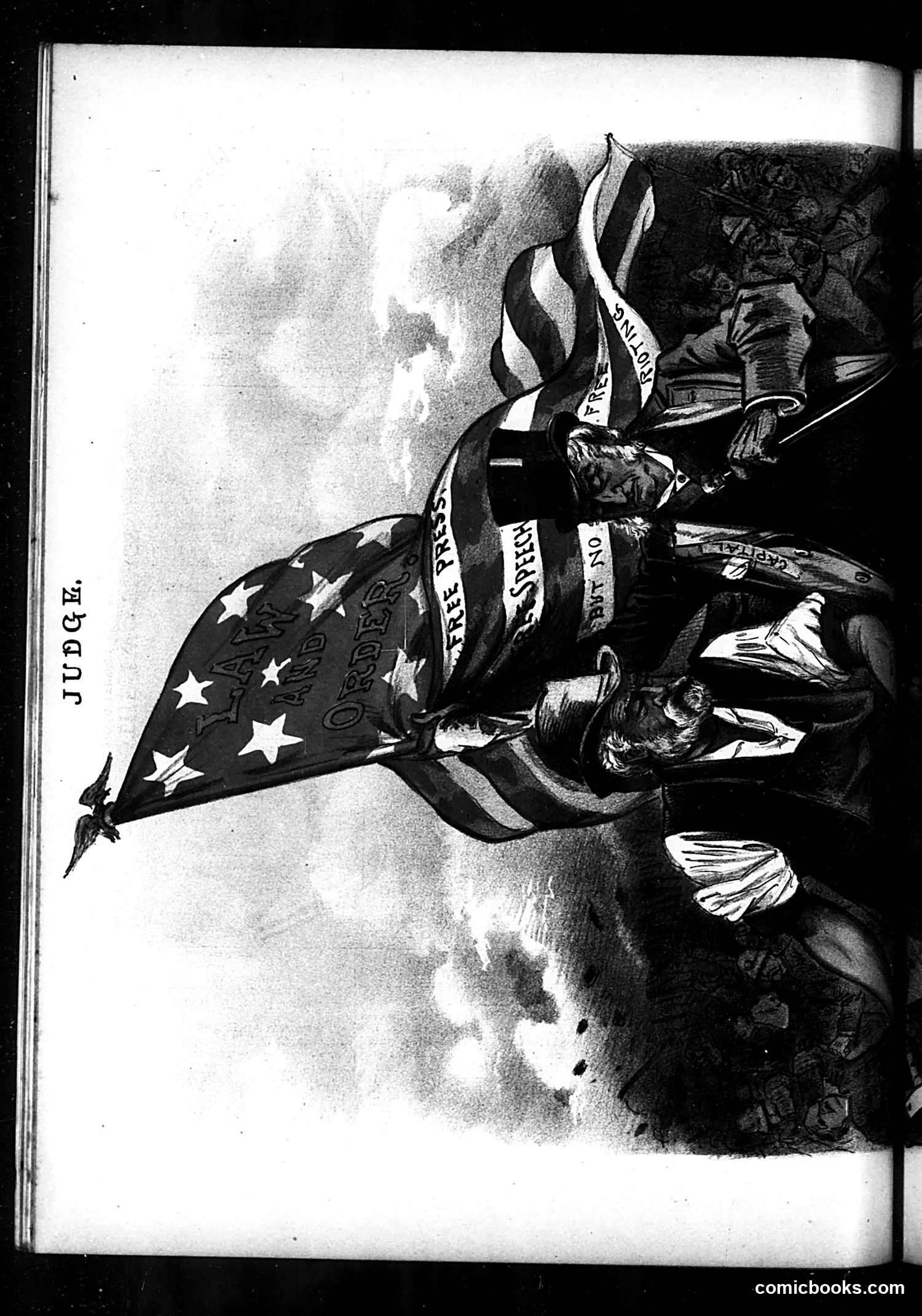
I can see this is a political cartoon labeled "JUDGE" on the left margin. The image shows a figure in classical robes holding ribbons or banners with text (though the specific text on the ribbons is difficult to read clearly in this reproduction). The figure appears to be Lady Justice or a similar allegorical representation, holding what looks like an American flag with stars. However, the OCR text provided is largely illegible—it appears to be garbled characters rather than readable content. Without clear text identifying the specific political or social reference, the date of publication, or the names of figures involved, I cannot reliably explain what particular issue, scandal, or event this cartoon satirizes. The artistic style and medium suggest late 19th or early 20th century American political satire, but I cannot determine the specific meaning without clearer source material.
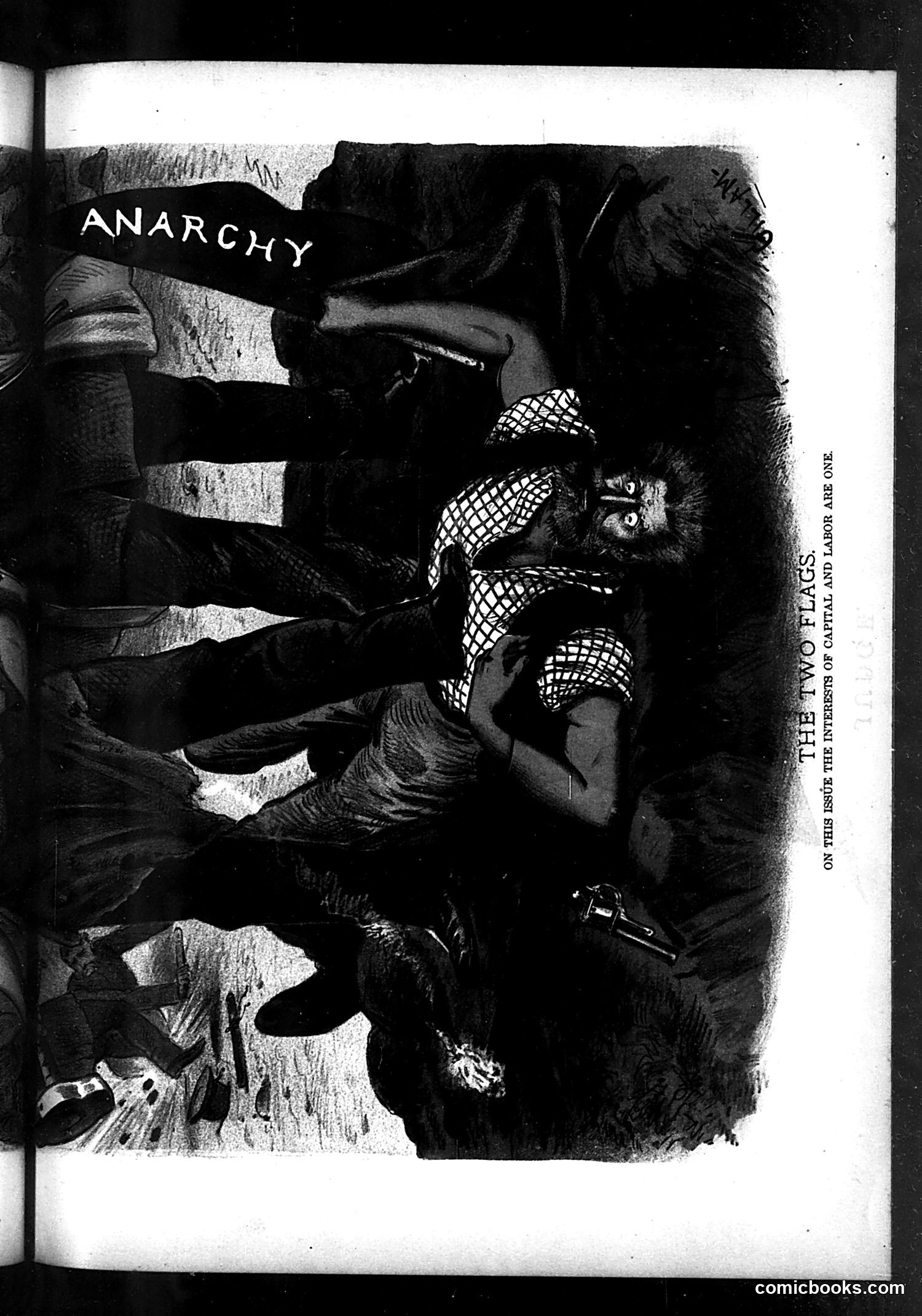
I can see this is a political cartoon titled "ANARCHY" from Judge magazine, showing a figure wearing a mesh or netted garment being restrained or imprisoned. The word "ANARCHY" appears at the top left of the image. However, the OCR text provided is corrupted and unreadable, making it impossible to identify the specific figures, historical context, or political message with confidence. To properly explain this cartoon to a modern reader, I would need either: legible text from the page, the publication date, or additional context about which political figure or anarchist movement this references. Without these, I cannot accurately identify who is depicted or what specific event or ideology the satire targets.
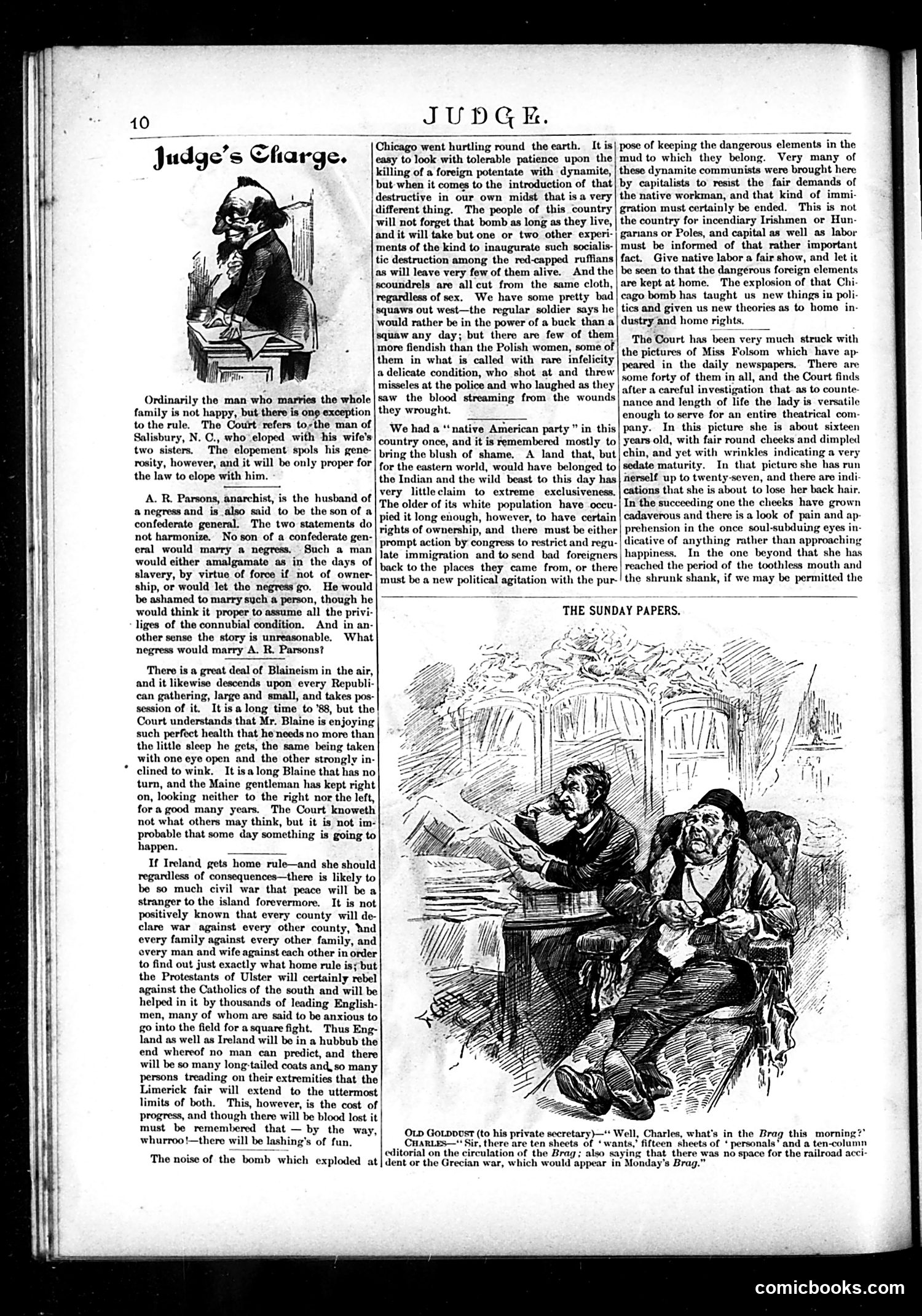
This page contains multiple brief satirical commentaries ("Judge's Charge") on contemporary issues: **A.R. Parsons case**: The text mocks anarchist A.R. Parsons for marrying a Black woman, using racist logic to argue this is hypocritical—suggesting a Confederate general's son wouldn't marry a Black woman but might exploit her otherwise. **James G. Blaine**: References to "Blaineism" suggest the Maine politician's influence pervading Republican gatherings. The sleeping reference appears to mock his personal habits or political torpor. **Irish Home Rule**: Satirizes fears that Irish independence would trigger civil war between Protestant Ulster and Catholic south, with English intervention. **Dynamite Bombs**: Responds to recent anarchist bombings (likely the Chicago Haymarket incident of 1886), expressing outrage and xenophobic fear of immigrant radicals, particularly Polish women anarchists. The cartoon illustration accompanying "The Sunday Papers" depicts what appears to be an old man and younger figure in domestic/journalistic context, though its specific reference is unclear.
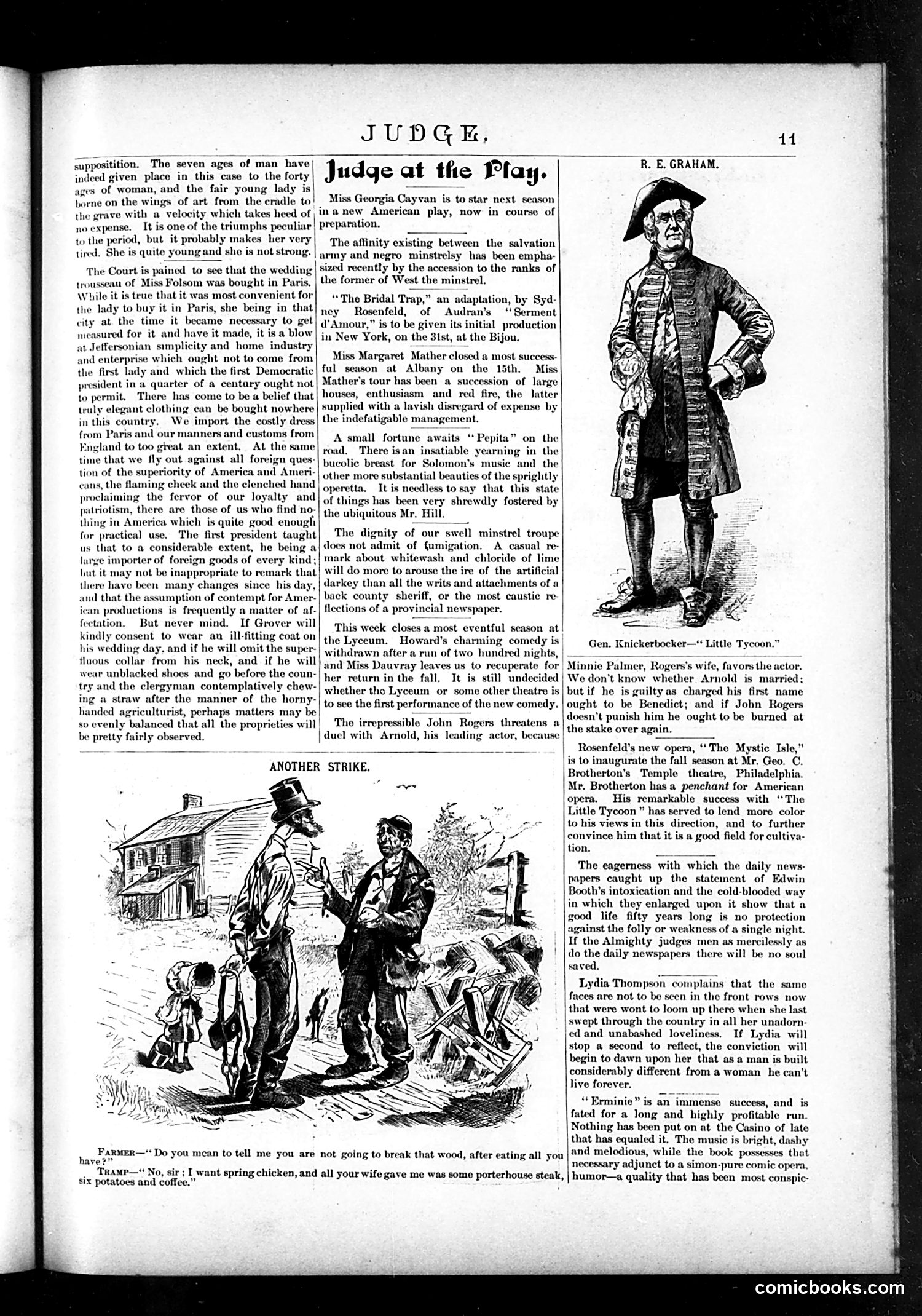
This page from *Judge* satirizes multiple theatrical and political topics circa the 1880s. **Main Political Satire (top article):** The text criticizes President Grover Cleveland's bride, Miss Folsom, for purchasing her wedding dress in Paris rather than America. The satire mocks this as hypocritical—Democrats claim patriotism and "Jeffersonian simplicity" while the First Lady imports luxury goods, contradicting American manufacturing pride. The author sarcastically suggests Cleveland wear an ill-fitting American coat and go barefoot to prove his democratic credentials. **Cartoon ("Another Strike"):** Shows two men (appears to be a farmer and laborer) in conflict over broken wood/fence, captioned with dialogue about eating spring chicken and potatoes. This likely satirizes labor disputes or class tensions of the era. **Theater Section:** Brief reviews of contemporary plays and performers (Georgia Cayvan, Margaret Mather, etc.), typical of *Judge*'s entertainment coverage. The page exemplifies *Judge*'s blend of political commentary and popular culture criticism.
This is primarily an **advertising page** from Judge magazine, not a political cartoon page. The layout consists almost entirely of commercial advertisements typical of late 19th-century publications. The notable content includes: **Theater/Entertainment References:** Brief theatrical gossip mentions actress **Lotta** (likely Lotta Crabtree, a popular performer), who apparently renamed her play multiple times as it toured different cities. References to **Martha Porteous** and **Mr. Booth** (likely actor Edwin Booth) discuss theatrical personalities and their reputations. **Products Advertised:** Hats, safes (Marvin Safe Co.), furniture, carriages, clothing, toiletries, and other merchandise typical of the era. The page demonstrates how 19th-century magazines funded publication—not through the editorial content alone, but through dense paid advertising. The theatrical gossip sections served to attract readers interested in entertainment news, creating an audience for advertisers.
This page is primarily an advertisement section from *Judge* magazine, not a cartoon page. The visible content consists almost entirely of commercial advertisements for products like Lundborg's perfumes, collars and cuffs, insurance, tailoring services, and various remedies. There is one small illustration—appears to be a silhouette of what looks like a person or figure in the upper right—but it's largely illegible at this resolution and lacks clear context. The textual content below the ads discusses theatrical criticism and editorial praise for *Jupae*, a competing illustrated newspaper, noting its cartoons and artistic talent. A section titled "The Animal Harbinger" begins at the bottom but is cut off mid-sentence. This appears to be a back page or filler section of *Judge* dedicated to advertising revenue rather than satirical content.
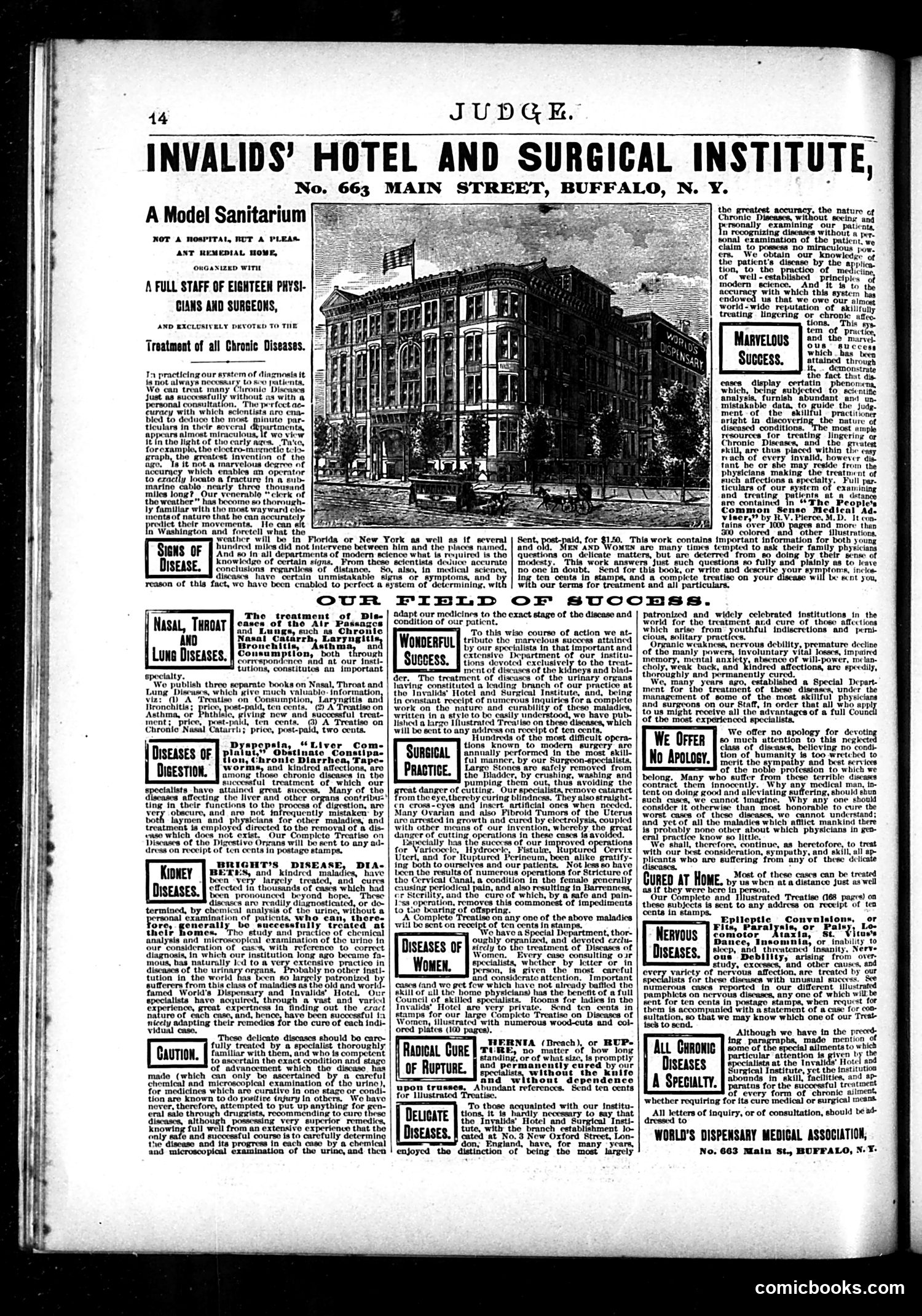
This page is **entirely advertising**, not satire or political commentary. It's a full-page advertisement for the "Invalids' Hotel and Surgical Institute" in Buffalo, New York—a private medical facility claiming to treat chronic diseases remotely through mail-based diagnosis. The ad emphasizes their supposed scientific method: they claim to diagnose patients without in-person examination by analyzing reported symptoms, comparing this accuracy to telegraph operators locating cable breaks across oceans. They offer a mail-order medical book ("The People's Common Sense Medical Adviser") for $1.40. **For modern readers**: This represents 19th-century medical quackery dressed in pseudo-scientific language. The facility exploited distance patients unable to access regular doctors, offering diagnosis-by-mail and mail-order treatments—classic practices of medical fraud from this era. The pompous comparison to telegraphy and weather prediction was marketing designed to suggest legitimate scientific authority where none existed.
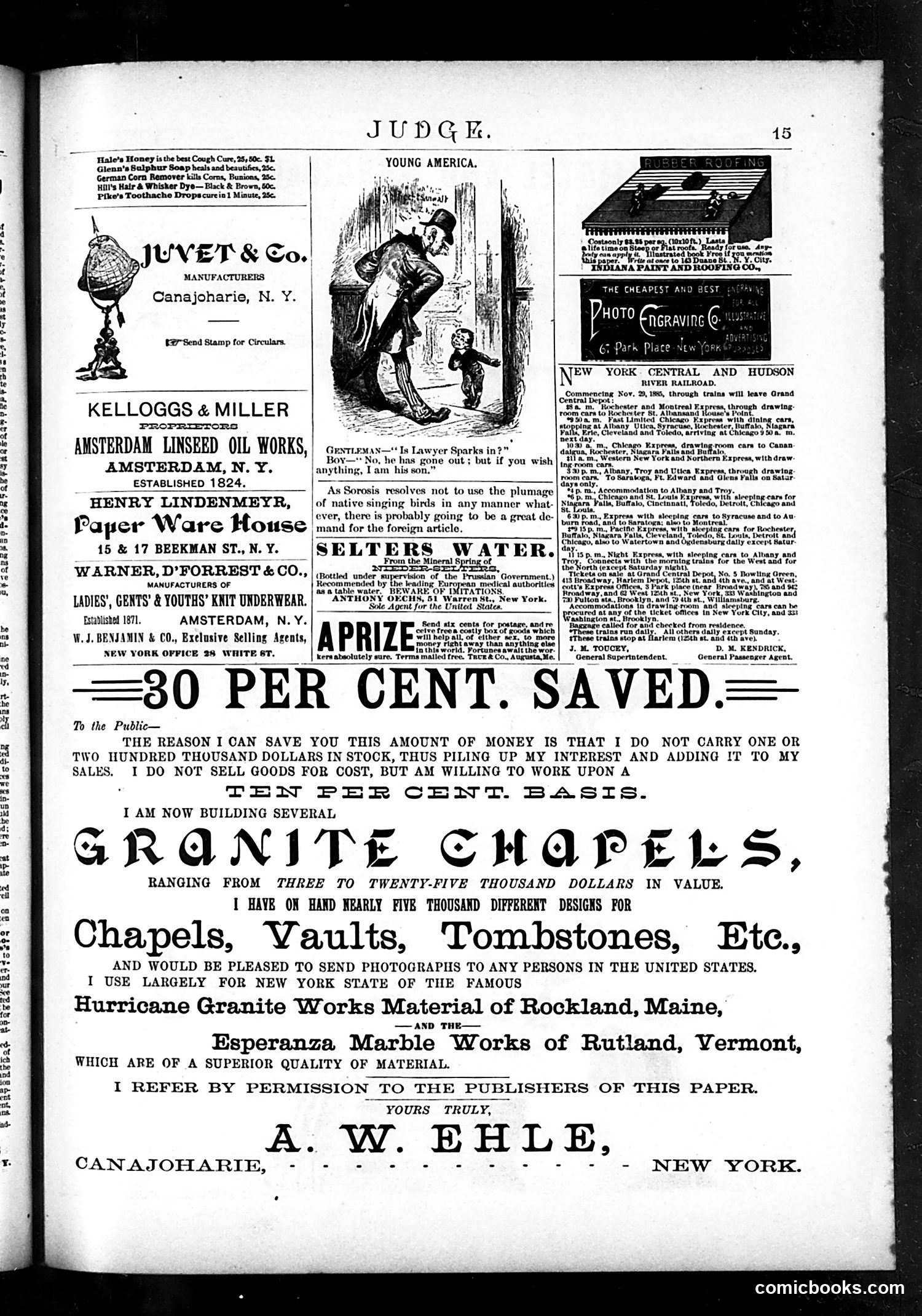
This page is primarily **advertisements** interspersed with one small cartoon titled "Young America." The cartoon depicts a well-dressed gentleman (likely representing an adult or authority figure) scolding a young boy. The dialogue reads: "Gentlemen—Is Lawyer Sparks in?" / "No, sir. He has gone out; if you wish anything, I am his son." **The satire**: This is a commentary on precocious American youth and child labor. The joke suggests that American boys are so eager to work or so prematurely adult that even a child will confidently present himself as capable of handling business matters in a lawyer's office. It mocks both the ambition of "Young America" and perhaps the period's acceptance of children in professional settings. The surrounding advertisements (for hair dye, toothache drops, granite chapels, and railroad schedules) are standard commercial notices typical of Judge magazine's funding model, offering no additional satirical content.
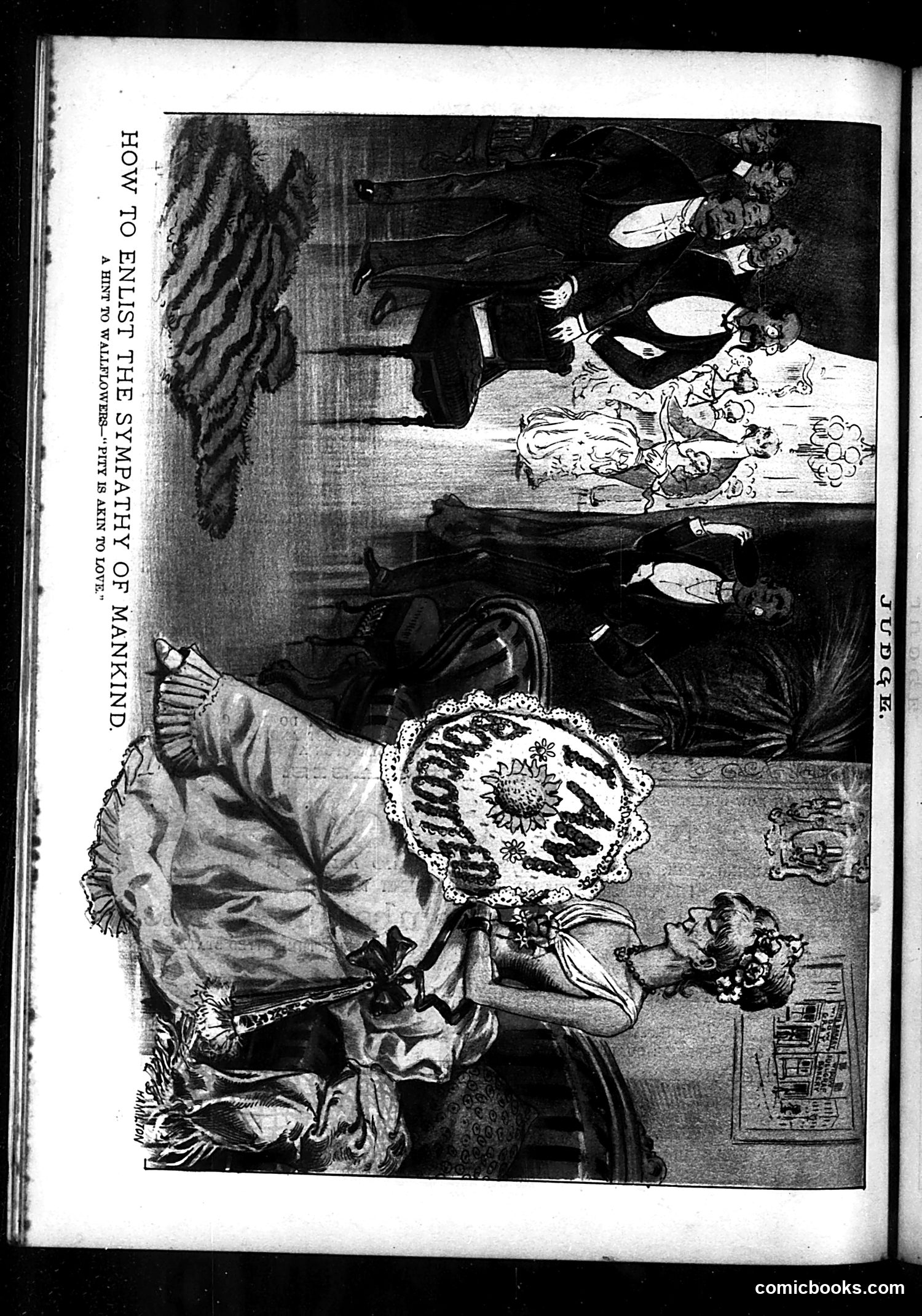
This satirical illustration critiques social dynamics among unmarried women ("wallflowers"—those who sat out dances). The main image shows a woman in an elaborate, decorated dress with an exaggerated facial expression displaying distress or suffering. Below her, another figure appears to be consoling or attending to her. The caption's wordplay—"pity is akin to love"—suggests the cartoon's satirical point: that women might deliberately cultivate an appearance of suffering or pitifulness to attract male sympathy and romantic attention. The elaborate costume and theatrical presentation mock this manipulative strategy. The subtitle "A Hint to Wallflowers" directly addresses unmarried women excluded from social participation, implying they could use false displays of distress as a tactic for gaining male notice. It's a somewhat cynical commentary on courtship rituals and gender relations of the period.