
Judge, 1886-05-22 · page 2 of 16
Judge — May 22, 1886 — page 2: what you’re looking at
What you’re looking at
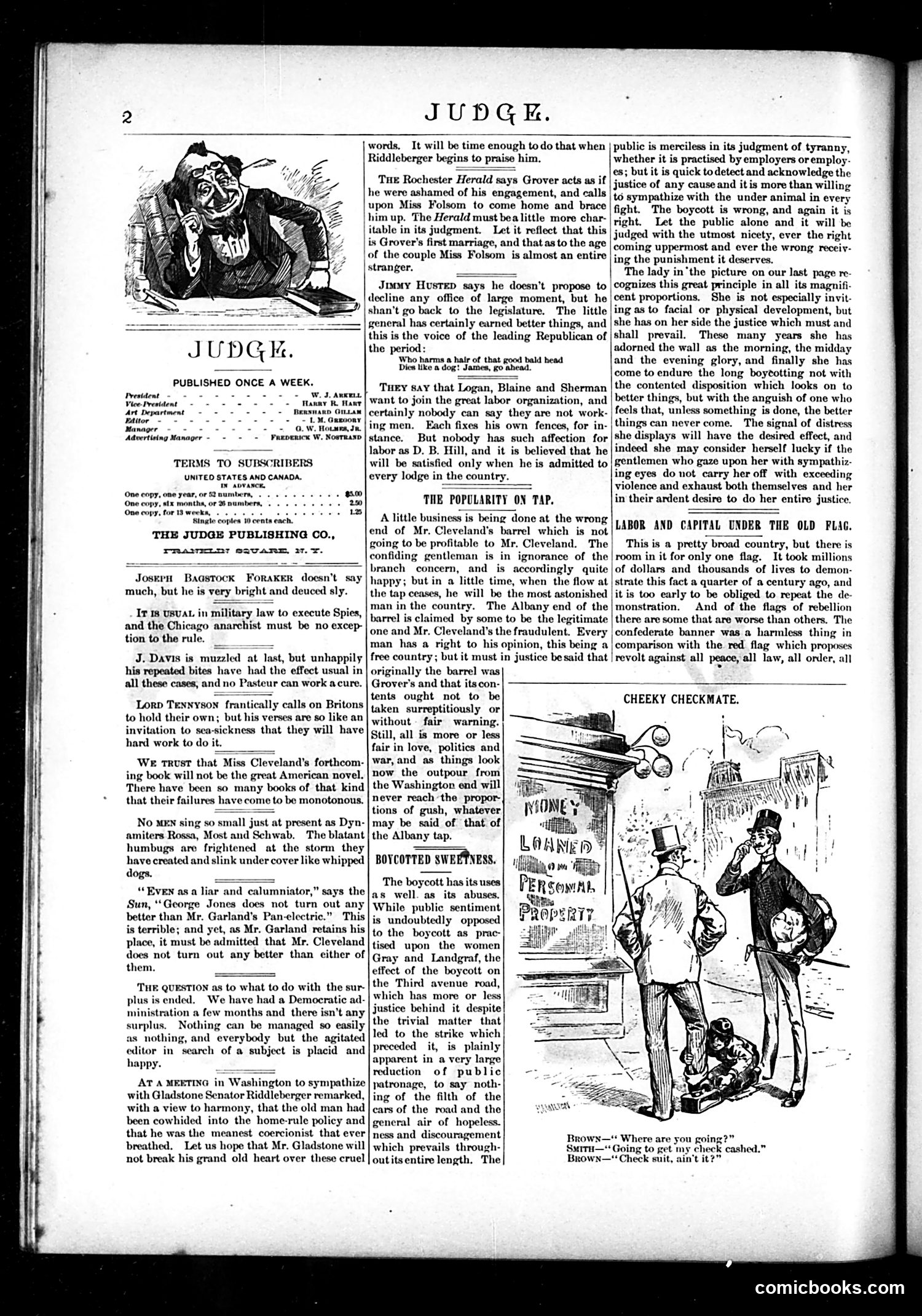
This cartoon satirizes labor boycotts and their social consequences during the Gilded Age. The illustration shows well-dressed figures confronting strikers/boycotters blocking access to property or businesses (labeled "Home," "Land," "Personal Property"). The accompanying text references the "boycott" as a tool used by labor organizers, particularly mentioning figures like Logan, Blaine, and Sherman joining labor organizations. The cartoon mocks the boycott's effectiveness and unintended consequences—notably that it harms ordinary people and public order while targeting capital. The "checkmate" framing suggests the boycott is portrayed as both a clever tactical move and a dangerous overreach that threatens civil society, property rights, and social stability. The satire critiques labor activism as destabilizing, reflecting Judge magazine's generally conservative, pro-business editorial stance.
📄 Transcribed text from this page (OCR, searchable)
Machine-transcribed from the original scan — historical spelling and the odd misread are preserved.
JUDGE. President ~~~ Vice-President Art Departmer Pattor ~ ~~ Manager -- Advertising Manager =~ TERMS TO SUBSCRIBERS: UNITED STATES AND CANADA. 1X ADVANCE, ‘One copy, one year, or numbers... One copy, six months, or B numbers, . . One copy, for 13 weeks, Bees | oe ‘Single coples 10 cents each. THE JUDGE PUBLISHING CO., rmaonmeinr savas, 2. +. JoserH BaastocK ForaKER doesn't say much, but he is very bright and deuced sly. Ir 18 UsvAL in military law to execute Spies, and the Chicago anarchist must be no excep- tion to the rule. J. Davis is muzzled at last, but unhappily his repeated bites have had the effect usual in all these cases, and no Pasteur can work acure. Lorp Tennyson frantically calls on Britons to hold their own; but his verses are so like an invitation to sea-sickness that they will have hard work to do it. WE trust that Miss Cleveland's forthcom- ing book will not be the great American novel. There have been so many books of that kind that their failures have come to be monotonous. No MEN sing so small just at present as Dyn- amiters Rossa, Most and Schwab. The blatant humbugs are frightened at the storm they have created and slink under cover like whipped dogs. = “Even asa liar and calumniator,” says the Sun, “George Jones does not turn out any better than Mr. Garland’s Pan-electric.” This is terrible; and yet, as Mr. Garland retains his place, it must be admitted that Mr. Cleveland does not turn out any better than either of them. ‘THE QUESTION as to what to do with the sur plus is ended. We have had a Democratic ad- ministration a few months and there isn’t any surplus. Nothing can be managed so easily as nothing, and everybody but the agitated editor in search of a subject is placid and happy. AT A MEETING in Washington to sympathize with Gladstone Senator Riddleberger remarked, with a view to harmony, that the old man had been cowhided into the home-rule policy and that he was the meanest coercionist that ever breathed. Let us hope that Mr. Gladstone will not break his grand old heart over these cruel words. It will be time enough todo that when Riddleberger begins to praise him. Tue Rochester Herald says Grover acts as if he were ashamed of his engagement, and calls upon Miss Folsom to come home and brace him up. The Herald must bea little more char- itable in its judgment. Let it reflect that this is Grover’s first marriage, and thatasto the age | of the couple Miss Folsom is almost an entire stranger. Jnmy Hustep says he doesn’t propose to decline any office of large moment, but he shan’t go back to the legislature. The little general has certainly earned better things, and this is the voice of the leading Republican of the period: Who harms a hair of that good bald head Dies like a dog! James, go ahead. Tuey say that Logan, Blaine and Sherman want to join the great labor organization, and certainly nobody can say they are not work- ing men. Each fixes his own fences, for in- stance. But nobody has such affection for labor as D. B. Hill, and it is believed that he will be satisfied only when he is admitted to every lodge in the counti THE POPULARITY ON TAP. A little business is being done at the wrong end of Mr, Cleveland's barrel which is not going to be profitable to Mr. Cleveland. The confiding gentleman is in ignorance of the branch concern, and is accordingly quite happy; but in a little time, when the flow at the tap ceases, he will be the most astonished man in the country. The Albany end of the barrel is claimed by some to be the legitimate one and Mr. Cleveland's the fraudulent. Every man has a right to his opinion, this being a free country ; but it must in justice be said that originally the barrel was Grover’s and that itscon- public is merciless in its judgment of tyranny, whether it is practised by employers or employ. es; but it is quick to detect and acknowledge the justice of any cause and it is more than willing | to sympathize with the under animal in every \fight. The boycott is wrong, and again it is |right. Let the public alone and it will be judged with the utmost nicety, ever the right coming uppermost and ever the wrong receiy- ing the punishment it deserves. The lady inthe picture on our last page re- cognizes this great principle in all its magnifi- cent proportions. She is not especially invit ing as to facial or physical development, but she has on her side the justice which must and shall prevail. These many years she has adorned the wall as the morning, the midday and the evening glory, and finally she has come to endure the long boycotting not with the contented disposition which looks on to better things, but h the anguish of one who feels that, unless something is done, the better |things can never come. The signal of distress she displays will have the desired effect, and indeed she may consider herself lucky if the gentlemen who gaze upon her with sympathiz- ing eyes do uot carry her off with exceeding violence and exhaust both themselves and her in their ardent desire to do her entire justice. LABOR AND CAPITAL UNDER THE OLD PLAG. This is a pretty broad country, but there is room in it for only one flag. It took millions of dollars and thousands of lives to demon- strate this fact a quarter of a century ago, and it is too early to be obliged to repeat the de- monstration. And of the flags of rebellion there are some that are worse than others. The confederate banner was a harmless thing in comparison with the red flag which proposes revolt against all peace, all law, all order, all tents ought not to be taken surreptitiously or without » fair warning. Still, all is more or less fair in love, politics and war, and as things look now the outpour from the Washington end will never reach the propor tions of gush, whatever may be said of that of the Albany tap. BOYCOTTED SWEET NESS. The boycott has its uses as well. as its abuses. While public sentiment is undoubtedly opposed to the boycott as prac- tised upon the women Gray and Landgraf, the effect of the boycott on the Third avenue road, which has more or less justice behind it despite the trivial matter that led to the strike which preceded it, is plainly apparent in a very large reduction of public patronage, to say noth- ing of the filth of the cars of the road and the general air of hopeless. ness and discouragement which prevails through- outitsentire length. The CHEEKY CHECKMATE. comicbooks.com