
Judge, 1886-05-22 · page 10 of 16
Judge — May 22, 1886 — page 10: what you’re looking at
What you’re looking at
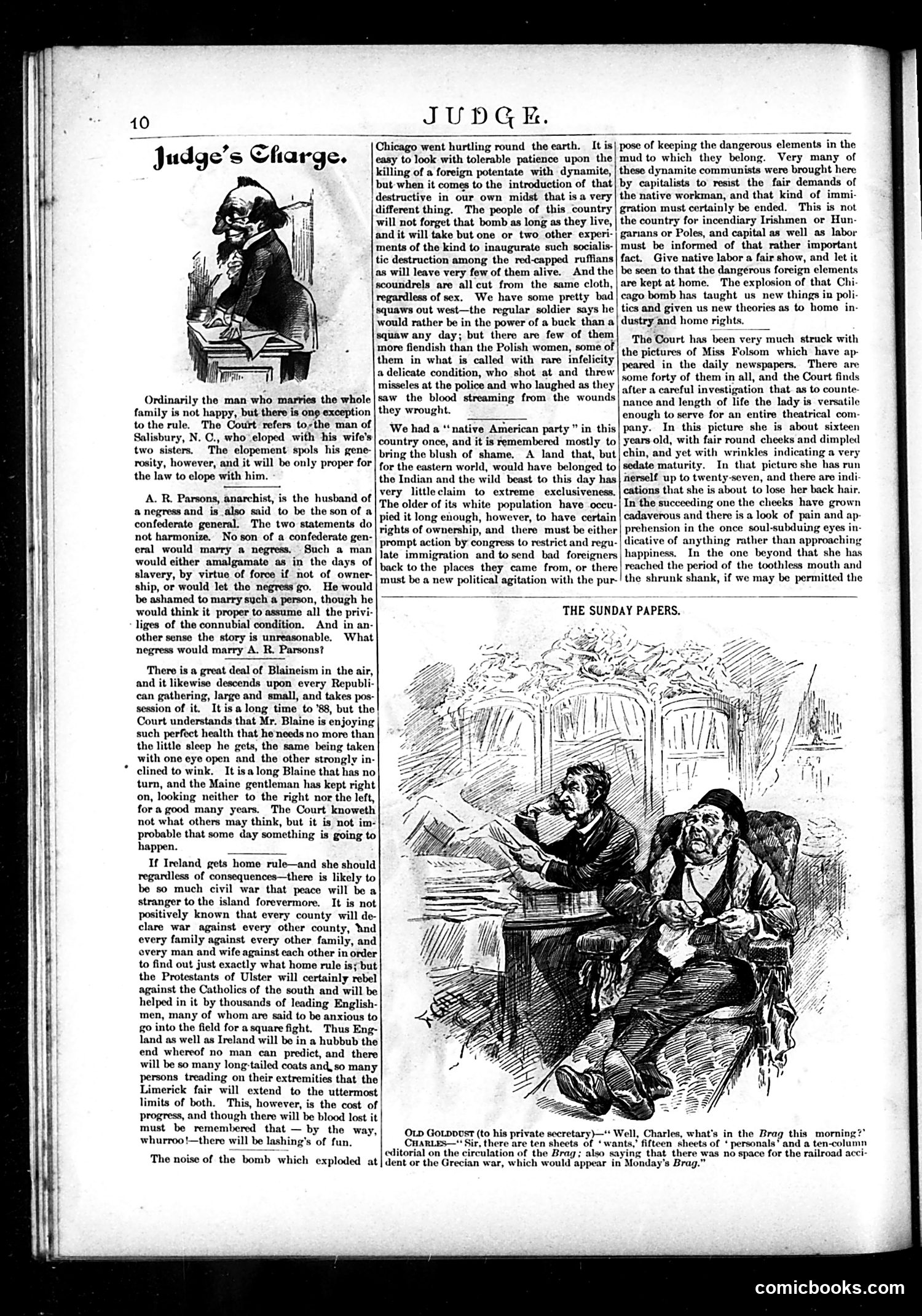
This page contains multiple brief satirical commentaries ("Judge's Charge") on contemporary issues: **A.R. Parsons case**: The text mocks anarchist A.R. Parsons for marrying a Black woman, using racist logic to argue this is hypocritical—suggesting a Confederate general's son wouldn't marry a Black woman but might exploit her otherwise. **James G. Blaine**: References to "Blaineism" suggest the Maine politician's influence pervading Republican gatherings. The sleeping reference appears to mock his personal habits or political torpor. **Irish Home Rule**: Satirizes fears that Irish independence would trigger civil war between Protestant Ulster and Catholic south, with English intervention. **Dynamite Bombs**: Responds to recent anarchist bombings (likely the Chicago Haymarket incident of 1886), expressing outrage and xenophobic fear of immigrant radicals, particularly Polish women anarchists. The cartoon illustration accompanying "The Sunday Papers" depicts what appears to be an old man and younger figure in domestic/journalistic context, though its specific reference is unclear.
📄 Transcribed text from this page (OCR, searchable)
Machine-transcribed from the original scan — historical spelling and the odd misread are preserved.
10 JUDGE. Judge’s Charge. Ordinarily the man who marries the whole family is not happy, but there is ong exception to the rule. The Court refers to-the man of Salisbury, N. C., whoeloped with his wife's two sisters, The elopement spols his gene- rosity, however, and it will be only proper for the law to elope with him. A. R. Parsons, anarchist, is the husband of a negress and is also said to be the son of a confederate general. The two statements do not harmonize. No son of a confederate gen- eral would marry a negress. Such a man would either amalgamate as in the days of slavery, by virtue of force if not of owner- ship, or would let the negress go. He would be ashamed to marry such a person, though he would think it proper to assume all the privi- liges of the connubial condition. And in an- other sense the story is unreasonable. What negress would marry A. R. Parsons? There is a great deal of Blaineism in the air, and it likewise descends upon every Republi- can gathering, large and small, and takes pos- session of it. Court understands that Mr. Blaine is enjoying such perfect health that he needs no more than the little sleep he gets, the same being taken with one eye open and the other strongly in- clined to wink. It isa long Blaine that has no turn, and the Maine gentleman has kept right on, looking neither to the right nor the left, for a good many years. The Court knoweth not what others may think, but it is not im- probable that some day something is going to happen. If Ireland gets home rule—and she should regardless of consequences—there is likely to be so much civil war that peace will be a stranger to the island forevermore. It is not positively known that every county will de- clare war against every other county, ‘nd every family against every other family, and every man and wife against each other in order to find out just exactly what home rule is; but the Protestants of Ulster will certainly rebel against the Catholics of the south and will be helped in it by thousands of leading English- men, many of whom are said to be anxious to go into the field for asquare fight. Thus Eng- land as well as Ireland will be in a hubbub the end whereof no man can predict, and there will be so many long-tailed coats and,so many persons treading on their extremities that the Limerick fair will extend to the uttermost limits of both. This, however, is the cost of progress, and though there will be blood lost it must be remembered that — by the way, whurroo!—there will be lashing’s of fun. The noise of the bomb which exploded at It isa long time to '88, but the! Chicago went hurtling round the earth. It is easy to look with tolerable patience upon the killing of a foreign potentate with dynamite, but-when it comes to the introduction of that destructive in our own midst that isa very different thing. The people of this country will not forget that bomb as long as they live, and it will take but one or two other experi- ments of the kind to inaugurate such socialis- tic destruction among the red-capped ruffians as will leave very few of them alive. And the scoundrels are all cut from the same cloth, regardless of sex. We have some pretty bad squaws out west—the regular soldier says he would rather be in the power of a buck than a squaw any day; but there are few of them more fiendish than the Polish women, some of them in what is called with rare infelicity a delicate condition, who shot at and threw misseles at the police and who laughed as they saw the blood streaming from the wounds they wrought. We had a ‘native American party ” in this country once, and it is remembered mostly to bring the blush of shame, A land that, but for the eastern world, would have belonged to the Indian and the wild beast to this day has. very littleclaim to extreme exclusiveness. The older of its white population have occu- pied it long enough, however, to have certain rights of ownership, and there must be either prompt action by congress to restrict and regu- late immigration and to send bad foreigners back to the places they came from, or there must be a new political agitation with the pur- pose of keeping the dangerous elements in the mud to which they belong. Very many of these dynamite communists were brought here by capitalists to resist the fair demands of the native workman, and that kind of immi- gration must certainly be ended. This is not the country for incendiary Irishmen or Hun- garians or Poles, and capital as well as labor must be informed of that rather important fact. Give native labor a fair show, and let it be seen to that the dangerous foreign elements are kept at home. The explosion of that Chi- cago bomb has taught us new things in poli- tics and given us new theories as to home in- dustry‘and home rights. The Court has been very much struck with the pictures of Miss Folsom which have ap- peared in the daily newspapers. There are some forty of them in all, and the Court finds after a careful investigation that as to counte- nance and length of life the lady is versatile enough to serve for an entire theatrical com- pany. In this picture she is about sixteen years old, with fair round cheeks and dimpled chin, and yet with wrinkles indicating a very sedate maturity. In that picture she has run nerself up to twenty-seven, and there are indi cations that she is about to lose her back hair, In the succeeding one the cheeks have grown cadaverous and there is a look of pain and ap- prehension in the once soul-subduing eyes in- dicative of anything rather than approaching happiness. In the one beyond that she has reached the period of the toothless mouth and the shrunk shank, if we may be permitted the Otp Gotpvvst (to his private secretary)—‘t Well, Charles, what's in the Brag this morning?" CHaRLes—* Si there are ten sheets of * wan! editorial on the culation of the Brag ; also sayin; fteen sheets of * personals’ and a ten-column ¢ that there was no space for the railroad acci- dent or the Grecian war, which would appear in Monday's Brag.” comicbooks.com