
Judge, 1886-05-22 · page 5 of 16
Judge — May 22, 1886 — page 5: what you’re looking at
What you’re looking at
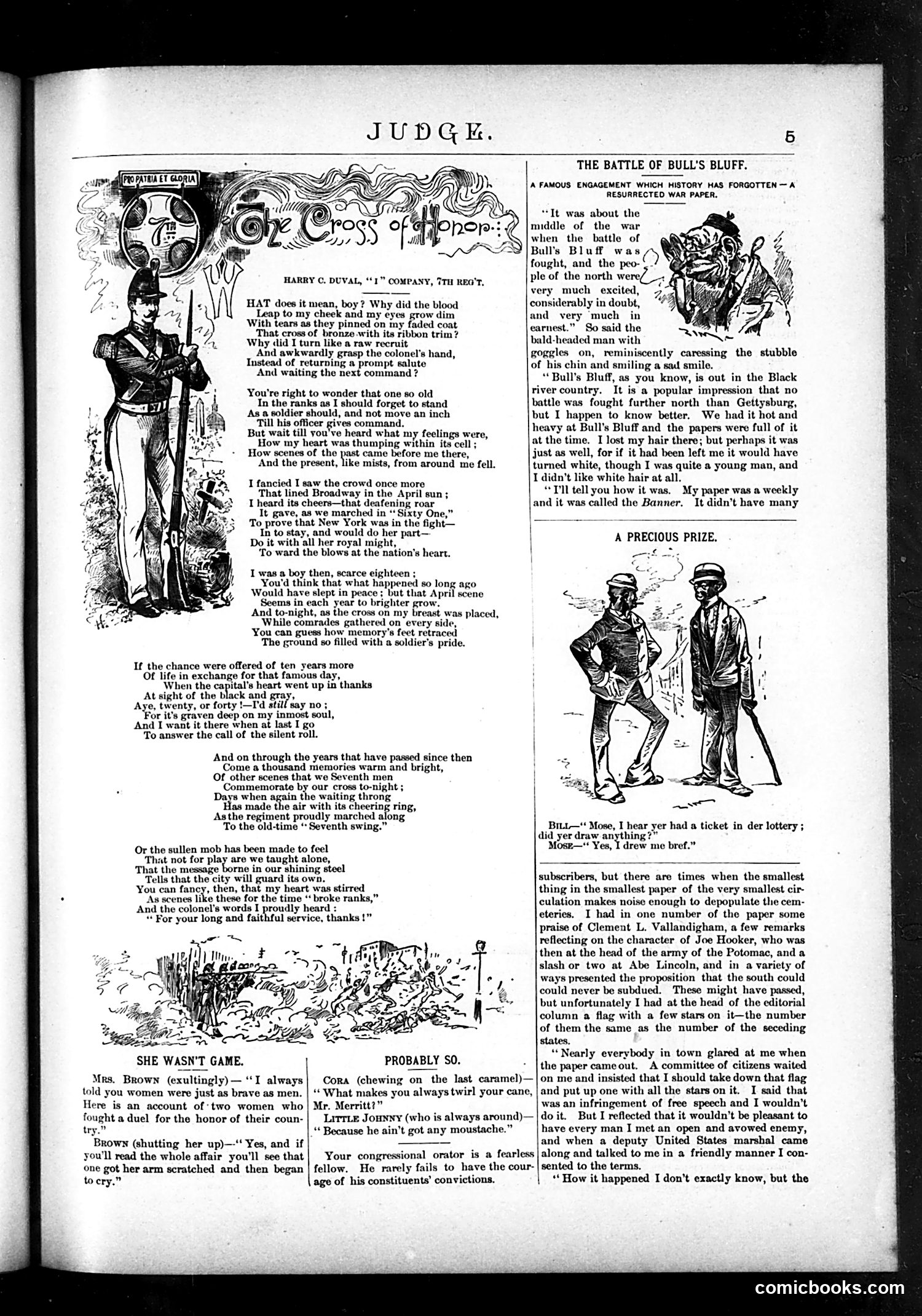
This page contains Civil War reminiscence mixed with light social humor. **Main Content**: "The Battle of Bull's Bluff" features a veteran soldier receiving a military decoration, triggering memories of the Civil War (specifically the 1861 Battle of Bull's Bluff in Virginia). The verse describes an elderly soldier emotionally recalling his youth marching with New York's Seventh Regiment in 1861, when crowds cheered them as they departed to defend the nation. The soldier reflects that he wouldn't trade those patriotic memories for additional years of life. **Historical Context**: Bull's Bluff was an actual 1861 Union defeat. The story uses this battle as a vehicle for nostalgic patriotism and veteran reverence—themes popular in Judge during the post-Civil War period. **Humor Section**: Brief comic vignettes mock women's suffrage ("women brave as men") and social pretension (a man twirling a cane to compensate for lacking a mustache). The overall tone balances sentimental militarism with gentle domestic satire typical of 1880s-90s American magazines.
📄 Transcribed text from this page (OCR, searchable)
Machine-transcribed from the original scan — historical spelling and the odd misread are preserved.
HARRY C. DUVAL, “1” COMPANY, 7TH REG'T, HAT does it mean, boy? Why did the blood Leap to my cheek and my eyes grow dim With tears as they pinned on my faded coat That cross of bronze.with its ribbon trim? Why «lid I turn like a raw recruit And awkwardly grasp the colonel’s hand, Instead of returning a prompt salute And waiting the next command ? You're right to wonder that one 80 old In the ranks as I should forget to stand As a soldier should, and not move an inch Till his officer gives command. But wait till you've heard what my feelings were, How my heart was thumping within its cell ; How scenes of the past came before me there, And the present, like mists, from around me fell. I fancied I saw the crowd once more That lined Broadway in the April sun; I heard its cheers—that deafening roar It gave, as we marched in “Sixty One,” To prove that New York was in the fight— In to stay, and would do her part— Do it with all her royal might, ‘To ward the blows at the nation’s heart. I was a boy then, scarce eighteen ; You'd think that what happened so long ago Would have slept in peace ; but that April scene Seems in each year to brighter grow. And to-night, as the cross on my breast was placed, While comrades gathered on every side, You can guess how memory’s feet retraced The ground so filled with a soldier's pride. If the chance were offered of ten years more Of life in exchange for that famous day, When the capital's heart went up in thanks At sight of the black and gray, Aye, twenty, or forty !—I'd still say no ; For it's graven deep on my inmost soul, And I want it there when at last I go To answer the call of the silent roll. And on through the years that have passed since then Come a thousand memories warm and bright, Of other scenes that we Seventh men Commemorate by our cross to-night ; Days when again the waiting throng as made the air with its cheering ring, Asthe regiment proudly marched along To the old-time “ Seventh swing.” Or the sullen mob has been made to feel That not for play are we taught alone, That the message borne in our shining steel Tells that the city will guard its own. You can fancy, then, that my heart was stirred ‘As scenes like these for the time ‘broke ranks,” And the colonel’s words I proudly heard : “For your long and faithful service, thanks !” PROBABLY SO. Mrs, Brown (exultingly)— “I always| Cora (chewing on the last caramel)— told you women were just as brave as men. | ‘‘ What makes you always twirl your cane, Here is an account of:two women who | Mr. Merritt?” fought a duel for the honor of their coun-| LrtTLe Jounyy (who is always around)— try.” “ Because he ain't got any moustache.” Brown (shutting her up)—-‘' Yes, and if —— you'll read the whole affair you'll see that| Your congressional orator is a fearless one got her arm scratched and then began | fellow. He rarely fails to have the cour- THE BATTLE OF BULL'S BLUFF. A FAMOUS ENGAGEMENT WHICH HISTORY HAS FORGOTTEN — A RESURRECTED WAR PAPER. “It was about the middle of the war when the battle of Bulls Bluff wa sv) fought, and the peo-‘. ple of the north were? + very much excited, considerably in doubt, and very ‘much in earnest.” So said the bald-headed man. goggles on, reminiscently caressing the stubble of his chin and smiling a sad smile. “Bull's Bluff, as you know, is out in the Black river country. It is a popular impression that no battle was fought further north than Gettysburg, but I happen to know better. We had it hot and heavy at Bull’s Bluff and the papers were full of it at the time. I lost my hair there; but perhaps it was just as well, for if it had been left me it would have turned white, though I was quite a young man, and I didn’t like white hair at all. “T'll tell you how it was, My paper was a weekly and it was called the Banner, It didn’t have many A PRECIOUS PRIZE. BILL—“ Mose, hear yer had a ticket in der lottery ; ing ? drew me bref.” subscribers, but there are times when the smallest thing in the smallest paper of the very smallest cir culation makes noise enough to depopulate the cem- eteries. I had in one number of the paper some praise of Clement L. Vallandigham, a few remarks reflecting on the character of Joe Hooker, who was then at the head of the army of the Potomac, and a slash or two at Abe Lincoln, and in a variety of ways presented the proposition’ that the south could could never be subdued. These might have passed, but unfortunate! had at the head of the editorial column a flag with a few stars on it—the number of them the same as the number of the seceding states. “Nearly everybody in town glared at me when the paper cameout. A committee of citizens waited on me and insisted that I should take down that flag and put up one with all the stars on it. I said that was an infringement of free speech and I wouldn't doit. But I reflected that it wouldn't be pleasant to have every man I met an open and avowed enemy, and when a deputy United States marshal came along and talked to me in a friendly manner I con- sented to the terms. tory.” age of his constituents’ convictions. | “How it happened I don’t exactly know, but the comicbooks.com