
A complete issue · 16 pages · 1886
Judge — May 15, 1886
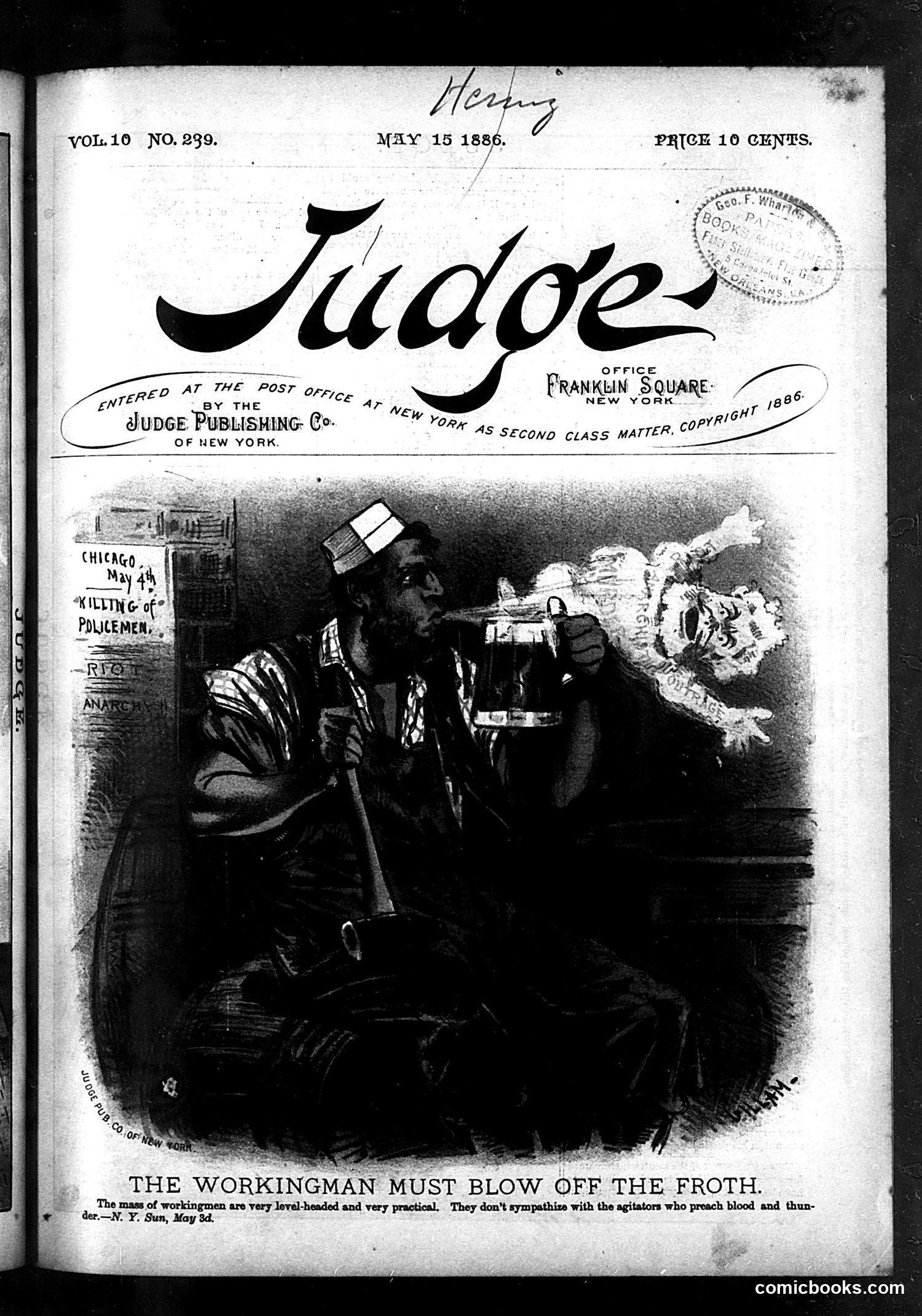
This cartoon criticizes working-class pragmatism regarding labor agitation. The image shows a working man rejecting inflammatory rhetoric—"blowing off the froth"—from radical activists preaching violence and anarchism (visible text references "Chicago," "killing of policemen," and "anarchists"). The satire targets both the anarchist movement and middle-class reformers. The accompanying quote from the N.Y. Sun notes that working people are "level-headed and practical" and don't sympathize with "agitators who preach blood and thunder." This likely references the post-Haymarket Affair period (May 1886), when American anarchism faced public backlash following the bombing in Chicago. Judge's cartoon suggests ordinary workers rejected radical ideology, portraying them as sensible rather than revolutionary.
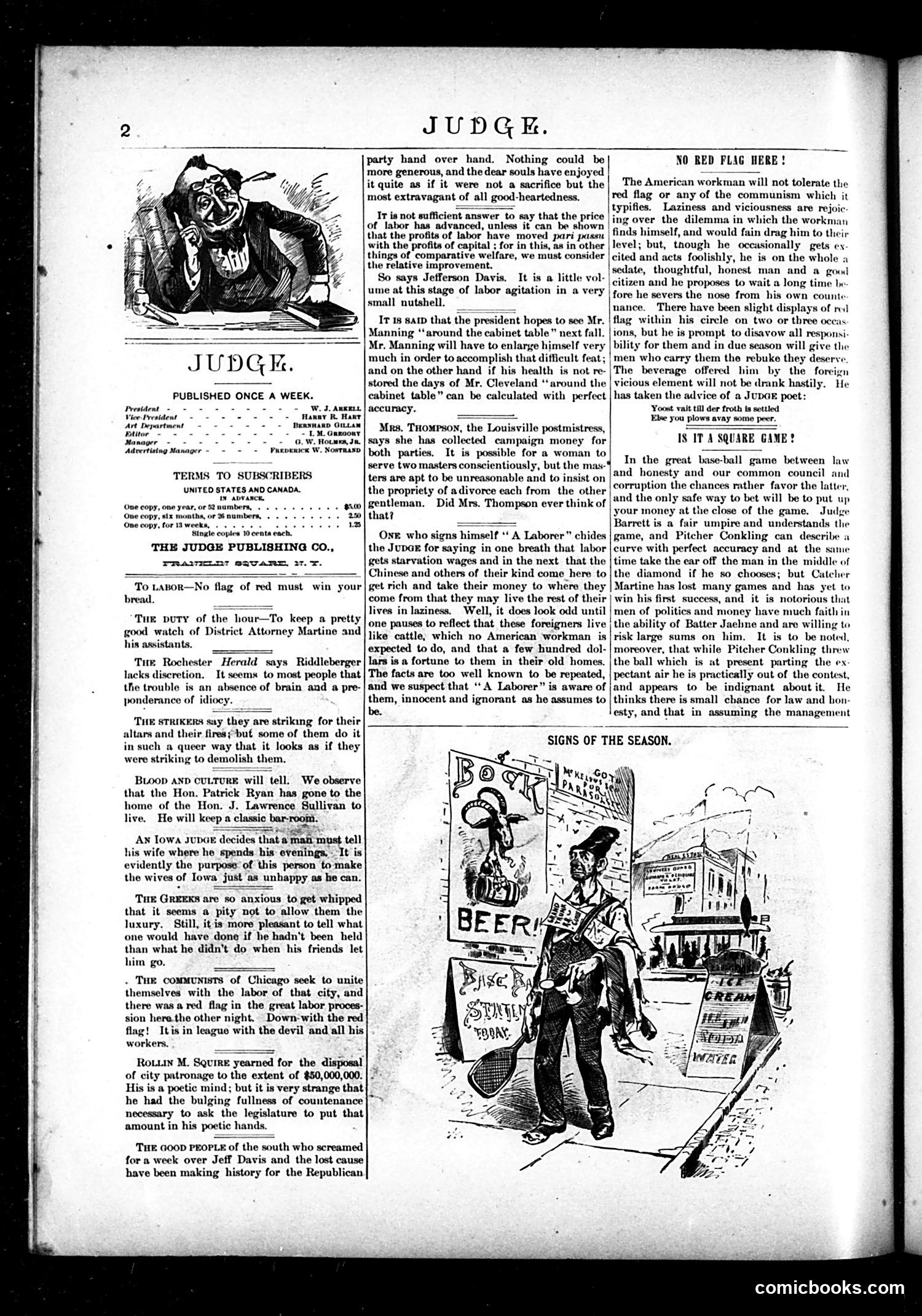
This page contains satirical commentary typical of late 19th-century Judge magazine. The main cartoon "Signs of the Season" depicts a street vendor selling various items (beer, biscuits, cream) alongside political signs and advertisements, satirizing commercialism and seasonal activities. The text sections critique labor disputes and political figures. "No Red Flag Here" mocks American workers' tolerance of foreign labor competition, dismissing claims that immigrants pose threats. Other brief pieces comment on President Cleveland's cabinet, Mrs. Thompson (a Louisville postmistress), and labor relations. The humor targets both labor radicals (the "red flag") and nativist anxieties about immigration, reflecting Gilded Age tensions between organized labor, employers, and anti-immigrant sentiment. The carnival-like vendor image suggests American society as commercially-driven spectacle.
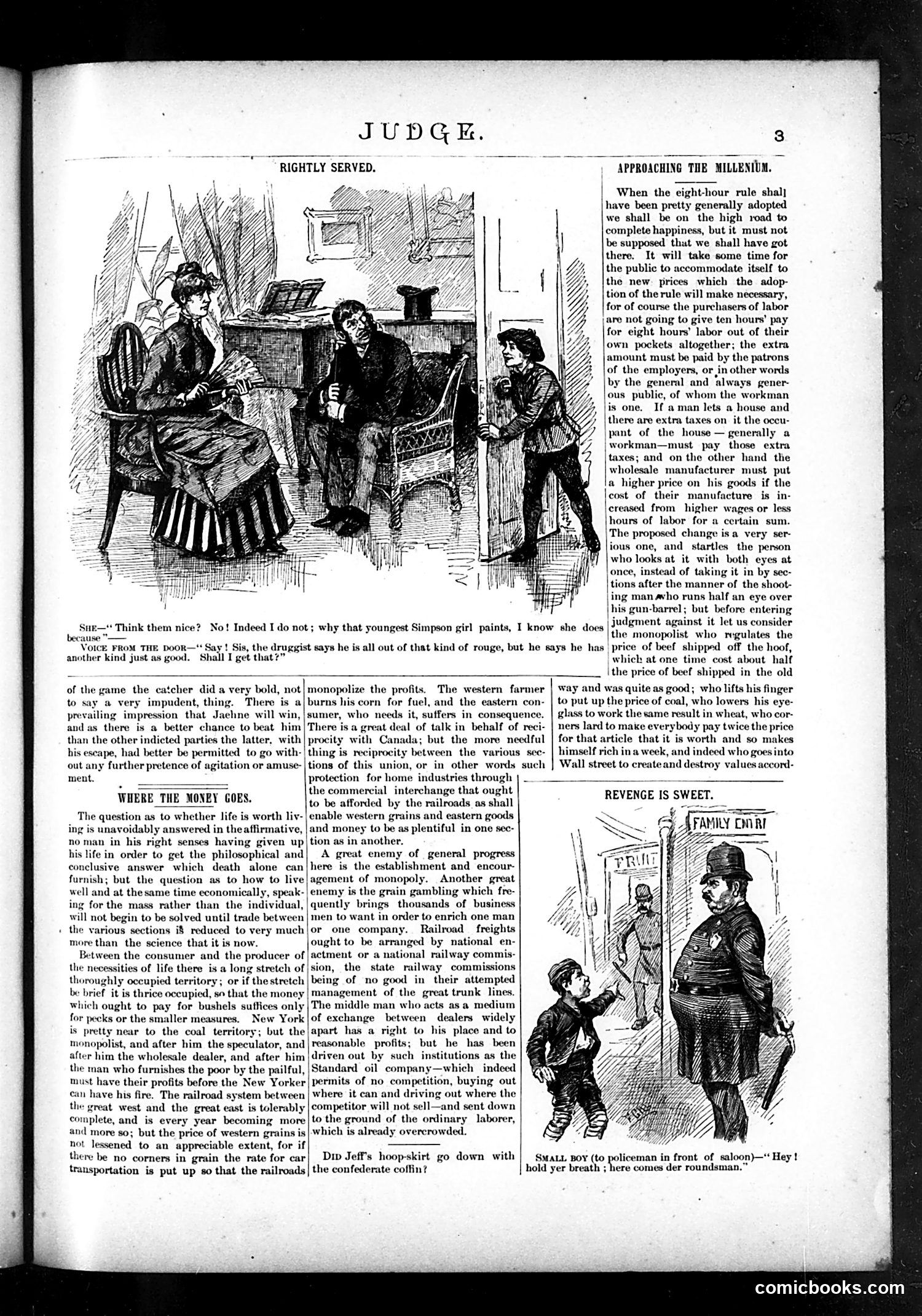
**"Rightly Served"** (top cartoon): A woman complains to a druggist that he's out of a particular rouge, and he suggests an alternative. The joke appears to target cosmetics fraud or deceptive marketing practices—the woman's friend claims the inferior substitute is "just as good," satirizing how consumers are misled into accepting inferior products. **"Approaching the Millenium"** (right column): This editorial discusses the eight-hour workday rule. Judge's satirical point: while workers celebrate shorter hours, the public will ultimately pay through higher prices. The piece cynically suggests monopolists (beef traders, railroads, grain dealers) exploit every opportunity to maintain profits—whether through wage increases or manufactured scarcity. The criticism extends to railroad profiteering and the failure of interstate commerce to benefit ordinary consumers. **"Revenge is Sweet"** (bottom cartoon): A small boy confronts a policeman, likely depicting a street urchin testing authority—typical period humor about class conflict and urban life. The page critiques monopoly capitalism and argues that labor reforms benefit only workers while harming consumers through price inflation.
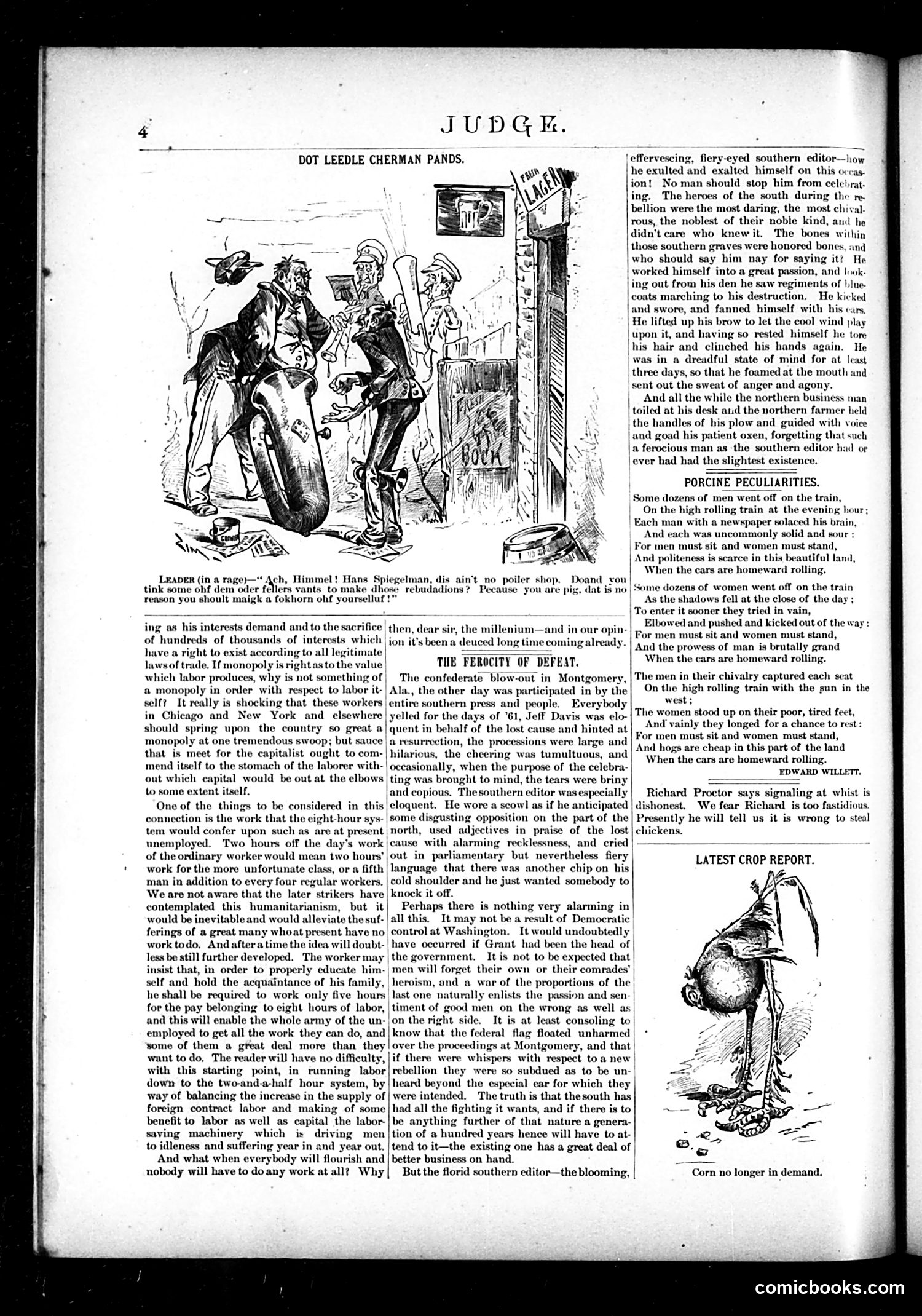
## The Main Cartoon ("Dot Leedle Cherman Pands") The cartoon depicts a German immigrant ("Hans Spiegelman," indicated by the dialect) in what appears to be a barbershop, loudly demanding action—likely representing working-class labor agitation. The caption suggests he's advocating for labor strikes or radical demands ("rebudadions"). The satire mocks German immigrant workers and union activists as loud, unreasonable troublemakers disrupting respectable business. ## "The Ferocity of Defeat" Article This lengthy piece criticizes a Confederate reunion in Montgomery, Alabama, where Southern politicians and press figures, including Jeff Davis, celebrated the Lost Cause with passionate rhetoric. The satire targets the Southern editor's fierce, emotional defense of the Confederacy—his "ferocity" expressed through inflammatory language and crocodile tears—as absurdly overwrought. **Overall**: The page attacks both labor radicalism (immigrant workers) and Southern neo-Confederate sentiment, reflecting post-Reconstruction tensions and nativist anxieties about foreign agitators.
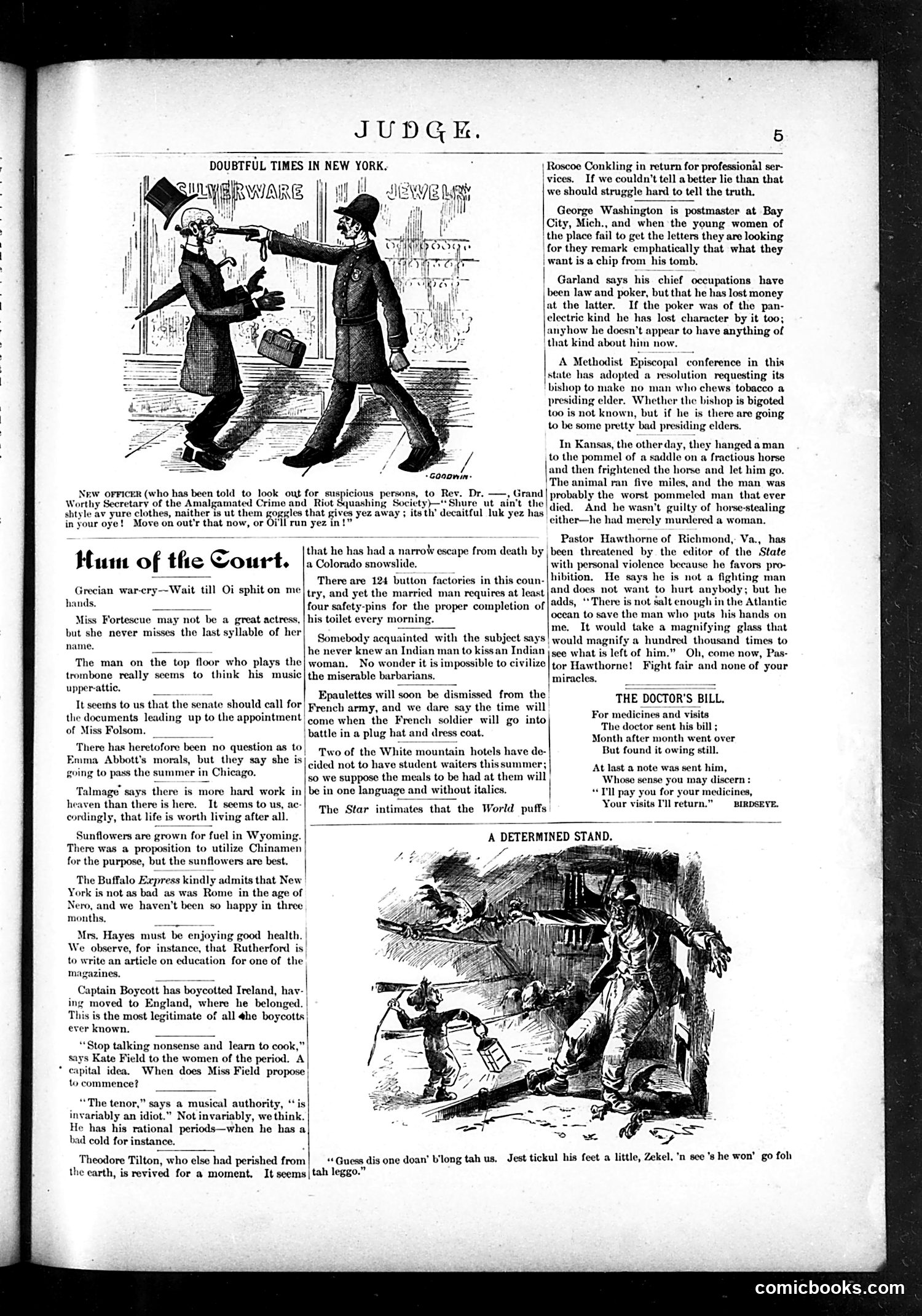
This page from *Judge* magazine contains satirical commentary on contemporary political and social figures, along with humorous illustrations. The top cartoon depicts a newly appointed police officer instructed to watch for suspicious persons; his Irish accent ("Shure 'ut ain't the shiyle") and detective work are mocked. The text criticizes various public figures: Roscoe Conkling (a prominent Republican politician), George Washington's namesake serving as postmaster, and a Methodist bishop's tobacco prohibition resolution. A notable anecdote describes a lynching in Kansas where a man was hanged from a horse's saddle, then fled on the frightened animal. Pastor Hawthorne of Richmond receives ridicule for opposing violence while supporting prohibition—the satire suggests his pacifism undercuts his moral authority. The bottom illustration, "A Determined Stand," shows figures in conflict but its specific reference is unclear from the visible text. Overall, the page satirizes political hypocrisy, ethnic stereotypes (Irish and Native American), and moral inconsistency among public figures of the era.
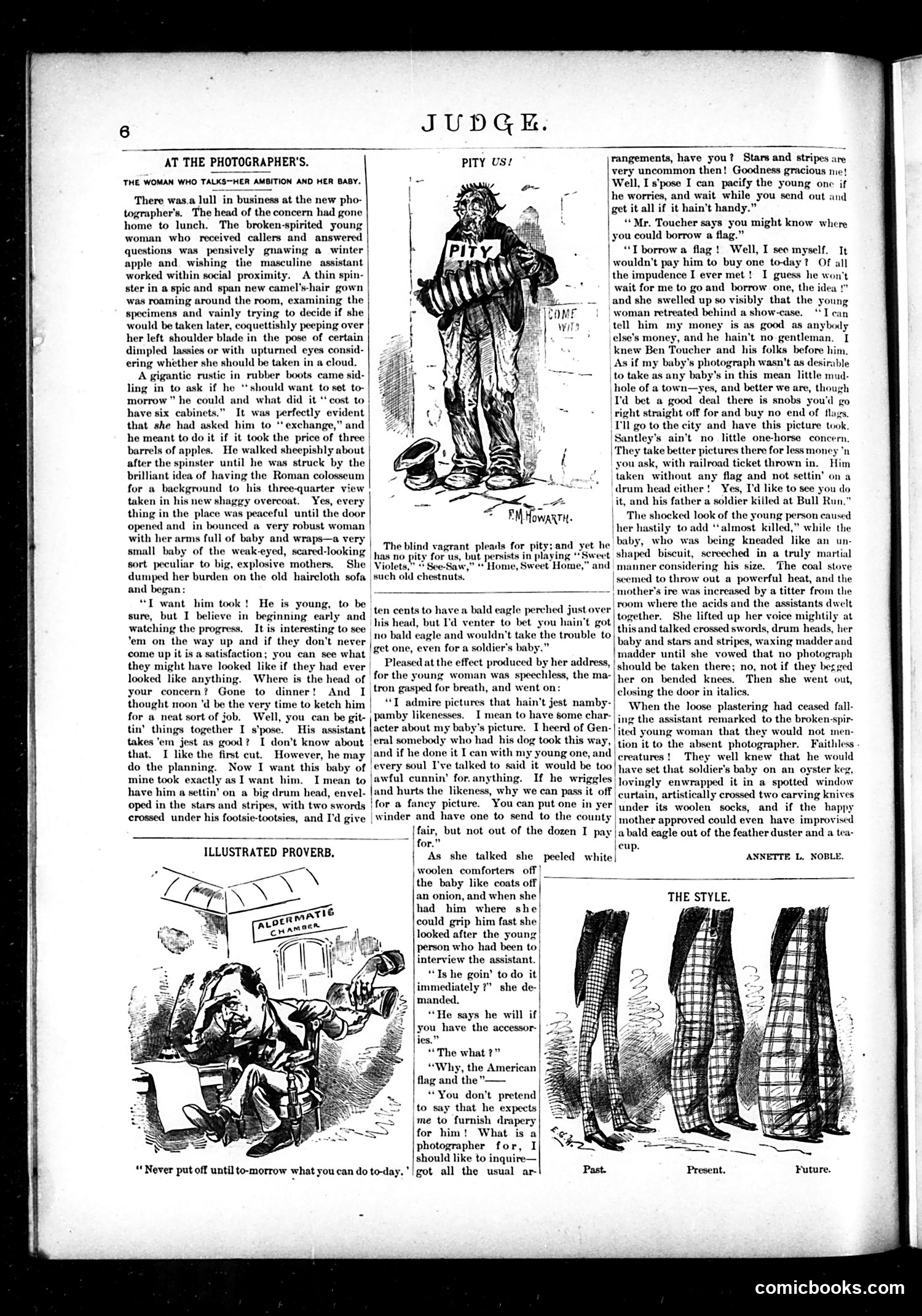
This page satirizes a common social tension of the era: a working-class mother's indignation at perceived disrespect. A robust, poor woman arrives at a photographer's studio with her baby, demanding a portrait. When told the photographer wants to borrow a flag as a backdrop (likely patriotic decoration), she erupts—interpreting this as an insult suggesting her baby isn't important enough to photograph without embellishments. Her outrage escalates: she invokes her late husband ("a soldier killed at Bull Run"), denounces the photographer's lack of gentlemanliness, and threatens to take her business to a city studio instead. The joke targets her working-class defensiveness and overreaction to what appears to be a routine studio practice. The satire mocks both her dignity-consciousness and the photographer's apparent tactlessness, capturing class friction in Victorian-era America.
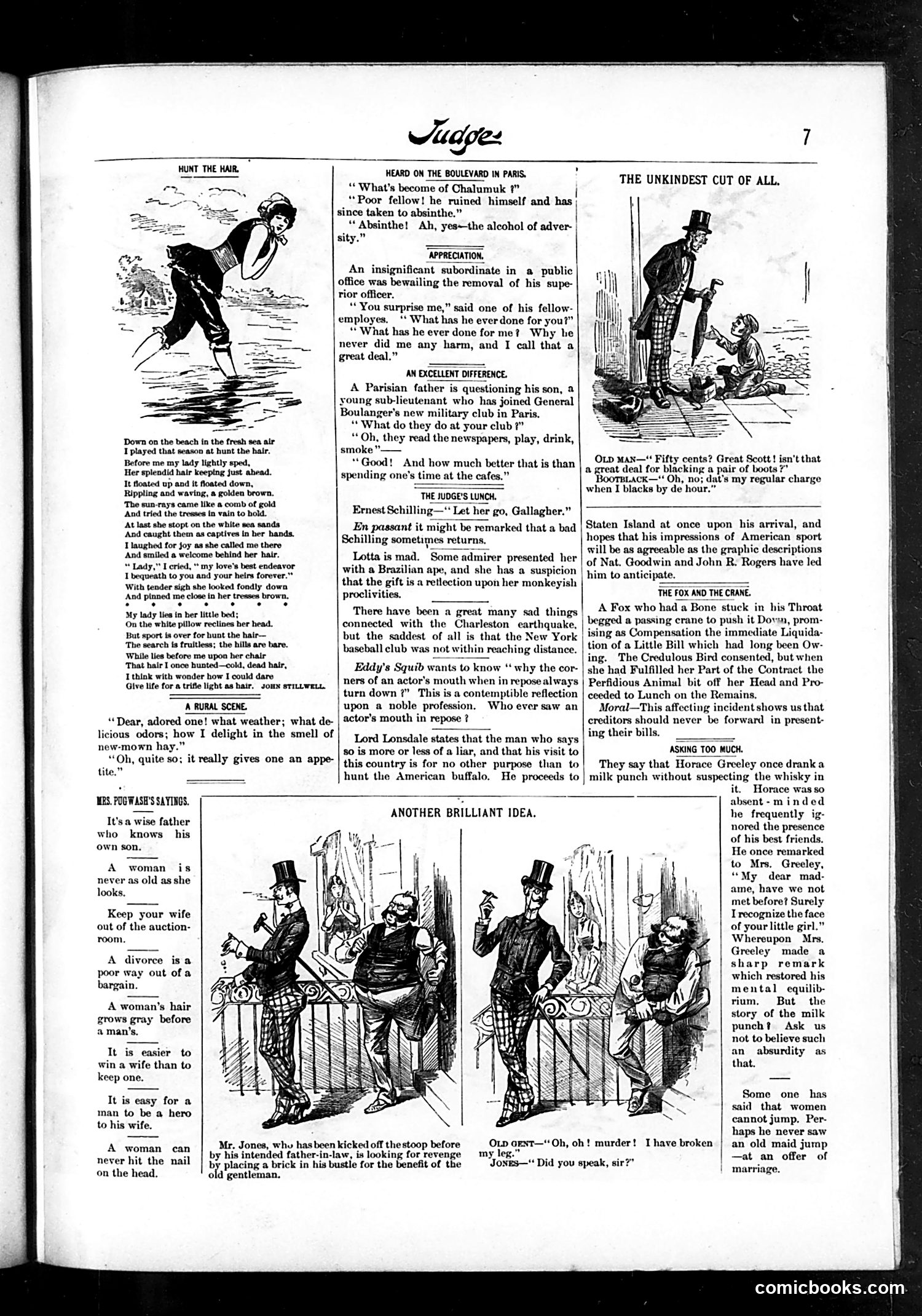
This page contains several brief satirical pieces typical of Judge's humor circa the 1880s-90s: **"Hunt the Hair"** is a sentimental poem about a man's love, ending darkly when his beloved dies—her hair, once alive and animated, now lies "cold, dead hair" on her chair. The satire mocks Victorian romantic excess. **The Boulanger reference** jokes about General Boulanger's Paris military club, suggesting members waste time reading papers and smoking rather than doing actual military work—a dig at fashionable but frivolous institutions. **The Charleston earthquake joke** sarcastically regrets the New York baseball club wasn't destroyed, reflecting Judge's cynical humor about sports. **"The Unkindest Cut"** plays on working-class dialect humor: a bootblack charges premium rates for hourly work, exploiting the customer's assumptions about piece-work pricing. The page reflects Judge's mix of sentimental verse parodies, topical political jabs (Boulanger was a controversial French nationalist figure), and working-class humor. The Aesop's fable fragment at bottom appears incomplete.
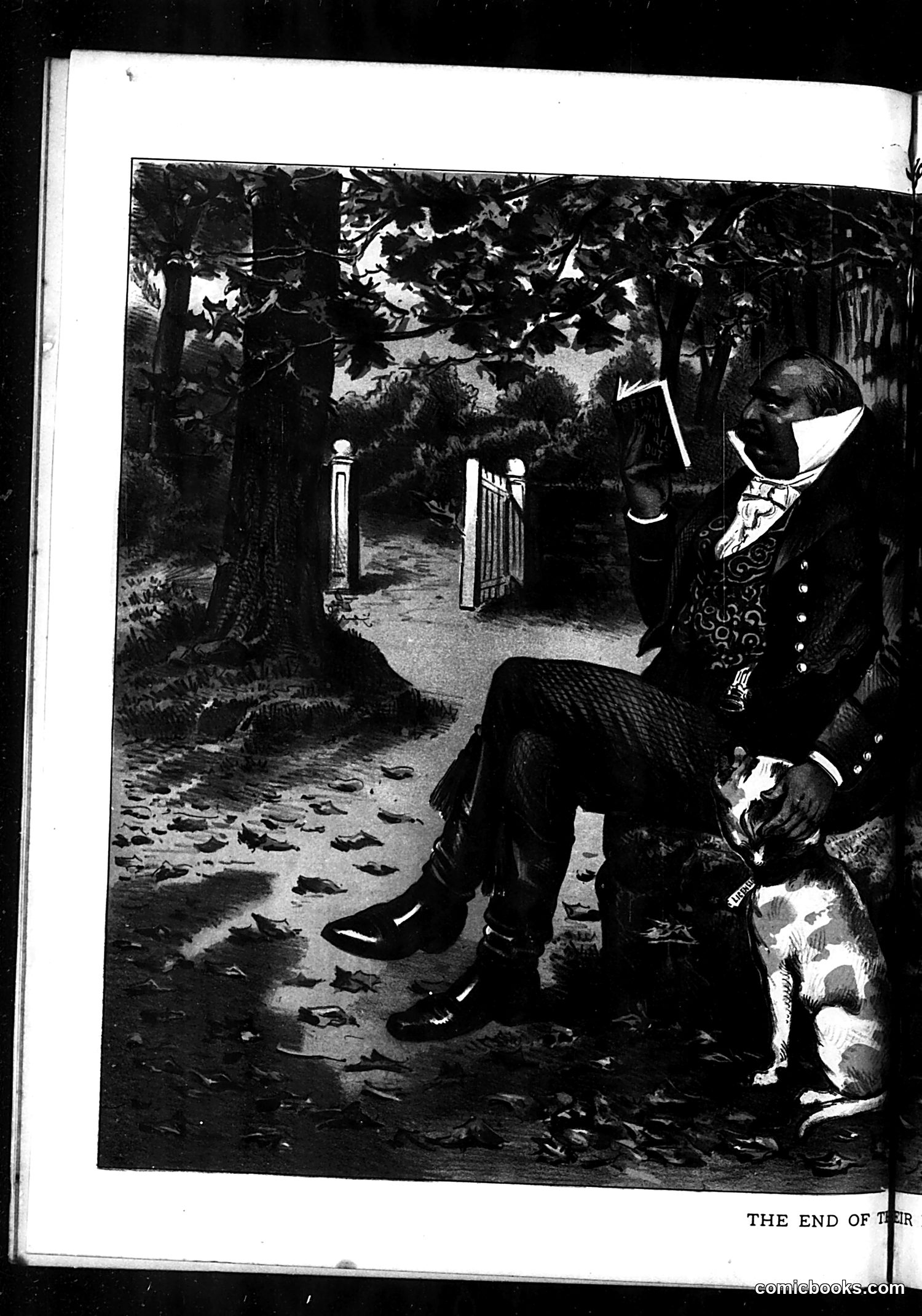
This black and white photograph shows a well-dressed man in formal 18th-century attire (ornate coat with decorative buttons, breeches, formal shoes) standing in a garden setting, wearing a surgical mask. He holds what appears to be a small dog. The caption reads "THE END OF T[HE]" (text cut off). This appears to be satirical commentary on pandemic precautions or health protocols, likely from a Judge magazine issue. The juxtaposition of historical formal dress with modern mask-wearing creates absurdist humor. However, without seeing the complete caption or article text, the specific political or social target remains unclear. The formal, aristocratic presentation may suggest satire directed at elites or authority figures adapting to health measures.
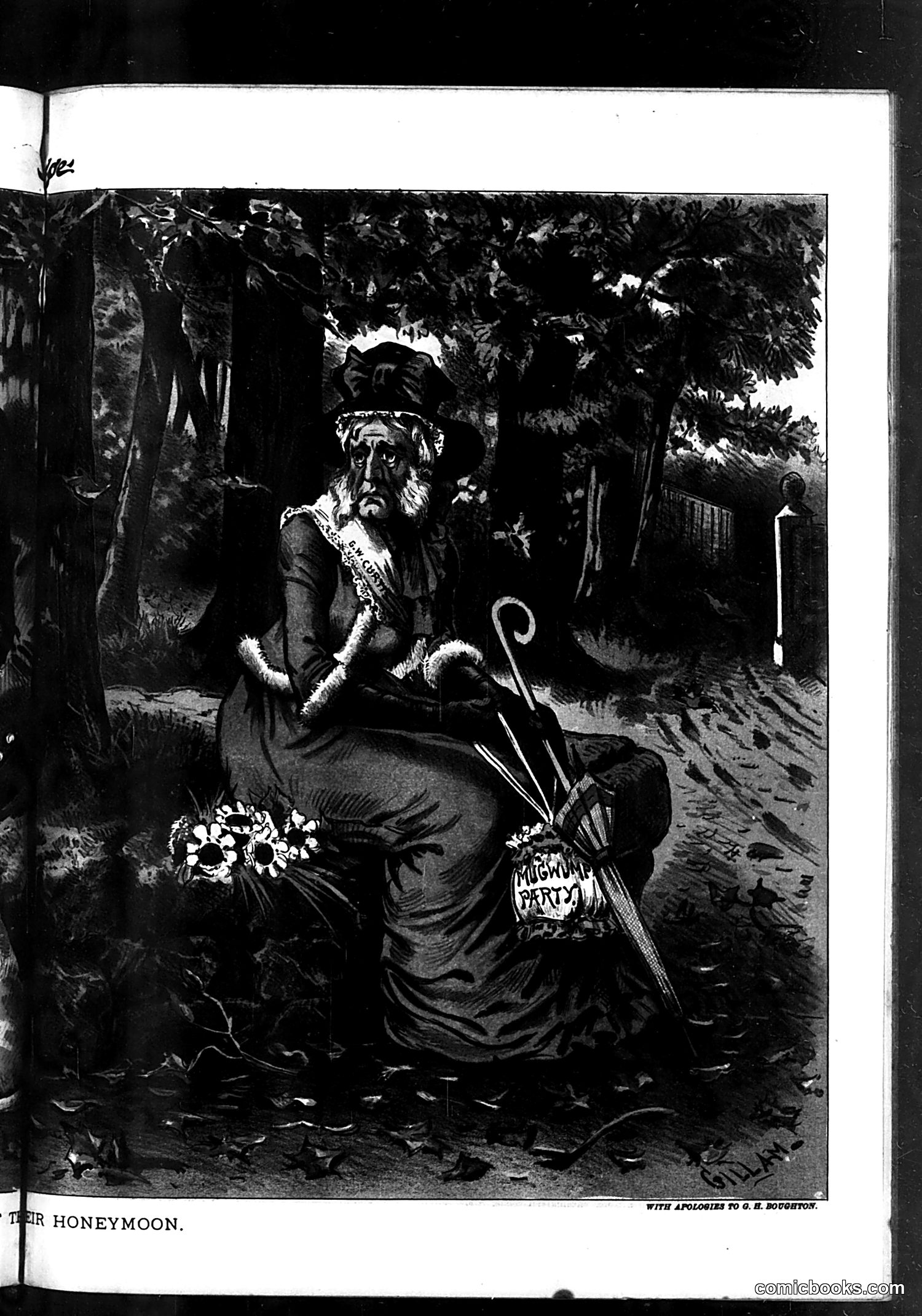
This political cartoon depicts an elderly, bearded man in royal or ceremonial dress seated in a forest setting, appearing distressed or contemplative. He holds a walking stick and is surrounded by flowers. An umbrella nearby bears text that appears to read "MUGWUMP PARTY." The cartoon likely satirizes a political figure's honeymoon period—the initial goodwill following an election or appointment. The "Mugwump" reference suggests this targets someone associated with the Mugwump movement (Republicans who split from the party, notably during the 1884 election). The elderly gentleman's unhappy demeanor suggests the satire critiques either a politician's brief period of public favor or his retreat from mainstream politics. Without a visible artist signature or date, precise identification remains unclear.
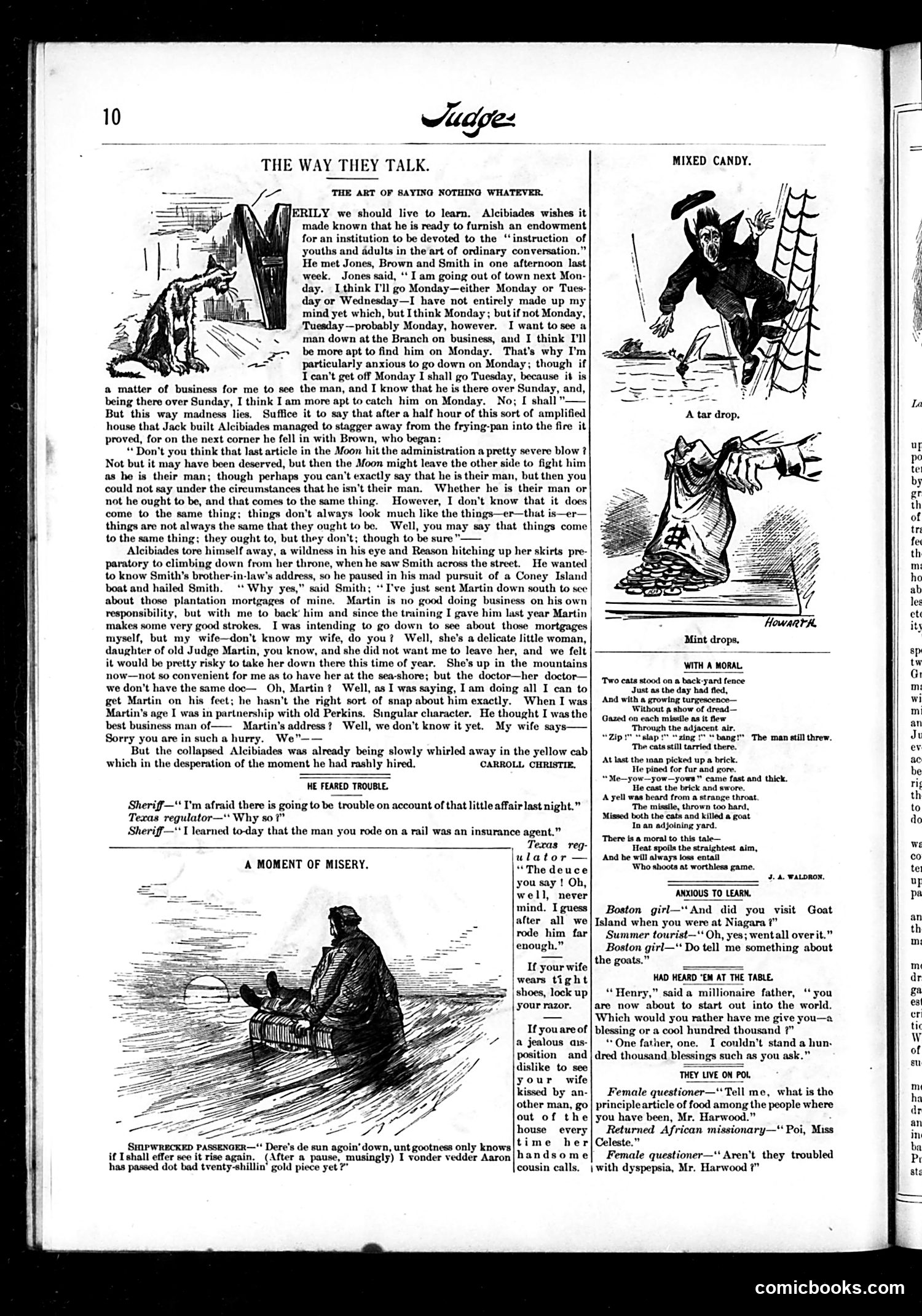
This piece by Carroll Christie satirizes the American habit of speaking at length while saying nothing substantive. The unnamed character Alcibiades seeks to found an institution teaching "the art of ordinary conversation"—a joke premise that becomes the satire's vehicle. The three men Jones, Brown, and Smith represent types of verbose speakers who exemplify this art through their circular, meandering dialogue. Jones cannot simply state when he's leaving town; he endlessly qualifies and repeats himself. Brown cannot offer a straightforward opinion about a newspaper article's political impact without constantly hedging and reversing himself. Smith launches into irrelevant biographical tangents while dodging a simple question about an address. The cartoon mocks how educated Americans of the era filled conversation with disclaimers, qualifications, and tangential anecdotes—prioritizing the appearance of thoughtfulness over clarity. By the end, Alcibiades "collapsed" in a taxi, driven mad by exposure to this epidemic of meaningless talk. The satire suggests that American discourse had become fundamentally hollow.
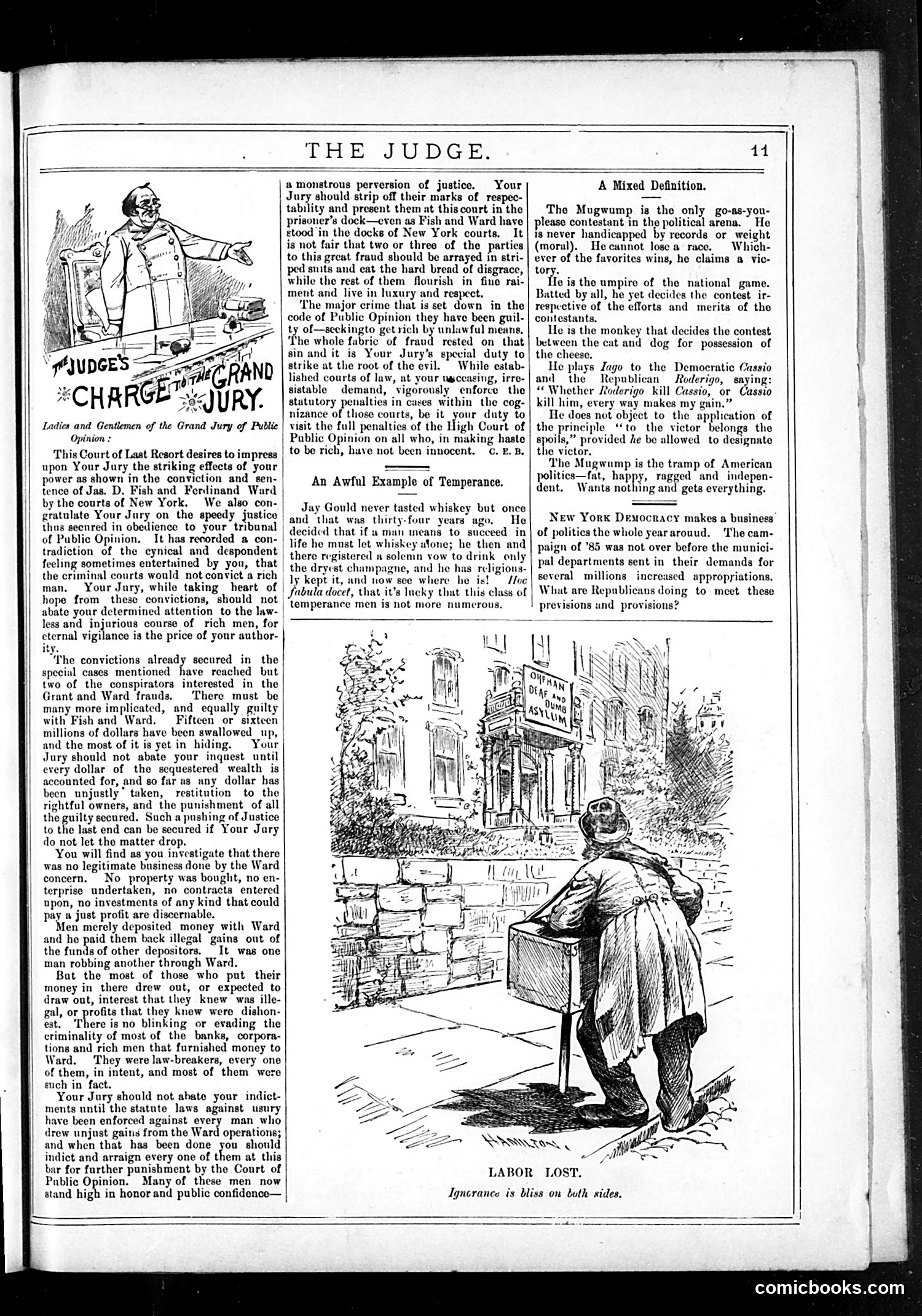
This page addresses the **Grant-Ward financial scandal** of the 1880s—a massive fraud involving Ferdinand Ward and James D. Fish that defrauded investors of approximately $15-16 million. The left column's editorial ("Judge's Charge to Grand Jury") criticizes the selective prosecution of the scandal. While Fish and Ward faced conviction and imprisonment, the magazine argues that numerous wealthy bankers, corporations, and investors who *knowingly* profited from illegal schemes escaped punishment. The piece sarcastically notes these men "now stand high in honor and public confidence"—a "monstrous perversion of justice." The cartoon "Labor Lost" (lower right) depicts a figure searching through debris/refuse, illustrating the public's futile search for their stolen money, which remains hidden or already spent by the conspirators. The page's core argument: wealth insulates the guilty from accountability. While working-class perpetrators faced hard time, wealthy co-conspirators retained respectability despite their criminality.
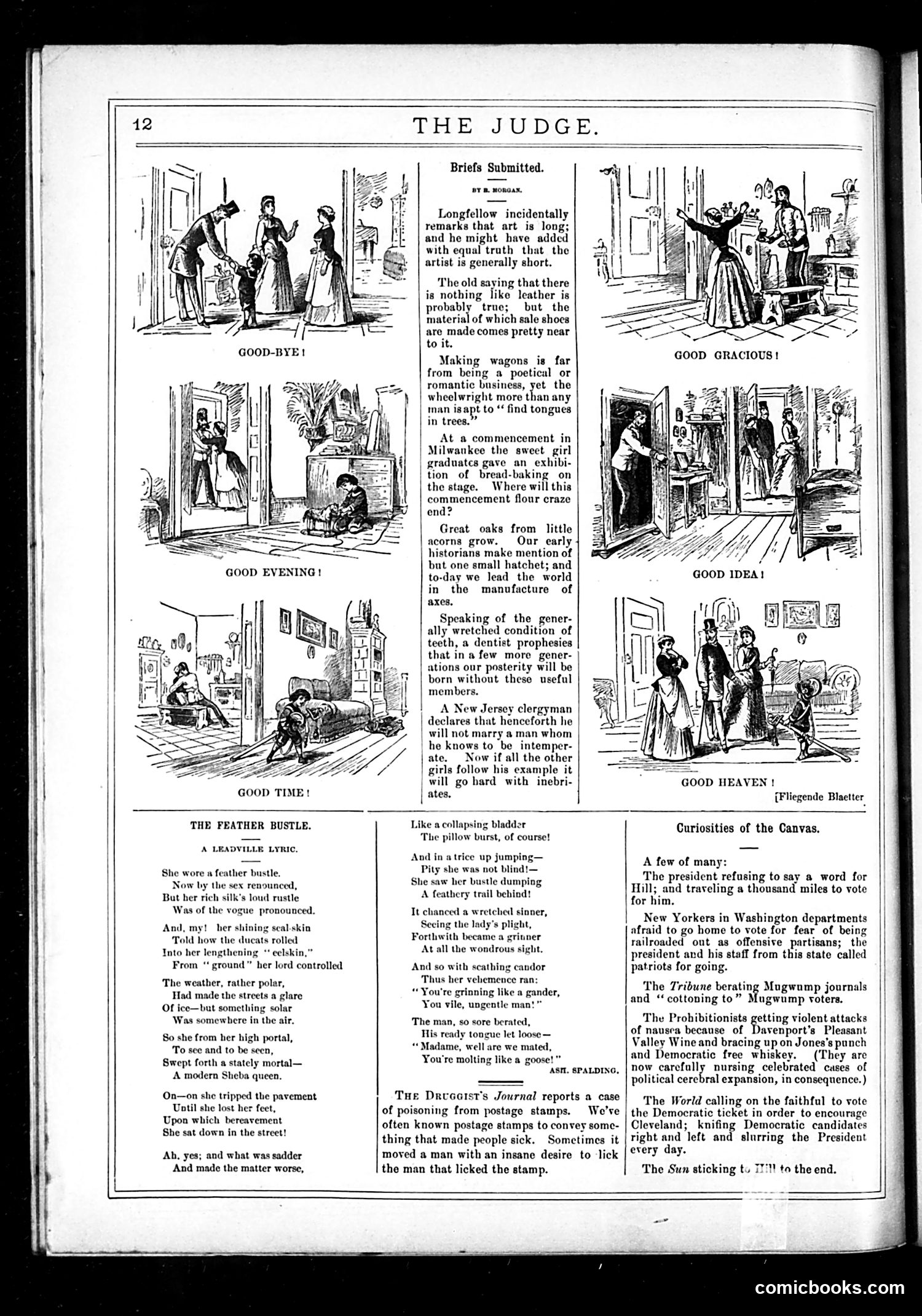
This page contains political satire from the 1880s (likely 1884, given Cleveland references). The "Briefs Submitted" section offers dry witticisms on various topics—comparing artists to leather, joking about a Milwaukee commencement featuring bread-baking demonstrations, and satirizing a New Jersey clergyman who refuses to marry intemperate men. "The Feather Bustle" poem mocks the then-fashionable bustle garment: a woman's elaborate bustle bursts when she slips on ice, scattering feathers, humiliating her publicly. "Curiosities of the Canvas" directly attacks Democratic politics: it mocks President Grover Cleveland for refusing to campaign for running mate Henry Hill but traveling to vote for him anyway. It also ridicules partisan inconsistencies—Tribune editors supporting "Mugwumps" (Republican reformers who bolted their party), Prohibitionists accepting alcohol, and newspapers attacking their own party's candidates while demanding voter loyalty. The cartoons illustrate social situations accompanying the written humor.
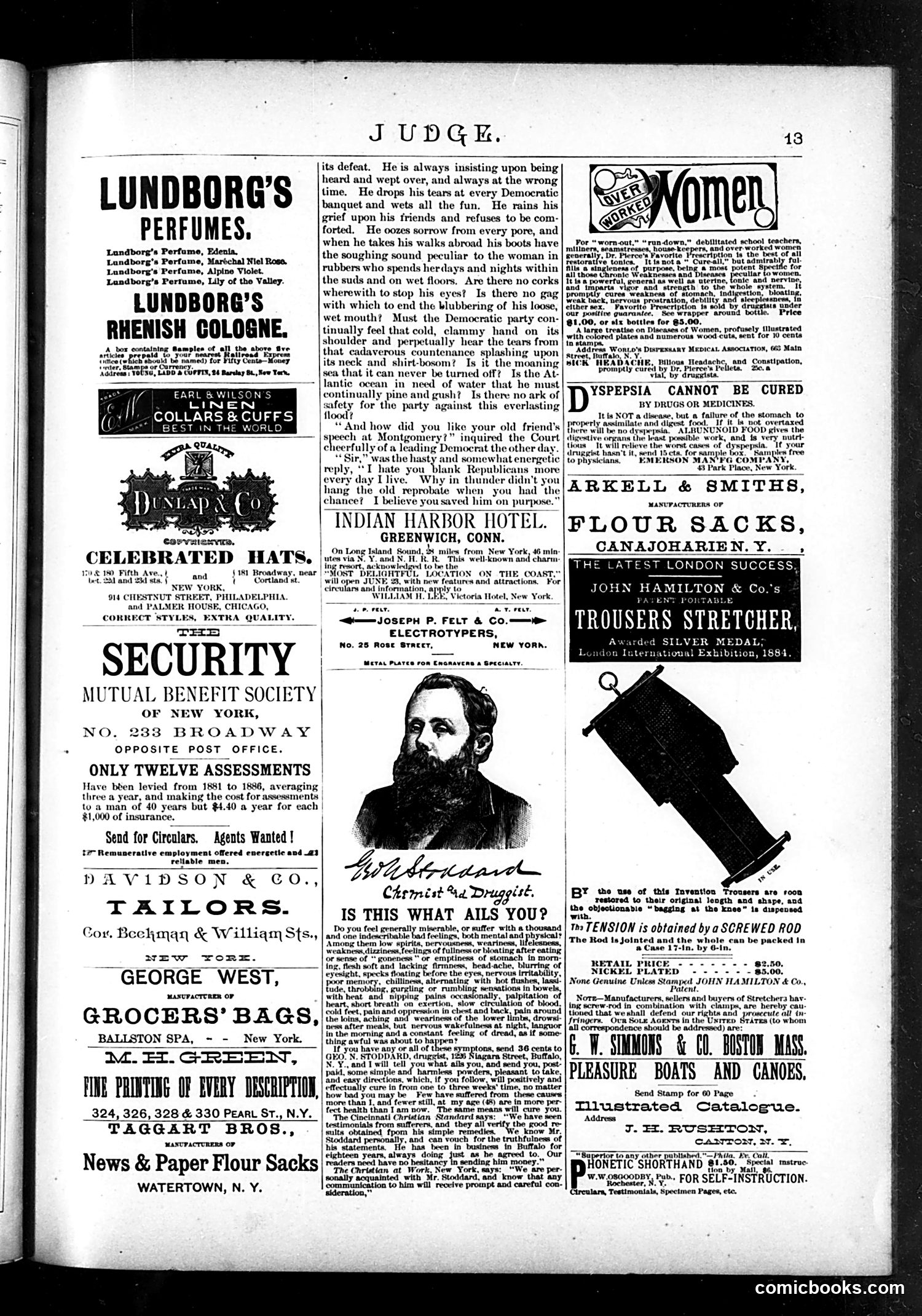
This page is primarily **advertisements** with one significant satirical cartoon featuring a bearded man labeled "W. Waldorf Astor, Chemist & Druggist." The cartoon mocks a wealthy Democrat—likely referencing **Samuel J. Tilden** or another prominent defeated Democratic politician—through the accompanying text above the image. The satirist complains this figure perpetually wallows in grief over electoral losses, constantly "weeping" and spreading "sorrow" through Democratic ranks like an unstoppable flood. The "Is This What Ails You?" advertisement juxtaposed with this portrait sarcastically suggests the politician's chronic melancholy resembles a genuine medical ailment requiring treatment. The extensive list of nervous symptoms (depression, weakness, anxiety) mirrors the political "sickness" described in the text—obsessive, self-pitying dwelling on past defeats. The joke: Republicans mock Democrats for their perpetual mourning, framing it as pathological rather than political.
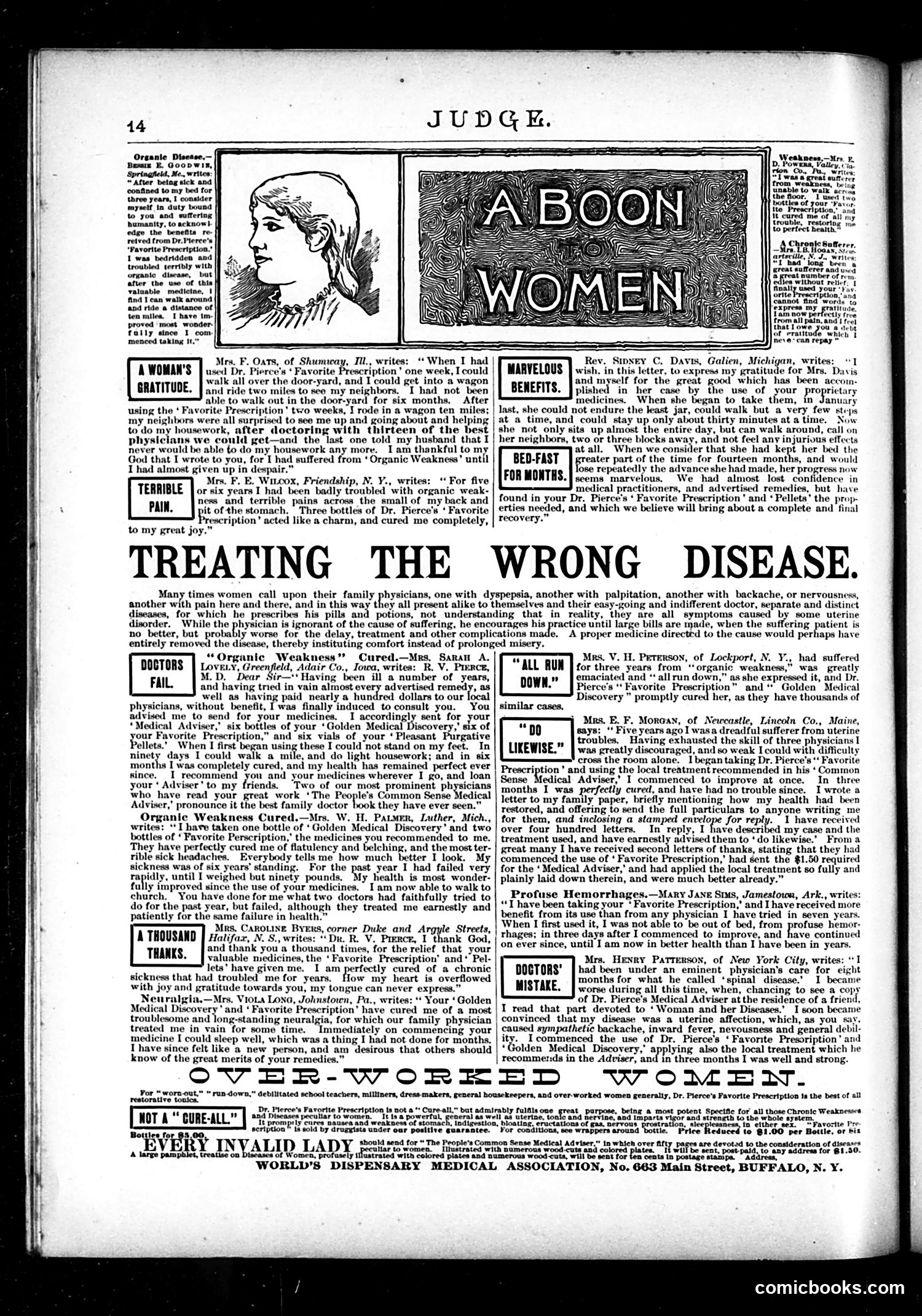
This page is primarily **advertising**, not satire or political commentary. It promotes Dr. Pierce's "Favorite Prescription," a patent medicine marketed to women. The advertisements feature **testimonial letters** from women claiming the product cured various ailments—"organic weakness," bed-confinement, back pain, and nervous conditions. The central article, "TREATING THE WRONG DISEASE," argues that family physicians misdiagnose women's complaints, treating symptoms rather than underlying female disorders, and that Dr. Pierce's remedies work where conventional medicine fails. The illustration shows a woman's profile, likely meant to represent a typical female patient. **Historical context**: In the late 19th/early 20th century, patent medicines made sweeping health claims without regulation. Doctors genuinely disagreed about women's ailments; "female weakness" was a common diagnosis. These advertisements exploited both women's real health struggles and medical uncertainty, presenting the product as superior to physicians' care. The page reflects an era of largely unregulated medical marketing.
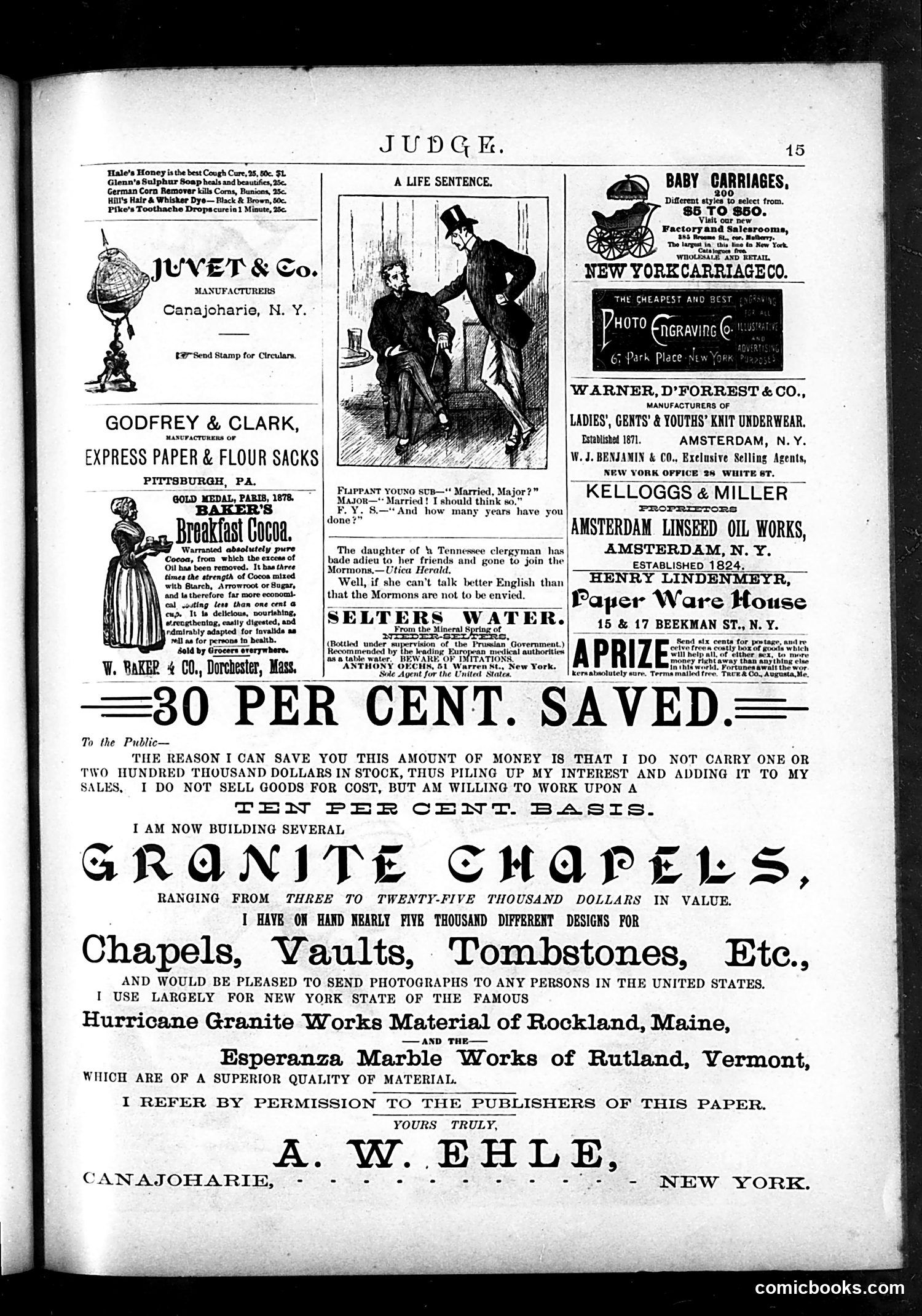
This single-panel cartoon satirizes Mormon polygamy through a domestic scene. A man in a top hat (likely representing a Mormon or polygamist) stands behind a seated woman, placing his hand on her shoulder in a somewhat menacing or possessive gesture. The woman appears distressed or resigned. The caption reads: "Flippant young set—'Married, Major?' Major—'Married! I should think so.' F.Y.S.—'And how many years have you done it?'" The joke plays on "life sentence"—equating marriage (particularly polygamous marriage, given the context of accompanying text about a Tennessee clergyman's daughter joining Mormons) with imprisonment. The humor derives from treating marriage as punishment, while also implicitly critiquing Mormon polygamy as an oppressive practice. The term "done it" suggests serving time, reinforcing the prison metaphor. This reflects 1870s-80s American anti-Mormon sentiment prevalent in Judge magazine's satirical content.
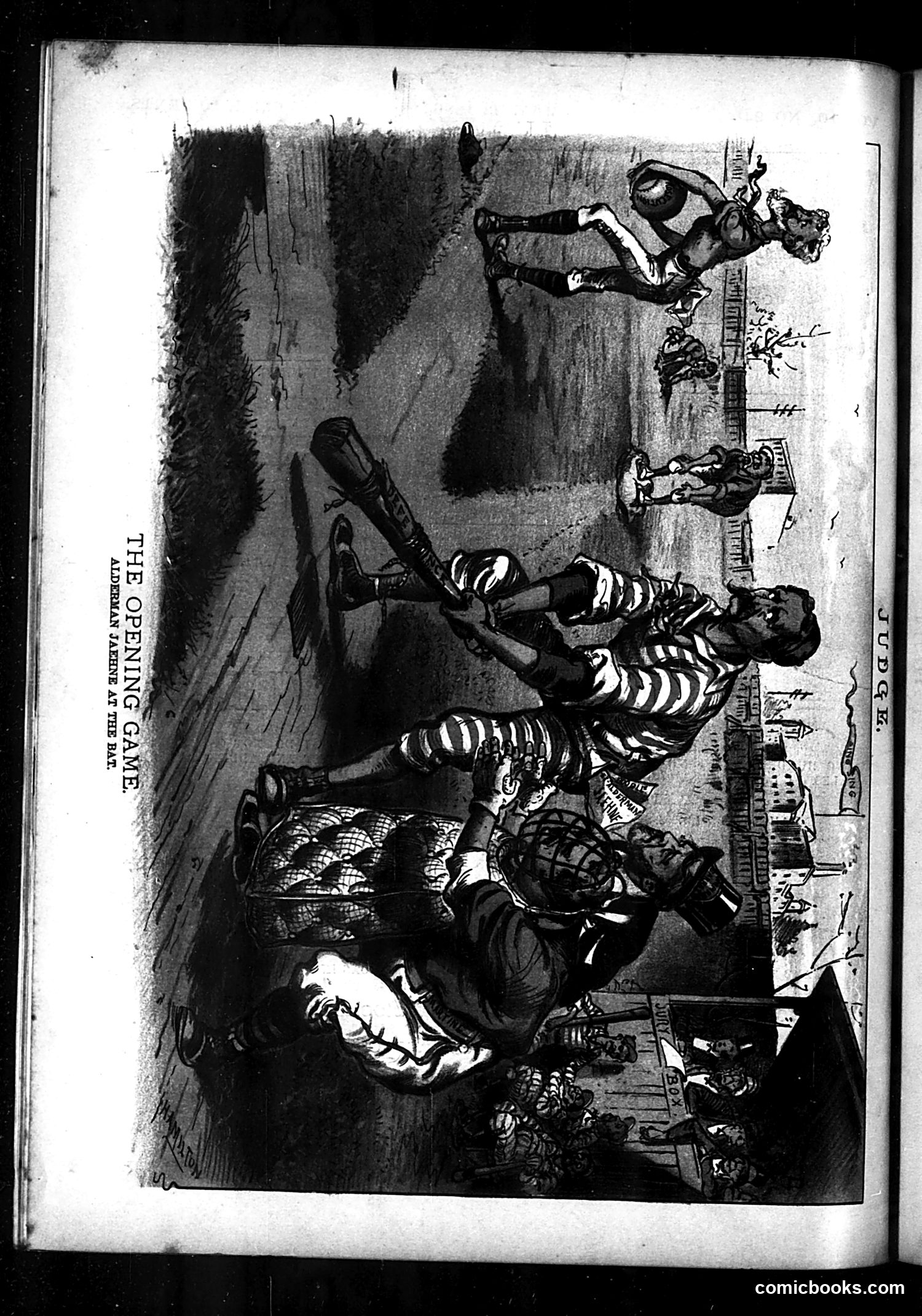
This Judge cartoon depicts what appears to be a baseball game scene, with the title referencing "Alderman Jaehne at the Bat." The figures in striped uniforms suggest players, while the scene includes spectators and what appears to be a grandstand or bleachers on the right. Without additional context about Alderman Jaehne's identity or the specific historical moment, the exact political or social satire remains unclear. The cartoon likely uses baseball as a metaphor for political maneuvering or public action. Jaehne was apparently a notable Chicago alderman during Judge magazine's publication era, and this probable references either his political ambitions, a scandal, or a public controversy being satirized through the baseball analogy—a common Judge technique for making political commentary accessible and entertaining.