
Judge, 1886-05-15 · page 3 of 16
Judge — May 15, 1886 — page 3: what you’re looking at
What you’re looking at
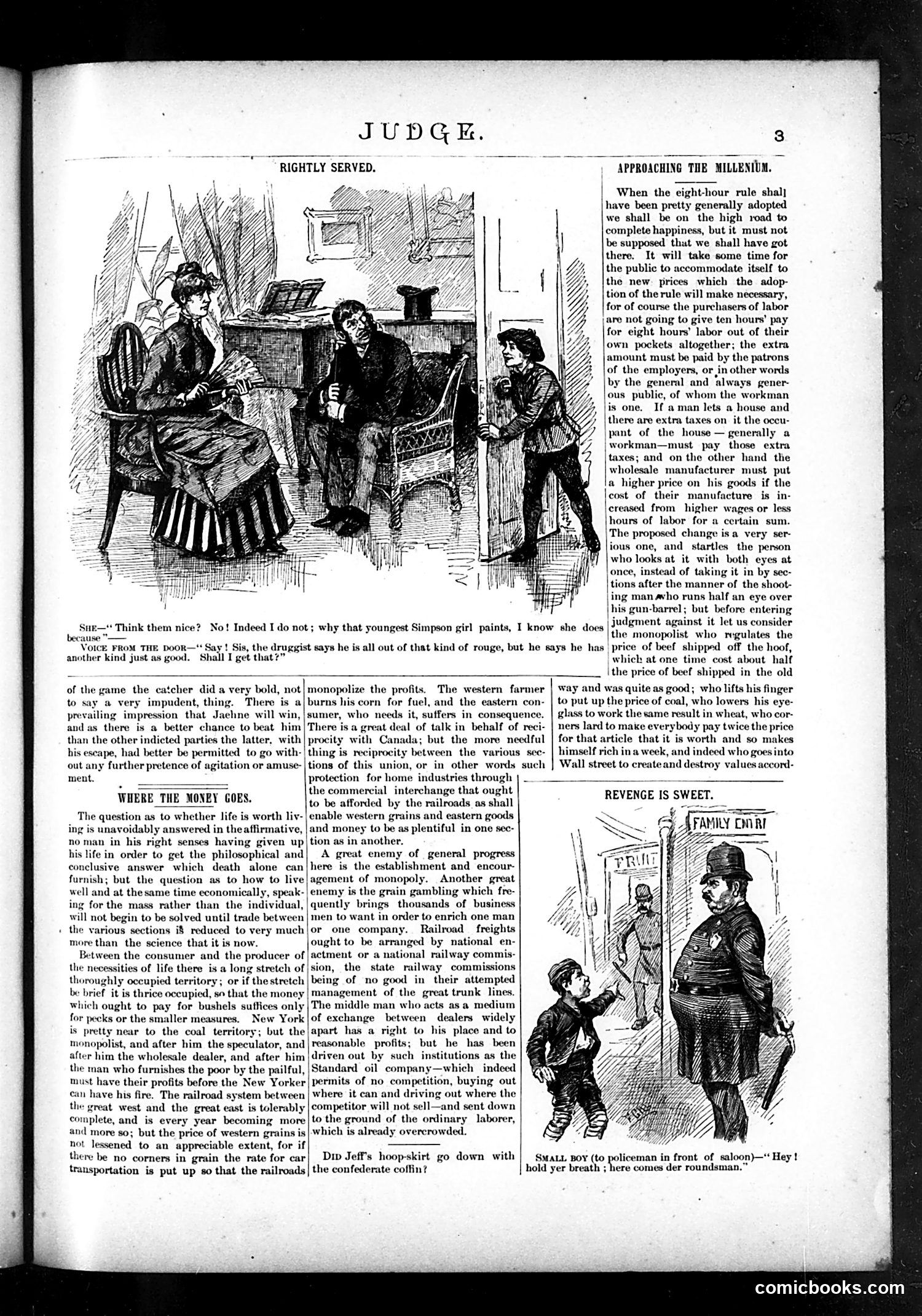
**"Rightly Served"** (top cartoon): A woman complains to a druggist that he's out of a particular rouge, and he suggests an alternative. The joke appears to target cosmetics fraud or deceptive marketing practices—the woman's friend claims the inferior substitute is "just as good," satirizing how consumers are misled into accepting inferior products. **"Approaching the Millenium"** (right column): This editorial discusses the eight-hour workday rule. Judge's satirical point: while workers celebrate shorter hours, the public will ultimately pay through higher prices. The piece cynically suggests monopolists (beef traders, railroads, grain dealers) exploit every opportunity to maintain profits—whether through wage increases or manufactured scarcity. The criticism extends to railroad profiteering and the failure of interstate commerce to benefit ordinary consumers. **"Revenge is Sweet"** (bottom cartoon): A small boy confronts a policeman, likely depicting a street urchin testing authority—typical period humor about class conflict and urban life. The page critiques monopoly capitalism and argues that labor reforms benefit only workers while harming consumers through price inflation.
📄 Transcribed text from this page (OCR, searchable)
Machine-transcribed from the original scan — historical spelling and the odd misread are preserved.
RIGHTLY SERVED. FROM THE DoOR—* Say another kind just as good. Sh: JUDGE. 3 he druggist says he is all out of that kind of rouge, but he says he has hat?” APPROACHING TIE MILLENIUM. When the eight-hour rule shal] have been pretty generally adopted we shall be on the high road to complete happiness, but it must not be supposed that we shall have got there. It will take some time for the public to accommodate itself to the new. prices which the adop- tion of the rule will make necessary, for of course the purchasers of labor are not going to give ten hours’ pay for eight hours’ labor out of their own pockets altogether; the extra amount must be paid by the patrons of the employers, or in other words by the general and ‘always gener- ous public, of whom the workman is one. If aman lets a house and there are extra taxes on it the occu- pant of the house — generally a |workman—must pay those extra |taxes; and on the other hand the wholesale manufacturer must put a higher price on his goods if the cost of their manufacture is in- creased from higher wages or less hours of labor for a certain sum. The proposed change isa very ser- ious one, and startles the person who looks at it with both eyes at once, instead of taking it in by sec- tions after the manner of the shoot- ing man avho runs half an eye over his gun-barrel; but before entering judgment against it let us consider the monopolist who regulates the price of beef shipped off the hoof, whick at one time cost about half ithe price of beef shipped in the old of the game the catcher did a very bold, not to say a very impudent, thing. There is a prevailing impression that Jaehne will win, as there is a better chance to beat him aan the other indicted parties the latter, with his eseape, had better be permitted to go with- out any further pretence of agitation or amuse- ment. WHERE THE MONEY GOES. The question as to whether life is worth li ing is unavoidably answered in theaffirmative, no man in his right senses having given up his life in order to get the philosophical and conclusive answer which death alone can furnish; but the question as to how to live well and at the same time economically, speak- ing for the mass rather than the individual, will not begin to be solved until trade between « the various sections i8 reduced to very much morethan the science that it is now. Between the consumer and the producer of the ne ies of life there is a long stretch of thoroughly occupied territory ; or if the stretch be brief it is thrice occupied, so that the money ch ought to pay for bushels suffices only for pecks or the smaller measures. is pretty near to the coal territor monopol and after him the speculator, and after him the wholesale dealer, and after him the man who furnishes the poor by the pailful, must have their profits before the New Yorker can have his fire. The railroad system between the great west and the great east is tolerably plete, and is every year becoming more and more so; but the price of western grains is not lessened to an appreciable extent, for if there be no corners in grain the rate for car transportation is put up so that the railroads monopolize the profits. The western farmer burns his corn for fuel, and the eastern con- sumer, who needs it, suffers in consequence. There is a great deal of talk in behalf of reci- procity with Canada; but the more needful thing is reciprocity between the various sec- tions of this union, or in other words such protection for home industries through way and was quite as good; who lifts his finger to put up the price of coal, who lowers his eye- glass to work the same result in wheat, who cor- ners lard to make everybody pay twice the price for that article that it is worth and so makes himself rich ina week, and indeed who goesinto Wall street to createand destroy values accord- the commercial interchange that ought to be afforded by the railroads as shall enable western grains and eastern goods and money to be as plentiful in one sec- tion as in another. A great enemy of general progress here is the establishment and encour- agement of monopoly. Another great enemy is the grain gambling which fre- \quently brings thousands of business men to want in order to enrich one man lor one company. Railroad freights ought to be arranged by national en- actment or a national railway commis- sion, the state railway commissions being of no good in their attempted |management of the great trunk lines. The middle man who acts as a medium of exchange between dealers widely lapart has a right to his place and to reasonable profits; but he has been driven out by such institutions as the Standard oil company—which indeed |permits of no competition, buying out | where it can and driving out where the competitor will not sell—and sent down to the ground of the ordinary laborer, which is already overcrowded. Dw Jeff's hoop-skirt_ go down with the confederate coffin? SMALL Boy (to hold yer breath ; REVENGE IS SWEET. policeman in front, of saloon)}—“ Hey here comes der roundsman. comicbooks.com