
Judge, 1886-05-15 · page 4 of 16
Judge — May 15, 1886 — page 4: what you’re looking at
What you’re looking at
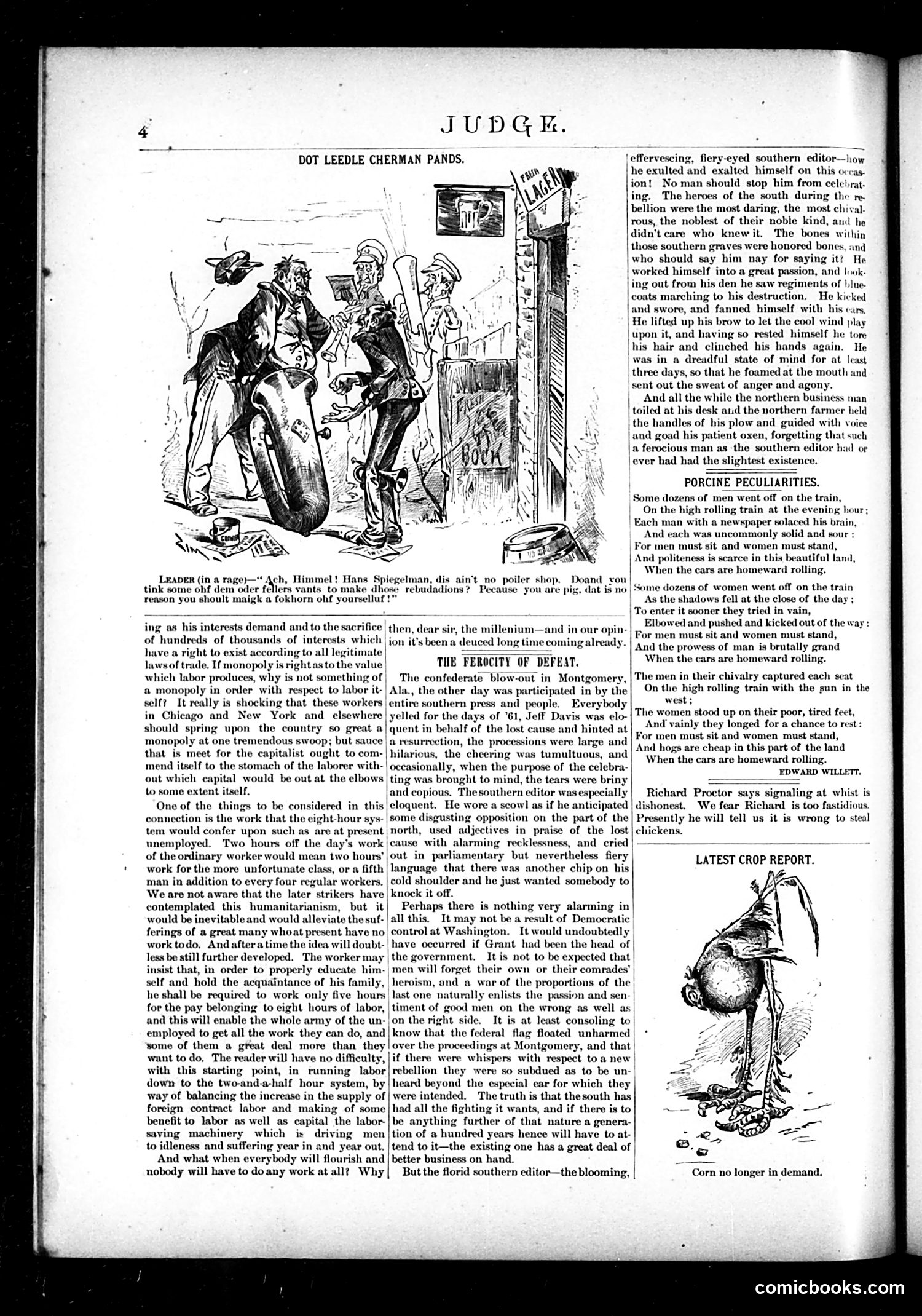
## The Main Cartoon ("Dot Leedle Cherman Pands") The cartoon depicts a German immigrant ("Hans Spiegelman," indicated by the dialect) in what appears to be a barbershop, loudly demanding action—likely representing working-class labor agitation. The caption suggests he's advocating for labor strikes or radical demands ("rebudadions"). The satire mocks German immigrant workers and union activists as loud, unreasonable troublemakers disrupting respectable business. ## "The Ferocity of Defeat" Article This lengthy piece criticizes a Confederate reunion in Montgomery, Alabama, where Southern politicians and press figures, including Jeff Davis, celebrated the Lost Cause with passionate rhetoric. The satire targets the Southern editor's fierce, emotional defense of the Confederacy—his "ferocity" expressed through inflammatory language and crocodile tears—as absurdly overwrought. **Overall**: The page attacks both labor radicalism (immigrant workers) and Southern neo-Confederate sentiment, reflecting post-Reconstruction tensions and nativist anxieties about foreign agitators.
📄 Transcribed text from this page (OCR, searchable)
Machine-transcribed from the original scan — historical spelling and the odd misread are preserved.
JUDGE. DOT LEEDLE CHERMAN PANDS. leffervescing, fiery-eyed southern editor—low | he exulted and exalted himself on this occas. ion! Noman should stop him from celetrat- ling. The heroes of the south during the re bellion were the most daring, the most chival- rous, the noblest of their noble kind, and he didn't care who knew it. The bones within those southern graves were honored bones, and |who should say him nay for saying it? He worked himself into a great passion, and look. ing out from his den he saw regiments of blue. coats marching to his destruction. He kicked and swore, and fanned himself with his cars, He lifted up his brow to let the cool wind pl: |upon it, and having so rested himself he his hair and clinched his hands again. He was in a dreadful state of mind for at least three days, so that he foamed at the mouth and sent out the sweat of anger and agony. And all the while the northern business man toiled at his desk and the northern farmer held | the handles of his plow and guided with voice |and goad his patient oxen, forgetting that such |a ferocious man as the southern editor had or Laven (in a rage)—" Ach, Himmel! Hans Spiegelman, dis ain't_no poiler shop. tink some obf dem oder fellers vants. to make dhose rebudadions ? reason you shoult maigk a fokhorn ohf yourselluf Doand_you | Pecause you are pig, dat i8 no | ing as his interests demand and to the sacrifice then, dear sir, the millenium—and in our opin- of hundreds of thousands of interests w have a right to exist according to all legitin ——e- = lawsof trade. If monopoly is rightas to the THE FEROCITY OF DEFEAT. which labor produces, why is not someth: The confederate blow-out in Montgomery, a monopoly in order with respect to labor it-| Ala., the other day was participated in by the self? It really is shocking that these workers entire southern press and people. Everybody | in Chicago and New York and elsewhere | yelled for the days of '61, Jeff Davis was elo- should spring upon the country so great a| quent in behalf of the lost and hinted at monopoly at one tremendous swoop; but sauce | a resurrection, the processions were large and that is meet for the capitalist ought to com- | hj us, the cheering tumultuous, and | mend itself to the stomach of the laborer with-! occasionally, when the purpose of the celebra- out which capital would be out at the elbows ting brought to mind, the tears were briny to some extent itself. |and copious. The southern editor was especially One of the things to be considered in this eloquent. He wore a scowl as if he anticipated connection is the work that the eight-hour sys- some disgusting opposition on the part of the tem would confer upon such as are at present north, used adjectives in praise of the lost unemployed. Two hours off the day's work |cause with alarming recklessness, and cried of the ordinary worker would mean two hours’ |out in parliamentary but nevertheless fiery work for the more unfortunate class, or a fifth language that there was another chip on his man in addition to every four regular workers. | cold shoulder and he just wanted somebody to We are not aware that the later strikers have | knock it off. contemplated this humanitarianism, but it| Perhaps there is nothing very alarming in| would be inevitable and would alleviate the suf- | all this. It may not be a result of Democratic ferings of a great many whoat present have no control at Washington. It would undoubtedly work todo. Andaftera time the idea willdoubt-| have occurred if Grant had been the head of tion it’s bee: ed long time coming already. less be still further developed. The worker may the government. It is not to be expected that insist that, in order to properly educate him-|men will forget their own or their comrades’ self and hold the acquaintance of his family, | heroism, and a war of the proportions of the he shall be required to work only five hours! last one naturally enlists the passion and sen for the pay belonging to eight hours of labor, |timent of good men on the wrong as well as and this will enable the whole army of the un-|on the right side. It is at least consoling to employed to get all the work they can do, and|know that the federal flag floated unharmed some of them a gteat deal more than they! over the proceedings at Montgomery, and that want to do. The reader will have no difficulty, |if there were whispers with respect to a new with this starting point, in running labor|rebellion they were so subdued as to be un- down to the two-and-a-half hour system, by|heard beyond the especial ear for which they way of balancing the increase in the supply of foreign contract labor and making of some benefit to labor as well as capital the labor saving machinery which is driving men to idleness and suffering year in and year out. And what when everybody will flourish and nobody will have to do any work at all?’ Why were intended. The truth is that thesouth has had all the fighting it wants, and if there is to be anything further of that nature a genera- tion of a hundred years hence will have to at- tend to it—the existing one has a great deal of | better business on hand. But the florid southern editor—the blooming, | ever had had the slightest exi PORCINE PECULIARITIES. Some dozens of men went off on the train, On the high rolling train at the evening Each man with a newspaper solaced his brai ‘And each was uncommonly solid and sour : For men must sit and women must stand, And politeness is scarce in this beautiful land, When the cars are homeward rolling. Some dozens of women went off on the train As the shadows fell at the close of the day ; To enter it sooner they tried in vain, Elbowed and pushed and kicked out of the way : For men must sit and women must stand, And the prowess of man is brutally grand When the cars are homeward rolling. The men in their chivalry captured each seat On the high rolling train with the sun in the wes The women stood up on their poor, tired feet, And vainly they longed for a chance to rest : For men must sit and women must stand, And hogs are cheap in this part of the land When the cars are homeward rolling. EDWARD WILLETT. Richard Proctor says signaling at whist is dishonest. We fear Richard is too fastidious Presently he will tell us it is wrong to steal chickens. LATEST CROP REPORT. Ma Corn no longer in demand. comicbooks.com