
A complete issue · 16 pages · 1885
Judge — November 28, 1885
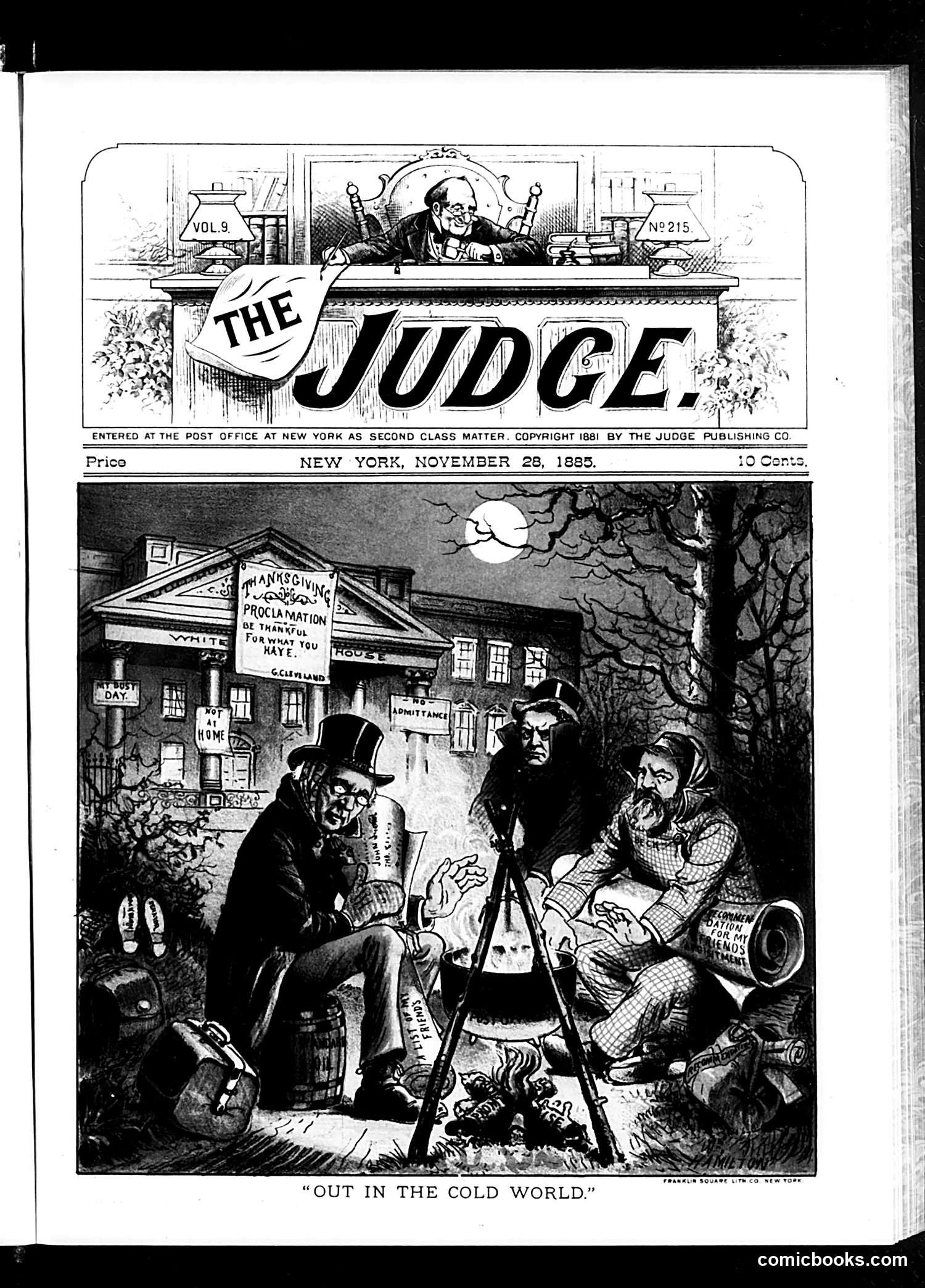
This Thanksgiving-themed cartoon satirizes poverty and homelessness. Three destitute figures huddle outside a prosperous house displaying a "Thanksgiving Proclamation" and "Admittance" sign. The contrast is stark: while citizens inside celebrate the holiday with warmth and abundance, the poor remain literally "out in the cold," excluded from society's bounty. The full moon and bare trees emphasize the bleakness of their situation. The figures' ragged clothing and desperate postures underscore social inequality. The house represents institutional indifference—even religious proclamations of thankfulness exclude the vulnerable. This appears to critique the gap between Thanksgiving's charitable ideals and the actual treatment of poor Americans, suggesting that official proclamations ring hollow for those denied basic shelter and sustenance during winter.
This page from *Judge* magazine contains editorial commentary and satirical articles rather than visual cartoons. The main illustrated header shows "THE JUDGE" - the magazine's mascot character. The content critiques Democratic politics and figures, particularly targeting the "Mugwump" reformers (Republicans who defected to support Democratic candidates). One section, "The Dog on Top," uses dog-fighting as a metaphor for Democratic Party struggles for power and privilege among New York politicians, suggesting internal corruption. Other articles mock Democratic hypocrisy regarding reform principles and attack specific figures like Mayor Grace and President Cleveland's administration. The satire assumes readers' familiarity with contemporary New York Democratic scandals and factional disputes. The page is primarily text-based political commentary rather than visual satire.
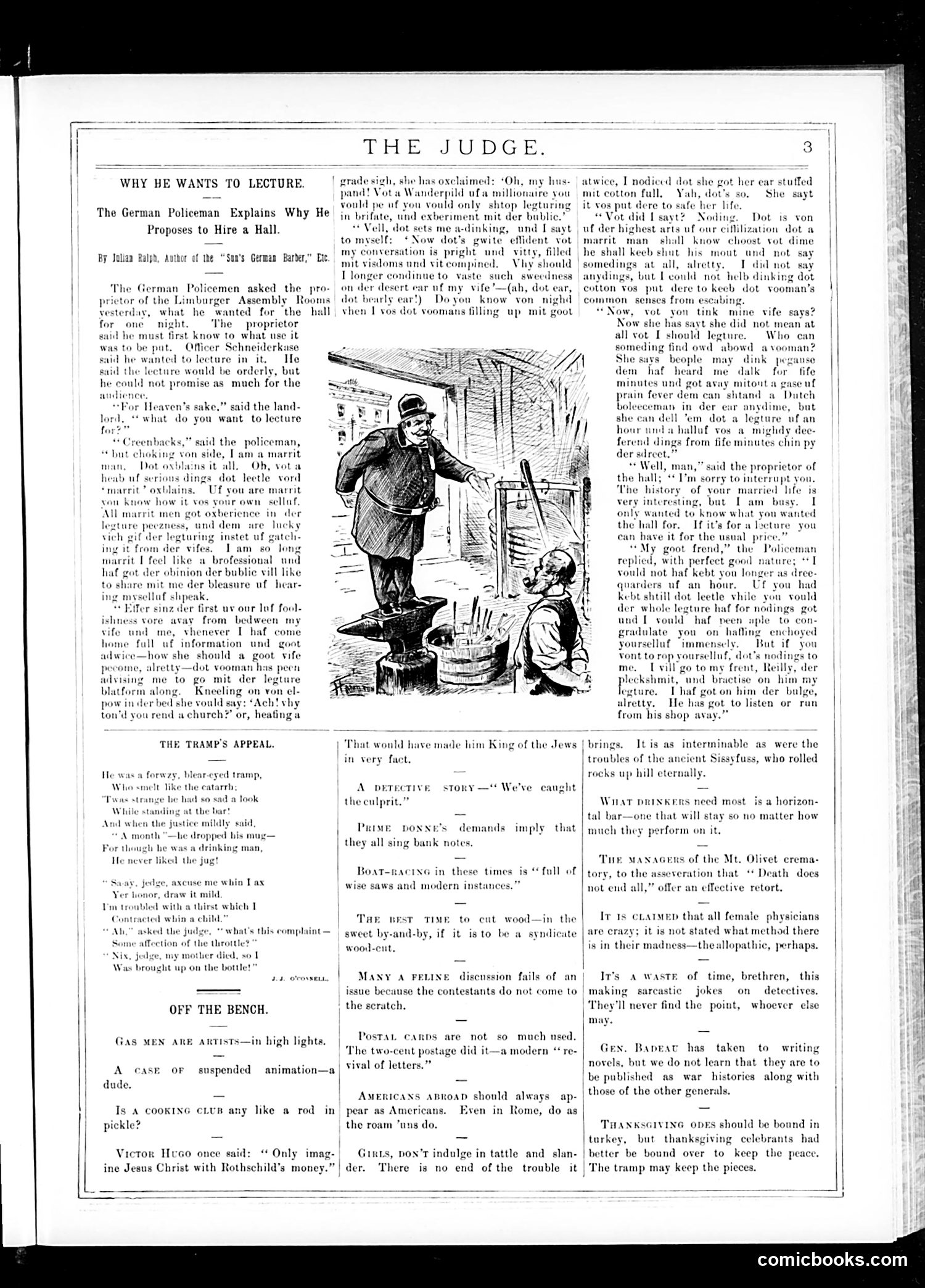
This page contains two satirical pieces from *Judge* magazine: **"Why He Wants to Lecture"** (main cartoon): A German policeman seeks to rent a hall, but his fractured English and rambling explanation reveal the real issue—his wife won't stop talking at home. The satire targets both German immigrants (through exaggerated dialect) and marital dynamics. The policeman essentially wants to lecture publicly as escape from domestic chatter, a commentary on 19th-century marriage frustrations played for ethnic humor. **"The Tramp's Appeal"** (poem): A vagabond explains his poverty to a judge, claiming he's "troubled with a thirst." It's straightforward satire of homelessness attributed to alcoholism—a common Victorian-era stereotype used to blame the poor for their condition rather than examining systemic causes. The page also contains various short quips mocking detectives, boat-racing, cooking clubs, and other contemporary subjects—typical of *Judge*'s format as a weekly humor magazine mixing visual and textual satire.
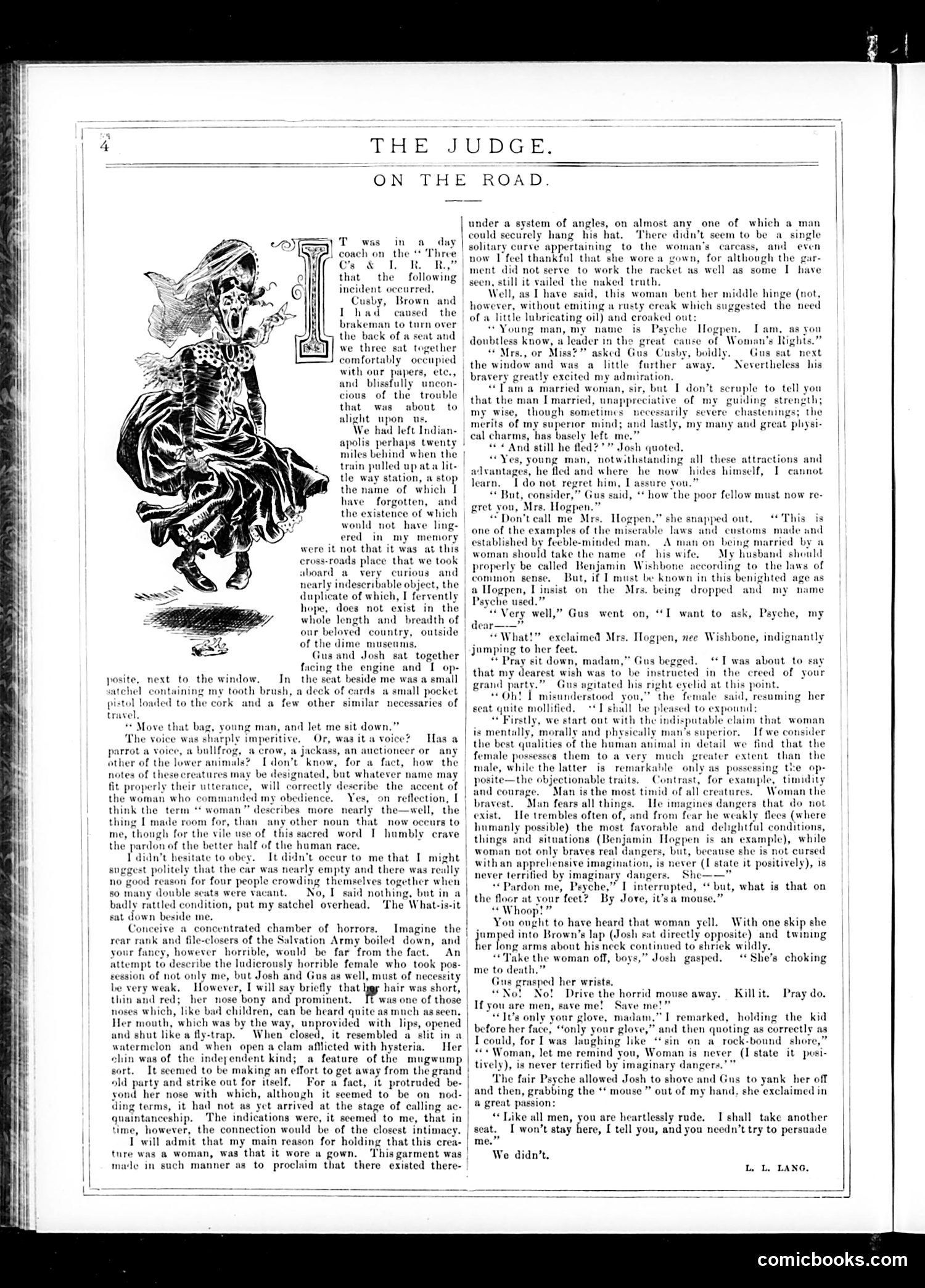
This is a humorous travel narrative, not a political cartoon. The illustrated figure appears to be a grotesque caricature of an aggressive, unattractive woman passenger who boards a train and commandeers the narrator's seat. The satire mocks both the woman and Victorian social conventions. She's depicted with exaggerated masculine features—short hair, prominent nose, thin lips resembling a "fly-trap"—and an imperious manner. The humor derives from her violation of genteel railroad etiquette and the narrator's reluctant, deadpan acceptance of her rudeness. The piece also satirizes contemporary debates about women's assertiveness and "new woman" independence (referenced in the text's mention of "woman's rights"). The woman's authority and aggressive behavior are presented as comically unfeminine and ridiculous, reflecting period anxieties about changing gender roles. The narrative's resigned tone suggests society must tolerate such ungracious women, however unwillingly.
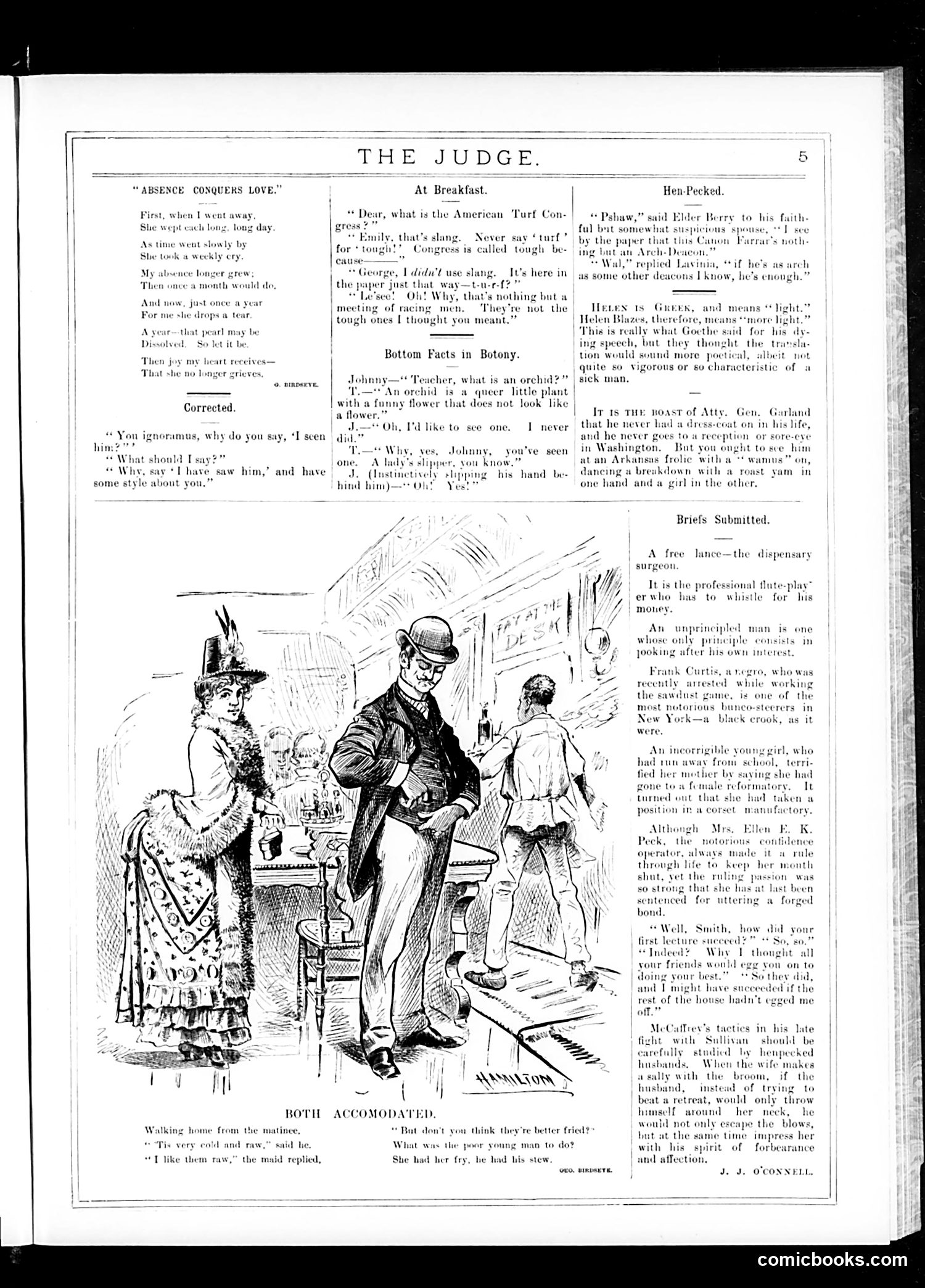
This page contains three distinct satirical pieces typical of 1880s American humor: **"Absence Conquers Love"** and **"Hen-Pecked"** are paired poems mocking marriage dynamics—the first shows a wife's affection fading during her husband's absence, the second jokes about a wife correcting her husband's speech about "arch-deacons." **The main cartoon, "Both Accommodated,"** depicts a couple leaving a theater matinee. The husband wants raw oysters; the wife prefers fried. The caption's punchline—"she had her fry, he had his stew"—is a crude sexual double entendre, typical of Judge's risqué humor. **"Bottom Facts in Botany"** is a pedagogical joke where a student confuses "orchid" with inappropriate language. The **"Briefs Submitted"** section contains short satirical observations about contemporary figures, including Attorney General Garland (noted for never wearing formal dress) and boxer McCaffrey, plus jabs at unprincipled men and disreputable con artists ("bunco-steerers"). The overall tone reflects Judge's irreverent approach to marriage, pretension, and public figures.
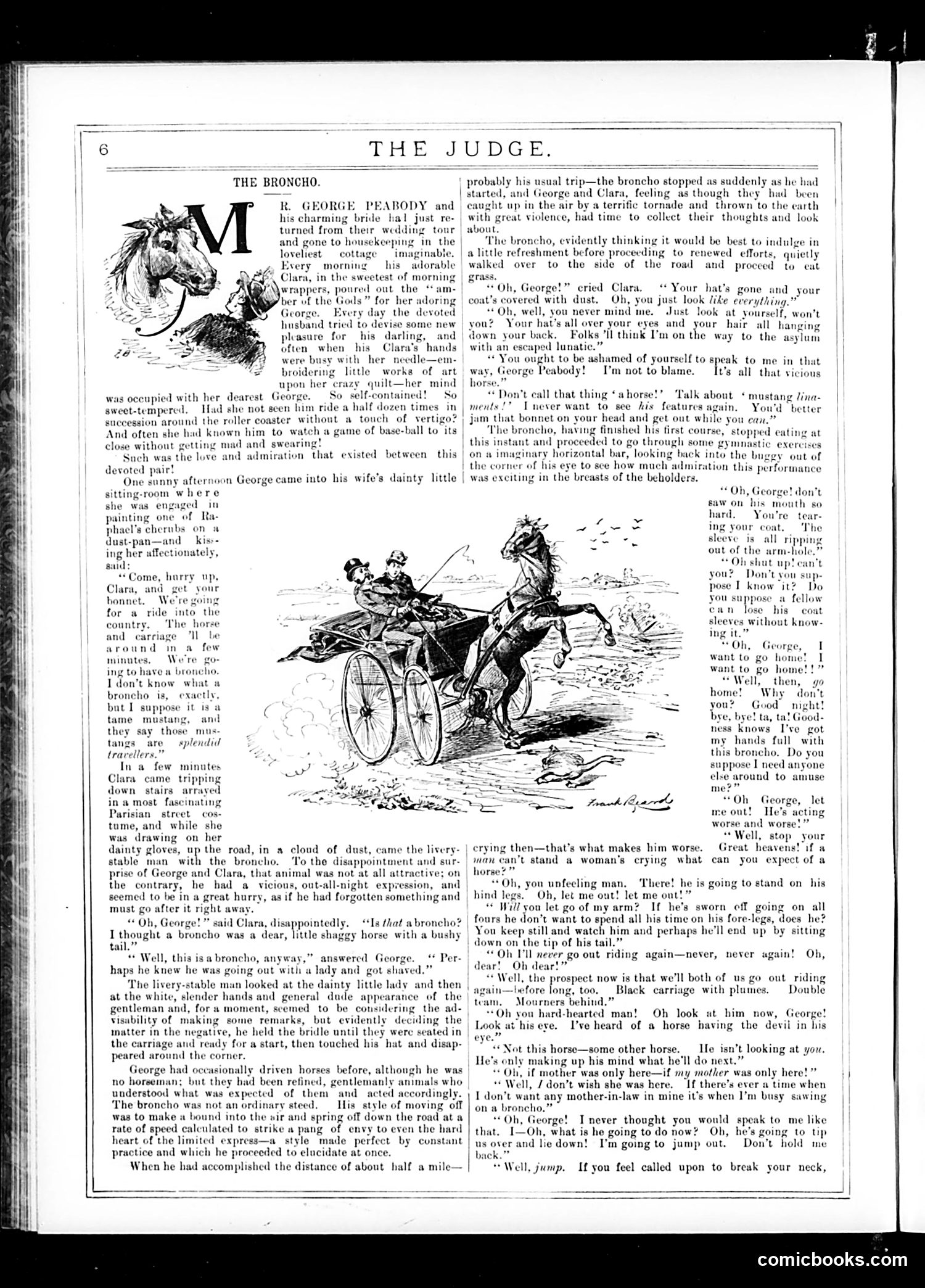
This is a humorous domestic satire about a naive city couple taking a reckless carriage ride on an untamed western horse ("broncho"). **The Setup:** George, a devoted but inexperienced husband, arranges a country outing for his wife Clara, renting what he thinks is a docile "mustang" but receives instead a wild broncho from the livery stable—an animal with a "vicious, out-all-night expression." **The Joke:** George's pretensions to sophistication ("Perhaps he knew he was going out with a lady and got shaved") clash with reality. When the broncho suddenly bucks violently into the air, the couple is thrown about helplessly. The satire mocks both George's ignorance and his attempt to impress his wife with an activity he's unprepared for. **Social Context:** This reflects late-19th-century American humor about urban gentlemen attempting rural/western activities beyond their competence—a common Judge theme satirizing middle-class pretension and the gap between city sophistication and frontier reality.
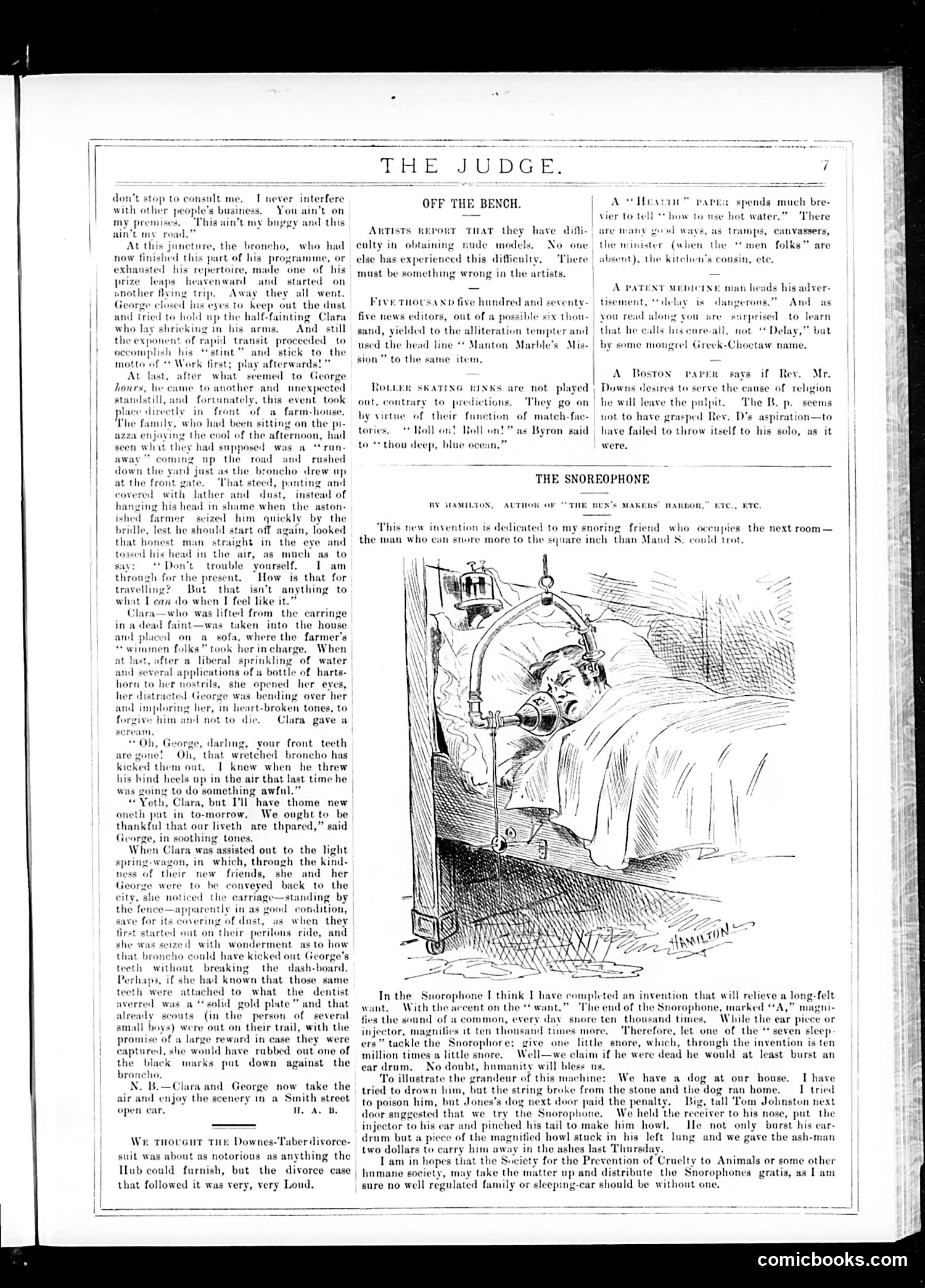
This page features a humorous invention story by Hamilton titled "The Snoreophone." The accompanying illustration depicts a mechanical contraption attached to a sleeping man's head—essentially an elaborate pipe system designed to redirect snoring sounds. The satire targets two things: (1) the Victorian-era obsession with patent medicines and dubious mechanical "inventions" promising to solve everyday problems, and (2) the annoyance of snoring in shared households. The joke is that this absurdly complicated device exists to address a simple domestic nuisance—the author sarcastically claims it will "reflect a long-felt want" and promises it will benefit "humanity." The accompanying text elaborates the joke by describing humorous consequences: a neighbor's dog being poisoned by the redirected snoring, a child's tail being pinched, etc. This exaggerates the impracticality of the invention, mocking both inventors and consumers who bought into such dubious contraptions. The tone is typical Judge magazine satire—poking fun at American entrepreneurialism and technological optimism run amok.
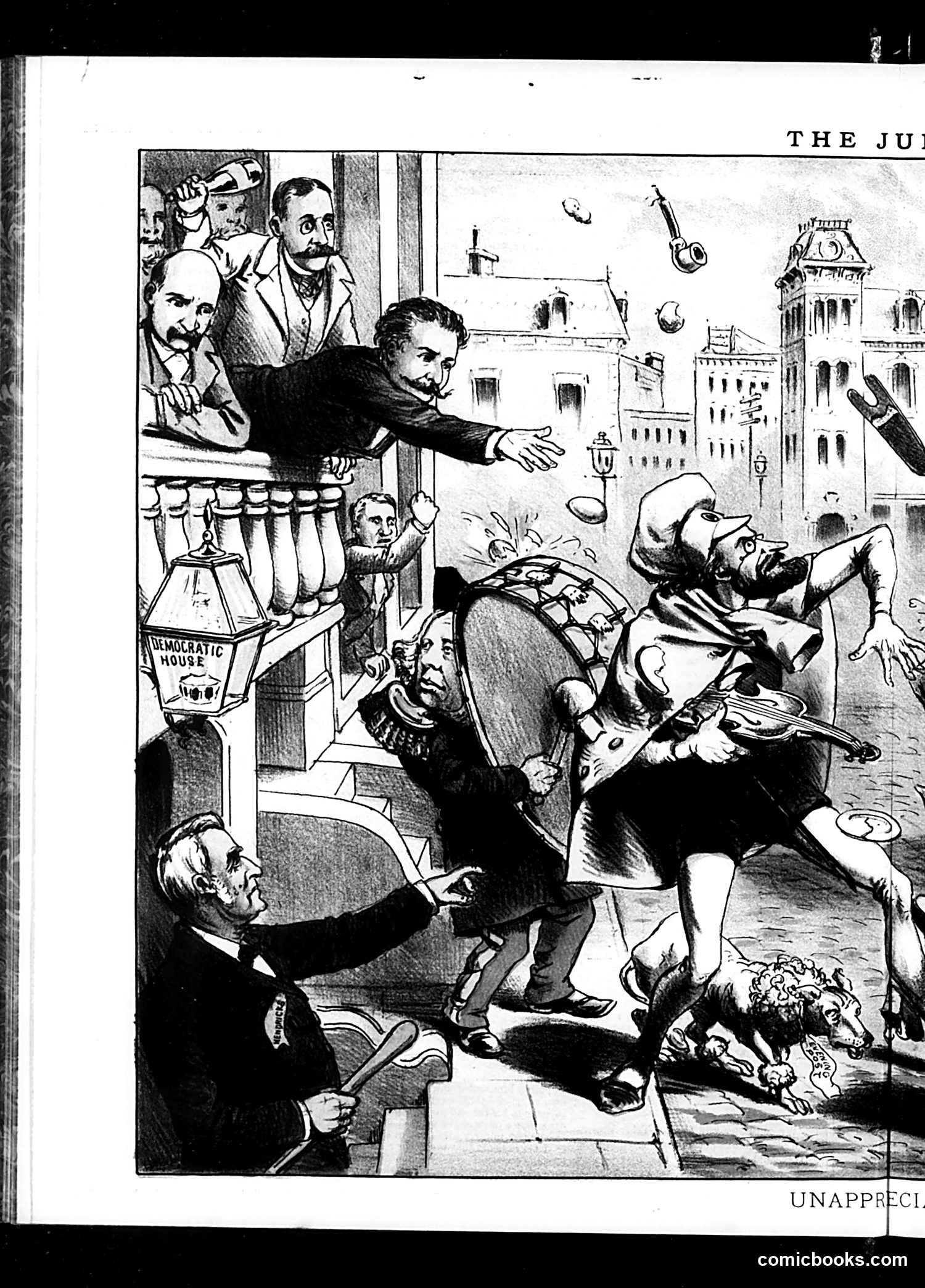
This appears to be a satirical cartoon from *Judge* magazine critiquing Democratic Party leadership (note "Democratic House" label on the lantern). The scene depicts politicians on a balcony overlooking chaos in the streets below—juggling balls, acrobatic performers, and general disorder. The title "UNAPPRECIATED" suggests the cartoon mocks Democratic officials for their efforts or policies going unrecognized or poorly received by the public. The contrast between the composed politicians above and the tumultuous activity below likely satirizes the gap between government intentions and real-world consequences, or leadership's disconnect from popular sentiment. Without clearer identification of specific figures or a visible date, precise political references remain unclear, but the cartoon criticizes Democratic governance through this visual metaphor of mismanagement and public chaos.
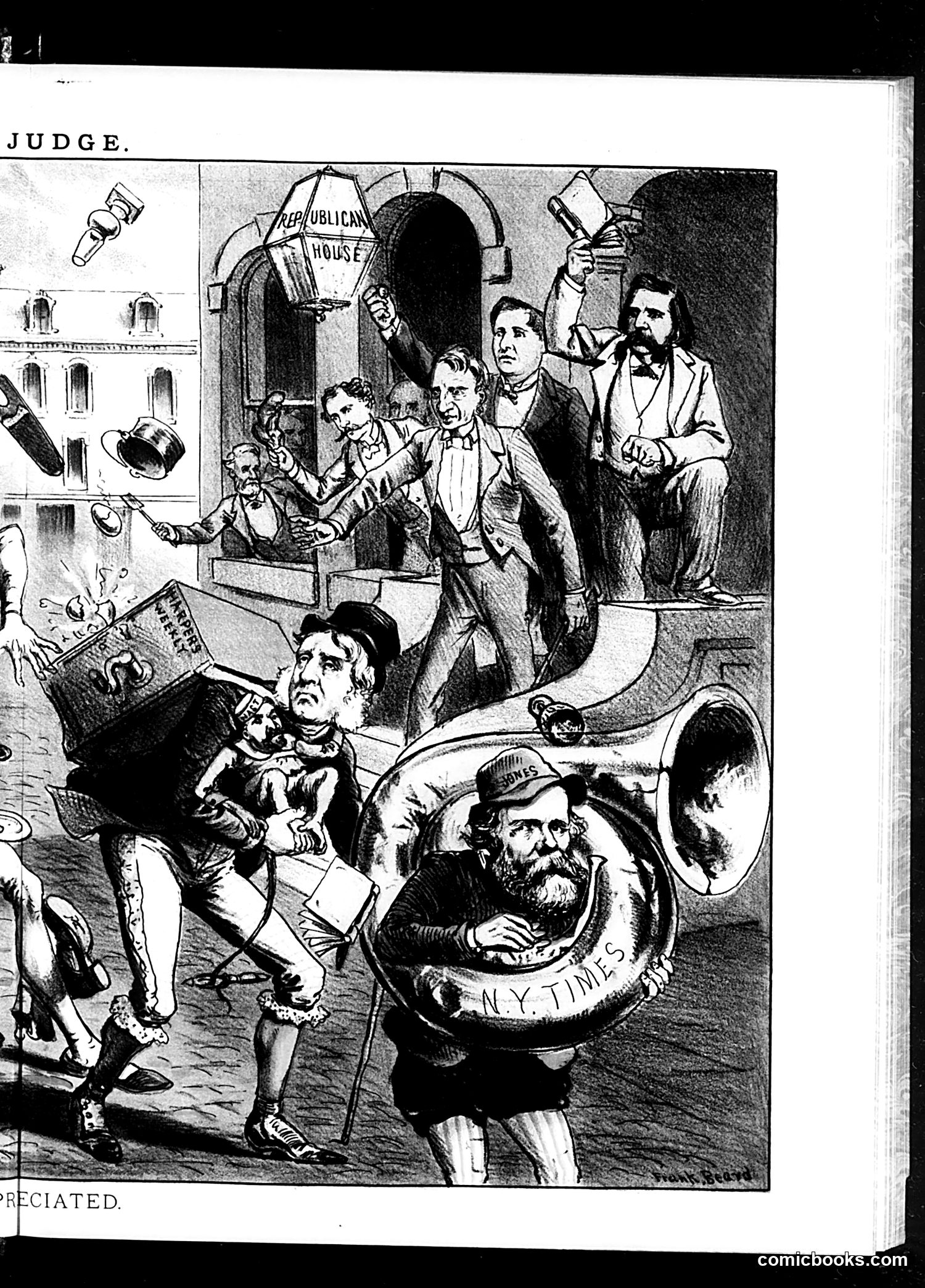
This is a political cartoon titled "Judge" depicting chaos at what appears to be the Republican House (visible on the building's arch). Several well-dressed men inside the building are wielding gavels and mallets in aggressive, combative poses, suggesting internal conflict or disorder within Republican leadership. In the foreground, a bearded man labeled "N.Y. TIMES" carries a large megaphone or speaking trumpet, apparently amplifying or broadcasting the chaos. A woman and child observe the tumultuous scene. The cartoon satirizes Republican Party infighting and internal dysfunction, while suggesting the New York Times' role in publicizing or sensationalizing these conflicts. The overall message appears to criticize both Republican disorganization and media coverage amplifying political discord.
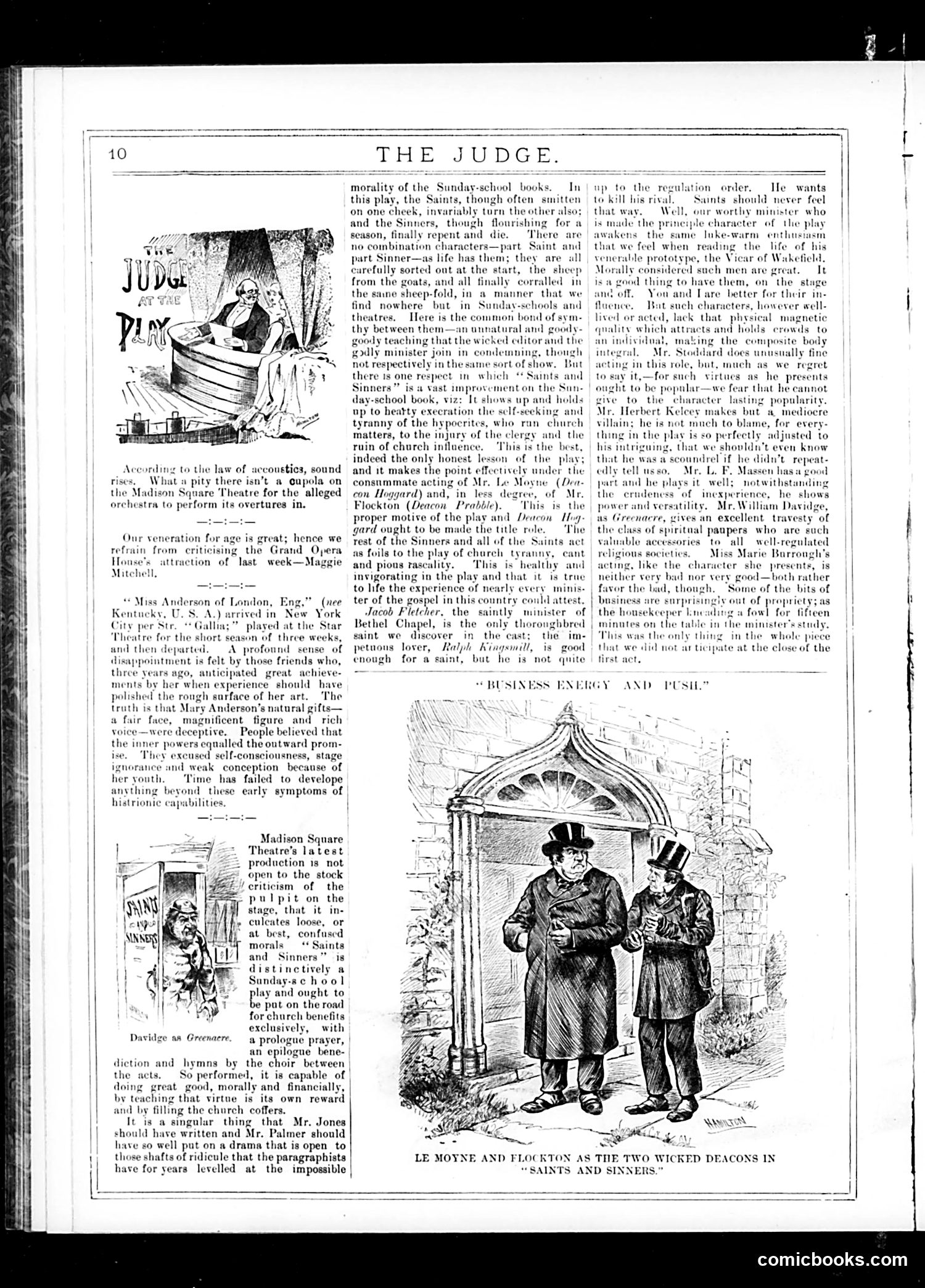
This page contains theater reviews of contemporary 1880s productions, primarily critiquing "Saints and Sinners," a play at Madison Square Theatre. The main satire targets the play's moral hypocrisy: while it presents itself as a moral Sunday-school lesson about virtue and redemption, Judge argues the plot actually depicts church corruption—a "Saint" attempting to murder his rival and various moral compromises that only resolve through convenient deathbed repentance. The accompanying illustration shows two characters labeled as "Le Moynes and Flockton as the Two Wicked Deacons," depicting corrupt church officials. Judge's broader point is that the play inadvertently exposes what religious institutions and Sunday-school literature typically hide: that clergy and church members are often hypocrites, making the play's "moral lesson" accidentally honest despite itself.
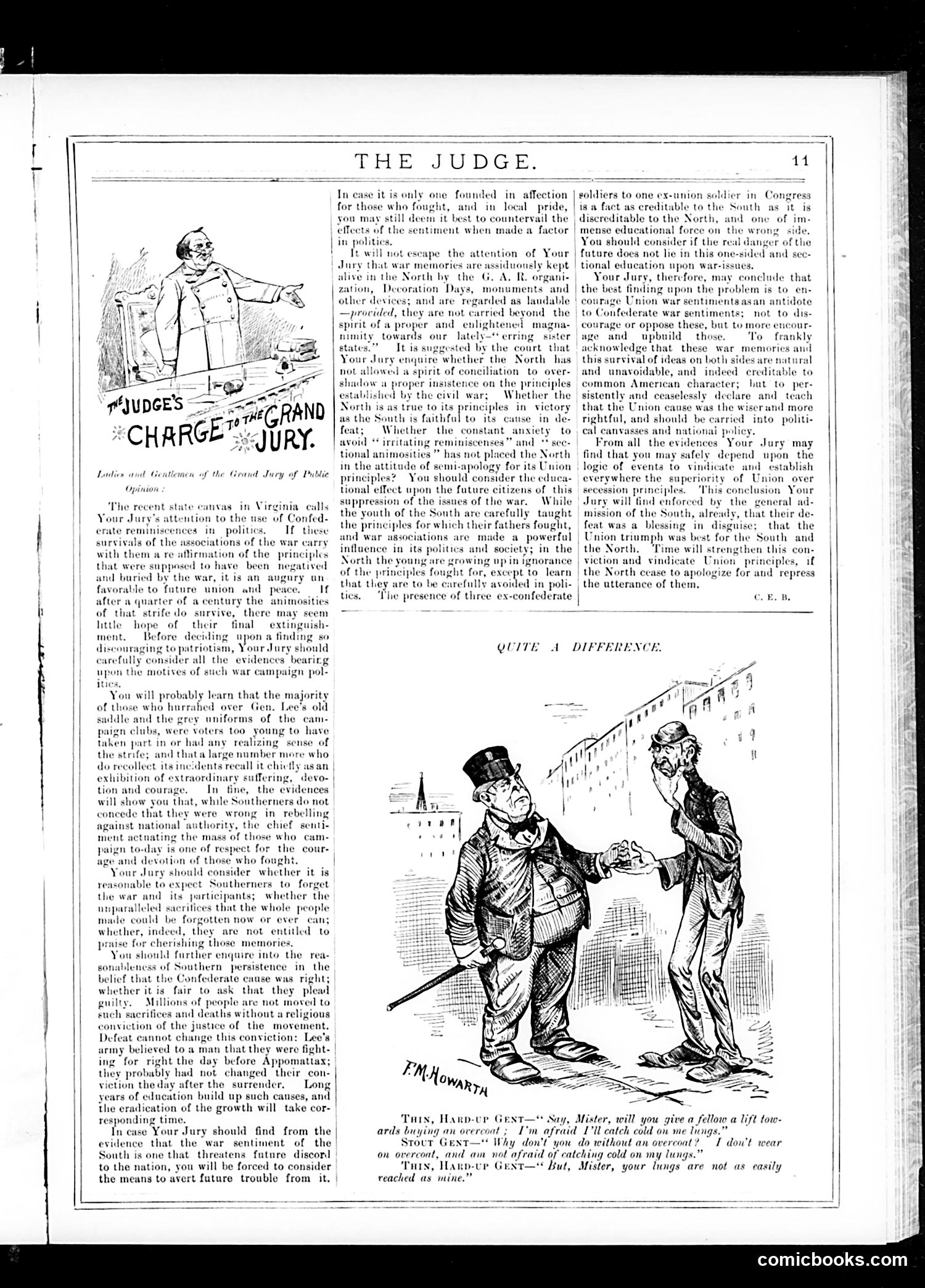
This page from *Judge* magazine addresses post-Civil War politics in Virginia. The main editorial ("The Judge's Charge to the Jury") instructs jurors to consider whether Southern war sentiment still threatens national unity a quarter-century after Appomattox. It debates whether Southerners should be expected to abandon Confederate loyalty and whether the North has adequately countered pro-Southern education. The lower cartoon ("Quite a Difference") satirizes Northern hypocrisy. It shows a Union soldier and Confederate veteran both buying overcoats. The Union soldier admits his fearlessness about the cold, while the Confederate veteran claims the same—but the caption notes the Union soldier "was not afraid of catching cold on overcoat," whereas the Confederate "was not afraid of catching cold on *no* overcoat," suggesting Southerners endured greater hardship. The joke mocks Northern self-congratulation while implicitly defending Southern courage.
This page contains two distinct pieces of satire: **"At Church"** (left column): A poem mocking social pretension. A churchgoer asks about an elegant woman creating a sensation, assuming she must be nobility or a senator's daughter. The punchline reveals she's "Miss O'Grady"—daughter of a lager-brewer, a working-class tradesman. The joke targets the American obsession with social status and inherited wealth, suggesting appearances deceive and nouveau riche (newly wealthy) individuals can fool observers. **"Two Kisses"** (bottom): A humorous anecdote where a Colonel contrasts his "sweetest" kiss—a romantic moment with a young woman at a picnic decades ago—with his most memorable kiss: being stung on the ear by a hornet while hanging a rope swing, which caused him to plunge into the picnic provisions. The satire mocks romantic nostalgia by suggesting an absurd accident was more impactful than genuine romance. Both pieces use Judge's signature comedic approach: deflating pretension and sentiment with unexpected, mundane reality.
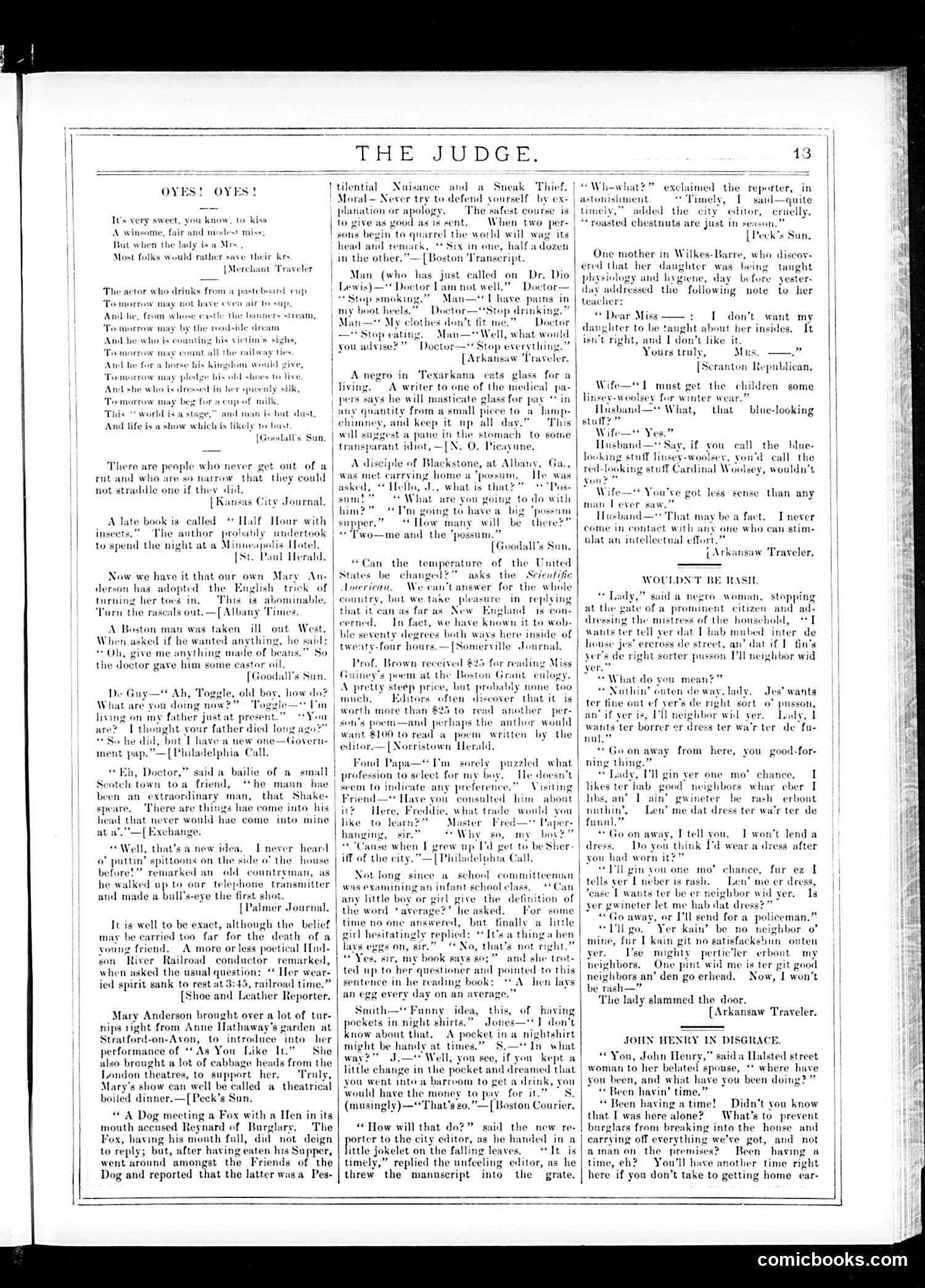
This page from Judge magazine (page 13) contains humorous anecdotes and social commentary typical of late 19th-century American satire. The content includes: **Main Features:** - Multiple short comedic stories and observations about social behavior - "Oyes! Oyes!" section offering cynical life advice (e.g., "never try to defend yourself by explanation or apology") - Anecdotes about class differences, medical advice, and domestic life - A letter from a Wilkes-Barre mother objecting to her daughter being taught physiology/hygiene **Satirical Targets:** - Social pretension and hypocrisy - Incompetent doctors and quacks - Racial stereotypes (African American dialect humor) - Gender relations and marital discord - Educational controversies (Victorian prudishness about teaching human biology) **Historical Context:** The humor reflects Gilded Age anxieties: tension between tradition and modern education, class anxiety, and attitudes toward race and gender typical of the era. The page is primarily text-based rather than illustration-heavy.
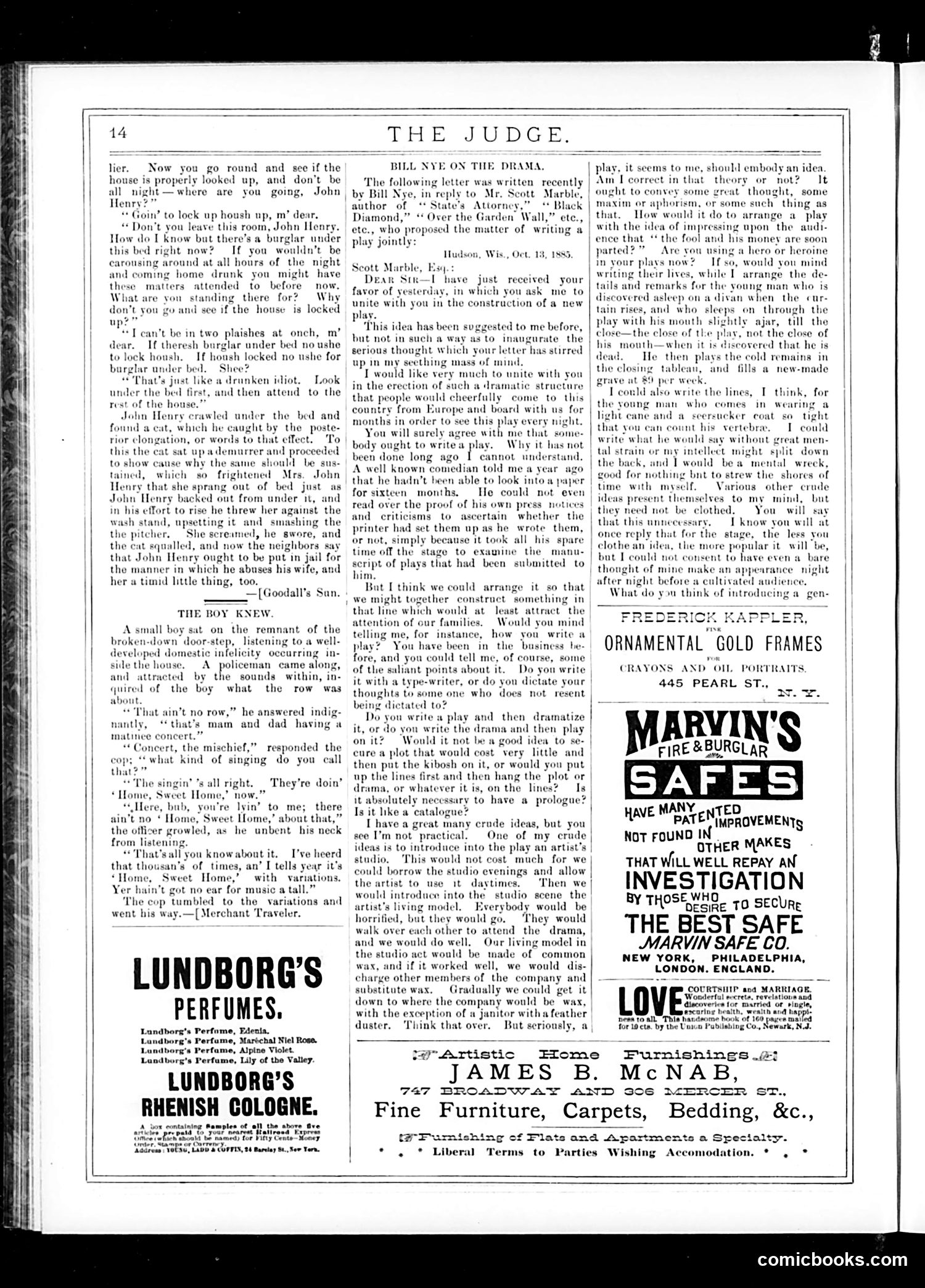
This page contains three separate satirical pieces typical of Judge magazine's humor: **"The Boy Knew"** and the untitled domestic comedy sketch mock working-class married life. Both depict drunk or quarrelsome husbands and exasperated wives—common "domestic infelicity" subjects in period humor. The sketches play on misunderstandings: one wife mistakes her husband's drunken argument with his wife for operatic singing ("Home, Sweet Home, with variations"). **"Bill Nye on the Drama"** features humorist Bill Nye's letter responding to playwright Scott Marble about collaborative playwriting. Nye satirizes theatrical conventions by suggesting absurdly simple premises (like "the fool and his money are soon parted") and ridiculous staging ideas (placing a live artist's model on stage, substituting wax figures). The advertisements for Lundborg's Perfumes, Marvin's Safes, and James B. McNab's furnishings occupy the lower half—typical period advertising copy emphasizing product quality. The overall tone reflects late-19th-century urban American attitudes toward marriage, theater, and consumerism.
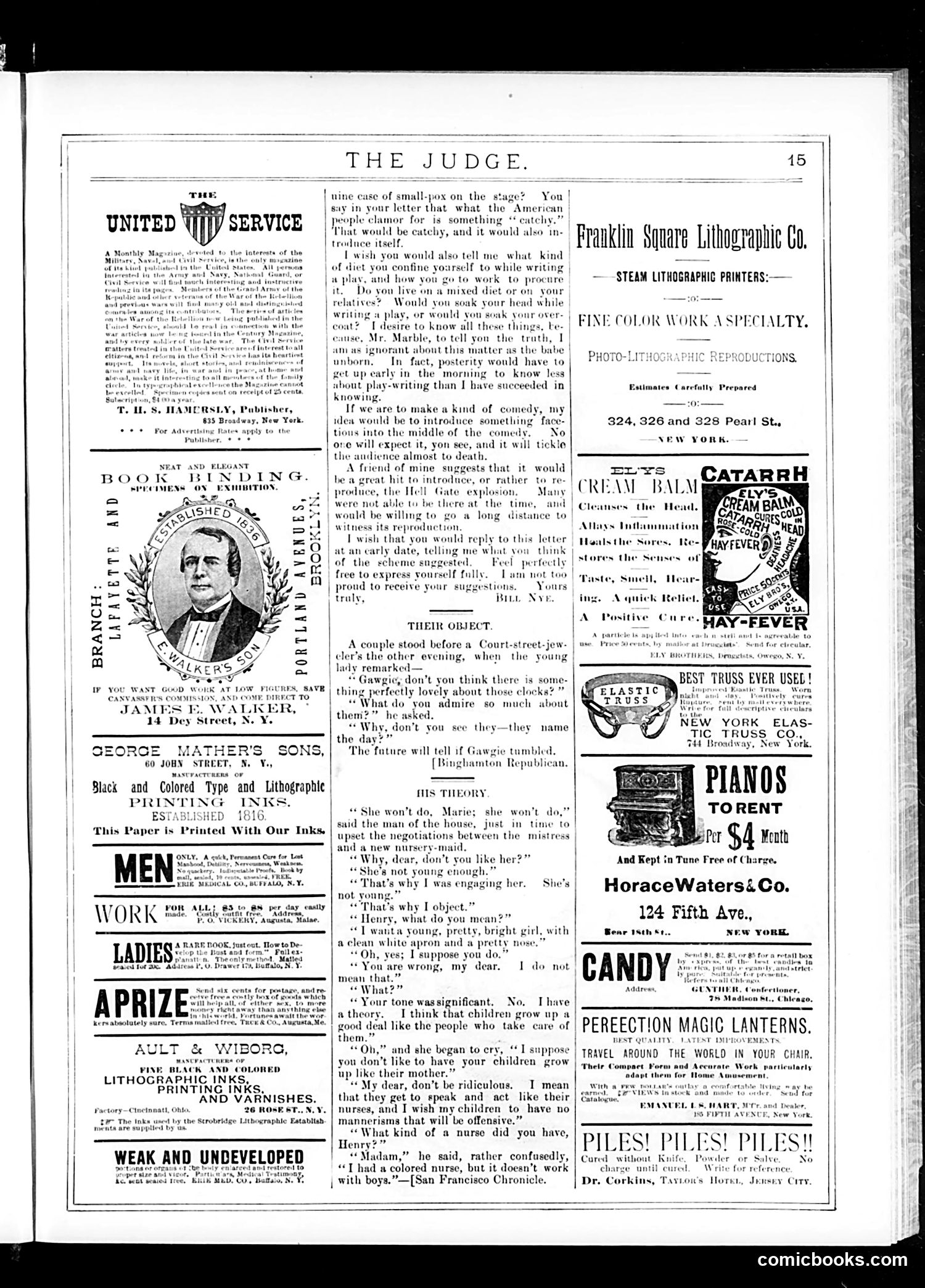
**"His Theory": A Satire on Racial Prejudice and Parenting** This cartoon satirizes a wealthy man's contradictory and hypocritical racial attitudes. A wife proposes hiring a nurse; the husband initially rejects candidates as "not young enough," but when told a prospective nurse is a Black woman, he suddenly claims he doesn't want his children raised by her—not because of age, but claiming he fears they'll adopt her "mannerisms" and speech patterns. The satire is cutting: the husband reveals his true objection is racial prejudice, not legitimate parenting concern. The punchline exposes his hypocrisy—he'd previously employed a Black nurse with his boys but dismisses this for spurious reasons, masking bigotry as child-rearing philosophy. The cartoon criticizes how upper-class employers weaponize respectability concerns to justify racial discrimination while employing racist stereotypes about influence and propriety.
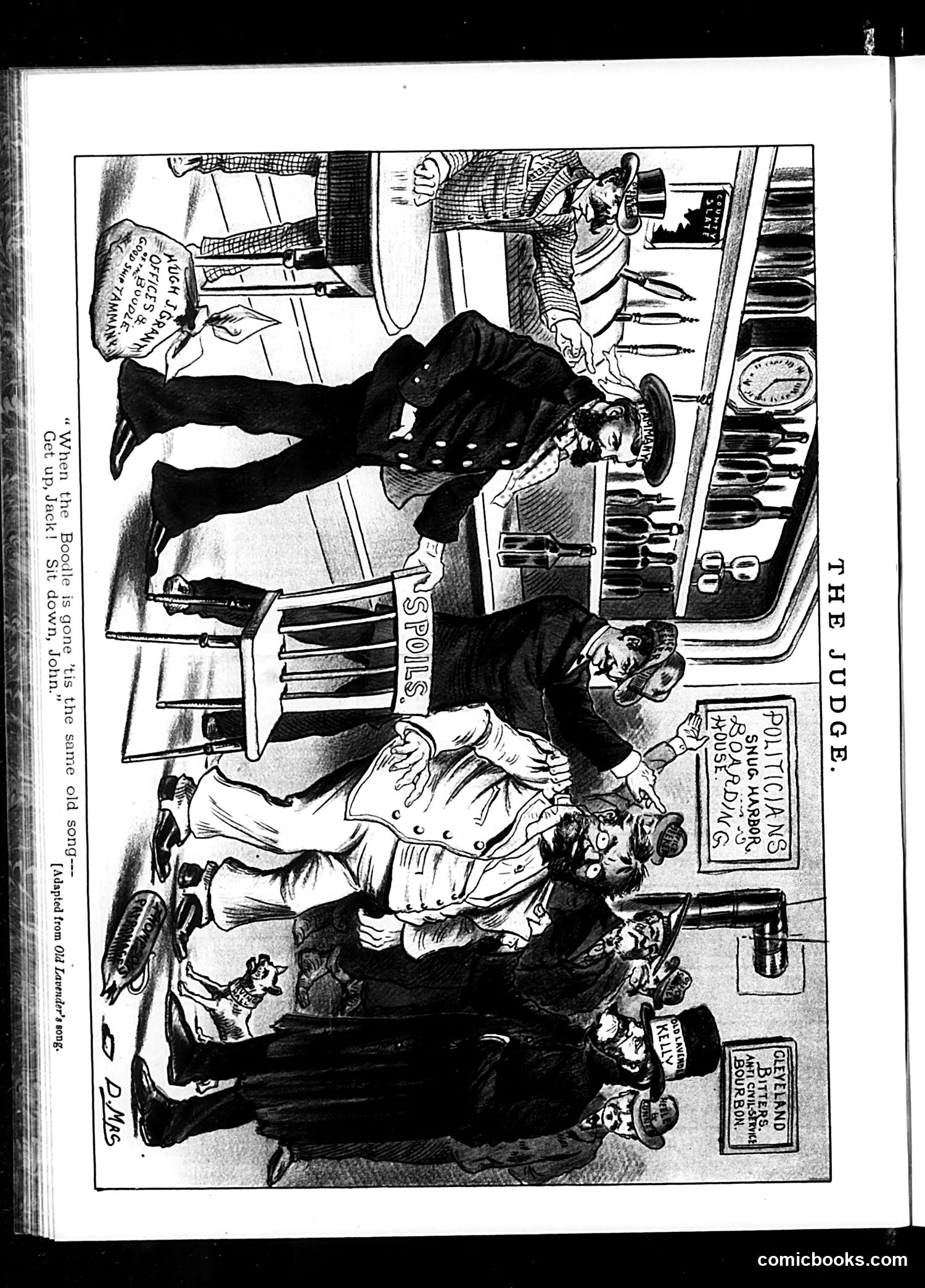
This cartoon satirizes corruption and political patronage ("boodle" being slang for bribery money). The scene depicts a courtroom or official setting where figures in suits and judicial robes are engaging in what appears to be corrupt dealings. The title references an old song about money disappearing, suggesting a cyclical pattern of political misconduct. The phrase "Get up, Jack! Sit down, John" implies interchangeable corrupt politicians taking turns at power—one leaves office as another arrives, with the same corrupt practices continuing regardless of who holds the position. The cartoon mocks how political corruption persists across administrations, with different individuals perpetuating identical schemes. The formal setting contrasts with the obvious malfeasance occurring within it.