
Judge, 1885-11-28 · page 10 of 16
Judge — November 28, 1885 — page 10: what you’re looking at
What you’re looking at
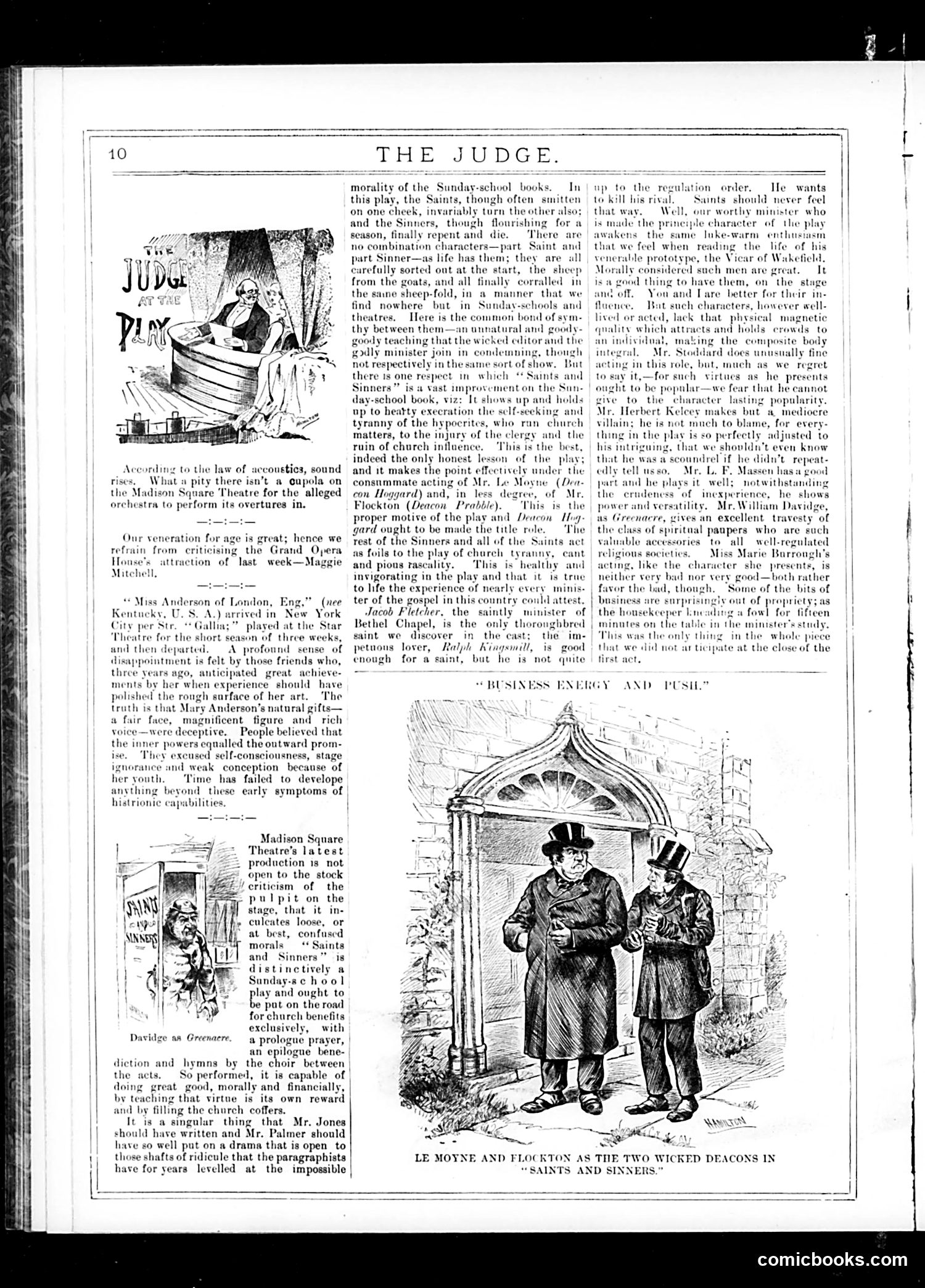
This page contains theater reviews of contemporary 1880s productions, primarily critiquing "Saints and Sinners," a play at Madison Square Theatre. The main satire targets the play's moral hypocrisy: while it presents itself as a moral Sunday-school lesson about virtue and redemption, Judge argues the plot actually depicts church corruption—a "Saint" attempting to murder his rival and various moral compromises that only resolve through convenient deathbed repentance. The accompanying illustration shows two characters labeled as "Le Moynes and Flockton as the Two Wicked Deacons," depicting corrupt church officials. Judge's broader point is that the play inadvertently exposes what religious institutions and Sunday-school literature typically hide: that clergy and church members are often hypocrites, making the play's "moral lesson" accidentally honest despite itself.
📄 Transcribed text from this page (OCR, searchable)
Machine-transcribed from the original scan — historical spelling and the odd misread are preserved.
According to the law of accoustics, sound rises, What a pity there isn’t a cupola on the Madison Square ‘Theatre for the alleged orchestra to perform its overtures in. Our veneration for ag rat; hence we refrain from criticising the Grand Opera House's attraction of last week—Maggie Mitehell. “ Miss Anderson of London, Eng,” (nee Kentucky, U.S. A.) arrived in New York y per Str. “Gall played at the Si tre for the short season of three week: and then departed. A’ profound. sen’ disappointment is felt by those friends w three years ago, anticipated great achiev ments by her when exper should have polished the rough surface of her art. ‘The is that Mary Anderson’s natural gifts— face, magnificent. figure and rich voice—were deceptive. People believed that the inner powers equalled the outward prom- excused self-consciousne gnorance and weak conception be her youth. ‘Time has failed to develope anything beyond these early symptoms of histrionie capabilities. | Madison Square Theatre’s latest = production 18 not open to the stock -/ criticism of the pulpit on the | . that it ine bh» culcates loose, or (hs jy. at best, confused it morals ** Saints and Sinners” is distinctively a Sunday-sc hool lay and ought to [PY 2A T — be pat on the road “PAP " for‘chnech benefits exclusively, with a Greenaere. 4 prologue prayer, an epilogue bene- and hymns by the choir between the acts. So performed, it is capable of doing great good, morally and financially, by teaching that virtue is its own reward and by filling the church coffers. It is a singular thing that Mr. Jones should have written and Mr. Palmer should have so well put on a drama that is open to those shafts of ridicule that the paragraphists | have for years levelled at the impossible | 3 THE JUDGE. morality of the Sunday-school books. : thongh often smitten iably turn the other also; and the Sinners, the season, finally repent up to the re to kill his rival, uints should ne Well, our worthy minister ster af the play ude the principle « that we feel when venerable prototype, the Vicar of V Morally considered such men are great. od thing to have them, on the stage better for their in- ters, however well- carefully sorted out at the start, the sheep from the goats, and all tin p-fold, in a manner that we mon bond of sym- lived or acted, lack th qnality which’ between them—an unt ditorand the emning, though Jy minister join in not respectively in the sume sort of show. But there Is one re: ard does unusually fine role, but, muel t improvement on the S . viz: It shows up and holds day-school boo up to heatty exec tyranny of the hypocrite matters, to the injury of the clergy and the ruin of church influence. indeed the only honest lesson of th and it makes the point effectively un consummate acting con Hoggard) and, in less de Flockton (Deacon Prabble). proper motive of the play gard ought to be made the title role. 5 nd all of the Saints act as foils to the play of chureh tyranny, cant and pions tascalit ? invigorating in the play and t to life the experience of nearly every minis. ter of the gospel in this country could at Jacob Fletcher, Bethel Chapel, is the on who ran chureh villains he is not much to blame, for every- thing in the play is so perfectly. adjusted to shovldn’t even know } notwithstanding inexperience, Mr. William I san excellent travesty of sof spiritual paupers who are such well-regulated Miss Marie Burrongh’ g. like the character she —both rather Some of the bits of yout of propriety; as power and versatility. minister's study. the whole piece that we didn Pa Ralph Kingsmill, enough for a saint, but he is not quite “BUSINESS ENERGY comicbooks.com