
A complete issue · 16 pages · 1885
Judge — November 14, 1885
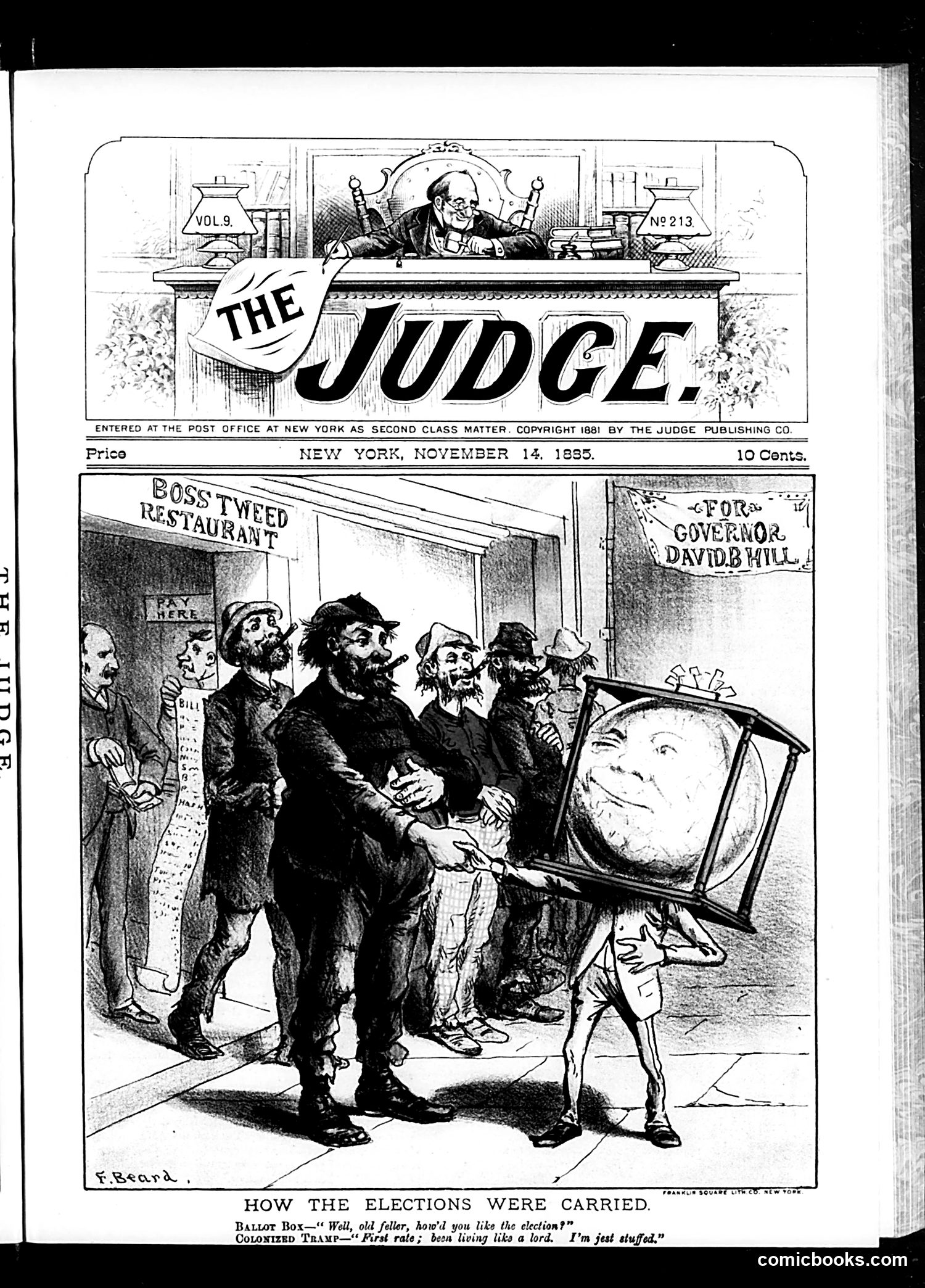
This 1885 *Judge* cartoon satirizes vote-buying and electoral corruption. A small figure labeled "For Governor: David Hill" holds a ballot box shaped like his own head, while rough-looking men (likely representing party operatives or immigrant voters) crowd outside Boss Tweed's Restaurant. The caption contrasts two election philosophies: a "Ballot Box" asks "Well, old feller, how'd you like the election?" while a "Colored Tramp" responds that living "like a lord" was better than voting—implying voters were bribed with money or favors rather than voting on principle. The cartoon mocks machine politics and suggests elections were "carried" through corruption and bribery rather than legitimate democratic process.
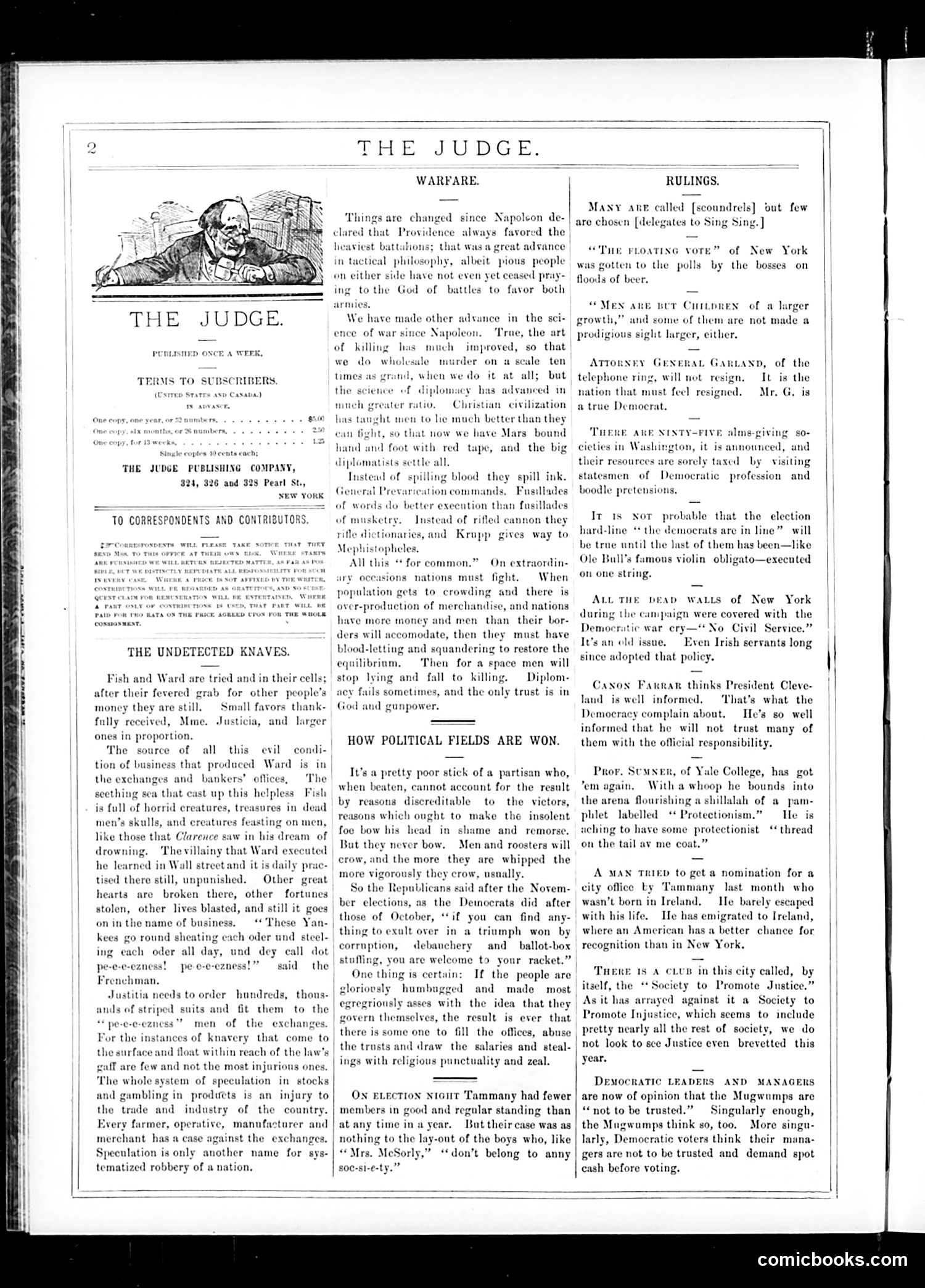
The main cartoon titled "THE UNDETECTED KNAVÉS" depicts two figures labeled Fish and Ward in prison cells. Based on the accompanying text, this satirizes their trial and imprisonment for financial crimes, with the passage noting they "are tried and in their cells; after their honesty tested goods for other people's money they are still." The political commentary criticizes corruption in business and Wall Street, suggesting these men's crimes—manipulating exchanges and "systematized robbery"—were widespread practices dressed up as legitimate commerce. The right-hand "RULINGS" section contains miscellaneous political commentary on contemporary issues including New York Democratic politics and election disputes, typical of Judge's satirical coverage of 1880s American political life.
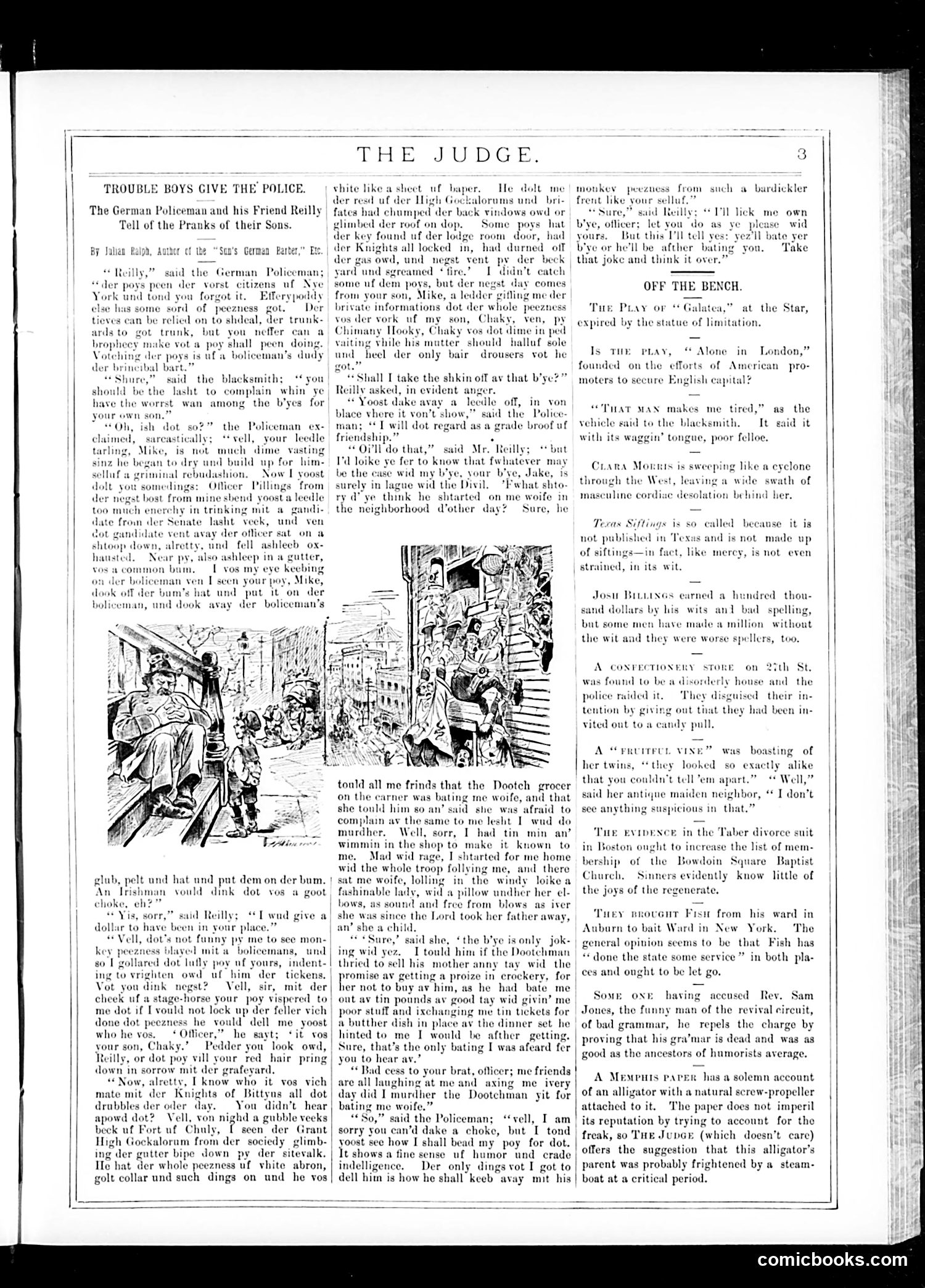
This page features a humorous dialogue between a German policeman and an Irish policeman named Reilly, comparing the mischievous behavior of their sons. Both fathers complain about youthful pranks—swapping hats with sleeping tramps, locking up members of a social club, disrupting a high-society gathering, and spreading false rumors. The satire relies on **ethnic stereotyping common to 1880s-90s American humor**: the German officer speaks in exaggerated accent and malapropisms ("poys" for "boys," "vos" for "was"), as does Reilly with Irish dialect. The joke is that both immigrant communities experience similar disciplinary frustrations with their troublemaking sons, suggesting a universal parental struggle that transcends ethnicity. The accompanying illustration shows a street scene of working-class immigrant life, reinforcing the period's treatment of German and Irish immigrants as outsiders worthy of ridicule. The humor is gentle rather than malicious—sympathetic to fathers' exasperation—but relies entirely on caricatured accents for its comic effect.
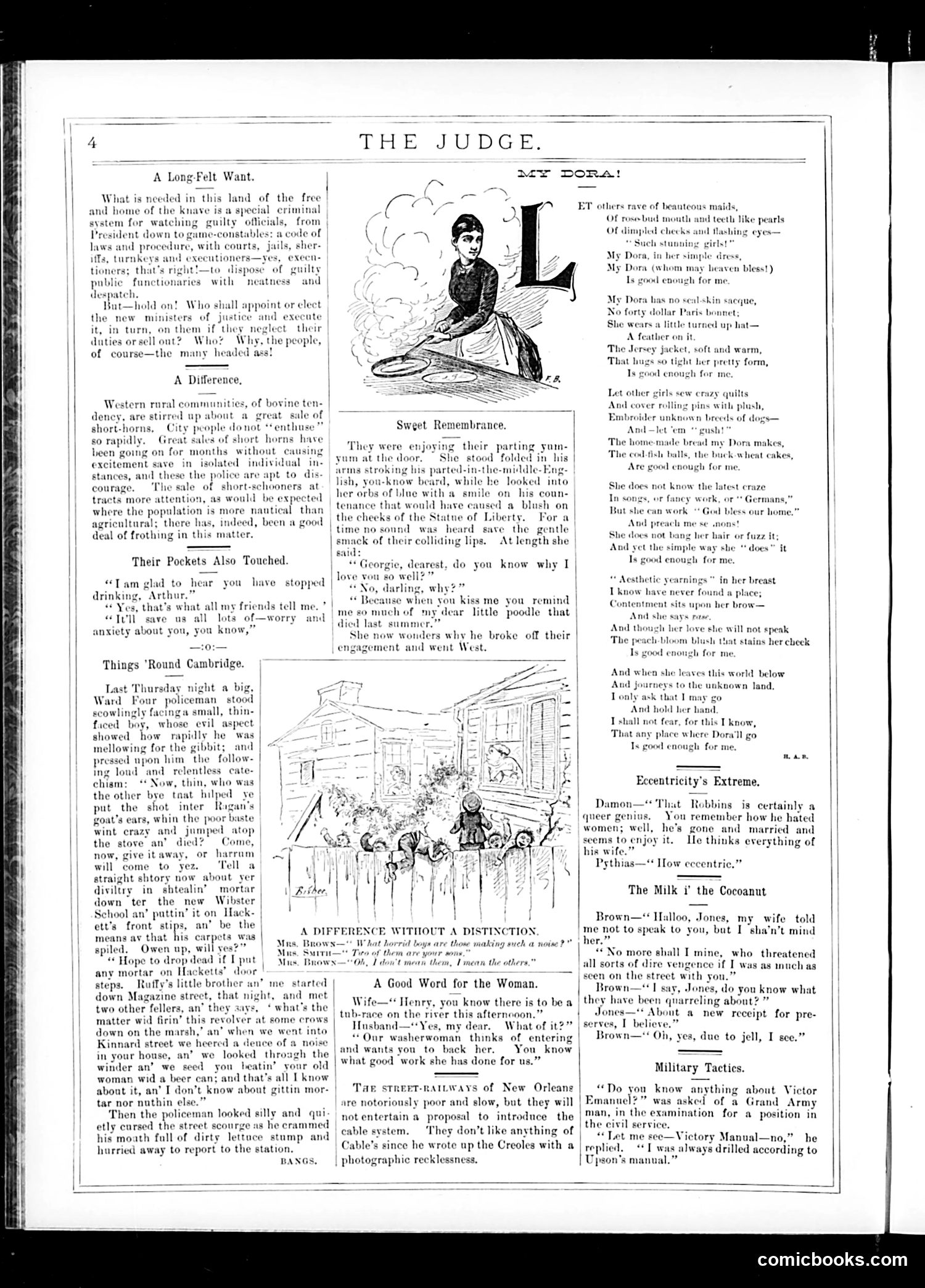
This page from *Judge* (a late 19th-century satirical weekly) contains several unrelated humor pieces and cartoons typical of the publication's mixed-content format. The main cartoon, "A Difference Without a Distinction," depicts two society women gossiping—a standard trope mocking upper-class pretension. The text pieces include social satire: "A Long-Felt Want" criticizes ineffective law enforcement and judicial corruption (a perennial concern of the era); "Their Pockets Also Touched" mocks sentiment in courtship; "Things 'Round Cambridge" features an Irish-accented policeman interrogating a boy—ethnic humor common to period American comedy; "A Good Word for the Woman" gently satirizes domestic gender roles. The "My Dora!" poem celebrates an idealized modest woman—sentimental Victorian verse. There's also mention of New Orleans streetcars refusing cable-car technology due to lingering resentment toward writer George Washington Cable, who had published sympathetic Creole fiction. The page demonstrates *Judge*'s mix of class mockery, ethnic caricature, and local political references now requiring historical context.
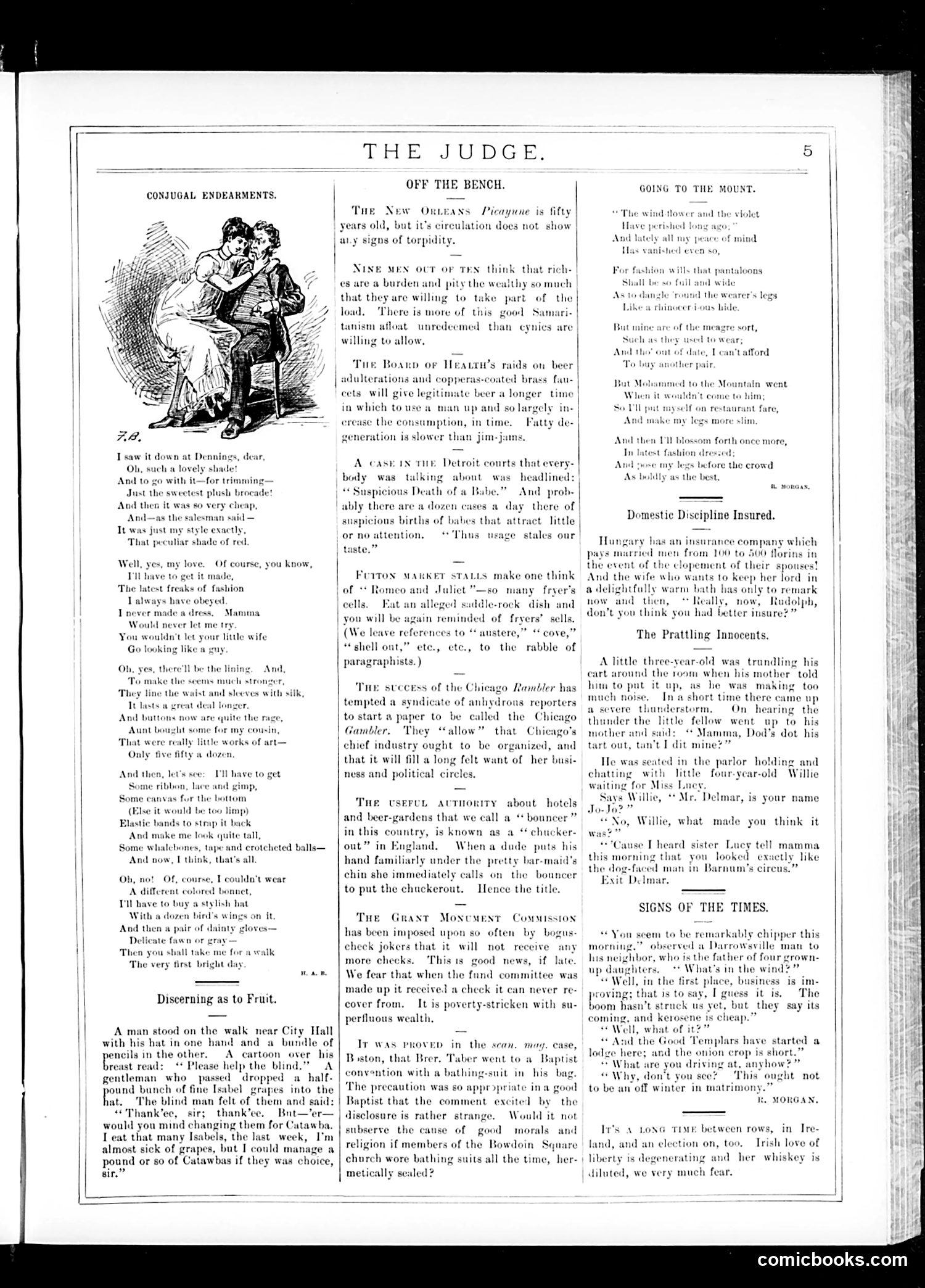
## Main Cartoons/Content: **"Conjugal Endearments"** (left): A satirical poem mocking wives' shopping habits. A couple discusses a dress purchase—the husband is portrayed as bewildered and financially exasperated as his wife catalogs endless additional expenses (ribbon, lace, canvas, whalebone, hat with bird wings, gloves). The joke targets women's perceived frivolousness and the financial burden of female fashion. **"Discerning as to Fruit"** (bottom left): A blind beggar asks a charitable gentleman to swap grapes for different varieties, showing ingratitude and pickiness despite receiving charity—satirizing the undeserving poor or ironic aspects of beggary. ## Right-side Short Items: Brief satirical notes on contemporary topics: the New Orleans *Picayune* newspaper, wealthy people's attitudes, health board beer raids, Detroit court scandals involving suspicious infant deaths, Chicago's "Rambler" newspaper and organized crime, hotel bouncers, and a grant monument commission. **Overall theme**: Typical Judge content combining gender stereotypes, class commentary, and topical humor through short satirical pieces and illustrations.
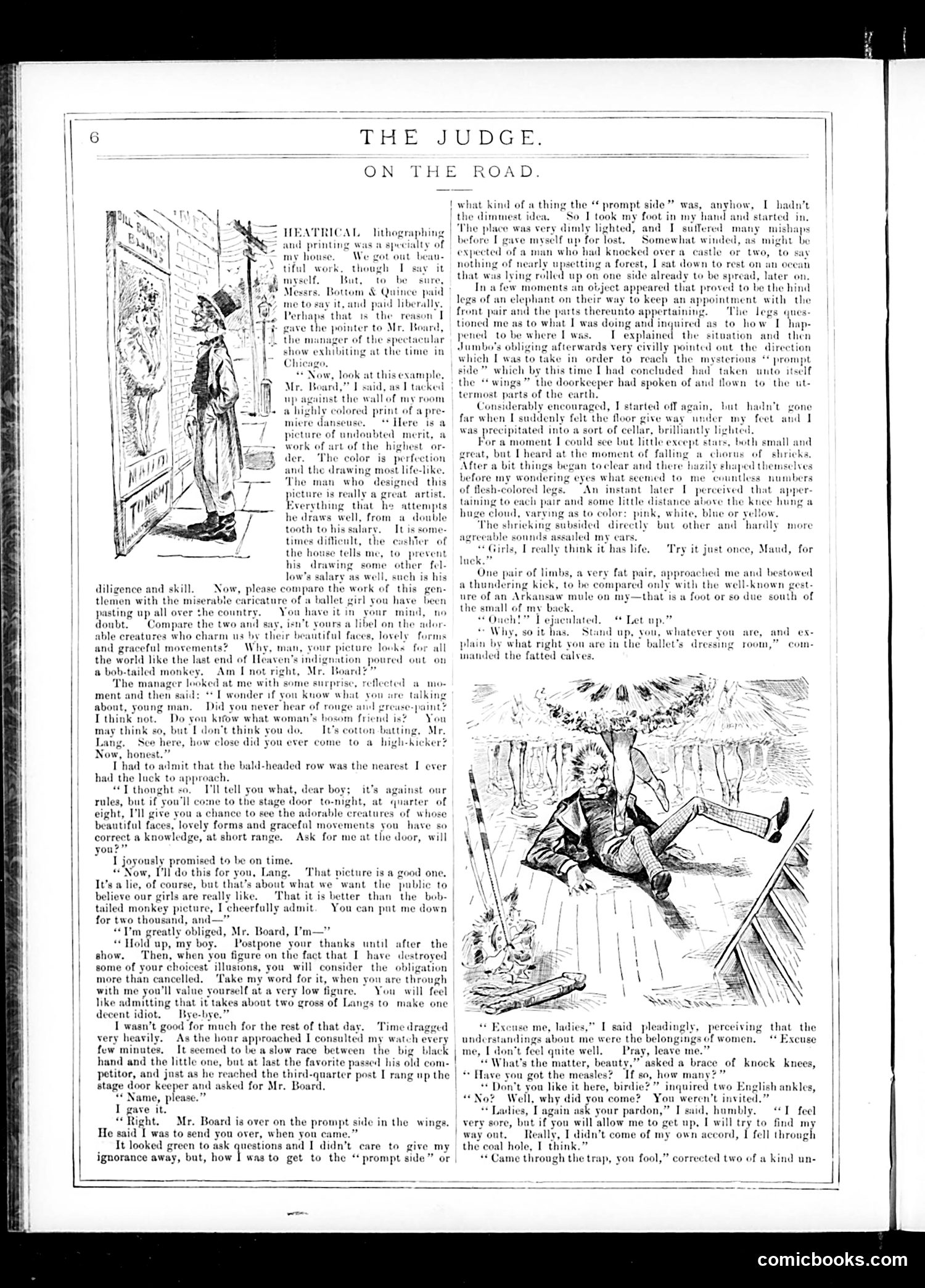
This page satirizes theatrical life, specifically the chaos of a ballet production. The narrator describes stumbling backstage at a theater, confused about reaching the "prompt side" (prompter's box). He falls into the dressing room and encounters the ballet dancers—repeatedly referred to mockingly as "the fatted calves"—whose legs are emphasized through exaggerated illustration. The satire targets the disconnect between how ballet dancers are portrayed in idealized lithographs versus reality. The manager contrasts flattering theatrical posters showing graceful, beautiful dancers with the crude behavior of actual performers, who kick the narrator and speak vulgarly. The recurring term "fatted calves" suggests the dancers are overfed, ungraceful, and ungainly—mocking both their physiques and their pretensions to artistry. The piece ridicules both theatrical vanity and the gap between romantic public perception and backstage reality.
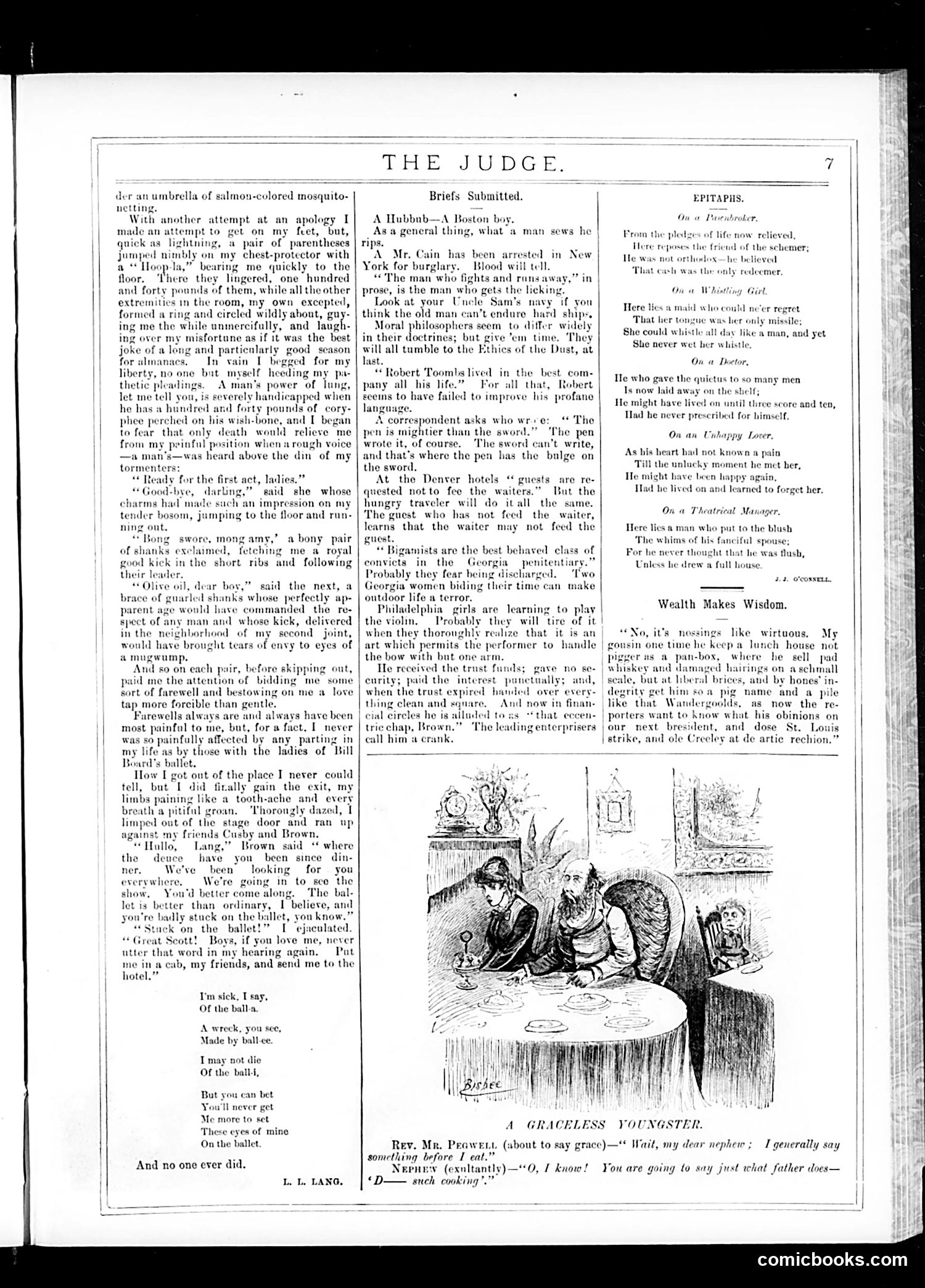
This single-panel cartoon depicts a social etiquette lesson gone wrong. A well-dressed older gentleman (likely representing proper Victorian manners) instructs a young boy at a dining table. The caption shows the boy rudely interrupting: "I generally say something before I eat," to which the exasperated adult responds, "such cooking." The satire targets youth's lack of refinement and respect for social conventions. The "graceless youngster" represents the younger generation's disregard for formal dining etiquette and deference to elders—a common Judge magazine theme mocking modern manners. The boy's crude honesty about the food's quality, rather than polite restraint, exemplifies the perceived moral decline of American youth that conservative satirists frequently lamented in this era.
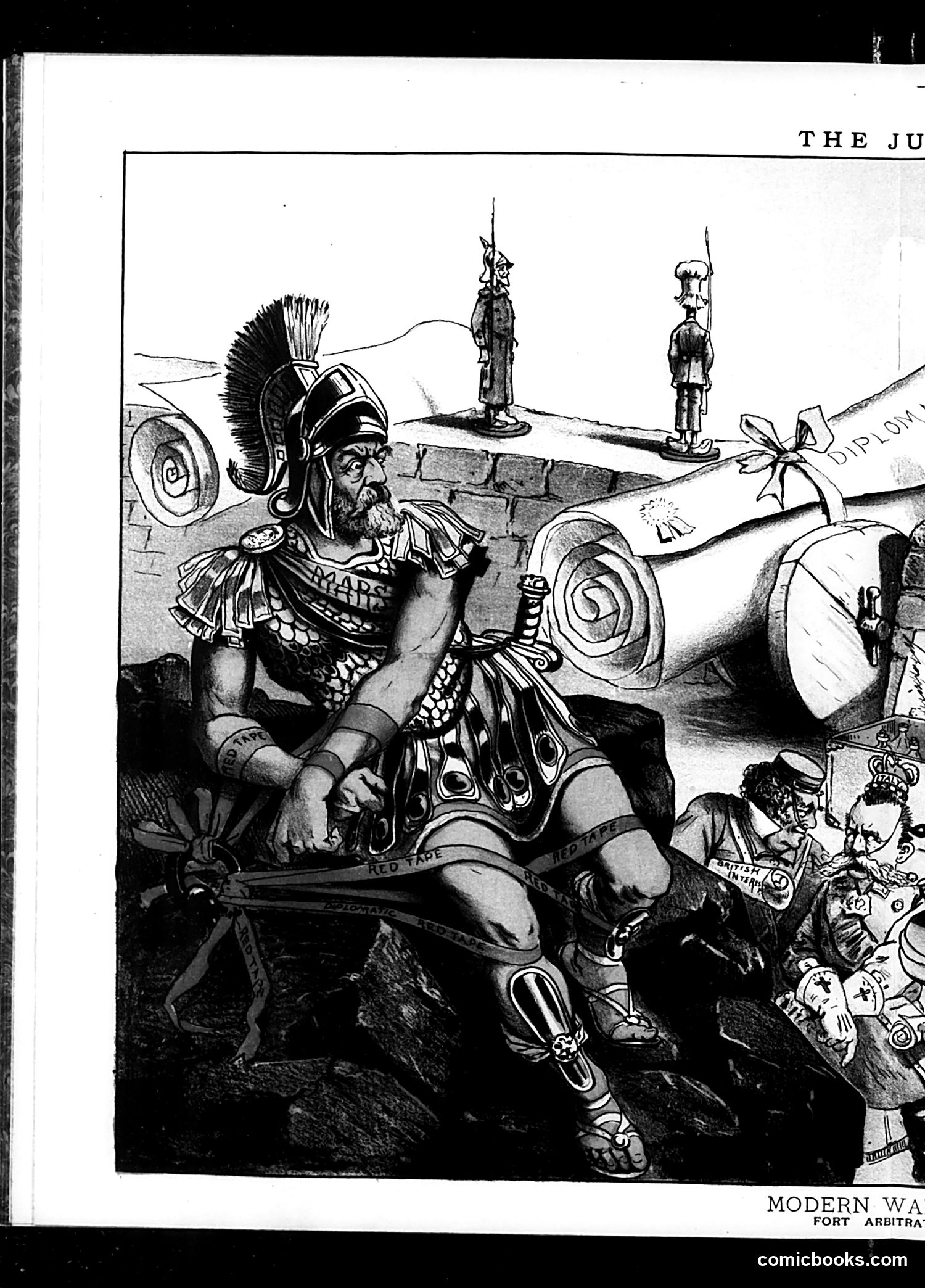
This appears to be a satirical illustration titled "Modern War" and "Fort Arbitration" from *Judge* magazine. The central figure is a classical warrior or gladiator in ornate armor, depicted in a heroic pose but seemingly outdated. He's surrounded by modern industrial elements—artillery, cannons, and military equipment—suggesting a contrast between traditional martial glory and contemporary warfare's mechanized, impersonal nature. The small figures on the right appear to be civilians or diplomats, possibly representing arbitration or peace efforts. The satire likely critiques either the romanticization of military conflict or the tension between old-fashioned notions of honorable warfare and modern industrial-scale combat. The "Fort Arbitration" reference suggests commentary on international dispute resolution, though the specific historical context remains unclear without a date.
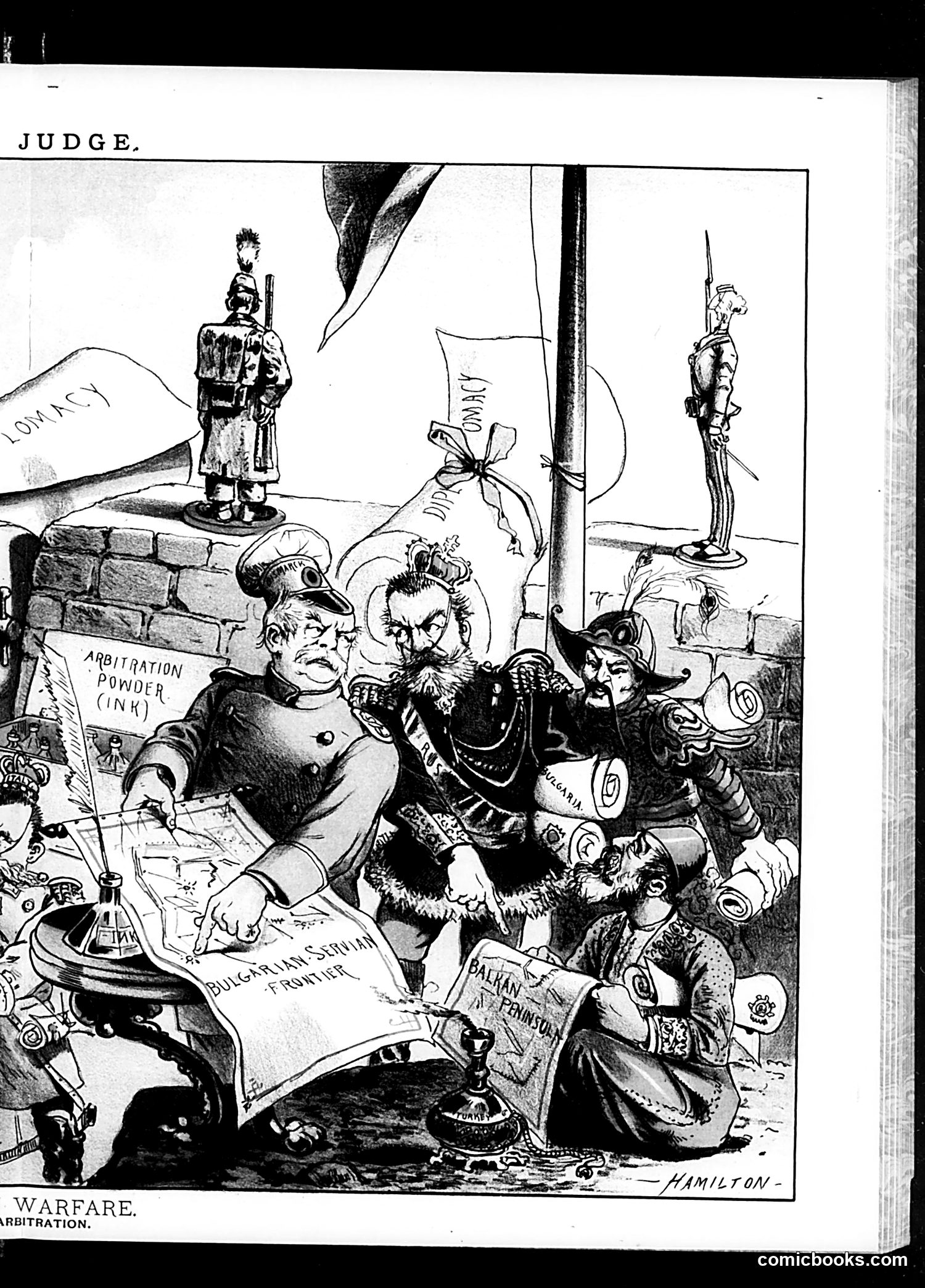
This cartoon satirizes international conflict resolution through arbitration. Central figures appear to be national leaders or military representatives engaged in warfare, surrounded by documents labeled "Arbitration Powder (Ink)" and references to "Burglarian Scheme" and "Balkan Frontier." The satire suggests that arbitration—supposedly a peaceful dispute-resolution method—is merely cosmetic ("powder," "ink") masking continued warfare and aggression. Military figures stand guard above while diplomats below engage in paperwork, implying that diplomatic efforts are ineffectual theater hiding real imperial or colonial ambitions. The cartoon critiques the gap between arbitration's peaceful rhetoric and nations' actual power-seeking behavior, likely referencing early 20th-century Balkan conflicts or broader imperial expansion despite arbitration frameworks.
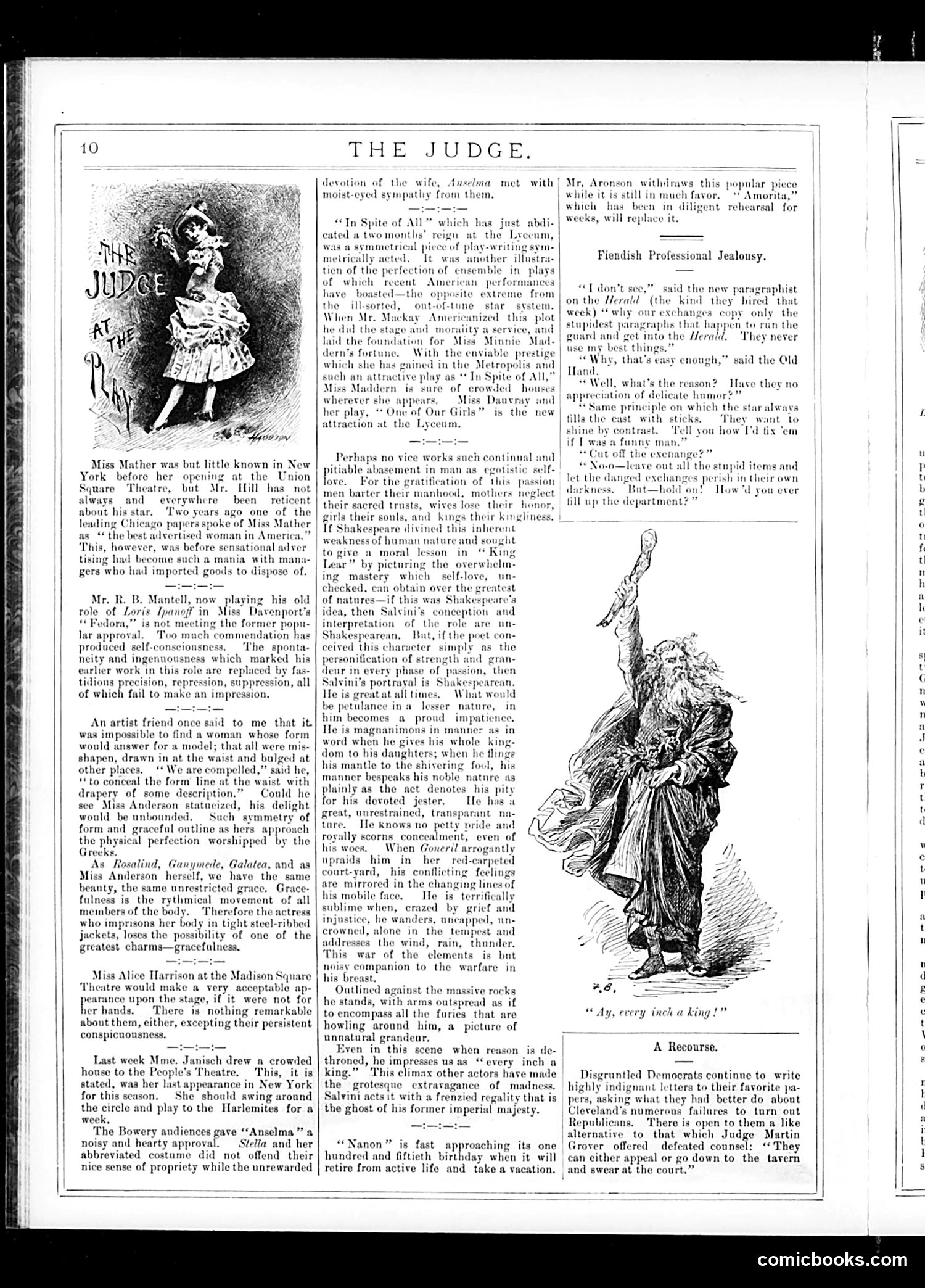
This page from *Judge* magazine features theater criticism and social commentary typical of the publication's satirical focus on New York's entertainment world. The main illustrated cartoon depicts a figure in classical dress with the caption "Ay, every inch a king!" — likely referencing actor Tommaso Salvini's contemporary performance as King Lear, which the accompanying text discusses extensively. The written content critiques various theatrical performers and productions of the era, including Miss Mather, R.B. Mantell, and Miss Anderson. The criticism focuses on acting styles, physical presentation, and theatrical conventions. A notable recurring theme is the satire of excessive advertising and self-promotion by theater managers ("such a mania with managers"). The piece titled "A Recourse" at bottom discusses Democratic political strategy regarding judicial appointments, suggesting Judge magazine's typical blend of entertainment and political satire. The overall tone suggests *Judge*'s role as arbiter of taste in both entertainment and political matters for educated urban readers.
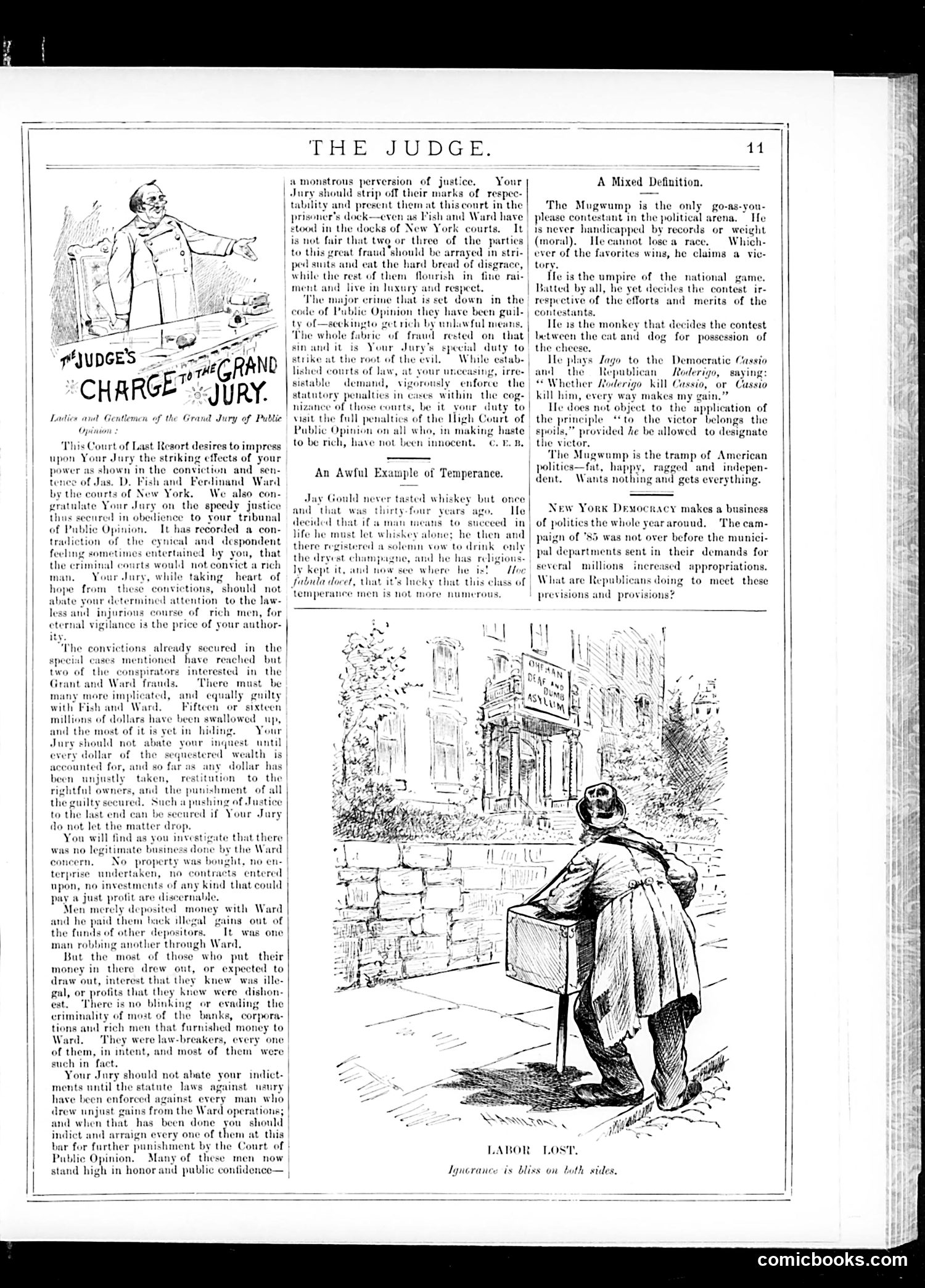
This page addresses the **Fish and Ward frauds**—a major 1884 financial scandal involving James D. Fish and Ferdinand Ward at the Marine National Bank in New York. The editorial charges that only two conspirators faced conviction while others involved in the scheme escaped justice. The **left cartoon** depicts a judge charging a grand jury to pursue accountability beyond the courtroom, invoking "Public Opinion" as a higher tribunal. The satirical point: wealthy fraudsters should face the same disgrace as the convicted Fish and Ward. The **right cartoon**, "Labor Lost," shows a laborer outside tenement housing—illustrating the human cost of the fraud. The caption "Ignorance is bliss on both sides" suggests both the wealthy conspirators and poor victims remain willfully blind to systemic corruption. The secondary piece mocks Jay Gould's claimed temperance (never drinking whiskey except once, decades ago), implying that avoiding one vice while profiting from financial crimes is moral hypocrisy. The satire targets: inequality in justice, financial crime's victims, and the apparent indifference of the wealthy to consequences.
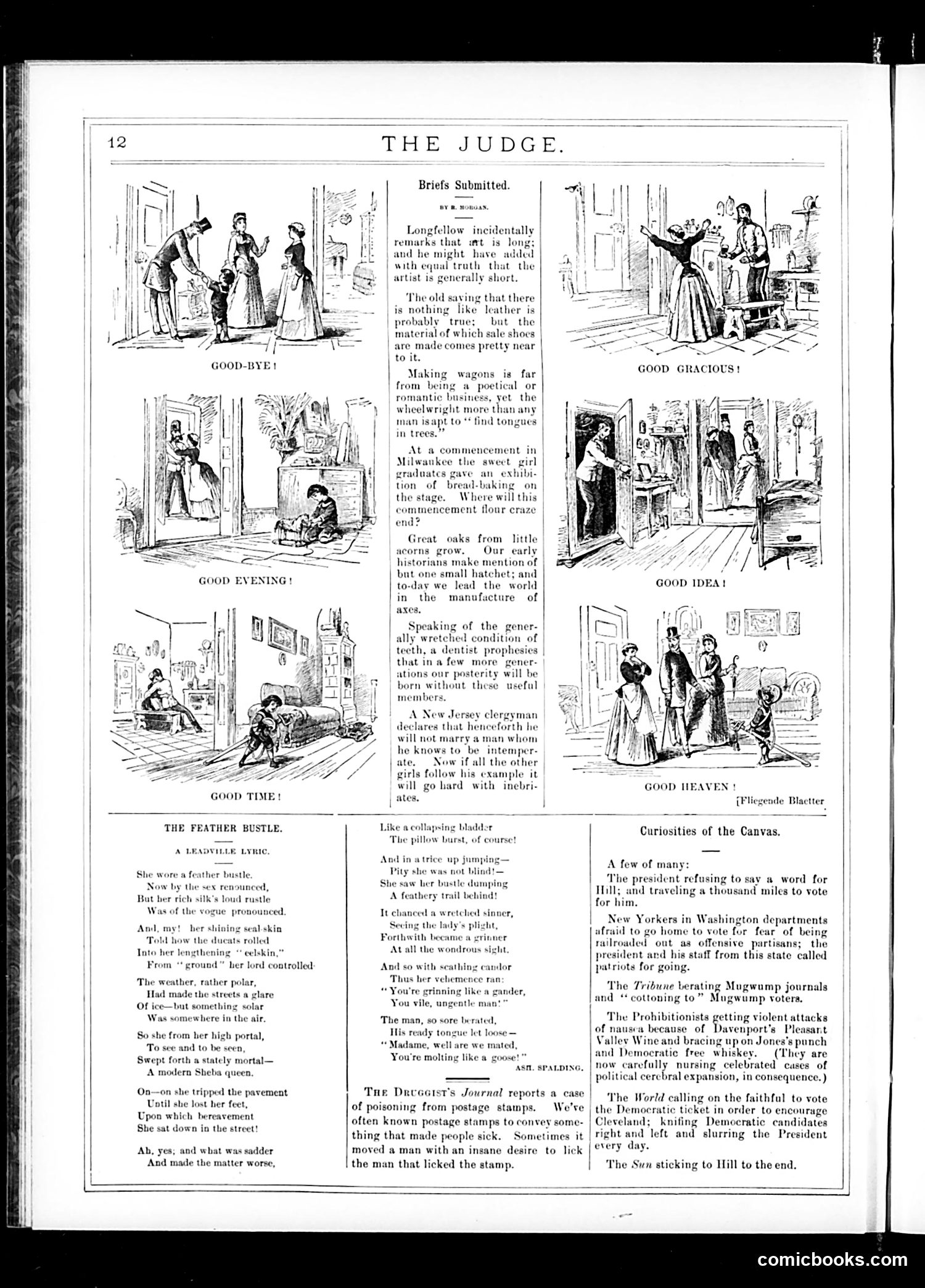
This page contains several satirical pieces mocking American politics and social pretensions circa the 1880s-90s. The "Briefs Submitted" section offers cynical commentary on contemporary issues: artists' poverty, dentists' predictions about humanity losing teeth, and a New Jersey clergyman refusing to marry intemperate men. "The Feather Bustle" lampoons women's fashion excess—a woman wearing an impractical feathered bustle slips on ice, it bursts spectacularly, and a passerby mistakes the scattered feathers for molting, mocking both female vanity and male foolishness. "Curiosities of the Canvas" satirizes newspaper and political hypocrisy, attacking publications (the *Tribune*, *World*, *Sun*) for inconsistent coverage. It mocks Democratic papers supporting Cleveland while simultaneously attacking Democratic candidates, and criticizes the *Sun* for blindly supporting "Hill" (likely David B. Hill, New York politician) regardless of merit. The overall tone ridicules vanity, journalistic dishonesty, and political insincerity.
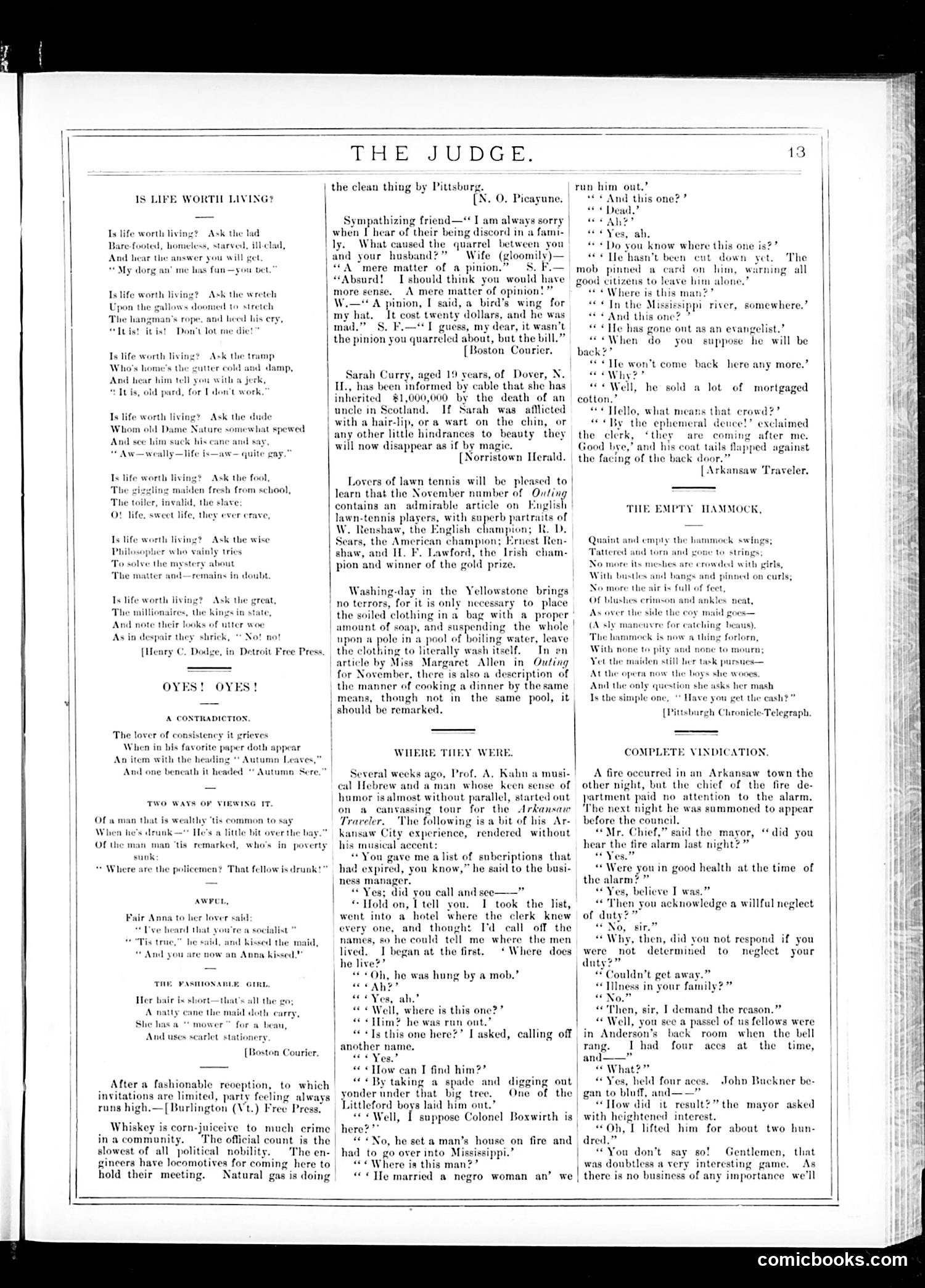
This page from *Judge* magazine contains multiple short satirical pieces typical of 1890s American humor: **"Is Life Worth Living?"** — A philosophical poem asking various social classes (homeless, workers, fools, wise men, millionaires, kings) whether life has value. The satire suggests life's worth varies by circumstance, with the wealthy finding it least worthwhile despite their advantages. **Various brief satirical anecdotes** mock contemporary issues: a wife's quarrel over a broken "pinion" (bird wing) she's misnamed; a Scottish inheritance suddenly making an unattractive woman desirable; dishonest political officials; and excessive drinking correlating with crime. **"The Fashionable Girl"** satirizes modern women's fashion—short hair, cane-carrying, and scarlet stationery—suggesting these affectations are ridiculous. The overall tone is light social commentary on class differences, women's changing roles, political corruption, and consumer culture—typical *Judge* magazine fare criticizing Victorian-era American society through humor.
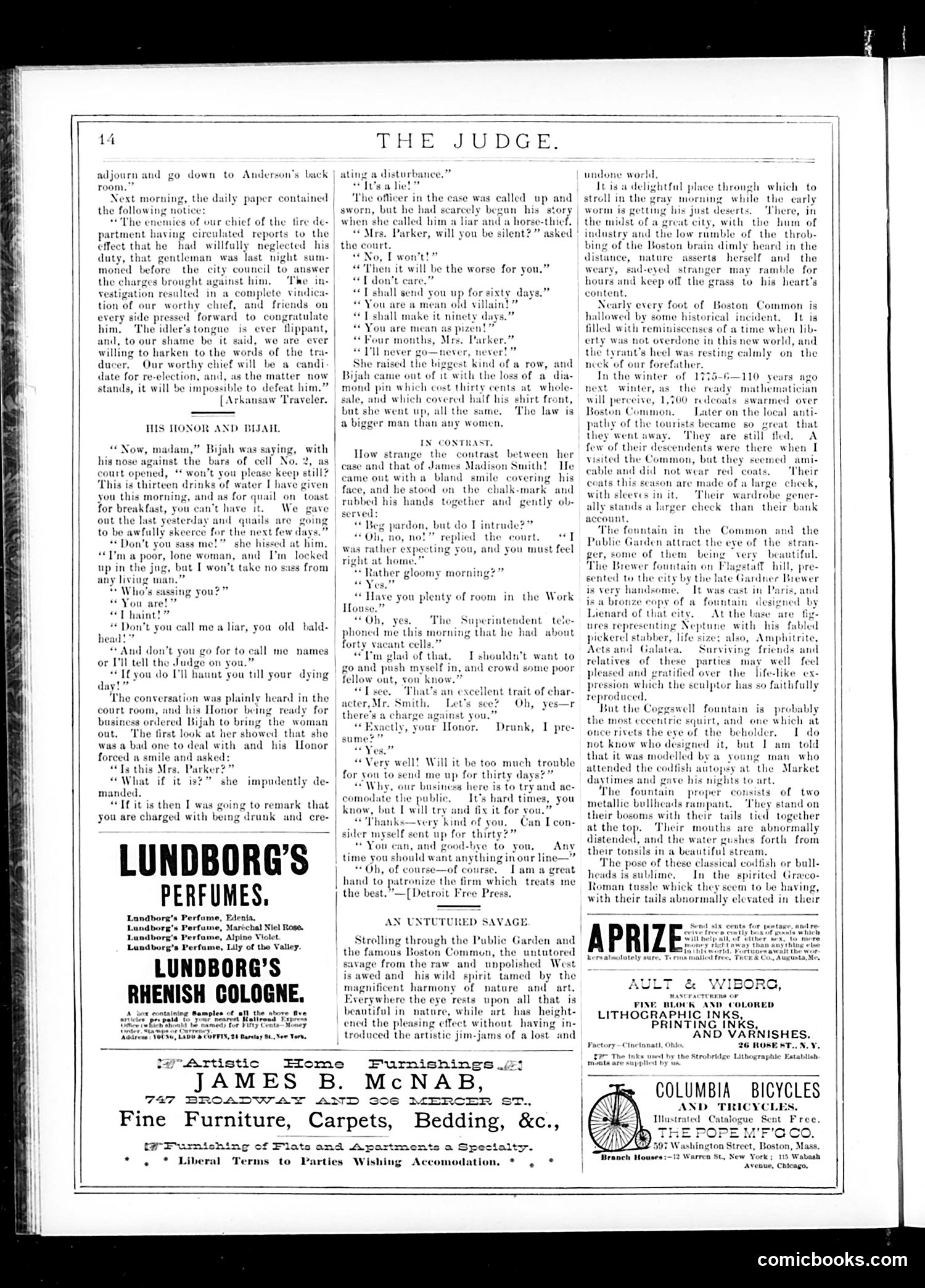
This page contains a satirical story contrasting two court cases. A respectful male defendant ("Bijah") receives lenient treatment from the judge—who offers him water, sympathizes with his poverty, and arranges a light sentence. Meanwhile, Mrs. Parker, a disruptive female defendant, is treated harshly: she's threatened with escalating jail time (60, then 90 days) for sass and contempt. The satire mocks judicial bias and hypocrisy. The judge displays chivalry toward the working-class man while showing zero tolerance for the "difficult woman," despite her being similarly disadvantaged. The piece exposes how judges rationalize unequal justice through selective sympathy, ultimately suggesting the law serves male interests over female dignity—even when women are equally impoverished and desperate. The "Arkansas Traveler" attribution suggests frontier/rural context, adding a layer of critique about rough justice in developing regions.
This page is primarily **advertisements** with one satirical piece: "The Modern Shakespeare," a parody of theatrical dialogue attributed to Bill Nye. The satire mocks **contemporary American writers** who imitated Shakespeare's flowery, archaic language while addressing mundane domestic situations—specifically, the complications of loving a woman whose mother is unattractive or incompetent. The piece uses absurdly inflated Shakespearean language ("Andromeda!" "deities of damning bane forfend!") for trivial problems: a rival suitor, an unattractive mother-in-law, complaints about her cooking and "warpage of the soul." The joke targets the pretentiousness of American literati who adopted Shakespearean conventions inappropriately, treating common emotional grievances as tragic material worthy of the Bard's style. By elevating such pedestrian concerns to mock-Shakespearean heights, Nye ridicules both the affectation of his era's writers and the absurdity of applying classical dramatic language to everyday relationship troubles. The attribution to the "Yonkers Gazette" adds comic irony—a provincial source claiming Shakespearean authority.
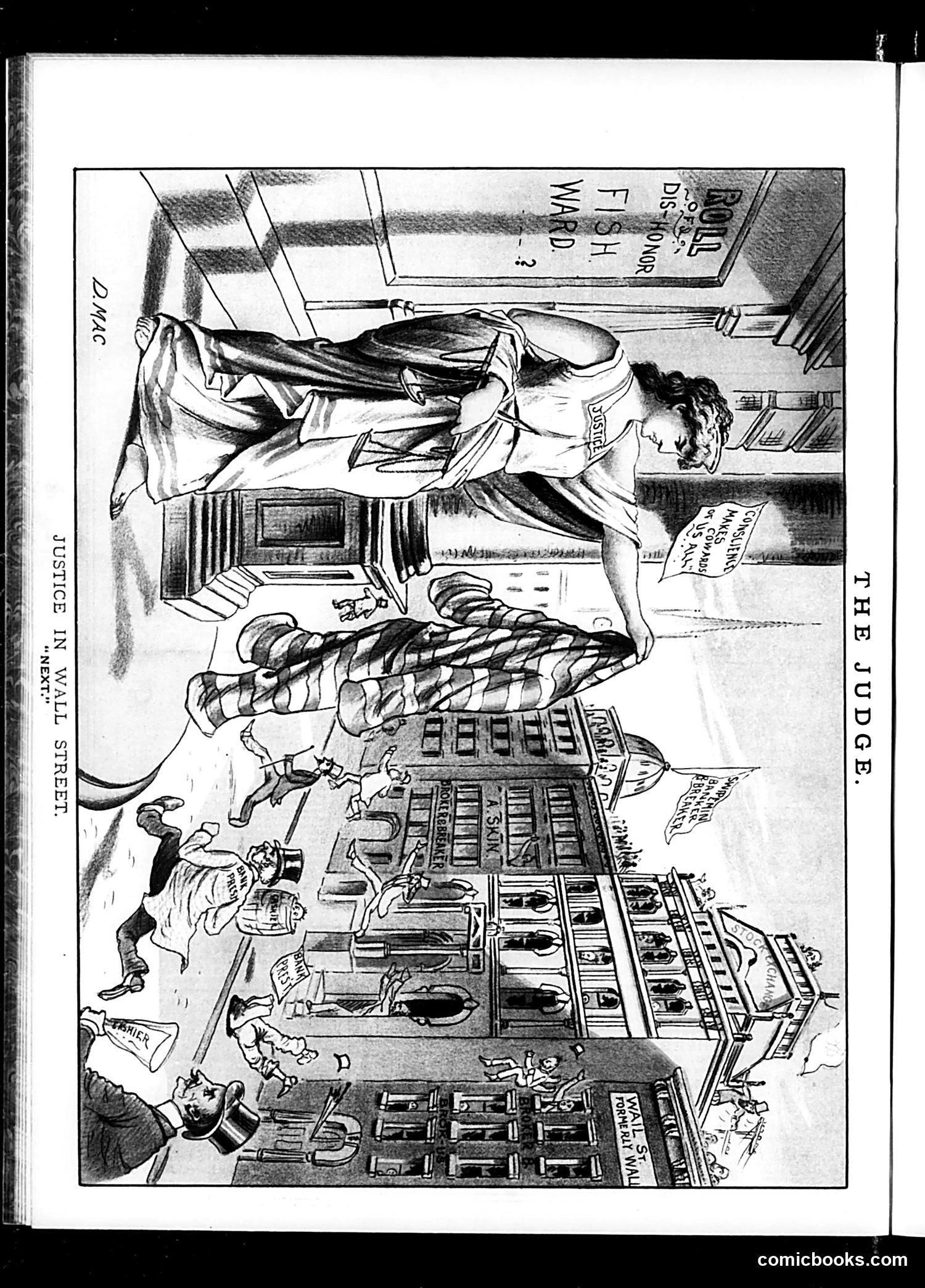
This satirical cartoon depicts a courtroom scene on Wall Street. A judge presides over proceedings while well-dressed businessmen in striped suits (suggesting corruption or criminality) stand before the bench. The visual joke appears to criticize the *absence* of actual justice in financial dealings—the title's irony suggests that Wall Street operates outside normal legal accountability. The cartoon likely comments on financial fraud, market manipulation, or corruption among wealthy financiers during the Gilded Age or early 20th century, when Judge magazine frequently mocked the wealthy and powerful. The exaggerated formal courtroom setting contrasts with the implicit suggestion that real justice doesn't actually occur in Wall Street dealings. The specific financial scandals or figures referenced remain unclear without additional context.