
Judge, 1885-11-14 · page 10 of 16
Judge — November 14, 1885 — page 10: what you’re looking at
What you’re looking at
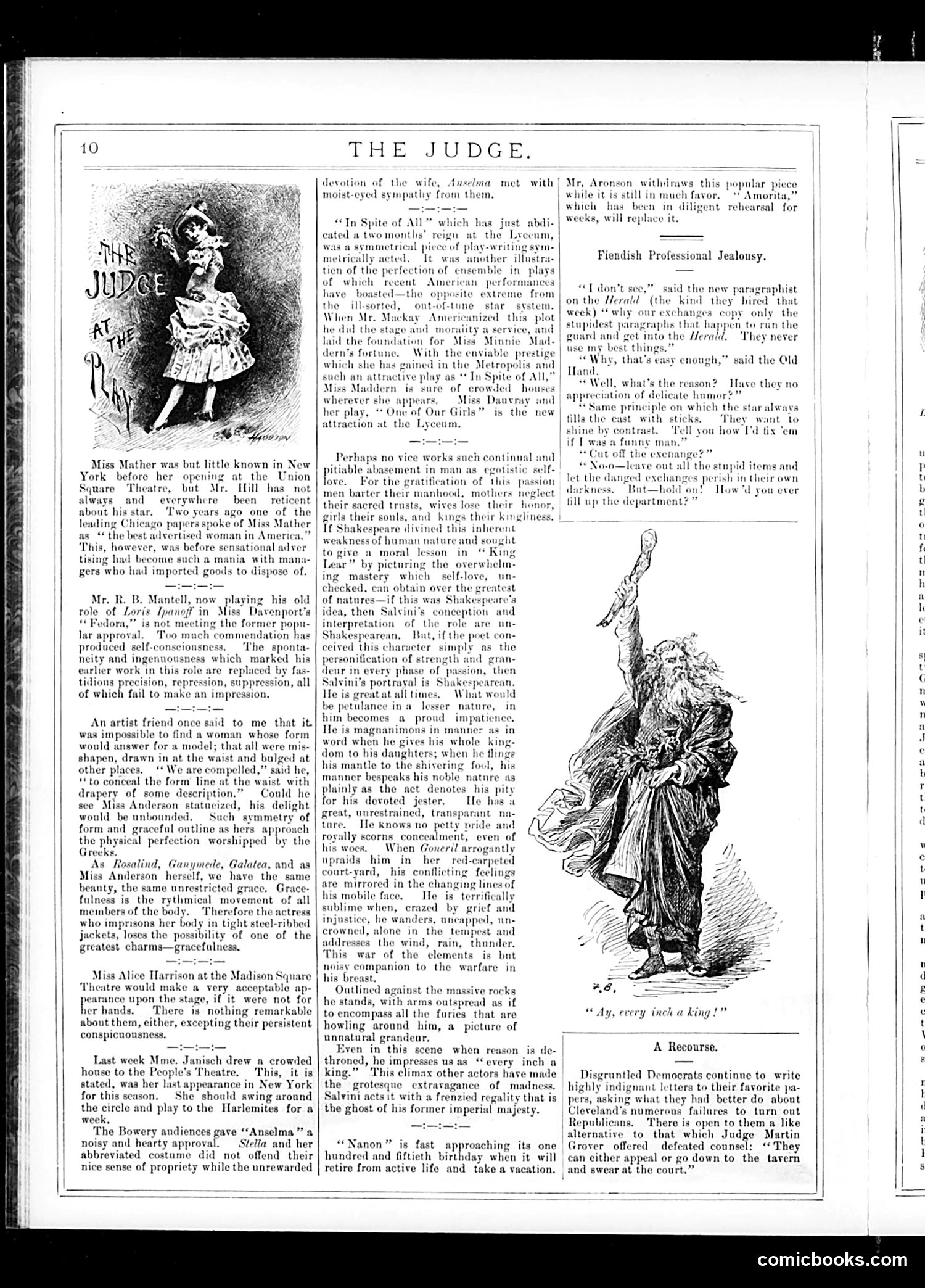
This page from *Judge* magazine features theater criticism and social commentary typical of the publication's satirical focus on New York's entertainment world. The main illustrated cartoon depicts a figure in classical dress with the caption "Ay, every inch a king!" — likely referencing actor Tommaso Salvini's contemporary performance as King Lear, which the accompanying text discusses extensively. The written content critiques various theatrical performers and productions of the era, including Miss Mather, R.B. Mantell, and Miss Anderson. The criticism focuses on acting styles, physical presentation, and theatrical conventions. A notable recurring theme is the satire of excessive advertising and self-promotion by theater managers ("such a mania with managers"). The piece titled "A Recourse" at bottom discusses Democratic political strategy regarding judicial appointments, suggesting Judge magazine's typical blend of entertainment and political satire. The overall tone suggests *Judge*'s role as arbiter of taste in both entertainment and political matters for educated urban readers.
📄 Transcribed text from this page (OCR, searchable)
Machine-transcribed from the original scan — historical spelling and the odd misread are preserved.
DIN her was but little known in New ‘ore her the Union Square Theatre, but Mr. Till has not always and everywhere — been reticent about his star. ‘Two years one of the leading Chicago papers spoke of Miss Mather Miss M. York b opening a as he best advertised woman in America.” This, however, was before sen ver tising become such a mania with mana- gers who had imported goods to dispose of. Mr. R. B. Mantell, now playing his old role of Loris Ipanoff in Mi onport’s “Fedora,” is not meeting the former popu- lar approval. ‘Too much commendation has produced sel jousn The sponta heity and ingenuousnes marked his earlier work in this role are replaced by fas- tidions precision, repression, suppression, all of which fail to make an impression. 1 which An artist friend once said to me that it was impossible to find a woman whose form would answer for a model; that all were mis- shapen, drawn in at the waist and bulged at other places.‘ We are compelled,” said he, **to conceal the form line at the waist with drapery of some description.” Could he see Miss Anderson statueized, his delight would be unbounded. Such symmetry of form and graceful outline as hers approach the physical perfection worshipped by the G é As Rosalind, Ganymede, Galatea, and as Miss Anderson herself, we have the same beauty, the same unrestricted grace. Grace- fulness is the rythmical movement of all members of the body. Therefore the actress who imprisons her body in tight steel-ribbed jackets, loses the possibility of one of the greatest: charms—gracefulness, Miss Alice Harrison at the Madison Square Theatre would make a very acceptable ap- m nce upon the stage, if it were not for her hands, There is nothing remarkable about them, either, excepting their persistent conspicuousness. Last week Mme. Janisch drew a crowded house to the atre, This, it is stated, was her last appearance in New York for this season. he should swing around the circle and play to the Harlemites for a week, ‘The Bowery audiences gave “Anselma” a noisy and hearty approval. Stella and her abbreviated costume did not offend their nice sense of propriety while the unrewarded | are mirrored in the changing lin THE JUDGE. the wife ympatl fnselma met with from them, which he vite of All just abdi- cated a two mont the Lyceum, | was a symmetrical piece of play-writing sym metrically acted. It was another illustr: tien of the perfection of ensemble in plays of which recent’ American performances have boasted—the opposite extreme from the ill-sorted, — ont-of-tune system. | When Mr. Mackay Americani plot he did the stage and mc and tid the foundation for d- dern’s fortune which she hus g such an attrac star ned int ve play as “In Spite of All Miss Maddern is sure of crowded hous wherever she appears. Miss Dauvray and her play, ** One of Our Girls” is the new attraction ut the Lyce Perhaps no vice works such continual and pitiable ement in man as tistic love. For the gratification of this px men barter their mant mothers ne their sacred trusts, wives their girls their souls, and king veare divined this inhe of human nature and s moral lesson in. “ King by picturing the overwhelm: ing mastery which self-love, un- checked, can obtain over the greatest atures—if this was Shakespeare's then Salvini’s conception and interpretation of the role are un- akesp in. But, if the poet con- ceived this character simply as the personification of strength and g deur in every phase of pa: Salvini’s portrayal is Shakespearean. He is greatatalltimes. What would be petulance ina lesser nature, in him becomes a proud impatience. He is magnanimous in manner as in word when he gives his whole king- dom to his daughters; when he flir his mantle to the shivering fool, his manner bespeaks his noble nature as plait the act denotes his pity for his devoted jester. He has i great, unrestrained, transparant na- ture. Ile knows no petty pride and royally scorns concealment, even of his w When Goneril arrogant] upraids him in her red-carpeted court-yard, his conflicting feelings of his mobile face. He is. terrifically sublime when, crazed by grief and injustice wanders, uncapped, nn- crowned, alone in the tempest and addresses the wind, rain, thunder, This war of the elements is but noisy companion to the warfare in his breast. Outlined against the massive rocks he stands, with arms outspread as if to encompass all the furies that are howling around him, a picture of unnatural grandeur. Even in this scene when reason throned, he impresses us as ‘‘ every king.” This climax other actors have made the grotesque extravagance of madness. Salvini acts it with a frenzied regality that is the ghost of his former imperial majesty. is de- inch a “‘Nanon” is fast approaching its one hundred and fiftieth birthday when it will retire from active life and take a vacation. | while it is | use my best things. and swear at the court.” Mr, Aronson withdraws this popular pic Tin much favor. Amorita,” which has been in diligent rehearsal for weeks, will replace it. F ndish Professional Jealousy. “T don't seo,” said the new paragraphist onthe Merald (the kind they hired that week) “why our exchanges copy only. the stupidest paragraphs that happen to rin the guard and get into the /erald. hey never. ” said the Qld “Why, that’s easy enoug Hand “Well, what's the reason? appreciation of delicate humor * Same principle on which the star always fills the east with sticks. ‘They want. to shine by contrast. ‘Tell you how I'd fix ‘em if P was a funny man.” Cut off the exe No Have they no pid items and ish in their own How ‘d you ever A Recourse. Disgruntled Democrats continue to write highly indignant letters to their favorite pa- pers, asking what they had better do about Cleveland’s numerous failures to turn out Republicans. There is open to them a like alternative to that which Judge Martin Grover offered defeated counsel: ‘‘ They can cither appeal or go down to the tavern comicbooks.com