
A complete issue · 16 pages · 1885
Judge — August 15, 1885
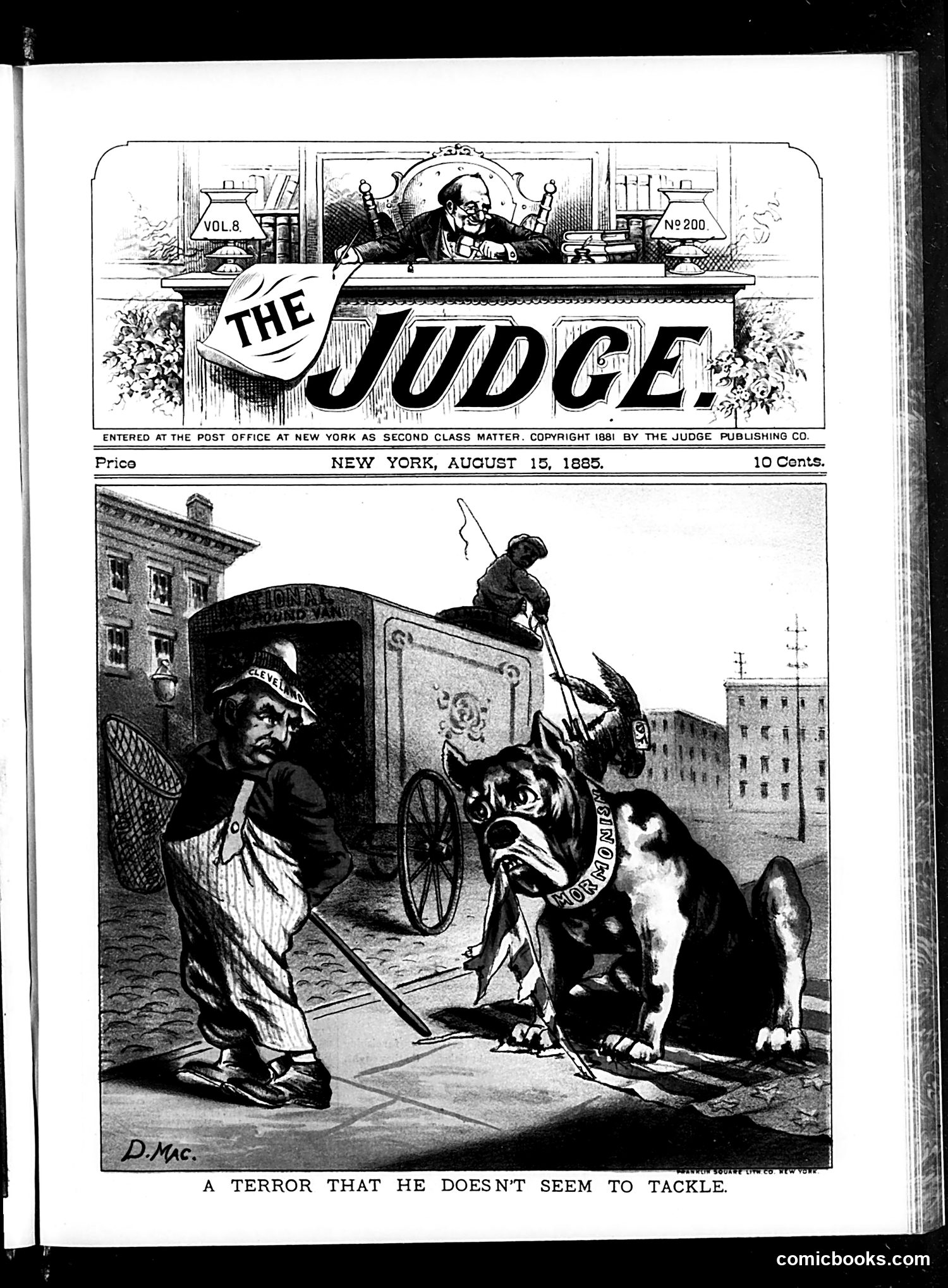
This political cartoon depicts a police officer (left) confronting a large dog wearing a "Police Dog" collar beside a delivery wagon. The title "A Terror That He Doesn't Seem to Tackle" suggests ironic criticism of law enforcement. The cartoon appears to satirize police ineffectiveness or selective enforcement—the officer confronts the dog while ignoring threats from the wagon above (a figure wielding what appears to be a weapon or club). The satire likely critiques New York City police for pursuing minor infractions (represented by the harmless dog) while neglecting serious crimes or dangers. The specific context remains unclear without additional historical documentation about August 1885 New York City policing scandals or crime concerns.
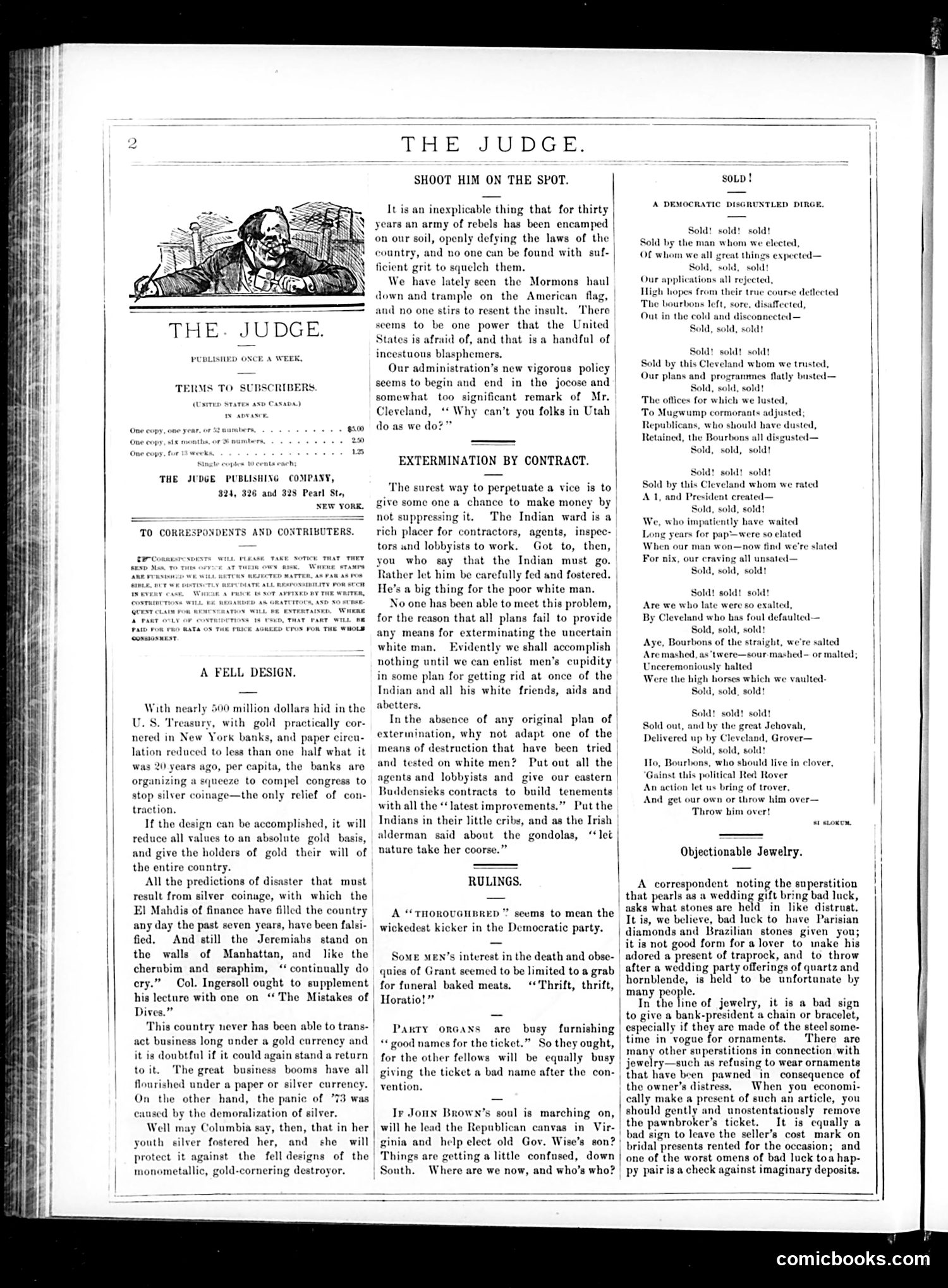
This page contains multiple political editorials attacking the Cleveland administration and Democratic Party. **"Shoot Him on the Spot"** criticizes the government's failure to suppress Mormon polygamy in Utah for thirty years, sarcastically asking why the U.S. is "afraid" of this religious minority. **"Sold! A Democratic Disgruntled Dirge"** mocks Democratic voters' disappointment with Cleveland's policies, using repetition of "sold!" to suggest betrayal of party promises. **"A Fell Design"** attacks financiers and bankers allegedly orchestrating a monetary contraction scheme using gold to consolidate wealth and control. References to "Dives" (biblical rich man) and Col. Ingersoll add moral weight. **"Extermination by Contract"** sarcastically proposes solving the "Indian problem" by exploiting contractors' greed—suggesting the government corrupt itself rather than address indigenous peoples humanely. It's bitterly ironic commentary on how profit motives perpetuate systemic failures. The tone is consistently partisan Republican critique of Democratic governance.
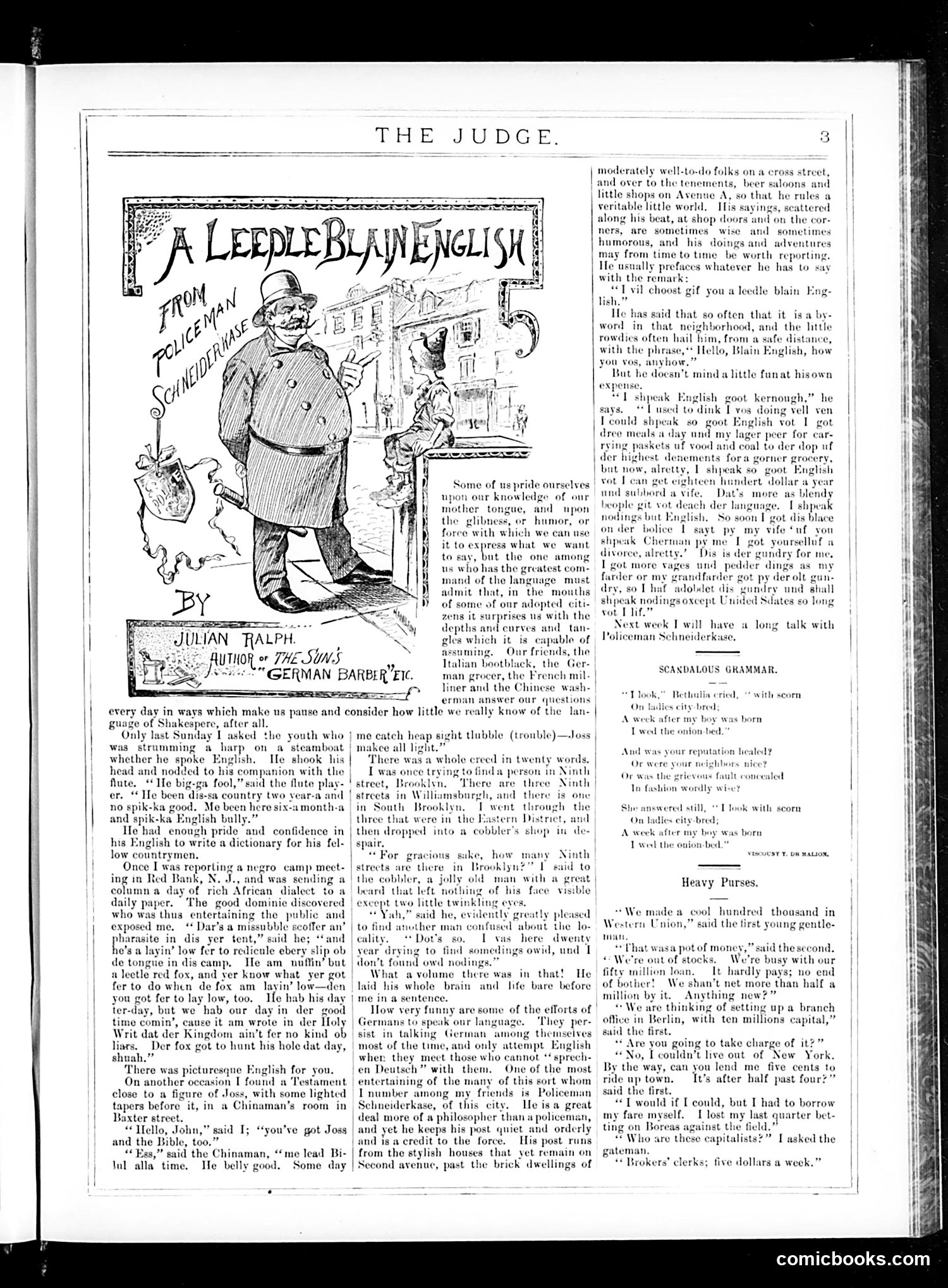
This satirical piece by Julian Ralph mocks the broken English spoken by immigrants in late 19th-century America. The cartoon's title character—a portly German immigrant in a top hat—exemplifies the struggle of adopted citizens to master English. Ralph catalogs humorous examples: an Italian bootblack, German grocer, French milliner, Chinese launderer, and Irish policeman Schneiderkase all mangle English in ways that reveal both linguistic confusion and cultural displacement. The humor targets not immigrants themselves but rather American assumptions about language mastery and assimilation. The recurring phrase "leedle blain English" (little broken English) frames these struggles sympathetically—the immigrants try earnestly despite mixing German syntax, dropped articles, and mispronunciations. Ralph suggests their garbled speech paradoxically reveals deeper truths about human nature and experience than "proper" English might. The satire ultimately critiques American smugness about linguistic superiority while celebrating immigrant resilience.
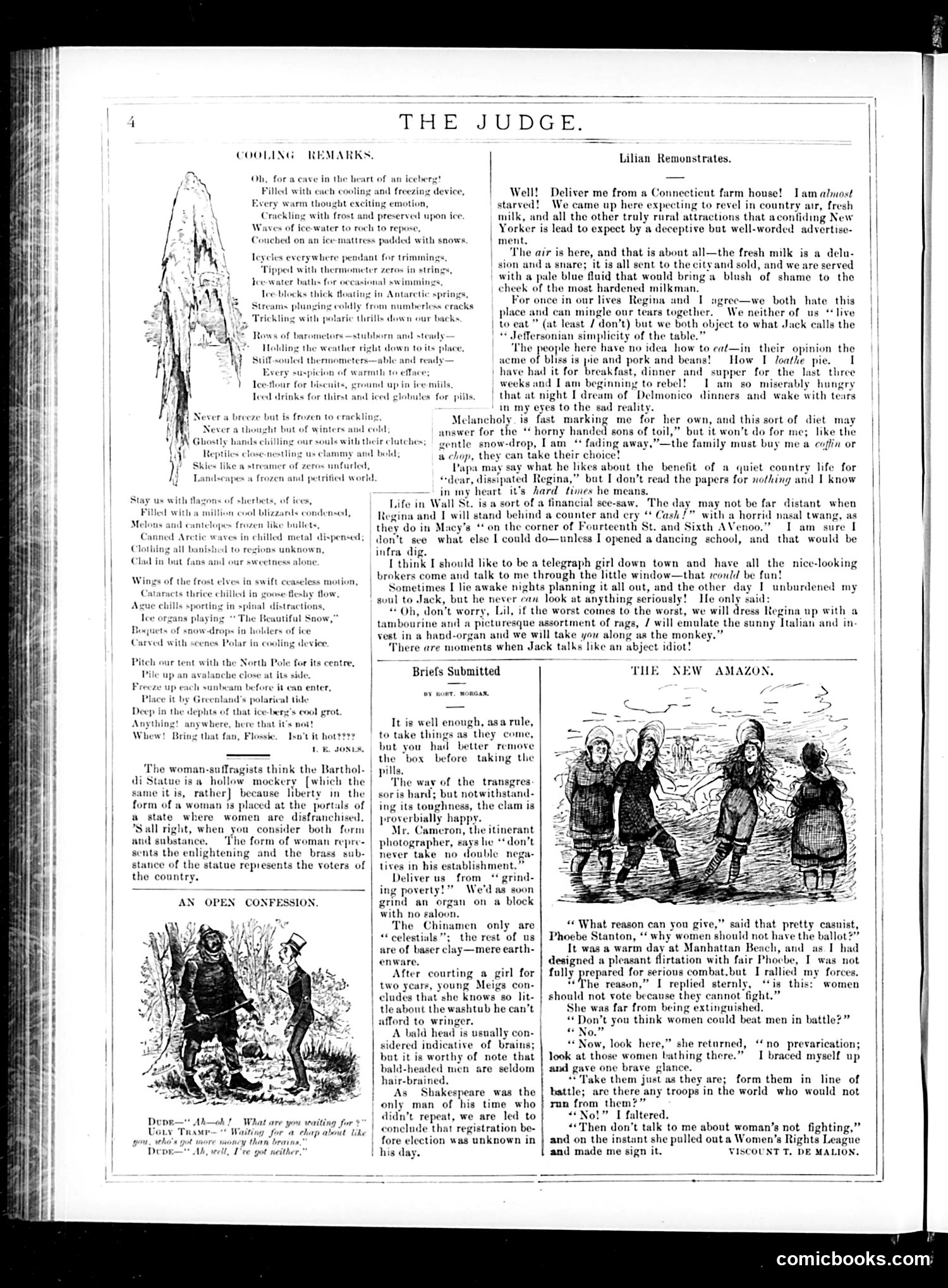
This *Judge* page lampoons the oppressive summer heat afflicting American cities, particularly New York. The lengthy poem "Cooling Remarks" (left) humorously catalogs fantasies of arctic relief—ice caves, frozen drinks, snow-filled landscapes—reflecting the pre-air-conditioning era's genuine discomfort. The right column features "Lilian Demonstrates," where a wealthy New Yorker complains about escaping to the country for "fresh air" but finding only disappointing conditions: adulterated milk, inadequate food (begrudgingly accepting "beans and pork"), and homesickness. The satire mocks both urban heat-seekers' false expectations and rural/country life's modest reality. "Briefs Submitted" (bottom) contains short social jabs: woman suffragists' criticism of the Statue of Liberty's placement in a state denying women voting rights; a photographer's claim never to take "double negatives"; and commentary on female suffrage as inherently contentious. The tone reflects upper-class frustrations with summer discomfort and rural disappointments.
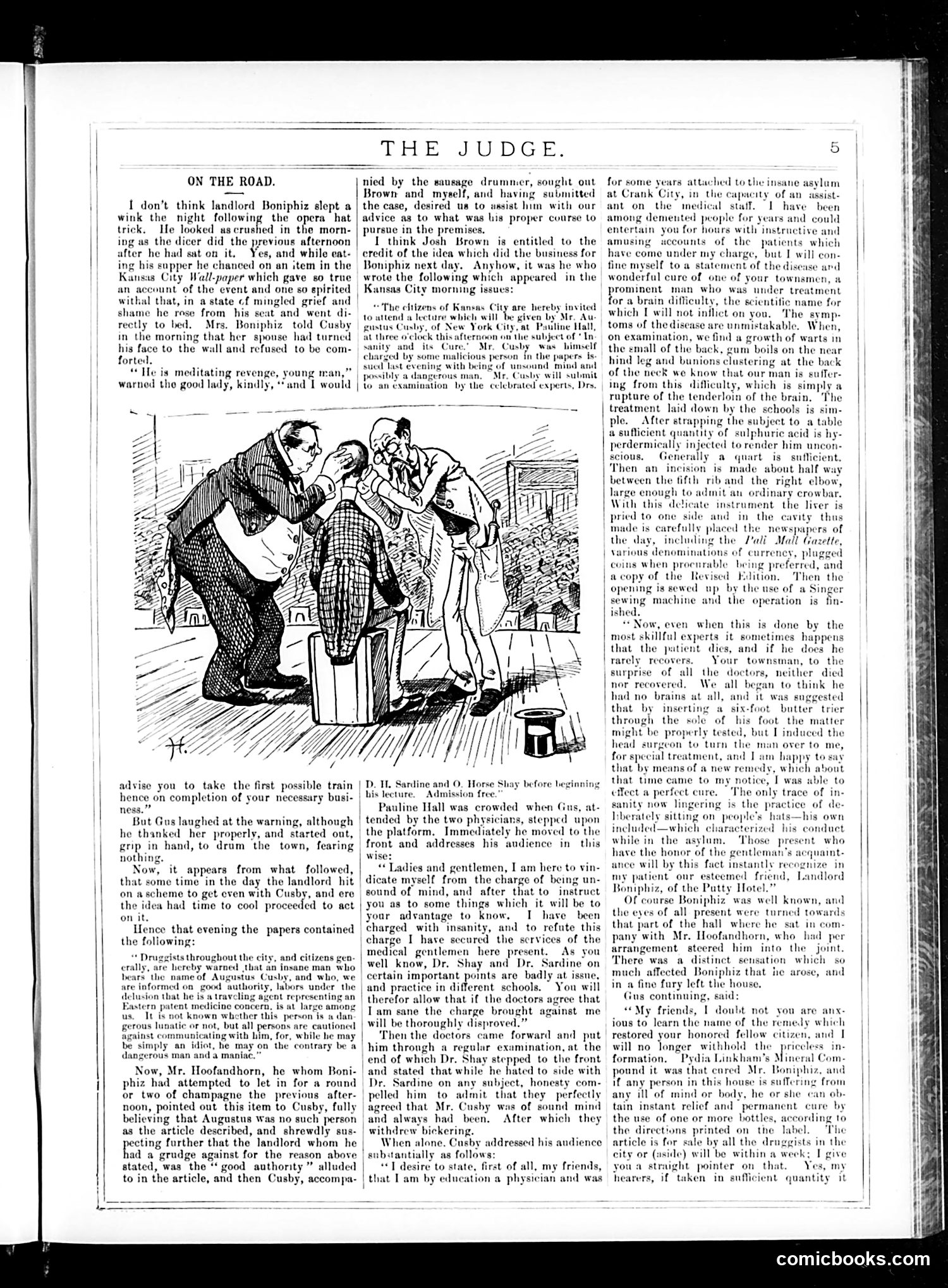
This page satirizes a petty revenge scheme between a traveling medicine-show operator named Augustus Cusby and landlord Boniphiz over an opera hat incident. **The Setup:** Cusby humiliates Boniphiz by sitting on his hat. Boniphiz retaliates by publishing a fake newspaper notice claiming Cusby is insane and dangerous—a serious public accusation in the era. **The Joke:** Cusby calls Cusby's bluff by hiring two real doctors to publicly examine him at a lecture hall. The physicians, though they disagree on nearly everything, are forced to admit Cusby is perfectly sane. The "insanity" charge backfires spectacularly on Boniphiz. **Social Context:** This mocks how medical authority could be weaponized or manipulated—doctors' reputations were being leveraged in disputes. The satirical thrust appears to critique both petty revenge and the gullibility of using medical "expertise" to settle scores. The illustration shows Cusby with the two physicians on stage, presumably during his vindication.
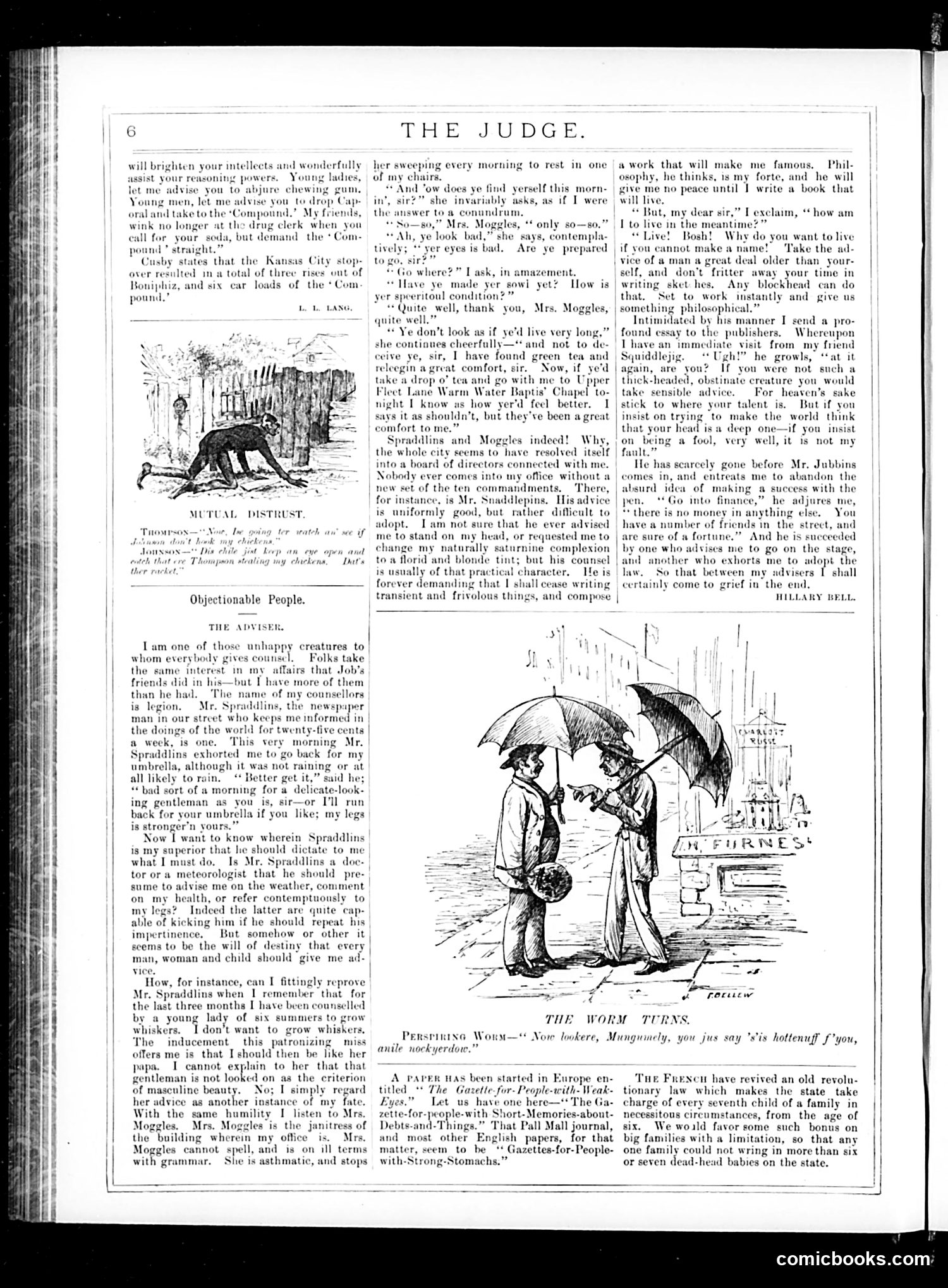
This page satirizes the universal human tendency to give unsolicited advice. The main article describes the author's frustration with various people constantly counseling him—a newspaper vendor (Mr. Spraddlins), a six-year-old girl urging him to grow whiskers, and Mrs. Moggles, the building's janitress, who recommends green tea and religious conversion. The satire's point: everyone considers themselves qualified to direct others' lives, regardless of actual expertise or standing. The irony is that the author cannot politely refuse even ridiculous suggestions without seeming ungrateful or rude. The accompanying cartoon "The Worm Turns" (bottom right) shows two men with umbrellas in conversation, likely illustrating this theme of unwanted interpersonal advice. The final note about a new European gazette "for people with short memories about their debts" is separate satirical commentary on publishing.
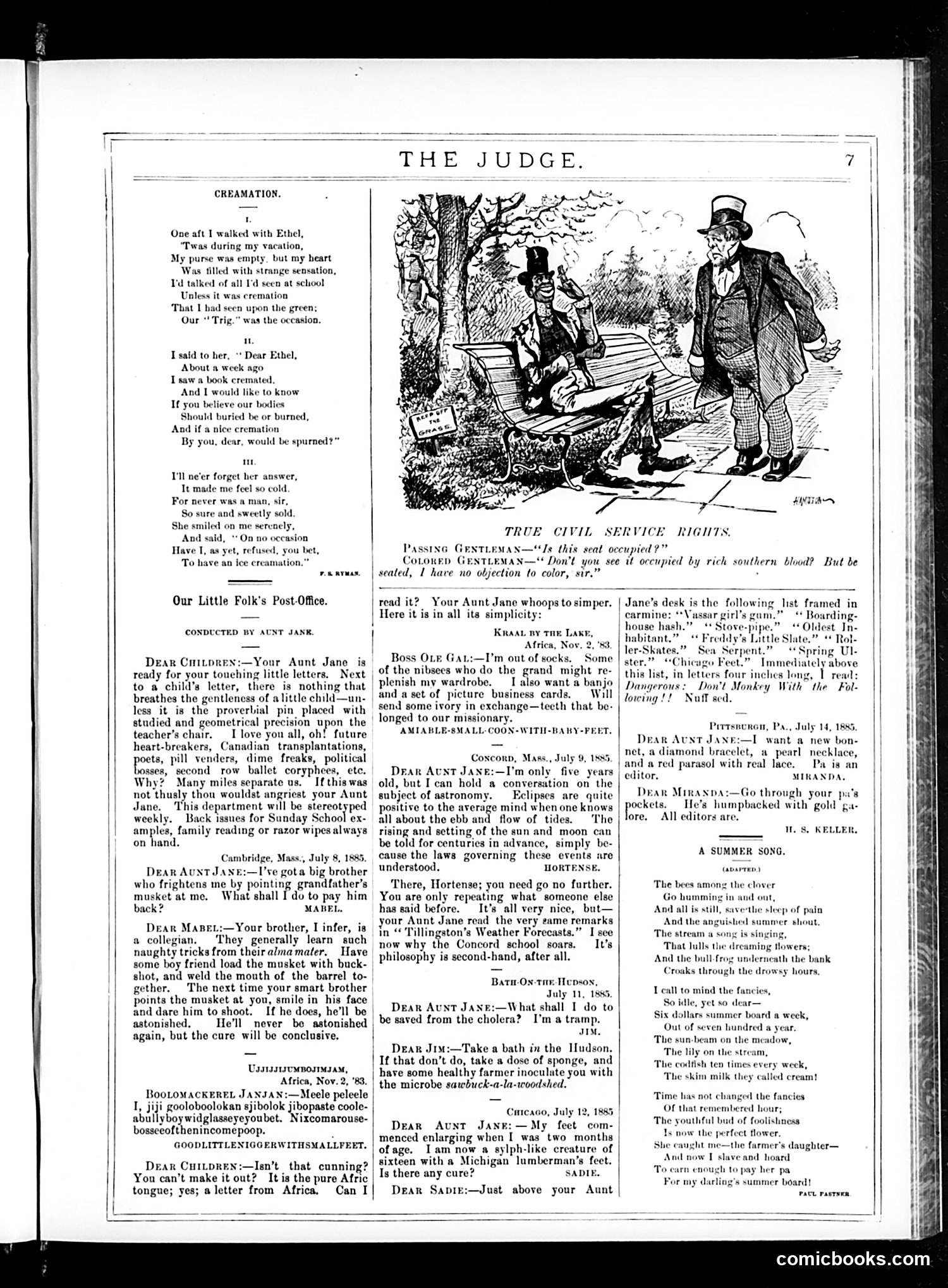
This cartoon satirizes post-Reconstruction racial attitudes and Civil Service reform debates of the 1880s. Two well-dressed gentlemen sit on a park bench—one appears to be a Black man or is being read as such by the other. When asked if the seat is occupied, the white gentleman responds that it *is* occupied "by rich southern blood," then sarcastically invites him to sit anyway while claiming to have "no objection to color." The satire cuts two ways: it mocks Southern whites' claims of racial superiority ("rich southern blood") while simultaneously exposing the hypocrisy of Northern "civil service rights" rhetoric. The cartoon suggests that despite reform efforts to create merit-based government positions, racial prejudice persists—and that Northern gentility masks the same exclusionary attitudes as Southern tradition. The title "True Civil Service Rights" implies these rights exist only theoretically, not in practice.
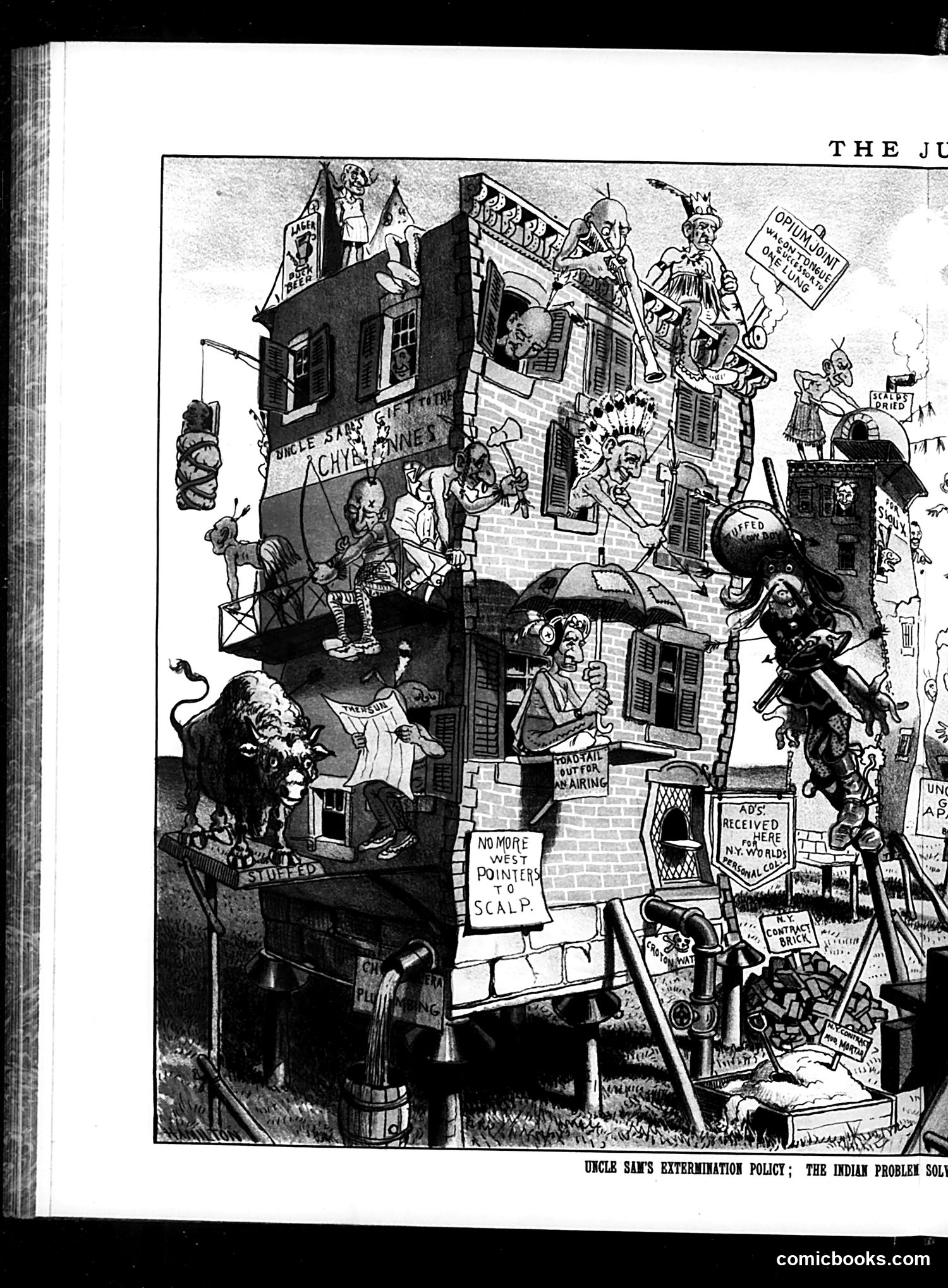
This Judge magazine cartoon depicts a grotesque "solution" to American Indian policy through a heavily satirical building labeled with controversial 19th-century approaches to Native Americans. The structure is crowded with caricatured figures and signs referencing policies like "No More West Pointers to Scalp" and "Road Gate Buffering." A menacing Uncle Sam figure (representing U.S. government) appears at left. The cartoon satirizes the federal government's historical treatment of Native Americans—portraying extermination rhetoric and assimilationist policies as absurd architectural schemes. The jagged, chaotic composition and grotesque imagery emphasize the cruelty and dysfunction of these policies, though the satire's exact target remains unclear without publication date context.
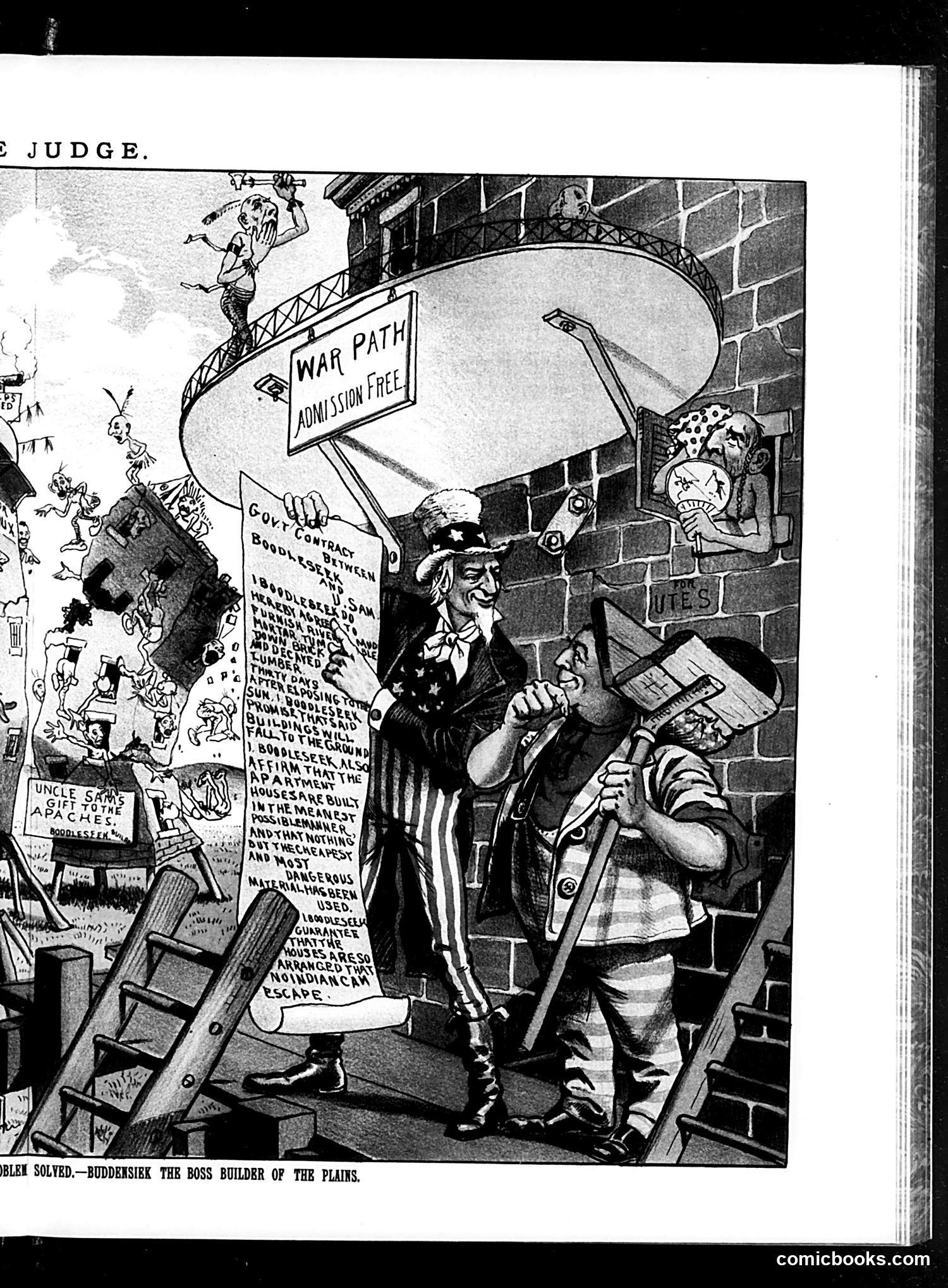
This Judge magazine cartoon satirizes government contracting corruption. Uncle Sam (center, in stars-and-stripes costume) appears to be a complicit "boss builder" facilitating war profiteering. The sign advertising "War Path - Admission Free" suggests military conflict is being commercialized for profit. The lengthy contract document visible in the image lists various corrupt practices: dangerous materials, price-gouging, collusion between contractors, and guaranteed profits regardless of quality or ethics. The cartoon criticizes how government contracts—particularly during wartime—enriched unscrupulous contractors while putting soldiers and civilians at risk through substandard supplies and construction. This reflects Progressive-era concerns about military-industrial corruption and corporate influence on government policy.
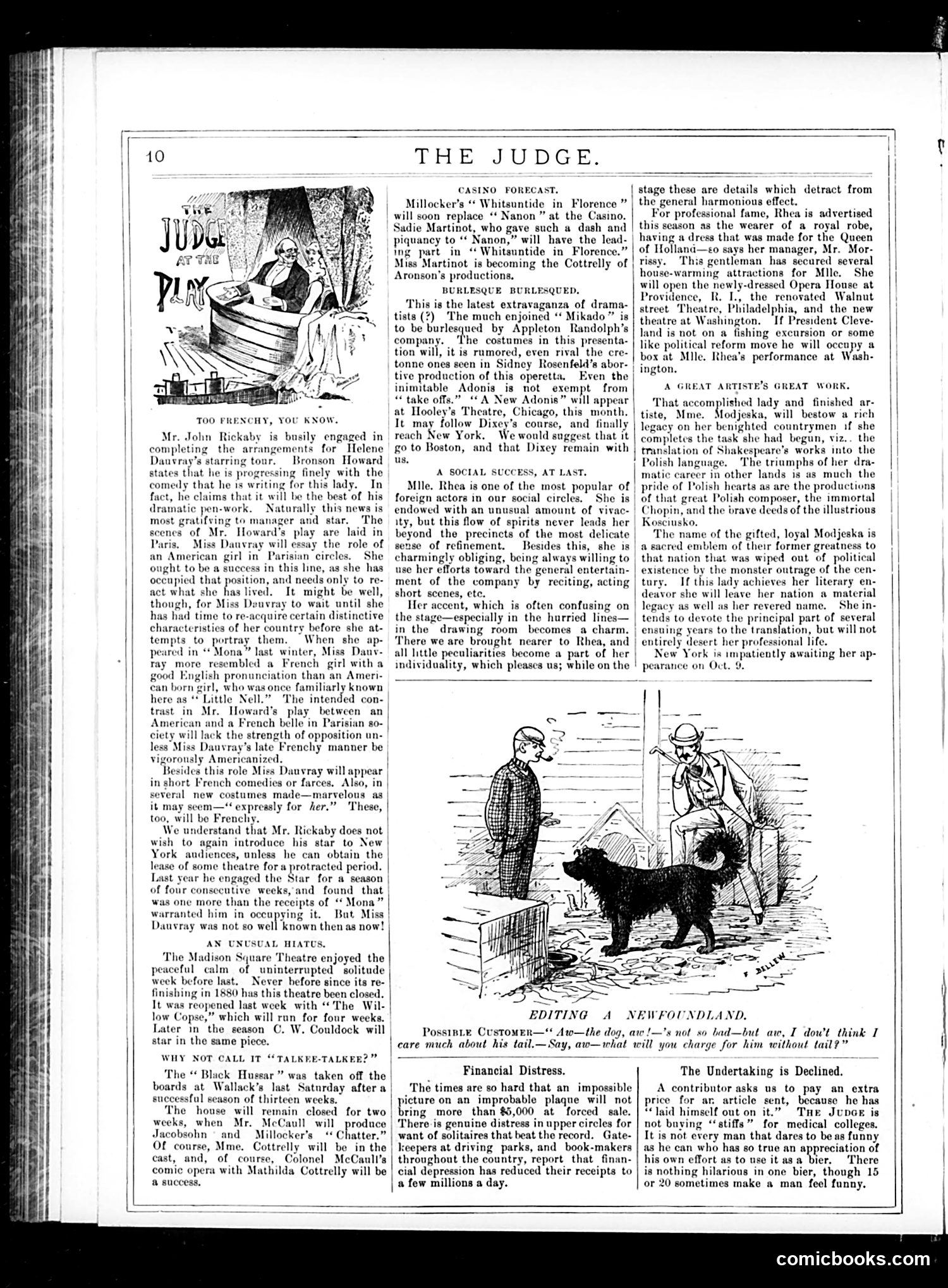
This theatrical gossip column critiques actress **Helene Dauvray**, a French performer starring in an American play set in Paris. The writer's central complaint: Dauvray is *too French* to effectively portray an American girl in Parisian society. The satire targets her overly French mannerisms and accent, which undermined her previous role in "Mona." The author argues that unless she "vigorously Americanizes" herself, the intended contrast between American and French characters will lack dramatic punch. The accompanying cartoon depicts a dog without a tail—a visual pun on the article's title, suggesting someone has adopted foreign affectations and lost their original identity. The piece reflects late-19th-century anxiety about immigrants and performers maintaining "American" characteristics versus adopting foreign pretense—a common Judge magazine theme mocking both excessive Francophilia and identity confusion among entertainers navigating transatlantic careers.
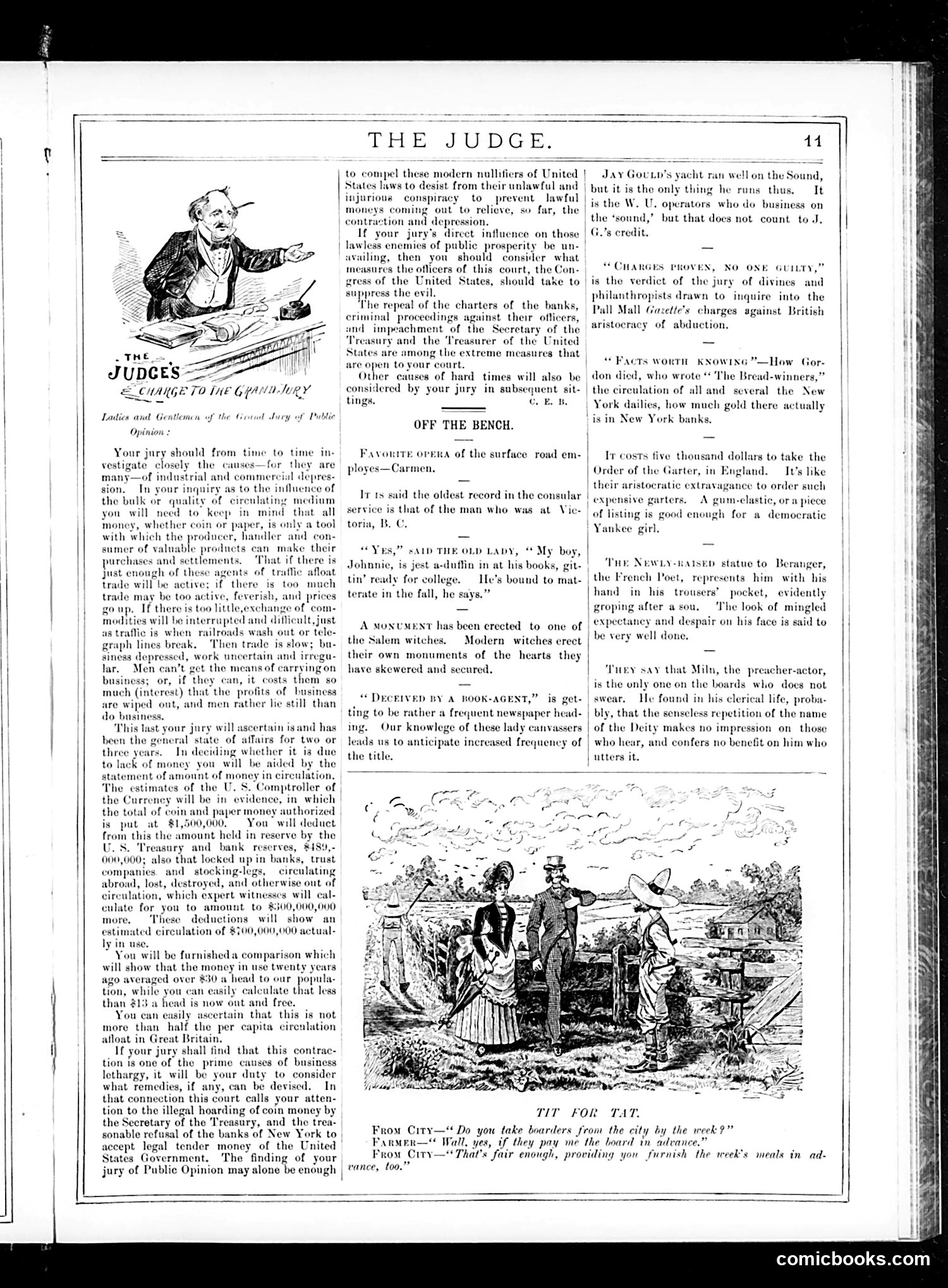
This page from *Judge* magazine presents political satire addressing the economic depression of the 1890s (likely the Panic of 1893). **Main Cartoon:** "The Judge's Charge to the Grand Jury" depicts a judge addressing a jury about currency contraction. The satire targets what the author calls "modern nullifiers"—specifically the U.S. Treasury Secretary and New York banks—whom he accuses of illegally hoarding coins and refusing legal tender, thereby restricting money circulation and causing business depression. **The Argument:** The piece argues that insufficient circulating currency (estimated at only $13 per capita versus higher amounts twenty years prior) has strangled commerce. It proposes the jury of "Public Opinion" should consider extreme remedies: repealing bank charters, criminal prosecution of bank officers, and impeaching Treasury officials. **Bottom Cartoons:** "Tit for Tat" and other brief jokes provide lighter relief, including commentary on boarding houses and other social matters. The satire reflects populist-era frustrations with banking and monetary policy, positioning economic hardship as deliberate sabotage by financial elites rather than market forces.
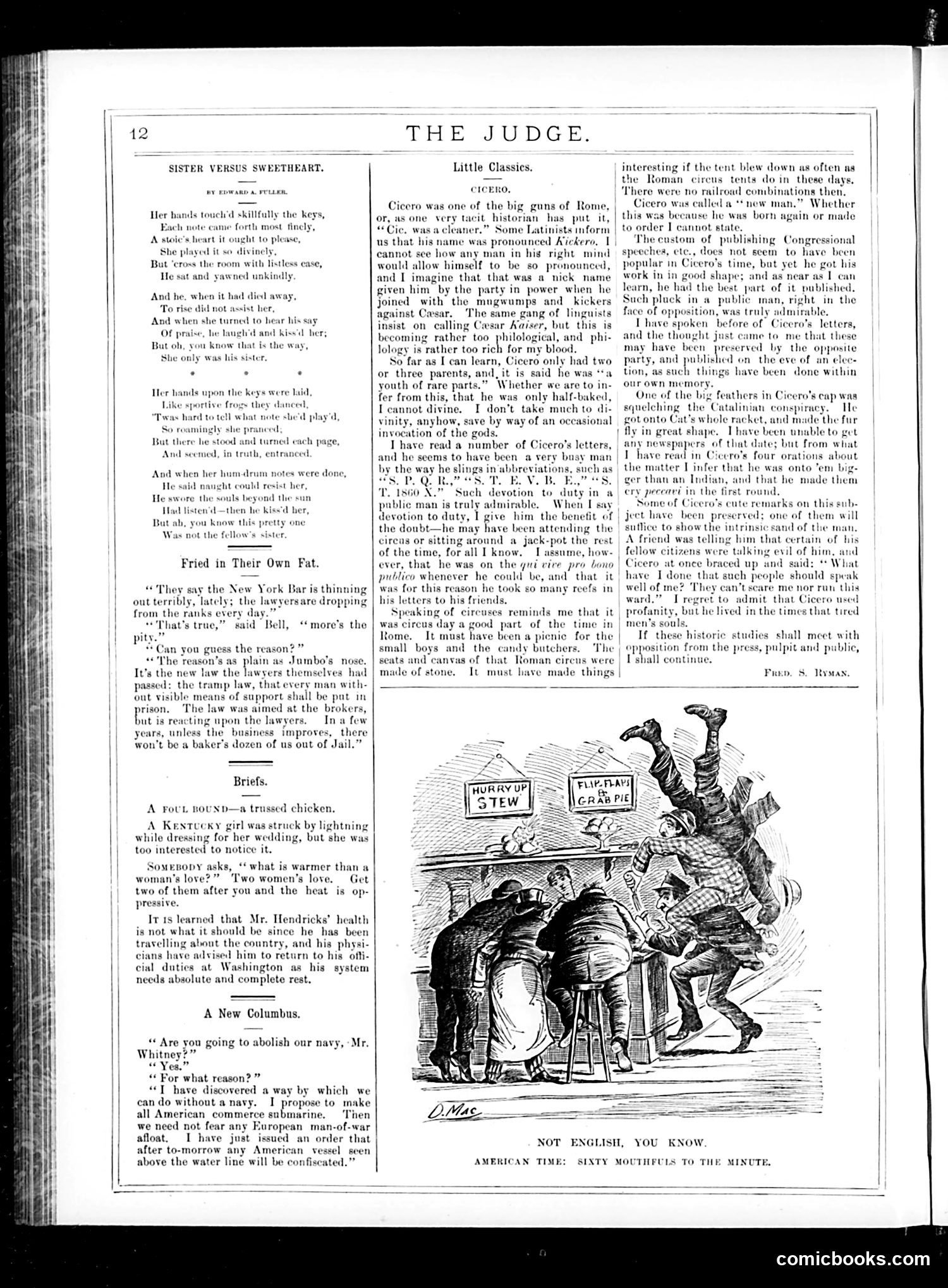
This page contains satirical commentary and light humor typical of late-19th-century American magazines. The main cartoon at bottom—titled "NOT ENGLISH, YOU KNOW"—depicts what appears to be well-dressed Americans eating rapidly with exaggerated mouth positions, labeled "AMERICAN TIME: SIXTY MOUTHFULS TO THE MINUTE." The satire mocks American eating habits as rushed and unrefined compared to European decorum. The text articles include: - Two sentimental poems about romantic encounters ("Sister Versus Sweetheart," "Fried in Their Own Fat") - "Briefs"—short jokes about contemporary figures (possibly referencing Secretary Whitney's naval policies and Vice President Hendricks' health) - "A New Columbus"—satirizing Whitney's proposal to replace the navy with submarine commerce The "Little Classics: Cicero" section provides humorous Latin commentary, including wordplay on pronunciation and abbreviations. Overall, the page satirizes American manners, politics, and culture through gentle mockery aimed at educated readers familiar with classical references and current political debates.
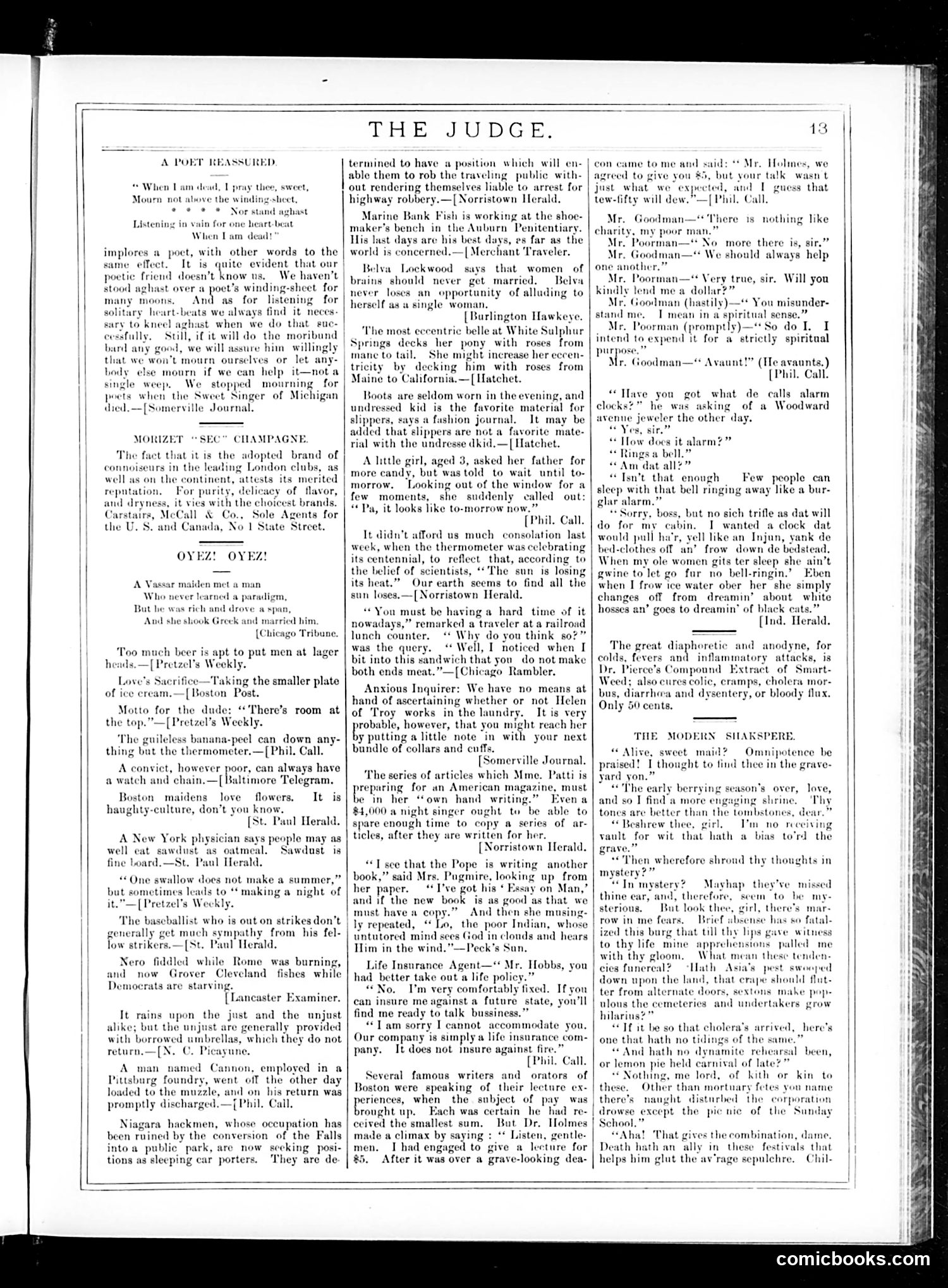
This page from **Judge** magazine (a satirical weekly) contains primarily **short humorous observations and quips** rather than political cartoons. The pieces mock various contemporary subjects through brief satirical commentary. Key targets include: - **Poets**: Mocked for expecting mourning; the magazine ridicules sentimental verse - **Social types**: Baseball players, convicts, Boston maidens, hackmen (Niagara Falls carriage drivers displaced by park conversion) - **Political reference**: A quip about "Grover Cleveland" and starving Democrats, likely referencing economic hardship during Cleveland's presidency - **Women's rights**: A jab at **Belva Lockwood** (women's suffrage advocate and presidential candidate), sarcastically praising her comments about women with brains avoiding marriage - **Daily absurdities**: Observations on umbrellas, banana peels, sawdust, and thermometers used for wordplay humor The satire is **light, topical social commentary** rather than serious political critique—typical of Judge's style as a humor magazine mixing advertisements with witty aphorisms about contemporary American life.
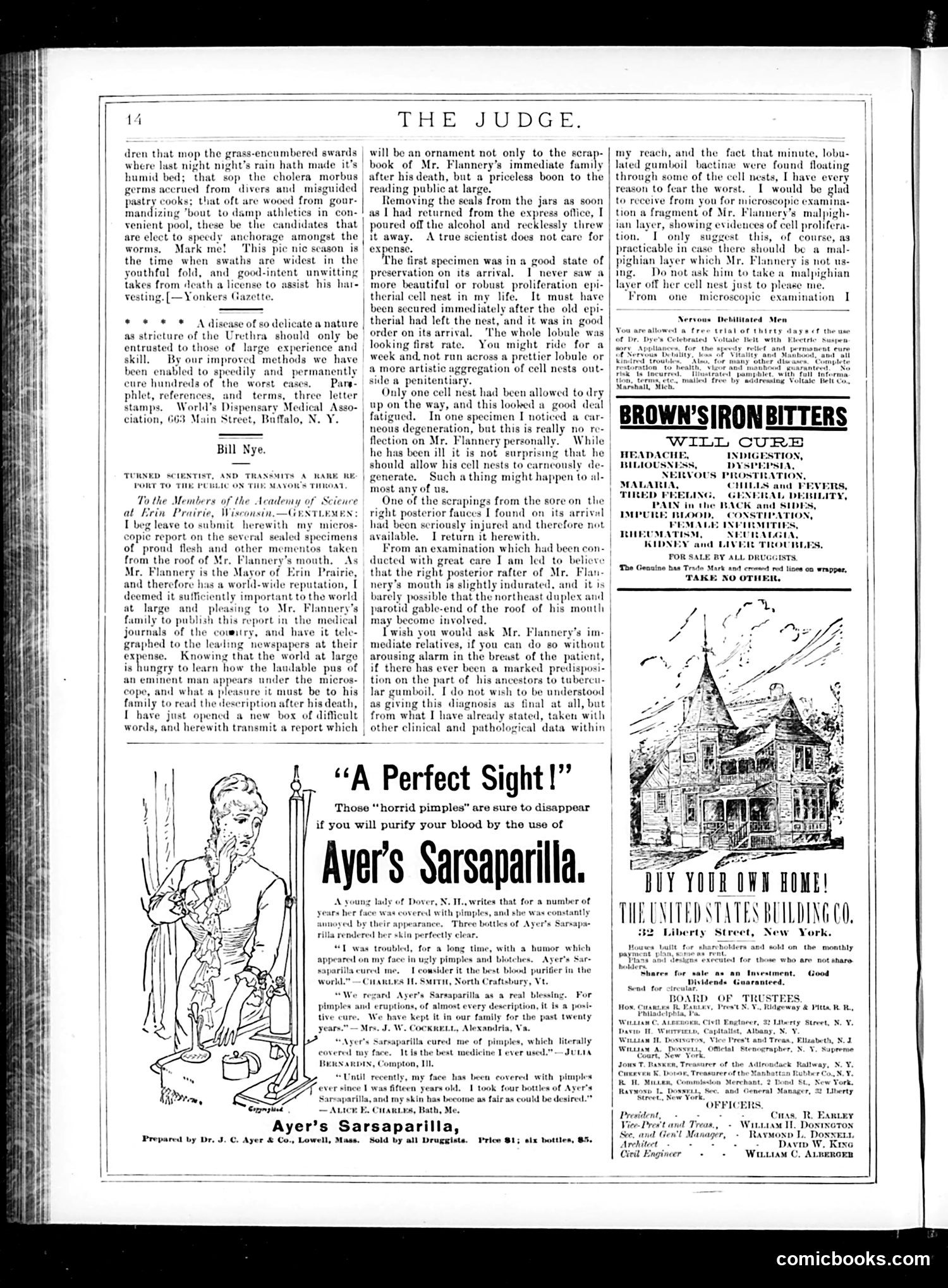
This page contains a satirical piece by Bill Nye (a popular humorist of the era) mocking pseudoscientific pretension. Nye adopts the persona of a fake "scientist" submitting an absurdly overwrought medical report on tissue samples allegedly taken from Mayor Flannery's mouth to an "Academy of Science." The satire works through intentional obfuscation: Nye uses genuine medical terminology mixed with nonsensical jargon ("northeast duplex," "parotid gable-end") to parody how scientists and doctors of the era often obscured simple observations behind impenetrable technical language to appear authoritative. The comedic effect comes from the sheer pretentiousness—treating trivial mouth tissue as momentous scientific discovery worthy of newspaper publication. This mocks both the self-importance of minor officials (the mayor) and the affectations of the scientific establishment, exposing how technical language could be weaponized to impress the public regardless of actual substance. The piece exemplifies Judge's satirical approach to American society's follies.
This page is primarily **advertisements and filler content** rather than political satire. The main editorial content is two humorous anecdotes: ## "Couldn't Eat Corn from a Cob" A mild social comedy about dinner etiquette. A young man eats corn directly from the cob while others cut it first with a knife. When challenged, another guest admits he can't tell corn from his false teeth, embarrassing the original corn-eater. The joke targets vanity and social pretension around eating habits. ## "Love Sees No Faults" A sentimental piece (appears to be an advertisement for Dr. Pierce's "Favorite Prescription") arguing that disease makes women lose their beauty and charm, and only his patent medicine can restore them. This reflects period attitudes about female health and beauty being inseparable. The remaining content is commercial: book binding, pianos, printing inks, trusses, bicycles, and various patent medicines—typical of 19th-century magazine advertising. No significant political satire or caricature is evident on this page.
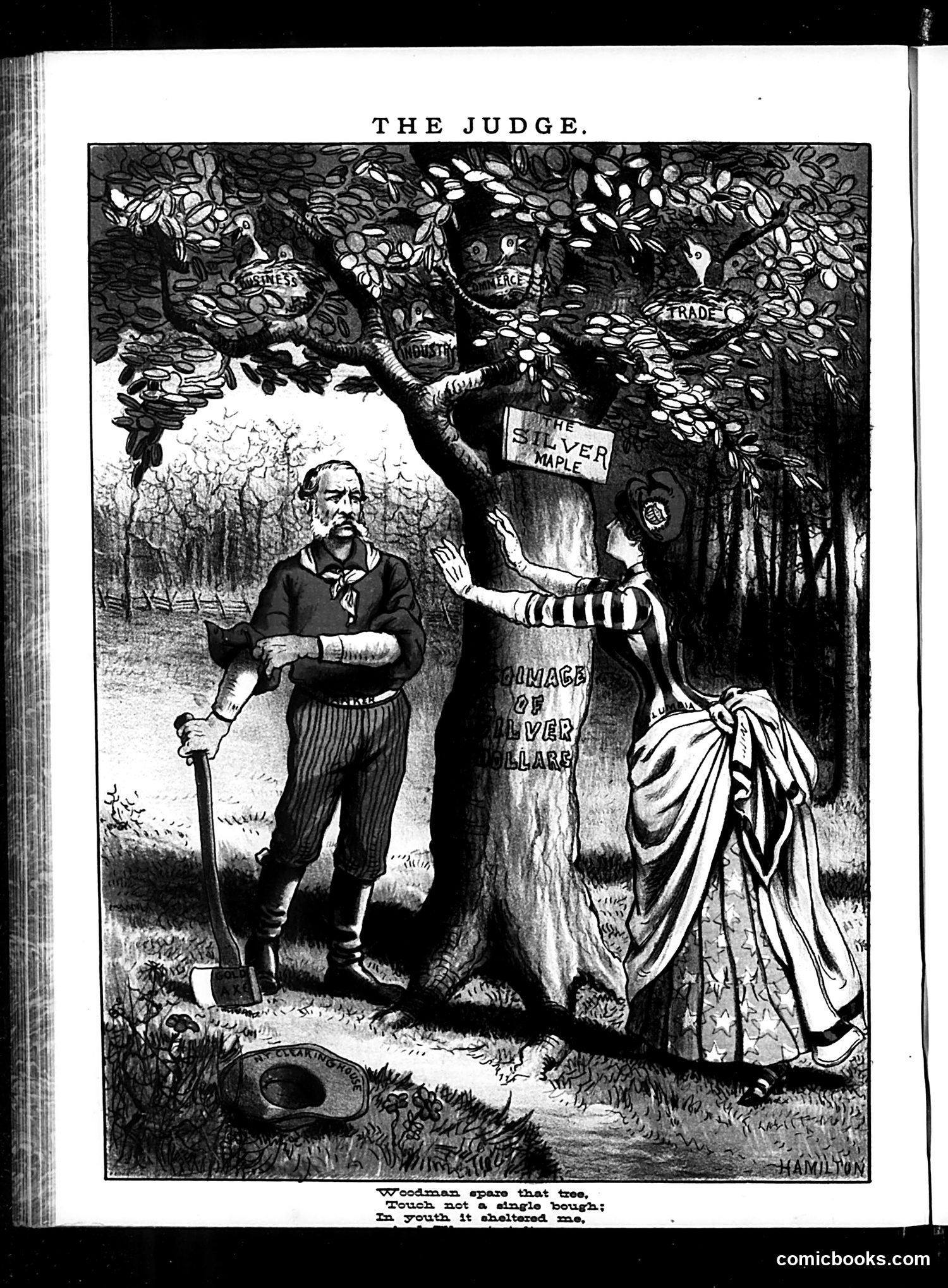
This cartoon titled **"The Judge"** depicts a man with a shovel standing before a large tree labeled with various commercial interests: "CHESS," "DICE," "TRADE," "THE SILVER MAPLE," and "DAMAGE OF SILVER DOLLAR." The tree is personified as a woman in flowing robes, appearing to be injured or damaged. The epigraph references Woodman sparing the tree in youth—suggesting nostalgia for a protected past. **The satire likely critiques** the destruction of American commerce or institutions through unchecked exploitation and greed. The figure with the shovel represents a force of economic or political damage, while the wounded tree symbolizes something once protective and valuable that's now being harmed for profit. The specific commercial labels suggest this targets gilded-age financial abuses and corporate exploitation.