
A complete issue · 16 pages · 1885
Judge — July 18, 1885
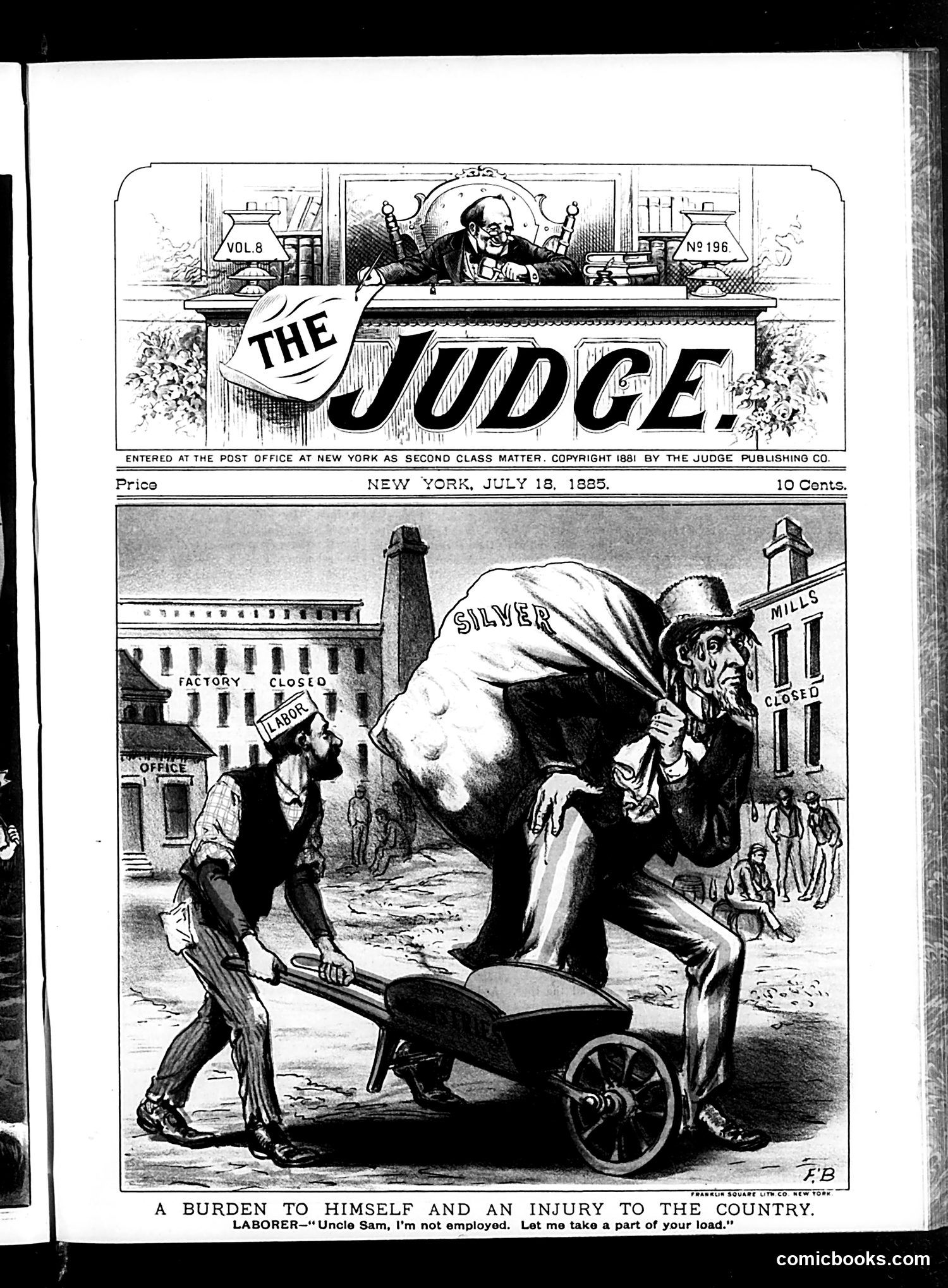
This cartoon titled "A Burden to Himself and an Injury to the Country" depicts a massive figure labeled "Silver" crushing laborers and industry. The scene shows closed factories and mills with unemployed workers struggling beneath the weight of the silver burden. The satire addresses the **silver question**—a major 1880s political debate over whether to maintain silver coinage or adopt the gold standard. The cartoon argues that silver currency policy harms working people and businesses, literally crushing economic activity. The laborer's plea—"Uncle Sam, I'm not employed. Let me take a part of your load"—suggests silver advocates were worsening unemployment. This reflects anti-silver arguments that the metal's overvalue was damaging American commerce and labor employment.
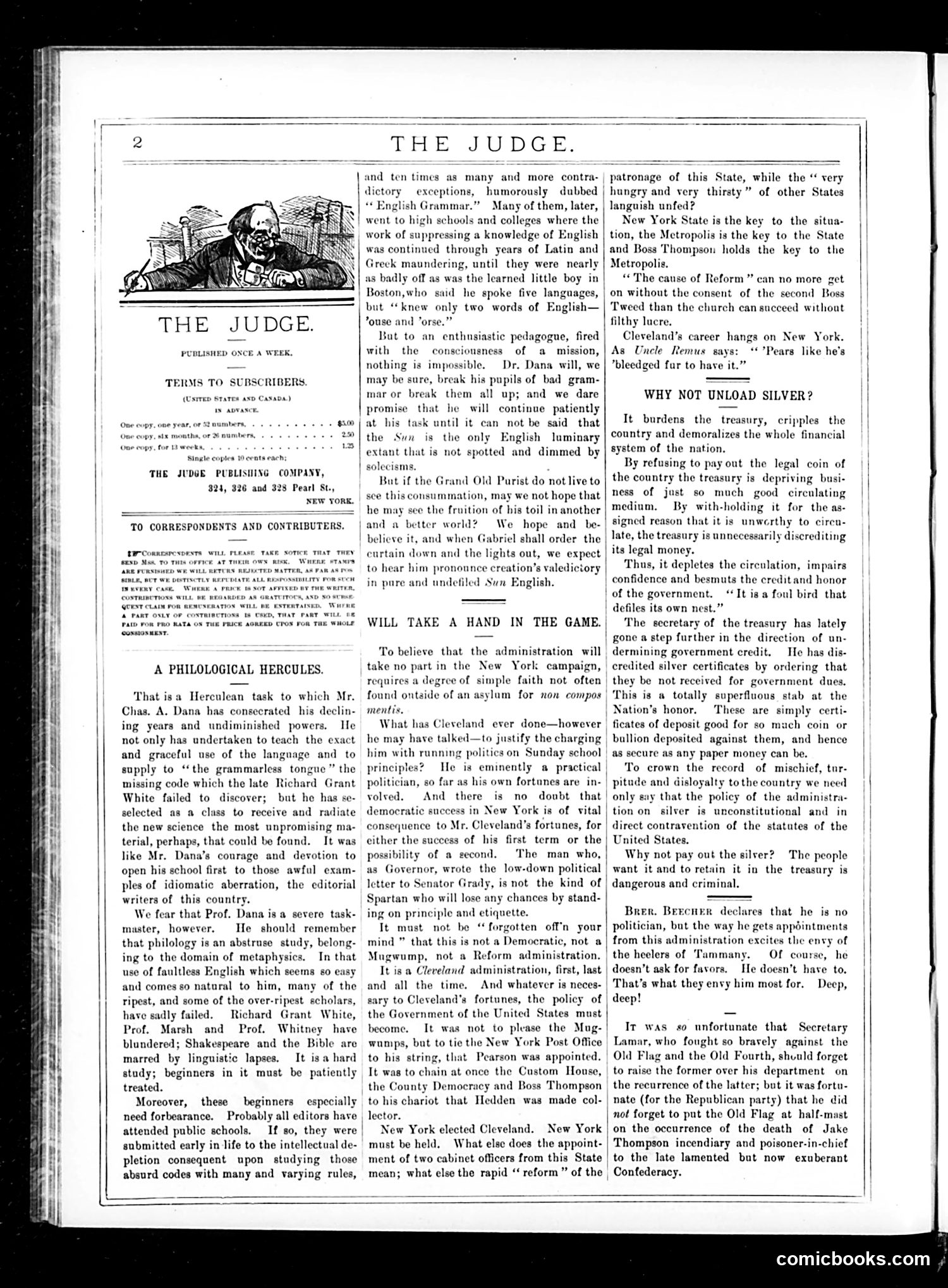
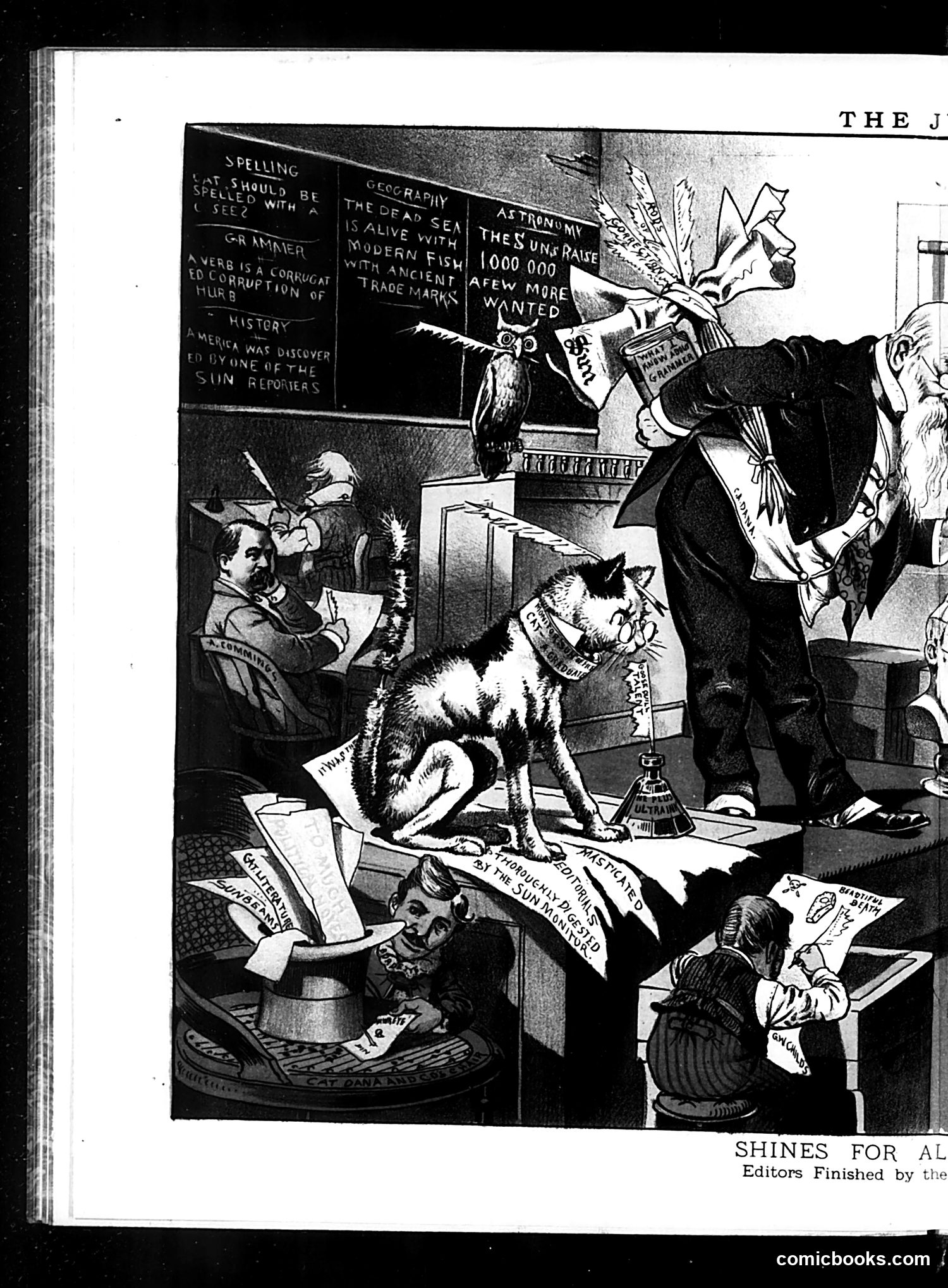
This satirical page from Judge magazine contains two main editorial pieces mocking prominent figures of the era. **"A Philological Hercules"** ridicules **Charles A. Dana**, editor of the New York Sun, for presuming to teach other journalists proper English grammar. The piece sarcastically praises his "courage" while suggesting editors are the worst possible students—having had grammar beaten out of them by school, then further damaged by studying Latin and Greek. The joke: Dana, despite his pretensions, publishes in a newspaper (the Sun) itself full of grammatical errors, making him a hypocrite. **"Will Take a Hand in the Game"** attacks **President Cleveland**, arguing that despite claims of non-involvement, he will inevitably meddle in New York politics because his political fortunes depend on Democratic success there. The article sarcastically notes his past "low-down political letter" to Senator Grady proves he's no principled "Spartan" above political scheming. Both pieces use irony and exaggeration to expose what Judge saw as hypocrisy among Democratic-leaning figures.
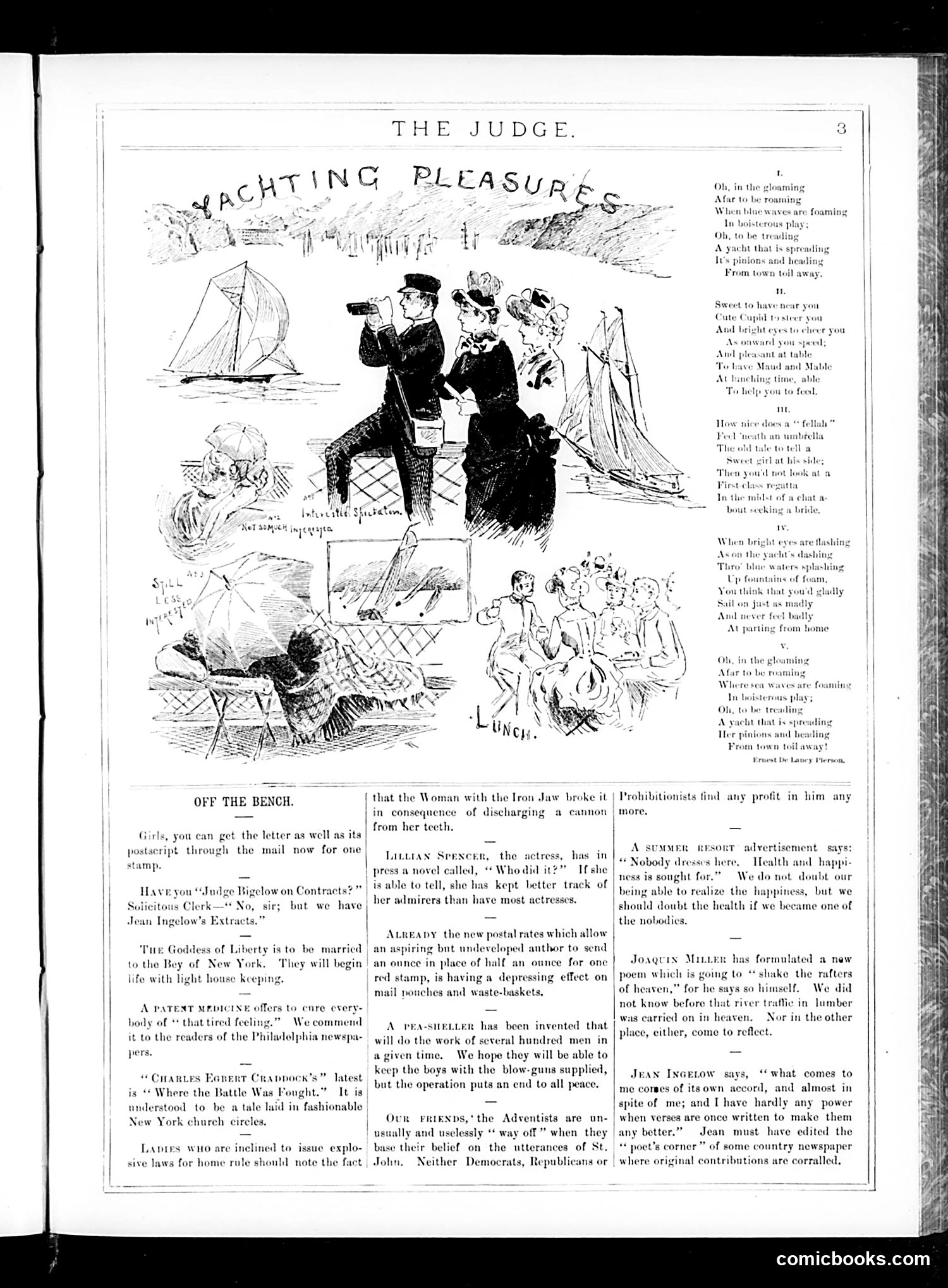
This page features a poem and several satirical "news" items typical of Judge's humor. The main cartoon illustrates "Yachting Pleasures," depicting wealthy leisure activities—men observing boats through telescopes, couples socializing on vessels, and seaside dining. The accompanying poem romanticizes yacht outings while subtly mocking the pretensions of upper-class recreation. The "Off the Bench" section contains brief jokes and commentary. Notable items mock: a patent medicine claiming to cure "tired feeling," the postal service's new rates discouraging authors from mailing manuscripts, an invented pea-sheller that eliminates peaceful silence, and Adventists' religious interpretations. References to actress Lillian Spencer and author Jean Ingelow appear as contemporary cultural commentary. The satire targets Victorian-era leisure culture, suggesting the wealthy pursue frivolous pleasures while society faces practical problems. The tone is gently mocking rather than politically sharp.
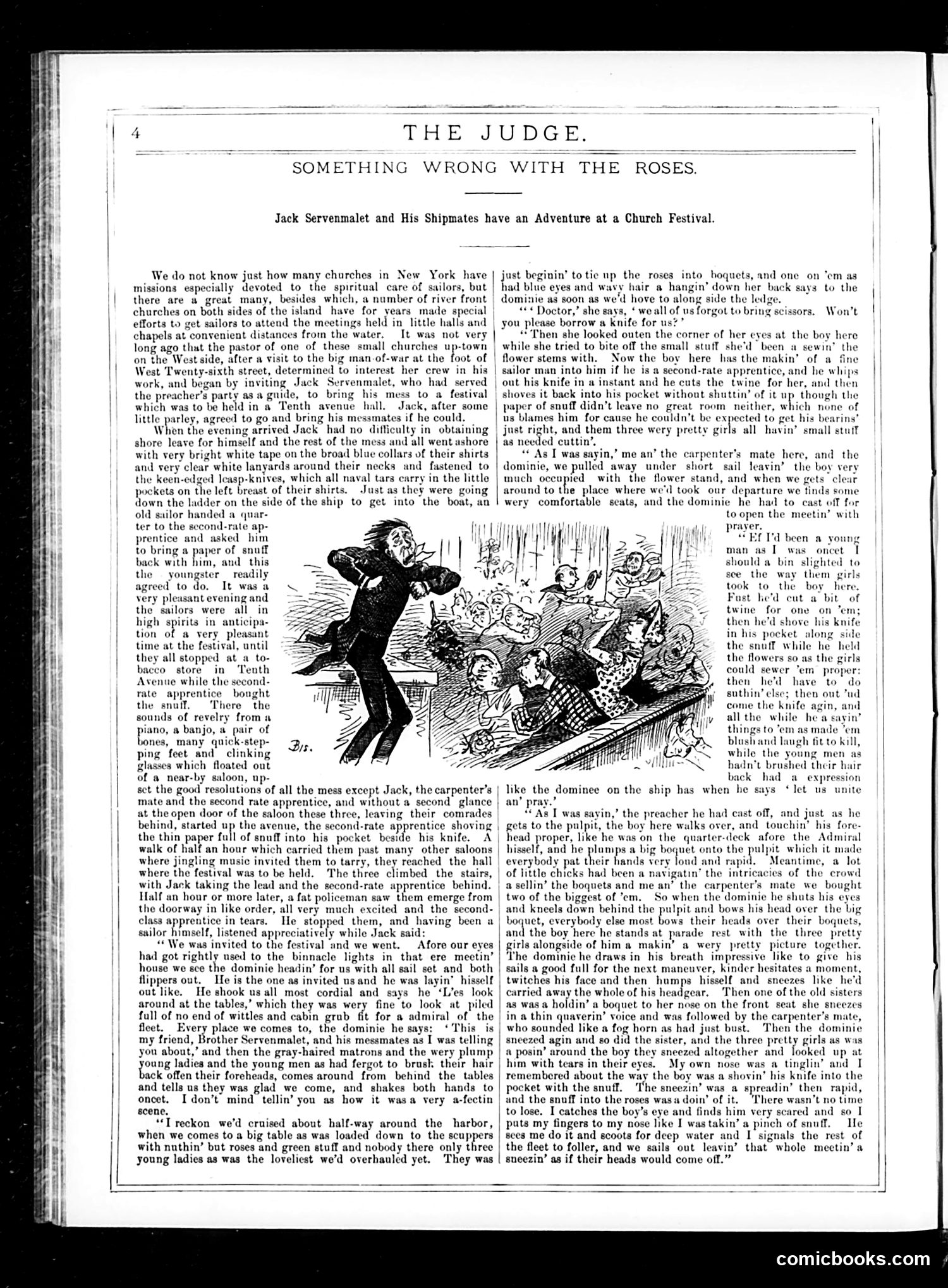
This satirical story ridicules well-meaning but naive church outreach to sailors. A small Tenth Avenue church pastor invites naval crew to a festival, hoping to uplift them morally. The illustration shows sailors and church ladies in comedic chaos at the event. The joke hinges on a setup involving a paper of snuff (powdered tobacco). Three sailors arrive late after ducking into a saloon, and the second-rate apprentice has accidentally sat on the snuff packet, ruining it. When church ladies attempt to flirt with and impress the sailors using roses as props, the snuff powder explodes everywhere—hence "Something Wrong with the Roses." The satire mocks both the sailors' lack of restraint and the church's patronizing, clumsy attempts at moral reformation. It plays on class and cultural tensions: refined church ladies versus rough working-class sailors, with predictably absurd results. The story emphasizes the gap between pious intentions and messy reality.
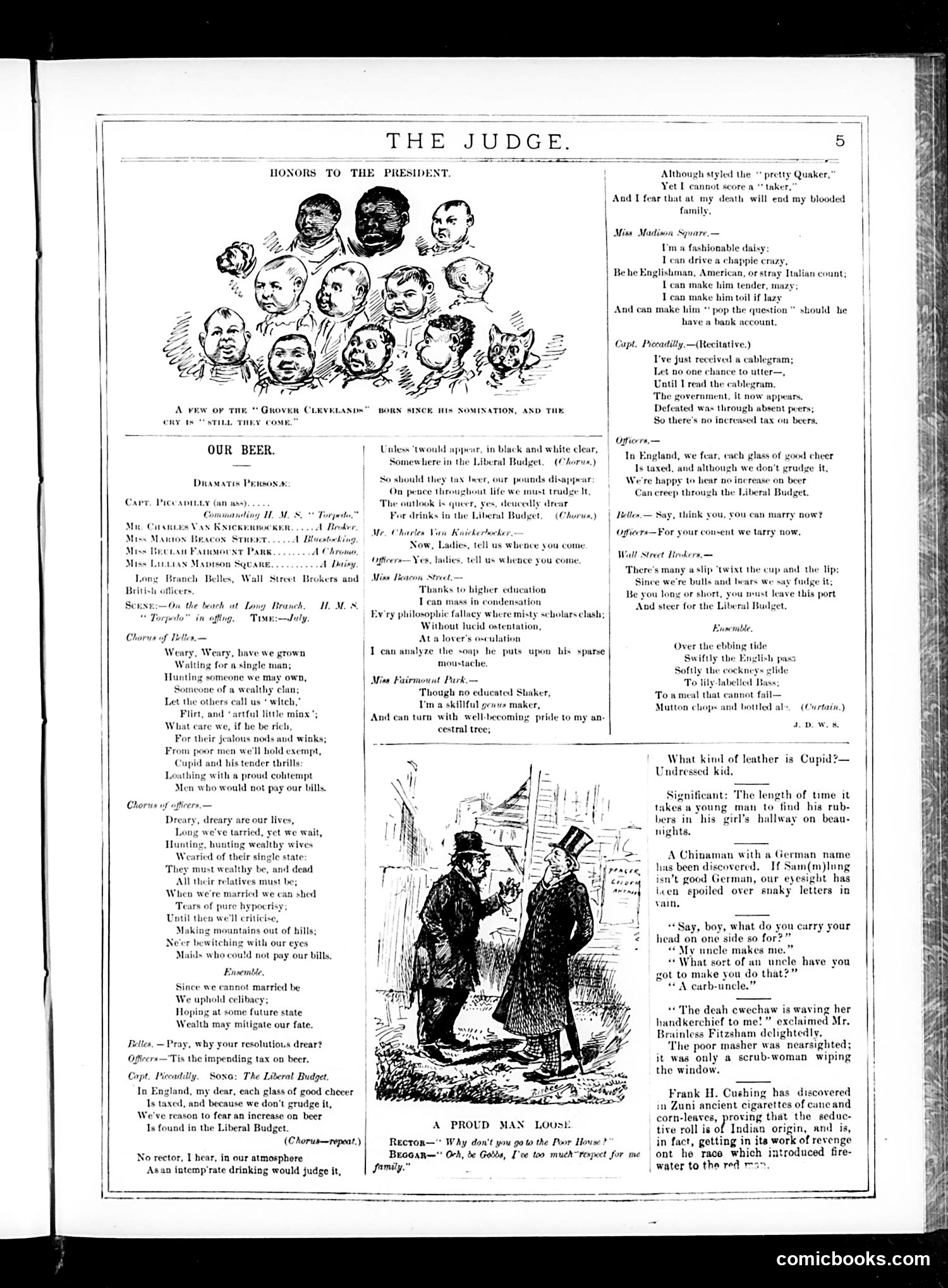
This page satirizes the British Liberal government's proposed beer tax through an elaborate musical comedy number set at Long Branch (a fashionable resort). The central cartoon shows well-dressed officers and young women singing about seeking wealthy husbands—the joke being that they're now worried they can't afford to marry due to increased taxes on beer, a staple of male socializing. The "Grover Clevelands" caricatures at top mock President Cleveland's family (appearing to reference multiple children born during his presidency, with the caption "Still they come"). The beer tax was apparently a controversial Liberal Budget proposal. The satire ridicules both the government's fiscal policy and the mercenary marriage-hunting of wealthy socialites, suggesting that even the leisure class can't escape economic anxiety. The humor relies on knowing this was a current political controversy—the budget debate likely dominated newspapers when this issue published.
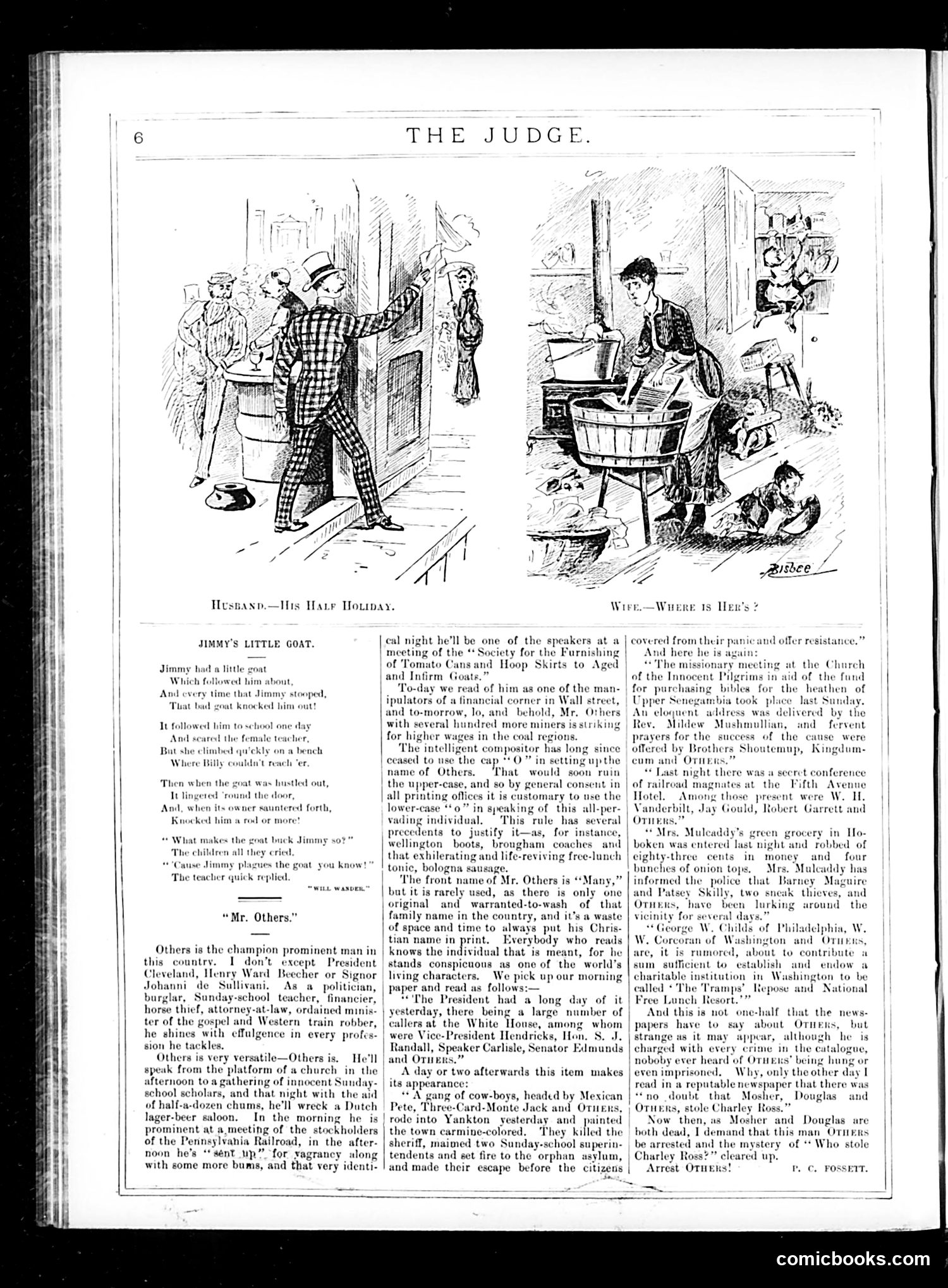
This page from *Judge* magazine contains satirical commentary on a public figure named "Mr. Others." **The Satire:** The piece mocks a prominent man—apparently a real political/financial figure of the era—who appears everywhere in news reports. Whenever important events occur (White House visits, railroad meetings, charitable fundraisers, mining disputes), "Mr. Others" is mentioned as a participant. The joke is that this ubiquitous figure, whose first name is "Many," embodies every profession and social position simultaneously: politician, financier, horse thief, attorney, preacher, and vagrant. **The Point:** The satire critiques sensationalist journalism of the 1880s-1890s, which repetitively invoked prominent names to lend authority to news stories, regardless of relevance. By exaggerating this practice to absurd extremes—showing "Others" as impossibly present at contradictory events—*Judge* highlights how newspapers manipulated public perception through name-dropping and manufactured importance. The left cartoon illustrates the phrase "Jimmy's Little Goat," a whimsical poem about mischief, unrelated to the political satire.
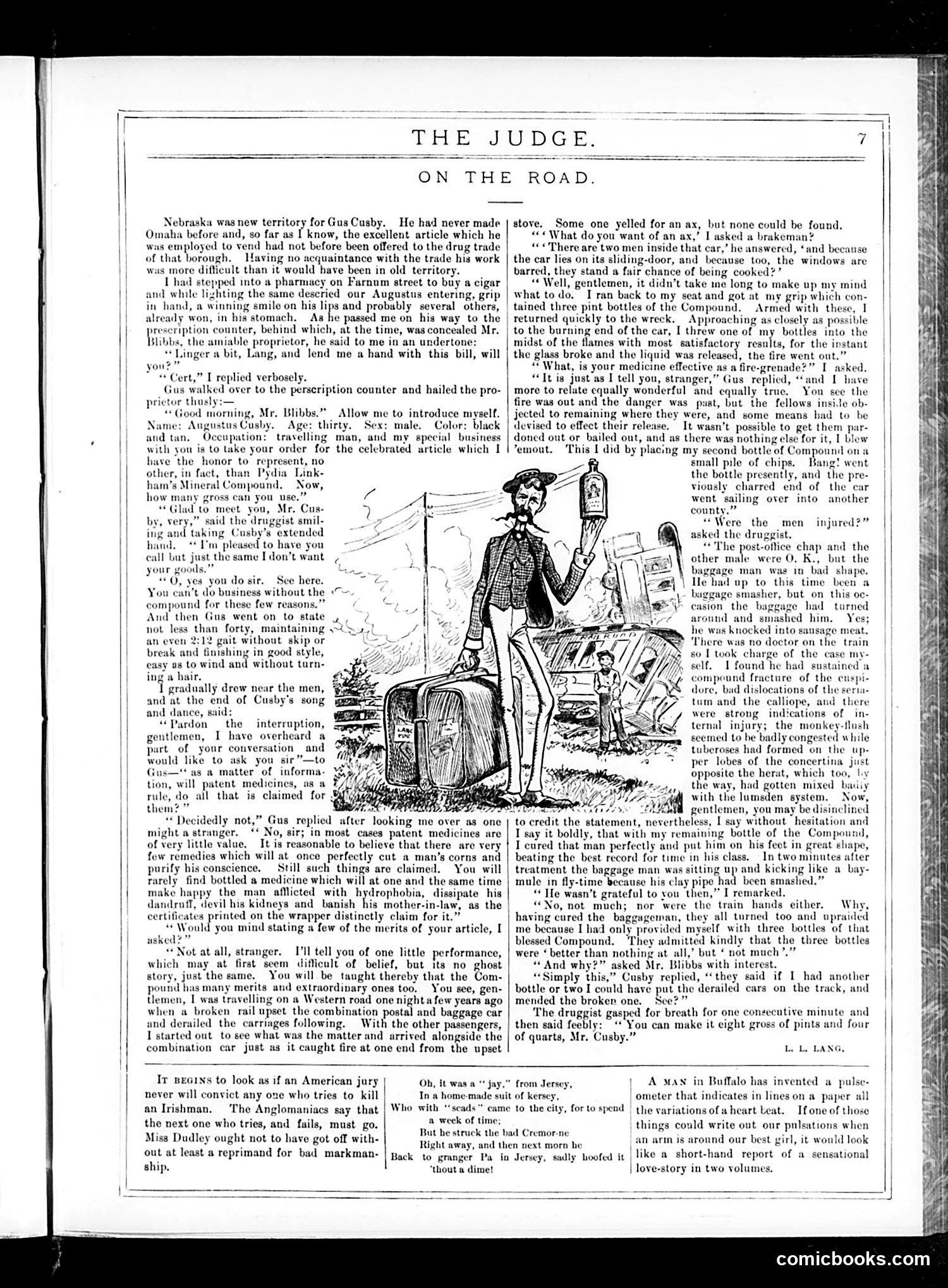
This page from Judge magazine presents a humorous sales pitch story featuring traveling salesman Gus Cusby promoting "Lydia Pinkham's Mineral Compound" to a skeptical druggist, Mr. Blibbs. The satire targets **patent medicine salesmen and their exaggerated claims**. Cusby delivers a lengthy, absurd pitch listing forty supposed benefits, then proves his product's worth through an incredible anecdote: supposedly using the compound to rescue trapped railroad workers from a burning car—implying the medicine possessed impossible, even miraculous properties. The druggist's opening skepticism ("I don't want your goods") and Cusby's own admission that most patent medicines are "of very little value" expose the fraud inherent in the industry. The illustration shows Cusby as a stereotypical traveling salesman in period dress, gesturing persuasively. This reflects genuine Progressive Era concerns about unregulated patent medicines making false health claims—a problem that eventually prompted FDA regulation.
This appears to be a satirical cartoon about education and curriculum debates, likely from the early 20th century. The blackboard shows contested subjects: spelling, grammar, history, geography, astronomy, and modern languages—suggesting contemporary arguments about what should be taught in schools. The central figure (possibly a teacher or education official) is depicted as a donkey, a common symbol for stupidity in political cartoons. Various characters—including what appears to be students or education stakeholders at the bottom—seem to be arguing about curriculum priorities. The satire likely mocks confusion or disagreement over educational standards, with the donkey suggesting that educational leadership itself was seen as foolish. The scattered papers and animated discussion convey chaos in educational policy-making. Without more context about the specific date and educational debates of the era, the precise historical reference remains unclear.
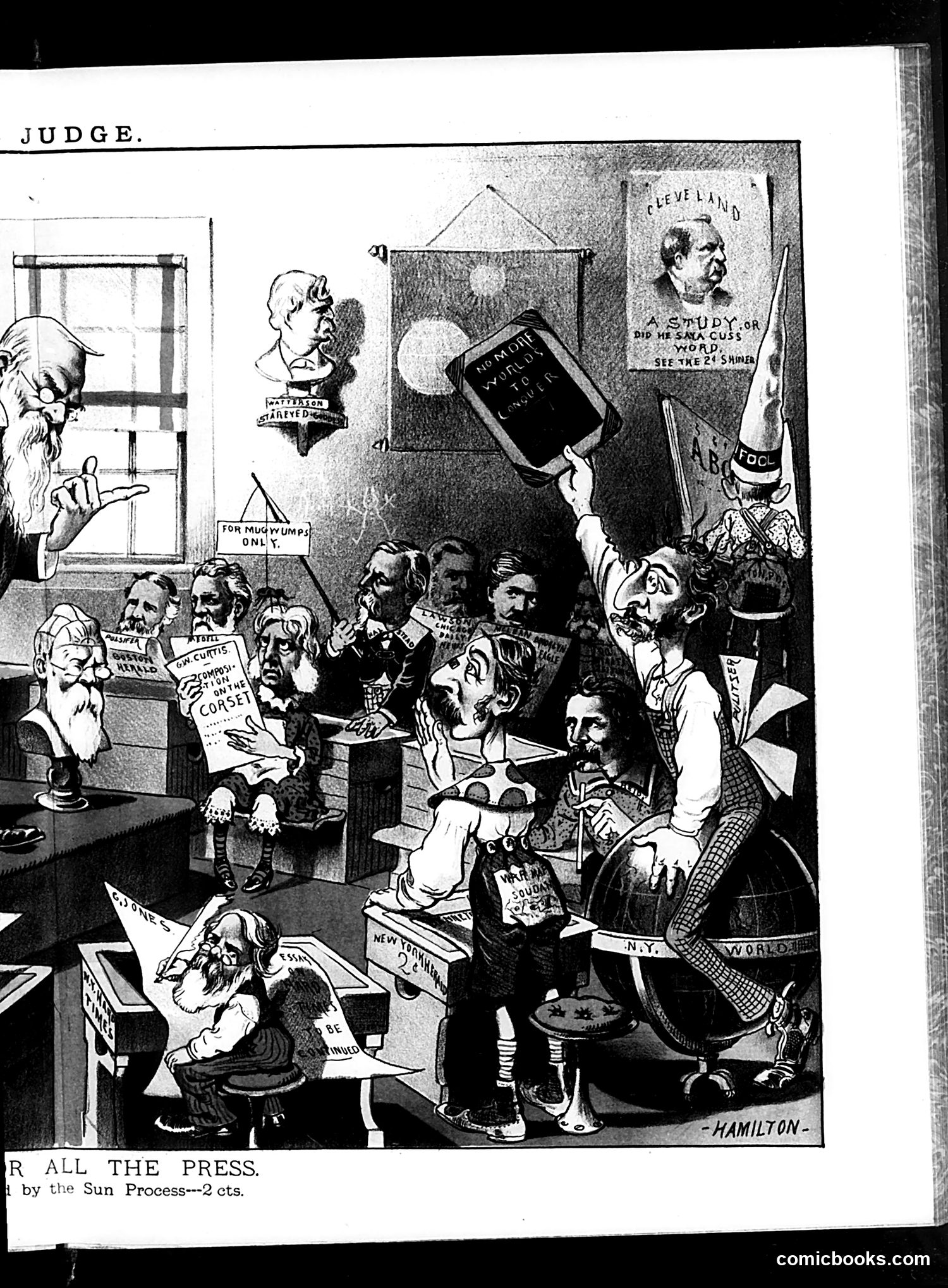
This Judge cartoon satirizes the American newspaper industry and press freedom. A judge presides over a courtroom where various newspaper representatives (identifiable by visible mastheads including "NEW YORK," "CURTIS," and "CORSET") present their cases or arguments. The figure at top right labeled "Cleveland" appears to oversee proceedings, while a figure holding a large book on the left suggests judicial authority or law. The satire likely critiques how the press operated as competing interests seeking judicial favor or protection, or comments on sensationalism and self-serving coverage by different publications. The diverse crowd of "press" figures suggests the fragmented, contentious nature of American journalism during this era. The "Sun Process" credit indicates this is a printing technique advertisement.
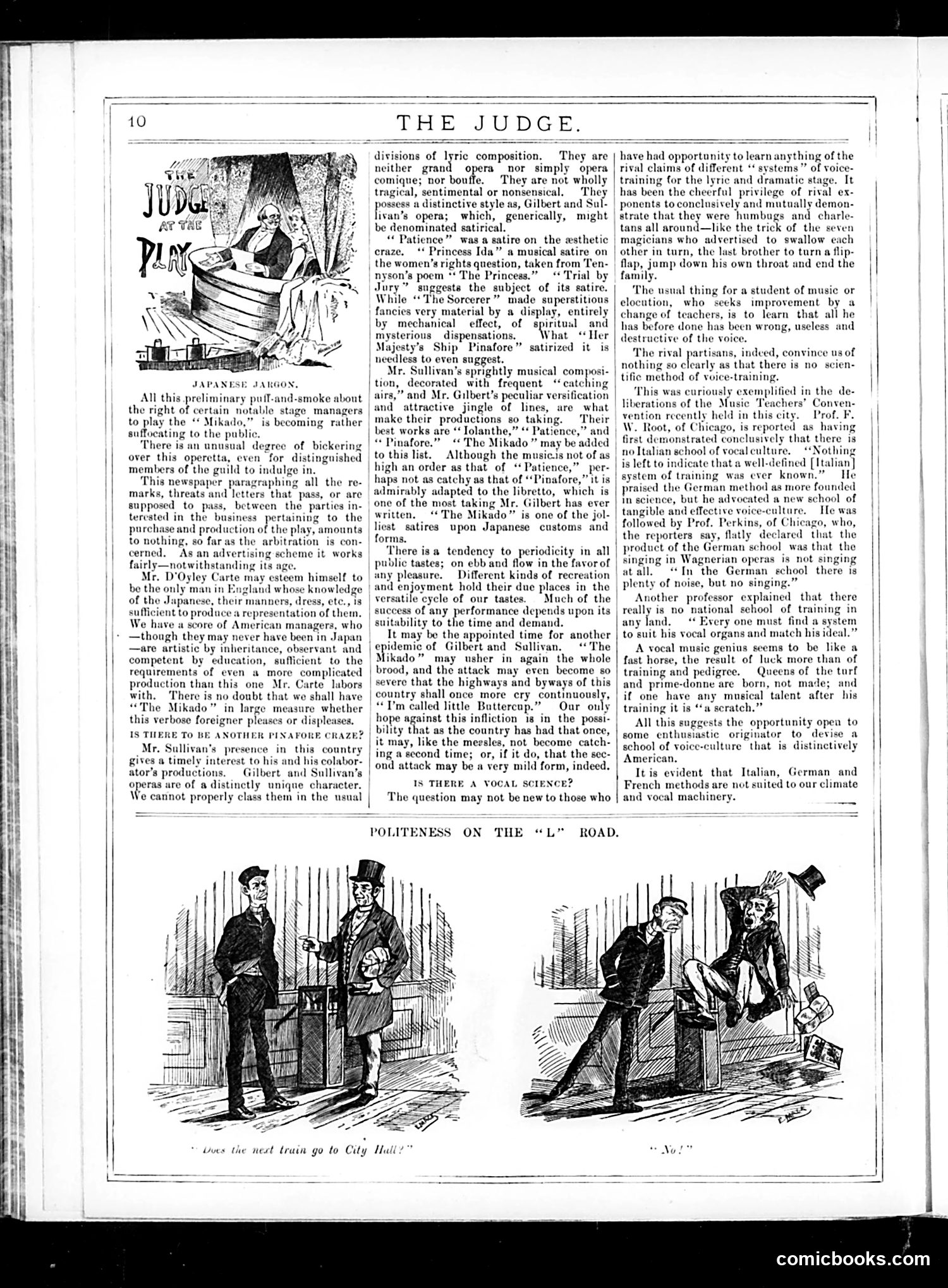
This page primarily discusses Gilbert and Sullivan's operetta *The Mikado*, debating its artistic merit compared to their earlier works like *Patience* and *Pinafore*. The text defends the production against claims that only one manager (likely D'Oyley Carte) understands Japanese culture. The two cartoons at the bottom, titled "Politeness on the 'L' Road," appear unrelated to the opera discussion. They depict two scenes of men at what seems to be an elevated train station ("L" likely refers to Chicago's elevated railway). The captions—"When the next train go to City Hall?" and "No!"—suggest a humorous exchange about train directions, satirizing either commuter rudeness or the confusion of urban transit systems. The cartoon's point remains unclear without additional context about contemporary Chicago transit issues.
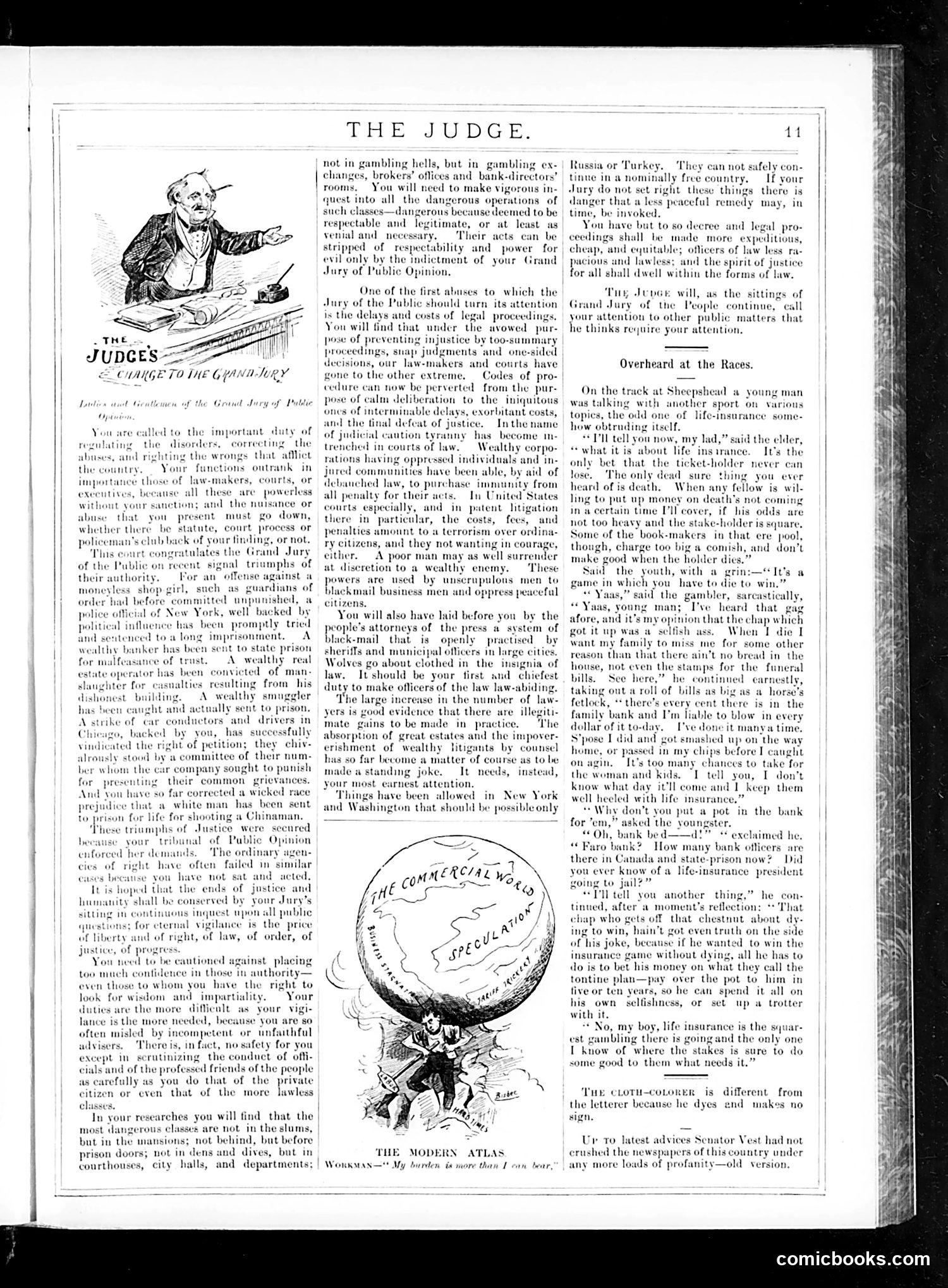
This page presents an editorial address to grand juries, framed as instruction on their civic duty. The main cartoon shows a judge gesturing emphatically—illustrating the authority figure delivering this charge. **Key Points:** The text advocates for grand juries as a check against corruption across all social classes. It warns that danger comes not from "slums" but from "mansions"—wealthy businessmen, bankers, and corporations—operating through "gambling exchanges, brokers' offices and bank-directors' rooms" rather than street gambling. **Specific Examples Referenced:** - A corrupt New York police official imprisoned - A wealthy banker sent to prison for fraud - A smuggler convicted - Strike conductors vindicated for petition rights **The Satire's Target:** Legal delays and costs that allow wealthy defendants to escape justice through procedural manipulation. The editorial argues courts have perverted "caution" into enabling tyranny, letting corporations evade accountability. This reflects Progressive Era concerns about corruption, corporate malfeasance, and whether ordinary legal institutions could deliver justice against powerful interests.
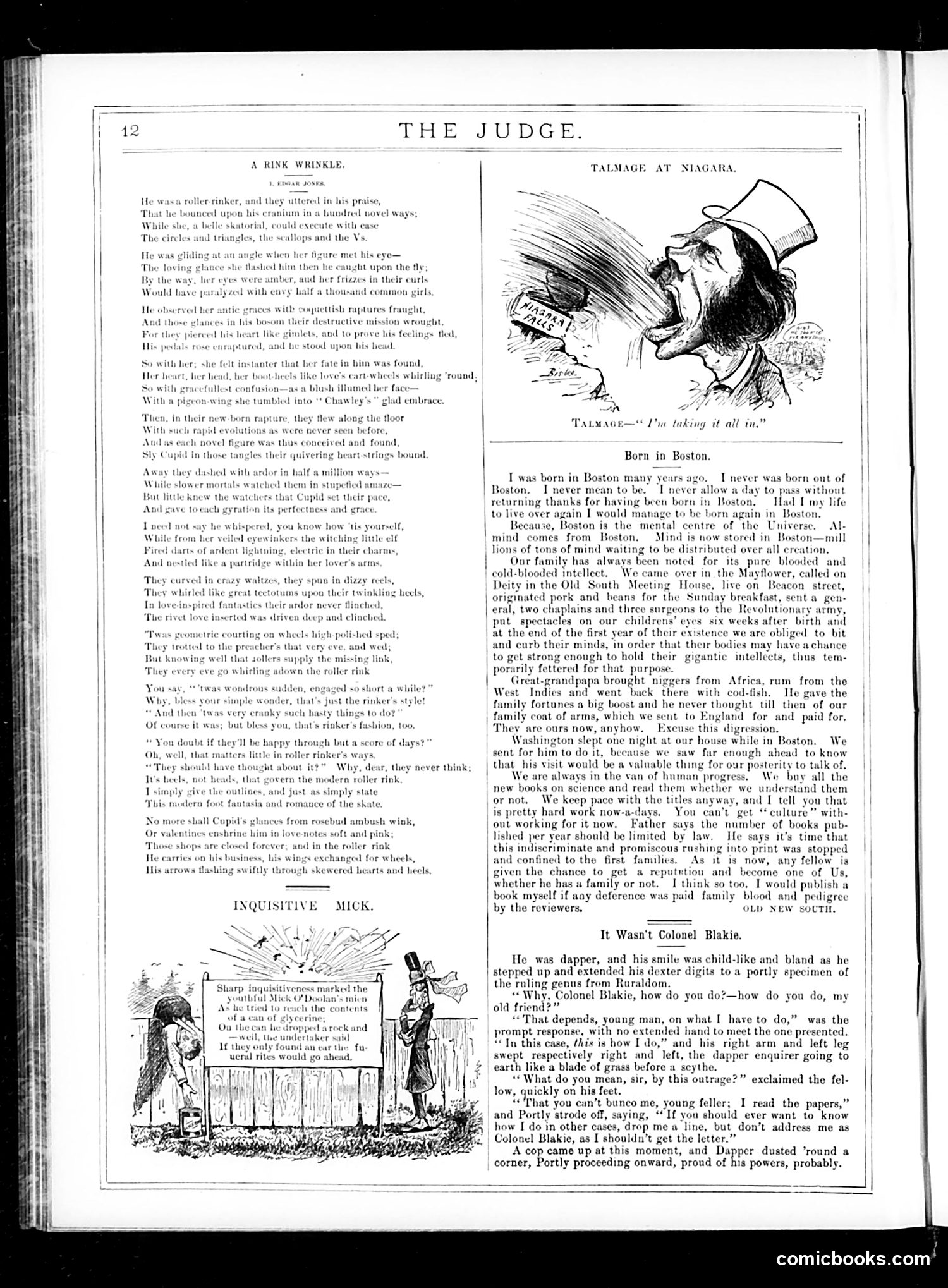
## "A Rink Wrinkle" This poem satirizes roller-skating culture, fashionable in the 1880s-90s. It mocks young couples who meet and rapidly fall in love at skating rinks, using exaggerated language about "Cupid in those tangles" and whirlwind romance. The joke targets the superficiality and speed of rink-based courtships—they marry within days. ## "Talmage at Niagara" The cartoon depicts a figure labeled "Talmage" at Niagara Falls, saying "I'm taking it all in." This likely references Thomas DeWitt Talmage, a prominent Presbyterian minister known for grandiose preaching. The satire appears to mock his bombastic, self-aggrandizing nature—even at natural wonders, he's still the center of attention. ## "Born in Boston" and "It Wasn't Colonel Blakie" These prose pieces satirize Boston Brahmin (old-money elite) pretension. The first mercilessly parodies Bostonians' obsessive self-regard and claims of intellectual/moral superiority. The second presents a contrasting figure—Colonel Blakie—noted for unpretentious common sense, implying Boston's elite lacks genuine substance.
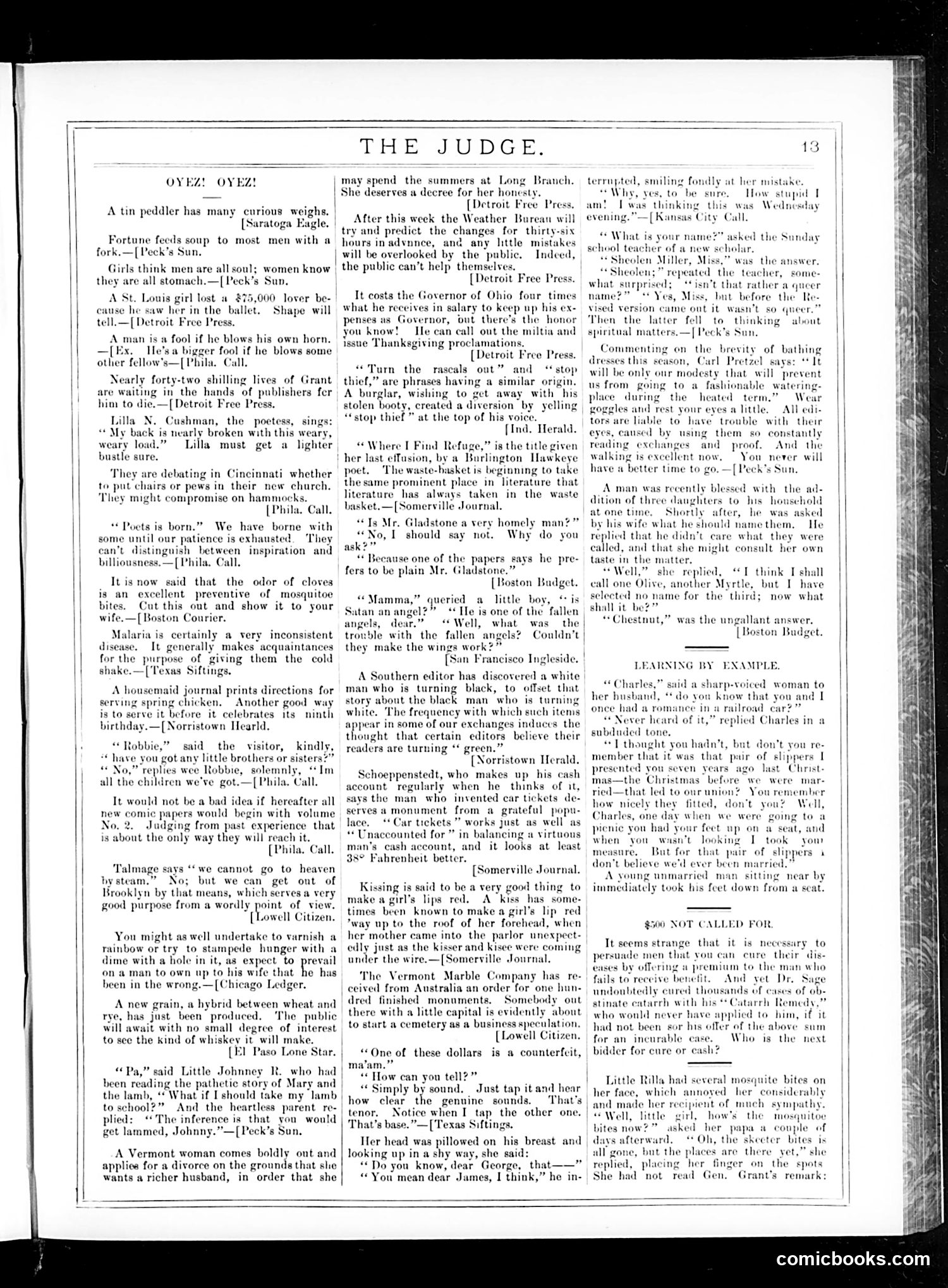
This is a miscellaneous **humor and joke page** rather than a political cartoon. It collects brief witticisms and anecdotes from various newspapers, typical of Judge's format. The jokes reflect late 19th-century American life: commentary on courtship (a man loses his lover after seeing her in ballet), marriage (wives and husbands' disputes), and social absurdities (a Vermont woman divorcing for a richer husband to afford Long Branch summers). There's also editorial commentary—mocking the Weather Bureau's poor forecasting accuracy and satirizing Ohio's governor for spending four times his salary maintaining appearances despite receiving "the honor." The content satirizes **contemporary social values**: women's limited economic independence, materialistic marriage incentives, and government inefficiency. Several jokes appear to target **Reconstruction-era politics** indirectly through references to Grant. The humor is crude by modern standards, relying on puns, wordplay, and sharp one-liners rather than visual satire. No specific identifiable political figures are caricatured on this particular page.
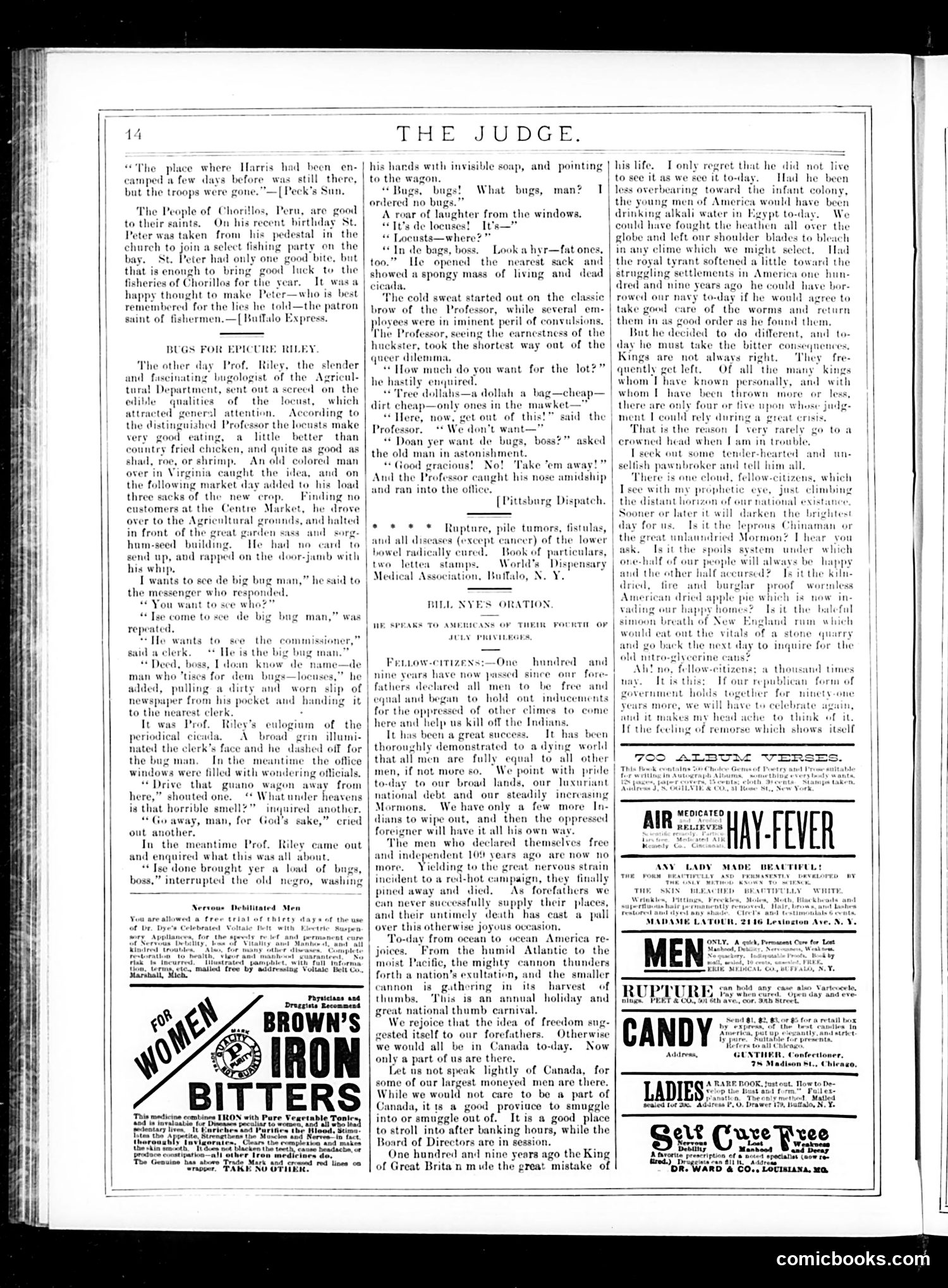
This is a humorous sketch about Professor Riley (appears to be a real entomologist, based on context), who maintains an elaborate laboratory studying insects. An elderly Black man arrives at the professor's office attempting to *sell* him locusts and other bugs, having misunderstood the professor's scientific interest as a commercial demand. The joke hinges on the collision between the working-class vendor's literal interpretation ("Doan yer want de bugs, boss?") and the professor's horror at receiving actual living insects rather than scholarly specimens. The satire mocks both the academic's pretentious distance from practical matters and the absurdity of the miscommunication itself. The accompanying page also contains Bill Nye's Fourth of July oration—satirizing American patriotic rhetoric through Nye's deadpan, cynical commentary on "freedom," westward expansion, and treatment of Native Americans.
This page is predominantly **advertisements and filler content** rather than political satire. The magazine's satirical material appears confined to three brief humorous anecdotes in the center-right column: 1. **"A Sensible Compliment"**: A joke about a man complimenting a woman's beauty, then admitting he's never seen her before—his "sensible" reasoning being that she stopped her car at the correct crossing. 2. **"Not So Remarkable"**: A saloon keeper's anecdote about a customer drinking brandy allegedly consumed by John Wilkes Booth before assassinating President Lincoln, then joking that one drink would drive anyone to murder a grandmother. 3. **"A Wonderful Freak of Nature"**: A pseudo-scientific preamble advertising Dr. Pierce's "Golden Medical Discovery" patent medicine for various ailments. The remainder consists of business advertisements for pianos, printing services, book binding, trusses, and other period products. No major political figures or events are caricatured on this particular page.
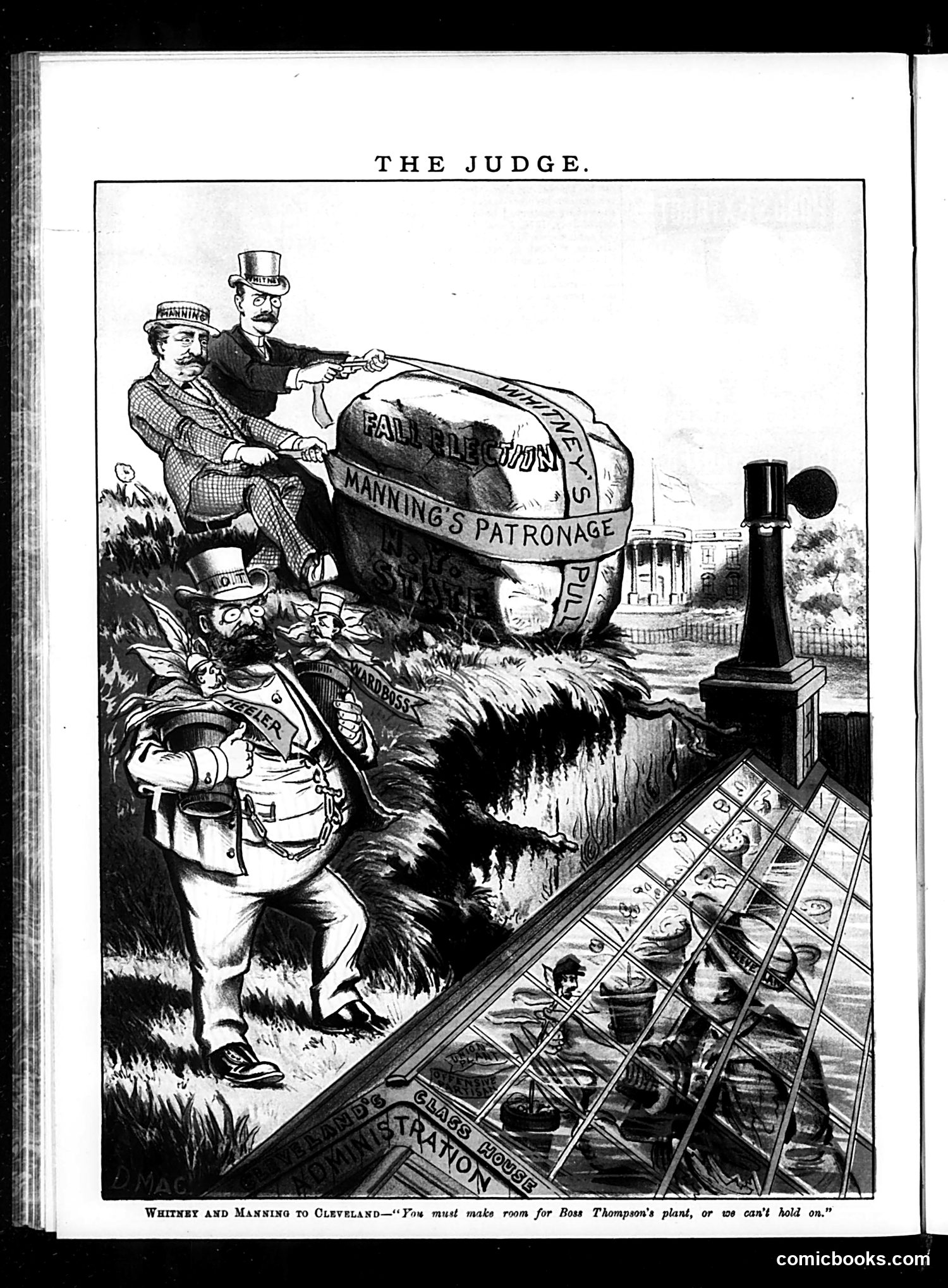
This political cartoon satirizes the relationship between Whitney and Manning (likely political or business figures) and "Boss Thompson's plant." The image shows two men riding an enormous egg or bulbous object labeled "Manning's Patronage," suggesting they're profiting from political favoritism. Below, a caricatured figure (possibly representing opposition or the public) gestures from what appears to be a crowded railway or station, labeled with references to "Boss" Thompson. The caption's demand to "make room for Boss Thompson's plant, or we can't hold on" suggests the cartoon criticizes how political patronage and boss politics are displacing or overwhelming legitimate interests. The satire targets machine politics and the power of political bosses to commandeer public resources for their allies' benefit.