
Judge, 1885-07-18 · page 10 of 16
Judge — July 18, 1885 — page 10: what you’re looking at
What you’re looking at
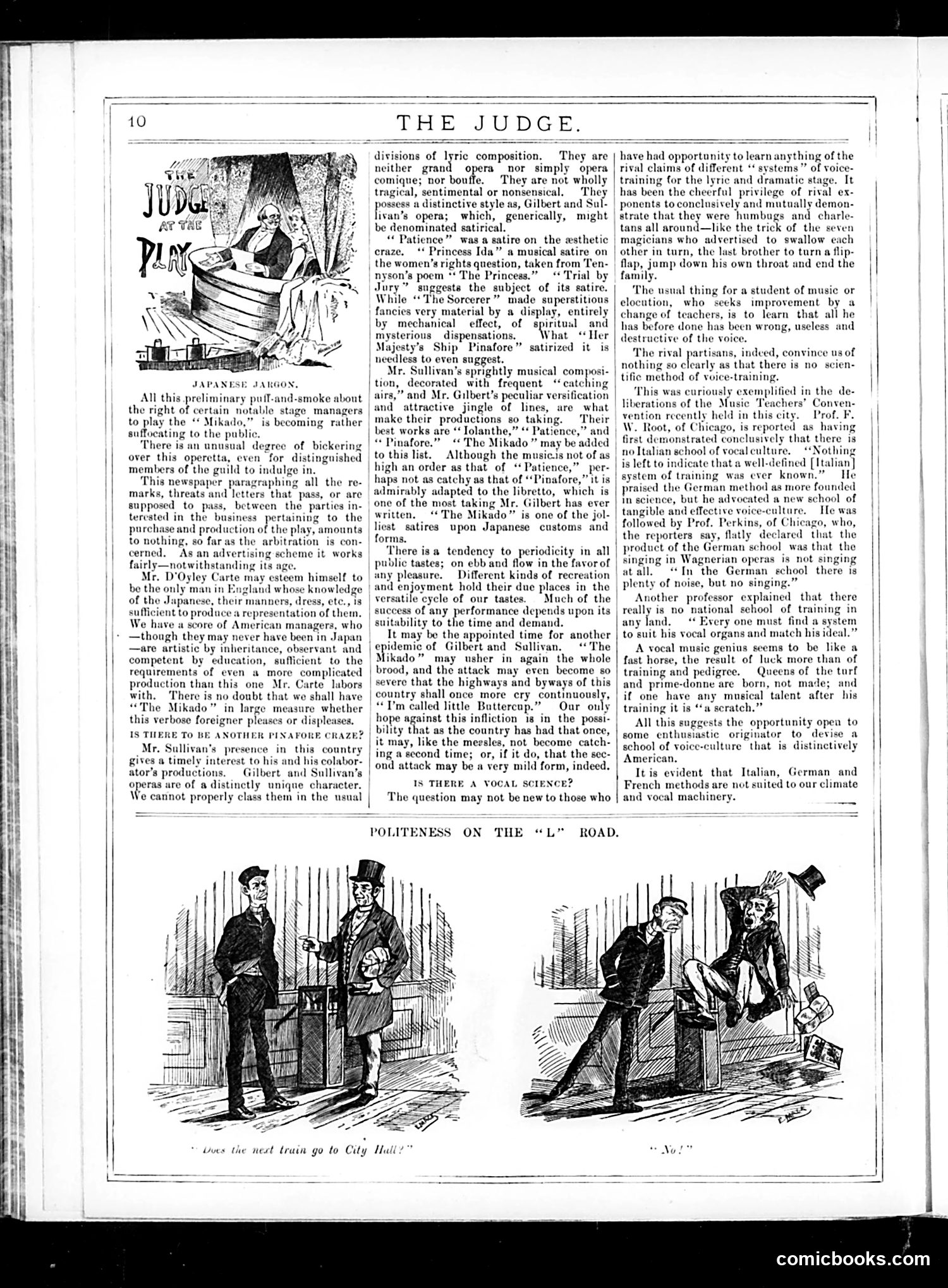
This page primarily discusses Gilbert and Sullivan's operetta *The Mikado*, debating its artistic merit compared to their earlier works like *Patience* and *Pinafore*. The text defends the production against claims that only one manager (likely D'Oyley Carte) understands Japanese culture. The two cartoons at the bottom, titled "Politeness on the 'L' Road," appear unrelated to the opera discussion. They depict two scenes of men at what seems to be an elevated train station ("L" likely refers to Chicago's elevated railway). The captions—"When the next train go to City Hall?" and "No!"—suggest a humorous exchange about train directions, satirizing either commuter rudeness or the confusion of urban transit systems. The cartoon's point remains unclear without additional context about contemporary Chicago transit issues.
📄 Transcribed text from this page (OCR, searchable)
Machine-transcribed from the original scan — historical spelling and the odd misread are preserved.
10 THE JUDGE. divisions of lyric composition, They are | neither grand opera nor simply opera comique; nor boutfe They are not wholly tragical, sentimental or nonsensical, Th } s a distinctive style as, Gilbert and S livan’s opera; which, generically, might be denominated satirical. “ Patience” was a satire on the esthetic craze. ‘* Princess Ida” a musical satire on | | the women’s rights question, taken from Te nyson’s poem * The Princess.” ‘Trial by Jury” suggests the subject of its satire. While ‘* The Sorcerer” made superstitious fancies very material by a display, entirely by mechanical effect, of spiritual and mysterious dispensations. Vhat “Her Majesty’s Ship Pinafore” satirized it is needless to even suggest. Mr. Sullivan’s sprightly musical composi tion, decorated with frequent ‘catchin All this preliminary puff-and-smoke about | #irs,” and Mr. Gilbert's peculiar versificatio the right of certain notable stage managers | 8d attractive jingle of lines, are what y the “Mikado,” is becoming rather Make their productions so taking. Their suffocating to the public. best works are “Tolanthe,” ** Patience,” and ‘There is un unusual degree of bickering | ‘* Pinafore.” ‘The Mikado” may be added over this operctta, even for distinguished | to this list. Although the music.is not of as members of the guild to indulge in. high an order as that of ‘ Patience,” per- This newspaper paragraphing all the re- haps not as catchy as that of “Pinafore,” it is marks, threats and letters that pass, or are ®dmirably adapted to the libretto, which is supposed to pass, between the parties in- | one of the most taking Mr. Gilbert has ever | terested in the business pertaining to the | ¥ritten. ‘*The Mikado” is one of the chase and production of the play, amounts | liest satires upon Japanese customs to nothing, so faras the arbitration is con- | forms. There is a tendency to periodicity in all | v0, public tastes; on ebb and flow in the favorof | ‘ay esteem himself to | #ny pleasure. Different kinds of recreation be the only man in England whose knowledge | 4nd enjoyment hold their due places in the of the Japanese, their manners, dress, etc., is | versatile cycle of our tastes. Much of the cient to produce a representation of them, | Success of any performance depends upon its We have a score of American managers, who Suitability to the time and demand. —thongh th y never have been in Japan , It may be the appointed time for anoth —are artistic by inheritance, observant and | epidemic of Gilbert and Sullivan. competent by education, suffi requirements of product jol- and y nding its Mr. D'Oyley Carte 1 vr he nt to the | Mikado” may usher in again the whole ’n a more complicated brood, and the attack may even become so n than this one Carte lubors | severe that the highways and byways of this with, t we shall have | Country shall once more cry continuously, “The » measure whether ‘I’m called little Buttercup.” Our ouly this verbose foreigner pleases or dis hope against this infliction 18 in the possi- | 18 THERE To BE ANOTHER PINAFOR bility that as the country has had that once, | Mr. Sullivan's y ce in this country | it M&Ys like the meesles, not become catch- gives a timely interest to his and his colabor- | in&,% second times or, if it do, that the sec- ' y interest to his and his colabor- | ond attack may be a very mild form, indeed. | ator’s productions. Gilbert_and Sullivan’s | ° | operas are of a distinctly unique character. 18 THERE A VOCAL SCIENCE? We cannot properly class them in the usual | The question may not be new to those who | POLITEN THE “L” ROAD. | product of the have had opportunity to learn anything of the rival claims of different ‘* systems” of voice: training for the lyric and dramatic stage. It has been the cheerful privilege of rival ex- ponents to conclusively and mutually demon- strate that they were humbugs and charle- tans all around—like the trick of the seven magicians who advertised to swallow each other in turn, the last brother to turna flip- | flap, jump down his own throat and end the family. The usual thing for a student of music or elocution, who seeks improvement by a ange of teachers, is to learn that all he has before done has been wrong, useless and destructive of the voice. The rival partisans, indced, convince us of nothing so clearly as that there is no scien- tific method of e-training, ‘This was curiously exemplified in the de- liberations of the Music Teachers’ Conven- tly held in this city. Prof. F. ot, of Chicago, is reported as having onstrated conclusively that there is culture. ‘Nothing ¢ that a well-defined [Italian] | first di no Italian school of voe: is left to indic tem of training was ever known.” He | praised the German method as more founded | In science, but he advocated a new school of tangible and effective voice-culture. Ie was followed by Prof. Perkins, of Chic: the reporters say, flatly declared t erman school was that the singing in Wagnerian operas is not singing atall, ‘*In the German echool there is plenty of noise, but no singing.” Another professor explained that there really is no national sehool of training in any land, ‘* Every one must find a system to suit his vocal organs and mutch his ideal.” A vocal music genius seems to be like a fast horse, the result of luck more than of | | training and pedigree. Queens of the turf | and prime-donne are born, not made; and if one have any musical talent after his training it is ‘a scratch.” All this suggests the opportunity open to some enthusiastic originator to devise school of voice-culture that is distinctively American, 1] | It is evident that Italian, German and French methods are not suited to our climate and vocal machinery. | Kl comicbooks.com