
A complete issue · 16 pages · 1885
Judge — June 27, 1885
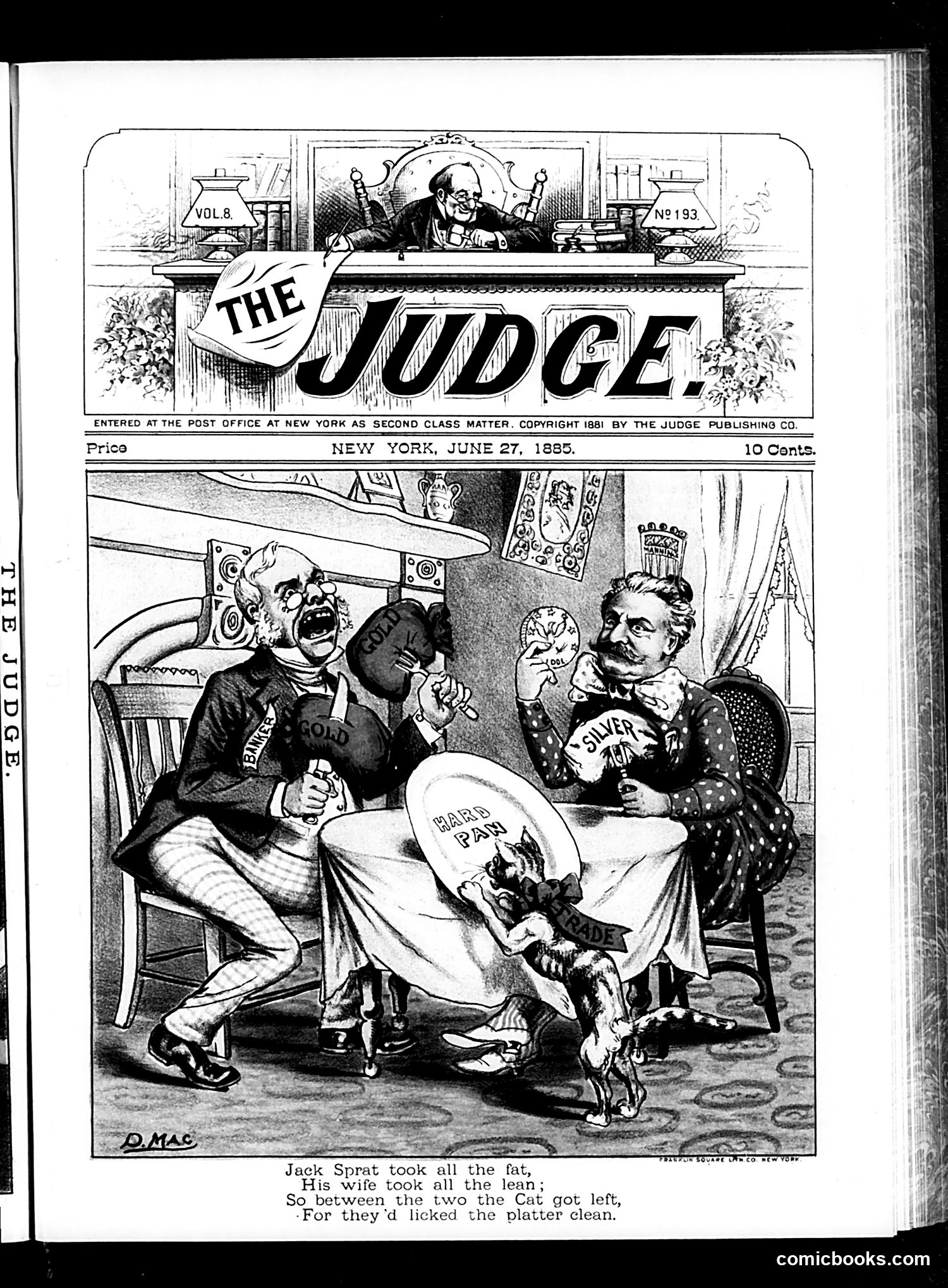
This satirical cartoon depicts a domestic scene with two men and a cat. The verse jokes about "Jack Sprat," referencing the nursery rhyme about a couple where one ate fat and one ate lean, with their cat cleaning the plate between them. The men wear labels suggesting they represent different economic or political positions ("GOLD," "SILVER" visible on their clothing). The cartoon appears to be commentary on late-19th-century monetary policy debates—specifically the gold versus silver standard controversy that dominated American politics in the 1880s-1890s. The "cat" likely represents the working class or public, positioned between opposing factions and metaphorically "licked the platter clean"—suggesting ordinary people suffered while political elites fought over currency policy.
This page contains two distinct political commentaries from what appears to be the 1880s-90s era: **"Burlesque Statesmanship"** attacks British Prime Minister **Gladstone** for making beer taxation—rather than serious imperial matters like Afghanistan—the issue that caused his electoral defeat. The satirist argues this apparent loss is actually a clever strategic retreat that will vindicate Gladstone historically, while his Tory opponents (represented by "John Bull") celebrate prematurely over a trivial victory. **"The Great Usurpation"** critiques U.S. financial policy, claiming the government has betrayed the people's will regarding **bimetallism** (using both silver and gold as currency). The piece alleges a conspiracy between Treasury officials and New York banking syndicates to monopolize gold while removing silver from circulation, thereby strangling trade and confidence. This reflects real 1890s debate over monetary policy and populist suspicions of banker influence over government. Both pieces employ sarcasm to expose what the author sees as political hypocrisy and betrayal of democratic principle.
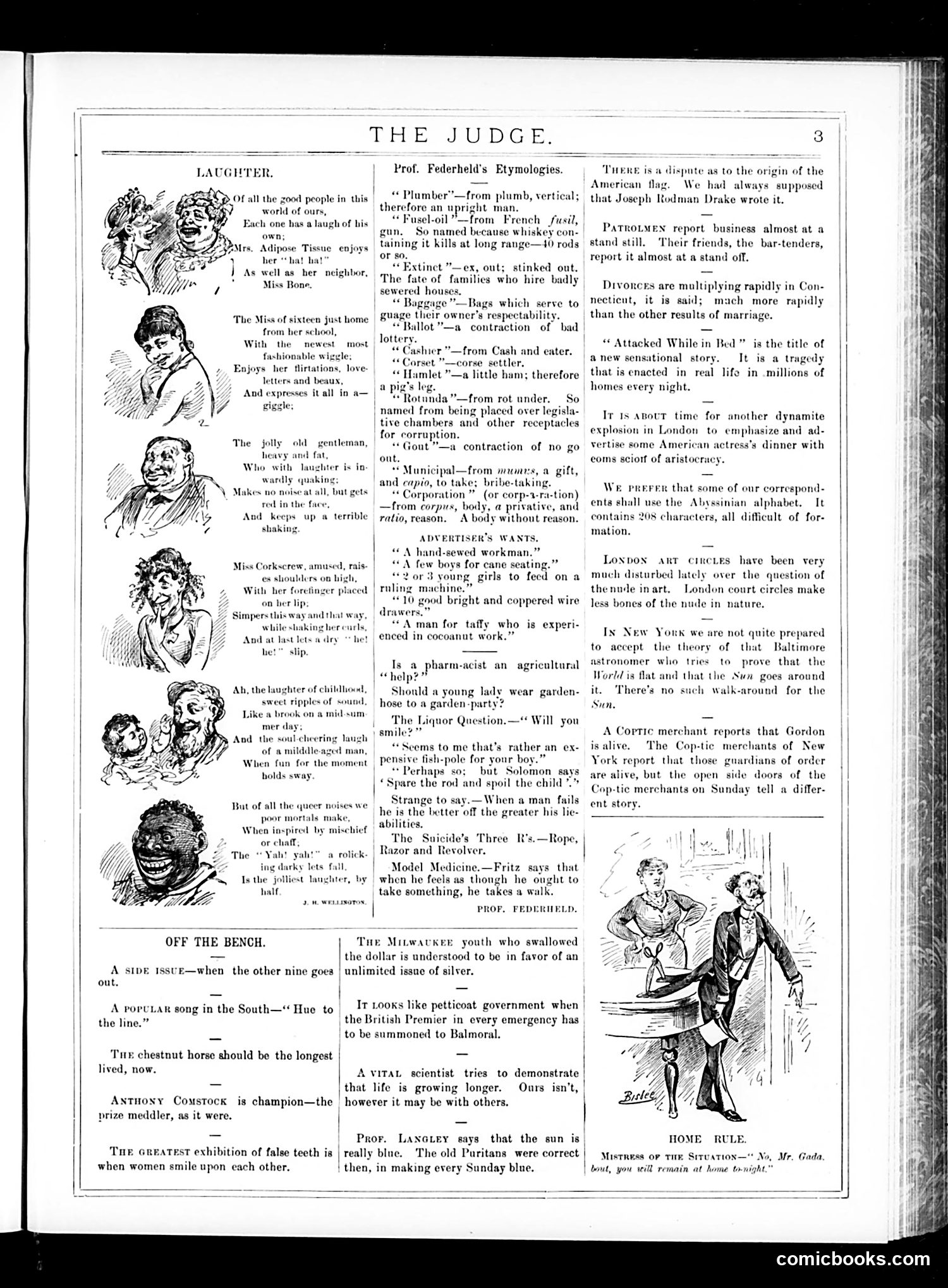
This page from *Judge* contains humorous observations and satirical commentary typical of late 19th-century American humor. The left column features illustrated character sketches with accompanying verse about different types of people—a flirtatious young woman, a portly gentleman, Miss Corkscrew, and others—poking fun at social types and human vanity. The right column offers "Prof. Federheldt's Etymologies," a satirical wordplay feature that humorously derives word origins to critique social issues: "Baggage" relates to respectability, "Ballot" to lottery, "Municipal" to bribe-taking, and "Corporation" to a body "without reason." The scattered notes below mock contemporary figures (Anthony Comstock, the meddling censor) and current events (British politics, Connecticut divorces, currency debates). The overall tone is lighthearted social satire aimed at human foibles and institutional absurdities rather than serious political critique.
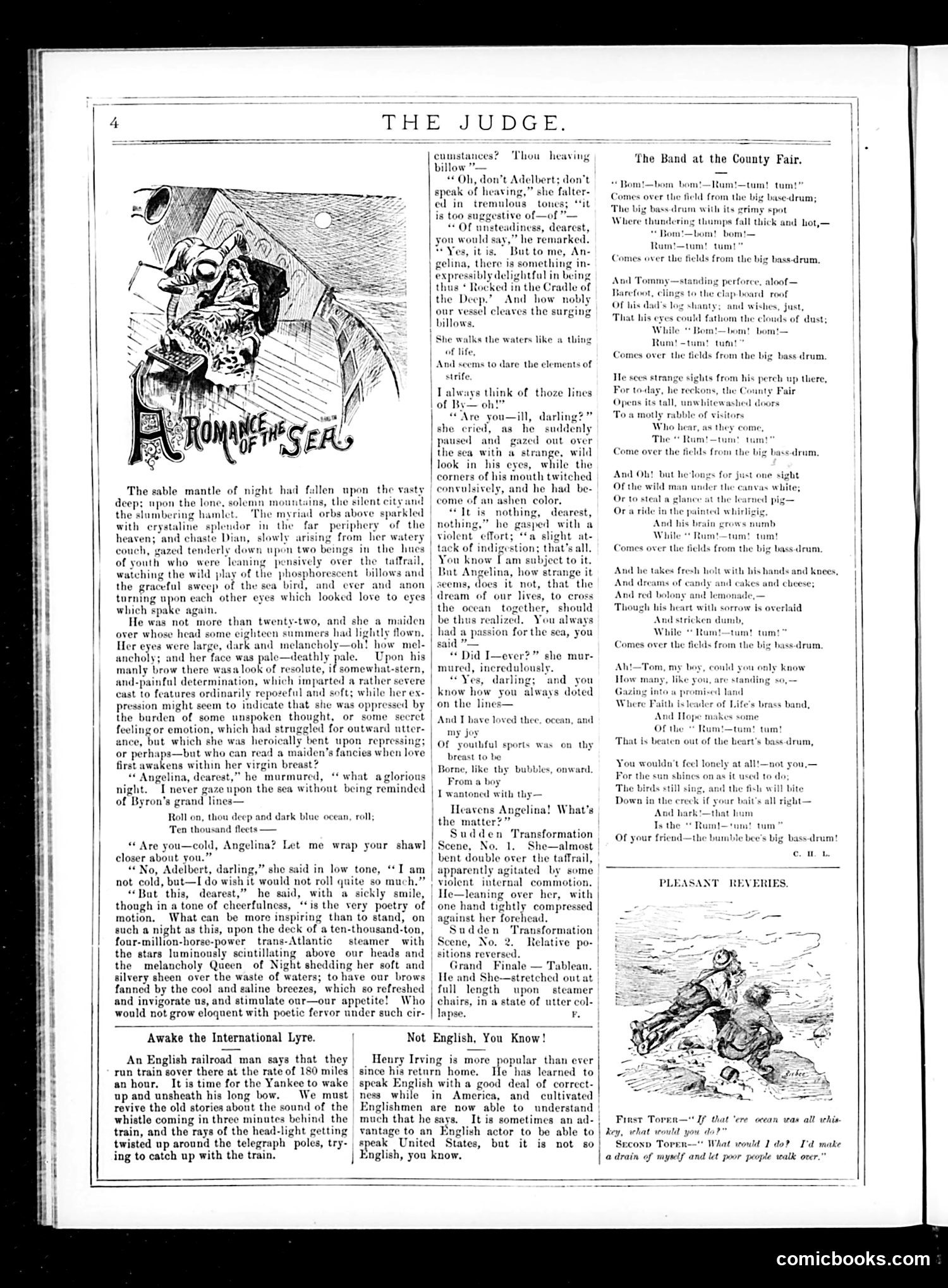
This page presents sentimental romantic fiction rather than political satire. The main feature, "Romance of the Sea," is a melodramatic narrative about two young lovers, Adelbert and Angelina, on a trans-Atlantic steamer. The story employs purple prose typical of Victorian romance—flowery descriptions of moonlit ocean scenes, passionate declarations, and emotional tension. The humor appears gentle rather than pointed: Adelbert waxes poetic about the "poetry of motion" and Byron's verses while Angelina suffers from seasickness, creating an ironic gap between his romanticizing and her physical discomfort. The "Sudden Transformation Scene" suggests the narrative will shift comedically as her condition worsens. The page also includes lighter verses like "The Band at the County Fair" and "Pleasant Reveries"—typical magazine filler content. This appears to be entertainment-focused rather than addressing contemporary political or social issues, making it less directly satirical than typical Judge content.
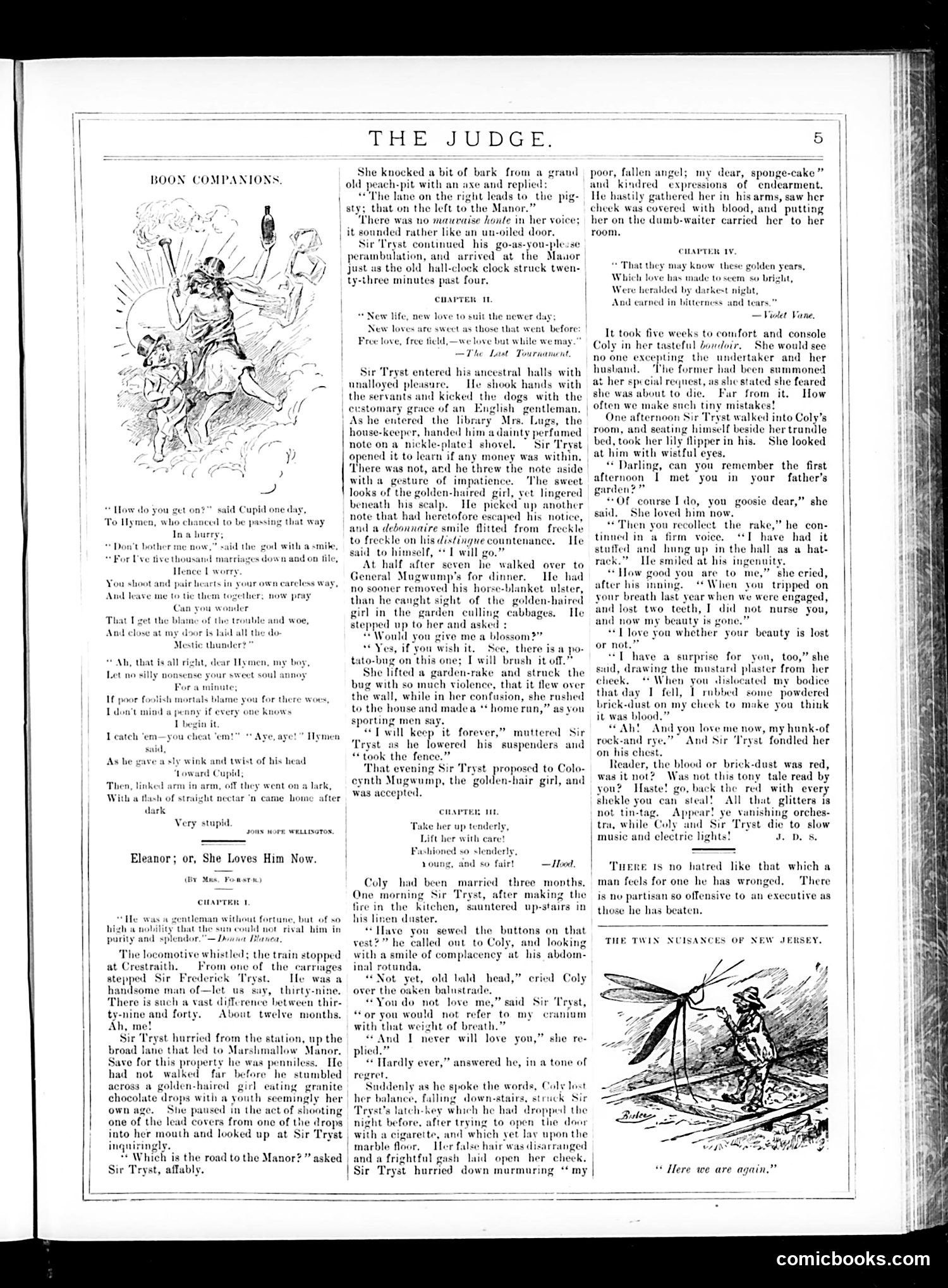
This page from *Judge* contains serialized fiction rather than political satire. "Eleanor; or, She Loves Him Now" follows Sir Tryst, a gentleman who pursues a golden-haired girl (Coly) and proposes to her. The narrative satirizes romantic conventions and class dynamics of the era. The humor emerges from the contrast between Sir Tryst's aristocratic pretensions and Coly's blunt, practical responses. When he asks for a flower, she violently kills a potato bug instead—an anticlimactic, unromantic act. Their three-month marriage has already soured; Coly calls him "old bald head" when he demands she sew his buttons. The satirical point mocks both sentimental Victorian romance narratives and the rapid deterioration of marriages based on superficial attraction rather than genuine compatibility. The poetry epigraphs about "free love" underscore the critique of conventional courtship rituals.
This satirical piece mocks the colonial powers' territorial disputes and hypocrisy. The Russian and English Consulates share a building and stairway in an unnamed city (likely Shanghai or another treaty port). When the English Consul demands delimitation, the Russian representative fails to appear. The English Consul unilaterally draws a chalk line, then redraws it to claim the entire lower stairway. The satire sharpens when the English Consul uses a pastry cook and a Black shopkeeper as pawns—claiming to "civilize" them while exploiting them for leverage against the Russian Consul. The piece exposes how Western powers invoked "civilization" as justification for imperial control, abuse, and territorial aggression. The absurd escalation (from stairway dispute to threatened military force) underscores the pettiness and brutality underlying great-power diplomacy.
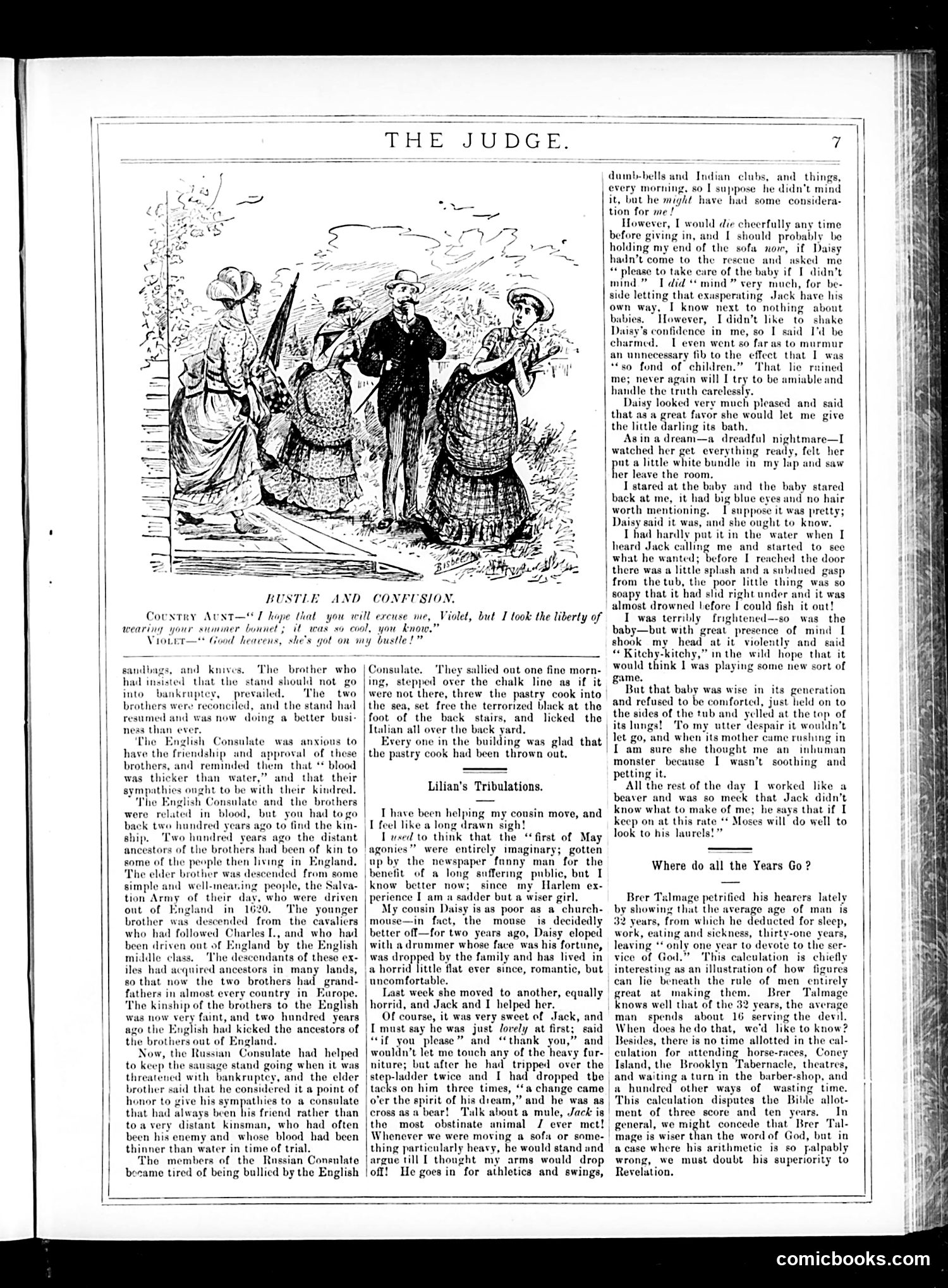
This page contains two distinct pieces of satire: **"Bustle and Confusion"** (the cartoon): A visual joke about women's fashion. A country aunt apologizes for wearing her niece Violet's summer bonnet, claiming it was cooler—then realizes she's sat on and crushed Violet's large "bustle" (the rigid framework that puffed out skirts at the back). The humor lies in the absurdity of Victorian-era women's clothing construction and the casual destruction of expensive garments. **"Lilian's Tribulations"** (the essay): A humorous account of helping a poor cousin move apartments in Harlem, New York. The cousin "Daisy" eloped with a drummer (musician) and was disowned by her family. Lilian complains that helping move furniture was exhausting and that her male companion Jack, initially gallant, became irritable and argumentative during the heavy lifting—an early comedic take on gender dynamics and domestic labor. Both pieces use everyday domestic inconveniences for satirical effect, typical of *Judge* magazine's approach to middle-class American life.
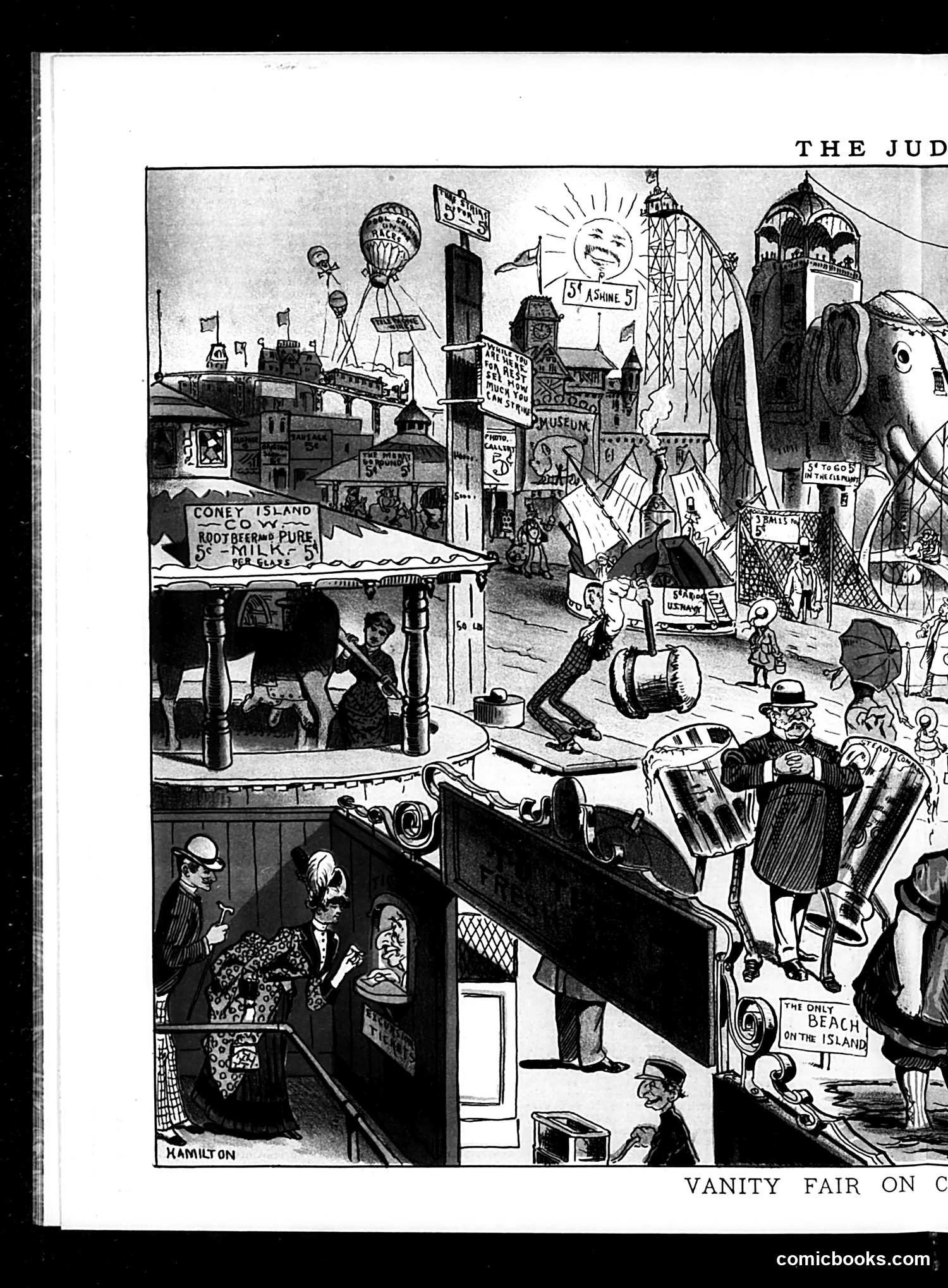
This is a satirical illustration of Coney Island amusement park, signed by Hamilton. The cartoon depicts the chaos and spectacle of early 20th-century mass entertainment: garish attractions (balloons, a sun character, an elephant), carnival games, crowds of working-class visitors, and various amusements packed densely together. The lower left shows what appears to be a theater or indoor venue. The satire targets the commercialization and vulgar excess of popular entertainment—mocking both the carnival operators exploiting visitors and the crowds drawn to such attractions. "Vanity Fair" references the biblical allegory of worldly temptation, suggesting Coney Island represents shallow consumerism and frivolous amusement-seeking among ordinary Americans. The dense, chaotic composition emphasizes sensory overload and moral decay associated with mass culture.
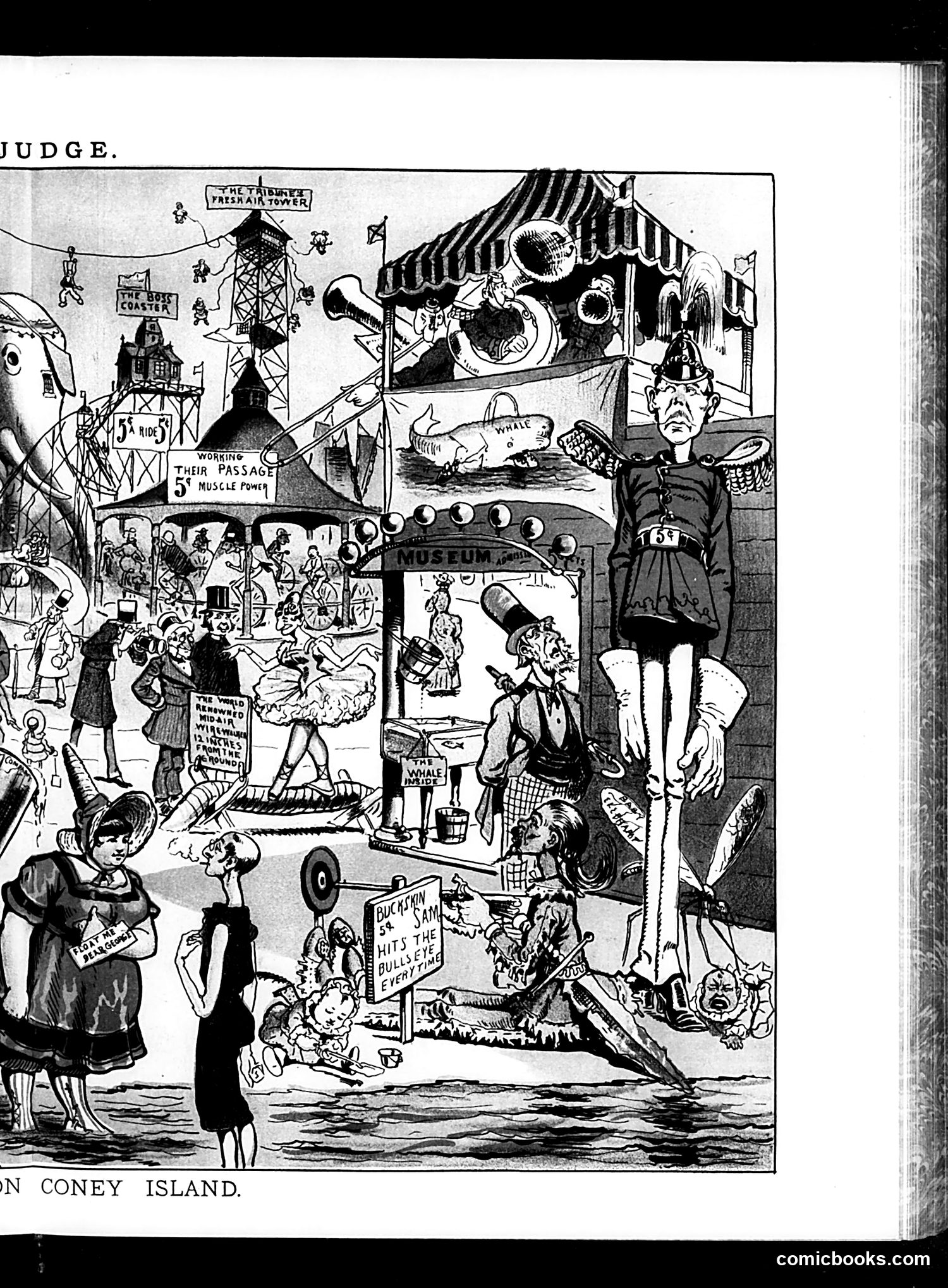
This is a satirical illustration of Coney Island amusement park, depicting it as a chaotic, commercialized spectacle. The cartoon shows various carnival attractions, rides, and crowds of working-class visitors enjoying leisure activities. A prominent military or authoritarian figure stands on the right, towering over the scene—likely representing government oversight or social control of public spaces. The visible signs reference working-class attractions ("5¢ Ride," "Muscle Power") and carnival barkers. The satire appears to critique how Coney Island represents both democratic leisure access for ordinary people and concerns about crowd management, commercialism, and potential social disorder. The composition suggests Judge magazine's somewhat ambivalent view of mass entertainment and working-class culture during the early 20th century.
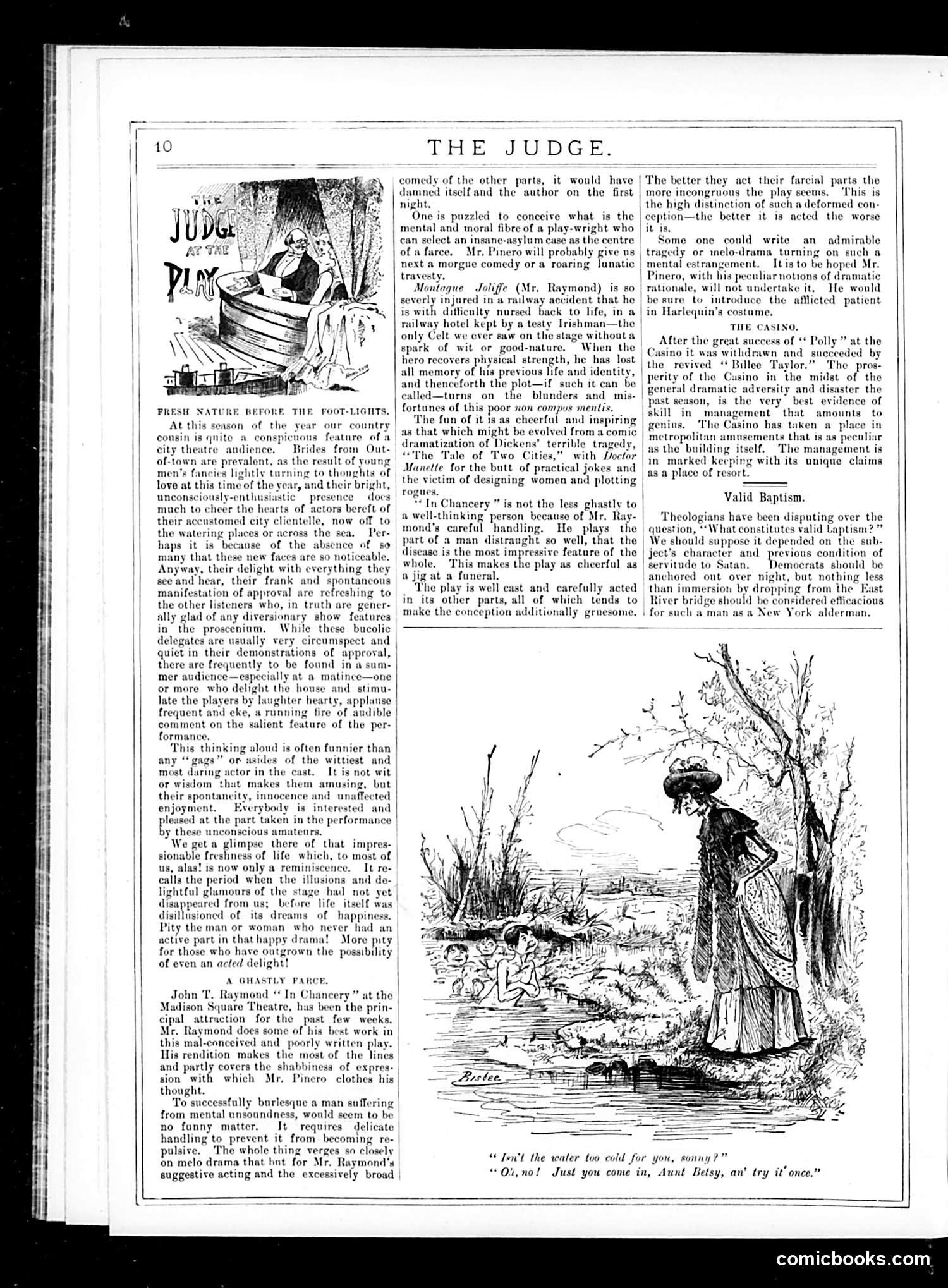
This page reviews theatrical productions, primarily criticizing playwright Arthur Wing Pinero's "In Chancery," starring John T. Raymond. **The Main Critique:** The reviewer finds Pinero's choice to center a farce around a man suffering mental illness (amnesia from a railway accident) in a hotel run by an Irish stereotype deeply problematic. The critic argues that mental illness shouldn't be comedic material—it requires "delicate handling" to avoid becoming "repulsive," yet Pinero treats it as broad farce. The reviewer sarcastically suggests Pinero might next write comedies about morgues or asylums. **The Praise:** Despite the poor script, Raymond's skilled acting "covers the shabbiness" and makes the best of bad material. **The Lower Section:** A separate piece praises the enthusiasm of young rural theatergoers—their genuine, unselfconscious delight refreshes jaded urban audiences and reminds sophisticated viewers of theater's lost magic. The satire targets Pinero's insensitive subject matter, not the actor.
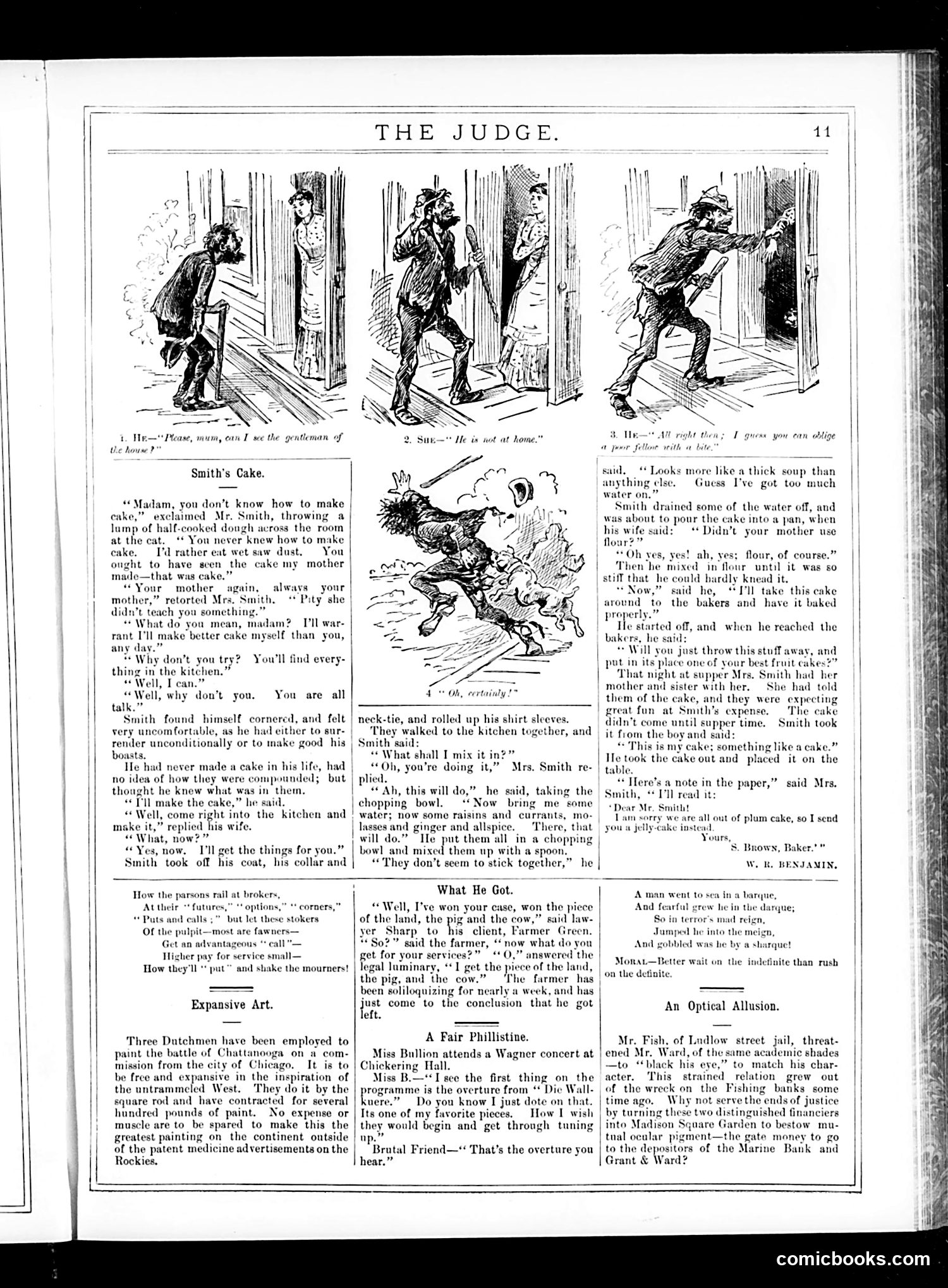
This page from *Judge* magazine features a humorous domestic satire about marital conflict and masculine pride. **The Setup**: Mr. Smith boasts that his late mother made superior cakes, insulting his wife's cooking. When challenged to prove himself, he confidently attempts baking—despite having never made a cake in his life. **The Joke**: Smith's incompetence is absolute. He uses a chopping bowl instead of proper baking equipment, adds ingredients without understanding their proportions (adding excessive water, then flour to compensate), and produces a mixture so terrible he must secretly take it to professional bakers to salvage his pride. **The Satire**: The cartoon mocks masculine arrogance and the Victorian husband's tendency to invoke his mother as the gold standard while being utterly helpless in domestic matters. His wife and her guests anticipate his humiliation with schadenfreude. The page also includes unrelated short pieces and advertisements typical of *Judge*'s format—a satirical weekly combining social commentary with humor.
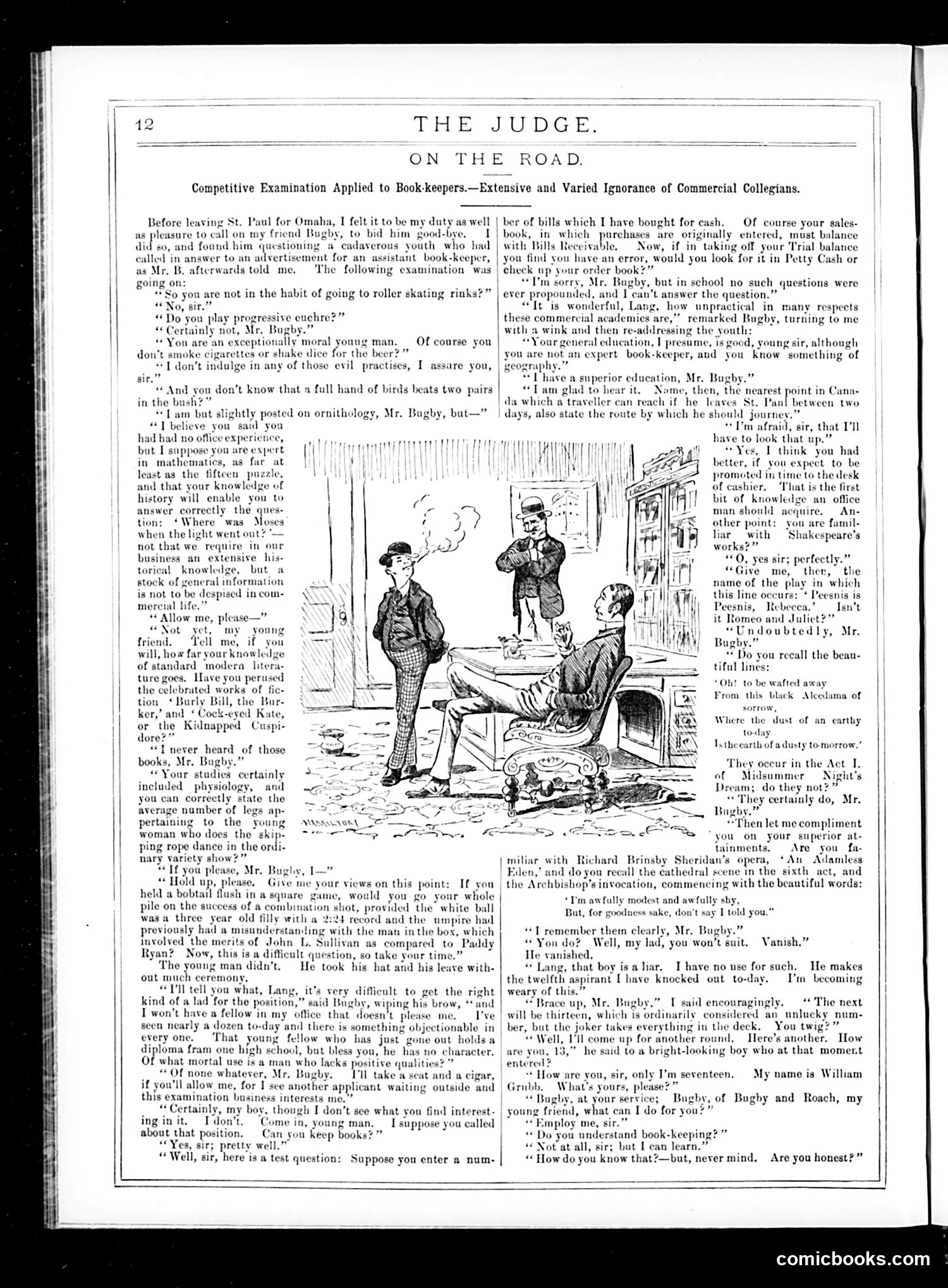
This satirical piece mocks the inadequate preparation commercial colleges provide for actual office work. Mr. Bugby, a businessman, interviews candidates for a bookkeeping position. He pointedly contrasts useless general-knowledge questions (roller skating rinks, progressive euchre, dime novels like "Early Bill the Barker," Shakespeare trivia) with practical accounting skills the candidates lack. The cartoon critiques both employers and educational institutions: Bugby wastes time on irrelevant social etiquette, while the "commercial academies" fail to teach real job competencies like trial balance reconciliation and petty cash procedures. The irony is that neither party—the overly moralistic boss nor the ill-trained graduates—focuses on what actually matters in commerce. The satire exposes the gap between contemporary business education and real workplace demands.
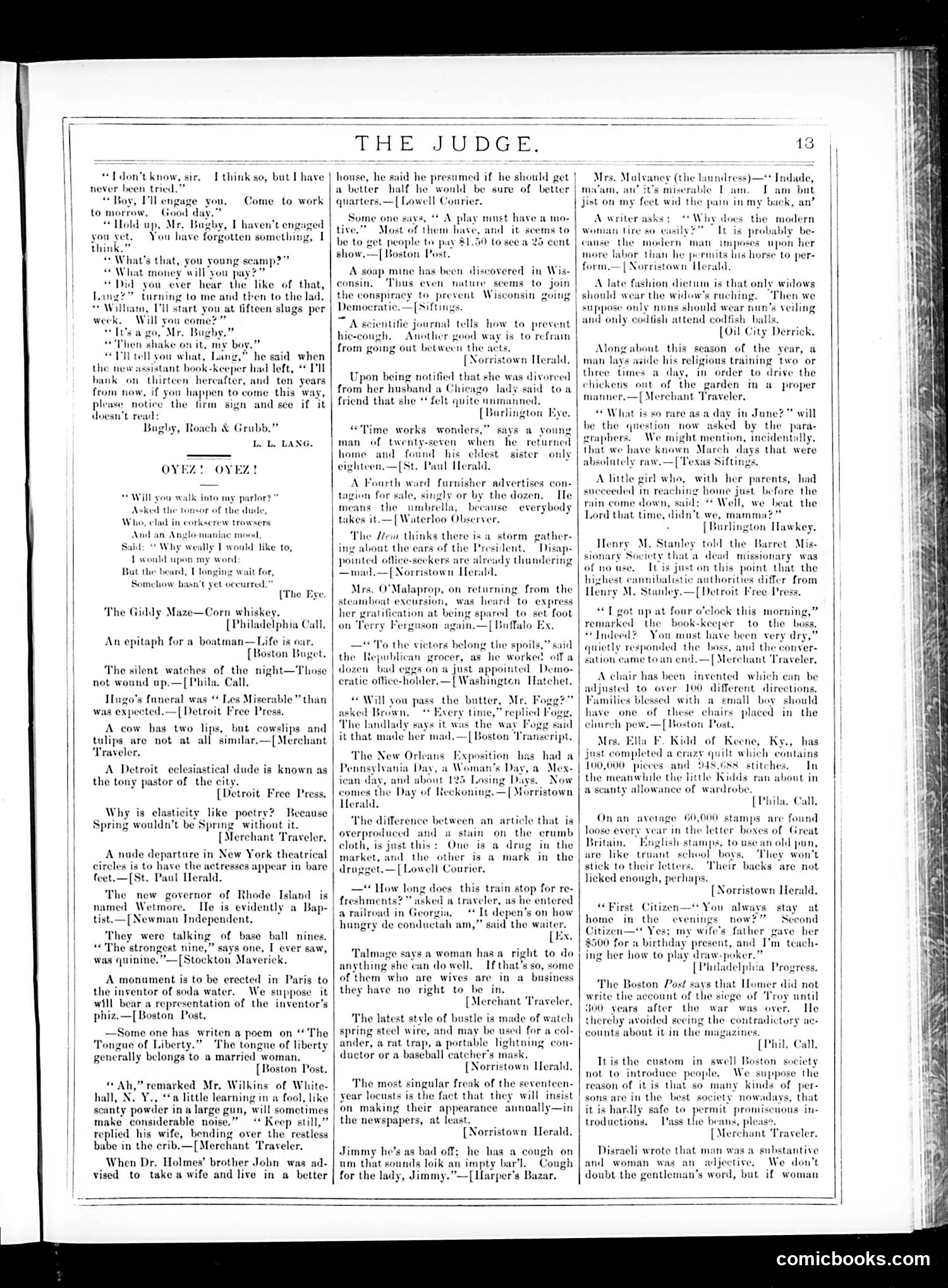
This page contains brief satirical quips and jokes typical of Judge magazine's format—short humor pieces rather than a political cartoon. The jokes target various subjects: business practices (a young clerk hired at low wages who'll eventually build the firm), romantic/marital follies (a woman divorced from her husband, a man's learning compared to "scanty powder in a large gun"), urban inconveniences (umbrellas called "contagion" because everyone catches them), and political satire (disappointed office-seekers complaining to the new President). Several items mock pretension: a "giddy maze" of corn whiskey, a dude in "corkscrew trousers," and theatrical actresses appearing in "bare feet." The humor is gentle, domestic, and wordplay-focused rather than sharp political commentary. Without specific dates or named figures, the satire targets broad social types—politicians, bureaucrats, married couples, and social climbers—rather than specific events or individuals.
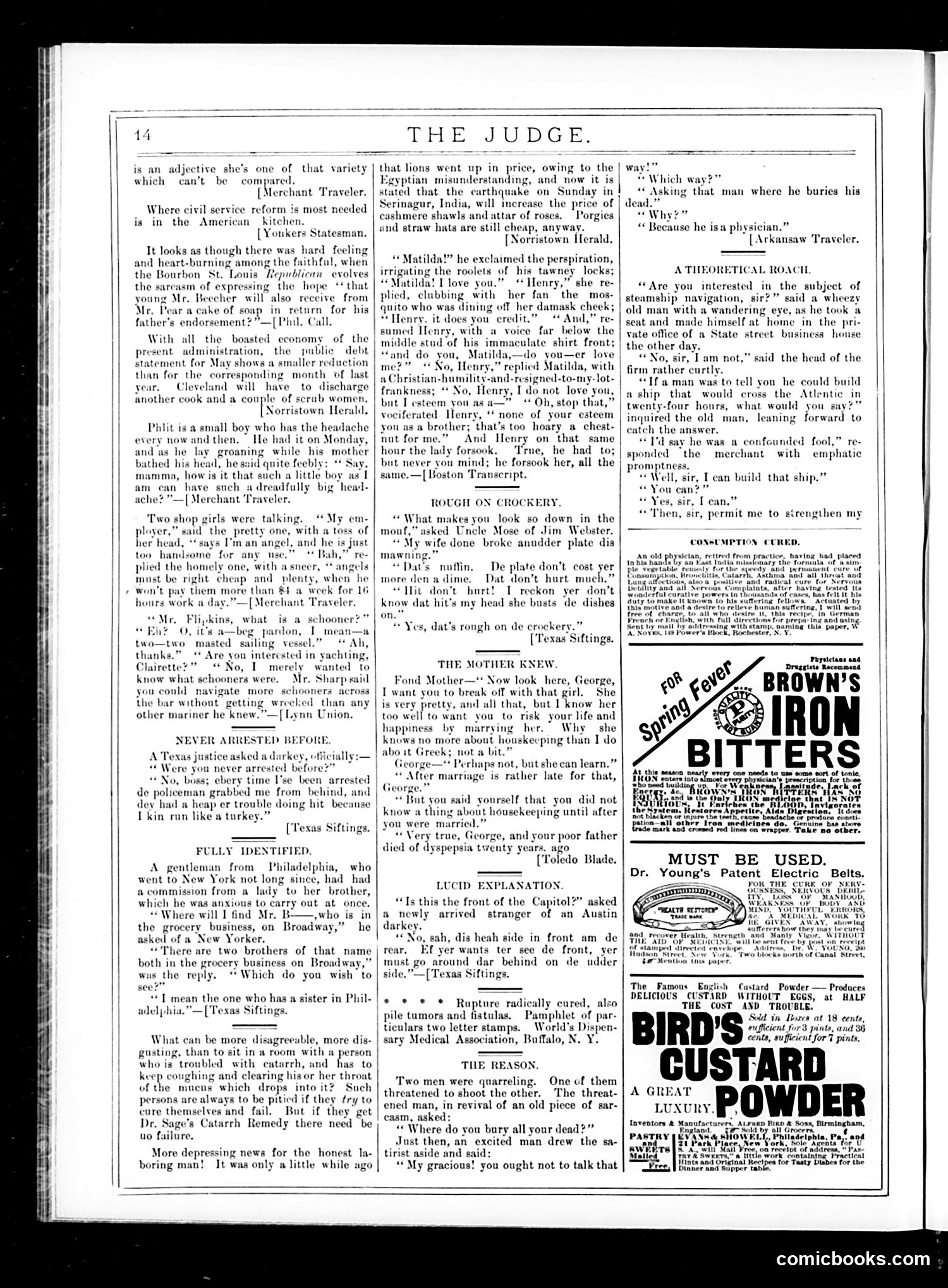
This page from *Judge* is primarily a humor/satire column featuring short jokes and anecdotes typical of late 19th-century American periodicals. The content includes: **Main humor pieces:** - Brief comedic stories about everyday life (a boy with a headache, shop girls discussing wages, a man confused about which grocer to visit) - Social commentary disguised as jokes (references to civil service reform, administration spending) - Sarcastic observations about marriage, relationships, and gender roles **Political/social context:** - References to "the Bourbon St. Louis Republican" and Cleveland's administration suggest Gilded Age political rivalries - Wage complaints ("won't pay them more than $1 a week for 16 hours") reflect labor concerns of the era - The satire targets both politicians and social pretension **Note:** This page contains mostly text-based humor rather than visual cartoons. The advertisements (Brown's Iron Bitters, Bird's Custard Powder, Dr. Young's Electric Belts) reflect period patent medicine marketing. The humor is decidedly dated—relying on puns, dialect jokes, and marital discord comedies typical of Victorian-era publications.
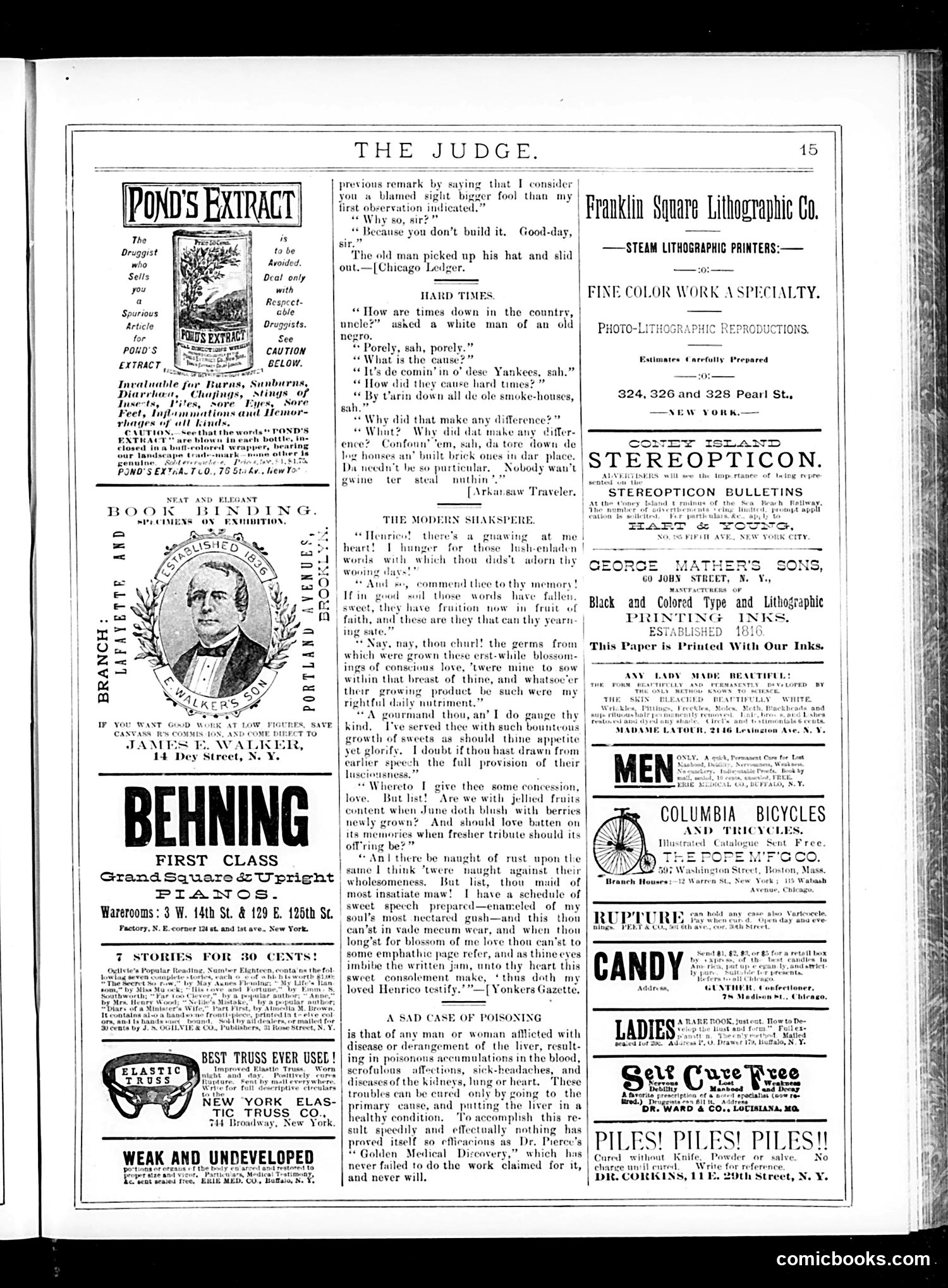
This page is primarily **advertising**, with several satirical humor pieces interspersed. The main content includes: **Humor Sections:** - **"Hard Times"**: A dialect joke about rural poverty, with a Black farmer explaining crop failures to a white man—typical period racial humor reflecting economic hardship. - **"The Modern Shakspere"**: A parody of flowery Shakespearean language applied to courtship and romantic flattery, mocking Victorian sentimentality. - **"A Sad Case of Poisoning"**: Medical satire promoting a patent cure, reflecting the era's quackery concerns. **Advertisements:** The page features numerous ads for commercial products: Pond's Extract, book binding, pianos, bicycles, medical remedies, and corsets—typical late 19th-century Judge content. **Satire Strategy:** Judge's humor relies on exaggerated dialect, literary parody, and mild social commentary rather than sharp political critique. The page demonstrates the magazine's mix of advertising revenue with genteel satirical content aimed at middle-class readers.
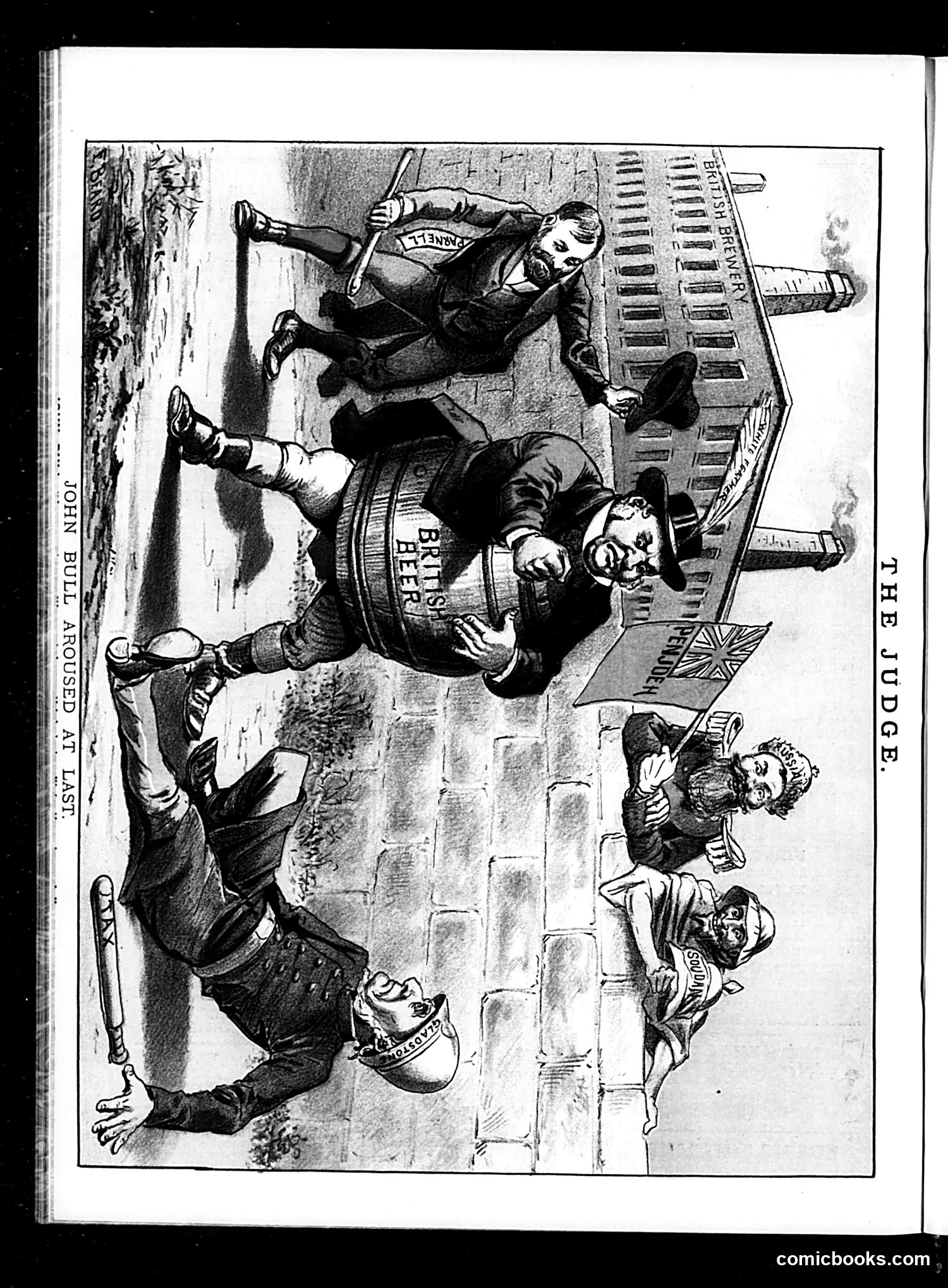
This political cartoon depicts Britain (personified as "John Bull," the traditional British character shown as a stout, angry man) finally taking action. The image shows him wielding a club or cudgel while confronting several figures, likely representing adversaries or problems Britain faced. The specific historical context is unclear without a date, but the composition suggests a commentary on British foreign policy or military response—possibly to colonial conflicts, European tensions, or imperial rivalries common in late 19th/early 20th century political satire. The "aroused at last" caption implies Britain had been passive or reluctant before now taking a forceful stance. The other figures appear to represent opposing nations or interests, though identifying them specifically would require additional historical documentation.