
Judge, 1885-06-27 · page 4 of 16
Judge — June 27, 1885 — page 4: what you’re looking at
What you’re looking at
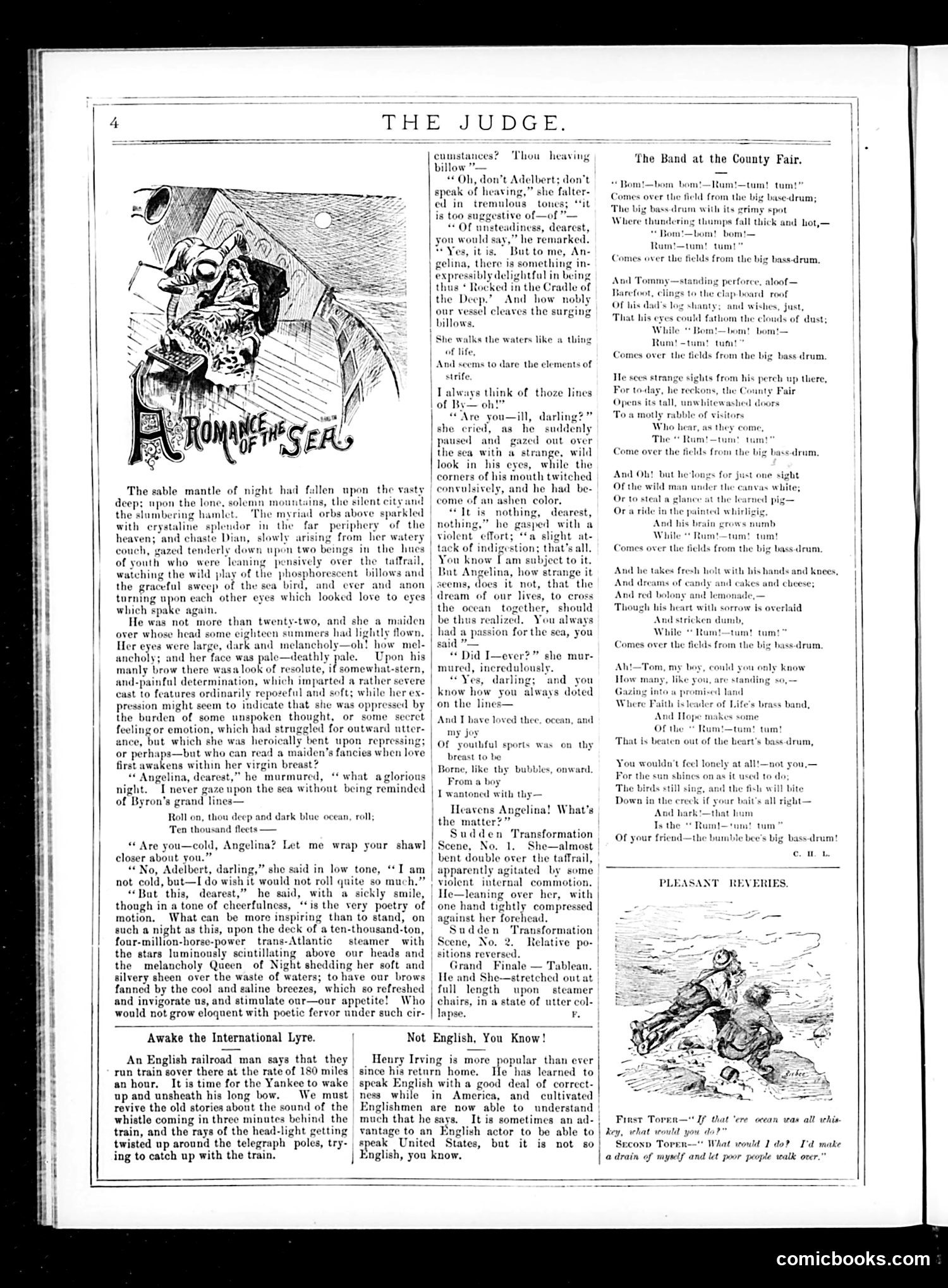
This page presents sentimental romantic fiction rather than political satire. The main feature, "Romance of the Sea," is a melodramatic narrative about two young lovers, Adelbert and Angelina, on a trans-Atlantic steamer. The story employs purple prose typical of Victorian romance—flowery descriptions of moonlit ocean scenes, passionate declarations, and emotional tension. The humor appears gentle rather than pointed: Adelbert waxes poetic about the "poetry of motion" and Byron's verses while Angelina suffers from seasickness, creating an ironic gap between his romanticizing and her physical discomfort. The "Sudden Transformation Scene" suggests the narrative will shift comedically as her condition worsens. The page also includes lighter verses like "The Band at the County Fair" and "Pleasant Reveries"—typical magazine filler content. This appears to be entertainment-focused rather than addressing contemporary political or social issues, making it less directly satirical than typical Judge content.
📄 Transcribed text from this page (OCR, searchable)
Machine-transcribed from the original scan — historical spelling and the odd misread are preserved.
TH The sable mantle of night had fallen upon the vasty deep: upon the lone, solemn me » silent city and the slumbering hamlet. ‘The myriad orbs above sparkled with crystaline splendor in the far periphery of the ‘and chaste Dian, slowly arising from lier watery ch, gazed tenderly down upon two beings in the hue of youth who leaning pensively over the taffrail, watching the wild play of the phosphorescent billows and the graceful aweep of the sea bird, and ever and turning upon each other eyes which looked love to eyes which ipake in. He was not more than twenty-two, and she a maiden over whose he ghteen summers had lightly flown, Her eyes dark and melancholy—oh! how mel. ancholy; was pale—deathly pale. Upon his manly brow there wasa look of resolute, if somewhat-stern, and-painful determination, which imparted a rather severe cast to features ordinarily repozeful and soft; while her ex- pression might seem to indicate that she was oppressed by the burden of some unspoken thought, or some secret feeling or emotion, which had struggled for outward utter- ance, but which she was hero’ ent upon repres: or perhaps—but who can read Jon’s fancies when love first awakens within her virgin breast? “ Angelina, dearest,” he murmured, night. I never gaze upon the sea without | of Byron’s grand lines— “what aglorio cing reminded Roll on, thou deep and dark blue ocean, roll; Tent “ Are you—c closer about you. “No, Adelbert, darling,” she said in low tone, “I am not cold, but—I do wish it would not roll quite so much.” “But this, dearest,” he said, with a sickly smile, though in a tone of cheerfulness, ‘is the very poetry of motion. What can be more inspiring than to stand, on such a night as this, upon the deck of a ten-thousand-ton, four-million-horse-power trans-Atlantic steamer with the stars luminously scintillating above our he and the melancholy Queen of Night shedding her soft and silvery sheen over the waste of waters; to have our brows fanned by the cool and saline breez which so refreshed and invigorate us, and stimulate our—our appetite! Who nusand fleets Id, Angelina? Let me wrap your shawl E JUDGE. cumstances? ‘Thou billow ”. “Oh, don’t Adelbert; don’t speak of heaving,” she falter- ed in tremulous tone is too suggestive of—of ”- * Of unsteadiness, dearest, you would say,” he remarked. 8, it But to me, An- there is something in- expressibly delightful in being thus * Rocked in the Cradle of the Deep.” And how nobly our vessel cleaves the surging billows. - heaving Iks the waters like a th ms to dare the elements of ys think of thoze lines of By— oh!” “Are you—ill, she crie as he paused and gazc the sea with w strange, wild look in his eyes, while the | corners of his mouth twitched convulsively, and he had be- come an ashen color. “It is nothing, dearest nothing,” he gasped. with violent effort; ‘a slight 3 tack of ind jon; that’s You know fam subj But Angelina, how stra eems, does it not, that the dream of our lives, to cross the ocean together, should be tl lized. You alway had a passion for the sea, you said ”. Did I—ever?” she mur- mured, incredulously. “Yes, darlin know how you alw on the lines— AndI my joy Of youthful s arling: suddenly out over nd you s doted ve loved thee, oce ts was on thy onward. I wantoned with thy— Heavens Angelina! What's the matter? | Sudden Transformation Scene, No. 1. She—almost bent double over the taffrail, apparently agitated by some | Violent internal commotion, Me—lean over her, with hand tightly compressed nst her forehead, Sudden Transformation Scene, No. 2. Relative po- sitions reversed. Grand F He and She—stretched out: | full length upon steamer | chairs, in a state of utter col- jom!—bom bom!—Rum!—tum! tam!” over the field from the The big bas Where than ig busedrum; rimy spot thumps fall thick and bot,— bom!— tun Comes aver the fields from the big bass-drum, Ram!—tun perforce, aloof — the clap-board roof hanty; and wis es could fathom the ¢ n!—bom! Rum! -tum! tumt” Comes over the fields from the ust, Is of dust; ig bass drum, He sees strange sights from his perch up there, . the County Fai hed doc For today, he re Opens its tall, unwhitew Toa motly rabble of visite Who hear, The“ Rum!— Come over the fields from the big bassdrum, And Ob! but helong Of the wild man under the Or tos at the learned Or a ride in the painted whirlig And his bi While “8 Comes over the fields f in grows numb tum! tum! the big bass-drum. And he takes fresh ly And dreams of « And red bi Though his heart with sorrow is overlaid And stricken dumb, While * Ram!—tum! tum! Comes over the fields from the ti tL with his hands and knees, and cakes and che my and lemonac uss-drum. Ah!—Tom, my boy, conkd you only know How m i Gazing into a pr Where Faith is leader And Hope t Of the * Ru That is beaten out of the b Tike ye some tum! tum! art's bass.drum, You wouldn't feel lone shines o and th a in the creck if your hait’s all right— And hark'!—that 1b Is the ** Rum!—tun Of your fri the bub) 1!—not you,— to do: fish will bite tum bee's big bass-drum! cow hk. PLEASANT REVERIES. would not grow eloquent with poetic fervor under such cir- | lapse. ’. Not English, You Know! Awake the International Lyre. r_ than ever | learned to An English railroad man says that they run train sover there at the rate of 180 miles an hour, It is time for the Yankee to wake up and unsheath his long bow. We must revive the old stories about the sound of the whistle coming in three minutes behind the train, and the rays of the head-light getting twisted up around the telegraph poles, try- ing to catch up with the train. Henry Irving is more popu since his return home. He speak English with a good deal of correct- ness while in America, and cultivated Englishmen are now able to understand much that he says. It is sometimes an ad-| First Torer— vantage to an English actor to be able to | ey, what would you do?” speak United States, but it is not so} Srcoxp Torrn—" What vould 1 do? I'd make English, you know. | adrain of myself and let poor people walk orer.” If that ‘ere ocean was all whis comicbooks.com