
A complete issue · 16 pages · 1885
Judge — June 20, 1885
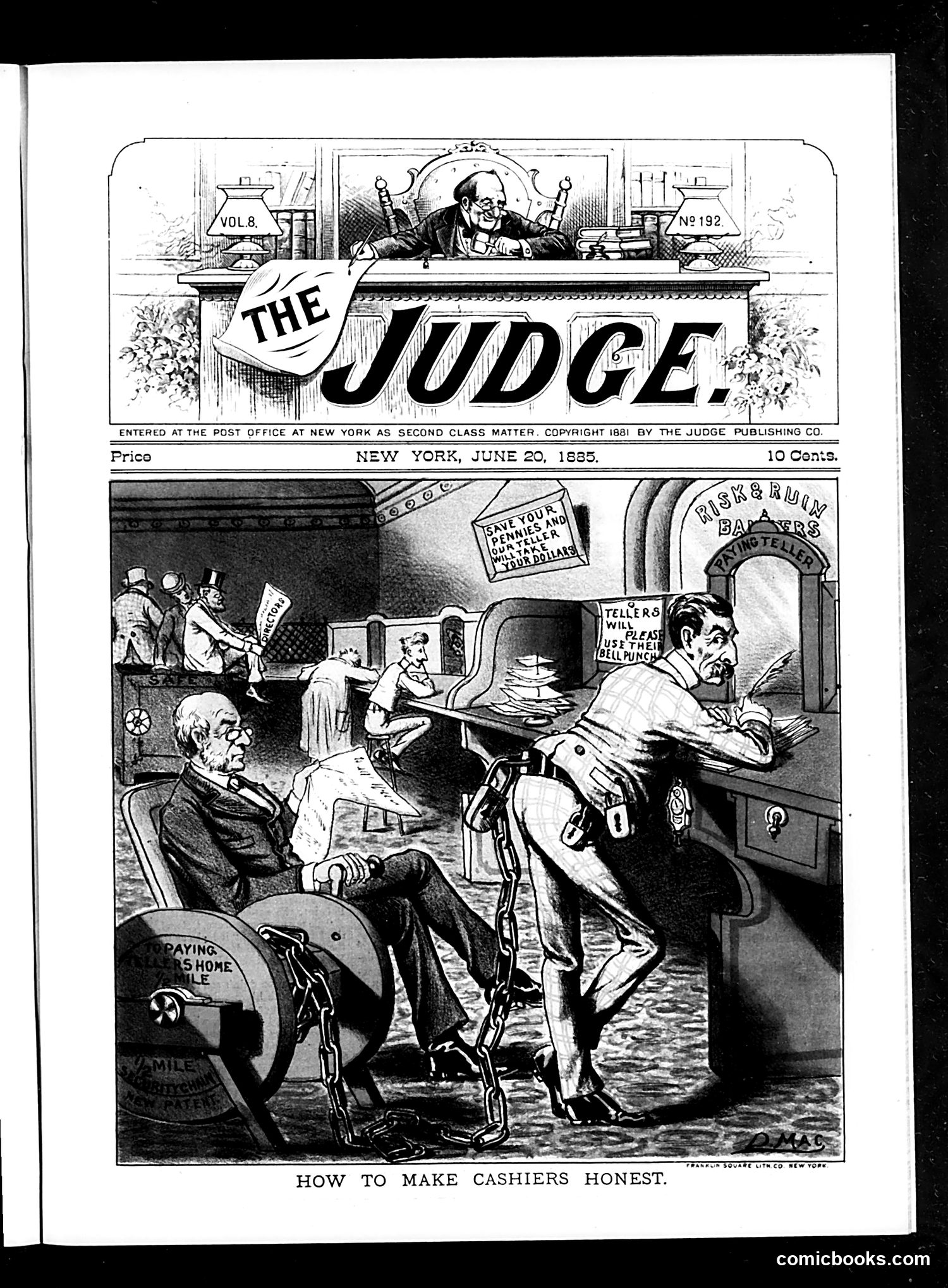
This satirical cartoon critiques bank security practices of the 1880s. The image shows a cashier chained to his workstation, literally shackled to prevent theft. Signs visible in the background reference "Risk & Ruin," and one reads "Save Your Pennies"—playing on anxieties about financial institutions. The cartoon mocks the era's harsh response to employee dishonesty: rather than implementing better accounting systems or oversight, banks resorted to literal physical restraint. The exaggerated chains suggest the absurdity of this "solution." The sleeping or inattentive figures in the background imply that security theater and punishment don't actually address underlying problems. This reflects 1880s debates about labor practices, trust, and financial regulation in America's rapidly industrializing economy.
This page contains two main editorial critiques of President Cleveland's administration (likely 1885-1889): **"Absurd and Impudent"** attacks Cleveland's hypocrisy: he campaigned to remove Republican "rascals" from office, claiming only Democrats were honest. The editorial argues this is merely spoils-system corruption dressed in moral language. It cites specific appointees (Higgins, Chase, Cameron—identified as an "ex-convict and swindler") as evidence that Cleveland replaced one party's corruption with another's, not with genuine reform. **"Honest, If Tied"** explores a darker theme: that honest men become corrupt when given unchecked power and financial incentive. It draws moral equivalences between various crimes—embezzlement, stock-watering, grain-corner manipulation—suggesting systemic dishonesty pervades business and government equally. **"The Uncertain White Man's Policy"** (partially visible) criticizes inconsistent Indian policy as weakness masking injustice. The cartoon's message: Cleveland promised reform but delivered partisan cronyism. Moral posturing cannot substitute for structural accountability.
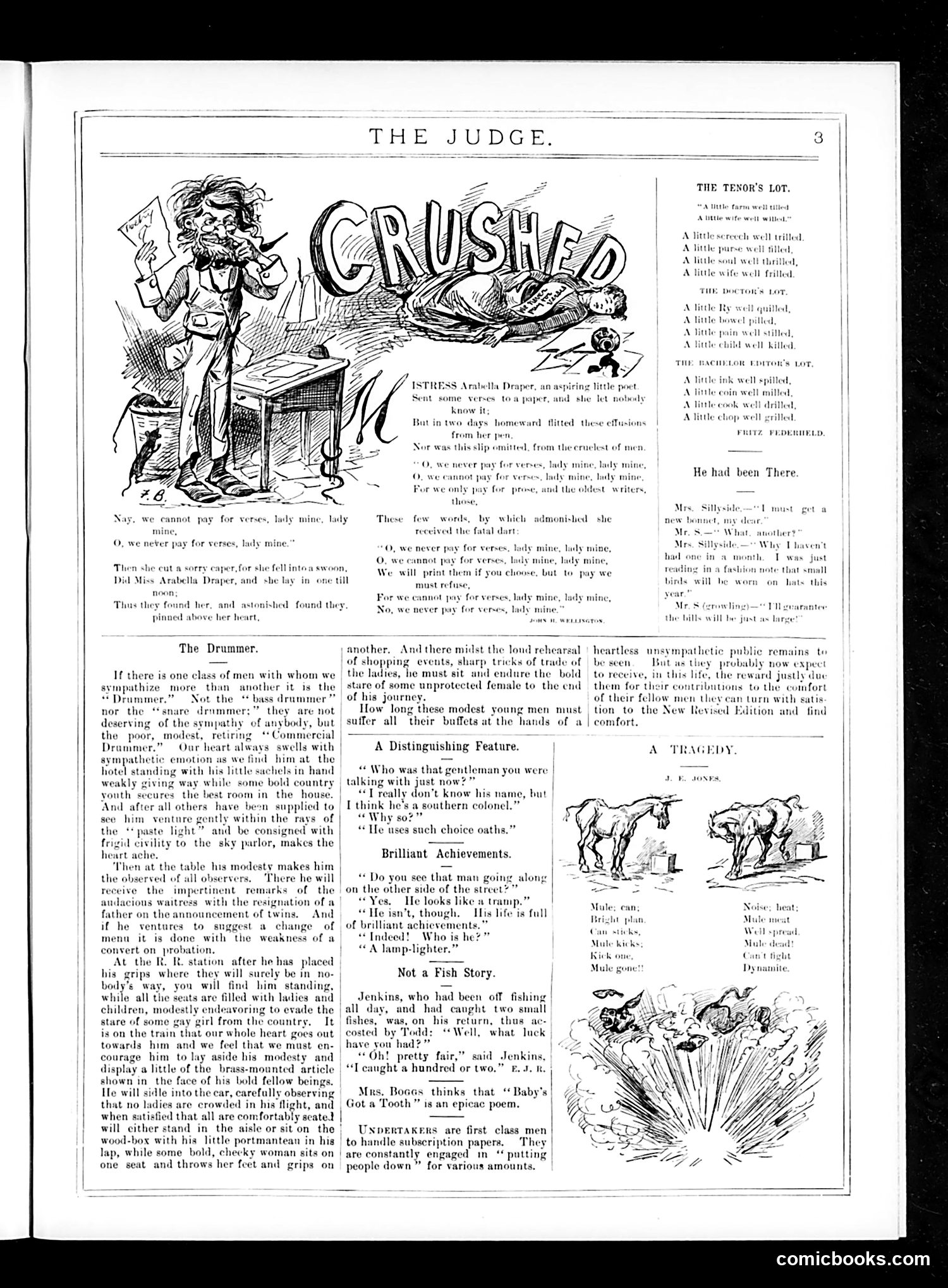
This page contains several satirical pieces typical of late 19th-century American humor: **"Crushed"** (top): A cautionary verse about Miss Arabella Draper, an aspiring poet who submits verses to a newspaper anonymously. The editor's rejection—repeatedly stating "we never pay for verses, lady mine"—mortifies her so deeply she faints. The satire mocks both amateur poets' vanity and newspapers' refusal to compensate contributors. **"The Drummer"**: A sympathetic portrait of traveling salesmen ("commercial drummers"), depicted as modest, diffident men who endure poor hotel treatment and transportation discomfort while bolder passengers claim the best accommodations. The satire celebrates their quiet dignity despite social indignities. **Minor items** include humorous observations about domestic life and professional types, rendered in typical Judge style—witty, class-conscious commentary on American social behavior. The page reflects late Victorian attitudes toward gender (women as sensitive, vain) and class (sympathy for working-class traveling men versus disdain for bold, assertive travelers).
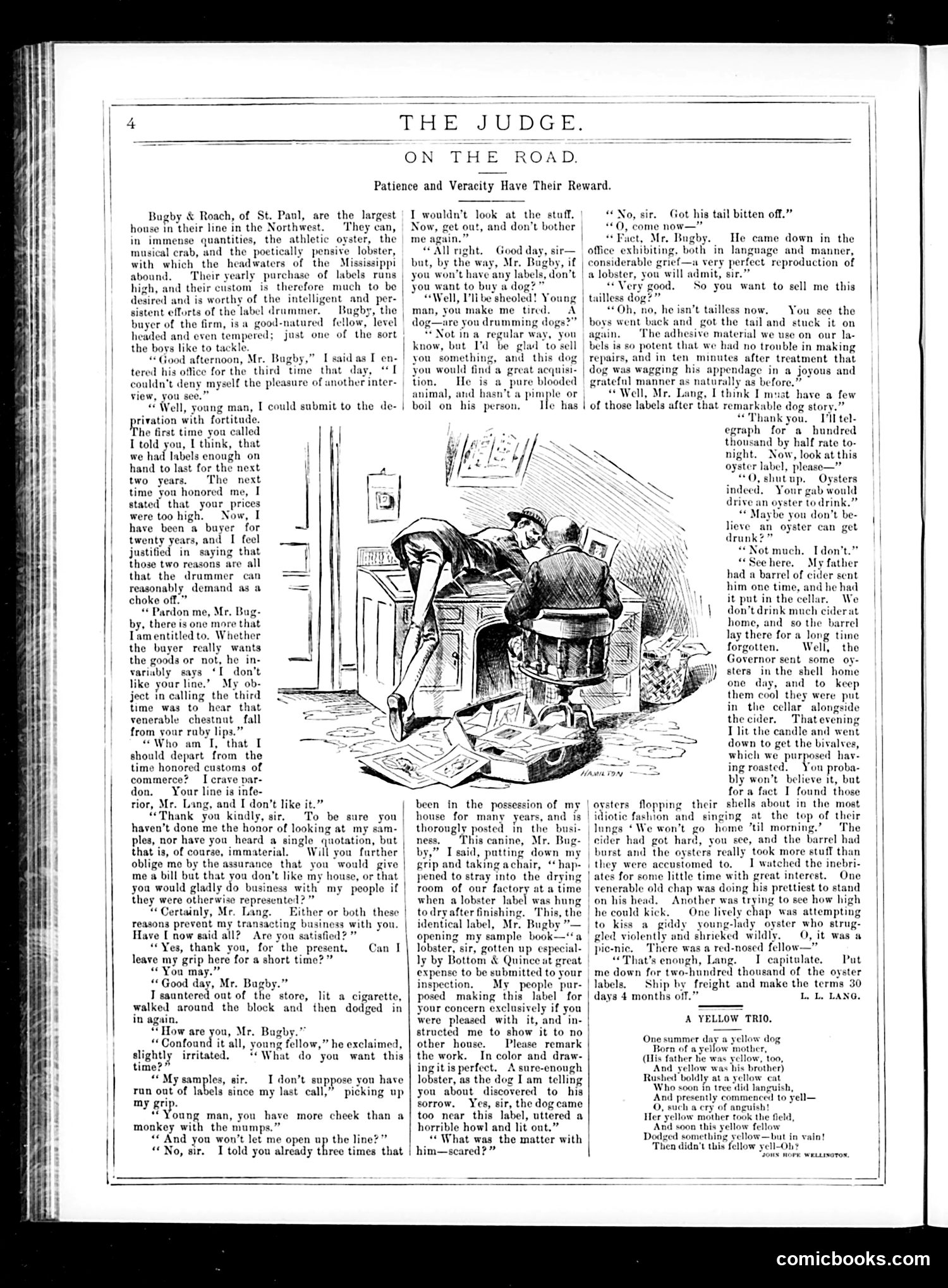
This page depicts a sales call scene satirizing the persistence and clever tactics of traveling label salesmen in the late 19th century. The protagonist, "Mr. Lang," is a label drummer (traveling salesman) repeatedly visiting Mr. Bugby, a oyster/seafood buyer in St. Paul. After Bugby dismisses him three times with stock excuses ("we have enough labels," "your prices are too high," "I don't like your line"), Lang returns a fourth time—now attempting a humorous bait-and-switch by introducing a dog that supposedly swallowed a lobster label in the factory. The joke satirizes both parties: Bugby's predictable, evasive buyer persona, and Lang's absurdly persistent, creative sales techniques. The accompanying poem "A Yellow Trio" appears unrelated to the main cartoon. The satire reflects real commercial frustrations of the era—the tension between aggressive sales tactics and buyers' defensive strategies—rendered comic through exaggerated persistence and ridiculous product pivoting (selling a dog instead of labels).
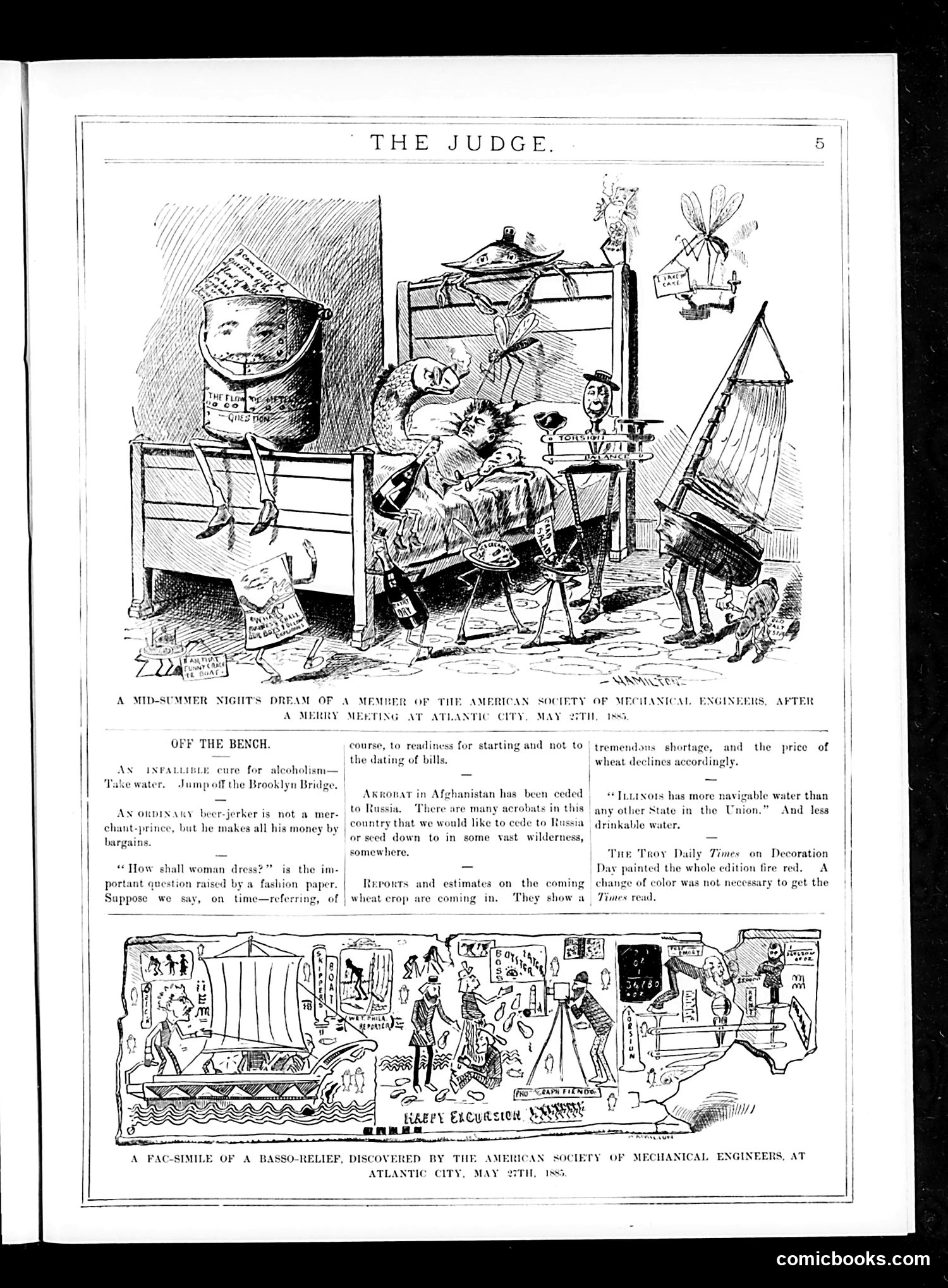
This page from *Judge* satirizes the American Society of Mechanical Engineers' convention at Atlantic City in May 1885. The top cartoon depicts a drunken engineer's fever dream after the "merry meeting"—showing him in bed surrounded by surreal mechanical and nautical imagery, mocking the engineers' revelry. The "OFF THE BENCH" section contains brief satirical quips about contemporary issues: alcoholism, fashion, and wheat prices. References to Afghanistan being "ceded to Russia" and Illinois's water quality appear to be topical political jabs. The bottom cartoon is a "fac-simile" (fake ancient relief) depicting a humorous "happy excursion"—likely a comedic commentary on the engineers' actual activities or pretensions. Overall, the satire ridicules engineers as drunken revelers and suggests their meeting was more about indulgence than serious professional work.
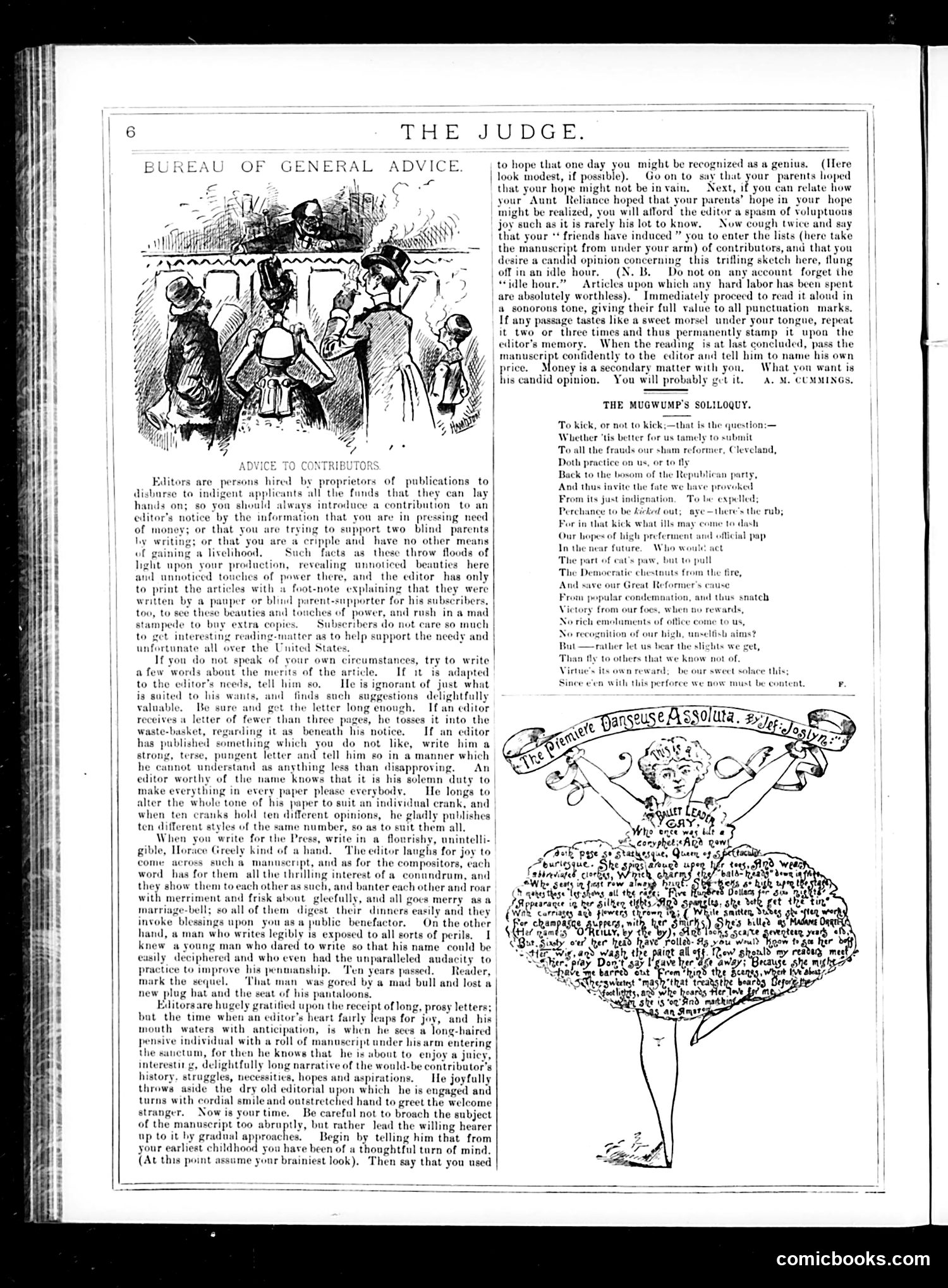
This page satirizes how magazine editors actually treat aspiring contributors—exposing the gap between their stated ideals and real practices. The left column mocks editors' hypocrisy: they claim to champion struggling writers (the blind, crippled, poor), yet secretly judge manuscripts by sentiment rather than merit. The satire suggests editors publish sob stories not for quality but to attract readers wanting to feel charitable. The "advice" section then ridicules contributor behavior: writers submit illegible handwriting, rambling multi-page letters, and elaborate personal backstories. Editors supposedly love this chaos—compositors treat illegible manuscripts as entertainment, gossiping about them gleefully. The final paragraphs invert expectations: an editor's "greatest joy" comes when a "long-haired pensive individual" arrives with manuscript in hand, promising a tedious personal narrative. The editor abandons real work to hear life stories. The cartoon (right side) appears to illustrate this absurdity, though details are difficult to discern in reproduction. **The core joke**: Both editors and contributors are ridiculous—one group pretending noble motives while seeking sensationalism; the other believing personal hardship compensates for poor writing.
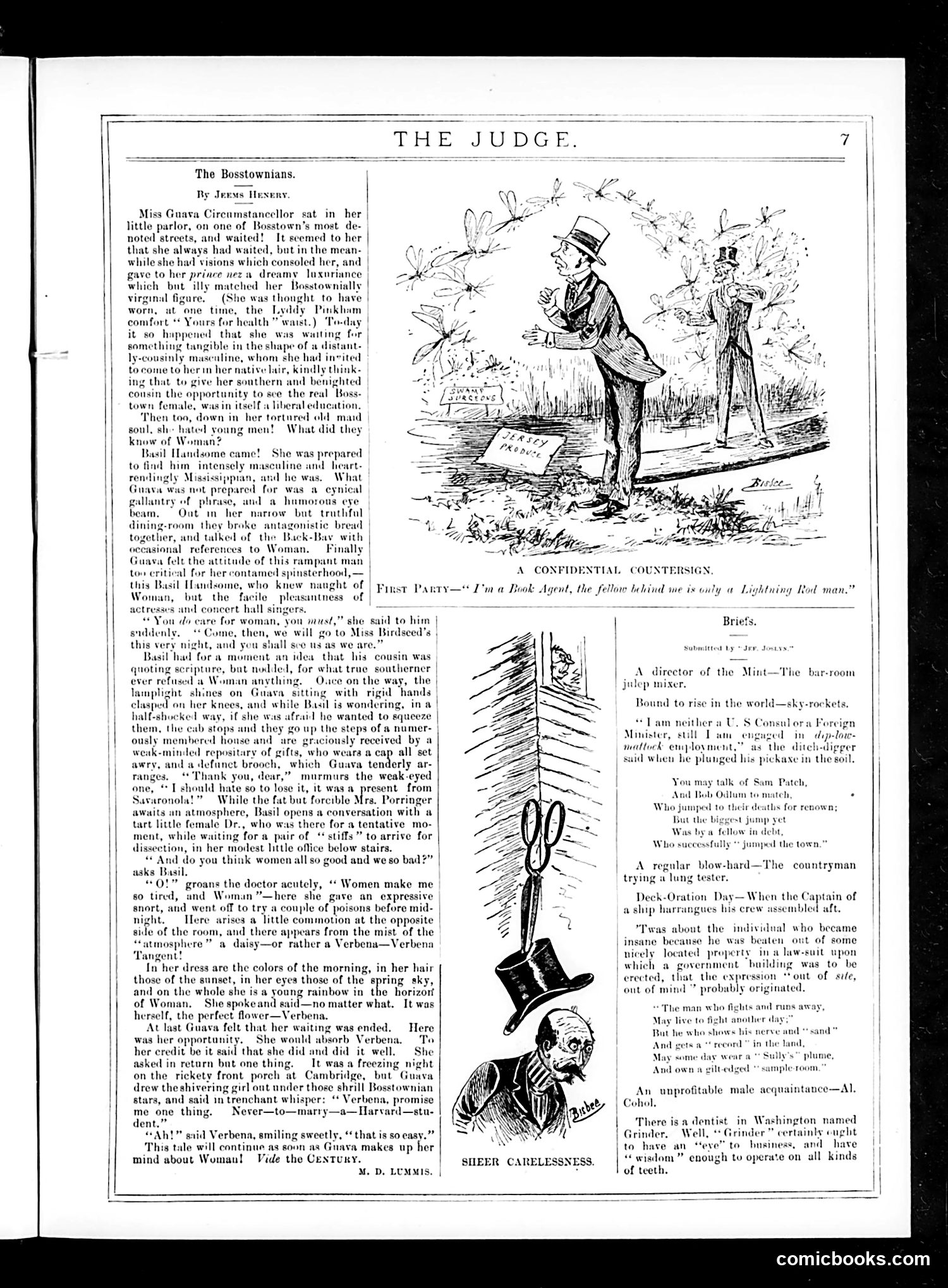
This story-illustration mocks Boston's pretentious upper-class society, particularly its rigid attitudes about women and courtship. **The Setup:** Miss Guava Circumstancellor, a spinster obsessed with idealized "Woman," invites a charming Southern visitor (Basil Handsome) to a Boston salon to observe "real" Bostonian females. **The Satire:** Judge ridicules several targets: Boston's self-serious intellectual class, the contradiction between Bostonian women's high-minded rhetoric and their actual behavior, and the absurdity of romanticizing womanhood while remaining cynical about actual men. The character Verbena—described in flowery, overwrought language—represents the idealized woman Boston society pretends to worship. **The Joke's Endpoint:** When Guava finally meets her perfect "flower," she immediately extracts a promise that Verbena never marry a Harvard student—revealing that Boston's lofty principles about Woman mask provincial snobbery and practical self-interest. The cartoons illustrate accompanying brief jokes (unrelated to the main story).
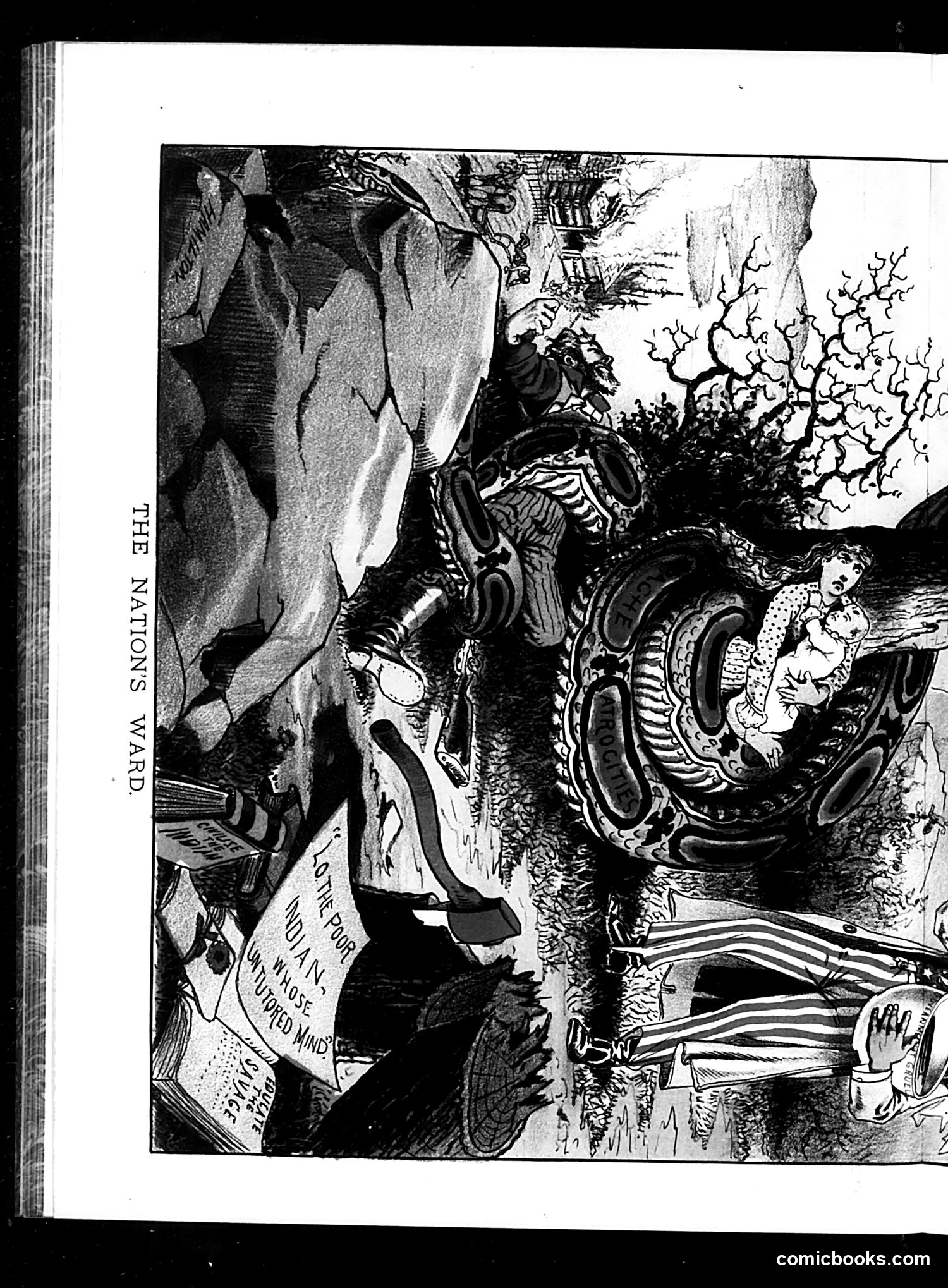
This appears to be a satirical illustration from *Judge* magazine, though the image is rotated and somewhat difficult to read clearly. The OCR text is corrupted, making precise interpretation challenging. The cartoon seems to depict a domestic or institutional scene with multiple figures interacting. Based on the title "The Matron's Ward," it likely satirizes institutional management or domestic supervision—possibly commentary on how authority figures (a "matron") manage their charges. The ornate, detailed engraving style is typical of late 19th-century satirical illustration. Without clearer visibility of specific details or legible captions identifying the figures, I cannot confidently identify which particular political figures or social situations are being mocked. The satire appears social rather than overtly political in nature.
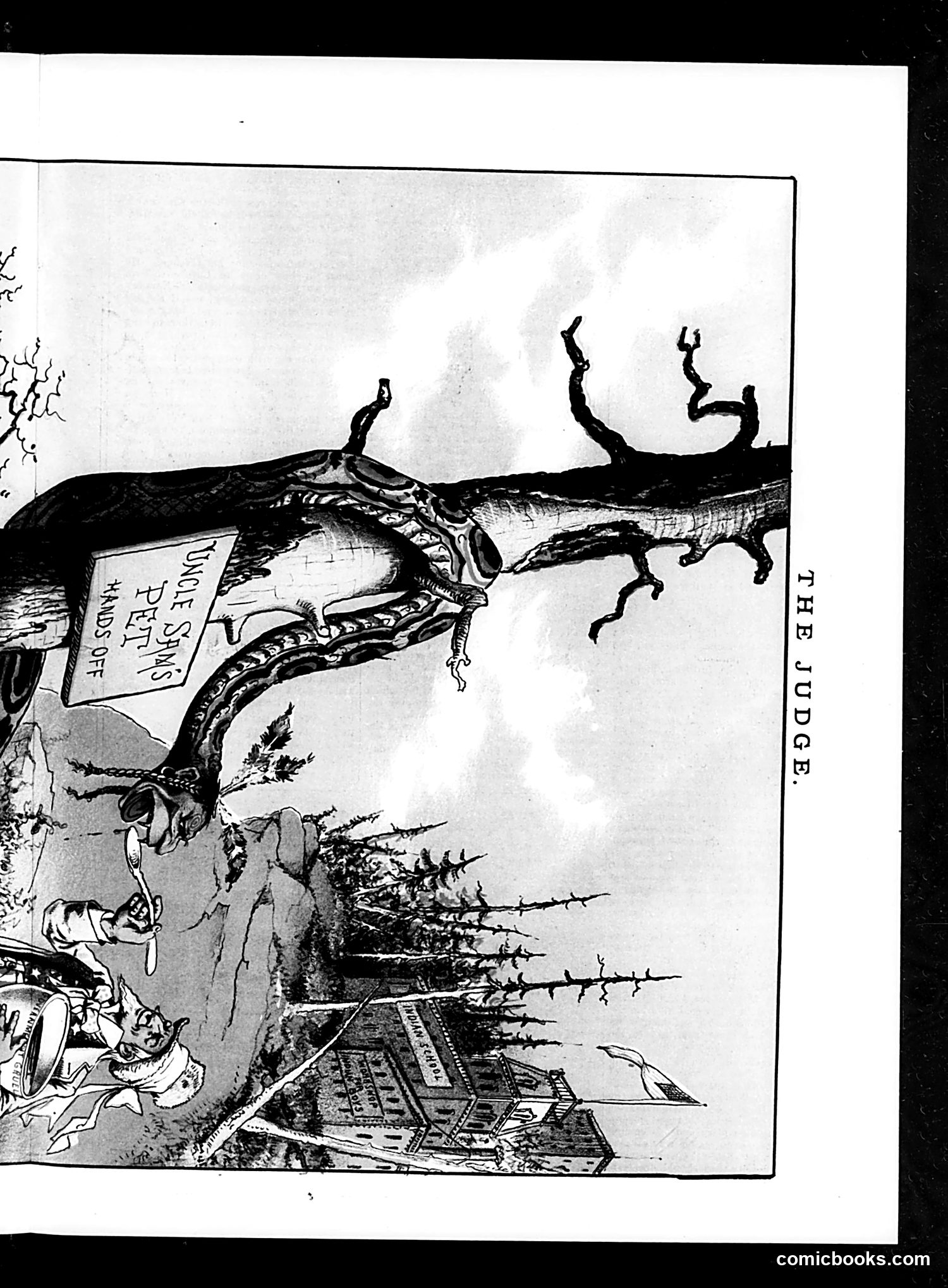
This political cartoon depicts a gnarled, dead tree branch with twisted growths emerging from it, labeled "UNCLE SAM'S PET" with text reading "UNDER PET" (OCR unclear). The branch appears diseased or infested. The title reads "THE JUDGE." The satire likely critiques something the U.S. government was nurturing or supporting that had become corrupt or problematic—visualized as a diseased growth. Without clearer OCR text or a visible date, I cannot identify the specific historical context, political figure, or policy being mocked. The visual metaphor suggests governmental mismanagement or a failed initiative that produced toxic results rather than intended benefits.
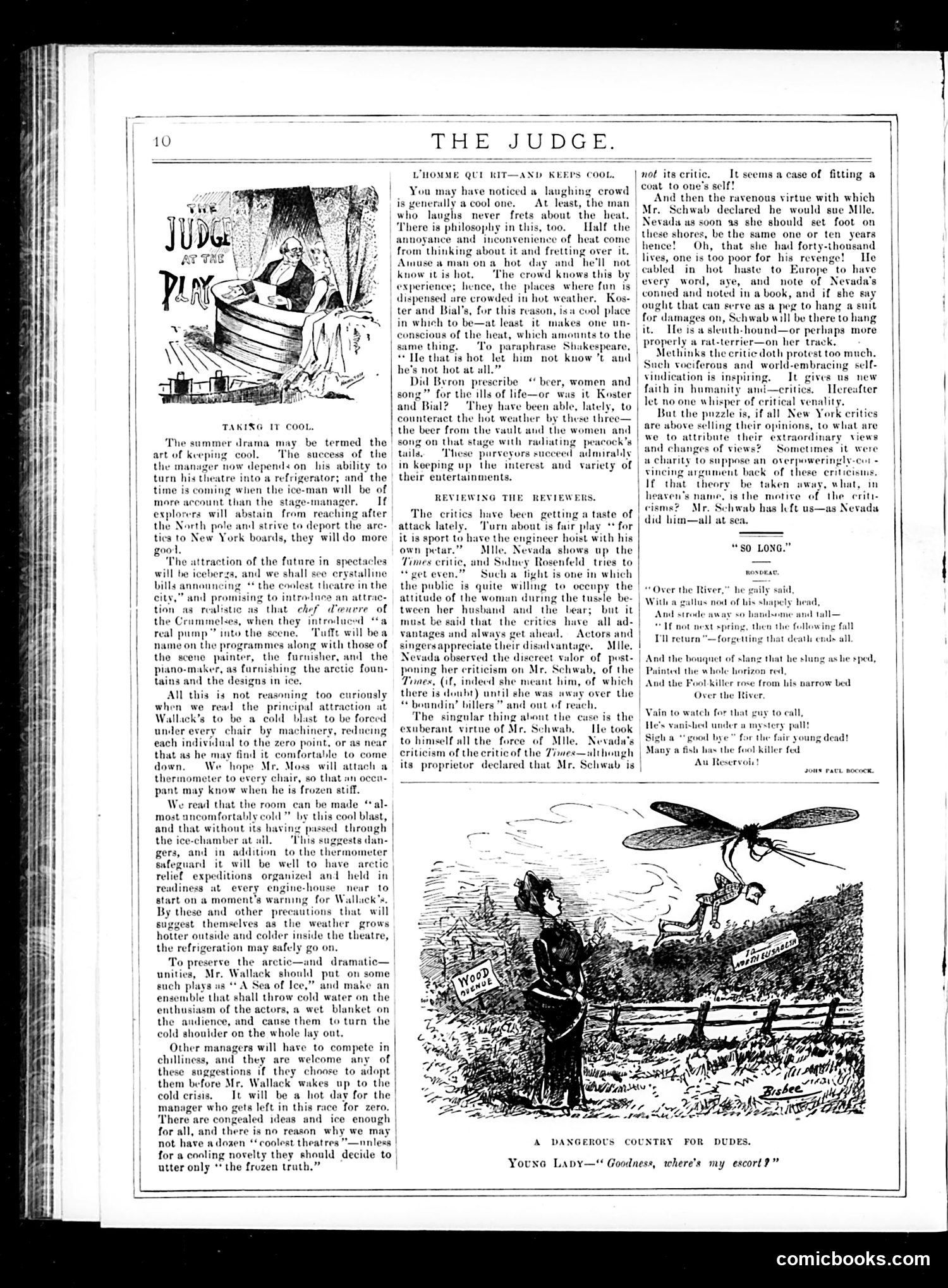
This page satirizes theatrical managers' attempts to keep audiences cool during summer heat waves by installing mechanical cooling systems in theaters. The main article "Taking It Cool" mocks the trend of turning theaters into refrigerators, suggesting managers will soon hire "ice-men" and advertise "the coolest theatre in the city." The satire targets Wallack's Theatre specifically, which apparently featured a "cold blast" forced under seats by machinery. The author ridicules this as absurd spectacle-chasing, joking that patrons need thermometers to know when they're "frozen stiff." The counterargument in "The Judge" section—that laughter and entertainment naturally cool people by distracting them from heat—represents the satirist's preferred approach. He cites Koster and Bial's as successfully using "beer, women and song" to keep crowds cool through amusement rather than mechanical gimmickry. The cartoon below (captioned "A Dangerous Country for Dudes") appears unrelated to the cooling debate, showing a young woman encountering a large insect outdoors, likely satirizing urban dandies' vulnerability in rural settings.
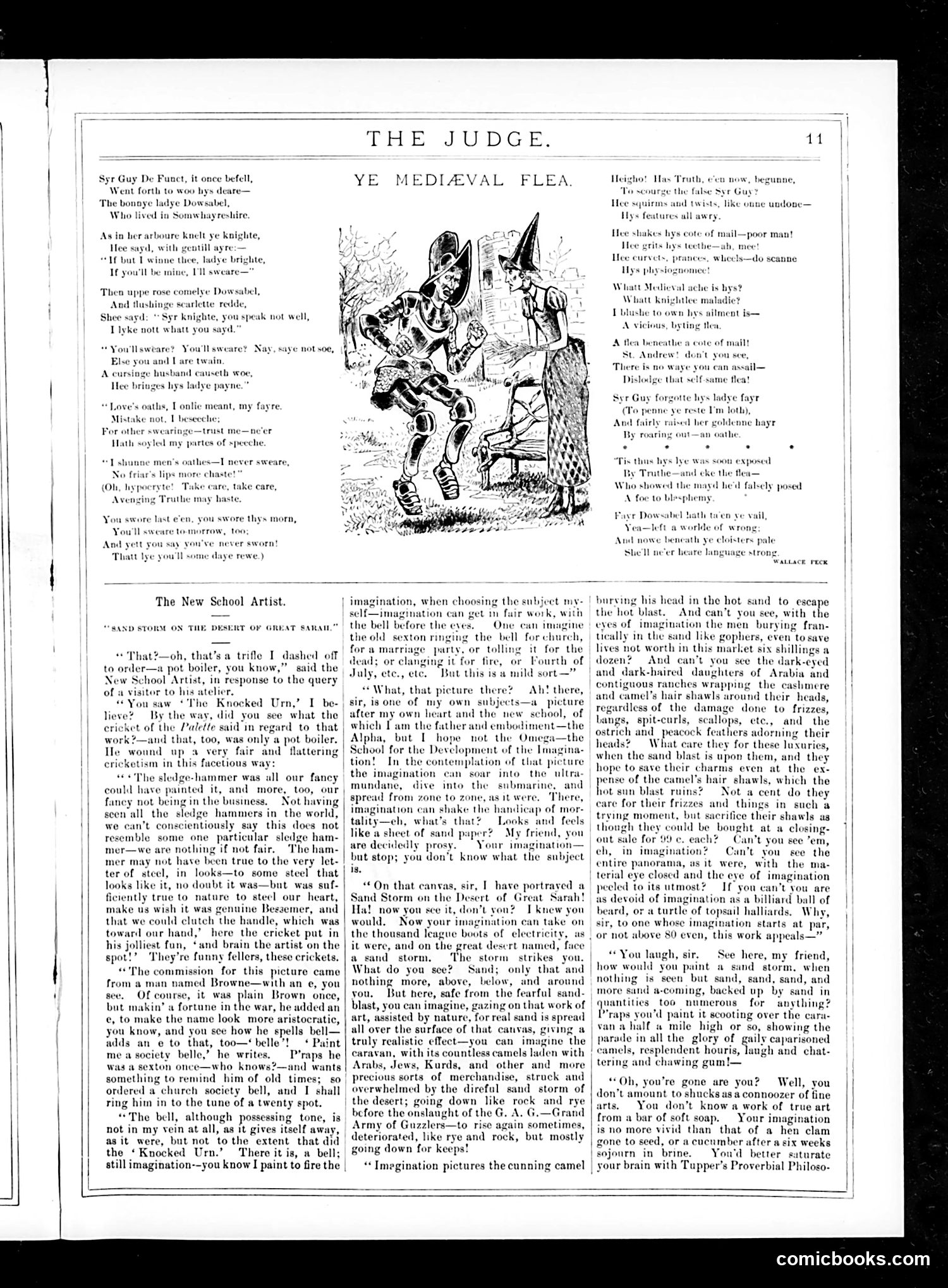
This page contains two satirical pieces mocking pretension and artistic fakery. **"Ye Mediaeval Flea"** (center illustration): A medieval knight encounters a flea. The poem humorously presents the flea as a noble creature questioning the knight's honor and truthfulness—ironically, a tiny parasite lecturing a armored warrior about integrity. The satire likely targets Victorian hypocrisy: those who claim high moral standards while behaving dishonestly. **"The New School Artist"**: A dialogue ridiculing a self-important modern painter who creates deliberately obscure, meaningless works (like "The Knocked Urn" and "Sand Storm on the Desert of Great Sarah") yet claims they require profound imagination. He dismisses practical representation as "pot boilers" while charging wealthy patrons like "Brown" for vague, pretentious art. The critic's mocking commentary—comparing his sledgehammer painting to actual sledgehammers—exposes the emperor's-new-clothes absurdity: critics praising incomprehensible work as genius. Both pieces ridicule false claims of sophistication and honor.
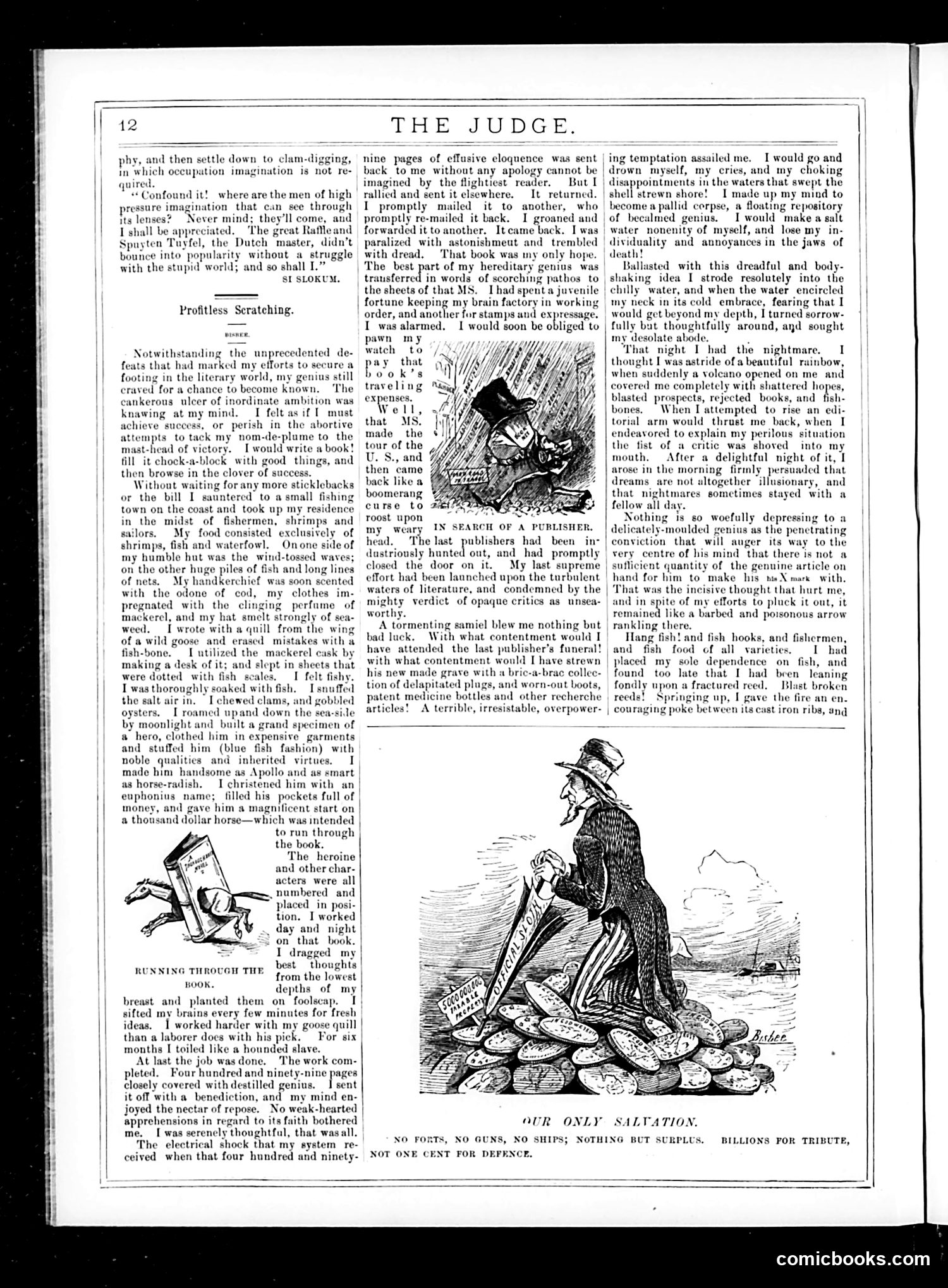
This page presents a serialized first-person narrative titled "Profitless Scratching" by Si Slokum, a struggling writer attempting to achieve literary success. The story is autobiographical satire mocking artistic ambition and rejection. The narrative describes Slokum's desperate attempt to write a novel while living in a coastal fishing town, subsisting entirely on fish and seafood. He works obsessively for six months creating a 499-page manuscript featuring a heroic protagonist. However, the manuscript is repeatedly rejected by publishers and returned without apology. The accompanying illustrations show Slokum's dejection and struggle—one depicts him amid his writing materials; another shows a despondent figure contemplating his failed efforts. The satire targets pretentious literary aspirants and the publishing world's indifference to amateur writers. The caption at page's bottom ("No posts, no guns, no ships; nothing but supplies") appears unrelated to the main narrative, suggesting magazine formatting of the era.
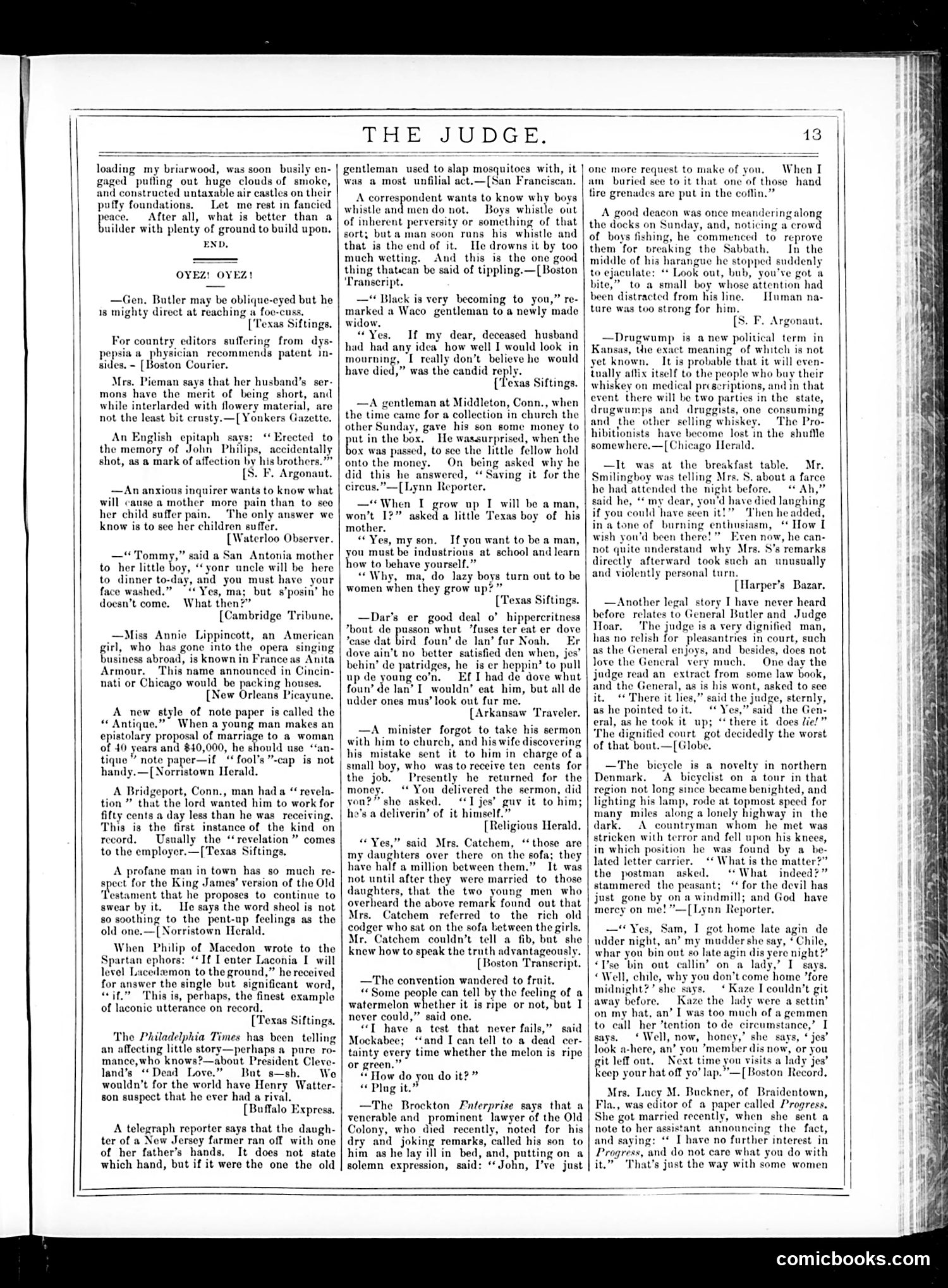
This page from *Judge* is primarily a **collection of brief satirical anecdotes and jokes** rather than political cartoons. The humor targets various social behaviors and contemporary figures. Key satirical items include: - **Gen. Butler**: Mocked for being "oblique-eyed" yet "mighty direct" — likely referring to General Benjamin Butler's controversial Civil War leadership - **Widow joke**: A newly widowed woman admits she wishes her husband had known how good she'd look in mourning — satire of superficial mourning customs - **Miss Lippincott**: An American opera singer using a stage name in France that would "pack houses" in America — satirizing American cultural pretensions - **Marriage proposal anecdote**: Mockery of men pursuing wealthy older women using "antique" stationery — social commentary on fortune-hunting - **Various wordplay items**: Jokes about religion, temperance, and family relationships typical of late 19th-century humor magazines The overall tone satirizes American social hypocrisy, superficiality, and domestic life of the Gilded Age period.
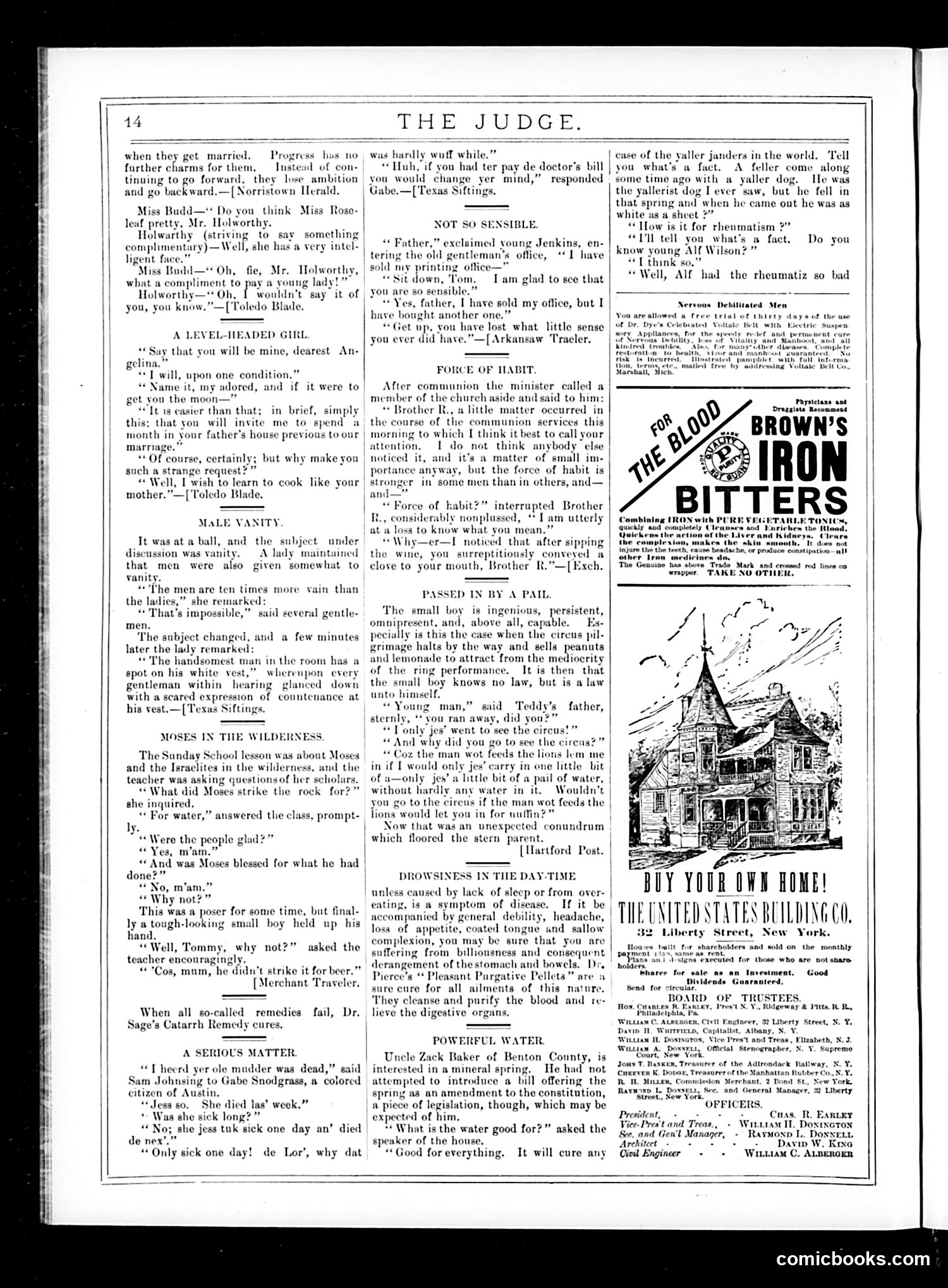
This page from *Judge* magazine contains several brief humorous anecdotes and a period advertisement, rather than a coherent political cartoon. The jokes satirize social conventions of the era: a woman praising another's "intelligent face" (backhanded compliment about appearance), a fiancée wanting cooking lessons before marriage, men's vanity exposed when they all check their vests for spots, and a Black dialect joke about Moses not being blessed because he "didn't strike it for beef." The religious humor ("Force of Habit") depicts a church member unconsciously making a drinking motion during communion—habit overriding solemnity. A prominent advertisement for "Brown's Iron Bitters" and "The United States Building Co." occupies the right side, offering home construction and patent medicine. The page reflects *Judge*'s formula: light social satire targeting middle-class pretension, gender relations, and everyday absurdities, with advertising revenue supporting publication.
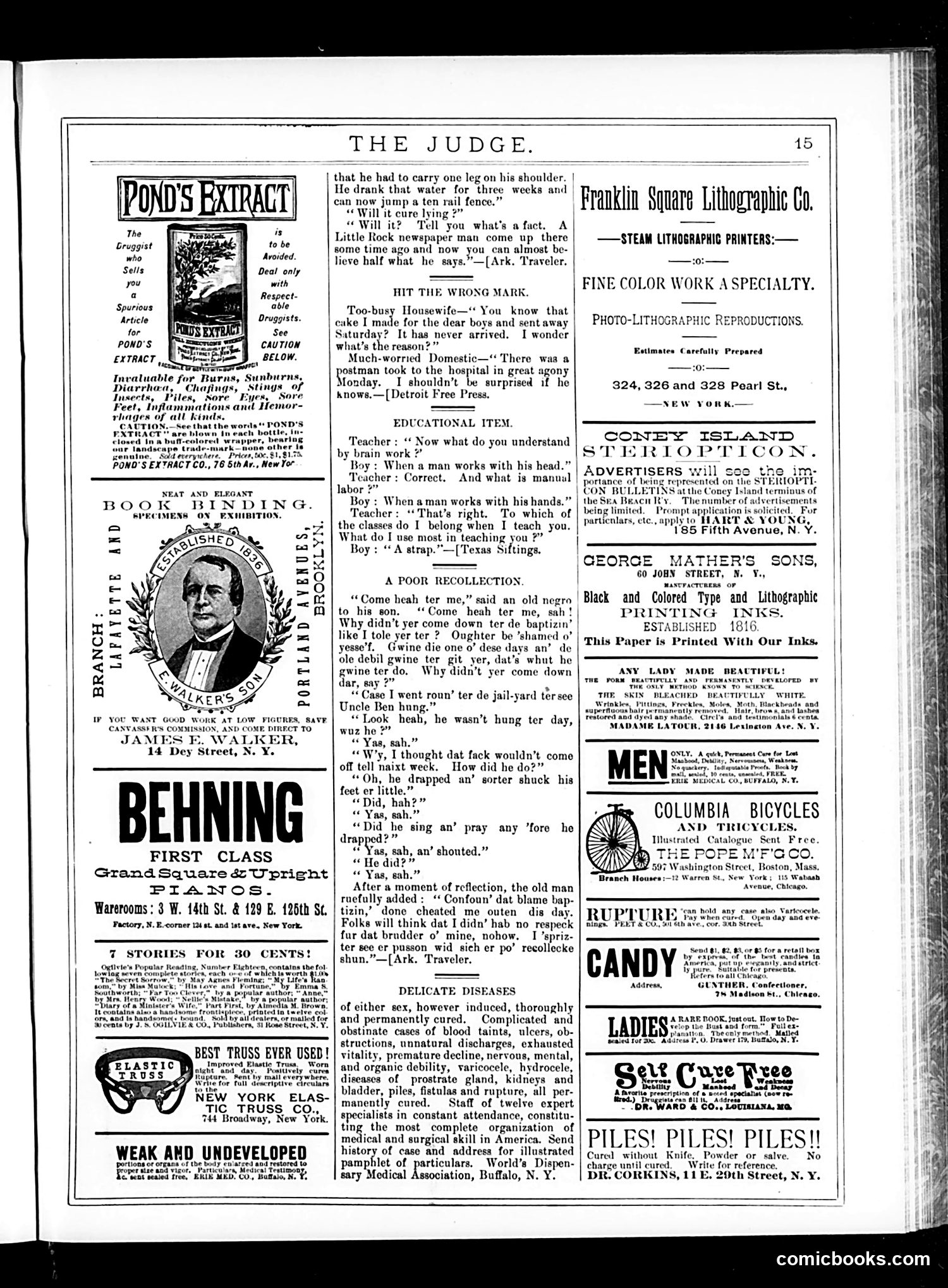
This page is primarily **advertising** rather than political satire. However, it contains several period-appropriate jokes embedded in the editorial content: **"Hit the Wrong Mark"** and **"A Poor Recollection"** are humorous anecdotes using racial dialects common to 1880s-90s American humor magazines. These jokes rely on stereotypical depictions of African Americans and Irish immigrants—considered acceptable comedic fodder at the time, though offensive today. **The "Educational Item"** is a gentle joke about corporal punishment in schools (the boy's answer about using "a strap" when asked about teaching methods). The remaining content is classified advertising for patent medicines, pianos, trusses, and medical "treatments" that were typical of Judge magazine's revenue model. Many of these remedies (particularly the "delicate diseases" ad) would today be recognized as fraudulent quackery. The page reflects Victorian-era attitudes toward both humor and unregulated medical marketing.
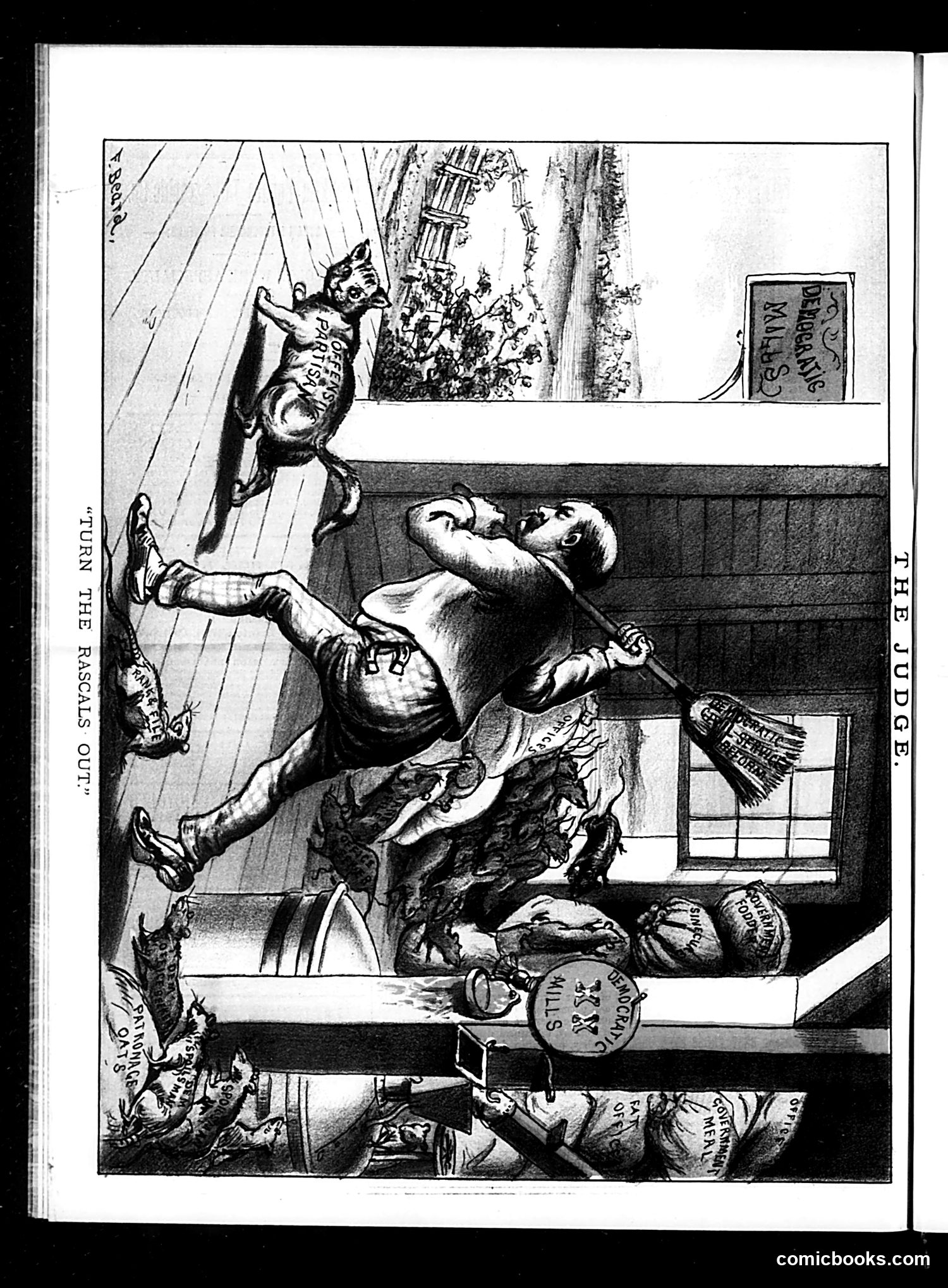
This appears to be a satirical cartoon from *Judge* magazine, though the OCR text is largely illegible. The image shows a rotated scene of a man lying on the ground surrounded by what appear to be baseball-themed objects and debris. Text along the margins reads "TURN THE RASCALS OUT" and "THE JUDGE," suggesting political criticism. The baseball imagery likely references a contemporary political figure or scandal, as sports metaphors were common in Gilded Age satire. The scattered items and prone figure suggest someone has been defeated or exposed. However, without clearer OCR text or visible publication date, I cannot definitively identify the specific political target or the exact scandal being referenced.