
A complete issue · 16 pages · 1885
Judge — April 25, 1885
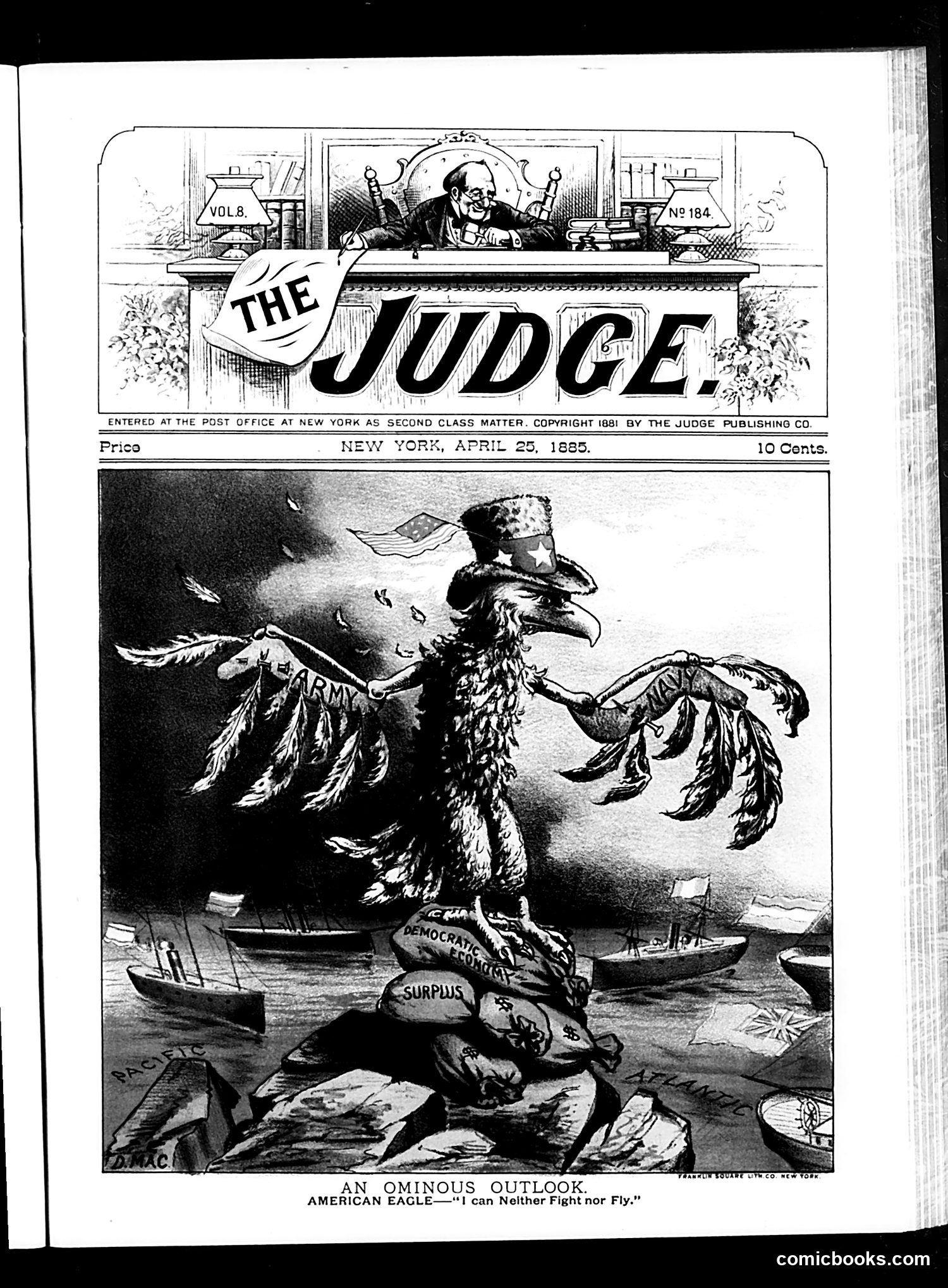
This political cartoon depicts an American Eagle wearing a top hat labeled "ARMY," appearing wounded and unable to function. The bird stands amid scattered debris labeled "DEMOCRATIC," "SURPLUS," and other items in a harbor setting with ships. The caption states: "I can Neither Fight nor Fly." The satire criticizes the Democratic Party's military and fiscal policies in 1885 (early in Cleveland's presidency). The disabled eagle suggests America's military weakness and ineffectiveness under Democratic governance. References to "surplus" likely critique Democratic handling of treasury funds. The cartoon warns readers that Democratic policies have rendered the nation unable to defend itself—unable to "fight" militarily or "fly" (progress economically or diplomatically). This represents typical partisan criticism of the opposing party's competence.
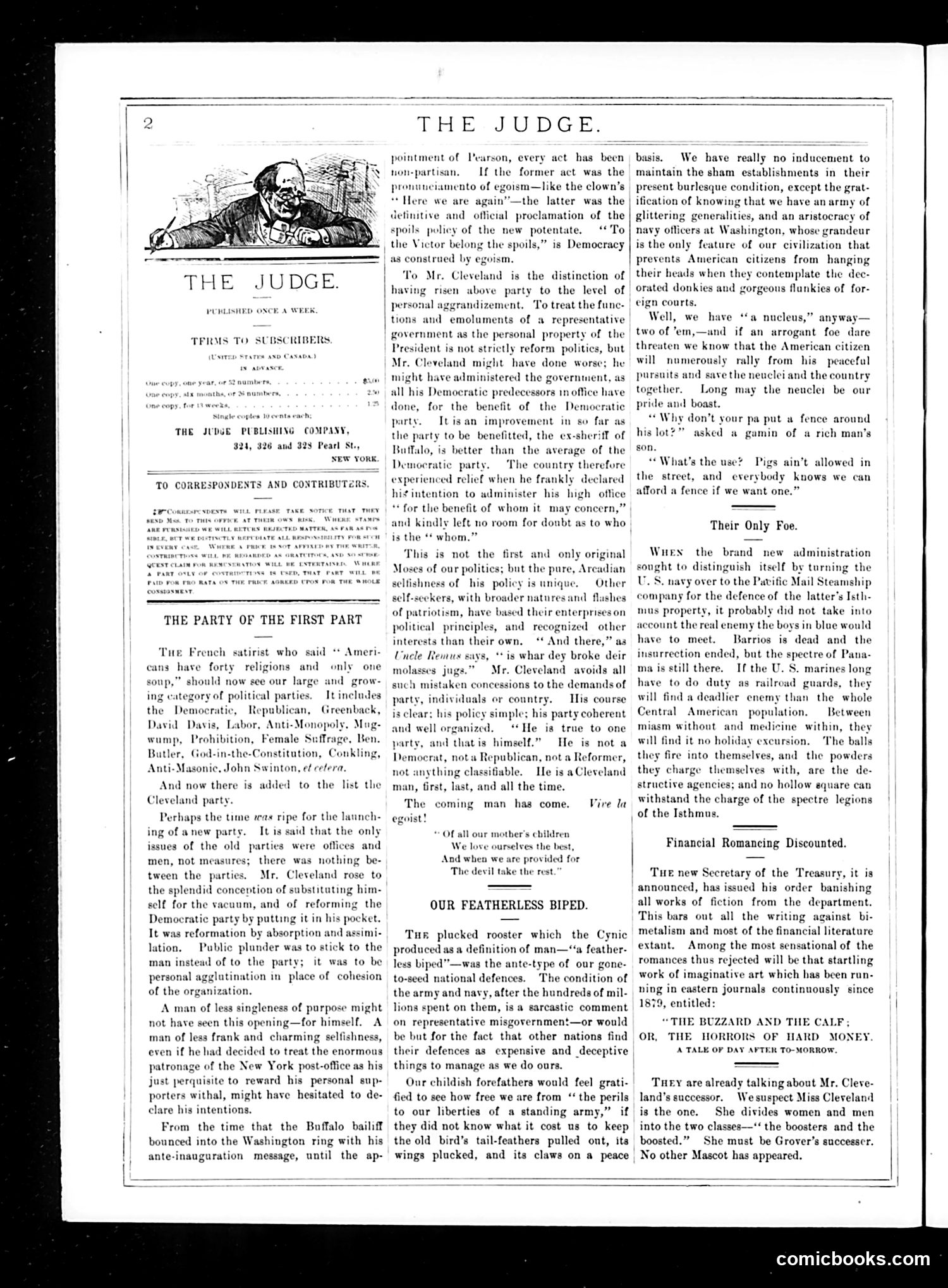
This page satirizes President Grover Cleveland's administration as fundamentally self-serving rather than genuinely reformist. The main article argues that Cleveland has essentially created a new political party—"the Cleveland party"—dedicated solely to his personal ambitions. The satire mocks his famous promise to run government "for the benefit of whom it may concern" as transparently self-interested: he's merely redirecting spoils and patronage to himself rather than the Democratic Party, calling this "reform" when it's really just absorption of power. The piece references Cleveland's role as "Buffalo bailiff" (ex-sheriff) and his appointment of Pearson, suggesting a pattern of self-aggrandizement. The authors argue that unlike other ambitious politicians who at least cloak their ambitions in broader political principles, Cleveland is refreshingly honest about his pure, unapologetic egoism. This paradoxical "honesty about dishonesty" appears to be the magazine's central joke about Cleveland's presidency.
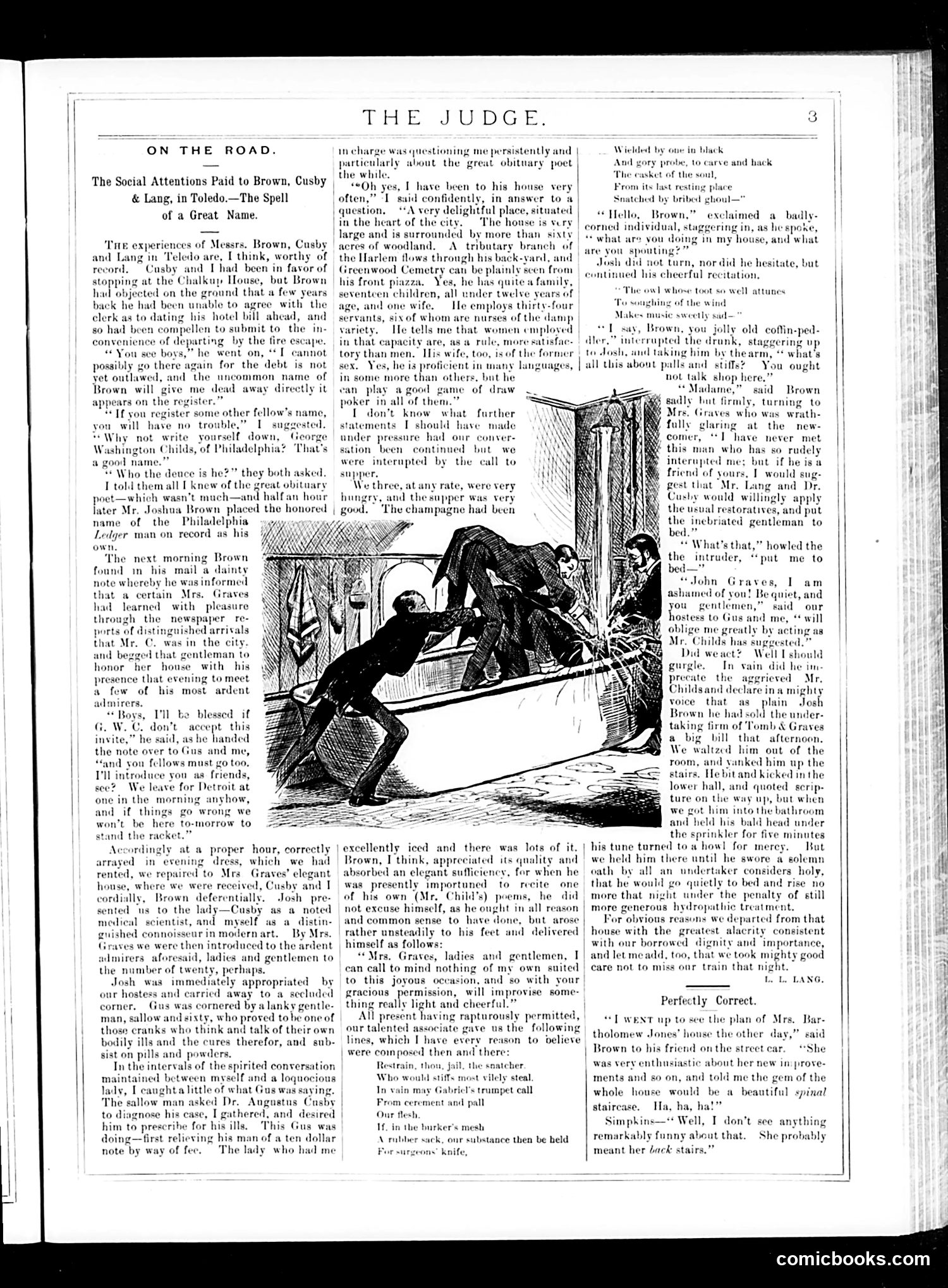
This page satirizes the power of a famous name to gain social access. The story follows three men—Brown, Cushy, and Lang—staying at a Toledo hotel. When the clerk threatens to expose Brown for not paying his bill, they devise a scheme: Brown registers under the name "Washington Childs," apparently referencing a prominent Philadelphia newspaper poet. The ruse works spectacularly. A society woman, Mrs. Graves, learns of "Childs's" arrival and invites him to an elite gathering. At her soirée, an drunk intruder crashes the party, but the fabricated identity grants Brown such social credibility that his mere presence—and association with the distinguished "name"—prevents serious consequences. The joke mocks both American social climbing and the hollow authority of celebrity names. A nobody becomes respectable simply by adopting a famous person's identity, suggesting that Gilded Age high society values reputation over character. The satirical point: social status in America is disturbingly transferable and superficial.
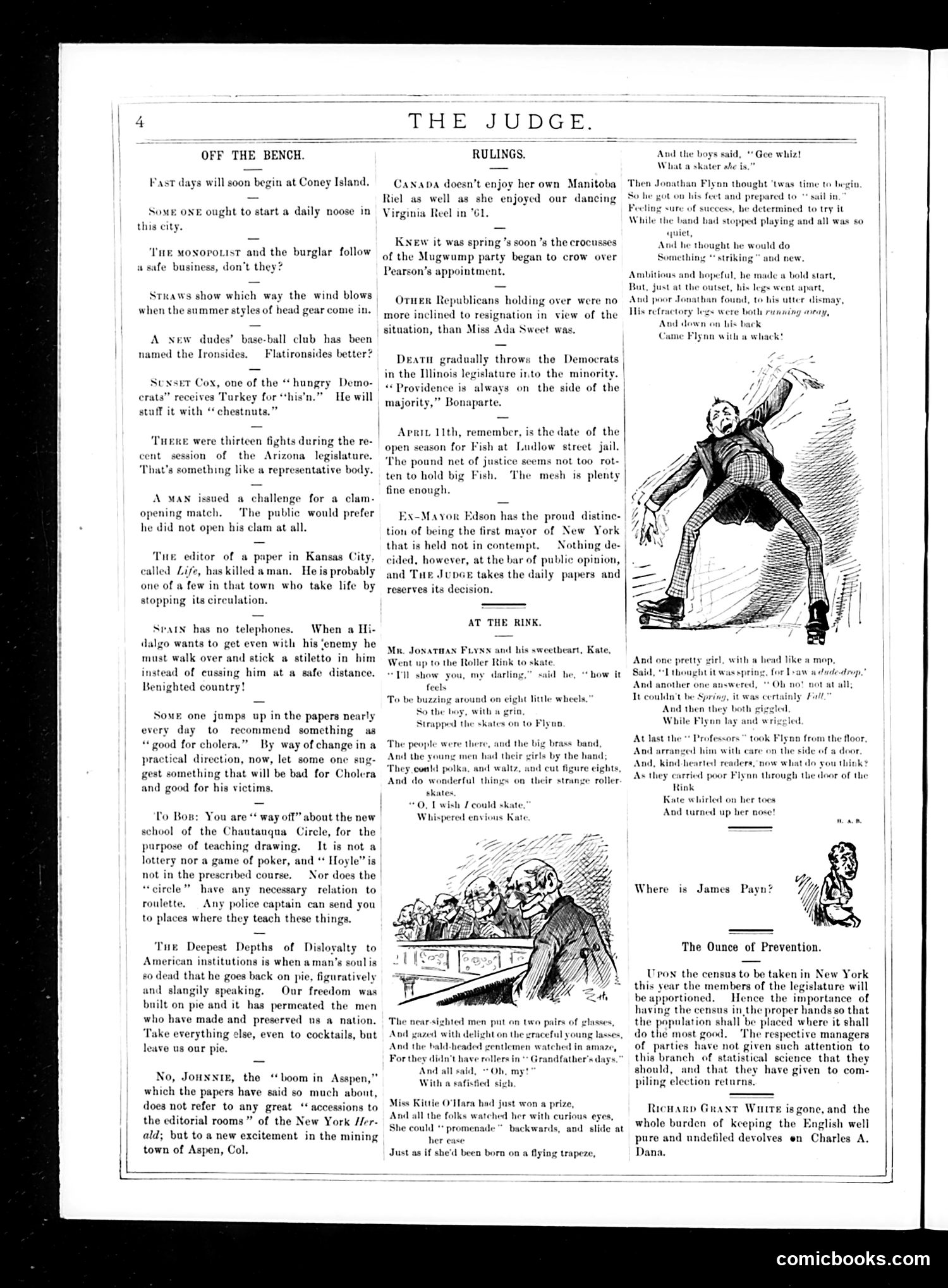
This page from **Judge** (a 19th-century satirical weekly) contains short political jibes and social commentary rather than extended cartoons. Key targets include: **Political references**: "Sunset Cox" (a Democratic congressman) receiving Turkey; the declining Democratic majority in the Illinois legislature; Ex-Mayor Edson of New York being held "in contempt of public opinion"; the "Mugwump party" (Republicans who split from their party). **Social satire**: Jabs at Kansas City's *Life* magazine editor killing a man by "stopping its circulation"; Spain's primitive customs; Americans' supposed devotion to pie as foundational to national character. **The skating story** (bottom right) appears to be light romantic verse about Jonathan Flynn and his sweetheart Kate at a roller rink—a fashionable leisure activity of the era. The overall tone is snide political humor targeting Democratic politicians and general social absurdities, typical of Judge's Republican-leaning satirical approach.
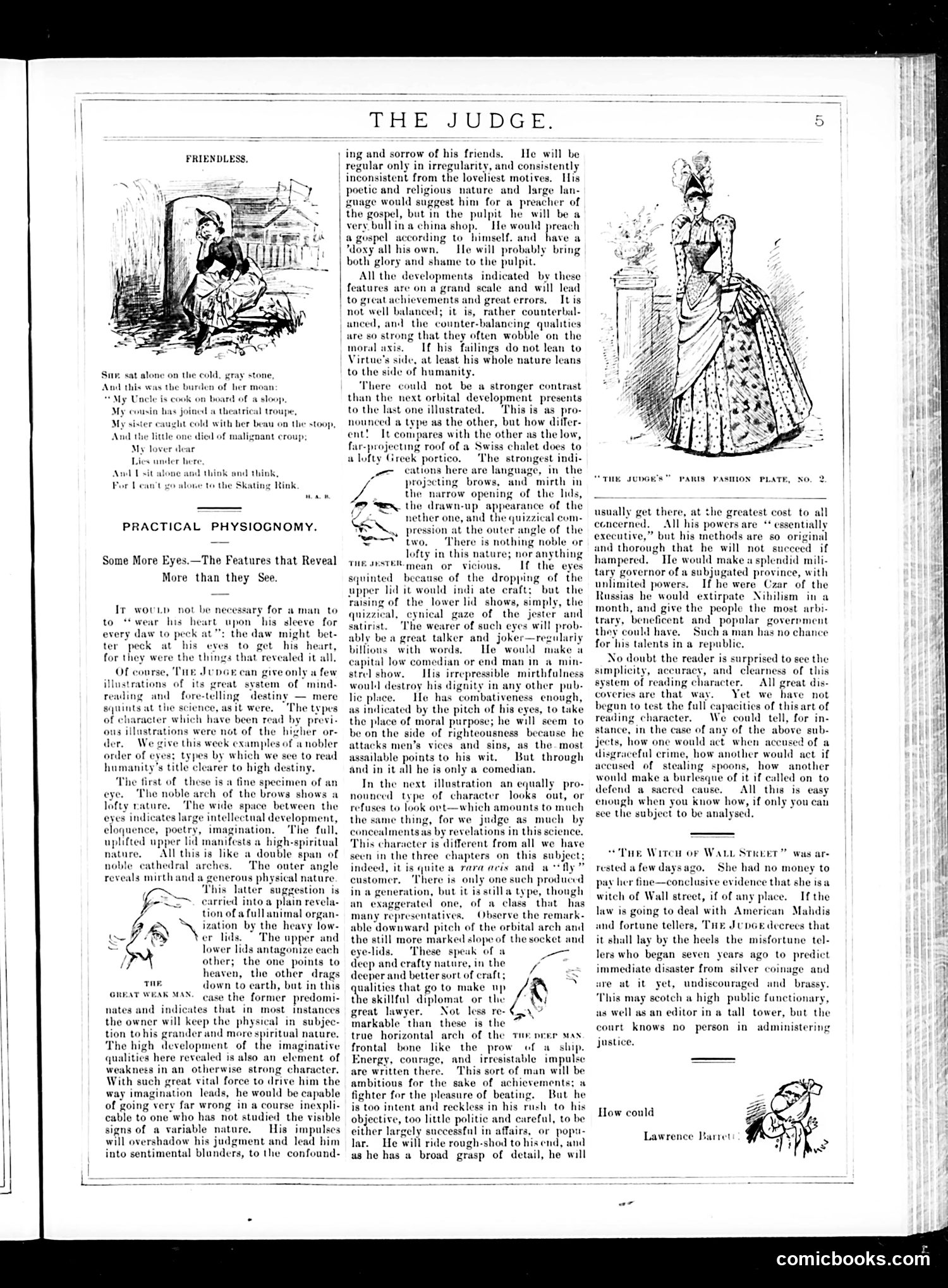
This page contains two distinct sections: **"Friendless"** (left) is a sentimental poem-and-sketch about a destitute woman cataloging her sorrows: her uncle works on a sloop, her sister caught cold, her lover is dead. The illustration shows her alone and melancholy. This appears to be Victorian-era sentiment rather than satire—a sympathetic portrayal of poverty and loneliness. **"Practical Physiognomy"** (center/right) is Judge's satirical take on phrenology and physiognomy—pseudoscientific practices claiming facial features reveal character. The article mocks these theories by describing elaborate personality readings from eye shapes. It humorously predicts that one noble-browed type will be inconsistent, sentimental, and "a very bull in a china shop" as a preacher; another type with low brows will be quizzical and mirth-filled. Judge ridicules the era's widespread belief that faces could scientifically predict destiny and morality.
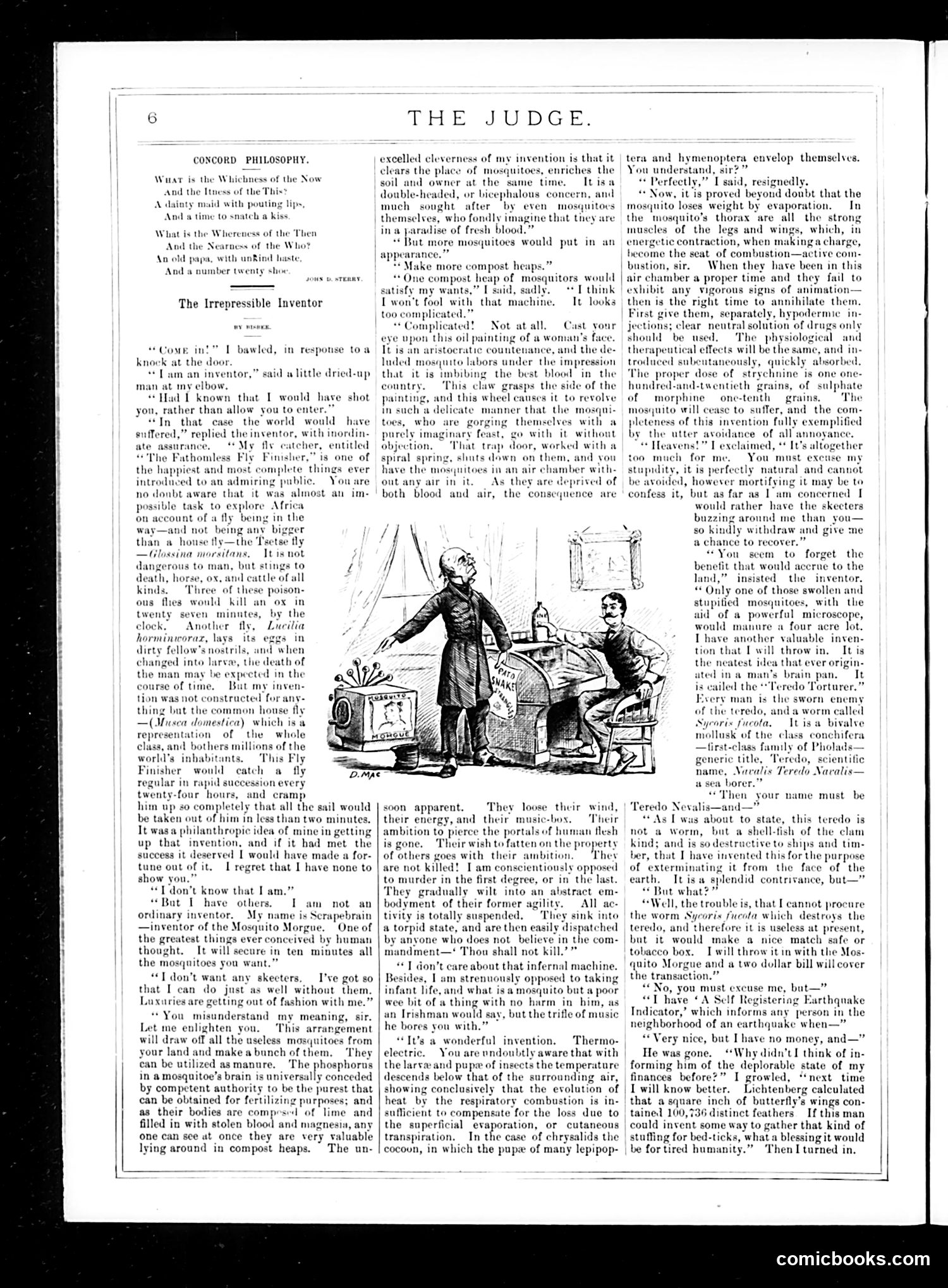
This page satirizes a stock character of the era: the bumbling, self-deluded inventor with grandiose claims and impractical contraptions. The unnamed protagonist—"Scrapebrain"—represents the type of charlatan inventor who pitched elaborate schemes to gullible investors during the Industrial Age. The joke relies on absurdist humor: his "Fathomless Fly Finisher" promises to catch common houseflies with industrial complexity, while his "Mosquito Morgue" converts dead mosquitoes into fertilizer via their phosphorus content. The satire mocks both the inventor's obliviousness to his own ridiculousness and the "Concord Philosophy" section above—transcendentalist pseudo-intellectualism rendered as nonsensical wordplay ("Whichness of the Now"). The host's exasperated responses ("Had I known I would have shot you") signal the social irritation these persistent inventors caused. The cartoon lampoons Victorian-era technological optimism and the gap between grand ambitions and practical results.
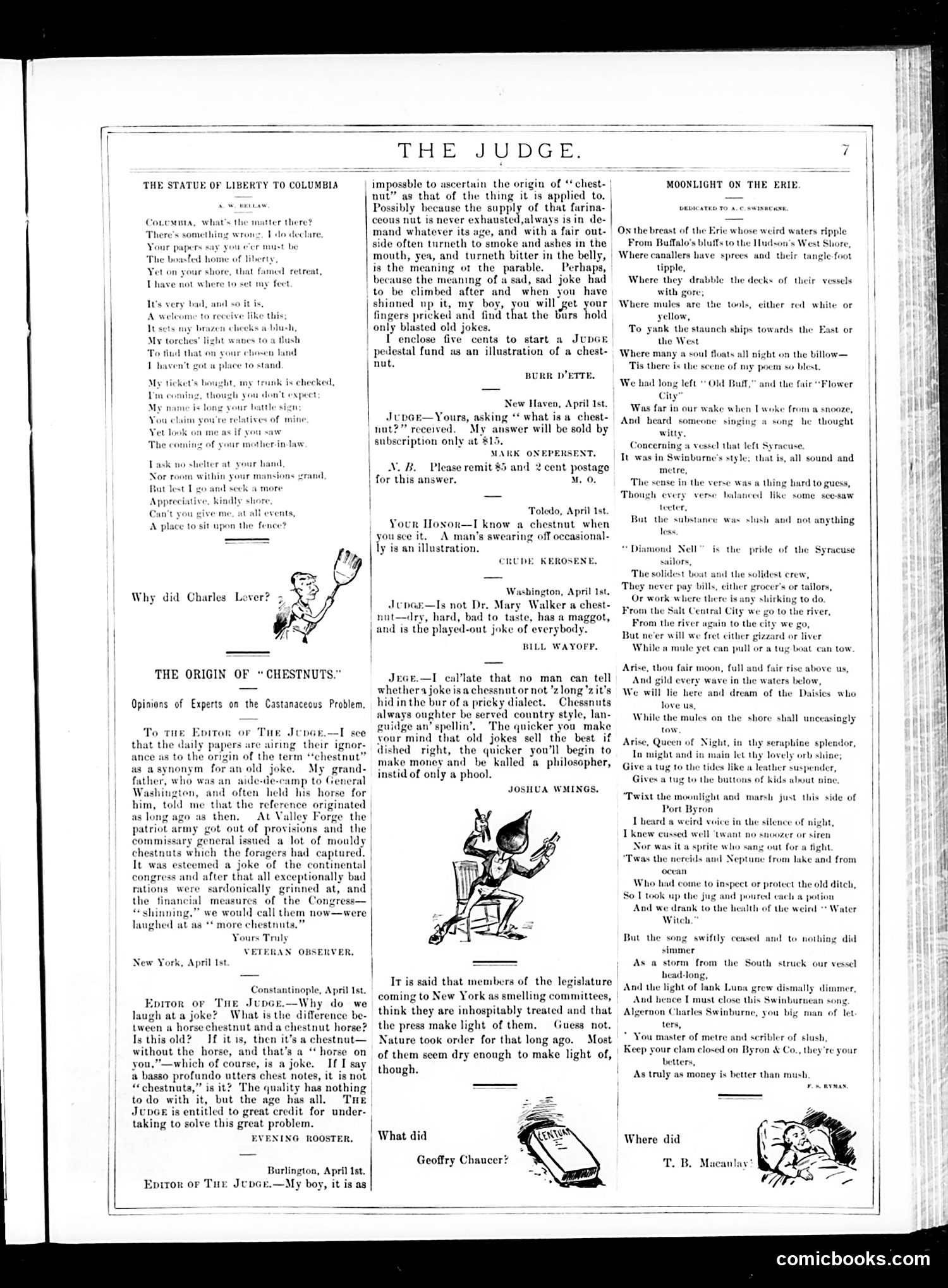
This page satirizes the term "chestnut," slang for a stale, repeated joke. The magazine invited readers to explain the phrase's origin, receiving absurd mock-scholarly responses. The humor lies in the *non-answers*: a "Veteran Observer" traces it to Valley Forge rations, another contributor creates circular logic about horse chestnuts, Mark Onpersent charges $15 for his "answer," and Dr. Mary Walker is mockingly called "a chestnut"—suggesting she's a worn-out public figure (she was a controversial Civil War surgeon and women's rights advocate). The final contribution from "Joshua Wangs" cynically notes old jokes sell best if "dished right," and you'll be called a philosopher rather than a fool—satirizing how recycled material passes for wisdom. The page lampoons both the public's endless appetite for stale humor and the pretense of expertise masquerading as insight.
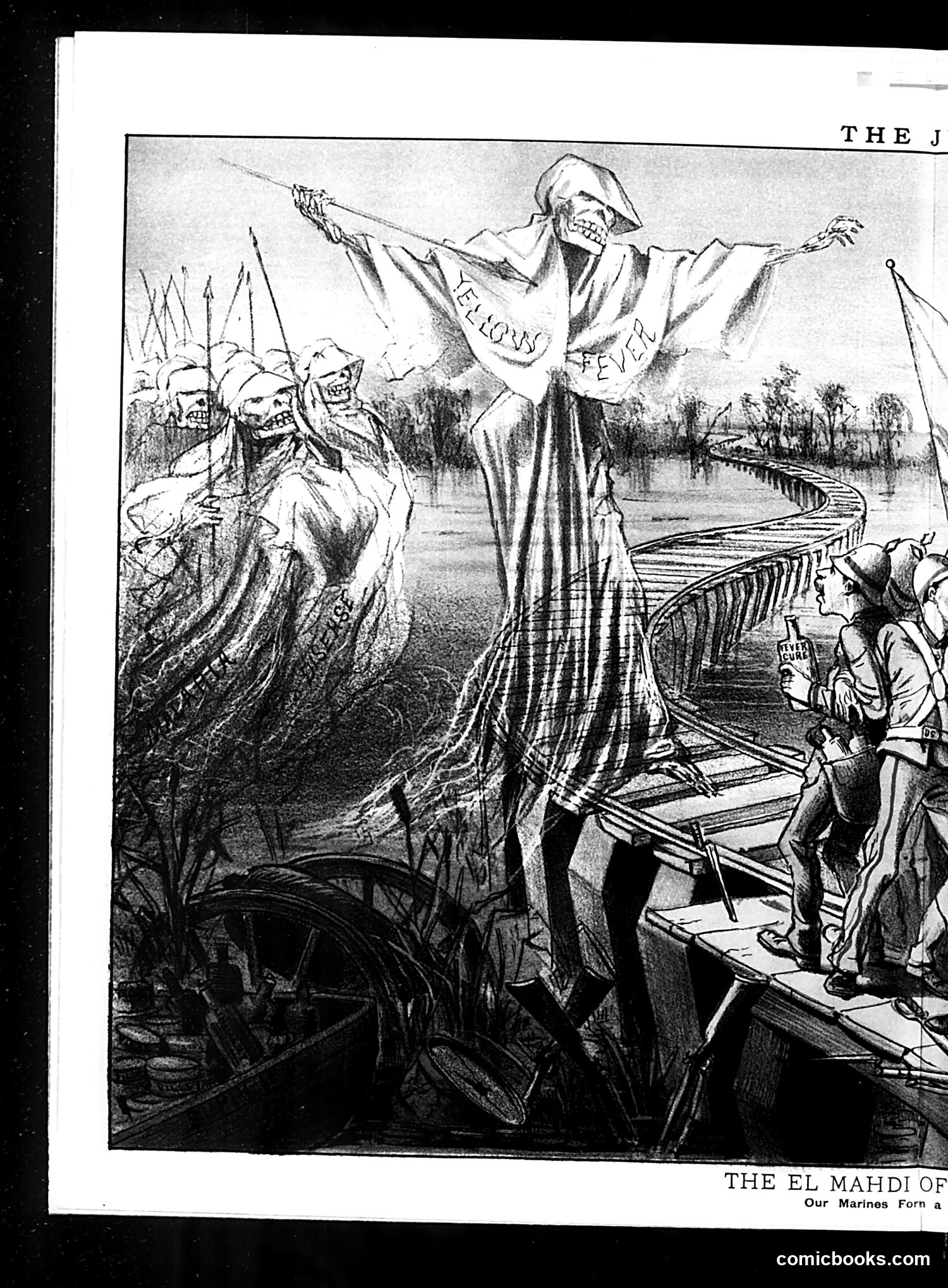
This appears to be a political cartoon titled "The El Mahdi of..." (title cut off) from *Judge* magazine. The image depicts a skeleton figure labeled "FELONS" and "LEVIES" towering over armed soldiers on the right and what appear to be military forces on the left near a waterway. The cartoon likely references the Mahdist War or colonial military campaigns, using the "El Mahdi" (a messianic Islamic figure) as metaphor for a threatening force. The skeleton suggests death or ruin, while the labels indicate the cartoon critiques taxation ("levies") and criminal elements ("felons"). The Marines referenced in the caption appear positioned against this threatening specter. Without the complete title and publication date visible, the specific historical context remains unclear.
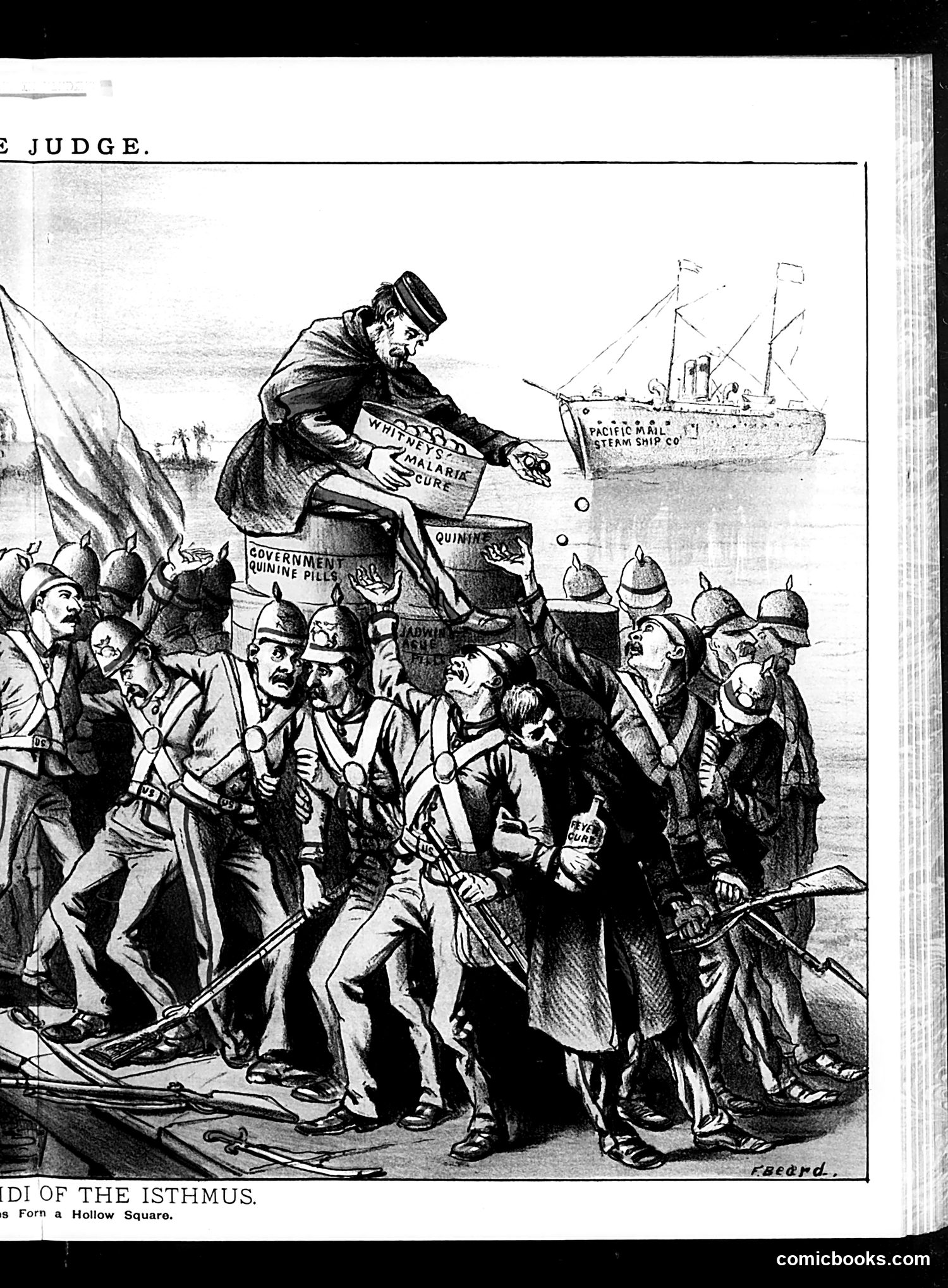
This Judge magazine cartoon satirizes American military intervention, likely during the Spanish-American War or Philippine-American War era. A tall figure (appearing to represent Uncle Sam or American authority) stands elevated, dispensing quinine and malaria "cures" to soldiers below. The soldiers wear spiked German-style helmets and appear sickly or distressed. A Pacific Mail steamship is visible in the background, suggesting overseas deployment. The cartoon critiques how American troops were sent to tropical regions (suggested by "isthmus" reference—possibly Panama or the Philippines) where they faced disease rather than conventional warfare. The satire suggests that American military leadership offered inadequate medical solutions to disease problems that plagued soldiers in unfamiliar climates, treating serious health crises as minor inconveniences to be managed rather than prevented.
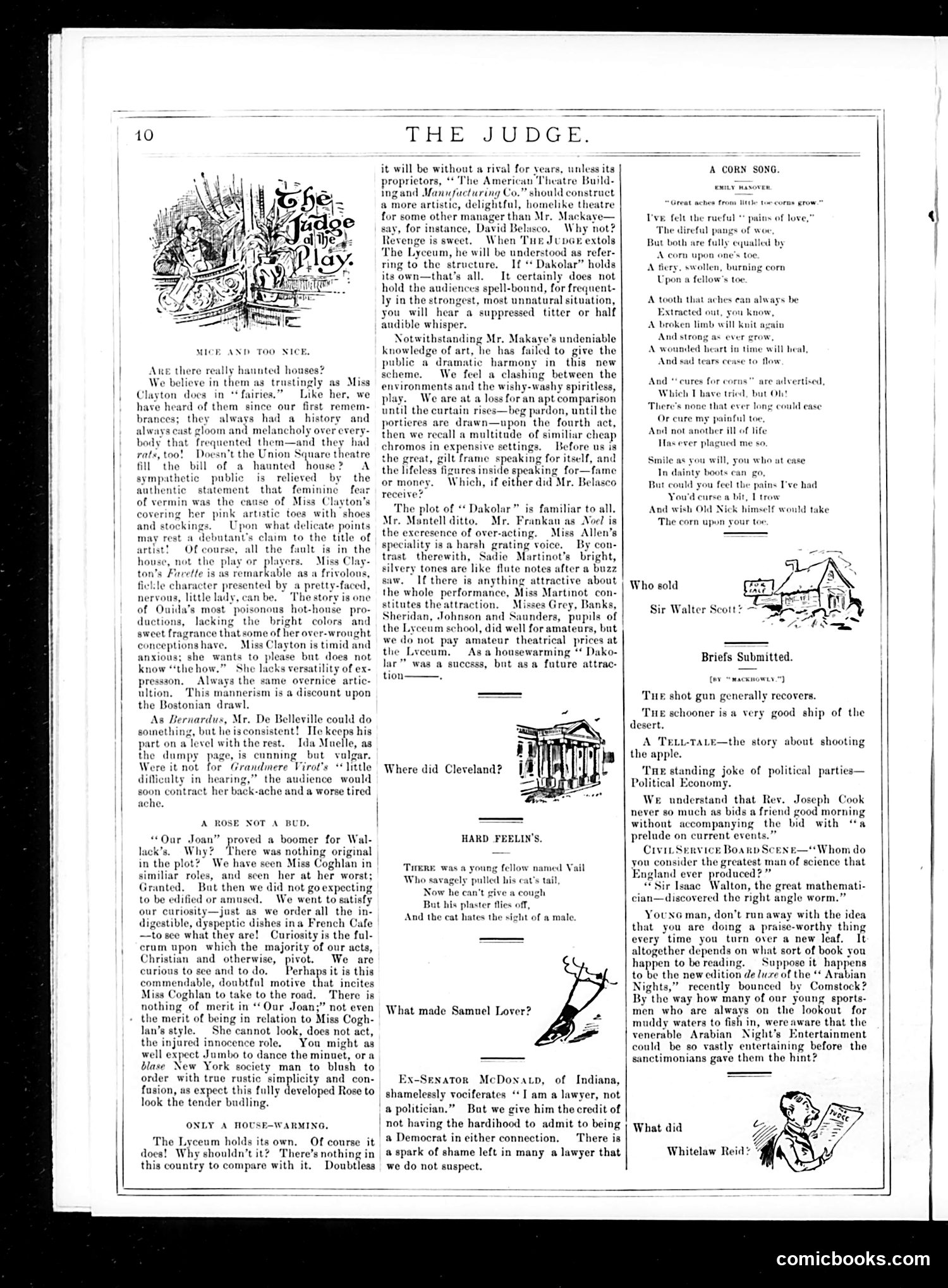
This page reviews several theatrical productions. The main critiques target: **"Mice and Too Nice"** — A play featuring Miss Clayton, criticized for timid, monotonous acting and over-reliance on a Bostonian accent. The reviewer sarcastically blames rats at Union Square Theatre for her character covering her feet with shoes, suggesting the production itself is the real problem, not the actress's choices. **"Our Joan"** — Miss Coghlan is mocked for miscast in an "injured innocence" role, compared absurdly to expecting an elephant to dance or a jaded society man to blush genuinely. **"Dakota"** — Performed at the Lyceum, praised for its theater building but criticized for Mackaye's direction creating dissonance between environment and "wishy-washy spiritless" play execution. Audiences allegedly suppress titters during serious scenes. The satirical tone throughout mocks both theatrical performances and the public's curiosity-driven theater-going habits. The page also includes unrelated poem "A Corn Song" and brief news items.
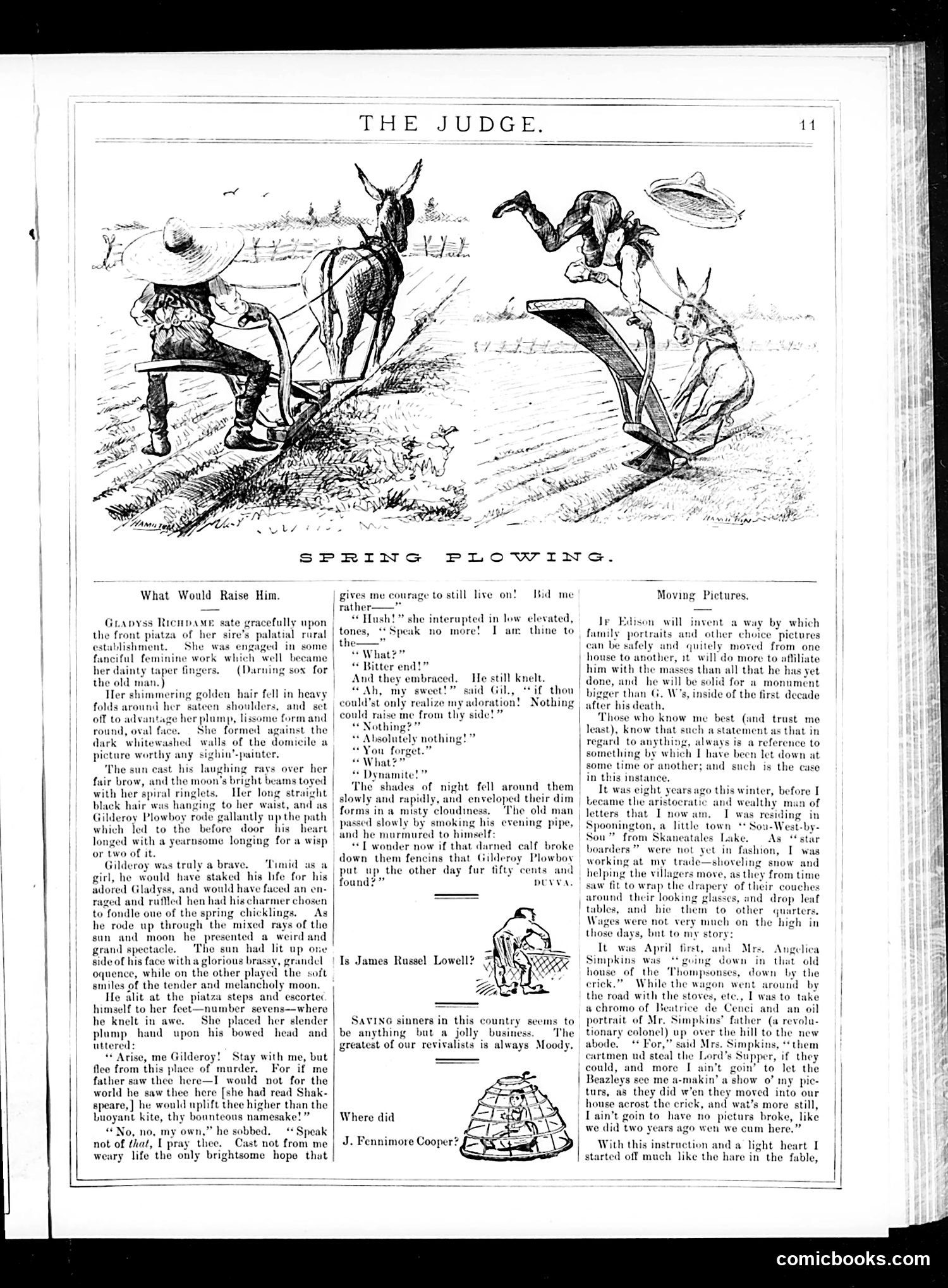
This page contains two separate pieces of satirical humor: **"Spring Plowing"** (main illustration): A visual pun showing farmers literally plowing fields alongside a romantic melodrama parody. The text mocks overwrought Victorian romance fiction with absurdly flowery descriptions of characters "Gladyss" and "Gilderoy Plowboy." The farmer-father's mundane concern about a broken fence contrasts with the couple's theatrical declarations of love—the satire targets both sentimental literary conventions and the gap between rural reality and romantic fantasy. **"Moving Pictures"** (right column): A humorous piece asserting that whoever invents a safe way to move household furniture will become more beloved than wealthy philanthropists. It's satirizing how Americans value practical convenience over grand gestures of charity—a jab at contemporary values prioritizing comfort over social responsibility. The brief question items ("Is James Russell Lowell?" "Where did J. Fennimore Cooper?") appear to be incomplete joke references, possibly mocking famous authors or cultural figures of the era.
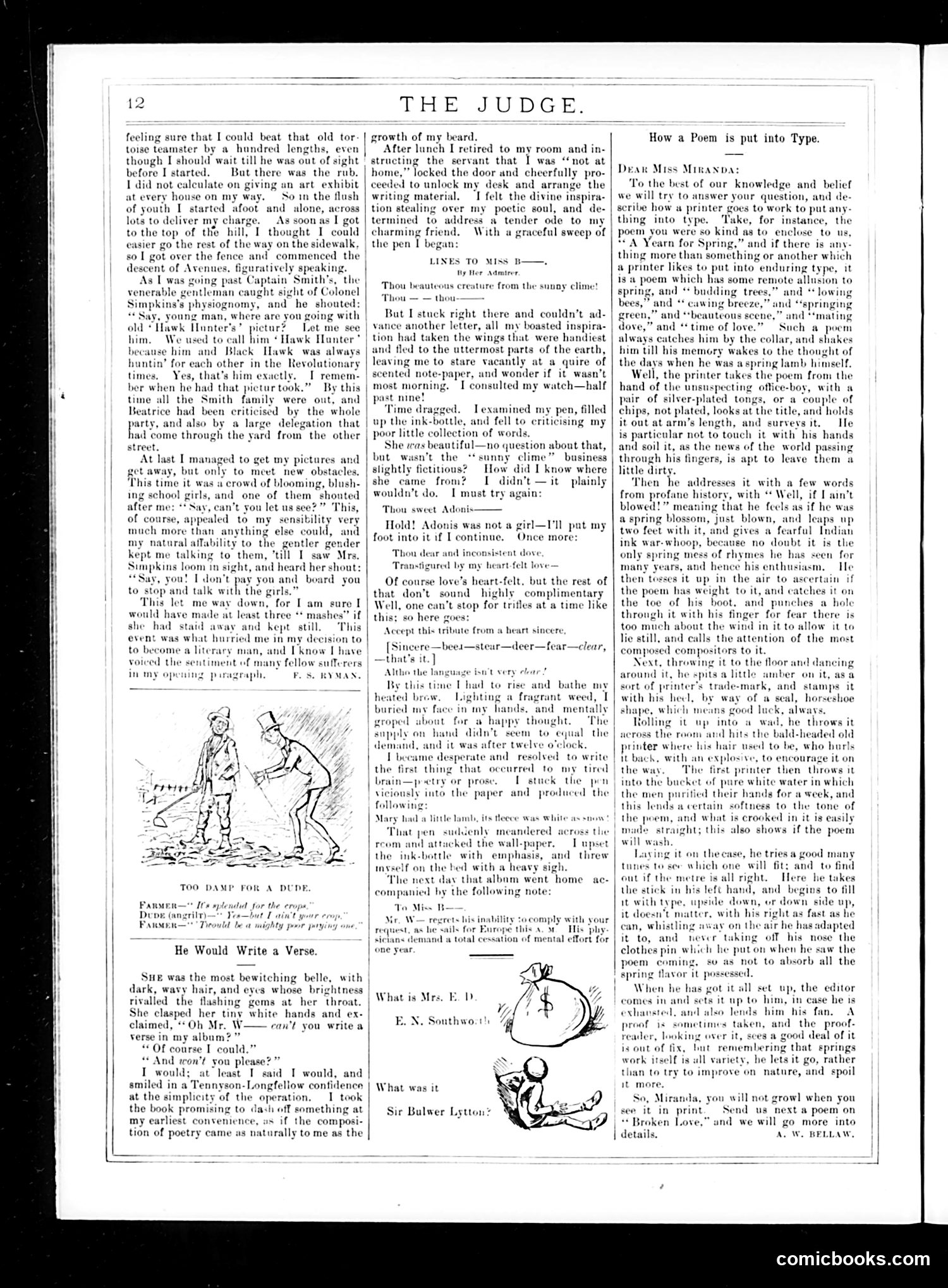
This is a humor magazine page containing two unrelated comic narratives about young men's social embarrassments. **"Too Damp for a Dude"** (left): A farmer ridicules an overly-dressed city man ("dude") for being impractical in rural conditions—likely referencing the Gilded Age tension between urban sophistication and rural practicality. **"He Would Write a Verse"** (right): A man agrees to write romantic poetry in a young woman's album but struggles creatively. The humor lies in his pretentious confidence collapsing into writer's block and self-doubt. He questions whether his flowery descriptions ("beauteous creature from the sunny clime") are even truthful—satirizing the artificiality of Victorian romantic verse and male posturing around women. Both stories mock male vanity: one through fashion pretension, one through literary pretension. The cartoons are period genre humor typical of Judge magazine's satirical approach to American social types and manners.
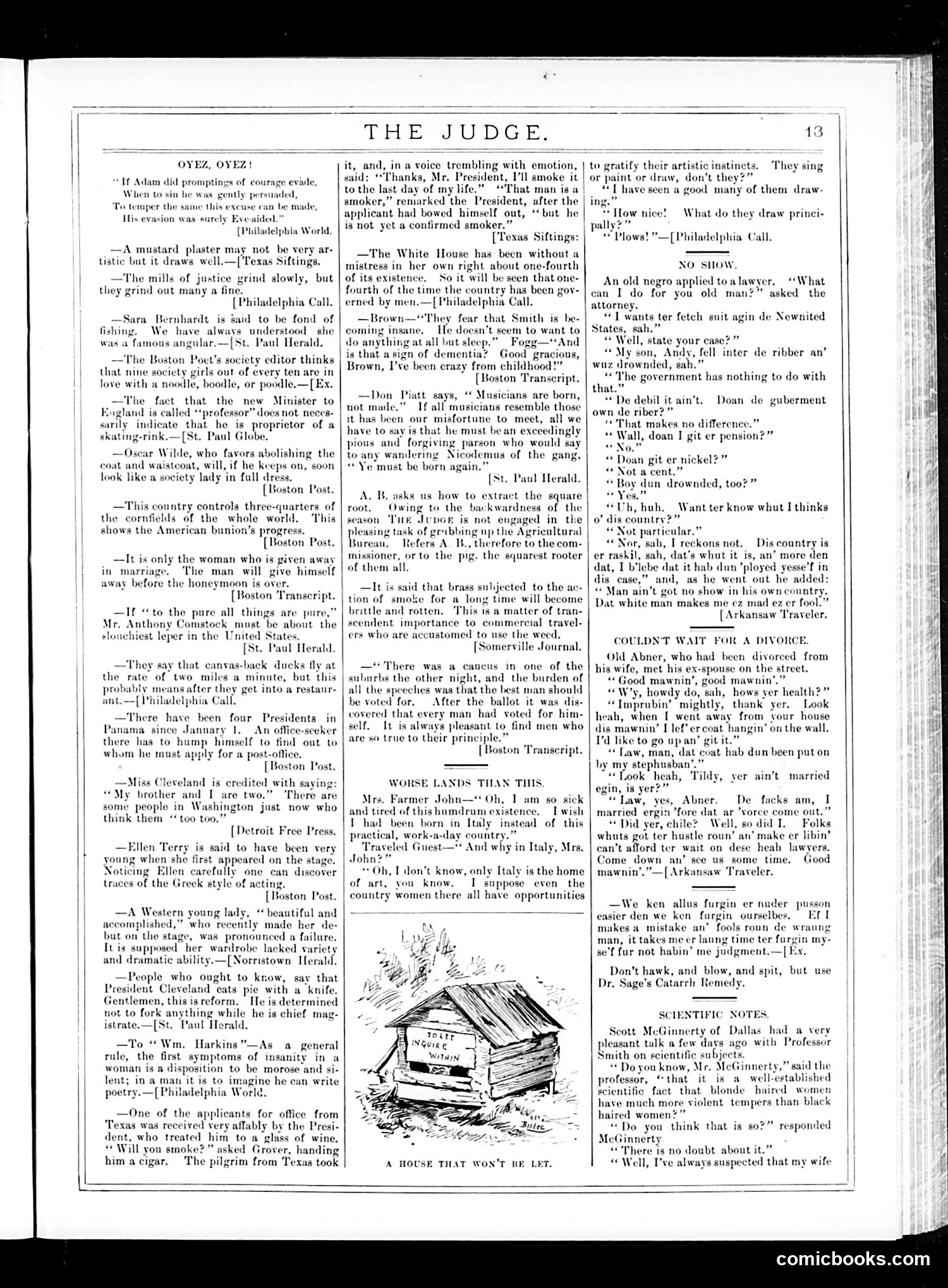
This page from Judge magazine (a 19th-century American satirical weekly) contains numerous brief satirical quips rather than a single political cartoon. The main illustrated cartoon titled "A HOUSE THAT WON'T BE LET" shows a dilapidated, ramshackle building—likely satirizing poor housing conditions or slum properties. The text snippets mock contemporary figures and social issues: references to President Cleveland (eating pie with a knife as "reform"), Oscar Wilde (fashion critiques), Sara Bernhardt (acting), and Anthony Comstock (censorship). Other jokes target women's suffrage advocates, political patronage in Panama, and racial stereotypes (the "old negro" dialect joke). The satire reflects Gilded Age concerns: government corruption, changing social roles, and artistic pretension. The humor is characteristic of 1880s-90s Judge magazine—topical, often mean-spirited, and assuming reader familiarity with contemporary scandals and personalities.
This page consists primarily of advertisements for financial services, patent medicines, and consumer goods, with only brief satirical snippets interspersed. The few cartoon elements include: **"He Wiped His Shoes on the Mat"** — A schoolteacher's joke where a dim student mispronounces "mat" by sounding it out letter-by-letter, misunderstanding the teacher's question about wiping feet. **"What He Did"** — A crude courtroom anecdote where a woman describes hitting a man who tried to kiss her with "a stick of stovewood," satirizing both romantic assault and vigilante justice. **"The Modern Shakespeare"** — A parody using Shakespearean language to mockingly describe a temperance lecturer's notably red nose, the joke being that his intemperate appearance contradicts his message. These are brief, lowbrow humor pieces typical of *Judge*'s satirical content — they target everyday social situations rather than political figures or events. The page is dominated by period advertisements for remedies, financial services, and bicycles, with satire relegated to short filler items.
This page is primarily **advertising**, typical of late 19th-century magazines. The small cartoon content includes: **"A Natural Death"**: A brief comic dialogue between two Arkansas men. One asks about another's death; the reply is that he "died, except that he was dead"—a deadpan joke playing on the phrase "natural death" by taking it literally. The humor relies on rural dialect humor, common in period satire. **"How Old Are You?"**: A flirtation joke where a gentleman guesses a girl's age as 13, she corrects him to 15, and he quips he "ought to know what I'm 15 of"—an innuendo joke about female development that reflects period attitudes. The rest of the page consists of patent medicines (Pond's Extract), musical instruments (Behning Pianos), food products (Bird's Custard), and medical devices (beer pumps, trusses)—standard magazine revenue. The medical claims are wildly exaggerated by modern standards.
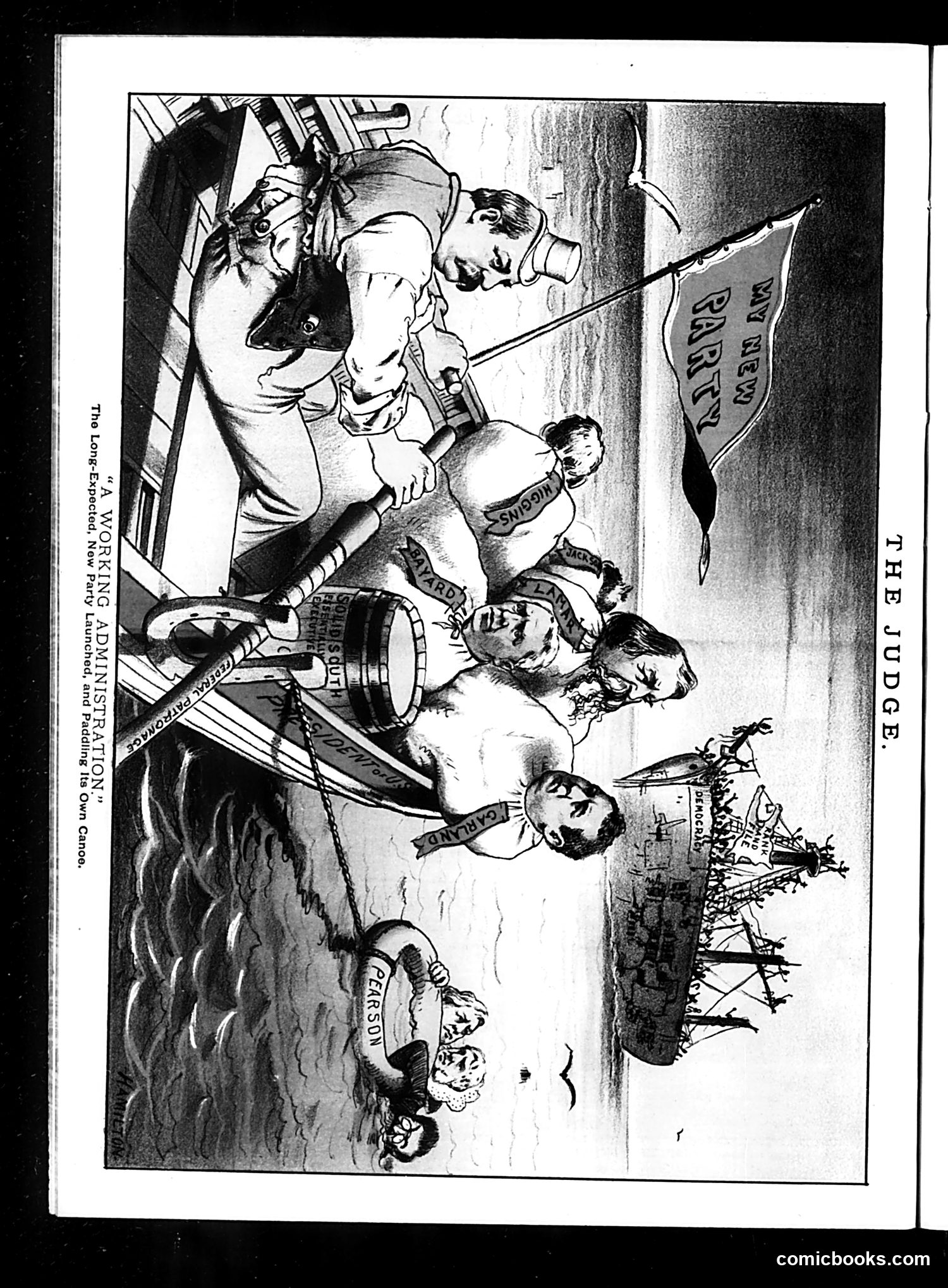
This political cartoon depicts the newly launched Democratic Party as men paddling a canoe labeled "Democracy" through rough waters. The caption sarcastically calls it a "working administration," suggesting skepticism about the party's competence and direction. The figures appear to be Democratic leaders struggling to navigate effectively—the canoe metaphor emphasizes their difficult journey and lack of coordinated effort. The turbulent water represents political and social challenges they face. The cartoon's tone is mocking: calling them "working" is ironic, implying the opposite—that they're floundering rather than functioning smoothly. This likely comments on a newly formed or reorganized Democratic administration, criticizing their ability to govern coherently. The date and specific political moment remain unclear from visible text, but the satire targets Democratic Party leadership's perceived incompetence.