
A complete issue · 16 pages · 1885
Judge — April 18, 1885
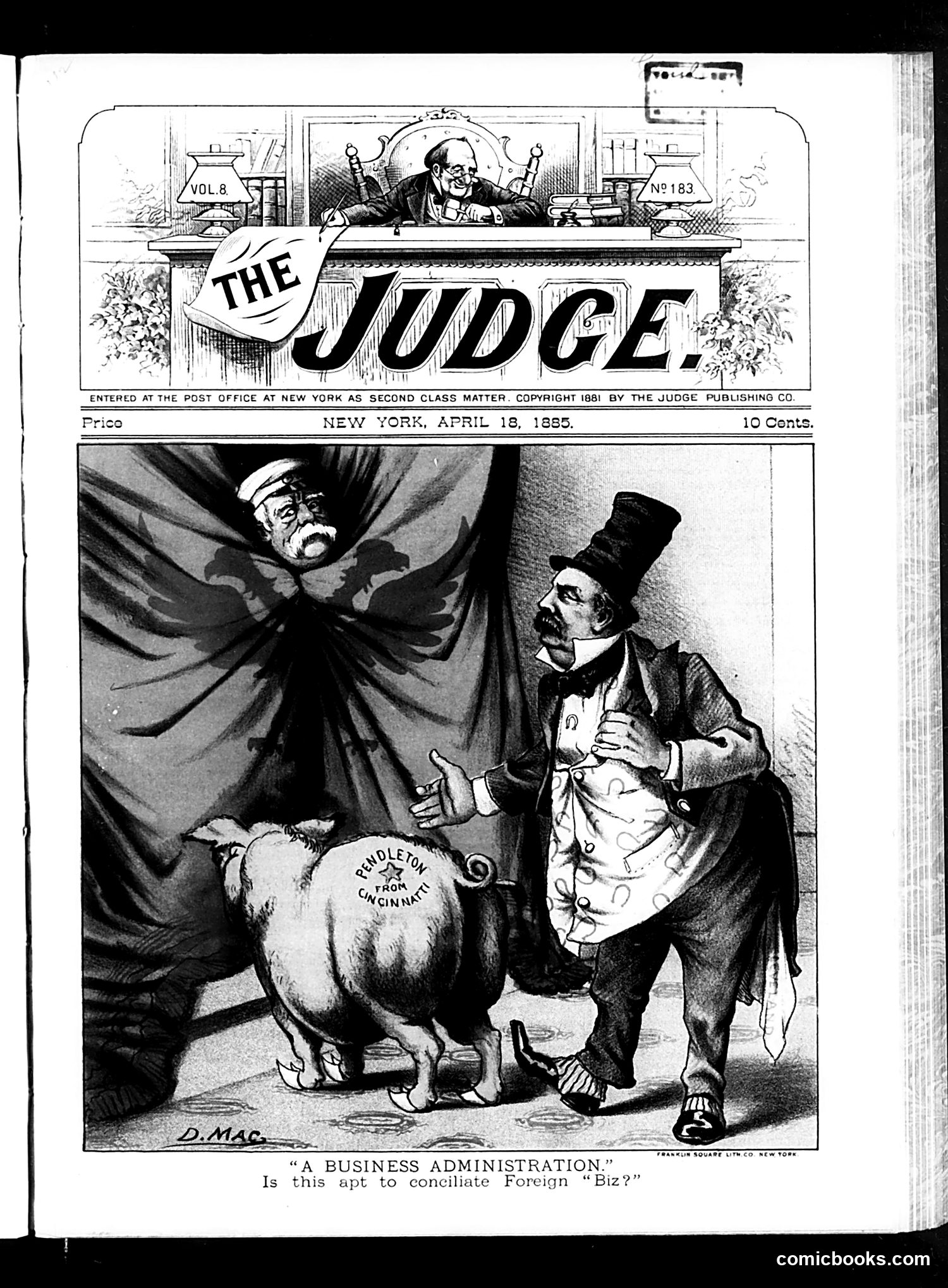
This 1885 Judge cartoon satirizes American foreign policy through caricature. A well-dressed American businessman (top hat, formal coat) confronts a small goat labeled "Randleton From Cincinnati"—likely referencing a specific diplomat or business figure. A threatening, demonic figure looms in the shadows above, suggesting malevolent foreign forces or competitors. The caption asks: "Is this apt to conciliate Foreign 'Biz?'" The satire mocks the administration's approach to international commerce and diplomacy, suggesting their methods are clumsy or counterproductive. The goat may represent an American business interest being sacrificed or mishandled. The cartoon criticizes how political leadership conducts foreign relations, implying their "business administration" actually alienates rather than cultivates foreign trade relationships.
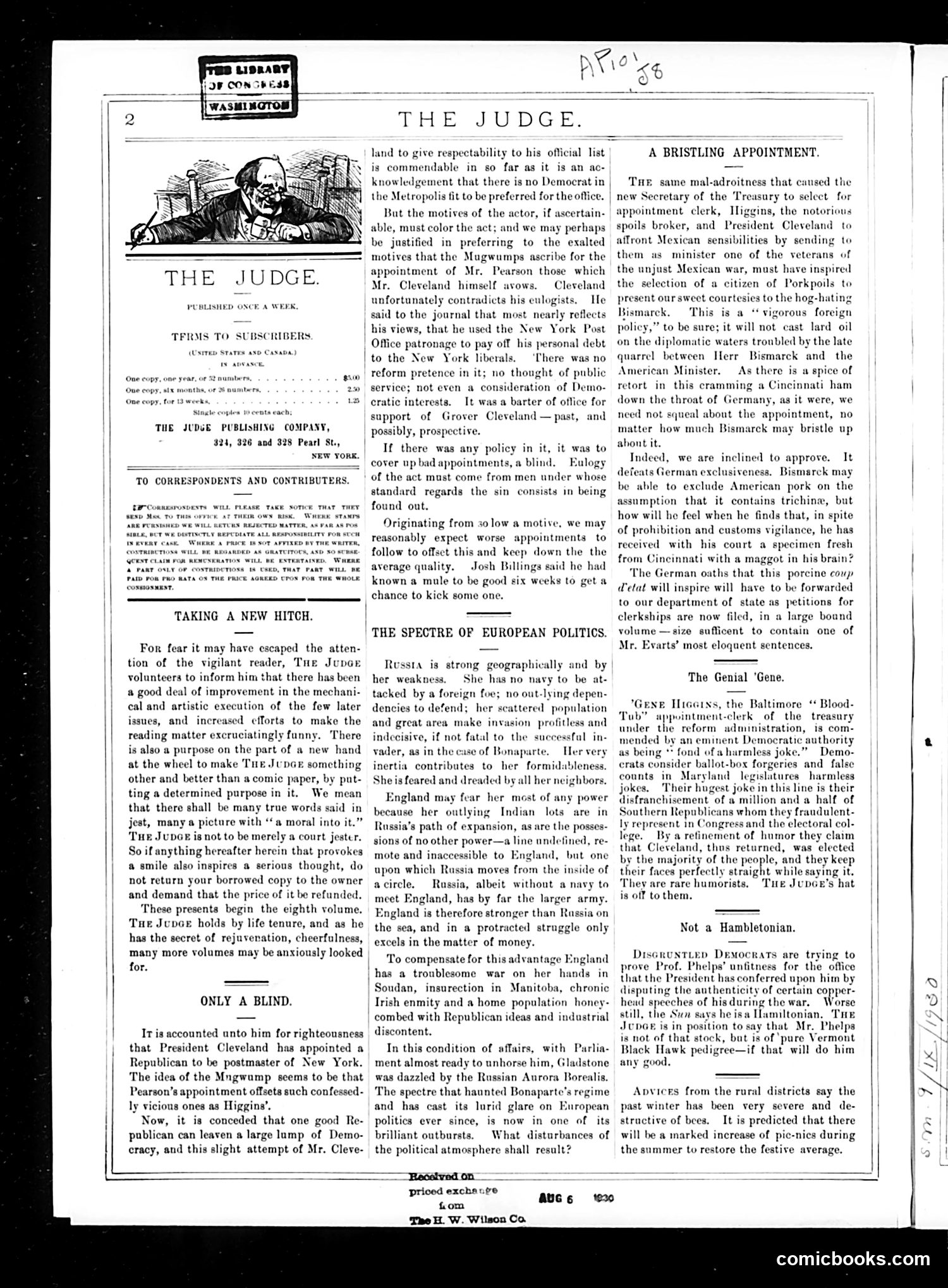
The page contains two brief satirical pieces critiquing President Cleveland's appointments: **"Only a Blind"** attacks Cleveland's appointment of a Republican postmaster in New York as a transparent attempt to mask poor Democratic appointments (specifically mentioning "Higgins"). The satire suggests Cleveland is using this token Republican hire as political cover—a "blind"—to distract from genuinely unqualified Democratic selections. **"A Bristling Appointment"** mocks the appointment of Higgins as Treasury clerk, comparing his selection to Cleveland's earlier blunder of appointing a Cincinnati ham merchant as American minister to Germany. The joke: this crude diplomat antagonized Bismarck where diplomatic finesse was needed. The author suggests Cleveland's incompetence in personnel selection is pattern-forming. Both pieces target Cleveland's spoils-system patronage practices and question whether his rare Republican appointment represents genuine reform or merely calculated public relations damage control. The cartoon illustration (top-left) appears to show a disheveled figure among papers, likely representing bureaucratic chaos or corruption, though details are unclear.
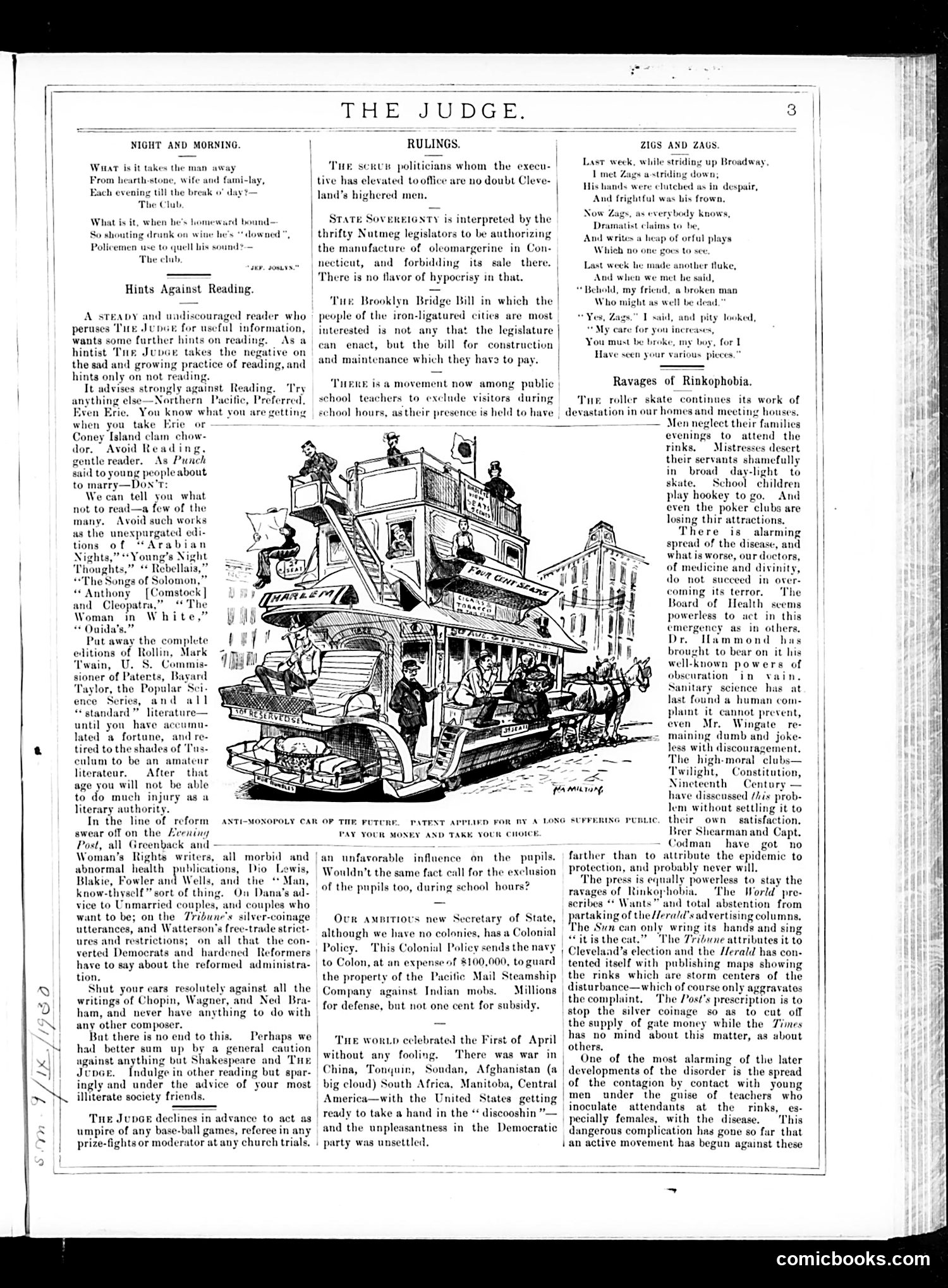
This satirical cartoon mocks the concept of a monopolistic public transportation system. The grotesque, multi-level vehicle labeled "ANTI-MONOPOLY CAR" appears to be a chaotic contraption overflowing with passengers, suggesting that attempts to regulate monopolies through government intervention create inefficient, bloated systems that serve the public poorly. The caption's promise to "pay your money and take your choice" is ironic—there is clearly no choice offered; the monopoly persists despite anti-monopoly legislation. The design satirizes both corporate monopolies and the government reforms meant to combat them, implying both are dysfunctional. This reflects 1880s-90s American anxieties about railroad monopolies and ineffective regulatory responses, positioning *Judge* as skeptical of government intervention as a solution.
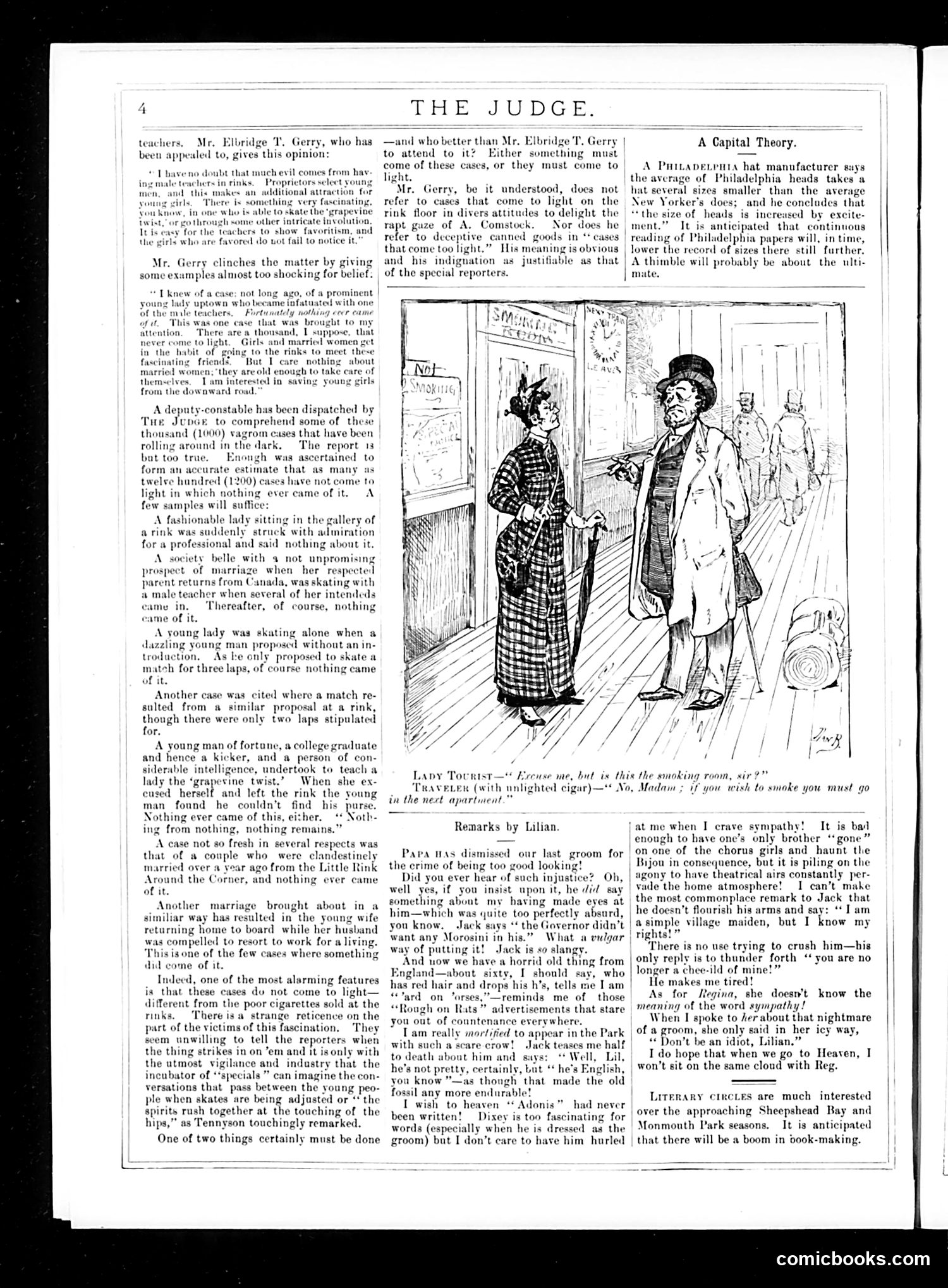
This page satirizes concerns about **ice-skating rinks as venues for improper romance and social misconduct** in late 19th-century America. The main article mocks moral panic over young people meeting at rinks, citing Mr. Elbridge T. Gerry (a real anti-vice activist) warning that rinks enable unsupervised courtship, particularly between young women and male skating teachers. The "cases" described are humorous non-events—a woman admiring a professional skater, a marriage proposal lasting "three laps"—depicting how puritanical authorities fret over innocent interactions. The cartoon shows a woman asking a man about "the smoking room," suggesting rinks were sites of questionable behavior and mixed-gender socializing that scandalized proper society. The satire targets both rink morality crusaders AND the actual social restriction of women's freedom. Judge magazine mocks the prudishness of reformers while exposing the reality: young women had limited opportunities to meet people outside chaperoned settings, so rinks became significant social spaces—which reformers found deeply threatening.
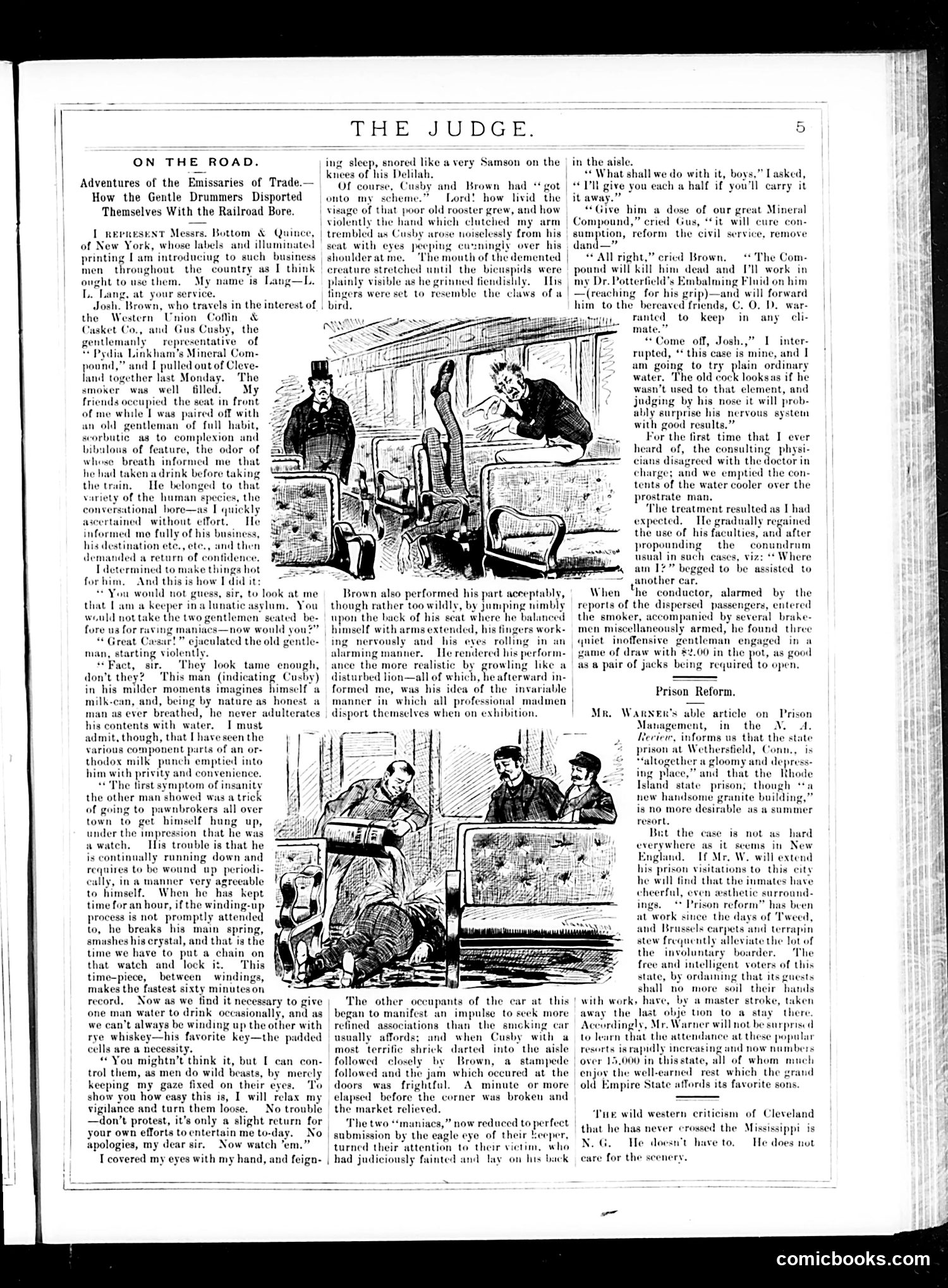
This satirical piece mocks the tedium of train travel and incompetent traveling salesmen. The narrator, L. Lang, describes sharing a railroad car with three objectionable passengers: Bottom and Quince (label/printing salesmen), Josh Brown (Western Union Coffin & Casket representative), and Cushy (Lydia Pinkham's Mineral Compound promoter). The humor derives from their absurd schemes—when an elderly, drunk passenger passes out, the three compete comically to "treat" him with their products, joking about embalming and mineral compounds while actually just splashing water on him. The accompanying illustrations show the mayhem aboard the train. The satire targets both the aggressive sales culture of the era and the ridiculous patent medicines (particularly Lydia Pinkham's tonics) that were heavily marketed during this period. The piece ridicules how these traveling salesmen embody everything annoying about modern commerce.
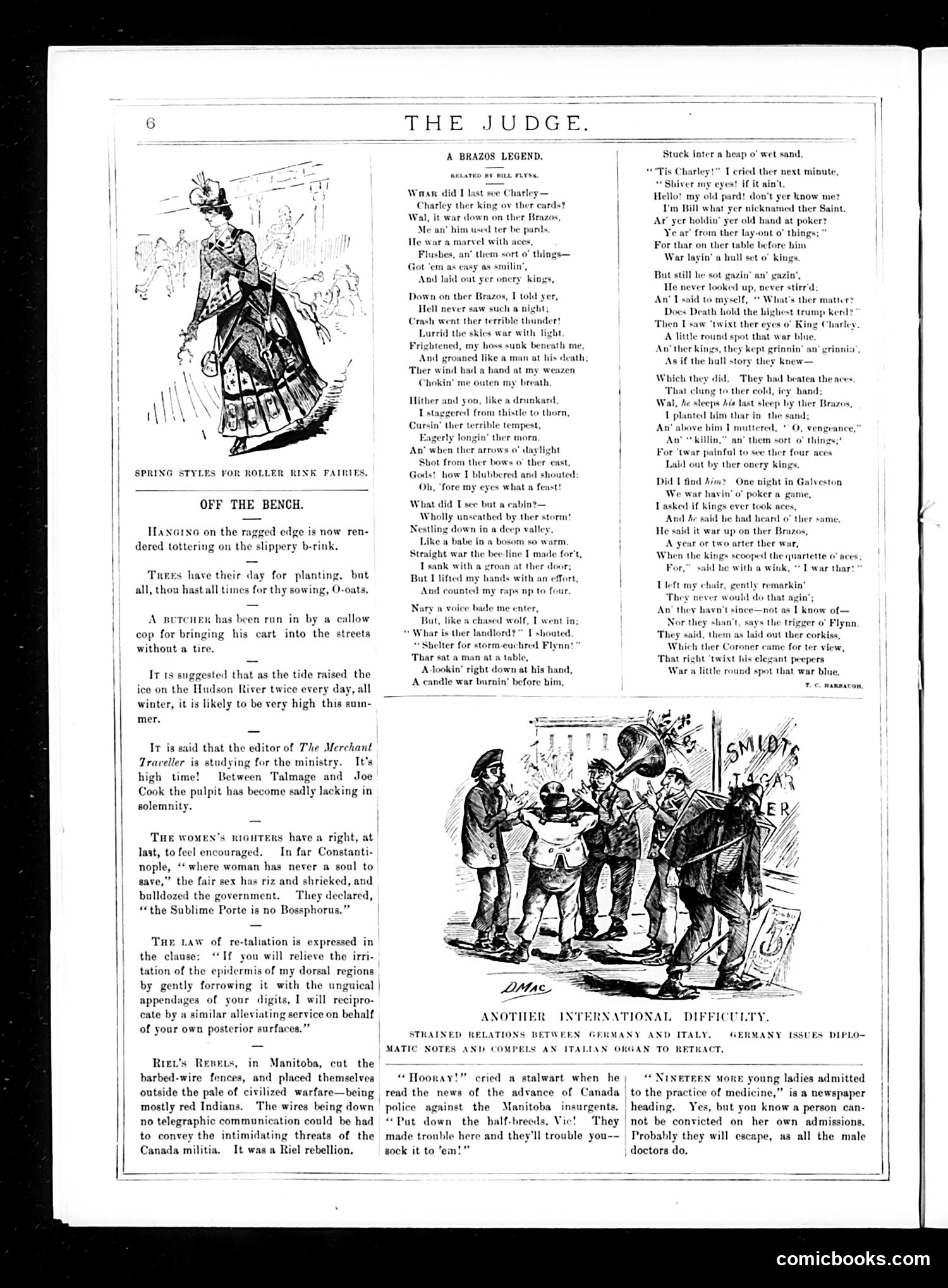
This page contains three distinct satirical pieces from Judge magazine: **"Spring Styles for Roller Rink Fairies"** (top left): A fashion cartoon mocking exaggerated or theatrical skating attire, likely targeting affectation and social pretension. **"Off the Bench"** (left column): Short quips satirizing contemporary absurdities—bureaucratic overreach (arresting a cart without a tire), media figures like preacher Talmage, and women's rights activism in Constantinople. **"A Brazos Legend"** (center/right): A dramatic poem about frontier card players. A man discovers his old partner Charley dead, having won a "hull set o' kings"—suggesting either divine judgment or ironic fate claiming the gambler mid-victory. **"Another International Difficulty"** (bottom): Brief satire on Canada-Italy diplomatic tensions, with dialogue about suppressing Manitoba insurgents (likely the 1885 Riel Rebellion). The page exemplifies Judge's mix of topical political commentary, social observation, and literary humor typical of 1880s American satirical journalism.
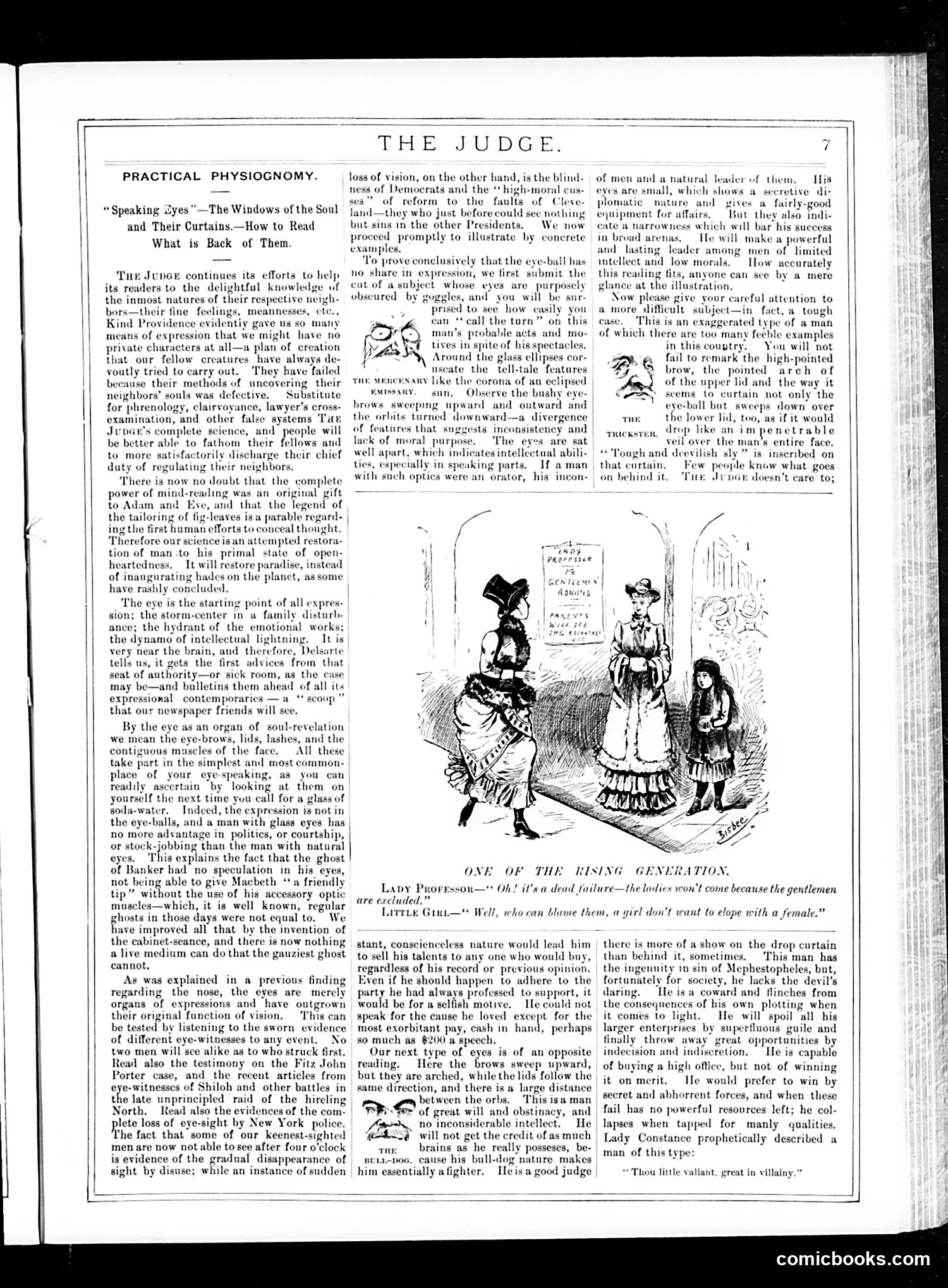
This is a satirical piece titled "Practical Physiognomy" mocking pseudoscientific claims about reading character from facial features. Judge magazine uses humor to critique both the fad and human nature itself. The main cartoon depicts a Victorian-era woman (likely representing society gossip or judgment) pointing accusingly at a young girl, with the caption "One of the Rising Generation." The accompanying dialogue jokes that a girl "don't want to elope with a female," suggesting social anxieties about propriety and courtship. The essay sarcastically presents "eye-reading" as a science for judging neighbors, then undermines itself by noting that eyewitnesses constantly disagree. It takes a political jab at Democrats and Cleveland administration reformers, claiming they suddenly became "blind" to faults once their preferred candidate took office. The satire ultimately mocks both pseudoscience and human hypocrisy—our tendency to judge others while ignoring our own biases.
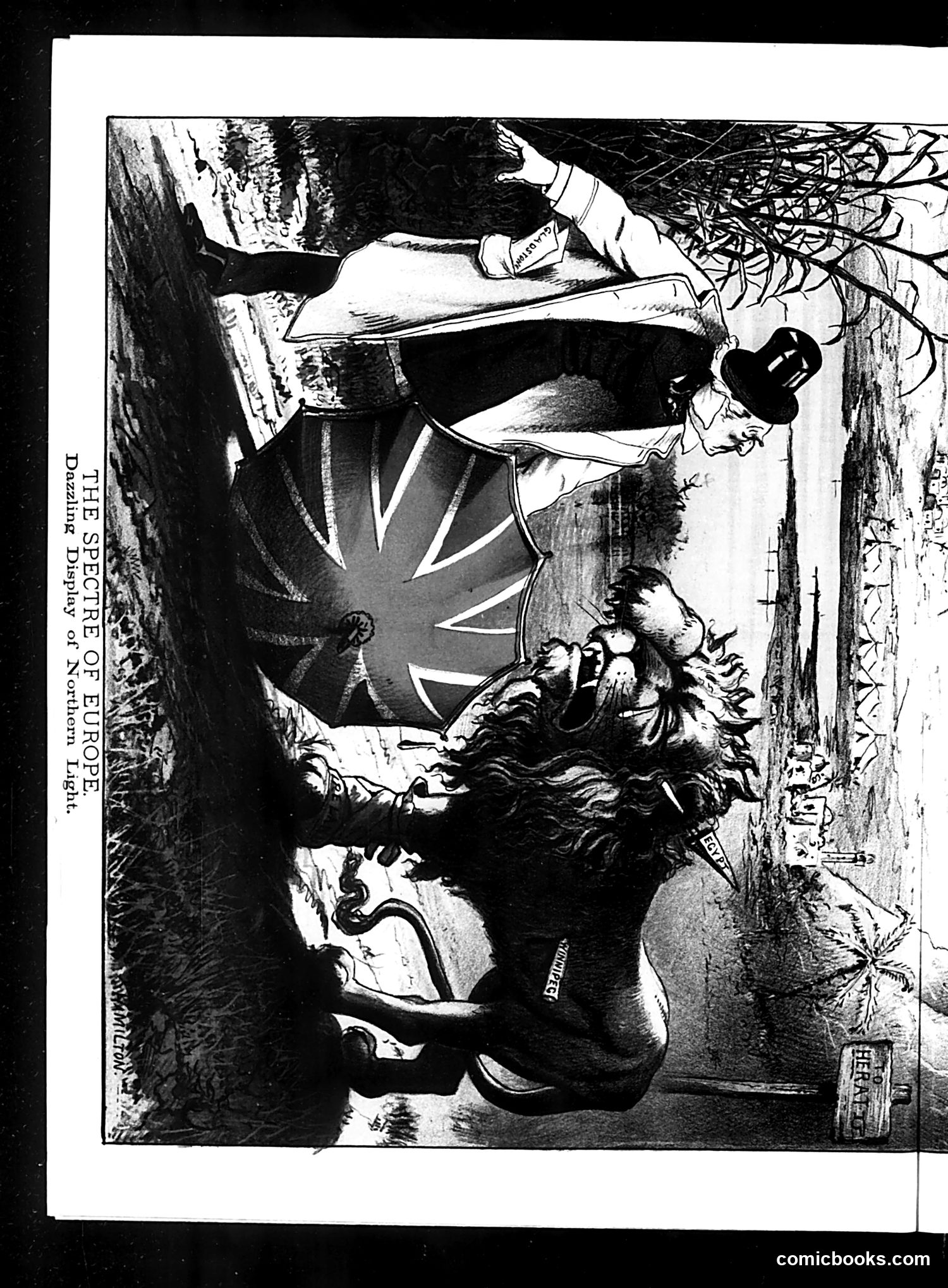
This political cartoon depicts a specter or ghost figure holding what appears to be a British flag, looming over huddled figures below. The caption "Dazzling Display of Northern Light" suggests a reference to the Northern Lights (Aurora Borealis), but uses it metaphorically. The "Spectre of Europe" likely represents a threatening political force or ideology haunting Europe—possibly militarism, imperialism, or another destabilizing power. The British flag in the specter's hand suggests British imperial ambitions or influence being depicted as ghostly and ominous rather than beneficial. The huddled figures below appear to be common people or nations cowering beneath this threat. Without a specific date visible, the exact historical context remains unclear, though the imagery suggests anxieties about European power dynamics during a period of imperial competition.
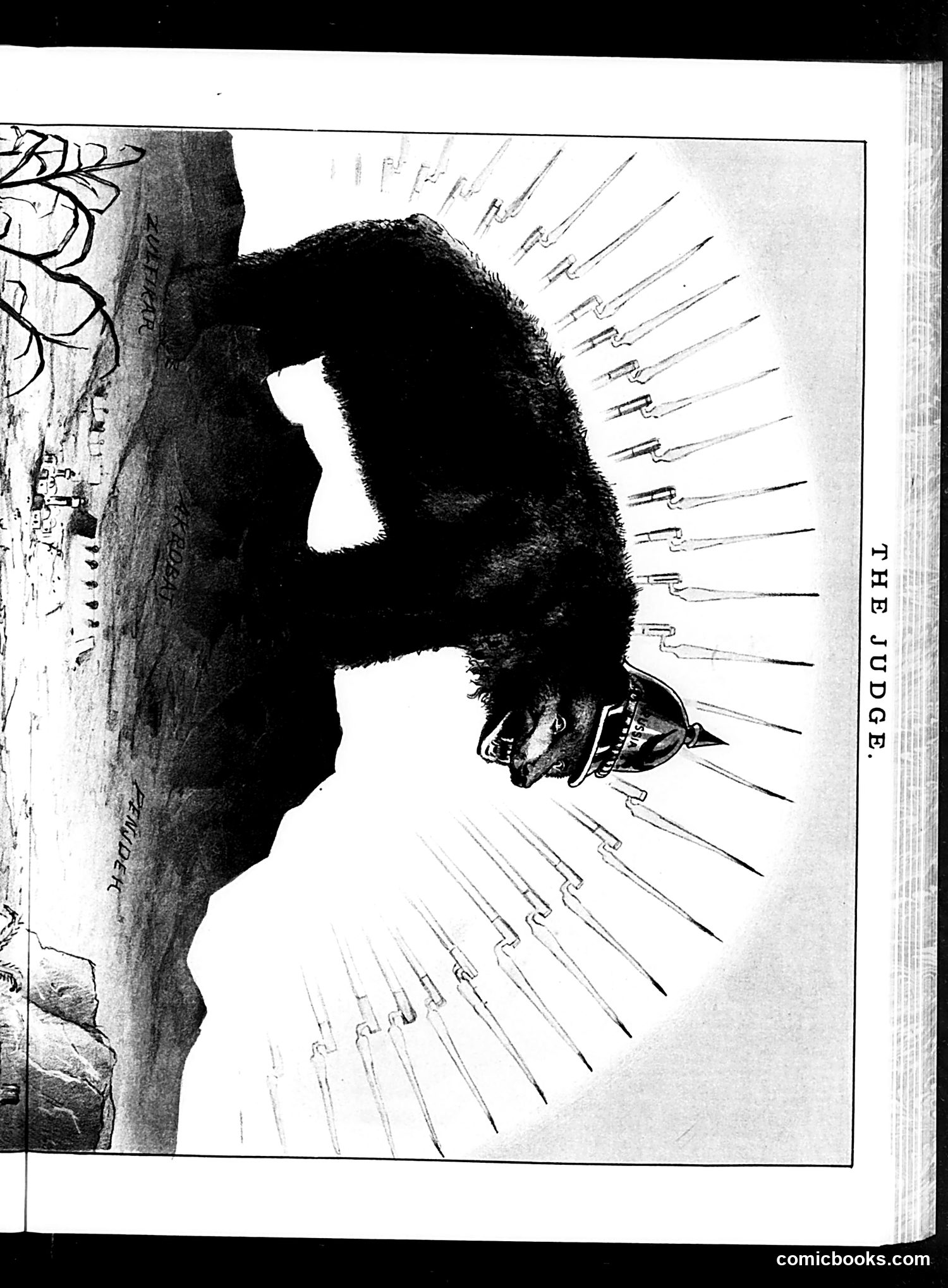
This page appears to be primarily a title or section header page from *Judge* magazine, with "THE JUDGE" text visible on the right margin. The OCR text is largely corrupted characters that don't form readable words. The image shows a silhouetted figure in dark clothing against a light background with radiating lines, which was a common compositional style in early 20th-century satirical illustration. However, without legible text identifying the subject, the specific political or social reference remains unclear. The dramatic backlighting and radiating lines suggest the figure represents something of importance or consequence, but I cannot definitively identify who is depicted or what event or issue is being satirized without additional context or clearer text.
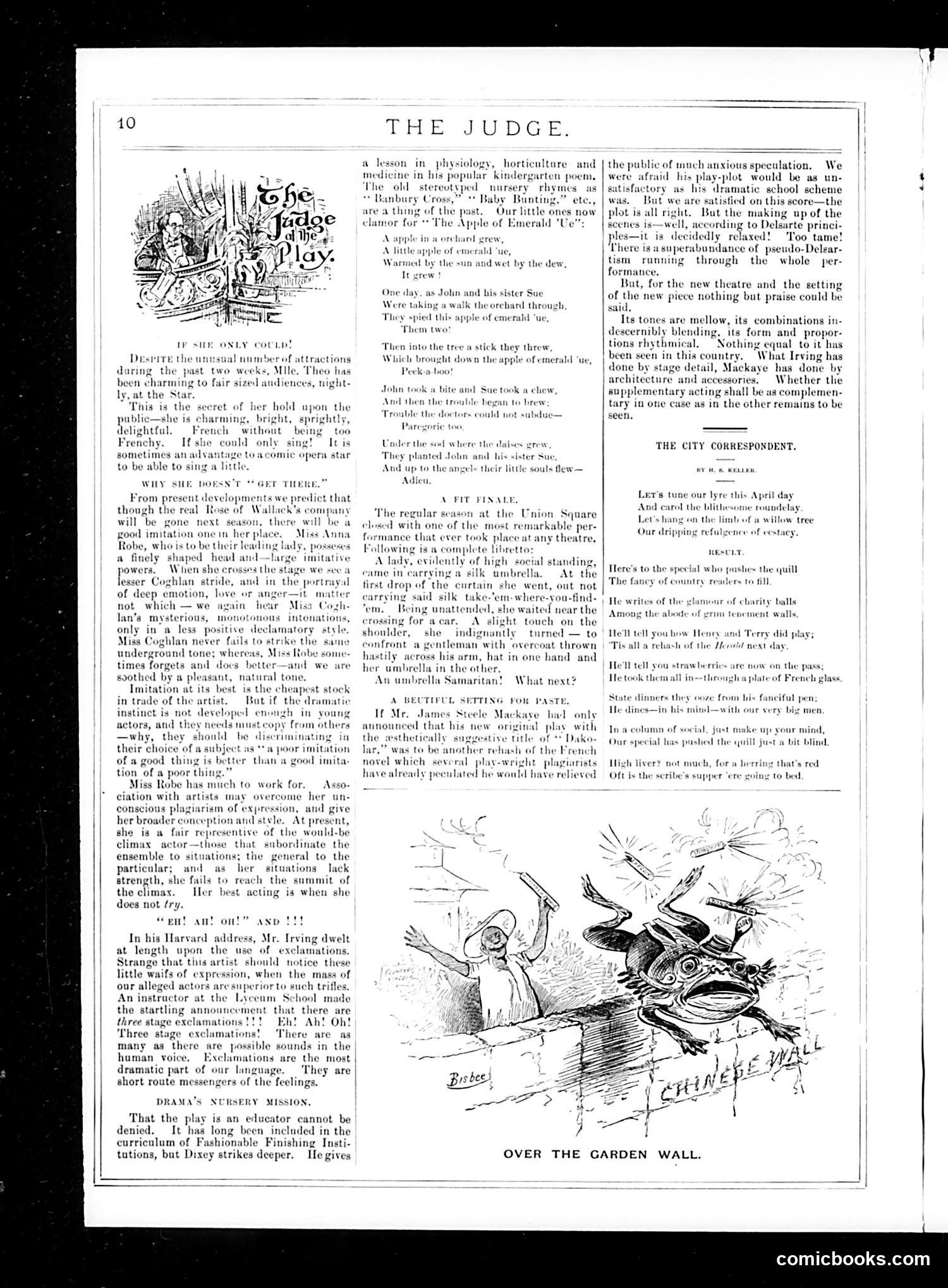
This page from *Judge* magazine contains theatrical criticism and light satirical commentary on 1880s New York stage productions. **"The Apple of Emerald Ue"** section mocks the trend of replacing traditional nursery rhymes with pseudo-educational, pseudo-Delsarte (a reference to a fashionable movement emphasizing dramatic gesture) versions for children—a pretentious overcorrection the writer finds ridiculous. **The main theater review** discusses a new piece at Union Square Theatre. The critic praises the set design and architecture (comparing it favorably to Henry Irving's work) but critiques the acting as derivative and overly mannered. Miss Coghlan and Miss Robe are the actresses being evaluated. **"Over the Garden Wall"** (the illustrated scene) appears to depict the theatrical production being reviewed—showing figures in a comedic or dramatic moment. **The City Correspondent** section offers gossipy theater-world observations, including complaints about derivative acting and clichéd dramatic devices. The satire targets pretentious theatrical fashion and actors' reliance on borrowed techniques rather than genuine talent.
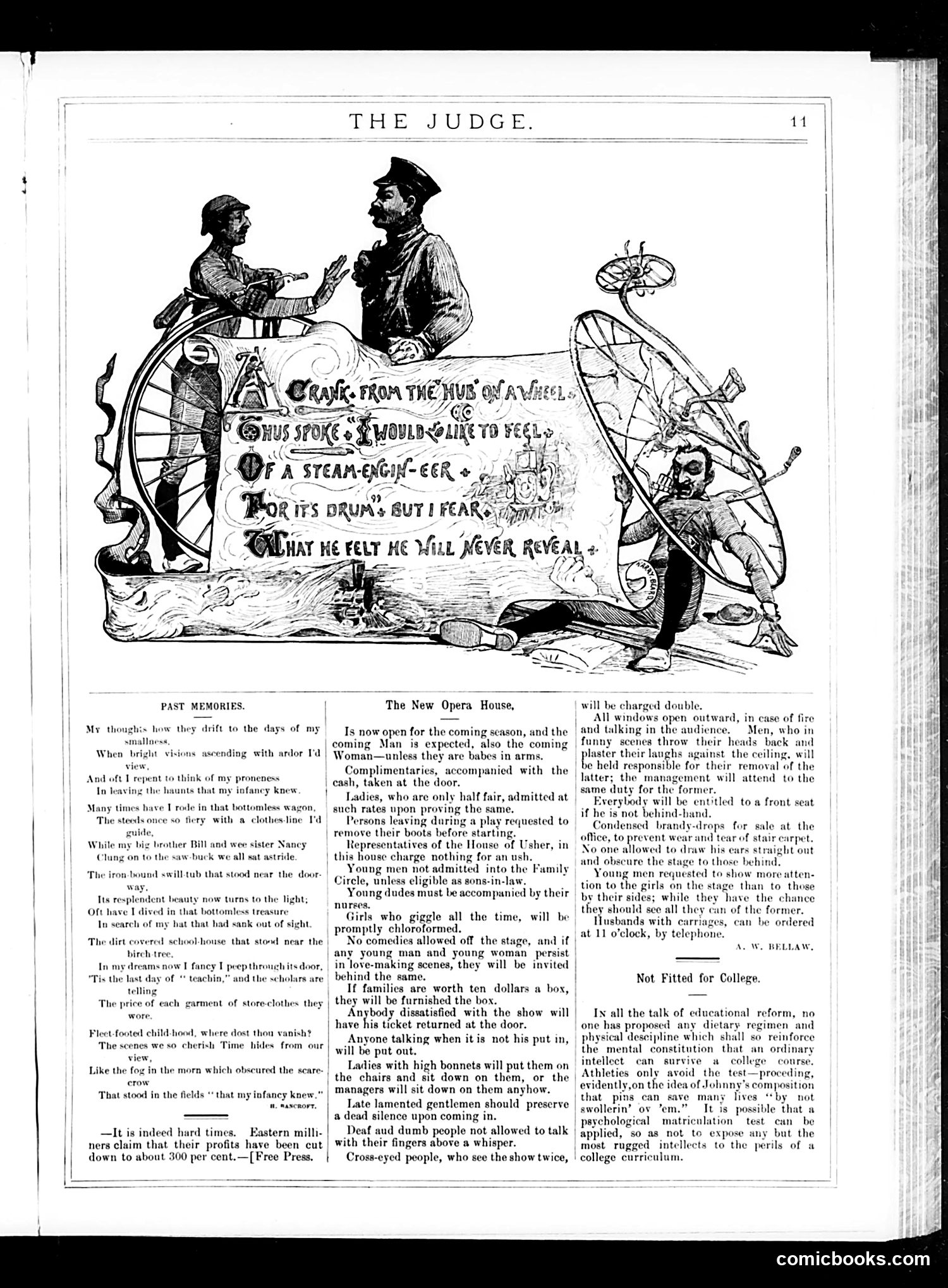
This page contains **three distinct items**: 1. **"Past Memories" poem**: A nostalgic piece about rural childhood, referencing playing on farm wagons and swimming holes—standard sentimental Americana for the period. 2. **"The New Opera House" rules**: A satirical list of absurd house regulations mocking opera-goers' behavior. It targets the pretentious and ill-mannered wealthy attending performances—women in oversized bonnets blocking views, men loudly laughing, people wearing expensive clothes, families "worth ten dollars a box," and working-class people inadequately prepared for high culture. The humor lies in exaggerating real social anxieties about theater etiquette and class mixing. 3. **"Not Fitted for College"**: An editorial criticizing college education's difficulty. It argues colleges provide no dietary or physical training to help students survive academically, and suggests only athletes avoiding rigorous testing actually succeed. All three items reflect typical *Judge* magazine satire: mocking pretension, social climbing, and the gap between aspirations and reality in Gilded Age America.
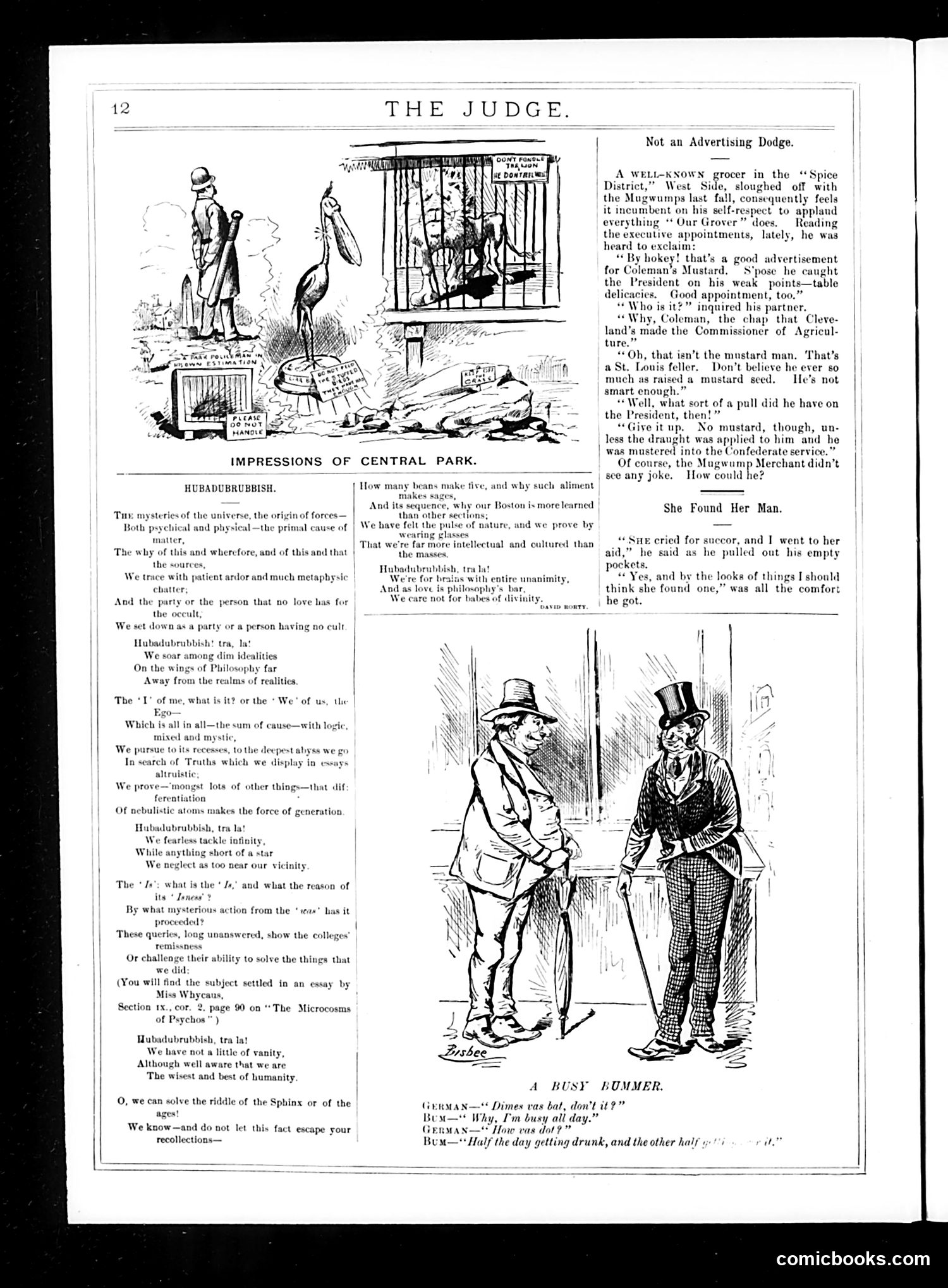
**"Not an Advertising Dodge"** satirizes a grocer who defected to the "Mugwumps" (Republicans who abandoned their party) during the last election and now slavishly praises President Cleveland's appointments to demonstrate his political respectability. The grocer mistakes the new Agricultural Commissioner for a mustard manufacturer, assuming Cleveland appointed him as a favor—not realizing the grocer's own judgment is worthless. The joke: Cleveland didn't appoint this man based on mustard-industry connections, exposing the Mugwump grocer's shallow opportunism and lack of genuine political understanding. **"A Busy Bummer"** presents a German immigrant humorously explaining his daily routine: getting drunk half the day and drinking the other half. It's stereotypical ethnic humor mocking working-class immigrants' alleged alcoholism. The page uses these cartoons to mock political carpetbaggers and ethnic stereotypes typical of Gilded Age satirical magazines.
This page from *Judge* is primarily a **humor/joke compilation** rather than a political cartoon spread. The content consists of short satirical quips and observations about contemporary American life, circa the 1880s-90s. **Key identifiable references:** - **Cleveland**: Multiple jabs at President Grover Cleveland—one mocks his inaugural talk of "public trust" while criticizing voters who sell their votes for cash; another jokes about a Tennessee couple leaving Washington on laundry day rather than visiting the White House. - **Vassar College girl**: A satirical note about a female student swearing not to cut her bangs until a Republican occupies the White House (suggesting partisan female activism). **The humor targets:** - Marriage complaints (nagging wives) - Fashion trends (yellow clothing, women's dress lengths) - Social pretension (cultured Boston owls vs. country owls) - Gender relations and courtship etiquette - Political corruption and appointments The page's approach is broadly **mocking American social customs, politics, and gender dynamics** through brief, often absurdist observations rather than illustrated satire.
This page from *Judge* magazine contains several humorous anecdotes, most prominently: A satirical story about two rival German-Jewish merchants in Austin who reconcile on the Jewish Day of Atonement, but when shaking hands, each sarcastically wishes the other the same hardships they've suffered—then both refuse to actually forgive, defeating reconciliation's purpose. The heavy German accent and stereotypical depiction reflects the publication's ethnic humor conventions. Another joke mocks a young politician for claiming ignorance about President Cleveland's future party affiliation—implying politicians pretend neutrality while secretly involved in partisan maneuvering. A third anecdote humorously describes a man dreaming of poker and mistakenly striking his wife while trying to discard a card, emphasizing slapstick domestic chaos. The page is primarily advertisement-heavy, with various patent medicines and services typical of the era dominating the margins. The humor relies on ethnic stereotypes, marital discord, and political cynicism characteristic of 1880s satire.
This page is **primarily advertisements** with minimal editorial cartoon content. The advertisements reflect late 19th-century American commerce: patent medicines (Pond's Extract, Dr. Young's Electric Belts), industrial equipment (beer pumps, storage tanks), and consumer goods (bicycles, pianos, trusses). The small integrated **jokes and anecdotes** (titled sections like "A Sinecure" and "It Astonished the Public") are typical Judge filler content—brief, often mildly risqué or cynical observations about daily life. These lack specific political targets and instead mock universal human behavior: laziness, vanity, and hypocrisy. The reference to **Dr. Pierce's "Golden Medical Discovery"** suggests contemporary skepticism toward patent medicines' miraculous claims, though the context is unclear from this excerpt alone. Overall, this represents Judge's mixed editorial-advertising model rather than pointed political satire—the magazine subsidized humor through commercial partnerships.
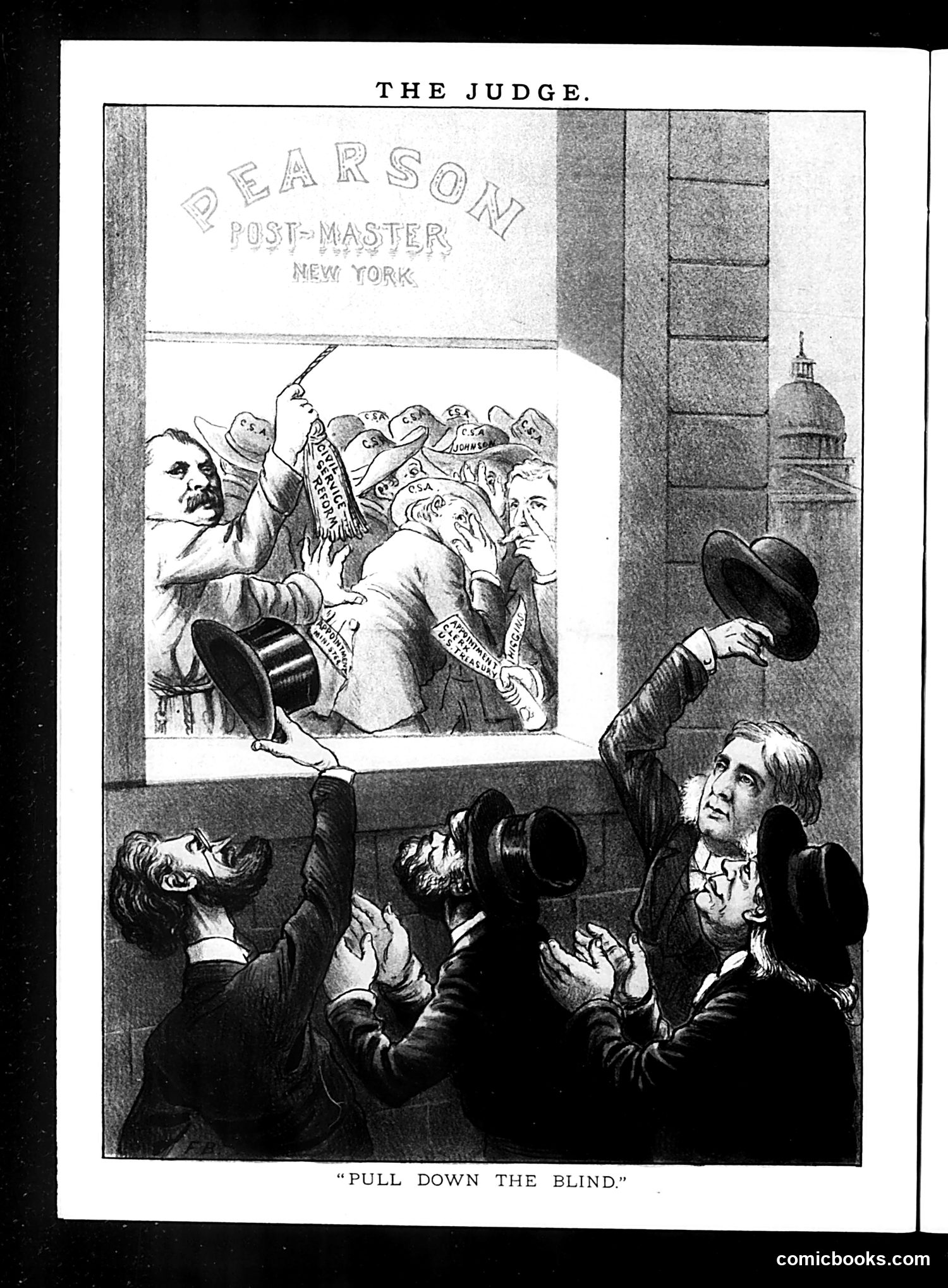
This political cartoon from *Judge* magazine satirizes corruption in the Post Office under Postmaster Pearson (New York). The upper panel shows postal officials distributing favors or patronage positions (marked "P.S.A.") to a crowd of applicants—typical machine politics. The lower panel depicts observers outside the Capitol building pulling down a blind/shade to hide these corrupt practices from public view. The satire targets the deliberate concealment of governmental misconduct. The phrase "Pull Down the Blind" suggests complicity and willful ignorance by officials and the public who choose not to witness postal service corruption. This reflects Progressive Era criticisms of spoils systems and political patronage networks that dominated American government in the late 19th/early 20th century.