
A complete issue · 16 pages · 1885
Judge — January 31, 1885
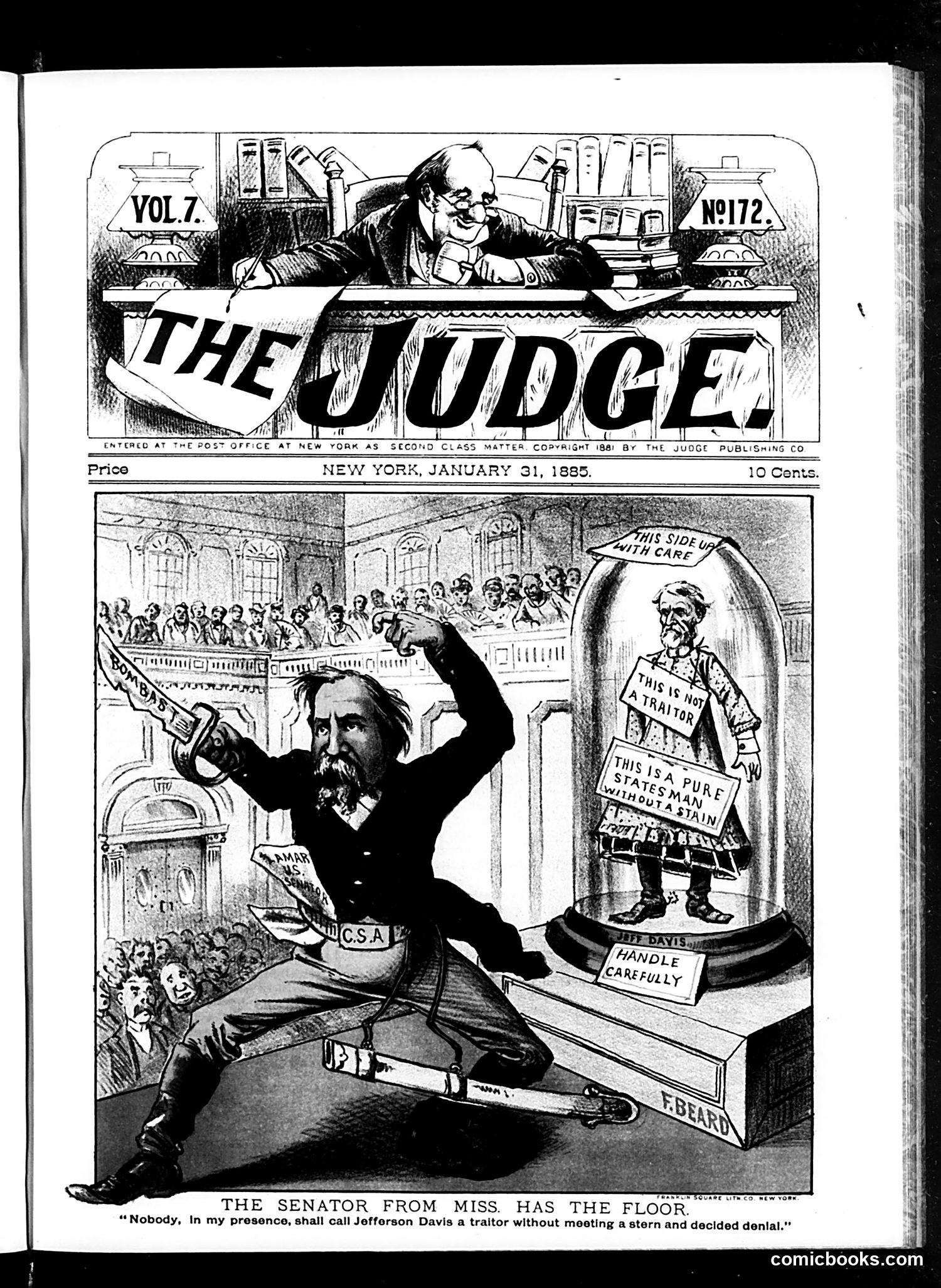
The main cartoon depicts a bearded man labeled "The Senator from Miss" (Mississippi) performing an acrobatic kick in a legislative chamber. He's juggling what appears to be a "C.S.A." (Confederate States of America) reference, while crowds watch from the gallery. On the right, a glass dome contains a figure labeled Jefferson Davis with text reading "This is not a traitor" and "This is a pure statesman without stain," suggesting ironic commentary on how Davis was being rehabilitated in public memory. The caption states: "Nobody, in my presence, shall call Jefferson Davis a traitor without meeting a stern and decided denial." This satirizes a senator's passionate defense of the Confederate president during Reconstruction-era politics, mocking the effort to restore Davis's reputation after the Civil War.
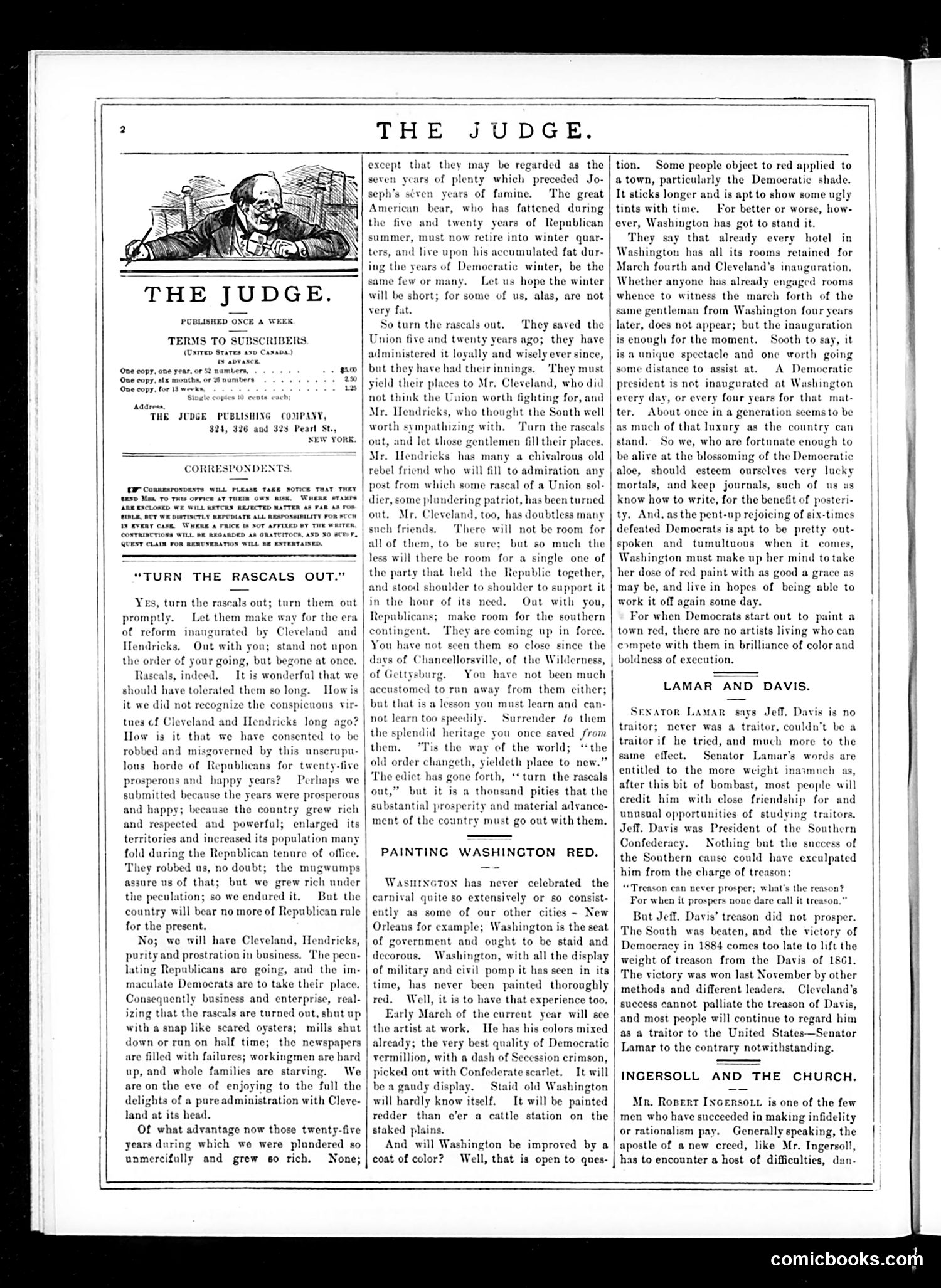
This editorial cartoon satirizes the 1884 election victory of Democrat Grover Cleveland and running mate Thomas Hendricks over the incumbent Republicans. The piece mocks the naive optimism of reformers (particularly "mugwumps"—Republicans who switched sides seeking purity in government). The satire's central irony: Cleveland campaigned on ending Republican "plundering," yet immediately upon his election, businesses shut down, mills closed, newspapers reported failures, and workers faced hardship. The author sarcastically suggests that while Republicans were corrupt, their 25 years in power at least brought prosperity—comparing it to "seven years of plenty" before famine. The piece particularly attacks Hendricks, who opposed the Union cause during the Civil War, questioning why Republicans who "saved the Union" should yield to Democrats. The "rascals out" refrain invokes the reformist cry, but the economic collapse following the election proves, the author argues, that corrupt competence served the country better than idealistic incompetence. This represents partisan criticism of early reform movements and Democratic governance.
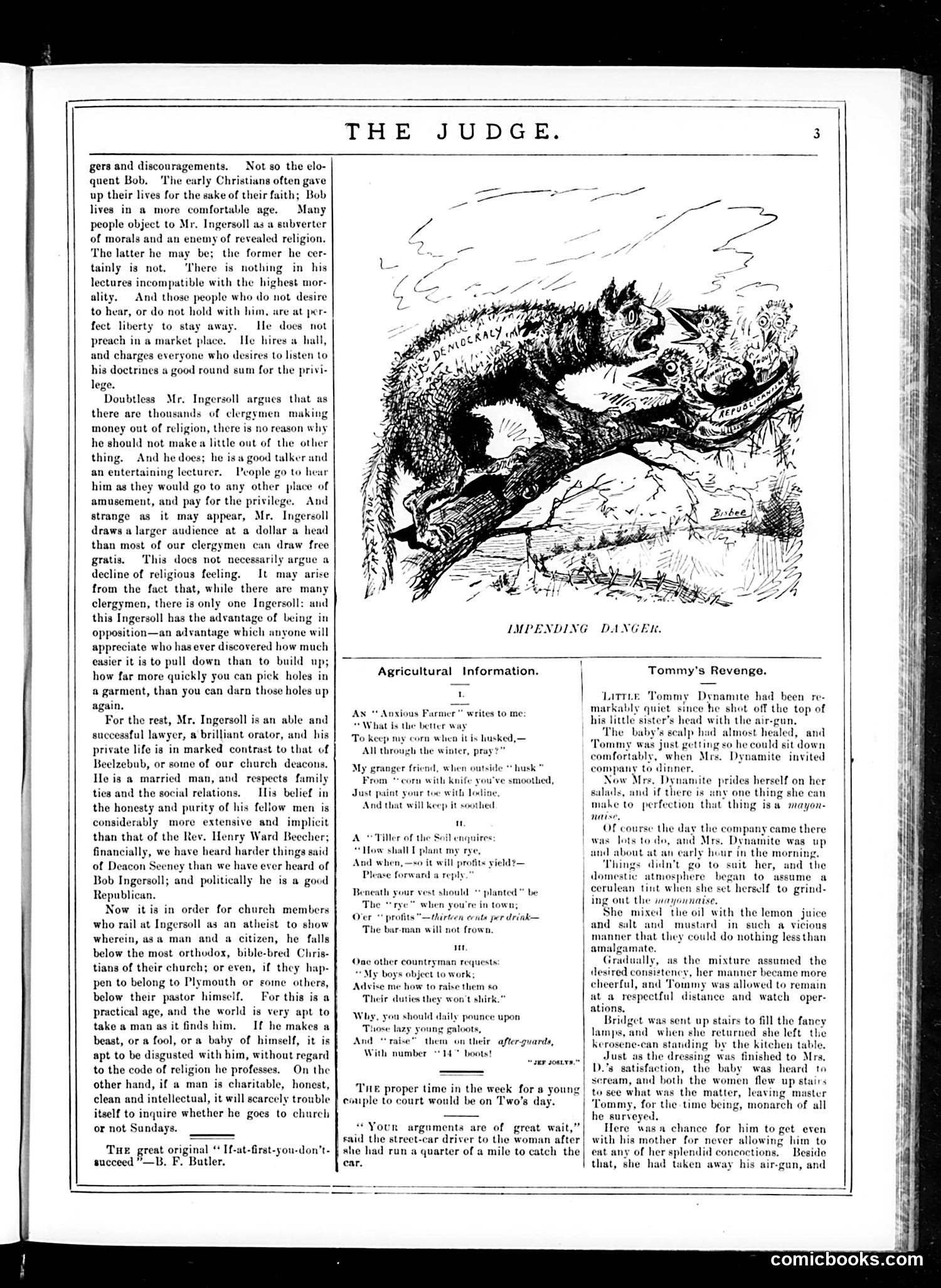
This Judge page contains commentary on **Robert G. Ingersoll**, a famous 19th-century agnostic lecturer and orator. The text defends him against religious critics who called him an atheist and "subverter of morals." The author argues Ingersoll is actually ethical, honest, and respectable—a successful lawyer and devoted family man—and questions why religious people attack him while tolerating corrupt clergy. The cartoon titled "IMPENDING DANGER" (artist signature: Zulac) appears to show a menacing creature or figure, likely satirizing fears about Ingersoll's influence on religion and morality. The page also includes lighter content: agricultural advice about corn storage and a brief humorous piece called "Tommy's Revenge" about a mischievous child. This reflects the period's heated debates over rationalism versus religious orthodoxy.
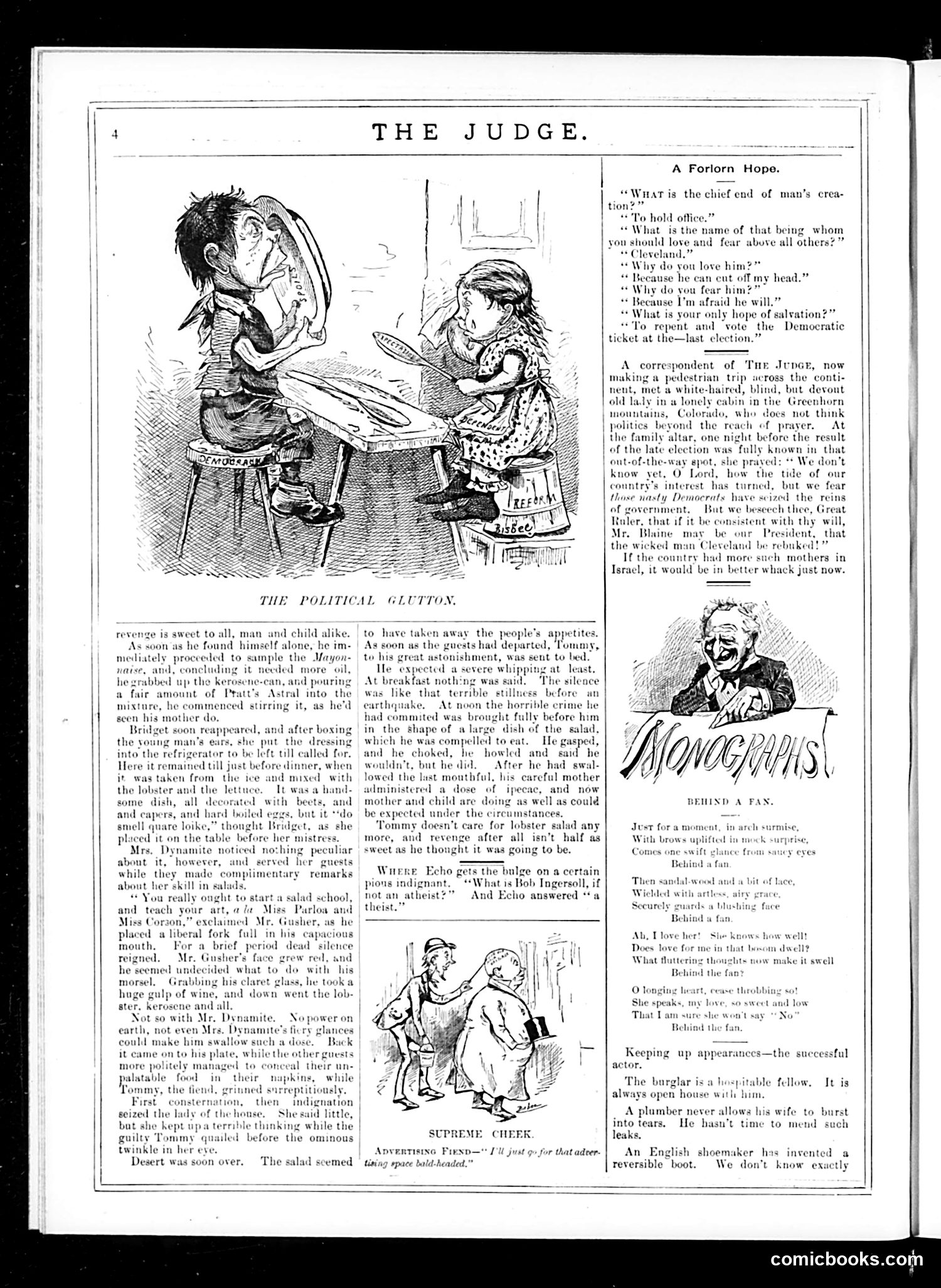
**"A Forlorn Hope"** mocks religious Democrats after an election loss (likely 1884, when Cleveland defeated Blaine). An elderly blind woman in Colorado prays for Blaine's victory, fearing "those nasty Democrats have seized the reins of government." The satire ridicules rural voters' mixing of piety with partisan politics—suggesting their religious devotion is actually just partisan desperation. **"The Political Glutton"** is a revenge tale: a boy tastes his mother's salad dressing, steals the recipe to replicate it, adulterates it with Pratt's Astral (a cleaning oil), and serves it to dinner guests. The satire appears to equate bad political behavior with poisoning—possibly criticizing politicians who corrupt public discourse or institutions. Both pieces use dark humor to critique American politics and social hypocrisy of the Gilded Age period.
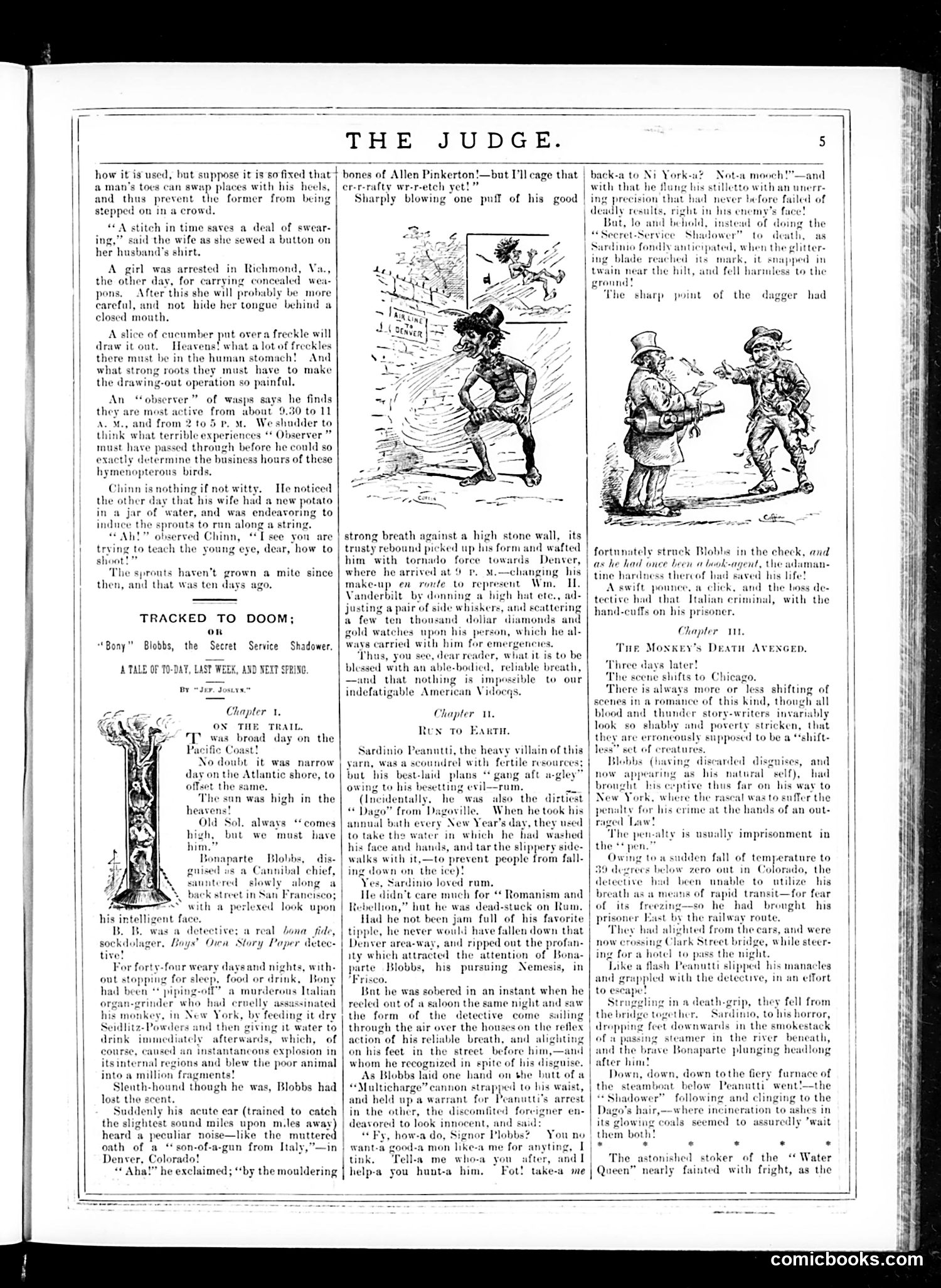
This page contains the opening installments of a serialized detective story titled "Tracked to Doom; or 'Bony' Blobbs, the Secret Service Shadower," appearing in *Judge* magazine. The narrative is a parody of sensational detective fiction popular in that era. "Bony" Blobbs is an absurdly superhuman secret agent who pursues the villainous Sardinio Peanutti. The humor derives from exaggerated descriptions: Blobbs travels 40+ days without stopping, uses his "strong breath" to propel himself across distances like a human cannonball, and disguises himself as William H. Vanderbilt (a famous wealthy industrialist). The Italian villain Peanutti is a crude ethnic stereotype—portrayed as a drunk and generally incompetent criminal whose main flaw is excessive drinking ("rum"). The cartoons accompanying the text show the characters in action. This is satirical entertainment mocking both pulp detective stories and immigrant stereotypes common to the period's popular fiction.
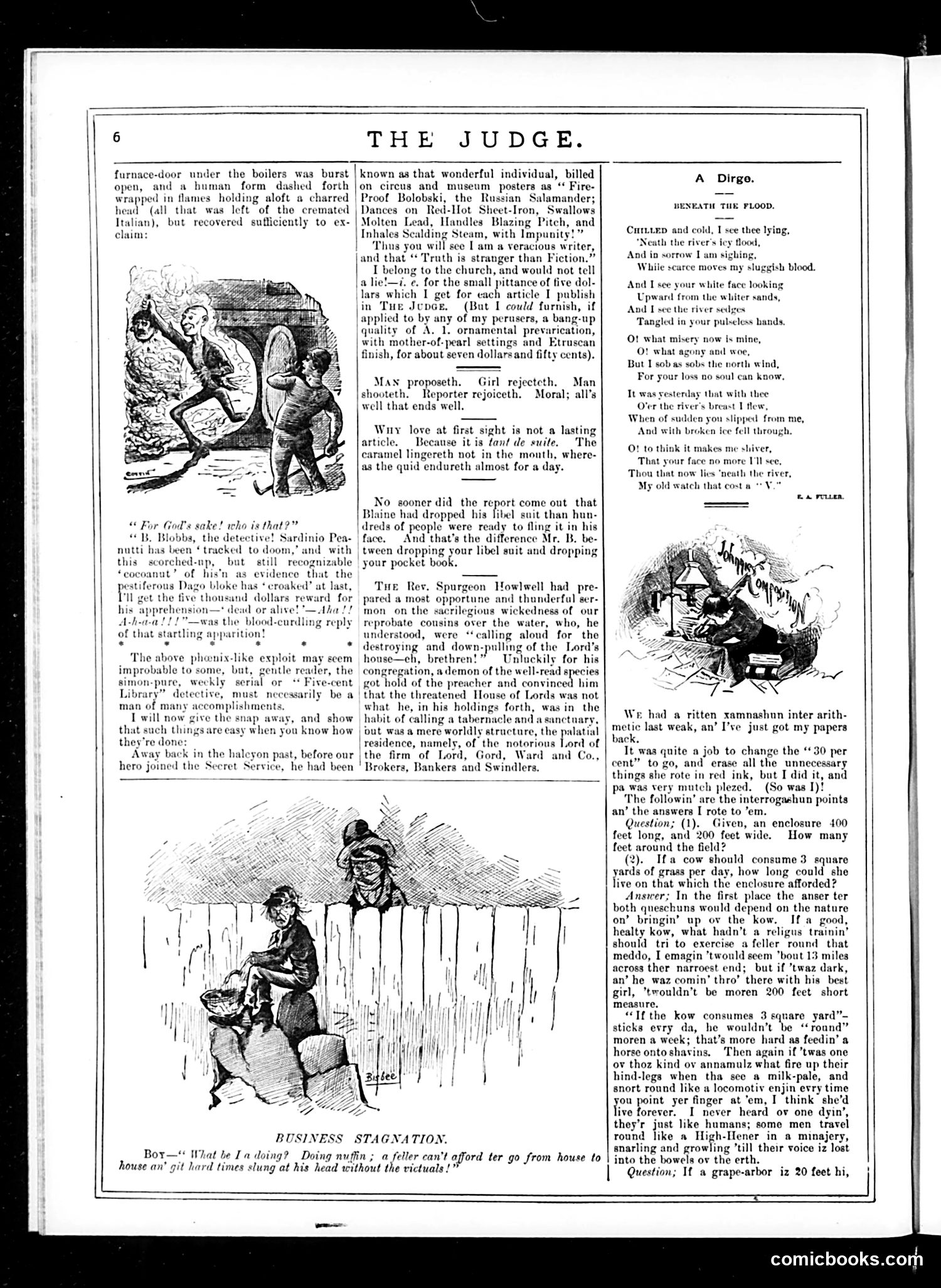
This page contains satirical commentary on late 19th-century American life. The main cartoon depicts "B. Blobba, the detective," a character who apparently survived a furnace explosion because he was formerly "Fire-Proof Bolobski, the Russian Salamander"—a circus performer. The satire mocks sensationalist detective fiction and implausibly heroic newspaper narratives. The text includes jabs at contemporary figures: references to **James G. Blaine** (likely the 1884 presidential candidate) dropping a libel suit, and **Rev. Charles Spurgeon Howlwell** preparing anti-British sermons attacking the "House of Lords" while confusing it with a financial firm ("Lord, Gord, Ward and Co."). Other sections lampoon romance ("Man proposeth. Girl rejecteth. Man shooteth"), economic hardship ("Business Stagnation"), and include a sentimental poem about drowning. The overall tone is irreverent, mixing cynicism about journalism, politics, and social pretense—typical Judge magazine satire for its era.
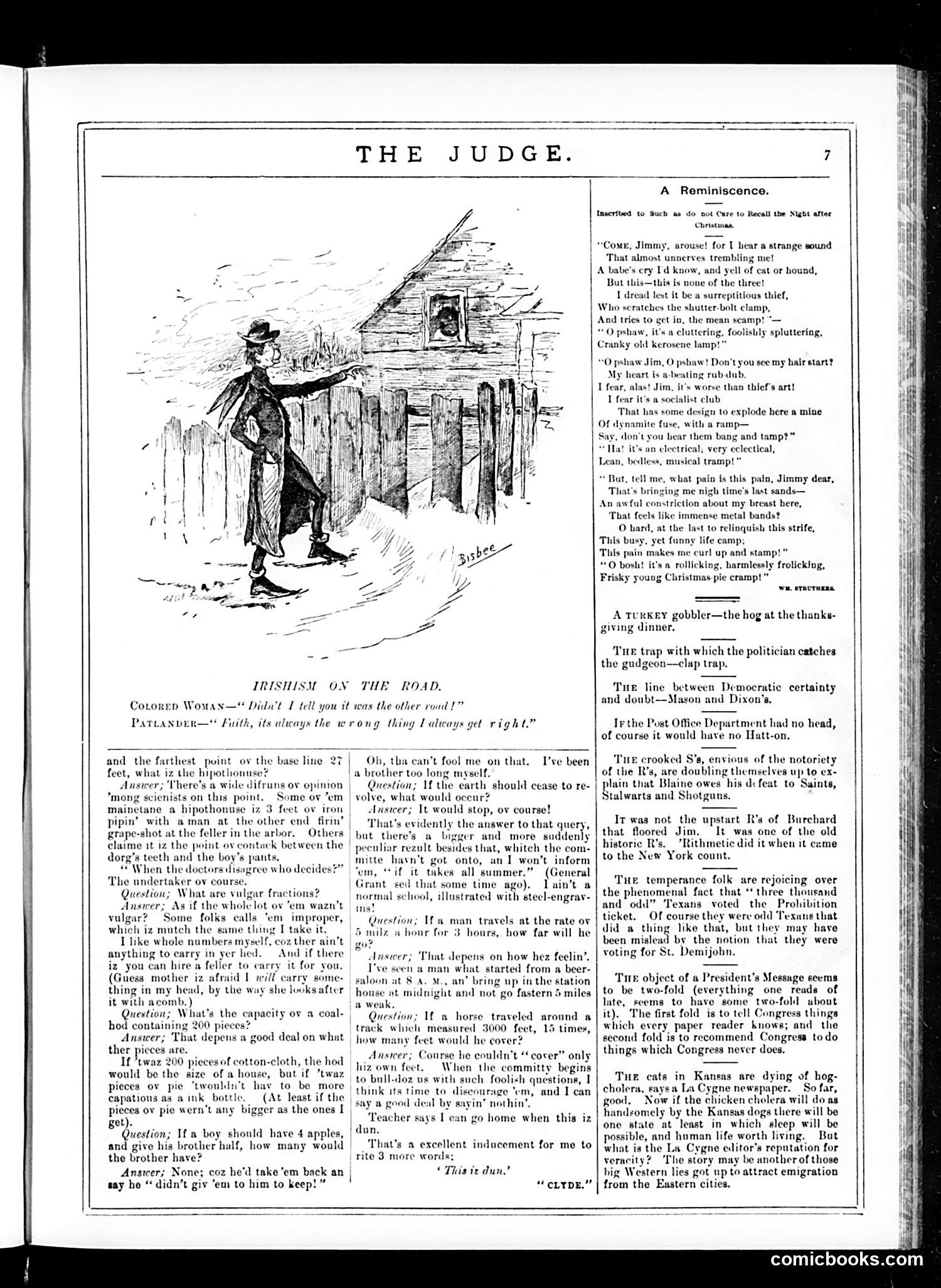
## Main Content: "Irishism on the Road" This cartoon satirizes Irish immigrants through a dialogue between a "Colored Woman" and an Irish "Patlander" (derogatory term for Irish). The humor relies on ethnic stereotyping: the Irish character mangles English grammar and logic while answering absurd math questions, exemplifying period stereotypes depicting Irish immigrants as unintelligent and prone to malapropism. The exchange mocks both groups through comparative ridicule. ## Secondary Content: "A Reminiscence" A humorous poem about a man awakened at night by mysterious noises—a baby's cry, a cat, or a scratching shutter—which he anxiously attributes to thieves or explosives. The joke escalates his paranoid misidentifications before revealing the cause as simply an old kerosene lamp rattling. ## Historical Context These pieces reflect late 19th-century *Judge* magazine's reliance on ethnic humor and working-class caricature as primary comedic material, targeting Irish immigrants specifically during a period of significant anti-Irish prejudice in America.
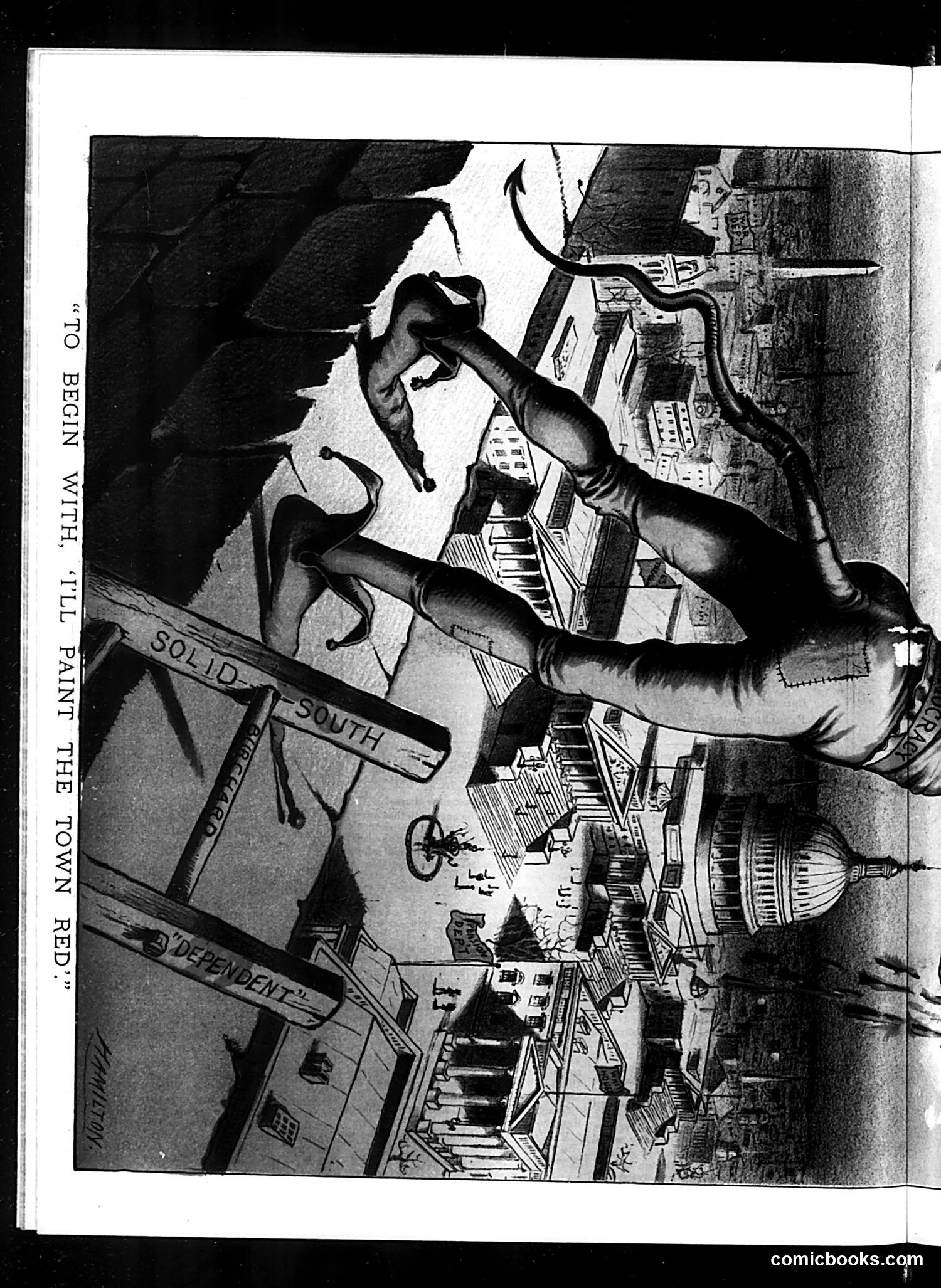
This page is difficult to interpret with confidence. The OCR text is largely corrupted and unreadable, consisting mainly of garbled characters rather than coherent English. The image itself, when rotated for proper viewing, appears to show a figure examining or working on architectural or urban plans/maps. The text visible on elements in the cartoon includes "SOLID-SOUTH," "TOWN RED," and "DEPENDENT"—phrases suggesting political commentary, possibly about Southern politics or regional divisions. However, without legible caption text or a clear date visible on this page, I cannot reliably identify the specific political figures, events, or satirical points this Judge cartoon is addressing. The corruption of the OCR data prevents accurate historical contextualization for a modern reader.
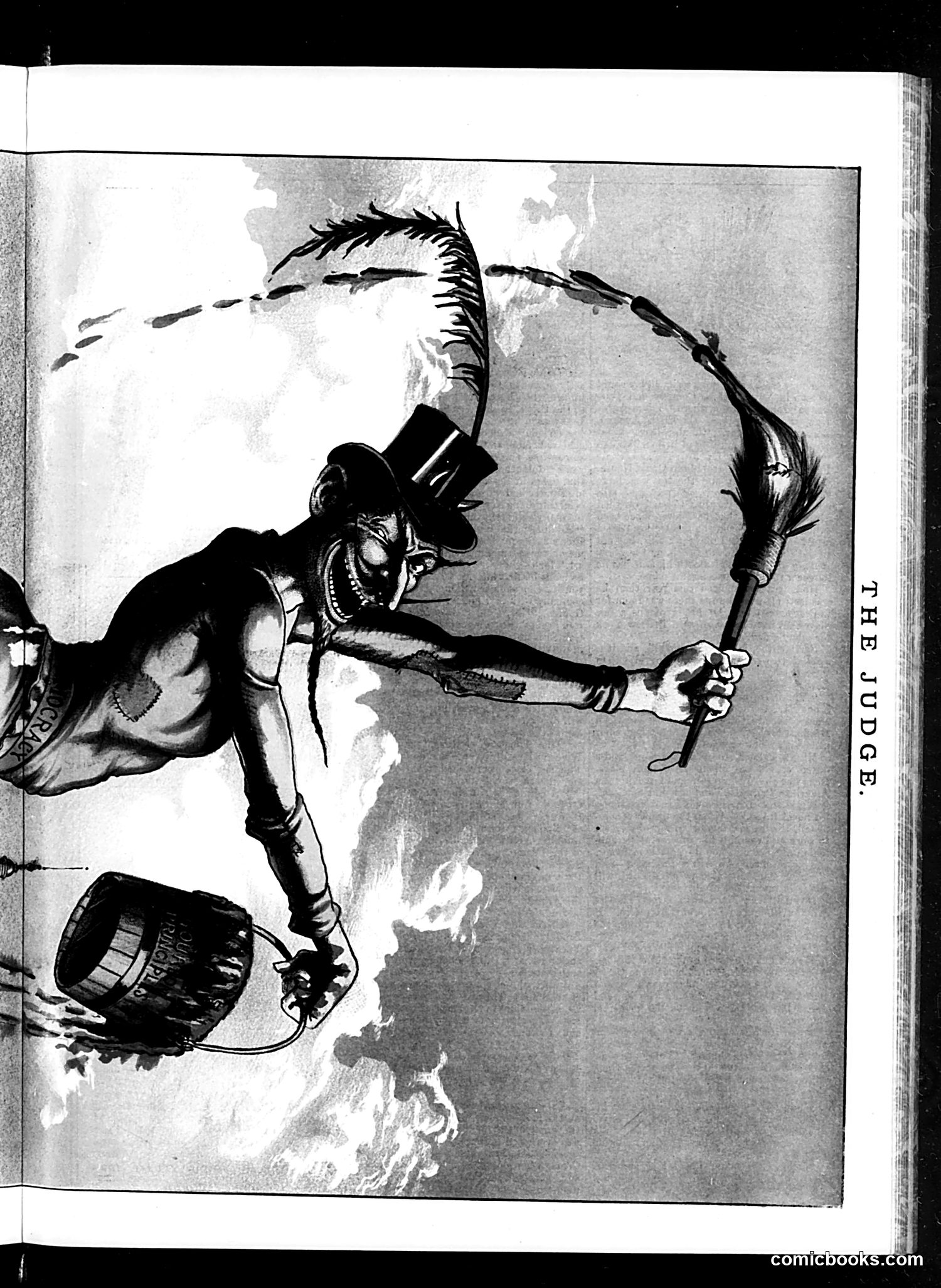
This political cartoon depicts a figure in formal attire (top hat and tails) wielding a large whip or rod, striking at a serpent or dragon-like creature. The figure appears to be a personification of justice or authority. The image uses classic allegorical symbolism: the well-dressed authority figure represents the law or judicial power, while the serpentine creature likely represents corruption, crime, or a specific social evil that was the target of contemporary reform efforts. Without the specific date or additional text, I cannot identify the exact historical event or figure being referenced. However, the cartoon follows Judge magazine's typical satirical approach of depicting moral authority aggressively confronting societal problems, using dramatic imagery to make its political point clear to readers.
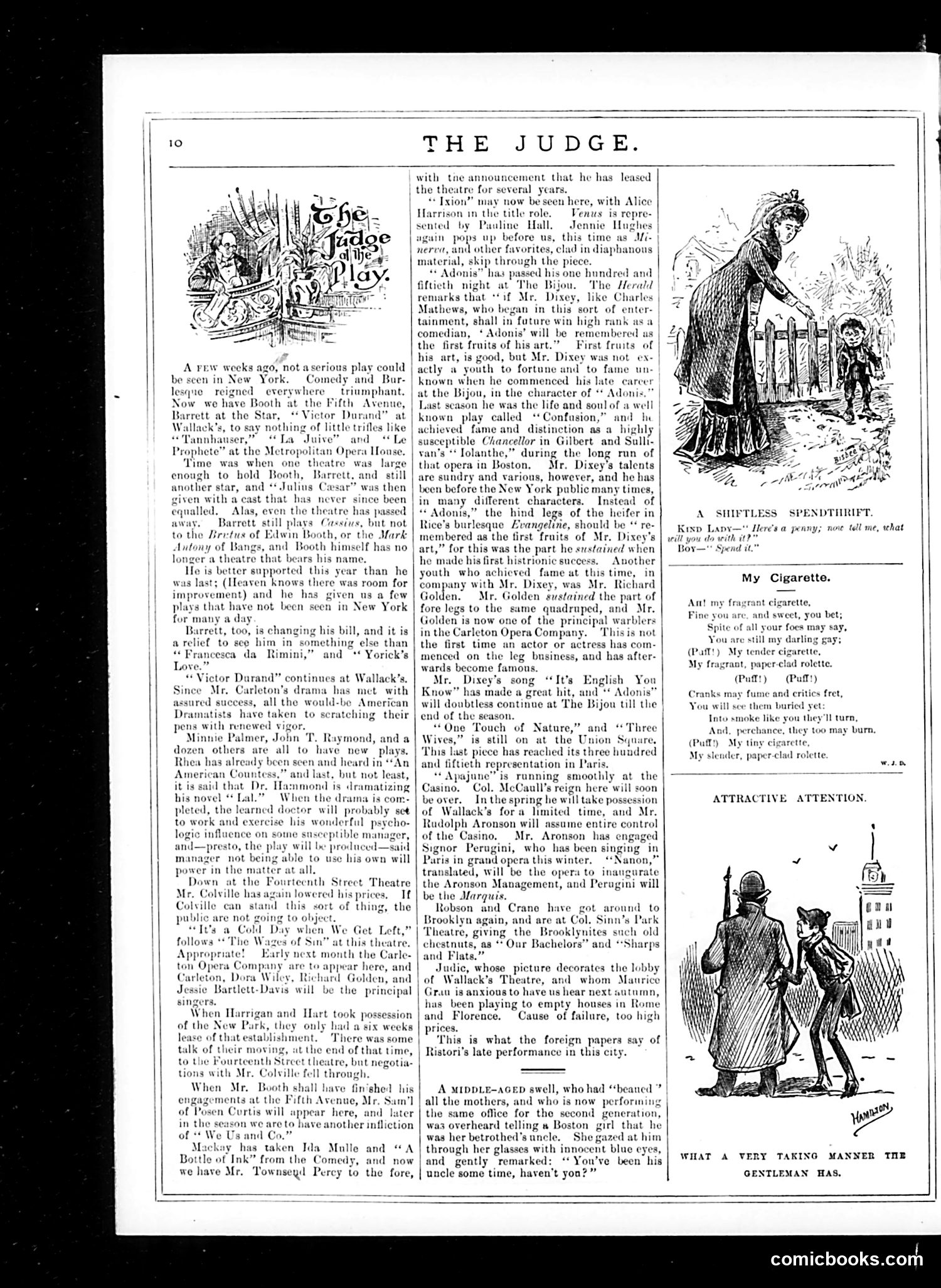
This page discusses New York theater seasons, focusing on recent productions and performers. The text reviews plays like "Adonis" (starring Henry Dixey, now at 150+ performances at The Bijou) and "Ixion" with Alice Harrison, alongside comments on various theatrical stars including Barrett, Booth, and others. The cartoons illustrate theatrical themes: one titled "A SHIFTLESS SPENDTHRIFT" depicts a figure in period costume discarding money; another titled "WHAT A VERY TAXING MANNER THE GENTLEMAN HAS" (signed Mansfield) shows a man in military dress. A poem titled "My Cigarette" appears between them. The satire targets theatrical excess and financial wastefulness—typical Judge magazine social commentary. The specific performers and theaters named suggest this addresses 1880s New York theater world trends, though the exact satirical targets of individual cartoons remain unclear without additional context about contemporary theatrical debates or personalities referenced.
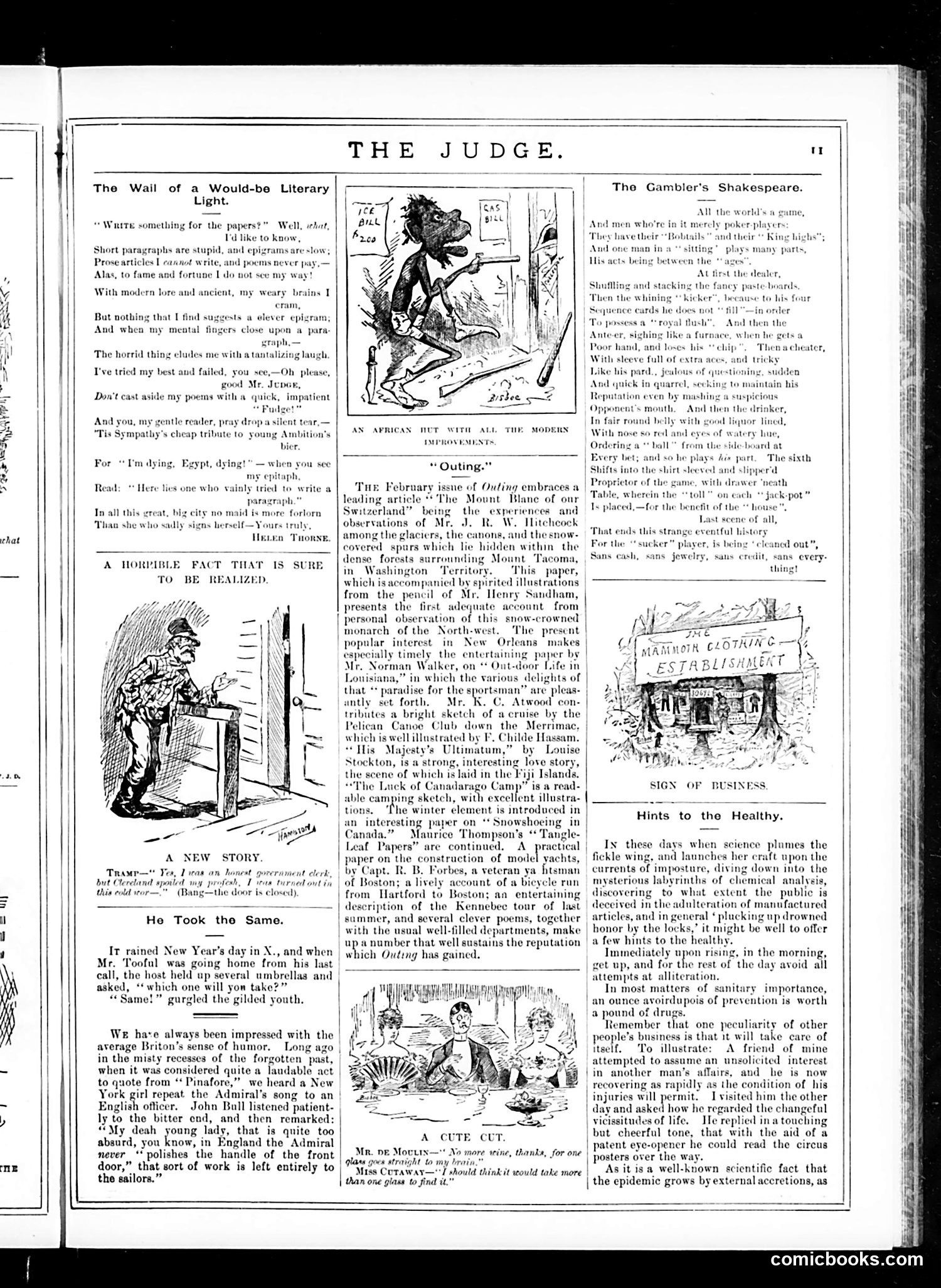
This satirical magazine page contains several disconnected pieces mocking contemporary American life and culture: **"The Wail of a Would-be Literary Light"** ridicules an aspiring writer lamenting failure to publish—mocking pretentious amateur authors who lack talent but seek sympathy. **"An African Nut with All Modern Improvements"** appears to be a racist caricature cartoon, though the specific reference is unclear from the visible text. **"He Took the Same"** jokes about British humor—a man asks which umbrella to take after a New Year's visit; when told to pick one, he says "Same!" (meaning he'll take them all). The commentary suggests this reflects British comedic sensibilities. **"Outing" magazine review** is straightforward literary coverage, not satire. **"A Cute Cut"** shows a brief dialogue where someone claims wine goes "straight to my brain," and another responds it should "take more"—implying the person lacks brains. The page exemplifies *Judge*'s mix of social satire, literary criticism, and crude humor typical of 1890s American magazines.
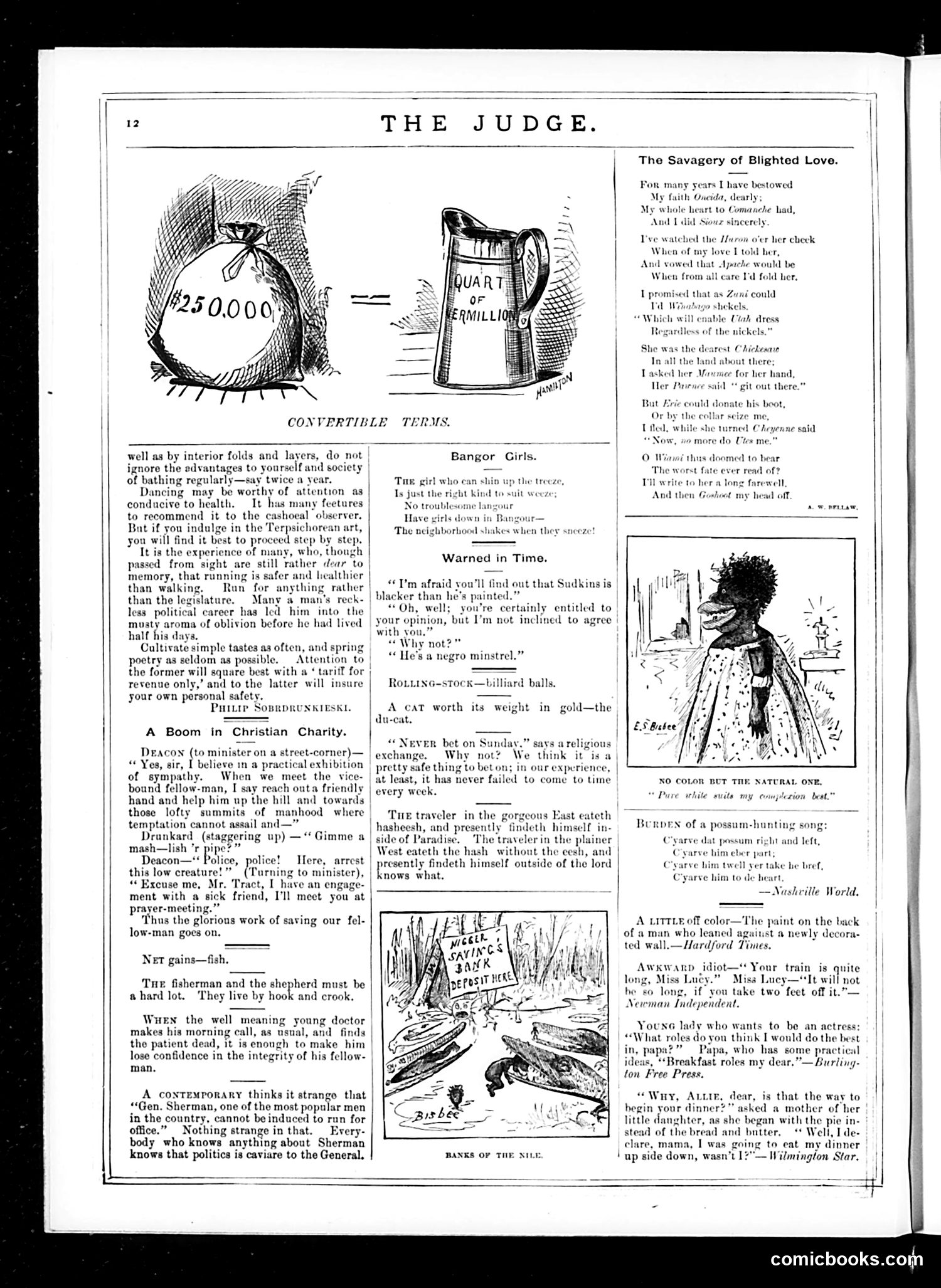
This page contains several satirical pieces targeting social and political issues of the era: **"Convertible Terms"** (top): A visual pun comparing a money bag labeled "$250,000" to a "quart of vermillion," suggesting wealth and artistic value are interchangeable—satirizing the wealthy's taste in art. **"Bangor Girls"** and other brief items mock social conventions: bathing habits, dancing, and religious hypocrisy (the "Christian Charity" piece depicts a well-meaning deacon helping drunks only to flee when confronted by an actual needy man). **"Banks of the Nile"** illustration appears to satirize colonial or travel narratives. **"The Savagery of Blighted Love"** parodies sentimental romantic poetry with exaggerated dialect and melodrama. The overall tone reflects Judge's characteristic blend of social commentary, moral critique, and wordplay humor—targeting Victorian pretense, class inconsistency, and sentimental excess typical of 19th-century American satire.
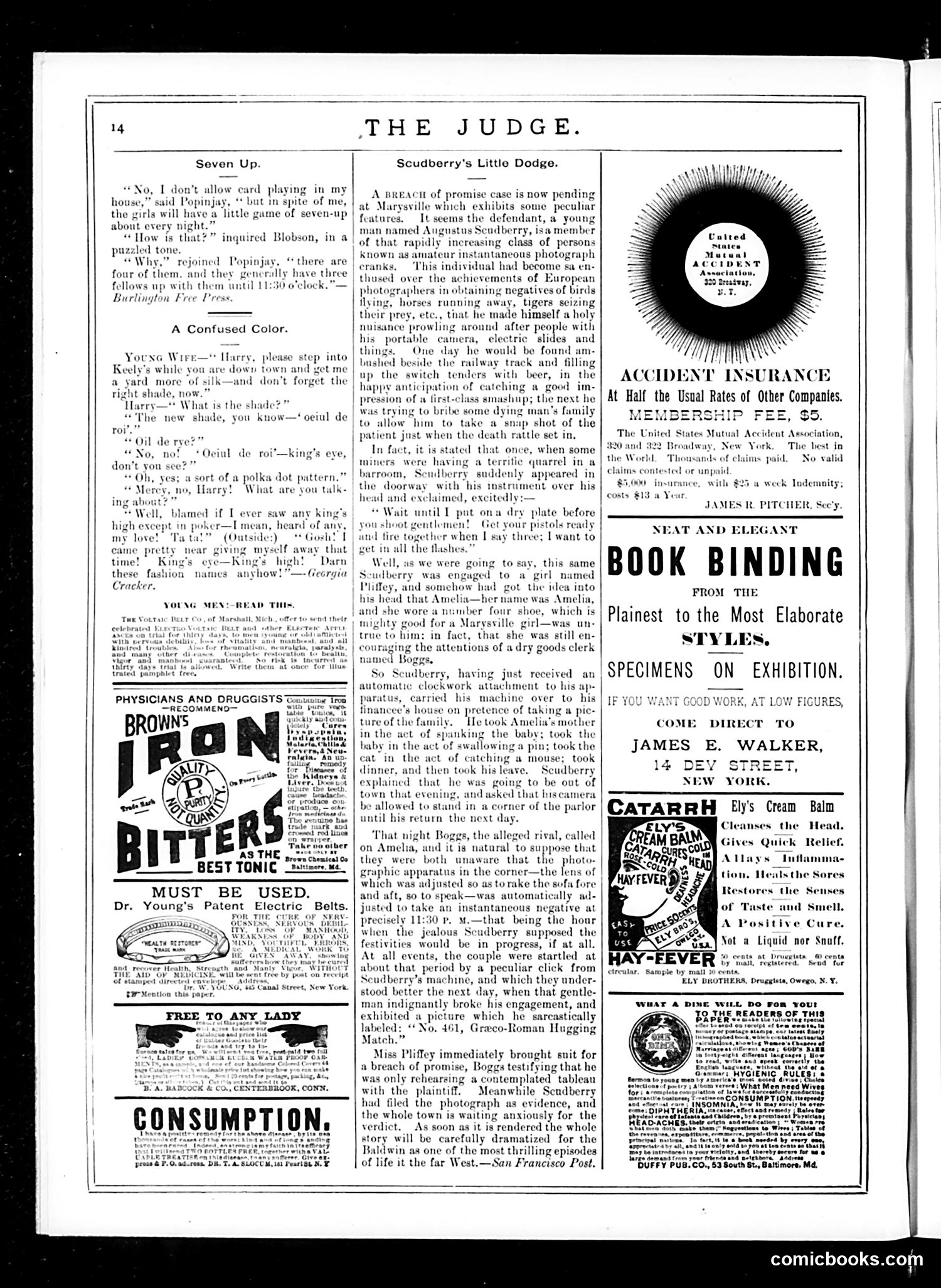
This page contains a satirical story about Augustus Scudberry, an obsessive amateur photographer. The humor mocks the era's photography enthusiasts—men so consumed with capturing dramatic images that they behave recklessly and absurdly. Scudberry's scheme involves visiting his fiancée Amelia's home, secretly positioning his camera in the parlor, then departing so her rival suitor Boggs will visit. When Boggs arrives unaware of the hidden apparatus, the setup promises to photograph a "compromising" moment—capturing evidence for a breach-of-promise lawsuit. The satire targets both photography hobbyists (portrayed as obsessive cranks willing to endanger lives for good shots) and the era's legal culture around breach-of-promise suits. The story's title "Dodge" refers to Scudberry's underhanded scheme. The page also includes unrelated comic vignettes and advertisements typical of Judge's format.
This is primarily an **advertising and promotional page** rather than a satirical cartoon page. It showcases *The Judge* magazine itself—an illustrated weekly satirical publication—alongside period advertisements for pianos, magic lanterns, lithography services, and medical treatments (notably a cure for piles). The page includes scattered one-liners and brief humorous items typical of 19th-century comic magazines: jokes about forged signatures, eloping couples, Chinese doctors, wealthy men hiring foreign coachmen, and other domestic absurdities. These represent the "clever, witty, sarcastic" humor *The Judge* promised readers. The central content promotes *The Judge's* value to advertisers, emphasizing it reaches educated, affluent audiences preserved and shared across time. At five dollars yearly, it positioned itself as quality journalism for the purchasing classes—exactly the demographic advertisers sought. This is essentially a **meta-advertisement**: a magazine page advertising itself to both readers and potential advertisers.
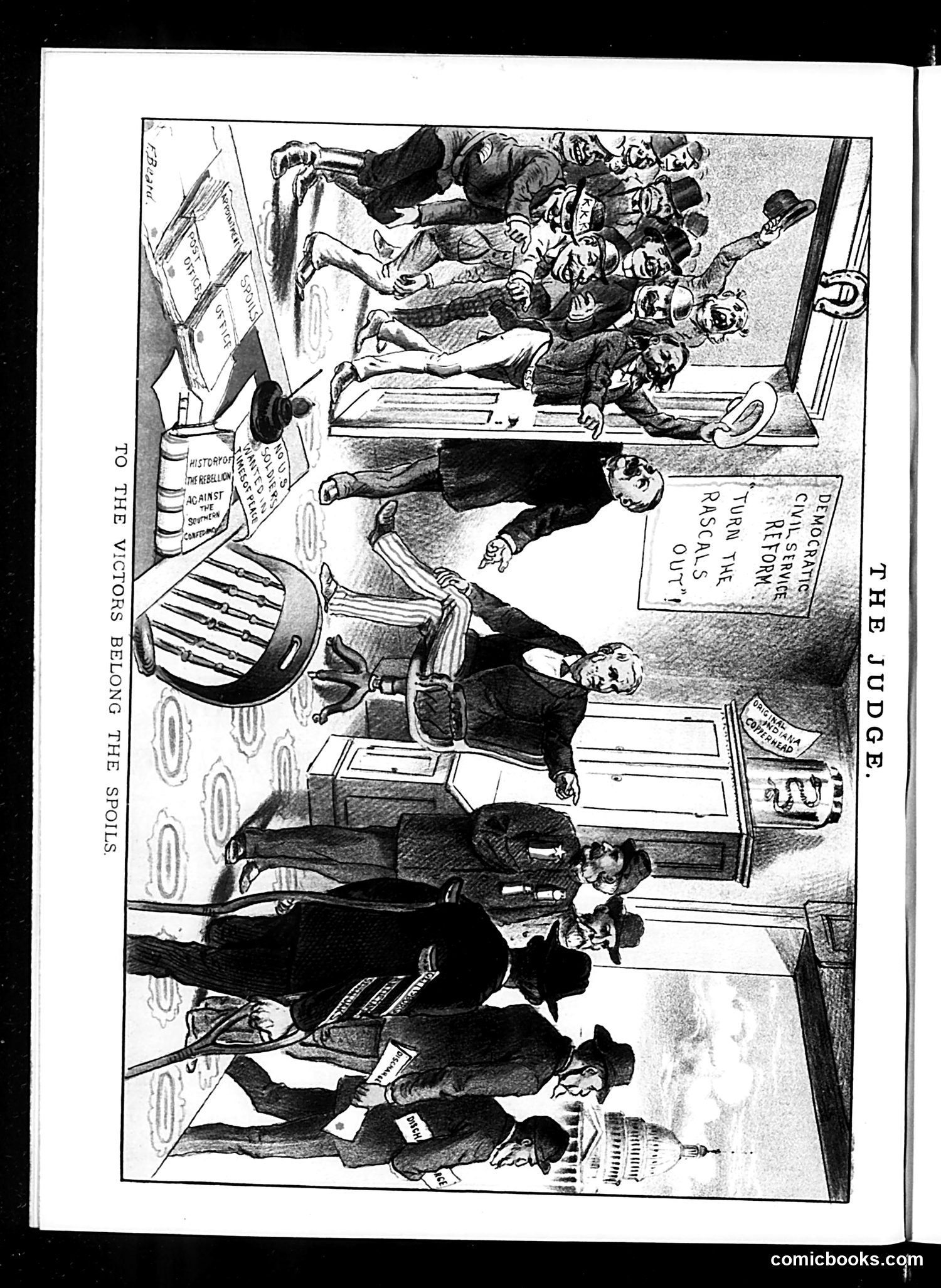
This page is rotated 90 degrees and appears to be titled "THE JUDGE" with text references to "VICTORS BELONG THE SPOILS" and what appears to be courtroom or legal proceedings imagery. The cartoon depicts what appears to be a judicial or political satire scene. The OCR text is largely unreadable due to rotation and image quality, making it difficult to identify specific figures or political references with confidence. Without clearer text, I cannot reliably identify the particular politicians, events, or satirical targets being depicted. The composition suggests commentary on legal proceedings, political patronage ("spoils"), or judicial corruption—common Judge magazine themes—but I cannot specify which historical incident or figures this references without risking inaccuracy. A clearer or properly-oriented image would be needed for proper identification.