
A complete issue · 16 pages · 1884
Judge — December 20, 1884
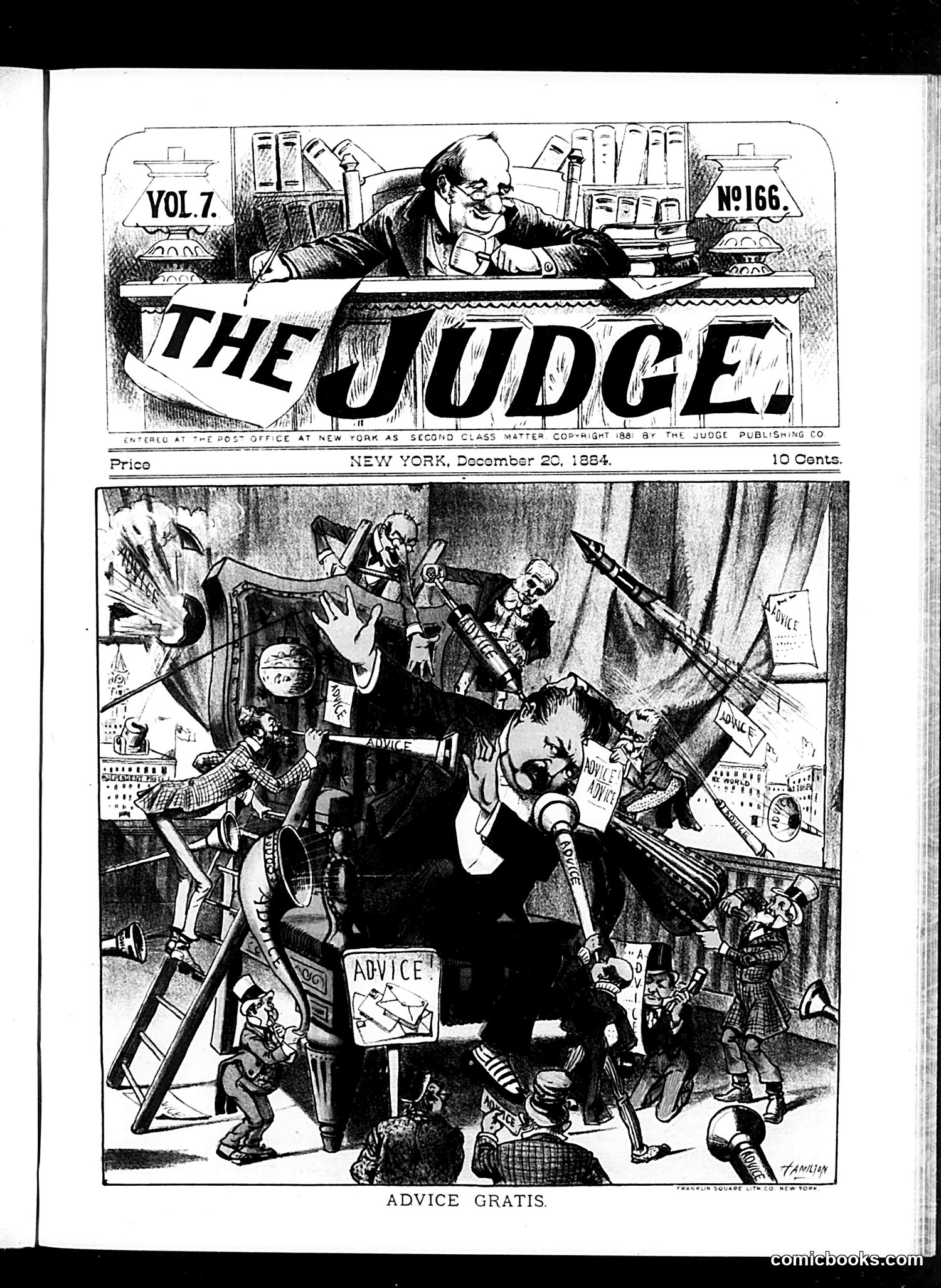
**Publication Details:** This is issue No. 166, Vol. 7 of *The Judge*, a satirical weekly magazine priced at 10 cents, published in New York. **Main Cartoon: "Advice Gratis" (Free Advice)** The cartoon depicts a central figure being bombarded with unsolicited advice from various smaller figures wielding megaphones, trumpets, and signs labeled "ADVICE." The scene is chaotic and cacophonous, suggesting multiple voices competing to offer counsel simultaneously. **Likely Meaning:** This appears to satirize the proliferation of advice-givers and commentators in American public life—possibly referencing political advisors, newspaper editors, or self-appointed social critics during the 1884 election period. The cartoon mocks the absurdity of receiving conflicting guidance from numerous sources, a critique that remains relevant today regarding media noise and opinion overload.
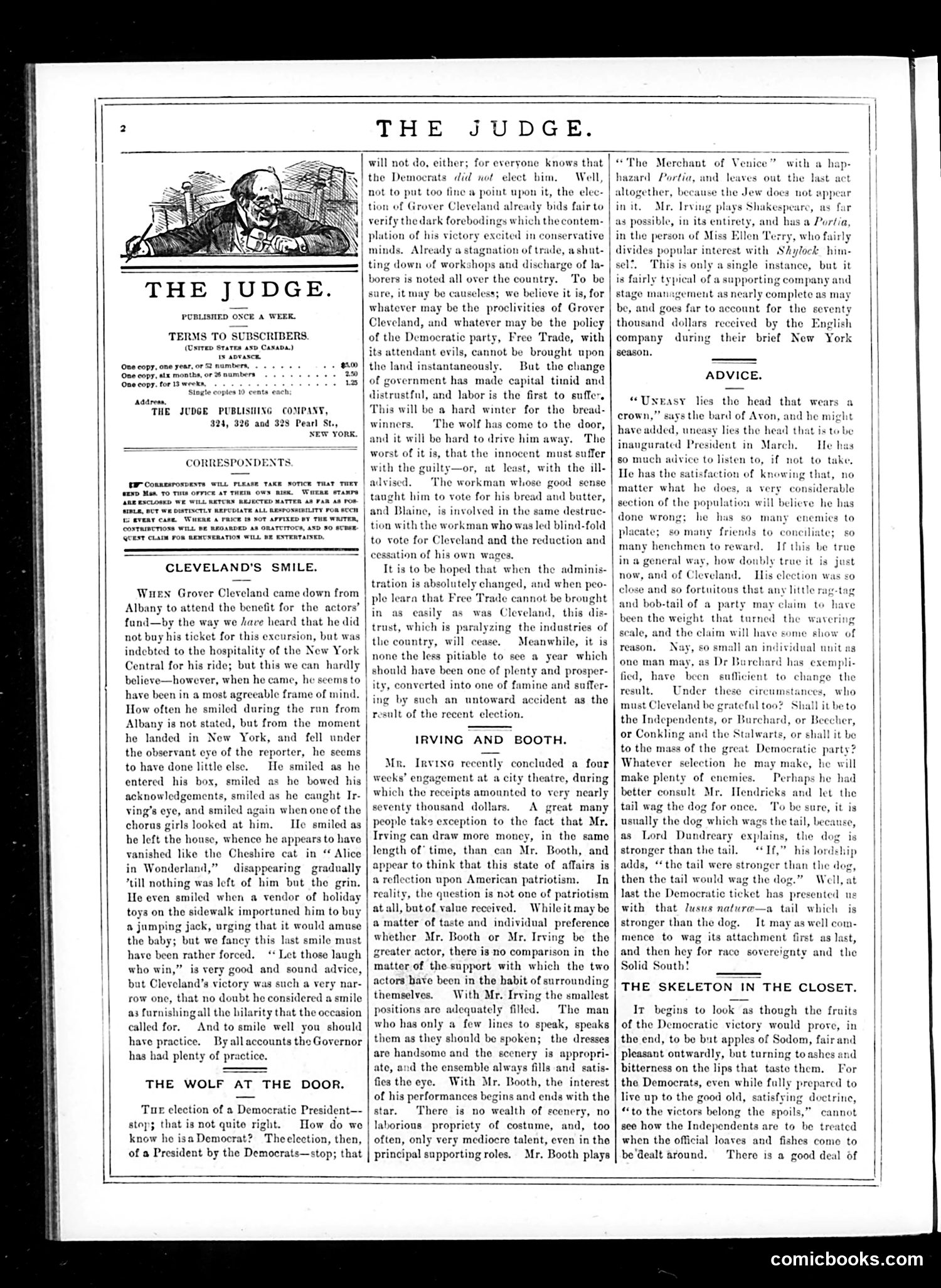
This satirical page attacks Grover Cleveland's Democratic election victory and its economic consequences. **Main Figures:** - **Grover Cleveland**: The newly elected Democratic President, caricatured as perpetually smiling despite economic disaster - **Henry Irving and Edwin Booth**: Actors mentioned in "Irving and Booth" section, contrasted favorably with Cleveland **Political Context:** The cartoons mock Cleveland's election by Democrats, arguing it triggered economic panic. The "Wolf at the Door" section claims his victory caused capital flight, factory shutdowns, and worker layoffs—presenting this as self-inflicted economic damage. **The Satire:** Cleveland's constant smiling (shown in the cartoon) is mocked as inappropriate given the suffering his election supposedly caused. The magazine argues even workers who voted for Cleveland deserve sympathy since innocent laborers suffer alongside those "led blind-fold" to support him. **Bias:** This is clearly *Republican* satire, blaming Democratic victory for economic hardship rather than acknowledging other causes like the broader business cycle or tariff policies.
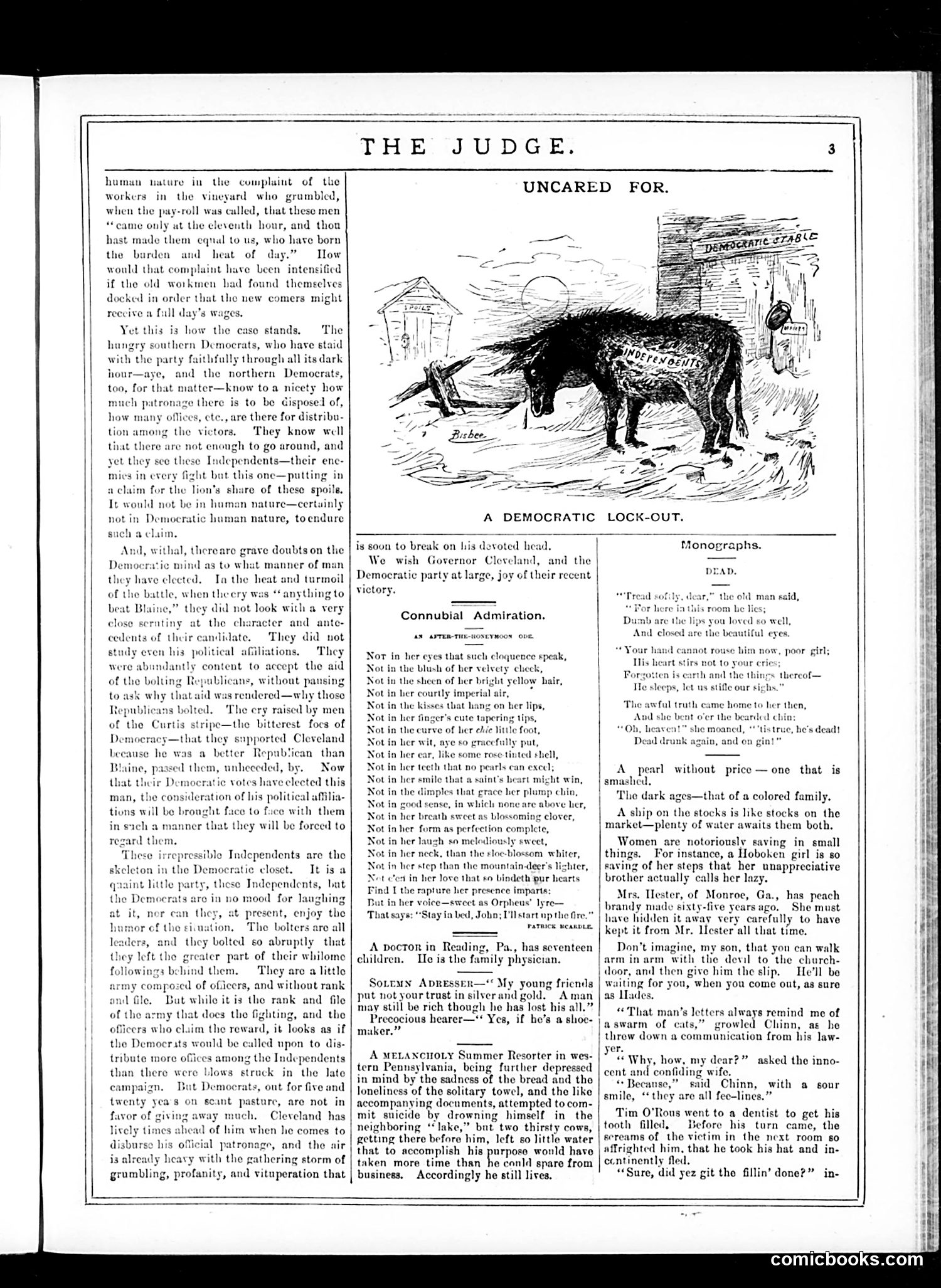
This **1884 Judge magazine page** satirizes Democratic Party patronage conflicts following Grover Cleveland's election victory. ## The Main Cartoon: "A Democratic Lock-Out" The sketch shows a starving mule labeled "Biker" (likely representing the Democratic Party or its workers) chained to a post, unable to reach hay. The title suggests Democrats are being excluded from promised spoils of office. ## The Political Context The article critiques infighting between two Democratic factions competing for government jobs: - **"Hungry southern Democrats"** who loyally supported the party through hard times - **Northern "Independents"** (bolters from the Republican Party) who only recently switched allegiances but demand significant patronage The complaint echoes the Biblical "vineyard workers" parable—longtime loyalists resent latecomers receiving equal or better rewards. ## The Satire's Point Judge mocks Democratic hypocrisy: they celebrated winning but can't fairly distribute office-holding positions without angering core supporters. Cleveland faces an impossible situation managing competing claims. The cartoon's starving mule visually reinforces this theme of deprivation amid political chaos.
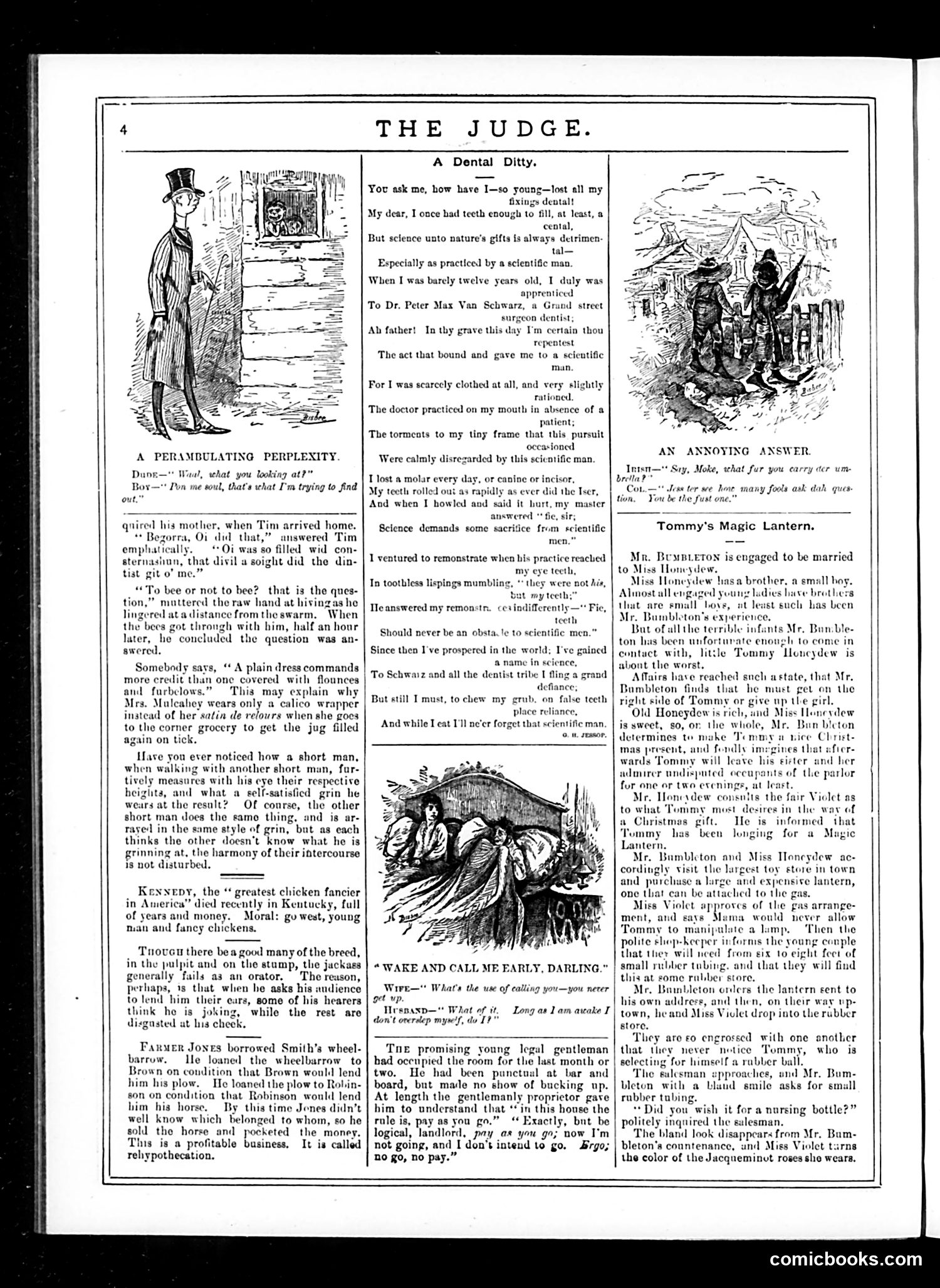
This page from *Judge* magazine contains several unrelated humorous pieces typical of 19th-century satirical publications: **"A Dental Ditty"** is a comic poem mocking a dentist named Dr. Peter Max Van Schwarz who practiced on young apprentices' teeth without anesthesia as "scientific" training. The satire targets both the dentist's cruel methods and the era's pseudo-scientific justifications for harsh practices. **Other brief jokes** include Irish dialect humor ("Begorra"), observations about human nature (short men comparing heights), and a moralizing anecdote about borrowing and theft ("Farmer Jones"). **"Tommy's Magic Lantern"** is a serialized story excerpt about a young boy's Christmas gift creating domestic complications. The cartoons show Victorian-era social types: a perplexed gentleman, and a domestic scene. The overall tone reflects *Judge*'s formula—combining working-class Irish stereotypes, sarcasm about "scientific progress," and gentle moral lessons. Nothing here references specific current events; it's generic social satire meant for broad appeal to American readers of that era.
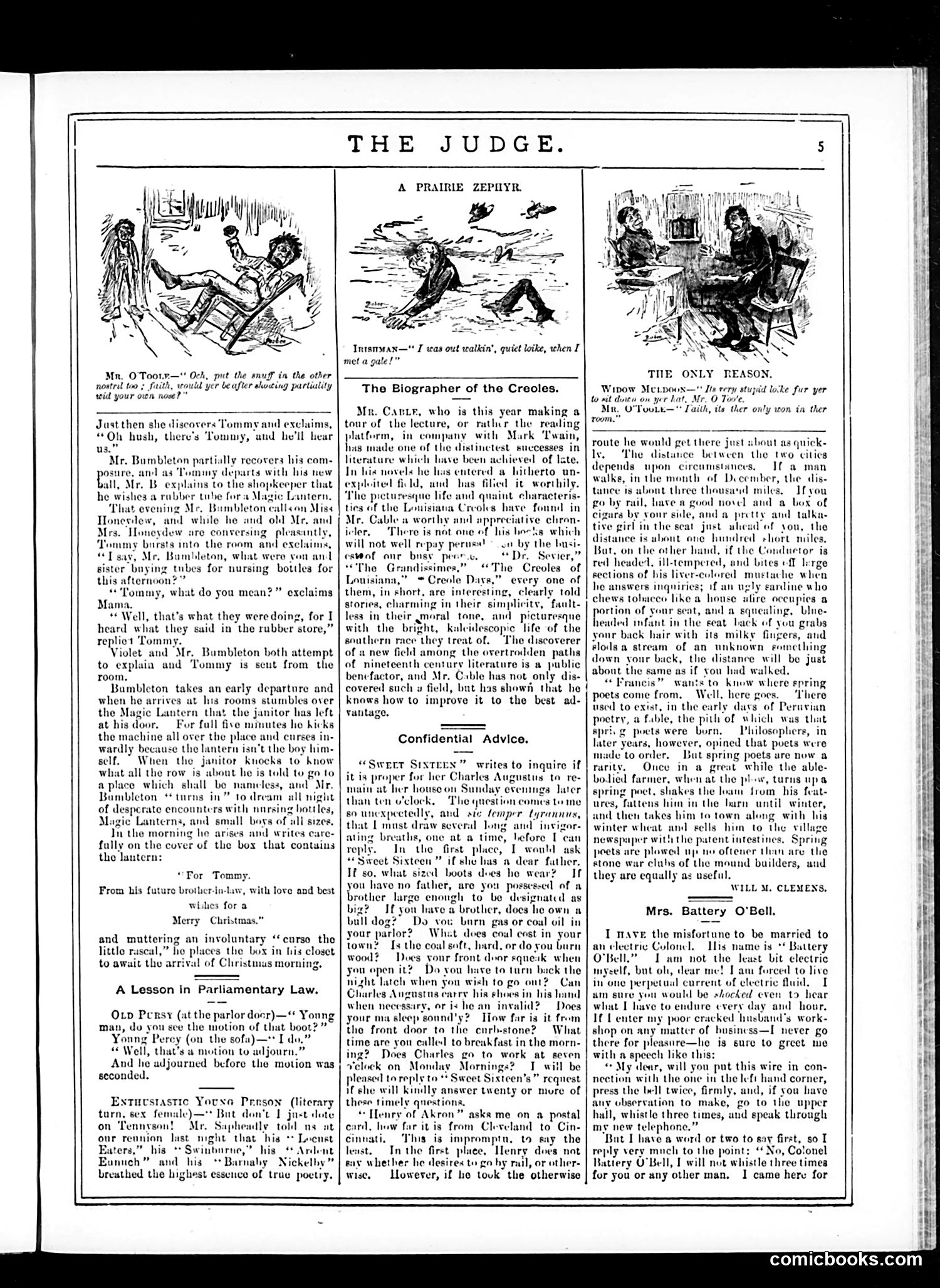
This page contains several comic sketches satirizing middle-class social anxieties. The main narrative follows Mr. Bumbleton, who embarrassedly purchases nursing bottles but is misinterpreted by an eavesdropping child named Tommy as doing something illicit. The comedy derives from the resulting social mortification—Bumbleton's frantic attempts to explain, his nightmares, and his grudging Christmas gift to Tommy. A secondary sketch mocks parliamentary protocol when an older man interprets a young man's boot motion literally rather than as a metaphor. The page also discusses George Washington Cable's literary success exploring Creole society through novels like *The Grandissimes*, treating this as a serious cultural achievement. Finally, an advice column humorously addresses Victorian courtship propriety, questioning when suitors should leave Sunday evening visits. The overall tone reflects 1880s-90s middle-class preoccupations with propriety, social embarrassment, and respectability.
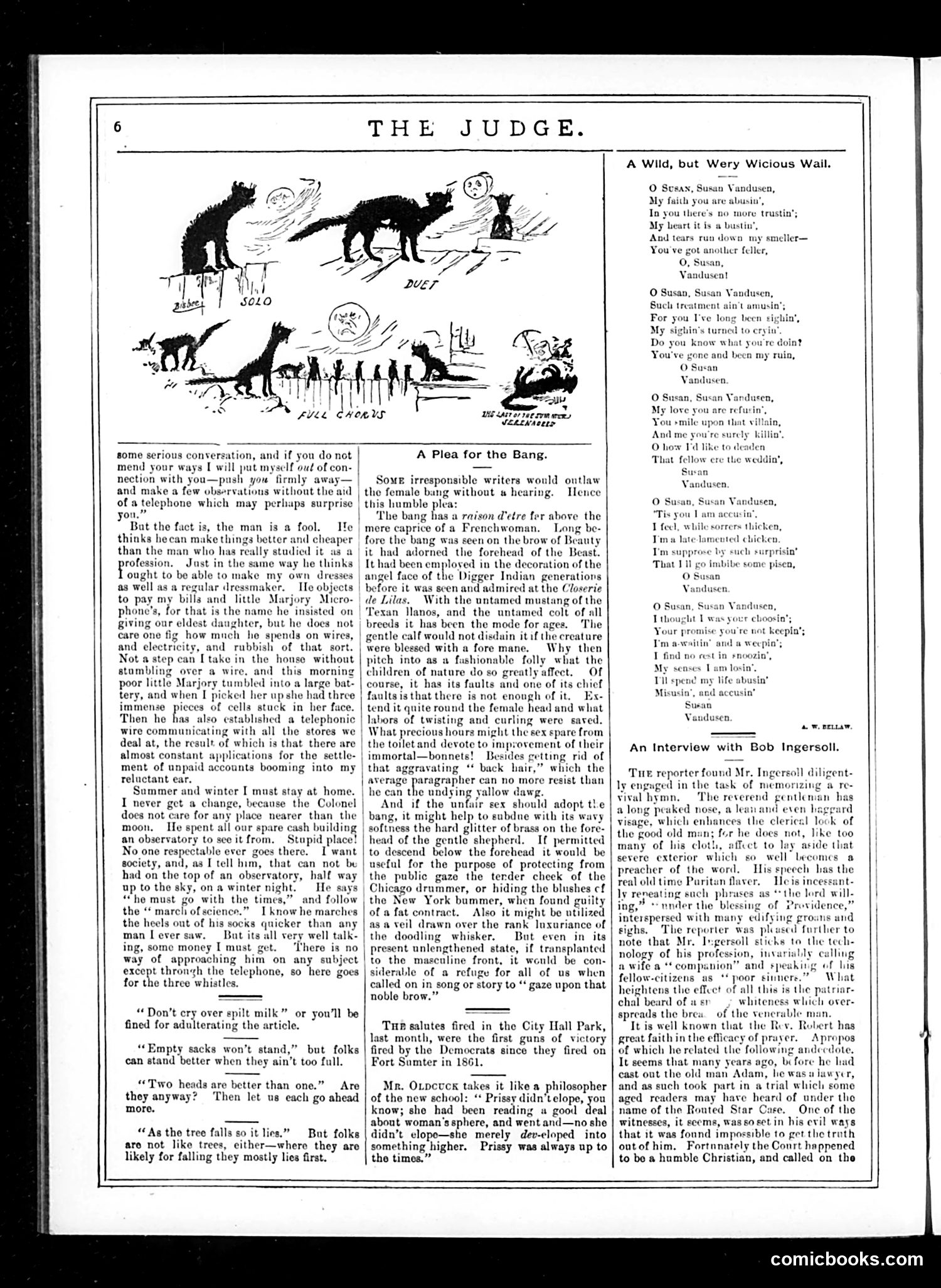
This page from the satirical magazine *Judge* contains three distinct pieces satirizing American society and gender roles: **"A Wild, but Wery Wicious Wail"** (poem, right): A woman's lament about her obsessive husband who constantly tinkers with technology—telephones, wires, and an observatory—trapping her at home. The satire mocks the "modern man" who believes he can improve everything through scientific gadgetry while neglecting his wife and family's actual needs. **"A Plea for the Bang"** (center): Defends the female hairstyle (bangs/fringe) against critics, arguing it's natural to animals and humans across cultures. The humor lies in the overwrought defense of a trivial fashion choice, comparing bangs to animal manes and suggesting they'd free women from tedious hair styling. **"An Interview with Bob Ingersoll"** (lower right): Discusses the famous rationalist lecturer's eloquence and faith in prayer's efficacy, likely satirizing religious hypocrisy or the appeal of charismatic speakers. The cartoons above depict domestic chaos—dogs and people in disarray—visualizing the marital discord described in the poetry.
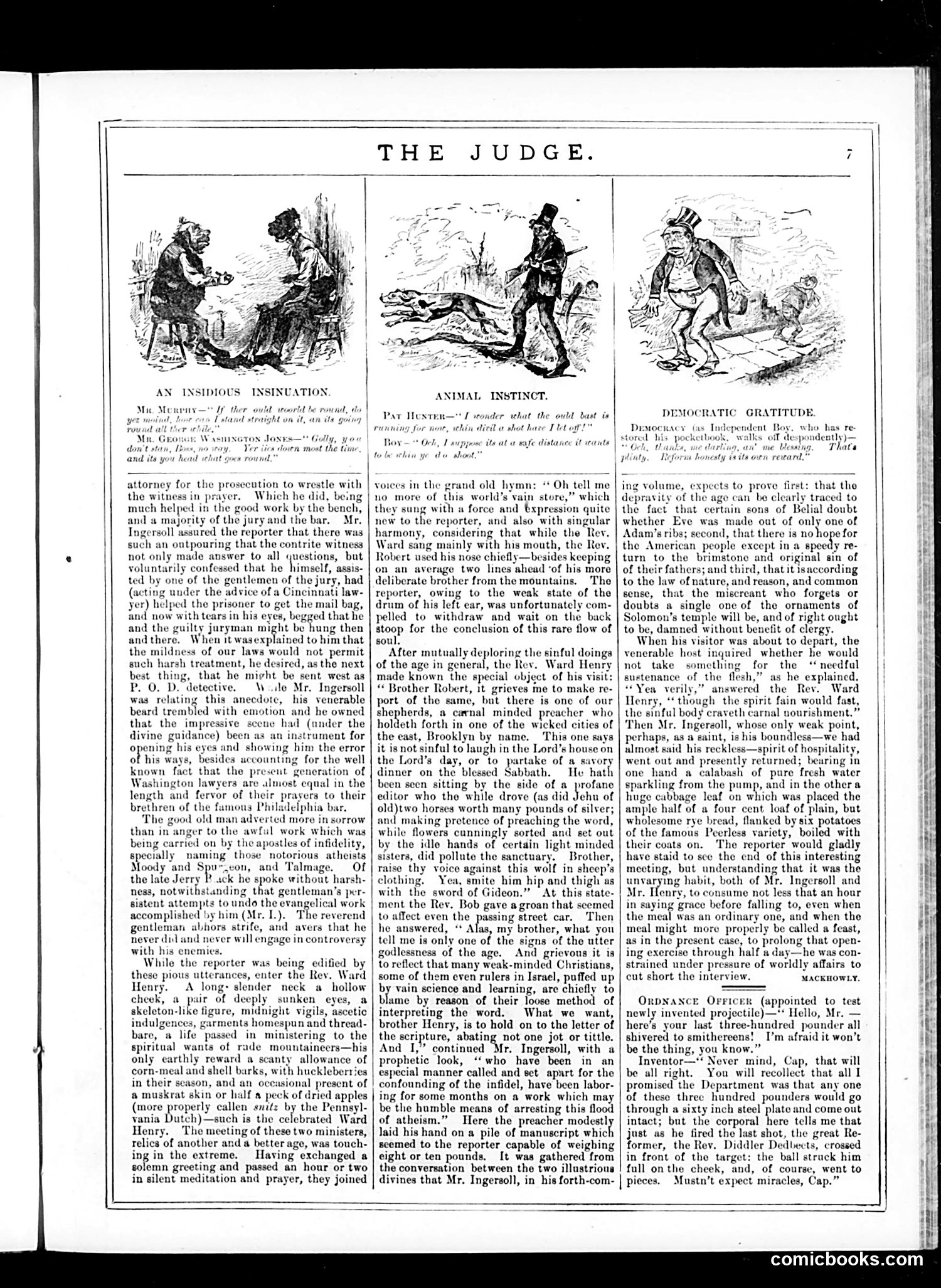
This page satirizes religious hypocrisy in Gilded Age America through three cartoons and accompanying text. **"An Insidious Insinuation"** mocks Rev. Ward Henry (likely a fictional composite of prominent preachers), who uses prayer to manipulate a guilty witness into confession. The satire suggests evangelical religiosity masks moral corruption—the witness admits to mail theft after "divine guidance." **"Animal Instinct"** depicts an Irishman (caricatured with exaggerated features) discussing a horse, playing on ethnic stereotypes equating Irish immigrants with animalistic behavior. **"Democratic Gratitude"** appears to criticize political patronage, suggesting politicians reward loyalty despite incompetence or moral failings. The broader theme attacks hypocrisy: respected clergymen use piety to conceal worldliness; the text names "atheists" Moody, Spurgeon, and Talmage ironically, suggesting even renowned preachers operate from base motives. Judge positions itself as exposing America's sanctimonious establishment.
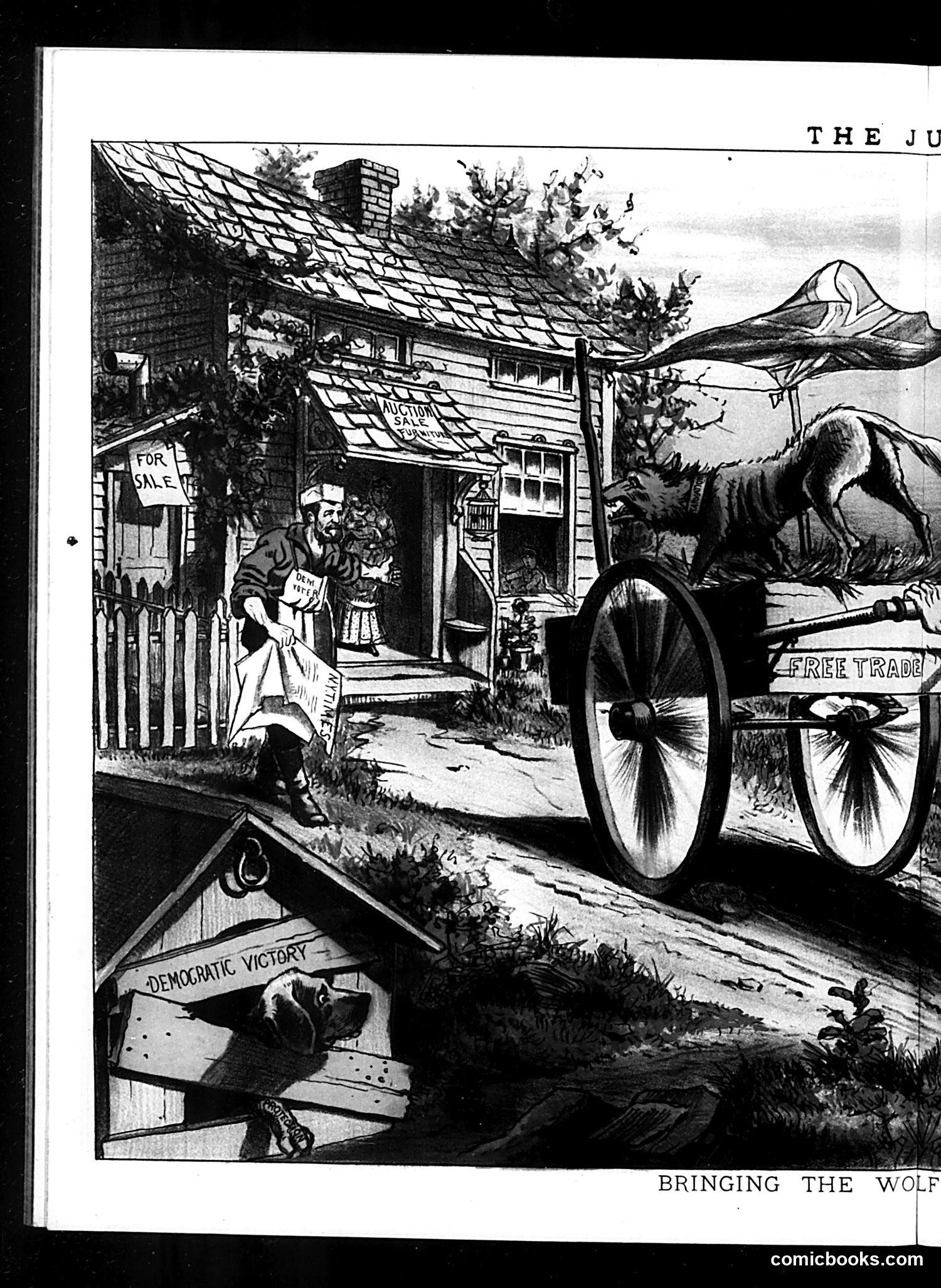
This is a satirical cartoon titled "Bringing the Wolf," likely from the late 19th century American protectionism debate. The illustration shows a man at a house marked "FOR SALE" and "AUCTION SALE," representing economic distress. A cart labeled "FREE TRADE" is being pulled by a wolf, symbolizing free trade as a dangerous threat to American prosperity and domestic stability. The "Democratic Victory" banner at the bottom suggests this criticizes Democratic free-trade policies. The imagery equates free trade doctrine with an approaching predator threatening the American home and family. This reflects the protectionist arguments common in *Judge* magazine, which generally opposed free trade and advocated tariffs to protect American workers and businesses from foreign competition.
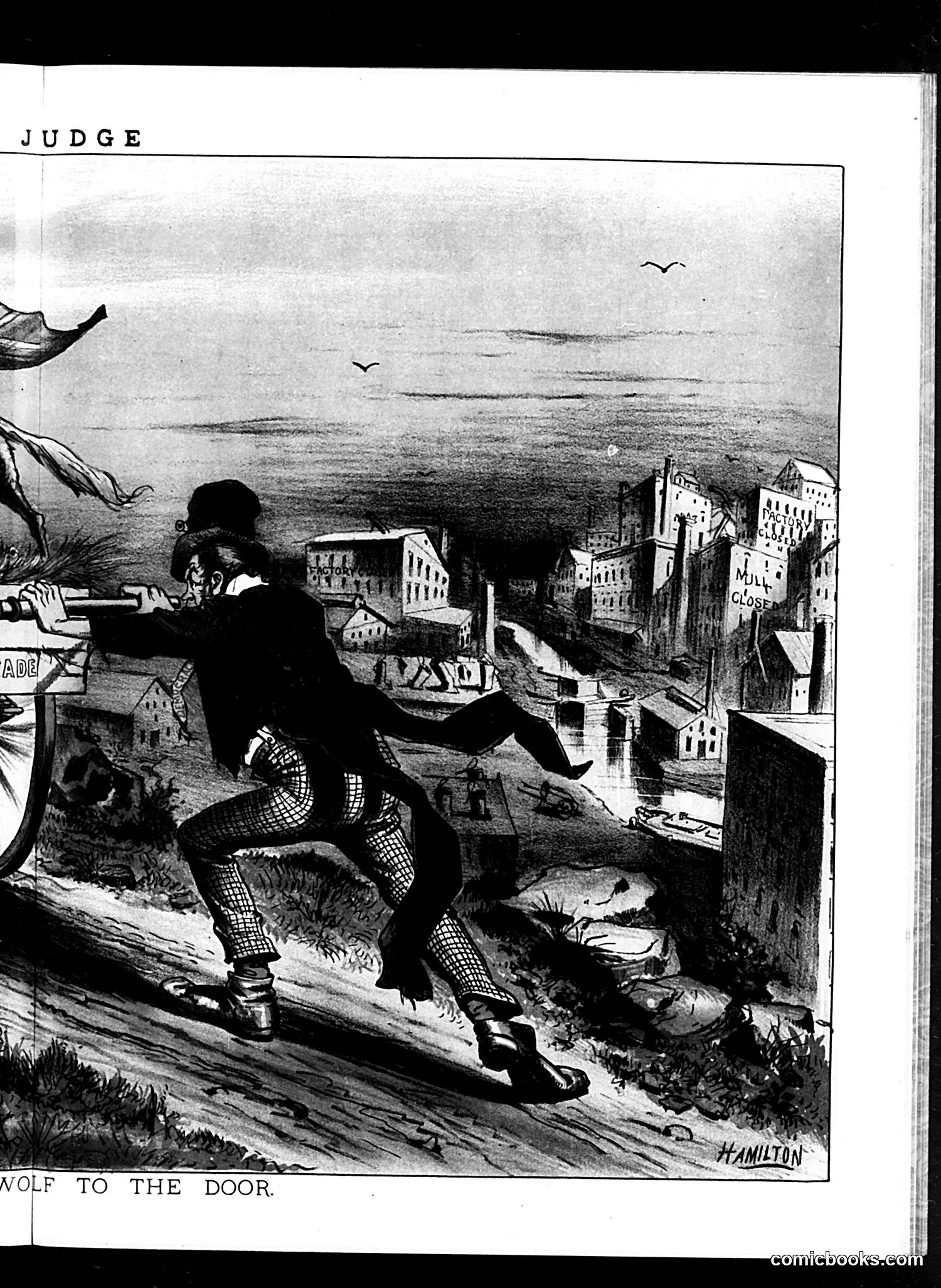
This political cartoon by Hamilton depicts a figure in checkered clothing desperately beckoning or signaling toward a cityscape across water. The title "Wolf to the Door" suggests economic hardship or deprivation—a common phrase meaning poverty is imminent. The cartoon appears to satirize economic anxiety or crisis, with the figure in distressed posture representing the common person facing financial ruin. The distant city buildings, some marked "CLOSED," reinforce themes of business failure and economic collapse. Without a specific date visible, the exact historical reference remains unclear, though the style and content suggest this addresses a period of American economic downturn, possibly the Great Depression or another significant recession when business closures and unemployment were widespread public concerns.
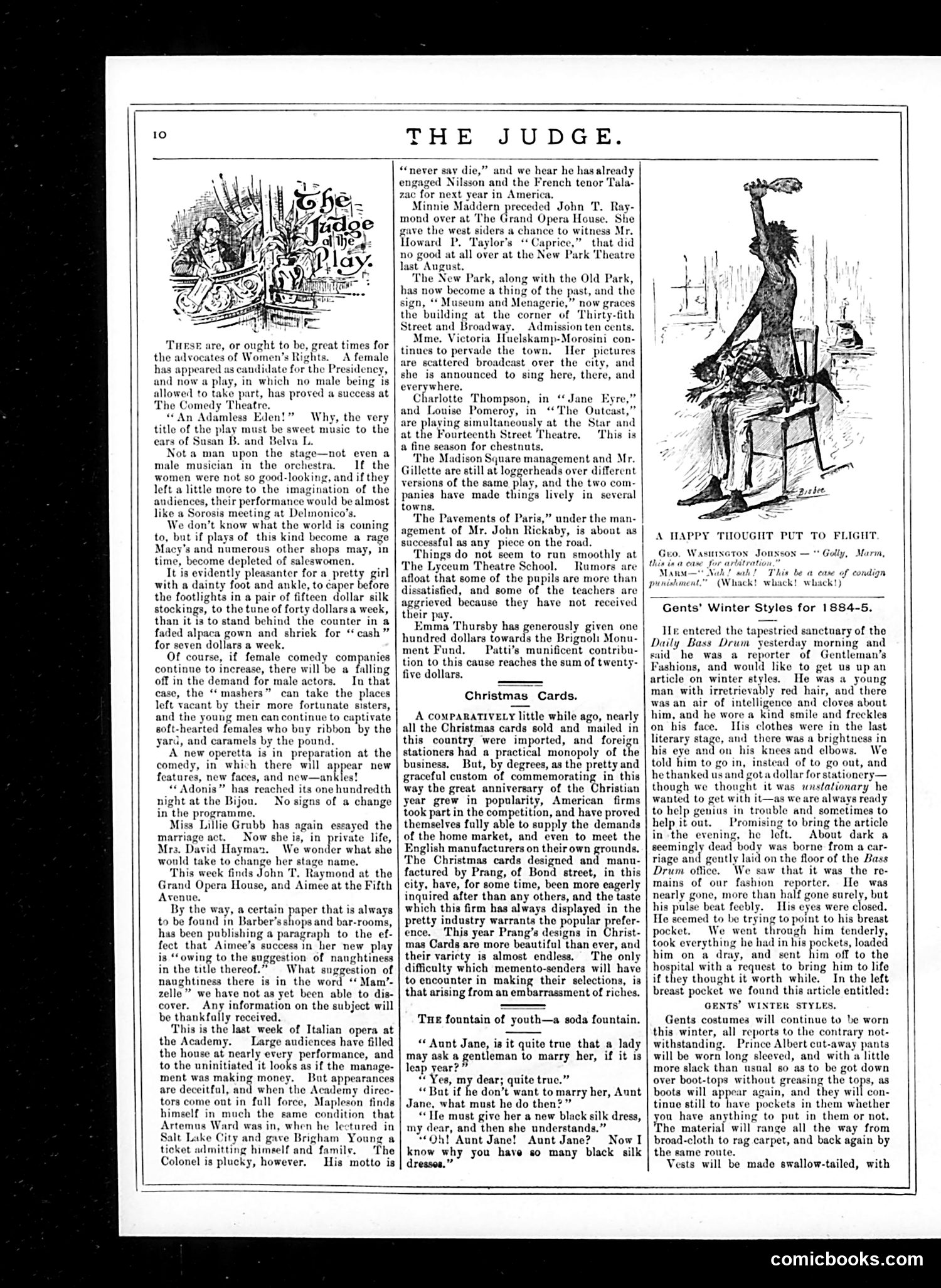
This page from Judge satirizes 1880s theater culture and women's changing social roles. The main cartoon, "A Happy Thought Put to Flight," depicts a man startled by a woman—likely mocking anxieties about female independence. The text reviews recent theatrical productions while making pointed social commentary. It ridicules an all-female play called "An Adamless Eden" at the Comedy Theatre, sarcastically suggesting it appeals to women's rights advocates like Susan B. Anthony and Belva Lockwood. The author worries such productions will deplete department stores of saleswomen and displace male actors. The piece also notes the long run of "Adonis" and mentions various stage performers' successes. Throughout, Judge uses theatrical gossip to critique emerging feminist movements and women entering the workforce, presenting female ambition as both amusing and mildly threatening to male dominance in commerce and entertainment.
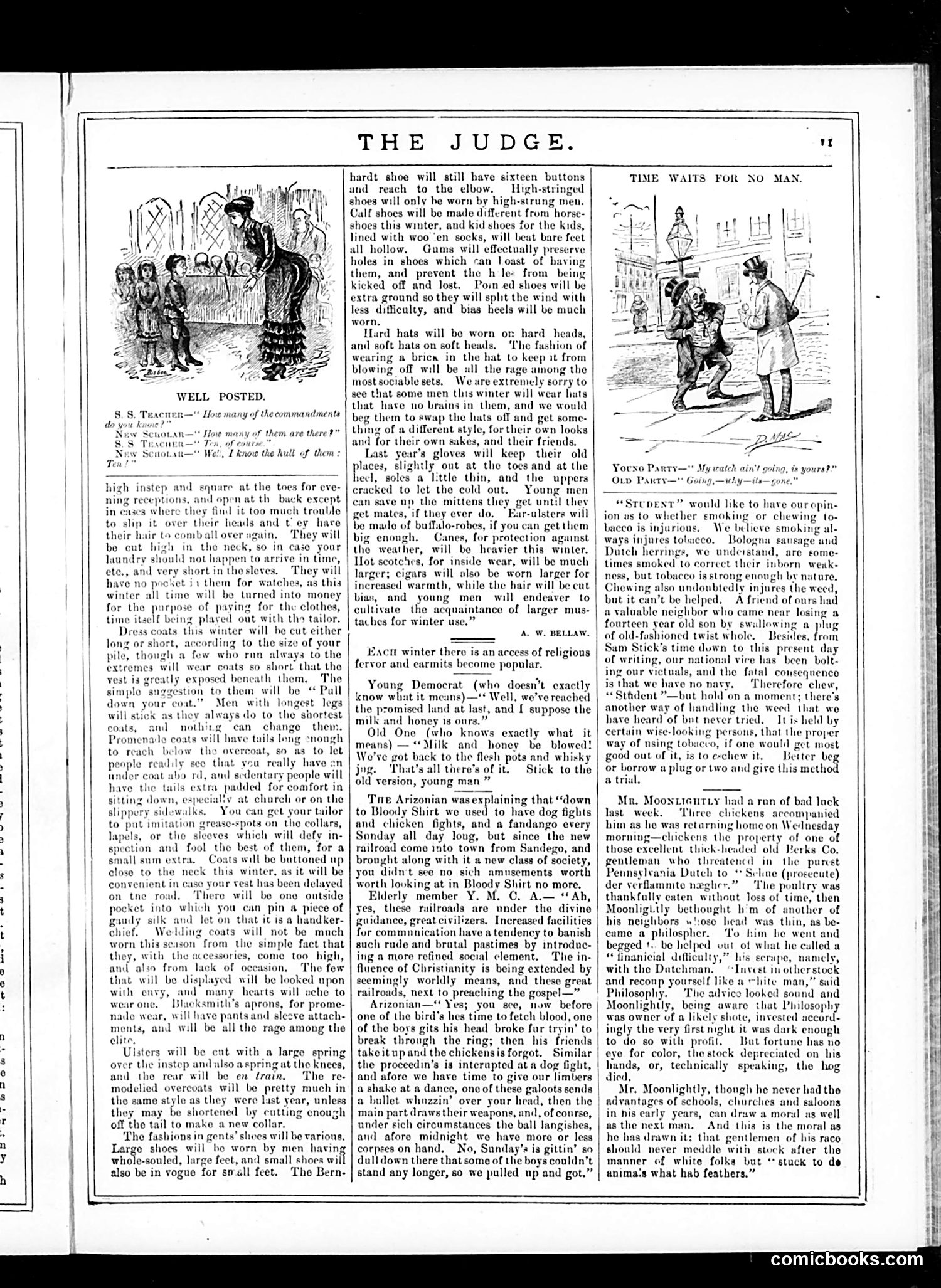
This page satirizes a common type of American blowhard: the lazy man who protests his industriousness through endless, contradictory excuses. The cartoon's central figure claims he's not lazy, but his monologue hilariously proves otherwise. He boasts of "working hard" at the dinner table, "resting harder" than others, and his best jobs involve sitting down (shoemaking, card games). He admits to "putting off" work while claiming this exhausted him. His father supposedly never had to ask *him* to work—he'd ask his brother John instead, and the narrator "saw that it was done" (implying he watched someone else). The title "Another Lie Nailed Up" suggests this is a familiar character type being exposed: the man who talks constantly about his work ethic while describing obvious indolence. The satire targets self-deception and hollow braggadocio common among working-class and lower-middle-class Americans of the era.
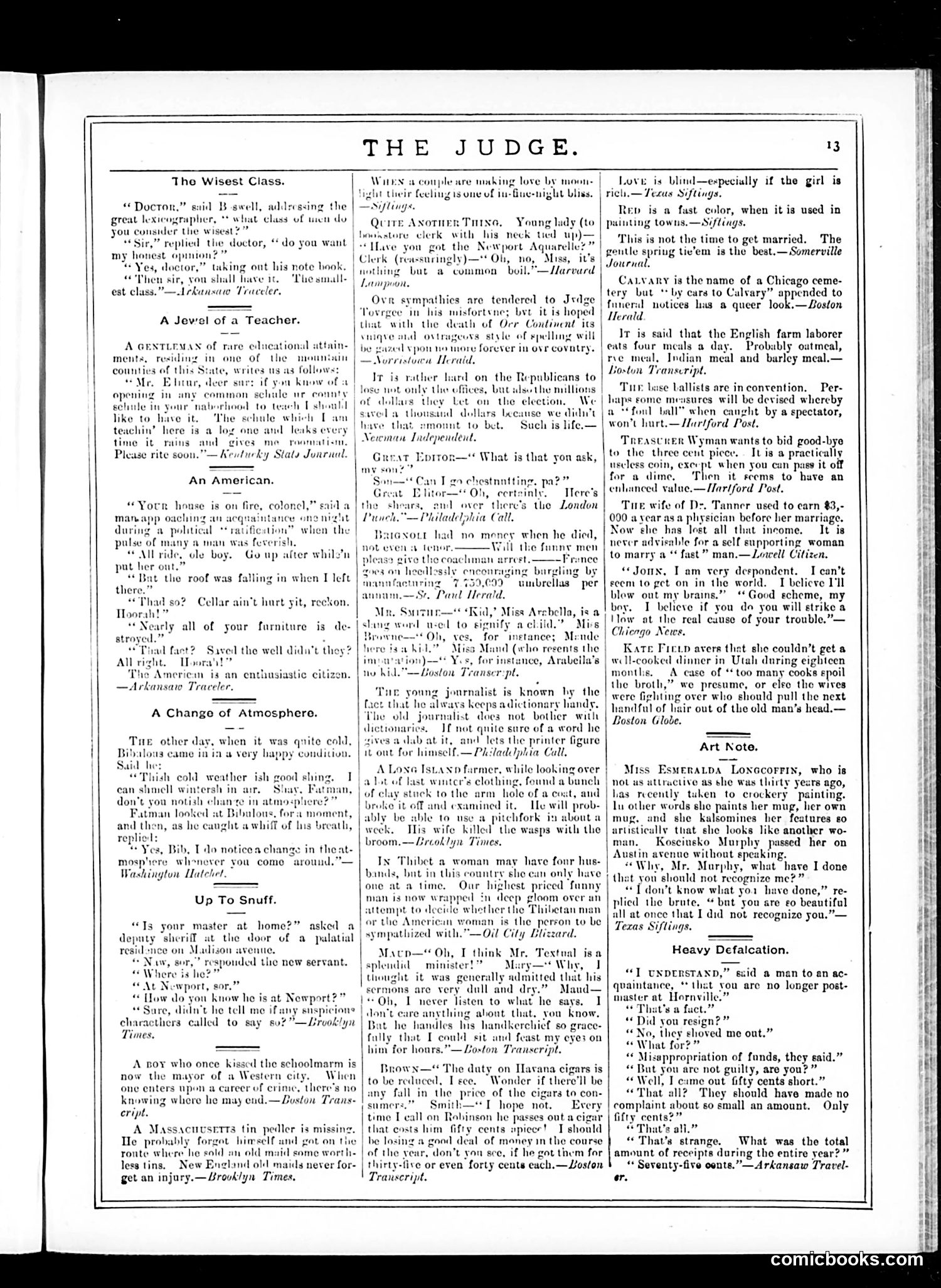
This page from *Judge* (a 19th-century American satirical magazine) contains multiple brief humorous sketches rather than political cartoons. **Key content includes:** - **"The Wisest Class"**: A dialogue joke about which class of women a doctor considers wisest—the punchline apparently depends on the "small class." - **"An American"**: Satire on American optimism/indifference. A man's house is burning, furniture destroyed, but he cheerfully notes the cellar wasn't damaged—mocking exaggerated patriotic enthusiasm. - **"A Change of Atmosphere"**: A drunk man ("Bib") notices the weather has changed; the joke implies his bad breath is the real atmospheric change. - **Rural/dialect humor**: Several sketches mock rural American speech and naiveté (Arkansas Traveler references, servant misunderstandings). The page emphasizes *Judge*'s typical late-19th-century humor: gentle mockery of American character types, rural simplicity, and domestic situations—rather than hard political satire. No specific historical figures or events appear to be referenced.
This page from *Judge* is primarily **advertising and miscellaneous humor**, not a unified political cartoon. The content includes: **Humorous snippets** (left column): Short jokes and anecdotes about everyday life—a woman with a pet monkey and parrot, Irish immigrants, Sarah Bernhardt's small stature, and disputes over newspaper subscriptions. These appear designed as light social commentary on domestic absurdities and contemporary personalities. **Advertisements** dominate the page, promoting patent medicines (Brown's Iron Bitters, Dr. Pierce's Favorite Prescription), accident insurance, and breakfast cocoa—typical late 19th-century advertising. **No identifiable political figures or clear satire** are evident. The humor is domestic/personal rather than topical. References to Sarah Bernhardt (the famous actress) and oblique mentions of Democrats appear incidental rather than central. This appears to be a standard issue page from *Judge*'s humor section, mixing mild social satire with commercial content typical of period magazines.
This page is primarily **advertising**, not political satire. It contains multiple patent medicine and product advertisements typical of late 19th-century American magazines, including: - **Pond's Extract** (a popular medicinal salve) - **Catarrh Cream Balm** - **Men's Agitat Molem** (unclear product) - **Magic Lanterns** (early projectors) - **Vichy Water** (French mineral water) - Piano and bicycle advertisements The page also includes brief humorous anecdotes rather than editorial cartoons—jokes about courtship, cabmen, voting, domestic life, and milkmen. These appear to be reprinted from other publications (*London Punch*, *Harvard Lampoon*, etc.). **The satire is minimal and gentle**: the brief stories mock romantic pretense, political indifference toward Black voters, and marital tensions—standard Victorian-era humor. There are no identified political figures or events. This is essentially a **classified advertising section with filler humor**, common in Judge's later pages.
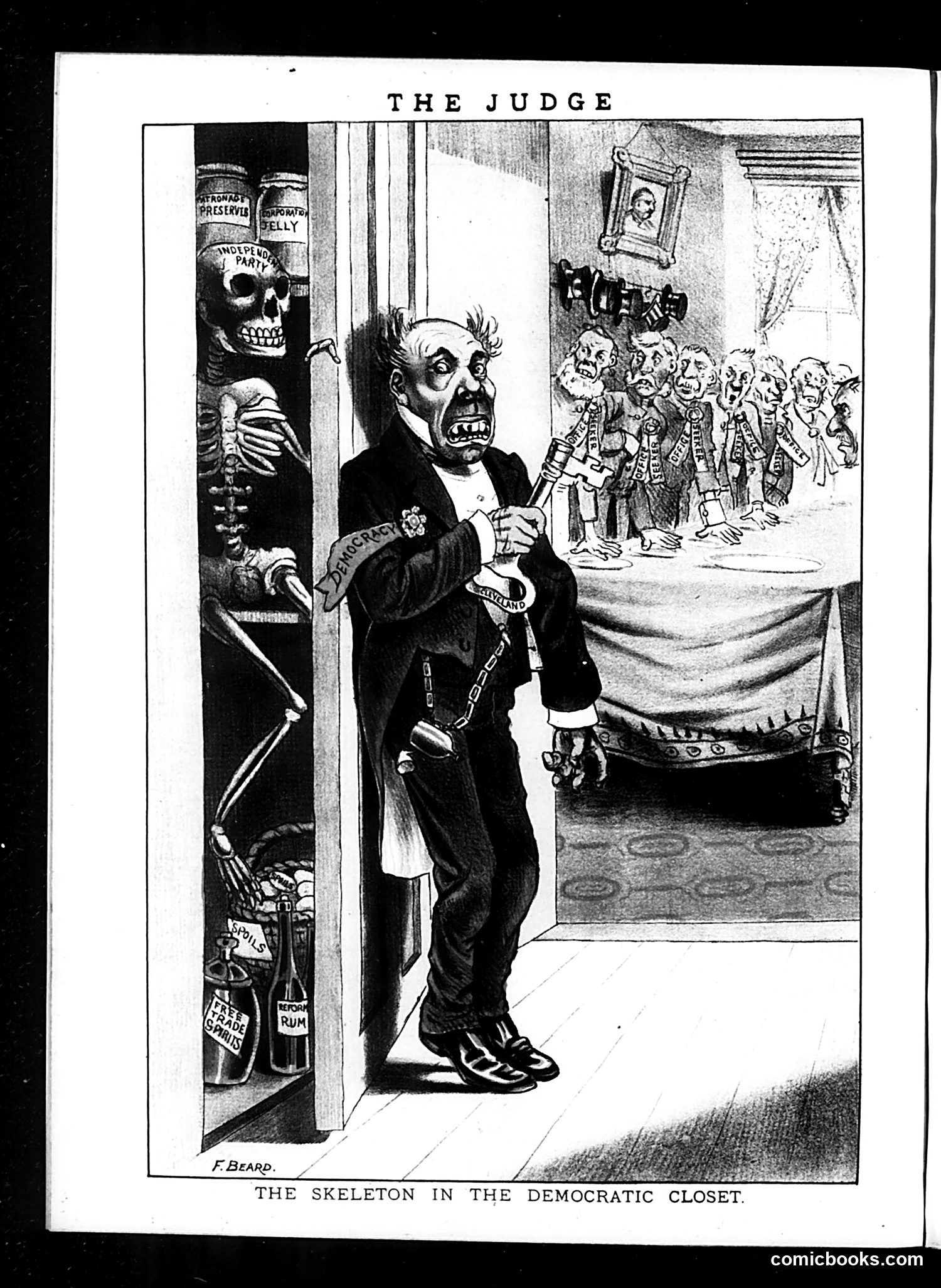
This political cartoon, signed by F. Beard, depicts a frightened dignitary discovering hidden corruption within the Democratic Party. The central figure—a formal official with an exaggerated, horrified expression—recoils from an open closet revealing a skeletal corpse surrounded by bottles labeled with various vices (preserved meats, belly, rum, and other items suggesting corruption and excess). Behind him, a crowd of caricatured Democratic politicians peers in, equally alarmed. A framed portrait hangs above, possibly representing party leadership. The "skeleton in the closet" metaphor suggests long-hidden scandals or moral failures within Democratic ranks that threaten to expose the party's hypocrisy. The cartoon's title makes the satirical point explicit: despite public respectability, the party harbors shameful secrets.