
Judge, 1884-12-20 · page 5 of 16
Judge — December 20, 1884 — page 5: what you’re looking at
What you’re looking at
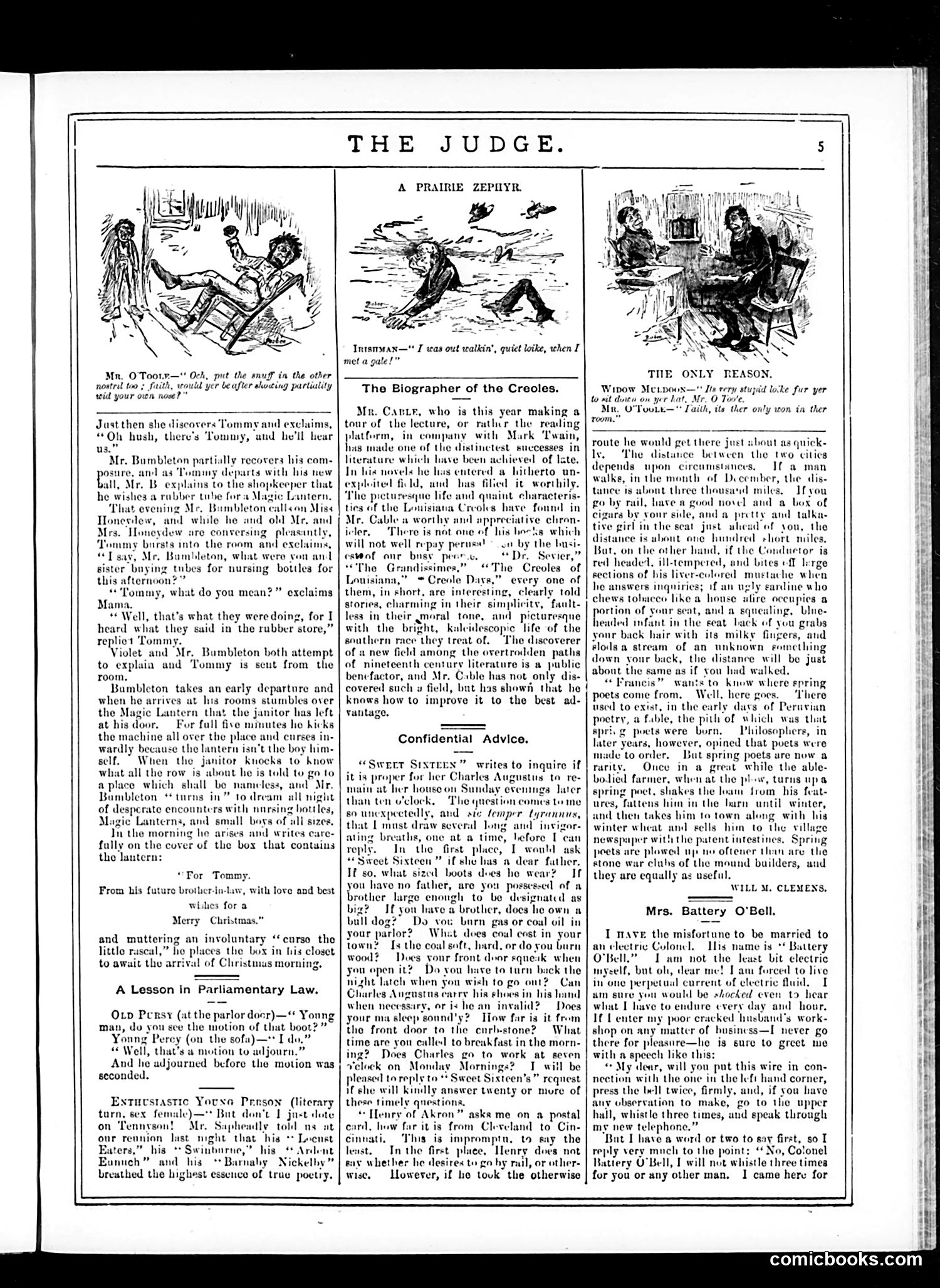
This page contains several comic sketches satirizing middle-class social anxieties. The main narrative follows Mr. Bumbleton, who embarrassedly purchases nursing bottles but is misinterpreted by an eavesdropping child named Tommy as doing something illicit. The comedy derives from the resulting social mortification—Bumbleton's frantic attempts to explain, his nightmares, and his grudging Christmas gift to Tommy. A secondary sketch mocks parliamentary protocol when an older man interprets a young man's boot motion literally rather than as a metaphor. The page also discusses George Washington Cable's literary success exploring Creole society through novels like *The Grandissimes*, treating this as a serious cultural achievement. Finally, an advice column humorously addresses Victorian courtship propriety, questioning when suitors should leave Sunday evening visits. The overall tone reflects 1880s-90s middle-class preoccupations with propriety, social embarrassment, and respectability.
📄 Transcribed text from this page (OCR, searchable)
Machine-transcribed from the original scan — historical spelling and the odd misread are preserved.
Mn. OToorn—"' Och, put the snuff in the other nostril too ; firith, would yer be after aluwing partiality teid your owen nose?” Just then she disco “Ol ‘ommy and exclaims, hush, there's ‘Tommy, aud he'll hear Mr. Bumbletan partially recovers his com- postire, and as ‘Teminy departs with his wew all, Mr. Bo explains to the shopkeeper that he wishes a rabber tube fora Magic Lantern. That evening Me. Bumbleton callson Miss Tlonevdew, and while 1h id old Mr. and Mrs, ‘Honeydew are conversing pleasantly, ‘Tommy bursts into the ream and es aims, “Tsay, Mr, Bumbleton, what were ven and sister buying tubes for nursing bottles for this afternoon?” “Tommy, what do you mean? Mam: “Well, that’s what they weredoing, for I heard what they said in the rubber store,” repliot Tommy. Violet and Mr. Bumbleton both attempt to explain and Tommy is seut from the room. Bumbleton takes an early departure and when he arrives at his rooms stumbles over the Magic Lantern that the janitor has left at his door, or full five mmutes he hicks the machine all over the place and curses in- wardly because the lantern isn’t the boy him- self. “ When the janitor knocks to know what all the row is about he is told to go to aplace which shall be nameless, and Mr. Bambleton ‘turns in” to dream all night of desperate encounters with nursing bottles, Magic Lanterns, and small boys of all sizes, In the morning he arises and writes car fully on the cover of the box that contains the lantern: ?” exclaims “For From his future brother-in-law, Tommy. with love and best whhes for a Merry Christmas.” and muttering an involuntary “curso the little rascal,” he places the box in his closet to await the arrival of Christmus morning. A Lesson in Parliamentary Law. Otp Persy (at the parlor doer) —* Youn; man, do you see the motion of that boot?” nung Perey (on the sofa)—* I do.” “ Well, that’s a motion to adjourn, And he adjourned before the motion was seconded. Estuts turn, sex fen on Tennyson! our reunion astic Youxa Prrson (literary rule)" But don’t [just de Mr. Sapheadly told_ ns last mght that his ** Lecnst Eaters,” his Swinburne,” his Eunuch” and his ** Barnaby Nickelby breathed the highest essence of true poetry. THE JUDGE. A PRAIRIE ZEPHYR. Intsmstan. met agate!" * I was out realkin', quict loike, when I The Biographer of the Creoles. Mr. Canter, who is this year making a tour of the lecture, or rather the reading platform, in company with Mark ‘Twain, has made one of the distinctest: successes in literature which have been achieved of late. Tn his novels he has enter 1 a hitherto un- exploited fidld, and hh it. worthil ‘The picts ties of the Louis Mr. Cable a worthy and appreciative chron- ‘ler, There is not one ef his becks which will not well repay perus! ou by the bus. cswof onr busy peore, — De, “The Grandissimes,” “The Creoles se Louisiana,” * Creole Daye,” every one of them, in short, are interesting, clearly told stories, charming in their simplicity, fault- less in their moral tone, and picturesque with the bright, kulcidescopic life of the southern race they treat of, The discoverer of a new ficld among the overtrodden paths of nineteenth century literature is a public benefactor, and Mr, Cable has not only dis- covered such field, but has shown that he knows how to improve it to the best ad- vantage. ¢ found in Confidential Advice. “Sweet Sixt writes to inquire if it is proper for her Charles Augustus to re- main at her house on Sunday evemngs Jater than ten o'clock, ‘The question comes tome so unexpectedly, and femprr tyrannu: t IT mast draw 8 W long and ine ming breaths, one at a time, lefore T can reply. In the first place, I eA ask “Sweet Sixteen” if she has a dear father, Tf so, what sized boots dees he wea you have no father, are you po: brother large enough to be d big? If you have a brother, does ‘ie own a bull dog?” Do. vou burn gas or coul oil in your parlor? What does coal cost in your town? Is the coal soft, hard, or do you burn wood? Dues your front dear squeak when you open it? Do you have to turn biek the ght latch wl hto go ont? Can Charles Augustus carry his shoes in his hand when necessary, or is he an invalid? Does. your ma sleep gound'y? the front door to the cnrh-stone? time are you called to breakfast in the morn- i Does Charles go to work at seven Yelock on Monday Mornings? Le will be pleased to reply to * Sweet Sixteen’s” request if she will kindly answer twenty or more of these timely qnestions, * Henry of Akron” asks me on a postal card, how fur itis from Cleveland to Cin- cinnati, ‘This is impromptn, to say the least. In the first place, Henry does not ay Whether he desires to go hy rail, or oth wise, Llowever, if he touk the ‘otherwise THE Winow Merpo« to it duien on yer hat, Mr. O'TuoLre— rom.” ONLY REASON, Tis very stupid locke fur yer Mr. O Tov'e. ih, ite ther only won in ther route he would get there just ubout as qu Iv. The distance between the two citics depends upon circumstances. If a man walks, inthe month of December, the dis- tance is about three thousand miles. Ifyou go by rail, have a good novel and a box of ra by your side, and a pretty and talkas girl in the seat just uheud of you, the nce is ubout one hundred short miles. Bat, on the other hand, if the Conductor is red headed, ill-tempered, and bites off lerge sections of his liver-colored mustache when he answers inquiries; if un uzly sardine who chews tohaceo like a honse ulire eceupics a portion of t, and a squealing, U headed infant in the seat back of you grabs your back hair with its milky fingers, and Bods a stream of an unknown eomething down your back, the distance will be just about the same as if vou had walked. rancis” wants to know where spring poets come from, Well, here goes. There to exist, in the early days of Peruvian poetry, a fable, the pith of which was that sprig pocts were burn, Philosophers, in later years, however, opined that poets were made to order. But spring poets are now a rarity, Once in a great while the able- bodied farmer, when at the plas, turns up a spring poct, shakes the loam from his feat- ures, fattens him in the barn until winter, and then takes him te town along with his. winter wheat and eclls him to the village newspaper with the patent intestines, Spring poets are plowed np no oftener than are the stone war eluhs of the mound builders, aud they are equally az useful, WILL M. CLEMENS, Mrs. Battery O'Bell. I mave the misfortune to be married to an electric Culonel, Mis name is ** Battery O'Bell.” Tam not the least bit electric myself, but oh, dear me! Tam forced to live in one perpetual current of clectric fluid, I am sure yeu would be shocked even to hear what I have to endure every day and hour, If Lenter my poor cracked husband's work= shop on any matter of busincss—I never go there for pleasure—he is sure to greet me with a speech like this: “My dear, will you put this wire in con- nection with the one in the left hand corner, press the bell twice, firmly, and, if you have any observation to make, go to tle upper hall, whistle three times, aud speuk through my new telephone,” ‘But I have a word or two to say firet, so T reply very much to the point: * No, Colonel Battery O'Bell, I will not whistle three times for you or any ‘other man, 1 came here for comicbooks.com