
A complete issue · 16 pages · 1884
Judge — December 13, 1884
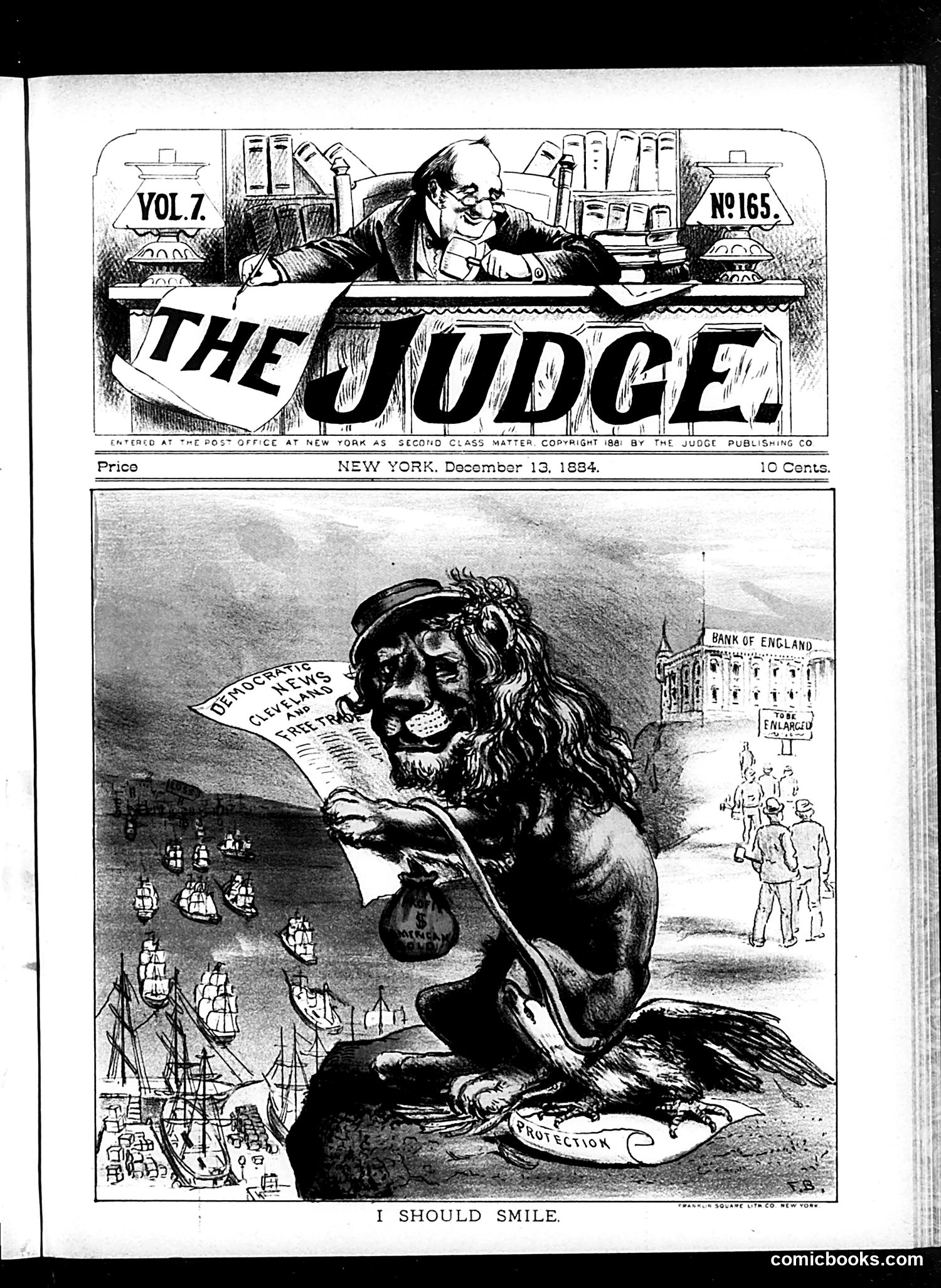
This cartoon depicts Britain (represented as a lion reading a newspaper) confronting economic hardship. The lion holds a "Democratic News" paper while standing on "Protection"—referencing the American tariff debate of 1884. Ships in the background suggest British maritime/trading dominance under threat. The cartoon satirizes Britain's vulnerability to American protectionist policies. Despite Britain's traditional naval and commercial power (the ships), the lion appears forced to "smile" through economic distress caused by American trade barriers that restricted British exports. The timing—just after the 1884 U.S. elections—suggests commentary on how American protectionism was harming British interests, forcing Britain to endure economic consequences while maintaining diplomatic composure.
This is a satirical piece mocking President-elect Grover Cleveland's cabinet selections. Judge magazine proposes intentionally absurd and inappropriate appointees to ridicule Democratic choices. The satirical "cabinet" includes: - **Jeff Davis** (Confederate president) for Treasury—mocking Democratic leniency toward the South - **John Bull** (personification of Britain) for Navy—suggesting pro-British sympathies - **Henry Ward Beecher** (famous preacher) for State—criticizing political cronyism - **Roscoe Conkling** (Republican politician) for Attorney General—attacking recent Democratic legal positions The satire implies Cleveland is either incompetent at selecting qualified officials or compromising with unsavory elements (Southern sympathizers, foreign interests). The cartoon suggests the new administration will betray Republican/Northern interests and reward Democratic allies regardless of qualification—a common post-Civil War partisan attack on Democratic administrations.
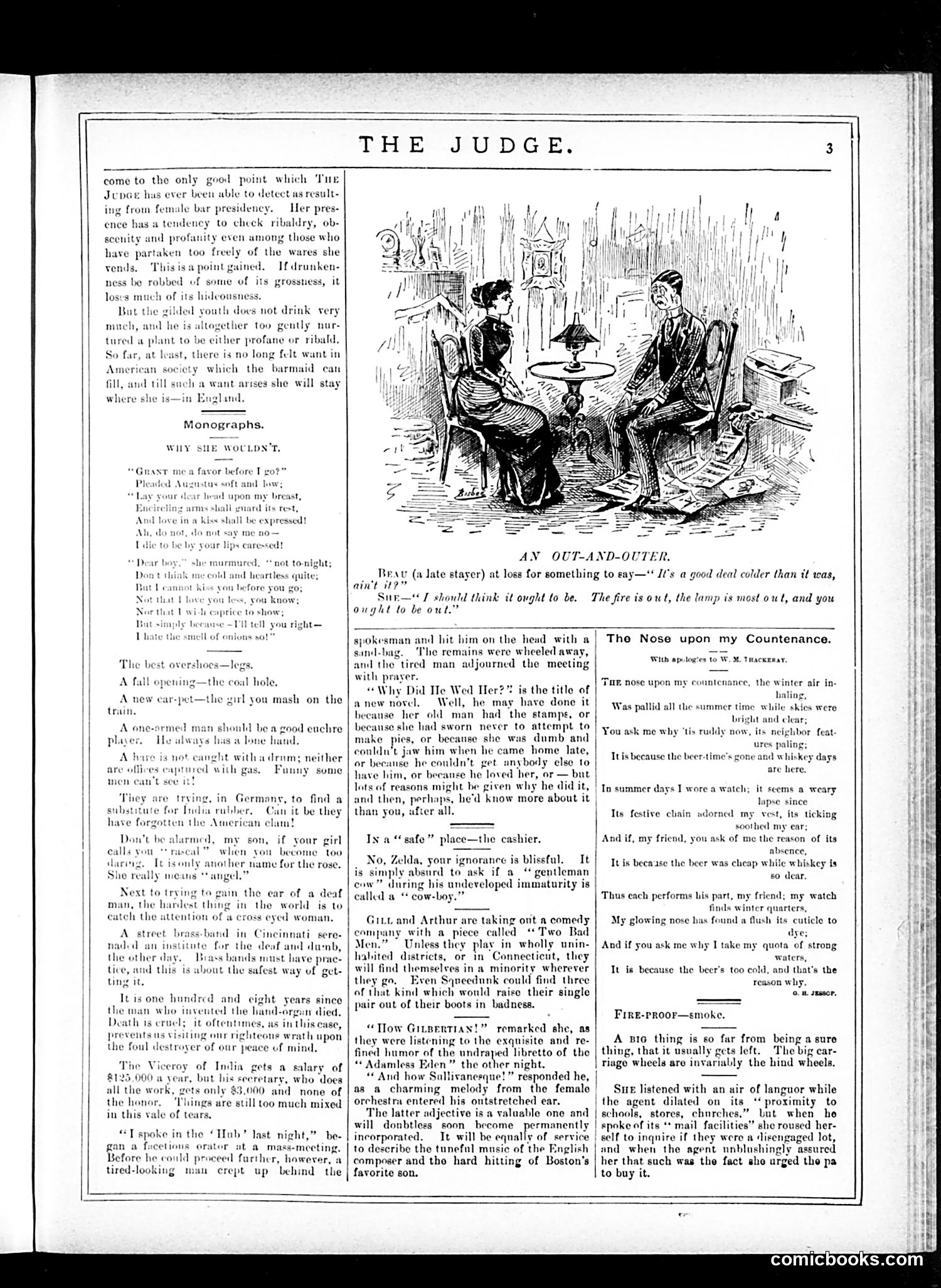
The cartoon depicts a domestic scene where a man returns home late to find the fire extinguished and lamp nearly out. When he complains about the cold, his wife responds with sharp wit: the fire and lamp are "out" because he's been out all night—an "out-and-outer" (slang for an extreme or habitual offender). The satire targets late-night male behavior, likely referencing drinking establishments or questionable activities. The wife's clever retort positions her as the moral superior, punishing negligence with domestic discomfort. This reflects Victorian-era anxieties about male vice and the domestic sphere as women's domain of moral authority. The surrounding text—"Monographs" offering witty observations about gender relations and social behavior—reinforces the page's theme: poking fun at contemporary courtship, marriage dynamics, and social pretensions through brief satirical sketches.
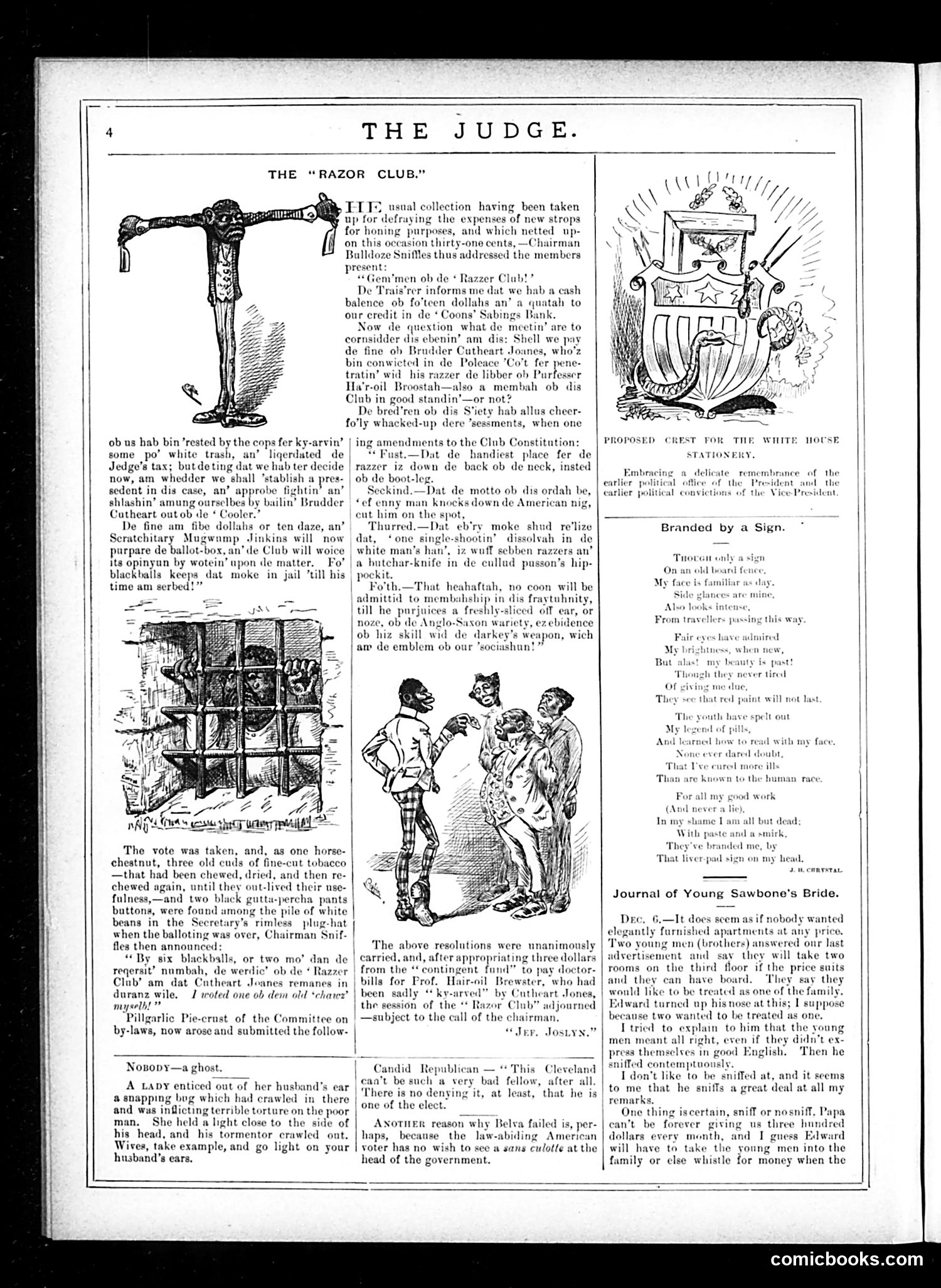
This is a racist caricature depicting a fictional African American social club debating whether to pay a fine for one member who stabbed another with a razor. The text uses degrading dialect and stereotypes to mock Black Americans. The satire conflates Black identity with violent behavior—specifically razor violence—presenting this as inherent to the group. The "club" establishes rules celebrating razor attacks as badges of membership, demanding members prove themselves by slicing off ears or noses from white people as "evidence" of skill. The humor relies entirely on dehumanizing caricature: mocking speech patterns, depicting Black men as inherently violent and criminal, and treating such violence as comedic. This reflects late-19th-century Judge magazine's reliance on racist content for its audience. The page also includes unrelated items (a White House crest design, a poem, and anecdotes), suggesting this was standard satirical-magazine format mixing political commentary with humor and advertisements.
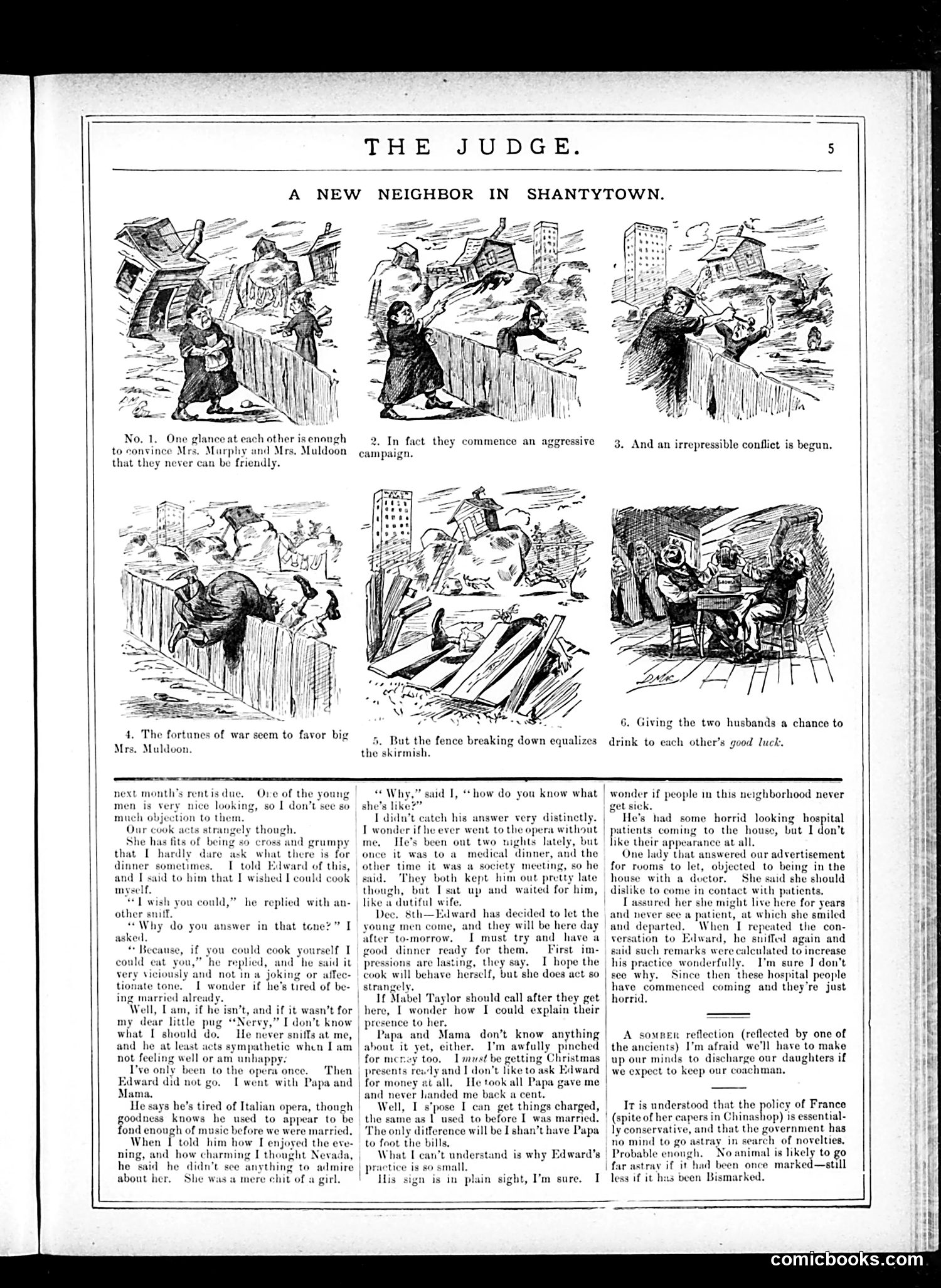
This six-panel comic strip satirizes petty neighborhood conflict among working-class Irish immigrants ("Mrs. Murphy and Mrs. Muldoon"). Two neighbors, initially hostile over a fence boundary, escalate into an "aggressive campaign" of quarreling. The dispute is resolved when the fence collapses, forcing both to accept the situation equally. The accompanying narrative—appearing to be a diary entry—mocks a newly married middle-class woman's snobbish complaints: her husband's small medical practice, her cook's bad temperament, her inability to afford opera and Christmas presents, and her embarrassment over the "horrid looking hospital patients" visiting their home. The satire targets class pretension and hypocrisy: while the poor Irish neighbors engage in honest, direct conflict, the narrator's genteel anxieties reveal self-absorbed materialism and social anxiety. The juxtaposition suggests both groups have their absurdities, though the magazine likely aimed primary ridicule at the pretentious middle class.
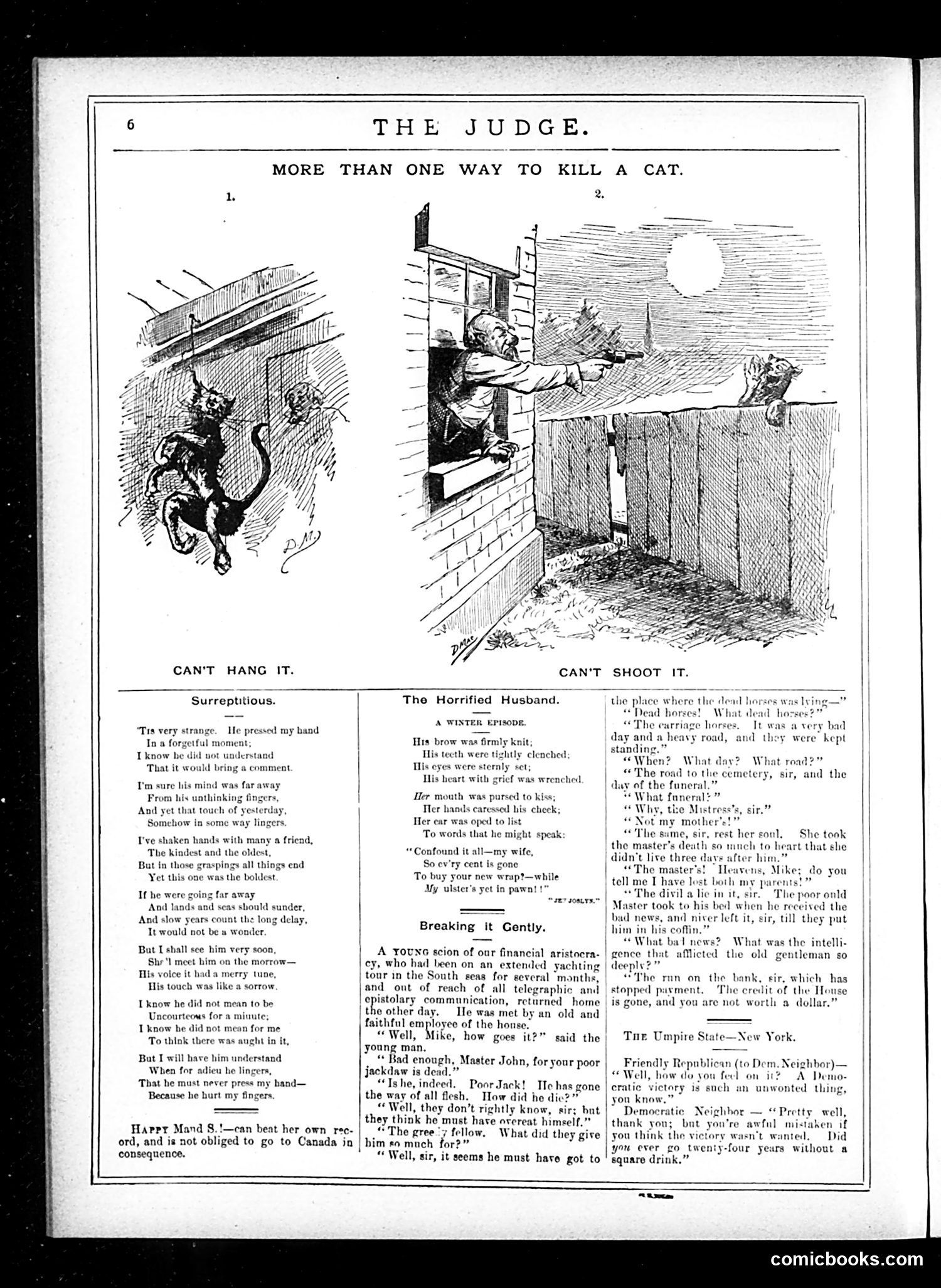
This page collects satirical poems and brief comic scenarios typical of late 19th-century American humor. The title alludes to finding multiple solutions to problems. **Key content:** 1. **"Can't Hang It / Can't Shoot It"** – Two illustrated methods of disposing of a cat, presented as literal visual jokes about animal cruelty (which was apparently a topic of public debate). 2. **Sentimental poems** – "Surreptitious" and "The Horrified Husband: A Winter Episode" are melodramatic verses mocking romantic sentimentality and spousal anxiety—standard Judge fare ridiculing emotional excess. 3. **"Breaking It Gently"** – A wealthy young man returns from vacation to learn his pet jackdaw died from overfeeding. The humor relies on servants delivering bad news with comic understatement, a class-based joke. 4. **"The Umpire State"** – A brief political exchange between Republican and Democratic neighbors, seemingly about the 1884 election aftermath, though context is unclear. The magazine targets sentimentality, class pretension, and partisan politics through crude humor and verse.
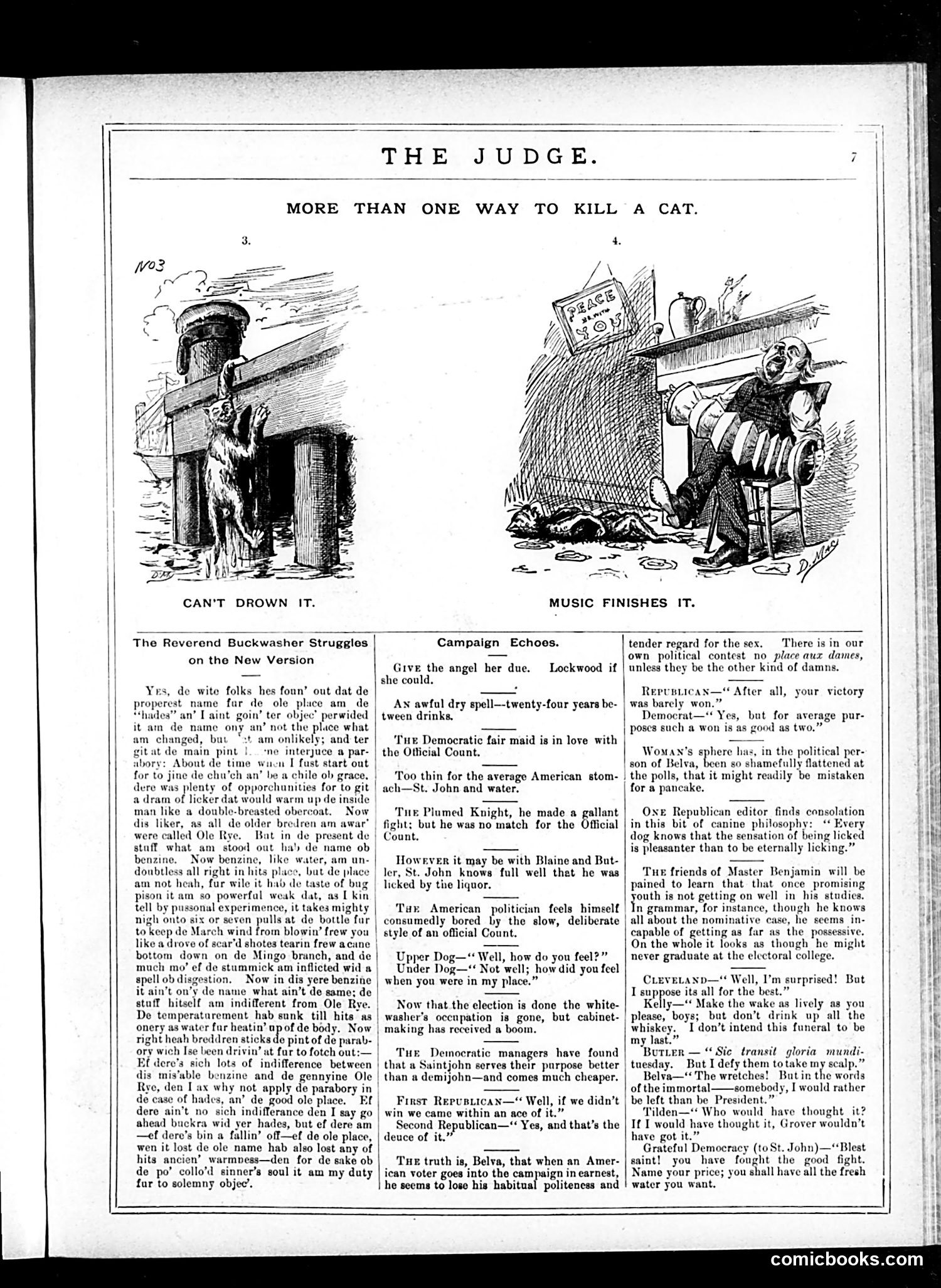
This 1884 *Judge* page satirizes the recent presidential election (likely Blaine vs. Cleveland). The two cartoons use the metaphor "More Than One Way to Kill a Cat" to mock political defeat. **Cartoon 3** ("Can't Drown It"): Shows a cat surviving drowning—apparently referencing how Republican candidate Blaine's campaign couldn't be eliminated despite efforts. **Cartoon 4** ("Music Finishes It"): Depicts someone playing loud, discordant music to kill the cat—likely satirizing how Democratic victory or some other political factor finally defeated the Republican cause. The accompanying text contains mock-serious political commentary on the election outcome, with jokes about candidates (Blaine, St. John, possibly Belva Lockwood) and the "Official Count" determining results. The lengthy dialect piece mocking a Black preacher appears to be period-typical offensive humor unrelated to the main cartoons.
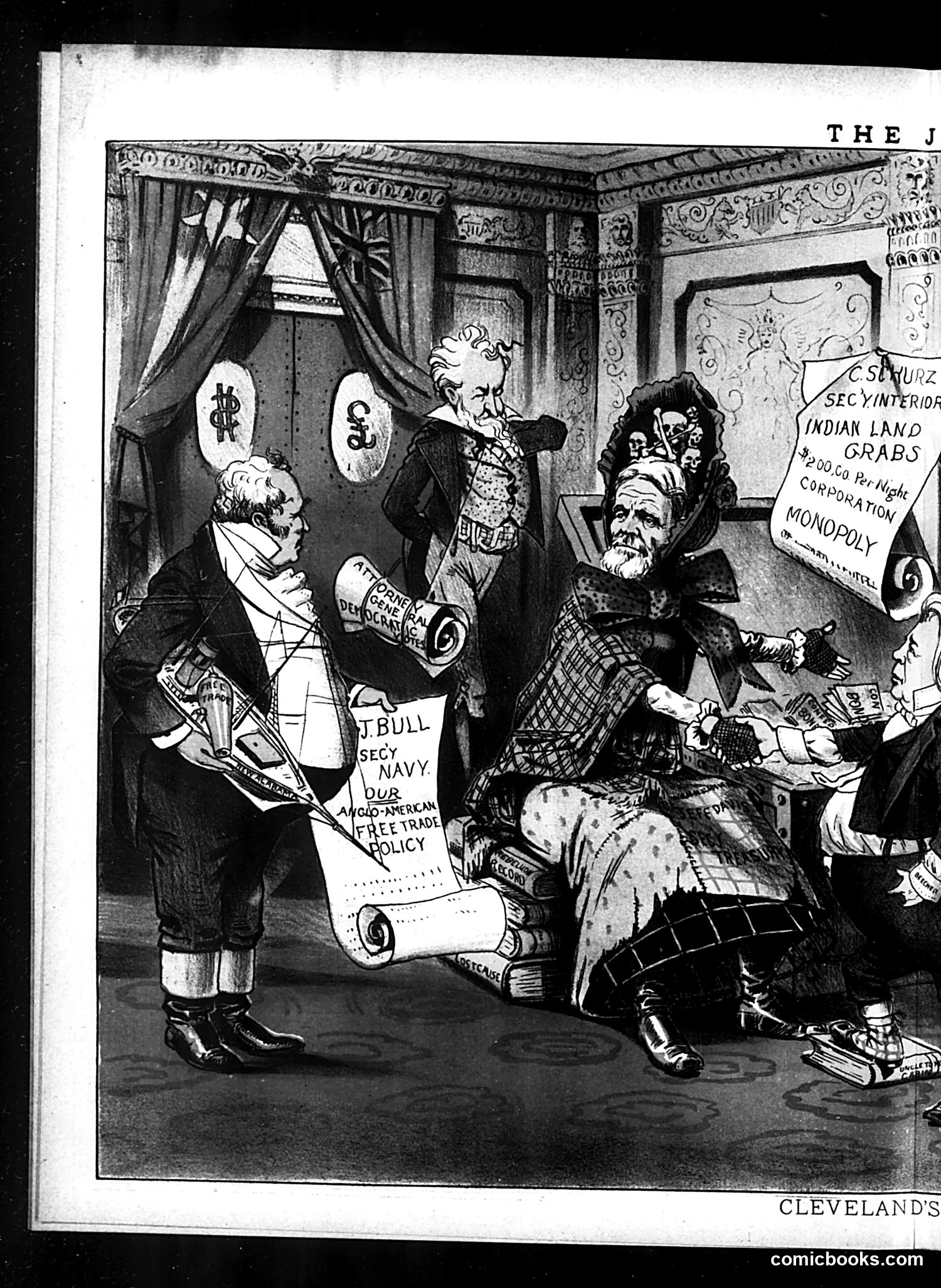
This appears to be a political cartoon from Judge magazine satirizing President Grover Cleveland's administration. The scene depicts wealthy businessmen or politicians in an ornate office, with visible signs advertising "Schurz Sec'y Interior," "Indian Land Grabs" ($200 per Night, Corporation Monopoly), and references to naval policy and trade concerns. The cartoon critiques Cleveland-era corruption: specifically, it mocks alleged conflicts of interest involving Secretary of the Interior (likely Carl Schurz) profiting from Indian land appropriation schemes. The caricatured figures appear to represent government officials engaged in corrupt dealings—selling access to public resources while claiming administrative legitimacy. The satire targets the contradiction between Cleveland's reform-minded image and his administration's actual tolerance of corporate exploitation of federal lands and Native American resources.
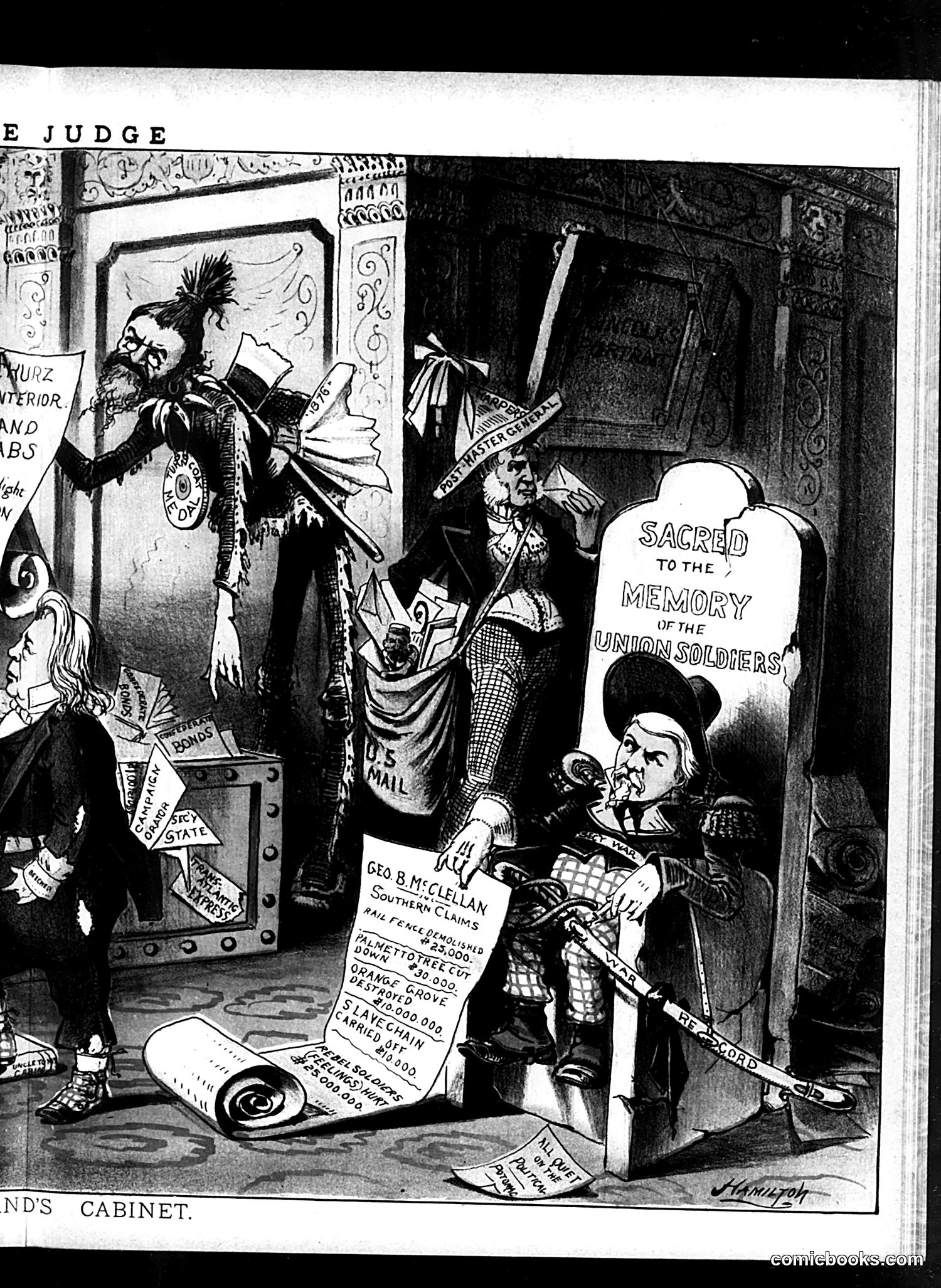
This cartoon satirizes what appears to be a military or government leader's cabinet during the post-Civil War era. The central figure is a caricatured military officer with exaggerated features, labeled as "GEO. B. McCLELLAN" (likely General George B. McClellan). A monument reading "SACRED TO THE MEMORY OF THE UNION SOLDIERS" stands prominently, suggesting McClellan is being mocked for his relationship to Union military policy or casualties. The cartoon critiques McClellan's administration through grotesque caricature and the juxtaposition of military glory rhetoric with what the artist implies is hollow commemoration. Various figures around him appear to represent different cabinet members or political associates, though their specific identities are unclear from the visible text. The overall tone is deeply satirical about military leadership and government accountability.
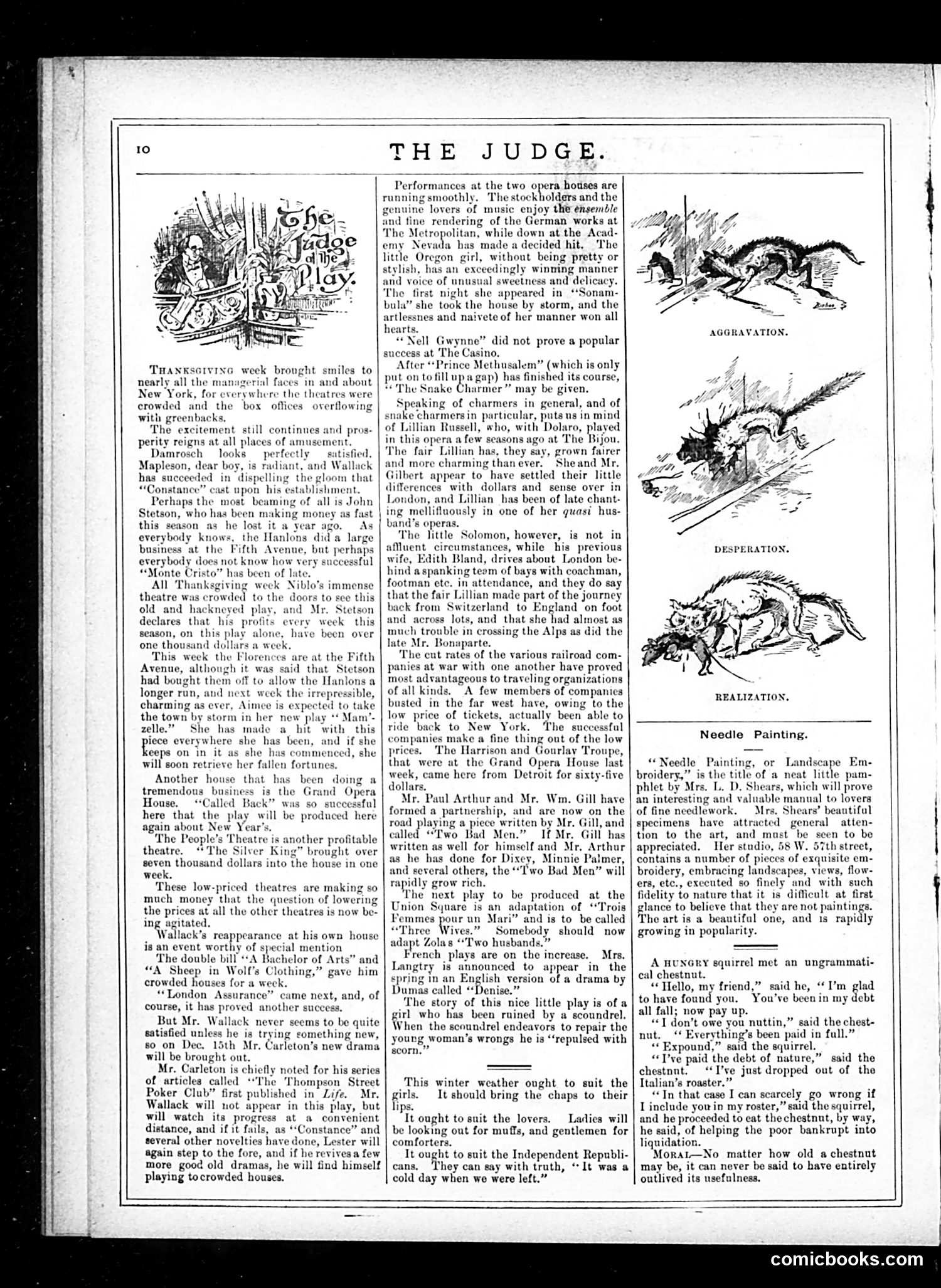
This page from the satirical magazine **Judge** contains theatrical gossip and reviews rather than political cartoons. The content focuses on New York's thriving theater scene during Thanksgiving week. **Key References:** - **John Stetson** and the **Hanlons**: Theater managers enjoying financial success; "Monte Cristo" is generating over $1,000 weekly profit - **Wallack's Theatre**: Owner returning to perform in classic plays like "A Bachelor of Arts" and "London Assurance" - **Grand Opera House**: Successfully staging "Called Back" - **Nevada** (an opera singer): A young woman from Oregon making her debut at the Academy, praised for her winning manner and sweet voice - **Lillian Russell**: A famous opera performer noted for her beauty and charm **The Satire:** The piece gently mocks theater managers' obsession with profit and novelty while praising the success of established works. It also satirizes the social obsession with celebrity performers like Russell, treating her personal life as public gossip. The small illustrations appear to be unrelated vignettes rather than political commentary.
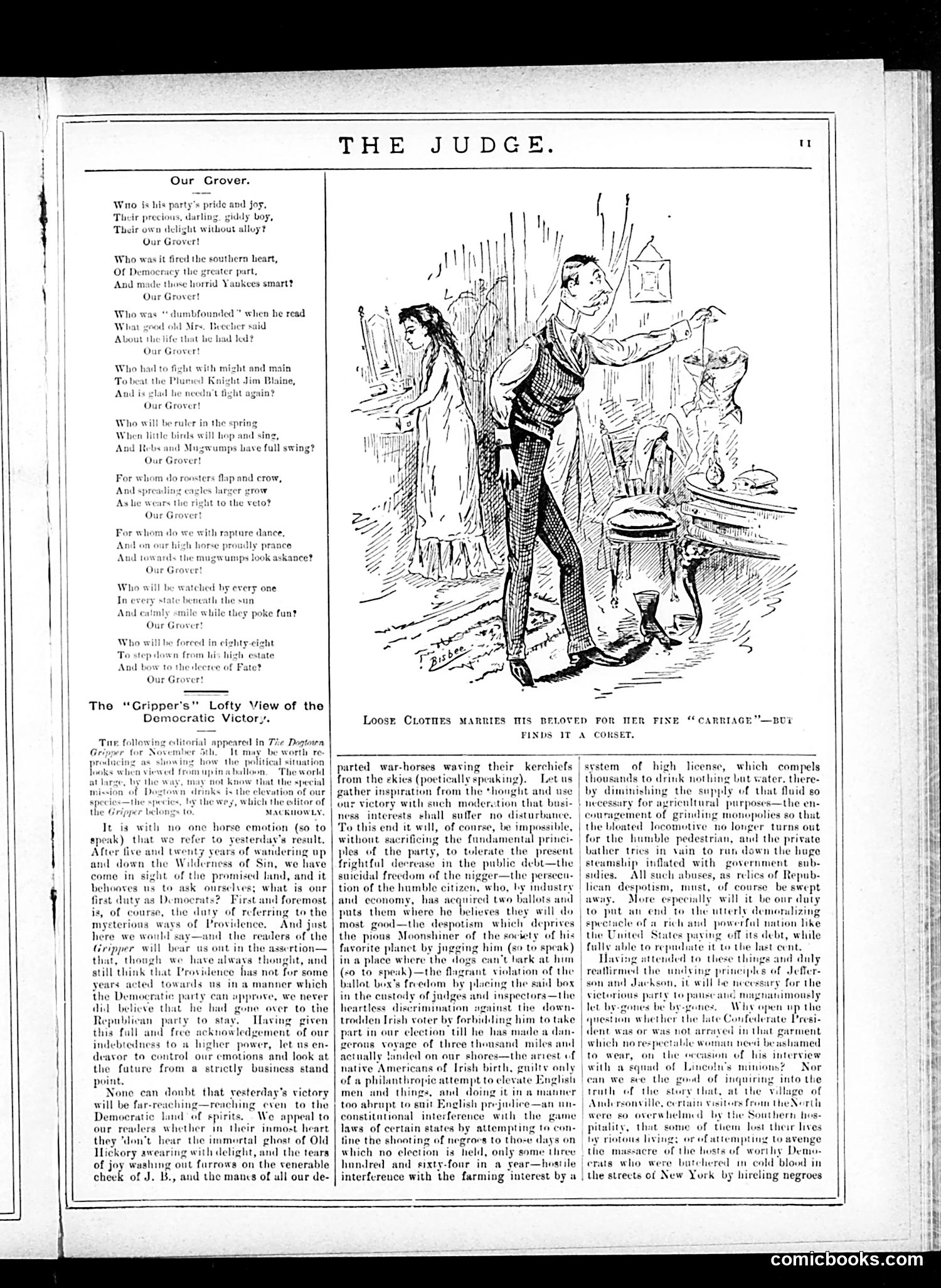
This page satirizes the Democratic Party's celebration of electoral victory, likely following an 1884 election. The main cartoon depicts a man (appearing to represent a Democratic politician) surrounded by disorder—loose clothing, scattered items, and general chaos—suggesting the party's disorganization despite victory. The accompanying poem "Our Grover" repeatedly invokes "Grover" (likely President Grover Cleveland), portraying him as the party's hero while the editorial text mockingly praises Democratic "virtue." The satirical editorial employs heavy irony, listing grievances Democrats supposedly cannot tolerate: reduced public debt, "freedom of the nigger," prosecuting moonshiners, and restricting Irish voter participation. The satire targets Democratic hypocrisy—claiming moral victory while protecting corrupt interests and opposing reforms. Judge, a Republican publication, uses this page to ridicule Democratic inconsistency and corruption wrapped in righteous rhetoric.
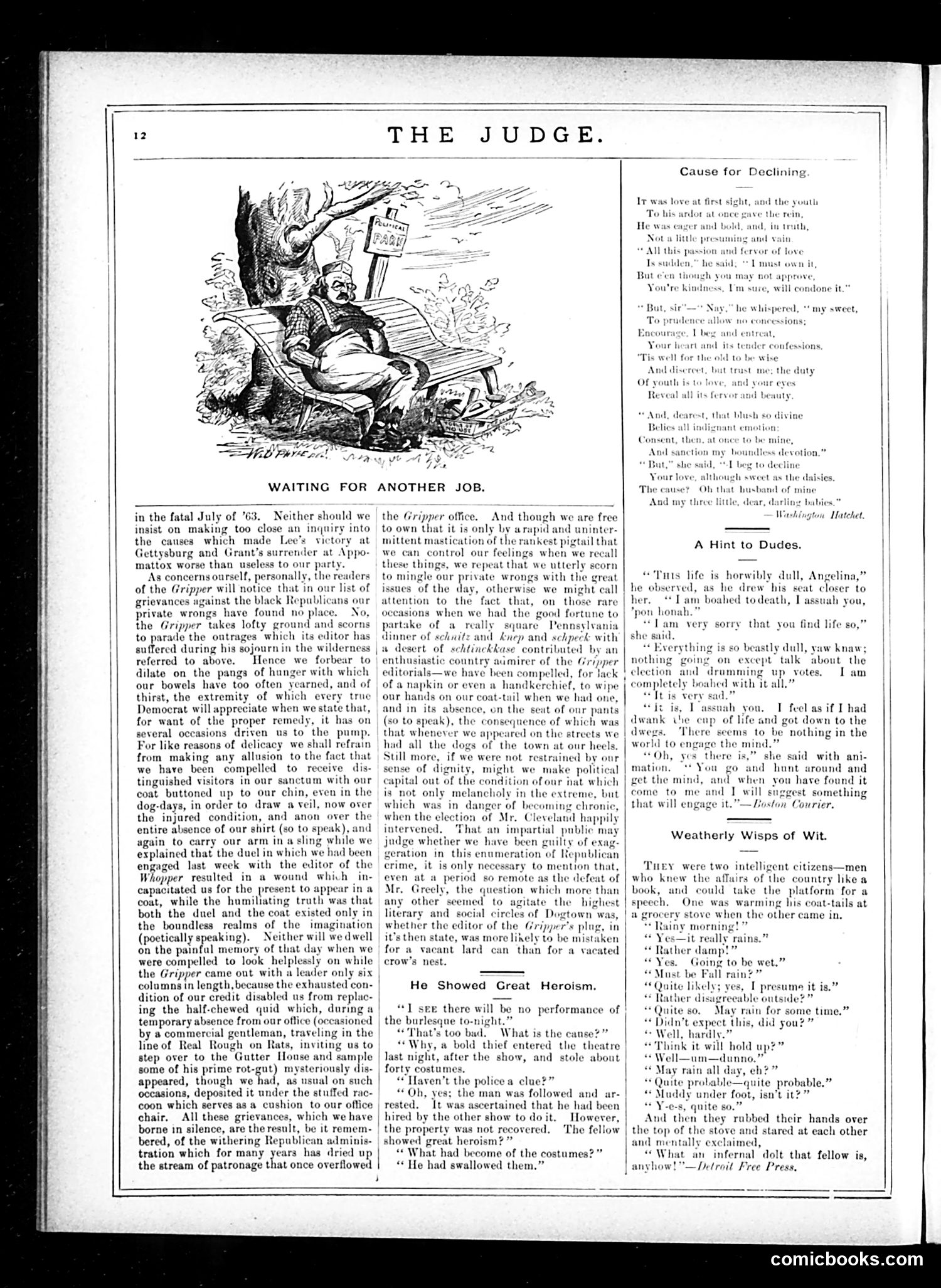
This is a satirical editorial from *Judge* magazine, likely from the 1880s, written by the magazine's editor (identified as representing the *Gripper*) complaining about Republican political dominance and loss of patronage jobs. The cartoon depicts a destitute man lounging by a tree, waiting idly—representing a Democratic office-seeker whose income dried up when Republicans held power. The lengthy text is a mock-serious complaint, filled with exaggerated self-pity about the author's hardships: hunger, unpaid debts, a torn coat, and a duel (all admittedly invented). The satire's real target: the author sarcastically claims he won't complain about *personal* losses while discussing the party's "great issues," but then does exactly that—airing petty grievances about lost patronage jobs, unpaid bills, and embarrassing circumstances. This mocks Democratic complaints about losing government positions after the Civil War and Republican electoral victories, while revealing that partisan magazine editors were primarily motivated by personal profit rather than principle.
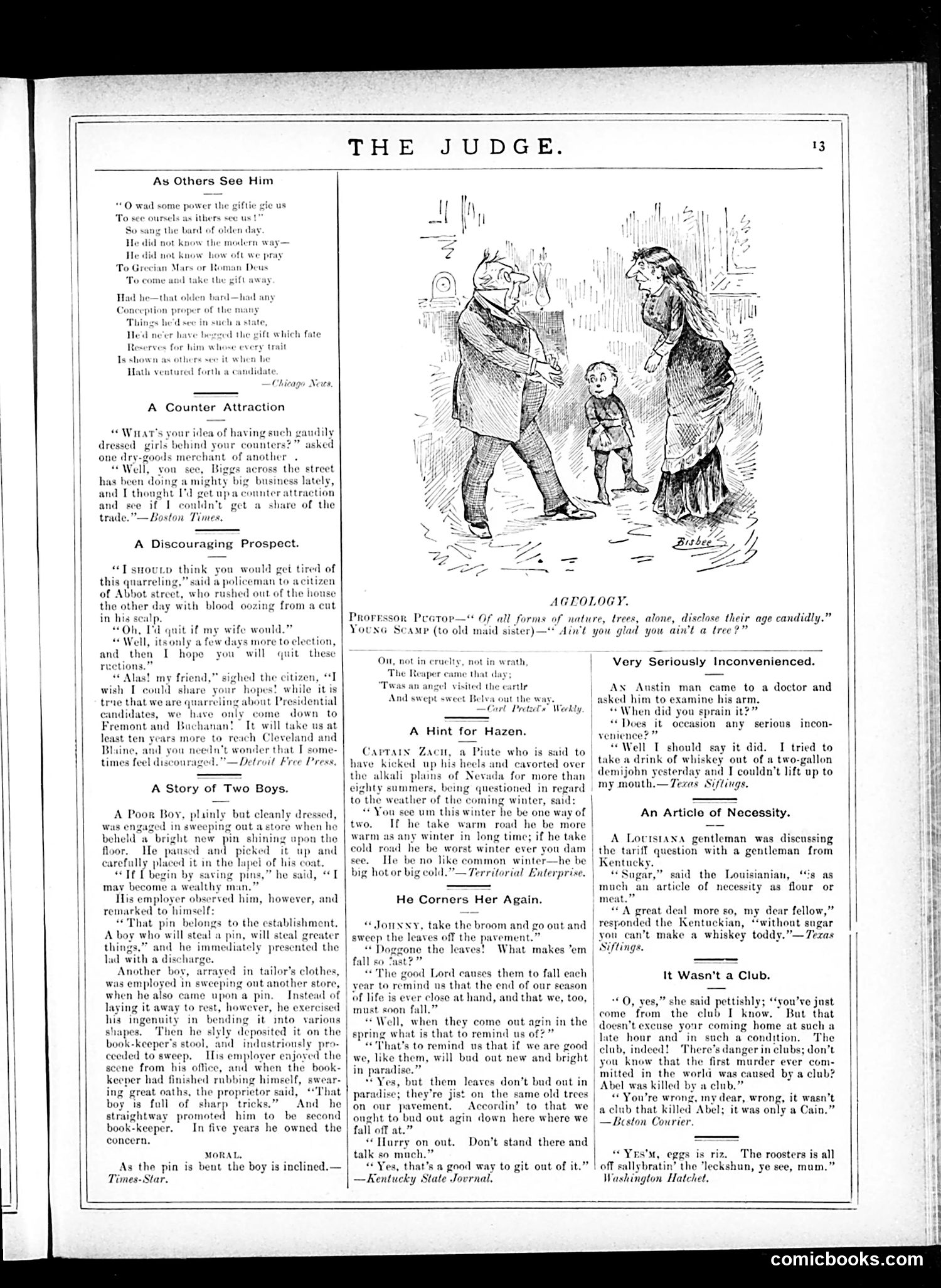
This page contains multiple short humorous pieces typical of Judge's satirical format: **Main Cartoon ("Agrology"):** Shows a professor lecturing a young boy about trees, asking if he's glad he isn't one. The joke plays on the boy's literal interpretation of nature education—a simple gag about childhood misunderstanding. **Notable Pieces:** - **"As Others See Him"**: Political commentary on candidates running for office, suggesting their public image differs from reality. - **"A Story of Two Boys"**: A moral tale contrasting two boys' responses to finding a pin—one honest but poor, one dishonest but rewarded. The ironic "moral" suggests society rewards cunning over virtue. - **"A Counter Attraction":** Urban social commentary about department stores using attractive female clerks to compete for customers. - **"A Discouraging Prospect"**: References Cleveland and Blaine (1880s electoral politics), suggesting citizens quarrel over presidential candidates like they do domestically. The page exemplifies Judge's mix of political satire, moral commentary, and light domestic humor aimed at educated readers familiar with contemporary political figures and social debates.
This page from Judge magazine consists primarily of **brief satirical quips and advertisements**, not a coherent political cartoon narrative. The humor pieces mock everyday absurdities: a candymaker's disappearance ("turn up in the Sweet-By-and-Bye"), expensive women's fashion requiring larger capital, and social observations like why unmarried paragraphers make mother-in-law jokes while married ones avoid them. Several jokes target contemporary technology adoption—Washington using bicycles to deliver telegraph messages will soon have them "playing marbles." Others mock bureaucratic overreach: telegraph companies using lawyers to force property access despite lacking legal authority. The page's satire is **gentle and domestic** rather than political—poking fun at gender relations, emerging technologies, and social pretension. The closing piece about "no Alps" appears to reference Napoleon's ambitions (unclear without full text). The content is largely **filler material surrounding advertisements** for patent medicines (Brown's Iron Bitters, consumption cures) and ladies' products—typical of 19th-century satirical publications that relied heavily on advertising revenue.
This page is primarily **advertisements and brief satirical newspaper-style quips**, typical of Judge magazine's format. The scattered humor pieces are short jokes playing on wordplay and contemporary absurdities: - A pun on "exspectation" (a man seeing his dead wife's ghost isn't scared, just "surprised") - Mock-serious reporting on trivial matters (a railroad between two towns, noting one is a prohibition town) - Social commentary on language ("Chicago English" spreading to Boston) - Jabs at journalism (Japanese reporters giving minimal typhoon coverage because they work by the day, not by piece-work) **The advertisements dominate**: Pond's Extract (patent medicine), Catarrh treatments, magic lanterns, bicycles, pianos, and lithography services. These reflect 1890s consumer products and concerns. One item mentions **Philip Armour**, the famous Chicago meatpacking magnate, worth $25 million—a reference to Gilded Age wealth concentration that Judge's readership would recognize. The page contains **no coherent political cartoon**—it's standard period magazine filler combining product ads with short jokes mocking human foibles, journalistic practices, and contemporary life.
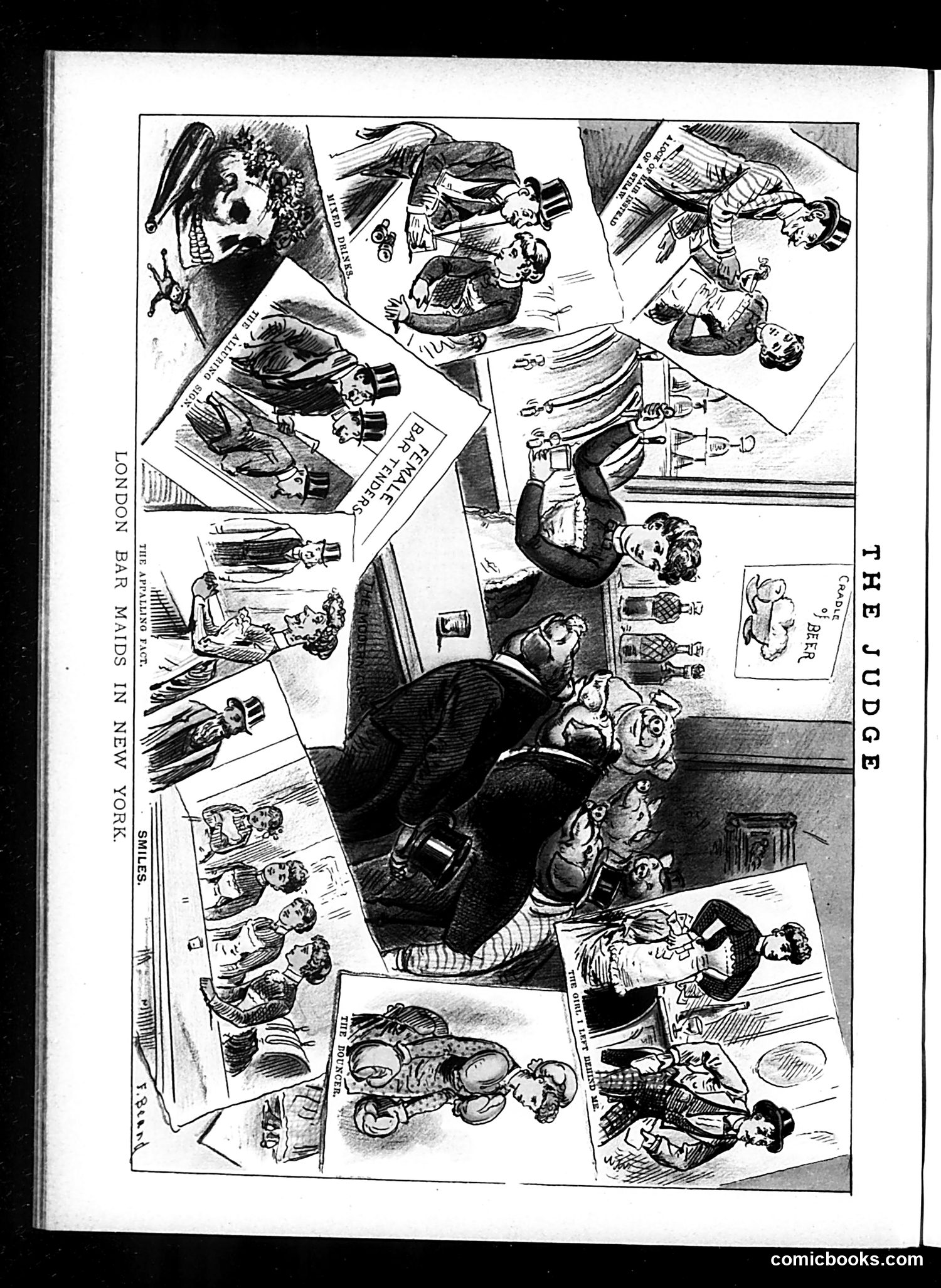
This page presents a satirical cartoon titled "The Judge" showing a well-dressed man in formal attire examining multiple illustrated cards or photographs spread around him. The figure appears to be evaluating or scrutinizing various people depicted in these smaller images. The text references "London Bar Maids in New York" and mentions "Smiles," suggesting the cartoon satirizes the importation or display of British women for entertainment or employment in America. The central figure's pose—studying the cards with apparent critical judgment—satirizes the commodification and evaluation of women as objects. The specific social commentary likely critiques either labor trafficking, the objectification of working women, or contemporary attitudes toward British immigrants in American society during this period.