
Judge, 1884-12-13 · page 2 of 16
Judge — December 13, 1884 — page 2: what you’re looking at
What you’re looking at
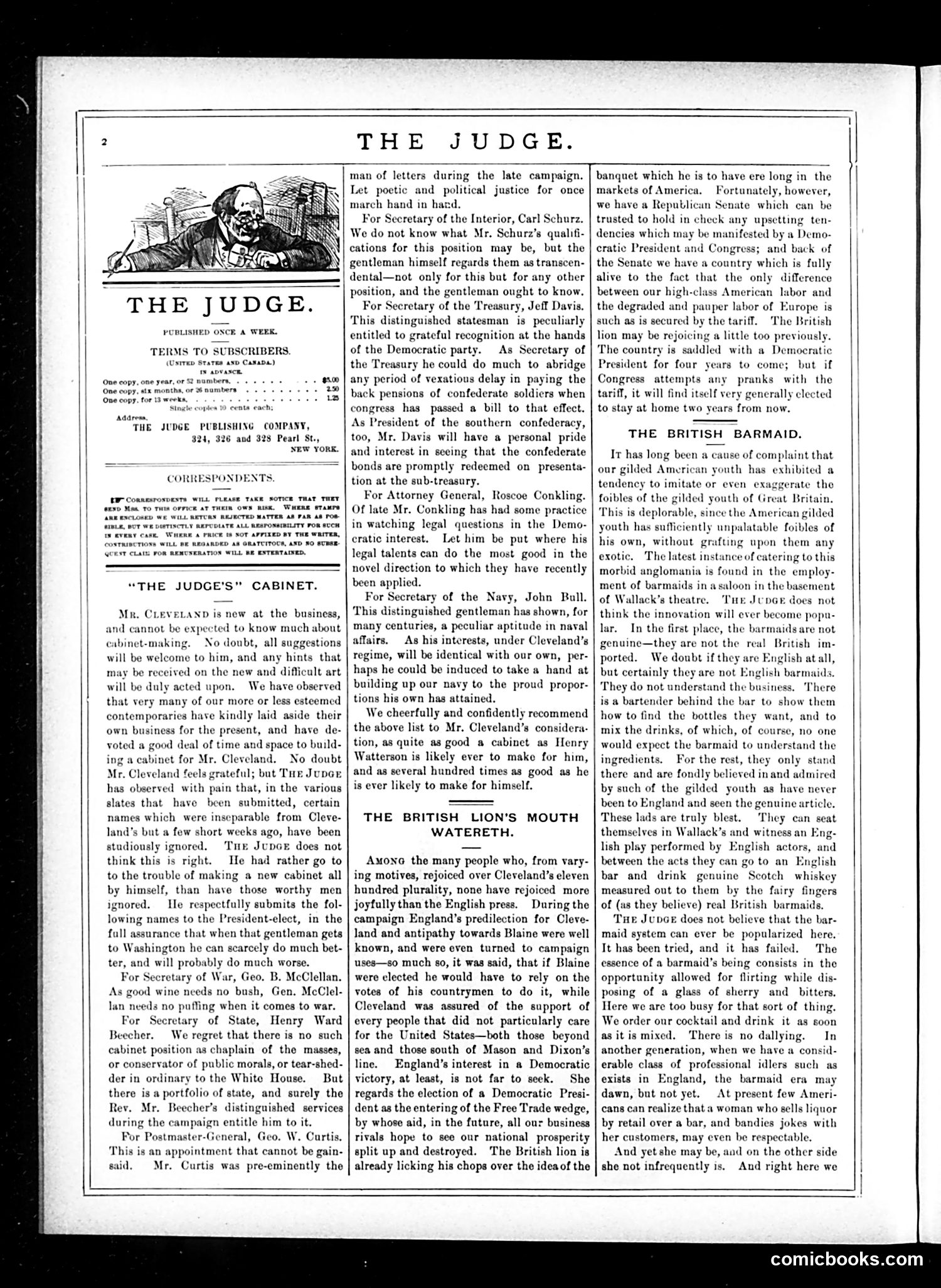
This is a satirical piece mocking President-elect Grover Cleveland's cabinet selections. Judge magazine proposes intentionally absurd and inappropriate appointees to ridicule Democratic choices. The satirical "cabinet" includes: - **Jeff Davis** (Confederate president) for Treasury—mocking Democratic leniency toward the South - **John Bull** (personification of Britain) for Navy—suggesting pro-British sympathies - **Henry Ward Beecher** (famous preacher) for State—criticizing political cronyism - **Roscoe Conkling** (Republican politician) for Attorney General—attacking recent Democratic legal positions The satire implies Cleveland is either incompetent at selecting qualified officials or compromising with unsavory elements (Southern sympathizers, foreign interests). The cartoon suggests the new administration will betray Republican/Northern interests and reward Democratic allies regardless of qualification—a common post-Civil War partisan attack on Democratic administrations.
📄 Transcribed text from this page (OCR, searchable)
Machine-transcribed from the original scan — historical spelling and the odd misread are preserved.
THE JUDGE. THE JUDGE. A WEEK. CRIBERS. p Casada.) PUBLISHED ON TERMS TO SUB: (Ustre Staves ‘One copy, one year, 6 ‘One copy, aix months One copy. for 13 weeks Address, THE JUDGE PUBLISHING COMPANY, 6 and 328 Pearl St., NEW YORK. “THE JUDGE'S” CABINET. Mr. CLEVELAND is new at the business, and cannot be expected to know much about cabinet-making. No doubt, all suggestions will be welcome to him, and any hints that may be received on the new and difficult art will be duly acted upon. We have observed that very many of our more or less esteemed contemporaries have kindly laid aside their own business for the present, and have de- voted a good deal of time and space to build- ing a cabinet for Mr, Cleveland. No doubt Mr. Cleveland feels grateful; but Tue Jupce has observed with pain that, in the various slates that been submitted, certain names which were inseparable from Cleve- land’s but a few short weeks ago, have been studiously ignored. Tne JupGE does not think this is right. He had rather go to to the trouble of making a new cabinet all by himself, than have those worthy men ignored. He respectfully submits the fol- lowing names to the President-elect, in the full assurance that when that gentleman gets to Washington he can scarcely do much bet- ter, and will probably do much worse. For Secretary of War, Geo. B. McClellan. As good wine needs no bush, Gen. McClel- lan needs no puffing when it comes to war. For Secretary of State, Henry Ward Beecher. We regret that there is no such cabinet position as chaplain of the masses, or conservator of public morals, or tear-shed- der in ordinary to the White House. But there is a portfolio of state, and surely the Rev. Mr. Beecher’s distinguished services during the campaign entitle him to it, For Postmaster-General, Geo. W. Curtis. ‘This is an appointment that cannot be gain- said. Mr. Curtis was pre-eminently the have man of letters during the late campaign. ] banquet which he is to have ere long in the Let poetic and political justice for once march hand in hard. For Secretary of the Interior, Carl Schurz. We do not know what Mr. Schurz’s qualifi- cations for this position may be, but the gentleman himself regards them as transcen- dental—not only for this but for any other position, and the gentleman ought to know. For Secretary of the Treasury, Jef Dav This distinguished statesman is peculiar! entitled to grateful recognition at the hands of the Democratic party. As Secretary of the Treasury he could do much to abridge any period of vexatious delay in paying the back pensions of confederate soldiers when congress has passed a bill to that effect. As President of the southern confederacy, too, Mr. Davis will have a personal pride and interest in seeing that the confederate bonds are promptly redeemed on presenta- tion at the sub-treasury. For Attorney General, Roscoe Conkling. Of late Mr. Conkling has had some practice in watching legal questions in the Demo- cratic interest. Let him be put where his legal talents can do the most good in the novel direction to which they have recently been applied. For Secretary of the Navy, John Bull. ‘This distinguished gentleman has shown, for many centuries, a peculiar aptitude in naval affairs. As his interests, under Cleveland’s regime, will be identical with our own, per- haps he could be induced to take a hand at building up our navy to the proud propor- tions his own has attained. We cheerfully and confidently recommend the above list to Mr. Cleveland’s considera- tion, as quite as good a cabinet as Henry Watterson is likely ever to make for him, and as several hundred times as good as he is ever likely to make for himself. THE BRITISH LION'S MOUTH WATERETH. Amono the many people who, from vary- ing motives, rejoiced over Cleveland’s eleven hundred plurality, none have rejoiced more joyfully than the English press. During the campaign England’s predilection for Cleve- land and antipathy towards Blaine were well known, and were even turned to campaign uses—so much 80, it was said, that if Blaine were elected he would have to rely on the votes of his countrymen to do it, while Cleveland was assured of the support of every people that did not particularly care for the United States—both those beyond sea and those south of Mason and Dixon’s line. England’s interest in a Democratic victory, at least, is not far to seek. She regards the election of a Democratic Presi- dent as the entering of the Free Trade wedge, by whose aid, in the future, all our business rivals hope to see our national prosperity split up and destroyed. The British lion is already licking his chops over the ideaof the markets of America. Fortunately, however, we have a Republican Senate which can be trusted to hold in check any upsetting ten- dencies which may be manifested by a Demo- cratic President and Congre and back of the Senate we have a country which is fully alive to the fact that the only difference between our high-class American labor and the degraded and pauper labor of Europe is such as is secured by the tariff. The British lion may be rejoicing a little too previously. The country is saddled with a Democratic President for four years to come; but if Congress attempts any pranks with the tariff, it will find itself very generally elected to stay at home two ye from now. THE BRITISH ‘BARMAID. It has long been a cause of complaint that our gilded American youth has exhibited a tendency to imitate or even exa; foibles of the gilded youth of Great Britain. Th ince the American gilded youth has sufficiently unpalatable foibles of his own, without grafting upon them any exotic. The latest instance of catering to this morbid anglomania is found in the employ- ment of barmaids in asaloon in the basement of Wallack’s theatre. THe JupGe does not think the innovation will ever become popu- lar. In the first place, the barmaidsare not genuine—they are not the real British im- ported. We doubt if they are English at all, but certainly they are not English barmaids. ‘They do not understand the business. There is a bartender behind the bar to show them how to find the bottles they want, and to mix the drinks, of which, of course, no one would expect the barmaid to understand the ingredients. For the rest, they only stand there and are fondly believed in and admired by such of the gilded youth as have never been to England and seen the genuine article. These lads are truly blest. They can seat themselves in Wallack’s and witness an Eng- lish play performed by English actors, and between the acts they can go to an English bar and drink genuine Scotch whiskey measured out to them by the fairy fingers of (as they believe) real British barmaids, Tue Jupce does not believe that the bar- maid system can ever be popularized here. It has been tried, and it has failed. The essence of a barmaid’s being consists in the opportunity allowed for flirting while dis- posing of a glass of sherry and_ bitters. Here we are too busy for that sort of thing. We order our cocktail and drink it as soon as itis mixed. There is no dallying. In another generation, when we have a consid- erable class of professional idlers such as exists in England, the barmaid era may dawn, but not yet. At present few Ameri- cans can realize that a woman who sells liquor by retail over a bar, and bandies jokes with her customers, may even be respectable. And yet she may be, aud on the other side she not infrequently is. Aud right here we rate the is deplorabl comicbooks.com