
A complete issue · 16 pages · 1884
Judge — November 29, 1884
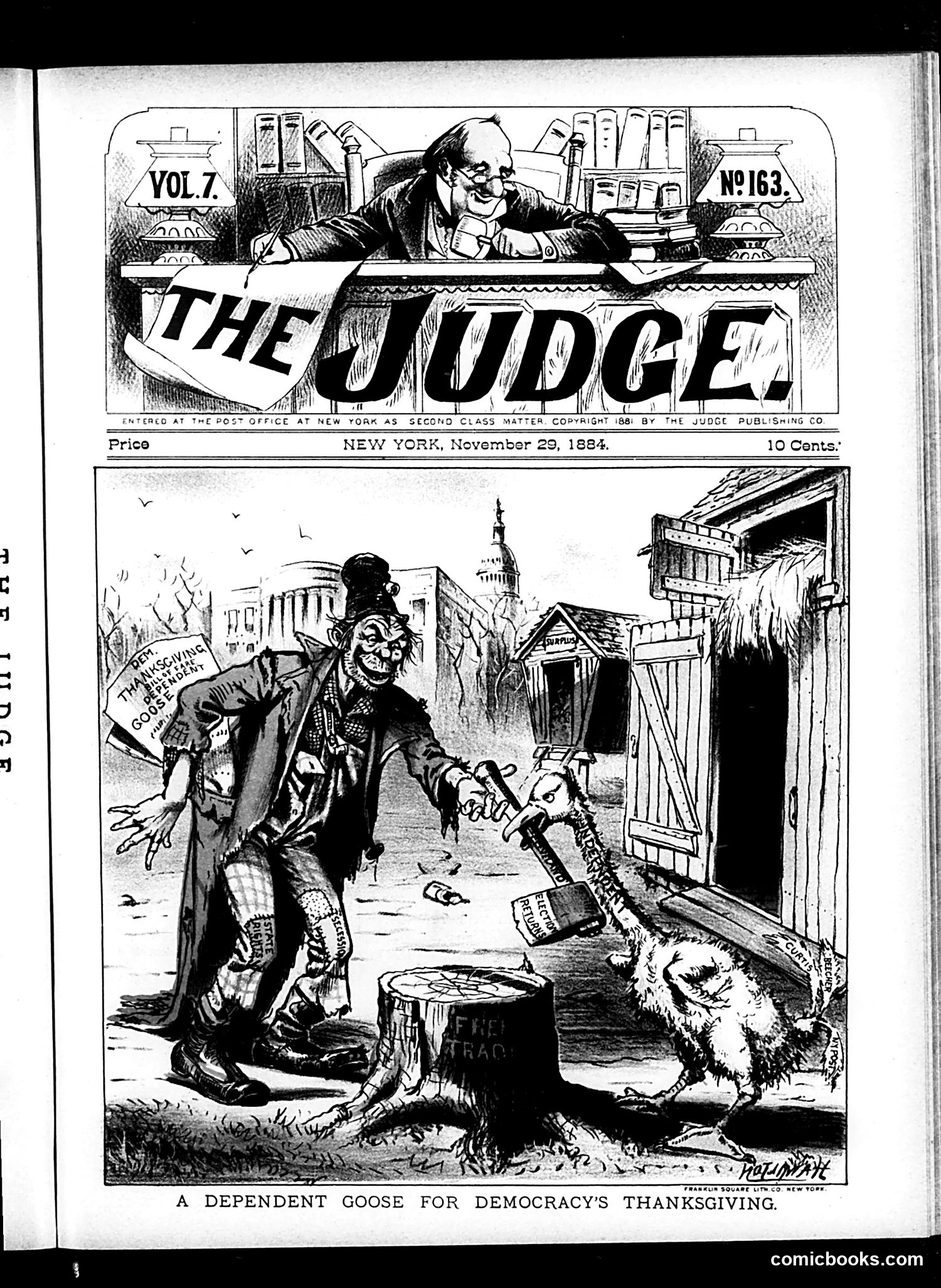
This *Judge* cartoon from November 29, 1884, uses political allegory to critique American democracy. A caricatured figure (likely representing a corrupt political boss or machine politician) stands menacingly over a goose labeled "Democracy," holding an axe. The goose clutches papers reading "Thanksgiving" and "Goods Label"—suggesting Democracy has become commodified or reduced to hollow ritual. The "dependent goose" metaphor suggests democracy is vulnerable, kept alive only at the pleasure of powerful interests. Rather than a free institution, democracy is portrayed as livestock—useful but ultimately disposable. The Capitol dome visible in the background emphasizes the betrayal occurs at government's heart. The satire warns that American democracy, by 1884, had become corrupted by political machines and reduced to mere appearance during election cycles.
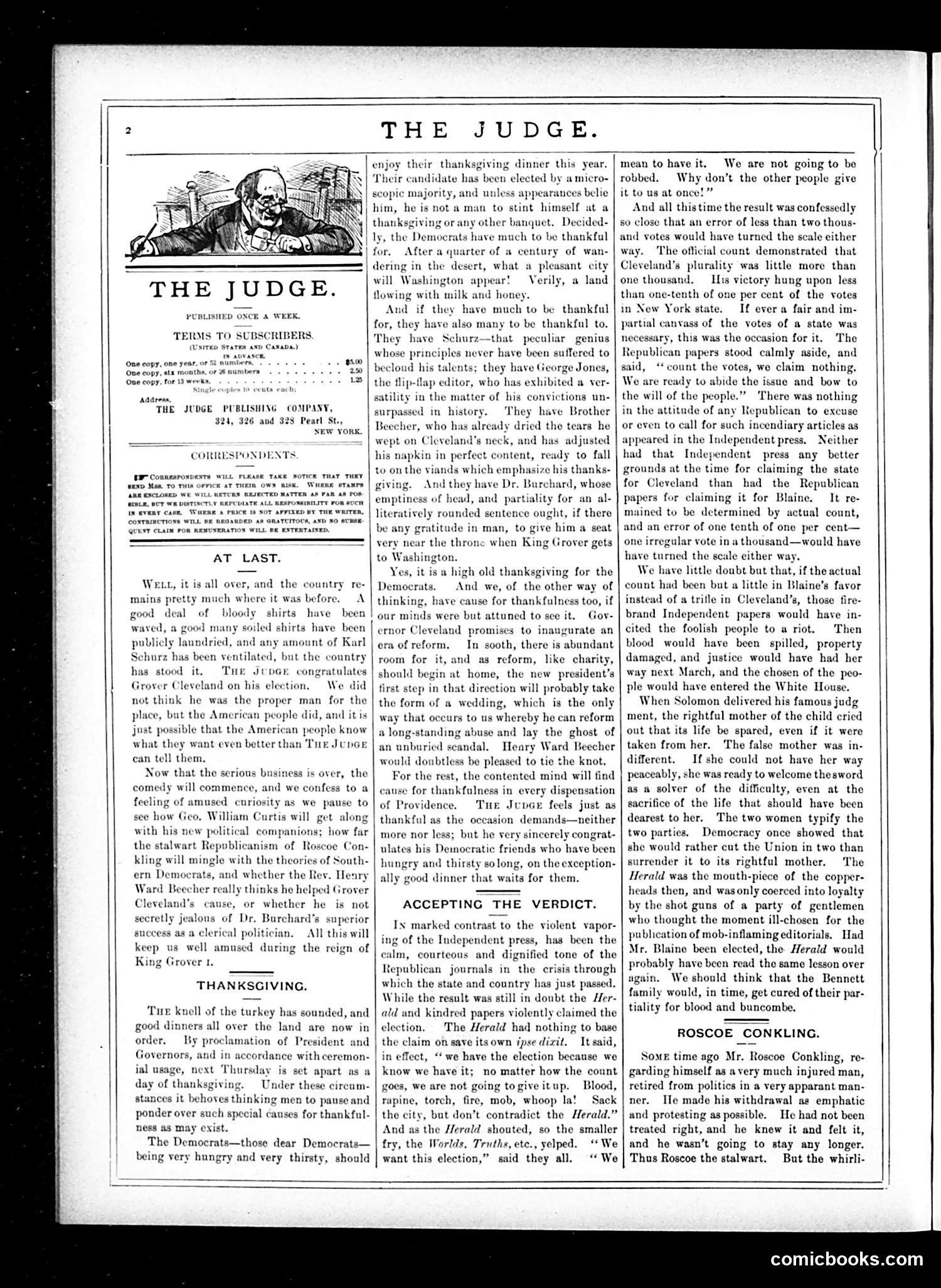
This page from *Judge* magazine celebrates Cleveland's 1884 election victory with satirical commentary on Democratic gratitude. **The Main Cartoon (top left):** Shows a portly figure (likely representing a Democratic politician) lounging contentedly—visual mockery of Democrats eager to access government positions and patronage after 25 years out of power. **"Thanksgiving" Section:** The satire lists whom Democrats should thank for their victory: **Schurz** (Liberal Republican who split the GOP vote), **George Jones** (editor whose inconsistent positions helped), and **Reverend Burchard** (whose "Rum, Romanism, and Rebellion" gaffe damaged Republicans). The piece sarcastically suggests these figures deserve credit for the narrow Democratic win. **"Accepting the Verdict" Section:** Praises Republican newspapers for accepting defeat with dignity, contrasting their restraint against Democratic papers' earlier inflammatory rhetoric. **Overall Context:** Post-1884 election; celebrates Cleveland while mocking Democratic hunger for office-holding and spoils-system benefits after long Republican dominance.
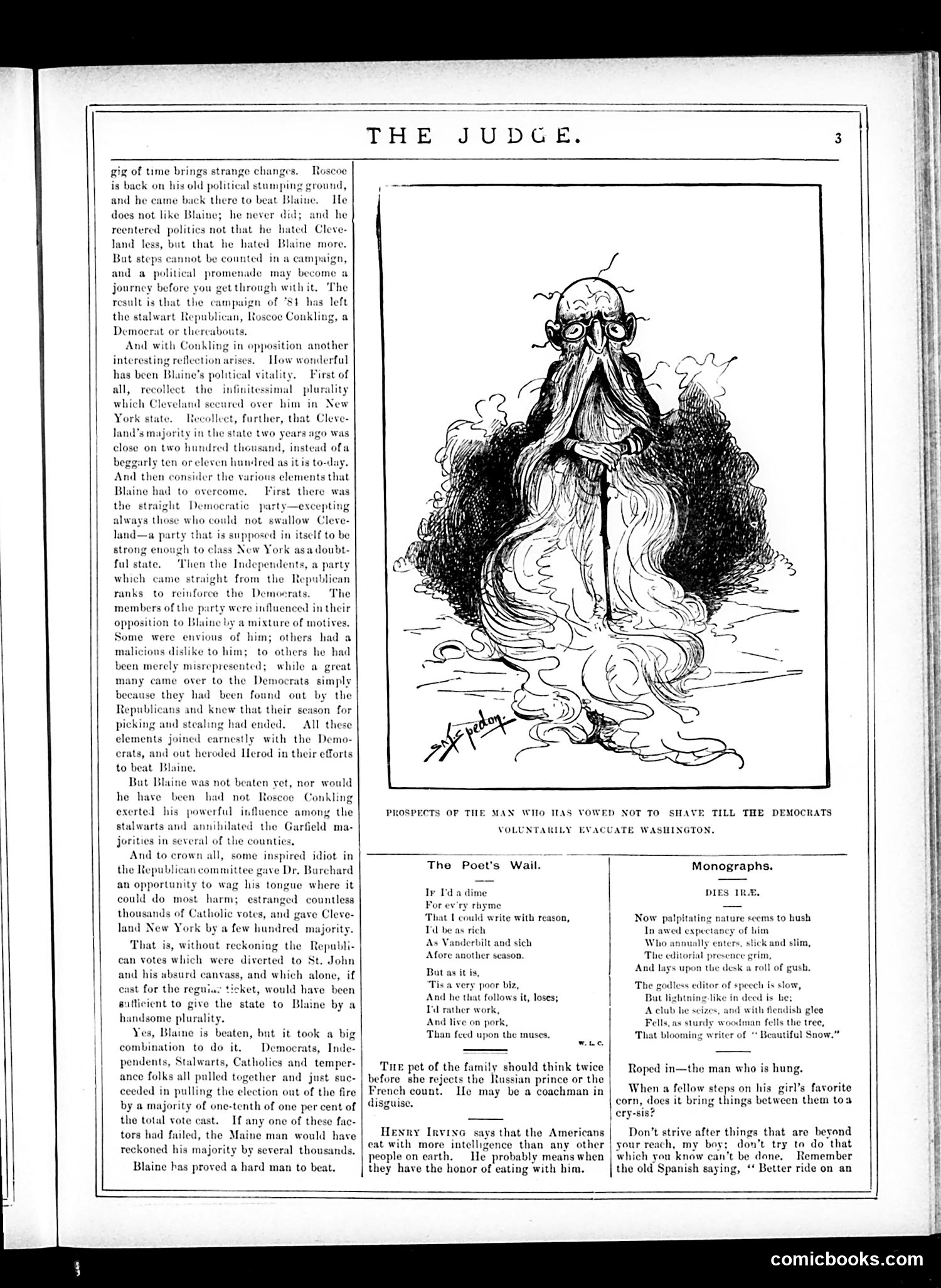
The main cartoon depicts a disheveled, wild-haired figure labeled as representing a man who "vowed not to shave till the Democrats voluntarily evacuate Washington." This is political satire about the 1884 presidential election. The accompanying text discusses James G. Blaine's narrow loss to Grover Cleveland in New York—a pivotal state. The article argues Blaine's defeat required an unusual coalition: regular Democrats, Independents (called "Mugwumps"), Stalwart Republicans (led by Roscoe Conkling), and Catholic voters angry at Blaine. The text emphasizes Blaine was a formidable candidate who "proved a hard man to beat," suggesting Republicans remained bitter about losing despite this broad opposition alignment. The cartoon mocks a Republican voter's extreme, absurd protest—refusing to shave—expressing frustration that Democrats won and would control Washington. It's satirizing the intensity of partisan feeling and the somewhat ridiculous nature of such defiant gestures against electoral outcomes.
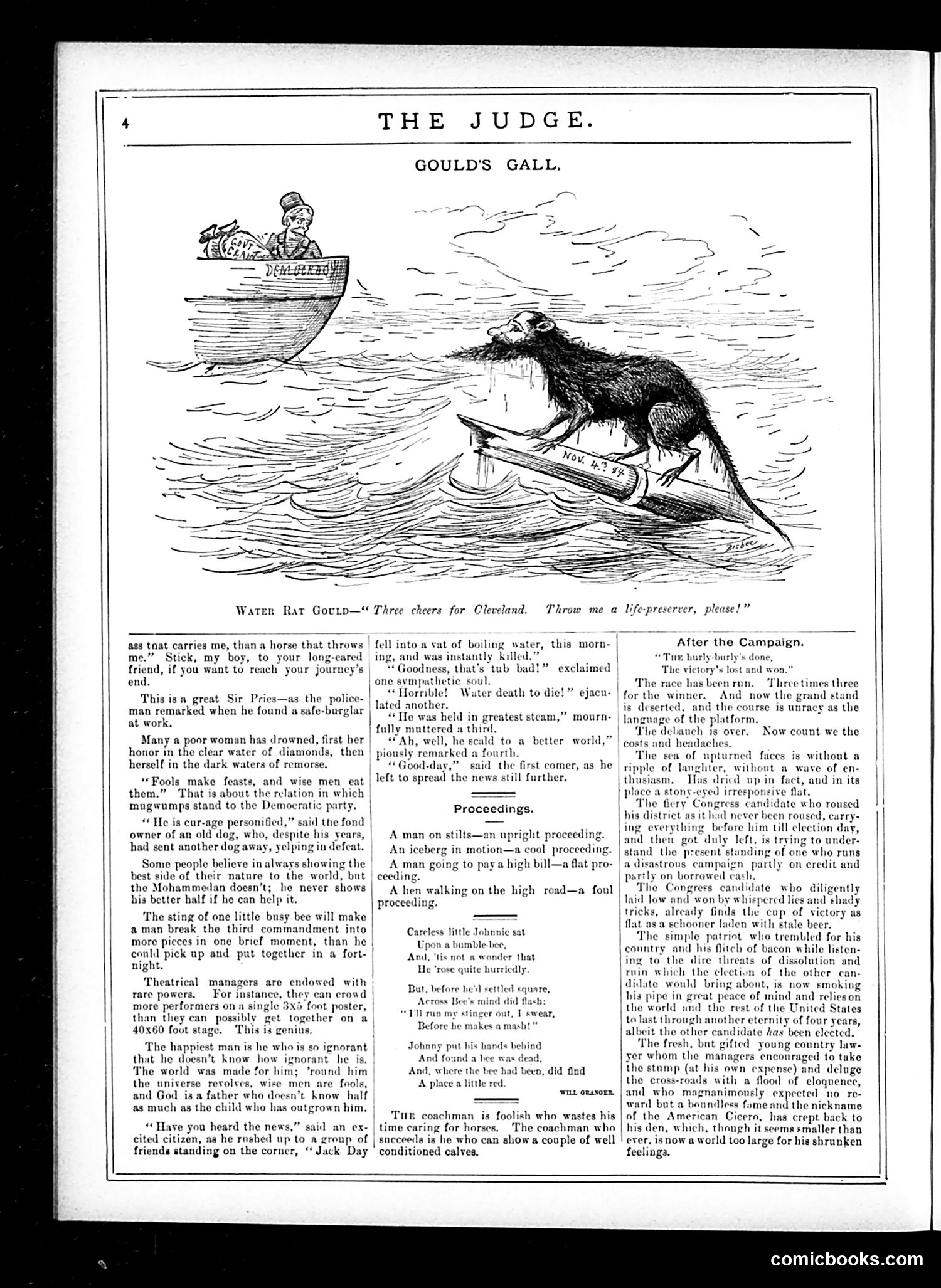
This page satirizes **Jay Gould**, the notoriously ruthless Gilded Age railroad magnate, depicted as a water rat in the main cartoon. The rat cries "Three cheers for Cleveland"—likely referring to **Grover Cleveland**—while clutching a life preserver labeled "Nov 4" (election day), as someone drowns nearby. The satire targets Gould's opportunistic political maneuvering: despite his predatory business practices, he publicly supports Democratic candidates to advance his interests. The cartoon mocks his shameless hypocrisy and self-serving activism. The page also contains miscellaneous satirical observations and jokes typical of Judge's format, including commentary on contemporary politics (references to "mugwumps" and Democratic party divisions) and social absurdities. The overall message: wealthy robber barons like Gould exploit politics for personal gain while pretending civic virtue.
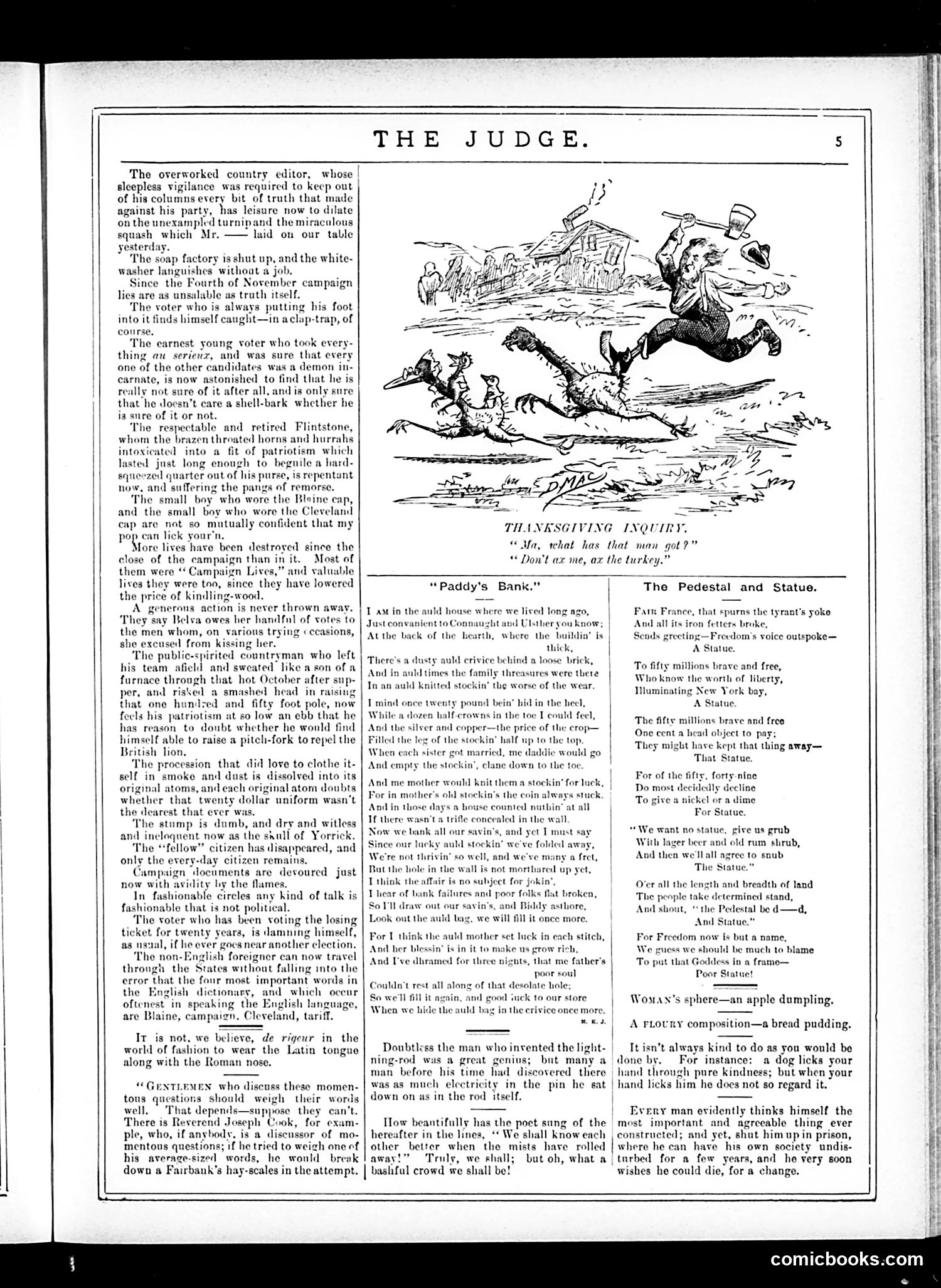
This satirical page from *Judge* magazine (likely post-1884 election) mocks the aftermath of a contentious political campaign. The left column contains witty observations about how citizens and institutions behave differently once the campaign ends—editors now publish trivial stories instead of propaganda, soap factories close because "lies are unsalable," and zealous voters lose their fervor. The central cartoon depicts what appears to be a chaotic election-day scene with figures tumbling and fighting, captioned "THANKSGIVING INQUIRIES"—satirizing the violence and disorder associated with 19th-century American elections. The right column presents poems about patriotic statues and Irish immigrant savings, mixed with humorous definitions. References to "Blaine" and "Cleveland" indicate this concerns the 1884 presidential race. The satire targets the intense, temporary patriotism campaigns generate, the corruption of the process, and how quickly public attention and moral fervor evaporate once voting ends.
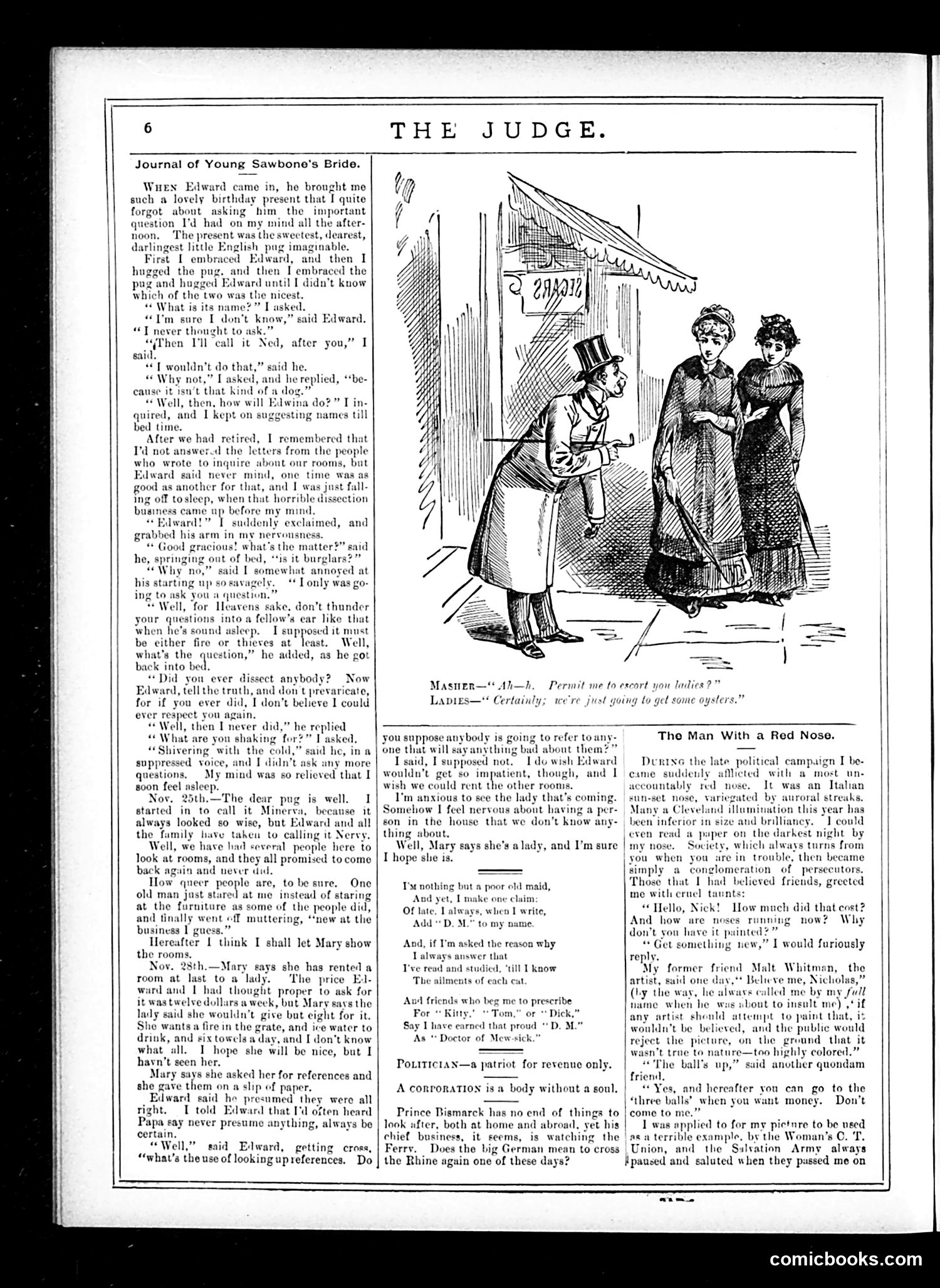
This page from *Judge* magazine contains a serialized fictional diary ("Journal of Young Sawbone's Bride") about a newlywed woman managing household concerns. The main narrative concerns her anxiety about renting rooms in their home to lodgers—a common income source for middle-class households of this era. The **cartoon** (captioned "Permit me to escort you ladies?") depicts a man in a top hat offering to escort two women, who respond they're "just going to get some oysters." This appears to be a mild social joke about unexpected encounters or forward behavior, typical of *Judge*'s light satirical humor. The **side article** "The Man with a Red Nose" mocks artistic pretension—specifically targeting an artist friend ("Malt Whitman") who attempted painting a man with a prominent red nose, claiming it was "true to nature." The satire ridicules both the artist's poor judgment and society's tendency to reject unflattering but honest depictions. Both pieces reflect *Judge*'s focus on domestic life, social etiquette, and satirizing middle-class pretensions rather than political commentary.
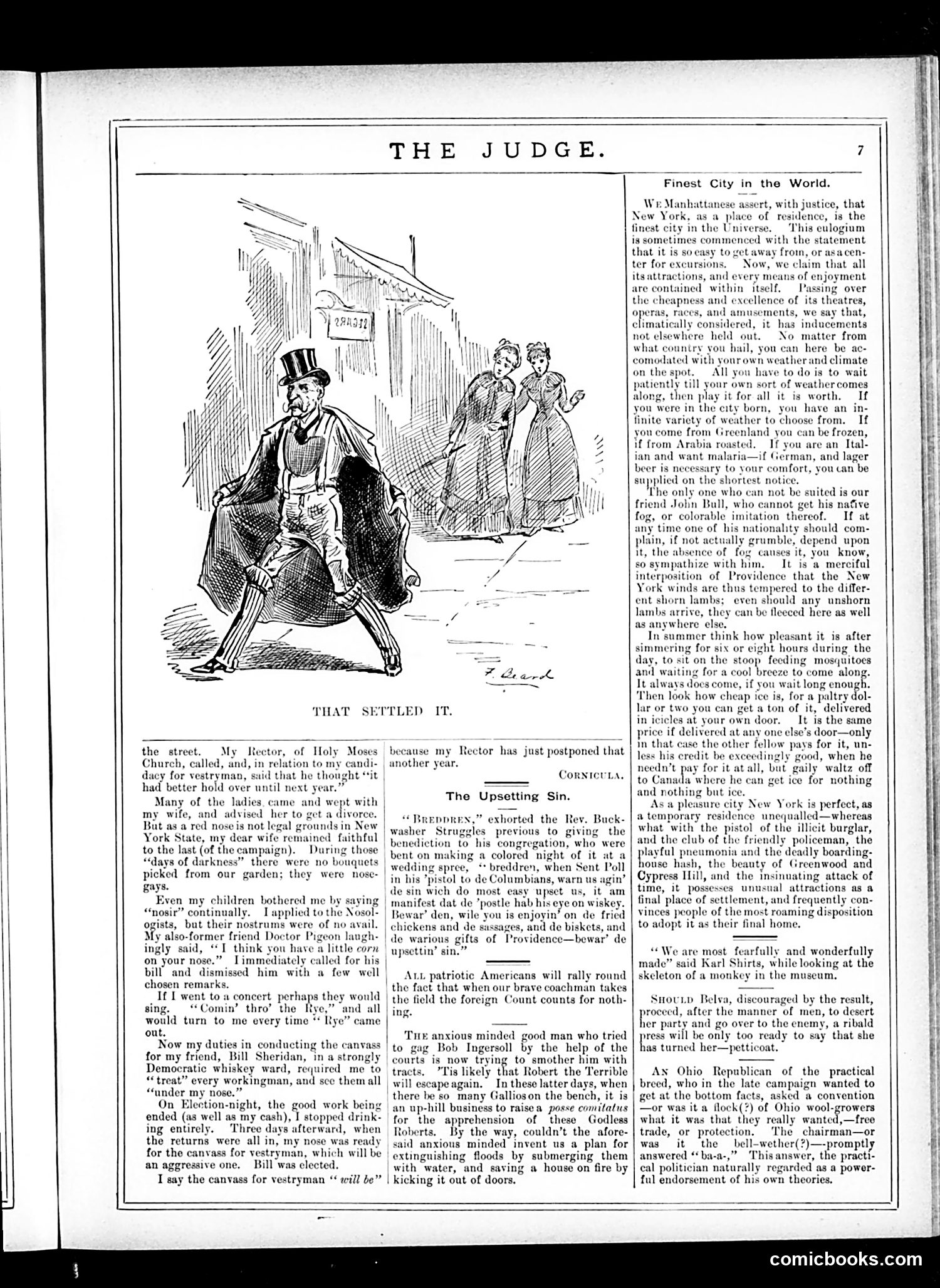
This page contains two satirical pieces mocking American social pretensions and religious hypocrisy. **Main cartoon ("That Settled It"):** A man with a notably red nose describes his humiliation during a local election campaign. After his church rector suggests he wait another year for a vestry position, locals constantly mock his nose—even his wife considers divorce. The satire targets small-town social climbing and how a minor physical flaw can destroy political ambitions, suggesting American electoral politics operates on superficial vanity rather than merit. **"The Upsetting Sin":** A mocking dialect piece where a Black preacher warns against whiskey as the "upsetting sin" while his congregation enjoys fried chicken and sausages. This racist caricature satirizes religious hypocrisy—clergy condemning vices while congregants indulge freely. Both pieces ridicule American pretentiousness: electoral self-importance in the first, religious moralizing in the second. The magazine targets how status-conscious Americans are about appearance and propriety while ignoring substantive issues.
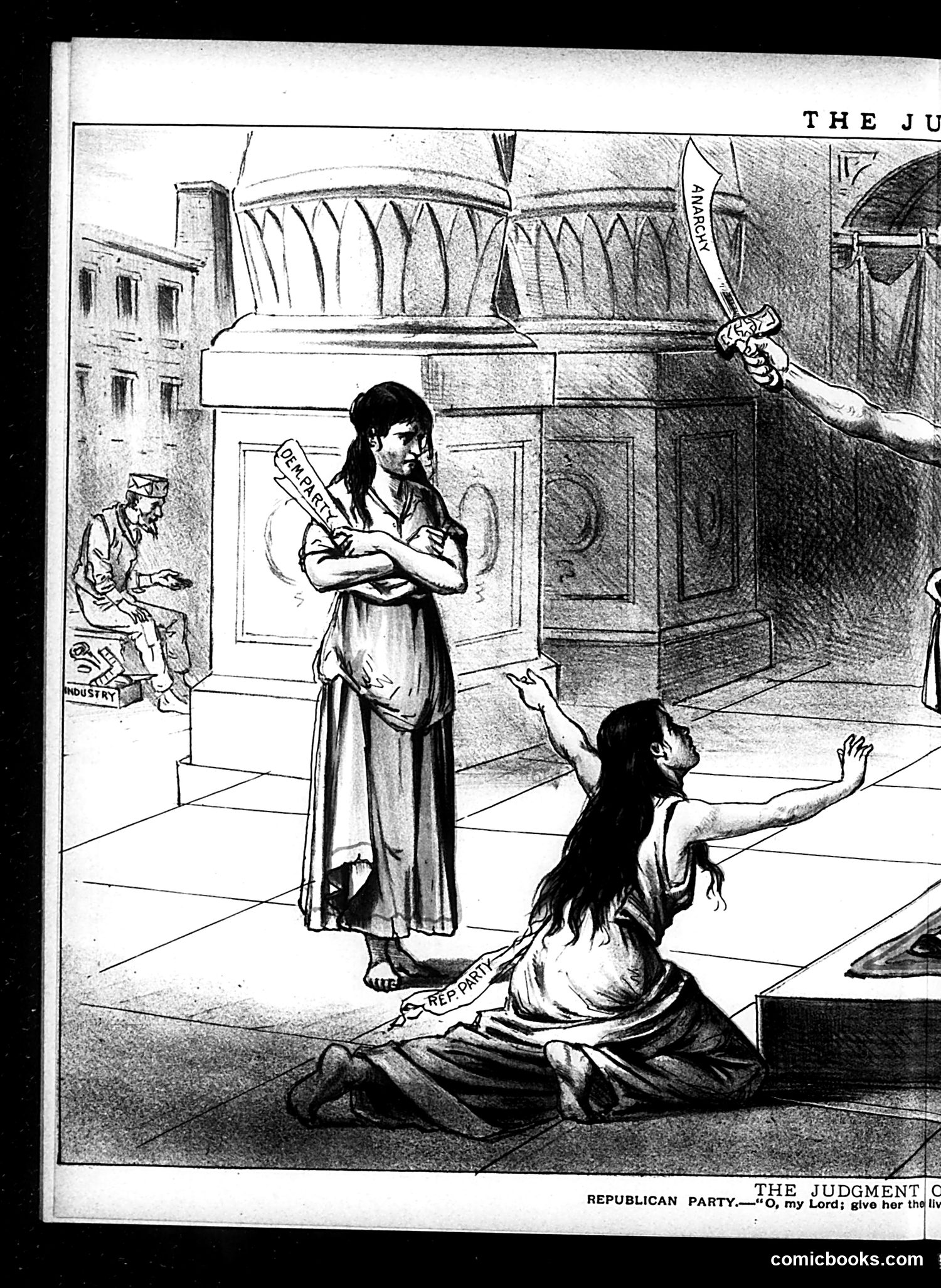
This is a satirical illustration titled "The Judgment" attacking the Republican Party. The image depicts a woman in classical dress (representing either the nation or justice) standing over a kneeling, distressed figure labeled "Republic" who clutches a document labeled "Republican Party." The caption—"O, my Lord; give her the liv[e]"—appears incomplete but suggests a prayer or plea. The cartoon uses biblical/classical imagery to critique Republican governance, portraying the Party as having brought the Republic to a state of desperation or ruin. The architectural setting and formal composition reinforce the gravity of the satire. Without the full date, the specific political moment remains unclear, though this reflects Judge magazine's Democratic-leaning editorial stance toward Republican administrations.
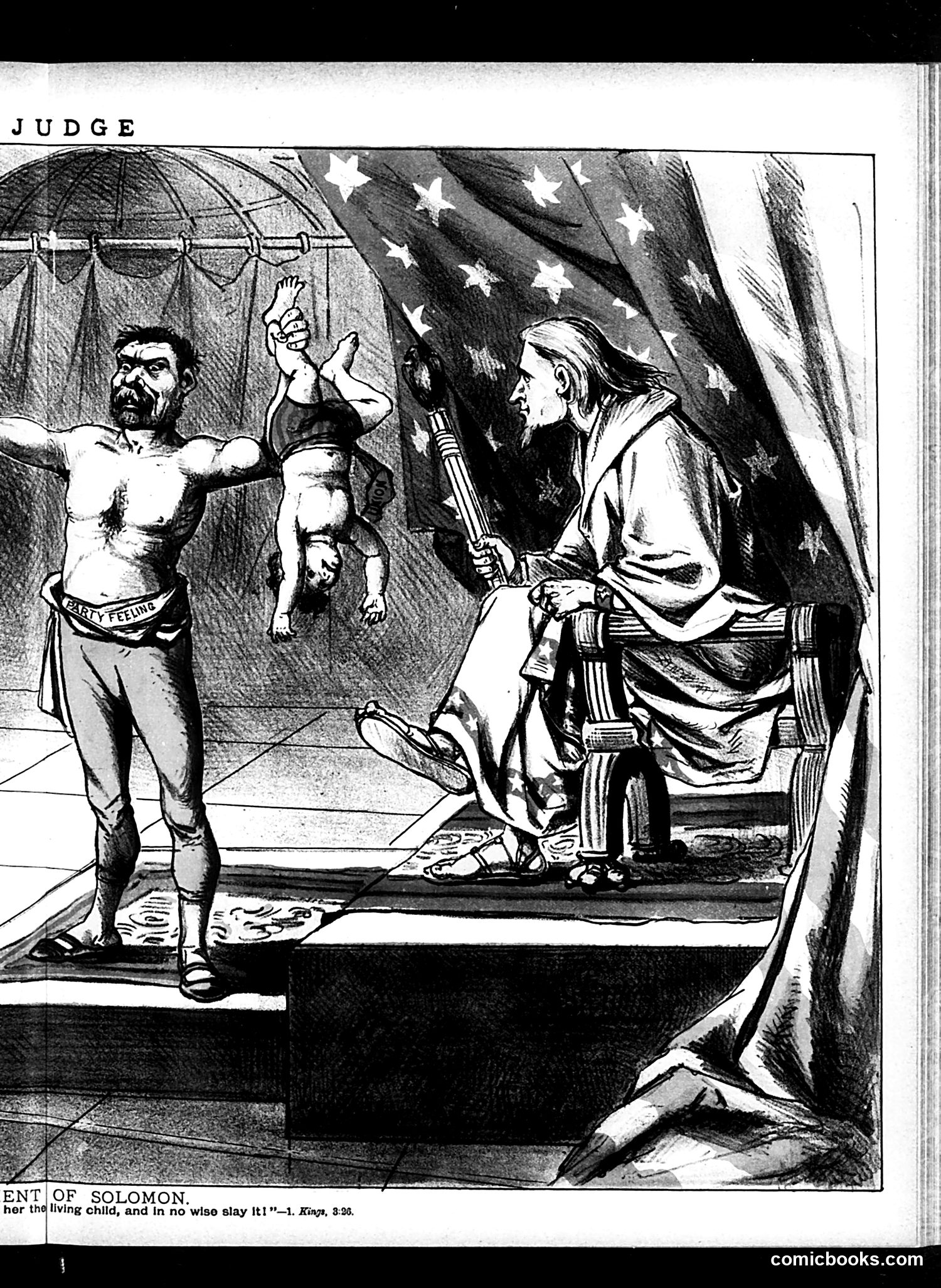
This page shows a biblical allegory cartoon titled "Judgment of Solomon." The image depicts a figure resembling a Native American or indigenous person standing before a seated judge holding a gavel, with an American flag in the background. A child appears between them. The cartoon likely references the famous biblical story where King Solomon judges between two mothers claiming the same child, determining true parentage through wisdom. Here, it appears to satirize U.S. government policy toward Native Americans and their lands or sovereignty—comparing disputed territorial or jurisdictional claims to Solomon's judgment scenario. The OCR text is fragmentary and illegible, preventing confirmation of the specific historical context or date. Without additional text, the precise political issue remains unclear, though the imagery suggests commentary on Native American affairs during Judge magazine's publication era (likely late 19th/early 20th century).
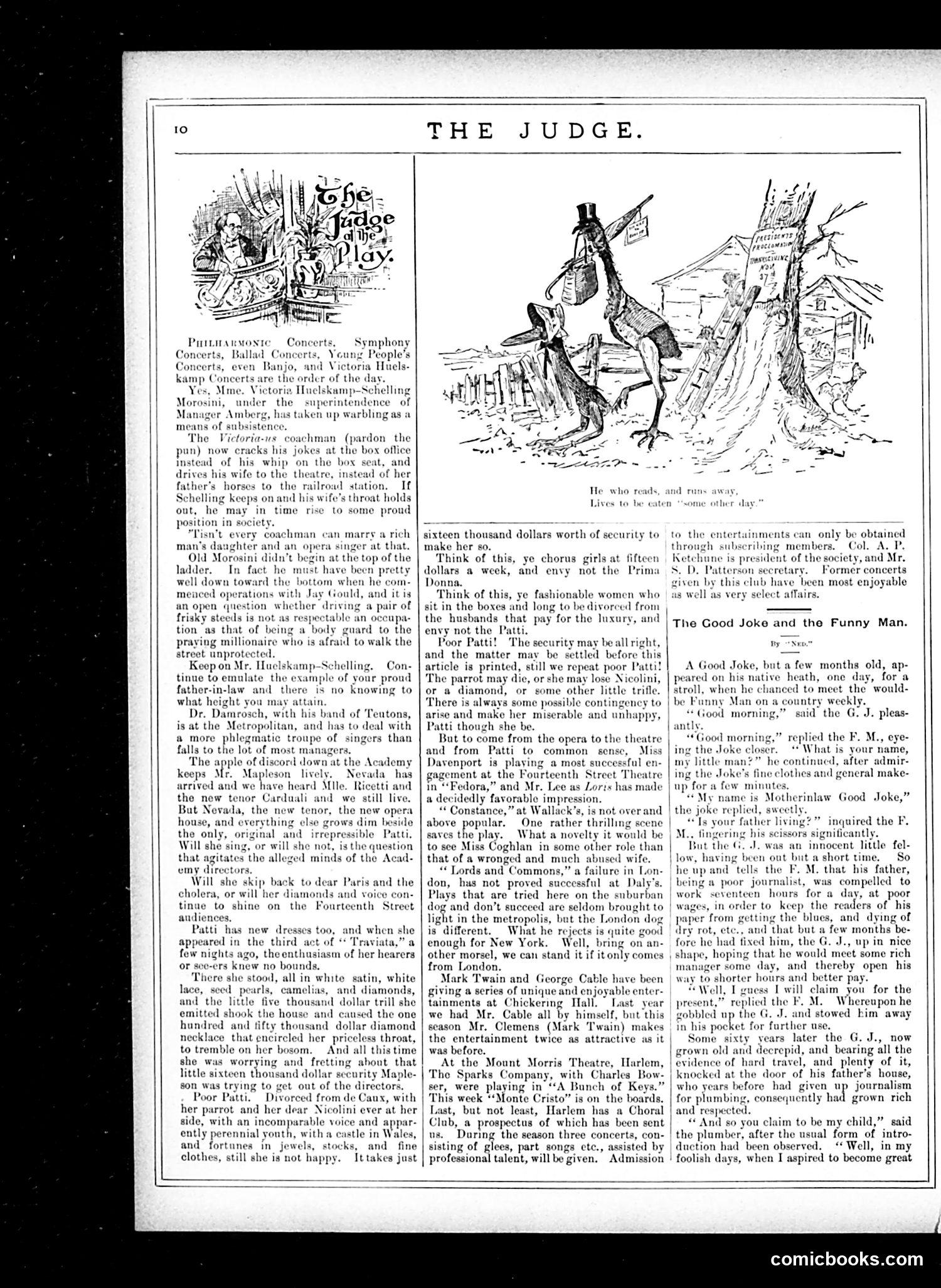
This page satirizes the New York opera and theater world of the 1880s. The main cartoon depicts two figures (likely opera singers or society figures) in distress near a collapsed building, illustrating the precarious financial circumstances of entertainers despite their glamorous public personas. The accompanying text mocks the absurdities of operatic life, particularly targeting the soprano Adelina Patti. The satire focuses on how Patti, despite her fame and earnings, remains unhappy without constant financial security—requiring "$16,000 worth of security" to function. The piece ridicules wealthy society women who envy opera singers' divorces and luxuries, and critiques the superficiality of theatrical success. References to various performers (Nevada, Damrosch's orchestra, Miss Coghlan) anchor the commentary in contemporary theatrical gossip. The overall message: beneath opera's glamorous surface lies financial anxiety and human discontent that money cannot cure.
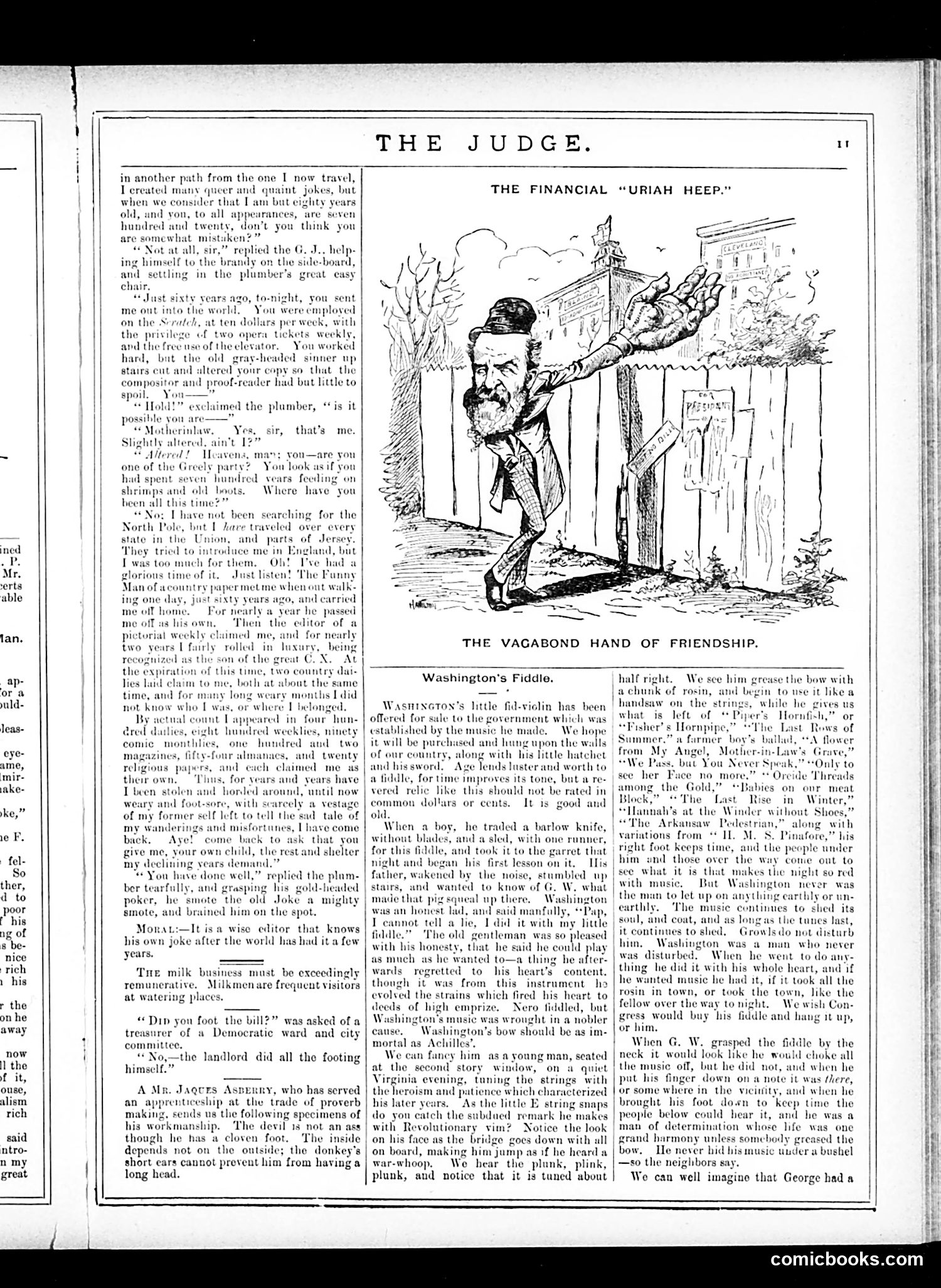
This page from *Judge* satirical magazine contains several pieces of social commentary typical of the publication's style. The main cartoon, titled "The Financial 'Uriah Heep,'" depicts a caricatured figure (likely representing a financial manipulator or con artist, alluding to the obsequious character from Dickens' *David Copperfield*) prowling near a building labeled "U.S. Bank." The image satirizes financial scheming or embezzlement. The accompanying text pieces mock various social types: a plumber who encounters an old "joke" (a pun on worn-out comic material) that has circulated so widely it's become worthless; commentary on milkmen as frequent visitors to wealthy watering holes; and a celebration of George Washington's violin. The "Washington's Fiddle" section ironically romanticizes a supposedly authentic relic—a fiddle Washington allegedly traded for as a boy—suggesting American gullibility toward patriotic memorabilia and historical artifacts, even questionable ones. Overall, the page satirizes financial fraud, journalistic theft of material, and American reverence for dubious historical relics.
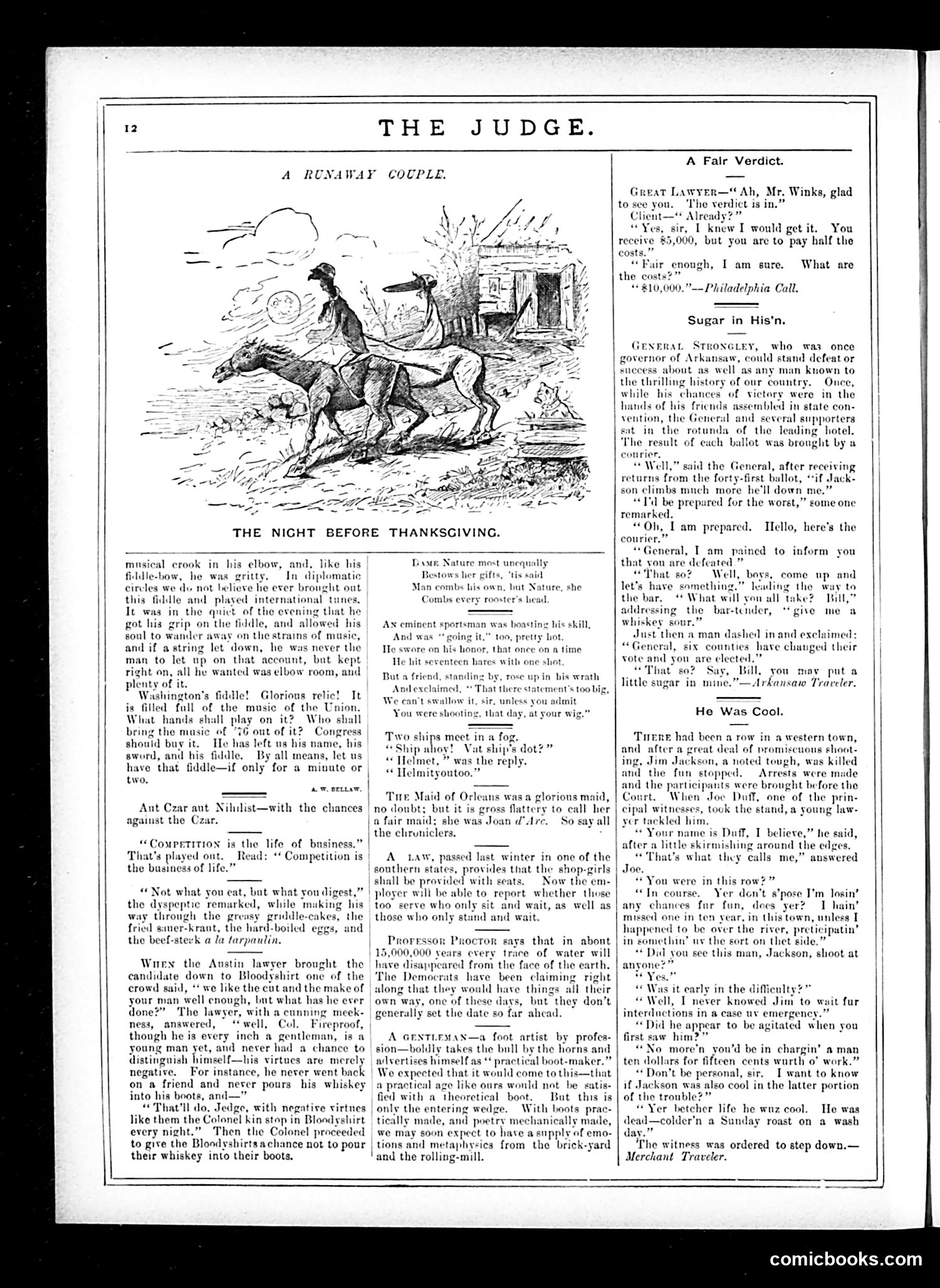
The main cartoon depicts a couple fleeing on horseback, likely eloping. The title "The Night Before Thanksgiving" suggests they're escaping family obligations or an unwanted domestic situation—a common satirical subject. The sketch style and composition emphasize their hasty departure. The accompanying humor pieces are disconnected vignettes typical of Judge's format: wordplay about "competition," anecdotes about dyspeptic lawyers, a boastful sportsman, and quips about new labor laws requiring shop-girls to have seats. The page reflects 1880s American life: legal satire, gender dynamics (shop-girls as workers), and philosophical musings presented as comic relief. Most pieces are light social commentary rather than sharp political satire—humor for middle-class readers about everyday foibles, legal absurdities, and modern changes. The "Fair Verdict" sidebar about a lawyer's fee suggests courtroom humor, another recurring Judge topic.
This page from *Judge* magazine contains several short humorous anecdotes typical of late-19th-century American satirical journalism. The pieces mock various social types and situations: **"Rights and Lefts"** jokes about election results—a candidate loses and is told he's "left" (broke/defeated) rather than "right." **"Gaunt Poverty"** satirizes wealthy Philadelphians who appear poor because they skip breakfast—mocking both class pretension and absurd assumptions about wealth. **"Majority and Plurality"** ridicules a wife's confusion about electoral terms, implying women's political ignorance while also jabbing at Republican election victories. **"He Didn't Complain"** features a Jewish immigrant businessman (indicated by heavy dialect spelling) proudly explaining his success through honest pricing—likely both sympathetic and stereotypical portrayal. **"A Difficult Task"** humorously depicts a carriage driver's trouble with a horse, playing on class differences and assumed incompetence. The page contains no illustrations visible, consisting entirely of text-based humor typical of Judge's satirical commentary on American society, politics, and immigrant communities.
This is primarily an **advertising and humor page** from Judge magazine, not a political cartoon. The content consists of: **Main Humor Sections:** - "What He Was": A comedic dialogue where a wealthy man demands a young woman's hand in marriage, then interrogates her about her family's occupations. The joke relies on class anxiety—he's horrified to learn her relatives are ordinary workers (plumber, cashier, baseball pitcher, inventor), reflecting Gilded Age snobbery about marrying "down." - Various short jokes about contemporary life, including one about a wife trusting a clock over her husband's word, and another about a hotel overcharging for writing paper. **Advertising:** The page is dominated by period patent medicine and product ads, including: - Dr. Pierce's "Golden Medical Discovery" (claiming to cure consumption) - Brown's Iron Bitters - Accident insurance - Musical watches - Various other remedies The page reflects late-19th-century anxieties about class, marriage, and the proliferation of dubious medical "cures" marketed to the public.
This page is primarily **advertising**, with some brief satirical snippets interspersed. The main content consists of patent medicine ads (Pond's Extract, Catarrh treatments, rupture cures) and commercial advertisements typical of late 19th-century publications. The satirical humor pieces are short, topical jokes about contemporary life: - **Newspaper editors**: A jab at five newspaper men running for office in New York and Chicago, losing elections—the joke being journalists make poor politicians - **Musical fashion**: Mocking the trend of painting Wagner concert scenes on piano panels, then having servants wipe off the paint - **Gender/family humor**: Light jokes about bachelor confusion regarding twins and a woman's confusion about paint colors (she thinks "carmine" describes actual paint on her dress) These snippets reflect everyday social satire rather than partisan politics. The **"Rupture Cured" and medical ads** were common in era publications, often making dubious health claims. The page demonstrates *Judge's* mix of satirical commentary on social foibles alongside commercial revenue-generating advertisements.
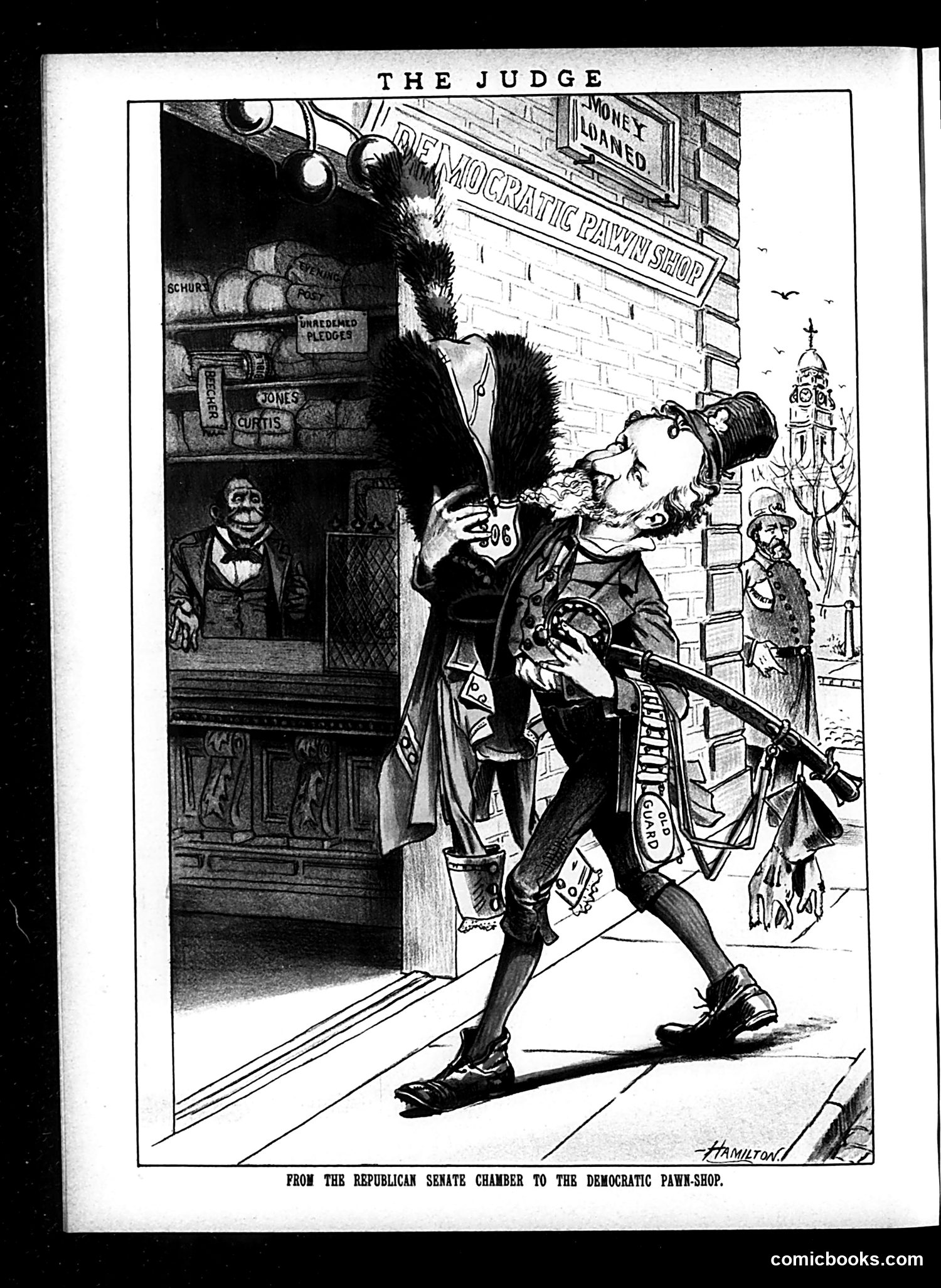
This political cartoon satirizes the Democratic Party by depicting a military or government figure being escorted from the Republican Senate Chamber directly to a "Democratic Pawn-Shop." The exaggerated caricature and the journey from one institution to another suggest the cartoonist's criticism that Democrats are corrupt or financially desperate—willing to "pawn" away principles or government assets for money. The cartoon's style and the storefronts visible in the background (including a "Democratic Pawnshop" sign) reinforce the mockery. The figure's distressed expression and the predatory large figure looming over him emphasize the satirical message. This appears to be partisan political commentary from *Judge* magazine attacking Democratic integrity and financial ethics, typical of American editorial cartooning during periods of intense partisan conflict.