
Judge, 1884-11-29 · page 13 of 16
Judge — November 29, 1884 — page 13: what you’re looking at
What you’re looking at
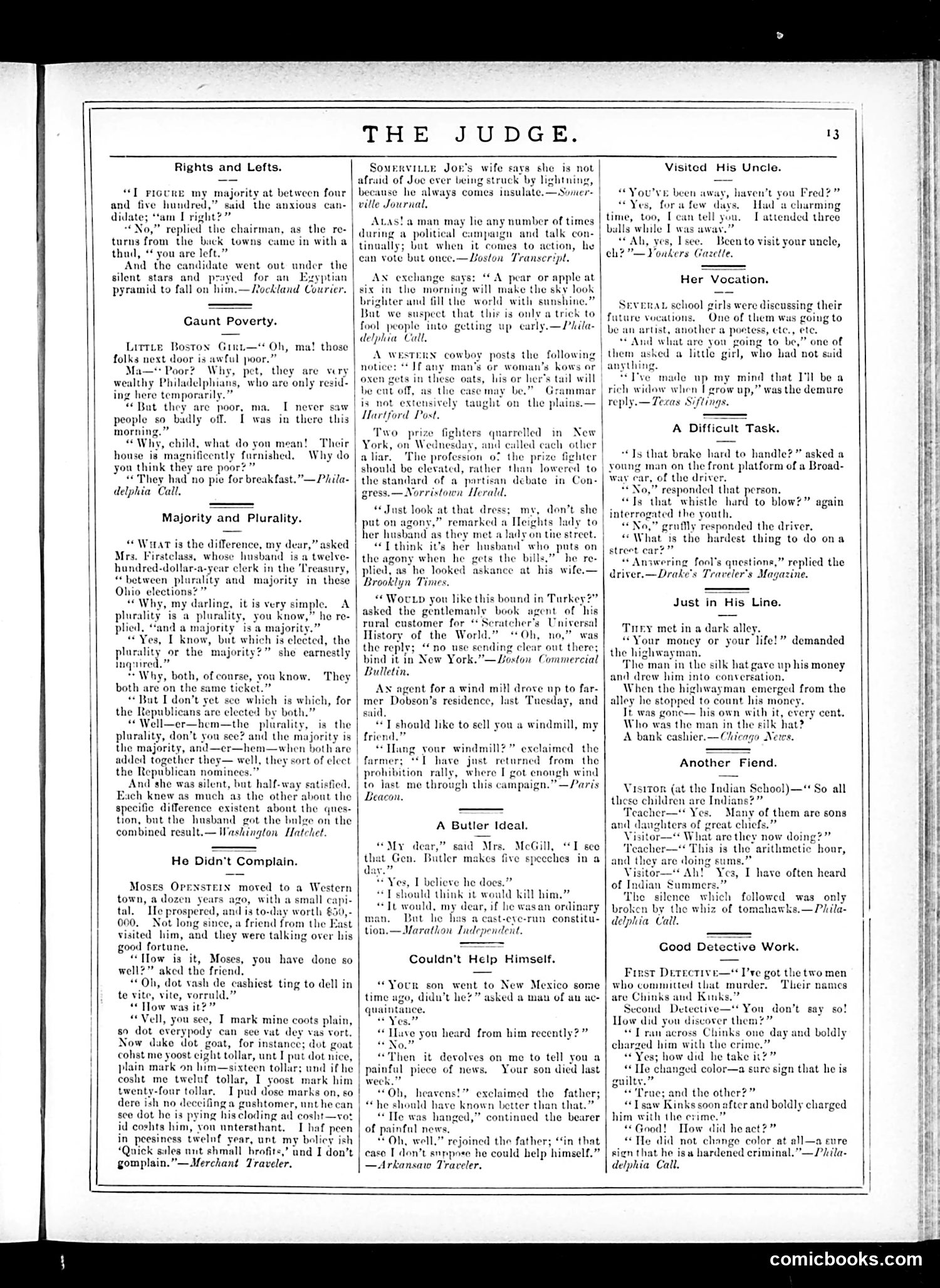
This page from *Judge* magazine contains several short humorous anecdotes typical of late-19th-century American satirical journalism. The pieces mock various social types and situations: **"Rights and Lefts"** jokes about election results—a candidate loses and is told he's "left" (broke/defeated) rather than "right." **"Gaunt Poverty"** satirizes wealthy Philadelphians who appear poor because they skip breakfast—mocking both class pretension and absurd assumptions about wealth. **"Majority and Plurality"** ridicules a wife's confusion about electoral terms, implying women's political ignorance while also jabbing at Republican election victories. **"He Didn't Complain"** features a Jewish immigrant businessman (indicated by heavy dialect spelling) proudly explaining his success through honest pricing—likely both sympathetic and stereotypical portrayal. **"A Difficult Task"** humorously depicts a carriage driver's trouble with a horse, playing on class differences and assumed incompetence. The page contains no illustrations visible, consisting entirely of text-based humor typical of Judge's satirical commentary on American society, politics, and immigrant communities.
📄 Transcribed text from this page (OCR, searchable)
Machine-transcribed from the original scan — historical spelling and the odd misread are preserved.
THE JUDGE. Rights and Lefts. “T PIGURE my majority at between four and five hundred,” said the anxious can- didate; ‘tam I right?” “No,” replied the chairman, as the re- turns from the back towns came in with a thud, “you are left.” And the candidate went out under the silent stars and prayed for an pyramid to fall on hiim.—Rockland Courier. Gaunt Poverty. Boston —* Oh, ma! thos folks next door is awful poor.” Ma— Why, pet, they are wealthy Philadelphians, who are only rez ing here temporarily “But they are poor, people so badly off. I morning.” “Why, child, what do you mean! house is magnificently furnished. you think they are poo: hey had no pie for breakfast.”—Phila- | delphia Call. LittLe ma was never saw in there this Their Why do Majority and Plurality. “Wuat is the difference, my dear, Mrs. Firstclass, whose husband is hundred-dollar-a-year clerk in the Treasury, “between plurality and majority Ohio elections?” “Why, my darling, plurality is a pluralit plic nd a majority majority Yes, t know, but which is clected, the plurality or the majority?” she earnestly inquired.” Why, both, of course, both are on the same ti * But I don’t yet h is which, for the Republicans are elected by both.” “ Well—er—hem—the plurality, don’t nd the majorit the majority, and—cr—hem—when both added together they— well, they sort of elect the Republican nominees.” And she was silent, but half-way Sach knew as much specific difference tion, but the hus combined result, A he re- it is very simple. you know,” ‘ou know. ‘They tisfied. existent abont the ques- and got the bulge on the Washington Hatchet. He Didn't Complain. Moses Op town, adozen y EIN moved to ars ago, with a small capi- tal. Ile prospered, and is to-day worth $50,- 000. t long since, a friend from the I visited him, and they were talking over his good fortun “Ilow is it, Moses, you have done so well?” aked the friend, “Oh, dot vash de cashiest ting to dell in te vite, vite, vorruld.” “Tow was it?” Vell, you see, T mark mine coots plain, so dot overypody can see vat dey vas vort. Now dake dot goat, for instance; dot goat cohst me yoost ci plain ma cosht me tweluf tollar, twenty-four tollar. I pud dose ms dere ish no deceifing a gushtomer, unt he see dot he is pying hiscloding ad cosht—v id coshts him, you untersthant. in peesiness twelnf year, unt my ‘Quick sales unt shmall brofits,’ und I don’t gomplain.”—Merchant Traveler. a Western I yoost m | tinuall Somrnrvitte Jor’s wife afraid of Joc ever being struck because he alw: ville Journal, Abas! a mann during a politi ys she is not by Lightning ys comes insulate. —Sumer- ay lie any number of times al campaign and talk con- but when it comes to action, he can vote but onc ston Transcript. AN exchange says: ‘¢ A pear or apple at ix in the morning will make the sky look brighter and fill the world with sunshine.” But we wet that thir is only a trick to fool people into getting up early. —Phila- delphia Call. very | in these | a3 the other about the | hetollar, unt I put dot nice, | on him—sixteen tollar; und ifhe | Aw not cowboy posts the following y man’s or woman's kows or ts, his or her's tail will be. nmar it on the plains. | be ent off, is not ex Hartford Po Two | pri fighters quarrelled in| New York, on Wednesday, and culled cach other aliar. The profession of the prize fighter should be elevated, rather than lowe the standard of a partisan debate in Con- gress.—Norristown Herald. “Just look at that dr put on agony,” rem her husband as they met a} “Tthink it’s her husb: the agony when 1} plied, as he looke ‘Brooklyn Pines. my, don’t she lyon the street. ul” who pnts on gets the | he re- askance at his wife.— « Wovtp you like this bound in Turkey? asked the gentlemanly book agent of h | rural customer for ‘ Scratcher’s Univers: istory of the World.” “Oh, no,” w: ply; “no use sending clear out there; bind it in New York.”—Joston Commercial Bulletin. AN agent for a wind mill drove up to far- mer Dobson’s residence, last Tuesday, and said, “T should like to sell you a windmill, friend.” oh Tung your windmill?” exclaimed the ss ave just returned from the | rally, where I got enough wind | t me through this campaign.” —Paris Beacon. my A Butler Ideal. “My dear,” M McGill, | that Gen. day. * Yes, I believe he doe: “T should think it would kill him.” It would, my dear, if he n ordinary man, But he has a cast-eve-run constitu- tion.—Marathon Independent. said “I seo Couldn't Help Himself. “Your son went to time ago, didu’t he?” ‘ew Mexico some asked a man of au ac- ‘IIave you heard from him recently?” No.” Phen it devolves on me to tell you a ainful piece of news. Your son died last ens!” exclaimed the father; ‘¢ known better than that.” nged,” continued the bearer of painful news, “Oh, well,” rejoined the father; “in that caso I don’t snppore he could help himself.” —Arkansaw Traveler, 1 to rked a Heights lady to Sutler makes five speeches in a | Visited His Uncle. “You've been away, | “Yes, forufew days, time, too, [can tell you. | balls w wav, | Ah, yes, Isee. Been to visit your uncle, | ch? "—Youkers Gazelle. ven’t you Pred?” Hada charming T attended three Her Vocation. Severat school girls were discussing their ure Vocation One of them wus going to san artist, another a poetess, ctc., ete. And what a roing to be,” one of them cd a little girl, who had not suid anythin ‘I've made up my mind that I'll be a rich widow when I grow up,” was the demure reply.—TZecas Siftings A Difficult Task. “Ts that brake hard to handle?” asked a young man on the front platform of a Broad- way car, of the driver, No,” responded that “Ts that whistle hard interrogated the youth. “No,” grufily responded the driver. “What is the hardest thing to do ona street car?” Anjwering fool's driver,—Drake's Ti erson. to blo’ again questions,” replied the aveler’s Magazine. Just in His Line. Tiry met in a dark alley. “Your money or your life! the highwayman, The man in the silk hat gave up his money and drew him into conversation, When the highwayman emerged from the alley he stopped to count his money. It. was gonc— his own with it, every cent. Who was the man in the silk ? A bank cashier. —Chicago Ne ” demanded Another Fiend. Visitor (at the Indian School) — ¢ children are Indians?” Many of them are sons “So all are they now doing?” This is the arithmetic hour, loing sums.” Yes, I have often heard 1 Summers,” lence which followed was only broken by the whiz of tomahawks.—Phila- delphia Call. Good Detective Work. Finst Detective—‘* I’ve got the two men who committed that murder. Their names are Chinks and Kinks.” cond Detective—‘* You don’t say How did you discover them?” “Tram across Chinks one day and boldly ed him with the crime.” how did he take “Tle changed color—a sure sign that he is guilty.” “True; and the other?” Kinks soon after and boldly charged th the crime. “Good! Tow did he act?” “Tle did not change color at all—a eure g he isa hardened criminal.”—Dhila- delphia Call. so! comicbooks.com