
A complete issue · 16 pages · 1884
Judge — November 15, 1884
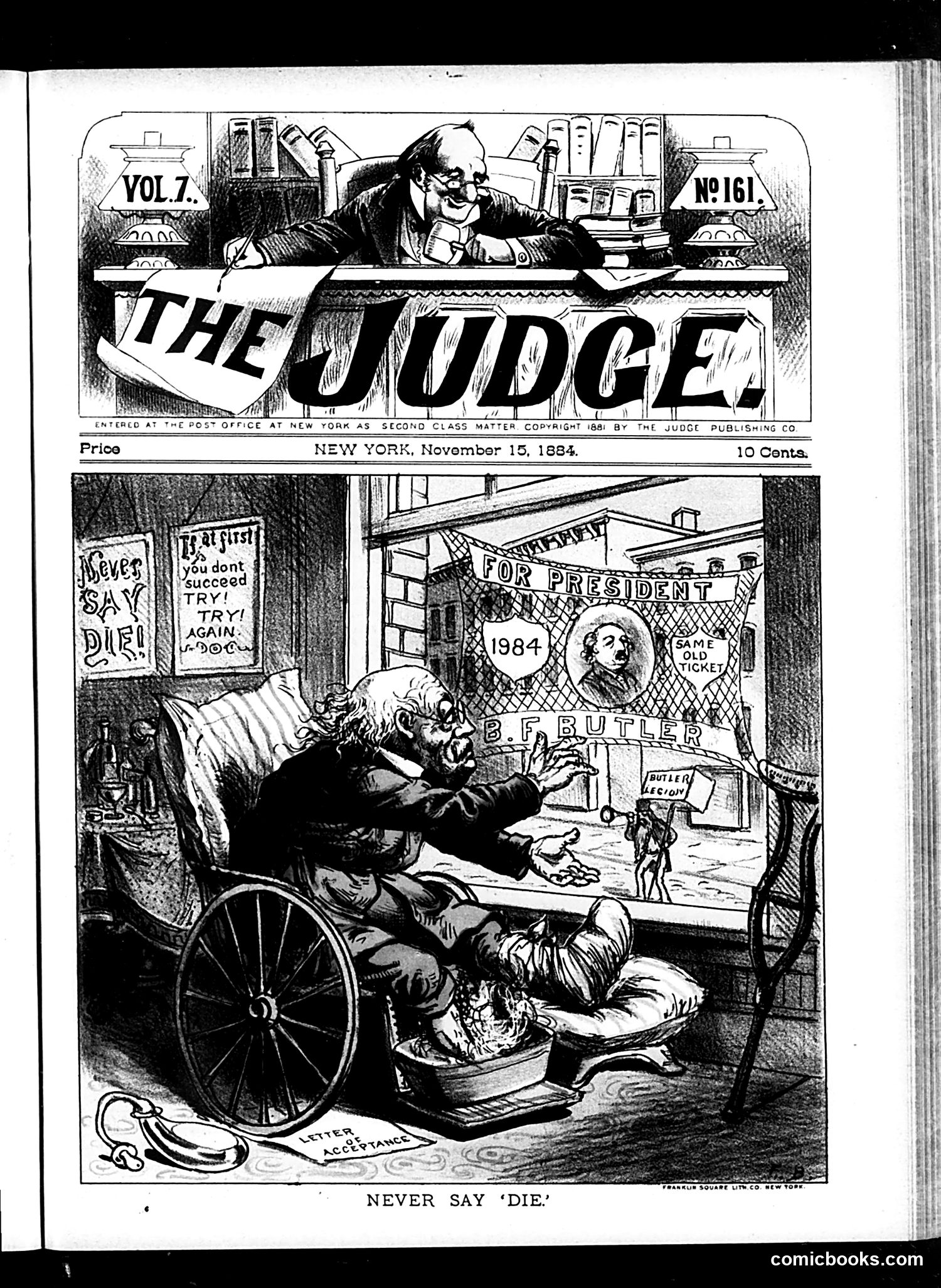
The main cartoon, titled "Never Say 'Die,'" depicts a destitute figure in a rickshaw viewing a campaign poster for "B. Butler" as president in 1884. The scene satirizes Benjamin Butler's failed presidential campaign that year. The man's signs reading "Never Say Die" and "Try! Try Again!" mock Butler's persistence despite poverty and apparent lack of public support. The "Letter of Acceptance" on the ground reinforces this theme of dogged determination against odds. The header illustration shows the magazine's editor at his desk, a standard feature for Judge magazine during this period. The cartoon critiques Butler's quixotic political ambitions during the contentious 1884 election, using the struggling beggar as a metaphor for his candidacy's hopelessness.
This page appears to be from the 1884 presidential election aftermath. The main editorial discusses the extremely close New York result that determined whether **James G. Blaine (Republican)** or **Grover Cleveland (Democrat)** won the presidency. Judge, a Republican publication, initially expected Blaine's victory by "a small plurality," though the actual outcome (Cleveland won) is already evident in the text's conceding tone. The satirical content mocks those who "backed the wrong horse"—presumably Cleveland supporters—while praising the American public's willingness to accept the democratic result peacefully. References to Cleveland's "unsavory private character" allude to his well-known illegitimate child scandal that dominated the campaign. The page emphasizes that only "official count" and "authoritative figures" matter legally, reflecting the real uncertainty and contested nature of this historically significant election.
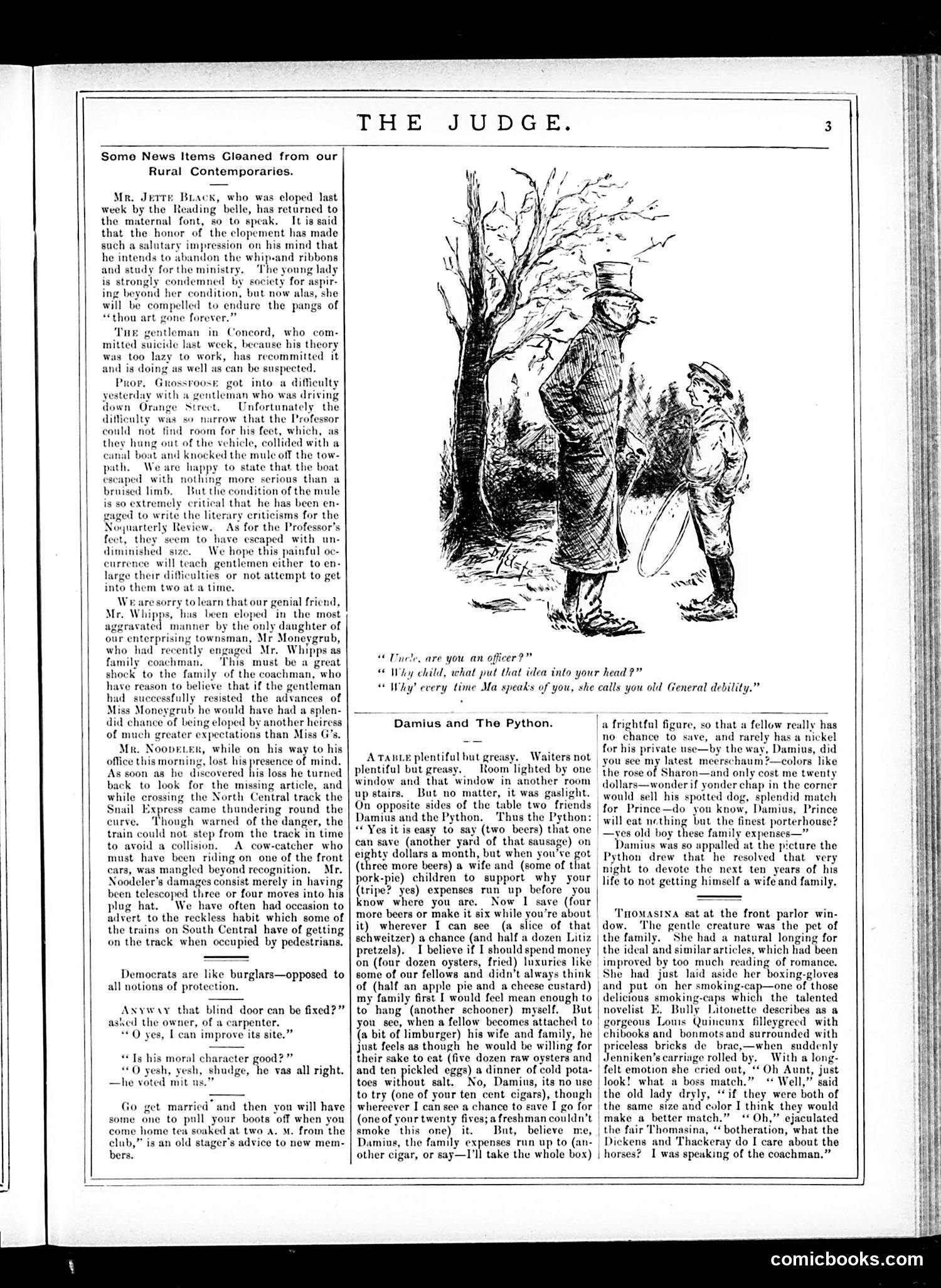
This page from the satirical magazine **Judge** contains two main sections: **Left column:** Rural humor items mocking small-town scandals and absurdities—elopements, a man who recommitted suicide, a professor knocked off a carriage into a canal, and a gentleman struck by a train while crossing railroad tracks. The humor is crude physical comedy and social mockery typical of rural gossip. **Right side:** A cartoon titled "Damius and the Python" showing two men dining poorly. Below it, dialogue depicts a child calling an officer "old General debility"—a pun on the medical term for weakness. The cartoon satirizes the contrast between claiming to save money on meager wages while frequenting expensive restaurants. The page's satire targets rural pretension, reckless behavior, and working-class financial self-deception. The final political quip equates Democrats with burglars opposing "protection" (likely a tariff reference). This is representative of Judge's style: crude, class-conscious humor mixing physical comedy with contemporary political jabs.
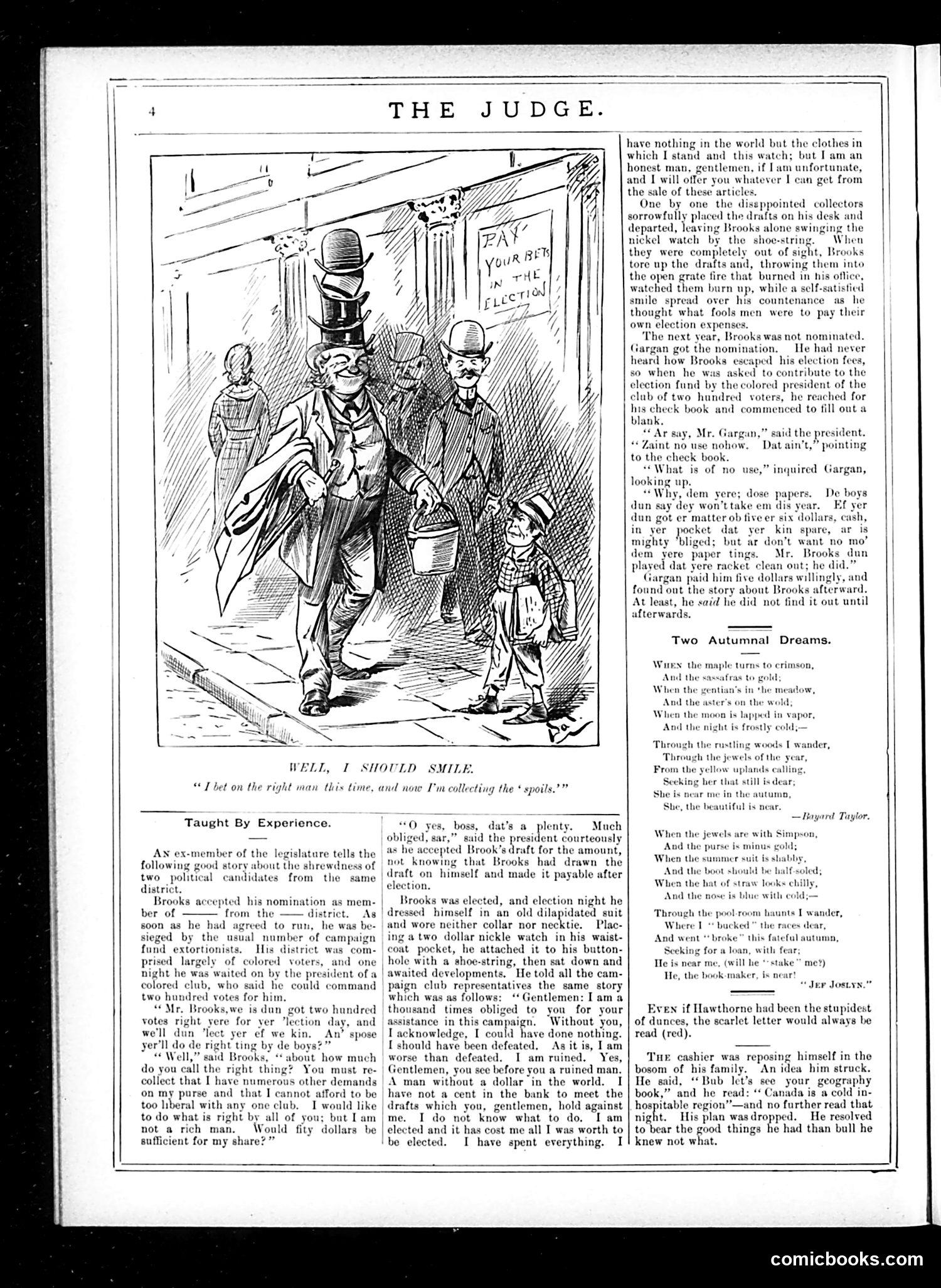
This page satirizes electoral corruption and the exploitation of political candidates by campaign operatives. The main cartoon illustrates a story about two rival candidates, Brooks and Gargan, and their encounters with a Black political club president demanding campaign contributions. **The Satire:** Brooks, elected to office, poses as a pauper—wearing shabby clothes and a cheap nickel watch on a shoelace—to convince campaign creditors he cannot pay them. They sorrowfully leave, and he burns their drafts. The next year, Gargan, the new candidate, attempts the same trick, but the club president has learned Brooks's scheme and demands cash instead, which Gargan reluctantly pays. **The Point:** The cartoon mocks the dishonest tactics both politicians use to avoid legitimate campaign expenses, while also satirizing the transactional nature of electoral politics where voting blocs demand payment for their support. The humor targets the candidates' desperation and deception rather than endorsing it.
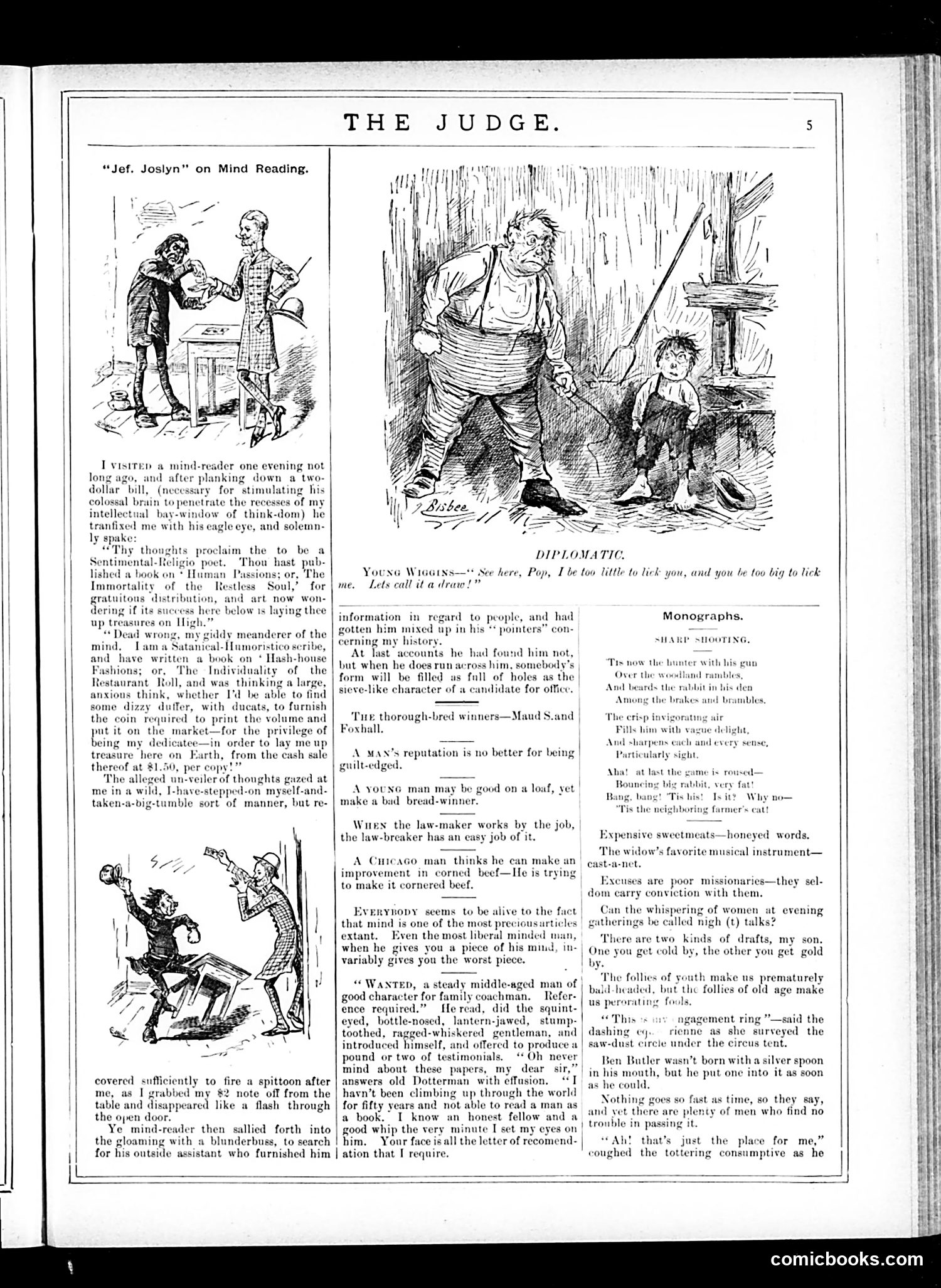
This page contains humorous sketches and short satirical pieces typical of 1880s-90s American magazine humor. **"Jef. Joslyn on Mind Reading"** mocks both spiritualism and vanity publishing. A narrator visits a mind-reader who, after extracting two dollars, makes grandiose claims about the visitor's character—only to be completely wrong. The joke: the "mind-reader" reveals himself as a charlatan when the narrator actually wants money from *others* to publish his own book at their expense. The final detail—the mind-reader attacks with a spittoon—adds slapstick absurdity. **"Diplomatic"** shows a small boy proposing a truce to a larger man, using diplomatic language ("Let's call it a draw"). The satire comments on how weaker parties negotiate with stronger ones, likely referencing international diplomacy of the era. **"Monographs"** presents brief, cynical one-liners on society—observations about reputation, excuses, women's gossip, drafts (both wind and financial), and courtship. These are generic social commentary rather than topical satire. The page represents **Judge**'s typical mix of visual humor and sardonic social observation.
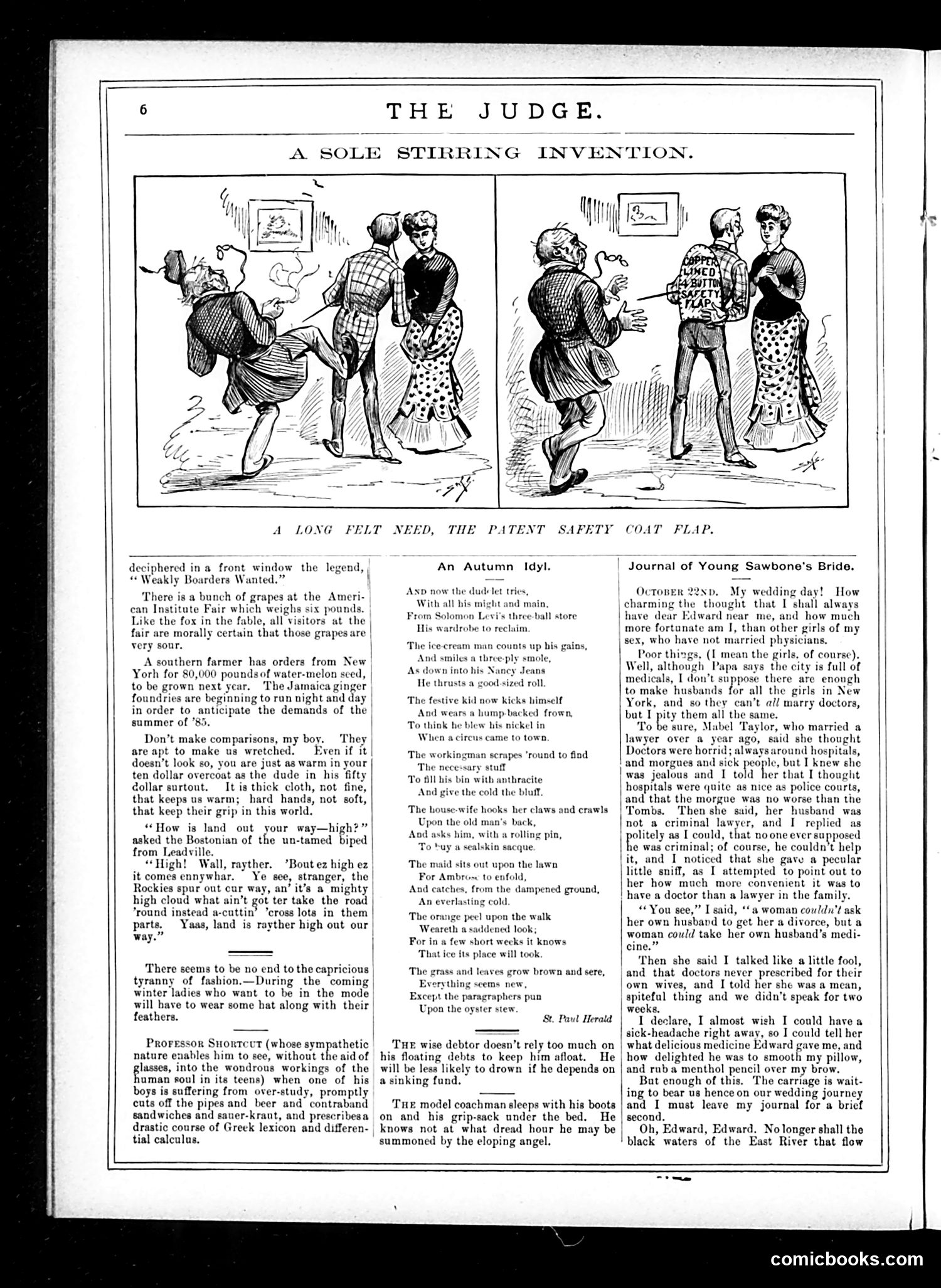
This page contains two cartoon panels (top) depicting "A Long Felt Need, The Patent Safety Coat Flap" — appearing to mock an absurd invented solution to some trivial problem. The left panel shows someone demonstrating this contraption; the right shows its apparent use or failure. The satire likely targets the era's obsession with patents and mechanical "improvements" for everyday annoyances. The accompanying text consists of miscellaneous short humor pieces typical of Judge's format: light social commentary on fashion, farming, weather, and manners. Notable items include jokes about southern watermelon seeds, the tyranny of fashion (women's feathers), and a professor's harsh academic remedies for overworked students. The "Journal of Young Sawbone's Bride" column satirizes a newlywed physician's wife, presumably naive and snobbish about her husband's profession compared to lawyers' wives. The overall page reflects 1880s middle-class anxieties and foibles through genteel mockery.
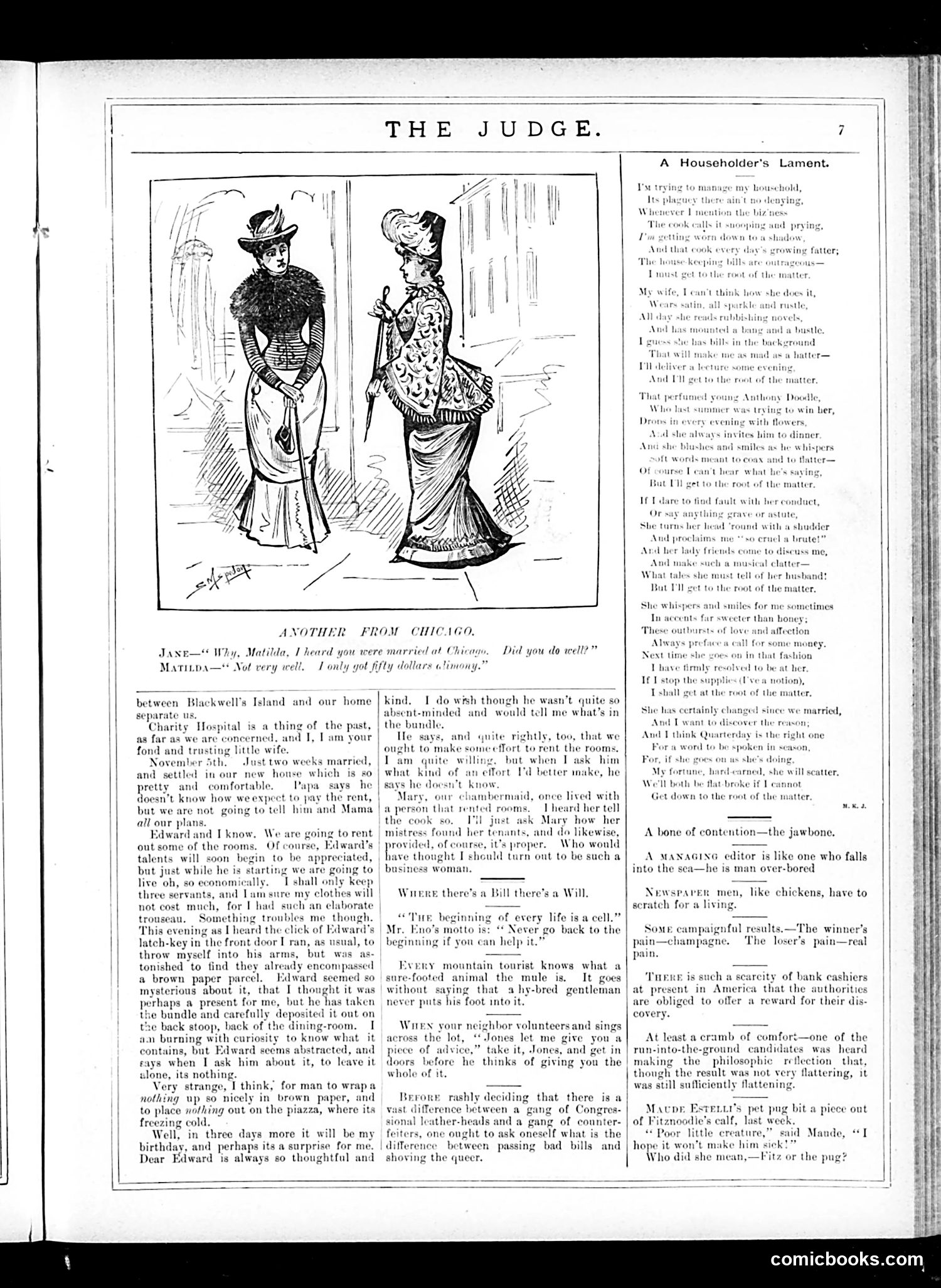
This satirical page contains social commentary presented through letters and brief anecdotes typical of Judge's humor. **"Another from Chicago"** depicts a newlywed couple's domestic financial strain. A wife writes about her new husband Edward mysteriously hiding a brown paper package, which she suspects is a birthday surprise. The satire targets the pretensions of young married couples trying to maintain appearances—they've rented out rooms to pay rent and hired servants they can't afford—while managing household finances poorly. The humor lies in the wife's anxiety over the mysterious package and Edward's refusal to explain it. **Supporting anecdotes** mock various social types: managing editors who are "over-bored," the scarcity of honest bank cashiers (suggesting corruption), and absurd advice about neighbors and mules. **"A Householder's Lament"** (the poem on the right) complains about a wife's domestic incompetence—she reads novels, can't manage the household, and dismisses her husband's concerns. The satire critiques both marriage dynamics and women's domestic roles during this era. The overall tone reflects turn-of-century middle-class anxieties about money, marriage, and social propriety.
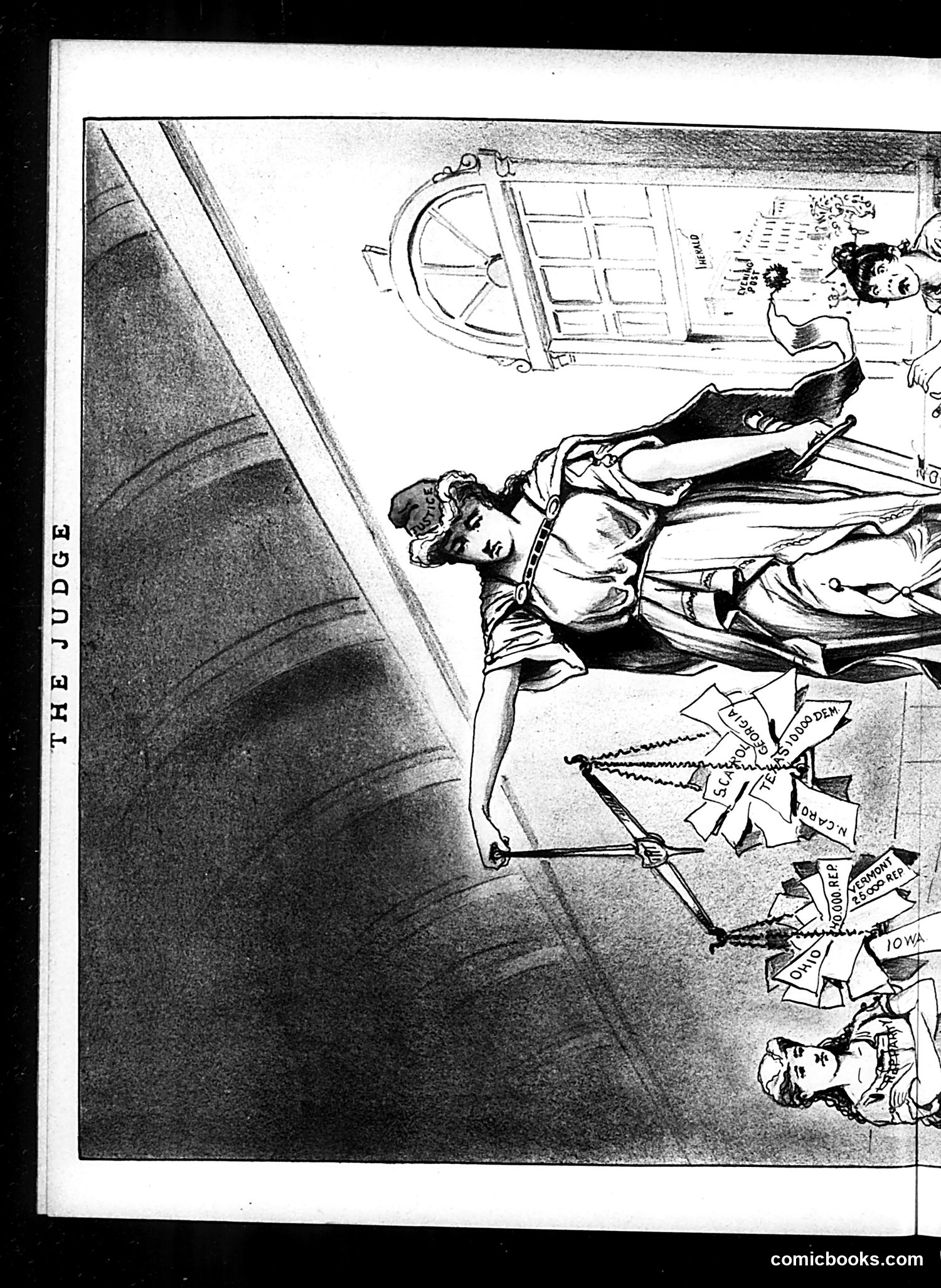
This page from *Judge* magazine features a political cartoon titled "The Judge" showing a female figure (likely representing Justice or the American legal system) seated and presiding over a map of the United States. Various state labels are visible scattered below her, including references to Ohio and Iowa. The cartoon appears to critique judicial authority or interstate legal matters, though the specific OCR'd text is too fragmented to identify the precise satirical target. The allegorical female figure and her positioning above the state map suggest commentary on federal versus state power or a particular Supreme Court decision affecting multiple states. Without clearer text or date information, the exact political controversy being lampooned remains unclear.
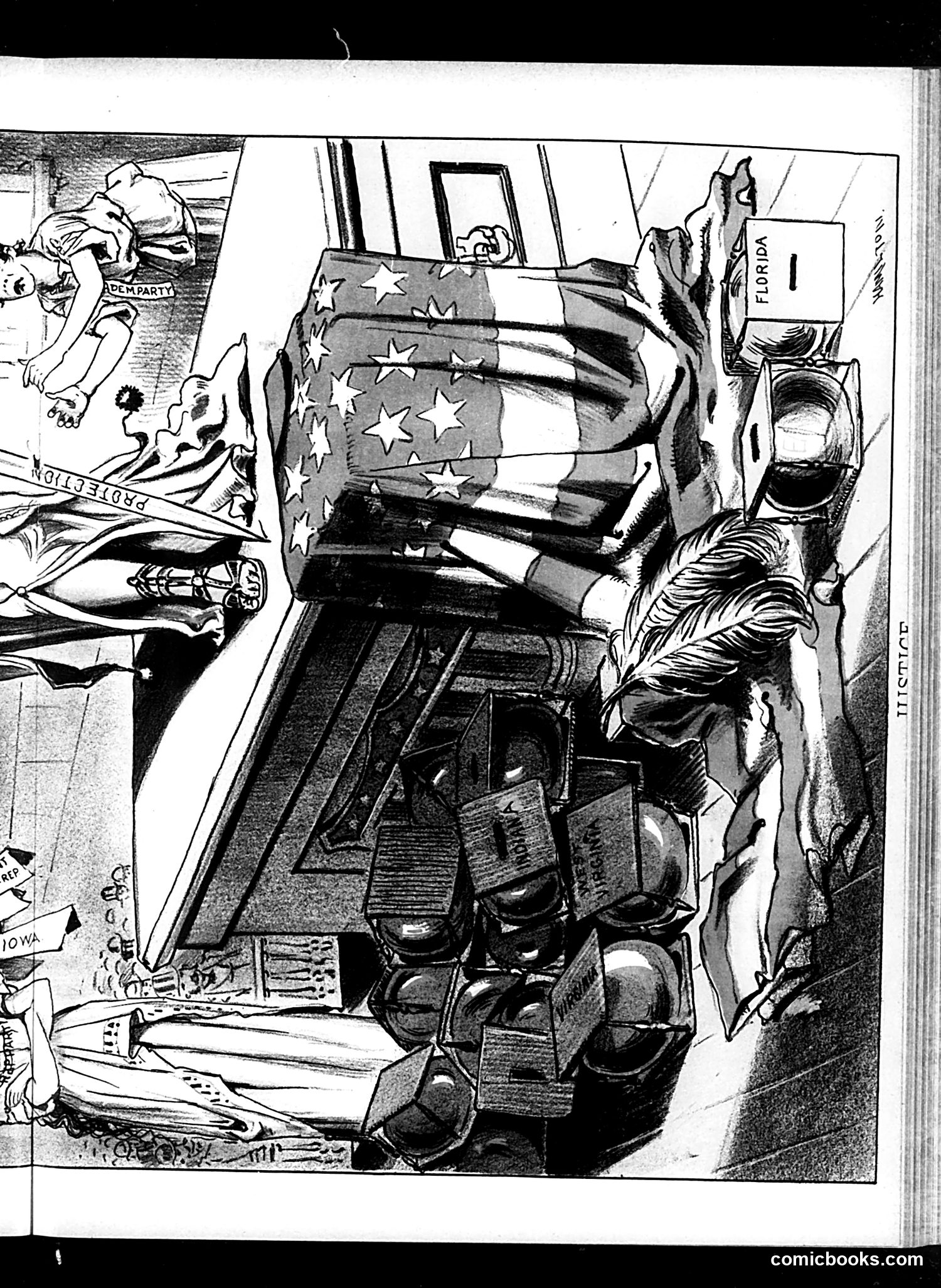
This Judge magazine cartoon appears to depict the American flag being crushed or weighed down by multiple large bombs or explosive devices. On the right side, an eagle (symbol of America) appears distressed or struggling. The composition suggests anxiety about military threats or war preparation facing the nation. The text is largely illegible in the OCR, making specific historical context difficult to determine precisely. However, the imagery—combining the flag, eagle, and weaponry—suggests this cartoon critiques either warmongering, military buildup, or foreign threats to American sovereignty. Without clearer dating or text, the exact political event or controversy remains unclear, though the overall message appears skeptical of military escalation or conflict.
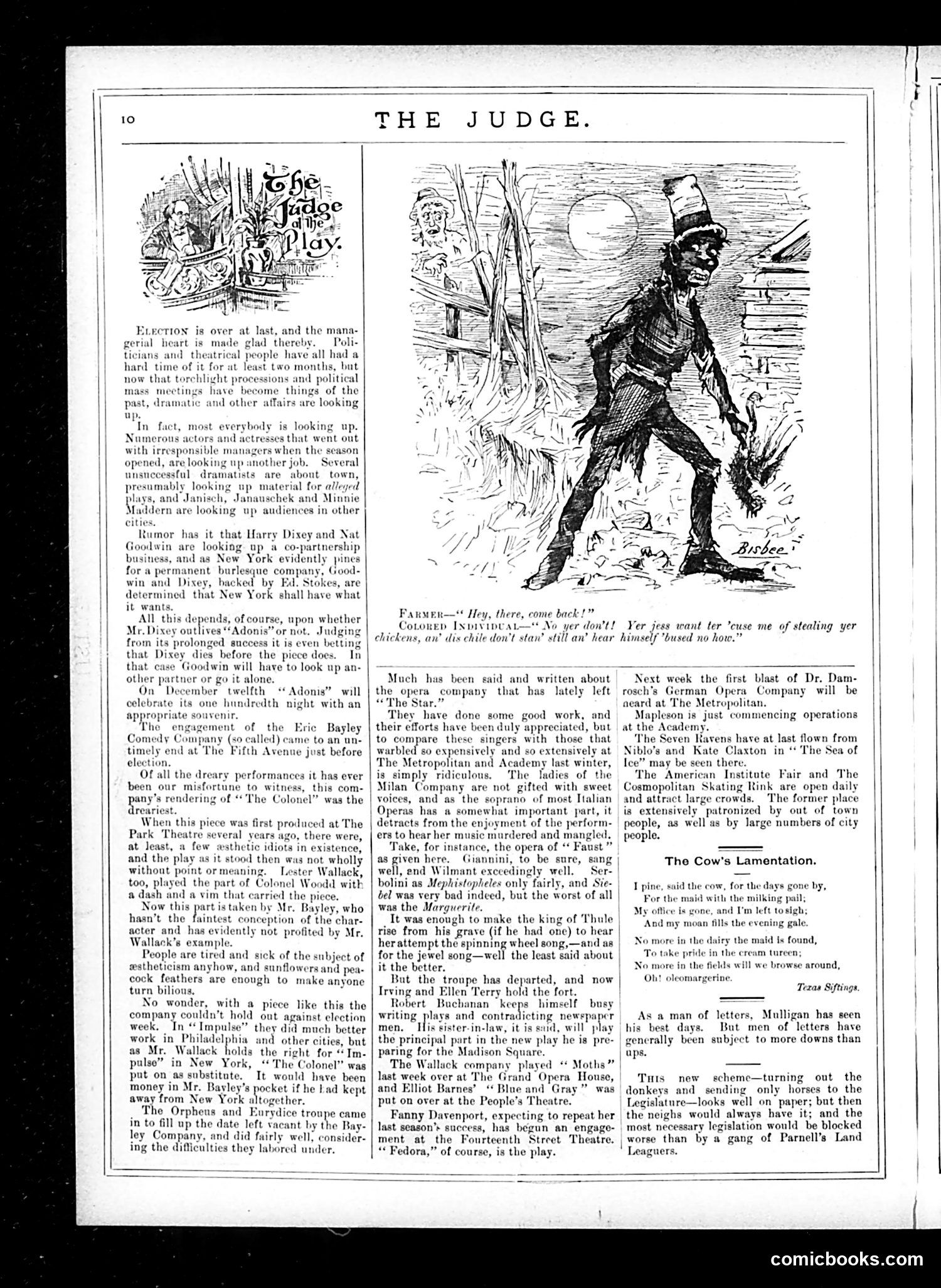
This page from *Judge* satirizes the post-election theater world of the 1880s. The main cartoon depicts a caricatured Black man labeled "Colored Individual," shown in exaggerated stereotypical style typical of period racist imagery. The dialogue parodies dialect humor common to minstrelsy, with the figure protesting about stolen chickens. The surrounding text discusses theatrical matters: the revival of "Adonis" (a burlesque), criticism of an "Aestheticism"-themed play called "The Colonel," and reviews of an opera company performing "Faust." **Key context for modern readers:** This page exemplifies how *Judge* combined political/social commentary with entertainment industry gossip, while openly featuring racist caricature as humor—reflecting the deeply prejudiced attitudes of 1880s American media. The chicken-stealing stereotype represents the dehumanizing racial mockery standard to the era's popular comedy.
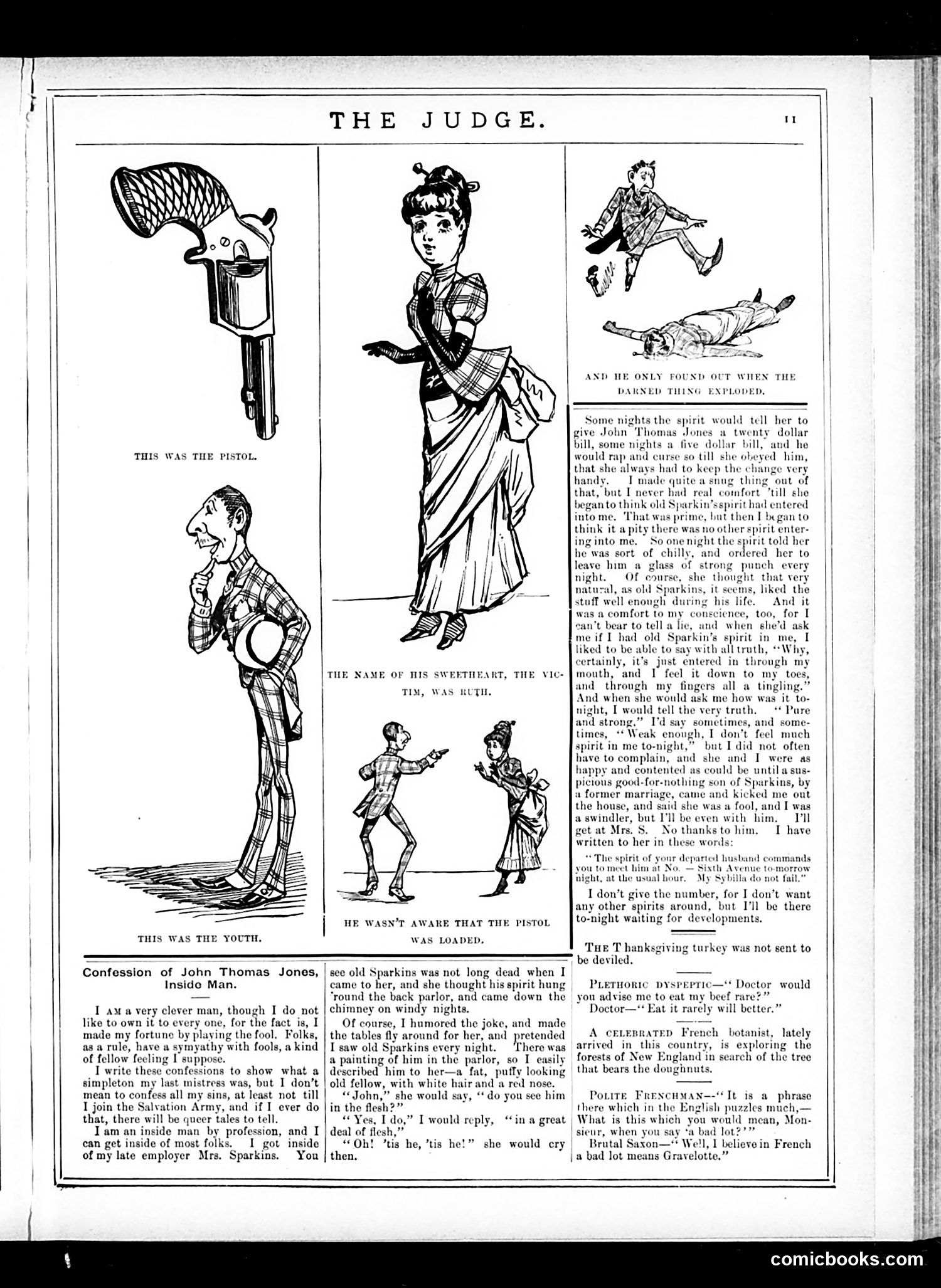
This page from *Judge* contains a serialized confessional story titled "Confession of John Thomas Jones, Inside Man"—a cautionary tale about con artistry and fraud. **The Plot:** A con man named Jones exploits a wealthy widow, Mrs. Sparkins, by pretending to channel her dead husband's spirit. He stages supernatural tricks (moving tables, fake apparitions) and convinces her the spirit demands money and alcohol nightly. Jones profits handsomely until Mrs. Sparkins's son from a previous marriage discovers the scheme and expels him. **The Satire:** The story mocks both the gullibility of spiritualism believers (a popular fad in the late 19th century) and the unscrupulous men who exploited them. Jones presents himself as clever, but his con is transparent—he admits to obvious deceptions. **The Illustrations** depict key plot elements: a loaded pistol (suggesting danger ahead), the sweetheart "Ruth," and the youth unaware of peril—foreshadowing disaster. The page also includes humorous brief items satirizing pretentious French visitors and medical quackery.
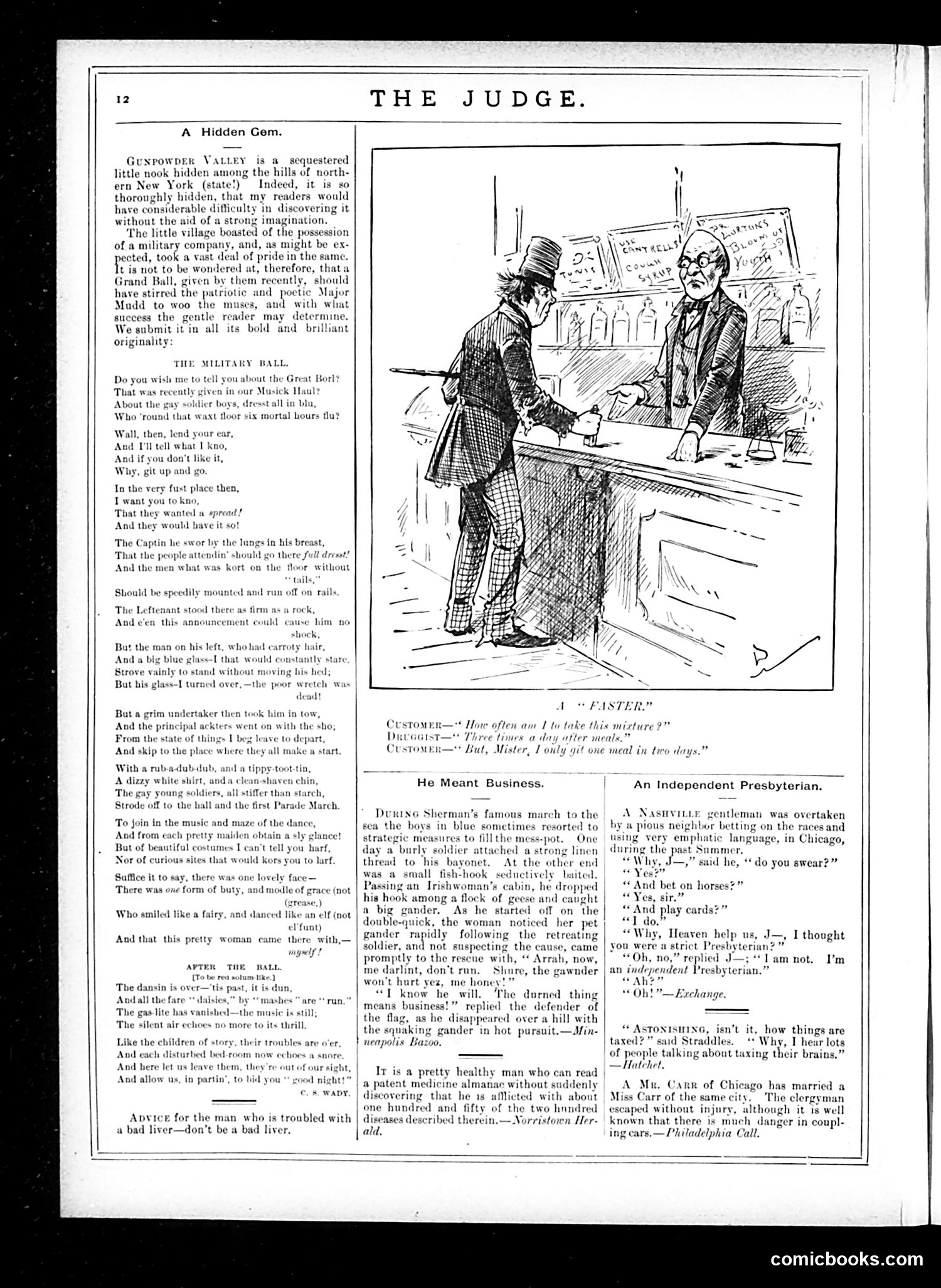
This page from *Judge* magazine contains several unrelated items typical of 19th-century satirical periodicals: **"A Hidden Gem"** features a humorous poem about a military ball in rural upstate New York, mocking the pretensions of a small-town militia company and its grand event. The accompanying sketch shows what appears to be a pharmacist/druggist interaction—likely satirizing excessive formality in everyday transactions. **"He Meant Business"** recounts an anecdote from Sherman's Civil War march to the sea, where a Union soldier uses a fishing hook to catch a goose from an Irish woman's cabin. The humor lies in the woman's misunderstanding—she thinks the soldier means harm to the goose, not realizing he's simply stealing it for food. The satire gently mocks both the soldier's deception and the woman's protective naïveté. **"An Independent Presbyterian"** appears to be a brief joke about a clergyman from Chicago, though the complete text is cut off. The overall tone reflects typical 19th-century American humor: gently mocking rural sensibilities, military pretensions, and wartime hardships.
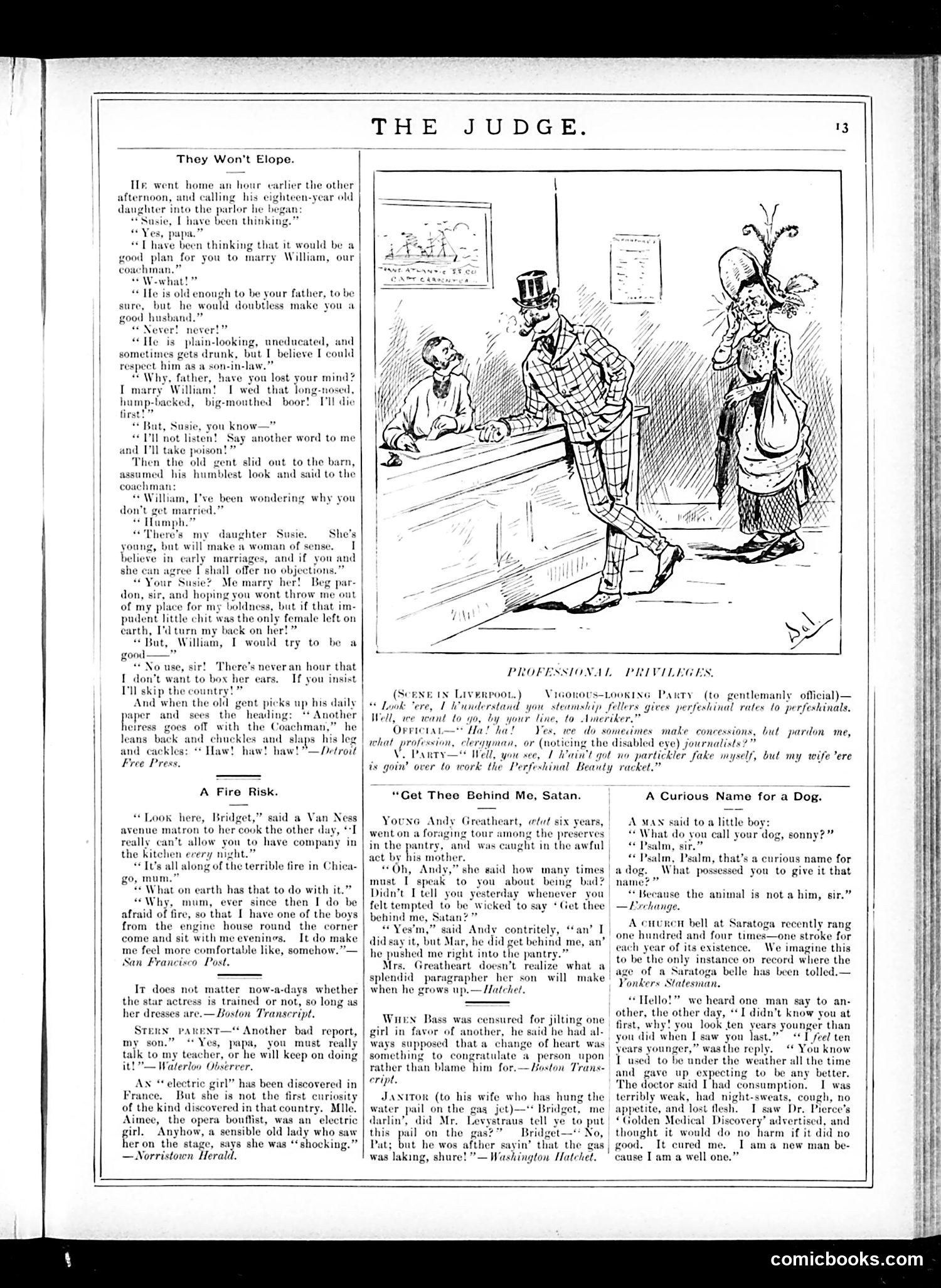
This page contains three satirical pieces typical of late 19th-century American humor: **"They Won't Elope"** (main cartoon): A father proposes his daughter Susie marry William, the coachman, expecting she'll refuse—but she does so vehemently. When he then suggests the same to William, the coachman also violently refuses. The satire mocks class pretensions and the assumption that "lower" classes should be grateful for such "opportunities," while also suggesting both parties are so disagreeable that neither can find willing partners. **"Professional Privileges"**: A shipping official makes concessions to travelers claiming professional status. The joke targets people (particularly women engaged in the "beauty racket") who falsely claim professional credentials to obtain discounts—satirizing both fraud and the era's vague definitions of respectable professions. **"A Curious Name for a Dog"**: A boy names his dog "Psalm" because it "got thee behind me"—a pun on the biblical phrase, with the dog literally pushing the child. Simple wordplay humor typical of the era. These reflect Judge's focus on domestic situations, class anxiety, and pun-based comedy.
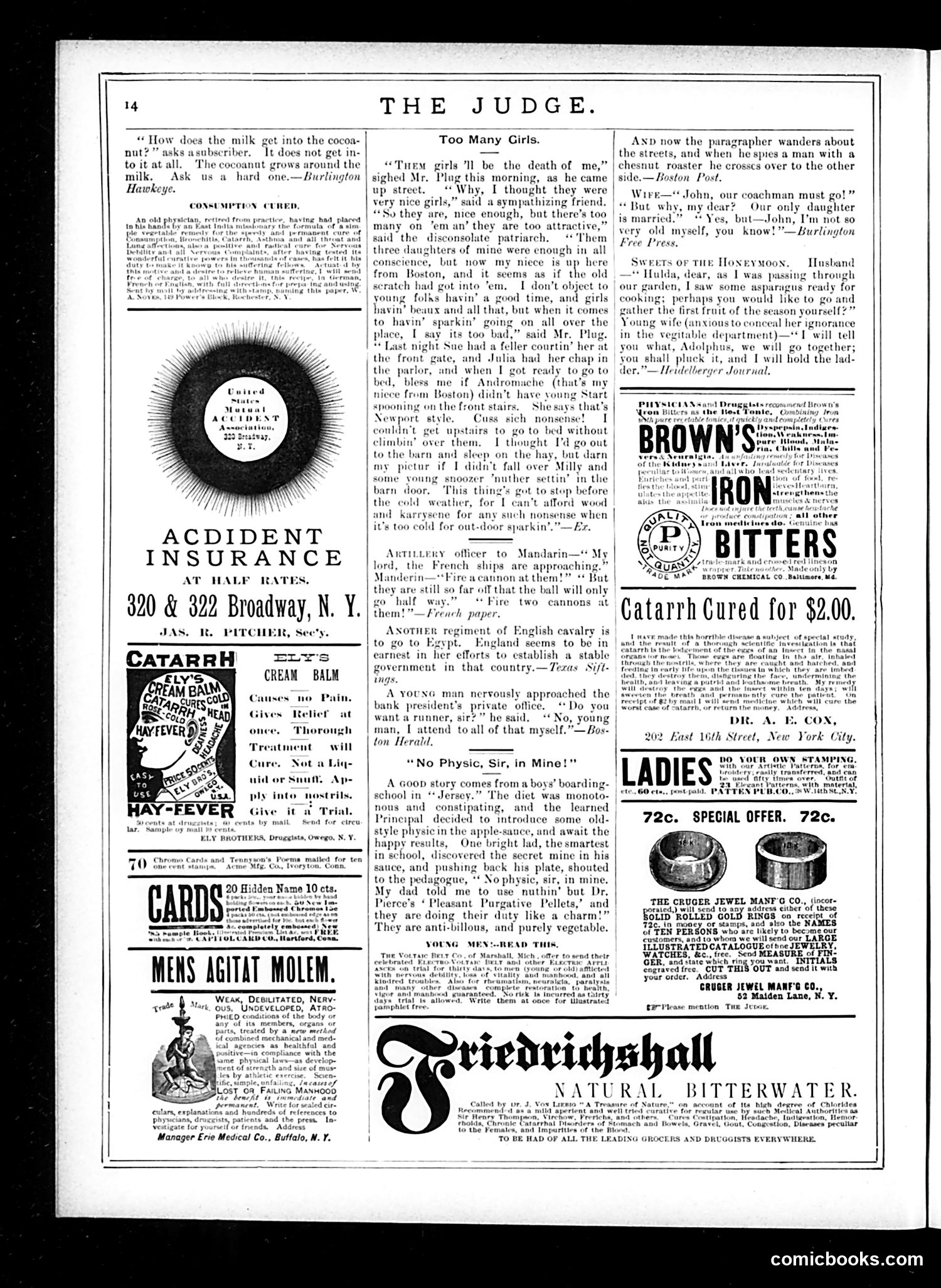
This page is primarily **advertisements and filler humor** rather than political satire. The main content includes: **"Too Many Girls"** - A domestic humor piece where Mr. Plug complains that too many young women visiting his home (his daughters and niece from Boston) are entertaining suitors simultaneously. The joke relies on Victorian-era anxieties about proper courtship: multiple simultaneous "sparking" (courting) sessions happening in different rooms creates chaos and prevents him from even sleeping. It's gentle social commentary on changing courtship customs, particularly the more relaxed Boston style versus traditional propriety. **Minor anecdotes** include jokes about French military incompetence in Egypt, a schoolboy discovering a physics dose hidden in apple sauce, and marital humor about servants and vegetables. **The page is dominated by patent medicine advertisements** (Ely's Cream Balm, catarrh cures, etc.) typical of the era, plus ads for insurance and jewelry. These carry no political content—they reflect standard late-19th-century advertising practices in American magazines. No identifiable political figures or events appear on this page.
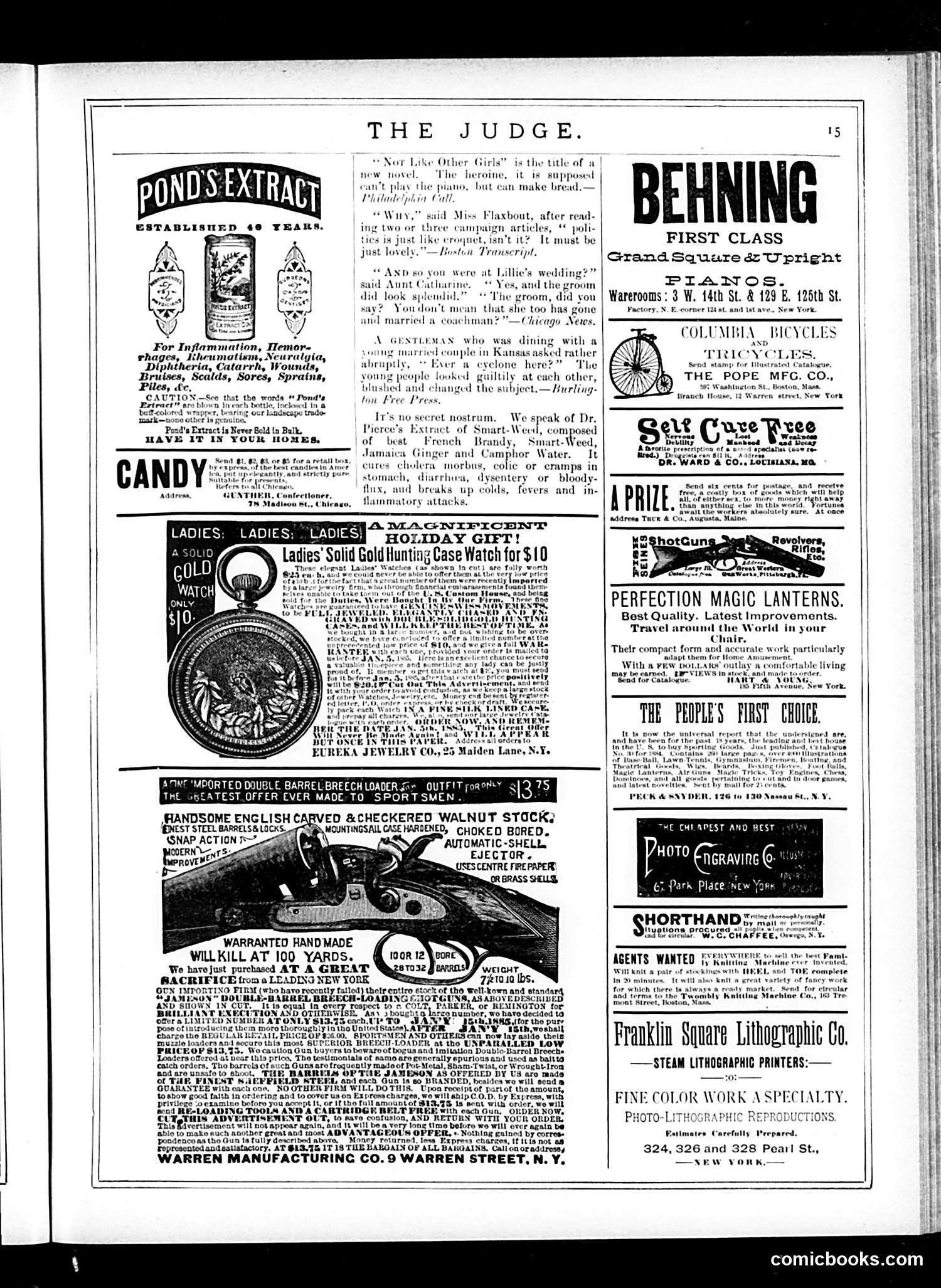
This page is primarily **advertising**, with minimal editorial content. The few brief joke items scattered among ads are typical of Judge's satirical humor: **The jokes** appear to mock contemporary social conventions: - A reference to "Not Like Other Girls" (a novel) jokes about women's domestic limitations - Political commentary comparing campaign politics to croquet - Social humor about wedding guests and Kansas propriety - A doctor's patent remedy advertisement (Pierce's Extract) **The substantial content** consists of product advertisements: Pond's Extract (medicinal), candy, a ladies' gold hunting case watch, a breech-loading rifle ("Will Kill at 100 Yards"), and various pianos, bicycles, and printing services. The rifle ad is notably elaborate and detailed. **For modern readers:** This reflects late-19th-century consumer culture and Judge's model of supporting satire through advertising revenue. The sparse jokes suggest the magazine balanced social commentary with commercial interests. The prominence of patent medicines and firearms ads reflects the era's unregulated marketing practices. The page contains no identifiable political cartoons or caricatured figures.
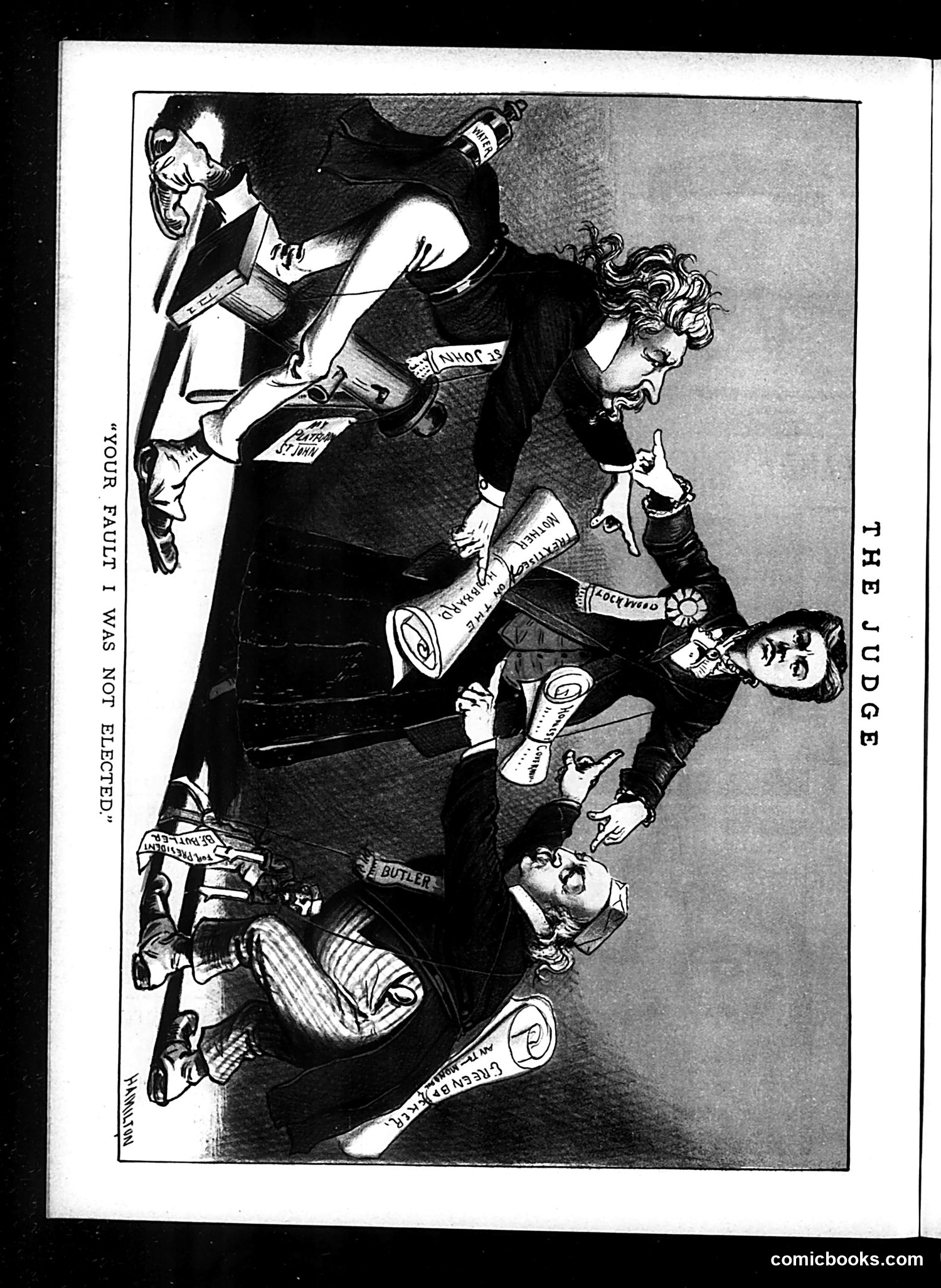
This satirical cartoon titled **"The Judge"** depicts a judicial figure wielding a large gavel/hammer, striking down multiple figures labeled with what appear to be corrupt or undesirable practices. The figures being struck seem to represent various social vices or illegal activities—visible labels suggest references to bootlegging, gambling, or other Prohibition-era crimes. The satire appears to criticize either the judicial system's effectiveness (or ineffectiveness) in addressing widespread corruption during Prohibition, or conversely, celebrates aggressive legal enforcement. The cartoon's composition—with the judge as a dominant, powerful force crushing wrongdoing—suggests commentary on American justice and reform efforts of the early 20th century. The poor OCR quality prevents precise identification of all labeled targets, limiting definitive interpretation of specific references.